Sunday, May 10, 2020

France's No-Go Zones: The Riots Return - Guy Millière


by Guy Millière

The dangerous shadow civilization in France continues to reign

  • A few months ago, a police officer, Noam Anouar, who infiltrated Islamist circles... stated that no-go zones in France are now foreign enclaves on French territory. "The gangs operating there," he wrote, "have formed a parallel economy based on drug trafficking. They consider themselves at war with France and with Western civilization. They act in cooperation with Islamist organizations, and define acts of predation and rampage as raids against infidels". He noted that reclaiming these areas today would be complicated, costly, and involve calling in the army.
  • For years, successive French governments have chosen a policy of "willful blindness": they simply behave as if they do not see what is going on. They do not even try to find solutions.
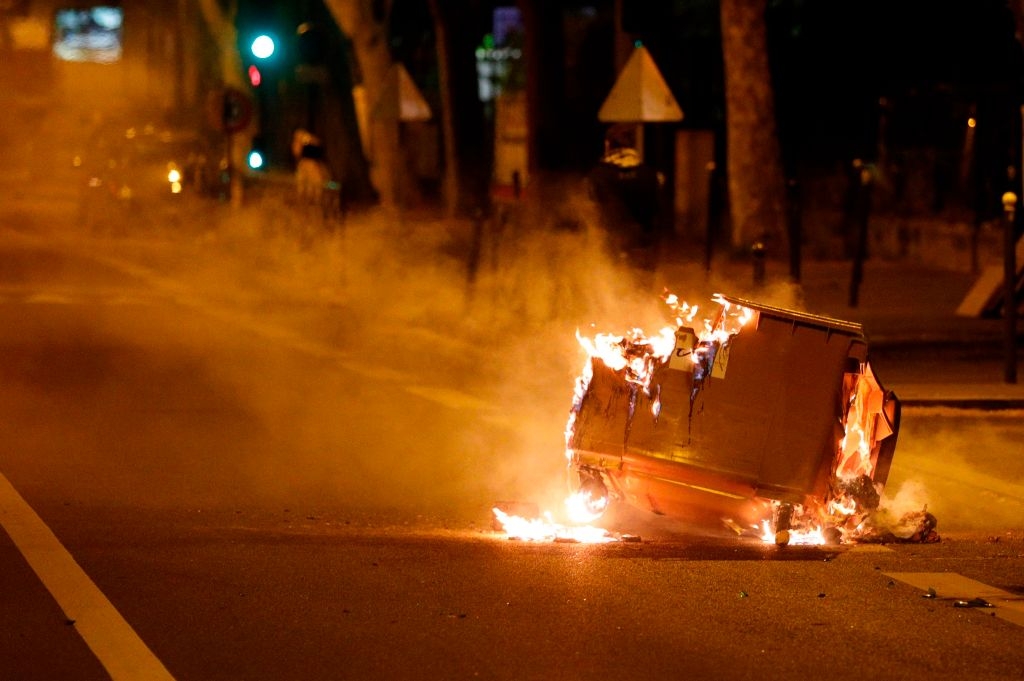
While France's general population remains under strict lockdown due to the coronavirus pandemic and police have been ordered to enforce the rules ruthlessly, people living in no-go zones are treated differently. Police officers have been told by the government not to stop them at all and to avoid going near where they live. Pictured: A garbage dumpster burns in the street during a riot in Villeneuve-la-Garenne, in the northern suburbs of Paris, on April 21, 2020. (Photo by Geoffroy van der Hasselt/AFP via Getty Images)

Saturday, April 18, 11 pm. Villeneuve-la-Garenne, a small town in the northern suburbs of Paris. A young man rides a motorcycle at high speed and hits the door of a police car. He breaks his leg. He is sent to the hospital. He does not have a driver's license but does have a long criminal history. He was sentenced several times by the courts for drug trafficking, robbery with violence and sexual assault.

As soon as news of the accident is released, hostile messages about the police circulate on social media; and in a dozen cities in France, riots break out. The riots are continue for five days in a row. A police station in Strasbourg is attacked and set on fire. A school is nearly destroyed a few miles from Villeneuve-la-Garenne.

Rather than responding with firm language, the French government is saying that an investigation into the behavior of the police has been opened and that the officers will most likely be punished.

The coronavirus pandemic, which struck France hard, has been aggravating the serious problems already plaguing the country.

France's general population remains under extremely strict lockdown; the police have been ordered to enforce the rules ruthlessly. Permits to leave one's home were limited to 60 minutes, once a day, and no farther than half a mile. On Aril 23, Minister of the Interior Christophe Castaner said, "Since the start of the lockdown, more than 915,000 citations have been handed out; 15.5 million persons have been stopped and checked". The citations, according to newspapers, were given to people who stayed outside for more than an hour, or who went beyond the authorized limits.

People living in no-go zones [zones-urbaines-sensibles "sensitive urban zones"] are treated differently. Police officers have been told by the government not to stop them at all and to avoid as much as possible going near where they live.

Yves Lefebvre, president of a police union, remarked:
"The government knows that a large-scale uprising could happen, and that a minor incident might be enough to set the powder keg ablaze. Therefore, police officers have unwritten instructions: they must avoid incidents at all costs. If an incident occurs, they know that the government will blame the police, and no one else".
"The choice of the government is easy to explain," he said. "The police would not have the materiel or the manpower to calm a large uprising". He compared the current condition to riots in October 2005, and added that the situation in France today is quite different.

The situation in France today is quite different. It is worse.

In 2005, no-go zones existed, but they were not numerous -- fewer than a hundred -- and were located in the suburbs of the largest cities in the country. The police could still enter them; gangs and radical Islamist imams did not yet control them. Today, there are more than 750 no-go zones in France, and police enter them only by carefully preparing commando-like operations beforehand. Gangs and radical imams seem totally in control.

In 2005, the riots had begun with the death of two young men. They had been trying to escape from the police and taken refuge in an electric-power substation where unfortunately they were electrocuted. Today, a simple traffic accident involving the police can lead to nights of destruction and looting.

In 2005, the police tried to quell the riots, unsuccessfully. For three weeks, the country seemed on the verge of a civil war. Today, because members of the government seem to believe that if riots occur, a civil war really could happen, the police are asked not to intervene and to stand aside until the destruction stops. In July 2018, riots lasting almost a week broke out in Nantes. While the public library and other buildings burned down, the police remained invisible. Eight months later, in March 2019, when riots lasting three days broke out in Grenoble and hundreds of shops and cars were totally destroyed, the police again remained invisible.

In 2005, the people living in no-go zones were hostile to France. Today, their hostility has increased.

A few months ago, a police officer, Noam Anouar, who infiltrated Islamist circles, published a book, France Must Know. No-go zones in France, he wrote, are now foreign enclaves on French territory. "The gangs operating there," he noted, "have formed a parallel economy based on drug trafficking."
"They consider themselves at war with France and with Western civilization. They act in cooperation with Islamist organizations, and define acts of predation and rampage as raids against infidels".
Anouar concluded that reclaiming these areas today would be complicated, costly, and involve calling in the army.

For years, successive French governments have chosen a policy of "willful blindness": they simply behave as if they do not see what is going on. They do not even try to find solutions.

The jihadist attacks of 2015 seemed to be a wake-up call, indicating that maybe an emergency response could be required. A massacre at the headquarters of the satiric magazine Charlie Hebdo on January 7, 2015 was a huge shock. The incident led to a demonstration of more than a million people in Paris. Ten months later, on November 13, a mass shooting at the Bataclan Theater , where 89 people were murdered and dozens injured -- and 86 people murdered by a truck-ramming in Nice on July 14, 2016 -- were equally huge shocks, but did not lead to any responses. Soldiers were simply dispatched to patrol the streets and stand guard in front of public buildings, churches and synagogues.

Since then, there seems to have been a choice by the government to define terrorist attacks as "inexplicable" and committed by people who were "depressed". The no-go zones were treated as time bombs that would eventually explode, but with the explosion delayed a few years.

Currently, exempting the no-go zones from a lockdown appears to be one way the government implicitly admits that they are no longer a part of French territory, but tries to maintain a precarious coexistence with them.

The riots of April 18 were not supposed to happen. They happened anyhow.

The government seems to hope that calm will return, but appears afraid of any more riots. When Ramadan began April 24, the police were ordered, despite the lockdown, to let Muslims gather to celebrate every evening wherever they wished.

Linda Kebbab, a Muslim police officer, strongly expressed her disagreement. This decision, she said, "causes a feeling of discrimination towards Christians and Jews who celebrated Lent and then Easter or Passover according to the rules of lockdown".
"In addition to dangerously encouraging breaking the French pact of equality before the law, this decision asks the police to bow down to those for whom Ramadan is an excuse to disturb public tranquility. It is a very bad service to law-abiding Muslims"
On April 13, French President Emmanuel Macron promised that the country's lockdown would at least partially end on May 11, even though he is aware that the end of the lockdown means going back to problems. A public transport strike, for instance, had lasted until the pandemic broke out. Unions have been calling for strikes as soon as possible. The polls already in January had indicated that the French were furious with the government. The lockdown, however, had to end at some point. The risk of riots is simply one more problem.

The fear of death from the Wuhan coronavirus had prompted the general population to accept the lockdown, the inspections and the citations.

Every evening since March 18, France's director general of health, Jerome Salomon, has been announcing on television in a dismal tone the number of each day's Covid-19 deaths. He never forgets to say that "the United States is the country most affected by the pandemic", and then gives the number of deaths in America, while "forgetting" to add that the population of France is five times less than that of the U.S. As of May 10, France has suffered 403 Covid-19 deaths per million inhabitants. Only four countries have records that are sadder: Belgium, Spain, Italy and the United Kingdom.

The French government could be expecting criticism for its appalling management of the pandemic. As of late April, most doctors still did not have protective face-masks, and screening tests were still virtually absent. Doctors have lost the right to decide what medicine to prescribe and are forbidden to see patients in person. They can only recommend using acetaminophen or aspirin to whoever calls on the phone.

People who have the symptoms for Covid-19 are asked to remain at home without medication; if their condition worsens, they may call an ambulance. If they are over 70 years old, however, an ambulance will not come. A decree from March 19 asked hospitals strictly to limit access to people defined as "too old". The number of deaths in retirement homes is horrendously high.

More than half of those working in the private sector are now unemployed. Thousands of small businesses in multiple sectors are now bankrupt and not able to reopen.

"The feeling of decay that permeates the minds of many French today comes from a truth that few wanted to admit," wrote a historian, Pierre Vermeren, in Le Figaro. "France is a fallen country..."

Laurent "Riss" Sourisseau, a survivor of the 2015 jihadist attack on Charlie Hebdo, and now its editor-in-chief, noted:
"France is living hours of disillusionment as deep as those it had known in May 1940... Before our eyes, everything collapsed at an unimaginable speed... We will have to ask a question: why such a disaster... how was this possible. And the present catastrophe inevitably brings us to the same conclusions: incompetence, disorganization, lack of long-term vision, improvisation. In summary: the nullity of our leaders."
"Two months of lockdown," the author Éric Zemmour said on CNews TV, "will lead to an unprecedented economic crisis and probably to a very serious explosion of violence: it is high time to face reality: France is on the brink of chaos".

Dr. Guy Millière, a professor at the University of Paris, is the author of 27 books on France and Europe.

Source: https://www.gatestoneinstitute.org/15977/france-no-go-zones-riots

Follow Middle East and Terrorism on Twitter


Italy: China's Trojan Horse into Europe - Giulio Meotti


by Giulio Meotti

Chinese leaders "believe they have a narrow window of strategic opportunity to strengthen their rule and revise the international order in their favor". — Former U.S. National Security Advisor H. R. McMaster

  • Chinese leaders "believe they have a narrow window of strategic opportunity to strengthen their rule and revise the international order in their favor". — Former U.S. National Security Advisor H. R. McMaster, Battlegrounds: The Fight to Defend the Free World.
  • "Europe has now become the buffer zone for the confrontation between China and the United States". — Pierre-Henri d'Argenson, Le Figaro, April 28, 2020.
  • Now, China is trying to dominate southern Europe's infrastructure. China was already granted a license to run Greece's largest seaport, Athens' Piraeus harbor, which Beijing plans to turn into Europe's biggest commercial harbor. Then China started to project its expansion in Italy's ports, where four major ports are also in line for Chinese investments.
  • The People's Bank of China... "has steadily amassed stakes above 2 percent (the disclosure threshold in Italy) in a slew of Italy's largest shareholder-owned companies" China has also invested in strategic Italian energy entities....
  • This economic penetration will also have immense security consequences... Italy, which is being lured by the promise of a $3 billion Huawei investment in its telecommunications system, announced that it has no plans to stop Chinese telecom firms playing a role in the country's future 5G network. It is a project that U.S. Attorney General William P. Barr defined a "monumental danger".
  • Italy will see a collapse of its GDP and the explosion of its public debt... the highest since World War II. Beijing knows this and claims that "Italy has many economic problems, Europe is in crisis and the Belt and Road Initiative is the only major global investment plan".

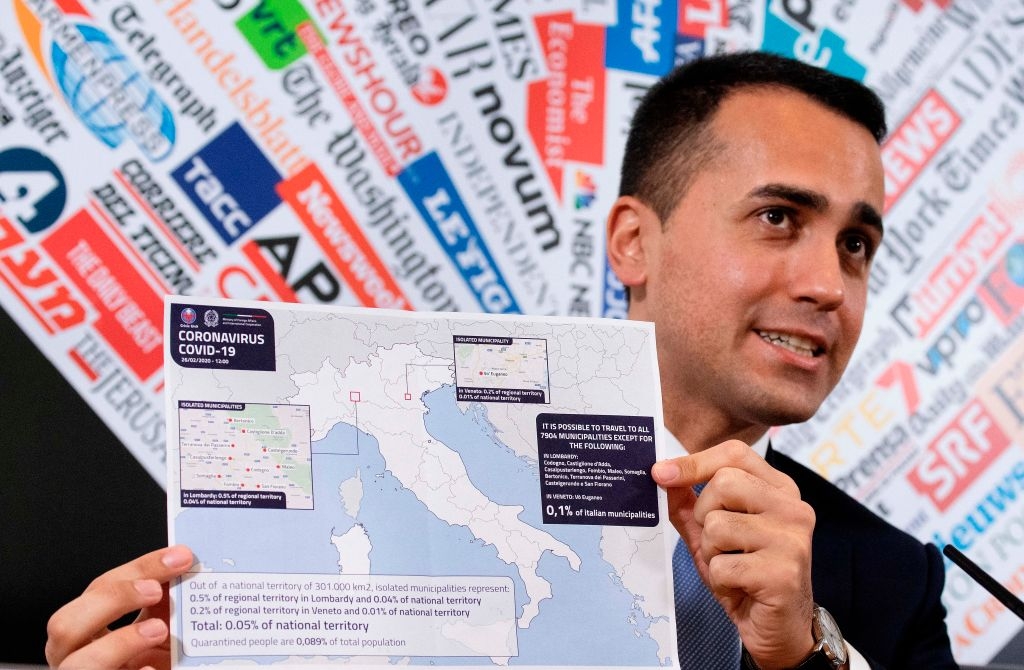
Italy's foreign minister, Luigi Di Maio, welcomed a plane-load of Chinese medical supplies on March 12. "We will remember those who were close to us in this difficult period", Di Maio said. It is not necessary, China will remind them. Pictured: Di Maio shows a map of quarantined Italian municipalities as he gives a press conference in Rome, on February 27, 2020. (Photo by Tiziana Fabi/AFP via Getty Images)

A few days after China had announced it was sending medical supplies to Italy, Chinese state media aired pictures of Italians on balconies and streets applauding the Chinese national anthem. "In Rome, with the Chinese anthem playing, some Italians chanted 'Grazie, Cina!' on their balconies, & their neighbors applauded along", wrote Zhao Lijian, the spokesman for China's foreign ministry who shamefully and wrongly suggested that the U.S. military had brought the Covid-19 to Wuhan.

China presented itself in the role of the savior, willing to rush to the bedside of the sick patient Italy.

Now a Financial Times investigation reveals that those videos were manipulated as part of Beijing's coronavirus propaganda. Hashtags #ThanksChina and #GoChina&Italy were further generated by bots. A report by the Carnegie Endowment called Italy "a target destination for China's propaganda".

An article called, "Why the Covid-19 epidemic is so politicized" and posted on the Chinese embassy website in Paris, said, "Some Westerners are beginning to lose confidence in liberal democracy" and "some [Western countries] have become psychologically weak".

Antoine Bondaz, a researcher at France's Foundation for Strategic Research, told Politico:
"China considers Europe the soft belly of the West. In their logic, there is the West, and in it the U.S. that will oppose China for structural and ideological reasons, and their European allies that need to be neutral in case of conflict between China and the U.S."
According to Lt. Gen. (ret.) H.R. McMaster, President Donald Trump's former national security adviser, in his new book Battlegrounds: The Fight to Defend the Free World, Chinese leaders "believe they have a narrow window of strategic opportunity to strengthen their rule and revise the international order in their favor".

There is now a huge risk that Italy is becoming "China's Trojan horse into Europe".

A leading French official, Pierre-Henri d'Argenson, wrote in Le Figaro that "Europe has now become the buffer zone for the confrontation between China and the United States". Beijing chose Italy as its soft belly in Europe and is following its script.

In April 2019, the Italian government of Prime Minister Giuseppe Conte was the first G7 country to sign a Memorandum of Understanding on China's "Belt and Road Initiative" during a state visit by President Xi Jinping. According to an analysis by The Economist, the Chinese Belt and Road plan could surpass the Marshall Plan, by which the US revived Europe's war ravaged economies.

Italy has a government coalition led by the Five Star Movement, an extremely pro-Chinese party, whose founder Beppe Grillo has been spotted frequently at the Chinese embassy in Rome. As the European Council on Foreign Relations reported, "in Italy business and political lobbies for China have been on the rise". The former PM Matteo Renzi has visited Beijing for conferences.

Five years ago, China National Chemical Corp bought Pirelli, a 143-year-old Italian company, and the world's fifth-largest tire maker. A study published by KPMG before the Pirelli deal revealed Chinese acquisitions in Italy have totaled 10 billion euros in five years (in a total of 13 billion euros investments). A third of foreign purchases in Italy are Chinese. The goal is to turn Italy into "Europe's top destination for highly coveted investment from China".

Now, China is trying to dominate southern Europe's infrastructure. China was already granted a license to run Greece's largest seaport, Athens' Piraeus harbor, which Beijing plans to turn into Europe's biggest commercial harbor. Then China started to project its expansion in Italy's ports, where four major ports are also in line for Chinese investments. Zeno D'Agostino, the president of Trieste's northern port, says that "China is opening because it feels strong".

Italy's political appeasement of China was on display during the fatal early days of the coronavirus crisis.

On January 21, Italy's culture and tourism minister hosted a Chinese delegation for a concert at the National Academy of Santa Cecilia to inaugurate the year of Italy-China Culture and Tourism. Michele Geraci, Italy's former undersecretary for development, was not sure that was his place. "Are we sure we want to do this?", Geraci said looking at his colleagues. "Should we be here today?". A few days later, in many Italian cities, such as Florence and Prato, where there is a Chinese manufacturing stronghold, mayors and local communities promoted the initiative, "hug a Chinese" to fight xenophobia and racism.

In Rome, Italy's President, Sergio Mattarella, visited a school that has a high percentage of Chinese students to counter "discrimination" and Nicola Zingaretti, the leader of the Democratic Party, met the Chinese ambassador in Rome. Meanwhile, Italian televisions organized live tastings of Chinese products. That was Italy's fatal initial mistake: fighting racism instead of the virus, which only a few days later would devastate the country.

China has been able to brainwash Italian public opinion. In a poll published April 17, 50% of Italians consider China a "friend" (just 17% of Italians think as much of the United States). And in the race for the global power to which Italy should be allied China is ahead of the US, 36% to 30%.

Italy's foreign minister, Luigi Di Maio, welcomed a plane-load of Chinese medical supplies on March 12. "We will remember those who were close to us in this difficult period", Di Maio said. It is not necessary, China will remind them.

Walter Ricciardi, an advisor to the World Health Organization (WHO) and the Italian government, tweeted: "Thanks China!".

We know now that while the Chinese regime misled the world about the contagiousness of Covid-19, it stockpiled medical supplies. As the editor of the German BILD wrote in a letter to Chinese president Xi:
"I suppose you consider it a great 'friendship' when you now generously send masks around the world. This isn't friendship, I would call it imperialism hidden behind a smile – a Trojan Horse".
Not a single Italian minister or official blamed China for the cover up of the epidemic or causing witnesses to "disappear".

"For the first time in many years, Western countries united behind the request to China for clarifications on how Covid-19 was born and then spread", Paolo Mieli wrote in a front-page editorial for Italy's largest newspaper, Il Corriere della Sera. Mieli mentioned the United States, Australia, United Kingdom, France and Germany.
"Who is missing? Italy, the only country in the Western world to have welcomed half a million masks sent to us (for a fee) from China with a truly excessive blaze".
The world-renowned Italian textile industry was one of the major victims of a globalization expansion led by Chinese dishonest economic dumping. China is now reducing Italy to a setting to help spread and implement its propaganda and will to power. As Italian analyst Francesco Galietti wrote, Italy is going to become "the target of a Chinese 'charm offensive', a combination of hard cash and 'soft power', money and influence". He notes as an example the People's Bank of China:
"It has steadily amassed stakes above 2 percent (the disclosure threshold in Italy) in a slew of Italy's largest shareholder-owned companies, including FCA (the Fiat Chrysler group), Telecom Italia, and Generali Group, Italy's largest insurer".
China has also invested in strategic Italian energy entities such as Eni and Enel and Italian oil services group Saipem.

This economic penetration will also have immense security consequences. During the first days of the Covid-19 epidemic, Italy, which is being lured by the promise of a $3 billion Huawei investment in its telecommunications system, announced that it has no plans to stop Chinese telecom firms playing a role in the country's future 5G network. It is a project that US Attorney General William P. Barr defined a "monumental danger".

"The geopolitical effects of the pandemic could be significant," said NATO Secretary-General Jens Stoltenberg. "Some allies (are) more vulnerable for situations where critical infrastructure can be sold out" in a Chinese "buying spree". US Secretary of Defense Mark Esper has also warned that China will exploit the virus "to further their own interests and try to sow division in the Alliance and in Europe".

Italy is most vulnerable to this Chinese offensive. It is one of the most indebted countries in the world and has an economic growth close to zero. It is also one of Europe's most unstable and fragile governments and had one of Europe's highest coronavirus death tolls -- an experience that an Italian nurse compared to a "world war".

Italy is now Europe's sick man. Due to the Chinese coronavirus crisis, the country will see a collapse of its GDP (-9.5%) and the explosion of its public debt which is set to 160% of gross domestic product -- the highest since World War II. Beijing knows this and claims that "Italy has many economic problems, Europe is in crisis and the Belt and Road Initiative is the only major global investment plan".

"The possibility that Europe will become a museum or a cultural amusement park for the nouveau riche of globalization is not completely out of the question", said the late historian Walter Laqueur. Rome's dramatic fall could mean Beijing's equally dramatic rise. It is a huge warning for the West.


Giulio Meotti, Cultural Editor for Il Foglio, is an Italian journalist and author.

Source: https://www.gatestoneinstitute.org/15999/italy-china-trojan-horse

Follow Middle East and Terrorism on Twitter


British Jews should stop attacking Netanyahu - Ed Husain


by Ed Husain

Hat tip: Sefton Bergson

We need to acknowledge the reality of the Middle East, argues Ed Husain


Ed Husain
Ed Husain 

[Editor's note: While it is very refreshing and encouraging to see a burgeoning openness in Muslim-Jewish relations, it is appropriate for Jews to retain a certain degree of skepticism in light of the anti-Semitic intrinsic to the Quran and in light of historical enmity, which the author chooses to downplay. That said, it also behooves us to keep the door - and our eyes - open.]
 

Israel is under attack again.

Not from the usual suspects of Hamas, or Iran, the Muslim Brotherhood, or Jeremy Corbyn but, this time, from sections of Britain’s Jewish community who are missing the bigger picture.

I am not Jewish but a Muslim who wants to see long-lasting, real peace between Israel and her Arab allies. That is not a naïve dream, but a reality being shaped today by many Arabs and Muslims across the Middle East

Attacking Israel is not only about Hamas lobbing rockets, sending terrified families into bunkers. Long-lasting damage to Israel is done by the political rhetoric of the Corbynite left, the Muslim Brotherhood and Iran’s other proxies against Israel’s very legitimacy. The intended end-result of that rhetoric is a weakened, isolated Israel, boycotted and sanctioned by the world, which will then be on its knees, with its borders reshaped and Jews again expelled from the Middle East.

The latest uproar is about Israel annexing the West Bank in the coming months -- that somehow the British government must act to stop this ‘violation of international law’.

No. The British government must not act and British Jews should take a broader view, reverse out from the cul-de-sac of Bibi bashing and understand the new developments taking shape across the Middle East’s motorways of new ideas.

I have never met Bibi Netanyahu. The future of Israel in a modernised, moderate Middle East is not about Netanyahu. Since publication of my first book, The Islamist, in 2007, and the founding of Quilliam in 2008, I have been involved in various ways in undoing the damage done by political Islamists to my religion but also to Muslim-majority regions of the world.

In my latest book, The House of Islam: A Global History (2018), I explain how across a millennium, Muslims and Jews lived together, generally, in peace and harmony. The Quran is a continuation of the narrative of the prophets of ancient Israel: one God, family, justice and charity. When the prophet Mohamed declared his ummah (community) in Medina in 622, Jews were explicitly part of that ummah. The second caliph, Omar, invited Jews to return to Jerusalem in 636 after five centuries of Roman expulsion.

Why? Because early Muslims, trained by Mohamed, recognized that Jews were from Judea and Jerusalem was their city. Muslims and Jews, together as brothers of the same father, Abraham, suffered at the hands of the medieval Crusades and then again when the Spanish Inquisition sought blood of Jews and Muslims.

We must not forget that Maimonides wrote in Arabic, learned from Muslim philosophers and was a physician to Saladin. Muslims in France, Turkey, Morocco and the Balkans protected Jews from the Nazis.

Based on that long history of Jews and Muslims living together in co-existence, the desire now to remove the cancer that is the ideology of the Muslim Brotherhood and the Iranian government, there are new cultural, religious, economic and political initiatives from new leaders in the Middle East.

Private polling done by several Arab governments shows that Muslim youth, 32% of the Arab world, aged between 15 and 25 - 100 million people today - are not interested in hatred of Israel and the false glory of the lost wars of 1947, 67, 73, 91. But their middle-aged elders are stuck in an Islamist narrative of conflict, Jihad, Jew hatred and ‘liberating Jerusalem’.

The challenge for political leaders is to close that gap and normalise relations with Israel for a future Middle East that is free from Iran’s and the Muslim Brotherhood’s threatening of Islamist revolutions or rigged elections to topple governments in Saudi Arabia, Bahrain, Egypt, Jordan, Syria, Algeria, and others.

Here is the rub: Netanyahu’s strong and fearless stance against Iran and the Muslim Brotherhood worldview is now respected in the Arab world. He has made Israel a strategic ally of Sunni Arabs who wish to see a peaceful world.

British and American Jews now risk looking out of date, still fighting the last battles while unaware of the new horizon across the sand dunes. Go to the United Arab Emirates and Dubai on a Friday night and you’ll find a popular shul. Visit Abu Dhabi on Sunday and on Sa’diyat Island you’ll find the Louvre Museum with ancient artefacts telling the story of Judaism and Islam as religions of the region, pioneered by peoples of the Middle East.

Look further and you’ll see a new and majestic synagogue being built in the United Arab Emirates, the Abrahamic Family House, alongside a church and mosque in Abu Dhabi.

There, right there, is the vision for a new Middle East in action: Jews, Christians and Muslims worshipping, trading, traveling and being free together.

If you’re in Bahrain, go to the oldest synagogue in the Arabian Gulf. Put on the TV in your hotel room, and you’ll see the vastly popular Saudi channel MBC booming into every home in the region with a popular TV series, Umm Haroun, ‘Mother of Aaron’, lamenting the loss of Jewish neighbours and friends from the region. In the movie, an Arab businessman has investments in Israel, another objects, the former shrugs his shoulders and says, literally ‘so what?’ He continues ‘The Palestinians curse us daily while we fund them and their government. What has Israel ever done against us in the Gulf?’

Speak to intelligent Egyptians and you’ll hear praise for Israel signing a $15 billion deal last year to provide Egypt with roughly 2.2 trillion cubic feet of gas over a 10-year period that will help transform both into regional energy players.The intelligence and security co-operation between these nations keeps us safe. The peace treaty between Prime Minister Menachem Begin and President Anwar Sadat, forty years later, still stands. Young Arabs in Egypt, and Saudi Arabia, want to visit Israel.

Israel is a welcome guest at the World Expo 2020 in Dubai later this year. I could go on but what of Palestinians? And the West Bank? The Palestinian leadership, sadly, belongs to a bygone world, out of touch with their youth and full of contempt for new leaders in the Middle East. Gaza is an Iranian outpost controlled by the fascism of Hamas, killing dissenters, punishing homosexuals, and preparing terrorists against Israel.

I attended the White House’s Peace to Prosperity conference in Bahrain last year. Talk now of ‘annexing the West Bank’ is fiction to put in peril a new Middle East. The Americans sent their Treasury Secretary, Steven Mnuchin -- the British Foreign Office sent a junior treasury minister, another failure by Theresa May and Jeremy Hunt.

When unemployment in Gaza is at 45% and 43% of women in the West Bank are unemployed, the real challenge for ordinary Palestinians is economics and survival.

Their leaders in Fatah and Hamas have become millionaires from the aid given to them by Gulf Arab nations and the West. In Bahrain, the finance ministers of the wealthiest Arab states and the United States committed to a $50 billion investment over ten years and brought AT&T and others to address the telecommunications challenges about which the Palestinian youth complain daily.

As part of the peace plan, Ramallah and Mahmoud Abbas must negotiate with Israel. The pressure from British Jews should be on Abu Mazen. In exchange for American recognition of Israeli sovereignty over particular areas, Netanyahu has agreed to freeze all settlement activity for the next four years in areas the plan envisions for a future Palestinian state. But where is Palestinian leadership? And which leader: Hamas or Fatah?

Hamas leader in Gaza Ismail Haniyeh had no trouble flying to Tehran to mourn for the loss of Qasem Soleimani, the Iranian general and terror mastermind. Mahmoud Abbas can take phone calls from the Iranian foreign minister to ‘foil the deal’. We in the West must not be on the side of Hamas and Iran but see the bigger picture that uplifts the lives of ordinary Palestinians with economic freedom, jobs and thereby dignity.

Free from the shackles of Europe, Boris Johnson and Dominic Raab should support the vision of a new Middle East and British Jews must not let disagreements with Bibi blind them to the bigger picture of a more secure, stable and serene Israel.


Ed Husain is a senior fellow at Civitas in Westminster and a global fellow at the Woodrow Wilson Center in Washington DC

Source: https://www.thejc.com/comment/comment/british-jews-should-stop-attacking-netanyahu-1.499605

Follow Middle East and Terrorism on Twitter


Lebanese Zugzwang and Harlequin's Choice - Amir Taheri


by Amir Taheri

One master wants Lebanon to be a beach, the other sees it as a bunker. In real life, as opposed to theater, at some point Harlequin must choose.

  • It may be a cliché to suggest that Lebanon is meant to be a Middle Eastern Switzerland, just as Uruguay is a haven of peace in South America, Singapore in Asia and Austria in Central Europe. Whenever Lebanon played that role it thrived. Whenever it diverged from that role, or was pushed out of it by foreign powers, it suffered.
  • To Ayatollah Ali Yunesi, an adviser to President Hassan Rouhani [of Iran], Beirut is one of four Arab capitals that "we now control."
  • Lebanon's interests today do not coincide with those of Iran. Lebanon needs stability and peace to revive its economy by attracting foreign investment, reviving tourism and developing itself as a service-based hub for international trade and high-tech industries. In contrast, Iran, as a revisionist power seeking to reshape the Middle East if not the whole world, thrives on tension and conflict.
  • One master wants Lebanon to be a beach, the other sees it as a bunker. In real life, as opposed to theater, at some point Harlequin must choose.

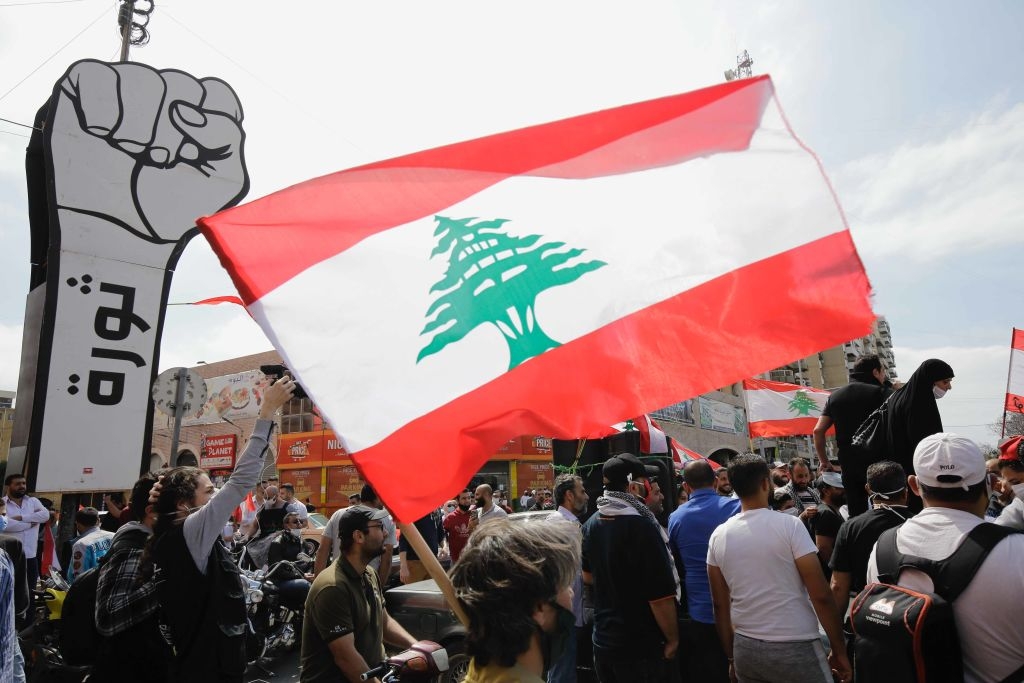
As Lebanese protests continue, albeit with varying degrees of intensity, speculation over what has caused the current crisis is also rife. The list of woes that afflict Lebanon is long. Pictured: A protest against dwindling economic conditions in Lebanon, in the northern port city of Tripoli, on May 3, 2020. (Photo by Ibrahim Chalhoub/AFP via Getty Images)

As Lebanese protests continue, albeit with varying degrees of intensity, speculation over what has caused the current crisis is also rife.

The list of woes that afflict Lebanon is long.

There is a banking crisis caused by a Ponzi-like scheme introduced by the Central Bank three years ago to attract foreign money. Recent falls in the price of oil have led to a sharp drop on remittances by Lebanese working in oil-rich countries but building their egg-nests back home. A bloated civil service, created by politicians trying to buy votes or curry favor with their respective sects by inventing unnecessary jobs, is becoming too costly for an ailing economy. Corruption, the bane of many developing nations, has gone beyond the limits of an aberration to become almost a way of life.

Add to all that a prolonged political crisis caused by the way the sectarian system distributes power and one would have a perfect storm.

All in all, it is certain that a majority of Lebanese are unhappy about their current situation and worried about the future, the two key ingredients of a cocktail of grievances that incites a nation to revolt.

However, what if the real cause of the current zugzwang is somewhere else, somewhere beyond shabby economic management and Third World-style corruption?

What Lebanon is facing may be a redefinition of its existence as a nation-state. All nation-states are constructed in accordance with a paradigm that reflects the content of their essence, the shape of their existence and the vision of their future.

Lebanon is one of those states destined to reflect internal diversity and build a place in the international arena as a haven for peace, creativity, dialogue, exchange and compromise by rival outside powers.

It may be a cliché to suggest that Lebanon is meant to be a Middle Eastern Switzerland, just as Uruguay is a haven of peace in South America, Singapore in Asia and Austria in Central Europe. Whenever Lebanon played that role, it thrived. Whenever it diverged from that role, or was pushed out of it by foreign powers, it suffered.

In 1958, barely a decade after independence, Lebanon was classed by the International Monetary Fund (IMF) as the richest country in the Middle East and North Africa in terms of gross domestic product per head of population. In the IMF's first report on the region, Libya was classed as the poorest nation while Turkey came second after Lebanon and Iran was fifth after Egypt. More importantly, Lebanon played a leading cultural role in what was to be marketed as "the Arab World" from the 1960s onwards.

Despite bumps on the road, including sectarian clashes often plotted by rival foreign powers, Lebanon managed to develop a sense of Lebanese-ness, Libanité in French, which everyone knows is hard to achieve.

In that Libanité, Lebanon is a Mediterranean nation with a seafaring tradition going back 5,000 years. At the same time, it is one of the oldest chunks of the two Roman Empires, west and east, and one of the first regions to welcome Christianity. Last but not least, it added a layer of Islam and Arab-ness to its rich identity as part of the Umayyad, Mameluke and ultimately Ottoman empires. A brief stint under French mandate added yet another shade.

Call it an attempt at paradigm shift if you like, but what we witness is an attempt at effacing that Libanité to replace it with a new identity in which Lebanon is a forward bunker for a pan-Shiite Revolution led by the mullahs from Tehran.

"Lebanon is the most advanced base of the Resistance Front," says Ayatollah Mohsen Araki, head of the Office for Convergence of Islamic Communities in Tehran.

To Ayatollah Ali Yunesi, an adviser to President Hassan Rouhani, Beirut is one of four Arab capitals that "we now control."

In his one and only press interview, the late General Qassem Soleimani, relates how he traveled to Lebanon whenever he and his armed companions liked without any visa and never felt a need to contact or inform anyone from the Lebanese government.

Lebanon was just part of the "emerging" empire that he was trying to build for Supreme Guide Ali Khamenei.

Today, Tehran believes it has succeeded to impose a paradigm shift on the way to creating a monochrome Lebanon to replace the rainbow of Libanité.

This was reflected in an interview granted to the Tehran press corps by Haji Sadeqi, Khamenei's Special Representative in the Revolutionary Guards.

In it, Sadeqi relates a trip he made to Beirut where he spent "a whole night" with Hassan Nasrallah during which the Hezbollah leader offered a detailed report on his plan to "wipe Israel off the map" or "terminate the Israeli banquet."

Sadeqi was assured that the installation of a government fully backed by Hezbollah and answerable to it would mean "full readiness by Lebanon" to assume its responsibilities in the Resistance Front.

To be sure, it is possible that Nasrallah, a wily politician, may have thickened the sauce of his subservience to Tehran to make sure Iranian cash continues to flow into his pockets.

Yet, there is no doubt that Tehran feels it has achieved its objective for full control in Lebanon by installing Hassane Diab's "consensus" Cabinet, in which Hezbollah has the final word on key issues.

Khamenei's belief that he is now the master of Lebanon's destiny may be premature to say the least. Empire-building isn't that easy, especially when the would-be emperor appears naked in his own turf.

The new Lebanese government may repeat the experience of Harlequin in Goldoni's "Servant of Two Masters", trying to satisfy both and failing with both. Diab must solve Lebanon's problems while serving the ayatollahs' weird schemes for empire-building.

Lebanon's interests today do not coincide with those of Iran. Lebanon needs stability and peace to revive its economy by attracting foreign investment, reviving tourism and developing itself as a service-based hub for international trade and high-tech industries. In contrast, Iran, as a revisionist power seeking to reshape the Middle East if not the whole world, thrives on tension and conflict.

One master wants Lebanon to be a beach, the other sees it as a bunker. In real life, as opposed to theater, at some point Harlequin must choose.
This article was originally published by Asharq al-Awsat

Amir Taheri was the executive editor-in-chief of the daily Kayhan in Iran from 1972 to 1979. He has worked at or written for innumerable publications, published eleven books, and has been a columnist for Asharq Al-Awsat since 1987. He is the Chairman of Gatestone Europe.

Source: https://www.gatestoneinstitute.org/15998/lebanese-choice

Follow Middle East and Terrorism on Twitter


Turkey: Post-Coronavirus Challenges Are Likely to Hurt - Burak Bekdil


by Burak Bekdil

Erdoğan’s worst nightmare is President Donald Trump following through on his threat last year to “devastate the economy of Turkey.”


BESA Center Perspectives Paper No. 1,558, May 10, 2020

EXECUTIVE SUMMARY: Turkish president Recep Tayyip Erdoğan is faced with a dilemma: in order to avoid US sanctions, he must keep the S-400 system he purchased from Russia unopened, but doing so might open Turkey up to Russian sanctions. Erdoğan’s worst nightmare is President Donald Trump following through on his threat last year to “devastate the economy of Turkey.”

The coronavirus pandemic has deepened fundamental imbalances in the Turkish economy, making a post-crisis freefall quite likely. However, as far as Turkey’s difficult foreign policy challenges are concerned, the virus was like a bell going off at just the right moment to rescue a boxer cornered in the ring. Turkey’s Islamist president Recep Tayyip Erdoğan might be privately hoping the world never goes back to normal.

The post-coronavirus period could be payback time for Erdoğan’s policy miscalculations and blind ideology calculus. At the start of the “Arab Spring,” he thought he’d found his moment to build Turkey-friendly Sunni regimes across the Arab Middle East with which he would eventually revive the Turkish empire. Nearly a decade later, those visions of a caliphate, a worshipful umma, and Ottoman grandeur spread far and wide appear as illusory as Erdoğan’s ambitions to make Turkey a major world power.

One very hot potato is the Russian-made S-400 air and anti-missile defense system Moscow delivered to Ankara last July. No doubt, champagne will be uncorked in Moscow the moment the Turkish military turns on the system, which it promised would happen in April. Turkish officials cite coronavirus as the force majeure that has delayed that deeply controversial activation. Turkey’s top defense procurement official, Ismail Demir, told state broadcaster TRT on April 28 that the pandemic inevitably slowed down the activation process due to restrictions on official visits and meetings. That may well be true, but Erdogan’s government—especially at a time when unemployment is skyrocketing, the national currency is in freefall, and there is a booming debt stock and prospects of stagflation—does not wish to be questioned about the merits of spending $2.5 billion on a system that will never be used.

On April 20, Reuters quoted a senior government official who spoke on condition of anonymity as saying, “There is no going back on the decision to activate the S-400s (but) due to COVID-19 … the plan for them to be ready in April will be delayed.” The phrase “there is no going back” may keep Turkey in the Russian orbit, but this will come at a cost.

“We made our position quite explicit to President Erdoğan, to all the senior leadership of Turkey, and that is the operation of the S-400 system … exposes Turkey to the very significant possibility of congressional sanctions, both those that invoke the [Countering America’s Adversaries Through Sanctions Act] legislation and additional freestanding legislative sanctions,” David Satterfield, the US envoy in Ankara, told an online panel hosted by the Atlantic Council. The ambassador added: “We do not have in our possession the assurances from the government of Turkey that would allow us to mitigate those concerns.”

“This will be a top-down decision coming from President Erdoğan,” a senior defense official told this author on May 4. “There have been no signs that the president may be rethinking the activation of the system.”

Turkey has already paid a price for the S-400 purchase by being suspended from the US-led multinational consortium that is building the next-generation F-35 Lightning II fighter jet. If sanctioned via CAATSA, Turkey’s entire thriving defense industry will suffer. But Erdoğan fears even worse consequences.

Activating the S-400 might trigger punishing sanctions on state lender Halkbank, which is facing US charges of violating the sanctions on Iran. A multibillion-dollar fine on Halkbank could cripple Erdoğan’s post-corona economic recovery plans. His worst nightmare is President Donald Trump following through on his threat last year to “devastate the economy of Turkey.”

That would be a losing war for Erdoğan, with both economic and political repercussions. A debt default, collapsing markets, and a further nosedive of the Turkish lira would be the perfect recipe for a punishing financial crisis that could spark early elections.

Ironically, Erdoğan’s only option to avoid US sanctions—keeping the S-400 system unopened—could expose Turkey to possible Russian sanctions. Russian economic sanctions cost Turkey billions of dollars within just a few months early in 2016 in the aftermath of the Turkish shooting down of a Russian Su-24 fighter jet in Syrian airspace in November 2015.

In order to minimize diplomatic damage, Erdoğan has launched a public diplomacy campaign to make himself look as pretty as possible to the world at large. Turkey sent medical kits to 57 countries to show solidarity in the fight against coronavirus, including two consignments of supplies to the US. The boxes bore the words of 13th-century poet Jalaluddin Rumi in Turkish and English: “After hopelessness there is so much hope and after darkness there is much brighter sun.”

Abdulkadir Selvi, a prominent pro-Erdoğan columnist, wrote in Hürriyet: “America has moved from sanctions talk to a favorable opinion of Turkey … You could not do this [PR] work even if you spent billions.” That may be too optimistic, but Erdoğan’s Islamist supporters continue to believe a few cargo planes full of medical supplies can win hearts and minds in a world half of which remains hostile to Erdoğan’s Turkey.

As the S-400 is being frozen because of the pandemic, a Syrian town near the Turkish border awaits a return to normal so it can resume its challenge to Ankara. The Turkish military embarrassingly suffered the deaths of around 50 soldiers in February in Idlib. The fire came from Syrian forces with air support from Russia. These deaths shocked Turkey: If the Russians are our allies, why did they kill our soldiers? It’s a good question, and one Erdoğan prefers not to answer. Once coronavirus fades, fire will resume in the Idlib theatre.

On May 3 a convoy of 30 Turkish military trucks entered Syrian soil, most likely carrying supplies to Turkish military outposts around Idlib. On the same day, local observers reported that Hayat Tahrir Al-Sham (HTS), one of the jihadist groups fighting in the Idlib area, blocked a Turkish Army column from entering the militant stronghold of Daret Izza near Aleppo. Erdoğan should prepare for the moment when his Russian friends, in the show’s final act, force his troops and their jihadist auxiliaries out of Syria.

In addition, accession talks with the EU remain stalled; Turkey will have to find a better way out than gunboat diplomacy if it wants to amicably resolve the disputes over Eastern Mediterranean hydrocarbons; and tensions might well deepen in Libya and elsewhere in the Middle East between Turkey and Egypt, the UAE, Saudi Arabia, Israel, Cyprus, and Greece.

This may be a long, hot summer for Erdoğan.


Burak Bekdil is an Ankara-based columnist. He regularly writes for the Gatestone Institute and Defense News and is a fellow at the Middle East Forum. He is also a founder of the Ankara-based think tank Sigma.

Source: https://besacenter.org/perspectives-papers/turkey-coronavirus-challenges/

Follow Middle East and Terrorism on Twitter


Purging Christian Higher Education - Stephen Baskerville


by Stephen Baskerville

[W]e may now be seeing a nationwide purge of the ideologically retrograde from Evangelical colleges, universities, and seminaries, as they succumb to pressure to jettison Christian principles and substitute political ideology.


Rooting out political heretics is a practice we now associate with liberal secular universities, despite pretenses of "academic freedom" and claims to protect it with the lifelong employment guarantee known as "tenure."

But today, the practice appears just as likely at conservative Christian institutions. In fact, we may now be seeing a nationwide purge of the ideologically retrograde from Evangelical colleges, universities, and seminaries, as they succumb to pressure to jettison Christian principles and substitute political ideology. Southern Baptist Theological Seminary (SBTS) just fired four of its most senior faculty members, all full professors. Some have active publication records that put them at the forefront of their profession, elevated their institution's profile, and made them respected public voices for the seminary's professed values. The pretext was budget cuts, but no reputable institution dismisses its most eminent faculty in their prime to save money. All had resisted the radicalization being encouraged by the administration, and they were the first to go not despite their experience and leadership, but because of it.

SBTS is not alone. In November, Robert Lopez was fired from Southwestern Baptist Theological Seminary (SWBTS). Lopez is a leading voice in controversies over sexual politics, where he has questioned the homosexualist political agenda. He has also criticized the Southern Baptist Convention (SBC)'s political leadership, which has close ties to both seminaries. In recent months, SWBTS has also seen mass firings of senior faculty (42 by one count, mostly full professors, including at least one endowed chair), likewise for political reasons disguised implausibly using "budget shortfalls."

More examples could be cited, but doing so would cause the ejected professors serious legal and financial problems, because they were terminated using innovative schemes to hide these obviously unethical actions from public view.

In fact, it is difficult to know how many professors have been purged because, as always, unscrupulous administrations seek to hide actions they know to be indefensible. The SBTS four were all offered "non-disclosure agreements": payments in return for their silence. Strikingly, Lopez was terminated shortly after he introduced a resolution at the SBC declaring such agreements antithetical to academic integrity.

The agreements are indeed, ipso facto, as scandalous as the firings and prima facie proof that the administration has things to hide. To understand why, one must realize that colleges and universities can maintain integrity only by respecting the principle of academic freedom. Firing professors for political heterodoxy defeats the purpose of higher education, which must be dedicated to the disinterested pursuit of truth. If you disagree with a scholar's writings, you challenge them in peer review or by writing a rejoinder, marshaling logic and citing evidence. This is the academic process, to which these institutions are dedicated, or else they are fraudulent. Subverting it by summarily dismissing reputable faculty is an admission of intellectual weakness, dishonesty, cowardice, or worse, and it will quickly compromise an institution's reputation.

Institutions receiving state funding generally must respect academic freedom and protect it with tenure. They may even be bound by the First Amendment. Privately funded Christian institutions generally are not held to be thus bound by law and often have no tenure. But they usually profess to honor the principle nevertheless, because their reputations (and accreditation) depend on it. Oversight bodies such as faculty senates, boards of trustees, and accreditors must ensure that the administrations are not compromised by politicization. An institution known to impose ideology on its professors will also find that students, parents, faculty, donors, and others will start looking elsewhere. This is why transparency is critical to keeping private institutions honest and why disreputable ones crave secrecy.

Incidentally, academic freedom does not prevent religious institutions from maintaining doctrinal integrity. Legitimate methods exist to discipline faculty who deviate from valid commitments to doctrinal orthodoxy, and such discipline does not violate academic freedom. Secrecy is not needed when the institution acts out of principle — only to hide actions of which it is ashamed.

This is the role of non-disclosure agreements: to stop the mouths of faculty who call attention to improper dismissal and other unethical practices. Borrowed from the business world, these agreements are often accepted there as providing for legitimate confidentiality, such as industrial secrets.

In academia, they are inherently un-ethical. They violate academic freedom in themselves and hide other violations. They serve to protect the institution not only from legal liability, but, more seriously, from public scrutiny and criticism. Typically, the professor is fired without warning or notice (often breaking a contract), which immediately cuts him off from not only his livelihood, but also internal grievance procedures. His salary and benefits are then dangled before him in exchange for renouncing his legal claims, his constitutional rights, and above all his freedom to speak out. Not only is it extortionate, but it immunizes the administration from accountability, because it opens him, not them, to legal liability for telling the truth about their wrongdoing. Even oversight bodies with a legitimate interest in knowing, such as accreditors and the institution's own trustees, can be kept in the dark. By using this method, SBTS and SWBTS are proclaiming to the world that they are substandard institutions, frightened to subject themselves to the ethical norms recognized by reputable institutions. 

If money fails to shut their mouths, Christian institutions have devised even more diabolical weapons against their own faculty. Employment contracts now contain mandatory arbitration clauses, requiring that "employment disputes" be adjudicated in secret by a private arbitration firm. Here too, the ejected professor can voice objections only in a secret commercial proceeding consisting not of colleagues but of lawyers, who will ensure that no one else hears the truth, because the procedure is without record, and public disclosure is legally punishable. In effect, the professor is treated as if he signed an NDA even if he did not.

This subterfuge is breathtakingly cynical for a Christian institution. Purporting to apply "biblical" principles of "Christian Conciliation" — principally Matthew 18:15–17 and 1 Corinthians 6 — it is really nothing more than secular forced arbitration, sprinkled reassuringly with Bible verses but leaving nothing of what Jesus prescribes. 

In the name of reducing "animosities," lawyers curtail due process protections and basic constitutional freedoms (like speech). Rules of evidence are explicitly discarded, and arbitrators (enjoying legal immunity) have no specified limits on what they can inflict, including punitive damages and lawyers' fees. Nothing requires that they follow the Bible or even the law. The secretive decisions are then enforced by civil courts (flouting Paul's instructions to avoid courts), without challenge or appeal, and parties have no redress. The larger church community, where Jesus places jurisdiction, is cut out altogether. In short, the Bible command is appropriated and inverted to serve the very evils it was provided to remedy: to conceal wrongdoing and shield wrongdoers from the moral judgment of the community.

This too was devised for secular business contracts. Pitting lone employees against organized interests like universities has already provoked sharp criticism.

But the "Christian" version is especially pernicious, not only because it invokes religious faith to disguise commercial gain, but because it exploits goodwill and betrays good faith by deceiving Christians with the illusion that they are being relieved of their own "animosity," when they are really being relieved of their access to public justice and their constitutional rights. It also grants profit-making ventures a captive market on any arbitration labeled "Christian" and an incentive to collude with any self-styled Christian employers who support the monopoly by writing forced arbitration clauses into their employment contracts. Ironically, this even blocks employees from invoking Matthew 18 as written or even calling attention to its subversion. The aim is not reconciling people who disagree, but eliminating them.

This makes it the perfect tool for airbrushing professors who resist liberalization out of the picture. If a professor speaks out, a "conciliation" procedure can be launched, and he can be "conciliated" into silence and secretly plundered. 

When one understands how strikingly appropriate is Jesus's own straightforward conflict resolution method for administering educational establishments — because it requires that differences be resolved by exchanging ideas rather than inflicting punishments — one can realize just how devious are the institutions that pervert it.
* * *
The implications of all this extend well beyond Christian academies. It simultaneously violates both Christian ethics and secular academic ones. In higher education, Christian institutions are the last redoubt of not only Christian faith itself and the classical liberal arts, but basic academic integrity. Even open-minded secularists find it difficult to understand why institutions grounded in religious doctrines are the last to become corrupted by politicization. But it is logical that institutions lacking such a foundation should be more vulnerable to importing substitute creeds in the form of political ideologies. This is why Christianity is largely responsible for the Western university as we know it. When they throw in the towel, higher education becomes a seminary of leftist ideology.
* * *
By shrinking from the opportunity to openly engage and challenge ideas in the administration of their own institutions, and instead banishing dissenters under dishonest pretexts, while hiding their mendacity behind a battery of legal fortifications, these institutions are undermining their own reason for existing. This is the main function of learned institutions after all: to weigh and critique ideas and teach their students and the rest of us how to understand and evaluate them. But that is precisely where these institutions show themselves inadequate in managing their own affairs. They are proclaiming to the world that they are too intellectually feeble (and perhaps morally arrogant) to articulate a coherent defense of their own principles and actions. Who would trust the word, let alone the scholarship, coming from a university that cannot engage with inconvenient ideas? And who would trust such a college with his education or that of his children?

This in turn raises larger questions. Christian institutions have already been accused of intellectual cowardice because of their refusal to stand up and be heard on highly salient public issues that most threaten the integrity of higher education today, and that directly impinge on their Christian identity — namely, today's radical sexual ideology. It is no accident that most of these firings concern faculty who stand their ground on Christian sexual morality and take a public position on the current controversies. Having first abdicated their own responsibility, the institutions must then purge the faculty who demonstrate the embarrassing integrity to insist on doing their job.

All this casts into serious doubt on the claim of such institutions to be either Christian or academic at all and instead makes them appear as little more than employment schemes for diffident administrators and pliable faculty — or as one critic puts it, hedge funds "with classrooms attached."

Stephen Baskerville, Ph.D., has over 30 years' experience teaching in universities in the United States and Europe, and he writes extensively about the reform of higher education. Last July he was dismissed as professor of government after twelve years at Patrick Henry College.

Source: https://www.americanthinker.com/articles/2020/05/purging_christian_higher_education.html

Follow Middle East and Terrorism on Twitter