Sunday, May 24, 2020

"Epidemic Prevention" Chinese Communist Party Style: Persecute Religious Minorities - Judith Bergman

​
by Judith Bergman

Horrific human rights violations continue unabated in China

  • One member of [The Church of Almighty God], who had been released, said that the police had "threatened to send her to the coronavirus epicenter in Hubei Province to be infected if she continued practicing her faith." — From Bitter Winter, May 6, 2020.
  • Members of CAG are imprisoned in education camps alongside Uyghurs and other Muslims, Christians and Falun Gong practitioners. One CAG member said that the Xinjiang camp she was sent to had 400 inmates, mostly Uyghurs, Christians and Falun Gong members. She was beaten, nearly raped and subjected to all sorts of torture as part of the indoctrination effort. — From Bitter Winter, March 18, 2020.
  • When the elderly man in charge of the church asked why the government had destroyed it, the police viciously beat him. In April, authorities demolished a Three-Self church in Xining for being "illegal". Throughout the coronavirus outbreak, the Chinese regime continued to remove crosses from Three-Self churches in Anhui, Jiangsu, Shandong, and other provinces. — From Bitter Winter, April 11 and 23, 2020.
  • "Independent experts estimate that between 900,000 and 1.8 million Uighur, Kazakh, Kyrgyz, and other Muslims have been detained in more than 1,300 concentration camps in Xinjiang." — United States Commission on International Religious Freedom (USCRIF), April 28, 2020.
  • "Meanwhile, authorities in Xinjiang and other parts of China have destroyed or damaged thousands of mosques and removed Arabic-language signs from Muslim businesses." — United States Commission on International Religious Freedom, April 28, 2020.
  • "Human rights advocates and scientists presented evidence that the practice of harvesting organs from prisoners—many of whom are believed to be Falun Gong practitioners— continued on a significant scale." — United States Commission on International Religious Freedom, April 28, 2020.
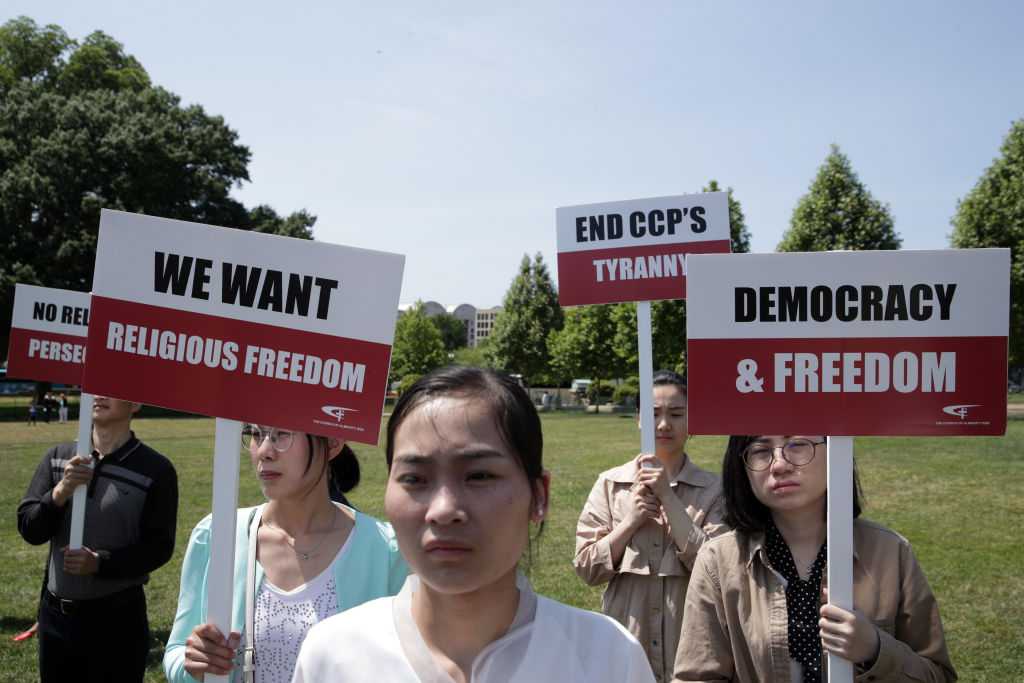
China's regime continues its crackdown on The Church of Almighty God, a group China banned as a "dangerous cult". In February and March, authorities arrested at least 325 members of the church "as a result of investigations in the name of epidemic prevention". One member said that the police had "threatened to send her to the coronavirus epicenter in Hubei Province to be infected if she continued practicing her faith". Pictured: Members of The Church of Almighty God commemorate the 30th anniversary of the Tiananmen Square massacre, on June 4, 2019 in Washington, DC. (Photo by Alex Wong/Getty Images)

Since early 2020, China has been doubling down on its already extreme suppression of religious freedom, and the Covid-19 outbreak has done nothing to curb the Chinese Communist Party's (CCP) enthusiasm. If anything, the virus outbreak has served as an excuse to crack down even more on freedom of religion.

In February, for instance, officials came to inspect whether a church in Henan province was implementing lockdown instructions, but, according to one church member interviewed by Bitter Winter, "seeing some bible verses written on a blackboard they said, 'China is the land of the Communist Party, and we are not allowed to hold religious beliefs'". The officials then "smashed everything in the venue and left, locking the door..."

The CCP also continued its crackdown on The Church of Almighty God (CAG), a group China banned and that it considers a "dangerous cult". Between February and March, authorities arrested at least 325 members of the group "as a result of investigations in the name of epidemic prevention". One member of the group, who had been released, said that the police had "threatened to send her to the coronavirus epicenter in Hubei Province to be infected if she continued practicing her faith". At the height of the epidemic in early February, authorities in the province of Shanxi "launched a special crackdown campaign against the CAG, encouraging masses to report on its members". A government employee from Anhui province said that he had been instructed "not to delay investigations into CAG members because of the pandemic: On the contrary, government personnel should use preventive measures as a pretext to enter residents' homes".

Members of CAG are imprisoned in "re-education" camps alongside Uyghurs and other Muslims, Christians and Falun Gong practitioners. One CAG member said that the Xinjiang camp she was sent to had 400 inmates, mostly Uyghurs, Christians and Falun Gong members. She was beaten, nearly raped and subjected to all sorts of torture as part of the indoctrination effort. Elderly members of CAG have been imprisoned and subjected to beatings and torture, despite being frail and ill. They are subjected to hours of indoctrination to make them sign papers saying that they will relinquish their beliefs.

Protestant house-churches have also been demolished. In February, a house-church in Guangdong province, which had been built mainly by seniors, was demolished and police arrested an elderly woman for five days for opposing the demolition. In April, officials demolished a church in Jiangxi province. Before the demolition, local Communist Party members told the congregation, "coronavirus was introduced from overseas, and the United States is China's enemy." In early April, police arrested a pastor, Zhao Huaiguo, in the central province of Hunan, who founded the Bethel Church, on suspicion of "inciting subversion of state power" for using a virtual private network (VPN) to access foreign news websites that are blocked by Chinese government censors. In early May, police raided a church service in the southeastern province of Fujian and violently beat many worshippers.
In 2019, according to the United States Commission on International Religious Freedom (USCIRF), which published its Annual Report 2020 on International Religious Freedom on April 28:
"Chinese authorities raided or closed down hundreds of Protestant house churches... including Rock Church in Henan Province and Shouwang Church in Beijing. The government released some of the Early Rain Covenant Church congregants who had been arrested in December 2018, but in December 2019, a court charged Pastor Wang Yi with 'subversion of state power' and sentenced him to nine years imprisonment. Local authorities continued to harass and detain bishops...who refused to join the state-affiliated Catholic association. Several local governments, including Guangzho city, offered cash bounties for individuals who informed on underground churches. In addition, authorities across the country have removed crosses from churches, banned youth under the age of 18 from participating in religious services, and replaced images of Jesus Christ or the Virgin Mary with pictures of President Xi Jinping".
The CCP is even targeting the state-run "Three-Self" Protestant churches, which have already been forced to incorporate CCP propaganda in their sermons. In March, more than 200 officials and police officers showed up at a Three-Self church in Henan province and demolished it. When the elderly man in charge of the church asked why the government had destroyed it, the police viciously beat him, fracturing two of his ribs. They threatened to kill him if he "challenged the Communist Party again". In April, authorities demolished a Three-Self church in Xining for being "illegal". Throughout the coronavirus outbreak, the Chinese regime continued to remove crosses from Three-Self churches in Anhui, Jiangsu, Shandong, and other provinces.

The Communist regime also continues its destruction of Buddhist temples, such as one in Hebei province, in early March. The temple was destroyed for lacking "a religious activity venue registration certificate" even though the temple director had never been asked by authorities to obtain such a certificate. According to the Annual Report 2020 on International Religious Freedom of the United States Commission on International Religious Freedom, in 2019:
"The Chinese government continued to pursue a strategy of forced assimilation and suppression of Tibetan Buddhism, as demonstrated by the laws designed to control the next reincarnation of His Holiness the Dalai Lama and those of other Tibetan eminent lamas. Monks and nuns who refused to denounce the Dalai Lama have been expelled from their monasteries, imprisoned, and tortured. During the summer of 2019, authorities demolished thousands of residences at the Yachen Gar Tibetan Buddhist center in Sichuan Province, displacing as many as 6,000 monks and nuns. In April [2019], authorities closed the Larung Gar Buddhist Academy to new enrollment. Authorities also intensified a crackdown on possessing or displaying photos of the Dalai Lama, continued to monitor religious festivals, and, in some areas, banned students from attending festivals during their school holidays".
One of the members of USCRIF wrote in the report that, "Tibet is second only to Syria in terms of religious freedom and human rights violations. The situation in Tibet is worse than in North Korea..."

In addition to the demolitions of places of worship, arrests and general harassment of religious minorities, the CCP regularly imprisons members of religious faiths, alongside dissidents and a variety of other unwanted people in psychiatric hospitals for "treatment", where they are forced, frequently through torture, to take medication. One staff member in a psychiatric hospital in the Guangxi Zhuang Autonomous Region said that when members of The Church of Almighty God are brought in, the hospital starts the "treatment" immediately, without any tests or examination. A church member who spent 157 days in a psychiatric hospital said, "A doctor told me that because of my faith, I was a mental patient, and there was no need for further tests".

According to the Annual Report 2020 on International Religious Freedom:
"Independent experts estimate that between 900,000 and 1.8 million Uighur, Kazakh, Kyrgyz, and other Muslims have been detained in more than 1,300 concentration camps in Xinjiang— an estimate revised upward since the previous reporting period. Individuals have been sent to the camps for wearing long beards, refusing alcohol, or other behaviors authorities deem to be signs of 'religious extremism.' Former detainees report that they suffered torture, rape, sterilization, and other abuses. In addition, nearly half a million Muslim children have been separated from their families and placed in boarding schools. During 2019, the camps increasingly transitioned from reeducation to forced labor as detainees were forced to work in cotton and textile factories. Outside the camps, the government continued to deploy officials to live with Muslim families and to report on any signs of 'extremist' religious behavior. Meanwhile, authorities in Xinjiang and other parts of China have destroyed or damaged thousands of mosques and removed Arabic-language signs from Muslim businesses".
In addition to all of the above, the United States Commission on International Religious Freedom concluded in its "Key Findings" for China:
"According to reports, thousands of Falun Gong practitioners were arrested during 2019 for practicing the movement's meditation exercises or distributing literature about their beliefs. Human rights advocates and scientists presented evidence that the practice of harvesting organs from prisoners — many of whom are believed to be Falun Gong practitioners — continued on a significant scale. In addition, there were widespread reports that authorities across China demolished Mahayana Buddhist, Daoist, and Confucian statues they claimed were 'unauthorized'".
It is positive that the coronavirus outbreak has focused attention on China's irregular international behavior. The world, though, also needs to muster the courage and the will vehemently to protest the unspeakable human rights abuses that the Chinese Communist regime inflicts on its own population on a daily basis.

Judith Bergman, a columnist, lawyer and political analyst, is a Distinguished Senior Fellow at Gatestone Institute.

Source: https://www.gatestoneinstitute.org/16051/china-religion-persecution

Follow Middle East and Terrorism on Twitter


US Aid to Israel Is a High-Yield Investment - Dr. Frank Musmar

​
by Dr. Frank Musmar

Besides several key shared interests, Israel also invests heavily in the American economy and is one of the top 20 suppliers of direct investment in the US.

BESA Center Perspectives Paper No. 1,578, May 24, 2020

EXECUTIVE SUMMARY: America and Israel face numerous shared challenges, including terrorism, weapons and nuclear proliferation, cyber warfare, and the spread of radical Islamist ideology. America can consistently depend on the beacon of stability represented by democratic Israel in the turbulent Middle East, where the two countries share the same national and homeland security concerns: the megalomaniacal vision of Iran’s ayatollahs, the threat of Sunni and Shiite Islamic terrorism, and the critical security requirements of vulnerable pro-US Arab regimes. Israel also invests heavily in the American economy and is one of the top 20 suppliers of direct investment in the US.

The US and Israel have a mutually beneficial relationship that provides America with a high return on its annual $3.8 billion investment. Between 1985, when the US and Israel signed a Free Trade Agreement, and 2016, trade between the countries increased tenfold to $49 billion. The agreement was successful in three dimensions: politically, economically, and strategically. Israel now invests close to $24 billion in the US, nearly triple the figure of a decade earlier. Strategically, Israel is an American beachhead in the Middle East and the only regional ally on which Washington can rely.

Israel’s relationship with Saudi Arabia and other Arab Gulf states has improved dramatically in the recent past, irrespective of the Palestinian issue. Because of this new warmth, the US does not have to choose between strategic cooperation with Jerusalem versus Riyadh. US-Israel and US-Arab relations complement one another, and that synergy works to Washington’s benefit.

On the economic front, critical components of leading American high-tech products are invented and designed in Israel, making the American companies that manufacture those products more competitive and profitable. Cisco, Intel, Motorola, Applied Materials, and HP are just a few examples. The US-Israeli economic and commercial relationship now encompasses IT, biotech, life sciences, health care solutions, energy, pharmaceuticals, food and beverages, defense industries, cyber-security, aviation, desalination, recycling, conservation, management, and irrigation.

US firms established two-thirds of the 300 foreign-invested research and development centers in Israel at Start-Up Nation (an independent non-profit that builds bridges to Israeli innovation firms). Israeli firms represent the second-largest source of foreign listings on the NASDAQ after China, and more than Indian, Japanese, and South Korean firms combined. According to an estimate by the US Chamber of Commerce, Israel is home to more than 2,500 American firms employing some 72,000 Israelis.

The US and Israel have three joint research & development foundations: the Binational Industrial Research and Development Foundation (BIRD), the Binational Science Foundation (BSF), and the Binational Agricultural Research and Development Foundation (BARD).  Since its inception in 1977, the BIRD Foundation has granted $282 million to 813 projects that have directly and indirectly generated $8 billion in sales.

Israeli businesses invest heavily in the US economy, with Israel placing among the top 20 suppliers of direct investment in the US. More than $150 billion was invested by Israeli companies in the US between 2010 and 2015 (more than $25.1 billion in 2015 alone). As of this writing, over 30 US states have signed bilateral agreements with Israel to foster closer ties in fields like business, technology, agriculture, homeland security, and energy.

Strategically, the US and Israel have developed deep strategic ties to confront common threats. This strategic relationship is a crucial pillar of America’s Middle East security framework, and the partnership is continually growing and expanding into new areas. Both nations gain from a strong strategic partnership, which draws in part upon Israel’s capabilities in designing advanced military, homeland security, counterterrorism, and cyber-protection technologies that help the US meet its growing security challenges. Israel’s military strength and central geostrategic location provide a strong deterrent to regional actors opposed to the US.

Israel is the place where US special operations units trained before deployment in Iraq and Afghanistan, and Israeli armor plating technology protects US soldiers. Israel is a cost-effective, battle-tested laboratory for US defense industries, and it provides the US with more intelligence than all the NATO countries put together. American battle tactics are formulated according to the Israeli playbook.

Israel is a strategic beachhead of the US in the Middle East. It is in effect the largest US aircraft carrier, yet it does not require a single American boot on the ground. Israel is the only stable, reliable, capable, democratic, and unconditional ally of the US, and it is willing to flex its muscles.


Dr. Frank Musmar is a financial and performance management specialist and a non-resident research associate at the BESA Center.

Source: https://besacenter.org/perspectives-papers/us-aid-israel-investment/

Follow Middle East and Terrorism on Twitter


Can Israel Profit from China's Past Errors? - Mike Konrad

​
by Mike Konrad

Investment is already starting to move out of China as labor costs rise. What Israel offers is profitability that comes from intelligence, not cheap labor.


There is a lot of conjecture about who will profit from this coronavirus after the virus and the panic has abated. May I suggest that one winner is presently being overlooked.
Some suggest that the U.S. will win the economic war, and that China will lose in the wake of coronavirus. They see China’s behavior as scandalous, and that this coronavirus panic will draw away investments to cause the final abandonment of China as the world’s cheap manufacturing supply house.
The new coronavirus Covid-19 will end up being the final curtain on China’s nearly 30 year role as the world’s leading manufacturer.
“Using China as a hub... that model died this week, I think,” says Vladimir Signorelli, head of Bretton Woods Research, a macro investment research firm. -- FORBES
Some wonder if the USA and the West are too deeply intertwined with China for a clean break to occur, while others think China might prevail despite its behavior. The West has become too dependent on the Chinese for electronic, medical, and technical products.
Mainland China has reached this position by piggybacking on the technology of other nations to rise to become a great industrial power, but the key is that China is not that great an innovator on its own. It seeks investments to provide what it cannot provide itself. 
If one looks at reviews on Amazon, Chinese products are not considered high quality. True, the same was said of Japanese products in the fifties and sixties, but Japan closed that gap. The Chinese have yet to close it. And much of what China makes that is good is often made by foreign companies who have set up in China.
Meanwhile, the Netherlands joined Spain, Turkey, Georgia and the Czech Republic in rejecting China-made medical gear, claiming the items were substandard and questioning their quality as the number of global coronavirus cases passes 826,000, according to Fox News. -- NY Post
May I suggest that Israel will be the one of those to prosper from this disaster after China’s behavior has caused a move away from its products.
Unlike the Chinese, the Israelis are well known for inventing their own technologies. They are world class innovators. Contrariwise, given the total control that their government exerts, China will never be a start-up nation, as Israel has become. Freedom is necessary for true innovation, and China will never allow it. China survives only by producing at lower costs, but it needs other countries to innovate.
Ironically, Israeli innovation has already attracted the eyes of Chinese investors, to make up what the Chinese lack. Over U.S. objections, Chinese firms have stepped up their involvement in Israel:
Israeli government officials estimate that in Israel alone, Chinese corporations have invested in or accessed projects worth nearly $15 billion. -- JPost (2019)
Yet, some in the Israeli government were worried.
The Shin Bet (Israel Security Agency), the National Security Council (NSC) and US administrations have time and again expressed their concerns regarding this growing trend. Yet government ministers are finding it difficult to reach a decision. -- JPost (2019)
Happily, the Israeli government has taken precautionary steps.
Israel Acts to Counter Chinese Corporate Influence -- Defense of Democracies
If Israel can avoid the mistakes that the West has made, and minimize Chinese influence, it may find itself in a position to become a first-rate supplier of some goods to the West that will replace China.
Given that Israel already produces a lot of high tech, and both Apple and Microsoft have invested heavily in Israel, there is absolutely no reason that Israel could not replace China as a major electronic supplier to the world.
Intel bought Habana Labs, an Israeli startup that develops chips for artificial intelligence applications, for about $2 billion, to bolster its efforts in the fast-growing market for AI silicon.
The purchase is the latest in a string of acquisitions aimed at making Intel’s offerings essential to some of the biggest buyers of silicon and fending off rising competitors. -- Industry Week
China has not grabbed control of the server chip market – of major import - and a good reason is Israel’s Annapurna Labs.
Amazon Cloud Services revealed a list of new products and services at the Re:Invent convention in Los Angeles on Tuesday, including products that were developed by Israeli company Annapurna Labs, which is owned by Amazon.
The most notable product was Graviton2, Annapurna’s new processor, which is designed for server farms and is an upgrade from Graviton, which was released a year ago. -- Haaretz
Israel already has a good chunk of the world’s pharmaceutical market, and yes, TEVA, the world’s largest manufacturer of generic drugs, has run into scandals -- but so have a lot of other pharmaceuticals.
Some have averred that Israel cannot compete with China because its reservoir of labor is too small. Israel proper has 8 million citizens to China’s 1.4 billion, a ratio of 1 to 175. By that logic, Britain should never have conquered a quarter of the globe, yet it did. And Taiwan and Singapore are major producers with small populations.
Industrial output is moving away from large-scale labor-intensive operations to massive Artificial Intelligence (AI) based production.
Israel is well known for its strength in deep-tech, and is also home to a vibrant AI ecosystem that has been growing rapidly over the past few years. Israel’s unique tech ecosystem includes companies and startups that utilize AI technologies in healthcare, cybersecurity, autonomous driving, and many other fields. – Forbes
And here Israel has also the edge. Intel has been the recipient of massive capital investment for a long time.
Intel's $11 Billion Israeli Expansion Plan Is Back on Track – Ctech (2019)
Investment is already starting to move out of China as labor costs rise. What Israel offers is profitability that comes from intelligence, not cheap labor. One’s profits will not decline as the standard of living increases, since the profits depend on an educated work force, not a starving one.
The problem is that China still comes in with the allure of large-scale investment, as well. This has to be resisted. Otherwise, Israel will make the same mistakes the West has made. Israel should disconnect itself from China altogether and concentrate on penetrating Europe, India, and Latin America.
By distancing itself from China – though it might take an investment hit for a while – Israel has the potential to become the tech supplier to the world. Israel is unique in that it has the intellectual base and a lot part of the industrial plant already set up.
Some might say that Israel could not emulate Foxconn’s success in Taipei, due to its labor shortage. But there is no reason that Israel could not tap some pacified areas of Judea and Samaria for labor intensive operations. Trump’s plan offers a four-year deadline for the PA to accept terms.
[T]he deal provides for a four-year window for them to engage in renewed settlement talks. - New York Times
The PA will never accept, and then Israel will have a free hand to act. Between its own Israeli Arabs, and the unemployed that will result from an eviscerated PA, Israel may have all the labor it needs to run a Foxconn operation. Artificial intelligence will fill in any gaps.
The Israeli government should consider branding Israel as the replacement for China, with better quality and ethics. Take a hint from 7 up, the soda which once branded itself as the unCola. Perhaps Israel should brand itself as the unChina.
Graphic credit: Torange

Mike Konrad

Source: https://www.americanthinker.com/articles/2020/05/can_israel_profit_from_chinas_past_errors.html

Follow Middle East and Terrorism on Twitter


The trial begins. A guide to the trial of Israel’s Prime Minister - Barry Shaw

​
by Barry Shaw

The efforts to unseat Netanyahu failed at the polls. Will they succeed in court? Three cases about gifts and media coverage. Opinion.


When Benjamin Netanyahu appeared in the Jerusalem District Court on Sunday May 24th it made political history.

Israel has had no shortage of leaders who have been proven corrupt.

An Israeli President was sent to prison when Moshe Katzav was sentenced to seven years on rape charges.

Ehud Olmert resigned as Prime Minister to stand trial on charges of bribery and breach of trust both as mayor of Jerusalem and later as Prime Minister. He was sentenced to 27 months on fraud charges and was discharged from prison after serving just sixteen months.

Israel has an inglorious record of ministers, Knesset members, chief rabbis, mayors and other officials going to prison on criminal or security charges,

But when Benjamin Netanyahu appeared in front of the three judges it was the first time that a sitting Prime Minister has faced criminal charges.

The timing is immaculate. After a traumatic year in which three elections failed to produce a majority government, it took the political skills of Netanyahu and the conscience of opposition leader, Benny  Gantz, to cobble together an emergency unity government. Yet, even before this government has fully taken its Knesset seat, the acting Prime Minister has set out on a marathon legal journey to clear his name.

“There will be nothing, because there is nothing,” has been the drumbeat slogan of Bibi, as he is affectionately known.

Throughout the agonizing process of investigations by the police, acting on the orders of the State Attorney-General, Netanyahu has protested that there has been political dirty business going on aided and abetted by a compliant media. He proclaimed that the only way the opposition can get rid of him was by staging a coup using the courts as a way to removed him from power.

This may sound familiar to American readers.

Netanyahu’s lawyers have lodged over a hundred complaints of leaks to the media and prosecution witnesses talking to reporters.

Leaving aside protests, let’s look into the charges ranged against him.

Benjamin Netanyahu faces three different set of charges, but all are related by the general charge against him of bribery and breach of trust.

The most serious case concerns Case 4000. This is the case in which Bibi is charged with a media bribery scheme with the owners of Bezek and Walla communications and media companies. In this case, the owners, Shaul Elovitch and his wife, Iris, are also co-defenders with a separate legal team.

The charges claim that Walla gave Bibi favorable coverage in exchange for him making government policies favoring Elovitch’s Bezek company to the value of around 1.8 billion shekels.

Bibi has protested that issues relating to the communications industry rest with the ministry concerned and that several decisions had gone against Bezek. The prosecution, however, will be producing as supporting evidence large amounts of letters, email exchanges, text messages and an array of witnesses, including a couple of significant people who have turned state witnesses in return for immunity against the prime minister.

Watch out for the appearances of Nir Hefetz and Shlomo Filber, two former aides to the prime minister. Hefetz will accuse Bibi of micromanaging the Walla news coverage. His court appearance is important and may take several days with the prosecution attempting to substantiate his verbal evidence with an array of documents. To counter this, the lawyers of Netanyahu and of the Elovitchs may take even longer when they cross-examine Hefetz.

There have been reports that the prosecution, via the police investigation team, used excessive methods to break Hefetz in order to get him to turn against his former boss.

Shades of FBI and Michael Flynn, Roger Stone, George Papadopoulos, Paul Manafort.

Shlomo Filber may be a tougher nut to crack. He will make the case that Bibi hatched the scheme to grant favors to Shaul Elovitch via government policies and he is expected to back up his evidence with documents.

The prosecution could also call Walla management personnel to give evidence against the prime minister. This is a touchy issue because a dozen Walla reporters have protested interference in their reporting of the prime minister.

Netanyahu’s defense will give evidence of the many negative news stories against their client to prove there was no pro-Bibi dominance in Walla reporting. He will also protest that any communications policies that favored Elovitch were approved by named neutral bureaucrats.

It has been reported that parts of Bibi’s defense arguments in Case 4000 are solid. The outcome may rest on how successfully his lawyers can offset the appearance of Shlomo Filber.

Case 1000 concerns gifts that Bibi and his wife received over the years from wealthy friends. Questions have arisen regarding whether these were only friends, or patrons looking for favors. Certainly the reports of crates of pink champagne and boxes of expensive cigars to the Netanyahus, and rumors of Sara Netanyahu’s demands for clothes to meet her self-given status as Israel’s first lady, have had a grating effect on some of the Israeli public, but they are reports and rumors. It may prove difficult to establish any quid pro quo in the Netanyahu dealings with Sheldon and Miriam Adelson, Australian billionaire, James Packer, or Israeli Hollywood mogul, Arnon Milchan.

More complicated for Bibi is Case 2000. This involves his relationship with Yediot newspaper owner, Noni Moses. Bibi is charged with reducing the influence of the pro-Netanyahu Israel HaYom free newspaper, owned by his former friend, Sheldon Adelson, in favor of Yediot. The expected evidence of Sheldon Adelson will be interesting.

In the Case 2000, Bibi is on stronger ground. Moses is not going to testify against himself and Attorney-General has already reduced the charges against Bibi from bribery down to breach of trust. It is also a case without precedents.

The three cases will produce a procession of star witnesses including former Mossad head, Tamir Pardo, no political friend of Bibi, former Shin Bet head, Yuval Diskin, former national security adviser, Uzi Arad, leader of the Opposition, Yair Lapid, a Bibi detester. Others may include Tzipi Livni, Labour’s Eitan Cabel. Witnesses for Bibi will be Gilad Erdan, before he takes up his posts in New York and Washington, Ron Dermer, until recently Ambassador to the US, new Knesset Speaker, Yariv Levin, Ze’ev Elkin and Tzachi Hanegbi.

The initial Sunday hearing will mostly cover technical issues concerning documents that the defense has requested from the court.

The trial is likely to drag on until late 2021 and possibly as late as mid-2023. If Bibi is sentenced this is probably not going to be before early 2022 and could be as late as the end of 2024.


Barry Shaw, Israel Institute for Strategic Studies. He blogs at The View from Israel.

Source: http://www.israelnationalnews.com/News/News.aspx/280755

Follow Middle East and Terrorism on Twitter


Dershowitz: Netanyahu trial is danger to democracy - Tal Polon

​
by Tal Polon

"It's the first time in the history of any modern democracy that a person was put on trial for trying to get good press coverage."


Alan Dershowitz
Alan Dershowitz                                                                                                      Reuters

Leading US attorney Prof. Alan Dershowitz told Galei Tzahal's Morning News Show with Efi Triger that "The criminal trial of Prime Minister Netanyahu raises grave dangers to democracy and the rule of law."

"It's the first time in the history of any modern democracy that a person was put on trial for trying to get good press coverage," he added.

"I don't blame the prime minister for defending himself aggressively. He has to make a decision as to whether its his tactical advantage or disadvantage. But that's a tactical decision. Morally, he's entitled to defend himself."

At the same time, Dershowitz opposed attacks on Israeli Attorney General Avichai Mandelblit, saying that "he is a decent man who I think has made a mistake."

"In a democracy, you criticize someone for making a mistake but you don't threaten them and call them a criminal."


Tal Polon

Source: http://www.israelnationalnews.com/News/News.aspx/280738

Follow Middle East and Terrorism on Twitter


The Three Blows to the New World Order - Bruce Thornton

​
by Bruce Thornton

So much for "the end of history."


Nearly 30 years ago the Cold War ended with the collapse of the Soviet Empire. Communism, the last challenge to the Western paradigm of liberal democracy and free trade, disappeared, defeated by the same free-world alliance that had vanquished earlier totalitarian foes like fascism and Nazism. History understood not as events but as a tournament of conflicting socio-politico-economic orders had ended. A “new world order,” over a century in the making, finally had won.

That heady optimism was expressed by George H.W. Bush in his 1991 State of the Union address. The disintegration of the Soviet Union seemingly confirmed the triumph of democracy, free markets, and transnational institutions, or as Bush said, “a new world order, where diverse nations are drawn together in common cause to achieve the universal aspirations of mankind––peace and security, freedom, and the rule of law.”

The Nineties saw several developments that seemingly confirmed Bush’s optimism about the future: The swift defeat of the brutal dictator Saddam Hussein, and the ending of revanchist violence in the Balkans by multinational coalitions; the expansion of NATO to the borders of Russia; the creation of the European Union by the Maastricht Treaty, and the welcoming of communist China into the World Trade Organization. All were signs of history’s “end.” At the same time, the tech revolution was relentlessly shrinking the world further, facilitating global trade and global communication through the World Wide Web, more powerful computers, email, and social media.

Over the last three decades, however, three disruptions have challenged the assumptions of a Kantian “perpetual peace” based a “rules-based international order” that reflects a new “harmony of interests” among the world’s peoples. Each crisis has exposed the flawed assumptions behind the naïve optimism and arrogant over-confidence of those in the West who have promoted, built, and managed this paradigm.

9/11: Jihadist Terror

History returned with a vengeance on September 11, 2001. The smoking ruins of the World Trade center reminded us that another vision of socio-politico order, Islam––one that had occupied two-thirds of the old Roman Empire and serially raided and invaded a nascent Europe for a thousand years––was not done with history. The “war on terror,” including the Second Gulf War and the invasion of Afghanistan, both of which are still not finished, should have made us rethink our triumphalist assumptions about the inevitability of democracy and free-trade and peace and human rights.

And it should have chastened us for our arrogance and failure of imagination. Our continuing inability to create liberal democracies and human rights among peoples for whom such concepts are alien didn’t lead to a critical reassessment of the New World Order’s foundational assumptions. Indeed, President George W. Bush, in the 2002 National Security Strategy, defined the foreign policy of the United States as promoting a “single sustainable model for national success: freedom, democracy, and free enterprise,” for “these values of freedom are right and true for every person, in every society.” Bush returned to these themes in his inaugural speech in January 2005––while the failure of remaking Iraq and Afghanistan was still obvious. He linked U.S. security and global peace to the “force of human freedom” and the expansion of democracy: “The survival of liberty in our land increasingly depends on the success of liberty in other lands. The best hope for peace in our world is the expansion of freedom in all the world.”

The terrorist attacks on 9/11 and the expensive, both in troops and resources, misguided wars abroad repudiated these utopian goals. We failed, and still fail, to acknowledge that Islam is a 14-centuries-old socio-political order contrary to the Western liberal “rules-based international order.” The New World Order’s banishment of religion to the realm of the private was exposed as a mistake, and its global identity revealed to be an artifact of Western elites that did not capture even their own peoples’ varied and distinct identities.

The election of Donald Trump for now has led to a retreat from policies that reflect this unwarranted and arrogant belief in transforming Muslim nations into Western liberal democracies. But the foreign policy establishment, evidenced in its hostility to Trump, still defends this bankrupt paradigm. They have continually criticized his weakening of the “rules-based international order,” especially his withdrawal from the Iran nuclear deal, his pressuring NATO members to live up to their pledge to spend 2% of GDP on defense,  and his “America First” foreign policy principle and frank nationalism.

Despite Trump’s pushback and the pause in major terror attacks, Islamic jihadism remains a potent threat. And it threatens the New World Order, evidenced by Iran’s race to acquire nuclear weapons. Finally, it repudiates the fundamental assumptions of a common global identity and a “harmony of interests” underlying that order.

2007-9: The Great Recession

The Great Recession exposed the dangers of a globally integrated economic system. It began in a feckless government policy in the U.S. that relaxed standards for home mortgages, particularly interest rates, in order to increase minority home ownership. A real estate bubble followed, and Wall Street wolves took advantage by creating risky financial instruments for marketing these sketchy mortgages. When lending rates increased and the bubble burst, financial institutions were damaged, infecting the whole global economy. Unemployment in the U.S. reached over 10%, GM declared bankruptcy, banks disappeared, and consumer spending slowed. What followed with the election of Barack Obama was one of the slowest economic recoveries in history, and economists proclaimed growth of GDP would remain at 2% indefinitely.

In Europe, the sovereign debt crisis and bank failures revealed fault lines in the EU project. Its economic regulations and the single currency, managed by Brussels and its elite transnational technocrats, were exposed as incoherent: A single currency with various economic policies determined by distinct sovereign nations was always a recipe for disaster. Particularly in the Mediterranean South, interventions by the EU, the European Central Bank, and the International Monetary Fund were accompanied by demands for fiscal austerity that the Southern tier felt to be high-handed and arrogant.

Suddenly the “one Europe” version of the New World Order, in which national differences were subordinated to a transnational governing elite, was fissuring. National differences in cultures and mores were still important and acted as centrifugal forces, straining the bonds of the Union. For all the global elite’s denigration of nationalism, Germans are still Germans, and Italians are still Italians, with different historical memories, different attitudes toward work and leisure, and different expectations of what governments should do for its citizens.

These divisions have not healed, and indeed were widened by the 2015 crisis of migration from the war-torn Middle East of mostly young male Muslims, including large numbers of jihadist terrorists. The Schengen Zone of open travel among European states was now revealed to be dangerous, and many countries reinstated border controls. Terror attacks increased in frequency and lethality, and entry states like Italy and Greece resented having to bear the disorder resulting from migrants transiting through their countries to the welfare paradises of northern Europe. Eastern European members simply refused to accept the EU mandated quotas for migrants professing a faith that for a millennium had attacked, conquered, and occupied their territories.

The Great Recession uncovered deep flaws in the globally integrated economy, one of which is the dismissal of national identities and cultures. It seems that Joseph de Maistre was right: “Now, there is no such thing as ‘man’ in this world. In my life I have seen Frenchmen, Italians, Russians, and so on . . . . But as for man, I declare I’ve never encountered him.” There are no “citizens of the world,” nor is there a “global community” beyond the tiny globalist elite.

2020: The Coronavirus Pandemic

The fracturing of the EU has been worsened by the pandemic. The divide between the EU North and South has widened even further, as already strapped economies are nearing collapse, such as Italy’s, the fourth largest in the EU, with France not far behind. That calamity can be averted only by the successful northern economies that will pay up or see more countries abandon the EU as did Great Britain.

More significant is the dysfunctions in the West’s relationship with China. Like the formation of the EU, bringing China and its totalitarian communist regime into the World Trade Organization was a milestone in the expansion and consolidation of the New World Order. China’s role in the pandemic, particularly in obscuring the origins, scope, and infectability of the outbreak, and in attempting to blame it on the U.S., confirmed what more than 25 years of its bad behavior should have taught us: an illiberal, culturally different country ruled by ruthless autocrats cannot be trusted to abide by the terms of an institution based on principles and values it does not share.

Rather, those laws and conditions will be, as Jonathon Swift put it, “like cobwebs, which may catch small flies, but let wasps and hornets break through.” Since it joined the WTO in the Nineties China has violated trade agreements, stolen intellectual and technical property, dumped products, manipulated its currency, and committed other violations to gain an economic advantage over its rivals, particularly the U.S. Worse yet, in our globalist delusions about the transformative powers of free trade, we have outsourced critical industries, such as computer chips and pharmaceuticals, to China, giving them potent leverage over us. The “rules-based international order” has merely afforded China the mechanisms and cover for undermining the economies of the West and increasing China’s global power.

Finally, the virus crisis has stripped the pretensions of the technocratic foundations of the New World Order, discrediting its progressive champions and their naïve faith in science as transcending professional interests, partisan biases, political ideologies, and nationalist loyalties. Real science  and technology work well for understanding and manipulating the material world, but are less reliable when humans––defined by their passions and interests, their self-awareness, and their undetermined free will––become part of the equation. Then certainty and predictability become rare and transient, lying as they do beyond the “complexity horizon,” as mathematician John Allen Paulos calls it, “that limit or edge beyond which social laws, events, and regularities are so complex as to be unfathomable, seemingly random.”

The past few months have confirmed this assessment. The “experts” we have relied on to advise our leaders during the crisis have been inconsistent and sometimes incoherent in their prescriptions, vitiated as they are by incomplete data, flawed models, questionable assumptions, and political pressures. As a result, panic, hysteria, and political rent-seeking have flourished, leading to policies like quarantining the healthy, productive young and shutting down a thriving economy, throwing the country into a recession on its way to becoming a depression. As a result, lives have been needlessly lost and others will be ruined for years to come, while trillions of dollars have been added to budget deficits and the national debt.

Time to Decide

The Trump administration has made some critical moves towards realizing that goal of dismantling some of the New World Order, particularly in terms of China. But as the fierce, relentless domestic and international hatred of Trump shows, the global managerial elite will fight hard and dirty to protect its interests.

We will see in the coming months whether the crisis will make us all rethink our unexamined assumptions about technocratic globalism, the transnational institutions of the “rules-based international order,” the one-world delusions about bringing democracy and freedom to cultures inhospitable to the principles and virtues necessary for those goods, and the outsized authority and power we reflexively grant to government “experts” to solve all our problems, even those that lie beyond the ken of science, and depend on our own common sense, practical wisdom, morals, and virtues.

Or we will watch as our unalienable rights, national sovereignty, and freedom, already assaulted by government autocrats, are further eroded. The choice is ours.

* * *
Photo credit: Pxhere


Bruce Thornton is a Shillman Journalism Fellow at the David Horowitz Freedom Center.

Source: https://www.frontpagemag.com/fpm/2020/05/three-blows-new-world-order-bruce-thornton/

Follow Middle East and Terrorism on Twitter


The Supreme Leader's New Tom and Jerry Sequence - Amir Taheri

​
by Amir Taheri

Is open confrontation in the cards?

  • The mullahs have threatened "dire consequences" if the US does try to stop the tankers. Since the Islamic Republic lacks the naval power to escort the tankers right down to Venezuelan ports, the "dire consequences" would not come in the form of a naval battle in the Caribbean. Instead, as the daily Kayhan, expressing "Supreme Guide" Ali Khamenei's views, said in an editorial Monday, retaliation may come in the form of a seizure of one or more US oil tankers in the Strait of Hormuz. Another option is targeting all oil tankers in the waterway for a fixed period as Iran did in 1988.
  • Last week, the ayatollah called for the formation of a "young Hezbollahi government", serving notice that President Hassan Rouhani and his "New York Boys", now old and not Hezbollahi enough, are moving towards the exit.
  • Khamenei has compared his struggle with the American "Great Satan" with the Tom and Jerry conflicts in the wor[l]d of Hollywood cartoons. On many occasions viewers think that the playful mouse is done for, only for him to dodge the cat and bounce back with a new trick.
  • Four decades of Tom & Jerry Iranian-style was made possible by the gullibility and impatience of Americans who always wanted quick results, took their wishes for reality, and allowed the mischievous/playful mouse to live another day for another adventure.

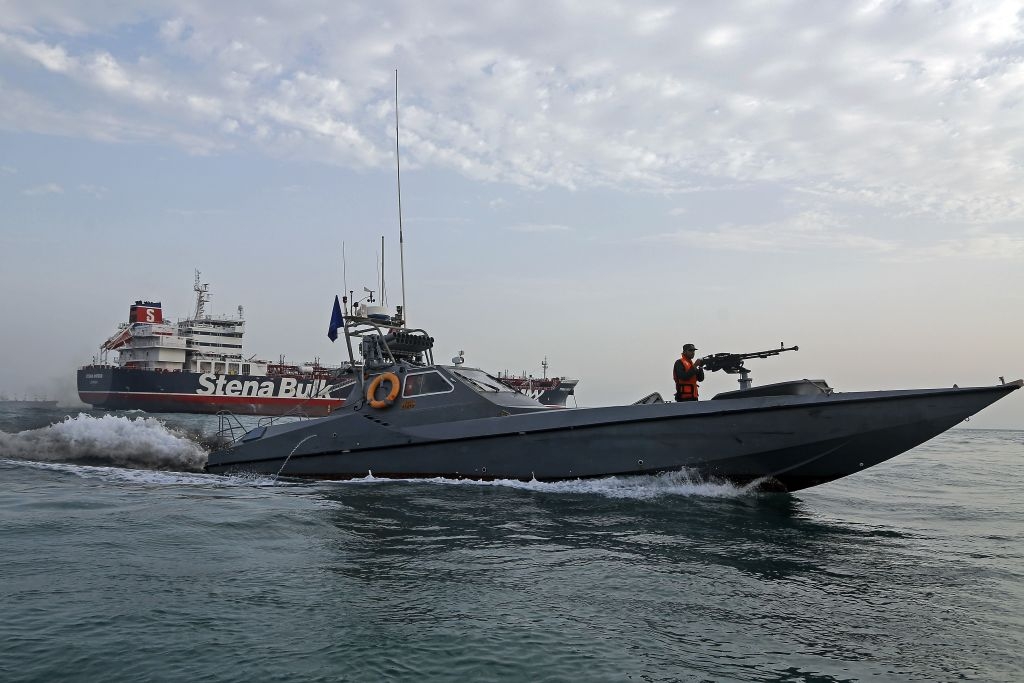
Iran's mullahs have threatened "dire consequences" if the US tries to stop its oil tankers from reaching Venezuela. Since the Islamic Republic lacks the naval power to escort the tankers right down to Venezuelan ports, its retaliation may come in the form of a seizure of one or more US oil tankers in the Strait of Hormuz. Pictured: Iranian Revolutionary Guards patrol around the British-flagged tanker Stena Impero on July 21, 2019, after Iran seized it and brought it to the port city of Bandar Abbas. (Photo by Hasan Shirvani/AFP via Getty Images)

Is a military clash between the United States and Iran inevitable? Since January, when the Americans assassinated Tehran's top general, Qassem Soleimani, policy circles in major capitals have grappled with the question without reaching a consensus.

At the time of this writing, the question is bouncing back as Iranian tankers carrying oil to Venezuela risk running into an American cordon designed to keep them away.

The mullahs have threatened "dire consequences" if the US does try to stop the tankers. Since the Islamic Republic lacks the naval power to escort the tankers right down to Venezuelan ports, the "dire consequences" would not come in the form of a naval battle in the Caribbean. Instead, as the daily Kayhan, expressing "Supreme Guide" Ali Khamenei's views, said in an editorial Monday, retaliation may come in the form of a seizure of one or more US oil tankers in the Strait of Hormuz. Another option is targeting all oil tankers in the waterway for a fixed period, as Iran did in 1988.

Heshmat-Allah Falahat Pisheh, a former chairman of the National Security Committee in the Islamic Majlis, Iran's ersatz parliament, argues that a clash is inevitable because the conflict between Tehran and Washington is "of a unique nature" that leaves no space for retreat by either side or an attempt at mediation by a third party. Thus, when tension reaches a certain point, the only way to relieve it is blowing up the top of the kettle.

Iranian sociologist Sa'id Mo'ayedfar advances a similar argument from a different angle. He claims the Khomeinist regime is aware that it is approaching its sell-by date and would do anything to delay the inevitable a bit longer. And that "anything" could include a short and sharp military clash with the US that could arouse Iranian patriotic feelings but leave the regime in place with a new veneer of legitimacy.

An analysis in FARS, a news-site of the Islamic Revolutionary Guard Corps (IRGC), also evokes the possibility of a clash by claiming that the US is too weak and too affected by the coronavirus crisis to look for a long war with the Islamic Republic. It quotes Nancy Pelosi, Speaker of the US House of Representatives, as saying that "people are starving all over America" and, thus, unwilling to be dragged into a foreign war. The site also quotes Barbara Slavin, described by Iranian media as a "leading American intellectual", saying that Tehran has already defeated President Trump's "maximum pressure" policy and thus, need not offer any concessions for fear of a military clash.

For weeks, Tehran media have thrown hints about an "October surprise" to derail Trump's second term election bid.

Despite all that, guess is that, barring an accident, there is going to be no military clash, not forgetting that Tehran's military, as shown with the downing of a Ukrainian passenger jet with three missiles, and the recent "friendly fire" tragedy in the Gulf of Oman, is accident-prone.

There are three reasons for this. The first is that the highest concern of the Khomeinist system, like other ideological regimes, is self-preservation.

No normal government would have signed the Brest-Litovsk treaty that Lenin ordered Trotsky to sign with the Germans, giving up almost all of Russia's European "possessions." Mao's Communist China swallowed the bitter pill of "normalization" with the American "paper tiger" after a drubbing at the hands of the Russians in the Wusuli River battle in 1969. Eight months later, Beijing started secret talks with Washington, with Iran and Pakistan as intermediaries. In 1991, fear of being targeted next forced Syria's President Hafez al-Assad to join the US-led invasion of Iraq.

Lenin's advice to his team in April 1918 about "hanging on for another 100 days no matter how" has been heard by many ideologues who may not be familiar with his story.

The second reason the mullahs will shy away from a military clash is that their regime is now at its weakest position in four decades. They may weather the economic storm triggered by the re-imposition of sanctions by freezing all development projects, raising prices of state-owned utilities, and selling the family silver at fire-sale prices. What they cannot cope with is a serious loss of legitimacy and the continued erosion of their support base.

The third reason why, the recent huffing and puffing notwithstanding, the mullahs may play their trump card, no pun intended, once again is that "Supreme Guide" Ali Khamenei now controls all levers of power as never before.

The trump card in question consists of the mullahs' tradition of surrendering at five minutes to midnight. Ayatollah Ruhallah Khomeini, the man who set up the regime, played the card every time his back was to the wall in 1980 and 1988.

Khamenei calls this "heroic flexibility" and has written extensively to give the tactic some theological mooring with references to Imam Hassan Ibn Ali.

Today, Khamenei no longer fears that his rivals within the ruling establishment may use normalization with the outside world, which cannot happen without some normalization with the US, as a weapon to their own advantage. Having carried out an extensive purge of the military, he has consolidated his position as the military's political face. On the clerical front, the mullahs who might have challenged him are either dead or too young to take him on openly. He has appointed his handpicked men to key positions of power and since the last Majlis election also has full control of an ersatz parliament which contained some unruly elements in the past.

Last week, the ayatollah called for the formation of a "young Hezbollahi government", serving notice that President Hassan Rouhani and his "New York Boys", now old and not Hezbollahi enough, are moving towards the exit.

Khamenei has compared his struggle with the American "Great Satan" with the Tom and Jerry conflicts in the word of Hollywood cartoons. On many occasions viewers think that the playful mouse is done for, only for him to dodge the cat and bounce back with a new trick.

Four decades of Tom & Jerry, Iranian-style, was made possible by the gullibility and impatience of Americans who always wanted quick results, took their wishes for reality, and allowed the mischievous/playful mouse to live another day for another adventure.

Will history repeat itself?
This article was originally published by Asharq al-Awsat

Amir Taheri was the executive editor-in-chief of the daily Kayhan in Iran from 1972 to 1979. He has worked at or written for innumerable publications, published eleven books, and has been a columnist for Asharq Al-Awsat since 1987. He is the Chairman of Gatestone Europe.

Source: https://www.gatestoneinstitute.org/16055/iran-tom-and-jerry

Follow Middle East and Terrorism on Twitter


U of Florida pro-Palestinian group falsely accuses “Zionists” of “ethnic cleansing” Palestinians from 1947 to 1949 - Robert Spencer

​
by Robert Spencer

None of that really happened, of course. Nor did any of Ihmoud’s other claims.


None of that really happened, of course. Nor did any of Ihmoud’s other claims. Israeli troops did not engage in “systematic massacres and evictions during the destruction of Palestinian villages in 1948.” As The Palestinian Delusion: The Catastrophic History of the Middle East Peace Process shows, the Arabs, for the most part, left Israel because they were ordered to do so by Muslim Arab leaders. The Arab Higher Committee actually exhorted Arabs to leave the new State of Israel, and they obeyed in large numbers.

This action had been contemplated for a considerable period: in May 1946, fully two years before the State of Israel proclaimed its independence, Abdul Rahman Hassan Azzam, secretary-general of the Arab League, stated that “Arab circles proposed to evacuate all Arab women and children from Palestine and send them to neighboring countries, to declare ‘Jehad’ and to consider Palestine a war zone.”

When the war came, many of the Arab Muslims left of their own accord, to the consternation of others who were determined to wage jihad. The Arab newspaper Ash Sha’ab, based in Jaffa, lamented on January 30, 1948, that “the first group of our fifth column consists of those who abandon their houses and businesses and go to live else- where…. At the first sign of trouble they take to their heels to escape sharing the burden of struggle [jihad].”

Others left because the plan to get the Arabs out of harm’s way until the Jews were destroyed and Israel was defeated was being implemented. The Economist magazine reported on October 3, 1948: “Of the 62,000 Arabs who formerly lived in Haifa not more than 5,000 or 6,000 remained. Various factors influenced their decision to seek safety in flight. There is but little doubt that the most potent of the factors were the announcements made over the air by the Higher Arab Executive, urging the Arabs to quit…. It was clearly intimated that those Arabs who remained in Haifa and accepted Jewish protection would be regarded as renegades.”

The Jordanian daily Falastin complained on February 19, 1949, that “the Arab state which had encouraged the Palestine Arabs to leave their homes temporarily in order to be out of the way of the Arab invasion armies, have failed to keep their promise to help these refugees.”

The Near East Arabic Broadcasting Station confirmed this on April 3, 1949: “It must not be forgotten that the Arab Higher Committee encouraged the refugees’ flight from their homes in Jaffa, Haifa, and Jerusalem.” The Egyptian daily Akhbar el Yom on October 12, 1963, reported that the grand mufti had issued the same call to Arabs to leave: “The 15th May, 1948, arrived…. On that day the mufti of Jerusalem appealed to the Arabs of Palestine to leave the country, because the Arab armies were about to enter and fight in their stead.”

The Jordanian daily Al Urdun reported on April 9, 1953: “For the flight and fall of the other villages it is our leaders who are responsible because of their dissemination of rumors exaggerating Jewish crimes and describing them as atrocities in order to inflame the Arabs…. By spreading rumors of Jewish atrocities, killings of women and children etc., they instilled fear and terror in the hearts of the Arabs in Palestine, until they fled leaving their homes and properties to the enemy.”


“U. of Florida Pro-Palestine Club Posts Antisemitic Messages to Social Media,” by Tom Ciccotta, Breitbart, May 17, 2020:
The University of Florida’s chapter of Students for Justice in Palestine posted several antisemitic messages on Instagram this week. The group previously came under fire after they were accused of hurling antisemitic remarks at a campus guest lecturer from the Israeli Defense Force.
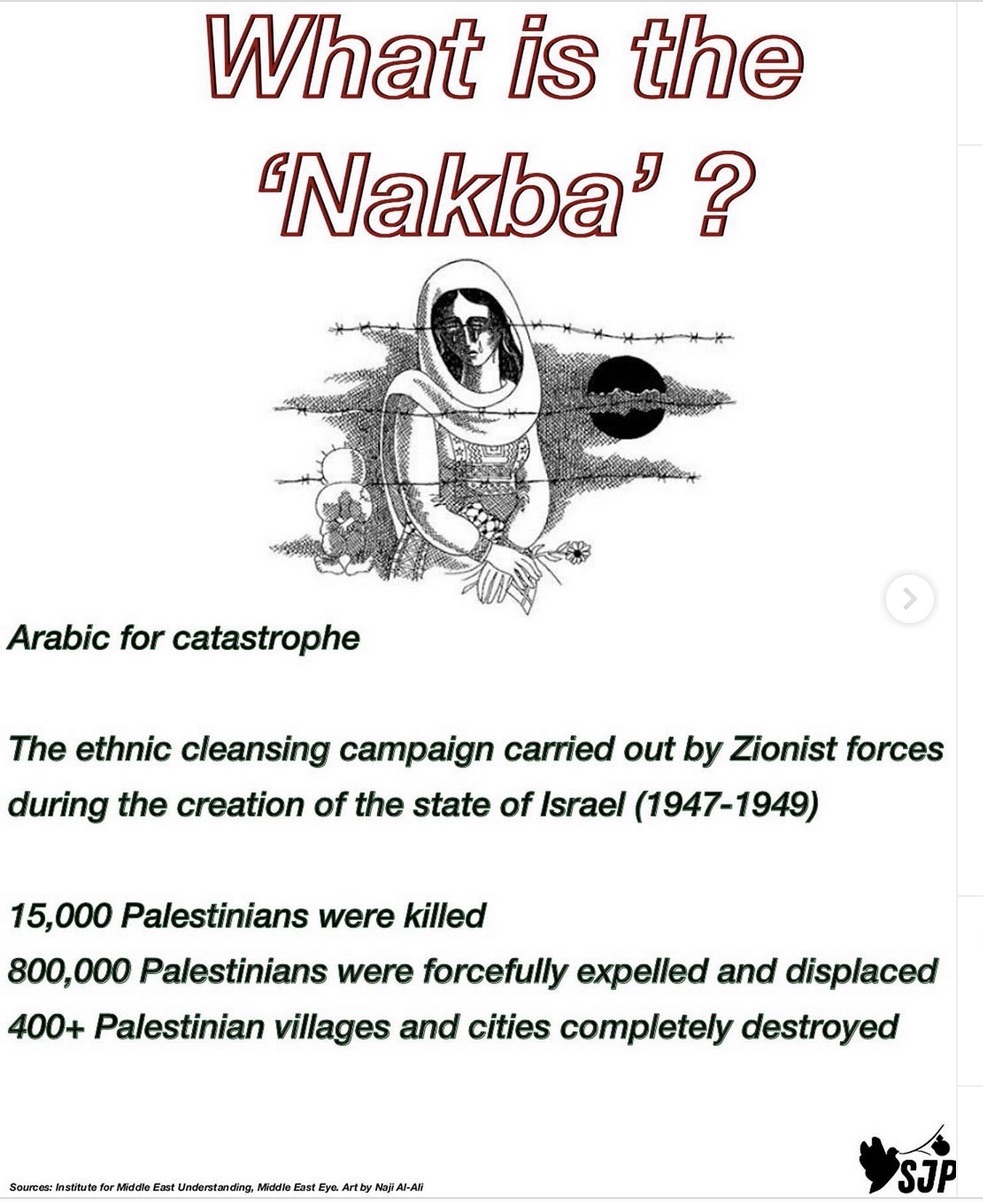
The Students for Justice in Palestine at the University of Florida came under fire this week for a post on Instagram that accused “Zionist forces” of engaging in an “ethnic cleansing” of Palestinians between 1947 and 1949.
“Rooted in 19th century Zionist thought that called for the est. of a Jewish state on indigenous Palestinian land. Passed in Nov. 1947, UN Resolution 181 divided land between Palestinians and Jews. In March 1948, the Plan Dalet military strategy enforced by Israeli Parliamentary force that called for the “destruction of villages,’” the Instagram post from Friday reads.
Student protesters from the Students for Justice in Palestine reported hurled anti-semitic remarks at guest lecturer Yoni Michanie, an Israeli Defense Force reserve member during an event in November. The protesters reported called Michanie a “Nazi” and a “war criminal” during the event. Michanie shared a video from the event on Twitter in November….

Robert Spencer

Source: https://www.jihadwatch.org/2020/05/u-of-florida-pro-palestinian-group-falsely-accuses-zionists-of-ethnic-cleansing-palestinians-from-1947-to-1949

Follow Middle East and Terrorism on Twitter