Sunday, August 9, 2020

The Nasrallah myth is no more - Prof. Eyal Zisser

​
by Prof. Eyal Zisser

Hezbollah leader Hassan Nasrallah is no longer regarded as the unbeatable "defender of Lebanon." This makes him a wounded animal, and his weakness could impair his judgment.

The city of Beirut has known its share of protests. Beginning with Hezbollah supporters hailing their leader, Hassan Nasrallah, who calls for the destruction of Israel, to the throngs of Lebanese citizens decrying the murder of former Prime Minister Rafik Hariri in the spring of 2005, to the protests last winter, upon the outbreak of the coronavirus pandemic, when Lebanese youth took to the streets to voice their economic distress and demand profound governmental reform.

However, it's likely that Beirut has never seen a more justified and necessary protest than the one that erupted on Saturday, targeting corrupt politicians and demanding punishment for those responsible for the blast at Beirut port last week.

According to reports out of Beirut, the government was quick to arrest the port's manager and several of his deputies, but the protesters are unwilling to suffice with that and want the country's leaders, the same corrupt and rotten elites who have ruled over Lebanon from its inception, to face the music as well.

Hezbollah is counted among this ruling class, chiefly the group's leader, Hassan Nasrallah. Hezbollah's representatives have been part of various governments for around two decades, presiding over key ministries, and now Nasrallah is brazenly claiming he didn't know, see or hear a thing. In his speech on Friday, Nasrallah even tried to divert the conversation from the Beirut port to the Haifa port. But for the people of Lebanon, and even his fellow Shiites, Israel isn't remotely part of this conversation. Far more important to them is their lives and futures, which have been ruined and imperiled thanks to Nasrallah and his cohort.

It's not surprising that Hezbollah's Al-Manar television network has completely ignored the protests; further displaying the "credibility" that Israelis seem to love attributing to the terrorist organization and its leader. Al-Mayadeen, meanwhile, another network under Hezbollah's thumb, reported that the Zionist lobby in Washington is behind the protests in Beirut. It's no wonder that Hezbollah members tried forcibly dispersing the demonstrators, even opening fire on them.

With that, this spontaneous revolt is bereft of leaders or a large organizing force behind it, and doesn't have a concrete goal beyond the desire to oust the corrupt politicians and change the system. It's difficult, therefore, to assume they will now succeed where they've failed before.

The politicians are playing their customary joker card against the protesters: dispersing the government and calling for elections. They know that after elections they will return strengthened to their positions of power. After all, Lebanon is an ethnic and clan-based country, divided and splintered. Although the current protest appears sectorial in nature, Hezbollah's traditional Shiite and even Druze support base are extremely unhappy with Nasrallah. Yet, on election day, with no better choice and lacking any true alternative, they will continue to back him.

Regardless, one should not downplay the sight of Nasrallah's effigy being "hanged" in Beirut's Martyrs' Square on Saturday. Is this the beginning of the end for him? It's impossible to say, but it's certainly the end of the myth of the "defender of Lebanon" and the beguiling, unbeatable politician. In any case, this makes Nasrallah a wounded animal, and his weakness could impair his judgment.


Prof. Eyal Zisser

Source: https://www.israelhayom.com/opinions/the-nasrallah-myth-is-no-more/

Follow Middle East and Terrorism on Twitter


The Reverse-Colonization of France - Guy Millière

​
by Guy Millière

"France is undergoing reverse colonization. Populations coming mainly from countries formerly colonized by France have settled in France without any intention of integrating."

  • Asking the police not to give the name of killers is an attempt to hide the truth and prevent the public from knowing exactly who in France is committing these acts. Hiding the name shows a desire to appease the killers: when a killer has a Christian name, it is immediately printed on the front page.
  • "We only love what hates us, anything that destroys us is seen as great. There is a desire to destroy truth, history... We no longer teach the history of France and we no longer say what our civilization has accomplished. We only talk about our civilization to disparage it." — Michel Onfray, Le Salon Beige, July 30, 2020 and YouTube, July 17, 2020.
  • "France is undergoing reverse colonization. Populations coming mainly from countries formerly colonized by France have settled in France without any intention of integrating. Most of them live in neighborhoods where the laws of Islam now reign and where imams spread hatred of France.... And in a gesture of submission, the French authorities say that hatred does not emanate from those who kill, but from those who want to react and say that we must put an end to assaults and murders. It is a suicidal attitude." — Éric Zemmour, YouTube, November 22, 2016.

On July 4, on a small road in Lot-et-Garonne, in southwest France, a young gendarme, Mélanie Lemée, age 25, tried to stop Yacine E., a driver who was speeding. He accelerated and deliberately crushed her. She was killed instantly. Pictured: Gendarmes carry the coffin of Mélanie Lemée at her funeral in Merignac, near Bordeaux on July 9, 2020. (Photo by Philippe Lopez/AFP via Getty Images)

Lyon, the third largest city in France, July 20, 3 a.m. A middle-class neighborhood. A young woman walks her dog on a quiet street. A car arrives at high speed and crushes her dog. The driver stops, backs up, runs over the young woman and crushes her too. He goes forward again, at full speed, and drags her dead body half a mile. People awakened by the noise write down the license number of the car. The police officers who come to the scene are horrified. The young woman's body was dismembered. A leg was found on one side of the street; the rest of her body was shredded. One arm was close to the body of her dog. The other was still holding onto the dog's leash. Her name was Axelle Dorier. She was a nurse, only 23.

The French Department of Justice asked the police not to release the name of the killer. An anonymous policeman released it anyway on a social network site. The killer's name is Youssef T. He was driving under the influence, without a license. The prosecutor charged him with "reckless murder". He is in jail awaiting trial. He risks a maximum sentence of ten years. Residents of Lyon wanted to organize a peaceful march to pay tribute to the young nurse. They asked the government to get tough on crime. The young woman's parents objected: they said they have "have no hatred" for the killer.

This was not the only barbaric act in France during the month of July. On July 4, on a small road in Lot-et-Garonne, in southwest France, a young gendarme, Mélanie Lemée, age 25, tried to stop a driver who was speeding. He accelerated and deliberately crushed her. She was killed instantly. The other gendarmes at the scene quickly found the driver. One of them, a police officer, gave the name of the driver to a journalist. The driver's name is Yacine E. He too was driving under the influence, without a license. Mélanie Lemée's parents did agree to a peaceful march, but also said that they had "no hatred" for the murderer. They even added that they had compassion for him, because "his life is destroyed".

A third barbaric act occurred on July 5 in Bayonne, a small town in the French Basque area. A bus driver, Philippe Monguillot, age 59, refused to allow two young men to board without tickets and masks. The two young men immediately started beating him violently and forced him get out of his bus. Two more young men joined them and began beating him too. They left him on a sidewalk. He was covered in blood and dying. At the hospital, he was diagnosed with a cerebral coma. His relatives, who came to see him there, said his face had been completely destroyed. Two days later he died. The four killers, who are in prison, have been identified. Journalists knew their names but decided not to publish them. Police officers gave them out anyway: Mohamed C., Mohammed A., Moussa B., Selim Z. There was a peaceful march. Philippe Monguillot's wife said that her life is destroyed and that she doubts the courts will do their job.

Equally horrific acts, increasingly numerous, have been taking place every day in France, many times, for years. The perpetrators are usually young adults in their late teens or early twenties. All are immigrants from the Muslim world. They are not Islamists and have no political or religious motives. They generally show no remorse.

They are described by the psychiatrists examining them as "practicing gratuitous violence": a violence without a goal other than enjoying inflicting violence. They appear to have no respect for human life or for laws.

Maurice Berger, a psychiatrist assigned to treat young people of this kind, recently published a book, "Sur la violence gratuite en France" ("On Gratuitous Violence in France"). "Gratuitous violence", he writes, can now happen anytime, anywhere, and strike anyone. "An act of gratuitous violence," he notes, "occurs every 44 seconds in France.... Any citizen can be confronted by it. If you do not want to compromise your chances of survival, you should submit, look down, accept humiliation."

Sometimes, as with Axelle Dorier, submitting is not possible: she did not have any contact with her killer until the moment he crushed her. Sometimes -- if you are, say, a bus driver or part of the police force -- your job does not allow you to submit.

The families of the victims, however, can submit, and often do just that. They are then showered with congratulations from political authorities and the media. Days after the terrorist attack at the Bataclan Theater in Paris in 2015, Antoine Leiris, the husband of a woman horribly tortured and killed inside the music hall, posted a letter to the terrorists on Facebook. He said he understood their motives and does not hate them. He added that he is not angry and has to continue living his life. The letter was immediately shared by hundreds of thousands on social media. A publishing company asked the author of the letter to add elements to the letter and make it into a book. The book, called "Vous n'aurez pas ma haine" ("You Will Not Have My Hate"), became an instant bestseller.

The judicial authorities also look down and submit: it is what they do. Asking the police and the media not to give the name of killers is an attempt to hide the truth and prevent the public from knowing exactly who in France is committing these acts. Hiding the name shows a desire to appease the killers: when a killer has a Christian name, it is immediately printed on the front page. Hiding the name shows fear of the communities to which the killers belong and of anger among the rest of the French population.

The political authorities do the same. They know that Muslim votes matter more than ever. Commenting on the murders of Axelle Dorier, Mélanie Lemée and Philippe Monguillot, President Emmanuel Macron called them "incivilities" and "regrettable", then quickly fled to another subject. The new Minister of Justice, Eric Dupond-Moretti, a lawyer, responded to a journalist who asked him what he thought of those who asked the government to be tough on crime. "Justice," the minister replied, "must be the guarantor of social peace". His most important task right now, he added, was to secure the repatriation of French jihadists imprisoned in Syria and Iraq to France, "because they are French citizens and the duty of France is to ensure that they avoid the death penalty".

Only Marine Le Pen, leader of the rightist National Rally Party, sounded firmer:
"What level of barbarism must we reach for the French to say stop to this increasing savagery in our society? How many policemen, gendarmes, bus drivers, slaughtered young girls or boys does it take?"
Immediately, the mainstream media accused her of pouring fuel on the fire and being an irresponsible extremist.

"France is undergoing reverse colonization," commented a journalist, Éric Zemmour, on television.
"Populations coming mainly from countries formerly colonized by France have settled in France without any intention of integrating. Most of them live in neighborhoods where the laws of Islam now reign and where imams spread hatred of France. Successive governments have allowed these neighborhoods to grow in the belief that hatred of France and the French would not come out of these neighborhoods.
"The hatred of France and the French did come out and took the form of riots and terrorism. It now takes the form of assaults and murders: a generalized expression of hatred of France and the French. And in a gesture of submission, the French authorities say that hatred does not emanate from those who kill, but from those who want to react and say that we must put an end to assaults and murders. It is a suicidal attitude."
"France is in a coma and near death", Michel Onfray, an author and philosopher, said in an interview. The main sign, he said, was the disappearance of Christianity, on which are based the values ​​and ethics that have suffused the country for centuries. He noted that the churches are empty, the cathedrals burned down, and that the desecration of Christian places of worship is taking place and multiplying in in the face of general indifference. "Christianity is vanishing quickly," he added. "We are in an exhausted civilization. We only love what hates us, anything that destroys us is seen as great. There is a desire to destroy truth, history." He pointed to the root of the destruction: "We no longer teach the history of France and we no longer say what our civilization has accomplished. We only talk about our civilization to disparage it."

He concluded that he did not believe in a reawakening, but that he would fight to the end: "We must stand up, resist."

The number of anti-Jewish acts in France has grown in recent years. Tens of thousands of Jews have left, a wave of emigration that is gradually emptying France of its Jewish population. Many of the Jews who still live in France have abandoned the towns and neighborhoods where they used to live and moved to temporarily safer areas. Christians in France are considered infidels by the imams in the no-go zones; they are also easy prey for young men imbued with a hatred of France and the French, who are certainly not dissuaded by the submissive attitude of the authorities.

On May 30, in Paris, a demonstration was held of illegal immigrants, mostly from North- and sub-Saharan Africa. Although the demonstration had been banned by the government, the police were ordered not to intervene. Even though all the protesters were in violation of the law, only 92 participants were apprehended -- then quickly released. Two weeks later in Paris, another demonstration took place: in support of the family of Adama Traoré, an African criminal who died while violently resisting arrest. That demonstration was also banned by the government, and the police again ordered not to intervene. "Death to France," the protesters shouted, and sometimes, "Dirty Jews". Neither the government nor the mainstream media were shocked. French youths people belonging to Génération Identitaire (Generation Identity), a movement for the defense of France and Western civilization, stood on a roof and held up a banner saying, "Justice for the victims of anti-white racism". A man climbed on the roof of the building, in an apparent to destroy the banner. During interviews by television stations he was described for days as a hero of the "fight against fascism." The French youths who had held the banner, meanwhile, were arrested and charged with "incitement to hatred".

From June 16 to 18, in Dijon (population 156,000), the capital of Burgundy, street fights pitted a gang of Chechen drug traffickers against a gang of Arab drug traffickers. Military-grade weapons were used -- this in a country with no constitutional right to bear arms. The government once again asked the police not to intervene. The conflict was eventually settled in a mosque, under the supervision of imams. The police called for the residents of Dijon not to leave their homes and to be extremely careful until the fighting ended. The police made a few arrests, but only after the fighting had stopped.

On July 26, a ceremony was organized in Saint-Étienne-du-Rouvray, a small village in Normandy where, four years ago, 86-year-old Father Jacques Hamel was murdered by two young Islamists while he was conducting mass. This year, Interior Minister Gerard Darmanin delivered a speech condemning "Islamic barbarity". "Killing a priest, in the heart of a church," he said, "is to try to assassinate a part of the national soul". He did not say that during the murder, the church had been almost empty, with only four elderly congregants who witnessed the murder helplessly. Darmanin, nevertheless, did add how satisfied he was that the French had not given in to anger but instead had chosen "peace".

Dr. Guy Millière, a professor at the University of Paris, is the author of 27 books on France and Europe.

Source: https://www.gatestoneinstitute.org/16327/france-colonization

Follow Middle East and Terrorism on Twitter



Swirling corruption in Illinois, the state that brought us Obama - Jack Hellner

​
by Jack Hellner

Is Obama really separate from all the news of corruption now rolling out of Illinois?


In Illinois, the speaker of the house, Michael "King" Madigan is being investigated for a massive kickback scheme with Commonwealth Edison. It seems that in order for Commonwealth to get favorable legislation, that they had to pay the king with no-show jobs, board seats and hiring lobbyists. Commonwealth is now pretending that these kickbacks didn’t harm consumers.
Could ComEd Customers Get Reimbursed for ‘Wrongfully Inflated Rates’?
“From 2011 through the present day, millions of individuals and businesses owning or leasing property and operating businesses in the State of Illinois were unknowing victims of a vast and corrupt criminal scheme perpetrated by the State’s largest utility company,” the complaint reads.
But in a statement, ComEd spokesman Paul Elsberg said: “The improper conduct described in the deferred prosecution agreement, however, does not mean that consumers were harmed by the legislation that was passed in Illinois
Now, 202 years after Illinois became a state and 50 years after King Madigan took office, Illinois, for the umpteenth time, after corrupt politicians are caught with their hand in the cookie jar, is going to focus on ethics legislation. Anyone who believes Madigan or Democrats care about ethics needs their head examined.

Every journalist and other Democrat in Illinois knows Madigan controls everything that passes and doesn’t pass. He rewards his supporters with taxpayer-funded raises and pension increases as well as with committee chairmanships that are worthless because Madigan controls everything. He also seems to have judges at his beck and call who keep independent redistricting and term limits off the ballot no matter how many signatures the public gets.
Madigan’s rules: How Illinois gives its House speaker power to manipulate and control the legislative process
But there’s another source of power the majority party of Illinois holds that allows its leaders a more underhanded influence over the legislative process and, ultimately, the daily lives of Illinoisans.
That power emanates from the little-known legislative rules that Illinois House of Representatives Speaker Mike Madigan – who’s held that position for more than 31 years since 1983 – uses on an everyday basis to orchestrate the legislative and political outcomes he wants.
Those rules allow Madigan to influence the makeup of legislative committees; how lawmakers vote; and when, if ever, the bills get voted on. But the most obstructive rule of all keeps bills – even those with popular support, such as term limits – from ever seeing the light of day. Madigan, and not the General Assembly, has the power to decide what has the chance to become law.
Virtually no state grants the types of powers to its legislative heads that Illinois grants to Madigan.
I haven’t seen any journalist ask Illinois Sen. Dick Durbin or Illinois Sen. Tammy Duckworth to demand Madigan resign as head of the Illinois Democrat Party or as speaker. They obviously don’t care.

If journalists and other Democrats truly cared about ethics, corruption and the rule of law they would not have elected a billionaire who committed fraud to save property taxes.

A billionaire who takes toilets out of one of his mansions to save $300,000 does not give a damn about ethics, corruption or paying his fair share, which he always talks about. In effect Pritzker stole money from teachers, the police, firemen, pensions and other taxing bodies to save peanuts for him. It doesn’t make a bit of difference that he paid it back after he was caught and was running for governor. A bank robber who pays the loot back still goes to jail. Why not someone who intentionally stole $300,000?
Cook County watchdog says 'scheme to defraud' saved Pritzker $330,000 in property taxes
Billionaire Democratic governor candidate J.B. Pritzker improperly received $330,000 in property tax breaks on one of his Gold Coast mansions as part of a “scheme to defraud” taxpayers, Cook County’s top watchdog concluded.
If journalists and other Democrats cared about electing an honest man as U.S. senator and president twice they would have never supported the corrupt Barack Obama. The stories of corruption are endless. He was clearly part of the corrupt Chicago political machine.

Anyone who dared point out Obama’s actions, policies or acquaintances were subject to being called racists by all the campaign workers posing as journalists. The media also didn’t care about anything Biden had done.

See the link?
Former Obama fundraiser Rezko gets 10-year sentence
...and these, too:
POLITICS: Obama and the Integrity Gap: The Machine
Obama Kick-Back Cronyism - Part 2: Illinois Health And Human Disservices
The President’s Utility: Crony capitalism in Chicago turns “green” into greenbacks
What do you get when you elect a corrupt, unethical man as President and join him with a career swamp creature as vice president (Joe Biden) who has spent his entire adult life enriching himself and his family while feasting from the public trough? You get the most corrupt, unethical, lawless administration in our lifetime. The corruption and lawlessness was compounded because Obama/Biden had co-conspirators in the media and with elected officials in the House and Senate such as Nancy Pelosi, Harry Reid, Chuck Schumer, Adam Schiff, Jerry Nadler, Dick Durbin, Steny Hoyer and other swamp creatures who covered up the lawless acts and act as if the Obama/Biden administration was pure as the driven snow.

It is no surprise that the corruption and lawlessness started as soon as they took office.


Jack Hellner

Source: https://www.americanthinker.com/blog/2020/08/swirling_corruption_in_illinois_the_state_that_brought_us_obama.html

Follow Middle East and Terrorism on Twitter


Trump’s triumphant-end run around the Democrats - Andrea Widburg

​
by Andrea Widburg

Between executive orders giving Americans economic relief, and a phenomenal press conference, Trump undercut and called out the greedy Democrats.


Animals that are ambush hunters tend to be very still until they have their prey where they want them. Then, the ambush hunter is an explosion of efficient motion and the prey . . . well, the prey is toast. With Saturday’s executive orders and press conference, Trump proved himself to be a masterful ambush hunter, and the Democrats found themselves being hapless prey.

As with so many of their initiatives in 2020, the Democrats got greedy. Time and time again, they’ve used the excuse of the Wuhan virus and George Floyd’s death to advance hard-left policies unrelated either to the virus or to the exceedingly rare instances when American police wantonly kill black men.

When the virus first appeared, Trump, in good faith, allowed Fauci to lead him down the primrose path. This meant giving in to, and signing off on, the Democrats’ demands for stimulus bills. His agreement made the Democrats foolhardy. With the economy on life support, deaths from the virus dropping, and Americans desperately wanting to go back to work, the Democrats decided that they could again lard the latest stimulus bill with all manner of things. They assumed Trump would be either trapped or compliant.

What they hadn’t realized was that Trump, like a cat watching a rat draw near, was just waiting for the right moment to spring. Saturday was that day. In the kind of press conference that helps win elections, Trump explained that he was cutting through the Democrats’ ridiculous negotiating tactics and using his executive power to bring relief directly to Americans. Here’s the entire press conference, including his walking away at the end when CBS’s shrewish and disrespectful Paula Reid refuses to stop screaming questions at him:


The executive orders Trump signed do four things:
  1. Create a payroll tax holiday for Americans earning less than $100,000 annually. The executive order will be retroactive to August 1 and end on December 31, putting more money in employees’ pockets.
  2. Continue enhanced unemployment benefits at $400 per week, which is $200 less than the Democrats were demanding, which Trump alleges (probably correctly) makes going back to work more attractive.
  3. Extend the eviction moratorium on federal subsidized housing.
  4. Suspend student loan payments. (It’s to be hoped that Trump will not ultimately endorse Elizabeth Warren’s demand that the Wuhan virus should be used as an excuse to forgive all student loans. If someone was stupid enough to get a $300,000 gender studies degree, taxpayers should not be on the hook.)
As Trump acknowledged to reporters in the Q-and-A session, the Democrats will sue but it won’t be a good look for them. The moment Trump announced his executive orders, psychology says that Americans immediately felt ownership of these benefits. They’ll resent any effort to reverse them and will be unimpressed by arguments about executive overreach -- especially because all that the Republicans have to say is “Dreamers” and “DACA” to show how hypocritical Democrats are being.

Trump also explained to Americans that he had to sign these executive orders because the Democrats’ demands were “ridiculous.”


Even people who aren’t huge Trump fans were impressed. Paul Mirengoff, who can’t warm up to Trump but knows he’s better than Biden, called Trump’s actions on Saturday a “political masterstroke.” While Mirengoff is concerned, as everyone should be, about executive overreach (something at which Obama excelled), he recognizes the political strength behind Trump’s having emerged suddenly and overwhelmed the Democrats:
[A]s a political matter, Trump’s move looks like a masterstroke. Since the days of FDR, the public has always seemed to approve of presidents who act to ameliorate suffering while Congress diddles. A flurry of activity, even of the futile or potentially counterproductive kind, makes a president look energetic and caring.
People who underestimate Trump routinely do so at their peril. Everything he does is calculated, including tweets that send his political opponents scurrying around like cats chasing a light while he’s getting things done to help the American people.


Image: White House YouTube screengrab


Andrea Widburg

Source: https://www.americanthinker.com/blog/2020/08/trumps_triumphantend_run_around_the_democrats.html

Follow Middle East and Terrorism on Twitter


Lebanon: Ancient synagogue destroyed 'beyond repair' - Arutz Sheva Staff

​
by Arutz Sheva Staff

The only remaining synagogue in the country, Beit Abraham, was severely damaged and it's doubtful whether it can be restored.


Maghen Abraham synagogue in Beirut
Maghen Abraham synagogue in Beirut                                                                    REUTERS
In Lebanon, new updates continue to roll in regarding the heavy damage caused by the explosion in the port of Beirut last week. According to local reports, the only remaining synagogue in the country, Maghen Abraham, was badly damaged and it is now doubtful whether it can be restored.

The synagogue has been inactive for years, but Lebanese authorities have preserved it as a historic site. It's located in the Wadi Abu Jamil district in downtown Beirut, where the city's Jewish quarter used to stand, a few kilometers from the port of Beirut.

Built in 1925, it is the oldest Jewish house of worship in the Lebanese capital, and was named after the son of Abraham Sassoon, Moise Abraham Sassoon of Calcutta. It was built on land donated by Raphael Levi Stambouli, and designed by the architect Bindo Manham.

Due to difficulties in financing the project, the head of the Jewish community of Lebanon, Yosef Farhi, ended up assisting with the purchase of religious items as well as the inside structure of the building. A number of social institutions situated their offices in the synagogue's courtyard.

In 1936, due to the ongoing fighting, Yosef Farhi decided to transfer the Torah scrolls to Geneva, entrusting them to Edmond J. Safra, a Jewish banker of Lebanese descent, who kept them in his safes.

Lebanon's Jewish community once numbered up to 22,000, when the country served as a refuge for those who fled the Spanish Inquisition. But Jews fled the country during the 20th century, until finally even the Maghen Abraham Synagogue closed its doors in the mid-1970s.

After 1951, only two Jews remained in the Wadi Abu Jamil area of ​​Beirut, just 60 in the entire country, with the once-prominent community virtually ceasing to exist. In 1976, a year after the civil war began, the synagogue closed, and the Torah scrolls were taken to Geneva, where they were given to renowned Jewish-Lebanese banker Edmond Safra. There they were placed in Safra's bank vault, where they were stored until they were eventually relocated to Sephardic synagogues in Israel.

At the end of the civil war, Lebanese Prime Minister Rafic Hariri decided to rehabilitate the synagogue and surround it with a garden. The plan did not materialize, but the synagogue is considered a historical site.


Arutz Sheva Staff

Source: http://www.israelnationalnews.com/News/News.aspx/284967

Follow Middle East and Terrorism on Twitter


US Ambassador David Friedman heads to Washington for marathon talks on sovereignty - Arutz Sheva Staff

​
by Arutz Sheva Staff

US Ambassador reportedly heads to Washington in bid to reach agreement for Israel's application of sovereignty over parts of Judea, Samaria.


Mike Pompeo with David Friedman
Mike Pompeo with David Friedman                                                                                 Reuters
US Ambassador to Israel David Friedman has left Israel for marathon talks in Washington DC aimed at reaching an agreement on Israel’s sovereignty plan, according to a report by Channel 12 Sunday.

The report claimed that Friedman will be in Washington for two weeks to discuss the future of Israeli Prime Minister Binyamin Netanyahu’s plan to apply Israeli law over parts of Judea and Samaria within the framework of the Trump administration’s Middle East peace plan.

A source within the US embassy in Israel said in response that Friedman had left the country for “personal leave”.

"The Ambassador is out of the country on personal leave. We don’t comment on internal US government policy deliberations. We remain committed to supporting the President’s Vision for Peace as laid out in January.”

Netanyahu’s sovereignty plan, which was supposed to be brought to the government at the beginning of July, has not yet been formally proposed.

Last week, Netanyahu hinted that the sovereignty plan was being held up due to an inability to reach an agreement with the Trump administration over the parameters of the plan.

"For me, the application of sovereignty has not been dropped from the agenda - it depends on the White House," Netanyahu told Likud lawmakers at a faction meeting.


Arutz Sheva Staff

Source: http://www.israelnationalnews.com/News/News.aspx/284968

Follow Middle East and Terrorism on Twitter


When Memory Becomes a Prison of Nations - Amir Taheri

​
by Amir Taheri

Algerian leaders have tried to divert attention from their own shortcomings, not to say misdeeds.

  • Keeping alive the narrative of victimhood, successive Algerian leaders have tried to divert attention from their own shortcomings, not to say misdeeds.
  • Covering the 1990s troubles in Algeria, I was often told by Algerian politicians of all colors that all of their country's troubles, including terrorism in the name of religion and police brutality, were due to French colonial rule. After a while... I suggested to Algerian interlocutors to fix a certain date up to which everything was the fault of the French but after that regard Algerians as responsible for their own troubles.

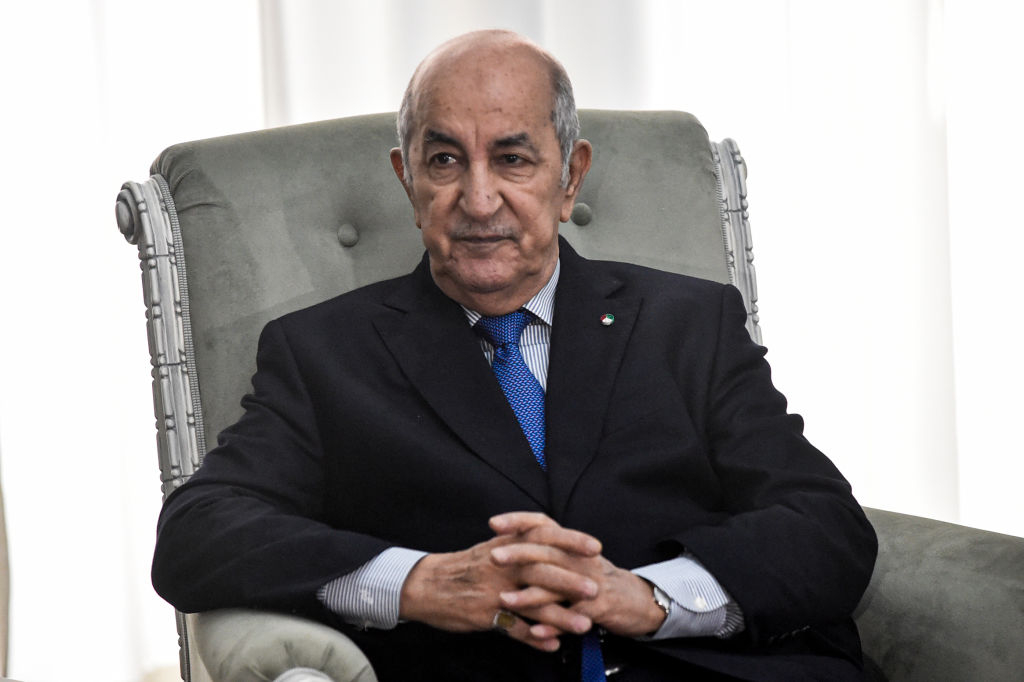
Keeping alive the narrative of victimhood, successive Algerian leaders have tried to divert attention from their own shortcomings, not to say misdeeds. Pictured: Algerian President Abdul-Majid Tebboune. (Photo by Ryad Kramdi/AFP via Getty Images)

Should the writing of history be treated as a governmental project? French President Emmanuel Macron and his Algerian counterpart Abdul-Majid Tebboune seem to think so. They have ordered the creation of a joint commission to write the history of relations between the two countries since the French annexed that strand of North Africa in 1832.

Macron and Tebboune are not the first rulers to seek an officially vetted and approved narrative of our human story. However, their case is unique because other rulers just wanted to tell their side of the story while Macron and Tebboune demand a two-voices, presumably parallel, narrative.

There is one more difference between the old official histories and what we are likely to see this time. Old official histories were often presented with the modesty they merited as chronologies. And because they carried a heavy load of hagiography, they never pretended to be scientific. Macron and Tebboune, of course are not looking for props to build a cult of personality with. However, they may be seeking something even less dignified: the presentation of history in the colors of current, and necessarily transient, fads of political correctness.

Macron has already shown those colors by stating that colonialism was "a crime against humanity". Benjamin Stora, the historian chosen to represent the French side, goes even further by labelling colonization as "violent, unequal and illegal."

Tebboune, for his part, has cast Algeria as a helpless and innocent victim of imperialism.

What Macron does not realize, or perhaps chooses to ignore, is that because colonization has been a constant feature of history from the start, we might suggest that mankind has always lived in the context of a crime against humanity. When they invaded Gaul, the Franks, a Germanic tribe, were colonizers who subdued the natives by force, imposed their language and culture on them, and ended up giving their own name to the country they had colonized. Even on the eve of the French Revolution, only 12 percent of the population had French as mother tongue, although most used it as lingua franca.

In any case, the concept of crime against humanity is a new one, having taken shape in the aftermath of World War II and to apply it retrospectively would be confusing at best and dishonest at worst.

President Tebboune might also want to rethink his victimhood narrative. To imply that the Algerian people, in their rich diversity, were nothing but objects in their own history for some 130 years is not very flattering.

The French could not have colonized Algeria without the participation of large chunks, perhaps even a majority, of the population. Tens of thousands of Algerians of all ethnicities helped the French build the infrastructure needed for a colonial presence. Algiers, a beautifully French-style city, was built by Algerian labor supervised by the French.

Over the decades, large numbers of Algerians who served in the French armies fought in two world wars and a number of colonial wars, notably in Indochina. In the meantime, Algerians of all ethnicities adopted French as their lingua franca creating a rich literature and press. Algerian friends tell me that they regarded the French language as "war booty", presumably the same as English, which has made India the largest English-speaking country in the world.

Writing or re-writing history should not be a means of making the French of today feel guilty or humiliating today's Algerians.

Stora says the Macron-Tebboune project aims at a reconciliation of memories. This means imposing a single monochord narrative that, rather than fostering reconciliation, could injure everyone's memory. The nostalgia-stricken adepts of Algérie française (French Algeria), the Harkis driven out of their homes and made stateless for decades, the Pied-noir (black foot) settlers who had been born and bred in Algeria for generations, would not have the same memories as the thousands of Algerian freedom fighters who were tortured by the French or the many more Kabyle and Arab peasants who had their villages burned by colonialists.

Keeping alive the narrative of victimhood, successive Algerian leaders have tried to divert attention from their own shortcomings, not to say misdeeds. Covering the 1990s troubles in Algeria, I was often told by Algerian politicians of all colors that all of their country's troubles, including terrorism in the name of religion and police brutality, were due to French colonial rule. After a while, having gotten tired of that shibboleth, I suggested to Algerian interlocutors to fix a certain date up to which everything was the fault of the French but after that regard Algerians as responsible for their own troubles.

Almost two decades later, that suggestion has not gone anywhere. The new project is partly designed to "probe the colonial roots of Algeria's socio-economic problems" as if six decades of independence didn't count.

Can governments play a role in the writing of history?

The answer is yes. The first thing they need to do is to refrain from trying to dictate history. Next, they could make their archives accessible to researchers. They could also loosen the rules of "official secrets acts" to make as many "sensitive" documents as possible available for scrutiny.

Interviews with officials could also help provided they are not under gag orders. In some cases, especially in closed societies, granting visas to historians could also help.

Above all, governments should not use the writing of history as a means of advancing partisan political aims, noble or ignoble. To say that the object of the Macron-Tebboune project is "reconciliation" is an abuse of history for a laudable political aim. If France and Algeria need reconciliation, Macron and Tebboune should find their ways of achieving their objective, leaving history alone to do its work.

In any case, as an outsider but a friend of both sides, I don't think France and Algeria need reconciliation. Millions of French citizens of Algerian descent provide a human bond that is rare between any other two nations.

Today's French, many of whom, descendants of European and other immigrants over the past century, were in no way involved in the conquest of Algeria or anywhere else, and thus have nothing to apologize for unless today's Germans also apologize for the invasion of Gaul by the Franks. Today's Algerians also have no need of masquerading victimhood because, looking to the future, they don't want to become prisoners of the past.
This article was originally published by Asharq al-Awsat

Amir Taheri was the executive editor-in-chief of the daily Kayhan in Iran from 1972 to 1979. He has worked at or written for innumerable publications, published eleven books, and has been a columnist for Asharq Al-Awsat since 1987. He is the Chairman of Gatestone Europe.

Source: https://www.gatestoneinstitute.org/16328/algeria-france-history

Follow Middle East and Terrorism on Twitter


Cancel Culture and the Jewish Experience - Dr. Manfred Gerstenfeld

​
by Dr. Manfred Gerstenfeld

Jews have been the targets of cancel culture for centuries, long before anyone formulated the expression. 

BESA Center Perspectives Paper No. 1,683, August 9, 2020

EXECUTIVE SUMMARY: Cancel culture—the denial to certain people of any platform on which to express their side of an issue—has become more and more accepted in public debate. It led to a letter decrying it by more than 150 writers and intellectuals in Harper’s Magazine. But the signatories never saw fit to object to the longstanding anti-Israeli and anti-Jewish cancel culture that exists at many Western universities. The letter offers no operational conclusions, though a logical one would be the reformulation of the First Amendment of the US Constitution to make hate speech punishable by law.

In recent years the term “cancel culture” has become more and accepted in public debate. It means denying someone a platform on which to express his or her opinion, and often entails boycotts of people or companies because they have done or said something deemed objectionable. As Western societies grow increasingly polarized, this trend is likely to worsen.

The popularity of cancel culture led to a letter against it signed by more than 150 writers and intellectuals and published in Harper’s Magazine. The signatories are a varied group: they include philosopher Francis Fukuyama, anti-American academic and self-hating Jew Noam Chomsky, J.K. Rowling of Harry Potter fame, Canadian novelist Margaret Atwood, former leader of the Canadian liberal party Michael Ignatieff, and veteran feminist leader Gloria Steinem.

Salman Rushdie, a British-Indian novelist, is a remarkable signatory. He was the victim of an ultimate form of cancel culture. In 1989, the then spiritual leader of Iran, Ayatollah Ruhollah Khomeini, condemned his book The Satanic Verses and issued a fatwa (a Muslim legal opinion) offering a reward to anyone who assassinated Rushdie.

The letter in Harper’s speaks out against the “intolerant climate that has set in on all sides” and “the censoriousness [that is] more widely spreading in our culture.” Examples given are “intolerance of opposing views, a vogue for public shaming and ostracism, and the tendency to dissolve complex policy issues in a blinding moral certainty.”

For anyone familiar with the history of antisemitism, this letter suggests a very late awakening by the signatories. Jews have been the targets of cancel culture for centuries, long before anyone formulated the expression. Antisemitism has been part of Christian culture for more than 1,500 years. It dates back as least as far as the 5th century, when the prominent Church father Augustine of Hippo in North Africa said it was good that the Jews survived because it would show how inferior they were to Christians.

Decades before Nazism became dominant in Germany, Jews were not admitted to certain positions there and in other European countries. Today, with antisemitism manifesting itself predominantly as anti-Israelism, there have been many attempts worldwide to boycott Israel.

Long before cancel culture became a well-known term, Arabs were boycotting Jews. A boycott of Jewish businesses in Palestine was decided upon at a meeting of the Fifth Arab Congress in Nablus in 1922. A similar call was made by the First Palestine Arab Women’s Congress in October 1929. Other Arab boycotts followed in the 1930s. After Israel was created, a major Arab boycott targeted not only Israel but also foreign governments, companies, and organizations with ties to Israel.

The Jews are usually the first to be affected by cancel culture, but they are rarely the last. In 2007, I edited the book Academics Against Israel and the Jews. The foreword was written by former Israeli minister Natan Sharansky, who cited multiple examples of what we would now call attempts by cancel culture to target Jews.
He wrote:
When I was minister I visited many dozens of university campuses abroad to gain firsthand knowledge of the defamation of Israel and the discrimination against those who support it in the academic world as well as to encourage the resistance of activists.
At Harvard Business School (of all places) a student told me that if she signed the open letter against divestment from Israel some of her professors would not like it—and that this would affect her grades. She added: “I am a very good student about to complete my thesis. These professors may consider my pro-Israeli position when giving me marks, which in turn can influence my career. It is better for me to wait and only afterward speak out in favor of Israel.”
On a Canadian campus, a student said to me: “In the past when I was active for Israel, I was often criticized and lost many friends. Now I promote ecological agriculture, and everybody loves me.” These types of remarks I heard again and again on different campuses in Western countries. They reminded me of communist rule. We were called the Jews of silence because we were not supposed to express our opinions, yet some courageous people did speak out. It is very worrying to see that some in the free world volunteer to be Jews of silence.
Through meetings like these I saw how the system functions. Israel’s enemies on campus are so powerful because they feel that the progressive world, the media, and intellectual powers support them. They are not interested in the truth and can propagate lies because few challenge them or even check what they say.
Cancel culture’s hostility to pro-Israeli thought at universities is well-known. Throughout universities in the US, Canada, Great Britain, and elsewhere, cancel culture against Israel and harassment of pro-Israeli students has flourished. This is a sign of the widespread degeneration of academics, in particular in the humanities and social sciences.

This version of cancel culture did not interest the Harper’s signatories, who saw fit to ignore it for all the years that it has been a problem. Only now, when they see themselves at risk, have they started to make noise. The signatories wrote: “It is now all too common to hear calls for swift and severe retribution in response to perceived transgressions of speech and thought.”

Many examples of anti-Israeli cancel culture are noted in my book. One particularly infamous example occurred at Concordia University in Montreal. Israeli PM Benjamin Netanyahu was supposed to speak there on September 9, 2002, but the protesters were so violent that his security staff decided it was not safe to bring him to the university.

In the UK in 2002, Mona Baker, an Egyptian-born professor of translation studies at UMIST University in Manchester, sacked two Israeli academics from the editorial boards of two translation journals that she and her husband own and edit. She said the two Israelis could remain on the board if they left Israel and severed all ties with it.

Another variant of cancel culture detailed in my book happened in the Netherlands. Professor Pieter van der Horst, a gentile, is an internationally known scholar specializing in early Christian and Jewish studies. On June 16, 2006, as he was concluding his academic teaching career at Utrecht University, he delivered a farewell lecture on the topic “The Myths of Jewish Cannibalism.” In the lecture he drew a line connecting the more than two millennia of classic pre-Christian Greek antisemitism to the anti-Jewish blood libel now popular in the Arab world.

On the day he gave the lecture, the Dutch Jewish weekly NIW claimed that his text had been severely censored by the university’s rector. Van der Horst later elaborated on this in an article entitled “Tying Down Academic Freedom” in the Wall Street Journal. In the piece, he said the Rector Magnificus of Utrecht University, a pharmacologist, had summoned him to appear before a committee that included three other professors. The committee and the rector told him along with others that his lecture damaged the university’s ability to build bridges between Muslims and non-Muslims.

The committee also claimed that the scholarly level of Van der Horst’s lecture was poor. This was a bizarre claim as he was a member of the Dutch Royal Academy, the pinnacle of Dutch scholarship. Later, his uncensored lecture was published as a book. It is a well-conceived text. What Van der Horst had wanted to say before the university’s censorship action was entirely true. If all Utrecht University’s lectures were on the same level, the institution could be proud.

In the last paragraph of the Harper’s letter, it says: “As writers we need a culture that leaves us room for experimentation, risk-taking and even mistakes.” This statement is old hat for defenders of Israel at the large number of universities where cancel culture has appeared. In light of the Jewish experience in this century, the Harper’s letter is an innocuous, inconclusive text.

Had the signatories of the letter thought more deeply about the issue they were writing about, they might have arrived at an operational conclusion. The text of the First Amendment of the US Constitution in its present form is obsolete. It should be reformulated to make incitement and hate speech punishable by law, as is the case in several other countries. Then, for instance, America’s leading antisemite, Louis Farrakhan, would be in jail rather than be flattered and quoted by people who don’t mind his anti-Jewish hate speech. If that amendment were changed, life might also become a little more comfortable for the signatories of the Harper’s letter.


Dr. Manfred Gerstenfeld is a Senior Research Associate at the BESA Center, a former chairman of the Steering Committee of the Jerusalem Center for Public Affairs, and author of The War of a Million Cuts. Among the honors he has received was the 2019 International Lion of Judah Award of the Canadian Institute for Jewish Research paying tribute to him as the leading international authority on contemporary antisemitism.

Source: https://besacenter.org/perspectives-papers/cancel-culture-jews-israel/

Follow Middle East and Terrorism on Twitter