Sunday, October 11, 2020

A viral WalkAway video shows that reality wins in the end - Andrea Widburg

​
by Andrea Widburg

An articulate young woman could no longer take the cognitive dissonance between what she was told and what she knew to be true.


The left lives on “narrative.” In other words, it tells stories. It tells stories about race, gender, criminal violence, and a host of other things. Occasionally, these stories intersect with the facts, but more often than not, they don’t. I mention this because it was the unmistakable difference between fact and narrative that drove Georgia H, a lovely and articulate educator and nurse, to #WalkAway from the Democrat party and its stories. Her video has already garnered 1.1 million views and counting. That’s because she says crucial things about the nature of reality.

“Cognitive dissonance” is a fancy word for simultaneously holding contrary beliefs or understandings, one of which connects with reality and the other of which does not. Over the long run, cognitive dissonance is an unsustainable state. Reality will win.

I know, because I had a WalkAway moment a couple of decades ago when my Democrat belief system crashed headlong into the lies I knew that NPR was telling me. I could either embrace the narrative or embrace the truth. That’s how I became a conservative.

Natan Sharansky, who was probably the most famous refusenik in the Soviet Union during the 1970s, has described how people struggle when they live in a totalitarian society that demands they believe its narrative, even when the realities of their lives brutally and explicitly contradict that narrative. In The Case For Democracy: The Power Of Freedom to Overcome Tyranny And Terror (2004 hardback edition), Sharansky discussed the “doublethink” that drove people mad:
In any place where dissent is banned, society fractures into three groups. One group is composed of those who remain committed to the prevailing order because they agree with it — the true believers. Another group is made up of those who are willing to defy the prevailing order despite the risk of punishment — the dissidents. For members of these two groups, there will be little or no gap between their private thoughts and public statements. Unlike true believers and dissidents, members of the third group do not say what they think. This group is comprised of people who no longer believe in the prevailing ideology, but who are afraid to accept the risks associated with dissent. They are the “doublethinkers.”
[snip]
Doublethinkers live in constant tension from the gap between their thoughts and words. They always avoid saying what is not permitted but also try to avoid saying what they do not believe. But fear societies generally do not leave their doublethinkers such a luxury. They demand from their “cogs” constant expressions of loyalty. In kindergartens, schools, universities, workplaces, religious institutions, public meetings, and elsewhere, doublethinkers must parrot the ideology of the regime and hide their true beliefs. This constant self-censorship can be such an inseparable part of a doublethinker’s existence that it becomes so habitual that the tension between thoughts and words is almost no longer felt. Indeed, only when doublethinkers are free are they fully aware of the extent of their previous self-imposed intellectual servitude. (pp. 43-46.)
Georgia H describes how, as a teacher, she was force-fed the narrative about systemic racism in America. However, when Georgia was actually in the classroom, and again when she was working as a nurse, there was a chasm between what she was told and what she knew to be true – and of course, a chasm between what she knew to be true and what she was allowed to say.

Eventually, the stress of that cognitive dissonance (or doublethink) was too great. George H solved it by walking away and then telling others about her intellectual journey:


What’s especially nice about the video is that, once Georgia realized that the narrative was untrue, she was able to see Alexandria Ocasio-Ortez for what she really is: A completely uninformed, goofily appealing mouthpiece for a narrative that has no relationship to the real world. Georgia saw that the Democrat party was “a vapid laughing-stock.” She knew that thinking people should be embarrassed to be a part of it.

It’s an excellent video. If you watch it, be sure to read the notes that Georgia added when the video went viral.

Hat tip: Power Line.


Image: Georgia H. YouTube Screengrab.


Andrea Widburg

Source: https://www.americanthinker.com/blog/2020/10/a_viral_walkaway_video_shows_that_reality_wins_in_the_end.html

Follow Middle East and Terrorism on Twitter


Looking beyond the polls, there continue to be signs that Trump will win - Andrea Widburg

​
by Andrea Widburg

Even as the polls predict a Biden blowout, the same way they predicted a Clinton blowout in 2016, subtle signs tell a different story.

There’s a delicate balance between hope and false hope. If we have hope, it’s incredible what we can do. If we have false hope, as the Democrats did in 2016, when those hopes are dashed, we risk going insane, as the Democrats have done every minute since November 8, 2016. Currently, the big polls show Biden cruising to victory, with Trump staggering after. However, Don Surber, who predicted Trump’s victory last time around, predicts Trump will win as many as 37 states! I thought I’d share with you some of his thoughts.

First, the mere fact that Surber got it right the last time around is not the reason I rely on him. After all, it was a binary election: Either Trump or Hillary would win. That Surber picked correctly meant he was willing to look beyond the polls, but it doesn’t make him a guru.

No, what makes Surber a guru is that he tends to be correct about so many things when it comes to understanding how Trump operates and seeing through the media’s machinations. I read Surber’s blog six days a week (he doesn’t blog on Sundays) with almost religious discipline. A former journalist himself (back in the day when it meant reporting the facts, not shaping the narrative), Surber is an excellent writer and a superb analyst. I always learn from him

On Saturday, Surber again predicted that Trump would win. But typically, Surber didn’t just say, “I don’t believe the polls.” Instead, he drilled down into some fascinating details.

The first point Surber made is that the Democrats are suddenly working hard in Pennsylvania. Or, as a Yahoo report said, “In campaign’s final stretch, Democrats claw their way back in Pennsylvania” – a state in which, according to Real Clear Politics, Biden’s lead averages 7.1%. Surber asked the right question: “If Democrats are that far ahead in Pennsylvania, why is the media saying he is clawing back?”

It’s significant for Surber that the Democrats have set up a campaign office in Erie County, a small county in northwestern Pennsylvania. Admittedly, Trump won there in 2016, but that doesn’t necessarily mean that Biden should go to war in Erie. It turns out, though, that Erie has a peculiar predictive property, said Surber:
[T]he last time Erie got it wrong was in 1988 when it went for Dukakis and the rest of the state went for Bush. The last time before that was 1944, when it went for Dewey instead of FDR. I will take a county that was right about how its state voted in 95% of the last 20 elections.
Democrats sweating Erie is an indication that gee, maybe, that 7-point lead is as believable as an email from a Nigerian prince.
538 gives Biden less than a 53% chance of winning Pennsylvania. That also says a lot about that 7-point lead.
Surber also picked up on a point that Ace, writing at Ace of Spades, made:
If there were a lot of Trump defectors, the media would be profiling them and lionizing them and promoting them 24-7. But I haven't seen a single story about Trump 2016-Biden 2020 defectors.
True. Instead, as Surber said,
Meanwhile, Johnny Rotten has gone from “don't you dare vote for Donald Trump” to “Of course I'm voting for Trump.”
Maybe Surber is whistling in the dark, trying to scare away the inevitable collapse of the Trump campaign, and maybe I’m just whistling along with him, trying to cheer myself up. Nevertheless, because Surber has repeatedly been prescient about political events over the past five years, I’ve got faith in him. That’s why I have what I hope is real hope, not false hope when Surber makes this prediction:
The number that matters is 270. That is the number of votes in the Electoral College needed to win the election. That 46% gave him 304 Electoral College votes in 2016, even after a couple of them defected. He carried 30 states that year. He will carry 37 this year. He won't get a landslide, which will burn them even more because once again they will come so close but win no cigar.
I highly recommend that you read Surber’s entire post, which you’ll find here, and then bookmark his blog. Trust me, you’ll be glad you did.

Also, here’s another “cheer-up” bonus from Kevin McCullough, which is another piece of information on which Surber relies:


Image: Kevin McCullough tweet predicting Trump victory. Twitter screengrab.


Andrea Widburg

Source: https://www.americanthinker.com/blog/2020/10/looking_beyond_the_polls_there_continue_to_be_signs_that_trump_will_win.html

Follow Middle East and Terrorism on Twitter


Justice Department seizes 92 Iranian Islamic Revolutionary Guard Corps websites spreading pro-Biden propaganda - Robert Spencer

​
by Robert Spencer

Iran is pulling for Biden (of course)


Remember the good old days when Obama showered billions on the Islamic Republic of Iran? The mullahs do, and want them back.


“U.S. Seizes 92 Websites Run by Iranian Intel Services,” 
by Adam Kredo, Washington Free Beacon, October 8, 2020:
The Department of Justice on Wednesday seized the domain names of 92 websites that it says Iran’s Islamic Revolutionary Guard Corps was using to spread propaganda and disinformation to American audiences.
Iran and the IRGC used these websites to “spread propaganda covertly” and “sow discord” among the American public ahead of the 2020 presidential elections, according to John Demers, assistant attorney general for national security. Iran has spent great resources trying to influence the election in favor of Democratic challenger Joe Biden, and its operation of these websites violates U.S. sanctions.
At least four of these websites were set up to appear as news outlets. They were, however, actually controlled by the IRGC, Iran’s paramilitary fighting force responsible for conducting cyber operations on the Islamic Republic’s behalf. This behavior violates the Foreign Agents Registration Act, which mandates that foreign governments disclose their activities in the United States. Visitors to these websites will now only see a Department of Justice notice about the domain name seizure….

Robert Spencer

Source: https://www.jihadwatch.org/2020/10/justice-department-seizes-92-iranian-islamic-revolutionary-guard-corps-websites-spreading-pro-biden-propaganda

Follow Middle East and Terrorism on Twitter


Lebanon's future runs through talks with Israel - Daniel Siryoti

​
by Daniel Siryoti

Given the growing number of Arab countries reportedly seeking rapprochement with Israel, even Hezbollah cannot deny the fact that the Middle East is changing.


Ironically, it was the devastating Aug. 4 explosion that decimated the Port of Beirut, pushing Lebanon into an unprecedented economic crisis, which prompted the country's government to understand that the only way they could save Lebanon from complete economic ruin was to tap into the country's offshore natural gas reserves.

Some areas where gas has been discovered are under dispute with Israel, which has prevented large energy conglomerates from pursing their developments in Lebanon's economic waters, thus creating a much-needed revenue stream for Beirut.

It stands to reason that had the explosion in Beirut not happened, Hezbollah leader Hassan Nasrallah would have dug in his heels, asserting that "under no circumstances would his organization allow any type of negotiation with the Zionist entity, as Hezbollah opposes any move that may imply the normalization of ties with the entity called 'Israel.'"

But even Nasrallah and, by extension, the Iranian-backed Shiite terrorist group that effectively controls Lebanon, knows that preventing talks to resolve the dispute about the maritime borders between Israel and Lebanon means deeming Beirut's coffers to remain empty, possibly for decades.

Moreover, Hezbollah, which often professes to be a patriotic group, is not oblivious to the growing criticism against it among the people whose interests it claims to protect.

Lebanon's liberal circles have long demanded that Hezbollah disarm and allow the Lebanese army do its job, and the fact that the US and many EU members no longer differentiate between its political and military wings, rather have designated Hezbollah as a terrorist group, adds to the pressure Nasrallah in under.

This is why he has remained silent when the Lebanese government declared it would pursue the resolution of the disputed maritime borders via indirect talks with Israel.

Political insiders in Lebanon, including Hezbollah members, say that the group refrains from weighing in on the issue because it is a civil negotiation held under the auspices of the UN and third-party political elements, and because this is not an agreement that could, heaven forbid, lead to a kind of normalization between countries.

Still, given the normalization between Israel, the UAE, and Bahrain, with new Arab countries reportedly seeking rapprochement with the Jewish state, and with the Saudis now allowing Israeli flights to travel through its airspace, even Hezbollah cannot deny the fact that the Middle East is changing.

In a Middle East where Israel, Egypt, Jordan and the Palestinian Authority set aside disputes in favor of pursuing economic and energy cooperation with Greece and Cyprus, it is clear to Lebanon's leaders that if they keep dancing to the tune of a corrupt terrorist militia they will be left behind as the region moves forward.


Daniel Siryoti

Source: https://www.israelhayom.com/opinions/lebanons-future-runs-through-talks-with-israel/

Follow Middle East and Terrorism on Twitter


US imposes new Iran sanctions that may spook European banks - Reuters and ILH Staff

​
by Reuters and ILH Staff


New measures target 18 banks in an effort to further choke off Iranian revenues as Washington ramps up pressure on Tehran weeks ahead of the US election.


The United States on Thursday slapped fresh sanctions on Iran's financial sector, targeting 18 banks in an effort to further choke off Iranian revenues as Washington ramps up pressure on Tehran weeks ahead of the US election.

The move freezes any US assets of those blacklisted and generally bars Americans from dealing with them, while extending secondary sanctions to those who do business with them. This means foreign banks risk losing access to the US market and financial system.

The Treasury Department said in a statement the prohibitions did not apply to transactions to sell agricultural commodities, food, medicine or medical devices to Iran, saying it understood the need for humanitarian goods.

However, Iranian Foreign Minister Mohammad Javad Zarif accused the United States of targeting Iran's ability to pay for basic necessities during the COVID-19 pandemic.

"US regime wants to blow up our remaining channels to pay for food & medicine," Zarif said on Twitter. "Conspiring to starve a population is a crime against humanity

Iranian Central Bank governor Abdolnaser Hemmati dismissed the sanctions as political propaganda and played down their practical impact.

"Rather than having any economic effect, the American move is for US domestic propaganda and political purposes, and shows the falsity of the human rights and humanitarian claims of US leaders," Hemmati said in a statement.

Analysts said the secondary sanctions may further deter European and other foreign banks from working with Iran, even for permitted humanitarian transactions.

"It's like a punch in the face to the Europeans, who have gone out of their way to indicate to the Americans that they view it as being extremely threatening to humanitarian assistance or humanitarian trade going to Iran," said Elizabeth Rosenberg of the Center for a New American Security think tank.

"They also want ... to make it very difficult for any future president to be able to unwind these measures and engage in nuclear diplomacy," Rosenberg added, alluding to the possibility that Democratic candidate Joe Biden could defeat Republican President Donald Trump in the Nov. 3 US election.

Biden, who was vice president when the Obama administration negotiated the nuclear accord, has said he would rejoin the deal if Iran first resumed compliance with it.

Tensions between Washington and Tehran have soared since Trump unilaterally withdrew in 2018 from the 2015 Iran nuclear deal struck by his predecessor and began re-imposing US sanctions that had been eased under the accord.

The sanctions Trump has reinstated target everything from oil sales to shipping and financial activities. While they exempt food, medicine and other humanitarian supplies, many foreign banks are already deterred from doing business with the Islamic Republic - including for humanitarian deals.

Washington's latest move targeted what the Treasury described as 18 major Iranian banks, which were designated under authorities including US Executive Order 13902, which allows the Treasury Department to target entire sectors of the Iranian economy.

It named them as Amin Investment Bank, Bank Keshavarzi Iran, Bank Maskan, Bank Refah Kargaran, Bank-e Shahr, Eghtesad Novin Bank, Gharzolhasaneh Resalat Bank, Hekmat Iranian Bank, Iran Zamin Bank, Karafarin Bank, Khavarmianeh Bank, Mehr Iran Credit Union Bank, Pasargad Bank, Saman Bank, Sarmayeh Bank, Tosee Taavon Bank, Tourism Bank and Islamic Regional Cooperation Bank.


Reuters and ILH Staff

Source: https://www.israelhayom.com/2020/10/11/us-imposes-new-iran-sanctions-that-may-spook-european-banks/

Follow Middle East and Terrorism on Twitter


Will They Or Won’t They? Saudi Recognition of Israel Is the $64,000 Question - Dr. James M. Dorsey

​
by Dr. James M. Dorsey

Palestine remains an emotive public issue.


BESA Center Perspectives Paper No. 1,771, October 7, 2020


EXECUTIVE SUMMARY: Will the Saudis formalize relations with Israel or will they not? Odds are that Saudi Arabia is not about to formalize relations with Israel—but the kingdom, its image tarnished by multiple missteps, is seeking to ensure that it is not perceived as the odd man out as smaller Gulf states establish diplomatic relations with the Jewish state.


Bahrain’s announcement that it would follow in the footsteps of the United Arab Emirates was as much a Bahraini move as it was a Saudi signal that it is not opposed to normalization with Israel.


Largely dependent on the kingdom since Saudi troops helped quash mass anti-government protests in 2011, Bahrain, a majority Shiite Muslim nation, would not have agreed to establish diplomatic relations with Israel without Saudi consent.


The Bahraini move followed several other Saudi gestures intended to signal the kingdom’s endorsement of Arab normalization of Israel even if it was not going to lead the pack.


The gestures included the opening of Saudi air space to Israeli commercial flights, as well as publication of a Saudi think tank report praising Crown Prince Muhammad bin Salman’s stewardship in modernizing the kingdom’s religious education system and encouraging the religious establishment to replace “extremist narratives” in school textbooks with “a moderate interpretation of Islamic rhetoric.”


They also involved a sermon by Abdulrahman Sudais, imam of the Grand Mosque in Mecca—the world’s largest mosque, which surrounds the Kaaba, Islam’s holiest site. The sermon highlighted the Prophet Muhammad’s friendly relations with Jews.


Sudais noted that the prophet had “performed ablution from a polytheistic water bottle and died while his shield was mortgaged to a Jew,” forged a peace agreement with Jewish inhabitants of the Khaybar region, and dealt so well with a Jewish neighbor that he eventually converted to Islam.


The imam’s comments, a day before President Donald Trump was believed to have failed to persuade King Salman to follow the UAE’s example, were widely seen as part of an effort to prepare Saudi public opinion for eventual recognition of Israel.


Criticism on social media of the comments constituted one indication that public opinion in Gulf States is divided.


Expression of Emirati dissent was restricted to Emirati exiles given that the UAE does not tolerate expression of dissenting views.


However, small-scale protests erupted in Bahrain, another country that curtails freedom of expression and assembly. Bahraini political and civil society associations, including the Bahrain Bar Association, issued a statement rejecting the establishment of diplomatic relations with Israel.


“What results from normalization will not enjoy popular backing, in line with what generations of Bahrainis have been brought up on in terms of adherence to the Palestinian cause,” the statement said.


Bahrain has long been home to a Jewish community. It was the first and, so far, the only Arab state to appoint a Jew as its ambassador to the US.


The criticism echoes recent polls in various Gulf states that suggest that Palestine remains a major public foreign policy concern.


Polling by David Pollock of The Washington Institute for Near East Policy found that Palestine ranked second to Iran.


Earlier polls by James Zogby, a Washington-based pollster with a track record that goes back more than a decade, showed Palestine ranking in 2018 as the foremost foreign policy issue followed by Iran in Emirati and Saudi public opinion.


The same year’s Arab Opinion Index suggested that 80% of Saudis see Palestine as an Arab rather than a purely Palestinian issue.


Pollock said in an interview that with regard to Palestine, Saudi officials “believe that they have to be a little cautious. They want to move bit by bit in the direction of normalizing at least the existence of Israel or the discussion of Israel, the possibility of peace, but they don’t think that the public is ready for the full embrace or anything like that.”


Gulf scholar Giorgio Cafiero noted in a tweet that “Israel formalizing relations (with) unelected Arab (governments) is not the same as Israel making ‘peace’ (with) Arab people. Look at, for example, what Egypt’s citizenry thinks of Israel. Iran and Turkey will capitalize on this reality as more US-friendly Arab [governments] sign accords [with] Israel.”


This year’s Arab Opinion Index suggests that in Kuwait, the one country that has not engaged with Israel publicly, Turkey—the Muslim country that has taken a lead in supporting the Palestinians—ranked highest in public esteem compared to China, Russia, and Iran.


A rift in a UAE-backed Muslim group created to counter Qatari support for political Islam and promote a state-controlled version of Islam that preaches absolute obedience to the ruler serves as a further indication that Palestine remains an emotive public issue.


In Sudais’s case, analysts suggest that the criticism is as much about Palestine as it is a signal that religious leaders who become subservient to the whims of government may be losing credibility.

Sudais’s sermon contrasted starkly with past talks in which he described Jews as “killers of prophets and the scum of the earth” as well as “monkeys and pigs” and defended Saudi Arabia’s conflict with Iran as a war between Sunni and Shiite Muslims.


The criticism coupled with indications earlier this year that Saudi Arabia’s religious establishment was not happy with Prince Muhammad’s handling of the coronavirus pandemic may be one reason why Saudi Arabia is gesturing rather than formalizing already existing relations with Israel.

Authorities reportedly arrested in March Sheikh Abdullah Saad, an Islamic scholar, after he posted online an audio clip criticizing the government for banning Friday prayers. Saad argued that worshippers should be able to ask God for mercy.


An imam in Mecca was fired shortly after he expressed concern about the spread of the coronavirus in Saudi prisons.


Scholars Genevieve Abdo and Nourhan Elnahla reported that the kingdom’s Council of Senior Clerics had initially drafted a fatwa, or religious opinion, describing the closing of mosques as a violation of Islamic principles. They said government pressure had persuaded the council not to issue the opinion.


Concern among the kingdom’s ultra-conservative religious scholars that the ruling Saud family may break the power-sharing agreement with the clergy concluded at the birth of the kingdom predates the rise of King Salman and Prince Muhammad.


Indeed, the clerics’ concern stretches back to the reign of King Abdullah and has focused on attitudes expressed by both senior members of the ruling family who have since been sidelined or detained by Prince Muhammad and princes who continue to wield influence.


The scholars feared that the ruling family contemplated separating state and religion. This concern has likely been reinforced since Prince Muhammad whipped the kingdom’s religious establishment into submission and downplayed religion by emphasizing nationalism.


Ultra-conservative Saudi religious scholars are also certain to have taken note of post-revolt Sudan’s recent decision to legally remove religion from the realm of the state.


Ultra-conservative sentiment does not pose an imminent threat to Prince Muhammad’s iron grip on a country in which many welcomed social reforms that have lifted some of the debilitating restrictions on women, liberalized gender segregation, and the as yet unfulfilled promise of greater opportunity for a majority youthful population.


It does, however, suggest one reason why Prince Muhammad, who is believed to favor formal relations with Israel, may want to tread carefully on an issue that continues to evoke passions.


Dr. James M. Dorsey, a non-resident Senior Associate at the BESA Center, is a senior fellow at the S. Rajaratnam School of International Studies at Singapore’s Nanyang Technological University and co-director of the University of Würzburg’s Institute for Fan Culture.

Source: https://besacenter.org/perspectives-papers/will-they-or-wont-they-saudi-recognition-of-israel-is-the-64000-question/

Follow Middle East and Terrorism on Twitter


Italy: Defend National Borders, End Up on Trial - Giulio Meotti

​
by Giulio Meotti

Italy's political ruling class, which for years has adopted as its migration policy the total surrender to illegal floods of immigrants -- has now decided to turn Salvini over to the judges for doing what they did not have the courage to do

  • This is the first time that a court of justice in Europe has been called upon to try a governmental minister -- who is actually supposed to responsible for the security of a country -- for holding migrants at a port pending a redistribution of newcomers across Europe.... Until then, Europe had never offered Italy the slightest help.
  • Italy's political ruling class, which for years has adopted as its migration policy the total surrender to illegal floods of immigrants -- often organized by criminal traffickers -- has now decided to turn Salvini over to the judges for doing what they did not have the courage to do: defend Europe's borders.
  • There seems to exist an assumption that tens of thousands of people can take boats from Libya to Italy without controls, without deterrence, and without a country being able to exercise its right to self-defense from an epochal migratory tsunami.
  • Italy is now sending a disturbing message to Europe and the rest of the free world: anyone who, by governing the country, defends national borders and tries to stop mass illegal immigration can end up on trial and in prison.
  • The real horror in this charade is that Italy is still turning away ships carrying migrants, so why is Salvini being set up to take the fall?


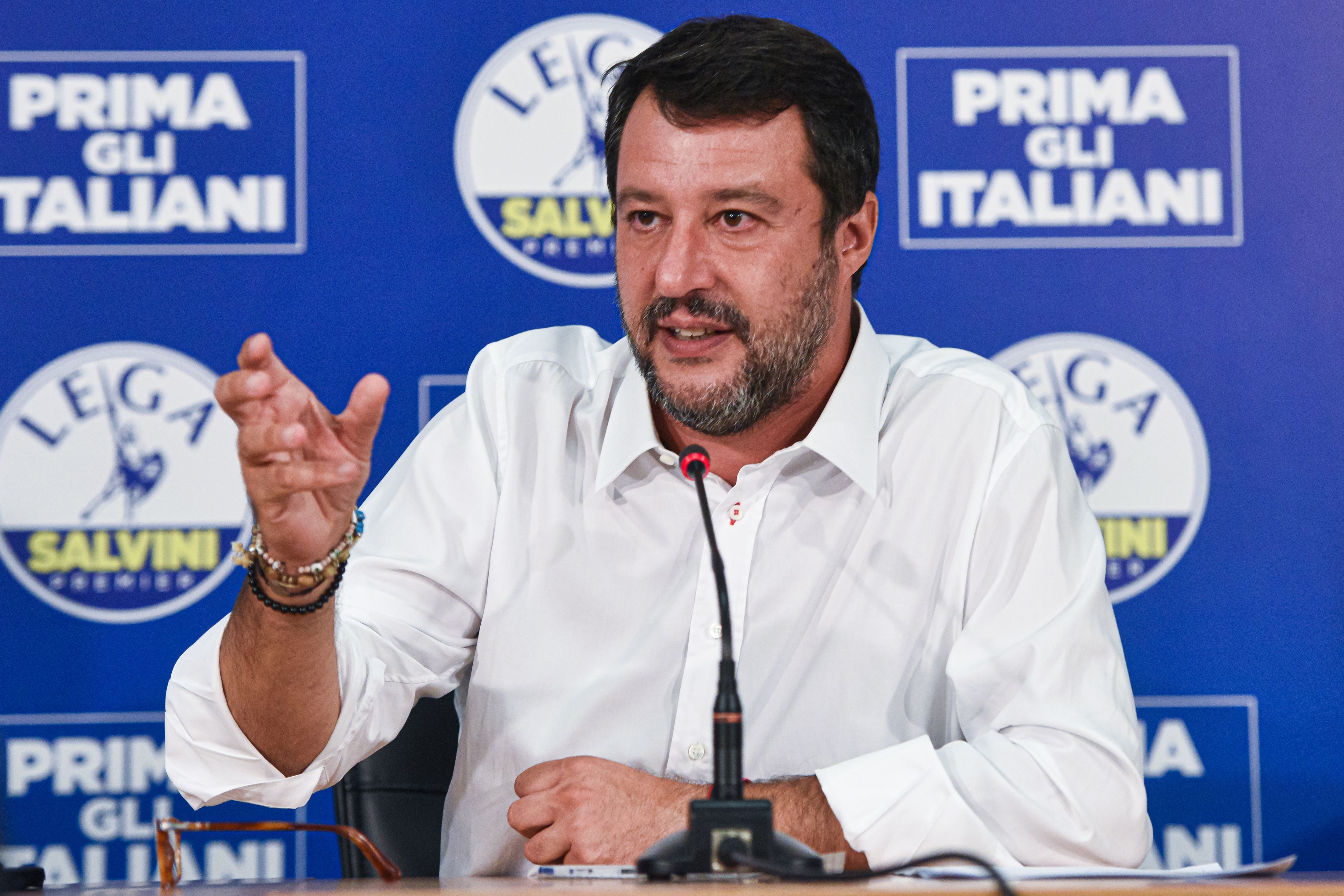
In 2019, Italy's then Interior Minister Matteo Salvini prevented illegal migrants from disembarking from a coast guard ship that had recovered the migrants at sea five days earlier. For this decision, Salvini now faces a criminal trial on charges of "kidnapping." Italy is sending a disturbing message to the world: anyone who, by governing the country, defends national borders and tries to stop mass illegal immigration can end up on trial and in prison. (Photo by Piero Cruciatti/AFP via Getty Images)

"My only regret from this situation is that I will have to explain to my two kids that their father is going on trial not because he is a criminal, but because he defended his country", Matteo Salvini said as Italy's Parliament stripped him of immunity to open the way for his trial.

For years, Italy's political ruling class has had a migration policy of surrendering to floods of illegal immigrants -- who have usually been organized by criminal traffickers. Europe has never offered Italy a jot of help. Now these "elites" -- politicians, opinion makers, journalists -- have decided to turn Salvini over to the judges for doing what they did not have the courage to do: defend the Italy's borders.

Salvini now faces up to 15 years in prison for "kidnapping." The charge against Salvini dates from 2019 when, as Italy's interior minister, he prevented illegal migrants from disembarking from a coast guard ship that had recovered the migrants at sea five days earlier. Salvini declared that he was defending his country and would do the same again. "I go with a clean conscience, with the pride of knowing that I defended the honor of Italy," he wrote on Facebook.

As interior minister, Salvini took a hard line on migrants. He closed Italy's ports to rescue ships and passed a law that allowed vessels carrying migrants to be seized and fined.

On July 26, 2019, Salvini called for stopping the disembarkation of migrants aboard the Gregoretti as it was reaching Sicily's east coast. "I have given instructions that no port will be assigned before there is a redistribution across Europe of all 140 migrants on board on paper," he said. Immediately after it landed -- a few European countries had agreed to take the migrants -- a public prosecutor opened a file against Salvini for kidnapping.

"The wait for the landing was necessary to agree on the redistribution in other European countries, with the full involvement of the Italian government", Salvini later justified his decision. Italy at the time was desperately in need of a migrant redistribution agreement in Europe. Europe had, until then, not offered Italy the slightest help. Salvini saw, as Albanian Premier Edi Rama said, that "Italy has been left alone by Europe on migrants".

Although it might sound melodramatic, what is at stake, as Salvini understood, is, bluntly, the survival of Italy as we know it. According to a report by the Machiavelli Center, if current trends continue, by 2065 first- and second-generation immigrants will exceed 22 million, or more than 40% of the total population of Italy, whose birth rate is "collapsing".

This is the first time that a court of justice in Europe has been called upon to try a governmental minister -- whose job it is to be responsible for the security of a country -- for holding migrants at a port pending a redistribution of newcomers across Europe.

There seems to exist an assumption that tens of thousands of people can take boats from Libya to Italy without controls, without deterrence, and without a country being able to exercise its right to self-defense from an epochal migratory tsunami.

By closing the borders, fining the NGOs and making it more difficult to reach the Italian shores, Salvini was able to reduce the number of arrivals in Italy, but sometimes tragically at the cost of deaths of migrants in the Mediterranean. When, however, did it become the obligation of countries to help the illegal people-smuggling industry?

When Italy adopted Salvini's immigration policies in 2018, the number of migrant arrivals to Italy did dramatically decrease. The number of arrivals went from 119,369 in 2017 to 23,370 in 2018 -- a drop of 80%, according to the United Nations.

Last year, however, after Salvini's departure, the number of migrants tripled. According to the Ministry of Interior, in 2019, when Salvini was interior minister, 7,894 migrants arrived in Italy. Now, in just the first nine months of 2020, 24,332 migrants have landed and are freely flowing throughout Italy and on to the rest of Europe.

Italy recently had to send troops to stop migrants from breaking a coronavirus quarantine. From Salvini's "closed ports" to anarchy, the step has been short.

The day after the beginning of Salvini's trial, the government softened the former Ministry of Interior's rules penalizing NGOs that bring illegal migrants ashore.

Most importantly, Italy is sending a disturbing message to Europe and the rest of the free world: anyone who, by governing the country, defends national borders and tries to stop mass illegal immigration can end up on trial and in prison. We are witnessing the suicide of a country and a continent.

The real horror in this charade is that Italy is still turning away ships carrying migrants, so why is Salvini being set up to take the fall?

Giulio Meotti, Cultural Editor for Il Foglio, is an Italian journalist and author.

Source: https://www.gatestoneinstitute.org/16613/italy-immigration-borders

Follow Middle East and Terrorism on Twitter


Yes it Hurts, No it Doesn't - Amir Taheri

​
by Amir Taheri

While Tehran leaders have turned relations with the United States into the central issue of Iranian politics, they still seem unable to decide whether the present tension between the two sides hurts or helps their regime.

  • General Hussein Salami, commander of the Revolutionary Guard Corps (IRGC), is equally sanguine about his claim that, far from hurting, the Islamic Republic is on course to become a global power. "We have already reached the Mediterranean and prepare to go even further," he said in a recent speech. "We are now in a position to occupy and set on fire all military bases of the United States in the region and beyond."
  • One audience consists of the Democrat Party in the US, with which part of the Islamic regime hopes to make a deal based on the one offered by Obama.
  • The other audience is the people in Iran, who feel they are poorer than they were six years ago and blame the leadership for its ineptitude, corruption and failure to develop a better foreign policy and stop using resources on foreign adventures. However, there may be a subtext in that: preparing public opinion for yet another climb-down in the fight against the "Great Satan". After all, if people are convinced that making a deal with Washington is the key to all problems they would welcome what Khamenei calls "a heroic flexibility."


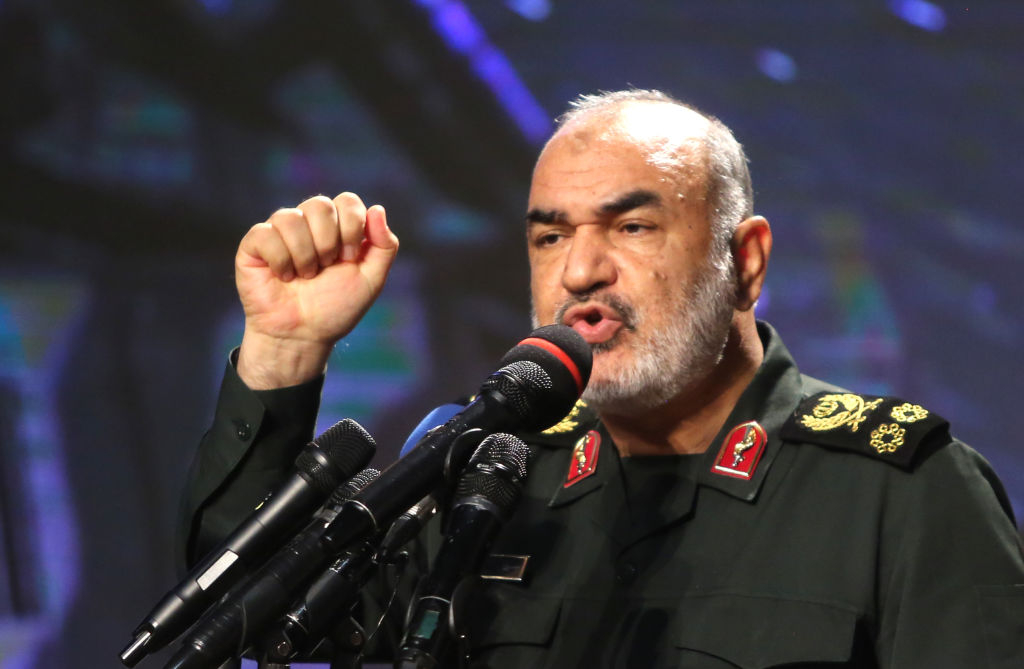
General Hussein Salami, commander of the Iran's Islamic Revolutionary Guard Corps, is sanguine about his claim that, far from hurting, the Islamic Republic is on course to become a global power. (Photo by Atta Kenare/AFP via Getty Images)

While Tehran leaders have turned relations with the United States into the central issue of Iranian politics, they still seem unable to decide whether the present tension between the two sides hurts or helps their regime.

One group within the establishment claims that the sanctions re-imposed by President Donald Trump actually helps the regime and hurts the US. In his recent talks to various US think tanks and media, Foreign Minister Mohammad Javad Zarif has defended that thesis with his usual panache. According to him, Trump has "isolated" the US while the Islamic Republic has earned "worldwide sympathy and support."

General Hussein Salami, commander of the Revolutionary Guard Corps (IRGC), is equally sanguine about his claim that, far from hurting, the Islamic Republic is on course to become a global power.

"We have already reached the Mediterranean and prepare to go even further," he said in a recent speech. "We are now in a position to occupy and set on fire all military bases of the United States in the region and beyond."

The general believes that even when it comes to military hardware, the Islamic Republic won't be hurt by the re-imposition of a UN embargo.

The official media are equally divided. The segment controlled by the IRGC peddles the claim that sanctions have helped Iran to develop a self-sufficiently economy capable of producing all that is needed. It goes even further by hailing "the end of reliance on oil exports" as the realization of a dream that generations of Iranians had since the 1950s. In a recent speech Eshaq Jahangiri, 1st Assistant to President Rouhani, claimed that income from oil had now fallen to $7 billion a year.

Doing without selling oil was a dream that supporters of Prime Minister Muhammad Mussadeq also trumpeted when, facing a British embargo, managed to survive without exporting oil for two years: 1951-52. Most other nations in the world also manage to survive without exporting oil.

The position of "Supreme Guide" Ali Khamenei, the man supposed to have the final word in Tehran, isn't always clear. At times he claims that the aim of the revolution is the destruction of America at almost any cost. And, yet, he has been involved in negotiations, secret or above-board, with the "Great Satan" for almost four decades. He also approved the so-called "nuke deal" dictated by President Barack Obama, putting large segments of Iranian industry, trade and scientific research under foreign tutelage.

There is, however, another faction that puts the blame for almost all of Iran's current problems on Donald Trump. The most vocal spokesman for that faction is Hojat al-Islam wa al-Muslemeen Hassan Rouhani, who acts as President of the Islamic Republic.

Under his administration, the value of the Iranian currency, rial, has fallen from 3,000 to 30,000 in just six years. Inflation has spiraled to almost 50 percent, while the economy is shrinking by an average of three percent a year. According to official statistics, over 30 percent of Iranians live below the poverty line, with more than a quarter of the work force unemployed.

In his recent speech, Rouhani all but claimed that the sanctions re-imposed by Trump have been even more effective than Washington says.

"The Americans say they have damaged our economy by tens of billions of dollars," Rouhani said. "The damage is higher. In the past three years they have done more than $150 billion in damage to our economy."

Describing US Secretary of State Mike Pompeo as "the Minster of Crimes", Rouhani said Pompeo's claim of preventing Iran from accessing $70 billion of its own money in foreign banks was an underestimation. The Hojat al-Islam even blamed the failure of his government to cope with the Covid-19 crisis on Pompeo who "prevented us from securing a $5 billion loan from the International Monetary Fund."

The Hojat al-Islam claims that without "Trump's sanctions" our people would have had a much more comfortable life.

What causes this apparent division in the analysis of the regime's central foreign policy problem? One reason may be the fact that two different audiences must be addressed.

One audience consists of the Democrat Party in the US, with which part of the Islamic regime hopes to make a deal based on the one offered by Obama. The message to please that audience is that Trump's Iran policy has failed, just like all his other policies and that the US has suffered more than Iran has.

The other audience is the people in Iran, who feel they are poorer than they were six years ago and blame the leadership for its ineptitude, corruption and failure to develop a better foreign policy and stop using resources on foreign adventures. However, there may be a subtext in that: preparing public opinion for yet another climb-down in the fight against the "Great Satan". After all, if people are convinced that making a deal with Washington is the key to all problems they would welcome what Khamenei calls "a heroic flexibility."

The question now is whether their climb-down will come with Trump still in the White House of will the mullahs wait for Joe Biden, the "little devil" they know better.

This article was originally published by Asharq al-Awsat

Amir Taheri was the executive editor-in-chief of the daily Kayhan in Iran from 1972 to 1979. He has worked at or written for innumerable publications, published eleven books, and has been a columnist for Asharq Al-Awsat since 1987.

Source: https://www.gatestoneinstitute.org/16620/yes-it-hurts-no-it-doesnt

Follow Middle East and Terrorism on Twitter


Netanyahu: Israel to airlift 2,000 Ethiopian Jews - i24NEWS and ILH Staff

​
by i24NEWS and ILH Staff

The move "symbolizes the special relationship between the two peoples," Ethiopian PM Abiy Ahmed says.


Prime Minister Benjamin Netanyahu spoke with his Ethiopian counterpart Abiy Ahmed on Friday, apprising him of Jerusalem's plans of airlifting 2,000 Ethiopian Jews to Israel.

"I updated Prime Minister Abiy that I intend to immediately bring some 2,000 people from Addis Ababa and Gondar, as part of our commitment to continuing the Aliyah of Jews to Israel," Netanyahu tweeted.

Netanyahu said Abiy replied that the move was to go ahead without impediment and that it "symbolizes the special relationship between the peoples."

"Ethiopian PM Ahmed congratulated PM Netanyahu on the historic peace agreements with the United Arab Emirates and Bahrain and said that PM Netanyahu had led a historic move, the magnitude and full positive ramifications of which will only be understood by future generations," a statement posted to the Israeli leader's Twitter account said.

Over the years, Netanyahu has pledged to bring to Israel the remainder of Ethiopia's Jewish community. Most of the 13,000 Ethiopian Jews still residing in the African country wish to move to Israel, which they call home. Many have relatives in the Jewish state.

Israel is home to over 145,000 Jews of Ethiopian descent, the majority of whom immigrated to Israel in the 1980s and 1990s.

This article was first published by i24NEWS.


i24NEWS and ILH Staff

Source: https://www.israelhayom.com/2020/10/11/netanyahu-israel-to-airlift-2000-ethiopian-jews/

Follow Middle East and Terrorism on Twitter


Saturday, October 10, 2020

Planning something sinister? Twitter shuts down Ric Grenell for tweet demonstrating ballot fraud - Monica Showalter

​
by Monica Showalter

Twitter is planning to suppress all news of ballot fraud in this coming election.


 Twitter shut down a big fish Thursday, censoring President Trump's popular former acting director of National Intelligence, Richard Grenell, for supposedly violating the company's terms of service.

According to ReclaimTheNet.org, an anti-censorship news site:
Upon his friend’s request, Ric Grenell took to Twitter and posted the images of two ballots that were sent to the names of a deceased couple.
Social media platforms, of late, have been extra vigilant about the content that gets posted on their platform. With the current year combining several important and critical events, including the US Presidential Elections and COVID-19 saga, platforms have grown even more stringent with their rules.
Which is pretty astonishing. Grenell is a highly visible tweeter, popular with viewers, with 660,000 followers. If they can shut him down, they can shut anyone down. His 'crime' was refusing to delete this tweet as they ordered:


He stood his ground, and was right to do so. After all, if you can't tweet about your lived-experience, and present evidence, as Grenell did, then it's obvious there's a story Twitter would like to see suppressed. 

For some reason, he's been let out now but the censorship message is clear. He's since tweeted this:


Clearly, Twitter has a game plan for censoring all news of ballot and electoral fraud in this age of mass-mail junk-mail voting. Grenell in fact is onto a very big story -- that of gargantuan Los Angeles County' already evident gross mismanagement of the election. Grenell tweeted evidence of dead people getting ballots. Just yesterday, a friend in Glendale tweeted to me pictures of his son's two ballots received in the mail.

The area is loaded with illegals, so all kinds of potential for ballot fraud -- and ballot-selling, are likely going on, but Twitter is getting out its mighty censorship machine to make sure voters don't know. 

There's also this, according to the Wall Street Journal:
Twitter Inc. will make it harder for posts to go viral ahead of the U.S. election, including by putting limits on how users can retweet.
The moves unveiled Friday, which also include pointing users viewing certain tweets to credible content, are among the boldest yet for the social-media platform and are designed to slow the spread of misinformation.
Where users previously hit a button to reshare, or “retweet,” items, they will now be directed to a screen that will encourage adding commentary before resharing posts. If users don’t write anything, their post will still appear as a traditional retweet—but the change “adds some extra friction” in the process, according to a company blog post.
Which is pretty disturbing. Hitting Grenell for a perfectly valid tweet showing genuine problems in our electoral system, and then slowing down retweets on stories they don't like is pure dictatorial censorship. If this isn't an argument for Republicans to get out and vote, and in particular vote for every downballot Republican in the congressional slots, what is? The U.S. desperately needs a House that is willing to force Twitter to become regulated as an edited platform, responsible for every word that goes out on their site including those of child molestors and Iranian terrorists. Their election shenanigans mean they're playing for keeps. No amount of 'reform' is going to make up for it, given the stakes at hand and what they are doing now. The die is cast. They are planning something, and they need to be stopped.

Image credit: Twitter screen shot

Monica Showalter

Source: https://www.americanthinker.com/blog/2020/10/planning_something_sinister_twitter_shuts_down_ric_grenell_for_tweet_demonstrating_ballot_fraud.html

Follow Middle East and Terrorism on Twitter