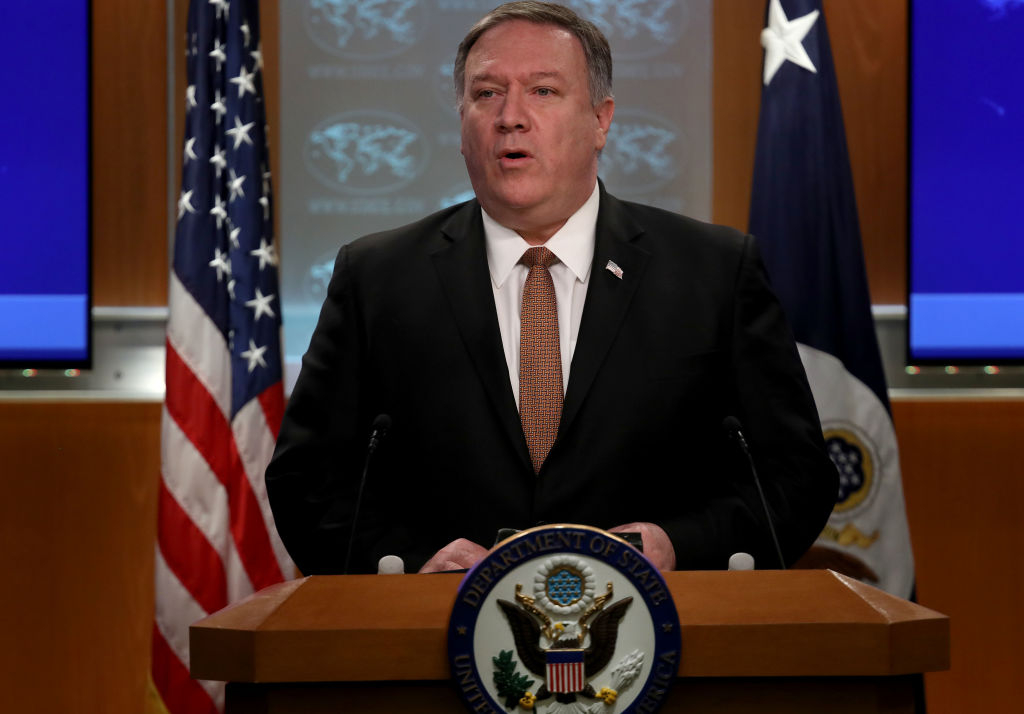
 In
February, US Secretary of State Mike Pompeo warned: "Chinese Communist
Party officials... are cultivating relationships with county school
board members and local politicians – often through what are known as
sister cities programs... Last year, a high school – a high school, a
high school in Chicago – disinvited a Taiwanese representative to serve
on a climate panel after Chinese pressure." (Photo by Win McNamee/Getty
Images) |
On November 17, four US Senators introduced legislation to investigate the "sister city" partnerships between communities in United States and China. According to Senator Marco Rubio:
"The Chinese government and Communist Party has a history
of exploiting cultural and economic partnerships to conduct malign
activities, and it's clear that opaque, sister-city partnerships deserve
increased scrutiny. We must do more to better understand, and then
counter, Chinese influence operations at the state and local level,
which are often conducted under the benign auspices of sister city
relationships."
In February, Secretary of State Mike Pompeo warned:
"Chinese Communist Party officials... are cultivating
relationships with county school board members and local politicians –
often through what are known as sister cities programs... Last year, a
high school – a high school, a high school in Chicago – disinvited a
Taiwanese representative to serve on a climate panel after Chinese
pressure."
Take Cascade Elementary School in Orem, Utah, which has a Chinese language immersion program. Orem has been the sister city of Urumqui, China since 2000. In March, China Daily, the English language newspaper of the Chinese Communist Party (CCP), published an article,
"US 4th-graders proud to be pen pals with Xi," featuring interviews
with staff and children at the school. The article appeared after 50
fourth-graders from Cascade Elementary School sent Chinese New Year's
cards to China's President Xi Jinping and he replied to them. In his
letter, according to China Daily, Xi praised the children for
their Chinese language skills, including being able to write Chinese
characters, and told them, "I hope you will keep at it, make even bigger
progress and become young 'ambassadors' for Sino-US friendship". According to China Daily:
The idea of writing to the Chinese president came from
those students and was supported by their Mandarin teacher, Zheng Yamin,
who also gives lectures on Chinese culture and festivals at the Salt
Lake City Public Library in Utah's capital.
...
"It's an amazing thing for our students to get a personal letter from
the president of China," Principal Darrin Johnson said. "President Xi
said he hopes to visit us here one day, but we also hope to follow up
with a visit by our students to China next year so they can see for
themselves how interesting and beautiful China is.
"I think it's a great honor. The Chinese president is incredibly busy, running a country and dealing with the new coronavirus."
According to "China's Influence & American Interests,"
a report by the Working Group on Chinese Influence Activities in the
United States, put out in 2019 by the Hoover Institution at Stanford
University and the Center on US-China Relations at the Asia Society in
New York:
"China pursues sister-city relationships under an
organization called the Chinese People's Association for Friendship with
Foreign Countries... that aims to strengthen the rule of the Chinese
Communist Party and increase China's influence overseas... under the
administration of Communist Party leader Xi Jinping, the association has
been revitalized as China seeks to groom local business, political, and
media leaders in countries around the world...
"Beginning in the early 1970s, China and the United States built
trust and common prosperity through cooperation at the local level. The
work of two hundred sister city pairs and over forty sister
state/province partnerships was reinforced by state and city trade and
investment promotion offices, chambers of commerce, Chinese American and
traditional clan associations, Chinatown cultural centers, and various
and sundry activities at US colleges and universities, secondary
schools, church groups, and museums...
"After forty years of engagement, the US-China focused foundations,
educational and exchange programs, research institutes, and arts and
entertainment initiatives throughout the country are too many and
various to be cataloged. American mayors, county executives, and
governors—many of whom travel to China often and host an unending stream
of Chinese visitors—have leveraged the work of these groups to enrich
local coffers and local culture..."
While American local governments value such 'exchanges' for financial
and cultural reasons, 'exchange' (交流) has always been viewed as a
practical political tool by Beijing, and all of China's 'exchange'
organizations have been assigned political missions."
"The Xi administration", according
to Professor Anne-Marie Brady who, among other things, has studied
Chinese influence activities in New Zealand, "has revived traditional
CCP policies of utilizing people-to-people... relations in order to
coopt foreigners to support and promote China's foreign policy goals".
One of the ways that they do that, according to Brady, is to "[u]se
sister city relations to expand China's economic agenda separate to a
given nation's foreign policy. The CCP front organization, the Chinese
People's Association for Friendship with Foreign Countries is in charge
of this activity".
According to Brady:
"CCP united front officials and their agents are tasked
with developing relationships with foreign and overseas Chinese
personages to influence, subvert, and if necessary, bypass the policies
of their governments and promote the interests of the CCP globally...The
Xi administration's strategy of working more with local governments for
economic projects has now revitalized the CPAFFC, as well as the local
equivalents they work with such as in New Zealand, the New Zealand-China
Friendship Society ".
An American equivalent of the New Zealand-China Friendship Society is
the US-China Peoples Friendship Association, a not-for-profit
organization that describes
as its purpose "to develop and strengthen friendship and understanding
between the peoples of the United States and China. USCPFA was founded
as a national organization in 1974, working on people-to-people
diplomacy between Americans and Chinese. Nearly 35 chapters in four
regions spanning the U.S. comprise the organization".
The State Department is currently reviewing the activities of the U.S.-China Friendship Association, which Secretary of State Mike Pompeo recently called a CCP United Front Work organization.
"These organizations ...have apparently attempted to
exert influence on groups all across the public sphere, including in our
schools, in our business associations, impacting local politicals –
politicians, media outlets, and Chinese groups here inside the United
States."
In July 2019, the fourth US-China Sister Cities Mayors' Summit was
held in Houston, Texas. It was co-hosted by Ron Nirenberg, mayor of San
Antonio, Texas, and chairman of Sister Cities International, the US
organization that co-hosted the summit, and Xie Yuan, vice-president of
the Chinese People's Association for Friendship with Foreign Countries.
"Subnational cooperation and people-to-people exchanges are the
highlights in the history of China-US interactions and a driving force
for the growth of our relations," said Cui Tiankai, China's ambassador to the US, in a message sent to the summit.
"The 277 pairs of relationships at the state, provincial
and city levels between China and the US -- 227 pairs of sister cities
and 50 pairs of sister states/provinces -- have led to win-win
cooperation as both sides share resources and complement each other's
strengths".
According to China Daily:
"More than 100 municipal representatives traveled from
China to join their US counterparts from over 20 cities in the one-day
summit, as the two sides engaged in broad-ranging discussions on topics
including innovation and smart cities, the Maritime Silk Road,
educational exchanges and how to energize and engage existing and
prospective sister city relationships".
There are, apparently, also direct US-China school partnerships.
According to the website of an organization that calls itself the USA-China Sister Schools Association,
it has "been dedicated to connecting students, teaching staff and
administrators of K-12 schools in the U.S. and China since our founding
in 1992."
"Over the past two decades, we have witnessed the
creation and execution of vibrant exchange programs between more than 20
sister school partnerships. These partnerships spread out in states
like Maryland, Virginia, Wisconsin and Kansas and are continuing to
expand to other parts of the country. Given the fact that Sino-American
relationship is one of the world's most important bilateral
relationships, we believe that interpersonal interaction between the
youth of the two countries will greatly enhance mutual understanding,
which in turn will contribute to the peace and development of the world.
We will keep connecting schools in the U.S. and China one at a time".
China has used its sister cities to boost its "mask diplomacy", in
which it plays both the arsonist and the firefighter, and has written
about this new initiative in state media with quotes from "grateful" US
sister cities thanking China for sending them masks.
In an article titled, "US sister cities get help from Chinese friends in virus fight", China Daily
quotes Jennifer Priest, executive director of the Norfolk Sister City
Association, as thanking the Ningbo Beilun District People's Government
for a donation of 2,000 masks. "We are so grateful to our counterpart in
China," she said. According to the article:
"Utah, which has enjoyed a 'sister-state' relationship
with Liaoning since 2006, received a batch of donations from the Chinese
province that included 7,000 N95 masks, 70,000 disposable surgical
masks, as well as 7,000 protective suits and 3,000 face masks for
children. Leaders from the Utah Legislature expressed their gratitude to
officials from Liaoning through a virtual special ceremony to celebrate
the arrival of the medical supplies.
"Also presented during the Skype meeting were teachers and students
from Cascade Elementary School, who were the recipients of parts of the
3,000 children's masks. The school's students in the Chinese-language
immersion program shared stories of their correspondence with President
Xi Jinping, which took place in the beginning of the year...
"Maryland's Deputy Secretary of State Luis Borunda praised the
long-term friendly relationship between Maryland and China, and extended
sincere gratitude to the sister province Anhui."
These quotes from "grateful" sister cities are invaluable propaganda for the Chinese Communist Party.
Local politicians and others, such as school principals, are simply
easy targets for the sophisticated tactics of CCP officials, who prey on
the goodwill and naiveté of unsuspecting Americans, although willful
blindness doubtless plays a role. According to Clive Hamilton and
Mareike Ohlberg, in their recently published book, Hidden Hand: Exposing How the Chinese Communist Party is Reshaping the World:
"Local politicians typically know little about China and
have no responsibility for national security, and because their Chinese
interlocutors present themselves as offering people-to-people exchanges
and 'opportunities for local business', these politicians have a strong
incentive to remain uninformed...
"The focus is typically on economic and cultural ties and it's easy
to pretend that there is no political element... however, these local
ties are in fact highly political, and where necessary they can be
leveraged to pressure national governments. This is the tactic of 'use
the countryside to surround the city'".