The "Middle East and Terrorism" Blog was created in order to supply information about the implication of Arab countries and Iran in terrorism all over the world. Most of the articles in the blog are the result of objective scientific research or articles written by senior journalists.
From the Ethics of the Fathers: "He [Rabbi Tarfon] used to say, it is not incumbent upon you to complete the task, but you are not exempt from undertaking it."
US Census data released last week called into question the official vote tally from the 2020 election.
According to a website called The Election Wizard, newly released Census data contains an "anomaly" when it comes to squaring it with the reported electoral results:
US
Census data released last week called into question the official vote
tally from the 2020 election. As part of the Census, the government
collects data on citizens who self-report as having voted in
presidential elections. The collected data shows an unusual anomaly in
the reported results.
According to the Census, the recorded number of people voting in 2020 was tallied at 154,628,000. On the other hand, official results place the number of actual ballots cast slightly north of 158 million. That's a discrepancy of nearly four million votes.
If
the Census data are correct, then about 4 million votes mysteriously
were added to the election totals. Usually, the Census data and the
reported vote totals correlate closely.
Speaking to pollster Richard Baris during an episode of "Inside the Numbers," lawyer Robert Barnessaid historically,
the Census tends to "pin on the nose" the recorded vote numbers with
the actual results. In other words, often the two data sets reasonably
match.
Barnes is right. For example, the bureau was nearly spot-on in 2008, slightly under-reporting that 131,100,000 voted, while the official results showed 131,300,000 ballots cast.
Of
course, sometimes the Census has missed the mark. But for decades, in
almost every case where the Census grossly botched the results, it was
because the bureau over-recorded the number of those who voted.
It
is very suspicious, but far from conclusive. Certainly, it does
justify questioning the election results and auditing where possible.
Barnes pointed out the Census data also calls into question a number of contested states too.
For example, in Georgia, the bureau recorded roughly 4.8 million voting, while official results show slightly less than 5 million. Barnes said the discrepancy is consistent with claims that there were roughly 100k questionable ballots cast in Georgia.
Here is the hour-long conversation between Barnes and Bartis (starts at 11:40):
To comment, you can find the MeWe post for this article here.
The common sense of the American people has largely prevailed over the "Big Lie."
If
you have been keeping an eye on the election audit taking place right
now in Maricopa County, Arizona, then you also know that Democrats, news
propagandists, and "concerned" NeverTrump Republicans are beginning to
sound more and more like trapped rats squeaking in fear. An army of
lawyers — many of the same political operatives who manipulated the
November election by contravening existing election laws and flooding
battleground states with uncontrolled and unverified mail-in ballots —
are begging state and federal courts to stop the audit midcourse and
petitioning Arizona's Democrat secretary of state and Merrick Garland's Department of Justice to intervene under
the absurd pretense that ensuring election integrity somehow deprives
voters of their civil rights. Arizonan and Biden-supporter Cindy McCain
has publicly called the
vote recount "ludicrous" because "the election is over." And MSNBC's
Rachel Maddow is so terrified of what the auditors might find that she insists that the whole exercise is not only "dangerous," but also the "end of democracy."
Even though the entire audit is being conducted with unprecedented transparency and live video feeds that
invite viewers anywhere in the world to watch the process, reporters
and adverse political agents have been repeatedly caught attempting to infiltrate the well run operation or laboring to expose the
identities of workers. If there is a reason for inserting spies into
an already open process other than to later cast doubt upon the
integrity of the auditing process itself, I don't know of it. And if
there is a reason to expose workers' identities to the public other than
to make them targets for campaigns of harassment and intimidation, reporters have made no attempt to provide it.
Compare
the highly professional audit taking place in Arizona to the
orchestrated chaos of the presidential election. It took five days last
November for vote-counters to find enough mail-in ballots for Joe Biden
for the Democrat press corps to declare him the winner, and in the
voting precincts where Trump leads disappeared over those days,
transparency was nowhere to be seen. Vote-counters covered windows with cardboard to block outside observation of any kind; counting paused and restarted in secret;
and ad hoc procedures were established on the fly and without
consistency from one precinct to the next when determining whether to
include ballots lacking legally required voter identification metrics,
including even the rudimentary safety protocol of a loosely matching
voter signature. If "free and fair" elections require basic security,
verification of ballot authenticity, and consistently applied standards
at least across the precincts and counties of any one state, then there
was obviously nothing free or fair about the 2020 election.
The remarkable thing is that most Americans have
actually come to this correct conclusion. After six months of some of
the worst gaslighting in America's history, during which corporate news
propagandists and tech behemoths have colluded with federal and state
authorities to paint the presidential election as aboveboard and all
those who question its legitimacy as kooks, "extremists," "violent
insurrectionists," and "terrorists," the nearly universal narrative
drumbeat from the press and the psychological warfare deployed against
regular Americans have failed miserably in their desired
effect. Whether spray-painted on highway overpasses,
discussed in uncensored online forums, or spoken aloud, more and more
Americans have concluded that the election was stolen from President
Trump.
State
legislatures were useless in ensuring election integrity. Election
lawsuits in Arizona, New Mexico, Georgia, New Hampshire, Michigan,
Pennsylvania, and Wisconsin failed to provide any timely mechanism for
remedying violations of states' own election laws, let alone for
redressing the likelihood of outright fraud. The Supreme Court shirked
its own constitutional duty to safeguard American enfranchisement by
declining to hear on appeal the merits of lawsuits alleging electoral
misconduct, consenting to review controversies only after Biden's
inauguration and then largely booting them as moot, and outright refusing to
exercise its original jurisdiction over Texas's suit against other
states for their failure to ensure equal application of their own voting
laws as required by the Constitution.
At every step of the way, America's institutions utterly failed to
safeguard the security of the 2020 election beforehand, to protect
Americans' votes once the predictable catastrophe of mail-in balloting
unfolded on November 3, or to provide any semblance of the rule of law
afterward that could have remedied the election's obvious and
multifaceted failures and halted America's downward decline toward a
banana republic farce whose elections look less reliable than those in
Venezuela.
Yet the common sense of the American people has largely prevailed over the "Big Lie,"
an astonishing accomplishment during a time when Americans have never
been more controlled by government authorities micromanaging everything,
from what they wear across their faces to which pronouns they use to
refer to others.
I
have always been of the opinion that whether the full scale of the 2020
election's fraud and manipulation ever comes to light, the historical
record will never be able to account for three facts that betray most
Americans' common sense: (1) no president for a century and a half has
won more votes during re-election than he did for his first election yet
lost re-election, and President Trump gained over ten million new votes
over his 2016 victory; (2) Joe Biden, a man evincing obvious signs of
mental decline and dementia who generated historically low levels
of excitement among his own Democrat voters, somehow won over fifteen
million more votes than Barack Obama, the political rock star who
energized Democrats like no other politician in recent memory, managed
in 2012; and (3) President Trump won almost every traditional bellwether county in the country from coast to coast by double-digits.
After
a year when Facebook and Twitter did everything they could to minimize
Trump's reach to his voters and his voters' reach to each other, and
after years of outright Pravda corporate news that pushed the Deep
State's "Russia collusion" and Ukraine "quid pro quo" lies to take down a
sitting president, President Trump's vote totals in 2020 were still so
remarkable that they would have normally indicated a resounding mandate
from the American people.
It
is revealing that, unlike other past election losses, there was no
great Republican "autopsy" done in order to pinpoint what went wrong, as
there was after Mitt Romney's 2012 failure. Other
than an occasional assertion that Republicans "must do better with
suburban women," there is no serious analysis about how Republicans
should improve upon President Trump's 2016 totals. The reason why is
obvious: he did better with voters, in general, than any other sitting
president in history, and with minority voters in particular than any
Republican in sixty years.
When George Bush recently remarked that
Republicans would lose future elections if they appealed only to a
"white, Anglo-Saxon, Protestant" base, his out-of-touch assessment of
the 2020 election was apparent to anyone paying attention. However
WASP-y George Bush's Republican Party may have been, it is Donald Trump
who expanded the party's reach to Americans of every background, and
Trump's direct engagement with black voters has been so successful that
even Obama was forced to minimize the accomplishment as merely due to
Trump's "macho style."
Trump built that. Most Americans seem to have figured that out.
The
problem with using the organs of the State to advance outright lies is
that the State becomes less and less credible as more lies are revealed
for what they are. The audit in Maricopa County, Arizona involves the
votes of one county out of roughly 3,100 in the United States, but after
six months when Americans' collective common sense has been at odds
with the collective narrative of the powers that be, one county's truth
could expose a whole nation's lies.
Republicans cry foul as White House bolsters communication between government agencies and unions
The Biden administration
has come under scrutiny from Republicans on Capitol Hill following its
decision to circumvent federal ethics rules and staff former union officials in senior posts.
Beginning
as early as March, the White House waived certain rules for former
labor union personnel slotted to fill Biden’s transition teams and
government vacancies, who would have otherwise been prevented from
communicating with their old unions.
Senior official in the Office of Personnel Management (OPM), Alethea Predeoux, was granted a waiver
to allow her to facilitate communication between the government agency
and the American Federation of Government Employees – a union
representing 700,000 federal workers for whom she was formally a top
lobbyist, Axios first reported.
In April, the White House issued a similar waiver,
allowing for Celeste Drake, who was tapped to lead the White House Made
In America Office, to communicate with her former employers, the
Director’s Guild of America and the American Federation of Labor and
Congress of Industrial Organizations (AFL-CIO).
The administration has said these are necessary moves to facilitate liaisons between government agencies and labor unions.
In
a statement to Fox News on Saturday, National Republican Senatorial
Committee spokeswoman Katharine Cooksey said, "The pattern of corruption
between Democrats and big union bosses is obvious – just follow the
money and follow the staff."
Biden pledged from the campaign
trail to bolster unions across the US – a move that Republicans believe
has made the administration overly beholden to them.
Union involvement in White House policymaking has become increasingly evident in recent months.
Reporting by the New York Post last week found that the nation’s second-largest teachers' union,
the American Federation of Teachers (AFT), regularly communicated with
the Centers for Disease Control and Prevention (CDC) on school reopening
guidelines.
Correspondence
obtained through a Freedom of Information Act request found the AFT had
a direct influence on language implemented in the CDC’s February safety
guidance for in-person instruction.
The
CDC had originally prepared guidelines that allowed in-school
instruction regardless of transmission rates. But at the suggestion of
the union, the language was adjusted to include a provision that granted
remote work for those "who have a household member" or "who have
documented high-risk conditions or who are at increased risk."
Frustrated
parents and city officials nationwide have launched lawsuits and
accused teachers' unions of utilizing the pandemic to bargain for
increased benefits by refusing to re-enter the classroom.
The AFT
political action committee further granted more than $1.6 million in
funding to Democratic congressional campaigns and committees between
January and March, according to FEC filings.
"Since
the very first day of the Biden administration, every single Democrat
has echoed the same union-approved talking points to keep schools closed
and to jam a radical, job-killing agenda through Congress," Cooksey
said. "While Republicans are working to get kids back in the classrooms
and the economy moving again, Democrats are taking orders from their
bosses at the unions to keep schools closed and stifle job
opportunities."
The White House did not immediately respond to Fox News’ request for comment regarding GOP concerns.
'Interesting way of admitting' Big Tech interference in elections, says Mollie Hemingway
NPR recently shocked social media users with a tweet that appeared to admit Big Tech has the ability to influence elections.
"Whether
or not Facebook decides to reinstate former President Trump’s account
in the coming months will likely have major consequences for Trump's
political power and possible future campaign," NPR wrote on Twitter.
"Being
on Facebook is crucial for modern-day political campaigns," NPR
explains in the accompanying story. A Big Tech blackout would
mean a drop in fundraising and "a significant revenue valve would be
shut off for Trump, imperiling a 2024 presidential bid, if he decides to
run again." This could also trickle down to negatively affect the
midterm candidates he plans to endorse, they write.
Mollie Hemingway,
a senior editor at The Federalist and a Fox News contributor, was among
the first to notice that NPR said the quiet part out loud.
Interesting way of admitting how much election interference and election meddling against Republicans that our tech companies can do and have done! https://t.co/EzQMD3lWO2
Last week, the Facebook Oversight Board announced that they were
upholding the company's indefinite ban on former President Trump's
account, but said that Facebook had six months to review the decision.
The board also called the ban "arbitrary" and argued that the company
"violated its own rules." Their ruling comes after Twitter booted the former president off their platform in January, recently doubling down and declaring that they won't invite Trump back even if he decides to throw his hat in the ring for the 2024 presidential election.
"What Facebook, Twitter, and Google have done is a total disgrace and an embarrassment to our Country," Trump said
in a statement reacting to the news. "Free Speech has been taken away
from the President of the United States because the Radical Left
Lunatics are afraid of the truth, but the truth will come out anyway,
bigger and stronger than ever before."
Trump also posted the
statement on his new communcations platform, "From the desk of Donald J.
Trump." But Twitter is cracking down on that as well, taking action
against accounts that post content from Trump's new platform as part of
their "ban evasion policy."
In the wake of Facebook's decision to keep Trump off their platform, Sen. Josh Hawley, R-Mo., renewed calls for antitrust action against the company and other Big Tech platforms. He's also introduced
his Bust Up Big Tech Act to reel in the reach of Google and Amazon,
effectively banning them from marketing their own retail goods alongside
other sellers.
"It's past time to bust up Big Tech companies,
restore competition, and give power back the American consumers," Hawley
said of the bill.
Cortney O'Brien is Editor, Flash at Fox News. Follow her on Twitter at @obrienc2.
[T]he PRC is developing electronic warfare capabilities such as satellite jammers....and China probably intends to pursue additional ASAT [Anti-Satellite] weapons capable of destroying satellites...." — Pentagon report about China's military capabilities
"China is taking steps to
establish a commanding position in the commercial launch and satellite
sectors relying in part on aggressive state-backed financing that
foreign market-driven companies cannot match." — US-China Economic and
Security Review Commission in its 2019 Annual Report to Congress.
"Chinese and Russian space activities present serious and growing
threats to U.S. national security interests. Chinese and Russian
military doctrines also indicate that they view space as critical to
modern warfare and consider the use of counterspace capabilities as both
a means of reducing U.S. military effectiveness and for winning future
wars." — U.S. Defense Secretary Lloyd J. Austin III, written testimony
prior to his confirmation hearing. Space.com, March 19, 2021.
"The PRC continues to strengthen its military space capabilities,
despite its public stance against the weaponization of space.... the
PRC is developing electronic warfare capabilities such as satellite
jammers....and China probably intends to pursue additional ASAT
[Anti-Satellite] weapons capable of destroying satellites...." —
Pentagon report about China's military capabilities, Military and
Security Developments Involving the People's Republic of China 2020.
Given the chance, China will also move ahead to use space to
dominate not only the US but also the rest of the planet. Any defense
budget cuts or flatlines in the in the US military budget -- or any
monetary transfers out of it -- should be regarded as suicidal.
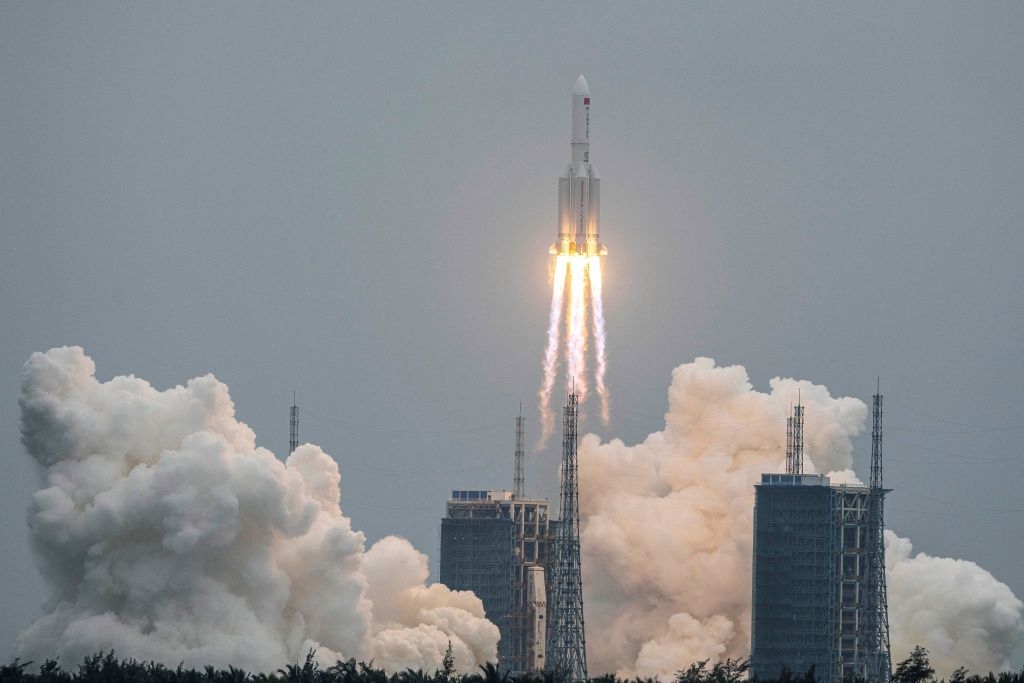
In
terms of US national security, China's space capabilities have been
defined as one of the most significant future threats. Pictured: A Long
March 5B rocket, carrying China's Tianhe space station core module,
lifts off from the Wenchang Space Launch Center in southern China's
Hainan province on April 29, 2021. (Photo by STR/AFP via Getty Images)
Shortly after becoming president in March 2013, Xi Jinping made his
ambitions for China's space power clear. "Developing the space program
and turning the country into a space power is the space dream that we
have continuously pursued", he said. "The space dream is part of the dream to make China stronger". China aims
to become the world's leading space power by 2045: "China will become
an all-round world-leading country in space equipment and technology. By
then, it will be able to carry out man-computer coordinated space
exploration on a large scale," wroteChina Daily in 2017.
One cornerstone of China's space program is the Beidou Navigation
Satellite system (BDS), a global navigation satellite system that
provides positioning, navigation and timing, in addition to data
communication. The People's Liberation Army created
the program in order not to be dependent on the US-controlled GPS
network. "In recent years, the PRC has actively sought to promote the
image of Beidou as a civilian-led program intended primarily for
commercial and scientific purposes," stated
a report by the Jamestown Foundation. "However, the program is under
overall military direction, with the PLA in charge of Beidou's
senior-most program management organizations,"
Beidou is also known as China's "Space Silk Road", which expands China's land-based "Silk Road Economic Belt" and sea-based "21st
Century Maritime Silk Road" -- better known collectively as the Belt
and Road Initiative (BRI) -- into space. Beidou makes participants in
the Belt and Road Initiative dependent on China for precision navigation
and other space based services. According to a report by Malcolm Davis from the Australian Strategic Policy Institute in 2017:
"A China Real Time Report in the Wall Street Journal
refers to Beidou as the 'digital glue' for the roads, railways, ports
and industrial parks that China builds to extend its presence and
influence.
"Chinese provision of satellite communications, weather monitoring
and earth observation add to this vision for a Space Silk Road that
overarches and underpins the Belt and Road Initiative. By signing up to
the BRI 'Space Information Corridor', the BRI states would become
dependent on Chinese-provided space services. That would give Beijing
greater power to influence the policy choices of those states, because
it would control the vital space capabilities that sustain their
economic growth".
"Beijing has specific plans not merely to explore space,
but to industrially dominate the space.... Beijing uses its space
program to advance its terrestrial geopolitical objectives, including
cultivating customers for the Belt and Road Initiative (BRI)... China's
promotion of... the Beidou global navigation system under its 'Space
Silk Road' is deepening participants' reliance on China for space-based
services,"
China's "Space Silk Road", however, forms just one, albeit crucial, part of its ambitious space goals. According to the report:
"China is taking steps to establish a commanding position
in the commercial launch and satellite sectors relying in part on
aggressive state-backed financing that foreign market-driven companies
cannot match. China has already succeeded in undercutting some U.S. and
other foreign launch and satellite providers in the international
market, threatening to hollow out these countries' space industrial
bases... The aggressive pursuit of foreign technology and
talent...continues to be central to this strategy and to China's space
development goals in general."
"The next steps in [China's] manned space programs will be manned exploration of the moon," wrote the CCP's China Daily in 2019.
"We will set up bases on the moon to conduct scientific
operations, expand a habitable place for mankind and gain experience and
expertise for deep-space expeditions beyond the moon. The long-term
goal is to send humans to Mars."
In March, China signed an agreement
with Russia to work together to build a research station on the moon
which will carry out research on exploration and, crucially, utilization
of the moon. Already in 2013, China launched
its first lunar rover to explore the surface of the moon, hoping, among
other things, to discover rare earth minerals, which are reportedly
abundant on the moon. In December, China's Chang'e 5 lunar probe mission
landed on the moon and brought back geological samples to China, which became just the third country to do so after the US and Russia.
China's first unmanned Mars mission -- the Tianwen 1 spacecraft -- entered its orbit around the planet in February and is reportedly due to land on Mars in May. In addition, China also plans to build a space-based solar power station by 2035.
In terms of US national security, China's space capabilities have
been defined as one of the most significant future threats. "Chinese and
Russian space activities present serious and growing threats to U.S.
national security interests," wrote Defense Secretary Lloyd J. Austin III in written testimony prior to his confirmation hearing.
"Chinese and Russian military doctrines also indicate
that they view space as critical to modern warfare and consider the use
of counterspace capabilities as both a means of reducing U.S. military
effectiveness and for winning future wars."
Counter space capabilities include anti-satellite weapons.
A September 2020 Pentagon report
about China's military capabilities, "Military and Security
Developments Involving the People's Republic of China 2020," specified:
"The PRC continues to strengthen its military space
capabilities, despite its public stance against the weaponization of
space. The PLA continues to invest in improving its capabilities in
spacebased intelligence, surveillance, and reconnaissance (ISR),
satellite communication, satellite navigation, and meteorology, as well
as human spaceflight and robotic space exploration...the PRC is
developing electronic warfare capabilities such as satellite jammers;
offensive cyber capabilities; and directed-energy weapons. ...China has
an operational ground-based Anti-Satellite (ASAT) missile intended to
target low-Earth orbit satellites, and China probably intends to pursue
additional ASAT weapons capable of destroying satellites up to
geosynchronous Earth orbit".
The Pentagon report showed
that China has already moved ahead of the US in several areas:
shipbuilding, land-based conventional ballistic and cruise missiles and
integrated air defense systems. China has the largest navy in the world,
with an overall battle force of approximately 350 ships and submarines,
whereas the U.S. Navy's battle force is approximately 293 ships as of
early 2020. It has more than 1,250 ground launched ballistic missiles
(GLBM) and ground-launched cruise missiles (GLCMs) with ranges between
500 and 5,500 kilometers, whereas the United States currently fields one
type of conventional GLBM with a range of 70 to 300 kilometers and no
GLCMs. Finally, China has one of the world's largest forces of advanced
long range surface-to-air systems.
Given the chance, China will also move ahead to use space to dominate
not only the US but also the rest of the planet. Any defense budget
cuts or flatlines in the US military budget -- or any monetary transfers
out of it -- should be regarded as suicidal.
Fears of even more violence growing as the U.S. and NATO complete their final military withdrawal from the country
KABUL, Afghanistan — The death toll in a horrific bombing at a girls’ school in the Afghan capital has soared to 50, many of them pupils between 11 and 15 years old, the Interior Ministry said Sunday.
The number of wounded in Saturday's attack has also climbed to more than 100, said Interior Ministry spokesman Tariq Arian.
Three
explosions outside the school entrance struck as students were leaving
for the day, he said. The blasts occurred in a mostly Shiite
neighborhood in the west of the capital. The Taliban denied
responsibility, condemning the attack.
The
first explosion came from a vehicle packed with explosives, followed by
two others, said Arian, adding that the casualty figures could still
rise.
In
the capital rattled by relentless bombings, Saturday's attack was among
the worst. Criticism has mounted over lack of security and growing
fears of even more violence as the U.S. and NATO complete their final
military withdrawal from Afghanistan.
Afghan men try to identify the dead bodies at a hospital after a
bomb explosion near a school west of Kabul, Afghanistan, Saturday, May
8, 2021. (Associated Press)
The attack targeted Afghanistan's ethnic
Hazaras who dominate the western Dasht-e-Barchi neighborhood, where the
bombings occurred. Most Hazaras are Shiite Muslims
The area has
been hit by violence against minority Shiites and most often claimed by
the Islamic State affiliate operating in the country. No one has yet
claimed Saturday’s bombings.
The radical Sunni Muslim group has
declared war on Afghanistan’s Shiites. Washington blamed IS for a
vicious attack last year in a maternity hospital in the same area that
killed pregnant women and newborn babies.
Soon after the bombing,
angry crowds attacked ambulances and even beat health workers as they
tried to evacuate the wounded, Health Ministry spokesman Ghulam Dastigar
Nazari said. He had implored residents to cooperate and allow
ambulances free access to the site.
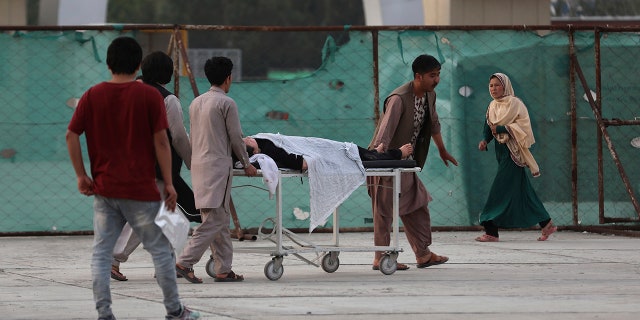
An injured school student is transported to a hospital after a
bomb explosion near a school in west of Kabul, Afghanistan, Saturday,
May 8, 2021. (Associated Press)
Bloodied backpacks and schools books lay strewn
outside the Syed Al-Shahda school. In the morning, boys attend classes
in the sprawling school compound and in the afternoon, it's girls' turn.
Residents
in the area said the explosion was deafening. Naser Rahimi told The
Associated Press he heard three separate explosions, and immediately
thought that the sheer power of the blasts meant the death toll would
almost certainly climb.
One of the students fleeing the school recalled the attack, the girls' screams of the girls, the blood.
"I
was with my classmate, we were leaving the school, when suddenly an
explosion happened, " said 15-year-old Zahra, whose arm had been broken
by a piece of shrapnel.
"Ten minutes later there was another
explosion and just a couple of minutes later another explosion," she
said. "Everyone was yelling and there was blood everywhere, and I
couldn’t see anything clearly." Her friend died.
Outside the
Muhammad Ali Jinnah Hospital, in the Dasht-e-Barchi neighborhood dozens
of people lined up to donate blood, while family members checked
casualty posted lists on the walls.
Most
of the dozens of injured brought to the EMERGENCY Hospital for war
wounded in the Afghan capital, "almost all girls and young women between
12 and 20 years old," said Marco Puntin, the hospital's programme
coordinator in Afghanistan.
In a statement following the attack,
the EMERGENCY Hospital said the first three months of this year has seen
a 21 per cent increase in war-wounded.
IS has previously claimed
attacks against minority Shiites in the same area, last year claiming
two brutal attacks on education facilities that killed 50 people, most
of them students.
Even as the IS has been degraded in Afghanistan,
according to government and US officials, it has stepped-up its attacks
particularly against Shiite Muslims and women workers.
Earlier the group took responsibility for the targeted killing of three women media personnel in eastern Afghanistan.
The
attack comes days after the remaining 2,500 to 3,500 American troops
officially began leaving the country. They will be out by Sept. 11 at
the latest. The pullout comes amid a resurgent Taliban, who control or
hold sway over half of Afghanistan.
The
top U.S. military officer said Sunday that Afghan government forces
face an uncertain future and possibly some "bad possible outcomes"
against Taliban insurgents as the withdrawal accelerates in the coming
weeks.
Associated Press photographer Rahmat Gul and video
journalist Ahmad Seir in Kabul, Afghanistan and Kathy Gannon in
Islamabad, Pakistan contributed to this report.
The flames in Jerusalem are difficult to control, and if they spread too rapidly everyone will pay a heavy price, mainly the Palestinians.
The link between Jerusalem, specifically the Temple Mount, Jerusalem
Day, which marks the city's liberation and unification, and finally, the
Muslim holy month of Ramadan, is the context for the violent events we've witnessed in the capital in recent days.
Yes, Ramadan has normally been a time of unrest, certainly in a
conservative society where religion plays a significant role, and it can
be a vessel for releasing tensions and frustrations often rooted in
social and economic distress. As per the norm in the Middle East,
demonstrations can erupt into unrestrained and uncontrollable violence
in a matter of seconds.
The causes behind the tensions are pre-existing and therefore all
that's needed is an excuse, followed by the usual inciters and agitators
to ignite the powder keg to advance their own political interests.
In recent weeks, and essentially since the onset of Ramadan, we have
seen tensions gradually rise in Jerusalem. Attacks on ultra-Orthodox
Jews by young Muslim assailants for no other reason than "likes" and
laughs on TikTok, consequent retaliation from Jewish youths, police
barricades at Damascus Gate during Ramadan, the events in Sheikh Jarrah –
all have materialized, as usual during this holiday, in its final days,
particularly the last Friday of the month.
This tension is structural and even predictable, and we see its
consequences every year. But it is rooted in the century-old
Israeli-Arab conflict for this land, and of course for Jerusalem. We
should not assume, therefore, that this tension will wane and dissipate
while Palestinians still refuse to accept the presence of Jews
throughout the land and to recognize the State of Israel.
It's not inevitable, however, for this tension to turn into a
conflagration. Virtually none of the parties want a conflagration. Not
the resident of Jerusalem, Jews and Arabs alike, who want to continue
living their lives. The majority of the Arab world also wishes for calm
and despite the default condemnations emanating from Arab capitals, no
one wants an unnecessary conflict for something that goes without saying
– freedom of worship in Jerusalem under Israeli sovereignty.
Only a small handful of agitators have something to gain from fanning
these flames, for example, members of the North Branch of the Islamic
Movement in Israel, and of course, Iran and Hezbollah, which promptly
hailed the riots and wished for blood. The Palestinian Authority, and
apparently Hamas as well, hope to scrounge a few points on the
Palestinian street and appear to be encouraging the violence in the
hopes that they can control the flames. The problem is that these flames
are difficult to control, and if they spread too rapidly everyone will
pay a heavy price, mainly the Palestinians.
Despite the tendency – by the Israeli press as well – to attribute
the recent events to measures implemented by the police or army, and
even to MK Itamar Ben-Gvir, who most Palestinians have never heard of –
things are far more complicated and deep. And yet, the Israeli interest
is for things to calm down and the government should be working to this
end.
From short-range Burkan rockets with massive warheads that can destroy buildings to medium-range Iranian Fateh 110 missiles that can reach greater Tel Aviv, the Alma Center sheds new light on how Lebanon is brimming with Hezbollah's firepower.
Hezbollah supporters watch a televised speech by Hezbollah leader Hassan Nasrallah | File photo: AFP
Reported Israeli strikes once again lit up Syria's night sky early on
Wednesday, with Israeli missiles slamming into multiple targets in
northwest Syria's Latakia region, according to Syrian state media. The
reports are the latest reminder of an ongoing shadow war raging between
Israel and the Iranian-Shi'ite axis, in which the Iranians and Hezbollah
attempt to smuggle and deploy advanced weapons to threaten Israel with
and Israel set out to disrupt this activity.
An Israeli organization closely monitoring this struggle is the Alma
Education and Research Center, which monitors Israel's northern borders
and publishes in-depth studies on the activities of the radical Iranian
axis in Lebanon and Syria.
"The reported airstrike in northwest Syria, in our estimation,
targeted the precision missile project and related weapons to
Hezbollah," Alma tweeted on Wednesday, in reference to the latest
airstrikes.
The precision missile project is the joint Iranian-Hezbollah
initiative to upgrade Hezbollah's projectiles and convert them into
precision-guided missiles (PGMs). Unlike unguided rockets, precise
missiles with guidance systems can strike targets within an accuracy of a
5-meter diameter.
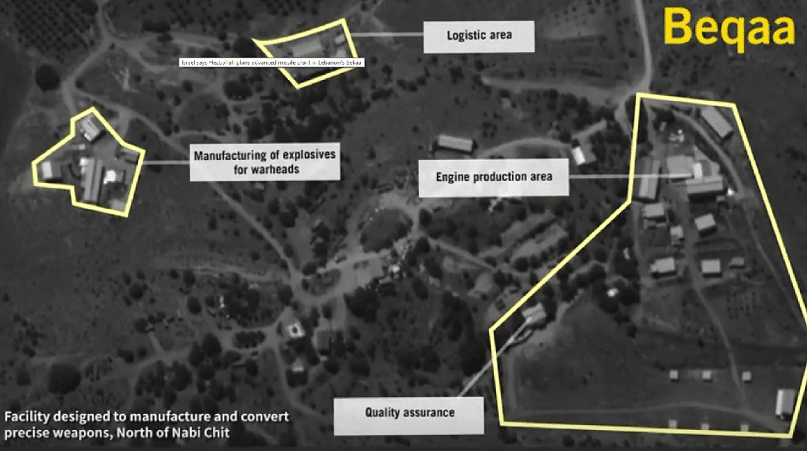
Hezbollah's alleged precision missile facilities in Lebanon (IDF Spokesperson's Unit/File)
The Alma Center has recently put together a detailed map of
Hezbollah's deployment of its arsenal while also exposing six new
military sites used by Hezbollah in south Lebanon, which provides a
glimpse into the scope of the terror army's firepower, estimated to be
larger in scope than that of most NATO armies.
"Hezbollah assesses that in its next conflict with Israel, it will
face great difficulties in dealing with the IDF in open area," Maj.
(res.) Tal Beeri, director of the research department at the Alma
research center, told JNS.
"It therefore decided to concentrate its activities in built-up
areas. Hezbollah always did this, but since the 2006 Second Lebanon War,
it shifted most of its activities into and around built-up areas,"
explained Beeri, who spent 20 years in Israel Defense Force intelligence
specializing in Lebanon and Syria.
Alma's map shows two primary lines of "defense" created by Hezbollah
designed to hamper any future IDF ground maneuver into Lebanon. It is
from these zones that Hezbollah plans to direct heavy waves of
projectile fire at Israeli population centers.
The first line, which begins at the Israeli border and runs north up
to the Litani River, contains a large number of Grad and Fajr rockets
with a 75-kilometer range, placing northern Israeli communities in their
sights. The third type of rocket, called the Burkan, is deployed in
southern Lebanon as well, and while its range is short, its firepower is
devastating.
"The Burkan is designed for use against border civilian communities
and against the IDF," said Beeri. "It has a warhead of 400 kilograms. It
can destroy a number of buildings on impact."
The Burkan was "born" in the Syrian civil war, where forces allied to
the Bashar Assad regime adopted a Russian doctrine of surrounding a
rebel-held area, placing it under siege and shelling it will all manner
of weapons. "This includes the Burkan rockets, which created huge
destruction. If this falls in a crowded area, it paralyzes the adversary
to the point of not being able to function," said Beeri. Entire
villages in Syria were destroyed through this technique, enabling Assad
and his allies, including Hezbollah, to seize many areas.
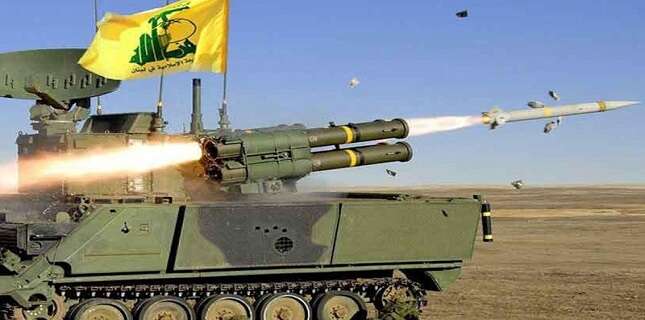
Hezbollah has been investing considerable resources in upgrading its missile arsenal (Screenshot)
Goal: 'Challenge the IDF in urban warfare'
Throughout southern Lebanon, Hezbollah has turned some 200 southern
Shiite villages into part of its "defensive" plan against a potential
IDF ground maneuver. This is where the rocket launchers have also been
embedded. "The fact that they are in villages, as well as near to them,
is how they plan to ensure their ability to challenge the IDF in urban
warfare, with the limitations it places, such as human shielding," said
Beeri.
The use of underground tunnels, bunkers and command posts dug
underground is also intended to make it hard on the IDF to hit the
organization. "All of this is in built-up areas," said Beeri. "This is
also where Hezbollah installed its missile infrastructure."
The first line of defense in Lebanon also contains a massive
deployment of anti-tank missiles and shoulder-held anti-aircraft
missiles, such as Stingers.
The second line of defense begins at the Litani River and stretches
north, to the Zahrani River. In this zone, according to Alma's
assessment, medium-range Zilzal rockets with a range of 200 kilometers
are deployed alongside more powerful anti-aircraft batteries.
"Here, too, apparently, are SA-8 surface-to-air missiles with a range of up to 60 kilometers," said Beeri.
Further north, in Beirut, is Hezbollah's central headquarters, and
the city area is packed with Iranian and Syrian-made Fateh 110 rockets
that can reach greater Tel Aviv. It is here that Hezbollah is trying to
turn some of those rockets into precision-guided missiles. (Alma exposed
32 such missile sites in Beirut in previous reports.)
The Beirut-area coastline has advanced anti-ship missiles deployed,
including the Chinese-made C-802 missile, which was used by Hezbollah in
2006 to strike an Israeli Navy Ship. "In our view and according to
international media reports, Hezbollah views this as a strategic tool,"
said Beeri.
Hezbollah is also likely armed with the supersonic Russian-made
Yakhont missile in the Beirut area that can be used to target Haifa
Port, the Haifa naval base and to challenge the Israel Navy's freedom of
maneuver. "As a bonus, they could try to target an offshore Israeli gas
rig with this missile," said Beeri.
"We believe the Yakhont is in Hezbollah's possession, and if it is,
it probably arrived from Syrian weapons warehouses. The war in Syria
opened a big door for Hezbollah to import high-quality weapons from
Syrian storage facilities. This is part of the local 'arrangement'
between Hezbollah and Assad, and some of this is going on with the
knowledge of the Russians," he stated.
The Grad and Zilzal rockets come from production facilities in both
Iran and Syria as well, smuggled in by the Iranian Quds Force.
The Bekaa Valley, in Lebanon's east, serves as a logistical and
operational rear for Hezbollah, as well as for hosting weapons factories
that apparently also create components for precision-guided missiles.
"Our estimate is that in the Bekaa Valley, Hezbollah likely also has
tens of Scud D missiles, which came from Syria," said Beeri.
Advanced Russian-made air-defense systems – SA-17 and SA-22 – are in
the Bekaa Valley region as well, he estimated, imported with the help of
Syria and Iran.
"We believe that Hezbollah trained in Syria on these missile
batteries, then came back to Lebanon with them and brought an unknown
quantity of them back," said Beeri.
The majority of Hezbollah's arsenal is short-range weaponry, but the
ongoing attempt to turn Fateh-110s into guided missiles is a severe
threat since it gives Hezbollah the ability to accurately target
Israel's strategic sites.
A guided Fateh-110 missile can launch at any target in greater Tel
Aviv, he noted, and although Israel's multi-layered air-defense systems
will stop many incoming threats, they won't be able to intercept
everything.
Said Beeri: "What more do they need than the ability to hit central Israel?"
"Al-Aqsa is in danger" is trundled out to fire up religious terrorism when national motivation is waving. Meanwhile, Israel allows the incredible concession it made in 1967 to be taken for granted.
Some 20 years after the October 2020 riots on the Temple Mount, and
the unforgettable remarks by then-leader of the Ra'am party MK Abd
al-Malik Dahamsha that he would "be willing to be the first shahid to
defend Al-Aqsa," both branches of the Islamic Movement in Israel – the
legal Southern Branch and the outlawed Northern one – are making similar
statements now.
Everything is coordinated: The ideological line is that of the Muslim Brotherhood. The operation on the ground and the incitement is handled by Hamas,
the Islamic Movement, and some Arabs in east Jerusalem. The Palestinian
Authority, as usual, is along for the ride. This is the same axis that
was active during the metal detector crisis. This is the same axis that
kicked in during the last scuffle around Damascus Gate. It's the same
axis now. The goal is to move the conflict onto religious lines after
the nationalist issue turned out to be insufficient grounds for a
conflagration. The way to do this is through the same old lie, "Al-Aqsa
is in danger."
Sometimes this is a delusional claim that Israel is planning to
demolish the mosques on the Temple Mount. Sometimes it's a basely claim
that Israel is supposedly planning to tinker with the status-quo on the
Mount, when the truth is completely the opposite: the Muslims are the
ones who are upsetting the Temple Mount status quo, in a major way.
But these stories have long since ceased to be propaganda and
incitement along. They have become surrogates for terrorism and
catalysts for terrorist attacks, rioting, and now a semi-uprising whose
purpose is to weaken Israel's hold on and sovereignty over the Old City
of Jerusalem and the Temple Mount.
The new equation Hamas is trying to construct is one in which Israel
gives up in Jerusalem in exchange for quiet, both in the city itself and
in Judea and Samaria and the Gaza Strip. This formula, whether it's
about the Temple Mount or the Sheikh Jarrah-Shimon HaTzadik
neighborhood, or about construction in the Har Homa neighborhood, should
be put down with a strong hand. Hamas sees any concession in Jerusalem,
or at all, as weakness and encouragement to step up the rioting,
terrorism, and sedition even more.
The public in east Jerusalem, Arab Israelis, and the Arabs in Judea,
Samaria, and Gaza are well-versed in leveraging the fictions about
"Al-Asqa being in danger" – and the defense that is supposedly needed –
for the sake of passing political and national purposes. The father of
the libel and religious terrorism in Israel was the Grand Mufti Haj Amin
al-Husseini. His successor is Sheikh Raed Salah, currently in prison as
he deserves. Salah's allies and students are the ones who are lighting
up Jerusalem and the Temple Mount now.
The "Al-Aqsa is in danger" coalition, which in recent years has
spawned terrorism, as well, includes the Islamic Movement in Israel,
some Arab MKs, the Palestinian Authority and its spokespeople, all
branches of the PLO, the Fatah, Turkish leader Recep Tayyip Erdogan,
Hamas, the Palestinian Islamic Jihad, Hezbollah, Iran, Syria, as well as
members of the bloc identified with the moderate Arab world in Egypt,
Jordan, Saudi Arabia, and Gulf states, and Indonesia. For years, members
of this coalition have been trying to out-do one another in incitement
and radicalism, because merely touching on the issue gives them bona
fides in the eyes of their respective publics and circles.
The discourse that radical Islam manages to drag the world, as well
as us, into focuses almost entirely on the Temple Mount's holy status
for Muslims. No one reminds the world about the enormous, incredible
concession of the Mount that Israel has already made, back in 1967. No
one mentions that the state of the Jewish people, which recaptured the
holiest place in Judaism in 1967, then placed it in the hands of a
competing religion, Islam, for which it is only the third-holiest site,
doing massive harm to the rights of the Jews there.
For some reason, this fact, which is the hardest thing to accept, has
become something to be taken for granted, but it shouldn't be. There is
no example of another concession like this one in interfaith relations
anywhere in the world, but Israel plays it down as if it never happened.
The Americans came to London with a set of clichés used during their presidential campaign last year, notably the catch-all "America is back!", but were unable to say where that "back" was or whether it was necessary to go there.
The real bad news, however,
is that the London conference failed to develop a coherent and mutually
agreed analysis of the international situation, without which no serious
policy-making is possible. The Americans came to London with a set of
clichés used during their presidential campaign last year, notably the
catch-all "America is back!", but were unable to say where that "back"
was or whether it was necessary to go there.
They also talked a lot about "multilateralism" without making it
clear what it was they wanted to be multilateral about. Multilateralism
is a method of doing things, not the substance of policy. You could do
both wise and foolish things multilaterally. The Libyan disaster
resulted from President Barack Obama's "leading from behind"
multilateralism. The latest example of foolish multilateralism is the
cut-and-run policy the Biden administration is marketing on Afghanistan.
What seems clear is that both China and Russia are trying to
project power in a 19th-century colonial style... Putin's strategy...
copying General Paskevich's warning: "to keep the land you grabbed
today, you will have to grab more land tomorrow."
Does anyone believe that, short of a shock-and-awe operation, Kim
Jung-on could be leashed in without help from China? And could the G7's
habitual cat-and-mouse game with the Khomeinist regime in Tehran
produce positive results while Russia plays cheerleader for the mullahs?
The current G7 position could only persuade Beijing and Moscow to
set their differences aside and promote a low-intensity global war
against the democratic world.
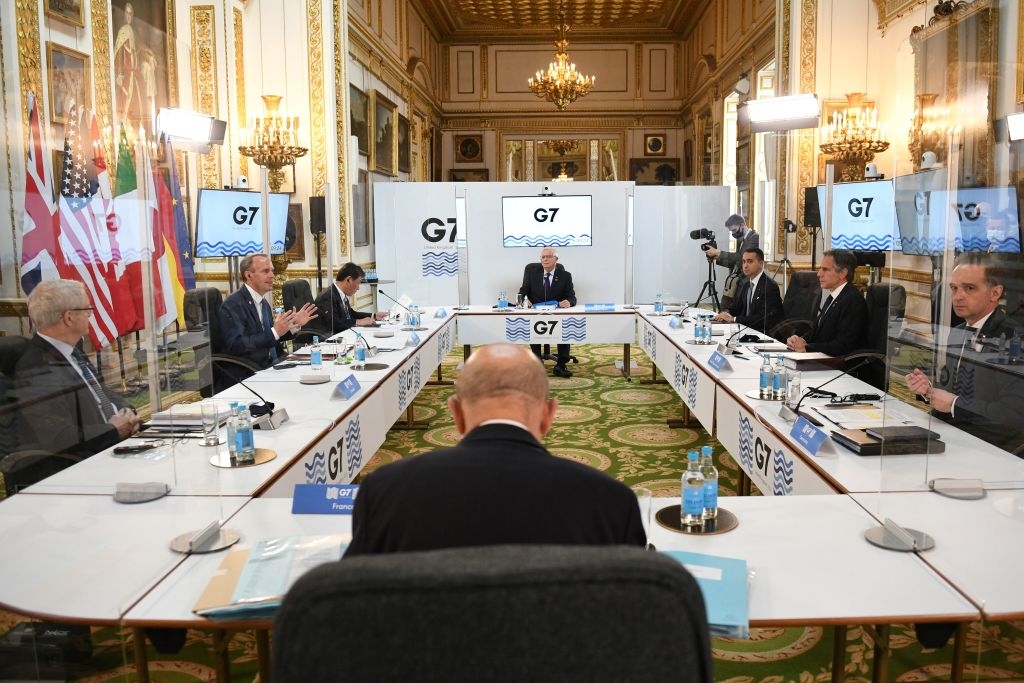
Even
if the so-called G7 group of industrial democracies is no longer as
powerful and/or relevant as it was when it was first launched more than
four decades ago, it is still capable of making a difference on the
global stage where a difference is necessary. Pictured: Foreign
ministers of the G7 meet in London on May 4, 2021. (Photo by Stefan
Rousseau/Pool/AFP via Getty Images)
Even if the so-called G7 group of industrial democracies is no longer
as powerful and/or relevant as it was when it was first launched more
than four decades ago, it is still capable of making a difference on the
global stage where a difference is necessary. It is therefore good news
that the group, consisting of the US, Canada, Britain, Germany France,
Italy, and Japan managed to convene a face-to-face conference of its
foreign ministers in London, the first in two years.
The ministerial conference, also attended by the European Union
foreign policy spokesman, had the task of preparing the agenda for a
full summit of the seven nations, again in Britain, next month. The
planned summit will provide Joe Biden with his first foray into the
international arena as US President.
While the holding of the London conference was good news, it also
contained an element of bad news. To start with, the British host tried
to promote one of Prime Minister Boris Johnson's many brainwaves by
inviting India, Australia, and South Africa as guests with a wink and
nod in the direction of the Commonwealth.
Having relished then regretted his reputation as the British Donald
Trump, Johnson isn't sure how he might get along with Biden, who has
made no secret of his "unhappiness" about Brexit. Johnson and his team
have been promoting what they call a D-10 group of democracies, most of
them part of the Anglo-sphere, as a broader alternative to G7 and a
cozier version of the G-20.
The real bad news, however, is that the London conference failed to
develop a coherent and mutually agreed analysis of the international
situation, without which no serious policy-making is possible. The
Americans came to London with a set of clichés used during their
presidential campaign last year, notably the catch-all "America is
back!", but were unable to say where that "back" was or whether it was
necessary to go there.
They also talked a lot about "multilateralism" without making it clear what it was they wanted to be multilateral about.
Multilateralism is a method of doing things, not the substance of
policy. You could do both wise and foolish things multilaterally. The
Libyan disaster resulted from President Barack Obama's "leading from
behind" multilateralism. The latest example of foolish multilateralism
is the cut-and-run policy the Biden administration is marketing on
Afghanistan. (Even Hillary Clinton has questioned the wisdom of that
decision.)
"Consensus" was another cliché circulated in London. But consensus,
too, is an abstraction that, if not applied to a clear policy, is
useless or even dangerous. Consensus on jumping together from a cliff
may sound dramatic but could be suicidal.
In any case, there was hardly any consensus on the key issues raised at the London conference.
There was no consensus on how to categorize the challenge that China
and Russia are supposed to pose against what US Secretary of State
Anthony Blinken calls "the rule-based international order", a cliché
that adds another layer of ambiguity to any analysis of the current
situation.
Does this mean that that international law and norms as practiced
since the end of World War II are no longer sufficient and that
additional "rules" are needed? And if yes who fixes those rules?
While President Biden portrays China as a growing monster capable of
"eating us up", Canada and the European trio of Britain, Germany, and
France see the Communist-dominated power as a lucrative partner. In
fact, had it not been for Trump's pressure, Prime Minister Johnson would
have not canceled the controversial 5G deal with the People's Republic.
As for China, investment plans currently taking shape could make
Germany the People's Republic's number one economic partner.
France, too, is drawing closer to China as a source of direct
investment, technology transfer, and market for luxury goods and
agricultural products.
There is also no agreement on what kind of threat Russia poses. While
the Americans claim that Vladimir Putin is trying to revive the Soviet
Union, the Europeans think he is after reconstituting the Tsarist
Empire.
What seems clear is that both China and Russia are trying to project
power in a 19th-century colonial style. China is building a blue-water
navy, copying the British imperial model, an expensive and ultimately
useless strategy in the rapidly changing world of the 21st century.
Putin's strategy is also very 19th century, copying General Paskevich's
warning: "to keep the land you grabbed today, you will have to grab more
land tomorrow."
Land-grabbing may have been profitable or at least not so costly when
the Berlin Conference colonial empires were running the show. These
days, however, the lands that Putin has annexed in Crimea, Donetsk,
South Ossetia, and Abkhazia, not to mention de facto glacises imposed in
Syria, Transcaucasia, and Central Asia, are a growing financial burden
for Russia's fragile economy.
To make matters more complicated it is clear that the G7 or the still
elusive D-10 won't be able to tackle other problems without the
support, or at least the neutrality of China or Russia, or in some
cases, both.
The London conference discussed North Korea, Myanmar, and the Islamic
Republic in Iran. Does anyone believe that, short of a shock-and-awe
operation, Kim Jung-on could be leashed in without help from China? And
could the G7's habitual cat-and-mouse game with the Khomeinist regime in
Tehran produce positive results while Russia plays cheerleader for the
mullahs?
As for Myanmar, it is clear that without at least tacit support from
China, the military regime won't be able to crush that nation's fragile
democratic movement.
To make things more complicated, China and Russia also have
conflicting interests in a number of places including Iran, Afghanistan,
Central Asia, and Myanmar. The current G7 position could only persuade
Beijing and Moscow to set their differences aside and promote a
low-intensity global war against the democratic world.
Neither China nor Russia is capable of winning such a contest, while
both can do much mischief in many domains. In their different ways, both
have succeeded in creating powerful state structures in weak short-term
societies, a model that, although capable of making an impression in a
100-meter stint, cannot win against the democratic model in a marathon
contest.
Henry Kissinger, a leading lobbyist for Beijing, portrays China as
the inevitable future "superpower". A similar claim is made by Russia's
European, mostly German apologists.
Such claims have persuaded the G7 to overestimate China and Russia as
challengers, competitors, rivals, or even enemies in strategic terms
while appearing negligent about them at the tactical level. That
analysis needs be stood on its head: Despise the enemy strategically but
take him seriously tactically.
This article was originally published by Asharq al-Awsat
Amir Taheri was the executive editor-in-chief of the daily Kayhan in
Iran from 1972 to 1979. He has worked at or written for innumerable
publications, published eleven books, and has been a columnist for Asharq Al-Awsat since 1987.
 Speaking to pollster Richard Baris during an episode of "Inside the Numbers," lawyer Robert Barnes said historically,
the Census tends to "pin on the nose" the recorded vote numbers with
the actual results. In other words, often the two data sets reasonably
match.
Speaking to pollster Richard Baris during an episode of "Inside the Numbers," lawyer Robert Barnes said historically,
the Census tends to "pin on the nose" the recorded vote numbers with
the actual results. In other words, often the two data sets reasonably
match.