The "Middle East and Terrorism" Blog was created in order to supply information about the implication of Arab countries and Iran in terrorism all over the world. Most of the articles in the blog are the result of objective scientific research or articles written by senior journalists.
From the Ethics of the Fathers: "He [Rabbi Tarfon] used to say, it is not incumbent upon you to complete the task, but you are not exempt from undertaking it."
France's
foreign ministry denounced his deportation and said that the French
government had actively sought to defend his rights and has been in
contact with Israeli authorities multiple times.
"We
condemn the Israeli authorities' decision against the law to deport
Salah Hamouri to France," the ministry said in a statement.
Ahmed Majdalani, a member of the Executive Committee of the Palestine Liberation Organization, called the deportation unlawful.
“He
didn’t commit any crime to be deported from his homeland and be
expelled into another country, where he had stayed for a short period
even if he holds the nationality of that country,” Majdalani told
Reuters.
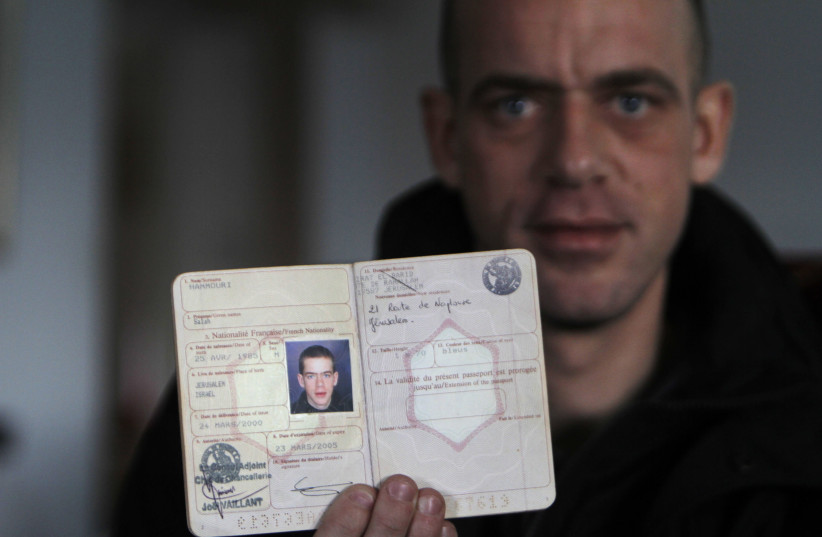
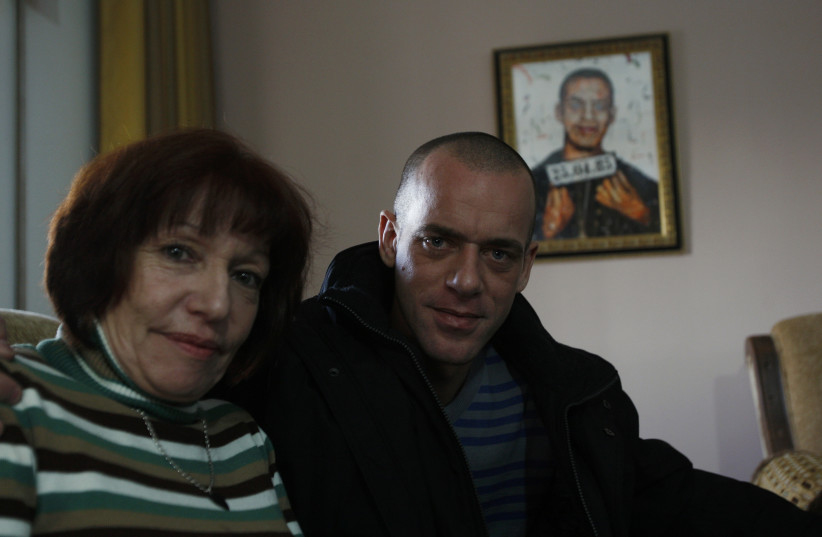
Salah Hamouri poses for a photograph with his mother during an
interview with Reuters in the West Bank neighbourhood of Dahiyet
al-Barid, on the outskirts of Jerusalem December 19, 2011. (credit:
MOHAMAD TOROKMAN/REUTERS)
Hamouri was escorted to the airport where he boarded a flight to France, the Interior Ministry said in a statement.
The
ministry did this after revoking his residency permit in east Jerusalem
on December 1, after Israel arrested him and placed him under
administrative detention without charge on March 7.
Who is Palestinian-French lawyer Salah Hamouri?
Hamouri,
an east Jerusalem resident born to a Palestinian father and French
mother, is a lawyer and researcher working for Addameer Prisoner Support
and Human Rights Association, one of the six Palestinian NGOs declared by Israel to be terrorist organizations.
He has also been accused of being a member of the Popular Front for the
Liberation of Palestine (PFLP), which is also recognized as a terrorist
group.
Since then, he has been arrested multiple times for a variety of reasons.
Former
interior minister Arye Deri, who also leads the Shas Party of which
Ovadia Yosef was the spiritual leader, has on more than one occasion
threatened to have his Jerusalem residency permit revoked and be
deported.
Congress "a separate and co-equal branch of government," senators point out.
Two
Republican senators this week slammed the Department of Homeland
Security for what they said were overzealous redaction decisions
pursuant to an oversight request made by the senators themselves.
In their letter to DHS Secretary Alejandro Mayorkas,
Missouri Sen. Josh Hawley and Iowa Sen. Chuck Grassley criticized the
department for its response to a request for documentation the two
lodged in June of this year.
Of the two responses the senators received, they wrote, one "did not
answer any of the ten questions" they originally posed, while the other
consisted of "two documents already in the public domain" and "500 pages
of material, approximately half of which are mostly or entirely
redacted."
"We remind you that the oversight letters we send to the Executive
Branch are signed in our capacity as sitting members of Congress, a
separate and co-equal branch of government," the senators wrote.
Noting that DHS cited Freedom of Information Act disclosure
privileges in making the redaction, Hawley and Grassley pointed out that
FOIA provisions "do not apply to the oversight requests we submit in
our capacity as constitutional officers and should not be applied to the
materials that DHS produces in response to congressional requests."
"Simply put, Congress controls when to make documents within its
possession public, not DHS, and the people’s business ought to be
public," they argued.
The senators demanded that DHS provide "full and complete responses"
to its earlier inquiries, as well as "a detailed description of DHS’s
policy for responding to congressional oversight requests," by Dec. 29
of this year.
“Without the intelligence contribution, there could have been no Soviet bomb that quickly.”
You’ve got to give the Left credit. It has an extensive agenda, a
long memory and when it seizes power, it rolls as many of its agenda
items, even the ancient ones, through the gate. Compare that to how
little conservatives get done when in office. And how little of the
things the Left does they reverse.
This is a seemingly unimportant example, but also a reminder of how
comprehensive the Left’s agenda is, how it encompasses the past, present
and the future. Lefties never let anything go.
The Biden administration has reversed a decades-old
decision to revoke the security clearance of Robert Oppenheimer, the
physicist called the father of the atomic bomb for his leading role in
World War II’s Manhattan Project.
U.S. Energy Secretary Jennifer Granholm said the 1954 decision by the
Atomic Energy Commission was made using a “flawed process” that
violated the commission’s own regulations.
“As time has passed, more evidence has come to light of the bias and
unfairness of the process that Dr. Oppenheimer was subjected to while
the evidence of his loyalty and love of country have only been further
affirmed,” Granholm said in a statement on Friday.
A Soviet spy chief’s memoirs published here today claim
that the late J. Robert Oppenheimer, head of the U.S. atomic bomb
project during and after World War II, passed nuclear secrets to Soviet
agents.
The allegations were made by Gen. Pavel Sudoplatov, who was in charge
of efforts to obtain atomic secrets from the West, and excerpts of them
ran in the Sunday Telegraph. Time magazine will print excerpts in
today’s issue.
The memoirs charge that Oppenheimer, a University of California
physicist known as “the father of the atomic bomb,” condoned and
assisted in the flow of vital nuclear secrets.
Sudoplatov charges that Elizabeth Zarubina, wife of the Soviet intelligence head in Washington, cultivated Oppenheimer socially.
Zarubina persuaded Oppenheimer to share atomic secrets with “anti-fascists of German origin,” Sudoplatov says.
The memoir, “Special Tasks,” declares: “We received reports on the
Manhattan Project from Oppenheimer and his friends in oral form, through
comments and asides, and from documents transferred through clandestine
methods with their full knowledge that the information they were
sharing would be passed on.
“In all there were five classified reports made available by Oppenheimer describing the progress of work on the atomic bomb.”
The Russians also received photos of the facilities at Oak Ridge, the book says.
“The Soviet bomb was constructed in three years,” Sudoplatov says.
“Without the intelligence contribution, there could have been no Soviet
bomb that quickly.”
Oppenheimer’s actions could have led to the deaths of millions of people and eventually far more than that.
Long before that, Edward Teller put his career on the line to
denounce Oppenheimer. That helped marginalize Teller, the father of the
H-bomb, and made him a pariah among lefties to whom the highest possible
honor was helping the USSR and the highest possible disgrace was
informing on Communists.
And then there’s the Merkulov letter which also revealed Oppenheimer’s complicity with the USSR.
In short, all of the “new evidence” actually makes it clear that Oppenheimer was collaborating with the USSR.
And all of this will also be ignored by the Biden administration and
the media who don’t actually know any of the history or care.
And watch for some media fact checkers to issue a ruling of ‘false’
or ‘lacks context’ on this post to block it from Facebook and Google.
We live in a new leftist empire. An empire of lies.
Come on, man. What's a little rounding error between friends?
What’s a little rounding error between a corrupt hack and the country he’s running into the ground?
“In the second quarter of this year, we created more jobs
than in any quarter under any of my predecessors in the nearly 40 years
before the pandemic,” Mr. Biden said on July 8.
“The economy created more than 1.1 million jobs in the second
quarter, or around 375k jobs per month,” the White House said in a
statement on July 22.
A million or ten thousand. Come on, man. Who’s keeping track?
The Philadelphia Fed’s new assessment shows that
employment numbers in 29 states and the District of Columbia were
significantly lower than the Bureau of Labor Statistics reported for the
March-through-June period.
The BLS, a division of the Department of Labor, estimated net job
growth of 1,047,000 jobs in the second quarter. The Philadelphia Fed now
says its data shows that 10,500 net jobs were created in that period.
Another reminder that anything from BLS or anything under the control
of administration political appointees cannot be trusted. The Biden
administration is actually worse than the Obama administration in this
regard. Everything is corruptly politicized and appointees will flat-out
tell the most outrageous lies.
Not that this comes as a surprise even to the media. How many times has this happened already?
Biden’s bogus boast of 1 million ‘construction jobs’ – Four Pinocchios – Washington Post
AP FACT CHECK: Biden’s fuzzy math on 1 million new auto jobs
Biden will still keep on lying anyway.
Daniel Greenfield, a Shillman Journalism Fellow at the David Horowitz Freedom Center, is
an investigative journalist and writer focusing on the radical Left and
Islamic terrorism.
Although China strictly polices gaming content for its home market — banning dissenting political views and permissive social values — major Chinese companies are aggressively expanding market share globally.
The
field of international relations is synonymous with the concept of
power — more specifically, "hard" power and "soft" power. The former
refers to a country's use of coercive tactics to get what it wants; the
latter employs the carrot rather than the stick. It involves the shaping
of preferences through more subtle means.
Examples of soft power include
economic power, political and religious values, diplomacy, and culture.
Within culture, we find art, music, and video games. Yes, video games.
With their vast popularity and reach, video games are among the most influential, if often overlooked, forms of soft power in today's world. But one place it's not overlooked is Beijing.
Last year, the Chinese Communist Party (CCP) referred to
online gaming as "spiritual opium," warning that the industry, now
"worth hundreds of billions," could "destroy a generation." Soon after
the announcement, Beijing barred those under the age of 18 from gaming
on weekdays and limited their play to just three hours on weekends.
Although China vigilantly polices gaming content for its home market —
banning dissenting political views and permissive social values — major
Chinese companies have made deep inroads in the international gaming
market, acquiring gaming studios across the globe and aggressively
expanding market share. Because of these acquisitions, video games may "look a little different"
in the future, warn many cultural commentators and industry observers.
That's because video games are more than just a form of entertainment.
They are highly immersive, narrative-driven storytelling mediums.
In the 1960s, the Hungarian-born American academic George Gerbner put
forward a sociological communications framework aptly titled
"cultivation theory." In an analysis that continues to influence media
psychologists to this day, Gerbner argued that sustained exposure to
mass media — especially television, the dominant medium of his day —
eventually shapes users' perceptions of social reality in profound
ways.
Video games too can inform or distort perceptions of reality, and the CCP appears to be using them to influence the ways in which users view China and its government. According to a 2021 Guardian article,
for example, this includes banning references to pro-democracy
movements in Hong Kong and comparing Chinese ruler Xi Jinping to Winnie
the Pooh. Games are being geared to directly reflect Chinese values.
Many of those that Beijing is attempting to influence reside in the U.S. Gaming is now one of the United States' favorite pastimes, with 214 million active gamers among the nation's 329 million people. The average gamer now spends more than 8 hours a week gaming. That's 384 hours a year, or 16 full days. Some play as many as 80 hours a week (160 days per year).
Music, movies, and TV simply can't compete with the allure of gaming.
This explains why Chinese companies like ByteDance, parent company of
the wildly popular — and increasingly controversial — video-sharing
platform TikTok, are also cashing in on the gaming craze. Between 2001
and 2022, ByteDance's portfolio generated more than $1 billion worldwide in revenues, from mobile games alone.
Another huge Chinese company, Tencent, is also busy growing its gaming empire. In an attempt to reach more users, Tencent has poured considerable sums into acquiring overseas partners and development centers.
Take the video game development studio TiMi Studio Group, for example. A
subsidiary of Tencent Games, TiMi is headquartered in Shenzhen, China,
with offices in Singapore, Montreal, Chengdu, and Shanghai.
Although barriers to entry for Chinese companies looking to enter
Western markets are low, the same is not true for Western companies
looking to enter China. For example, foreign gaming companies looking to
enter China are "legally obliged to have a local partner," as
journalist Oliver Holmes has reported. This has benefited the likes of Tencent. As Holmes highlighted, Tencent, a company with close ties to the Chinese government,
has acquired large stakes in a number of foreign video game operations.
Only after such partial acquisitions and partnerships have been
consummated are foreign firms allowed access to China's lucrative gaming
market.
Riot Games, the company behind League of Legends, one of the most successful games of all time, sold a 93% stake to Tencent for somewhere in the region of $400 million. Tencent has also either invested in or completely bought out dozens of other
huge video game companies, including Activision Blizzard, Ubisoft,
Platinum Games, FromSoftware, Marvelous Inc., and Epic Games, the
company responsible for Fortnite, the most popular online game in the world. Fortnite has 270 million players worldwide, including 83 million residing in the U.S.
Games aren't just a narrative-driven medium that can serve as a
vehicle for stealth cultural imperialism; they are also a
data-harvesting medium. Again, this fact is not lost on China, a country
that has, according to reports, stolen the personal data of 80% of Americans.
In a 2020 op-ed
for the Wall Street Journal, Jordan Schneider and Dave Aitel asked if
Chinese video games posed a distinct threat to U.S. national security.
They answered with a resounding yes. Companies like Tencent are using
games to spread soft power and collect the data of U.S. citizens, they
wrote. More worryingly, they continued, with access to hundreds of
millions of devices, China has "an unrivaled opportunity to use games to
conduct intelligence operations."
According to a recent Heritage Foundation podcast,
some Chinese-backed games come with software that runs on a gamer's
computer even when they are not playing, and this software could be used
to collect data and monitor online activity.
Gaming technology has come a long way from the days of Pac-Man and
Super Mario. Today, gamers don headsets and enter all-consuming virtual
worlds for hours (or even days) at a time. Going forward, with the advent of the metaverse, gaming is set to become
even more captivating and even more consuming, with even more data
being harvested. As gaming evolves, China's grip on the sector appears
to be tightening.
Because a certain gang of Germans gave nationalism a bad name in the last century, one must not forget that in a world of diversity, the nation-state is the most workable model of socio-political and economic organization.
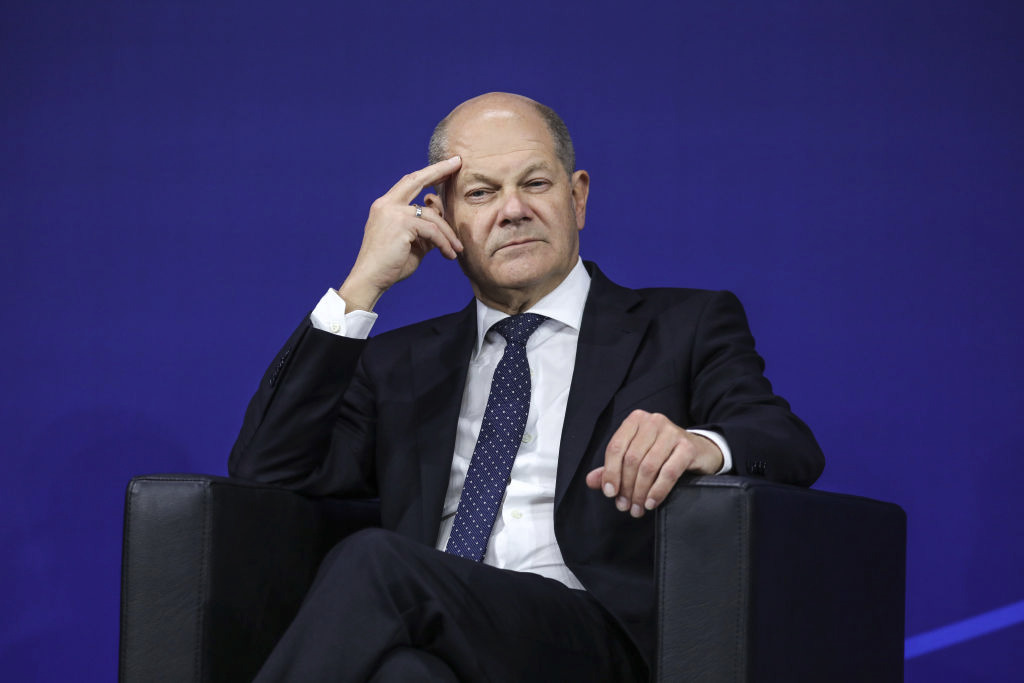
What [German Chancellor Olaf
Scholz] fails or decides not to mention is the need to acknowledge the
return of the nation-state as the key force capable of correcting those
mistakes.
Because a certain gang of Germans gave nationalism a bad name in
the last century, one must not forget that in a world of diversity, the
nation-state is the most workable model of socio-political and economic
organization.
A world of nation-states does not mean "each one for himself",
all the time, pursuing narrow and selfish "national interests".
Groupings of nation-states such as NATO or the European Union would be
based on the common interests of all member nations with their right of
opt-out or veto on certain issues preserved....
However, the real force that pushes inflation upwards may be the
decision by "liberal democratic capitalist" governments to print money
as if there were no tomorrow.
More good news is that the chancellor distances himself, ever so
gingerly, from the federalist project of some of the founders of the
European Union in its earlier version as the Common Market.
Reminding Europeans that there is no peace without security and
no security without a measure of self-sufficiency in strategic domains
is a timely contribution to the current debate about the future of
democracy in an increasingly complex world.
German Chancellor Olaf Scholz. (Photo by Omer Messinger/Getty Images)
Is the world order heading for a tectonic shift? And, if yes, what will that shift be like?
These are the questions that German Chancellor Olaf Scholz posed in an article in the American magazine Foreign Affairs,
published almost immediately after his lightning visit to China. The
word that Scholz uses to describe the shift is "Zeitenwende" or
"game-changer", but the tone of the article is more in tune with
Euro-pessimism of the kind expressed by French President Emmanuel
Macron, reflecting the current Zeitgeist or "spirit of the time" in
Western democracies.
Scholz speaks of a "multipolar" world order but does not say where
his imaginary poles are located. He then proceeds to depict what could
only be described as a one-and-a-half pole system in which the one pole
is constituted by the United States as "the decisive power of the 21st
century" with the European Union and the "Anglo-Saxon" world, that is to
say, Great Britain, Canada, Australia and New Zealand, plus Japan,
South Korea, and Taiwan in tandem. Together they represent "liberal
democratic capitalism." The remaining half a pole is the People's
Republic of China, which Scholz regards as a successful example of
"autocratic capitalism".
Scholz's analysis ends up as a new version of the "West and the rest"
in which Russia represents "Kleptocratic capitalism" with the remaining
150 or so other nations spread across the globe representing a new
version of the Third World, where the three kinds of capitalism
mentioned will compete for business, security interests and political
influence.
Scholz's analysis includes a number of encouraging points.
First, he admits that successive chancellors, including at least one
from his own Social Democratic Party (SPD), were wrong to make Germany
so dependent on Russia for energy. He also distances himself from the
European left's anti-military and NATO-bashing narrative to emphasize
the crucial role of the alliance in ensuring security and preventing a
"new Cold War". More importantly, perhaps, he calls for correcting the
mistakes of globalization.
What he fails or decides not to mention is the need to acknowledge
the return of the nation-state as the key force capable of correcting
those mistakes.
What he calls "liberal democratic capitalist" nations need to
consider is a massive program of re-industrialization, a task that would
require them to understand that something more than the profit margin
is needed to ensure their freedom, prosperity and security.
Because a certain gang of Germans gave nationalism a bad name in the
last century, one must not forget that in a world of diversity, the
nation-state is the most workable model of socio-political and economic
organization.
A world of nation-states does not mean "each one for himself", all
the time, pursuing narrow and selfish "national interests". Groupings of
nation-states such as NATO or the European Union would be based on the
common interests of all member nations with their right of opt-out or
veto on certain issues preserved, something that Scholz wants the EU to
abolish.
While warning of a looming Cold War, Scholz seems all at sea when it
comes to the hot war going on in the heart of Europe in Ukraine. He
offers no road map toward ending that war, giving the impression that
signing cheques and delivering "defensive weapons" to Volodymyr Zelensky
remain the only options.
Fomenting angst shouldn't divert attention from the real problems
that the "liberal democratic capitalist" nations are facing today.
The dramatic upsurge of inflation after almost three decades of
relative price stability can't be blamed solely on energy prices. The
claim that inflation reflects a shortage of supply is designed to
discredit Milton Friedman's monetarist theories.
Today, however, energy production, including oil and natural gas, is
at a record-high level. A shortage of supplies of certain agricultural
goods may be partly due to the war in Ukraine, while Covid-19 has also
affected industrial production in China.
However, the real force that pushes inflation upwards may be the
decision by "liberal democratic capitalist" governments to print money
as if there were no tomorrow. Even if Scholz, being a Social Democrat,
cannot appear as one of the Chicago Boys, he might at least consider the
possibility that the current inflationary spiral may be due to a
combination of supply shortages of farming and industrial goods and
increases in money supply, both in the EU and the US.
Scholz may also wish to reconsider his thinly disguised dismissive
reference to "the others", that is to say, the small, medium and large
nations that together form the majority of the United Nations. There,
again, treating the world as a family of nation-states might help with
each family member capable of making an important, sometimes decisive,
contribution to global peace and welfare.
In other words, shibboleths such as "liberal democracy" or
"autocratic capitalism" may be useful analytical tools for policymakers
but need not divide the world along ideological lines. In a world of
nation-states, difference need not be regarded as opposition let alone
hostility. The good news is that Scholz seems to be ditching the last
remaining illusions of the German center-left constituency, completing
the work started in Bad Godesberg at the height of the Cold War. More
good news is that the chancellor distances himself, ever so gingerly,
from the federalist project of some of the founders of the European
Union in its earlier version as the Common Market.
Unlike Macron, who preaches "the end of abundance," Scholz keeps his
pessimism within a perimeter of political realism; and that, too, is
good news.
Reminding Europeans that there is no peace without security and no
security without a measure of self-sufficiency in strategic domains, is a
timely contribution to the current debate about the future of democracy
in an increasingly complex world.
I remember a luncheon with Angela Merkel, Scholz's predecessor as
German Chancellor, in which she informed the guests, only half-jokingly,
that she spent half her time and energy keeping her two-party coalition
together. With a three-party coalition, Scholz has an even tougher time
attending to global challenges.
Whether or not Scholz succeeds in keeping his ramshackle coalition
together, let alone claiming a leadership position in the European Union
remains to be seen. Right now, however, he is touching the right
chords.
This article was originally published by Asharq al-Awsat and is reprinted by kind permission of the author.
Amir Taheri was the executive editor-in-chief of the daily Kayhan in
Iran from 1972 to 1979. He has worked at or written for innumerable
publications, published eleven books, and has been a columnist for Asharq Al-Awsat since 1987.
Jordan will need to rein in the protests and provide justice to the tribe of the man who was killed as it attempts to once again head off any growth in protests.
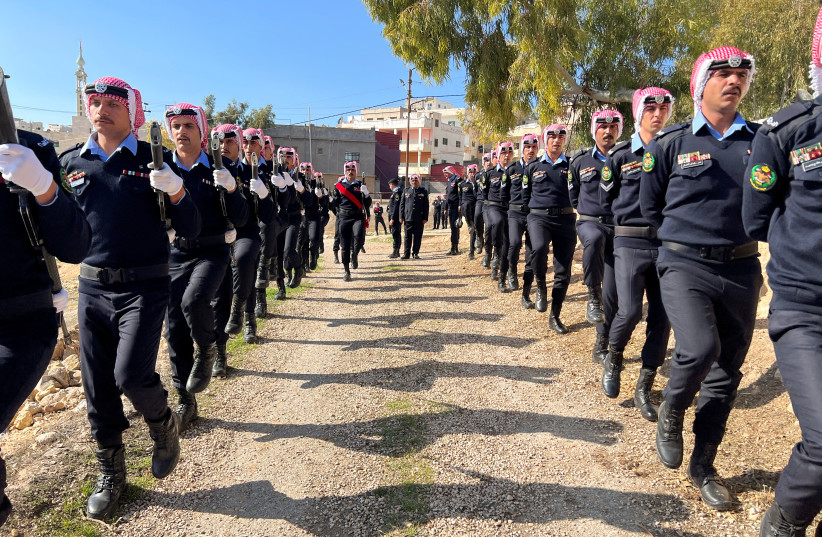
Jordanian security personnel carry the coffin of senior police
officer who was killed in riots on Thursday night according to
authorities, in Jerash, Jordan December 16, 2022.
(photo credit: REUTERS/JEHAD SHELBAK)
The death of a Jordanian police officer during riots that began with fuel price protests in Jordan appears to represent a rare and violent challenge to authority. The incident took place in the southern city of Ma’an.
“The
authorities said the policeman was killed on Thursday night by a
gunshot fired by an unidentified individual when armed officers entered a
neighborhood of Ma’an to quell riots,” Al Jazeera reported. “Youths had
attacked government property in the city.”
The
killing comes amid a number of protests in which other members of the
security forces have been injured. Many of these incidents appear to
have occurred outside the public eye, and it doesn’t seem like the
violence is spreading.
Nevertheless, this does indicate a serious challenge for the Kingdom of Jordan,
which has tried for many years to keep any kind of protest from
spreading. Every year brings new controversies, however, with many of
them seemingly rooted in economic challenges.
Jordan has faced decades of economic challenges for a variety of reasons.
Jordan
has faced decades of economic challenges for a variety of reasons. The
country is mostly landlocked, except for in the south, and it doesn’t
have many natural resources. Its economy is tied in part to the Gulf and
other monarchies, but it also has a large Palestinian population.
This
means that the kingdom not only has a human and economic attachment to
the West Bank, but it also has a political attachment and acts to be a custodian of Muslim and Christian Holy sites in Jerusalem. This role means Jordan is often at odds with the Israeli authorities.
Jordanian security personnel attend the funeral of senior police
officer who was killed in riots on Thursday night according to
authorities, in Jerash, Jordan December 16, 2022. (credit: REUTERS/JEHAD
SHELBAK)
The complex position of Jordan also means it
has been deeply impacted by the conflicts in Iraq and Syria. While the
kingdom once faced challenges from the Muslim Brotherhood, in recent
decades it also saw an influx of refugees from Iraq and Syria.
The
Syrians eventually came to number a significant percent of the
population – about a million people at its height. Some have returned to
Syria, but others have stayed in Jordan. Jordan views them in a
fraternal way, at least officially, welcoming Syrians from southern
Syria who often have some tribal or family links to people in northern
Jordan.
But this is a
major economic challenge. Western support and support from the wealthier
Gulf states isn’t enough for the kingdom. A partnership with Egypt and
Iraq is important, and Jordan also can serve as a conduit of trade to
Syria.
“Gunfire
killed a senior Jordanian officer and wounded two other police in the
country’s south, where protesters have taken to the streets for days
against rising fuel prices, authorities said on Friday,”
Washington-based news site Al-Monitor reported. The victim was Col.
Abdul Razzaq Dalabeh, deputy police chief of the Ma’an province, who was
shot in the head on Thursday. Apparently other security forces were
injured by gunshots.
The
killing has caused controversy among the Bani Hassan tribe, of which
Dalabeh was a member. They want justice, and they have demanded the
government follow up. This potentially creates another layer of
complexity for the government if it does not act quickly.
The
kingdom relies on powerful tribes to support its power, and it opened
up a new recruitment drive for the armed forces on Sunday, Jordan’s
Al-Ghad daily newspaper reported.
The
origins of the recent disturbances relate to a strike over diesel
prices, according to Arab News, an English-language daily newspaper
published in Saudi Arabia.
“Truck
drivers in Ma’an began the protest against rising diesel prices by
organizing a sit-in on the desert highway linking Amman and the port
city of Aqaba, before colleagues from other regions, including in Amman
and Mafraq on the border with Iraq, also joined in,” it reported.
Jordan
will need to rein in the protests and provide justice for the tribe of
the man who was killed as it attempts to once again head off an
escalation in protests.
“This is the third coin of this type found in excavations in Jerusalem, and one of the few ever found in archeological excavations,” said the researchers.
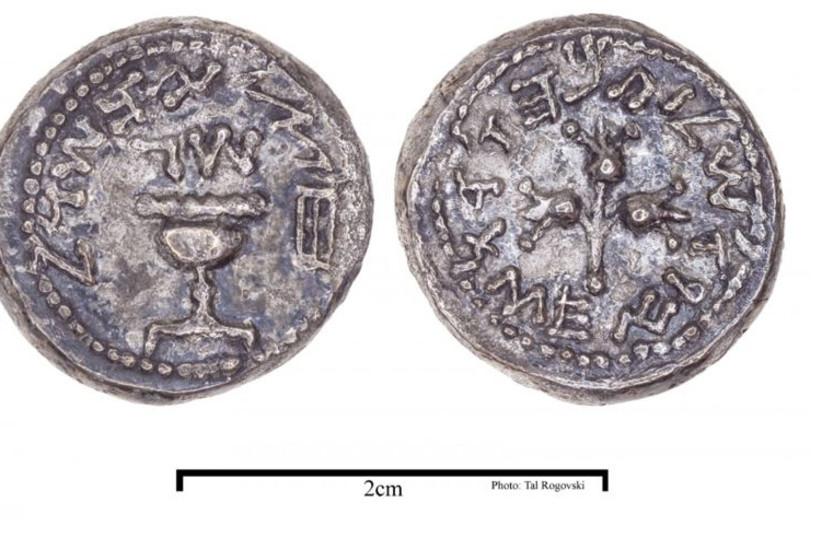
Half-shekel coin from the third year of the Great Revolt.
(photo credit: Tal Rogovski)
A rare, half-shekel coin from the Great Revolt from 66 CE to 70 CE
during the Second Temple period has been discovered in Jerusalem’s Ophel
excavations south of the Temple Mount.
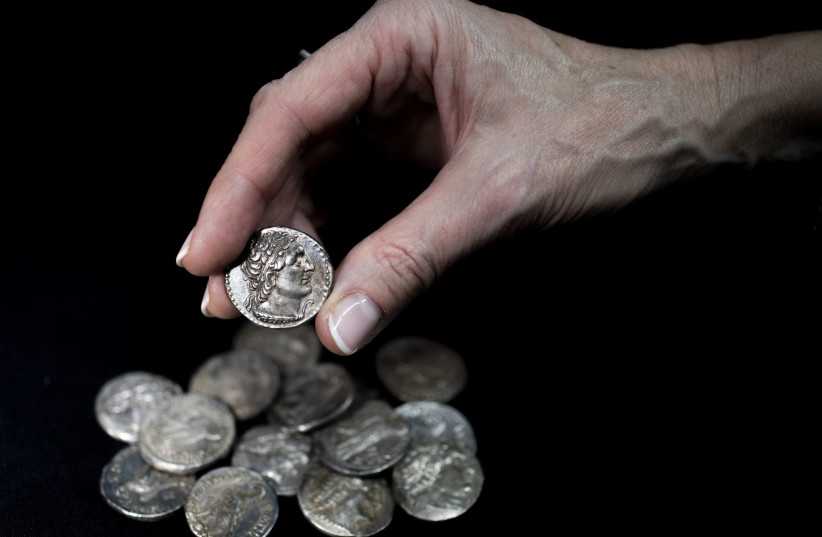
Only a few days ago, a wooden box containing 15 silver coins
that serve as proof of the Hanukkah story of the Maccabees – which was
found recently during an excavation in the Negev Desert – was
announced.
The
Ophel – or citadel – is the still-extant Herodian, cased-in Temple
Mount bordered to the south by a saddle, followed by the ridge known as
the southeastern hill that stretches down to the King’s Garden and the
lower Siloam Pool. Two kings of
Judah, Yotam and Manasseh, are described in the Book of 2 Chronicles to
have massively strengthened the Ophel fortifications and was either
very close to or identical with the “stronghold of Zion” conquered and
reused by King David.
In
the destruction layer, dozens of Jewish coins were found from the
period of the Great Revolt, most of them made of bronze. They also
included a particularly rare and unusual find – a silver coin in a
half-shekel denomination originating from 69/70 CE.
Dig and discovery
A wooden box containing 15 silver coins from the Maccabean period was
discovered in the Judean Desert earlier this year, and will be put on
display in the Hasmonean Museum in Modi'in, December 13, 2022. (credit:
SHAI HALEVI / ISRAEL ANTIQUITIES AUTHORITY)
The dig was
carried out by a team from the Hebrew University (HU), led by Prof. Uzi
Leibner of the Institute of Archaeology, in partnership with Armstrong
College in Edmond, Oklahoma, and with the support of the East Jerusalem
Development Company, the Israel Antiquities Authority and the Israel Nature and Parks Authority.
The
rare silver coin was cleaned at the conservation lab of the Institute
of Archaeology and identified by Dr. Yoav Farhi, the team’s numismatic
expert and curator of the Kadman Numismatic Pavilion at the Eretz Israel
Museum in Tel Aviv. Silver
coins from the Great Revolt were the first and the last in ancient times
to bear the title “shekel,” the archaeologist said. “The next time this
name was used was in 1980, on Israeli shekel coins produced by the Bank
of Israel.”
“This
is the third coin of this type found in excavations in Jerusalem, and
one of the few ever found in archeological excavations,” said the
researchers.
During the Great Revolt against Rome,
the Jews in Jerusalem minted bronze and silver coins. Most of the
silver coins featured a goblet on one side, with ancient Hebrew script
above it noting the year of the Revolt. Depending on its denomination,
the coins also included an inscription around the border noting either,
“Israel Shekel,” “Half-Shekel” or “Quarter-Shekel.” The other side of
these coins showcased a branch with three pomegranates, surrounded by an
inscription in ancient Hebrew script, “Holy Jerusalem.”
The production of silver coins
Throughout
the Roman era, the authority to produce silver coins was reserved
solely for the emperor. During the Revolt, the minting of coins,
especially those made of silver, was a political statement and an
expression of national liberation from Roman rule by the Jewish rebels.
In fact, throughout the Roman period leading up to the Revolt, no silver
coins were minted by Jews, not even during the rule of King Herod the
Great.
According
to the researchers, half-shekel coins with an average weight of seven
grams were also used to pay the “half-shekel” tax to the Temple,
contributed annually by every Jewish adult male to help cover the costs
of worship.
“Until
the revolt, it was customary to pay the half-shekel tax using
good-quality silver coins minted in Tyre in Lebanon, known as Tyrean
shekels or Tyrean half-shekels,” said Farhi. These coins held the image
of Herakles-Melqart, the principal deity of Tyre, and on the reverse,
they featured an eagle surrounded by a Greek inscription, “Tyre the holy
and City of refuge.” The silver coins produced by the rebels were
intended to also serve as a replacement for the Tyrean coins, by using
more appropriate inscriptions and replacing images forbidden by the
Second Commandment with symbols.
Members of Congress are terrified of saying anything negative about Qatar or Islam.
Qatar, an Islamic terror state linked to Hamas, the Taliban, and the
Muslim Brotherhood, used every dirty trick to get the World Cup, and
then made it clear that it was going to operate under Sharia law.
Since Qatar also owns Washington D.C., lefty Dems who want to
complain about it can’t. What do you complain about when you can’t
mention the ‘Q’ or ‘I’ words, when you can’t discuss Sharia law?
This congressional letter is the equivalent of the denunciations of
gun violence, as if guns jump off the shelf and shoot people on their
own. Here, they attack FIFA without ever once mentioning the country where the event took place.
A group of 30 Democratic lawmakers sent a letter to FIFA
President Gianni Infantino on Friday slamming the organization’s ban on
players wearing rainbow LGBTQ armbands at the World Cup in Qatar.
The signers of the letter, led by Sen. Jeff Merkley (Ore.) and Reps.
Mark Pocan (Wis.), Mark Takano (Calif.) and Ritchie Torres (N.Y.), said
they are concerned about FIFA’s decision to penalize players in the
World Cup for wearing “OneLove” armbands and reports that spectators
wearing clothing indicating support for the LGBTQ community have been
confronted by officials at events.
This is a surreal 1.5 page letter which never once mentions Qatar.
Not even within the context of where the World Cup took place or the
name. Nothing.
It’s absolutely bizarre and shows once again how thoroughly Qatar has its boot on the Democrat Party.
It’s as if there was a letter about human rights abuses at the 2014
Olympics that never once mentioned Russia or the 2022 Olympics and never
mentioned China.
Instead, these are these strange indirect cowardly references.
1. To what extent will FIFA consider government’s track
record on LGBTQ+ rights when determining where to host future World
Cups?
3. Will FIFA commit to reviewing its protocols for how it engages with host country governments?
Which government are they actually complaining about? The
representatives of what is supposed to be the mightiest nation on earth
can’t even say it.
This post isn’t about the actual issue under the debate. FIFA chose
to have its games in an Islamic tyranny run under sharia law. No one
should have expected anything else. What is revealing here is just how
terrified elected officials are of even saying anything negative about
Qatar.
And that’s disturbing as hell.
Daniel Greenfield, a Shillman Journalism Fellow at the David Horowitz Freedom Center, is
an investigative journalist and writer focusing on the radical Left and
Islamic terrorism.
Included in the thread were screenshots of requests from FBI offices for the platform to censor posts, even from low follower accounts, and subsequent images indicating that Twitter had complied with the requests.
The
latest "Twitter Files" release, on Friday evening, details the social
media platform's relationship with the FBI and outlined communications
between the federal agency seeking takedowns of select posts.
The most recent release is from independent journalist Matt Taibbi,
one of several individuals to whom new Twitter CEO Elon Musk has granted
access to the company's internal communications in a bid to highlight
the prior management's efforts to stifle posts that didn't agree with
their world view.
"Twitter’s contact with the FBI was constant and pervasive, as if it were a subsidiary," Taibbi wrote
early in the Tweet thread. "Between January 2020 and November 2022,
there were over 150 emails between the FBI and former Twitter Trust and
Safety chief Yoel Roth."
Taibbi also wrote: "a surprisingly high number are requests by the
FBI for Twitter to take action on election misinformation, even
involving joke tweets from low-follower accounts.
Taibbi also posted that he found in the email review that "Federal
intelligence and law enforcement reach into Twitter included the
Department of Homeland Security, which partnered with security
contractors and think tanks to pressure Twitter to moderate content."
Reports emerged earlier this year that executives from multiple Big Tech
platforms regularly met with federal agency officials to coordinate
efforts to combat "disinformation."
Included in the thread were screenshots of requests from FBI offices
for the platform to censor posts, even from low follower accounts and
subsequent images indicating that Twitter had complied with the
requests.
https://t.co/bcttGWKpFW unanswered question: do agencies like FBI and DHS do in-house flagging work themselves, or farm it out? “You have to prove to me that inside the fucking government you can do any kind of massive data or AI search,” says one former intelligence officer.
Taibbi subsequently documented the bureau's circulation of a list of
accounts that "may warrant additional action," before indicating that
Twitter received the list and censored many of the offending accounts and posts.
The thread went on to explain
that state governments also worked with the platform to flag content,
including request from California officials to act on a Tweet from
former President Donald Trump. Taibbi further highlighted other
organizations that partnered with the government to conduct mass reviews
on online content.
"The takeaway: what most people think of as the “deep state” is
really a tangled collaboration of state agencies, private contractors,
and (sometimes state-funded) NGOs," Taibbi concluded. "The lines become so blurred as to be meaningless."
 Salah Hamouri poses for a photograph with his mother during an
interview with Reuters in the West Bank neighbourhood of Dahiyet
al-Barid, on the outskirts of Jerusalem December 19, 2011. (credit:
MOHAMAD TOROKMAN/REUTERS)
Salah Hamouri poses for a photograph with his mother during an
interview with Reuters in the West Bank neighbourhood of Dahiyet
al-Barid, on the outskirts of Jerusalem December 19, 2011. (credit:
MOHAMAD TOROKMAN/REUTERS)