The "Middle East and Terrorism" Blog was created in order to supply information about the implication of Arab countries and Iran in terrorism all over the world. Most of the articles in the blog are the result of objective scientific research or articles written by senior journalists.
From the Ethics of the Fathers: "He [Rabbi Tarfon] used to say, it is not incumbent upon you to complete the task, but you are not exempt from undertaking it."
At a Seattle-area fundraiser, the U.S. president also said “I guess I shouldn’t get into all this about Israel.”
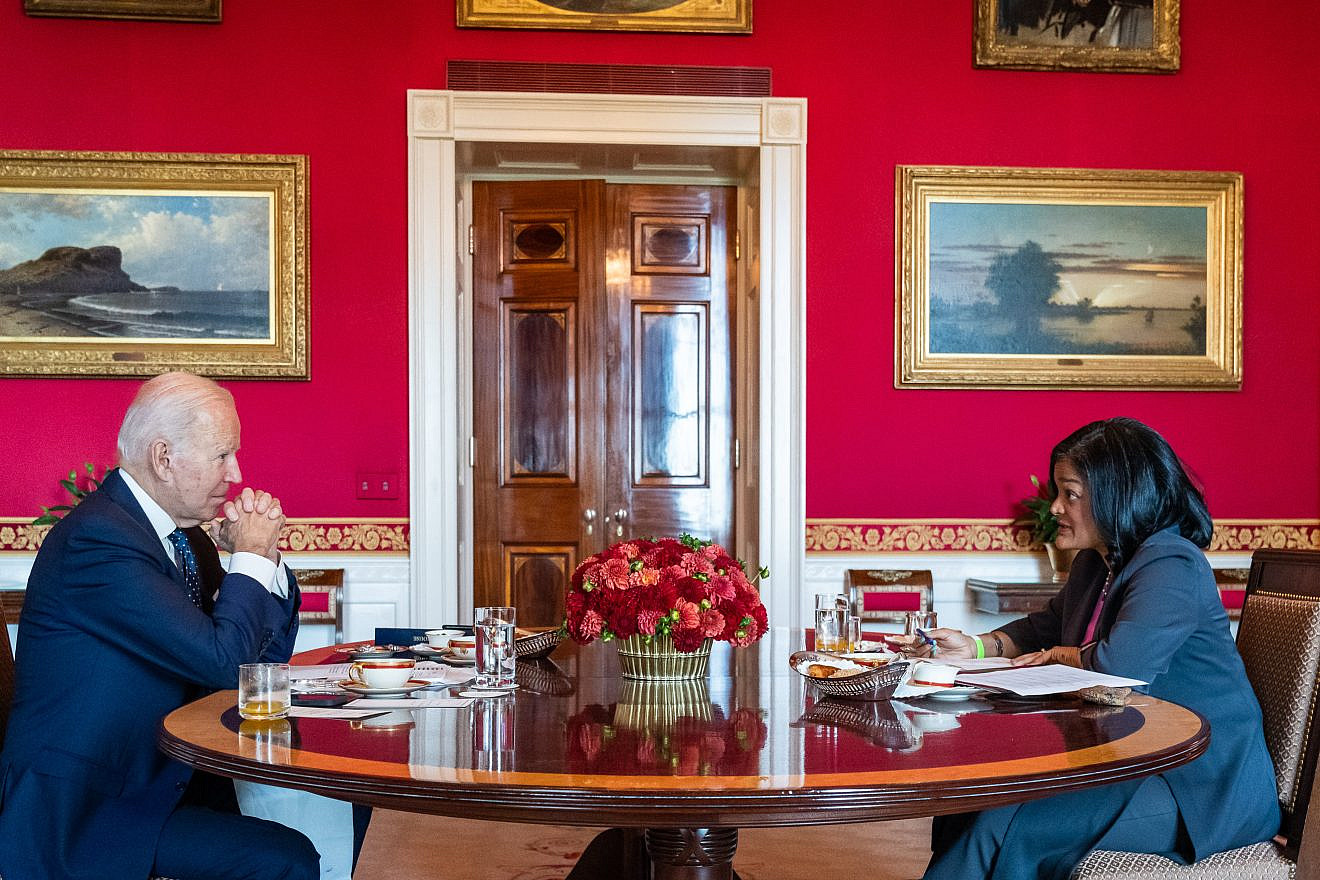
U.S. President Joe Biden meets with Rep. Pramila
Jayapal (D-Wash.) on Oct. 18, 2021 in the Red Room of the White House.
Credit: Adam Schultz/White House.
U.S. President Joe Biden praised Rep.
Pramila Jayapal (D-Wash.), chair of the Congressional Progressive
Caucus, as “a woman with more courage and chutzpah and stamina than anyone I know” at a Medina, Wash. fundraiser on Saturday evening.
Jon Shirley, former president and CEO of Microsoft, and his wife Kim held the fundraiser at their home near Seattle.
“Before I begin, let me answer a question
related to the hostages,” Biden said, per the pool report. “I keep
getting asked by the press and all the other folks out there. You know,
there would be a ceasefire tomorrow if Ira—Hamas released the hostages,
women, the elderly and the wounded.”
“Israel said it’s up to Hamas if they
wanted to do it, we could end it tomorrow,” the president added. “And
the ceasefire would begin tomorrow. It all has to do … you know, we’ve
not … anyway, I guess I shouldn’t get into all this about Israel but….”
“You know…,” Biden added, before pausing “for a full five seconds,” per the pool. “Well, I don’t want to get going…”
Jayapal, whose courage, chutzpah and stamina Biden praised, has a history of anti-Israel statements.
On May 1, she was one of 55 members of Congress who urged the White House to withhold military aid to the Jewish state.
In December, the congresswoman twice hedged her condemnations of Hamas terrorists raping Israeli women.
“I said it’s horrific, and I think that
rape is horrific. Sexual assault is horrific. I think that it happens in
war situations,” she told CNN at the time. “Terrorist
organizations like Hamas obviously are using these as tools, however, I
think we have to be balanced about bringing in the outrages against
Palestinians.”
Also in December, she accused Israel of “indiscriminate bombing.” The prior month, she said that Israel has committed “war crimes.”
In July 2023, Jayapal told protesters at a conference, “I want you to know that we have been fighting to make it clear that Israel is a racist state.”
During an interview with CNN last
week, Biden threatened Israel that he would withhold weapons if it
launched an attack in Rafah, the final stronghold of the Hamas terror
organization.
The Biden administration is willing to share "valuable" information regarding the whereabouts of Hamas's leadership and tunnels to stave off an Israeli invasion of Rafah, according to the Washington Post.
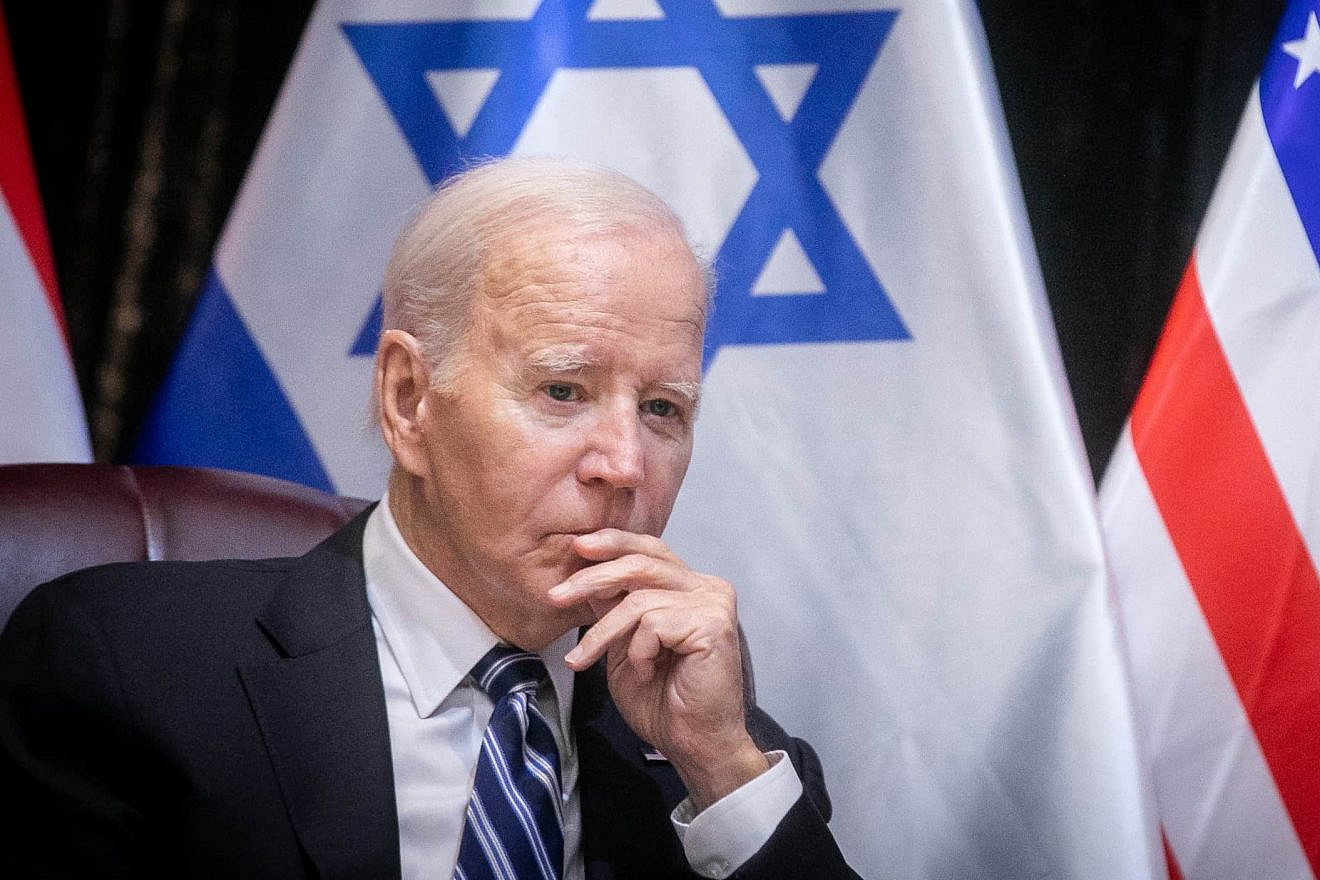
U.S. President Joe Biden in Tel Aviv, Oct. 18, 2023. Photo by Miriam Alster/Flash90.
The Biden administration will share key
intelligence with Israel about the whereabouts of Hamas’s leadership in
Gaza if Israel agrees not to go ahead with its military operation in
Rafah, according to TheWashington Post.
“The Biden administration, working
urgently to stave off a full-scale Israeli invasion of Rafah, is
offering Israel valuable assistance if it holds back, including
sensitive intelligence to help the Israeli military pinpoint the
location of Hamas leaders and find the group’s hidden tunnels, according
to four people familiar with the U.S. offers,” said the report.
The United States is seeking to delay the
operation, concerned that Israel is not doing enough to ensure the
safety of the over one million Gazans sheltered in Rafah should a
full-scale invasion move forward, according to the sources cited by the Washington Post.
In addition to intelligence, American
officials have also offered to help provide Israel with assistance for
Rafah evacuees, including “thousands of shelters so Israel can build
tent cities—and to help with the construction of delivery systems for
food, water and medicine,” the sources said.
Israel’s military has already evacuated hundreds of thousands of people from eastern Rafah
to an expanded humanitarian zone at Al-Mawasi as part of a limited
operation in the city that began on May 6. As part of the operation’s
initial stage, Israeli forces took control of the Gaza side of the Rafah
Crossing between the Strip and Egypt.
IDF Spokesperson Rear Adm. Daniel Hagari
said on Saturday night that dozens of terrorists have been killed,
underground tunnels uncovered and weapons confiscated during the
operation so far, stressing that the activities there “remain limited in
scope and focus on tactical advances; tactical adjustments; and
military advantages—and have avoided densely populated areas.”
The Rafah operation, which Israel
estimates will last around two months, is being carried out in phases as
opposed to a sudden, full scale invasion, according to Israel’s Channel 12.
The phased nature of the operation allows
for it to be paused should a hostage release deal be reached between
Israel and Hamas, according to the report.
The Biden administration last week announced the halt of offensive arms shipments to Israel over the looming operation in Gaza’s southernmost city.
In an interview with CNN on
Wednesday, U.S. President Joe Biden said, “If they [the IDF] go into
Rafah, I’m not supplying the weapons that have been used historically to
deal with Rafah, to deal with the cities—that deal with that problem.”
He went on to state that his
administration wasn’t walking away from Israel’s security and would
“continue to make sure Israel is secure in terms of Iron Dome and their
ability to respond to attacks that came out of the Middle East
recently,” such as Iran’s April 14 ballistic missile and drone attack.
However, with regard to offensive
armaments of the type that would likely be used in Rafah, “it’s just
wrong,” he continued. “We’re not going to—we’re not going to supply the
weapons and artillery shells,” he said.
The announcement led to widespread backlash both in Israel and the United States.
“This may give them encouragement, the enemies of the Jewish people and of the State of Israel,” said Israel’s U.N. Ambassador Gilad Erdan.
“If Israel is restricted from entering
such an important and central area such as Rafah, where thousands of
terrorists, hostages and the leaders of Hamas are still present, how
exactly is the goal of destroying Hamas supposed to be achieved?” he
continued.
According to Israel, defeating Hamas’s
remaining four battalions in Rafah are essential to winning the war and
securing the return of the hostages still being held by the terrorist
group.
Rep. Ritchie Torres tweeted, “As the
leader of the free world, America cannot claim that its commitment to
Israel is ‘iron-clad’ and then proceed to withhold aid from Israel. The
mixed messaging makes a mockery of our credibility as an ally. No one
will take our word seriously.”
Biden’s CNN announcement came a few days after Israel was blind-sided by Hamas’s public “acceptance” of a ceasefire deal the Jewish state had not even seen.
According to Axios, Israeli
officials were reportedly surprised to see “many new elements” in the
deal, that were not contained in the previous proposal to which Israel
had agreed and which had been presented to Hamas by the American,
Egyptian and Qatari mediators 10 days earlier.
The U.S. and the other mediators had drafted “a new deal” and were not transparent about it, two Israeli officials told Axios.
The officials went on to state that they suspect the Biden
administration gave Hamas guarantees via the Egyptians and Qataris about
ending the war, which the terror group demands but which Jerusalem says
is a nonstarter until Hamas is defeated, the hostages are released and
Gaza never again poses a threat to Israel.
Bill would revoke federal financial assistance for students who are convicted of trespassing, rioting, or damaging property while protesting.
(The Center Square) -
Legislation to “cut off federal
aid for grown adults who are breaking our laws, spewing antisemitism,
and openly embracing terrorists” has been proposed by a North Carolina
senator and eight other Republicans.
The No HAMAS Act – as the acronym is played in No Higher education
Assistance for Mobs of Antisemitic and terrorist Sympathizing Students –
would revoke federal student financial assistance for students who are
convicted of trespassing, rioting, or damaging property while protesting
at a higher education institution. Students convicted would lose their
eligibility for any federal grant, loan, or work assistance.
“Mobs of pro-Hamas students have flagrantly violated the law,
destroyed campus property, and resorted to violence against fellow
students and law enforcement,” said U.S. Sen. Thom Tillis, R-N.C., who
led introduction of the proposal with eight other Republican senators.
“Hardworking taxpayers shouldn’t have to keep paying for the college
tuition of convicted lawbreakers. The No Hamas Act is commonsense
legislation that will cut off federal aid for grown adults who are
breaking our laws, spewing antisemitism, and openly embracing
terrorists.”
Education Secretary Miguel Cardona appeared Tuesday for the lower
chamber’s Education and Workforce Committee. He was asked point-blank by
U.S. Rep. Virginia Foxx, R-N.C., chairwoman of the panel, if the Biden
administration’s program shifting repayment of college loans from
students to taxpayers should include taxpayers paying off those students
who are antisemitic and stopping Jewish students from going to class.
Cardona gave neither yes or no for an answer. He said students
breaking the law and disrupting the educational environment should be
held accountable; said his department is committed to campus safety; and
said he condemns hate and violence on campus. Foxx never got a yes on
three attempts.
In North Carolina, the famed Polk Place quad at UNC Chapel Hill was
the scene of the American flag being lowered and replaced with the flag
of Palestine. Interim Chancellor Lee Roberts, a security detail and some
fraternity brothers were instrumental in Old Glory's return atop the
pole. UNC Charlotte and Wake Forest are also on the Campus Safety
Magazine list.
Other Republican senators with Tillis on Senate Resolution 4302
were Sens. Mike Crapo and Jim Risch of Idaho, Ted Cruz of Texas, Josh
Hawley of Missouri, Steve Daines of Montana, Joni Ernst of Iowa, Marsha
Blackburn of Tennessee and Pete Ricketts of Nebraska.
“In Joe Biden’s America, hardworking taxpayers are forced to aid
Hamas-sympathizing students who blatantly violate the law by trespassing
and destroying campus property,” Blackburn said.
Chapel Hill native Keith Siegel, whose family was hosted by U.S. Sen.
Ted Budd, R-N.C., at the State of the Union last month, is among the Americans being held hostage by Hamas.
Separate legislation filed
by U.S. Sen. Tom Cotton, R-Ark., would prevent any college or
university student convicted of any offense while protesting at a higher
education institution from having their federal student loans forgiven,
cancelled, waived or modified.
Today's protesters know little about what they are rebelling against and, at least in our experience of talking to some of them in Paris and reading and/or hearing what their counterparts say on American campuses, don't even wish to know.
[T]he protest feeds on media attention. As soon as TV cameras are switched off, the shouting of slogans dies down.
[E]even if all the UN resolutions were implemented, they would
not reassure Israel and won't quench Hamas' "from the river to the sea"
thirst.
For seven decades, Israelis accepted the "advice" of the US and
its European allies to accept a fish-tail end to its wars rather than
the victory won on the battlefield. Beyond Hamas, which wants
everything, Palestinians, too, have realized that listening to advice
from "well-wishers" like Jimmy Carter, Bill Clinton and George W Bush,
the inventor of the "roadmap" to a two-state solution, will not provide
even half a state for them.
Today's protesters know little about what they are rebelling
against and, at least in our experience of talking to some of them in
Paris and reading and/or hearing what their counterparts say on American
campuses, don't even wish to know.
Today's protesters know little about what they are rebelling
against and, at least in our experience of talking to some of them in
Paris and reading and/or hearing what their counterparts say on American
campuses, don't even wish to know. Pictured: Anti-Israel protesters in
front of the Paris Institute of Political Studies (Sciences Po) on April
26, 2024. (Photo by Antonin Utz/AFP via Getty Images)
To those of us old enough to remember the good (or bad) old days of
student revolt in Western universities in the 1960s, current
disturbances in a number of European and American universities appear as
a bad remake of a controversial original.
The current disturbances are on a much smaller scale.
In the US, they have affected a handful of universities and attracted
a few thousand students out of a total college enrollment of over 15
million.
In France, the "uprising" is centered on the Paris Institute of Political Studies (Sciences Po), which boasts between 12,000 and 15,000 students, a third of them foreign, from more than 100 countries.
The Palestine Group that organizes and leads the "uprising" boasts a
membership of around 200, of which between 50 and 60 are involved in
actions including breaking windows, barring entrances and threatening a
hunger strike.
The smallness of numbers, however, is compensated by a media presence that was unimaginable in the 1960s.
Protests at the Paris Institute of Political Studies have attracted
TV channels from over 50 countries and often benefited from live
reporting on a Franco-Belgian channel.
Add to that the countless accounts on the ever-growing jungle of the
Internet and you get an exposure that the rebellious youths of the '60s
couldn't imagine.
Spending the good part of a day around Sciences Po, and talking to a
number of protesters and student observers of the "struggle," revealed
another fact: the protest feeds on media attention. As soon as TV
cameras are switched off, the shouting of slogans dies down.
The student revolts of the 1960s were prompted by two issues: the war
in Vietnam and the rejection of a cultural inheritance that some
students regarded as a relic of colonialism.
American students calling for an end to the Vietnam War had a direct
interest in the issue because they didn't wish to be drafted to fight in
what they saw as a bloody civil war in a distant land.
Student protesters in England and France also had direct interests at stake.
In England, John Osborne's play "Look Back in Anger" encouraged an
Oedipus revolt against the British Empire and its paternalistic
Victorian culture a key feature of which had been colonialism.
In France, the Algerian war of independence, which was seen as a
civil war because Algeria had never been a colony in the classical sense
and at the time formed two French provinces, furnished the template for
a revolt that later morphed into the May '68 Revolution.
It may be argued that the '60s protesters ultimately failed.
In the US, the protests may have prolonged the Vietnam War for at
least four years by persuading the silent majority shocked by scenes of
mayhem to vote for Richard Nixon who, on Henry Kissinger's delusional
advice, chased some form of victory as a prelude to peace. On the way,
the Nixon-Ford administration expanded the war to Laos and Cambodia.
In England, those who had looked back in anger soon found out that they had to look to the future in boredom.
In France, protests helped partisans of Algérie française to
expand their audience and make it difficult for shaky IVth Republic
governments to negotiate a peaceful disengagement from the North African
provinces as they had done in Morocco and Tunisia.
In political terms, the May 1968 "Revolution" in Paris also achieved
the opposite of what it had hoped for, by enabling Gaullists to maintain
their monopoly on political power for 13 more years.
The 1960s student rebels forged a neo-colonial narrative in which the
West was responsible for whatever was wrong with the world. That in
turn denied "the rest" any free will, reducing them to an object in its
own history.
In the Arab-Israel war of 1967, that belief persuaded rebellious students to support Israel against its Arab neighbors.
In Paris, Sciences Po was adorned with the Star of David flags and
shaken with cries of "Israel Vaincra!" ("Israel shall be victorious").
In London, New York and Chicago, Israel was seen as a victim of
"feudal Arab regimes" backed by the old colonial power in Great Britain.
At that time, Israel was the darling in the left because it owed its
birth to armed rebellion against British colonialists while obtaining
the weapons it needed from the Soviet bloc via Czechoslovakia with money
that came from America.
Israel's special place in the global left was illustrated by a vice-presidential slot it held in the Socialist International.
If support for Israel in those days was prompted by ideological
considerations that had nothing to do for its struggle to survive, a
mirror image of the same considerations inspires today's student rebels
in the West to be anti-Israeli.
Talking to some of the Sciences Po activists one sees Israel branded
as "an outpost of "American Imperialism" in the Middle East and Benjamin
Netanyahu as a key player in the resurgence of "the hard right" in
Europe and the US.
There are other differences today.
In the 1960s, student rebels focused on issues their respective governments were directly involved in.
Today, anyone who thinks that any Western power could set the tune
for either Israel or Hamas needs a refresher course in political
psychology. Sciences Po rebels mumble about "enforcing UN resolutions"
-- resolutions that have been meaningless for more than seven decades.
In any case, even if all the UN resolutions were implemented, they
would not reassure Israel and won't quench Hamas' "from the river to the
sea" thirst.
For seven decades, Israelis accepted the "advice" of the US and its
European allies to accept a fish-tail end to its wars rather than the
victory won on the battlefield. Beyond Hamas, which wants everything,
Palestinians, too, have realized that listening to advice from
"well-wishers" like Jimmy Carter, Bill Clinton and George W Bush, the
inventor of the "roadmap" to a two-state solution, will not provide even
half a state for them.
It may sound like a nostalgia-stricken voice from the past.
But, in the old golden days of campus rebellion, student rebels took
time to learn about what they were protesting against. Instead of
wrecking campus furniture, they organized what were called "teach-ins"
to discuss and debate the issues and hear different views.
Today's protesters know little about what they are rebelling against
and, at least in our experience of talking to some of them in Paris and
reading and/or hearing what their counterparts say on American campuses,
don't even wish to know.
Meanwhile, as flags are waved or burned and as the statue in Paris of
the philosopher Condorcet is coiffed with a keffiyeh, people die in a
distant land.
This article originally appeared in Asharq Al-Awsat
Amir Taheri was the executive editor-in-chief of the
daily Kayhan in Iran from 1972 to 1979. He has worked at or written for
innumerable publications, published eleven books, and has been a
columnist for Asharq Al-Awsat since 1987. He is the Chairman of
Gatestone Europe.
Hamas now has to fight in three areas of Gaza against three IDF divisions with fewer resources than before October 7.
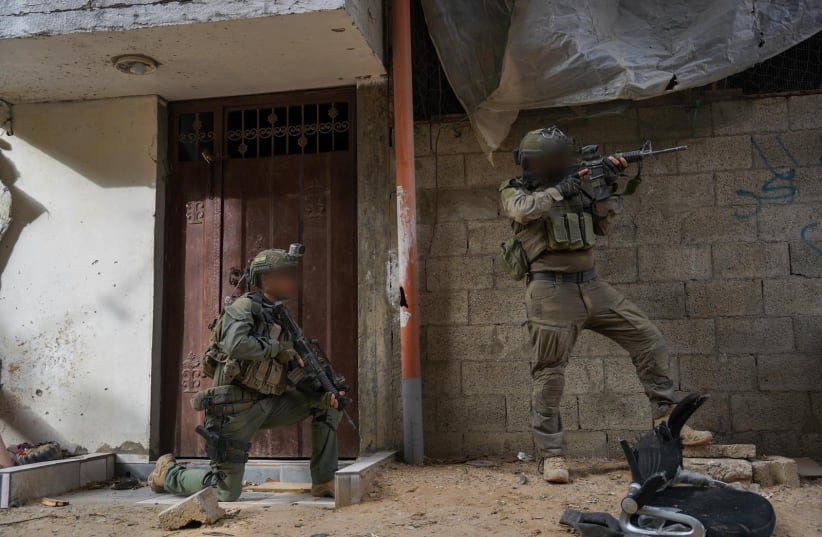
IDF soldiers operating in Gaza. May 2024(photo credit: IDF SPOKESPERSON'S UNIT)
Hamas is now facing an Israeli offensive
in Gaza on three fronts. Two of the fronts are in the north, in Jabalya
and Zaytun. A third is in Rafah. For Hamas, which has felt it was
winning the war, the multiple fronts it now faces the IDF on may pose a
challenge.
So
far, Hamas has proven that it can withstand seven months of war and
return to control almost ninety percent of Gaza, as well as rebuild its
capabilities. Hamas may now be facing a more complex challenge, and
despite its propaganda, it could be destabilized by this current round
of fighting. It depends a lot on whether Hamas can reconstitute itself
in Khan Younis and how it will seek to respond to the opening of new
fronts in northern Gaza. Hamas is already showing that it can respond
with rocket fire.
For
instance, Hamas fired rockets at Beersheba and Ashkelon twice in the
last several days. It has also targeted the Kerem Shalom crossing
systematically since May 5. This illustrates how Hamas thinks. It is
trying to cut off aid to Gaza via Kerem Shalom. It knows Egypt has
closed the Rafah crossing since IDF tanks rolled in there on May 7.
Therefore, it hopes it can create chaos in southern Gaza and lead to
pressure on Israel to stop the offensive. Israel has instead increased
the depth of its forces and called for more people to evacuate Gaza.
Hamas
battalions may be evacuating Rafah and moving back toward Khan Younis.
Khan Younis is the hometown of Hamas leader Yahya Sinwar. The fact the
IDF left Khan Younis in April has allowed Hamas to return there. Former
Israeli Prime Minister Naftali Bennett noted on X on May 11 that he
didn’t “understand why we pulled out division 98 that had been sealing
the Hamas fighters trapped in Rafah. Sort of like removing the lid on a
can in which they were trapped, allowing them to disperse all across the
Gaza Strip.” Hamas may have benefited from this lack of pressure around
Rafah, but it will also have to try to deal with the IDF incursions
into Jabalya and Zaytun.
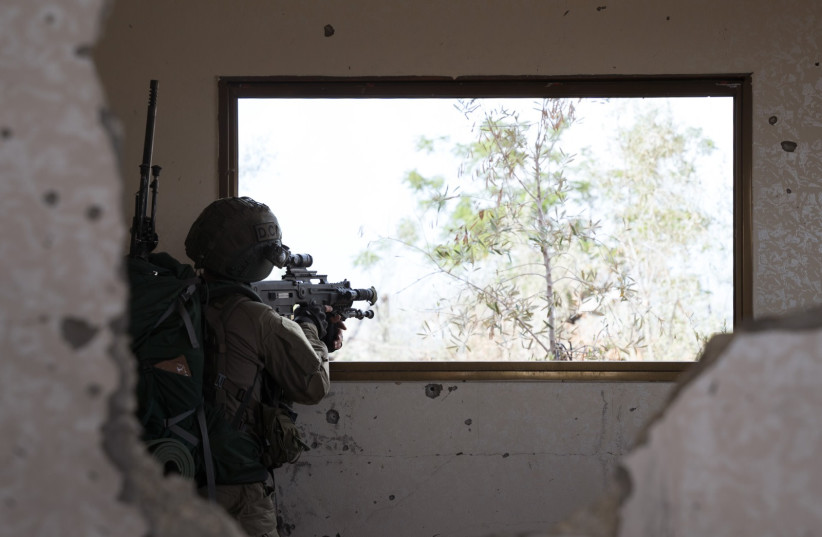
Israeli soldiers operating in Gaza. May 2024 (credit: IDF SPOKESPERSON'S UNIT)
While
some 300,000 people evacuated Rafah, another 100-200,000 have been
leaving Zaytun and Jabalya. Hamas claims that it continues to fight the
IDF in Zaytun and Jabalya and that it is coordinating with other
terrorist groups, such as Islamic Jihad.
This has been the usual Hamas claim over the last weeks, in which it
says it is working with several other groups in Gaza to target IDF
forces in the Netzarim corridor. The operations in Zaytun and Jabalia
have forced Hamas to shift forces and fight in Jabalya and Zaytun, where
it was previously gathering forces and capabilities.
Hamas unable to resist IDF advance
Hamas
claims via the pro-Iran al-Mayadeen channel do not appear to amount to
serious obstacles to the IDF. The terror group says it has used various
types of short-range rockets and mortars in the battle. This is not
going to be enough for the group to actually “resist” the IDF advance.
Therefore, Hamas will make claims that it has “succeeded” in fighting,
and then it will wait for the IDF to withdraw and it will return. It has
gotten used to this kind of “cat and mouse” like game in Gaza. It is
adapting to the new methods of fighting.
The
fact Hamas now has to fight in three areas of Gaza against three IDF
divisions is clearly going to be difficult for a terrorist group that
has less fighters and less capabilities than in October. It now faces
the IDF’s 162nd division in eastern Rafah
as well as two IDF reserve brigades in the Netzerim corridor and the
IDF’s Nahal brigade in Zaytun as well as the IDF’s 98th division in
Jabalya, according to various Israeli reports. Hamas has faced these
units before and it has lost. However, the Hamas tactic is to withdraw
and disperse its men and wait until the IDF leaves and then re-emerge.
Meanwhile Hamas will continue to put out statements to Al-Mayadeen and
other outlets highlighting its supposed abilities to continue attacks
within Gaza, and also rocket fire at Israeli cities such as Ashkelon,
Beersheba and other places.
The
question is now whether Hamas could be destabilized via this
multi-front battle that is unfolding. Hamas has more limited resources
than in the past to try to coordinate all these fronts. It relies on
local squads and units. But it has to manage a more complex battle
against a far superior IDF.
Predictions that the U.S. and the world would run out of fossil fuels go back decades, and these predictions have so far turned out to be wrong. A new report shows the U.S. has 227 of oil, 130 years of gas, and 485 years of coal.
For years, activists argued for an energy transition away from fossil fuels because, they said, we were hitting “peak oil,” the point at which we can no longer produce oil because there’s little left in the ground or it’s too expensive to recover.
In 2023, the U.S. produced nearly 13 million barrels per day, more than any other nation in history.
Predictions that the U.S. and the world would run out of oil go back
decades, and these predictions have so far turned out to be wrong.
Tom Pyle, president of the Institute for Energy Research (IER), a free market think tank focusing on energy, told Just the News that
anti-fossil fuel activists latched onto “peak oil” to push for
alternatives, and with the U.S. leading the world’s production, their
rhetoric has evolved.
“First, they said, ‘We don't have the resources. We're big consumers,
but we don't have the energy. So we have to get off of the resource.
Then it became evident and clear that that was not the case,” Pyle said.
Centuries of energy
In 2011, IER produced its first North American Energy Inventory.
“It was really for the purpose of shattering this myth of energy
scarcity. To my knowledge, prior to that, nobody had taken the effort to
compile, using government data …. the amount of energy that we have in
North America,” Pyle said.
In that 2011 report, Pyle stated: “Thanks to new and continuing
innovations in exploration and production technology, there’s every
reason to believe that today’s estimates of reserves are only a fraction
of what will be produced and delivered tomorrow.”
The statement turned out to be accurate. The Shale Revolution,
which combined technologies in horizontal drilling and hydraulic
fracturing, made available large deposits of previously unrecoverable
oil throughout the U.S.
The IER’s 2024 North American Energy Inventory update shows that
North America has 1.66 trillion barrels of technically recoverable
resources, and at current rates of consumption, the report calculates
that it would take 227 years to deplete it all.
“Technically recoverable resource” refers to oil and gas that can be
produced based on current technology, and it doesn’t consider economic
factors that might make it unprofitable under current technologies.
The 1.66 trillion barrels is 15% higher than the estimates from the 2011 report.
By the numbers
If all the oil in North America’s technically recoverable reserves
was devoted exclusively to gasoline production, according to the report,
the North American transportation sector would have enough energy for
539 years at 2023 usage rates.
There are 4.03 quadrillion cubic feet of technically recoverable
natural gas reserves, which is a 47% increase in the 2011 estimate. At
current rates of consumption, there’s enough gas for 130 years.
Proved reserves of coal, arguably the most abundant fossil fuel, can
satisfy 485 years of demand at 2022 consumption rates, and the U.S. has
53% more proven coal reserves than Russia, the country with the next
largest coal reserves.
Proved reserves are the resources that geologic and engineering data
demonstrate with reasonable certainty to be recoverable in future years
from known reservoirs under existing economic and operating conditions.
Pyle points out that production in the U.S. has increased to record highs, rather than depleting reserves, they’ve grown.
“As production increases, we find even more of a resource,” Pyle said.
Economic impact
The high levels of energy the U.S. is producing may be what’s
allowing the economy to tread water as inflationary pressures weigh it
down. Doomberg, a team of analysts who publish their work on Substack, argue that economies awash in fossil fuels are likely going to grow rather than shrink.
“Energy is not an input into the economy, it is the economy,” the analysts write.
“Humanity organizes its economic activities to ensure a steady growth
in the extraction and exploitation of primary energy because energy is
life, standards of living are defined by how much energy is available to
be exploited, and all humans everywhere are perpetually seeking a
higher standard of living.”
In 2008, U.S. oil production had dropped to 5 million barrels per day in 2008,
the lowest level since 1947. Then, America’s oil and gas producers
began to figure out how to use hydraulic fracturing to recover oil and
gas from shale profitably. U.S. production by 2011 had risen to 5.67
million barrels of oil per day, and it was just under 13 million barrels
per day in 2023.
North Dakota gained a lot of attention as the state experienced an oil boom that started about 2005. The state went from 35.7 million barrels of oil produced in 2005 to 429.6 million barrels in 2015.
Pyle said an irony of the Shale Revolution is that it likely kept the
U.S. from a much more serious economic crisis in 2008, and that helped
Obama get reelected.
“The sheer amount of economic activity generated after the housing
crisis is probably what saved the Obama economy. And the same can be
said, I think, is that it’s giving President Biden a fighting chance.
And that is the ultimate irony of the situation,” Pyle said.
Pyle said the U.S. was fortunate to have the technology, the know
how, and the resource base to become a leading producer. However, what’s
often overlooked in making the nation the leader in energy production
is a unique system of private mineral ownership. This allows private
owners to get royalties from oil produced from the mineral rights they
own.
“It gets people’s skin in the game,” Pyle said.
In most other countries in the world, the minerals are controlled by
the government. The U.S. federal government actually owns the largest
mineral estate in the county, and despite this, oil and gas production
is much higher on state and private lands than on federal land.
“It's that unique system of private property ownership that allowed
this to flourish here and to blossom and to create the environment that
we're now enjoying,” Pyle said.
Burgum launched a GOP presidential bid for 2024, but suspended his campaign and endorsed Trump in January.
With his appeal to moderate
voters, North Dakota GOP Gov. Doug Burgum is emerging as a potential
vice presidential pick for presumptive Republican nominee Donald Trump.
The latest signals came Saturday evening when Trump flew the
67-year-old Burgum on his jet to a rally in Wildwood, N.J., and put him
front and center on stage, where he forcefully made the case for a
second Trump term.
“President Trump respects state’s rights. He cut regulation. He
lowered taxes," he argued. "Working under the Biden regulatory regime is
like having a gale-force wind in your face."
Trump heaped his own praise on Burgum, citing his deep expertise on an issue important to voters.
“He probably knows more about energy than anybody I know,” the former president said.
Then he offered a big tease. “So, get ready for something, okay? Just get ready," Trump said, without elaborating.
Sources recently told Axios that Trump likes Burgum's gubernatorial experience and the fact that he doesn't get involved in drama.
Trump and former First Lady Melania Trump also reportedly hosted
Burgum and his wife, Kathryn, at Mar-a-Lago for an Easter Brunch.
Burgum launched a GOP presidential bid for 2024, but suspended his campaign and endorsed Trump in January. He also announced that he would not seek a third term as governor.
Before jumping into politics, Burgum was most well known for being the cofounder of "Arthur Ventures," a company that leads investments in B2B software companies in the U.S. and Canada.
Overall, Burgum has a conservative record when it comes to his
position as governor. He signed a law that bans abortion after six
weeks, but doesn't support a federal ban and that the issue should be
left up to the states.
He has been outspoken about illegal immigration and has sent the
North Dakota National Guard to the U.S. southern border to assist with
the crisis of multiple people coming in.
When Burgum was on the presidential campaign trail, his main
priorities included making energy more affordable and cutting taxes.
Burgum has been critical of Trump in the past and said that he didn't
believe the 2020 presidential election was stolen, a talking point the
former president repeated.
"I believe that Joe Biden won the election," Burgum said during a 2023 interview, according to NBC News.
Burgum recently did a wide-ranging interview with CNN where he said the main issues for the upcoming 2024 election are national security and public safety.
"2016 was about immigration," Burgum said. "Now it's about national
security and public safety and open borders is something the majority of
Americans are concerned about.”
He also added that unrest breaking out in other countries and inflation are also major concerns from Americans.
"The first rule of VP selection is reminiscent of a doctor’s
Hippocratic oath – 'first do no harm,'" Kyle Kondik, the managing editor
at Sabato's Crystal Ball, told Just the News. "Burgum seems like a
fairly inoffensive choice, and I think that would be fine for Trump. At
this point I don’t think Trump needs much help on his right – he did
back in 2016, which is why Mike Pence was a decent choice."
When Burgum was asked on CNN if he would serve as Trump's vice
president if asked, he said that him being on the "VP List" is
speculation and the main reason he is supporting Trump is due to his
energy policies because of the positive impact they have had on his
state.
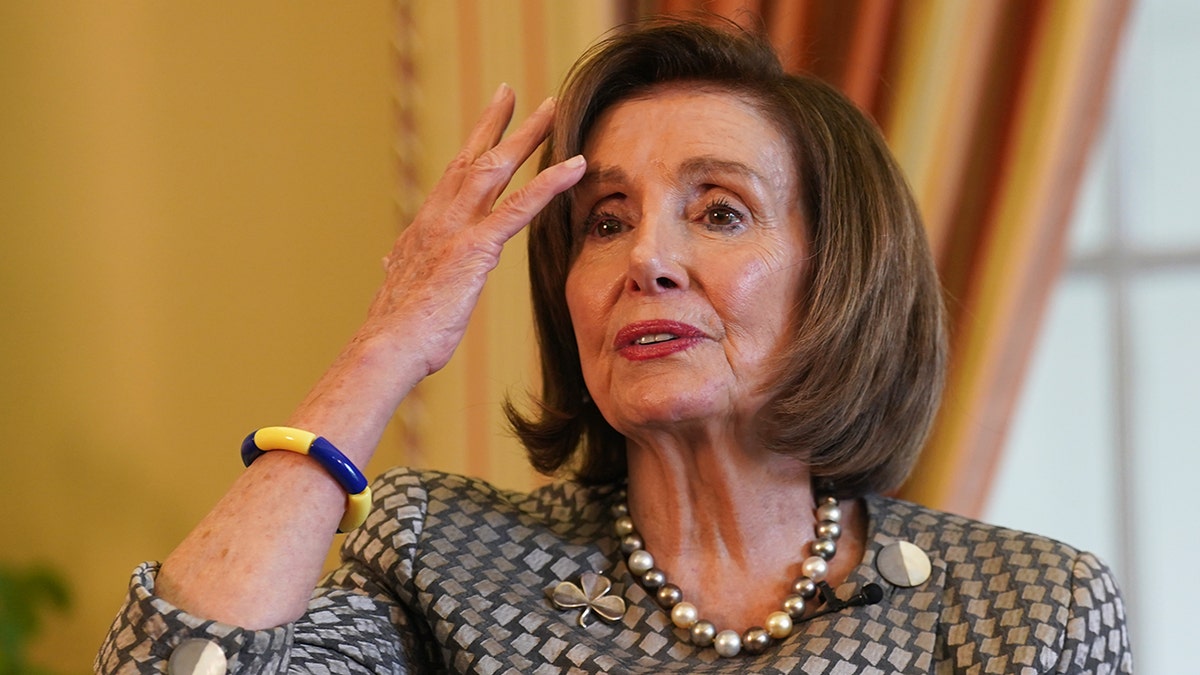
Pelosi suggested Americans refuse to listen to Democrats about certain issues due to their beliefs about 'guns, gays, [and] God'
Former House Speaker Nancy Pelosi, D-Calif.,
was rebuked as an "elite" during a recent Oxford Union debate, where
she argued that populism in the United States is a threat to democracy.
Pelosi — a self-described "devout" Catholic
— said during the April 25 debate that certain Americans, whom she
considered to be "poor souls who are looking for some answers," refuse
to accept the answers Democrats give them on particular topics due to
their beliefs about "guns, gays, [and] God."
Challenging Pelosi's
position in the debate about populism, Winston Marshall, a musician who
was once a part of Mumford and Sons and now hosts the "Marshall Matters"
podcast for The Spectator, spoke in opposition to the Oxford Union motion that "This House Believes Populism is a Threat to Democracy."
The
Oxford Union at the UK's famed university holds itself as a defender of
free speech, and has hosted events with numerous U.S. politicians in
the past, including former Republican House Speakers Newt Gingrich and
Kevin McCarthy.
Marshall argued at the April 25 debate that the
meaning of the word "populist" has been changed by "elites [who] have
failed" to align with their own narrative.
Pelosi
– a self-described "devout Catholic" – claimed that populism is a
threat to democracy and appeared to suggest that certain Americans
refuse to accept the answers Democrats give them on particular topics
due to their beliefs about "guns, gays, [and] God."(Getty Images)
"'Populism'
has become a word used synonymously with ‘racist.’ We've heard
‘ethno-nationalist,’ we have ‘bigot,’ we have ‘hillbilly,’ ‘redneck,’ we
have ‘deplorable,’" Marshall said. Pelosi had argued in her remarks
that contemporary American populism currently had an ethno-nationalist
character.
"Elites use it to show their contempt for ordinary people," Marshall said.
Marshall argued that the change in meaning of the word "populist"
is "a recent change," and pointed to a 2016 speech delivered by
then-President Barack Obama, who he said "took umbrage with the notion
that Trump be called a populist."
"If anything, Obama argued that
he was the populist. If anything, Obama argued that Bernie was the
populist," he said. "Something curious happens. If you watch Obama's
speeches after that point, more and more recently, he uses the word
‘populist’ interchangeably with ‘strong man,’ ‘authoritarian.' The word
changes meaning. It becomes a negative, a pejorative, a slur."
Pelosi bristles at the comparison between January 6 and the Portland BLM riots
Highlighting the Capitol riots
on January 6, 2021, which he believed to be "a dark day for America,
indeed," Marshall said: "I'm sure Congresswoman Pelosi will agree that
the entire month of June 2020, when the federal courthouse in Portland,
Oregon, was under siege and under insurrection by radical progressives,
those, too, were dark days for America."
At that point, Pelosi raised her hand and said: "There is no
equivalence there. . . . It is not like what happened on January 6th,
which was an insurrection incited by the President of the United
States."
"My point, though, is that all political movements are
susceptible to violence and, indeed, insurrection," Marshall said.
"Populism is not a threat to democracy. Populism is democracy. And why
else have universal suffrage if not to keep elites in check?"
Marshall
said he was "rather surprised" that Pelosi was arguing in favor of the
motion as he thought "the left was supposed to be anti-elite" and that
the "left was supposed to be anti-establishment."
"Today,
particularly in America, the globalist left have become the
establishment," he continued. "I suppose for Mrs. Pelosi to have taken
this side of the argument, she'd be arguing herself out of a job.
Marshall
went on to claim that "populism is the voice of the voiceless" and that
the "real threat to democracy is from the elites."
Winston
Marshall claimed that "populism is the voice of the voiceless" and that
the "real threat to democracy is from the elites."(Getty Images)
"Now,
don't get me wrong, we need elites. If President Biden has shown us
anything, we need someone to run the countries," he said. "When the
president has severe dementia, it's not just America that crumbles, the
whole world burns."
Marshal shifted his focus to examining the elites, saying he believes that Trump should have accepted the results of the 2020 presidential election.
"So should Hillary in 2016,
so should Brussels and Westminster in 2016, and so, too, should
Congresswoman Pelosi instead of saying the 2016 election was, quote,
‘hijacked.’"
"It was," Pelosi interjected, drawing laughter from those in attendance.
"That doesn't mean we don't accept the results of it," she added.
During
his speech in opposition of the motion, Marshall also took aim at the
social media companies that suspended Trump from their platforms
following the January 6 Capitol protests and the mainstream media.
"Mainstream
media elites are part of a class who don't just disdain populism, they
disdain the people. If Democrats had put half their energy in delivering
for the people, Trump wouldn't even have a chance in 2024 … you've had
power for four years. From the fabricated Steele Dossier, to trying to
take him off the ballot in both Maine and Colorado, the Democrats are
the anti-Democrat party," he said.
"Populism is not a threat to democracy. But I'll tell you what is:
It's elites ordering social media to censor political opponents,"
Marshall said. ". . . It's Brussels, D.C., Westiminster, mainstream
media, big tech, big Pharma, corporate collusion and the Davos cronies."
Delivering
remarks prior to Marshall, Pelosi said, "Democracy is the rule of law,
democracy is free and fair elections, democracy is about independent
judiciary, it's about freedom of the press to have transparency and to
have accountability of elected officials to the people."
"It's
about all of that, and that is everything that the populist regime in
Washington, D.C., is against," she added. "Ethno-nationalistic populism,
as is the threat to democracy, is about threatening what they call
elites, a free press," she said. "It's about fighting issues that relate
to free and fair elections, where we have voter suppression to the nth
degree under this regime and its resistance to passing the Voting Rights
Act, the John Lewis Act, all of that."
At
one point, while speaking about those who may consider themselves a
part of the populist movement and/or are "poor souls who are looking for
some answers," Pelosi said, "We've given them to them, but they're
blocked by some of their views on guns – they have the three Gs, guns,
gays, God, that would be a woman's right to choose — and the cultural
issues cloud some of their reception of an argument that really is in
their interest."
The motion debated by Marshall and Pelosi
ultimately received a passing vote from those attending the Oxford Union
event, 177 to 68.
Kyle Morris covers politics for Fox News. Story tips can be sent via email and on X: @RealKyleMorris.
Only nine countries voted against the resolution, among them the United States and Israel.
The United Nations General
Assembly on Friday approved a resolution to grant expanded rights to
Palestine, permitting it to operate within the U.N. framework in a form
of non-voting pseudo-membership. The move drew considerable scrutiny
from Washington and Jerusalem, which argued it would undercut efforts to
forge a lasting peace in the region.
Only nine countries voted against the resolution, among them the
United States and Israel. A further 25 abstained while 143 approved the
measure. Roughly 140 U.N. member states recognized Palestine
independently before the vote, according to the Jerusalem Post.
The decisive vote was something of a rebuke to the U.S. and Israel, the
latter of which had insisted it would effectively reward Hamas for the
Oct. 7 raid on Israel.
“Today the United Nations General Assembly condoned Hamas’ savage
terrorist attacks on Israel by voting overwhelming[ly] in favor of
admitting the Palestinians,” former Trump Deputy National Security
Advisor Victoria Coates told Just the News. “The events of Oct.
7th should have led to the revocation of the Palestinians’ non-member
observer status, not this legitimization of their terrorist tactics
against Israel, a UN member state. Instead, the UNGA stood with Hamas,"
he continued.
The U.S. previously vetoed
a Palestinian membership bid at the U.N. Security Council in April,
though the UNGA resolution was not subject to a veto and recommended
that the UNSC revisit its own decision.
While the Friday vote will likely have minimal impact on the
situation on the ground in Gaza in the immediate future, the expanded
rights will offer the Palestinian government a greater degree of
legitimacy and create options for it to advance its own initiatives on
the world stage.
What did the UNGA approve?
The UNGA vote did not grant full membership to Palestine. Instead, it
asserted that the state should “be admitted to membership” and
recommended that “the Security Council reconsider the matter favorably.”
The passage of the resolution
did grant Palestine the right to be seated among the member states, the
ability to speak on matters unrelated to Palestine or the region, the
right to speak on behalf of a group, to introduce proposals and
amendments, to raise procedural motions, and to fully participate in
U.N. conferences, among others.
It notably did not grant Palestine any voting rights in the UNGA. The
full U.N. body cannot formally grant full membership, though the
granting of procedural rights to Palestine could function as what the
Jerusalem Post described as a “de facto recognition.”
Who voted against it?
Apart from the U.S. and Israel, only Argentina, the Czech Republic,
Hungary, the Federated States of Micronesia, Nauru, Palau, and Papua New
Guinea opposed the measure, according to The Hill.
The U.S. explained its vote by asserting that, while it does support
Palestinian statehood, it believes Israel and Palestine must negotiate
directly first.
“Our vote does not reflect opposition to Palestinian statehood; we
have been very clear that we support it and seek to advance it
meaningfully,” Alternative Representative for Special Political Affairs
Robert Wood said.
“Instead, it is an acknowledgement that statehood will come only from a
process that involves direct negotiations between the parties.”
“The United States is committed to intensifying its engagement with
the Palestinians and the rest of the region to advance a political
settlement that will create a path to Palestinian statehood and
subsequent membership in the United Nations,” he continued. “This
resolution does not resolve the concerns about the Palestinian
membership application raised in April in the Security Council through
the Admissions Committee process. And should the Security Council take
up the Palestinians’ membership application as a result of this
resolution, there will be a similar outcome.”
Israel, meanwhile, offered stern warnings ahead of the vote, with
Israeli U.N. Ambassador Gilad Erdan symbolically shredding the U.N.
charter during remarks.
“I told the ambassadors that today will go down in infamy and I want
the world to remember when they shredded the UN Charter to advance a
Nazi regime into the UN’s ranks,” he posted after the vote.
“The UN, in a shameful violation of its own charter, will vote to
grant the Palestinian Authority the rights and privileges reserved only
for UN member states even though it doesn't meet the criteria for
statehood and failed to receive the recommendation of the Security
Council,” Erdan told USA Today beforehand.
“This is a reward for terrorism and will only strengthen Hamas and
make peace impossible. It is one of the most destructive resolutions
ever presented in the UN made possible due to the antisemitism and
political interests that are so prevalent at the UN,” he continued.
U.N. Security Council rules
require the affirmative vote of nine members of the
Council, including the concurring votes of the five permanent members:
China, France, Russian Federation, United Kingdom of Great Britain and
Northern Ireland, and the United States of America. A draft does not
pass if it fails to win nine votes, or a permanent member casts a
negative vote.
What impact will it have on the Israel-Gaza conflict?
While American and Israeli analysts and officials have suggested the
decision would prove a boon to Hamas, it remains unclear that the
terrorist group would be the primary beneficiary of the vote.
The West Bank-based Palestinian Liberation Organization has
represented Palestine in the U.N. for decades, with Riyad Mansour acting
as the Palestinian U.N. ambassador since 2005. The PLO does not govern
the Gaza Strip, which is currently held by Hamas, though it does regard
the region as part of its legitimate territory. Hamas seized control of
the strip in 2007.
Though a degree of enmity does exist between Hamas and the PLO, the
Ramallah-based government has criticized Israel’s actions in Gaza.
Last month, Palestinian Authority President Mahmoud Abbas urged the
U.S. to use its influence to prevent Israel from attacking Rafah, saying
“America is the only country able to prevent Israel from committing
this crime,” according to Al Jazeera.
Earlier this week, Israel seized the Gaza side of the Rafah border crossing with Egypt, which is situated on the edge of the city itself.
President Joe Biden on Wednesday said that he would halt arms shipments to Israel if it proceeded with an attack on the city.
“I made it clear that if they go into Rafah – they haven’t gone in
Rafah yet – if they go into Rafah, I’m not supplying the weapons that
have been used historically to deal with Rafah, to deal with the cities –
that deal with that problem,” he said at the time.
Ben Whedon is an editor and reporter for Just the News. Follow him on X.
This is, quite simply, evil. Biden is holding Israel to a standard that no other nation in the world has ever had to meet and that no modern rules of “civilized” warfare require.
Israel is at war with Hamas. Guess which side Joe Biden has chosen to support and which side he’s chosen to undermine.
Let’s talk about the combatants in the Israel-Hamas War.
Israel:
A nation on land that Jews have occupied continuously for around 4,000 years;*
A liberal democracy that extends full civil rights to all citizens, including women and the LGBTQ+ spectrum;
A majority Jewish nation that allows freedom of worship, including
for its Arab citizens, who make up over 20% of the population;
A country that expends enormous sums of money to protect its civilian population; and
A nation that wages war with such exquisite regard for protecting
enemy civilians that it puts its own troops at risk and reveals its own
battle plans in advance, even while it provides supplies to those enemy
civilians.
An entity that has its raison d'être killing Jews;
A fanatic Islamic organization that kills, terrorizes, or expels Christians from territory it controls;
A misogynistic people who subordinate women;
A band of sexual sadists that recently engaged in one of the most
primitive, sadistic, sexually perverse mass slaughters of civilians in
modern history; and
A military that has deliberately intertwined its military,
including its weapons storehouses, into its civilian population so that
civilians become an integral part of its defense.
According to Biden, in an interview with CNN’s Erin Burnett,
the problem is that the war is killing civilians in Gaza, and it’s all
Israel’s fault. Israel, says Biden, may not wage an offensive war. Biden
will only help it defend itself against Hamas’s attacks (which will
continue indefinitely, of course, unless Hamas is destroyed):
Biden tells CNN that he won’t provide continued offensive military support to Israel if it pursues the full defeat of Hamas in Rafah.
BIDEN: Civilians have been killed in Gaza as a consequence of those
bombs and other ways in which they go after population centers.
And I made it clear that, if they go into Rafah -- they haven’t gone
into Rafah yet. If they go into Rafah, I’m not supplying the weapons
that have been used historically to deal with Rafah, to deal with the
cities, to deal with that problem.
We’re going to continue to make sure Israel is secure, in terms of
Iron Dome and their ability to respond to attacks like came out of the
Middle East recently.
But it’s -- it’s just wrong. We’re not going to supply the weapons and the artillery shells used -- that have been used...
(CROSSTALK)
BURNETT: Artillery shells as well?
BIDEN: Yes, artillery shells.
BURNETT: So, just to understand, what they’re doing right now in Rafah, is that not going into Rafah, as you define it?
BIDEN: No, they haven’t gone into the population centers. What they did is right on the border.
And it’s causing problems with -- right now, in terms of with Egypt,
which I have worked very hard to make sure we have a relationship and
help. But I have made it clear to Bibi and the war cabinet they’re not
going to get our support if, in fact, they’re going into these
population centers.
We’re not walking away from Israel’s security. We’re walking away from Israel’s ability to wage war in those areas.
Let me reiterate: Biden has just told Israel, a long-standing ally,
that America will undercut it if it wages war against a designated
terrorist organization because that war might kill civilians (civilians,
incidentally, who provide material and moral support to Hamas).
Biden says this even though Hamas (and Hezbollah) have deliberately
targeted civilians for months, not just with the October 7 slaughter but
with tens of thousands of rockets that rain down daily on Israel. The
only reason Israeli civilians survive is because, as I said, Israel
protects its civilians while Hamas uses its civilians as part of its
military defense system. Thus, Biden has just rewarded a terrorist group
for hiding behind women and children.
This is, quite simply, evil. Biden is holding Israel to a standard
that no other nation in the world has ever had to meet and that no
modern rules of “civilized” warfare require.
The assistance that Biden is offering Hamas is to withhold
sophisticated weapons from Israel...the kind of weapons that, through
pinpoint targeting abilities, avoid civilian damage. He is forcing
Israel to kill more civilians if it wishes to defeat Hamas in its
stronghold.
In addition to revealing himself as a moral black hole, Biden is also
a political coward and someone who has just qualified for impeachment
under the Trump standard.
Biden is a political coward because he intentionally withheld news
about his undermining Israel until after he got to give his generic
speech opposing genocidal antisemitism:
“The White House National Security Council sought to keep the decision out of the public eye for several days… until Biden could deliver a long-planned speech on Tuesday to mark Holocaust Remembrance Day.” https://t.co/Qn9Er7sfbv
Biden has also set himself up for impeachment because he has refused to
expend funds that Congress specifically designated for an ally, and he’s
doing that for the manifest purpose of achieving a political benefit in
an election (i.e., winning Michigan by gaining the Hamas vote). We know
this is impeachable because Biden said so himself:
President Trump withheld Congressionally appropriated aid to Ukraine unless they granted him a political favor. It's the definition of quid pro quo.
This is no joke—Trump continues to put his own personal, political interests ahead of the national interest. He must be impeached. https://t.co/puPgevx568
What Biden just did is so bad that even CNN called him out:
CNN's @ScottJenningsKY absolutely DESTROYS Biden for the double standard of the first Trump impeachment over holding Ukraine aid while he's now doing the same thing with aid to Israel pic.twitter.com/tW62SlJ4KP
Indeed, it’s so bad that an ardent leftist on my Facebook page, who
also happens to be Jewish, finally bestirred herself to wonder why
progressives don’t like Israel. Americans are figuring out that the man
in the White House a dangerous to the civilized world.
UPDATE: Not only is Biden refusing to supply Israel
with myriad necessary weapons, effectively preventing her from engaging
with Hamas's remaining forces, but Biden has also authorized arms sales to Qatar and Lebanon.
That effectively means arms sales to Hamas because Hezbollah controls
Lebanon, and Qatar is the home base for Hamas. So Biden isn't just
handicapping our ally in its existential fight against a genocidal
enemy, but it's also arming that same genocidal enemy.