Monday, May 27, 2024

Egyptian soldier killed in shootout with IDF Egyptian soldier killed in shootout with IDF - Israel National News


by Israel National News

Egyptian soldiers fire on IDF troops in area of Rafah Crossing as tensions over Rafah operation escalate.


soldiers in Rafah
soldiers in Rafah                                                                                          IDF Spokesman

An unusual exchange of fire occured this morning (Monday) between IDF forces and soldiers of the Egyptian army in the Rafah Crossing area. During the incident, an Egyptian soldier was killed and several others were injured. There were no casualties among the IDF forces.

Israeli officials stated that the incident began when an Egyptian soldier opened fire at IDF troops, who then returned fire.

The IDF Spokesperson's Unit stated, "A few hours ago (Monday), a shooting incident occurred on the Egyptian border. The incident is under review and discussions are being held with the Egyptians."

The unusual event took place at the height of tensions between Israel and Egypt over the IDF's activity at the Rafah Crossing.

Last night it was reported that about 30 people were killed as a result of an IAF attack in the area where the displaced from Rafah had gathered. The IDF has confirmed that an airstrike took place but stated it was not in the humanitarian area. An investigation into the strike is underway.


Israel National News

Source: https://www.israelnationalnews.com/news/390640

Follow Middle East and Terrorism on Twitter

IDF destroys 800-meter long terror tunnel in the Gaza Strip - Jerusalem Post Staff


by Jerusalem Post Staff

Hamas used the tunnel, which passed near the area in which are stationed IDF troops, the military stated.


During operations in the Gaza Strip, IDF troops destroyed an 800-meter-long and 18-meter-deep underground tunnel in the Gaza Strip, the military said on Monday. 

Hamas used the tunnel, which passed near the area in which are stationed IDF troops, the military stated.

In addition, the IDF said troops operated in the center of the Strip to destroy terror infrastructure, find and demolish underground infrastructure, and eliminate terrorists.

IDF conducts operations in Jabalya

Earlier on Monday, the military said IDF troops operated in eastern Jablya, killing terrorists and locating many weapons, among which were Kalashnikovs, mortar shells, and additional military equipment, the military said on Monday. 

 IDF troops operate in the Gaza Strip. May 27, 2024. (credit: IDF SPOKESPERSON'S UNIT)Enlrage image
IDF troops operate in the Gaza Strip. May 27, 2024. (credit: IDF SPOKESPERSON'S UNIT)

Forces also found and destroyed a laboratory for the production of charges, tunnel shafts, terror infrastructure, and weapons. 

In addition, jets struck a launch area from which rockets were fired at Ashkelon during the war, the IDF noted.

In the center of the Gaza Strip, troops killed terrorists, some of whom had carried out observation operations on IDF soldiers.

In the past day, IDF aircraft and jets destroyed some 75 terror targets in the Strip, the military added. 


Jerusalem Post Staff

Source: https://www.jpost.com/breaking-news/article-803827

Follow Middle East and Terrorism on Twitter

Israel bars Spain’s consulate in Jerusalem from serving PA residents - JNS


by JNS

The move follows last week’s decision by Spain, Ireland and Norway to recognize a Palestinian state.


Israeli Foreign Minister Israel Katz shortly before his speech at the U.N. Security Council, March 11, 2024. Photo by Shlomi Amsalem/MFA.

Israel’s foreign minister on Monday sent a letter to Spanish authorities forbidding their country’s consulate in Jerusalem from providing services to residents of the Palestinian Authority.

The move follows last week’s decision by Spain, Ireland and Norway to recognize a Palestinian state.

“As of 1 June 2024, the Consulate General of Spain in Jerusalem may provide consular services strictly to residents of the consular district of Jerusalem,” the letter states. “The Consulate General, or anyone on its behalf, may not provide services to residents of the Palestinian Authority, nor may it perform any consular or other functions outside the district of Jerusalem, without prior written consent from the Ministry.”

The policy does not apply to consular services for Spanish citizens in Judea and Samaria.

“If this policy is not respected, the Ministry will not hesitate to take further actions,” the letter adds.

It also condemns the “inciting and hateful antisemitic statements by senior Spanish officials, including Deputy Prime Minister Yolanda Diaz, who was seen chanting ‘from the river to the sea Palestine will be free.’”

Israeli Foreign Minister Israel Katz said on Monday that the Jewish state “will not remain silent in the face of a government that rewards terror,” adding, “The days of the Inquisition are over. Today, the Jewish people have a sovereign and independent State, and no one will force us to convert our religion or threaten our existence: those who harm us, we will harm them in return.”

On Sunday, Katz tagged President Pedro Sánchez on an X post featuring a video of Hamas’s Oct. 7 attack with traditional Spanish music in the background. He wrote, “@sanchezcastejon, Hamas thanks you for your service.”

In response, Spain’s Foreign Minister Jose Manuel Albares called the video “scandalous and disgusting,” adding, “we will not fall for these provocations.”

The post is “scandalous because the whole world knows that we have condemned the actions of Hamas from the first moment, and it is abhorrent because it makes use of one of the symbols of Spanish culture,” he said.

Albares made the remarks during a press conference alongside P.A. Prime Minister Muhammad Mustafa.

On Monday, Albares called on the European Union to officially back the International Court of Justice’s ruling on Friday that Israel must “immediately halt its military offensive, and any other action in the Rafah Governorate, which may inflict on the Palestinian group in Gaza conditions of life that could bring about its physical destruction in whole or in part.”

“I am going to ask the other 26 partners to declare the backing of the International Court of Justice and its decision, and also, if Israel continues to pursue against that opinion of the Court, we would try to take the right measures to enforce that decision,” he said.

 
JNS

Source: https://www.jns.org/israel-bars-spains-jlem-consulate-from-serving-pa-residents/

Follow Middle East and Terrorism on Twitter

Despite Threats, Egypt Is Not about to Tear up Peace Treaty with Israel - Lazar Berman


by Lazar Berman

Cairo, eager to see war end and economy back on track, is open about its frustrations, but its long-standing interests in preserving deal with Jerusalem have not changed


Egyptian President Abdel Fattah el-Sissi attends a meeting with US Secretary of State Antony Blinken at Al-Ittihadiya Palace, in Cairo, February 6, 2024. (AP Photo/Mark Schiefelbein, Pool)

Based on frantic media coverage emanating from Cairo, the long-standing ties between Israel and Egypt seemed like they were about to unravel.

After Israeli troops finally embarked on the ground incursion into the Rafah border area on May 7, Cairo’s public reaction was swift and furious.

“Egypt warns Israel of ‘dire repercussions,’” read a CNN headline.

Unnamed Egyptian officials told reporters the Israeli offensive could endanger the 1979 peace accord between the countries. Other officials warned that diplomatic ties could be downgraded.

Then Egypt’s Foreign Ministry put out a statement that it would join South Africa’s “genocide” case against Israel in the International Court of Justice.

Egypt also halted coordination for aid trucks to pass from its territory into Gaza, insisting that the other side of the Rafah Crossing be under Palestinian control before it resumes deliveries.

An IDF tank crushing an “I love Gaza” sign at the Gazan side of the Rafah-Egypt border crossing. (X screenshot; used in accordance with clause 27a of the copyright law)

“The current situation vis-a-vis Egypt is the worst it has been since the war began,” one unnamed Israel official told the Haaretz daily newspaper.

Then, the threats stopped.

More significantly, Egypt made no move to actually join the ICJ case.

It also hosted a senior Israeli delegation in an attempt to smooth tensions.

File: Egypt’s Foreign Minister Sameh Shoukry attends a panel discussion during the World Economic Forum Special Meeting in Riyadh on April 29, 2024. (Fayez Nureldine/AFP)

The angry declarations from Egypt were to be expected, and do not signal an impending break in ties from a country that has long-standing interests in a multi-faceted relationship with Israel.

But they do reflect deep concerns Egypt has about the persistence of the war between Israel and Hamas, and what might come after.

Deep interests

Egypt’s behavior is driven by core interests — economic, security, and regional — it intends to protect amid the fighting in Gaza.

Egypt is suffering deep economic fallout from the conflict. Even before Hamas attacked on October 7, the Egyptian economy was in a steady decline. Rising debt caused the country to slash social services and basic subsidies over the past decade, and the Russian invasion of Ukraine in 2022 cut off its main sources of wheat imports. Cairo had to devalue the pound in order to receive a crucial loan from the International Monetary Fund, and sky-high inflation continues to climb.

An Egyptian vendor carries a bread tray at a popular market in Cairo, Egypt, on Jan. 26, 2024 (AP Photo/Amr Nabil, File)

The fighting next door in Gaza has only made a bad situation worse.

One of Egypt’s main sources of foreign currency — which it needs in order to repay almost $200 billion in foreign debt and to import key commodities — is international shipping through the Suez Canal. That traffic has dropped by 50% because of attacks by the Iran-backed Houthis from Yemen on ships sailing through the Red Sea.

Tourism, another key source of foreign currency and a sector that accounts for over 8% of GDP, is also in sharp decline because of the war. (Some Egyptian pundits have surmised that the fact that the Giza pyramids sound similar to Gaza has further deterred tourists.)

On top of those challenges, Egypt has also seen an influx of up to 100,000 Gazan refugees since the war started.

The situation at the Rafah Crossing doesn’t make the economic situation easier for Egypt. With the El-Arish to Rafah corridor providing a significant portion of aid flowing into Gaza, the government was making money by charging processing fees on every shipment.

File: Egyptian trucks carrying humanitarian aid bound for the Gaza Strip queue outside the Egyptian side of the Rafah border crossing into the enclave, March 23, 2024. (Khaled Desouki/AFP)

But it was Cairo that decided to halt aid shipments once Israel hoisted its flag on the Gaza side of the crossing.

The flag was seen in Egypt as a violation of the 2005 Agreement on Movement and Access, which Israel signed with the Palestinian Authority after pulling out of the Gaza Strip. It stipulates that the PA would control the Gaza side of the crossing under European Union supervision. The AMA was effectively suspended after the 2007 Hamas takeover of Gaza, but Egypt wants to see the PA back in control on the border.

“Egypt’s reaction is meant to make clear to Israel that its presence at the border crossings is illegitimate in Cairo’s eyes, and that uncoordinated decisions will have a price – damage to bilateral ties,” explained Ofir Winter, senior researcher at the Institute for National Security Studies in Tel Aviv.

Egypt has another important motivation for its refusal to accept Israel’s presence at the Rafah border.

A tank with an Israeli flag on it enters the Gazan side of the Rafah Border Crossing on May 7, 2024. (Israel Defense Forces via AP)

“It is also meant to signal to critics of the Abdel-Fattah el-Sissi regime in Egypt and in the Arab world that Cairo is not cooperating with Israel on the capturing of the Rafah Crossing,” said Winter.

“If conditions were different, they would prefer we were there all the time,” said Haim Koren, a former Israeli envoy to Egypt and South Sudan and researcher at the Mitvim think tank. “But they can’t say anything like that in times like these.”

Since Egypt signed a peace treaty with Israel in 1979, the first between Jerusalem and an Arab country, its rulers have been vulnerable to criticism from anti-Western states and Muslim Brotherhood supporters at home that it is a collaborator with the Zionist enemy.

That sensitivity is behind the call from Egypt’s Sissi urging Egyptians to take to the streets to protest against Israel before it even started the ground incursion in late October.

Egyptian activists hold bread as they participate in a pro-Palestinian protest outside the building of the Journalist Syndicate in Cairo, Egypt, Wednesday, April 3, 2024. (AP Photo/Mohamed El Raai)

“Muslim Brotherhood officials outside Egypt are trying to incite protest and criticism against the Egyptian regime through messages on satellite channels and social networks,” Winter said. “Although it is likely that the majority of the Egyptian public is more concerned with the economic hardship and the daily war of existence than with the war in Gaza, public opinion considerations influence the conduct of the regime.”

Hamas and the Brotherhood

That is not to say Sissi and the ruling elite have any sympathy for Hamas. They see it as an arm of the Muslim Brotherhood, an outlawed political movement founded in Egypt.

Top police, prison and intelligence officials blame Hamas for participating in a mass prison break in 2011 that released over 20,000 inmates, including jailed Hamas members and criminals who fueled a massive crime wave. Among the Muslim Brotherhood leaders freed in the coordinated attack was Mohammed Morsi, the man Sissi overthrew as president then held in prison until his death in 2019.

Egyptian protesters are surrounded by army soldiers trying to lead them away from Tahrir Square in Cairo, Egypt, February 13, 2011. (photo credit: AP/Tara Todras-Whitehill, File)

The regime also accused Hamas of being involved along with the Muslim Brotherhood in the 2016 killing of the country’s top prosecutor Hisham Barakat.

Sissi, who declared the Brotherhood a terrorist group when he came to power in 2014, has been pursuing the organization vigorously, as it represents the main threat to his rule.

In March, an Egyptian court sentenced to death by hanging eight senior leaders of the movement, including two former supreme guides. The Muslim Brotherhood continues to work to bring Sissi down from its headquarters abroad, especially in Turkey and Qatar.

Muslim Brotherhood spiritual leader Mohammed Badie waves from a defendants cage in a makeshift courtroom at the national police academy, in eastern Cairo, Egypt, May 16, 2015. (Ahmed Omar/AP)

At the same time, there does seem to be some quiet sympathy for Hamas — or at least a willingness to turn a blind eye for money — among Egyptian officers. IDF forces in Rafah have found around 50 cross-border tunnels, which could not have been dug without the knowledge of some security forces on the other side.

Still, the regime wants to prevent a flood of Gazan refugees from pouring across the border into the Sinai, adding hundreds of thousands of mouths to feed and allowing Hamas fighters to link up with Salafi and Muslim Brotherhood terrorists. Cairo remembers when Hamas set off explosions along the border fence in 2008, enabling up to half of Gaza’s population to cross unchecked into Egypt. It took almost a year for Egypt to round up the last of the Gazans in northern Sinai and return them to Gaza.

A golden opportunity

Amid all the pitfalls, if Sissi plays his cards right, the war in Gaza can recast Egypt’s regional standing.

“Egypt sees that this is a golden opportunity to take advantage of the current crisis to find a solution for the Palestine issue,” said Michael Barak, senior researcher at Reichman University’s International Institute for Counterterrorism.

“Egypt is also trying to fortify its image in the Arab world,” he continued, “meaning that Egypt is interested in signaling to the United States that it is a very crucial ally in the region that it is able to bring Israel and Hamas to the negotiating table, and to help reach a ceasefire.”

From left to right: Syria’s President Bashar Assad, Lebanon’s caretaker Prime Minister Najib Mikati, Egypt’s President Abdel-Fattah el-Sissi as they follow Saudi Crown Prince Mohammed bin Salman (Front R) and Iran’s President Ebrahim Raisi (Back R) during an emergency summit of the Arab League and the Organisation of Islamic Cooperation (OIC) in Riyadh, November 11, 2023. (Handout / Iranian Presidency / AFP)

It will go to significant lengths to try to shorten the war, even at the risk of straining ties with Washington. CNN reported that Egyptian intelligence changed the terms of a hostage deal Israel agreed to without the knowledge of the other mediators. That ham-fisted attempt angered Qatar, the US, and Israel, and talks have been stalled since.

Until it achieves that key aim, Cairo is seeking urgently from Israel clarity over the future of the Gaza Strip and the management of the Rafah Crossing before it agrees to work together on aid or the day after Hamas.

Alongside the denunciations, Egypt has also sent ample signals that it isn’t planning on doing anything too drastic against Israel.

IDF soldiers operate in the Rafah area of the Gaza Strip in a photo cleared for publication on May 20, 2024. (Israel Defense Forces)

“The peace agreement with Israel has been Egypt’s strategic choice for 40 years, and it represents a main pillar of peace in the region to achieve peace and stability,” Foreign Minister Sameh Shoukry said on the same day his ministry announced it would join the ICJ suit.

After accusing Israel of evading ceasefire efforts, Sissi said last week at the Arab League Summit that “despite the current gloomy picture, Egypt still clings to the hope that the voices of reason, justice and truth will ultimately prevail, saving the region from endless waves of wars and bloodshed.”

Notably — unlike envoys from countries like the UAE — Egypt’s ambassador continues his work from Tel Aviv, and Israel’s envoy does the same in Cairo.

Security cooperation remains close, with delegations quietly going back and forth regularly.

None of this should come as a surprise. Egypt is a country with consistent and deep interests, and decision-makers stay in power for many years.

“They know how many shared interests they have with us,” Koren said.

 
Lazar Berman

Source: https:https://www.timesofisrael.com/despite-threats-egypt-is-not-about-to-tear-up-peace-with-israel/

Follow Middle East and Terrorism on Twitter

House Republicans forcing tough and defining votes on Democrats ahead of November election - Natalia Mittelstadt


by Natalia Mittelstadt

Despite the near majority of Americans' most-pressing concerns are inflation, illegal immigration and non-citizens voting, House Democrats have largely voted against GOP bills on these issues. How will their voting records play out in November?


Ahead of the November election, Republicans have forced tough votes on Democrats that may hurt their chances at the polls. From election security to law enforcement to illegal immigration, House Republicans have passed bills that most House Democrats have voted against, despite Americans’ prevalent concerns about those issues. 

According to the Center Square Voters' Voice Poll, conducted with Noble Predictive Insights in March, when given a range of top concerns, 45% of likely voters said inflation/price increases, 44% said illegal immigration, and 24% said the economy/jobs. 

The rest of the top 10 issues were abortion rights at 22%, crime/violence at 22%, government corruption at 20%, climate change at 19%, health care access at 18%, national debt/government spending at 16%, and national security at 16%. 

According to a January poll conducted by McLaughlin & Associates and released by conservative-leaning Tea Party Patriots Action, 86% of voters want only U.S. citizens to be allowed to vote in elections and 87% of voters believe that proof of U.S. citizenship should be required to vote in elections. 

Despite Americans’ concerns about only U.S. citizens voting in elections, Democrats largely voted against a bill addressing it and claimed that it was a non-issue that Republicans are using to undermine the 2024 presidential election. The Hill went as far as calling the bill "insidious."

On Thursday, the House of Representatives passed a bill repealing a 2022 Washington D.C. law that allows non-citizens to vote in local elections. The final vote was 262-143. There were 52 Democrats who joined Republicans in supporting the bill for passage, 143 Democrats who voted against the bill, and 18 who did not vote. 

The Committee on House Administration on Thursday also passed a bill that requires proof of U.S. citizenship to register to vote in federal elections. 

During a committee hearing the prior week regarding the bills, Rep. Joe Morelle, D-N.Y., said that Republicans are using the “non-issue” to explain why former President Donald Trump will lose the 2024 presidential election. “This hearing is about preemptively covering Donald Trump’s lies,” Morelle said. “The hearing isn’t about law and order. It's about laying the foundation for the next big lie. It’s about saying that illegal voting is the cause of an election defeat.” 

Also during the earlier committee hearing, committee chairman Bryan Steil, R-Wis., said that 500 non-citizens are registered to vote in Washington, D.C.

In recent years, thousands of non-citizens have been found on state's voter rolls nationwide.

Meanwhile, amid a crisis along the U.S.-Mexico border, House Republicans have brought several law enforcement and border bills to the House floor this month that most Democrats shot down. 

Most House Democrats voted against DC CRIMES Act of 2024 earlier this month, which was a bill that lowered the age of a youth offender to 18 from 24 years old. While 207 Republicans voted for the bill and none voted against, only 18 Democrats voted for it, with 181 against. The bill was referred to the Senate Committee on Homeland Security and Governmental Affairs earlier this month. 

For a House resolution titled, “Condemning the Biden border crisis and the tremendous burdens law enforcement officers face as a result,” 208 Republicans voted for it, with none against, while a mere 15 Democrats voted for it, with 185 against and one present. 

The Detain and Deport Illegal Aliens Who Assault Cops Act was passed by the House with 211 Republicans voting for it, none against, and 54 Democrats voting for it, with 148 against. The bill requires the Department of Homeland Security (DHS) to take illegal immigrants into custody who have assaulted law enforcement officers or first responders. The bill was referred to the Senate Judiciary Committee earlier this month. 

The LEOSA Reform Act passed the House with 208 Republicans voting in favor of the bill, none voting against, and 16 Democrats voting for it, with 185 against. The bill, which allows qualified active and retired law enforcement officers to carry concealed firearms across state lines, was referred to the Senate Judiciary Committee earlier this month. 

The Police Our Border Act was passed by 209 House Republicans with none against, and 45 Democrats for and 157 against. The bill would require Attorney General Merrick Garland to submit a report to Congress 180 days after its enactment “on the impact the Biden border crisis is having on law enforcement officers.” The bill was referred to the Senate Judiciary Committee earlier this month. 

Following Democrats’ votes against the bills during National Police Week, the House GOP criticized them in a statement, writing, “Far Left House Democrat[s] overwhelmingly voted against these bills, once again reaffirming that they are the Party of lawlessness. Most notably 148 Far Left House Democrats voted against a bill to deport illegal immigrants who assault police officers.” 

In March, 214 House Republicans and 37 Democrats passed the Laken Riley Act, which would require DHS to detain illegal immigrants “who have been arrested for burglary, theft, larceny, or shoplifting,” and would authorize “states to sue the federal government for decisions or alleged failures related to immigration enforcement.” The bill died in the Senate. The bill was named after Laken Riley, a 22-year-old nursing student who was killed in February on the University of Georgia’s campus, allegedly by an illegal immigrant.

Biden had refused for weeks to address the crime, and under pressure he finally acknowledged her death in his 2024 State of the Union address, but called her "Lincoln" instead of "Laken."

Last year, the House passed the Born-Alive Abortion Survivors Protection Act, which would require healthcare practitioners to care for a child born alive after an attempted abortion. The bill was passed with 219 Republicans voting for it, none against, and one Democrat voting for it, with 210 against and one voting present. The bill died in the Senate. 

Last May, the House passed the Secure the Border Act of 2023, with 219 Republicans voting for it, and two against along with 211 Democrats. The bill, which would place limits on asylum eligibility and require employers to use an electronic verification system to determine employee eligibility when hiring, died in the Senate. 

What remains to be seen is whether voters will be swayed one way or the other on the down-ticket elections by considering the Democratic Party voting records of which GOP operatives may likely hit a sore point with some of those voters. 

 
Natalia Mittelstadt

Source: https://justthenews.com/government/congress/house-republicans-force-tough-votes-democrats-ahead-november-election

Follow Middle East and Terrorism on Twitter

19 GOP AGs sue to block 5 blue states' energy litigation citing federalism and junk science - Bethany Blankley


by Bethany Blankley

The Republican coalition raises constitutional issues “especially with California’s tactics” and asks the Supreme Court to intervene.


(The Center Square) -

Nineteen Republican attorneys general filed a Bill of Complaint with the U.S. Supreme Court, taking legal action against five Democratic-led states.

They argue these five Democratic-led state governments have “brought unprecedented litigation against the nation’s most vital energy companies for alleged ‘climate crisis,’ and they demand billions of dollars in damages. As litigation proceeds in their state courts, California and the other states threatened to impose ruinous penalties and coercive remedies that would affect energy and fuel consumption and production across the country.”

The Republican coalition raises constitutional issues “especially with California’s tactics” and asks the Supreme Court to intervene.

The coalition, led by Alabama, includes Alaska, Florida, Georgia, Idaho, Iowa, Kansas, Mississippi, Missouri, Montana, Nebraska, New Hampshire, North Dakota, Oklahoma, South Carolina, South Dakota, Utah, West Virginia, and Wyoming.

They are taking action against California, Connecticut, Minnesota, New Jersey and Rhode Island, they argue, because of state tort actions these states have taken under their state laws in their state courts that will impact the economies of the 19 states suing. Because the Democratic-led states are using state law to “dictate interstate energy policy,” the Republican AGs asked the Supreme Court to intervene.

“The theory advanced by these states is truly radical: A small gas station in rural Alabama could owe money to the people of Minnesota simply for selling a gallon of gas,” Alabama Attorney General Steve Marshall said. “The customer might even be liable too. These states are welcome to enforce their preferred policies within their jurisdiction, but they do not have authority to dictate our national energy policy. If the Supreme Court lets them continue, California and its allies will imperil access to affordable energy for every American. That would threaten our national security and harm millions of Americans already struggling to pay for gas and groceries. To protect Alabama citizens and our constitutional order, we had no choice but to sue.”

The Democratic-led states “want a global carbon tax on the traditional energy industry,” the complaint states. “Citing fears of a climate catastrophe, they seek massive penalties, disgorgement, and injunctive relief against energy producers based on out-of-state conduct with out-of-state effects. … If Defendant States are right about the substance and reach of state law, their actions imperil access to affordable energy everywhere and inculpate every State and indeed every person on the planet. Consequently, Defendant States threaten not only our system of federalism and equal sovereignty among States, but our basic way of life.”

The coalition’s filing with the high court includes a motion, complaint, and brief, which cite examples of how oil, natural gas, and coal “are essential for American prosperity.” They also emphasize the constitutional system of federalism that prevents one state from exerting more power over another.

It also notes that the Supreme Court has “consistently held that lawsuits over interstate air (and water) pollution, including emissions from the use of oil and gas, must be decided under federal law. Application of federal law to these fundamentally interstate matters prevents overreaching States from weaponizing their laws to impose their policy agendas on sister States and ensures that national policy remains sensitive to the interests of the whole Nation.”

The AGs argue the Democratic states’ actions “exceed state authority, flout the horizontal separation of powers, usurp federal authority over a federal issue, and violate the prohibition on extraterritorial regulation embodied in the Commerce Clause. Plaintiff States and their citizens rely on traditional energy products every day. The assertion that Defendant States can regulate, tax, and enjoin the promotion, production, and use of such products beyond their borders—but outside the purview of federal law—threatens profound injury.”

Florida Attorney General Ashley Moody said they were filing the lawsuit “to protect states from unconstitutional lawsuits filed by Green New Deal states targeting interstate emissions.”

She also took aim at California, saying, “California has destroyed itself with reckless and costly Green New Deal policies that have weakened their state and put them on the brink of financial ruin, and I refuse to allow California, and other states like it, to tell Florida how to govern itself.”

The AGs are asking the Supreme Court to accept their motion and ultimately declare unconstitutional and enjoin any attempts by Democratic led states to impose their energy policies on other states.

 
Bethany Blankley

Source: https://justthenews.com/nation/states/center-square/republican-attorneys-general-sue-block-five-blue-states-energy

Follow Middle East and Terrorism on Twitter

Exxon shareholder meeting will be a battleground between climate activists and ESG opponents - Kevin Killough


by Kevin Killough

“These activists have hijacked the shareholder proposal process by buying shares with the express purpose of strong arming companies like ExxonMobil to adhere to their radical Net Zero agenda," said Derek Kreifles, CEO of State Financial Officers Foundation.


A vote during the ExxonMobil 2024 shareholder meeting Wednesday will pit those who think an oil company should act according to the concerns of climate activists against those who think companies should act to produce the best investment returns for their shareholders. 

It is the latest front in the growing fight between proponents and opponents of environmental, social and governance (ESG), as the movement struggles to maintain the clout to effect social change through investments. 

“These activists have hijacked the shareholder proposal process by buying shares with the express purpose of strong arming companies like ExxonMobil to adhere to their radical Net Zero agenda. In other words, they are trying to force a company to act against its own interests,” Derek Kreifles, CEO of the State Financial Officers Foundation (SFOF), said in a statement. 

Fiduciary duties

ExxonMobil filed a lawsuit in January against a group of activist investor groups whose shareholder proposal was aimed at getting the company to address climate change by reducing its emissions. The proposal would require restricting the amount of oil and gas it produces,which would effectively be at odds with the company’s profitability. 

The groups had put forth similar proposals in the past, and they failed to get enough votes to pass. With the group attempting yet again to use shareholder proposals to advance a climate agenda, Exxon decided to take the matter to court. The activists withdrew their proposal, but Exxon is pursuing the case nonetheless. 

In response to the company’s leadership deciding to proceed with the case, Democratic state treasurers, union pension managers, and California’s public pension plan are urging major asset managers to vote against ExxonMobil’s board of directors, arguing the company’s leaders are trying to silence shareholder concerns. 

“You have a right to have your concerns heard by corporate directors and executives. They work for you,” Marcie Frost, California Public Employees Retirement System CEO, said in a statement. 

In response to the campaign, 21 state financial offices from the SFOF sent a letter to 18 asset managers ahead of Exxon’s shareholder meeting to support the company’s lawsuit and urge the asset managers to not act against their fiduciary duties. 

“These activists have been flooding corporate proxy statements with politically motivated proposals thinly veiled as business risk mitigation measures. Those of you who lead publicly traded companies know well that ESG proposals have been increasing in frequency year by year,” the letter states. 

In a statement, Utah Treasurer Marlo Oaks asked the asset managers to support board members who are trying to “reign in activists who are a drain on resources and, in this case, desire the ultimate demise of the business itself.” 

Shrinking companies

The shareholder resolution the activist groups proposed asked Exxon to address its greenhouse gas emission targets, and noted the company was behind its competitors with these targets. 

Exxon’s complaint filed in federal court argues that, unlike shareholders who invest in a company to get a return on that investment, activist shareholder groups become shareholders “solely to campaign for change through shareholder proposals that are calculated to diminish the company’s existing business.” 

A federal judge, according to Reuters, had determined that the case against one of the two groups, Amsterdam-based Follow This, lacked jurisdiction in the U.S., but the judge allowed the suit to continue against the other group,  Arjuna Capital, which has $352.7 million in assets under management, because of the likelihood the group could file a similar proposal in the future. 

Arjuna’s mission, Exxon’s complaint explains, is to “shrink” energy companies. A New York court, the lawsuit notes, found the company’s chief investment officer to be “manifestly biased” against Exxon. 

When blocking shareholder proposals, companies typically go through the Securities and Exchange Commission (SEC), which has a rule that allows the proposals to be scrapped when it relates to a company’s ordinary business operations. However, Bloomberg Law explains, in 2021, the SEC decided that environmental and social proposals could merit a shareholder vote. 

Compared to last year’s proxy season, the SEC this proxy season has received 36% more requests from companies looking to block shareholder proposals from their annual meeting voting materials, Bloomberg Law also reported. 

Alex Stevens, manager of policy and communications for the Institute for Energy Research, told Just the News that the SEC’s decision to broaden the scope of shareholder proposals effectively allowed a review of those proposals regardless of the financial impact to the target company. 

Steven said the groups likely withdrew their proposal because they didn’t want the courts reviewing the system that has made it much easier for such proposals to be voted on, and Exxon is still moving forward with the suit because it wants that judicial review. 

Ultimately, shareholder activists are using political tactics to undermine markets, Stevens said, which are great at determining what should be produced and how to do it in the most efficient way. 

“Rather than pursuing their political goals in a manner that's consistent with transparent democratic political processes to change policy in a direction they like, what is happening is a select minority of people are assuming the responsibility of making decisions on behalf of all of us,” Stevens said. 

Too successful

Before it was excluded from Exxon’s complaint, Follow This argued that the lawsuit is intended to stop shareholders from using their voting rights. 

“Apparently, the board fears investors will vote in favour of emissions reduction targets. It seems that ExxonMobil is afraid of its shareholders,” Mark van Baal, Follow This founder, said in a statement. 

The statement goes on to defend its proposal for Exxon to reduce emissions saying that fossil fuels can be replaced by renewable energy. Follow This didn’t provide any evidence to support this claim, and energy experts are doubting the potential for an energy transition away from fossil fuels in the timelines that climate activists demand. 

In an article on his Substack, energy expert Robert Bryce provided detailed charts from a variety of government data sources that raise doubts that the transition is happening at all. From 2004 to 2022, Bryce wrote, global spending on wind and solar totaled $4.1 trillion. Yet, in that time, the amount of primary energy from fossil fuels rose 3.4 times faster than wind and solar. In 2023, natural gas-fired generation increased 9.5 times faster than wind and solar combined. Despite adding 6 gigawatts of new capacity in 2023, electricity output from wind actually fell 2.1%

Financially, oil and gas companies have produced good outcomes for investors — something environmental groups condemn them for — while some sectors of the green economy are struggling. This is why investors are pulling billions out of so-called sustainable funds. 

Since the pandemic, the oil and gas industry managed to produce profits despite supply chain issues, inflation and interest rates, but these same difficulties forced a few of offshore wind projects to be canceled. 

The oil and gas industry managed to produce record-high production while President Joe Biden and the Democrats took hundreds of hostile actions against the industry. But automakers are losing billions on electric vehicles, even though the cars enjoy extensive consumer incentives and political support. 

David Blackmon, energy writer and analyst, told Just the News that the success of oil companies is a big reason why shareholder activism is such an attractive target for climate activists. 

“I think they're frustrated by the fact that the Democratic Party's chosen industries — the rent seeking industries: electric vehicles, wind and solar — are all in trouble at this point,” Blackmon said. “So it's not surprising we see the boosters of it resorting to these kinds of heavy political tactics.” 

Shareholder rights

In a statement explaining why it’s calling for a vote against Exxon’s board members, CalPERS, which has $464.6 billion in assets under management, said that climate change is “a serious threat to long-term investment returns,” but the organization said their concern is that the company puts at risk the ability for shareholders to raise proposals to counter worker safety or excessive executive compensation. CalPERS is California's money manager for their Public Employees' Retirement System, which ranges from teachers, first responders and even judges.

“Might future shareholders who seek answers from a company's leaders be ignored because of the legal precedent now sought by ExxonMobil?” CalPERS said. 

Exxon’s position is that the company supports the rights of shareholders to submit proposals.

“But these rights are increasingly being infringed by activists masquerading as shareholders. The SEC has rules in place to stop this approach, and our lawsuit simply calls for the proxy rules be enforced as they were written,” Exxon said in a statement. 

In 2021, another anti-fossil fuel activist group, Engine No. 1, successfully installed three Exxon board members who were supportive of the goal of getting the company to reduce the amount of petroleum it produces. Support for ESG has since declined, and in 2023, support for ESG shareholder proposals was cut nearly in half. 

On Wednesday, Exxon’s shareholders will decide if the company’s current leadership is on the right path or if it should bend to the will of activists.


Kevin Killough

Source: https://justthenews.com/politics-policy/energy/exxon-shareholder-meeting-will-be-battleground-between-climate-activists-and

Follow Middle East and Terrorism on Twitter

Palestinian Islamic Jihad Has Secured a Significant Foothold in Turkey Thanks to the Erdoğan Government - Abdullah Bozkurt


by Abdullah Bozkurt

Speaking in Parliament on May 15, 2024, Erdoğan claimed that Israel would "set its sights" on Turkey if it succeeded in defeating Hamas in the Gaza Strip. "Do not think that Israel will stop in Gaza," Erdoğan told his party lawmakers.


Documents referenced in this article are available in the original Nordic Monitor version.

Palestinian Islamic Jihad senior figure Ihsan Ataya appeared on Kudus TV, an Iranian-funded media propaganda outlet in Turkey, on March 10, 2024. (Photo: Nordic Monitor)

The Palestinian Islamic Jihad (PIJ), designated as a terrorist group by Turkey's strategic partners, the US and EU, has significantly increased its presence in Turkey, a NATO member state, with substantial support from the Islamist government of President Recep Tayyip Erdoğan and its allies.

Although Hamas is the preferred organization of the Erdoğan government, enjoying more generous support and more favorable public exposure in Turkey, the PIJ has nonetheless garnered significant influence and developed the ability to rally Turks in support of the militant organization.

The key Palestinian operative overseeing Turkish operations is Ihsan Ataya, the leader of PIJ in Lebanon and member responsible for the organization's external affairs. His main facilitator is Nurettin (also known as Nureddin) Şirin, a long-time Turkish asset for the Iran-based Quds Force. Şirin has served time in prison for aiding and abetting the Quds Force's terrorist network, known in Turkey as Tawhid-Salam.

Şirin was the subject of a new terrorism probe in 2010 when he threatened to kill Jews in Turkey, prompting the police and prosecutors to investigate him and his associates. However, the investigation, which had uncovered further evidence of Şirin's illegal ties to Iran, including illicit funding, was quashed by Turkish President Erdoğan in 2014. The police and prosecutors who had investigated Şirin were arbitrarily reassigned and later dismissed by the government.

Ataya has visited Turkey multiple times as a guest of Şirin and his network, attending anti-Israel rallies and giving speeches that encouraged armed jihad against the West, particularly Israel. On behalf of the PIJ, he has been raising funds and obtaining logistical support for the organization's terrorist operations.

The last time Ataya appeared in Turkey was on May 5, 2024, when he delivered a fiery speech at a rally in Istanbul organized by Turkish Hizbullah. This pro-Iran group, aligned with the Erdoğan government since 2014, is a separate entity from Lebanon's Hezbollah, although both share the same ideological views and are supported by Iran.

A second Turkish national serving as the PIJ's pointman is Kadir Akaras, the secretary general of the pro-Iran Ehli Beyt Alimleri Derneği (Ehlader) organization. A terrorism investigation conducted between 2011 and 2013 exposed Akaras's connections to the Quds Force and revealed his meetings with Quds Force agents who were working undercover as Iranian consulate attachés in Istanbul. Like Şirin, he also managed to escape the long arm of justice due to interference in the case by the Erdoğan government.

PIJ leaders met in Tehran with Iran's supreme leader, Ayatollah Ali Khamenei, In March 2024. (Photo: Nordic Monitor)

On behalf of Iran, Akaras carried out multiple clandestine operations, organized anti-West rallies in Turkey to shape public opinion and mobilized protesters against NATO's Kürecik Radar Station, located in the southeastern province of Malatya. The radar station, which serves as an early-warning system against ballistic missile attacks, was initially installed and is currently operated by US military personnel.

Ataya also received the Erdoğan government's blessing, which helped him navigate the Turkish bureaucracy smoothly and facilitated his engagement with Turkish officials. The Turkish Embassy in Lebanon even publicly shared a photo of him meeting with Turkish Ambassador Hakan Çakıl on January 17, 2020, an occurrence that would have been unimaginable a decade ago. The photo serves as a testament to Ataya's acceptance by Turkish state agencies.

Turkish Ambassador to Lebanon Hakan Çakıl met with the PIJ's Ihsan Ataya on January 17, 2020. (Photo: Nordic Monitor)

Hasan Turan, who mobilizes resources for Hamas in Turkey on behalf of President Erdoğan, has also been aiding and abetting the PIJ in its activities in the country. Turan, a member of parliament from Erdoğan's ruling Justice and Development Party (AKP), serves as head of the Palestine-Turkey Parliamentary Friendship Group.

Acknowledgment of the PIJ as a legitimate player within the top leadership in Turkey has also influenced the positive coverage it receives in media outlets directly or indirectly controlled by the Erdoğan government. It frequently garners favorable attention in Turkey's state-run Anadolu news agency, reflecting the official perspective of the government.

In return, the PIJ has positioned itself as a staunch supporter of the Erdoğan regime in Turkey, rallying its followers to endorse Erdoğan in elections. In fact Ataya issued a statement on behalf of the PIJ on May 29, 2023, congratulating Erdoğan on his victory in the presidential and parliamentary elections, which were conducted in an unfair manner favoring Erdoğan and his party.

In addition to Islamist groups, the PIJ also secured the endorsement of the far-left, neo-nationalist (Ulusalcı) Aydınlık group, led by Doğu Perinçek, the leader of the Homeland Party (Vatan Partisi). The group is distinctly anti-West and advocates for Turkey to sever its ties with NATO and move towards an alliance with Iran, Russia and China.

Ataya was featured in the group's mouthpiece, the Aydınlık newspaper, on February 18, 2024, in an exclusive interview he gave in Lebanon. He stated that the PIJ has been waging a war not only against Israel but also against the US, the UK and other Western countries that support Israel. He predicted that Israel would turn its gaze towards other countries in the region after Palestine, a viewpoint recently echoed by Turkish President Erdoğan .

Speaking in Parliament on May 15, 2024, Erdoğan claimed that Israel would "set its sights" on Turkey if it succeeded in defeating Hamas in the Gaza Strip. "Do not think that Israel will stop in Gaza," Erdoğan told his party lawmakers. "Unless it's stopped ... this rogue and terrorist state will set its sights on Anatolia [Turkey] sooner or later," he said. "We will continue to stand by Hamas, which fights for the independence of its own land and which defends Anatolia."

Nasser Abu Sharif, the PIJ representative in Iran, was another senior figure promoted in Turkey by the Aydınlık group. In an interview published on May 27, 2021, Sharif was given a platform to communicate the PIJ's jihadist ideology and commitment to armed campaigns against Jews in particular and the West in general.

While Hamas is the primary beneficiary of the Erdoğan government's endorsement, the PIJ's presence in Turkey has also significantly expanded in recent years. However, this fact has often been overlooked in the public debate, and it has remained in the shadow of Hamas.


Abdullah Bozkurt, a Middle East Forum Milstein Writing Fellow, is a Sweden-based investigative journalist and analyst who runs the Nordic Research and Monitoring Network and is chairman of the Stockholm Center for Freedom.

Source: https://www.meforum.org/65915/palestinian-islamic-jihad-has-secured

Follow Middle East and Terrorism on Twitter

2,300-year-old gold ring found in Jerusalem’s City of David - JNS


by JNS

Discoveries at the site "are beginning to paint a new picture of the nature and stature of Jerusalem’s inhabitants in the Early Hellenistic Period," said TAU professor Yuval Gadot.


A 2,300-year-old gold ring found at the Givati Parking lot excavation in the City of David. Credit: Asaf Peri/City of David.

A gold ring dating from the early Hellenistic period set with a precious stone was recently found in the joint Israel Antiquities Authority-Tel Aviv University excavation in Jerusalem’s City of David.

The 2,300-year-old ring was discovered by Tehiya Gangate, a City of David excavation team member.

The ring was manufactured by hammering thin pre-cut gold leaves onto a metal base. Stylistically it reflects the common fashion of the Persian and Early Hellenistic periods, dating from the late 4th to early 3rd century BCE and onwards.

The finds at the excavation “are beginning to paint a new picture of the nature and stature of Jerusalem’s inhabitants in the Early Hellenistic Period,” said professor Yuval Gadot of Tel Aviv University.

“Whereas in the past we found only a few structures and finds from this era, and thus most scholars assumed Jerusalem was then a small town, limited to the top of the southeastern slope (“City of David”) and with relatively very few resources, these new finds tell a different story: The aggregate of revealed structures now constitute an entire neighborhood,” he added.

“They attest to both domestic and public buildings, and that the city extended from the hilltop westward. The character of the buildings—and now of course, the gold finds and other discoveries—display the city’s healthy economy and even its elite status,” he said.

“It certainly seems that the city’s residents were open to the widespread Hellenistic style and influences prevalent also in the eastern Mediterranean Basin.”

The ring will be exhibited to the public at the free “Jerusalem Mysteries” conference hosted by the Israel Antiquities Authority on Jerusalem Day, June 5.


JNS

Source: https://www.jns.org/2300-year-old-gold-ring-found-in-jerusalems-city-of-david/

Follow Middle East and Terrorism on Twitter

Sunday, May 26, 2024

US blocking European efforts to introduce IAEA resolution against Iran - JNS


by JNS

The Biden administration is the "difficulty" in moving ahead with the resolution at the quarterly meeting next week, say European officials.


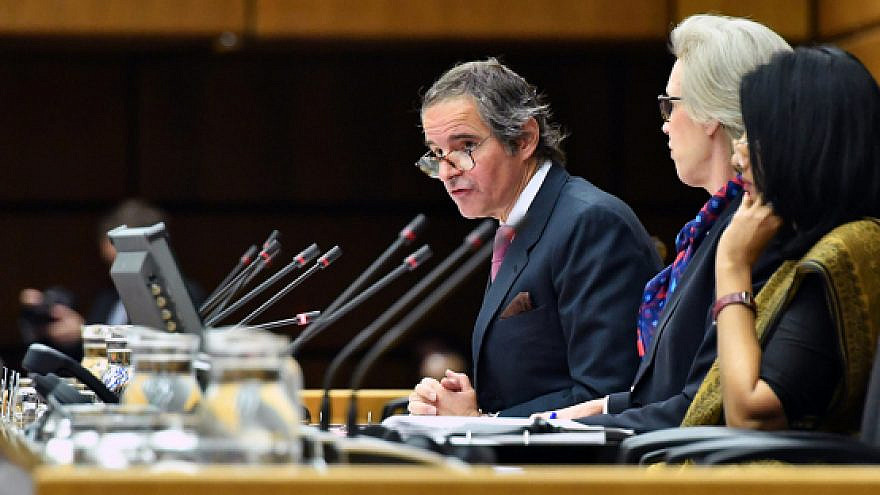
International Atomic Energy Agency Director-General Rafael Grossi addresses the IAEA Board of Governors, March 9, 2020. Credit: D. Calma/IAEA.

The United States is frustrating European efforts to introduce a resolution against the Iranian regime at the International Atomic Energy Agency, Reuters reported on Friday.

A senior European diplomat told the news agency that Washington is the “difficulty” in moving ahead with the resolution when the 35-nation Board of Governors’ quarterly meeting starts on June 3 in Vienna. The diplomat added that “in our conversations we continue to do everything to convince them.”

The last Iran-centered resolution, passed 18 months ago, called on Tehran to cooperate with an IAEA investigation involving three of the Islamic Republic’s nuclear sites.

France, Britain and Germany (the E3) are looking to present the new resolution to the IAEA Board of Governors meeting next week after not moving forward at the last IAEA meeting in March after the Biden administration expressed opposition to the move.

Officials often cite the upcoming November U.S. presidential election as the reason for the Biden administration being an obstacle to another resolution. However, the White House has argued that it doesn’t want to give Tehran an excuse to accelerate its nuclear program.

A senior European diplomat told Reuters, “It’s extremely difficult with Iran and the level of violations is unprecedented…There is no slowing down of its program and there is no real goodwill by Iran to cooperate with the IAEA.” The envoy added that “all our indicators are flashing red.”

Another diplomat said a resolution had been drafted, while others confirmed that the E3 had prepared a draft but had not shared it with other board members yet.

The matter is urgent; in late December, the agency said Iran had tripled its enrichment of uranium to 60%, which is just a short technical step away from 90%, or weapons-grade.

In February, Grossi accused Tehran of being less than forthright regarding its nuclear program, saying the Islamic Republic was “presenting a face which is not entirely transparent when it comes to its nuclear activities,” noting that “of course, this increases dangers.”

There have also been pointed Iranian threats of a push toward nuclear weapons. Earlier this month, an adviser to Supreme Leader Ali Khamenei said the Islamic Republic will weaponize its nuclear program if Israel “threatens its existence.”

“If the Zionist regime [Israel] dares to damage Iran’s nuclear facilities, our level of deterrence will be different. We have no decision to produce a nuclear bomb, but if the existence of Iran is threatened, we will have to change our nuclear doctrine,” said Kamal Kharrazi, according to the ISNA news agency.

Prior to that statement, in the aftermath of Iran’s unprecedented missile and drone strike on Israel in April, and Israel’s response, Maj. Gen. Ahmad Haghtalab, the Islamic Revolutionary Guard Corps commander responsible for safeguarding Iran’s nuclear sites, was quoted by Reuters as saying, “A review of our nuclear doctrine and politics as well as considerations previously communicated is entirely possible.”

“Our hands are on the trigger,” said Haghtalab, saying that the IRGC has identified Israel’s nuclear facilities.

Also in April, IAEA Director Rafael Grossi warned that Tehran’s nuclear activity had “raised eyebrows” and that the Islamic Republic was “weeks rather than months” away from having sufficient enriched uranium to manufacture a bomb.

 
JNS

Source: https://www.jns.org/us-blocking-european-efforts-to-introduce-iaea-resolution-against-iran/

Follow Middle East and Terrorism on Twitter