Sunday, August 25, 2024

The Middle East: A Story of Journalistic Failure - Nils A. Haug


by Nils A. Haug

"The founding of the PLO, now known as Fatah had nothing to do with the desire for statehood, throughout the charter it states, again and again, its sole goal is the destruction of Israel, nothing more, thus started the Palestinian Narrative, they needed a story behind their need." — Timothy Benton, February 14, 2019.

"The Palestinian people does not exist. The creation of a Palestinian state is only a means for continuing our struggle against the state of Israel for our Arab unity. In reality today there is no difference between Jordanians, Palestinians, Syrians and Lebanese. Only for political and tactical reasons do we speak today about the existence of a Palestinian people, since Arab national interests demand that we posit the existence of a distinct "Palestinian people" to oppose Zionism." — Zoheir Mohsen, Trouw, March 31, 1977.


  • "The founding of the PLO, now known as Fatah had nothing to do with the desire for statehood, throughout the charter it states, again and again, its sole goal is the destruction of Israel, nothing more, thus started the Palestinian Narrative, they needed a story behind their need." — Timothy Benton, February 14, 2019.

  • Arabs who fled during the fighting had likely assumed, based on broadcasts they were hearing, that leaving the area would make it easier for the Arab armies to kill the Jews. The plan presumably was to return soon to collect the spoils and take possession of a swiftly-conquered land.

  • When the Arab armies were defeated, and some of the people who had fled tried to return, they were told they had not been loyal and were refused admittance. It is the Arabs who fled, and their descendants, who now call themselves Palestinians. They are simply Arabs who fled Israel at the time and were not allowed back.

  • Neither the Palestinian Authority in the West bank nor Hamas in the Gaza Strip nor the Palestinians in general are seeking a two-state solution. They are quite openly seeking a one-state solution: displacing Israel.

  • Comparisons to England and Ireland fall way wide of the mark: even at the height of Ireland's "Troubles", no one ever claimed that England belonged to Ireland and that everyone who was not a Roman Catholic should leave.

  • The land that comprises Jordan, according the Balfour Declaration, was officially pledged as "a national home of the Jewish people." Jordan, therefore, is rightfully Occupied Israel.

  • The Wall Street Journal published its July 4, 2024 online edition with a piece titled, "Israel Has Seized More Land This Year Than in Any Year in the Past Three Decades" -- referring to those portions of the West Bank more correctly described as Samaria and Judea, which constitute, as at least one of the names denotes, the "heartland" of Israel. Israel cannot "seize" its own land. There is a historical, legal, and ethical warrant for acknowledging Israel's legitimate rights of ownership to all of its land, including Gaza, the West Bank and Transjordan (Jordan), as originally purposed not only by the Balfour Declaration, but also in the San Remo convention of 1920. This allocation was further partitioned by Winston Churchill in 1921 to accommodate claims by the Hashemite Emir Abdullah.

  • It therefore takes a strong dose of purposed cognitive dissonance, religious fanaticism, ignorance, naiveté or even anti-Semitism, to deny Israel's claims. When taking all these considerations into account, it is understandable that renowned international law expert Jacques Gauthier urges the Jewish people of Israel, "Never allow people to tell you that you are trespassers. It's your land; it's been given to you in law."

  • Although 145 UN members "currently recognise a Palestinian state, this doesn't make it so." James Sinkinson, jns.org, July 16, 2024.

  • What exactly does recognition of such a state entail in practice? Exclusive Islamist ownership of the land? What areas of land are these nations referencing exactly? Do they validate the legitimacy of radical Islamism and a jihadist government with its own military? Who has jurisdiction to make these decisions? What about the Jews and their claims?

  • With these questions and more, "recognition" makes no sense. All it does is to expose these countries' historic antisemitism, raise false expectations and create the danger of more deaths far from the countries making these unnecessary, sanctimonious, cost-free claims. Unilateral recognition of "Palestine" will inevitably result in yet another failed state, inhabited by jihadi terrorists, openly eager to repeat the terror of October 7, 2023 on Israel's population.

  • On July 17, 2024, Israel doubled-down on its rights to the land. Israel's parliament, the Knesset, passed a resolution rejecting the establishment of a Palestinian state, or any part of one, "on any piece of land west of the Jordon river." The situation is now clear: there is no chance of Israel agreeing to a so-called "two-state solution." to the Palestinian question. The Oslo Accords, having died a long time ago, are now officially dead.

  • It appears, then, that Islamist strategy is to take ownership of certain words to reverse their intended application. For this reason, Jews are referred to as "occupiers" of Israel, implying that Gaza, Judea, Samaria and Jerusalem comprise the original Palestinian homeland despite voluminous written and archaeological evidence to the contrary.

  • Israeli Jews cannot validly be accused of illegally occupying their own land. To the contrary, Palestinians and their allies are in occupation of Israel's land and are therefore subject to Israel's jurisdiction and control. They might resent the fact that the land belongs to Israel and the Jewish people who have the exclusive right of occupation, along with those whom Israel welcomes.

  • Accordingly, it is the task of journalists of courage -- from all spheres of the political divide – always to carefully investigate the validity of each party's claim. Should they do so in this instance, the outcome becomes clear: the land belongs to the Jewish people, and those they graciously welcome there -- not to anyone else. As this is not the conclusion that many writers and their editors seek, the propaganda of a Palestinian victimhood theory, coupled to a negation of Israel's land claims, will in all likelihood persist.

It is the task of journalists of courage always to carefully investigate the validity of each party's claim. Should they do so in this instance, the outcome becomes clear: the land belongs to the Jewish people, and those they graciously welcome there -- not to anyone else. As this is not the conclusion that many writers and their editors seek, the propaganda of a Palestinian victimhood theory, coupled to a negation of Israel's land claims, will in all likelihood persist. (Image source: iStock/Getty Images)

On May 15, 1948, five Arabs armies started a war – and lost. From that time on, many Arabs have called this loss a "nakba" ("catastrophe"). Ever since then, they have been seeking sympathy for losing a war which they began. If they are unhappy, perhaps they should not have started a war in the first place.

On that May 15, forces from Egypt, Syria, Transjordan, Lebanon, and Iraq "swooped in... just hours after British forces withdrew from Palestine and Israel had declared its independence." Until then, anyone born there was a Palestinian. Christians were Palestinians, Jews were Palestinians. The "place of birth" on every passport was stamped "Palestine."

Arabs who fled during the fighting had likely assumed, based on broadcasts they were hearing, that leaving the area would make it easier for the Arab armies to kill the Jews. The plan presumably was to return soon to collect the spoils and take possession of a swiftly-conquered land.

When the Arab armies were defeated, and some of the people who had fled tried to return, they were told they had not been loyal and were refused admittance. It is the Arabs who fled, and their descendants, who now call themselves Palestinians. They are simply Arabs who fled Israel at the time and were not allowed back.

The well-kept secret, of course, is that, according to none other than a late senior official of the Palestine Liberation Organization (PLO), Zoheir Mohsen, the "Palestinian people does not exist:

"The Palestinian people does not exist. The creation of a Palestinian state is only a means for continuing our struggle against the state of Israel for our Arab unity. In reality today there is no difference between Jordanians, Palestinians, Syrians and Lebanese. Only for political and tactical reasons do we speak today about the existence of a Palestinian people, since Arab national interests demand that we posit the existence of a distinct "Palestinian people" to oppose Zionism. For tactical reasons, Jordan, which is a sovereign state with defined borders, cannot raise claims to Haifa and Jaffa, while as a Palestinian, I can undoubtedly demand Haifa, Jaffa, Beer-Sheva, and Jerusalem. However, the moment we reclaim our right to all of Palestine, we will not wait even a minute to unite Palestine and Jordan." — From "Wij zijn alleen Palestijn om politieke reden", Trouw, 31 March 1977.

A 2019 article by Timothy Benton notes:

"The founding of the PLO, now known as Fatah had nothing to do with the desire for statehood, throughout the charter it states, again and again, its sole goal is the destruction of Israel, nothing more, thus started the Palestinian Narrative, they needed a story behind their need."

The Arabs who did not leave Israel during the War of Independence, and their descendants, still live there as Israeli Arabs, full citizens with the same rights as Jews, except exempt from military service -- Israel did not want anyone fighting his brother. These Israeli Arabs now make up 20% of Israel's population and hold prominent positions in medicine, business, journalism, the judiciary, representation in Israel's parliament, and even on Israel's Supreme Court. The claim of "apartheid" is a libel. By contrast, Arabs who had fled to Lebanon in 1948 are still prohibited from holding any number of worthwhile jobs. Some Arabs call that the real apartheid.

Israel, during that war and in the years after, welcomed roughly the same number of Jewish refugees who were expelled or fled from Arab states as there were Arabs who fled from Israel -- roughly 700,000 for each side. Unlike the Jews, however, the Arab countries refused to let their Arab "brothers" in as full citizens, and demanded that they could only "return" to the country they had just willingly left. Since that time, many Arab countries and enemies of Israel have used these souls and their descendants as political pawns to protest that Israel refused to let them in after they had started a war to exterminate it.

In 1967, the Arabs started another war -- and lost. Israel, after warning Jordan not to enter it -- a warning Jordan ignored -- retook land, including parts of Jerusalem, which Jordan had captured in the unlawful, earlier war. Israel also re-entered its historical homeland, Judea and Samaria, on the west bank of the Jordan River, which separates the two countries. This was when the calls began claiming that Jerusalem and the West Bank were supposedly "occupied". They had indeed been "occupied" -– illegally, by Jordan since the war of 1948. What is never said, of course, as at least one of the names denotes, is that the supposed "occupiers," the Jews, have historically been "occupying" this land for nearly 4,000 years.

Nevertheless, calls for Israel to end its supposed "occupation" began to emanate not only from Islamist media but even from supposed journalists in the West. Sadly, these allegations are never based on history or facts, but appear to come from ideological myths generated by theories of social justice and real or imagined victimhood.

In 2020, the New York Times was awarded the Pulitzer Prize, while "knowing full well that America's leading historians had concluded that more than a few of the [1619 Project] essays' claims]were utter nonsense." In other words: false. The absence of a factual context usually derives from solid investigative reporting – or more likely from any investigative reporting -- combined with fashionable socio-political theories. They perpetuate misleading and misinformed "news" stories that are disseminated to an unsuspecting public, whose trust is eventually eroded – sometimes to the mystified shock of the media outlets. Not all journalists, of course, are of this ilk, but they are probably in the minority. An example of sterling investigative journalism is Peter Schweizer exposing the corruption by "American's progressive elite" in his 2020 bestselling work, Profiles in Corruption.

History and facts reveal a number of erroneous assumptions about Israel's purportedly unlawful "occupation of Palestinian lands." When Norway's Prime Minister Jonas Gahr Store, for instance, described the unilateral recognition of a state of Palestine as "an investment in the only solution that can bring lasting peace in the Middle East," he showed an abysmal grasp of reality. Neither the Palestinian Authority in the West bank nor Hamas in the Gaza Strip nor the Palestinians in general are seeking a two-state solution. They are quite openly seeking a one-state solution: displacing Israel.

Comparisons to England and Ireland fall way wide of the mark: even at the height of Ireland's "Troubles", no one ever claimed that England belonged to Ireland and that everyone who was not a Roman Catholic should leave.

How these one-sided articles, proposals, and beliefs come about, apart from blatant anti-Semitism and anti-Zionism, might be worth looking into.

Some blame can be attributed towards a failure to apply the basic principles of journalism: namely, investigating the facts and then seeing where they lead. In today's kinetic news train, journalists often do not have the time, or possibly think they do not have to bother with, investigating the real story -- the history and facts -- behind popularised assumptions. They might also be told by their editors, explicitly or implicitly, what stories to bring and what not to bring. Veteran journalist Mark Judge laments that in the past, "writers found stories by exploring their subjects, and filled their reviews with insights and wisdom that came from long years of experience."

Perhaps some journalists – on both sides of the political spectrum – now write to pacify their editors, publishers or advertisers, whether consciously or not. The eminent editor of the New York Times Editorial Page, James Bennet, was fired for having published a column by Senator Tom Cotton that ran counter to the prevailing fad of the month. Cotton had suggested that if the riots at the time persisted, the government might "Send in the Troops" -- evidently a heresy; better to let the city burn down.

At crucial times in a polarized society, such as the present, independently-minded writers -- those with a critical outlook, integrity, and an objective, unbiased, attitude essential for the common good of their audience -- appear to be an endangered species.

"Independent journalism" wrote Bennet, is seen in "fair-minded, truth-seeking journalism that aspires to be open and objective." The New York Times' problem, he added, had "metastasised from a liberal bias to an illiberal bias; from an inclination to favour one side of the national debate to an impulse to shut debate down altogether."

The lacking element, Bennet claimed, is that of courage -- courage to write truth and to disclose the real facts in the face of editorial pressure to capitulate to fashionable ideals, increase sales, comply with the prevailing office ethos or to follow conventional wisdom -- all of which may mask truth. He noted integrity as the "moral and intellectual courage to take the other side seriously and to report truths and ideas that your own side demonises for fear they will harm its cause." That is the crux of the matter: a possible harming of the "cause" -- an ideological position, and anathema to objective reporting.

Sadly, a survey indicates only some 44% of US journalists accept that they "should always strive to give every side equal coverage" of the story. The rest seem simply to go with "conventional wisdom" – a superficial approach which can all too often screens the accurate narrative.

The New York Times might have been handed Pulitzer Prizes – as Walter Duranty was for a great whitewash of the crimes of the Soviet leader Joseph Stalin; and again for the Russia Hoax. The prizes should have been for fiction. The same dangerous journalistic nonsense was on also on display during responses to Covid-19, for claims that Hunter Biden's laptop was disinformation and for failing to mention that Hunter's father, President Joe Biden, was for years cognitively impaired.

The upshot of journalistic failure to root out the real story is that when the truth is at last displayed, "the entire country, including its most seasoned reporters, are as shocked as everyone" wrote Jill Abramson, previously of the New York Times. She was alluding to President Biden's mental and physical incapacity. Thus those who have the right to know -- the voting citizens of the country -- have been deliberately deceived for a significant period of time.

Many leading politicians, celebrities, and much of the media claim that "Biden's presidency has been a raging success," but, when properly considered, it has been quite a disaster -- encompassing America's surrender to the Taliban terrorist group in Afghanistan, passively watching a Chinese spy balloon gather information over America's most sensitive military sites, and in general, resulting in a "world in flames."

This brings attention to the land question.

In the view of Islamists, "Palestinian land" extends from the river (Jordan) to the sea (Mediterranean), giving birth to the fashionable slogan favoured by an anti-Zionist crowd of dedicated deconstructionists, "From the river to the sea, Palestine will be free." Why the neighbouring territory of Jordan, on the other side of the river, is not included in the land claim is not explained. The land that comprises Jordan, according the Balfour Declaration, was officially pledged as "a national home of the Jewish people." Jordan, therefore, is rightfully Occupied Israel. If Israel were a fraction as expansionist as Iran and the Palestinians, it should be claimed as such.

The Wall Street Journal published its July 4, 2024 online edition with a piece titled, "Israel Has Seized More Land This Year Than in Any Year in the Past Three Decades" -- referring to those portions of the West Bank more correctly described as Samaria and Judea, which constitute, as at least one of the names denotes, the "heartland" of Israel. Israel cannot "seize" its own land. There is a historical, legal, and ethical warrant for acknowledging Israel's legitimate rights of ownership to all of its land, including Gaza, the West Bank and Transjordan (Jordan), as originally purposed not only by the Balfour Declaration, but also in the San Remo convention of 1920. This allocation was further partitioned by Winston Churchill in 1921 to accommodate claims by the Hashemite Emir Abdullah.

Claims to territory are generally validated through various factors including international law. In the case of Hebrew-Jewish claims to the land, validation also comes from Israel's history, its ancient documents, religious texts, tradition, archaeological findings, and Jews living in the same land for more than 3,600 years. The Jews have maintained their historic language, culture and religion over nearly four millennia, and are the only remaining tribe in the region that can prove its ancient heritage and identity.

All these factors, and more, give credence to Israel's claims of legitimacy, namely, that the Jewish people are rightful owners and occupiers of all of Israel. It therefore takes a strong dose of purposed cognitive dissonance, religious fanaticism, ignorance, naiveté or even anti-Semitism, to deny Israel's claims. When taking all these considerations into account, it is understandable that renowned international law expert Jacques Gauthier urges the Jewish people of Israel, "Never allow people to tell you that you are trespassers. It's your land; it's been given to you in law."

The March 28 recognition by Norway, Ireland, and Spain of a non-existent Palestinian state – one without a functioning government, a definable border or even a viable economy -- has been shown to reflect an anti-Semitic bias by those nations when compared to the attitudes of Europe's other countries, which do not, at present, accept legitimacy of a non-existent, Palestinian state.

Although 145 UN members "currently recognise a Palestinian state, this doesn't make it so, " wrote the author James Sinkinson. What exactly does recognition of such a state entail in practice? Exclusive Islamist ownership of the land? What areas of land are these nations referencing exactly? Do they validate the legitimacy of radical Islamism and a jihadist government with its own military? Who has jurisdiction to make these decisions? What about the Jews and their claims? Will the result be a jihadist, Islamist, Palestinian Gaza and West Bank with a little bit of land in-between for Jews so that they are eventually squeezed or murdered out of existence? Will these countries try to force this recognition onto Israel?

With these questions and more, "recognition" makes no sense. All it does is to expose these countries' historic antisemitism, raise false expectations and create the danger of more deaths far from the countries making these unnecessary, sanctimonious, cost-free claims. Unilateral recognition of "Palestine" will inevitably result in yet another failed state, inhabited by jihadi terrorists, openly eager to repeat the terror of October 7, 2023 on Israel's population.

On July 17, 2024, Israel doubled-down on its rights to the land. Israel's parliament, the Knesset, passed a resolution rejecting the establishment of a Palestinian state, or any part of one, "on any piece of land west of the Jordon river." The situation is now clear: there is no chance of Israel agreeing to a so-called "two-state solution." to the Palestinian question. The Oslo Accords, having died a long time ago, are now officially dead.

Therefore, when the International Court of Justice (ICJ) made a finding on July 19, two days after the Knesset resolution, to the effect that "the Israeli settlements in the West Bank and East Jerusalem, and the regime associated with them, have been established and are being maintained in violation of international law," Israel's Prime Minister Benjamin Netanyahu replied:

"The Jewish people are not occupiers in their own land, including in our own capital Jerusalem, nor in Judea and Samaria our historical homeland. No absurd opinion at the Hague can deny this historical truth or the legal rights of Israelis to live in their own communities in our ancestral home."

The part of Israel known as the Gaza Strip is presently occupied by so-called Palestinians, who are simply residents there by the grace of Israel, which, for the sake of peace and future Gazan prosperity, decided in 2005 that they could reside there with no Jew in sight. Unfortunately, instead using the billions given them to build a Dubai on the Mediterranean, they built an underground city of terror tunnels instead.

Palestinians are Arabs who settled on the land, just like the Hebrews, the Jewish people who have lived there nearly four millennia. George Mason University Law Professor Eugene Kontorovich, a specialist in international law, notes that "all the arguments that make Israel out to be an occupying force collapse under the weight of a single, simple fact: A country cannot occupy territory to which it has a legal claim."

It appears, then, that Islamist strategy is to take ownership of certain words to reverse their intended application. For this reason, Jews are referred to as "occupiers" of Israel, implying that Gaza, Judea, Samaria and Jerusalem comprise the original Palestinian homeland despite voluminous written and archaeological evidence to the contrary.

Israeli Jews cannot validly be accused of illegally occupying their own land. To the contrary, Palestinians and their allies are in occupation of Israel's land and are therefore subject to Israel's jurisdiction and control. They might resent the fact that the land belongs to Israel and the Jewish people who have the exclusive right of occupation, along with those whom Israel welcomes.

Journalists deceive their audience by endorsing, without investigative effort, the standpoint of many political leaders in the West. Compliance with editorial culture can be a mitigating factor, yet journalists worthy of the name -- such as those who exposed the Watergate and other significant scandals -- are prepared expose the real story. Still, political loyalties can make a play: it was reported of even the highly respected journalist Carl Bernstein that he "admits Democrats have told him for 18 months that Joe Biden is not fit to serve a second term." Yet, where was the posting of this vital information?

When the UN recognized "Palestine as eligible for statehood," noted the French-Canadian attorney and scholar Jacques Gauthier, "many people wouldn't be following this falsehood if they knew the true narrative."

Accordingly, it is the task of journalists of courage -- from all spheres of the political divide – always to carefully investigate the validity of each party's claim. Should they do so in this instance, the outcome becomes clear: the land belongs to the Jewish people, and those they graciously welcome there -- not to anyone else. As this is not the conclusion that many writers and their editors seek, the propaganda of a Palestinian victimhood theory, coupled to a negation of Israel's land claims, will in all likelihood persist. As an attempted solution, Newsweek now displays on its website a "Fairness Meter," asking readers to indicate the level of bias or fairness (factuality) of a published article. Perhaps more news sites might consider a like idea.

To counter the prevailing "conventional wisdom" that often impedes the truth of a story, it is time, as James Bennet wrote, for journalistic "courage combined with a critical approach, objectivity, fairness, and integrity" to again take a rightful place in restoring public trust in the media. These requirements are particularly necessary in matters of international importance such as the intentions of Russia or China, or the claims of Iran and its proxies such as the Houthis, Hezbollah and Hamas. It is time for realism and truth to dominate the narrative, not idealism and ideology.


Nils A. Haug is an author and columnist. A Lawyer by profession, he is member of the International Bar Association, the National Association of Scholars, a faculty member at Intercollegiate Studies Institute, the Academy of Philosophy and Letters. Retired from law, his particular field of interest is political theory interconnected with current events. He holds a Ph.D. in Apologetical Theology. Dr. Haug is author of 'Politics, Law, and Disorder in the Garden of Eden – the Quest for Identity'; and 'Enemies of the Innocent – Life, Truth, and Meaning in a Dark Age.' His work has been published by First Things Journal, The American Mind, Quadrant, Minding the Campus, Gatestone Institute, National Association of Scholars, Israel Hayom, Jewish News Syndicate, Anglican Mainstream, Jewish Journal, Document Danmark, and others.

Source:https://www.gatestoneinstitute.org/20871/middle-east-journalistic-failure

Follow Middle East and Terrorism on Twitter

Netanyahu and Nasrallah warn 'story not over,' 'future attacks possible' - Tovah Lazaroff


by Tovah Lazaroff

The international community called for restraint, and the United States said it backed Israel’s right to self-defense.


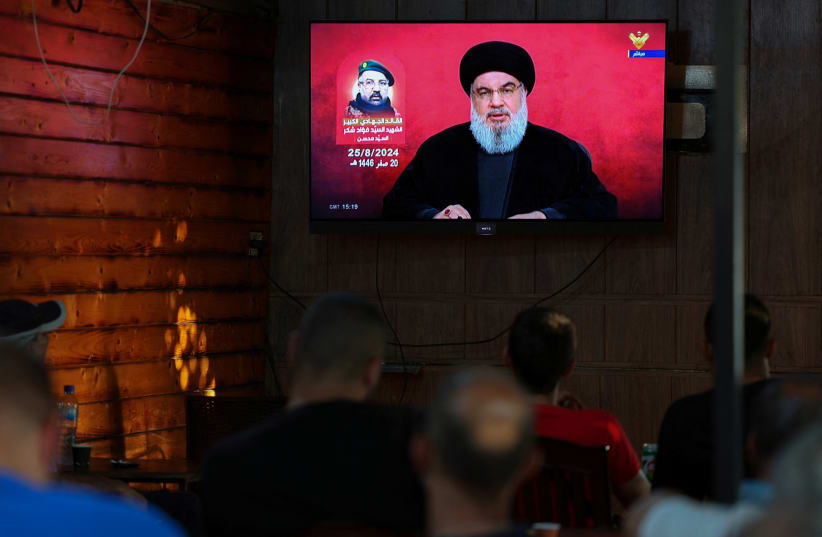
People watch Lebanon's Hezbollah leader Sayyed Hassan Nasrallah delivering a televised address, as they sit at a cafe in Beirut, Lebanon August 25, 2024.  (photo credit: REUTERS/MOHAMED AZAKIR)
People watch Lebanon's Hezbollah leader Sayyed Hassan Nasrallah delivering a televised address, as they sit at a cafe in Beirut, Lebanon August 25, 2024.
(photo credit: REUTERS/MOHAMED AZAKIR)

Israel and Hezbollah traded barbs and warned that their war was not over in the hours that followed an IDF preemptive strike that took out the Iranian proxy group’s missiles and drones before they could hit central Israel early Sunday morning.

”What happened today is not the end of the story,” Prime Minister Benjamin Netanyahu told his weekly government meeting. 

Hezbollah leader Hassan Nasrallah in a televised speech on Sunday evening said that the group’s military operation had ended and “we’ll see what will happen in the future,” based on a translation by GTV.


The crippling IDF attack came after 10 months of a cross-border war concurrent with the Gaza war. Thousands of Israeli and Lebanese civilians have been prevented from living in their homes in that area since October due to the conflict. 

Israel had braced for almost a month for a Hezbollah retaliatory attack after it assassinated its commander Fuad Shukr in Beirut on July 30. It has also expected a retaliatory strike from Iran for the assassination of Hamas leader Ismail Haniyeh in Tehran a day later, even though Israel has not claimed responsibility for his death.

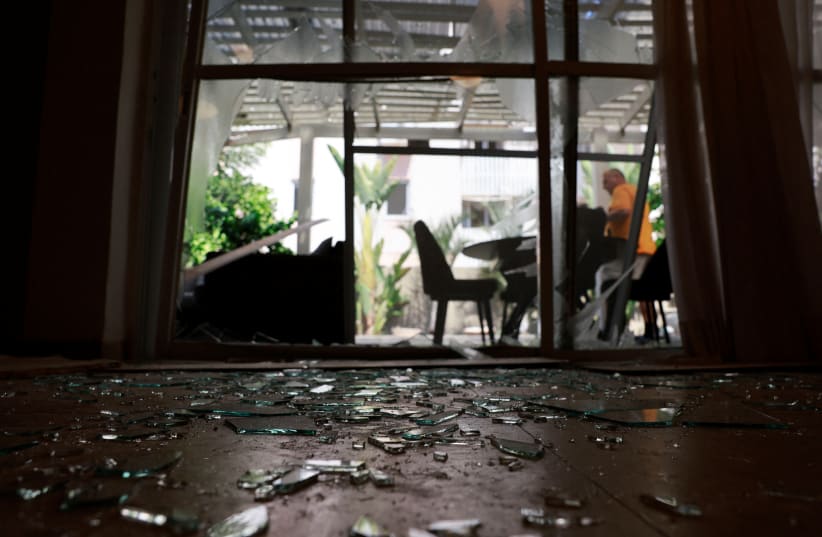
 A view of a damaged residential building, after Hezbollah launched hundreds of rockets and drones towards Israel in what the Iranian-backed movement said was a response to the assassination of a senior commander in Beirut last month, in Acre, northern Israel August 25, 2024.  (credit: REUTERS/AMMAR AWAD)Enlrage image
A view of a damaged residential building, after Hezbollah launched hundreds of rockets and drones towards Israel in what the Iranian-backed movement said was a response to the assassination of a senior commander in Beirut last month, in Acre, northern Israel August 25, 2024. (credit: REUTERS/AMMAR AWAD)
Netanyahu referenced the Hezbollah commander’s assassination, stating, “Three weeks ago, we eliminated its Chief-of-Staff and today we thwarted its attack plan.”

He warned that Nasrallah and Iranian leader Ayatollah Ali Khamenei in Tehran “need to know that this is an additional step in changing the situation in the North, and returning our residents securely to their homes.”

The international community called for restraint

The international community called for restraint and the United States said it backed Israel’s right to self-defense.

IDF Chief of Staff Lt.-Gen. Herzi Halevi and US Chairman of the Joint Chiefs of Staff Gen. Charles Q. Brown met on Sunday night. Brown is making his way through Jordan, Israel, and Egypt in an attempt to solidify the air defense alliance against a potential large Iranian attack and to advance a Gaza war ceasefire-hostage deal.

KAN reported that US intelligence helped thwart the Hezbollah attack, but was not involved in the Israeli operation itself.

Netanyahu told his government on Sunday that “Hezbollah tried to attack the State of Israel with rockets and drones.” As a result, he said, “We directed the IDF to carry out an intense preemptive attack to remove the threat. 

“The IDF destroyed thousands of short-range rockets, all of which were designed to attack our citizens and our forces in the Galilee,” he said.

“The IDF intercepted all of the drones that Hezbollah launched at a strategic target in the center of the country,” he said. “We are striking Hezbollah with surprising crushing blows.

”Nasrallah said his group was still assessing the impact of the IDF attack as he claimed that his group’s drones and missiles had caused damage to Israel, covered up by Netanyahu’s government.

If the operation has achieved its goal, he said, then “we consider the retaliation” has taken place, and if not, “we reserve the right to respond later on.

”In the meantime, he said, people can “relax and go back to their homes.

”He pledged that Hezbollah would not give up on the battle it “started 11 months ago. … We will not abandon Gaza, nor the people of Gaza, nor the resistance in Gaza, nor Palestine, nor the people of Palestine.

”Nasrallah explained that Hezbollah had in part planned its strike for the morning of a US summit in Cairo for a Gaza hostage and ceasefire deal. 

It had initially delayed its response, he said, first to examine whether to act jointly with Iran and because he had hoped that a Gaza ceasefire would be implemented. 

But it turns out the timeline had been protracted and the US is not serious about ending the war, Nasrallah said.“Our operations today, in any case,” might help the “Palestinians or the Arabs who are negotiating with the Palestinian team” in Cairo, he said. 

The message to Hezbollah’s enemies and their backers, the Americans, is that “any hopes to silence these supportive battlefronts [united with Hamas] be it in Lebanon, Yemen or Iraq… are futile,” he said.

National Security Council spokesperson Sean Savett said that US President Joe Biden “is closely monitoring events in Israel and Lebanon” and has been engaged with his “national security team.” At Biden’s direction, senior US officials have been communicating continuously with their Israeli counterparts, Savett explained. “We will keep supporting Israel’s right to defend itself, and we will keep working for regional stability,” Savett said.

Defense Minister Yoav Gallant updated US Defense Secretary Lloyd Austin about the strike and Netanyahu spoke with Israel’s security cabinet early in the morning.

Gallant told Austin, “We have conducted precise strikes in Lebanon in order to thwart an imminent threat against the citizens of Israel. We are closely following developments in Beirut, and we are determined to use all the means at our disposal in order to defend our citizens.”

Gallant and Austin discussed the importance of avoiding regional escalation, the Defense Ministry said.Foreign Minister Israel Katz said he had sent a message to dozens of his counterparts “urging them to support Israel against the Iranian axis of evil and its proxies, led by Hezbollah.” 

“We do not seek a full-scale war – but we will do whatever it takes to protect our citizens,” he said. 

United Nations Secretary-General Antonio Guterres said he was “deeply concerned by the significant increase in the exchanges of fire across the Blue Line. These actions put both the Lebanese and Israeli populations at risk, as well as threatening regional security and stability.

”He called for an “immediate de-escalation and on the parties to urgently and immediately return to a cessation of hostilities, as well as for the full implementation of UN Security Council  Resolution 1701 from 2006 that set out the terms of the ceasefire that ended the Second Lebanon War. 

Two United Nations offices, that of the special coordinator for Lebanon (UNSCOL) and its interim force in Lebanon (UNIFIL) issued a similar call. 

Egypt, one of the mediators in Gaza ceasefire talks, warned against the dangers of a new war front opening in Lebanon. 

Yemen’s Iran-backed Houthi group congratulated its ally Hezbollah on what it called a “great and brave” attack on Israel.Reuters and Yonah Jeremy Bob contributed to this report.

 
Tovah Lazaroff

Source: https://www.jpost.com/middle-east/article-816288

Follow Middle East and Terrorism on Twitter

After Hezbollah’s barrage, can it be deterred? - analysis - Seth J. Frantzman


by Seth J. Frantzman

So far, Hezbollah appears to believe that this kind of conflict, in which it dictates the tempo, time, and place of attack, is in its interest.


A view of a damaged residential building, after Hezbollah launched hundreds of rockets and drones towards Israel in what the Iranian-backed movement said was a response to the assassination of a senior commander in Beirut last month, in Acre, northern Israel August 25, 2024.  (photo credit: REUTERS/AMMAR AWAD)
A view of a damaged residential building, after Hezbollah launched hundreds of rockets and drones towards Israel in what the Iranian-backed movement said was a response to the assassination of a senior commander in Beirut last month, in Acre, northern Israel August 25, 2024.
(photo credit: REUTERS/AMMAR AWAD)

Hezbollah continues to carry out attacks on Israel, even as it takes losses. This illustrates how the Iranian-backed terrorist group is undeterred. Hezbollah’s losses are mounting, but it is attempting to show that despite this, it is ready to escalate.

On Sunday, Hezbollah put this plan into action, moving thousands of rockets aimed at Israel into place. The IDF carried out strikes on numerous locations using 100 aircraft and destroyed thousands of launchers.

Hezbollah has now lost more than 420 of its fighters since October 2023. It has had many of its terror sites, such as observation posts, targeted. The question is whether Hezbollah can replace these losses. Up until now, the terrorist group appears to be indicating that it can replace its losses and that it is not deterred. In fact, Hezbollah continues to claim that its attacks are successful.

From Hezbollah’s point of view and that of the larger Iranian-backed multifront war on Israel, the organization’s ongoing offenses are a success story because Hezbollah has fought much of the war inside Israel’s territory. As a result of its attacks, Israel has had to evacuate 60,000 people, with some 14,000 students now starting their school year away from home, meaning that they will likely be gone for up to two more years.

 A view shows smoke on the Lebanese side of the border with Israel, as a man stands at a beach in Tyre, amid ongoing cross-border hostilities between Hezbollah and Israeli forces, southern Lebanon August 25, 2024.  (credit: REUTERS/AZIZ TAHER)Enlrage image
A view shows smoke on the Lebanese side of the border with Israel, as a man stands at a beach in Tyre, amid ongoing cross-border hostilities between Hezbollah and Israeli forces, southern Lebanon August 25, 2024. (credit: REUTERS/AZIZ TAHER)

Communities in northern Israel are damaged and devastated. People fear returning to the city of Kiryat Shmona. Hezbollah likely sees this as a success.

Hezbollah has less to lose than Israel

This war is being managed and fought in a proportional manner. However, Hezbollah has less to lose than Israel. Hezbollah, so far, has not faced political repercussions at home for its actions. People have had to flee Southern Lebanon, but Hezbollah doesn’t seem to lose out due to this new reality. It has political opponents in Lebanon. However, it is willing to risk part of the country to achieve success.

From Iran’s point of view, this is a win. Iran can cause damage to northern Israel, and although there is destruction in Lebanon and Gaza, Iran itself remains intact.

Also, Iran gets to use its proxies such as those in Iraq, Syria, and Yemen to target Israel. If Israel responds, this does not appear to harm Iran’s overall posture in the region.

In addition, the countries that Iran exploits in the region are generally poor, so the proxies have less to lose if they plunge into war. Yemen, for instance, has already been at war for many years. The Houthis do not care if Yemen is harmed. As for Lebanon, it is already almost bankrupt. Iraq and Syria have been devastated by conflicts over the last decade as well.

This is where Iran seeks to redraw the “equation” in the region. Iran knows that Israel was seeking to wage a “campaign between the wars” atwixt 2014 and 2023. This entailed Israel trying to prevent Iranian entrenchment in Syria. However, Iran was able to entrench there anyway and move weapons to Hezbollah. This organization also increased its stockpile of precision-guided munitions and drones. Now Hezbollah may have taken some losses in its rocket stockpile. However, it appears to have many tunnels and underground bunkers where it can hide its most sophisticated capabilities.

Now, Hezbollah must weigh its next steps. Is it willing to make the type of conflict that unfolded in the early hours of Sunday morning a new normal? Will it continue to a second “phase” of operations, as it has threatened to do against Israel? Or is it happy to have tested Israel and increased the heat a bit, and now it will turn the heat back down and continue to attack northern Israel?

Hezbollah understood that the equation of attacks now meant that as long as it only struck within a few miles of the border, this would not lead to a major escalation. What this means is that it could launch several rockets and drones a day and the consequences will be proportional. This managed conflict is not likely in Israel’s long-term interests. Is it in Hezbollah’s long-term interest? This is the key question for Hezbollah.

So far, Hezbollah appears to believe that this kind of conflict, where it dictates the tempo, time, and place of the attack, is in Hezbollah’s interest. It is not deterred because it has generally only faced Israeli reactions. Even the attack yesterday was primarily about Israel preempting an attack, rather than rewriting the rules.

The question in Israel will be whether Hezbollah can be deterred and when that might happen. As the war in Gaza continues, there is a sense that over the last seven months, Israel has wanted to shift focus to the North. However, the war in Gaza continues to require focus because Hamas continues its attacks. 

 
Seth J. Frantzman

Source: https://www.jpost.com/middle-east/article-816283

Follow Middle East and Terrorism on Twitter

Whoever Is in Charge, Needs to Act: The Philippines and China Are on the Brink of War - James E. Fanell and Bradley A. Thayer


by James E. Fanell and Bradley A. Thayer

It is painful to recognize that the U.S. does not have a president who can fulfill a critical component of deterring a war between the Philippines and the PRC to which the U.S. will be a party.


The U.S. president has many responsibilities, one of his most important is to state what U.S. interests are and to issue warnings when hostile states encroach upon them.  When an American president speaks it comes with a unique authority that is unmatched in history.  When push comes to shove, the president has to speak—not the Secretaries of State or Defense, or their public affairs officers.  Given that President Biden is suffering from the onset of dementia and is no longer capable of meeting the demands of the office, this has profound costs for U.S. national security.  One result is that the American people and American allies do not have the authoritative voice necessary to deter aggression.  When the U.S. needs the president to draw the line in the sand and warn adversaries of the great costs of crossing it in order to deter a war that will involve the U.S., the president’s voice is absent.  The consequence is a void, a security vacuum, and America’s enemy, the People’s Republic of China (PRC), is filling it.  In essence, the sheriff is gone, and the bad guys can do what they want.

While many Americans are focused on the 2024 election, the Philippines is on the verge of war with the PRC.  The cause of this conflict is the PRC’s hyperaggression to achieve its objective of conquering the islands and shoals of the South China Sea while building many more to ensure absolute control.  While the PRC has been pursuing this Maritime Sovereignty Strategy for many decades, the form of that aggression has been gradual, but it is now quickening, escalating in intensity, and broadening in location.

On August 19, at least three collisions occurred between Coast Guard ships belonging to the PRC and the Philippines. As seen in video imagery and still pictures providentially recorded by the Philippines, the PRC first tore a hole 3.6 feet in diameter on the starboard side of a Philippine coast guard vessel.  Shortly thereafter, a PRC Coast Guard vessel rammed another Philippine coast guard ship twice, ripping a gap 2.5 feet long and 3 feet wide on the port side, again as reported by photographic evidence by the Philippines.  Fortunately, no one was killed in the incident.  But there is no question that these attacks were deliberate escalatory acts by the PRC in an effort to prevent the Philippines from exercising its sovereignty over its territory.  This is a direct violation of the 2002 Code of Conduct to which both states are a party, and a stark violation of the sovereignty of the Philippines.

The incidents occurred near Flat Island and Nanshan Island, which are a short distance from Second Thomas Shoal, where the Philippines has outposts.  In addition, the Philippines is attempting to block further reclamation efforts by the PRC at Sabina Shoal.  The Philippines said the collisions resulted from aggressive maneuvers by the PRC’s Coast Guard—a large and potent force on the front lines of Beijing’s Maritime Sovereignty efforts to enforce its claims in the South China Sea.  As is their pattern of prevarication, the PRC accused the Philippine coast guard of deliberately colliding with its ship.  A clear falsehood given the video evidence and the fact that the Chinese coast guard ships were 2-3 times the size of the smaller Philippine vessels.  The PRC is putting teeth in its illegal territorial claim to the Nine-Dash Line and trying to absolutely control the territory within it.  Moreover, Beijing is determined to break the Filipinos to force Manila out of its territory.  Right here, right now, the PRC is aggressing against the Philippines.

This matters to Americans because the Philippines is a 1951 treaty ally of the United States.  If the Philippines goes to war with the PRC, the U.S. is necessarily involved.  As such, the U.S. must deter this conflict from escalating to war, and that requires Presidential leadership that is lacking.  Second, this directly impacts Americans because Beijing’s aggressive ambitions will not stop if it successfully coerces the Philippines but will continue against other U.S. allies, partners, and other U.S. interests.  Third, the South China Sea and East China Sea are strategic bodies of water and critical for the world’s economy.  Trade through the East and South China Seas are estimated at $7.4 trillion, and critical for the PRC’s trade, as well as India’s and Japan’s.

While the PRC is using the stick to coerce the Philippines, it is employing the carrot to buy off Vietnam, a key actor in the South China Sea dispute.  General Secretary of the Communist Party of Vietnam Central Committee and State President To Lam, the General Secretary of the Communist Party of Vietnam, his spouse and a high-level Vietnamese delegation concluded on August 20 a three-day state visit to the PRC, where new trade and economic agreements were reached.  The PRC is attempting to secure the western flank of its illegal Nine-Dash Line claim while it aggresses on its eastern.  But Vietnam is not immune from the PRC’s aggression, and if Beijing is successful against Manila, Hanoi might be next.

U.S. presidential leadership is needed now to state the PRC’s aggression will not stand.  Inconceivably though the Biden-Harris administration has chosen to gap U.S. Navy aircraft carrier presence in the Far East for just the second time in three years, after not gapping our carrier presence since 2003.  This is a clear message of weakness and only entices Xi Jinping and the CCP to unleash the PLA against our treaty ally.

To correct this the U.S. must now state that it will support Filipino efforts to maintain its sovereign territory by providing a strong arm to permit resupply of its outposts.  The U.S. must not permit the PRC to be successful in its effort to break the Philippines.  Much more can be done by the Philippines.  Manila can take a page out of Taiwan’s playbook.  On August 23rd, Taiwan’s President Lai Ching-te made his first visit to Kinmen Island, which is just over a mile from the PRC’s coast, and one of the islands on the frontline of increasing tension with the PRC.  Lai has stated exactly what he should, Taiwan will not be intimidated by the PRC.  So senior Filipino leaders may travel to these outposts with the U.S. Ambassador and other senior U.S. officials and officials from Japan, South Korea, and Australia.  It is also in Vietnam’s interest to stand with the Philippines too.  Strong statements to this effect would be welcome.

It is painful to recognize the harsh truth that the U.S. does not have a president who can fulfill a critical component of deterring a war between the Philippines and the PRC to which the U.S. will be a party.  As the July Crisis that led to World War I started with the assassination of the Austrian Archduke and his wife in Sarajevo, so too World War III might start at Second Thomas Shoal.  The world is drifting into a conflict in the South China Sea.  Strong U.S. action is immediately necessary to deter it.  Whoever is acting for President Biden needs to respond today.

***


James E. Fanell and Bradley A. Thayer  are authors of Embracing Communist China: America’s Greatest Strategic Failure.

Source: https://amgreatness.com/2024/08/25/whoever-is-in-charge-needs-to-act-the-philippines-and-china-are-on-the-brink-of-war/

Follow Middle East and Terrorism on Twitter

'If we stayed in Gaza, Oct. 7 wouldn't have happened,' says general who led evacuation - interview - Sherry Makover Balikov


by Sherry Makover Balikov

"After the disengagement, Hamas rose to power. Before they forcibly took control of Gaza, Hamas won the elections, partly due to the disengagement," Hacohen said.


Gershon Hacohen speaks at a conference of the Israeli newspaper "Makor Rishon", in the southern Israeli city of Sderot, March 19, 2024. (photo credit: Liron Moldovan/Flash90)
Gershon Hacohen speaks at a conference of the Israeli newspaper "Makor Rishon", in the southern Israeli city of Sderot, March 19, 2024.
(photo credit: Liron Moldovan/Flash90)

Even when he commanded the evacuation of Gush Katif, retired Major-General Gershon Hacohen felt it was a mistake. But even in his darkest predictions, he could not have imagined the massacre on October 7. In a recent interview, Hacohen claimed that October 7 was made possible because it evacuated the Jewish communities in the Gaza Strip.

Nineteen years after Israel's departure from the Strip, he reflects on the mindset that led to the disaster, the failure of military commanders, the responsibility of the political echelon, the increasing Iranian threat, and the future.

In the days following the massacre, amidst the horror and cries, while the army remained uncertain about when the ground invasion of Gaza would occur, Hacohen publicly supported the offensive. It wasn't a simple or popular stance. While many soldiers and commanders called for an all-out assault, senior military officers and former generals urged caution, advocating patience or even abandoning the ground operation. Retired Major-General Yitzhak Brick, who had foreseen the events of October 7, gained public favor by arguing that a ground invasion would entangle the army, lead to significant losses, and destabilize the country. Hacohen thought the opposite and voiced his opinion openly. "Then I received messages from women who admired Brick," he recalls. "They told me, 'Why are you in favor of a ground invasion? You're going to kill our children.'"

That’s a serious accusation.

"Yes, but it’s also legitimate. After all, these are mothers of soldiers, deeply anxious about their children's fate. But despite understanding their concerns, there comes a time when you must stand and say, 'Do not fear, my servant Jacob,' and take action."

To ensure that action was taken, Hacohen went straight to the top. Together with senior members of the security movement, where he serves as the chairman of the board, he met with Prime Minister Netanyahu to encourage him to initiate a ground operation in Gaza. "I did this because there was considerable hesitation at the political level," he recalls. "The Chief of Staff was receiving calls from retired generals and former Chiefs of Staff, who weren’t aware of the situation on the ground, warning him against a ground invasion. Eventually, someone had to bang on the table and say, 'Give it to me, and I’ll handle it.'"

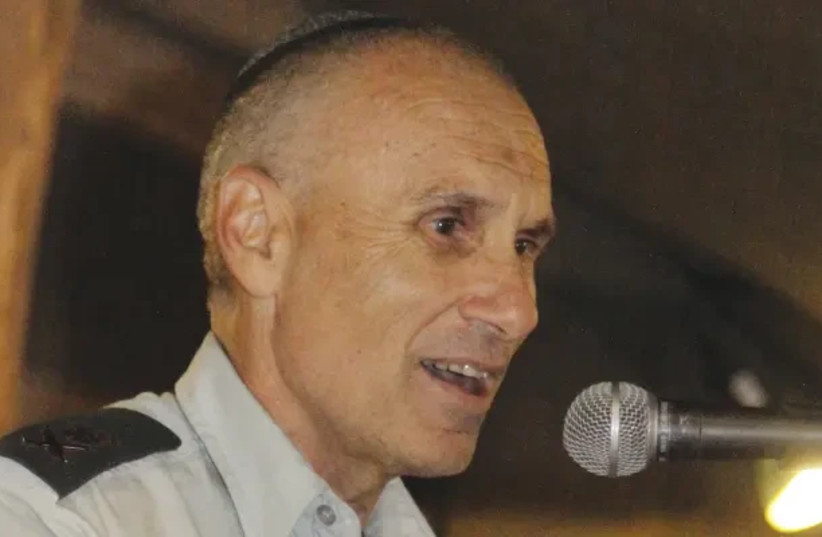
 Gershon Hacohen  (credit: GERSHON ELINSON/FLASH90)Enlrage image
Gershon Hacohen (credit: GERSHON ELINSON/FLASH90)

Chief of Staff Herzi Halevi pushed for a ground invasion.

"True, and that’s to his credit. But it wasn’t enough. A political decision was required, and the government hesitated."

Even Prime Minister Netanyahu hesitated

"Yes. He was very practical but still unsure whether to proceed or wait. When I left the meeting, I was interviewed on TV, and they wanted me to say that I saw a Prime Minister in shock, out of focus. But I said that I saw a clear-headed Prime Minister, fully aware of the situation."

So where was the hesitation?

"In the entire planning process for the offensive move. No military or security event comes without hesitation. Every operation or campaign requires it. I want a leader who hesitates before going to war because war is an unprecedented event that spins out of control and demands the creation of a new path. You can’t simply take a previous event off the shelf and repeat it. Every war comes with great responsibility and monumental decisions, so I want a leader who shows hesitation before taking every step. Hesitation is part of responsibility. Even Ben-Gurion became physically ill before the Sinai War because he understood the gravity of the decision he was making for the people of Israel."

Hacohen doesn’t just advocate action—he leads by example. At 68, during the Swords of Iron War, he donned his uniform and returned to reserve duty. He was active in both the Northern and Southern Commands, contributing to planning and implementation. "From the moment Simchat Torah morning began, I knew we were at war, because I had shaped these scenarios in previous exercises. I was sure that what happened in the southern communities would happen in the north as well, so I went to the Northern Command to offer my help. After a few days, I realized major events were unfolding in the south, so I moved south, joining one of the brigade commanders. There, I witnessed the organization of forces, the immense bravery of the young soldiers, and came to understand that October 7th was both a tragic day and a day of remarkable sacrifice."

Serving in the reserves at 68 is unusual

"I wish I could serve in the reserves for the rest of my life, in any capacity. I have a truck license—I’d even drive. But it takes a lot of humility. That’s key because as a person ages, it becomes harder to stay involved. Young people struggle with the condescending attitudes of older generations."

Hacohen’s humility stems from his religious beliefs. In the past, he referred to himself as "religious with an invisible yarmulke." But when asked about the positions of right-wing rabbis, he distances himself. "I’m not an intermediary between God and people through rabbis," he says. "That’s why I define myself as God-fearing."

Hacohen held several senior positions in the military, including Commander of the Golan Division, Commander of the Military Colleges, Commander of the Northern Corps, and Commander of the General Staff Corps. During the disengagement, he commanded Division 36, which participated in the evacuation of Gush Katif. Nineteen years later, he remains convinced that the disengagement was a mistake. "I believed it was a mistake back then, and everyone knew it," he says. "Unfortunately, the outcome was even worse than I predicted. A senior journalist recently told me, 'It’s a good thing you evacuated Gush Katif, or else 8,000 more Jews would have been massacred on October 7.' I told him, quite the opposite—if Gush Katif had remained, October 7 wouldn’t have happened."

"After the disengagement, Hamas rose to power. Before they forcibly took control of Gaza, Hamas won the elections, partly due to the disengagement, which they credited to what they called 'armed resistance.' There’s still a debate between Mahmoud Abbas and Hamas over the correct way to fight the occupation—Mahmoud Abbas supports a political path, while Hamas insists only armed struggle will remove the occupation. The disengagement convinced the Palestinian public that armed struggle was the right path. Immediately after, Hamas focused on building a powerful military force, developing platoons, battalions, brigades, and command-and-control systems. Smuggling, once minimal, became a flood after disengagement, as Egypt didn’t stop it. Without the disengagement, there wouldn’t have been October 7, because Hamas couldn’t have prepared the way they did. They spent years preparing for October 7. Gush Katif became a training ground—models of tanks, fences, and settlements were all set up. If we’d stayed in Gush Katif, they wouldn’t have had a place to train."

The division involved in the evacuation

"I acted against my personal views but carried out the mission with skill, creativity, and faith. Not just because one must obey the law and orders, but because I believed that if I did it, it would save the settlements and prevent bloodshed. My assessment was that Sharon intended to evacuate all of Judea and Samaria eventually. So I told the settlers that the main struggle was for Judea and Samaria. Had I resigned, the disengagement would have continued without me, and the result would have been worse. Someone else would have done the job without my ability to reach understanding with the settler leadership."

 The Neveh Dekalim community in Gush Katif burns on the day of the disengagement. (credit: MEYER BECK)Enlrage image
The Neveh Dekalim community in Gush Katif burns on the day of the disengagement. (credit: MEYER BECK)

Do you regret participating in a mission you fundamentally opposed?

"No, because as a man of faith, I understood that I was placed in the right time and place by divine will. In practice, the evacuation was a success—it was planned for a month, but it only took two weeks, including six days of real struggle. For a complex operation like this, it was a phenomenal success."

Today, Hacohen is a researcher at the Begin-Sadat Center for Strategic Studies and serves as chairman of the board for the Israel Defense and Security Forum. "We offer opinions, substantiate them professionally, and aim to influence public opinion and provide inspiration for decision-makers," he explained. "Our biggest problem isn’t just how much ammunition or how many soldiers the IDF has but the ideological perception and the question of what this war is about. War is an event driven by unresolved tensions, where balance points must be found, like the tension from the outset of this war: Are we here to dismantle Hamas, or are we here to return the hostages?"

Before balance points, there were failures.

"October 7 was a fine line between success and failure. If different decisions had been made that morning—if the air force had been ready and the limited forces in the south had been aware and prepared—we could have turned the event into a great victory with minimal casualties. We would have been congratulating ourselves, saying, ‘What excellent intelligence, what an incredible Shin Bet, what military ingenuity.’ The fact that this didn’t happen feels like the ‘wrath of the gods,’ as they called it in ancient Greece. The convergence of decision-making points all malfunctioned simultaneously."

So you're saying all systems failed at once?

"Exactly. Even if only the air force had been on alert and understood what was happening on the ground, things would have looked entirely different. But on the morning of October 7, the stars didn’t align. I don’t look at it through a religious lens of synagogue faith, but more through mythology. As a child, I learned about the Trojan Wars, and what the ancient Greeks and the heroes of Israel in the Bible understood is that ultimately, not everything is under human control. In the Trojan War, for example, even though the Trojans were inferior to the Greeks, there was a day when they won a battle, almost burned the Greek fleet, and Hector killed Patroclus, Achilles' friend. This event on October 7 is just as illogical—like Israel’s soccer team defeating Brazil. Mythology teaches us that on the night before the battle, Zeus wanted the goddess Hera. She refused him, and when he realized she supported the Trojans, while he backed the Greeks, he struck a deal: if she agreed to his advances, the Trojans would win the next day. And so it was. The key lesson isn’t about Zeus or Hera—it’s about understanding that sometimes the battlefield is unpredictable."

But on October 7, it wasn’t mythology or fate—it was human error.

"What led to October 7 was what I call the normalization of irresponsibility. The Gaza Division commander is an excellent officer, but for years the system he operated in normalized the reduced alertness and didn’t account for reserves. That said, it’s important to remember that emergencies, by their nature, throw everything into chaos. Even if systems function and are well-prepared, parameters often spiral out of control. That’s why the main message, in war or any disaster zone, is that response must come from the ground up. It’s the people on the ground who begin solving the problems until leadership recovers and starts functioning. It’s not the bureaucratic system that acts first—it’s the citizens themselves. This is difficult for people to accept because they believe the state protects them and allows them to live in peace. That’s why the shock was so profound—the over-promise shattered, and people were forced to confront the harsh reality."

Did you, too, become disillusioned?

"No, because I never bought into that over-promise. In my worldview, the idea that the state was established and now everyone can rest is false. I see the world as temporary, stability as transient, and the fundamental state of human existence as constant upheaval. For me, even if today is peaceful, there’s no guarantee it will be the same tomorrow because tomorrow is a new day. It’s exactly like a relationship. Anyone who thinks their relationship is safe and happy, and so they can relax and go about their business, is mistaken. Even in the best relationships, there are new problems and unexpected challenges, and you have to reinvent yourself every day. The same is true for the state. That’s why every citizen has responsibility and must remain alert. Look at countries that were once considered safe and peaceful—Marine Le Pen is rising in France, the UK is divided, and even Stockholm is experiencing shifts. The most peaceful systems can still be thrown into turmoil, partly due to the mistake of citizens thinking they’re living in paradise. There is no paradise—that’s the starting point."

Who, in your opinion, is responsible for the failures of October 7?

"Professionally, the responsibility lies entirely with the military. Anyone blaming the government for moving battalions around is mistaken. In all my life, I’ve never seen a government give the IDF so much freedom in how to deploy its forces. Fundamentally, the political echelon doesn’t even know the deployment of battalions. No Prime Minister receives the military’s deployment map on a Friday. These are the military’s decisions, and the military was deployed in Judea and Samaria during Simchat Torah to protect Tel Aviv as well."

But the government pursued a policy of containing Hamas and buying quiet with Qatari money, insisting Hamas was deterred.

"That’s why the political echelon shares responsibility. Ben-Gurion always made sure to study events personally. He would find out where the army was operating and what lay behind security decisions. He initiated meetings with senior commanders to understand how they saw things. He also ensured he appointed people he trusted. Prime Minister Netanyahu hasn’t been involved in appointing generals and senior commanders, even formally. I supported the strategy of separating Hamas in Gaza from Hamas in the West Bank, but after the Abraham Accords and other changes, that strategy needed to be reassessed. Netanyahu should have made a strategic decision, especially after Operation Guardian of the Walls. That didn’t happen, partly because neither the military nor the political echelon properly studied Guardian of the Walls, and the government didn’t focus on it."

Is this political failure connected to October 7?

"Yes, but the primary responsibility lies with the military. Rafool and Yanush wouldn’t have allowed this to happen. If they had received the 'Jericho Walls' document, which described the October 7 attack in detail and circulated through the intelligence leadership and Southern Command, they would have fortified the borders. But the military leadership didn’t take the threats seriously. A division commander’s job isn’t just to count their forces but also to act as a strategic sensor. That’s why they’re generals, not junior officers. If a division commander sees something wrong in the force structure, they can go directly to the Prime Minister. I’ve seen commanders do that in the past. The failure lies with the military system, which didn’t take the possibility of a surprise attack seriously or build defensive systems accordingly."

And what about the Prime Minister, who hasn't taken responsibility for the massive failure that occurred on his watch?

"I don’t know. I haven’t spoken to him about it. I assume lawyers told him that if he takes responsibility, he’ll be blamed. This is why I have a problem with lawyers—the reality is much bigger than the law. But of course, as the leader of the country, when something of this magnitude happens, the Prime Minister is responsible. There’s no way around it."

Hacohen has a clear, uncompromising security perspective, but he’s also fair and consistent. "Ben-Gurion had strategic superiority over the security system," he says. "But for years, we haven’t had a leader with superior knowledge in security. This must change because the political system should be the one shaping our military strength. The IDF has been irresponsibly downsized for years—where was the political echelon? The IDF decided this, and the political echelon agreed."

And the result is the current war?

"The current war is existential, about our very ability to live here. Our enemies want to erode the possibility of maintaining a sovereign, thriving Jewish state. The enemy simply wants to destroy us. Nasrallah is smart enough to sell Western audiences a narrative that appeals to them. His latest speech was directed at Kamala Harris, portraying himself as a freedom fighter, liberating Lebanon. This gives the illusion that if we withdraw from Lebanon, he’ll lay down his arms because he got what he wanted. But the moment we withdraw, he’ll find a new pretext. When he talks about the Shebaa Farms, the Western world imagines something pastoral—a house with a red roof, a cow with a trough, a girl with braids—but to his people, he speaks in the language of religious war, in the language of jihad."

  Maj. Gen. Gershon Hacohen (res.) speaks at the IDSF conference, Jan. 25, 2024. (credit: TAMIR HAION)Enlrage image
Maj. Gen. Gershon Hacohen (res.) speaks at the IDSF conference, Jan. 25, 2024. (credit: TAMIR HAION)

What’s new about this? Previous wars also involved jihad.

"The difference is huge. In the past, soldiers, like those from Egypt during the War of Independence, were taken from their villages to fight in wars they didn’t understand, and they had no interest in winning. When their commanders signed surrender documents, they went home. But since the Six-Day War, the war has become religious. It’s no coincidence that Sadat chose Yom Kippur and used religious language to attack Israel. When jihad is involved, there’s unity among believers, and everyone fighting us is motivated by a religious idea."

So what makes "Operation Swords of Iron" different? Even the Lebanon War had a religious backdrop.

"In the Lebanon War, we were fighting Hezbollah in Lebanon, and no one else intervened in the conflict. We could focus on a single-front campaign. The current war surrounds Israel from all sides because the unifying force is religious. During the Second Lebanon War, there was no unity between the Sunnis and Shiites. But Iran, through Jerusalem, created a bridge across a gap of hundreds of years, forging a blood alliance between the Sunnis and Shiites to act together for Jerusalem, their common goal. So there is also a religious shift here. In the new reality of jihad fighters, Jerusalem today holds more importance than even Mecca."

Is that why the Israeli public is more frightened now?

"The public has noticed a shift in the nature of warfare. Today, the weak can defeat the strong more easily than in the past because the era of exclusive technology being in the hands of the West is over. The phone that a shepherd in Afghanistan holds is just as advanced as an Israeli phone. Drone systems are widely available, and mass-produced. Warfare has changed—now weapons are accessible to all. Even the Americans face threats today that they didn’t before. The Russians can no longer dominate the Black Sea because they are facing swarms of drones, cheap technology that could sink them. Even the Houthis in Yemen, who might not be able to solve advanced math problems, are producing remote-controlled drones. Technology is available to everyone, and artificial intelligence capabilities exist in even the simplest computers."

And the public recognizes this?

"Yes, the public realizes that the threat is more real, and the ring of fire around us is closing in. When Ehud Barak was Chief of Staff, he led a project for a small, smart army built on technological superiority. Prime Minister Olmert embraced this idea and didn’t understand that you also need mass, not just advanced, remote-strike capabilities. How did Barak put it back then? 'Kahalani stood in the Valley of Tears with a 1:10 force ratio and won with courage, sacrifice, and tactical excellence. We will change the force ratio by destroying them from afar before they even get close.' So for years, we were told that sacrifice wasn’t necessary because we would win, and soldiers were no longer needed because drones would do the work. They didn’t understand that war requires mass, reserves, and forces—you can’t succeed without it."

"Meanwhile, two things happened on the enemy’s side: First, they couldn’t confront our superiority without making sacrifices, so they developed the spirit of jihad. Second, technology became so accessible that even the most inferior enemy had significant operational capabilities. This leads to a kind of anxiety, because in the past, a war would last two or three days, and then it would be over. Suddenly, we’ve been entangled in conflict for ten months, and the war is still ongoing. But that’s not because the IDF has weakened—it’s because the enemy’s combat systems have evolved entirely."

In light of all this, is the war being managed correctly?

"I think there have been many successes, but there are also a lot of questions about the future, like what will happen on the northern border, or how we bring residents back. I hope things will develop further because we are still approaching the decisive crossroads."

What are the objectives?

"War objectives must be reassessed as the conflict evolves. Putin changed his objectives mid-campaign. During the War of Independence, Ben-Gurion didn’t set final objectives; instead, he led a series of campaigns where each operation had its own beginning, middle, and end, each with its own goal. This is a more realistic way to manage a war because military struggles are not engineering projects with a clear destination. The military system evolves as it moves forward—that’s its nature. What may have seemed like a secondary theater can suddenly become central to our future. The goals of this war were correctly defined at the start, but now they need to be revised. Columbus set out for a specific purpose, but along the way, he discovered America. Maybe he didn’t achieve his initial goal, but he got to America. The goals of Operation Swords of Iron were initially set correctly, but many other things have happened since. It’s time to sit down and redefine the war’s objectives."

It doesn’t seem like that’s happening.

"That’s because the leadership doesn’t think in a 'Russian way.' Ben-Gurion thought like that. I think like that. War is a developing event—it can’t be fully controlled. Even when you can see the end, new elements emerge that need consideration."

What happens if the objectives aren’t refreshed?

"It means we’re losing touch with the evolving reality. We may have many tactical successes, but we need to turn them into a strategic outcome. What the enemy has done, with great sophistication, is create a war concept that denies us international legitimacy. This started during Operation Cast Lead with the Goldstone Report and continues today in a planned manner. Gaza is a new kind of military entity, and when we have to fight Hamas embedded in civilian populations—schools, playgrounds, hospitals—we achieve extraordinary results in minimizing harm to civilians by any objective standard, more so than what the Americans have achieved in minimizing civilian casualties in their operations. Yet, what concerns people like Kamala Harris is that we are harming civilians."

How do you explain that?

"Hamas and Hezbollah’s tactics are based on not caring about their civilians. They create a situation where we are forced to kill civilians, knowing that the more civilians who die, the more condemnation Israel receives and the more international legitimacy they gain. Civilian casualties are a huge strategic asset for them, allowing them to undermine the moral and ideological support for us. They’re willing to pay that price deliberately. In response, we do everything we can to avoid harming civilians—both for moral reasons and because we lose international support when civilians are killed. But then there’s internal tension, which was discussed after Operation Cast Lead. Parents of soldiers won’t accept their children being put at risk just because we want to avoid harming civilians. If we lose soldiers because we restrained ourselves too much, we might gain international legitimacy, but we lose internal legitimacy."

How do you reconcile the gap between internal and international legitimacy?

"By being aware that we are in a constant state of unresolved tension. Benny Gantz once said something that, had he been aware of this tension, he wouldn’t have said. After Operation Cast Lead, he mentioned that he prevented an airstrike in Shuja'iyya because he didn’t want too many uninvolved civilians to be harmed. If he had been fully conscious of the internal tension, he would have phrased it differently."

When you have that awareness, how do you satisfy both internal and international public opinion?

"Through balance. For example, when the IDF evacuated civilians from Rafah in an unprecedented preemptive action to reduce the number of civilians in a war zone. In Khan Younis, they managed to send messages urging the residents to leave, and they did because the IDF’s messages are credible. There was a comprehensive effort to minimize harm to uninvolved civilians. At the same time, commanders must be the first to account for their soldiers and convince them not to hold back if their safety is at risk. Soldiers gain confidence when they see how dedicated their commanders are to ensuring their security."

Does this tension explain Netanyahu’s actions—appeasing the Americans on one side and trying to placate Ben Gvir on the other?

"I believe the Prime Minister is demonstrating balanced management of these tensions. On the one hand, he complied with the American demand to allow humanitarian aid into Gaza. If he hadn’t, the war would have ended because we wouldn’t have received heavy ammunition, which we can’t produce ourselves. On the other hand, after much deliberation and despite American and international opposition, the army entered Rafah and achieved significant results, all while maintaining balance with the Egyptians."

Ben Gvir and others argue against providing humanitarian aid to the enemy, claiming that we’re fueling our adversary in the middle of a war.

"We had no choice; we had to provide aid, but only in areas we determine. We need to define specific zones and distribute the aid ourselves, creating spaces that are less under Hamas’s control. As long as Hamas controls food distribution, they hold significant power and governance. We could have managed this differently, and there were proposals to do so, but for various reasons, the IDF chose not to go that route. It’s worth noting that military governance is not a dirty word. It’s not permanent—it’s a tool in the military commander’s toolbox."

What’s your position on the hostages and the price Israel may need to pay for their release?

"This is an incredibly sensitive issue. We must never reach a point where it seems the hostages are not important and we’re moving on without them. Putin might be able to say, ‘I have a war to fight, and the hostage issue is small to me.’ That’s not a position I recommend—God forbid. On the other hand, when the families of the hostages cite the religious commandment of redeeming captives, someone needs to explain that even in Jewish law, there are limits to the price. It’s stated that a slave should not be redeemed at any cost and that captives are not ransomed for more than they are worth. Even the Maharam of Rothenburg instructed his community not to ransom him at an extortionate price, and he died in prison."

Gershon Hacohen (credit: YOSSI ALONI/MAARIV)Enlrage image
Gershon Hacohen (credit: YOSSI ALONI/MAARIV)

Who decides what is “more than they are worth” when it comes to hostages? How can you quantify the value of a person suffering in Hamas tunnels?

"The real question is who decides whether the price is reasonable or extortionate. Jewish law doesn’t determine this—it’s a matter of leadership, of who can press the right balance between paying a just price for freeing captives and not succumbing to an unsustainable, extortionate demand. The extortion exists in every case, but how we respond is a test of leadership."

In your opinion, does the state have an obligation to bring them back?

"Yes, but not at any cost. Within that space of ‘not at any cost,’ there are many options, and that’s where a leadership decision must be made."

What do you think Israel should do the day after?

"I reject the concept of ‘the day after.’ Moshe Dayan once said, ‘Gentlemen, the long term begins here and now.’ It’s not that we’ll fight and fight, and then suddenly the day after will arrive like a happy ending in a cartoon. Things change in war, and throughout, we must remain in control and aware of the evolving situations. War isn’t an engineering project. Netanyahu has said some important things that could shape the day after, like the fact that we won’t govern Gaza. But what Gaza’s future will look like remains an open question."

Ben Gvir and Smotrich often talk about the day after.

"It’s unacceptable for a position like whether to stay in the Philadelphi Corridor to be a sectarian right-wing stance. You don’t go to war with a sectoral view—you need a broad consensus. I expect Smotrich and Ben Gvir, even if they’re speaking the truth, not to color it with sectarian tones because that undermines the ability to turn their truths into something that leads the entire nation. Especially on matters as significant as war and its consequences."

And what about the day after in Israel?

"A new song, with a new story, needs to emerge. We need to internalize that even if residents return to the north, and even if there is a ceasefire in the south and some kind of agreement with the enemy, Hezbollah will still exist, the Iranian threat will remain, and anyone seeking absolute security won’t find such guarantees. People will need to return with a collective consciousness. It’s like people moving to Kiryat Shmona not just because there’s a financial grant for doctors but because there’s a pioneering spirit. A whole system needs to tell a story that gives meaning beyond the individual life because only a collective of people in distress creates priorities and builds national resilience."


Sherry Makover Balikov

Source: https://www.jpost.com/israel-hamas-war/article-816104

Follow Middle East and Terrorism on Twitter

Yahya Sinwar left Gaza tunnels several times, continues to elude Israel - NYT report - Jerusalem Post Staff


by Jerusalem Post Staff

Tracking down Sinwar has proven difficult for the IDF, as the terror leader has reportedly avoided electronic communication for months.


Hamas leader Yahya Sinwar in an underground terror tunnel in Gaza (illustrative) (photo credit: VIA REUTERS)
Hamas leader Yahya Sinwar in an underground terror tunnel in Gaza (illustrative)
(photo credit: VIA REUTERS)

While Israel has been searching for Hamas leader and October 7 mastermind Yahya Sinwar since the start of the war in Gaza, the terror leader may have left his hiding spot multiple times in the last year, Israeli and American officials told the New York Times on Sunday. 

Hamas's October 7 attacks, planned by Sinwar, saw terrorists kill over 1200 people in southern Israel, in addition to taking over 250 captive.

Searching for Sinwar

In one case, Sinwar reportedly left his tunnel complex only days before Israeli commando units raided the structure on January 31. Escaping into Khan Yunis, Sinwar left behind only a few documents and, exhibiting the wealth of Hamas leadership, the NIS equivalent of $1 million.

Tracking down Sinwar has proven difficult for the IDF, as the terror leader has reportedly avoided electronic communication for months. Instead, a series of human couriers is said to deliver communications on his behalf - a method used by other international terror figures like Osama Bin Laden, the Times reported.

However, while Al-Qaeda terrorist Bin Laden remained in a passive state of hiding for many years, Sinwar continues to play an instrumental role in Hamas leadership - even being promoted since the assassination of his colleague Ismail Haniyeh in Iran.

Hamas leader Yahya Sinwar in front of ruins from the October 7 massacre, with a bloody border (illustrative) (credit: REUTERS/FLASH90)Enlrage image
Hamas leader Yahya Sinwar in front of ruins from the October 7 massacre, with a bloody border (illustrative) (credit: REUTERS/FLASH90)

Qatari, Egyptian, Israeli, and American officials all told the Times that communication is now taking Sinwar significantly longer than it once did. While previously Sinwar could send messages in days, his proxies and deputies have now had to act as proxies in discussions on his behalf.

While Sinwar’s partners in terror, Mohammed Deif and Haniyeh, have since been eliminated, although Israel has only claimed responsibility for the former, not the latter, Israeli intelligence has yet to pin Sinwar down - despite the Shin Bet dedicating a special unit to hunting him.

The Times reported that the US had provided a ground-penetrating radar to aid in the search. However, one official familiar with the US-Israel intelligence-sharing arrangement told the Times that the US shared more information than Israel was willing to. The US had reportedly been eager to share information in hopes that it may have helped locate some of the American citizens who remain captive in the Gaza Strip.

The July 31 incident is not the only time that Israel closed the gap, as, during one raid early during the war, a video was discovered by the IDF showing Sinwar moving alongside his family to a new hiding spot.

Israeli intelligence told the Times that they believed Sinwar was able to keep his family with him for the first six months of the war.

In November, a hostage released in the ceasefire deal confirmed that Sinwar had directly addressed hostages not long after they were taken on October 7. Sinwar told the captives that they were safe and no harm would come to them, according to an account by a former hostage. 


Jerusalem Post Staff

Source: https://www.jpost.com/israel-hamas-war/article-816234

Follow Middle East and Terrorism on Twitter