Monday, August 26, 2024

Israel tightens ring around still elusive Hamas leader - David Isaac


by David Isaac

Time may be running out for Yahya Sinwar. "We have actually been minutes away more than once,” said a former Shin Bet official.


Yahya Sinwar, leader of the Hamas terrorist group, gestures during a rally in Beit Lahiya on May 30, 2021. Photo by Atia Mohammed/Flash90.

Hamas chief Yahya Sinwar, 61, has abandoned the tunnels and taken to cross-dressing as a woman to escape detection, Britain’s Daily Express reported on Monday, leading social-media wags to dub the mastermind behind the Oct. 7 massacre “Mrs. Dodgefire.”

So far, Sinwar has managed to evade the death blow Israel plans for him, a fate it has dealt out to many of Hamas’s leadership, including Ismail Haniyeh in Tehran and Mohammed Deif in Gaza.

But time doesn’t appear to be on Sinwar’s side.

“We have actually been minutes away more than once,” Shalom Ben Hanan, a former Israel Security Agency (Shin Bet) official heavily involved in the hunt for Sinwar, told the Daily Express.

“As we have discovered through other elimination operations, Sinwar will not be sitting in underground tunnels or special underground zones for more than 24 to 36 hours at a time,” Ben Hanan added.

“He knows we can find such underground locations through advanced technology. And he knows if a mistake is made or we find sources to tell us where he is, he needs to be on the move—to avoid that mistake becoming fatal for him,” he said.

Also in Israel’s favor is that Sinwar is unpopular with parts of the Gazan population. “They believe he has led them to ruin and it can only get worse the longer he stays alive,” an unnamed source told the paper.

Brig. Gen. Dan Goldfuss, commander of the IDF’s 98th Paratroopers Division, in an Aug. 11 interview with Channel 12 confirmed that the IDF only missed Sinwar by minutes in one raid:

“We were close. We were in his compound. We arrived at the compound underground. The compound was ‘hot.’ We also found a lot of money there. The coffee was still hot. The weapons had been dropped … minutes.”

In a Sunday feature on the hunt for Sinwar, The New York Times reported that he had left a bunker on Jan. 31, a few days before Israeli forces arrived.

The Israelis have released captured footage of Sinwar from October walking through a tunnel with some of his children.

Traceable electronics

Sinwar’s ability to evade detection is based largely on his abandoning traceable electronic communications, taking a page from the playbook of Osama bin Laden.

“He is believed to stay in touch with the organization he leads through a network of human couriers,” the Times said.

The paper interviewed more than two dozen Israeli and U.S. officials and found that both countries have invested “vast resources” into finding Sinwar.

The Americans are monitoring communications and have helped Israel with ground-penetrating radar to map the enormous Hamas “metro” of tunnels.

“We’ve devoted considerable effort and resources to the Israelis for the hunt for the top leadership, particularly Sinwar,” U.S. National Security Advisor Jake Sullivan said. “We’ve had people in Israel sitting in the room with the Israelis working this problem set. And obviously, we have a lot of experience hunting high-value targets.”

The United States is partly motivated by the hope that with Sinwar’s death, Israel could declare victory and end its military operations, the report noted.

The Shin Bet, along with the IDF’s Military Intelligence Directorate, has set up a special unit to track down a Cabinet-approved targeted-killing list of Hamas leaders, of whom Sinwar is the most important.

While he has managed to evade Israeli forces, the ring around him is tightening. In the first weeks of the war, Sinwar hid in the Hamas tunnels of Gaza City, but he has since moved to Khan Yunis. He also used cellular and satellite phones, even speaking to Hamas members in Doha, but has since ceased to do so.

“American and Israeli spy agencies were able to monitor some of those calls but were not able to pinpoint his location,” the Times reported.

He used to respond to messages within days, but hostage negotiation mediators and others say it now takes much longer to hear back from him.

And while he has leaned on a close group of Hamas political and military leaders in Gaza for policy decisions, that circle is shrinking, the Times noted.

Confidants of Sinwar killed include Deif, Marwan Issa, Rawhi Mushtaha, Izzeldin al-Haddad and Muhammad.


David Isaac

Source: https://www.jns.org/israel-tightens-ring-around-still-elusive-hamas-leader/

Follow Middle East and Terrorism on Twitter

The Quiet Before the Storms in Ukraine, Gaza, and Taiwan? - Victor Davis Hanson


by Victor Davis Hanson

Amid doubts about Biden's ability to effectively lead the U.S. in his remaining months as president, our enemies abroad might see an opportunity to alter the global balance of power.



There are three current hot or cold wars: on the Ukrainian border, in the regions surrounding Israel, and in the strategic space between Taiwan and mainland China. All three conflicts could not only expand within their respective theaters but also escalate to draw in the United States.

And all three involve nuclear powers.

Various Russian megaphones routinely threaten to use tactical nuclear weapons against Ukraine. Some boast about sending strategic nuclear bombs or missiles against its Western suppliers, especially as the costs of Russian aggression mount and the humiliation of Putin escalates.

Nuclear Israel and near-nuclear Iran have both exchanged attacks on their respective homelands—and promise to do so again.

China likewise on occasion existentially threatens Taiwan. Its freelancing generals and spokesmen periodically warn Japan and the U.S. of dire nuclear consequences should they intervene on Taiwan’s behalf.

In all these theaters, there superficially appears to be stasis and deadlock: Israel is said to be bogged down in Gaza as it seeks to neutralize 400 miles of subterranean command-and-control installations and munitions, find and rescue surviving Israeli hostages, and take out the Hamas leaders. And no one believes that the degradation of Hamas will mark the end of the war, given the agendas of Hezbollah, the Houthis, and Iran, to attack periodically and chronically the Jewish state.

Combined Russian and Ukrainian dead, wounded, and missing may be nearing one million. Experts argue about whether the current apparently successful Ukrainian counteroffensive towards Kursk inside Russia was merely a demonstration to gain diplomatic concessions. Or was it designed to take and hold ground inside the Russian homeland? Or intended to draw off Russian offensives to the southeast? Some call it brilliantly conceived but dangerous—given the risk of its ending like the ill-fated Battle of the Bulge German offensive of 1945 that achieved startling initial success but was soon ground down by superior numbers and ultimately weakened the overall German defense.

China has stepped up its harassment of Philippine forces and its rhetoric. It has upped its intrusions into Taiwanese airspace and waters while cementing strategic partnerships with Russia and Iran, even as it courts India and Turkey.

Yet for now, China is not especially eager to attack Taiwan, given that it feels it is steadily gaining momentum in psychologically, strategically, and politically strangling the Taiwanese.

Confusion and strategic pauses for the brief moment mark all these conflicts. In part, the hiatuses arose because of uncertainty surrounding the murky intentions and role of the United States. The latter is bogged down in an unpredictable if not bizarre election year, compounded by ambiguity about who is actually in control of the country and for how long, and who will be president after January 2025.

The 2024 race saw the first-ever presidential debate held well before the formal nomination of candidates, the sudden forced removal of President Biden from his reelection candidacy, the abrupt coronation of a once-deemed-unimpressive Kamala Harris as his replacement, the inability or unwillingness of Harris to meet the media or give interviews, the continued apparent debility of Biden as he enters the last six months of his presidential tenure, the assassination attempt on Donald Trump, and the near-even presidential polls.

While Russian and Ukrainian forces advance and retreat along their shared border, most experts privately feel that there is quiet consensus about an eventual armistice to end the Somme-like bloodbath. This will involve recognition of Russia’s control over the Donbas and Crimea that Putin attacked and de facto absorbed in 2014; a demilitarized border; and an autonomous and heavily armed but non-NATO Ukraine.

Currently, Ukraine is running out of manpower, given its losses, draft problems, and a quarter of the population having fled the country. Russia has suffered twice as many casualties as Ukraine and faced blows to its military prestige. It has so far found no tactical or strategic pathway to absorb Ukraine as it intended with its February 2022 surprise attack on Kyiv.

Yet the apparent ossification on the border may be illusory. If either side cracks and its enemy suddenly makes dramatic advances, a dangerous escalation could ensue, and rapidly so. Russia will likely not allow Ukraine to occupy for any extended period any Russian territory and will up its threats toward what it sees as an exhausted Ukraine and a tired NATO partnership.

And NATO and the United States will likely never allow Russia to annex Ukraine in toto beyond the Donbas and Crimea. The longer the ensuing stagnation, the more likely one side will seek a dramatic breakthrough, and so the more likely becomes a greater war with third-party intervention and deadlier weapons.

Turning to the second conflict, we find that Iran is now in a dangerous position of its own making. It has loudly promised Israel and boasted to the Muslim world that it will attack the Jewish homeland for a second time within a year. Hezbollah threatens to join in, perhaps along with anemic contributions from Hamas and the Houthis.

Yet does Iran really believe that even a missile and drone launch twice the size of its last huge but failed barrage—say 640 projectiles—will seriously injure Israel? Even with the confusion and chaos in the U.S., is Tehran really convinced that the U.S. and some of its European and Arab allies will not again intervene to protect their own assets or their own or international airspace, by knocking down Iranian aerial attacks?

In short, Iran’s rhetoric and the provocations of its satellites have put it in a lose/lose situation: to save face the theocracy feels it must honor its threats and attack Israel, but it also knows it may not be able to do much damage, while earning a second retaliatory response potentially far more grievous and far more warranted in international eyes than Israel’s prior successful but largely demonstrative missile launch.

Ditto Hezbollah. It hopes that its some 150,000 rockets and drones will do real damage in concert with an Iranian attack but accepts that it will certainly earn in response a devastation of Shiite Beirut and its environs far in excess of what it suffered in 2006. The damage from that conflict took a generation to repair, with hundreds of miles of roads, thousands of homes, and billions of dollars in infrastructure destroyed.

So, like the Ukrainian conflict, the Middle East war is only temporarily on pause. And it will continue until Iran or Israel seeks to break the stalemate in a second phase that would make the Gaza campaign seem minor in comparison and be far more likely to draw in outside powers—especially if the United States appears feeble and unable to protect its traditional ally Israel.

As for the third, still-bloodless conflict: China envisions strategy globally rather than regionally. It helps to fuel the stalemate in Ukraine, on the grounds that its traditional rival turned temporary friend Russia is hurting the West by consuming its money, weapons, and attention—while conveniently hurting itself in the process.

China is openly aiding Iran, not because it is especially friendly to radical Islam (cf. its treatment of the Uyghurs) or innately hostile to the Jewish state. Instead, it simply welcomes these tensions that cause radical domestic upheaval and political dissension inside America, while drawing U.S. naval and air assets far away from the South China Sea.

China’s operating principle seems to be to watch and wait for the outcome of the wars in Ukraine and the Middle East, given that both tax Western powers. It is eager and patient to see how the conflicts end, especially whether Russia achieves by force its apparent goals, and whether Iran and its proxies permanently redefine the future of the Middle East. These outcomes will serve to indicate the level of potential Western resistance to or intentional condemnation of its own planned annexation of Taiwan.

In conclusion, we are entering a very dangerous five-month period.

Joe Biden has been judged by the American people in the polls as too enfeebled to be reelected and declared by his own party to be too cognitively challenged to remain its nominee. That may suggest to foreign risk-takers that the U.S. president is deemed unfit by Americans themselves and thus conclude there might be a vacuum of rapid-response leadership at the White House.

The unspoken corollary is that the American people and both their political parties are certain that, while Biden is incapable of continuing as a normally engaged president through the last half-year of his tenure, he will nevertheless inevitably do so. And that conclusion is likely shared by enemies abroad, who may surmise that if there ever was a time to alter the current geostrategic map or the relative balance of power, that rare occasion is now on the horizon.


Victor Davis Hanson

Source: https://amgreatness.com/2024/08/26/the-quiet-before-the-storms-in-ukraine-gaza-and-taiwan/

Follow Middle East and Terrorism on Twitter

Federal judge blocks Biden administration's 'parole in place' immigration program - Misty Severi


by Misty Severi

U.S. District Judge J. Campbell Barker issued the administrative stay on the program, blocking it for at least two weeks as he hears the conservative states' challenge.


A federal judge in Texas on Monday blocked the Biden administration's "parole in place" program, which would have given illegal immigrant spouses of U.S. citizens a pathway to citizenship. 

A coalition of 16 Republican states, led by Texas, sued the administration over the rule last week, claiming it illegally bypassed Congress in order to create the pathway for "political purposes."

U.S. District Judge J. Campbell Barker issued the administrative stay on the program, blocking it for at least two weeks as he hears the conservative states' challenge. 

“The claims are substantial and warrant closer consideration than the court has been able to afford to date,” Barker wrote, per the Associated Press.

The program, which was launched last week, allows spouses of American citizens to stay in the country legally and apply for a green card. In order to qualify for the program, the immigrant must have been in the United States for at least 10 years, have no disqualifying criminal history, and have been married to the U.S. citizen by June 17. 

Illegal immigrants can already marry an American citizen and apply for a green card, but they usually have to leave the country first, and the process can take years. The new program eliminates the need to leave the U.S.

Aside from Texas, other states in the suit include Alabama, Arkansas, Florida, Georgia, Idaho, Iowa, Kansas, Louisiana, Missouri, North Dakota, Ohio, South Carolina, South Dakota, Tennessee and Wyoming. 


Misty Severi is an evening news reporter for Just the News. You can follow her on X for more coverage.

Source: https://justthenews.com/government/courts-law/federal-judge-blocks-biden-administrations-parole-place-program

Follow Middle East and Terrorism on Twitter

Philippines Is 'Next Ukraine': China Escalating in South China Sea - Gordon G. Chang


by Gordon G. Chang

Xi, in the domestic political landscape he has shaped, knows he is vulnerable, especially because his policies are being blamed for making a deteriorating situation worse. Xi needs a quick political victory, but unfortunately for him, a takeover of Taiwan is out of reach.


  • With his assault on the Philippines, Xi could be finally making his own move in East Asia.

  • Beijing claims all the features and waters inside its infamous "cow's tongue," now defined by ten dashes on official maps, which encloses about 85% of the South China Sea. Those waters, the Chinese proclaim, are "blue national soil."

  • It appears... that China's leader is not planning to start hostilities with an invasion of the main island of Taiwan.

  • Xi, in the domestic political landscape he has shaped, knows he is vulnerable, especially because his policies are being blamed for making a deteriorating situation worse. Xi needs a quick political victory, but unfortunately for him, a takeover of Taiwan is out of reach.

  • That means, I think, he has decided to move on a weak neighbor. The Republic of the Philippines fits the bill.

  • The risk is that an attack on the Philippines will lead to general conflict in the region. As an initial matter, Manila and the U.S. are parties to a 1951 treaty. The Biden State Department has issued written warnings — the last one on August 19 — that the U.S. was willing to use force against China to discharge its obligations...

  • In addition, NATO members over the last several years have become involved in the South China Sea.

Despite lack of justification, China's President Xi Jinping has committed one provocation after another in Philippine water. For example, on August 19, Chinese Coast Guard vessels, without justification, rammed two Philippine boats near Sabina Shoal as they tried to resupply forces stationed at Flat and Nanshan Islands. Pictured: A China Coast Guard ship (top) sails dangerously close to Filipino fishermen aboard two wooden boats (center), as a Philippine Fisheries and Aquatic Resources inflatable boat observes, near the Scarborough Shoal, in the South China Sea, on February 16, 2024. (Photo by Ted Aljibe/ AFP/Getty Images)

On August 23, China's foreign ministry said that the country had taken "countermeasures" against two Philippine military aircraft near Subi Reef in the South China Sea.

Four days earlier, Chinese Coast Guard vessels, without justification, rammed two Philippine boats near Sabina Shoal as they tried to resupply forces stationed at Flat and Nanshan Islands.

The move follows belligerent acts on June 17 at nearby Second Thomas Shoal, when Chinese vessels rammed Philippine craft, seized two of them, and wounded eight sailors, one seriously. On March 5, China wounded four Filipino sailors at Second Thomas, where Manila in 1999 grounded the Sierra Madre, a World War II-era vessel, to bolster its territorial claims.

All of these incidents took place close to main Philippine islands and therefore far from China. Sabina, for instance, is 124 nautical miles from Palawan of the Philippines and more than eight times that distance to China's Hainan.

Xi Jinping has also been waging proxy wars far from China's borders, most notably fully supporting Russia's drive to absorb Ukraine and Iran's attack on Israel. With his assault on the Philippines, Xi could be finally making his own move in East Asia.

Beijing claims all the features and waters inside its infamous "cow's tongue," now defined by ten dashes on official maps, which encloses about 85% of the South China Sea. Those waters, the Chinese proclaim, are "blue national soil."

China's expansive claims to Philippine features in that body of water were invalidated in 2016 by a Hague tribunal adjudicating Philippines vs. China, brought under the U.N. Convention on the Law of the Sea. Beijing, with virtually no legal support, has consistently maintained that the decision in favor of Manila "is illegal, null, and void."

Despite lack of justification, China's President Xi Jinping has committed one provocation after another in Philippine water. At the same time, Chinese actions against Taiwan have appeared far less serious. That is curious because Xi ardently desires to annex the island republic and has even staked his personal legitimacy on accomplishing that goal.

It appears, therefore, that China's leader is not planning to start hostilities with an invasion of the main island of Taiwan.

Why not?

First, the costs in blood of such a move would be too high for the Chinese Communist Party to survive. Richard Fisher of the International Assessment and Strategy Center estimates that China could lose about 50,000 troops, sailors, and pilots even if it were able to both achieve complete surprise in mobilizing thousands of barges, ships, and planes and prevent others from coming to Taiwan's rescue. "Should China fail to gain complete surprise and the United States and Japan successfully mount a counterattack that included sea-air combat and combat on Taiwan, China could lose 100,000 troops," Fisher told me.

Xi, I suspect, believes such losses, even at the lower end of Fisher's range, would imperil the Party's grip on power. At this moment of pervasive gloom and pessimism in Chinese society, people are in no mood for war.

There is also the widely held view that "Chinese should not kill other Chinese." Taiwan's people for the most part do not self-identify as "Chinese," but citizens of the People's Republic of China see themselves and people on the island as of the same blood. Killing Taiwanese is not bound to be popular, therefore, and killing them in great numbers would be less popular still.

Second, Xi, at a time of personal political peril for him, cannot afford to give up his position as the most powerful person in China. Assembling an invasion force would require ceding to a general or admiral complete control of almost all of the People's Liberation Army. Xi does not trust his senior officers, as purge after purge in the past year demonstrate and, in any event, he is not going to hand such power to anyone, trusted or not.

Third, China's military is in disarray and in no condition to fight a major engagement. For instance, the Rocket Force, the branch in charge of almost all the country's nuclear weapons, has been hit with detentions of dozens of senior officers, including its top two officers, since the middle of last year. With the effective demotion of the newly appointed Defense Minister Admiral Dong Jun — he was unexpectedly denied a seat on the Communist Party's Central Military Commission this summer — it is clear the turmoil is continuing.

In the first decade of this century, all top-level decisions in Beijing were made by consensus, so nobody got too much credit or too much blame. Xi took power from others, however, so he now has almost full accountability. To make matters worse for China's ruler, he raised the cost of losing political struggles, which means he knows he can lose everything if deposed.

Xi, in the domestic political landscape he has shaped, knows he is vulnerable, especially because his policies are being blamed for making a deteriorating situation worse. Xi needs a quick political victory, but unfortunately for him, a takeover of Taiwan is out of reach.

That means, I think, he has decided to move on a weak neighbor. The Republic of the Philippines fits the bill.

"Xi Jinping seems to be making a quiet shift from his bloodlust for Taiwan to more brazen action in the Philippine Exclusive Economic Zone," Blaine Holt, a retired U.S. Air Force general, told Gatestone. "As China's economy implodes, as tensions with neighbors increase, as his grand projects like the Belt and Road fall apart, Xi can no longer trust his inner circle to save him from a military he distrusts. China's leader is a cornered and dangerous dragon."

The risk is that an attack on the Philippines will lead to general conflict in the region. As an initial matter, Manila and the U.S. are parties to a 1951 treaty. The Biden State Department has issued written warnings — the last one on August 19 — that the U.S. was willing to use force against China to discharge its obligations pursuant to Article IV of the mutual defense pact. President Joe Biden has orally issued similar warnings, for instance on October 25, 2023, and April 11, 2024.

Moreover, the Philippines has powerful friends in the region, such as Japan. Japan, the U.S. and the Philippines have recently formed JAROPUS, a group dedicated to integrated defense. In April, these three partners and Australia held their first joint naval exercise, in the South China Sea.

In addition, NATO members over the last several years have become involved in the South China Sea. France and Germany issued statements condemning China this year, starting in April. Germany and the Philippines in August announced they will soon finalize a defense agreement. France has initiated discussions on a deal.

As China, Russia and North Korea act together, the U.S. and its partners have begun cooperating on common defense. The region is dividing, and if war comes, two grand coalitions, which have been rehearsing for the event, will almost certainly fight as teams.

Where does history's third global conflict start? Think East Asia, probably some Philippine reef, shoal, or ridge of sand. Filipinos now call their country the "next Ukraine."


Gordon G. Chang is the author of The Coming Collapse of China and the upcoming Plan Red: China's Project to Destroy America, a Gatestone Institute distinguished senior fellow, and a member of its Advisory Board.

Source:https://www.gatestoneinstitute.org/20893/china-philippines-next-ukraine

Follow Middle East and Terrorism on Twitter

The Israeli Imperative to Destroy Myths, Not Just Missiles - Ruthie Blum


by Ruthie Blum

[T]he U.N. continues to treat the PA as a "moderate" entity whose goal is independent statehood, free from the ostensible shackles of Israeli "occupation..." The idea behind this fallacy is that a reformed Palestinian group can replace Hamas in Gaza when the war is over.


  • [I]t's crucial not to lose sight of the bigger picture: the acute multi-front assault on the Jewish state since Oct. 7 and the chronic one that's been going on from various directions for decades.

  • Today's PA leader, Mahmoud Abbas, has the same agenda as his predecessor [to annihilate the Jewish state in stages], but dresses differently for foreign consumption. Having his pocket lined with millions of dollars, euros and shekels doesn't hurt in this effort, since the mega-wealth enables him to purchase the best that Armani has to offer. It has also provided him with the cash to fund his "pay for slay" policy.

  • Though Fatah, the faction headed by Abbas, is a longtime foe of Hamas, it shares the rival group's aim of eliminating Israel. To this end, the schools, mosques and media it controls glorify "martyrdom for Allah."

  • Nevertheless, the U.N. continues to treat the PA as a "moderate" entity whose goal is independent statehood, free from the ostensible shackles of Israeli "occupation..." The idea behind this fallacy is that a reformed Palestinian group can replace Hamas in Gaza when the war is over. Good luck finding anyone in the PA who fits the bill...

  • This hasn't prevented the administration in Washington from clinging to the notion of a viable "two-state solution" in the la-la-land of U.S. foreign policy. This outlook poses an even greater threat in the long term than the Hezbollah drones and rockets that the IDF destroyed early Sunday.

  • Most sane analysts understand that Hamas and Hezbollah are Iran-backed terrorist organizations whose military capabilities have to be countered. But illusions about the PA remain dangerously intact. It's imperative for Israel to destroy the myth along with enemy missiles.

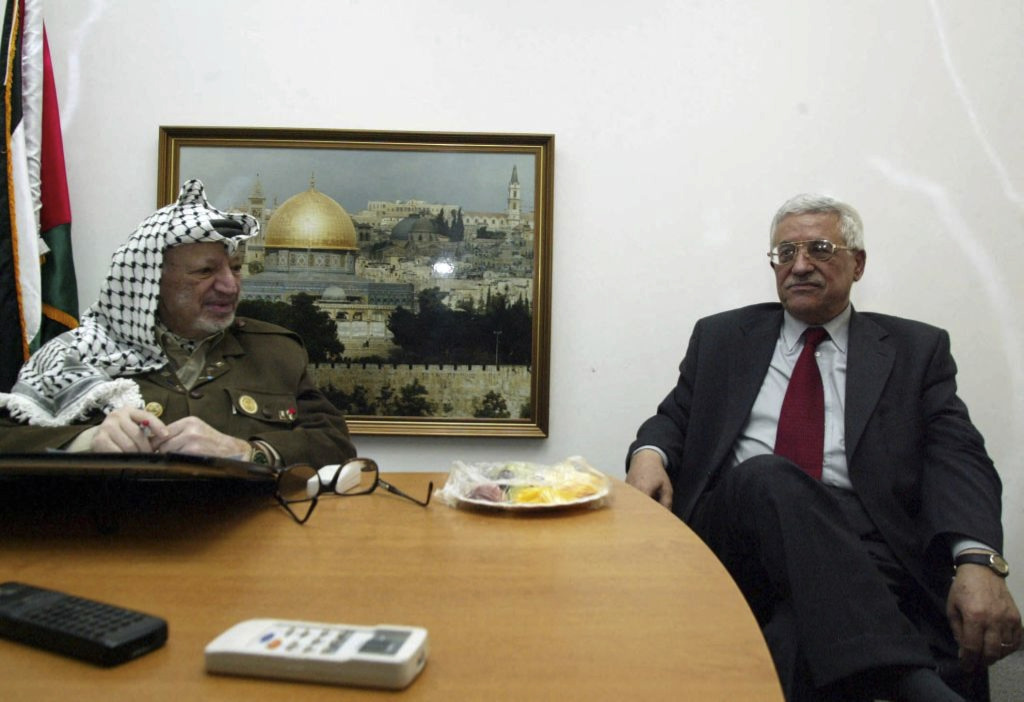
Today's Palestinian Authority (PA) leader, Mahmoud Abbas, has the same agenda as his predecessor Yasser Arafat [to annihilate the Jewish state in stages], but dresses differently for foreign consumption. Pictured: Arafat and Abbas meet in Ramallah on July 20, 2003. (Photo by Jamal Aruri/AFP via Getty Images)

Israel's preemptive strikes against Hezbollah targets in Lebanon during the wee hours of Sunday morning temporarily shifted focus away from Hamas in Gaza and from the next round of bogus "ceasefire" negotiations in Cairo for the release of hostages.

It's natural for the Israel Defense Forces to shine a spotlight on this noteworthy event, particularly since it involved the thwarting of a mass attack on a sensitive military-intelligence base in the center of the country by one of Iran's many proxies in the region.

The same applies to the media coverage of what initially seemed to be the start of a full-fledged war in the north, but which ended up being a finite operation in the meantime. Still, it's crucial not to lose sight of the bigger picture: the acute multi-front assault on the Jewish state since Oct. 7 and the chronic one that's been going on from various directions for decades.

One key arena is Judea and Samaria, otherwise known as the "West Bank," a terrorist hub from the moment that the Palestinian Authority (PA) was born in the sin of the Oslo Accords. That was when the military fatigues-clad Yasser Arafat managed to pull his keffiyeh over the eyes of the "peace camp" in Israel and abroad in order to implement his plan to annihilate the Jewish state in stages.

Today's PA leader, Mahmoud Abbas, has the same agenda as his predecessor, but dresses differently for foreign consumption. Having his pocket lined with millions of dollars, euros and shekels doesn't hurt in this effort, since the mega-wealth enables him to purchase the best that Armani has to offer. It has also provided him with the cash to fund his "pay for slay" policy.

Which brings us to his buddies at the United Nations. The illustrious international body on Wednesday marked "International Day of Remembrance and Tribute to Victims of Terror" with an exhibit in the foyer of its New York City building. Glaringly absent from the display were — you guessed it — Israelis.

In a video tour of the expo that he posted on X, outgoing Israeli Ambassador to the U.N. Gilad Erdan told followers:

"Soon, it will be a year since Oct. 7, the most horrific terror attack since the Holocaust. Yet the disgraceful U.N. did not see fit to include even a single Israeli terror victim in the exhibition it is presenting for this day of remembrance. There are no words left to describe how morally corrupt and twisted the U.N. is. It's simply a disgrace."

U.N. public information officer Laurence Gerard responded with the excuse that the exhibit was launched in 2022, so it only included victims of terrorist attacks prior to Oct. 7. Talk about a ridiculous answer, given the huge number of Israelis killed and wounded by Palestinian terrorists well before 10 and a half months ago.

The following day, in an indirectly related speech before the U.N. Security Council, Erdan's successor (and predecessor), Danny Danon, blasted his Palestinian Authority counterpart.

Addressing Riyad Mansour, the non-member-state's "permanent observer" to the farcical body, Danon said:

"You have spent two decades in this place proposing resolutions which stir chaos, sow division and avoid any hope. You have accomplished absolutely nothing.... Who do you represent here today? Do you represent the Hamas terror organization?"

The questions weren't merely rhetorical. As Danon pointed out, not once since the Oct. 7 massacre has Mansour come close to voicing "anything even resembling a condemnation" of the Hamas perpetrators.

Calling Mansour a "a terrorist in a suit," Danon noted that his failure to denounce Hamas makes him "one of them." Danon was right about that.

He was wrong, however, to tell Mansour that "you d0 not represent the Palestinian people." In fact, every survey shows that if elections were held today in the PA, Hamas would win by a landslide.

Nor is this new. Knowing that he would be pulverized at the polls, Abbas has prevented his people from casting ballots for many years.

Furthermore, Israel doesn't need phony disavowals from mass murderers, whatever they're wearing. Though Fatah, the faction headed by Abbas, is a longtime foe of Hamas, it shares the rival group's aim of eliminating Israel. To this end, the schools, mosques and media it controls glorify "martyrdom for Allah."

Nevertheless, the U.N. continues to treat the PA as a "moderate" entity whose goal is independent statehood, free from the ostensible shackles of Israeli "occupation." And those in the West who've come to acknowledge, grudgingly, that its current constellation can't be considered a partner for peace created a new fantasy: that of a "revitalized" Palestinian authority with a lower-case "a."

The idea behind this fallacy is that a reformed Palestinian group can replace Hamas in Gaza when the war is over. Good luck finding anyone in the PA who fits the bill, especially since the favored candidate for the top job, who's acceptable both to Hamas honcho Yahya Sinwar and much of the Palestinian street, is Marwan Barghouti.

Serving five life sentences in Israeli prison for his role in the murder of many Israelis, Barghouti reportedly heads the list of hundreds of terrorists whose release Sinwar is demanding as part of any ceasefire/hostage deal. So much for the de-radicalization of a post-war Gaza.

This hasn't prevented the administration in Washington from clinging to the notion of a viable "two-state solution" in the la-la-land of U.S. foreign policy. This outlook poses an even greater threat in the long term than the Hezbollah drones and rockets that the IDF destroyed early Sunday.

Most sane analysts understand that Hamas and Hezbollah are Iran-backed terrorist organizations whose military capabilities have to be countered. But illusions about the PA remain dangerously intact. It's imperative for Israel to destroy the myth along with enemy missiles.

Reprinted by kind permission of JNS and the author.

 
Ruthie Blum, former adviser at the office of Prime Minister Benjamin Netanyahu, is an award-winning columnist and senior contributing editor at JNS, as well as co-host, with Amb. Mark Regev, of "Israel Undiplomatic" on JNS-TV. She writes and lectures on Israeli politics and culture, and on U.S.-Israel relations. Originally from New York City, she moved to Israel in 1977 and is based in Tel Aviv.

Source: https://www.gatestoneinstitute.org/20895/israeli-imperative-destroy-myths

Follow Middle East and Terrorism on Twitter
Already under multi-state probe, MSCI allegedly penalizes Israeli banks that operate in Judea, Samaria - Mike Wagenheim


by Mike Wagenheim

“This is BDS. No doubt about it,” Richard Goldberg, of the Foundation for Defense of Democracies, told JNS.


Bank Leumi, Bank Hapoalim and Israel Discount Bank stand next to each other in the center of Tel Aviv, Aug. 4, 2015. Photo by Miriam Alster/Flash90.

The state-owned Bank of China operates a branch in the Xinjiang Uygur Autonomous Region, where Washington has assessed that China is committing genocide against the ethnic Uyghur population. Still, the major U.S. investment advisory firm MSCI gives the bank a “green” score in its social and human-rights categories, meaning it “is not involved in any major controversies,” though it could be involved “in minor or moderate controversies.”

The only controversy for which MSCI cites the Chinese bank is a “yellow” score—meaning that it “is involved in severe-to-moderate level controversies”—for bribery and fraud, per public data accessible via a search tool on the MSCI website.

Four Israeli banks—Bank Leumi, Bank Hapoalim, Israel Discount Bank and Bank Mizrahi-Tefahot—get “yellow” MSCI ratings, or “severe-to-moderate” levels of concern, in the categories of social and human rights concerns, per public data on the firm’s site. A source with knowledge of the more comprehensive information that MSCI provides to clients told JNS that the advisory firm ranks all four Israeli banks with “severe” controversy scores for doing business in Judea and Samaria, citing anti-Israel sources to bolster its claims.

Headquartered in New York, MSCI is already under a multi-state investigation for potential BDS—boycotting the State of Israel—practices for assigning the controversial ratings to at least nine companies conducting business in Judea and Samaria, including the Israeli defense contracting company Elbit. MSCI flagged the latter for building security and surveillance barriers designed to protect Israelis from terrorists.

In March, Ashley Moody, the Florida attorney general, announced that she was leading a coalition of 18 state attorneys general in investigating whether or not discrimination against Israel was at play.

“The allegations against MSCI are deeply disturbing, and we have called for a quick response from the company’s leadership directly addressing our concerns,” she said at the time. (JNS sought further comment from Moody.)

Experts told JNS that MSCI’s ratings of Israeli companies amount to “backdoor BDS.”

‘Severe controversy’ score

Socially-conscious investors often turn to firms like MSCI, which rate environmental, social and governance (ESG) factors, for guidance on investment options. These investors could be dissuaded from investing in companies accused of improper corporate practices, including connections to human-rights violations. 

MSCI assigns the “severe controversy” score to the four banks in the information that is available to clients who purchase MSCI’s data, the JNS source said. The source told JNS that Human Rights Watch, the United Nations Human Rights Council and Who Profits—all of which have supported boycotts of the Jewish state—are cited in the MSCI reports as sources of information that inform the controversy scores.

The alleged “controversy” that MSCI assigns the four banks centers on their providing financing and services to residents and businesses in Judea and Samaria, according to the source. The scores cite no other controversy that relates to alleged human-rights violations or other potentially damaging business practices in the “social” category, the source said. (JNS sought comment from the four Israeli banks.)

MSCI appeared to copy and paste the same report for all four banks, only changing the name of the alleged offender, per the source.

Its approach to the four Israeli banks appears to mirror the practices of Morningstar and its subsidiary, Sustainalytics, which were accused by a broad swath of U.S. Jewish and pro-Israel groups of relying heavily on anti-Israel sources to create “controversies” and penalize companies for doing business in what Morningstar called “occupied territory.”

“This is BDS. No doubt about it,” Richard Goldberg, senior adviser at the Foundation for Defense of Democracies, told JNS about MSCI’s practices. “No different from what Morningstar was doing with its ESG ratings.”

Goldberg, who was the architect of the first anti-BDS state law in Illinois and was part of a task force that reviewed Morningstar’s ESG ratings, told JNS that when it comes to MSCI’s reported practice, “state attorneys general should launch the same investigations, and both governors and state financial officers should invoke their anti-BDS laws.” 

Elana Broitman, who is leading efforts by the Jewish Federations of North America to combat anti-Israel bias, told JNS: “Our work with Morningstar has been a model of how to root out systemic anti-Israel bias.”

After multiple states cut financial ties with Morningstar and others investigated it for potential BDS practices, Morningstar reached an agreement with pro-Israel groups in 2022 to reform its sourcing, ratings and other practices for companies that do business in Judea and Samaria and to commission an independent assessment on the subject.

“Morningstar still has to finish the job, but others in the industry that want to ensure they have not allowed anti-Israel bias to infect their ESG ratings, such as MSCI, can see exactly what they need to do,” Broitman said.

‘Vetting process’

JNS sought comment from MSCI and asked to discuss the source’s charges about the advisory firm’s controversy ratings of the four Israeli banks.

In past statements to JNS, MSCI has repeatedly denied endorsing or supporting boycotts of Israel in the use of its products and services.

“MSCI ESG ratings and controversies are based on a published methodology that is free from political influence or other biases,” Konstantinos Makrygiannis, an MSCI spokesman for Europe, the Middle East and Africa, told JNS in a statement.

Makrygiannis cited a “data vetting process” that relies on “credibility assessments by external sources to assess the integrity of the data sources.”

He added that the company “relies on public data from a variety of sources, including specialized academic, government and NGO datasets; public company disclosures (e.g., sustainability reports, proxy reports, regulatory filings, etc.); and global and local media and news sources.”


Mike Wagenheim

Source: https://www.jns.org/already-under-multi-state-probe-msci-allegedly-penalizes-israeli-banks-that-operate-in-judea-samaria/

Follow Middle East and Terrorism on Twitter

Sunday, August 25, 2024

Trump can now deploy ex-Democrat 'power rangers' RFK Jr., Musk and Gabbard to prod bigger exodus - John Solomon


by John Solomon

RFK signals there are more Democrats willing to defect to join a "unity party" under Trump where dissent and disagreement will be tolerated.


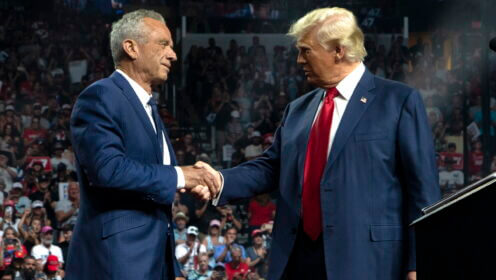
When Robert F Kennedy Jr. formally divorced the party his family once ruled as kingmakers, he opened the door for more Democrats to follow suit in embracing Donald Trump in 2024 and creating a "unity party" where Americans can disagree and debate without destroying each other.

“I attended my first Democratic Convention at the age of six in 1960,” Kennedy fondly recalled Friday of the era when his uncle John and father Robert Sr. ruled the Democratic establishment. “Back then, the Democrats were the champions of the constitution, and of civil rights. The Democrats stood against authoritarianism, against censorship, against colonialism, imperialism and unjust wars."

“We were the party of labor, of the working class,” he added. “The Democrats were the party of government transparency and the champion of the environment. Our party was the bulwark against big money interests and corporate power. True to its name, it was the party of democracy,” he said during a nationally televised press conference Friday where he announced he was suspending his independent presidential campaign and backing Trump.

Kennedy argued he didn’t leave the Democrat Party, but rather that “it had departed so dramatically from the core values that I grew up with” that it left him and other traditional Democrats like him.

“It has become the party of war, censorship, corruption, Big Pharma, Big Tech, Big Ag and big money,” he declared.

With that political indictment, Kennedy opened an unprecedented political door for defection. And standing at the threshold are two other celebrity defectors: billionaire tech innovator Elon Musk and former presidential candidate Tulsi Gabbard.

Even Jill Stein, the Green Party candidate, echoed similar sentiment, saying on X that "We may disagree with RFK Jr. about many things, but he’s right about how the Democratic Party uses lawfare and dirty tricks to suppress democratic competition and voter choice. The Dems preach about ‘saving democracy,’ but in reality they’re working overtime to stamp it out."

Senior Trump aides and outside advisers have been buoyed by the the once-unimaginable possibilities that:

  • Musk would lend his massive X social platform for an historic interview and fund a Super PAC to boost Trump;
  • Gabbard would help prep the GOP nominee for his debate with Kamala Harris and make a case for women to return to the GOP; and
  • Kennedy would lend his famous family name and political capital to lure defectors, especially the young and first-time voters who flocked to his independent campaign

"We now have a trio of Power Rangers who can swoop right into the middle of the rival party and convince traditional Democrats that it's OK to leave a party that left them," said one senior Trump adviser, who asked to remain unnamed.

The advisers credited Trump with being willing to set aside potential grievances -- Musk runs a rival to Trump's Truth Social platform and Kennedy lambasted Trump during his campaign -- and to reach out behind the scenes and court big-name Democrats to his side.

Likewise, Trump agreed to set aside four years of vitriol with Brian Kemp and mend fences with the popular Georgia governor who controls a powerful political machine in that battleground state.

Having a trio of most famous ex-Democrats at his disposal opens up entire new strategies for Trump, experts said.

"I think that the Trump people should package Tulsi Gabbard and Robert F Kennedy Jr, together, and they would -- as joint former Democrat witnesses about the corruption of the system -- be devastating," former Speaker of the House Newt Gingrich, R-Ga., told the "John Solomon Reports" podcast.

Gingrich also credited Trump for setting aside years of anger at Kemp over the 2020 disputed election and making amends for the good of the GOP party.

"Look, Brian Kemp is far and away the strongest politician in Georgia. He's been a remarkably effective governor, and the fact that he's now, you know, all in is an enormous step in the right direction," he explained. "And frankly, the fact that Trump has relaxed and accepted that having him as an ally really matters is very, very healthy, and I think it just dramatically improved the likelihood that we will carry Georgia" Gingrich said.

The former speaker said Kennedy in particular could play an outsized role in peeling young voters to the Trump team who had flocked to his independent campaign after supporting Joe Biden in 2020. The retribution and censorship that Democrats repeatedly tried to impose on Kennedy have made him authentically sympathetic, the former speaker noted.

Kennedy's defection "has an effect, first of all, on young people, because here they have a very famous name that was historically totally Democrat, who is saying to them that the Democratic Party has now become a party of thugs and bosses and Intimidators and is corrupt and is no longer responsive to the American people," Gingrich said.

Republican National Committee Chairman Michael Whatley told Just the News the fact that Kennedy followed Musk and Gabbard out of the Democrat fold is important "on two levels,"

"First it shows you that today's Democratic Party is leaving these people behind. Today's Democratic Party is so radical, so dangerous, so progressive, that there are millions of Democrats who are leaving that party every day.," Whatley told the "John Solomon Reports" podcast. "We're seeing thousands of them that are coming our way. Just look at the voter registration statistics in places like Pennsylvania, North Carolina, Georgia, Michigan and around the country. That's a huge thing, that people are leaving the Democratic Party. Because, frankly, the Democratic Party has left them.

"The other side of it is that the Republican Party is very quickly becoming the big tent party," the GOP boss added. "Donald Trump is willing to work with anybody who wants to make America great again, and he's willing to sit down with nontraditional platforms. He's willing to meet with nontraditional groups."

RFK Jr. acknowledged Friday that it was that very willingness by Trump to reach out to people who didn't agree all the time with him and signal that it was OK to debate and dissent that hastened his switch to the GOP nominee.

It has not been lost on Kennedy, Gabbard and Musk that Harris was appointed, not elected, to top the Democratic ticket. She did not receive a single primary vote, and never had an open debate. Critics such as JD Vance said that "she lied for nearly four years about Biden's mental capacity--saddling the nation with a president who can't do the job." After Biden's disastrous debate performance, Harris continued to defend Biden's mental acuity.

The Kennedy scion said that Trump's invitation gave him hope to create “a unity party” that would “allow us to disagree publicly and privately and seriously" and still work to better America.


John Solomon

Source: https://justthenews.com/politics-policy/all-things-trump/suntrump-can-now-deploy-ex-democrat-power-rangers-rfk-jr-musk-and

Follow Middle East and Terrorism on Twitter
The Left’s Swift Shift After RFK Jr.’s Trump Endorsement - Roger Kimball


by Roger Kimball

Kennedy’s indictment of his former party, along with his endorsement of Donald Trump, has sent shock waves through the chambers of the self-appointed elite who would rule us.


The thing I admire about contemporary deep-state Democrats is their nimbleness.

This nimbleness was on ostentatious view in the regime response to Robert F. Kennedy Jr.’s announcement Friday that he was 1) suspending his campaign (at least in battleground states) and 2) throwing his support behind Donald Trump.

The acrid scent of panic might have been expected among the limp-wristed, totalitarian faithful. And, in fact,  beneath the amusing cologne of anti-Trump bluster, the panic was indeed discernible.

But there was also that trademark smooth-as-a-suppository (as Saul Bellow put it) suaveness, exemplified, for instance, by former Obama strategist David Axelrod.

“Robert F. Kennedy Sr.,” Axelrod posted shortly after the deed was done, “would have been appalled to see his son cut a deal to drop out for [t]he race and endorse Trump.”

Imagine: someone agrees to drop out of a race at the last minute and support a rival candidate!  As the commentator Ned Ryan put it in response to Axelrod’s snippy post: “You suddenly seem offended by someone cutting a deal to drop out of the race and endorse someone else.”

Cast your mind back, David, to July 21 of this year.  That’s when Joe Biden, having been made an offer he couldn’t refuse by the secret committee running the country, suddenly announced that he was dropping out of the race. This was, remember, after Biden repeatedly insisted that he was staying in the race and was looking forward to the next debate against Trump. Yes, the first was a disaster, but he would show ’em!

Biden’s missive, posted to his personal—not his official POTUS—account, bore all the earmarks of haste not to say coercion.  Had someone actually dictated the text to him? We don’t know. But it was widely remarked that he neglected to endorse Kamala Harris. That came a few moments later in a separate post.

It is easy to forget what prodigious feats of political nimbleness were required to carry out this most delicate operation.  First, the media and the party bosses had to stop mid-track and start marching in the opposite direction.  On the morning of July 21, Joe Biden was “sharp as a tack.” By sundown, he was sadly diminished but also a brave hero for putting country before self and nobly bowing out of the race.  The whole maneuver displayed an Olympics-level nimbleness.

So has the subsequent coronation of Kamala Harris. On the day before Biden’s defenestration, she was widely acknowledged to be a disliked, incompetent, airhead. The day after, she was hailed as the reincarnation of Winston Churchill.

As I have several times noted since the magic bus of Kamala’s supreme makeover got underway, the nimbleness of her canonization, though impressive, was the brittle project of magical thinking.  It was like a hot-air balloon: eye-catching on ascent, intractable in flight, and dangerous when the air cooled and the plummet began.

As I and others observed, the ecstasy surrounding Kamala Harris on the run-up to the Democratic Convention was but a “sugar high,” a temporary state of intoxication that would be as short-lived as it was numbing.

The convention wasn’t over before strains of “the thrill is gone” could be heard beginning to echo in the chambers of the punditocracy.

By Thursday, the day that Kamala was to speak, it was beginning to be clear that her image as a great statesman-in-waiting was the closest thing to creatio ex nihilo since the events recounted in the opening chapters of Genesis.

This was something that Kennedy underscored in the course of his remarkable address Friday afternoon before joining Donald Trump at his rally in Arizona that evening. “[T]he DNC and its media organs engineered a surge of popularity for Vice President Harris based on nothing,” Kennedy said. “No policies, no interviews, no debates, only smoke and mirrors and balloons in a highly-produced circus.” Various Dems mentioned Trump 147 times from the stage on just the first day of their convention, while Republicans mentioned Joe Biden but twice over the course of their entire four-day event.. But “Who needs a policy,” Kennedy asked with calculated bile, “when you have Trump to hate?”

Bingo.  I understand that Kennedy has espoused certain ideas—about who actually killed his father, for example, or the legitimacy of the 2004 presidential election—that many will take issue with.  But his penetrating grasp of what has happened to the Democrat party, and therefore to the tradition of democracy itself, is as bracing as it is accurate. “In the name of saving democracy,” he notes,  “a Democratic Party set itself to dismantle it.”

Lacking confidence that its candidate could win a fair election at the voting booth, the DNC waged continual legal warfare against both President Trump and myself. Each time that our volunteers turned in those towering boxes of the signatures needed to get on the ballot the DNC dragged us into court, state after state, attempting to erase their work, and to subvert the will of the voters who had signed those petitions. It deployed DNC-aligned judges to throw me and other candidates off the ballot and to throw President Trump in jail. It ran a sham primary that was rigged to prevent any serious challenge to President Biden. Then, when a predictably awful debate performance precipitated a palace coup against President Biden, the same shadowy DNC operatives appointed his successor, also without an election. They installed a candidate who was so unpopular with voters that she dropped out in 2020 without winning a single delegate.

Everything Kennedy says in that searing assessment is true.  He is also right that the media, once thought to hold power to account, have become creatures of the ruling consensus, “stenographers for the organs of power.”

Kennedy noted that he and Trump were not in agreement on every issue. But, he said, they were at one about several important policies, including “ending the Forever Wars, ending the childhood disease epidemics, securing the border, protecting freedom of speech, unraveling the corporate capture of our regulatory agencies, and getting the U.S. intelligence agencies out of the business of propagandizing, censoring, and surveilling Americans, as well as interfering in our elections.”  That’s a good bit to be getting on with.

Kennedy’s indictment of his former party, along with his endorsement of Donald Trump, has sent shock waves through the chambers of the self-appointed elite who would rule us. The timing of Kennedy’s announcement—he spoke mere hours after Kamala’s acceptance speech—could not have been more deadly.  For one thing, he monopolized the headlines, just when the Dems were planning to luxuriate in their moment of triumph.  For another, his endorsement of Trump was almost instantly reflected in the polls.

Tony Fabrizio, Trump’s chief pollster, noted later on Friday that in every battleground state, Kennedy’s endorsement shifted votes to Trump. For example, “the net vote gained in a state like Arizona based on just a 2020 turnout model would be over 41,000 votes, nearly 4 times Biden’s winning margin.”

As I have said repeatedly these last few months, I expect Donald Trump to win on November 5. But as he himself has put it, he has to win by a margin that is “too big to rig.”  Kennedy’s suspension of his campaign in battleground states and his endorsement of Donald Trump almost guarantees that winning margin.


Roger Kimball

Source: https://amgreatness.com/2024/08/25/the-lefts-swift-shift-after-rfk-jr-s-trump-endorsement/

Follow Middle East and Terrorism on Twitter

Israel-Hamas ceasefire would breach international law - Prof. Louis René Beres


by Prof. Louis René Beres

Hat tip: Dr. Carolyn Tal 

International law has precise form and content. It cannot be invented and reinvented by terror groups. Such law does not support the hope-based adoption of cease-fire agreements between sovereign states and criminal gangs.


Prof. Louis Rene Beres

Israel and Hamas could still reach an agreement on a "cease fire." But because the jihadist terror organization still regards all of Israel as "Occupied Palestine," this agreement will almost certainly fail. Accordingly, for both Israel and the "international community," there will be injurious consequences for international justice. Some of these consequences would be “force-multiplying” and irremediable.

It’s high time for realistic understandings of these urgent issues.

The immediate effect of any anticipated cease-fire agreement would be the defiling bestowal of legal legitimacy on insidious terror-criminals. The longer-term effect would be to undermine the authority of international law in general and to enlarge the prospects of a continuous regional war.

In principle, at least, even such grievous effects could be acceptable if accompanied by a return of hostages (criminally-abducted citizens from over twenty separate countries, including a one-year old Israeli child), but no such humanity should be expected from Hamas. If perchance Hamas did actually return some of the still-living hostages, it would assuredly compensate for this “generosity” by attempting to repeat October 7th atrocities at later dates and in different venues.

There are further legal details. No authoritative system of law can encourage or allow accommodation between a legitimate national government and a barbarous criminal organization. Though any promised cessation of hostilities could conceivably benefit Israel as well as Hamas, the cumulative costs for both Israelis and Palestinians would plausibly exceed anticipated gains. Even if Israel could expect the return of some hostages, Hamas (the Islamic Resistance Movement) would feel incentivized to launch future hostage-taking operations. Lest anyone forget, Hamas is motivated at its core by “criminal intent” or mens rea.

Hamas is an illegal organization. This inherent illegality is deducible from the far-reaching criminalization of terrorism discoverable under binding international law. Such a primal status can never be correctly overlooked by third party agreement brokers (e.g., the United States), however well-intentioned.

Before the ancient Hebrew laws of Deuteronomy, there already existed determinable rules of warfare. Today, these "peremptory" norms (rules that are over riding and ought never to be broken) bind insurgent fighting forces, not just traditionally uniformed national armies. Conspicuously, these rules stem from the St. Petersburg Declaration (1868), a codification that followed still-earlier limitations identified at the First Geneva Convention (1864).

Under longstanding international law, “the means that can be used to injure an enemy are not unlimited.” No matter how allegedly just the cause, the willful maiming, rape and murder of noncombatants is always a crime. The ends can never justify the means. Regarding the deaths of many Palestinian Arab civilians occasioned by Israeli bombardments, these harms are not witting violations of the law of war. They represent the wholly unintentional result of necessary counter-terrorist operations, not of “criminal intent.” In Gaza, such harms are the collateral outcome of Hamas’ resort to “human shields.” The technical name for this ongoing Islamist crime is “perfidy.”

Whenever Hamas or other Palestinian terrorists claim the right to "any means necessary," they intend to deceive. Even if their corollary claims of "national self-determination" were in some way reasonable, there would still remain distinctly tangible limits on permissible targets and legitimate weapons.

Any calls to “Free Palestine from the River to the Sea” are exterminatory on their face. In law, such calls are always an expression of “intent to commit genocide.” Reciprocally, whatever one hears from so-called protestors, Israel-inflicted harms upon perfidy-shielded Palestinian Arab populations have nothing to do with genocide. These harms remain the unavoidable correlates of Israel’s inextinguishable right to self-preservation.

International law has precise form and content. It cannot be invented and reinvented by terror groups or by aspiring states (here, "Palestine") to accommodate narrow geo-strategic interests. Back on November 29, 2012, the Palestinian Authority (PA) was upgraded by the U.N. General Assembly to the status of a "nonmember observer state," but the PA subsequently declared itself nonexistent.

On January 3, 2013, Mahmoud Abbas formally "decreed" the absorption of the "former "PA into the "State of Palestine." While this administrative action did eliminate the PA, it did not create a new Arab state. Leaving aside Abbas' law-violating refusal to negotiate full sovereignty directly with Israel, the codified criteria of "nonmember observer state" fall far short of expectations of the governing international treaty on statehood: The Convention on the Rights and Duties of States (aka the "Montevideo Convention") of 1934.

There are further details. “National liberation movements” that fail to meet the test of “just means” are never legitimate. Even if one were to accept the argument that Hamas goals do meet the identifiable criteria of “just cause,” they would not satisfy the additionally limiting standards of distinction, proportionality, and military necessity. These standards are compulsory and were applied to insurgent organizations by (1) the common Article 3 of the four Geneva Conventions of 1949; and (2) the two 1977 protocols to these Conventions.

These same standards are also binding upon all combatants by virtue of broader customary and conventional international law, including Article 1 of the Preamble to the Fourth Hague Convention of 1907. This rule, called the "Martens Clause," makes “all persons” responsible for upholding the "laws of humanity" and the "dictates of public conscience."

In essence, every use of force by Palestinian Arab insurgents must be judged twice, once with regard to the justness of the objective and once with regard to the justness of the means employed. This signifies that even if Hamas were somehow law-compliant in seeking to carve a Palestinian state from the still-living body of Israel, the means adopted to achieve this goal (terror, rape and murder) clearly would be law-violating .

The egregious crimes committed by Hamas terrorists mandate universal cooperation in apprehension and punishment. As punishers of "grave breaches" under international law, all states are expected to search out and prosecute or extradite individual terrorist perpetrators. In no circumstances are states permitted to acknowledge terrorists as "freedom fighters." Under no circumstances is it permissible for an established state to create “cease fire” agreements with an unambiguously criminal non-state organization.

The implications are plain. In the final analysis, the broader international community should be working with Israel to delegitimize and disarm Hamas, not to broker an intrinsically illegal and war-fostering “cease-fire” agreement. By initialing such an agreement, Israel would effectively enhance Hamas’ plans to dismantle the Jewish State and wreak chaos in the wider region.

A cease-fire agreement could possibly bring certain short-term benefits to Israel, but only at the expense of variously insufferable longer-term costs. Plausibly, the immediate benefits of a cease-fire would not bring back the hostages. Moreover, at some not too distant point, the foreseeable costs could become existential. This is especially likely on account of Hamas ties to Iran and Iranian ties to North Korea.

International law clarifies and codifies millennia of human wisdom. Such law does not support the hope-based adoption of cease-fire agreements between sovereign states and criminal gangs.

In the case of Israel and Hamas, history reveals that any terrorist release or exchange leads directly to new acts of hostage-taking and jihadist barbarism.


Prof. Louis René Beres, born in Zurich, received his Ph.D at Princeton and is the author of many books and articles dealing with terrorism, counter-terrorism and international law. His writings have been published at The Atlantic; The New York Times; JURIST; Harvard National Security Journal (Harvard Law School); International Journal of Intelligence and Counterintelligence; Israel Journal of Foreign Affairs; Brown Journal of World Affairs; Case Western Reserve Journal of International Law; BESA Perspectives (Israel); Jerusalem Post; Israel National News; Israel Defense; Bulletin of the Atomic Scientists and Oxford University Press. Professor Beres is the author of seven principal articles in the annual Oxford University Press Yearbook on International Law and Jurisprudence.

Source: https://www.israelnationalnews.com/news/395115

Follow Middle East and Terrorism on Twitter
Have the IDF's massive preemptive strikes prevented all-out war in Lebanon? - analysis - Yonah Jeremy Bob


by Yonah Jeremy Bob

If Hezbollah's only achievement is limited strikes with few casualties, the preemptive strike may be seen as having averted a larger disaster.


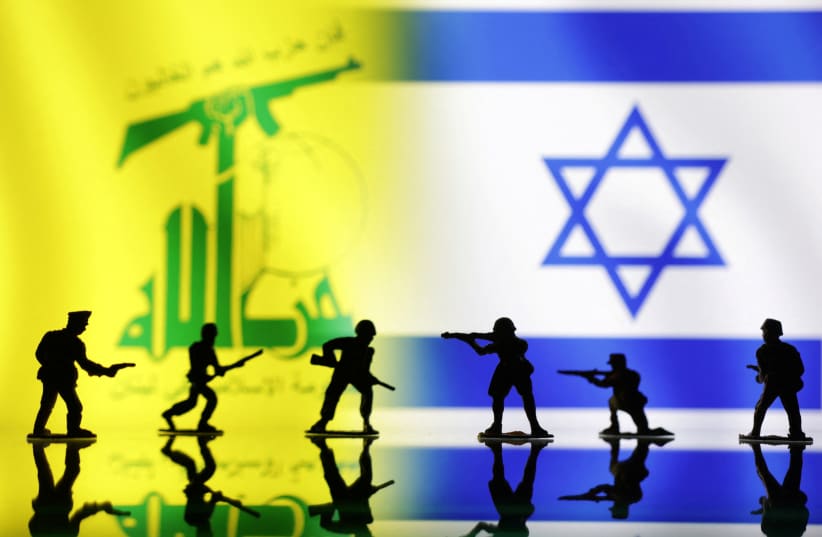
A war between Israel and Hezbollah (illustrative) (photo credit: REUTERS/DADO RUVIC)
A war between Israel and Hezbollah (illustrative)
(photo credit: REUTERS/DADO RUVIC)

Usually, a massive strike by one party in a conflict leads to a larger war.

Certainly, in the current war, predictions have been that if the IDF went an inch too far in its attacks on Hezbollah, the Lebanese terror group would savage Israel's home front with 6,000-8,000 rockets per day and mass drone swarms.

And that nightmare scenario could still happen.

But as Israelis awoke Sunday morning, the most likely picture was radically different.

Using immense intelligence capabilities and having constantly had huge numbers of aircraft and drones in the air for weeks since the July 30 killing of Hezbollah military chief Fuad Shukr, the IDF carried out over 100 virtually simultaneous attacks against Hezbollah rocket launching platforms in a matter of minutes or less than half an hour shortly before 5:00 a.m.

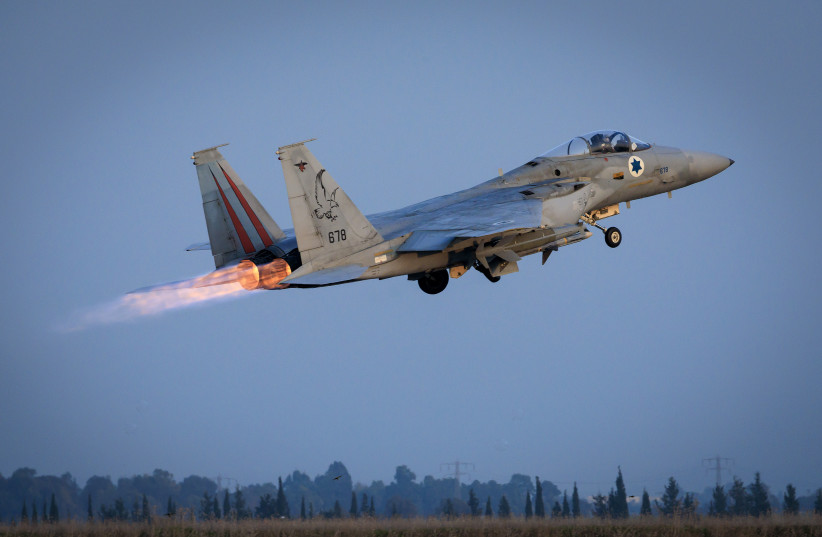
 Israel Air Force fighter jet F-15, at the Tel Nor airforce base. January 01, 2024.  (credit: MOSHE SHAI/FLASH90)Enlrage image
Israel Air Force fighter jet F-15, at the Tel Nor airforce base. January 01, 2024. (credit: MOSHE SHAI/FLASH90)

According to the IDF, it focused specifically on rocket launching platforms that were getting ready to imminently fire on Israel, especially the Tel Aviv and central Israel areas.

Since then, Hezbollah has fired around 320 rockets and claimed to have aimed at around 11 IDF bases.

Though the IDF is holding some details closely and keeping some under gag order, it has implied so far that hits and IDF casualties have been extremely minimal.

IDF measures may have prevented disaster

If Hezbollah's only accomplishment is more strikes on Safed and Acre, with minimal casualties, then the military's preemptive strike may later be credited with having prevented a much larger disaster and even war.

Step one in preventing such a war was stopping any successful strikes on major Israeli population centers or infrastructure.

Step two would be focusing Israel's strikes on imminent attack platforms of Hezbollah while leaving other parts of Hezbollah and all of non-Hezbollah Lebanon largely untouched.

In the balance of unwritten rules between Israel and Hezbollah, this would be a massive Israeli strike that still showed restraint and was not per se "offensive," but rather preemptive and narrowly tailored defense.

There are no moves by the IDF to invade southern Lebanon, which it could have decided to do.

Hezbollah may now be deciding how much more of a wave of attacks it can manage without exposing its capabilities to more hits by Israel.

It may also be trying to convince Iran to join the fight, which would make the situation even more dangerous.

But both Iran and Hezbollah know that the US could also still intervene on Israel's behalf.

Also, a Gaza ceasefire may still be possible if a larger war does not break out, possibly pitting Iran and Hezbollah against Hamas since they do not want to take larger losses. However, the Gaza terror group would like its more powerful allies to expand the war to help it get better terms from Jerusalem.

The future is highly uncertain, but round one has gone to Israel.

 
Yonah Jeremy Bob

Source: https://www.jpost.com/middle-east/article-816194

Follow Middle East and Terrorism on Twitter