The "Middle East and Terrorism" Blog was created in order to supply information about the implication of Arab countries and Iran in terrorism all over the world. Most of the articles in the blog are the result of objective scientific research or articles written by senior journalists.
From the Ethics of the Fathers: "He [Rabbi Tarfon] used to say, it is not incumbent upon you to complete the task, but you are not exempt from undertaking it."
At least 8 hurt in blast; After Arrow 3 missile defense system and the American THAAD missile defenses fail to intercept a missile launched in Yemen; Katz warns of retaliation
A ballistic missile fired by the Houthi rebels in Yemen landed in the Ben-Gurion International Airport outside Tel Aviv on Sunday after air raid sirens sounded across central Israel. According to the IDF the military attempted to intercept the missile after "sirens were sounded in accordance with protocol."
Ben Gurion international airport hit in Houthi missile strike
The missile caused damage and a number of injuries for the first time since the Iran-backed group renewed its attacks on Israel, after it landed near aircraft parked on the runway outside Terminal one.
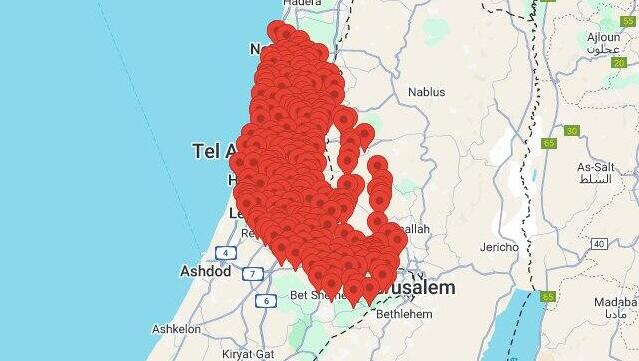
Sirens across central Israel
(Photo: via Telegram)
Damage caused in a missile strike at Ben Gurion airport
Flights were suspended during the attack and two people, a man and a woman, both in their 50s suffered slight and moderate injuries from the blast. A third woman in her 30s was hurt during her rush to shelter. all of the wounded were taken to the nearby Shiba Medical Center for treatment.
"We all went into the shelters as soon as the sirens were activated," Pinchas Idan, union boss at the Airport Authorities, told Ynet. "We heard a loud explosion. It fell near the planes. We were lucky because an aircraft was in the air."
Operations resumed at the airport soon after the strike but flight delays were expected.
Defense Minister Isarel Katz warned of retaliation against the Houthi rebels. "Anyone who harms us will be doubly harmed," Katz said. Israel's last military action against the Houthis was three months ago. Since then, the United States and its partners in an international coalition conducted strikes against the rebel army and asked that Israel refrain from attacks.
Last week, Israeli officials said they’re refraining from responding directly to the Houthis because the U.S. is leading the fight. “The fact that they’re firing doesn’t mean much,” a senior Israeli defense official said earlier this week.
The launch marks the fifth one in two days as the Iran-backed terror group ramps up its efforts to harm the country. The U.S. operations in Yemen continue against the Houthis, though focused mainly on airstrikes at this point.
“Whoever harms us, we’ll harm them sevenfold,” vows Defense Minister Israel Katz • “It is Iran that is firing ballistic missiles at the State of Israel, and it must bear responsibility,” says National Unity chief Benny Gantz.
Emergency services clear a road outside Israel's Ben-Gurion
International Airport after a Yemeni missile struck near the facility on
May 4, 2025. Photo by Jack Guez/AFP via Getty Images.
A ballistic missile fired from Yemen
struck near Israel’s Ben-Gurion International Airport on Sunday morning,
lightly to moderately wounding six people and disrupting takeoffs and
arrivals.
The attack triggered air-raid sirens
across central Israel, including in Tel Aviv, Jerusalem and the
Shfela/Judaean Foothills. Several attempts were made to intercept the
missile, according to the Israel Defense Forces.
The U.S.-made THAAD system attempted to intercept the missile but failed, as did Israel’s Arrow system, Channel 14
military correspondent Hillel Bitton Rosen reported. Authorities are
investigating whether the blast near Terminal 3 was caused by a direct
hit, missile fragments or interceptor debris. Police bomb squads and
security forces remain on scene.
Magen David Adom updated its casualty
figures on Sunday afternoon, reporting that six people were treated and
transported to hospitals: a man in his 50s in light-to-moderate
condition with limb injuries; two women, ages 54 and 38, in light
condition due to blast-related trauma; a 64-year-old man lightly wounded
by flying debris; and two women, aged 22 and 34, who were hurt while
running for shelter.
Medical
personnel at the site where a missile fired from Yemen hit near
Ben-Gurion International Airport, May 4, 2025. Photo by Chaim
Goldberg/Flash90.
The victims were evacuated to Shamir
Medical Center (formerly known as Assaf Harofeh Medical Center) in Be’er
Ya’akov, and Sheba Medical Center at Tel Hashomer in Ramat Gan.
The incident sparked panic at Ben-Gurion
Airport. Police and rescue personnel quickly cordoned off the impact
area at Terminal 3 and dispatched fire teams to check for additional
hazards.
The chairman of the airport workers’ union
said one person suffered a confirmed minor injury in the vicinity of
Terminal 3, and that authorities are investigating whether further
safety procedures will impact upcoming flights.
Israeli Police were actively searching for
fragments and hazardous materials linked to the projectile. “We urge
the public to remain close to protected areas and not to approach or
touch any suspicious debris. Officers from the Central District are
sweeping the Shfela region for any further signs of impact,” police
said.
In the wake of the strike, Ben-Gurion
Airport halted all takeoffs and landings for approximately 30 minutes,
forcing at least three inbound aircraft to remain airborne. While
airport officials have since announced the resumption of activity,
significant delays are expected throughout the day.
The impact created a hole dozens of meters in diameter and depth, according to police. pic.twitter.com/C0zQGECoWy
Despite air traffic gradually resuming,
police confirmed that entrances to the airport remain blocked as
emergency teams continue operating at the scene.
People
wait in traffic outside Ben-Gurion International Airport after a Houthi
missile attack, May 4, 2025. Photo by Yossi Aloni/Flash90.
Israeli Prime Minister Benjamin Netanyahu
in a statement on Sunday afternoon vowed that “there will be blows” in
response to the attack.
“We are acting against them,” Netanyahu
said of previous IDF military operations against the Houthis in Yemen.
“We have acted in the past and we will act in the future. I cannot
detail everything.
“The U.S., in coordination with us, is
also acting against them. It’s not a one-and-done—but there will be
blows,” vowed the Israeli premier.
Defense Minister Israel Katz vowed a forceful response. “Whoever harms us, we’ll harm them sevenfold,” he said.
National Unity Party chairman Benny Gantz responded sharply, blaming Tehran rather than Yemen for the attack:
“This is not Yemen—this is Iran. It is
Iran that is firing ballistic missiles at the State of Israel, and it
must bear responsibility,” Gantz wrote on X.
In Yemen, senior Houthi official Mohammed al-Bukhaiti told Qatar’s Al-Araby Television Network
that the group had proven its ability to hit “sensitive and strategic”
sites in Israel. He declared that the Iran-backed rebel force has “no
red lines” in its war against the Jewish state.
Nasser al-Din Omar, head of Houthi media
operations, warned international airlines to avoid Israeli airspace,
saying doing so posed a danger to aircraft safety.
Sunday’s attack is the latest escalation by Iranian-backed Houthi terrorists in Yemen, who in recent months have repeatedly launched long-range ballistic missiles and drones at Israel, targeting strategic sites including ports, military bases, and now, the country’s main international airport.
by Amichai Stein, Yonah Jeremy Bob, Jerusalem Post Staff
Since Trump took office, partly due to his request, Israel has refrained from striking targets in Yemen.
Israeli security forces at the site where a missile fired from Yemen hit an area of Ben-Gurion Airport, May 4, 2025(photo credit: Chaim Goldberg/Flash90)
Israel is set to retaliate to the Houthi missile launch at Ben-Gurion
Airport on Sunday, following a decision made at the security cabinet
later in the day.
Following
the Houthi missile strike, Prime Minister Benjamin Netanyahu said in a
video that Israel has acted against the Iran-backed Houthis in Yemen in
the past and will act again in the future.
“We’ve acted against them in the past, and we’ll act again in the future," Netanyahu said.
"This isn’t a one-and-done, but there will be some big hits,” the prime minister continued.
On Sunday, an Israeli source told The Jerusalem Post that following the recent Houthi missile attack, Israel is considering revising its recent policy toward Yemen to respond directly to such attacks.
Since
US President Donald Trump took office, partly due to his request,
Israel has refrained from striking targets in Yemen since the Houthis
resumed their attacks.
During the Biden administration, Israel struck Houthi targets in Yemen five times since July 2024.
Prime
Minister Benjamin Netanyahu will convene a meeting to discuss the
response to the missile fire from Yemen, with a limited number of
ministers and senior defense officials in attendance.
Defense sources told The Jerusalem Post that there will be a response to the Houthis, but it is too early to say when it will occur.
There
was a temporary shift in policy, giving Trump the opportunity to
address the Houthi problem without Israeli involvement, but now that
Ben-Gurion Airport was attacked, this policy is being reconsidered.
After the most recent attack at Ben-Gurion Airport on Sunday morning, Defense Minister Israel Katz said, "Whoever harms us will be struck sevenfold in return."
Houthi missile crashes in area of Ben-Gurion Airport, IDF reviewing incident
Three people were lightly wounded on Sunday as a result of a Houthi missile that crashed in the area of Ben-Gurion Airport's Terminal 3.
Sources
in the IDF said that they don't know whether it was a direct crash from
the missile or whether it was fragments from the missile that crashed
in the area. Army Radio noted that the missile was not intercepted,
however several attempts were made to intercept it.
Amichai Stein, Yonah Jeremy Bob, Jerusalem Post Staff
Firebrand lawyer Lori Lowenthal Marcus fights for civil rights for American Jewish students from a very young age.
The media are filled with news about
anti-Israel and antisemitic activism, including violence, on American
college campuses. However, according to Lori Lowenthal Marcus, legal
director of The Deborah Project, “what’s at least as important is the indoctrination of pre-Kindergarten through Grade 12, starting before they’re five years old.”
The Deborah Project (TDP) is a public interest law firm dedicated since 2016 to protecting Jewish civil rights in the American educational system.
Interviewed by JNS editor-in-chief
Jonathan Tobin at the inaugural JNS International Policy Conference at
the Waldorf Astoria Hotel in Jerusalem on April 28, Lowenthal Marcus
called “woke and leftist ideology” a “huge factor” in antisemitism on US
campuses and in schools, starting at a very young age.
Pre-schoolers are “learning with coloring
books with ABCs that include ‘P’ is for Palestine and ‘J’ is for Jihad,”
she said. “This is what very young children are learning from the
person in front of the room. When you’re that age, the person in front
of the room is the authority, and you learn that the Jews and Jewish
state are equal.”
Several factors have allowed the situation
to continue and even worsen. “American Jews, for the most part, really
lack information about Jewish history and the Jewish state, so they
don’t have the support system that they should have,” Lowenthal Marcus
explained. “The kids go to school and learn about a country called
‘Palestine’ that’s bordered by Egypt and Jordan and Syria and Lebanon.
That’s what they’re told, and that’s an experience that I had with one
of our clients.
“They’re told that in the quiz, that’s how
you have to fill it in. If you get it wrong by the teacher’s standards,
then you get marked down. It’s forced speech about the erasure of the
Jewish state.”
The firebrand lawyer shared shocking
examples of cases that The Deborah Project has taken on to defend
traumatized Jewish families whose children have suffered extreme
antisemitic abuse at American public schools.
“The worst example I have experienced thus
far—and I’m a very tough person, but this moved me to tears—was an
Israeli American student who started middle school in 2023, and kids
started picking on him right away; I don’t know why, maybe because of
his accent. After October 7, he was bullied, and it became physical
aggression against this 12-year-old boy. Kids would stand up in the
auditorium and say, ‘Everyone hates the Jews,’ ‘The Jews of baby
killers,’ and nothing was done. There were lots of meetings, but
meetings are meaningless if there is no action, if there is no
enforcement.”
“And don’t tell me, you school
administrators, that you have done so much for the Jewish families when
you met with them at least four times in the last month. No, you must
take action,” she asserted. “Finally, this boy was surrounded and told
to get on his knees and apologize for being a Jew. This is 2024—it was
last spring—in America, and the school district did nothing.”
The school is in a prosperous Philadelphia
suburb. “The Jewish Federation of Philadelphia was called in to help,”
Lowenthal Marcus recalled. “Finally, a person from Federation called me
and said, ‘I can’t help this family. We need someone like you.’”
The Deborah Project then sent a strong letter to the school, making it clear that it would share the story with the media.
“We ended up with a very good result for
this family, which was in deep crisis. The family was traumatized. The
result was that the district public school—in other words, taxpayer
money—is being used to pay for this boy’s 7th-12th grade high school
years and for his two older sisters at a Jewish Day School.”
Tuition at a Jewish Day School is
expensive, “but they wouldn’t change their policies,” Lowenthal Marcus
said, adding that the school administrators said she should be pleased
about getting the money. “I told them, ‘You failed. You didn’t do the
right thing…. I’ll be back next year for the next Jewish family that you
fail.’”
The court is the only solution
“We have to go to court,” Lowenthal Marcus
stated, insisting that there is no other solution for now. “The Deborah
Project only goes to court. We must have judicial orders with
enforcement mechanisms, but we will lose some of those cases and we have
to keep going. The NAACP lost for years before they were able to
construct a legal system that recognizes the civil rights of minorities,
and Jews have to do the same thing.”
In a separate interview with JNS,
Lowenthal Marcus noted the different backgrounds to antisemitism in
places like Philadelphia versus California. In the former, she said, “It
isn’t really Islam. It’s the attraction to a powerful, strong, hateful
ideology. In California, it’s very woke white folks, for the most part.”
She added, “The teachers’ unions are
bringing this stuff into the schools, and by this stuff I mean the
curriculum, the additional instructional materials. So, it’s not in the
actual standard curriculum, which must be approved by the school
district. It’s what the teacher views and brings into the classroom
without having anyone else vet it.”
“One client told me the teachers spoke
about the Gaza war, but not one of them spoke about October 7. They all
began with when Israel invaded Gaza.”
‘Don’t make a bigger deal out of it!’
As for college campuses, this reporter
recalls covering the campus scene extensively in Toronto in the years
2007-2011. Indeed, Israel Apartheid Week was launched in 2005 at the
University of Toronto, and in 2007, a group called High Schools Against
Israeli Apartheid was formed; minors were attending closed-door
sessions. The situation was already extremely disturbing, although the
Jewish establishment organizations were claiming that they had the
situation under control.
“In my experience, for a long time, the
major Jewish organizations’ position was: Don’t pay attention. Don’t
make a bigger deal out of it! You’ll give them what they want if you
protest or confront them or write something about it. Just leave it
alone. We’ll do our thing,” Lowenthal Marcus told JNS.
“I can understand why people would think
that would work, but I don’t understand decades of thinking that will
work. The mainstream Jewish organizations aren’t dealing so much
directly with universities. They like to have good relationships with
the municipalities. It was a horror show last year.”
Since the Hamas attack on Oct. 7, 2023,
she said, “they’re talking about it, but they’re not doing anything
about it. They don’t know what to do. I am not a diplomat, but I do not
understand trying to make nice to people, no matter what they do.”
As for public schools, Lowenthal Marcus
acknowledged that “it’s a tough situation. Not everything is a legal
violation, even if it feels terrible,” such as when a child makes rude
remarks on the school bus.
“Discipline has gone out the window.
There’s restorative justice. They sit in a circle and share their
feelings,” she said, citing another outrageous case in California, where
a teacher saw a girl standing outside the door and asked if she was
Jewish.
She answered in the affirmative, and the
teacher said he could tell because of her nose. He then asked what she
was doing there, and she said she was waiting for her friends, to which
he responded, “I’m so glad you have friends because you’re Jewish.”
The student complained to the
administration, but no disciplinary action was taken against the
teacher. Instead, “they had a restorative justice session,” Lowenthal
Marcus said. “The teacher and the student, with the principal and
another person present, had a discussion about it, and she ended up
saying it was okay. What else is the student going to say, with the
principal and teacher present?”
This wasn’t an isolated incident, she argued. “It’s very common.”
Lori Lowenthal Marcus talks to JNS Editor-in-Chief Jonathan Tobin on April 30, 2025.
‘I certainly have hope’
Regarding the boy who was bullied in
Philadelphia, the Jewish Federation “tried to push the school to do the
right thing. They did what they could, and they recognized that they
were limited and came to me.”
Besides The Deborah Project, there are
several other organizations, such as The Lawfare Project, the Brandeis
Center for Human Rights Under Law, and StandWithUs, helping Jewish
students who face discrimination.
“One thing I will say that has been very
positive is that there are hundreds and maybe thousands of
parent-teacher WhatsApp chat groups that have popped up all over the
country,” Lowenthal Marcus said. Until now, “Jews have not been united
before in this way.”
Lowenthal Marcus is hopeful about the
future of America, despite all the problems. She referred to the
antisemitism in the US in the first half of the 20th century, when there
were quotas for Jews wishing to enroll at universities, and Jews
fleeing Nazi Europe were denied entry. However, the tide turned, and
Jews thrived in America.
“So, I’m hopeful that there will be a course correction. Things have gone too far with this identity politics,” she said.
“I’ll tell you another reason I’m hopeful:
The DEI stuff is terrible. It’s an excuse for laziness; it really is,
and it hurts everybody. It doesn’t help anyone. And the fact that all
these huge corporations embraced it – they’re out of their minds. Now, a
lot of companies are scaling back on the DEI stuff. Am I positive? No.
But I certainly have hope.
“It’s counterintuitive for people to see
Jews as needing civil rights protection,” she continued. “They don’t
understand it, and the questions they ask, like what kind of harm did
they suffer? They don’t ask those questions when it’s about homophobia,
racism, etcetera. There’s a lot of hypocrisy, but we’re trying to
create a new area of civil rights litigation that protects the Jews. The
Blacks had to do it; it wasn’t given to them. They lost and lost, and
they figured it out. We’ll do the same for the Jews, and at some point, I
hope we won’t need it as much.”
She added, “One thing that I know is that
no one is going to make it easier for us. They’re not going to change
the rules to make it easier for us. So, we Jews will have to continue to
accomplish, succeed, do well in school. We’ve always had to be
tougher.”
Lowenthal Marcus believes that the action
taken by US President Donald Trump to fight antisemitism, especially on
campuses, such as deportations and the removal of grants to
universities, will improve the situation, although she acknowledged
many, including Jews, are furious about it.
“They’re afraid they’re going to hate us
more. I think if [former President Joe] Biden had done it, they would be
cheering, so it’s also political,” she said.
Leading defense analysts say that the Houthis' latest attacks are Tehran showing what it is truly capable of.
THE ‘CORDELIA MOON’ oil tanker bursts into flames after
being hit in a Houthi missile attack off Yemen’s Hodeidah Port last
October. (photo credit: Houthi Military Media/Reuters)
When a $20,000 missile fired by Yemen’s Houthi rebels
can bring down a US Reaper drone worth over $30 million, the cost of
war takes on a new, troubling shape. That imbalance is now defining the
crisis in the Red Sea, where sustained attacks from Iranian-backed
terrorists are draining Western defense budgets and disrupting the
arteries of global commerce.
Over 800 strikes have been carried out by the United States against Houthi positions
since March 15, yet the barrage of drones and missiles has not ceased.
As Houthi forces target American, British, and Israeli-linked ships
across one of the world’s most vital maritime corridors, military and
economic pressure is intensifying on the US and its allies, with no end
in sight.
According
to British Colonel (ret.) Richard Kemp, who commanded forces in
Afghanistan and has advised on Middle East security, said Iran’s fingerprints are all over the conflict. “This is Iran flexing its muscles,” Kemp said in an exclusive interview with The Media Line.
“It’s not only about attacking Israel—it’s about showing that Tehran
can hurt the West, especially economically, without ever firing a shot
directly.” Kemp described the Houthis as one arm of what he called the
“Iranian octopus,” used to deter Western attacks on Iran by threatening
both military and commercial targets. “It’s a way of saying: if you hit
us, we’ll unleash chaos through our proxies,” he said. “And the Red Sea
is one of the best places to do that.”
Protesters,
mainly Houthi supporters, hold weapons to mark the annual al-Quds Day
on the last Friday of Ramadan, in Sana'a, Yemen, March 28, 2025 (credit:
REUTERS/KHALED ABDULLAH)
The cost of containment
The
economic disparity between offensive and defensive action in this
conflict is staggering. While the Houthis fire relatively cheap
projectiles—often made with imported components from Iran—intercepting
them requires millions of dollars in sophisticated Western systems.
Janatan
Sayeh, a research analyst at the Foundation for Defense of Democracies,
explained that this isn’t accidental—it’s strategic. “This is
asymmetric warfare by design,” Sayeh told The Media Line. “You
don’t need to inflict mass casualties. You just need to make your
adversary bleed money.” Sayeh detailed how the Houthis now assemble most
of their weaponry inside Yemen. “Iran no longer sends complete
missiles,” he said. “They send parts—drones, guidance systems,
warheads—and the Houthis put them together locally, based on
instructions. This modular system makes interception harder and enables a
continuous supply chain.”
That
supply chain is hard to disrupt. Even if parts are intercepted at sea,
once the knowledge and tooling exist inside Yemen, the system can
regenerate. “Every Patriot missile or naval interceptor costs millions,” added Kemp. “Every drone they launch might cost a few thousand. This is not sustainable.”
Beyond
the cost of interception, maintaining a constant military presence in
the region adds to the strain. Aircraft carrier groups, drone patrols,
and airstrike campaigns in Yemen are expensive undertakings, and the
frequency of Houthi attacks suggests that this drain could last for
years. “This is turning into a war of attrition,” said Sayeh. “But only
one side is spending big.”
Maritime chaos and energy risks: A wider economic fallout
While
the military costs of intercepting Houthi attacks have dominated
headlines, the economic disruption caused by the crisis is equally
severe—and still growing. According to Noam Raydan, a senior fellow at
the Washington Institute for Near East Policy, commercial transit
through Bab el-Mandeb and even the Suez Canal has declined by over 50%
since the Houthis began their maritime campaign in late 2023. “This is
huge,” Raydan told The Media Line. “A lot of commercial ships
are simply unable to sail through the Red Sea, and they’ve had to
reroute around southern Africa. That adds weeks of travel and increases
transportation costs significantly.”
Raydan
noted that although the shipping industry has adapted in some
ways—shifting routes and adjusting services—many vessels linked to
American or Israeli interests still avoid the region altogether. “There
are no ships sailing under the Israeli flag in those waters,” she said.
“And even vessels with indirect links to Israel are steering clear.”
This
disruption has not only raised global freight rates but also created
opportunities for certain companies to profit from the instability.
“Some firms have taken advantage of the crisis,” Raydan explained. “One
Singapore-based shipping company even launched a new Red Sea service
during the conflict. And large players like Maersk and CMA CGM have
benefited from increased freight charges, though others, like MSC, which
saw vessels attacked, have had to pull back.”
Raydan
emphasized that the impact of these disruptions is far-reaching.
“Consumers are affected even if they don’t realize it,” she said.
“Transportation costs are factored into everything—whether it's gasoline
or imported goods.” She added that the effect is visible particularly
in oil shipments. “Crude oil from Iraq that once passed through the Red
Sea now has to take the longer route around Africa. That directly raises
the price per barrel by the time it reaches European refineries.”
Despite
some early warnings in late 2023, the expected dramatic inflation in
consumer goods didn’t fully materialize, thanks in part to industry
adaptation. However, Raydan cautioned that the risks remain volatile and
unresolved. “The Houthis are still tracking ships,” she said. “Even if
they aren’t attacking every target, they’ve already divided their
maritime campaign into multiple phases. There’s no telling what they
might do next—or for what reasons.”
She
also highlighted the broader strategic stakes, especially for regional
energy producers like Saudi Arabia and the UAE. “These countries are
investing in massive energy infrastructure,” Raydan said. “But all of
that depends on regional stability. If the Houthis are allowed to keep
expanding their capabilities, they could target high-profile energy
projects. They’ve done it before.”
Finally,
Raydan pointed to the silent economic victim in all of this: Egypt.
“The decline in Suez Canal traffic has cost them billions—at least $5
billion in lost revenue so far,” she said. “And with transit still down
by around 70%, it’s a major national blow.”
Limited Options, mounting pressure
Despite
the scale of the response, both Kemp and Sayeh criticized the West’s
handling of the crisis. “The US response, especially under the Biden
administration, was extremely weak,” Kemp argued. “They delisted the
Houthis as a terrorist group early on to appease Iran. That set the tone
for everything that followed.” Sayeh agreed that airstrikes alone would
not stop the attacks. “This is a game of whack-a-mole,” he said. “You
hit one missile site, they build another. You kill a commander, they
replace him. As long as Iran is providing the material and training,
this cycle continues.”
Both
analysts dismissed the likelihood of deploying ground forces. “There’s
no appetite in Washington or London for boots on the ground,” Kemp said.
“We might see special forces operations targeting key Houthi
leadership. But large-scale deployment? Unlikely.” Sayeh added that even
decapitation strategies have a limited effect. “You can take out one
figure, but if the infrastructure is intact, the threat persists. This
is about dismantling networks, not individuals.”
What about Iran?
While
some wonder if the Houthis are being addressed in the US–Iran nuclear
negotiations, Sayeh said they are not. “You can cap enrichment
percentages, but how do you tell Iran to stop helping a group it doesn’t
officially control?” Including them in the talks, he warned, would
actually limit US and Israeli options for retaliation. “Keeping them off
the table gives more operational flexibility,” he said.
Still,
Sayeh suggested that escalation is possible. “If Iranian ships or
personnel are proven to be supporting the Houthis, they could become
legitimate targets. The precedent exists.”
A costly pattern with no end in sight
As
long as the Houthis receive weapons, training, and political backing
from Tehran, none of the experts interviewed believe the threat will
disappear. “So long as the weapons are coming from Tehran,” said Sayeh,
“this issue is going to persist.” Kemp echoed the same warning: “Unless
we start thinking of this as a global strategy by Iran, we’ll keep
losing this battle—one overpriced missile at a time.”
[M]uch of the current "feel-good" message transmitted from Tehran and Washington may be due to what pre-Freudian psychologists called the "Coué Method," which suggests positive imagination as therapy.
There is, of course, one
non-judicial way to make sure a deal sticks: Remove the root causes of
enmity. For example, let's start by releasing the US hostages and make
sure that no further hostages are taken during what remains of Trump's
term.
Then join the rest of the world in the Financial Action Task
Force accords against money laundering and funding terrorism. Iran is
part of a blacklisted trio that includes North Korea and Myanmar.
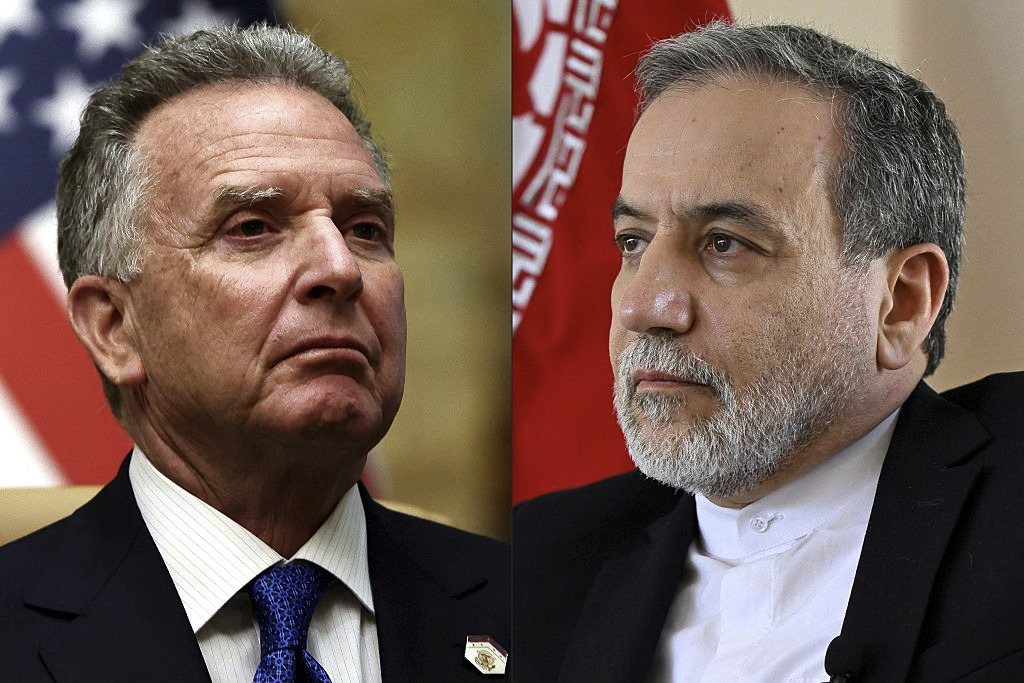
Judging by comments and leaks from the Iranian Foreign
Minister Abbas Araqchi and President Donald Trump's envoy Steve Witkoff
-- although problems remain -- things are going smoothly. Trump himself
keeps saying that he expects "a good agreement" without spelling out
what that means. The fact, however, is that so far nothing has happened.
Pictured: A combination of photos showing Witkoff (L) and Araqchi.
(Photos by Evelyn Hockstein and Amer Hilabi/AFP via Getty Images)
For the past two weeks, I have been bombarded by questions from
colleagues and "experts" from across the globe wondering how to assess
the current round of talks between Tehran and the Trump administration
in Washington.
The typical question is: what is going on?
Judging by comments and leaks from the Iranian Foreign Minister Abbas
Araqchi and President Donald Trump's envoy Steve Witkoff -- although
problems remain -- things are going smoothly. Trump himself keeps saying
that he expects "a good agreement" without spelling out what that
means.
Tehran pundits muse about an historic turnaround that would see the
US investing over a trillion dollars in Iran while the regime is given
the green light to continue merrily enriching the uranium it does not
need. Iranian President Masoud Pezeshkian goes further by talking about
"rebuilding the whole region in peace and with prosperity for all."
The fact, however, is that so far nothing has happened. The two sides
have not fielded their full teams and seem unable to establish a clear
agenda for talks. Nor are they in agreement about how long the talks
should last. Trump says he had given the "Supreme Guide" in Tehran two
months to make a deal or else, a time span to coincide with the
president's first 100 days in office, which has already come and gone.
Though I doubt that he is in the know, French Foreign Minister
Jean-Noël Barrot says the mullahs have until summer to do what is
required or, although he doesn't say it in these words, the roof will
fall on their heads.
More surprisingly, the global commentariat seems persuaded that the
Araqchi-Witkoff tandem are on course to do what their predecessors, in
almost half a century of talks between Iran and the "Great Satan,"
failed to do.
At first glance, such optimism might appear at least mildly
plausible. The biggest sign is Supreme Leader Ali Khamenei's open
intervention to endorse the talks and silence its critics.
He has even re-written parts of religious history to claim that
making "temporary peace" with a foe is not only permissible but actually
commendable.
Nevertheless, much of the current "feel-good" message transmitted
from Tehran and Washington may be due to what pre-Freudian psychologists
called the "Coué Method," which suggests positive imagination as
therapy.
According to Émile Coué de la Châtaigneraie, who developed the method
in the 19th century, "thinking that things are going the way you want
is halfway to having that actually happen."
Anyone who has followed the Tehran-Washington "talks" saga for almost
half a century would know that we are faced with a typical Alphonse and
Gaston situation, in which one side refuses to act until the other side
has acted first.
Trump wants Iran to dismantle its nuclear program, after which the US would lift sanctions.
Alphonse says: I will do what you want after you have done what I
want. But if I get what I want, why should I give what you want when I
always maintained that you had no right to ask me to do what you want.
For decades, Tehran has said it has no plan for developing a nuclear
weapon and has no intention of doing so in the future. The US under
President Barack Obama briefly accepted that, and did all he could to
get Iran off the hook. President Trump didn't buy that bundle and
scrapped the Obama "nuclear deal".
This is why opponents in Tehran of talks with the US are talking
about "guarantees" that if Iran agrees terms with the US, the "Great
Satan" should guarantee that another administration in Washington would
not scrap the deal.
In the past two weeks, a number of retired Iranian diplomats have
penned op-eds or written columns to demand "iron-clad guarantees".
Former US Secretary of State John Kerry, an active supporter of a deal
with Tehran, has tried to answer that concern by suggesting that the
putative deal be ratified by the Congress as a treaty, something that he
and Obama failed to do when in charge.
Barrot had hinted at furnishing such a guarantee in the form of yet another resolution by the United Nations Security Council.
What Kerry, Barrot and the retired Iranian diplomats ignore is the
principle of sovereignty, under which no sitting administration or
parliament could commit ad aeternam all future administrations and parliaments in a democracy to any agreement.
An international contract or treaty isn't the same as a private one
concluded under the jurisdiction of a state, where courts could impose
compliance through domestic jurisprudence.
In other words, even if Trump gives the guarantee that Iran wants,
and even if the US Congress passes it as a treaty, the principle known
as rebus sic stantibus could always be applied "where there has
been a fundamental change of circumstances, a party may withdraw from or
terminate a treaty."
There is, of course, one non-judicial way to make sure a deal sticks:
Remove the root causes of enmity. For example, let's start by releasing
the US hostages and make sure that no further hostages are taken during
what remains of Trump's term.
Next, give up the temptation to revive Hamas, Hezbollah and half a
dozen Iraqi groups through sneaky schemes while smuggling arms to what
is left of the Houthis. Also, end the burning of flags, attacks on
embassies and calls for this or that nation to be "wiped off the map".
And if you don't mean to attack targets as far as Europe, stop
developing long-range missiles.
Then join the rest of the world in the Financial Action Task Force
accords against money laundering and funding terrorism. Iran is part of a
blacklisted trio that includes North Korea and Myanmar.
The so-called "uranium enrichment" issue is a diversion.
If Iran expects to be treated differently, it should become
different, after which it could spend fortunes on enriching the uranium
it has no use for.
Gatestone Institute would like to thank the author for his kind
permission to reprint this article in slightly different form from Asharq Al-Awsat. He graciously serves as Chairman of Gatestone Europe.
Amir Taheri was the executive editor-in-chief of the daily Kayhan
in Iran from 1972 to 1979. He has worked at or written for innumerable
publications, published eleven books, and has been a columnist for Asharq Al-Awsat since 1987.
As Israel blocks aid to enclave and public anger mounts, terror group says cracking down on armed gangs looting food: 'We will strike with an iron fist all these renegades'; Gazans report gangs also rob civilians of money and phones
Hamas has executed a number of alleged looters after several incidents in which heavily armed gangs attacked food stores and community kitchens in the Gaza Strip this week, sources close to the Palestinian terrorist group said.
Hamas officials have accused some of the looters of working in collaboration with Israel, which has sealed off aid from entering Gaza for the past two months. Israel has not commented on the allegation.
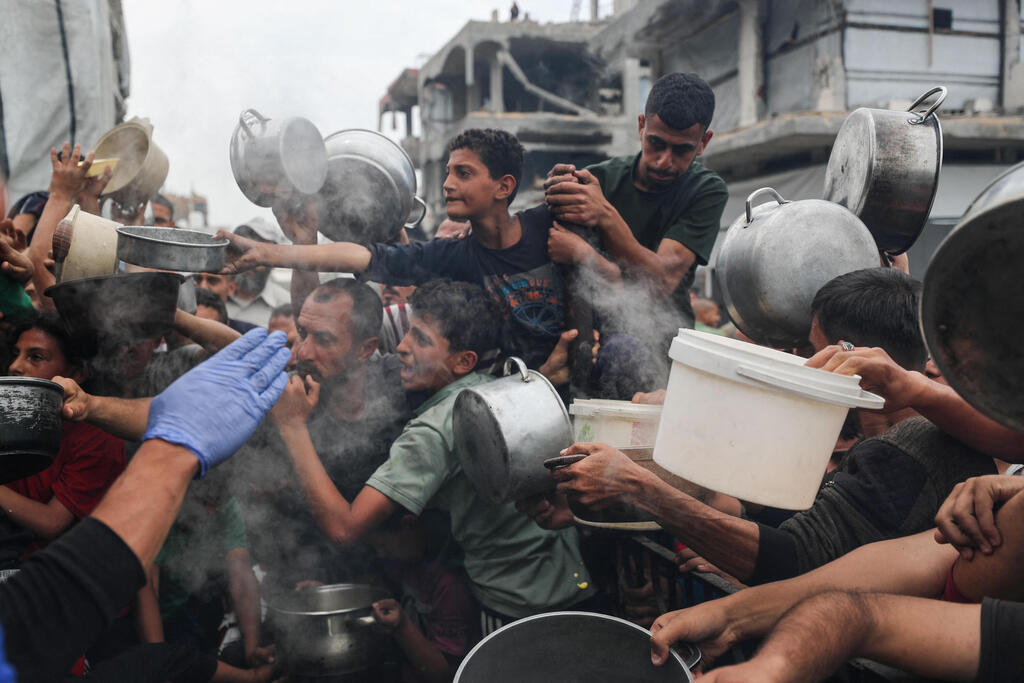
Long lines outside a community kitchen in northern Gaza's Beit Lahia
(Photo: REUTERS/Mahmoud Issa)
In one incident, the Hamas-run interior ministry said a police officer was killed and others were wounded when an Israeli drone fired a missile at a police unit chasing criminals in Gaza City.
"We will strike with an iron fist all these renegades, and we will take the necessary measures to deter them, no matter the cost, and we will not allow them to continue terrorizing citizens, threatening their lives and stealing their property," the ministry said in a statement on Saturday, referring to the alleged looters.
Ismail Al-Thawabta, director of Gaza's Hamas-run government media office, said some of the looters acted under a clan umbrella and others acted as organized groups, some of which he said received direct support from Israel.
He said a number of "revolutionary execution rulings" had been carried out against "several top criminals" proven to have been involved in looting.
Anti-Hamas protest in Beit Lahia
Some Gaza residents and Palestinian media said Hamas' armed wing imposed curfews starting at 9 p.m. to restrict the movement of civilians and to chase criminals.
United Nations officials have warned of the increasingly dire humanitarian situation facing Gaza, which has been devastated by the Israeli campaign launched following the Hamas-led attack on Israel on October 7, 2023.
Israel has defended its blockade against aid entering Gaza, alleging that Hamas steals supplies intended for the civilian population and distributes them to its own forces, an allegation that Hamas denies.
However, the problem has worsened as the blockade has persisted, posing a challenge to Hamas, which has faced irregular protests by people in Gaza angered by shortage of food reaching the enclave.
The incidents underlined the strain facing the Gaza population, which has been increasingly squeezed into areas in central Gaza and along the coast as Israeli forces have created wide buffer zones around the enclave.
Gangs take money, phones
"Those gangs, some of them armed, have terrorized people, not only stealing food, but stopping some people on the roads and taking away their money and phones," said Ahmed, from Gaza City, who asked that his full name not be used.
"They aid the occupation in starving us; they must be dealt with as collaborators," he told Reuters via a chat app.
SAFA news agency, close to Hamas, said the interior ministry has formed a new 5,000-member force tasked with confronting looters and armed gangs. However, local police forces have been hampered by attacks from Israeli drones against any armed Palestinians they identify.
Hamas deployed thousands of police and security forces across Gaza after a ceasefire took effect in January, but its armed presence shrank sharply since Israel resumed large-scale attacks in March.
The loophole, called the de minimis rule, allowed products worth up to $800 to avoid tariffs and be subject to limited inspections.
While some online American
shoppers are upset over President Donald Trump closing a trade loophole
that allowed China to import some small-dollar parcels into the U.S.
without paying tariffs and facing rigid inspections, Republican
attorneys general say the move is critical for stopping the flow of
small-sized fentanyl shipments into the country.
The loophole, called the de minimis rule, allowed products worth up
to $800 to avoid tariffs and face limited inspections, as long as they
were shipped directly to U.S. consumers or small businesses.
The process was intended to simplify
the import process for China importers and save them some money, which
resulted in such China-based companies as fast-fashion purveyor Shein and the digital marketplace Temue using it.
But so were fentanyl dealers in China, said the group of attorneys
general that asked Trump to close the loophole, known as the Entry Point
86 pilot program, which also provided the same exemptions for Hong Kong
importers.
"Within days, the president responded and closed this loophole,"
Kentucky Attorney General Russell Coleman, among those who signed the
March 31 letter to Trump, said on a recent John Solomon Reports
podcast. "My hat is off to President Trump and his administration for
getting things done. Not just talking about it, but getting things done
that make us safer."
The executive order states
that closing the loophole is a "critical step in countering the ongoing
health emergency posed by the illicit flow of synthetic opioids into
the U.S."
"We weren't looking at these packages at all, and we're talking about
hundreds of millions of packages," Coleman also said. "In fact, 1.2
billion, at least in the last year. We have numbers. That's a lot of
packages and a lot of risk."
The change went into effect Friday, following Trump signing an executive order to end the loophole a month ago.
After weeks of speculation and breathless coverage of will-they-won’t-they, the White House appears poised to announce trade deals as early as next week.
Just a month into his tariff policy, President Donald Trump could
unveil his first new trade deals with allies as early as this week as
his negotiators press for handshakes and signatures that could further
calm markets and empower a brighter future for American workers,
officials tell Just the News.
Commerce Secretary Howard Lutnick hinted at an approaching
announcement last week when he revealed he has a trade deal with an
unspecified country, pending approval of its conditions. Administration
officials said as many as two or three deals could be unveiled in the
coming days.
Speculation has swirled surrounding India being the first to forge a partnership after Vice President J.D. Vance last week met with India Prime Minister Narendra Modi in Delhi to discuss a Bilateral Trade Agreement (BTA).
The vice president's office put out a statement following their meeting,
which stated, "The BTA presents an opportunity to negotiate a new and
modern trade agreement focused on promoting job creation and citizen
well-being in both countries, with the goal of enhancing bilateral trade
and supply-chain integration in a balanced and mutually beneficial
manner."
Also last week, Treasury Secretary Scott Bessent indicated that many
trade partners had reached out to the White House since the tariffs were
unveiled and had made 'very good' proposals.
"I would guess that India would be one of the first trade deals we
would sign," Bessent told CNBC, and that the U.S. also held productive
negotiations with Japan and other Asian nations.
Former Deputy National Security Advisor Victoria Coates said an early
deal with India could be a game-changer, since it is a partner with the
market size of China that could apply pressure on Beijing.
"I'd love to have them be first out of the box," she said, noting
Prime Minister Modi's relationship with Vance has already yielded
dividends.
Coates said deals with the European Union will take longer, but there are some other big early possibilities.
"I would look at Japan. I think that that would be key," she said. "I
think the conversation with the Europeans is going to be a longer one,
but again that really has to happen. We might be surprised by the UK."
Mere signs of trade deals on the horizon have already calmed markets
after an early free fall prompted by Trump's "Liberation Day" tariff
announcement on April 2.
The S&P 500 on Friday notched its longest streak
of closing in the positive column in more than two decades, after it
rose 1.47% at the close of business and marked its ninth consecutive day
of gains.
India has a few notable incentives to make it happen soon: India's
largest trading partner is the United States. The nation was hit with
26% reciprocal tariffs on April 2 before Trump suspended the larger
tariffs on most countries for 90 days, but kept a universal 10% tariff
in place. India is also placing a large emphasis on an agreement as part
of its India-US Comprehensive Global Strategic Partnership, which Modi
says "will be a defining partnership of the 21st Century for a better
future of our people and the world." Adding sweetness to the deal: Apple
announced
on April 25 that it would be shifting production of most U.S.-bound
iPhones to India from China, bringing billions in revenue and jobs to
the populous, developing nation.
India's ambition to more than double trade between the U.S. and
India, from the current $190 billion to $500 billion, was originally
sent by Modi to Trump in February 2025.
With headlines alluding to a Trump "misfire,"
Democrats and legacy media have wasted no time prognosticating about
why the trade deals are taking so long, and may never come. However, sources toldFox Business
on Monday that the president is working on broader trade deals
encompassing additional nations, not just nations involving tariffs.
This, they report, is the reason there has been only speculation and no
official announcements of trade deals.
Academia’s collapse stems not from too much politics, but from the absence of anything but politics—and the virtues needed to resist it are in dangerously short supply.
Academia is once again in the news. Donald Trump’s recent commencement address
at the University of Alabama, where he said that America’s “next
chapter will not be written by The Harvard Crimson, it will be written
by you—the Crimson Tide,” sounded one leitmotif of the new,
Trump-inspired populism that is washing over the academic establishment.
Trump’s announcement that he was seeking to remove Harvard’s tax-exempt status sounded another.
These days, whenever the public’s attention is roused by academia, the oculus of media scrutiny turns up references to my book Tenured Radicals, first published more than 30 years ago but subsequently expanded and updated several times.
Given the renewed interest in academic culture, I thought I would
adapt a few thoughts from the introduction to the most recent edition of
the book.
Academic life, like the rest of social life, unfolds within a frame
of rules and permissions. At one end, there are things that one must (or
must not) do; at the other end, there is the rule of whim. The middle
range, in which behavior is neither explicitly governed by rules nor
entirely free, is that realm governed by what the British jurist John
Fletcher Moulton, writing in the early 1920s, called “Obedience to the Unenforceable.”
This middle realm is a place governed not by law or mere caprice but
by virtues such as duty, fairness, judgment, and taste. In a word, it is
the “domain of Manners,” which “covers all cases of right doing where
there is no one to make you do it but yourself.”
A good index of the health of any social institution is its
allegiance to the strictures that define this middle realm. “In the
changes that are taking place in the world around us,” Moulton wrote,
“one of those which is fraught with grave peril is the discredit into
which this idea of the middle land is falling.” One example was the
abuse of free speech in political debate: “We have unrestricted freedom
of debate,” say the radicals, “We will use it so as to destroy debate.”
The repudiation of obedience to the unenforceable is at the center of
what makes academic life (and not only academic life) today so noxious.
The contraction of the “domain of Manners” creates a vacuum that is
filled on one side by increasing regulation—speech codes, rules for all
aspects of social life, efforts to determine by legislation (from the
right as well as from the left) what should follow freely from
responsible behavior—and on the other side by increased license.
More and more, it seems, academia (like other aspects of elite
cultural life) has reneged on its compact with society. One of the great
ironies that attends the triumph of political correctness is that in
department after department of academic life, what began as a demand for
emancipation recoiled, turned rancid, and developed into new forms of
tyranny and control. As Alan Charles Kors noted in an essay from 2008,
…under the heirs of the academic Sixties, we moved on
campus after campus from their Free Speech Movement to their politically
correct speech codes; from their abolition of mandatory chapel to their
imposition of Orwellian mandatory sensitivity and multicultural
training; from their freedom to smoke pot unmolested to their war today
against the kegs and spirits—literal and metaphorical—of today’s
students; from their acquisition of young adult status to their
infantilization of “kids” who lack their insight; from their
self-proclaimed dreams of racial and sexual integration to their ever
more balkanized campuses organized on principles of group
characteristics and group responsibility; from their right to define
themselves as individuals—a foundational right—to their official,
imposed, and politically orthodox notions of identity. American college
students became the victims of a generational swindle of truly epic
proportions.
What, as Lenin memorably asked, is to be done? As with any disease,
the malady besetting academia requires two stages of therapy: first,
accurate diagnosis; then, effective treatment.
In some ways, the diagnostic stage is the most difficult because it
is the hardest to sustain. One corollary of society’s natural obedience
to the unenforceable is the tendency to assume that those institutions
in which we have invested great trust are inherently trustworthy. The
common assumption is, “Academic institutions are expensive, socially
respected bodies whose imprimatur is a powerful door-opener and tool of
accreditation; ergo, they must be doing a good job.”
Some such sentiment is the prevailing one, so when some radical comes
along to remove the scab, the shock is great—and unwelcome. One of the
chief tasks for critics of what has happened to academic life in this
country is to show the extent to which the anti-Semitic, anti-male,
anti-white, anti-American, and transfiliac radicals in the Ivy League
and elsewhere are not exceptions but the predictable result of
institutions that have gradually abandoned their commitment to education
for the sake of radical posturing. The prime difficulty of facing the
aspirant diagnostician is not the elusiveness of symptoms. They
are florid and nearly ubiquitous. On the contrary, the problem is
finding and sustaining the patience required to set forth chapter and
verse repeatedly and in language that effectively conveys the
depredations on view.
If real change is going to come to academic culture, criticism must
be ceaseless, pointed, and deep. It is not enough to expose the students
and professors shouting “Death to Israel” at places like Columbia
University. The academic culture that breeds and rewards such
figures—and their name is legion—must be exposed for what it is: a
thoroughly politicized rejection of the principles that inform liberal
learning.
In one sense, the diagnosis of the calamity that has befallen
academic culture is inseparable from the task of treatment. Which is to
say that the job of criticism is never finished. Basic questions, the
answers to which one could once have assumed were taken for granted,
must be asked anew.
To whom is the faculty accountable? To the extent that it holds
itself accountable to its pedagogic duties, it is accountable to itself.
To the extent that it repudiates those duties, it is accountable to the
society in which it functions and from which it enjoys its freedoms,
privileges, and perquisites. Faculties often take it amiss when critics
appeal over their heads to alumni, trustees, or parents. But ultimately
teachers still stand in loco parentis, if not on everyday moral issues, then at least with respect to the content of the education they provide.
Many parents are alarmed, rightly so, at the spectacle of their
children going off to college one year and coming back the next, having
jettisoned every moral, religious, social, and political scruple that
they had been brought up to espouse. Why should parents fund the moral
decivilization of their children at the hands of tenured antinomians?
Why should alumni generously support an alma mater whose political and
educational principles nourish a worldview that is not simply different
from but diametrically opposed to the one they endorse? Why should
trustees preside over an institution whose faculty systematically
repudiates the pedagogical mission they, as trustees, have committed
themselves to uphold? These are questions that should be asked early and
often.
It is time to revisit several large issues—the issue of tenure, for
example. An arrangement that was intended to protect academic freedom
and intellectual diversity but that has mutated into a means of
enforcing conformity and excluding the heterodox. And for those
representing establishment opinion in the academy, the institution of
tenure has the added advantage that, like a virus, it tends to be
self-perpetuating.
For several years now, I have heard several commentators from sundry
ideological points of view predict that the reign of political
correctness and programmatic leftism on campus had peaked and was about
to recede. I wish I could share that optimism. I see no evidence to
support it. Sure, students are quiescent. But indifference is not
instauration, and besides, faculties nearly everywhere form a
self-perpetuating closed shop.
It is the same with the fashion of “theory”—all” that anemic
sex-in-the-head politicized gibberish dressed up in reader-proof
“philosophical” prose. It is true that names like Derrida or Foucault no
longer produce the frisson of excitement they once did. Yet that is not
because their “ideas” are widely disputed but rather because they are
by now completely absorbed into the tissues of academic life. (Something
similar happened with Freud several decades previously: it’s not that
his silly ideas were no longer influential; on the contrary, they had
merely become commonplace assumptions: still toxic but by now taken for
granted.)
The key issue, I hasten to add, is not partisan politics but rather
the subordinating of intellectual life to non-intellectual, i.e.,
political imperatives. “The greatest danger,” the philosopher Leszek
Kolakowski wrote in “What Are Universities For?”
…is the invasion of an intellectual fashion which wants
to abolish cognitive criteria of knowledge and truth itself. . . . The
humanities and social sciences have always succumbed to various
fashions, and this seems inevitable. But this is probably the first time
that we are dealing with a fashion, or rather fashions, according to
which there are no generally valid intellectual criteria.
Indeed, it is this failure—a failure to check the
colonization of intellectual life by politics—that stands behind and
fuels the degradation of liberal education. The issue is not so much—or
not only—the presence of bad politics as the absence of non-politics in the intellectual life of the university.
Deep and lasting change in the university depends on deep and lasting
change in the culture at large. Undertaking that task is a tall order.
Criticism, satire, and ridicule all have an important role to play, but
the point is that such criticism, to be successful, depends upon
possessing an alternative vision of the good.
Do we possess that alternative vision? I believe we do. We all know,
well enough, what a good liberal education looks like, just as we all
know, well enough, what makes for a healthy society. It really isn’t
that complicated. It doesn’t take a lot of money or sophistication. What
it does require is candidness and courage, moral virtues that are in
short supply wherever political correctness reigns triumphant. The
bottom line is that those who want to retake the university must devote
themselves to cultivating those virtues and perhaps even more to
cultivating the virtue of patience, capitalizing wherever possible on
whatever local opportunities present themselves.