Monday, June 16, 2025

A fire that would burn Israel down: How Sinwar ruined Iran's dominance in Middle East - analysis - Herb Keinon


by Herb Keinon

Through its proxies, Iran once dominated the Middle East. After October 7 and the current war with Iran, the Islamic Republic's position in the Middle East might shift.


Iran's Supreme Leader Ayatollah Ali Khamenei speaks with defense industry experts in Tehran, Iran, February 12, 2025
(photo credit: Office of the Iranian Supreme Leader/WANA (West Asia News Agency)/Handout via REUTERS)

“In our view, the conditions in Israel after the Al-Aqsa Storm are historic, and in my opinion, it is the starting point of history itself.”

So said Iran’s Intelligence Minister Esmaeil Khatib on October 30, 2023, less than a month after Hamas’s barbaric assault (Al-Aqsa Storm). The attack – mass murder, rape, and abduction on a scale not seen in Israel’s history – was met not with condemnation by Tehran but with praise and triumphalism.

Iran’s Supreme Leader Ayatollah Ali Khamenei called the assault “logical and legal,” adding that, “the Palestinians were right.”

One rather doubts whether he still believes today that “the Palestinians were right” about unleashing that “storm.”

Hamas leader Yahya Sinwar believed that the massacre on the Jewish holiday of Simchat Torah would set off a chain of events that would redraw the Middle East map. It did – but not in the way he imagined.

 The aftermath of Hamas's Nova music festival massacre in Re'im, southern Israel, on October 7, 2023. Picture taken November 2, 2023 (credit: Arie Leib Abrams/Flash90)
The aftermath of Hamas's Nova music festival massacre in Re'im, southern Israel, on October 7, 2023. Picture taken November 2, 2023 (credit: Arie Leib Abrams/Flash90)

Sinwar saw October 7 as a tidal wave against Israel

According to intelligence assessments and interrogations conducted since the war began, Sinwar saw the attack not merely as a military operation but as a historic inflection point. He referred to it as an “earthquake” – a strategic jolt designed to shake the foundations of the existing regional order and replace it with a vision shared with Iran of a Mideast “free” of Israel.

Sinwar hoped that October 7 would unleash a tidal wave: a multi-front war against Israel, mass uprisings in Arab capitals, and the collapse of normalization efforts between Israel and moderate Arab states.

He believed the sheer shock value of the operation would galvanize Iran’s network of proxies – Hezbollah in Lebanon, militias in Syria and Iraq, the Houthis in Yemen – to rise in concert and overwhelm the Jewish state. He expected that the Arab street would erupt in solidarity. He thought that the region would shift beneath Israel’s feet and swallow it up.

The calculated brutality of the attack – the ISIS-style atrocities, the abductions of women and children, the filming and dissemination of the massacres – was not incidental. It was part of the plan. Sinwar’s message to the region was clear: look what is possible, look what we can do, look how vulnerable Israel is.

The goal was not only to kill but to whet the appetite of all the other extremists in the region – and there is no lack of them – to spark a fire that would burn Israel down.

Even the date seems to have been chosen for maximum symbolic impact. October 7, 2023, fell a single day after the 50th anniversary of the Yom Kippur War – another surprise attack that rattled Israel and reshaped the Middle East.

Sinwar felt that he was launching an updated equivalent. But while Egypt and Syria in 1973 used conventional armies to challenge Israel, Sinwar believed that mass terror could achieve even bloodier and more far-reaching results.

But not only did the gamble fail, it backfired – spectacularly. Just how spectacularly is playing out right now in Iran.

Israelis didn’t believe, even after decades of conflict, that Hamas truly thought it could destroy the country. That disbelief was a failure of imagination. But Hamas did believe it. Sinwar spoke of it. Hamas’s clerics preached it. And Iran worked toward it, building up a proxy strategy to deter Israel, as well as the arsenal and infrastructure over decades to make its destruction a reality.

Sinwar hoped that his act of barbarism would mark the beginning of Israel’s end. Yes, it sounds crazy, but he believed it. Instead, it triggered the unraveling of the strategy Iran had invested hundreds of billions of dollars in and which it has spent the last three decades putting into place.

What has happened since October 7 is a methodical, deliberate reversal of what Sinwar had envisioned and what Iran had been planning for. Prime Minister Benjamin Netanyahu said in the early days of the war that Israel would change the face of the Middle East. Step by step, it has.

First, Hamas has been decimated militarily: most of its leaders are dead, and its arsenal is mostly wiped out. Gaza, its stronghold, is being dismantled.

Second, Hezbollah – the cornerstone of Iran’s “ring of fire” strategy – has been defanged, so much so that the Lebanese government, which for years was under Hezbollah’s thumb, on Friday warned Hezbollah against firing at Israel and dragging Lebanon into this war.

Syria, which Iran essentially turned into a client state, is a client state no more, depriving Tehran of being able to rebuild Hezbollah or turn it into a staging ground for attacks against Israel.

And now, after all that, Israel’s attention has turned from the tentacles of the octopus to the head of the octopus itself.

For more than three decades, Iran’s strategy was to surround Israel with heavily armed proxies, creating a deterrent wall so formidable that Jerusalem would never dare strike Iran’s nuclear facilities. And if Israel did strike, the logic went, the price would be unbearable.

But that strategy is now unraveling. Piece by piece, Israel has peeled away the layers. First Hamas, then Hezbollah, then Syria. Iran’s deterrent shield has been punctured. The Houthis are still standing, but they are geographically distant. And while they’ve shown they can be disruptive, they were always the weakest link in the axis.

Today, the IAF is operating in the skies over Iran with near-complete freedom – something that, if mentioned even a few weeks ago, would have been dismissed as pure fantasy.

Since October 7, Netanyahu has shown and preached patience and resolve. Now, that persistence is yielding results once thought unimaginable.

Just a short time ago, Iran – through its proxies – cast a long, menacing shadow over the entire Middle East. That shadow is now shrinking dramatically. And to think it all began with Sinwar’s attack on October 7 – a massacre intended to bring Israel to its knees. Instead, it may mark the moment the Middle East began to shift – not toward Israel’s collapse, but toward the unraveling of those who set out to destroy it.


Herb Keinon

Source: https://www.jpost.com/israel-news/article-857848

Follow Middle East and Terrorism on Twitter

Does winning the war depend on Fordow? - Dr. Avi Perry


by Dr. Avi Perry

There is an additional, even more important, potentially long-term, and far more productive solution to ending the conflict with Iran once and for all. Opinion.


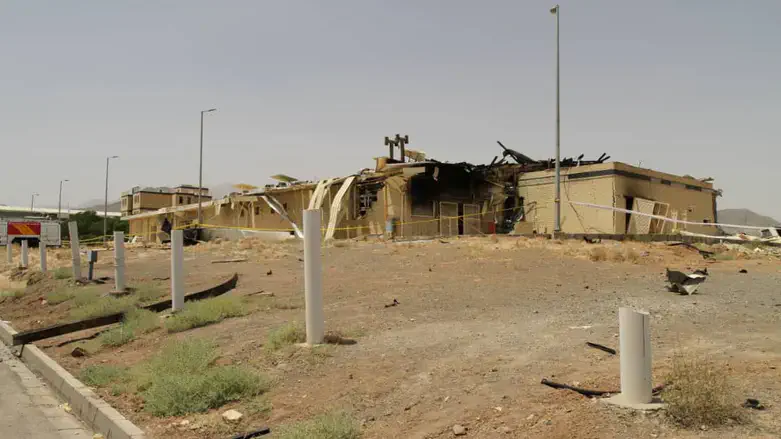
Damage at Iran's Natanz nuclear facility
Damage at Iran's Natanz nuclear facility                                                              Reuters

When will the war end? The answer most given by experts is: ?????. While it's certainly one of the most insightful responses, there are a couple of other valuable perspectives as well

Many Israelis hope for U.S. military involvement in the war—specifically, using American bunker-buster bombs to destroy the nuclear facility at Fordow. Israel currently lacks the bunker-busting capability needed to effectively penetrate and destroy the facility.

The Iranian nuclear facility at Fordow is considered a key component in Iran’s potential nuclear weapons development for several critical reasons:

1. Location and Fortification

  • Deep underground: Fordo is built into a mountain near the city of Qom, making it extremely difficult to destroy with conventional airstrikes or bunker-busting bombs.
  • Hard to detect and access: Its concealed and fortified nature raised immediate suspicions when it was revealed in 2009, especially since Iran had not declared it to the IAEA (International Atomic Energy Agency), violating its safeguards agreement at the time.

2. Enrichment Capabilities

  • High-level uranium enrichment: The facility has been used to enrich uranium to levels as high as 60% purity—just short of weapons-grade (which is ~90%).
  • Advanced centrifuges: Fordo houses advanced IR-6 centrifuges, which enrich uranium faster and more efficiently than older models.

3. Strategic Redundancy

  • Fordo serves as a backup facility to Natanz (another major enrichment site). If Natanz were damaged or attacked, Fordo could continue enrichment activities, ensuring Iran's program has resilience.

4. Weaponization Potential

  • Enriching uranium to higher levels at Fordo shortens the “breakout time” — the time Iran would need to produce enough weapons-grade uranium for a bomb if it chose to do so.
  • Its small size and secrecy suggest it’s more suitable for sensitive work like producing weapons-grade material, rather than for civilian energy purposes.

Fordow is central to concerns about Iran’s nuclear ambitions because of its concealment, protection, advanced enrichment capacity, and potential for producing weapons-grade uranium.

While Iran insists its nuclear program is peaceful, Fordo’s characteristics make it a focal point in nonproliferation discussions.

If the Fordo nuclear facility is not destroyed, Israel’s objective of eliminating what it sees as an existential threat from Iran will remain unresolved, casting a persistent shadow over the region. As long as Iran’s leadership continues to espouse genocidal rhetoric and openly declares its intention to eliminate Israel, the prospects for ending the conflict remain bleak.

For many, the only realistic path to winning the war involves direct American military intervention—either through U.S. airstrikes or by equipping Israel with the necessary tools to carry out the mission themselves.

But there is an additional, even more important, potentially long-term, and far more productive solution to ending the conflict with Iran once and for all. This solution is not only quietly favored by Israel and much of the civilized world, but it is also a goal for which many Iranian citizens would risk their lives: a new Iranian revolution that topples the Ayatollah regime and brings about a fundamental change in leadership.

Such a regime change could pave the way for a government that is friendly toward the West, the United States, and even Israel. The radical Islamists, the fanatics who have held the nation hostage, would be pushed to the margins of society, stripped of their power and influence. They would shrink into a small, irrelevant minority, lost within the confines of their own dogmatic and ruthless ideology.

The new regime would most likely be disinterested in nuclear weapons, and the existential threat to Israel and to Iran’s neighbors and anyone else would cease to exist naturally.

The path to achieving this preferred solution begins with the removal of Iran’s current political leadership—starting with Ayatollah Khamenei and his inner circle. While such a move could spark short-term unrest and possibly violent upheaval, it would likely destabilize the regime and embolden the Iranian people to rise up and reclaim their future.

Israel and the United States should quietly support and facilitate this transformation—offering encouragement, resources, and strategic backing to the revolutionaries—to ensure the regime’s collapse and the emergence of a freer, more peaceful Iran.

It has been reported that President Trump vetoed Israel’s plan to eliminate the Ayatollah and dismantle the regime’s leadership structure. This report may be purposely misleading, but if it is accurate, then it reflects a significant blind spot in his strategic judgment. He may have failed to recognize that such an action could be the linchpin in ending the long-standing conflict with Iran.

A successful regime change would not only defuse one of the most dangerous threats in the Middle East, but it would also spark global relief—and likely celebration. Most notably, the greatest beneficiaries of this shift would be the Iranian people themselves. After decades of oppression under a brutal theocracy, they would finally have a chance to reclaim their country and their future. Their joy and liberation would echo far beyond Iran’s borders.

Dr. Avi Perry, talk show host at Paltalk News Network (PNN)NN), is the author of "Fundamentals of Voice Quality Engineering in Wireless Networks,"and "72 Virgins," a thriller about the covert war on Islamic terror. He was a VP at NMS Communications, a Bell Laboratories - distinguished staff member and manager, as well as a delegate of the US and Lucent Technologies to the ITU—the UN International Standards body in Geneva, a professor at Northwestern University and Intelligence expert for the Israeli Government. Web site: www.aviperry.org


Dr. Avi Perry

Source: https://www.israelnationalnews.com/news/410084

Follow Middle East and Terrorism on Twitter

What Exactly Was Iran Thinking—Or Not? - Victor Davis Hanson


by Victor Davis Hanson

Iran bet on bluff and delay—but lost its proxies, deterrence, and leverage, leaving a regime rich in threats but bankrupt in power.


Iran apparently had not adjusted to its new 2025 status—or maybe it had. Most of its bought terrorists are currently either destroyed or anemic.

There is no more ascendant Iranian “Shia crescent” in the Middle East. Russia is no longer a Middle East power, patron, and protector.

The Assad dynasty imploded, flipping Syria from an Iranian proxy into a likely Iranian enemy. Hezbollah, once supposedly the most fearsome of all the Iranian terrorist tentacles, was humiliated and neutered by a series of surreal Israeli operations.

Hamas has been reduced to a subterranean terrorist remnant.

The Houthis’ tit-for-tat encounters with Israel and the U.S. are systematically turning their Yemeni enclave into an impotent dump. At its present rate, the Houthis will likely soon launch their last rocket at Israel or the Red Sea in a country without fuel, electricity, and ports.

Iran itself, last year in a disastrous air war with Israel, lost its air defenses and is now more or less impotent and defenseless against Israeli air incursions. Its oil income has been slashed by 70-80 percent by the renewed Trump sanctions and ‘maximum pressure’ campaign. Israel can destroy all of its oil industry if it wishes and, apparently, send operatives inside Iran itself as it pleases.

Most of the Arab Sunni world is now losing its accustomed fear of Iran. While the weary pan-Islamic solidarity boilerplate of the Middle East remains the same, privately, most Arab nations rely on the U.S. or even Israel to deter Iran—and predicate their own foreign policy on the degree to which they do just that.

With the end of the Biden administration and Obama a distant memory, Iran lost all hope that it could bluster, bluff, and negotiate itself out of sanctions and embargoes—and into nuclear weapons. There are no more John Kerrys or Antony Blinkens in charge, eager to meet Iranian demands. Ben Rhodes’s “echo chamber” Iran Deal is ancient history.

Israel had done more than all of America’s Middle East wars or all of NATO’s global presence to end Iran’s claims on power and the ability to project its brand of terror and fear throughout the Middle East.

So why did a neutered Iran still sound like the fiery Iran of old, when it once terrorized the Middle East and sent its assassination teams worldwide, with its nearly weekly loud threats to wipe out the one-bomb “Zionist entity?”

What was Iran thinking in refusing to negotiate seriously with the Trump administration to disband its nuclear weapons program and “normalize” its role in the Middle East?

Apparently, given its disastrous last two years, Iran still felt its last-gasp claim both internally and externally on power was on spec to stall and delay by negotiating its way to a dozen nuclear weapons, or, barring that, a deterrent consisting of huge stockpiles of conventional guided missiles.

Such a mini-nuclear arsenal, or fleets of long-range, conventional rockets, would, in Iran’s eyes, still frighten Israel, leverage Europe and the West, and eventually recharge its terrorist legions.

To achieve that unlikely deterrent, the theocracy thought it could draw out Trump’s negotiations endlessly with a series of its trademark feints, falsities, and even threats until it had enriched enough weapons-grade uranium to deter Israel, or created a massive missile force that could overcome the Israeli Iron Dome.

Tehran naively assumed that Trump’s own MAGA base forbade him from starting or even reacting to “forever wars.” Thereby, the Iranians may have believed that Trump’s willingness to deal was a signal that he was restrained domestically or naive enough to put up with their trademark dissimulation. And thus, they wished to believe that Trump would either harness Israel or keep distant from it should Israel preempt to end the Iranian nuclear option.

But Trump had always been clear that Iran could never obtain a nuclear weapon, if deliberately unclear about how that ultimatum would actually be enforced.

Moreover, Iran had always failed to grasp that Trump is not a neo-isolationist but rather a Jacksonian. He certainly does not believe in endless wars or, for that matter, any large, preemptive military action, especially on the ground in the Middle East. He loathes nation-building, and would likely never send a single platoon into Iran.

But all that said, the prior fates of the arch Iranian terrorist general Qasem Soleimani, ISIS kingpin Abu Bakr al-Baghdadi, or the Russian Wagner group in Syria might have reminded Iran that Trump will use force to restore or enhance deterrence and ensure U.S. interests.

When Trump began negotiating with Iran for an end to its nuclear program, he warned the theocracy that it had 60 days to renounce nuclear weapon acquisitions. He apparently had picked such a two-month window, given that any time beyond that date might have ensured Iran would have developed a few nuclear weapons, a reality he knew was untenable for Israel and the U.S.

Iran arrogantly gambled that Trump was bluffing and would stay in endless Iranian bartering while pressuring Israel to stand down so as not to derail his peace efforts. But anyone who knew Benjamin Netanyahu or Trump would know that staying the deadline was impossible, and Iran would likely be hit right after the two-month warning expired.

And so, the regime was hit—swiftly and decisively.

Did Iran think its new Russian and Chinese allies would intervene on its behalf or threaten Israel to stand down? But Russia is bogged down in Ukraine in a new Stalingrad that may have cost it 1 million dead and wounded, with no end in sight. Its military has been weakened. It has no desire to enter any additional foreign conflict. If anything, Putin may soon wish Trump to find him a way out of his own self-created quagmire.

Anyway, an Israeli-Iranian conflict and the subsequent unrest and uncertainty in the Persian Gulf, as far as Vladimir Putin was concerned, would only raise the price of oil and further help feed his tiring Russian war machine.

China is currently trying to avoid a catastrophic trade war with the U.S. It has no desire to prevent the U.S. from aiding Israel. Unlike Russia, China wants no conflict of any kind in the Persian Gulf. It once bought 80-90 percent of Iranian oil, and the Middle East supplies about 50 percent of Beijing’s current oil needs.

So, what was Iran’s backup strategy of resistance if its nuclear infrastructure came under attack before it obtained a bomb? Apparently, it had none.

And in some sense, that is a silly question, given the theocracy has no reason to exist if it is not an exporter of Shiite Persian-sponsored terrorism aimed at isolating Israel, bullying the Sunni Arab world, and scaring the West. Indeed, the regime always believed it would dissolve without terrorist satellites, a nuclear threat, and oil money. Yet what we are beginning to witness after nearly half a century is a terrorist regime with no terrorists, a would-be nuclear bully with no nuclear weapons, and a conventional threat that will soon not be threatening.

So, what is the future of this latest episode of the Iran-Israel air war? For now, Trump will keep raising the specter of negotiations, and Israel will keep hammering Iran. Trump will expect that, at some point, either the cornered regime will return to drag out negotiations, lie and cajole to save their battered regime and dwindling resources, or see their oil and defense infrastructure eventually wiped out—and the possibility the regime disappears as well.

We might then expect the current hot war to turn into an intermittent one for a few weeks, its pulse controlled by Israel, in the manner that it has systematically eliminated Hamas, Hezbollah, and the Houthis as threats.

Is that a viable solution? For now, yes, if the Iranian nuclear program is dismantled for a few years.

But no, if the regime survives.

The only end to the latest phase of forever wars in the Middle East is for the current regime in Iran to disappear and be followed by a somewhat sane regime resembling, say, Jordan or Egypt—mostly secular states that may loathe Israel in private but are pragmatic enough never to war with it ever again. 


Victor Davis Hanson is a distinguished fellow of the Center for American Greatness and the Martin and Illie Anderson Senior Fellow at Stanford University’s Hoover Institution. He is an American military historian, columnist, a former classics professor, and scholar of ancient warfare. He has been a visiting professor at Hillsdale College since 2004, and is the 2023 Giles O'Malley Distinguished Visiting Professor at the School of Public Policy, Pepperdine University. Hanson was awarded the National Humanities Medal in 2007 by President George W. Bush, and the Bradley Prize in 2008. Hanson is also a farmer (growing almonds on a family farm in Selma, California) and a critic of social trends related to farming and agrarianism. He is the author of the just released New York Times best seller, The End of Everything: How Wars Descend into Annihilation, published by Basic Books on May 7, 2024, as well as the recent  The Second World Wars: How the First Global Conflict Was Fought and Won, The Case for Trump, and The Dying Citizen.

Source: https://amgreatness.com/2025/06/16/what-exactly-was-iran-thinking-or-not/

Follow Middle East and Terrorism on Twitter

Israel Just Ended China's Great Power Status in the Middle East - Gordon G. Chang


by Gordon G. Chang

"The Chinese state is only as strong as its main energy provider, and that main energy provider, which so far has not been able to counter Israeli strikes, is unlikely to survive this war in its current form." — Brandon Weichert, author of The Shadow War: Iran's Quest for Supremacy, to Gatestone Institute, June 13, 2025.


  • "There were some very, very relieved people in the Gulf as the sun rose this morning.... The Saudis know that China had armed their enemy Iran with nukes and lesser weapons and fully backed the Houthis, who have been waging war on the Kingdom for years." — Jonathan Bass, Chief Executive Officer, Argent LNG, to Gatestone Institute, June 13, 2025.

  • "The Chinese state is only as strong as its main energy provider, and that main energy provider, which so far has not been able to counter Israeli strikes, is unlikely to survive this war in its current form." — Brandon Weichert, author of The Shadow War: Iran's Quest for Supremacy, to Gatestone Institute, June 13, 2025.

  • "With the loss of Syria and Hezbollah, Iran no longer has a command and control center in Damascus, only a two hour drive from Beirut. That means China can no longer manipulate events there." — Jonathan Bass, to Gatestone Institute, June 13, 2025.

  • China has a Trump problem in the wider region as well. With the exception of Iran, almost everybody, including Iran's partner Qatar, seems to love the American president. Trump took the Gulf by storm in his three-nation — Saudi Arabia, Qatar, and the United Arab Emirates — trip in May.

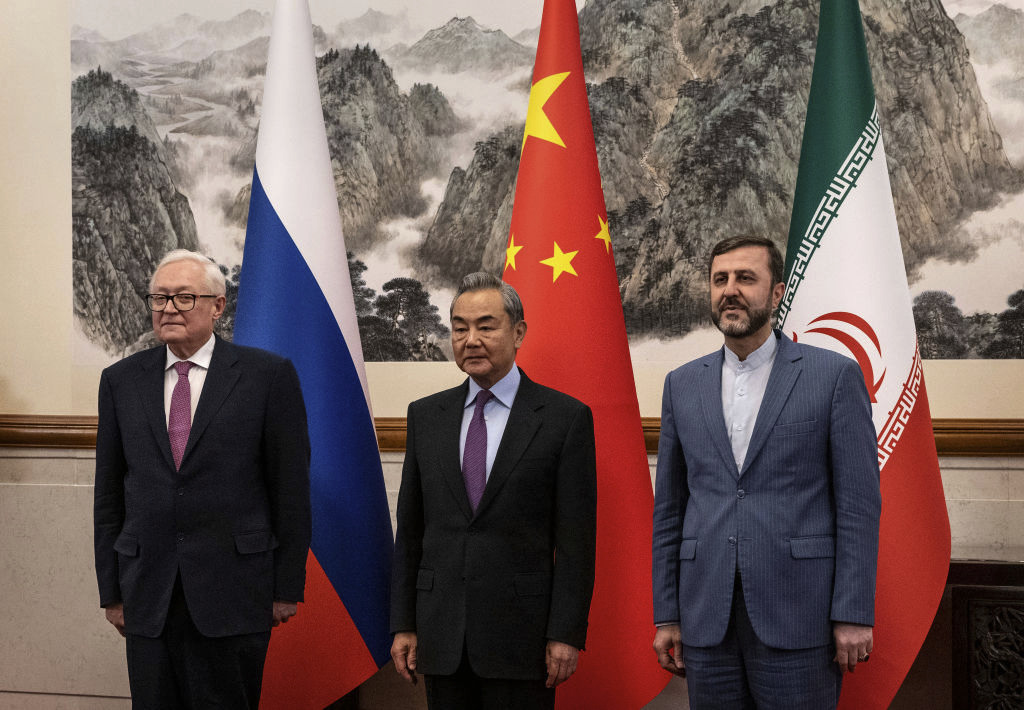
Narratives will change as the fighting between Ira and Israel continues, but one conclusion is already evident: China, Iran's long-time backer, is a victim of the fighting. That is a quick reversal of fortunes. Only last year, the Chinese looked ascendant in the region. Pictured: Chinese Foreign Minister Wang Yi (C), Russian Deputy Foreign Minister Sergey Ryabkov (L) and Iranian Deputy Foreign Minister Kazeem Gharibabadi meet on March 14, 2025 in Beijing. (Photo by Getty Images)

Israeli air and drone strikes during the early hours of June 13th crippled Iran -- and severely set back Tehran's regional ambitions. The Israel Defense Forces hit nuclear weapons development facilities and ballistic missile sites, and killed senior military officers, including Major General Mohammad Bagheri, the armed forces chief of staff, and Major General Hossein Salami, the commander-in-chief of the Islamic Revolutionary Guard Corps (IRGC).

Iranian media announced the death of Ali Shamkhani, Supreme Leader Ayatollah Ali Khamenei's top adviser.

Tehran said that Israel's action was a "declaration of war." This war is continuing, and Iran has struck back with ballistic missile and drone attacks.

Narratives will change as the fighting continues, but one conclusion is already evident: China, Iran's long-time backer, is a victim of the fighting. That is a quick reversal of fortunes. Only last year, the Chinese looked ascendant in the region.

"China is closely following Israel's attacks on Iran and is deeply concerned about the potential grave consequences of the operations," the Chinese foreign ministry stated on X a few hours after the initial attacks. "China opposes actions that violate Iran's sovereignty, security, and territorial integrity, and opposes moves that escalate tensions or enlarge conflicts."

"China stands ready to play a constructive role in helping ease the situation," it added.

Beijing may stand ready, but, apart from the Iranian regime itself, the region is not looking for Chinese assistance.

For instance, Saudi Arabia and neighboring Gulf states are, as academic and analyst Christopher Balding put it, "quietly happy" that Israel has set back Iran in general and its nuclear weapons program in particular. "There were some very, very relieved people in the Gulf as the sun rose this morning," Jonathan Bass told Gatestone the day after Israel's initial attack.

As Bass, who travels extensively in the region for Argent LNG points out, the losses sustained by the Iranian military and the IRGC give the Sunni Muslim states fewer reasons to cooperate with Tehran. "The Saudis were not particularly happy with Chinese attempts to forge a relationship between them and the Iranians," Bass said. "The March 2023 deal was not popular in the Kingdom."

Bass was referring to the China-brokered pact that led long-time enemies Riyadh and Tehran to reestablish diplomatic relations.

"The Saudis," Bass pointed out, "know that China had armed their enemy Iran with nukes and lesser weapons and fully backed the Houthis, who have been waging war on the Kingdom for years."

Yes, the Chinese regime did all that, and the Kingdom has been looking for payback for a long time.

Beijing may also suffer another setback. China has been taking more than 90% of Iran's exports of crude oil in recent years. Israeli strikes on June 14th hit a processing plant in Iran's South Pars gas field, the world's largest. There are reports that Israel also attacked Iran's Abadan oil refinery. If the strikes on Iranian energy sites continue, Beijing could soon be scrambling for hydrocarbons.

"As Iran's largest purchaser of energy, China stands the most to lose from the potential fall of Iran's theocracy," Brandon Weichert, author of The Shadow War: Iran's Quest for Supremacy, told this site. "The Chinese state is only as strong as its main energy provider, and that main energy provider, which so far has not been able to counter Israeli strikes, is unlikely to survive this war in its current form."

The possible loss of the Iranian regime reverses two years of fast Chinese progress in the region. "China is the head, Iran is the shoulder, Qatar is the elbow, and the proxies—Hamas, the Houthis, and Hezbollah—are the fingers," Bass notes. "Without the shoulder, the head cannot move either the elbow or the fingers."

The decimation of Iran also sets back China in another crucial part of the region. "With the loss of Syria and Hezbollah, Iran no longer has a command and control center in Damascus, only a two-hour drive from Beirut," Bass points out. "That means China can no longer manipulate events there."

Syria, once a promising target for Chinese domination, is leaving Beijing's sphere of influence. The country's new leader, former militant Ahmed al-Sharaa, is fast moving Syria closer to the United States.

Sharaa has a willing partner: U.S. President Donald J. Trump. While in Saudi Arabia last month, Trump met with Sharaa after announcing that the U.S. would drop its Assad-era sanctions on his country.

China has a Trump problem in the wider region as well. With the exception of Iran, almost everybody, including Iran's partner Qatar, expresses love for the American president. Trump took the Gulf by storm in his three-nation — Saudi Arabia, Qatar, and the United Arab Emirates — trip in May.

Chinese leaders obviously thought that their backing of Iran would let them ride into control of the region. A proxy war is a sly maneuver when the proxies do well, but it can lead to disaster when the proxies are being ground into the dust.

China's proxies — and China itself — are now being ground into the dust.


Gordon G. Chang is the author of Plan Red: China's Project to Destroy America, a Gatestone Institute distinguished senior fellow, and a member of its Advisory Board.

Source:https://www.gatestoneinstitute.org/21687/israel-iran-china

Follow Middle East and Terrorism on Twitter

IDF chases Iran's missile launchers as Tehran attempts to outwit Israeli surveillance - analysis - Yonah Jeremy Bob


by Yonah Jeremy Bob

Iran is attempting a new strategy of trying to maneuver its ballistic missile concentrations away from the locations where Israel has gotten used to them being based.


 IAF fighter jets taking off for strikes in Iran, June 16, 2025.
IAF fighter jets taking off for strikes in Iran, June 16, 2025.
(photo credit: IDF SPOKESPERSON'S UNIT)

The Israeli Air Force on Monday targeted several trucks carrying weapons, including trucks transporting surface-to-air missile launchers, moving from western Iran toward Tehran in an attempt to evade IDF strikes.

The IDF said that the air force's success in destroying dozens of missile launchers and many missiles has reduced the pace of Iranian missiles launched from launching hundreds at a time to dozens at a time.

Earlier on Monday, the military provided its first statistics of the war on its shoot down success against Iran's ballistic missiles, setting it at 80-90%, with only about 5-10% of ballistic missiles hitting actual residential areas.

The military said that it is constantly adjusting strategies and learning how the Iranians conduct their missile fire, with the Iranians also making adjustments to try to outplay Israel's defenses.

IDF move to cut off missile supply is crucial to war efforts

The crucial move by the IDF cuts off a new attempted Iranian strategy of trying to maneuver its ballistic missile concentrations away from the locations where Israel has gotten used to them being based.

If Iran could succeed in outwitting Israeli surveillance and hiding the missiles in other parts of the country, it could retain the capability to fire on Israel for much longer.

By immediately cutting off Iran's attempt to move the weapons, Israel also conveys to Tehran that moving weaponry is as much of a losing option as keeping them in place.

Jerusalem Post Staff contributed to this report.


Yonah Jeremy Bob

Source: https://www.jpost.com/middle-east/iran-news/article-857962

Follow Middle East and Terrorism on Twitter

Why does Iran launch missiles at night? Tehran's tactical, technological considerations - Dr. Itay Gal


by Dr. Itay Gal

While nighttime offers obvious concealment, the choice to strike under the cover of darkness is rooted in far more than visibility.


 Missiles launched from Iran are intercepted as seen from Tel Aviv, June 15, 2025
Missiles launched from Iran are intercepted as seen from Tel Aviv, June 15, 2025
(photo credit: REUTERS/TOMER NEUBERG)

As sirens blare and Israeli air defenses intercept incoming threats in the dead of night, a pattern has emerged in Iran’s missile strategy: darkness. Repeated missile barrages launched from Iran during the overnight hours are no coincidence—they reflect a deliberate military and technological doctrine designed to obscure, surprise, and instill fear.

While nighttime offers obvious concealment, the choice to strike under the cover of darkness is rooted in far more than visibility. It is a combination of technical constraints, operational necessity, and psychological warfare.

Missiles, unlike aircraft, cannot rely on atmospheric oxygen for propulsion. Instead, they must carry both fuel and oxidizer—components necessary for combustion—within their systems. This is because ballistic missiles reach altitudes where oxygen is sparse or nonexistent.

This fundamental requirement divides missiles into two categories: those powered by liquid fuel and those using solid fuel—each with its strategic implications.

Liquid fuel: Powerful but exposed

Iran's long-range missiles, including the Shahab series, typically use liquid fuel. These missiles require a complex fueling process before launch, involving two separate tanks—one for fuel and one for oxidizer. The operation is time-sensitive, hazardous, and requires stationary launch infrastructure and ground crews.
Missiles launched from Iran are intercepted as seen from Ashkelon, June 15, 2025 (credit:  REUTERS/Amir Cohen )
Missiles launched from Iran are intercepted as seen from Ashkelon, June 15, 2025 (credit: REUTERS/Amir Cohen )
This makes the fueling stage the missile’s most vulnerable window, especially under the watchful eye of enemy satellites and surveillance aircraft.

To reduce the risk of detection and attack, Iran often conducts fueling operations at night, when visibility is low and the chances of aerial detection drop significantly.

Solid fuel: Mobile and ready

In contrast, short- and medium-range missiles such as the Fateh-110 and Zolfaghar are typically powered by solid fuel. These systems are pre-loaded with a mix of fuel and oxidizer in a solid form, stored within the missile’s body. They are launch-ready, do not require on-site fueling, and can be fired from mobile platforms, making them ideal for surprise strikes and decentralized warfare.

However, once ignited, solid-fuel missiles cannot be shut down or throttled. The launch is irreversible—an operational trade-off for mobility and speed.

Why missiles must carry their own oxygen

The question of why missiles need onboard oxidizers often arises. Unlike jet engines, which intake oxygen from the atmosphere, missile engines must operate in environments where oxygen is insufficient or entirely absent.

Ballistic missiles can ascend dozens—or even hundreds—of kilometers into the sky, well beyond breathable altitudes. To ensure sustained propulsion, they must carry everything needed for combustion from the outset.

Doctrine shaped by technology and tactics

Iran’s repeated use of nighttime launches is no random decision. It reflects a multi-layered military doctrine that accounts for technical realities, strategic opportunities, and the psychological dynamics of war.

By leveraging both solid and liquid-fueled missiles, mobile launch platforms, and the natural concealment of night, Iran has built a system that prioritizes survivability, surprise, and psychological impact—even when the missiles themselves fail to reach their targets.

In the ongoing battle for deterrence and defense, the timing of the launch is as critical as the missile itself.


Dr. Itay Gal

Source: https://www.jpost.com/middle-east/iran-news/article-857856

Follow Middle East and Terrorism on Twitter

House intel committee member warns China has plan to 'replace' US, demands AI chip smuggling end - Charlotte Hazard


by Charlotte Hazard

The U.S. and China have had an increasingly complicated relationship over the past few years, regarding trade, technology and national security.


Rep. Darin LaHood, R-Ill., said that China has a plan to "replace" the U.S. and defeat the country technologically, militarily, economically and diplomatically. 

"China has a plan to replace the United States, and they're working at it every single day," LaHood said on the "John Solomon Reports" podcast. "I don't say that to scare people. That's the reality. They want to beat us technologically, militarily, economically and diplomatically. And the sooner we wake up to that, the better."

The U.S. and China have had a complicated relationship over the past few years, regarding trade, technology and national security.

Just the News reported this week that Chinese scientists were indicted for smuggling a potentially dangerous fungus into the U.S., admitting that on one occasion they succeeded by hiding contraband in a pair of boots.

Introducing bipartisan legislation 

West Virginia GOP Gov. Patrick Morrisey recently pressed his state's investment management board to decouple from China, delivering a blow to Beijing as Washington struggles to address Chinese aggression.

"We have to make sure that we are protecting this country appropriately, but also, it's equally important in making sure we win the strategic competition against China when it comes to AI, when it comes to quantum [and] when it comes to high-capacity chip manufacturing," LaHood said in the interview. 

LaHood, a member of the House Select Committee on China and the House Permanent Select Committee on Intelligence, introduced bipartisan legislation to stop the smuggling of American-made chips into China.

The legislation, titled the Chip Security Act, was drafted in response to evidence that U.S. chips were potentially funneled into China through shell companies to support the development of CCP AI software.

It comes down to AI

"There's evidence now that's come out that DeepSeek was successful in terms of their rollout," LaHood said. "Because of these chips, we're going to require location verification for advanced AI chips."

DeepSeek is a Chinese artificial intelligence company based in Hangzhou.

"This, again, is another wake-up call," LaHoos said. "We anticipate this bill will get a vote later this year, and I don't see any reason why it shouldn't become law."

“AI is one of the most high-stakes fronts in our strategic competition with the Chinese Communist Party,” LaHood said in a statement last month.

“The CCP has a track record of exploiting U.S. capital and intellectual property to develop its own advanced technology. I am proud to join my colleagues and introduce the Chip Security Act to protect American innovation and prevent our foremost adversary from smuggling American-made chips. Under no circumstances can the United States allow our technology to power CCP propaganda machines, like DeepSeek.” 


Charlotte Hazard

Source: https://justthenews.com/government/congress/illinois-congressman-says-china-has-plan-replace-us-says-ai-chip-smuggling

Follow Middle East and Terrorism on Twitter

Green group with ties to Chinese Communist Party part of network influencing U.S. policy - Kevin Killough


by Kevin Killough

“This isn’t environmentalism—it’s economic warfare. The Chinese Communist Party is using American nonprofits to make us dependent on their supply chains, from solar panels to EV batteries, while our policymakers walk straight into the trap," said Michael Lucci, CEO of State Armor, which produced the report.


A national-security watchdog group is asking members of Congress to take a closer look at an energy transition advocacy nonprofit that has ties to the Chinese Communist Party (CCP). According to State Armor, the watchdog group, nonprofits are coordinating with U.S. climate groups to influence climate policy, advance the interests of the CCP and undermine U.S. national security.

A new report by State Armor argues that the CCP is co-opting the American progressive climate change lobby to advance a transition away from fossil fuels. The alternative technologies being pushed by this lobby, according to the report, create significant economic and geopolitical advantages by undermining U.S. energy dominance and leaving it dependent on Chinese supply chains for its energy production. 

“It creates a dependence on our side and deprives us of a natural strength, which is our energy independence that comes from other resources,” Michael Lucci, CEO of State Armor, told Just the News. State Armor is a non-profit organization dedicated to advocating for state solutions to global security threats.

Broad approach to political warfare

Besides the dependency on China for energy supply chains, the U.S. may be vulnerable as a result of malicious actions. The State Armor report notes recent Reuters reports — based on anonymous sources — that rogue communication devices were installed in solar panels coming out of China. 

“So why would that be there? It's just there. So Beijing could shut things off over here,” Lucci said. 

The report focuses on Energy Foundation China (EFC) and documents the group’s ties to climate advocacy groups in the U.S. that are influencing climate policy. Energy China describes itself as a 501(3) non-profit which says its mission is "facilitating exchanges with and providing grants to policy research groups, industry associations, academic institutions, and non-governmental organizations committed to sustainable energy development and the energy transition."

According to the report, Energy Foundation China has ties to the Chinese government and coordinates with the CCP. It purportedly embedded itself in American universities and supported an event in 2023 in which California Gov. Gavin Newsom visited China. Lucci said the group functions as a central node that’s part of a larger network. 

“A key concept with China is what’s called a united front. This is their broad approach to political warfare. It's Leninist. It's actually directly out of Lenin where they get it. It's a communist approach to political warfare. And they stand up central nodes or central institutions like EFC. And then, around that, they try to just build any allies they can that are aligned with a communist vision or China's vision, and to attack or to delegitimize those who stand against the party's interest — the party's interest on energy, in this case,” Lucci explained.

The Energy Foundation did not respond to requests for comment from Just the News about the report or its allegations. 

Building allies in the United States

Energy Foundation China is a non-profit headquartered in San Francisco. It was originally known as the Energy Foundation, but it spun off most of its U.S.-based operations in 2019 into a separate organization called the U.S. Energy Foundation. The State Armor report documents numerous examples in which The Energy Foundation provided financial support to U.S. climate groups advocating for climate policies. 

In 2023, Energy Foundation China reported $84 million in revenues. According to the nonprofit’s website, it’s funded by a number of U.S. anti-fossil fuel groups, including the ClimateWorks Foundation, the William and Flora Hewlett Foundation, and the Climate Imperative Foundation. Hewlett and MacArthur are key contributors, according to the report, to the Collective Action Fund, which Fox News reported in 2022 was part of a dark money network supporting climate litigation against petroleum companies. 

In 2022, The Energy Foundation granted $350,000 to the Rocky Mountain Institute (RMI). Throughout the years, according to Fox News, the foundation granted the RMI $900,000. 

The Rocky Mountain Institute produced a study in 2023 claiming to find a link between gas stoves and asthma, which was often cited by policymakers and activists seeking restrictions on natural gas use. The RMI researchers used data from past studies to estimate rates of childhood asthma linked to exposure to gas stoves. The study has been criticized for failing to factor into its data a more comprehensive global study published in 2013 by the International Study of Asthma and Allergies in Childhood, which utilized data from 512,000 children in 47 different countries and found no evidence of any association between the use of gas stoves and asthma.

Citing the Energy Foundation’s 2022 and 2023 tax documents, the report shows that the group also gave millions to the International Council on Clean Transportation, which was an active supporter of incentives in the Inflation Reduction Act to transition U.S. trucking from diesel-powered semi-trucks to electric ones. 

The Energy Foundation also provides large grants to support climate policy research at American universities, including the University of California-Berkley, University of California-Los Angeles, Harvard, and the University of Maryland. 

Ties to the Chinese Communist Party

Though organized as an American nonprofit, The Energy Foundation, according to the report, is led by individuals with direct ties to the CCP. The organization’s CEO, Zou Ji, previously served as the deputy director general of China’s National Center for Climate Change Strategy, an agency within the Chinese government’s National Development and Reform Commission. The Energy Foundation’s environmental program director, Xin Liu, served in a leadership role at the Beijing Municipal Environmental Protection Bureau.

David Vance Wagner, vice president of strategic partnerships for The Energy Foundation, was the China counselor in the Office of the Special Envoy for Climate Change from 2014 to 2017. Wagner was also employed by China’s Ministry of Environmental Protection, according to his biography on the Energy Foundation website, where he was the “first and only foreigner at China’s national vehicle emission policy research center under the Ministry of Environmental Protection.” He received his master’s degree from China's state-run Tsinghua University in Beijing.

According to the State Armor report, the Energy Foundation has coordinated extensively with the CCP. The CCP’s National Development and Reform Commission (NDRC) oversees the group’s operations in China. The NDRC enforces compliance with Chinese regulations and cracks down on foreign investments in Chinese sectors considered important for the country’s national security. 

Lucci said the Chinese government’s involvement in U.S. climate policy stems from a concern over China’s own energy supplies. Much of its oil and gas comes from the Middle East, which leaves the supply vulnerable to U.S. naval blockades. They are diversifying their energy portfolio to help address that risk with increased wind, solar, hydroelectric, nuclear and coal. 

Referring to the Chinese government, he continued, “They'll do anything to, just from a security perspective, remove the United States ability to intercept their energy resources, their energy supplies.” That would include getting the U.S. to be more dependent on Chinese green energy supply chains. 

Asking for Congressional investigation 

Jason Isaac, CEO of the American Energy Institute, said in a statement that the report lays bare how the CCP has co-opted climate activism to push for energy technologies that are manufactured, mined and controlled by China. 

"From solar panels to EV batteries and rare earth minerals, our supply chains are increasingly entangled with a foreign adversary that uses forced labor, ignores environmental safeguards, and openly aims to dominate the global energy future. This isn’t progress—it’s dependence," Isaac said. 

In a letter to the chairs of House and Senate committees — including Rep. James Comer, R-Ky., chair of the House Oversight Committee and Sen. Chuck Grassley, R-Iowa, chair of the Senate Judiciary Committee — Lucci explained that the group was formed to help the U.S. resist Chinese influence and maintain U.S. sovereignty. Lucci outlines the findings of the report and the risks it says Chinese influence poses to the U.S. The letter urges Congress to initiate investigations and provide oversight into what Lucci calls a “grave and ongoing threat to our national security.” 

Lucci said in an interview that the Department of Justice should be investigating The Energy Foundation as a foreign agent under the Foreign Agent Registrations Act. The law would require the foundation to make disclosures of their relationship with China, as well as receipts and disbursements in support of activities in support of China.  


Kevin Killough

Source: https://justthenews.com/politics-policy/energy/group-ties-chinese-communist-party-part-climate-network-influencing-us

Follow Middle East and Terrorism on Twitter

Sunday, June 15, 2025

Peering Through the Fog of War - Clarice Feldman


by Clarice Feldman

The Israelis pulled off the most brilliant offensive in modern military history; the President orchestrated a genius misdirection; Iran’s regime is on its back feet from which it will not recover.


In wartime it’s particularly difficult to ascertain what’s happening. Governments have a natural and healthy instinct to hide from public eyes what is going on, even those fully democratic ones which in peace have some constraints on official censorship. Nevertheless, the fact that so many people around the world have video-capable mobile phones and access to the internet makes it harder to hide what is happening. All week long I’ve been looking at these videos, reading official IDF reports and statements by leaders of involved countries and they show that Stacey McCain and Lee Smith, whose takes I link to below, are in full accord with what I’ve seen. The Israelis pulled off the most astonishing, most brilliant offensive in modern military history; the President orchestrated a genius misdirection allowing the Israelis to cap off 20 years preparation for this attack; Iran’s regime is on its back feet from which it will not recover; Israel has saved the world with the assistance of a number of Arab countries and the U.S.; Britain under Keir Starmer has earned the disregard of the western world and was prudently left entirely out of advance knowledge of the attacks. Obama and Biden’s loony foreign policy gave the mullahs an almost two-decade opportunity to build their nuclear capacity which Israel, with Trump’s assistance, has destroyed. Finally, the war will continue for about a week or two, but I, at least, have no doubt about the outcome -- the end of the Mullahcracy.

Misdirection

Ido Hilbany wrote of the brilliant misdirection campaign Trump orchestrated with Netanyahu which allowed Israel to get into position if, as was certain, the mullahs would dither in negotiations to end their nuclear enrichment program. 

THE ART OF THE MISDIRECT:

I know some people are so broken they will never be able to muster a compliment for Trump, but the level of misdirection and coordination with Israel on this Iran attack was brilliant. Trump used his public platforms to lull Iran into complacency while privately coordinating with Israel. Trump and Netanyahu went so far as to meet privately this week to finalize things while publicly both leaking that Trump was urging restraint.

The problem here for the press corps is that so many of them hate Trump so much, they cannot nuance the cleverness of this. They must either approach it as Trump is a failure who even Israel does not respect or Trump is a liar who lied to everyone to get Iran.

The reality is everyone honest knows Iran has always been the liar, claiming it had no nuclear ambitions even as it plotted a bomb. The Obama/Biden policies helped Iran, which embedded agents within the Biden Administration. And Trump has turned the tables on it all, including probably taking advantage of Iran’s embedded agents to amplify his misdirection.

And now Iran has been set back significantly and the world is safer today.

But scream about Orange Man Bad if you must. The press corps that does not deal with the truth of what happened is just going to further discredit itself. They couldn’t detect Biden’s decline and cannot accept Trump’s calculated misdirection.

It’s amazing what allies can accomplish when they actually act like allies. 

He played a straight course between those in his party who wanted the U.S. to militarily intervene and those who said we should have nothing to do with this. He let Steve Witkoff play at allowing the Iranian regime to do its usual dithering while he said on April 11 that they had 60 days to end the enhancement program. Doubtless they thought they were dealing with the Obama/Biden-type vanishing red line. They weren’t. On the 61st day, Israel struck.

Lee Smith has been a longtime critic of America’s Middle east policies. This week, he thinks Trump finally got it right:

At last, an American president kept his word. He was very clear about it even before his second term started: Iran can’t have a bomb. Trump wanted it to go peacefully, but he warned that if the Iranians didn’t agree to dismantle their program entirely, they’d be bombed. Maybe Israel would do it, maybe the United States, maybe both, but in any case, they’d be bombed. Trump gave them 60 days to decide, and on day 61, Israel unleashed Operation Rising Lion.

Until this morning, when Trump posted on Truth Social to take credit for the raid, there was some confusion about the administration’s involvement. As the operation began, Secretary of State Marco Rubio released a statement claiming that it was solely an Israeli show without any American participation. But even if details about intelligence sharing and other aspects of Israeli-U.S. coordination were hazy, the statement was obviously misleading: The entire operation was keyed to Trump. Without him, the attack wouldn’t have happened as it did, or maybe not at all.

Trump spent two months neutralizing the Iranians without them realizing he was drawing them into the briar patch. Iranian diplomats pride themselves on their negotiating skills. Generations of U.S. diplomats have marveled at the Iranians’ ability to wipe the floor with them: It’s a cultural thing -- ever try to bargain with a carpet merchant in Tehran? And Trump also praised them repeatedly for their talents -- very good negotiators! The Iranians were in their sweet spot and must have imagined they could negotiate until Trump gave in to their demands or left office. But Trump was the trickster. He tied them down for two months, time that he gave to the Israelis to make sure they had everything in order.

Has Operation Rising Lion enhanced America’s peace? If it ends Iran’s nuclear weapons programs, the answer is absolutely yes. When American partners advance U.S. interests, it adds luster to American glory.

There’s already lots of talk about Trump’s deception campaign, and in the days and weeks to come, we’ll have more insight into which statements were real and which were faked and which journalists were used, without them knowing it, to print fake news to ensure the operation’s success. One Tablet colleague says it’s the most impressive operational feint since the Normandy invasion. [snip] It’s now clear that the insanely dense communications environment -- including foreign actors like the Iranians themselves, anti-Bibi Israeli journalists, the Gulf states, and the Europeans -- served the purpose of the deception campaign. But most significant was the domestic component. Did the Iranians believe reports that the pro-Israel camp was losing influence with Trump and that the “restraintists” were on the rise? Did Iran lobbyist Trita Parsi tell officials in Tehran that his colleagues from the Quincy Institute and other Koch-funded policy experts who were working in the administration had it in the bag? Don’t worry about the neocons -- my guys are steering things in a good way. It seems that, like the Iranians, the Koch network got caught in its own echo chamber.

The Brilliant Israeli Military Campaign

Stacy McCain described what I saw, a brilliant military campaign by Israel. He compared what we saw to Michael Corleone’s elimination of rival Mafia heads.

Can you imagine the kind of long-term surveillance and planning that went into this operation? Like, figuring out where the Iranian air force leaders would meet in an emergency, mapping out the location of that bunker, giving them some kind of signal of an impending attack, then watching them scurry to their bunker and -- WHAM! -- you took out the leadership at the outset of the campaign, so “that there was nobody to give the order” for the Iranian counter-attack. Meanwhile, you’ve got Mossad spies sneaking around all over Iran, ready to play their part in wrecking the enemy’s air defenses, so that the Israeli Air Force can fly in without danger of getting shot down.

One standard deviation -- it’s a lethal advantage. 

He detailed some of the campaign:

As it became clear Israel was about to attack, the commanders of the Islamic Revolutionary Guard Corps’ air force convened in a bunker to coordinate the response.
But Israel knew that emergency protocol, and the location of the bunker. They destroyed it, killing the overall commander and the heads of the drone and air defense forces. “The fact that there was nobody to give the order neutralized an immediate Iranian response,” an Israeli official said.
They were among the more than two dozen Iranian commanders targeted in a sprawling attack on Iran’s military command-and-control. The heads of the IRGC, the Iranian military and Iran’s emergency military headquarters were all eliminated in the opening salvo.
Another key target was Iran’s air defense systems and radars. Israeli intelligence mapped their locations, and most were hit by the Israeli Air Force in the opening strike. That gave the IDF virtually unchallenged freedom of operation in Iran’s skies.
Meanwhile on the ground, Israel’s Mossad spy agency was conducting a series of covert sabotage operations deep inside Iran to take out air defenses and ballistic missile launchers...
In central Iran, Mossad commando units had positioned guided weapons systems in open areas near Iranian surface-to-air missile launchers.
In another area inside Iran, Mossad covertly deployed weapon systems and sophisticated technologies hidden in vehicles. When the Israeli attack began, these weapons were launched and destroyed Iranian air defense targets. 

Iran Stood Alone

It helps that Iran really has no friends that matter.

The coordination went deeper, though. While it is unlikely that Arab nations in the region knew the time and scope of Israeli attacks, they were all prepared to help Israel beat back any Iranian counterstrike, and they did. While many of them are making noises about how unhappy they are regarding the Israeli attacks on Iran, they are also helping Israel defend itself against retaliation. 

So far, around 100 Iranian drones have been launched against Israel, and none have hit anything important. 

If your knowledge of the Middle East comes from the New York Times, Washington Post, CNN, or one of many loony U.S. universities, you may be astonished to realize how hated Iran’s regime is. 

“Saudi Arabia, Jordan, Azerbaijan, Qatar, Turkey, and the United Arab Emirates allowed Israel to use their airspace and/or defended Israel against Iranian drone attacks last night. That also suggests Russia was likely OK with the Israeli strike and China at least knew about it.” Apparently left in the dark was onetime ally Great Britain.

One of the architects of Obama’s disastrous policy on Iran reared his head, Ben Rhodes. The Great Iowahawk (David Burge) shot it off:

@Iowahawkblog 

“No matter how absurd and lunatic the White House inner circle is right now, it will never top assigning a failed creative writing grad student and campaign van drivers [sic] -- to concoct a strategy of appeasing Iran with a billion dollar airdrop of $100 bills.”

Iowahawk did, however, find some joy in this because some of these money went to Hezb’allah and was used by them to buy pagers which the Israelis had tricked out to blow up their private parts.

By week’s end numbers of Europeans who share a never-ending delusion that the Middle East is just like us marched, drove, and flew to Egypt expecting to be allowed to breach the border into Gaza to stand with Hamas. They were beaten up by Egyptian police and civilians and tossed out bodily, left in shock and tears. You must see this video of one of them on his knees to a group of Egyptians enforcing the border with Gaza as they roll their eyes at his stupid entreaty that all Islamic believers should stick together.

Israel now so completely controls the skies over Iran that reportedly it is refueling over Tehran. The IRGC is so weakened that its officers are not reporting and are being threatened with treason for not showing up. Elon Musk has activated Starlink over Iran so that civilians can more easily transmit outside the country after what’s left of the government shut down internet access. I’ve seen videos of Iranians dancing in the streets, apparently no longer fearful of recriminations. Finally, there are reports of private airplanes ferrying out what’s left of the regime elsewhere, perhaps to Russia where they can play backgammon with Assad, who also fled there from Syria earlier. 


Clarice Feldman

Source: https://www.americanthinker.com/articles/2025/06/peering_through_the_fog_of_war.html

Follow Middle East and Terrorism on Twitter

Devastation grows as Iran targets Israel’s civilian areas, despite interceptors and shelters - Emanuel Fabian


by Emanuel Fabian

IDF says rate of interception similar to 2024 attacks, denies Tehran has maneuverable missiles; missiles carry 1,100-lb warheads; US assisting with defense


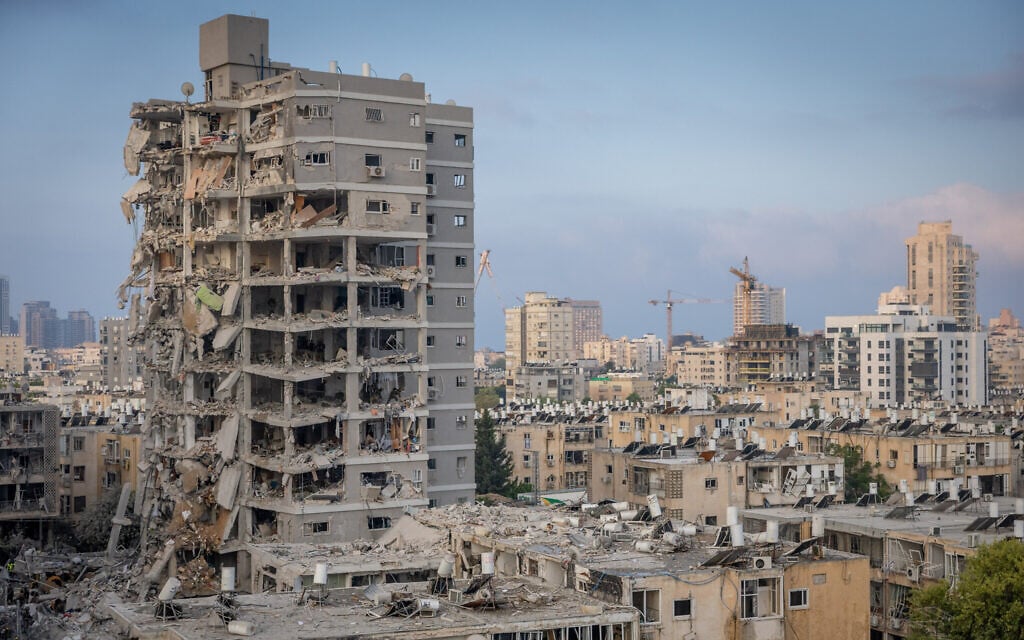
The scene of an apartment building destroyed by an Iranian ballistic missile impact, in Bat Yam, June 15, 2025. (Chaim Goldberg/Flash90)


Iran has fired some 280 ballistic missiles at Israel in several barrages since the Israel Defense Forces began its operation against the Islamic Republic’s nuclear program early Friday morning, according to updated statistics provided by the military on Sunday.

Most of the missiles were intercepted by air defenses at interception rates similar to those in Iran’s April and October 2024 attacks on Israel, the IDF said.

The military said that dozens of missiles were not intercepted “according to protocol,” allowing them to strike open areas without causing damage to any critical infrastructure. This is to conserve interceptors for missiles that are expected to cause harm.

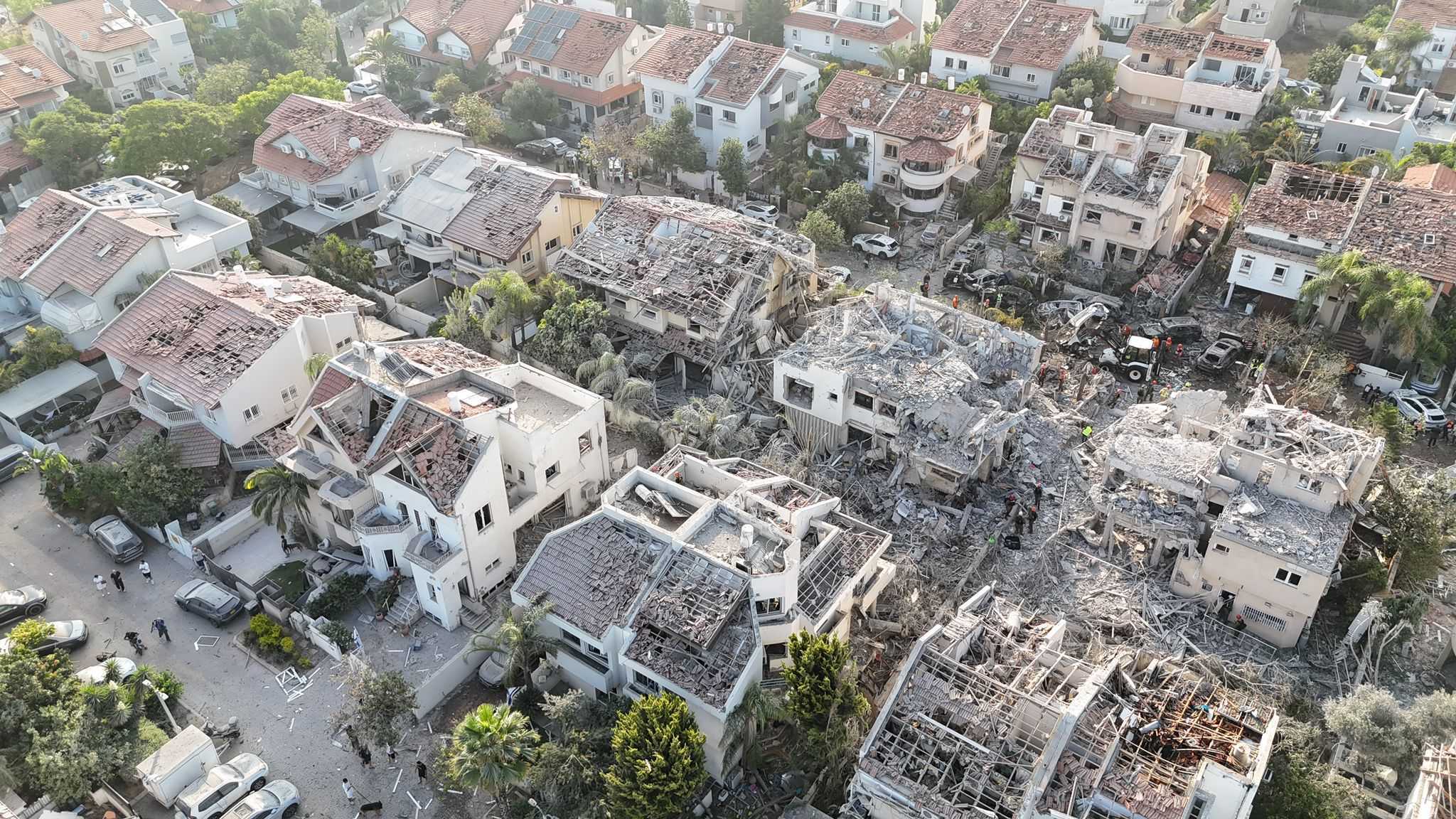
The damage seen in Rishon Lezion a day after a ballistic missile attack from Iran, June 14, 2025 (Rishon Lezion Municipality drone team)

A military official told The Times of Israel on Sunday that Iran’s missiles are “not something we don’t know how to intercept,” but some impacts were still expected.

The military has also said that all of its bases, including air bases, were operating as usual with no harm to their functionality.

The IDF said Sunday that so far, Iran’s attacks were below the “reference scenario,” or what the IDF had anticipated in a war with Iran. The military had estimated far larger numbers of casualties and more significant damage.

Iran is still believed to possess thousands of ballistic missiles.

Dozens of drones launched from Iran have also been shot down by the Israeli Air Force and Navy since Friday, nearly all of them before reaching the country’s borders, the IDF has said.

International help

American air defense systems and a US Navy destroyer helped Israel shoot down incoming ballistic missiles on Friday, US officials said.

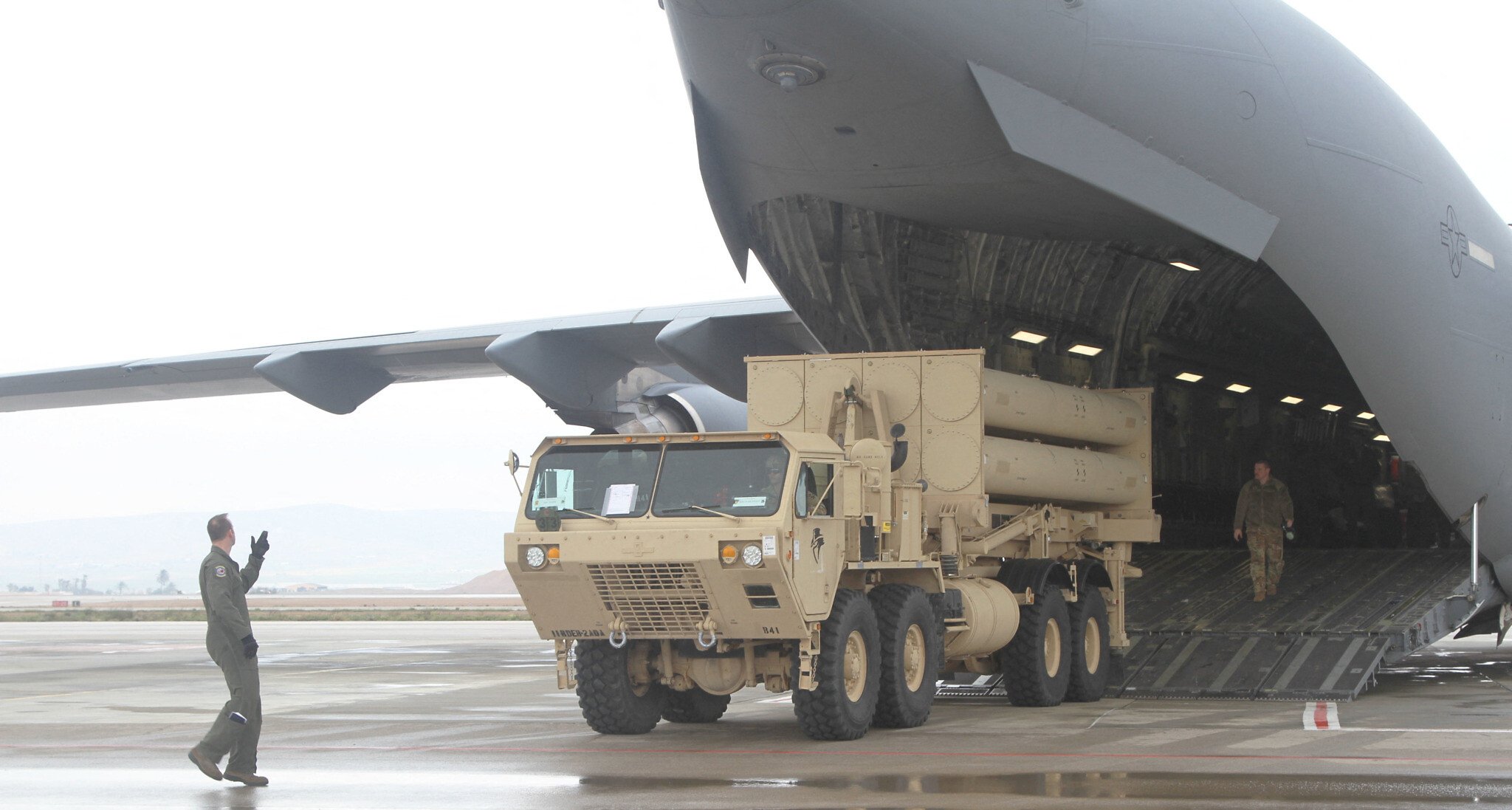
The US has THAAD (Terminal High Altitude Air Defense) systems deployed in Israel, which are capable of intercepting ballistic missiles. A US Navy destroyer in the eastern Mediterranean Sea also shot down Iranian missiles heading toward Israel, one official said.

In this image, courtesy of DVIDS, a US Air Force Airman offloads a THAAD launcher from a C-17 GlobeMaster III at Nevatim Air Base, Israel, for an exercise, March 1, 2019. (Robert DURR / DVIDS / AFP)

However, aside from the US, Israel’s allies in the region are not capable of shooting down ballistic missiles, which have a short flight time of around 10 minutes and are challenging to intercept, requiring advanced air defense systems like Israel’s Arrow or the US’s THAAD.

Jordan’s state media said Friday that it intercepted a number of drones that entered the country’s airspace.

Drones launched from Iran have a flight time of multiple hours to reach Israel, and need to first cross countries such as Iraq, Syria, Jordan, or Saudi Arabia, where they can be shot down either by Israel or its allies.


Emanuel Fabian

Source: https://www.timesofisrael.com/devastation-grows-as-iran-targets-civilian-areas-despite-interceptors-and-shelters/

Follow Middle East and Terrorism on Twitter