The "Middle East and Terrorism" Blog was created in order to supply information about the implication of Arab countries and Iran in terrorism all over the world. Most of the articles in the blog are the result of objective scientific research or articles written by senior journalists.
From the Ethics of the Fathers: "He [Rabbi Tarfon] used to say, it is not incumbent upon you to complete the task, but you are not exempt from undertaking it."
"Unilaterally declaring a Palestinian state is a violation of the Oslo Accords that everybody thought would lead to a Palestinian state," said the diplomat.
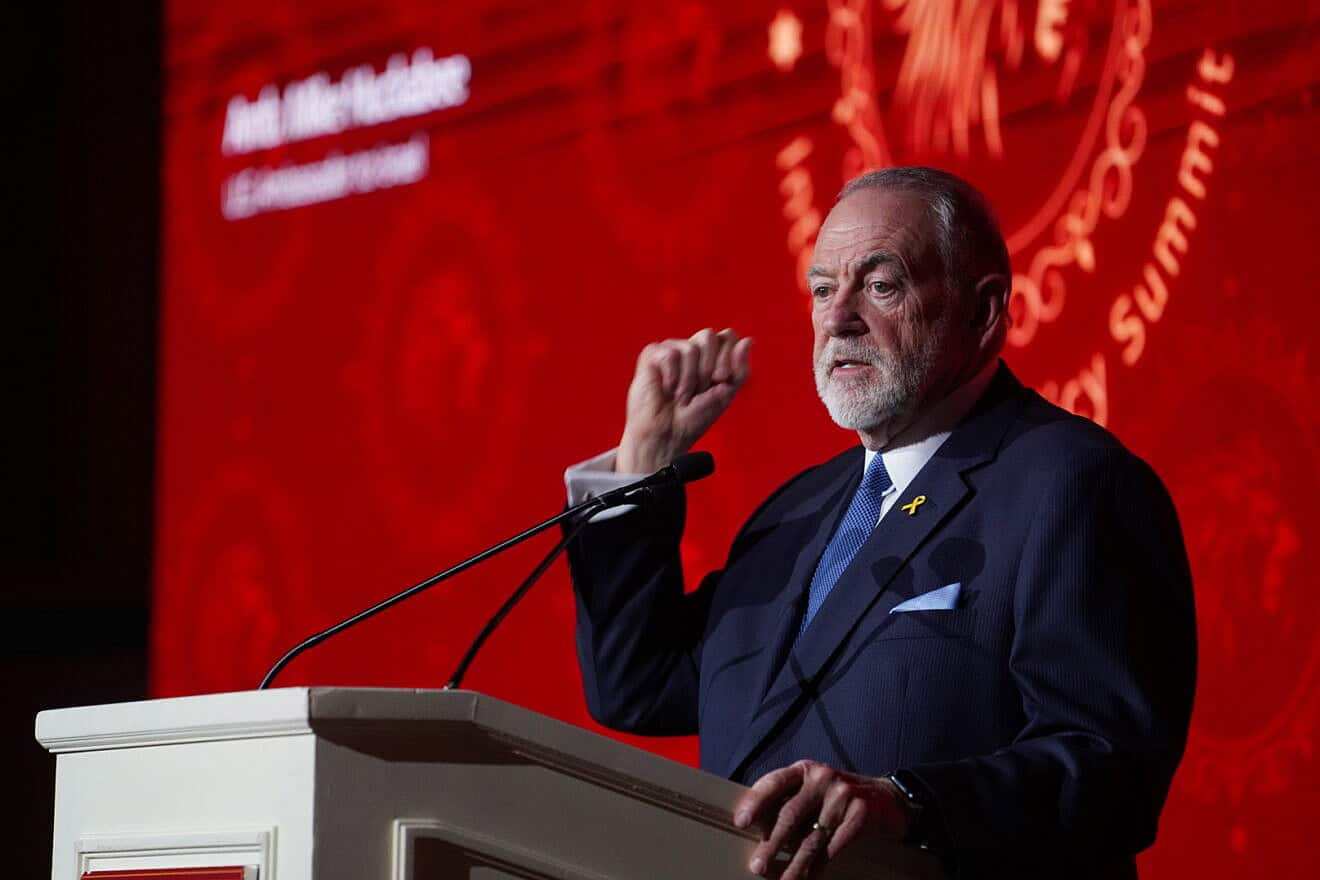
Mike Huckabee at the JNS International Policy Summit 2025. Monday, April 28
U.S. Ambassador to Israel Mike Huckabee told the BBC
on Sunday that the France- and Saudi-led drive to recognize a
Palestinian state at the United Nations later this month has had
“disastrous consequences.
“I wish they would’ve thought about the
implications,” Huckabee said in the interview, nothing the move would
violate the Oslo Accords signed between Israel and the Palestine
Liberation Organization in the 1990s.
“I don’t know why people don’t understand
that unilaterally declaring a Palestinian state is a violation of the
Oslo Accords that everybody thought would lead to a Palestinian state,”
said the diplomat.
Huckabee noted that Jerusalem was considering extending its sovereignty to “more parts of Judea and Samaria” in response.
“So whatever the thought was, however
noble it may have seemed, it has had disastrous consequences that have
proven to do exactly opposite of what many of the European countries
have thought would be a great idea,” he said.
Over the weekend, Huckabee told Israel’s Channel 14 News that the United States “has never asked Israel not to apply sovereignty” in Judea and Samaria.
Huckabee’s statement came on the backdrop
of Hebrew-language reports claiming that Washington asked Jerusalem not
to advance policies that could harm the Palestinian Authority’s
stability.
Secretary of State Marco Rubio said on
Thursday, “What you’re seeing with the West Bank and the annexation,
that’s not a final thing—that’s something being discussed among some
elements of Israeli politics.”
He went on to say that Washington had harsh words for world leaders who have said that they plan to unilaterally recognize a Palestinian state.
“We told all these countries, ‘If you guys do this recognition stuff—it’s all fake, it’s not even real,” Rubio told reporters during a diplomatic visit to Quito, Ecuador. “If you do it, you’re going to create really big problems.”
Adm. Brad Cooper wrapped his first visit to the Jewish state on Saturday, which included a tour of communities close to the Gaza Strip.
U.S.
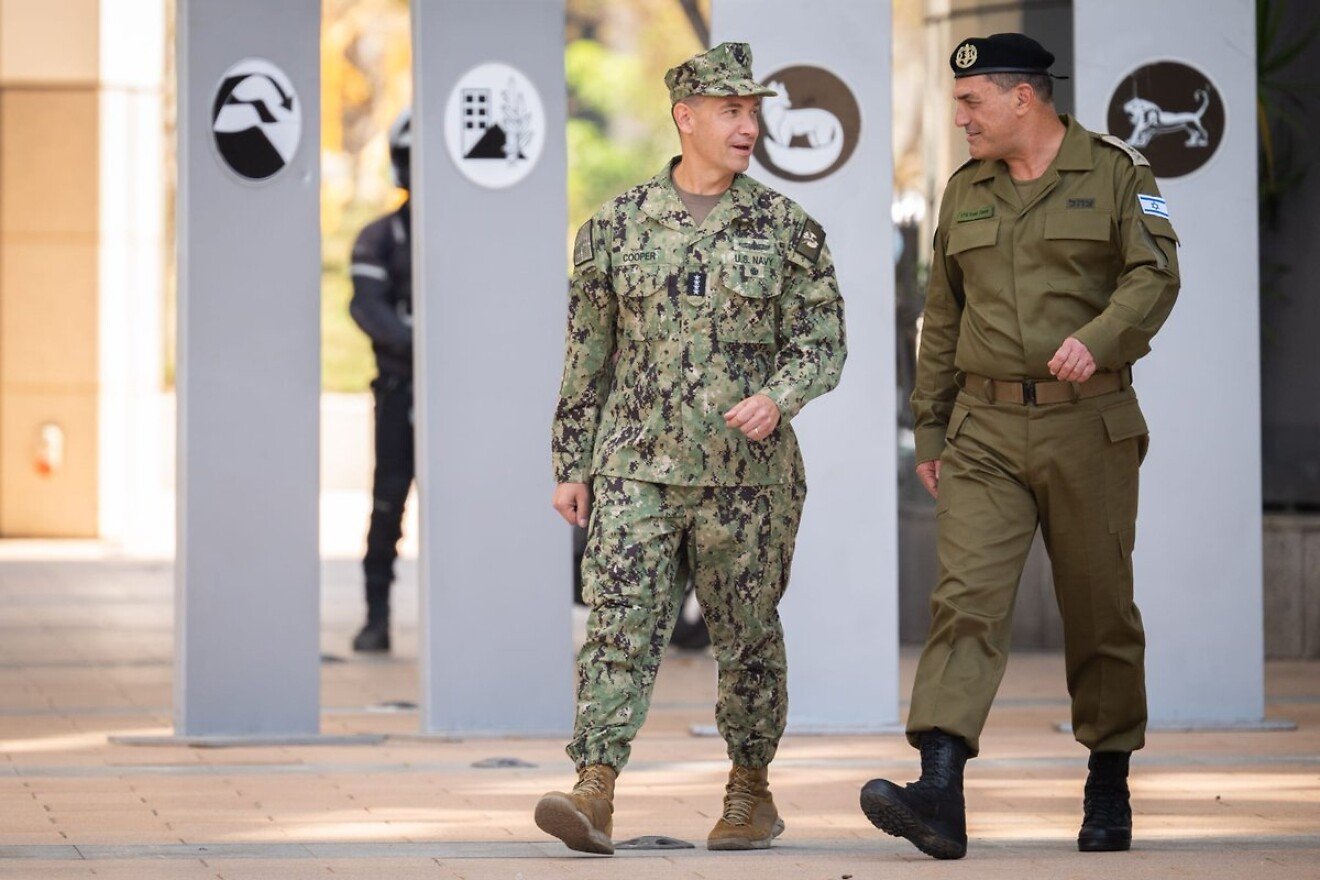
Central Command Commander Adm. Brad Cooper, left, and IDF Chief of
Staff Lt. Gen. Eyal Zamir at IDF headquarters, Tel Aviv, on Sept. 6,
2025. Source: @CENTCOM/X.
New U.S. Central Command (CENTCOM)
commander Adm. Brad Cooper on Saturday concluded his first visit to
Israel since replacing Gen. Michael Kurilla overseeing American military
operations in the Middle East, Central Asia and parts of South Asia.
An honor guard greeted the guest of Israel
Defense Forces Chief of Staff Lt. Gen. Eyal Zamir at IDF headquarters
in Tel Aviv, after which a situational assessment was held, chaired by
Zamir and with the participation of members of General Staff Forum,
where they discussed the “current operational picture and the plans
going forward.”
According to CENTCOM’s account of the
meeting, they talked about “regional security and the strong U.S.-Israel
military alliance.”
The Commander of @CENTCOM, Admiral Brad Cooper, concluded today his first visit to Israel in his position, as the guest of the Chief of the General Staff, LTG Eyal Zamir.
Admiral Cooper was received with an honor guard upon his arrival, after which he held an operational… pic.twitter.com/SUJwucaXGL
The IDF statement on his visit added that during his trip, Cooper toured communities near the Gaza Strip.
“The United States maintains an ironclad
commitment to Israel’s security,” Cooper was quoted as saying in a
CENTCOM X post. “We are mutually dedicated to promoting regional
security and stability.”
Kurilla stepped down from his position on Aug. 8, with Zamir calling him a “true friend of Israel.”
A staunch supporter of the Jewish state
who visited multiple times during his tenure, Kurilla helped guide
Israel’s transition from U.S. European Command to CENTCOM in 2021. That
move integrated Israel into America’s alliance with Gulf and other Arab
partners in the region and facilitated cooperation between Washington and Jerusalem on strikes against Iranian nuclear sites in June.
US Treasury Secretary Scott Bessent said that the administration was ready to attempt to "collapse" Russia's economy with help from the European Union.
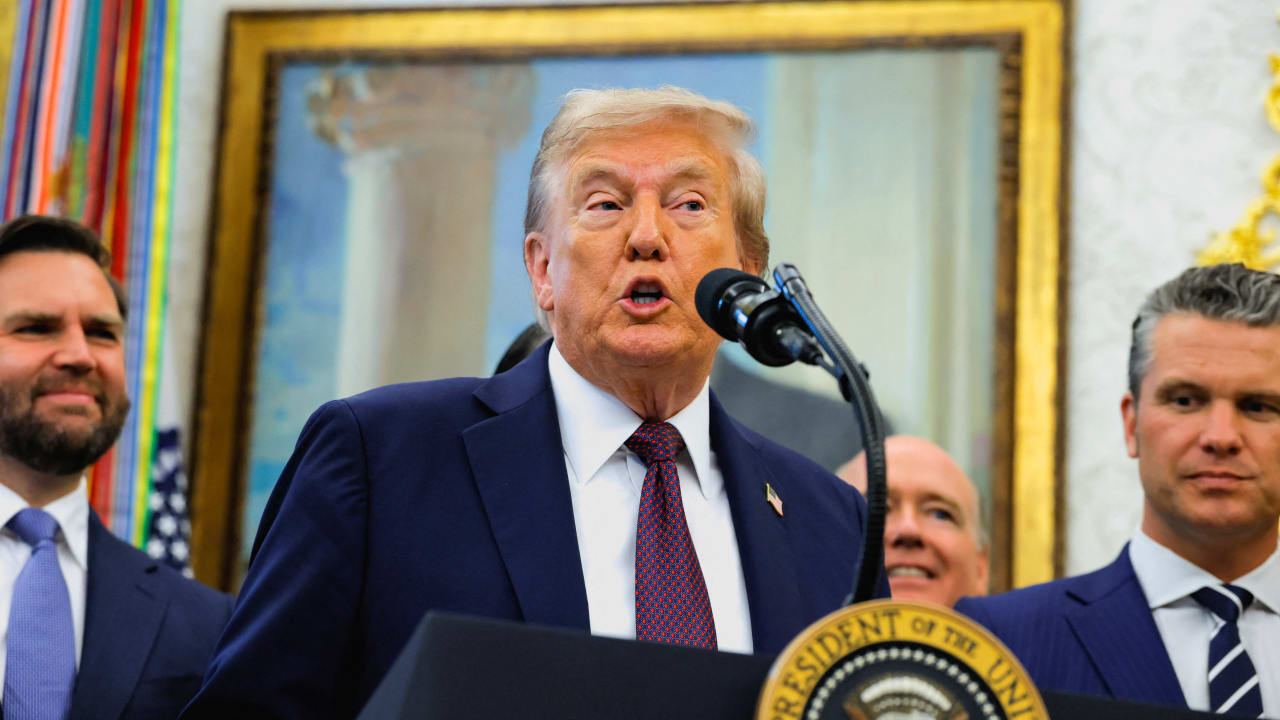
US President Donald Trump, next
to Vice President JD Vance and Secretary of Defense Pete Hegseth, speaks
during an event to announce that the Space Force Command will move from
Colorado to Alabama, in the Oval Office at the White House in
Washington, DC, US, September 2, 2025(photo credit: REUTERS)
US President Donald Trump
said that his administration was ready to instate a second round of
sanctions against Russia in comments to the press on Sunday.
"Are
you ready to move to the second phase of sanctions against Russia?" a
reporter asked Trump as he left the White House to attend the US Open in
New York.
"Yeah, I am," Trump responded.
Additionally, in a Sunday interview with NBC’s Meet the Press, US Treasury Secretary Scott Bessent said that the administration was ready to dial up pressure on Russian President Vladimir Putin. However, he noted that the European Union needed to assist in order to fully "collapse" the Russian economy.
"We are prepared to increase pressure on Russia, but we need our European partners to follow us," Bessent said.
Residents
stand at the site of an apartment building hit during a Russian drone
and missile strike, amid Russia's attack on Ukraine, in Zaporizhzhia,
Ukraine, August 30, 2025. (credit: REUTERS/Stringer TPX IMAGES OF THE
DAY)
US wants EU to help 'collapse' Russian economy to help bring Putin to table
"We
are in a race now between how long the Ukrainian military can hold up
versus how long the Russian economy can hold up," he added. "And if the
US and the [European Union] can come in, do more sanctions and secondary
tariffs on the countries that buy Russian oil, the Russian economy will
be in total collapse, and that will bring [Russian] President
[Vladimir] Putin to the table."
Earlier on Sunday, Ukrainian President Volodymyr Zelensky told ABC that he approves of putting secondary tariffs on countries that buy Russian oil and gas.
"I’m
very thankful to all the partners, but some of them, I mean, they
continue to buy oil and Russian gas, and this is not fair," Zelensky
said.
"The
Russian economy is pressured, and all the countries that trade with
Russia are pressured, and we will continue with this," he said in a
social media post on Thursday, adding that "secondary sanctions and
special trade tariffs" can help.
Early Sunday morning, Russia struck a Ukrainian government building in Kyiv, a first in the three-year-old war.
CNN
reported that the overnight attack was Russia’s largest one yet; Moscow
sent a total of 800 drones and 13 missiles to Ukraine.
Zelensky called the strikes a "deliberate crime and a prolongation of the war."
"It has been repeatedly said in Washington that sanctions will follow a refusal to talk," he added.
US Special Envoy to Ukraine, Keith Kellogg, wrote that he believed Russia was escalating the war.
"The
danger in any war is escalation. Russia appears to be escalating with
the largest attack of the war, hitting offices of the UKR Cabinet in
Kyiv," Kellogg posted on X/Twitter. "History shows events can escalate
out of control through actions as these. It is why President Trump is
working to stop this war. The attack was not a signal that Russia wants
to diplomatically end this war."
RFK Jr.’s Senate grilling wasn’t about COVID or the CDC—it was a proxy battle over power, Trump, and who controls the narrative.
The issue is never the issue.
The appearance of Robert F. Kennedy Jr., Secretary of Health and
Human Services, before the Pfizer Tribunal at the Dirksen Senate Office
Building on Thursday reminded me of the truth of that famous saying of
Saul Alinsky.
The issue is never the issue. What is always the issue, according to that community organizer nonpareil, is power.
Ostensibly, Secretary Kennedy came to answer questions about COVID
(remember that scam?) and the performance of people at—or, rather,
recently at—the Centers for Disease Control. He recently fired the new,
freshly confirmed director, Susan Monarez, for being “untrustworthy,”
and some 1000 staffers walked out in solidarity or—what’s that other
word beginning with an “s”?—Oh, right: in a snit.
One by one, the senators, mostly Democrats but also a few Republicans, screamed and gesticulated at Kennedy, accused him of being a “charlatan” and worse, and demanded that he resign or be fired.
One friendly questioner asked whether Kennedy thought that the
response to COVID had been “politicized.” Indeed, it had, Kennedy said.
Moreover, the government and the media lied to the public about many
aspects of the disease, beginning with its origin. (No bats were
involved in this entertainment.)
The public was also aggressively lied to about the danger of the
virus—overwhelmingly, the only vulnerable parts of the population were
the elderly, the obese, and the diabetic. We were lied to about the
efficacy of “social distancing”—it was a made-up nostrum—and cloth
masks. They are worse than useless. I still see damaged souls driving
around in cars or walking outside by themselves wearing a mask. You
might as well, as some wag proposed, wear a seat belt while walking around as a sort of safety blanket.
But the largest load of lies concerned the various COVID vaccines.
Kennedy’s views about the efficacy and safety of vaccines are often
caricatured. You may or may not always agree with him, but his views are
nuanced, well-informed, and subtle. Several senators seemed surprised
that Kennedy could agree with the proposition that President Trump
deserves the Nobel Prize for overseeing Operation Warp Speed, which
produced a spate of COVID vaccines in a matter of a few months, while
also remaining highly critical of the safety and effectiveness of the
vaccines.
But there is no contradiction. Remember, the public was assured by everyone from President Biden on down that the vaccine would prevent one from contracting COVID and also prevent one from transmitting the disease.
“When people are vaccinated, they’re not going to get infected,” quoth
Dr. Anthony Fauci, head of the NIH. “You’re not going to get COVID if
you have these vaccinations,” agreed Joe Biden. “Vaccinated people do
not carry the virus and don’t get sick,” said Rochelle Walensky, former Director of the CDC. Et ad nauseam cetera.
The public was also told, untruthfully, that the vaccine was more
potent than the natural immunity one achieved from contracting the
disease. Moreover, the public was told that everyone was at risk and
needed the vaccine—and many doses—when only a tiny fraction of the
population was at risk. Furthermore, the public was left in the dark
about the serious health dangers the vaccine posed to young men and
women.
The point to bear in mind here is that most of this misinformation
was not the result of innocent mistakes. It was the fruit of deliberate
lies.
So was what we might call the kinetic side of the government’s
draconian response to COVID: closing schools, work, and social gathering
places, shuttering the economy, and seriously handicapping large
swathes of the population.
We await a full accounting of the social and economic damage done to
Western societies that capitulated to the totalitarian zeal of the
health police. Aspiring social engineers like Klaus Schwab, founder and
former head of the World Economic Forum, were among those who welcomed
the COVID epidemic as an opportunity to embark on a “Great Reset” in
which all of society would be remade according to the socialist
blueprint furnished by Davos.
But in an important sense, the criticism of Kennedy for his views on
COVID, vaccines, and the staff at the CDC was merely a pretext. The
issue is never the issue. Yes, Senator Elizabeth Warren, who has received $1,224,145 from Big Pharma, did her psychotic squaw routine against Kennedy. Bernie Sanders ($1,953,613) and Ron Wyden ($1,207,873) joined in the war dance, as did many others.
But the thing to appreciate about the melodrama is that it had very
little to do with COVID or the CDC or even U.S. health policy writ
large. The real protagonist was someone who wasn’t even present, viz.
Donald Trump. The fire was directed at Kennedy, but the ultimate target
was Trump. The strategy is to discredit and then destroy Kennedy, a
potent outgrowth of the Trump administration. If the Dems can destroy
Kennedy, he would represent the outer skin of the onion. They would then
proceed against other Trump lieutenants.
Robert Kennedy wants to find out why Americans are fatter, sicker,
and more plagued by chronic disease now than ever before. He wants to
know why cases of autism have skyrocketed and why 8 out of 10 young
adults are not fit enough to join the military. Is it because of what
they eat, the medicines they are forced to take, or something else? The
Democrats want to play what Bill Clinton (and later Hillary) called “the politics of personal destruction.”
The issue is never the issue, but determined truth-tellers like
Robert Kennedy and his boss in the White House are a demonstration that
“the issue” can be made to succumb to the awful clarity of common sense,
bolstered by that other real issue, the executive power of the
presidency.
Prime Minister Benjamin Netanyahu supports expanding Hungary’s AI tool to track antisemitic hate online across Europe, warning it directly impacts Israel’s security.
President of Hungary’s Action and Protection Foundation (TEV) Kálmán Szalai (L) and Prime Minister Benjamin Netanyahu (R).(photo credit: COURTESY OF TEV)
Prime Minister Benjamin Netanyahu
backed a European rollout of a Hungarian-built system that flags
antisemitic content online, telling a visiting watchdog in Jerusalem on
Wednesday that the surge in Jew hatred “directly affects Israel’s
security.”
Kálmán Szalai, president of Hungary’s
Action and Protection Foundation (TEV), briefed Netanyahu on the
AI-assisted platform, which identifies antisemitic rhetoric on major
social media networks and refers serious cases to authorities.
The
tool already operates in Germany and Austria, and TEV aims to deploy it
in most European Union countries within a year, Szalai said.
Netanyahu
welcomed the initiative and urged wider adoption. “Antisemitic hatred,
both online and offline, impacts not only Jewish communities abroad but
also Israel’s security,” he said.
Szalai
also described TEV’s support programs for victims, which include legal
aid, psychological counseling, and security assistance. “The drastic
rise in hate crimes requires comprehensive institutional protection,” he
said.
A person holds a placard during a demonstration against antisemitism,
amid the ongoing Israel-Hamas War, in Brussels, Belgium, December 10,
2023; illustrative. (credit: REUTERS/Johanna Geron)Education
and media literacy are part of the plan as well. TEV runs classroom
programs that teach students how to spot classic and modern antisemitic
tropes, often disguised as anti-Zionism, and how to report incidents. He
pointed to “50 Minutes,” a current affairs program on Neshama TV, a
Jewish cable channel in Hungary, as a platform for fact-based coverage
and Israeli documentaries.
Figures TEV presented at the meeting showed steep increases since 2020. In Germany,
1,957 antisemitic incidents in 2020 rose to 4,886 in 2023, while online
expressions nearly doubled to 8,627 in 2024. TEV said about a quarter
of the German cases were categorized as anti-Israel antisemitism.
In the United Kingdom,
incidents climbed from 1,662 in 2020 to 4,106 in 2023, a 107% increase,
with 1,774 cases linked to Israel and the Gaza conflict.
Hungary,
which Jewish leaders often describe as comparatively safe, still saw
online cases jump from 45 in 2022 to 128 in 2023, most after October 7,
and then spike to 664 in 2024, with more than half classified as
anti-Israel.
The
meeting came less than a year after Netanyahu’s state visit to Hungary,
where he praised the country as one of the safest for Jews and
discussed cooperation with Prime Minister Viktor Orbán.
Szalai,
who last met Netanyahu in 2020, noted that TEV was founded by the
Chabad-Lubavitch-affiliated Association of Hungarian Jewish Communities
(EMIH) at the initiative of EMIH's Chief Rabbi Shlomo Köves.
EMIH's Chief Rabbi Shlomo Köves in 2023. (credit: Elekes Andor/WIKIMEDIA COMMONS)The
foundation works with the Hungarian government and engages a broad
spectrum of Jewish communities, including Reform congregations.
October 7 massacre brought spiking antisemitism from margins to mainstream discourse, public intimidation
Israeli
officials say the spike in antisemitism since October 7 has moved the
problem from the margins into mainstream discourse and street
intimidation.
By
framing it as a strategic issue and backing the EU expansion of TEV’s
monitoring tool, Netanyahu placed countering antisemitism within
Israel’s national security agenda and signaled support for exporting
practical methods to other democracies.The Hate Monitor is here to track antisemitism worldwide. Learn more >>
Scotland Against Antisemitism ended by calling on the government to "retract its inflammatory language" and "meet with the Jewish community to discuss how the government plans to protect us."
Demonstrators hold Palestinian
flags outside Bute House as Britain's Prime Minister Keir Starmer meets
Scotland's First Minister John Swinney at Bute House in Edinburgh,
Scotland, Britain July 7, 2024. (photo credit: REUTERS/LESLEY MARTIN)
Almost
3,000 people had signed an open letter warning the Scottish government
that its recent boycott against Israel may intensify antisemitism in the
country. On September 3, the government announced it had paused funding
to arms companies supplying Israel.
The
letter, organized by the group Scotland Against Antisemitism, has
gathered almost 3000 signatures, including lawyers, politicians,
educators, clergy, and students. While there are only 5000 Jews in
Scotland (less than 0.1% of the population), Scottish Jews were the
target of 17% of all religiously-motivated hate crimes in 2024.
“The
Scottish Government has no power over foreign policy, and the proposed
funding cuts are tiny and will have no effect on events in the Middle
East," said Leah Benoz, Founder and Director of Scotland Against
Antisemitism. "Not one Palestinian life will be saved by these measures,
but Jewish life in Scotland
will be put further at risk. Our question to Mr Swinney is simple: Is
our safety really a price worth paying for this kind of gesture
politics?”
The letter condemned First Minister John Swinner for claiming there is "prima facie evidence" that Israel is committing genocide
in Gaza. The letter noted that the accusation of genocide is one of the
gravest under international law and requires an exceptional standard of
proof alongside irrefutable evidence of intent. Given this is not the
case with Israel, the letter accuses the Scottish government of a
modern-day blood libel by espousing these views.
"It
appears the government has calculated that the cost of alienating
Scotland’s Jews will be outweighed by electoral rewards," the letter
added.
Scotland v Israel - Hampden Park, Glasgow, Scotland, Britain - October
9, 2021 General view as people display signs and Palestine flags outside
the stadium before the match Action (credit: REUTERS/LEE SMITH)
Calls for gov't to meet with Jewish community
Scotland
Against Antisemitism ended by calling on the government to "retract its
inflammatory language" and "meet with the Jewish community to discuss
how the government plans to protect us."
In
his speech to parliament, Swinney also announced that the funding
otherwise being given to weapons companies will now be redirected to
taking a deployable hospital in Gaza, which he said will provide essential surgical, maternity, and paediatric services to thousands of patients every year.
Swinney
also announced he will donate £600,000 to the UNOCHA-led Humanitarian
Fund for the "Occupied Palestinian Territories" and will bring up to 20
injured children from Gaza to Scotland for treatment.
Peter Navarro was convicted by Biden's DOJ and has already served his time for allegedly refusing to comply with a subpoena from the January 6th Committee. The Trump advisor has appealed his conviction, and is calling upon the Trump DOJ to explain why it has reversed it position on claims of executive privilege.
The Trump Justice
Department is attempting to abandon its previous defenses of the
Biden-era prosecution of Peter Navarro — even as the Trump DOJ seeks to
appoint an outside lawyer to continue to affirm his conviction on
appeal,
But Navarro, a Trump White House adviser, doesn’t want to let the DOJ walk away without explaining itself.
Navarro — a top adviser to Donald Trump during his first administration as well as in his second — was charged
by Biden's Justice Department in 2022 for refusal to comply with a
subpoena issued by the Democrat-led House select committee investigating
January 6, 2021.
Navarro repeatedly asserted claims of executive privilege, but President Joe Biden and his DOJ rejected this assertion, and Navarro was convicted in 2023 and sentenced in 2024, when he spent four months behind bars. The trial judge was Judge Amit P. Mehta, who was appointed to the United States District Court for the District of Columbia in 2014 by then-President Barack Obama.
Trump's DOJ seeks affirmance of conviction but on other grounds
Navarro, who is currently an Assistant to President Trump and the Director of the White House’s Office of Trade and Manufacturing Policy, appealed his conviction in 2024.
The Biden DOJ filed a lengthy brief defending its prosecution of Navarro last year. The Trump DOJ has now told
the appeals court that it wants to abandon the arguments put forward by
the Biden DOJ, but that it also wants an outside lawyer to argue to
sustain Navarro’s conviction during the ongoing appeals process at the
U.S. Court of Appeals for the District of Columbia. Navarro has objected to the appointment of an outside attorney.
Navarro doesn't want to let the DOJ walk away without explaining its own position on the controversy. Navarro first filed his appeal with the U.S. Court of Appeals for the District of Columbia in January 2024.
“I Went To Prison So You Won’t Have To”
is not just the title of my new book — it’s why I’ve kept fighting this
appeal even after serving my sentence. If I lose, future presidential
advisers of either party could face jail for honoring executive
privilege and defending the Constitution’s separation of powers,”
Navarro told Just the News.
Navarro added: “This isn’t just a legal duty — it’s a moral
one. DOJ opposed my release pending appeal by falsely insisting there
were no substantial questions of law. Now, by trying to withdraw its own
brief without explanation, it admits those questions exist. I can’t get
back the four months I lost in prison to the Democrat’s lawfare, but
DOJ can and must explain itself.”
DOJ's lawyer turns out to be donor to Biden, other Democrats
Assistant U.S. Attorney Mark Hobel has been the main
federal prosecutor defending the Biden DOJ’s prosecution of Navarro and
the Navarro's appeal.
Hobel donated more than $5,600 to Biden for President in
2020 along with another $1,000 to the Biden Victory Fund in 2020,
according to FEC records.
Hobel was also a supporter of then-Vice President Kamala Harris,
donating $1,250 to Harris for President in 2023 and another $1,500 to
Harris for President in 2024, according to FEC records.
Hobel has worked as an Assistant U.S. Attorney for the
District of Columbia from April 2016 through the present, according to
his LinkedIn page, and was previously an Obama-era advisor to the Special Envoy for Guantánamo Closure from September 2014 to August 2015.
Navarro case defended on grounds of executive privilege
“Dr. Navarro immediately and repeatedly asserted executive
privilege in response to the subpoena, and Dr. Navarro in fact did not
comply with the subpoena by providing documents or appearing for a
scheduled deposition,” Navarro’s lawyers argued in a brief to the appeals court in July 2024.
“Instead, Dr. Navarro implored the Select Committee to
confer with former President Trump concerning the implication of
executive privilege, but the Select Committee never made any attempt to
confer with former President Trump or any of his aides concerning the
subpoena.”
“Even if former President Trump had invoked executive
privilege, the district court correctly concluded that the Committee’s
need for the requested documents and testimony would have outweighed
that privilege,” the Biden DOJ told
the Court of Appeals for the D.C. Circuit in a September 2024 brief.
“Finally, the district court correctly concluded that, even if Navarro
had a plausible privilege claim, he properly faced contempt liability
given his total failure to comply with the subpoena.”
Navarro’s lawyers and the U.S. Attorney’s Office for the
District of Columbia — now led by U.S. Attorney Jeanine Pirro — filed a joint status report
in late August where it was revealed that the Trump DOJ would not be
taking the same position on executive privilege as the Biden DOJ had.
The Biden DOJ had targeted a number of former Trump allies — including Navarro
— related to their alleged refusal to comply with subpoenas for
testimony and records issued by the Democrat-led House committee
investigating the events of January 6, 2021.
Ironically, Barack Obama's Attorney General Eric Holder was
similarly cited in 2012 for contempt of congress, but in that matter
was never prosecuted, because President Obama and the DOJ insisted that
Holder was protected by executive privilege.
The White House Counsel’s Office for President Biden said
in February 2022 that it was rejecting Navarro’s arguments. “President
Biden has determined that an assertion of executive privilege is not in
the national interest, and therefore is not justified, with respect to
particular subjects within the purview of the Select Committee,” the
Biden White House said.
The Biden DOJ declined
to charge former White House chief of staff Mark Meadows and former
Trump social media director Dan Scavino, who were also cited by Congress
for contempt, but it did indict Navarro and Trump ally Steve Bannon for refusing to comply with subpoenas.
Navarro: "the Department of Injustice"
The day he was released from prison, Navarro spoke at the Republican National Convention in July 2024, where he slammed the “Department of Injustice.”
“Yes indeed, this morning I did walk out of a federal
prison in Miami. Joe Biden and his ‘Department of Injustice’ put me
there. … I’ve got a very simple message for you: if they can come for
me, and if they can come for Donald Trump, be careful, they will come
for you,” Navarro said on the third night of the RNC. “If we don’t control our government, their government will control us.”
After defeating Harris last year, Trump announced
in December 2024 that Navarro would be a senior counselor for trade and
manufacturing in the Trump White House, calling him “a man who was
treated horribly by the Deep State, or whatever else you would like to
call it.”
By criminalizing the press, Yunus is dismantling the very institutions that could hold his interim regime accountable, while empowering Islamist groups that thrive in darkness.
The silencing of Bangladesh's
media is not just about censorship -- it is part of a larger
transformation of the country into a breeding ground for radical
Islamist politics that threatens the stability of the entire region.
By criminalizing the press, Yunus is dismantling the very
institutions that could hold his interim regime accountable, while
empowering Islamist groups that thrive in darkness.
Ansar al-Islam, the Bangladeshi franchise of Al-Qaeda, openly
justifies murdering secular writers and bloggers by branding them
"enemies of Islam."
Yunus's reliance on Islamist allies such as Jamaat-e-Islami
undermines this role by pushing Bangladesh into a trajectory that will
likely make it hostile to US interests.
If Bangladesh descends further into authoritarianism and Islamist
radicalization, it risks becoming another Afghanistan -- a sanctuary
for extremist groups with transnational ambitions.
Washington cannot afford to remain silent while an unelected regime dismantles democracy and silences the media in Bangladesh.
Yunus has promised elections in February 2026, but his Islamist
allies are already signaling their intention to sabotage the process. If
the media remains silenced, if journalists remain in prison, the path
is clear: Bangladesh will be robbed of its democracy and its people
robbed of their voice.
Bangladesh stands at a dangerous crossroads. The persecution of
journalists under Yunus is not merely an assault on freedom of
expression - it is the deliberate dismantling of democracy itself. Every
day that Monjurul Alam Panna and other journalists remain behind bars,
Bangladesh moves closer to becoming another Taliban-ruled Afghanistan.
If Yunus's regime is not challenged now, Bangladesh will not just
lose its democracy -- it will proceed to export instability across
South Asia.
Since the Islamist-backed coup of 2024 that installed
Muhammad Yunus in power, Bangladesh has witnessed an unprecedented
assault on freedom of the press. Journalists have been dragged to jail
under trumped-up charges, assaulted in courtrooms, and criminalized
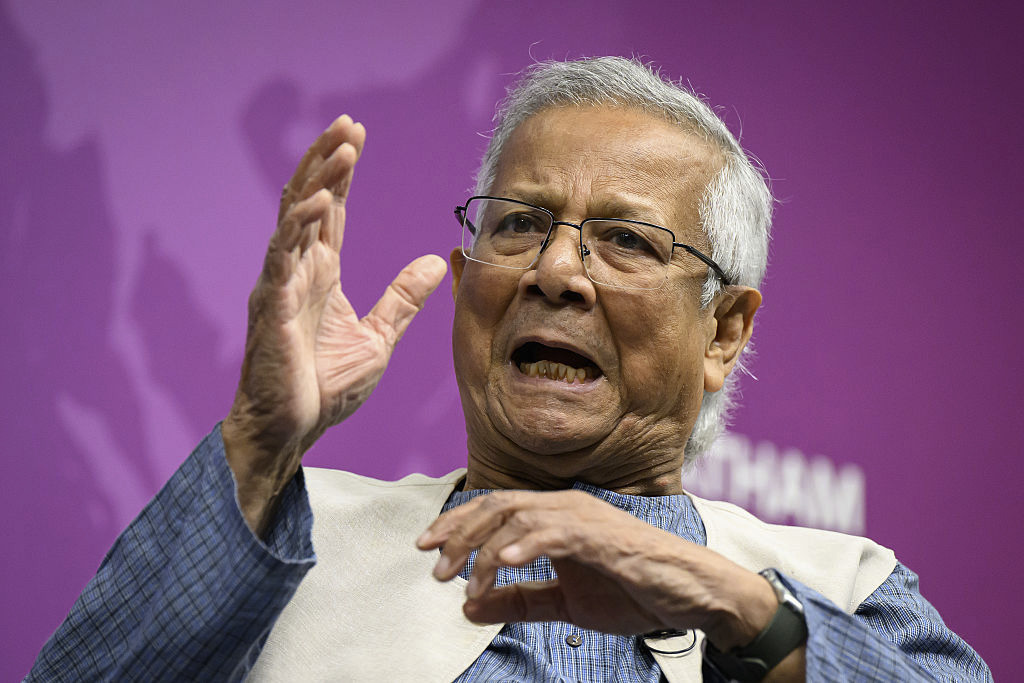
under the vague Anti-Terrorism Act. Pictured: Yunus speaks on June 11,
2025 in London, United Kingdom. (Photo by Leon Neal/Getty Images)
For years, Turkey's President Recep Tayyip Erdoğan has been synonymous with the brutal silencing of dissent, turning his country into one of the world's largest prisons for journalists. Today, shockingly, Bangladesh -- once hailed as a moderate Muslim democracy -- is following the same dangerous path under the unelected, military-backed rule of Nobel laureate Muhammad Yunus.
Since the Islamist-backed coup of 2024 that installed Yunus in power,
the country has witnessed an unprecedented assault on freedom of the
press. Journalists have been dragged to jail under trumped-up charges,
assaulted in courtrooms, and criminalized under the vague Anti-Terrorism Act.
The once vibrant Bangladeshi media, long known for its resilience, is
now suffocating under a regime that increasingly mirrors Taliban-style
authoritarianism.
This is a tragedy not only for Bangladesh. The repression unfolding
in Bangladesh carries far-reaching consequences for South Asia's fragile
security balance, for US strategic interests in the Indo-Pacific, and
for India's fight against Islamist extremism along its vulnerable
eastern frontier. The silencing of Bangladesh's media is not just about
censorship -- it is part of a larger transformation of the country into a
breeding ground for radical Islamist politics that threatens the
stability of the entire region.
"There have been more than 354 journalists harassed, 74
cases of violence reported, 113 criminal charges filed, and press
credentials revoked for 167 journalists, according to the [Rights and
Risks Analysis Group] report."
Unsurprisingly, Yunus's officials dismissed the report as "a wildly misleading piece of disinformation". But such denials
have become routine. From repressing minorities to intimidating
journalists, the regime consistently refutes what is visible to the
naked eye.
Beh Lih Yi, Asia program coordinator at the Committee to Protect Journalists, has condemned the campaign of repression:
"We are disturbed by the apparently baseless detentions
and criminal cases against journalists, and incidents of media groups'
offices being targeted and vandalized. These assaults on press freedom
must end. They create a chilling effect on the media."
The chilling effect is, of course, deliberate. By criminalizing the
press, Yunus is dismantling the very institutions that could hold his
interim regime accountable, while empowering Islamist groups that thrive
in darkness.
Case study: The arrest of Monjurul Alam Panna
The arrest of journalist Monjurul Alam Panna on August 28, 2025, illustrates the new climate of fear. Panna was seized
from the auditorium of Dhaka Reporters Unity while attending a
discussion on "Our Great Liberation War and the Constitution of
Bangladesh". The program was violently disrupted by protestors who had
already threatened the event online.
The International Federation of Journalists condemned
Panna's arrest, and noted that he and 15 others were rounded up on
charges that had been fabricated. In court the following day, Panna was paraded in a bulletproof vest and helmet as if he were a dangerous terrorist. On September 4, shocking images circulated of police officers choking
him inside the court premises. The message was unmistakable: in today's
Bangladesh, even the walls of justice are weaponized against the media.
Panna's case is not alone -- it is a symbol of how the Yunus regime is criminalizing journalism itself.
Extremists flourish as journalists are silenced
The most disturbing paradox is that while independent journalists are
being silenced, Islamist extremists are enjoying growing freedom. Ansar
al-Islam, the Bangladeshi franchise of Al-Qaeda, openly justifies
murdering secular writers and bloggers by branding them "enemies of
Islam." These extremist narratives are tolerated, if not encouraged, by
the state's unwillingness to confront them.
In July 2025, the political party Islami Andolan Bangladesh --
nicknamed "Congregation of the island of Monai" and advocating Islamic
sharia law for Bangladesh -- vowed to remake the country in the image of Taliban-ruled Afghanistan.
Jamaat-e-Islami, Yunus's key political ally, is also advancing the
same goals while supporting the indefinite tenure of the unelected
interim regime. The convergence of state repression and Islamist
radicalism is transforming Bangladesh into a ticking time bomb for South
Asia.
Global concern and rights groups' alarm
The crackdown has drawn international criticism. Earlier this year, a
coalition of major human rights organizations -- including Amnesty
International, ARTICLE 19, Human Rights Watch, PEN America, and the
Committee to Protect Journalists - issued a joint statement warning of escalating attacks:
"We note with alarm the number of arrests and incidents
of harassment and violence against individuals and human rights
defenders exercising their right to freedom of expression in Bangladesh.
The government has an obligation to guarantee the right to freedom of
expression, including protecting people from attacks by non-state
actors".
"Bangladesh's vibrant media landscape is facing an
increasingly alarming threat, with a worrying rise in violent attacks
and legal cases targeting journalists".
It further noted that police and political activists have beaten
journalists with sticks and hammers, placing Bangladesh among the most
dangerous countries for journalists in South Asia.
Strategic concerns for the United States
For Washington, the persecution of journalists in Bangladesh is not
simply a human rights issue -- it is a matter of strategic urgency. The
United States has long viewed Bangladesh as a partner in its
Indo-Pacific strategy, particularly as a counterweight to China's
growing influence in South Asia. Yunus's reliance on Islamist allies
such as Jamaat-e-Islami undermines this role by pushing Bangladesh into a
trajectory that will likely make it hostile to US interests.
If Bangladesh descends further into authoritarianism and Islamist
radicalization, it risks becoming another Afghanistan -- a sanctuary for
extremist groups with transnational ambitions. Such a development would
not only destabilize South Asia but also endanger US security interests
across the region. Washington cannot afford to remain silent while an
unelected regime dismantles democracy and silences the media in
Bangladesh.
India's growing alarm
For India, the stakes are even higher. Bangladesh shares a long,
porous border with India's sensitive northeastern states, where
separatist insurgencies and communal tensions simmer. A Bangladesh
modeled on the Taliban would provide a fertile ground for cross-border
terrorism, fueling instability in Assam, West Bengal, and Tripura.
Indian intelligence agencies have already warned of Jamaat-e-Islami
and other Islamist groups attempting to infiltrate northeastern India
with the support of Pakistan's Inter-Services Intelligence. The
systematic silencing of Bangladesh's media, by eliminating the watchdogs
who could expose such subversive plots, only accelerates this danger.
India has invested heavily in regional connectivity projects, energy
cooperation, and counter-terrorism coordination with Bangladesh. All of
these gains are now at risk. If Dhaka turns into a safe haven for
extremists under the cover of Yunus's authoritarianism, New Delhi may be
forced to radically rethink its security and diplomatic posture.
Democracy under siege
An independent media is universally regarded as the fourth pillar of
democracy. Yet under Yunus's rule, it is being systematically
dismantled. Ironically, Yunus -- once celebrated as a Nobel Peace Prize
laureate -- now presides over one of the harshest crackdowns on freedom
of expression in Bangladesh's history. His administration's use of the
judiciary, police and Islamist groups to suppress dissent demonstrates
how far the country has strayed from its former democratic norms.
Yunus has promised elections in February 2026, but his Islamist allies are already signaling their intention to sabotage
the process. If the media remains silenced, if journalists remain in
prison, the path is clear: Bangladesh will be robbed of its democracy
and its people robbed of their voice.
Bangladesh stands at a dangerous crossroads. The persecution of
journalists under Yunus is not merely an assault on freedom of
expression - it is the deliberate dismantling of democracy itself. Every
day that Monjurul Alam Panna and other journalists remain behind bars,
Bangladesh moves closer to becoming another Taliban-ruled Afghanistan.
The international community cannot afford silence. Washington must
recognize that a radicalized Bangladesh undermines its Indo-Pacific
strategy, while New Delhi needs to prepare for the grave security risks
that will most likely spill across its borders. Both the United States
and India, along with Europe and other democracies, need to speak with
one voice: journalism is not a crime, and silencing the press is a
betrayal of fundamental shared values.
If Yunus's regime is not challenged now, Bangladesh will not just
lose its democracy -- it will proceed to export instability across South
Asia. The world seriously needs to act-- without hesitation -- before
the voice of freedom in Bangladesh is silenced, perhaps forever.
Salah Uddin Shoaib Choudhury is an award-winning
journalist, writer, and Editor of the newspaper Blitz. He specializes in
counterterrorism and regional geopolitics. Follow him on X:
@Salah_Shoaib
From the 1980s onward. Iran has been implicated in multiple deadly attacks against American troops in Lebanon, killing hundreds of U.S. diplomats and military personnel, all carried out by Hezbollah under Tehran's guidance.
Investigations revealed that
the IRGC had employed intermediaries in Australia, including organized
crime networks, to carry out these attacks, demonstrating the regime's
continuing reliance on proxies to pursue its hostile objectives abroad.
From the 1980s onward. Iran has been implicated in multiple
deadly attacks against American troops in Lebanon, killing hundreds of
U.S. diplomats and military personnel, all carried out by Hezbollah
under Tehran's guidance.
The Iranian regime also had a role in the September 11, 2001
attacks on the US. In 2018, a U.S. federal court ruling determined that
Iran provided material support to Al-Qaeda in the period leading up to
and following the 9/11 attacks, resulting in a multibillion-dollar
judgment for the families of the victims.
[I]t is difficult to understand why some international actors
have advocated for engagement, negotiation or sanctions relief with
Iran. Diplomatic overtures and economic incentives have not only failed
to curb the regime's aggressive behavior; they have emboldened it.
Closing Iranian embassies and consulates, expelling diplomats,
and halting trade with Iran -- and especially secondary sanctions:
banning trade with countries that trade with Iran -- would disrupt its
operations, curb its influence, and send a message that the regime's
pattern of aggression and antisemitism will not be tolerated.
Closing Iranian embassies and consulates, expelling
diplomats, and halting trade with Iran -- and especially secondary
sanctions: banning trade with countries that trade with Iran -- would
disrupt its operations, curb its influence, and send a message that the
regime's pattern of aggression and antisemitism will not be tolerated.
Pictured: Iran's Ambassador to Australia Ahmad Sadeghi (L) walks toward
his car at the Islamic Republic of Iran's Embassy in Canberra on August
27, 2025, a day after Australia ordered him expelled from the country.
(Photo by Hilary Wardhaugh/AFP via Getty Images)
Iran's deep involvement in antisemitic attacks
in Australia should serve as a kick-in-the-head wake-up call to the
European Union and the wider international community. Australia made the
unprecedented decision to expel the Iranian ambassador, Ahmad Sadeghi, the first such diplomatic action in the country since World War II.
This unexpectedly welcome action came after the Australian Security Intelligence Organisation uncovered
that Iran's Islamic Revolutionary Guard Corps (IRGC) had orchestrated a
series of antisemitic attacks on Australian soil. The attacks targeted
a kosher restaurant in Sydney and a synagogue in Melbourne, causing
significant property damage and sowing fear within the Jewish community,
although fortunately nobody was killed in the attacks. Investigations revealed
that the IRGC had employed intermediaries in Australia, including
organized crime networks, to carry out these attacks, demonstrating the
regime's continuing reliance on proxies to pursue its hostile objectives
abroad.
Despite Iran's official denial
of these allegations -- calling them as baseless and a conspiracy to
undermine Iran-Australia relations -- the Australian government stood
firm, emphasizing that such acts of terrorism and antisemitism could not
be tolerated. Prime Minister Anthony Albanese, further solidifying
Australia's stance, signaled
plans to designate the IRGC as a terrorist organization. This move
underscores the necessity of a proactive and uncompromising approach to
dealing with a regime that consistently operates through violence and
intimidation, setting a clear contrast to the more cautious diplomatic
engagements often observed from the European Union and the West.
The attacks in Australia are just part of a broader pattern of
antisemitism and bellicosity from the Iranian regime against Jewish
communities across the world. Iran's belligerency toward Jewish
communities extended far beyond its borders. For decades, Iran, using
terror and intimidation to advance its ideological agenda. Iran has
systematically targeted Jewish institutions and individuals in multiple countries. The 1994 bombing
of the AMIA Jewish community center in Buenos Aires, killed 85 people.
Investigations revealed that Iran directed this attack in coordination
with Hezbollah operatives, who carried out the bombing under Tehran's
supervision. In 2024, Argentine courts, labeling Iran a terrorist state,
reaffirmed its culpability for the 1994 terror attack.
Iran's predations not limited just to antisemitism; they extend
broadly to global terrorism They have targeted Americans and other
Westerners in foreign countries, from the 1980s onward. Iran has been implicated in multiple deadly attacks against American troops in Lebanon, killing hundreds of U.S. diplomats and military personnel, all carried out by Hezbollah under Tehran's guidance.
The Iranian regime also had a role in the September 11, 2001 attacks on the US. In 2018, a U.S. federal court ruling determined that Iran provided material support to Al-Qaeda in the period leading up to and following the 9/11 attacks, resulting in a multibillion-dollar judgment for the families of the victims.
Iran regularly uses violent tactics abroad to advance its strategic
goals, leveraging proxy organizations, so that Iran can maintain
plausible deniability.
The regime has also targeted exiled Iranian dissidents in countries such as Iraq and Turkey, and has abducted and assassinated individuals who oppose it.
The regime actively plots terrorist attacks abroad, often leveraging its diplomatic missions as hubs for coordination with proxy groups and intelligence gathering.
Domestically, Iran's record is equally troubling. The regime routinely suppresses
its own citizens through brutal measures, which include arbitrary
detention, torture and executions, and demonstrates a savage disregard
for civil liberties and human life. Human rights organizations have documented instances where even minors have been subjected to violent repression, including hanging children as young as nine (more atrocities here, here and here).
This dual approach — external aggression coupled with domestic
repression — demonstrates a regime that thrives on intimidation, using
both overt and covert operations to project power and maintain its
authoritarian grip, leaving the international community exposed to its
persistent threat.
Given Iran's long, documented history of antisemitism, terrorism and
domestic repression, it is difficult to understand why some
international actors have advocated
for engagement, negotiation or sanctions relief with Iran. Diplomatic
overtures and economic incentives have not only failed to curb the
regime's aggressive behavior; they have emboldened it.
Australia's unequivocal response to Iranian terrorism is instructive.
By expelling Iran's ambassador, severing diplomatic ties, and moving
toward formally designating the IRGC as a terrorist organization,
Australia has set a precedent that European nations and other members of
the international community would do well to follow.
Closing Iranian embassies and consulates, expelling diplomats, and
halting trade with Iran -- and especially secondary sanctions: banning
trade with countries that trade with Iran -- would disrupt its
operations, curb its influence, and send a message that the regime's
pattern of aggression and antisemitism will not be tolerated.
The Israeli and American airstrikes on Iran's nuclear weapons sites,
and now Australia's decisive new stance, demonstrate the path forward: a
refusal to tolerate terror by a regime that has brought nothing but
suffering and instability, both inside Iran and across the globe.
Dr. Majid Rafizadeh is a political scientist,
Harvard-educated analyst, and board member of Harvard International
Review. He has authored several books on the US foreign policy. He can be reached at dr.rafizadeh@post.harvard.edu
IDF Arabic Spokesperson Avichay Adraee ordered civilians to evacuate a section of Gaza City, advising them to move southwards towards humanitarian zones in Khan Yunis and Al-Mawasi.
Smoke rises as a building hit by an Israeli air strike collapses, in Gaza City, September 5, 2025(photo credit: REUTERS)
The IDF struck a building with Hamas infrastructure and surveillance equipment, IDF spokesperson in Arabic Col. Avichay Adraee wrote on X/Twitter on Saturday.
Adraee ordered civilians to evacuate
a section of Gaza City earlier on Saturday, advising them to move
southwards towards humanitarian zones in Khan Yunis and Al-Mawasi.
In
his statement, Adraee detailed measures taken to reduce the possibility
of civilian casualties, including the evacuation notices, use of
precise striking techniques, and IDF-gathered intelligence.
WATCH: IDF strike flattens Gaza City high-rise used by Hamas
📹 - Photo from social media used in accordance with Clause 27a of the Copyright Law pic.twitter.com/IzCsLKaayq
One of the targets included a high-rise Gaza City tower that the military said was being used by Hamas.
IDF strikes Hamas-used high-rise building in Gaza City, September 5, 2025. (credit: TPS-IL)Defense
Minister Israel Katz shared a video on X/Twitter of what appeared to be
the multi-story building collapsing after the strike, sending a cloud
of dust and debris into the air.
The
IDF said Hamas used the building to gather intelligence and that
explosive devices had been planted nearby. Hamas denied using the
building for military purposes, and Palestinians said it had been used
to shelter the displaced.
On Friday, the military bombed another high-rise tower that was reported to be used by Hamas.
IDF invades Gaza City
The Saturday strike is part of the military's invasion of Gaza City that began on Friday.
"In
the coming days, the IDF will carry out precise, targeted strikes
against terrorist infrastructure that poses a direct threat to IDF
troops," the military stated ahead of the operation.
In previous weeks, the IDF carried out additional strikes in Gaza, killing prominent Hamas officials such as Hamas spokesperson Abu Obeida.
Last
Thursday saw a new photograph that showed Obeida with other Hamas
officials who have been killed in the Gaza war. Mohammed Odeh, head of
Hamas's Intelligence Staff, is said to be the only one in the photo who
hasn't been killed by the IDF during the Israel-Hamas war.
On
Sunday, shortly after the killing of Obeida, IDF Chief of Staff
Lt.-Gen. Eyal Zamir threatened Hamas leaders abroad, saying, "We will
reach them too."