Sunday, January 4, 2026

Second front: How a socialist cell in the US mobilized pro-Maduro foot soldiers within 12 hours - Asra Q. Nomani


by Asra Q. Nomani

For years, this cell has fomented anti-American hate in the U.S. under the cover of "anti-war" protests, rallying activists after the 9/11 attacks to condemn the U.S. response, appropriating "anti-racism" protests after the 2020 killing of George Floyd, marching with Antifa agitators, organizing antisemitic campus encampments after the Oct. 7, 2023, attack on Israel by Hamas and activating "working-class Americans" to support Maduro and his regime in a war against "U.S. imperialism."


As the U.S. military carried out a daring operation to capture Venezuela's Nicolás Maduro, a second front opened up within minutes in the United States  an information warfare, psychological and propaganda operation run by a hardened cell of self-described Marxist, socialist and communist leaders.

For years, this cell has fomented anti-American hate in the U.S. under the cover of "anti-war" protests, rallying activists after the 9/11 attacks to condemn the U.S. response, appropriating "anti-racism" protests after the 2020 killing of George Floyd, marching with Antifa agitators, organizing antisemitic campus encampments after the Oct. 7, 2023, attack on Israel by Hamas and activating "working-class Americans" to support Maduro and his regime in a war against "U.S. imperialism."

A Fox News Digital analysis of their minute-by-minute moves overnight reveals how this network activated a coordinated ideological and information warfare campaign, moving through digital social media channels with quickly produced posters to mobilize foot soldiers to the streets for an "EMERGENCY DAY OF ACTION" in New York City; Washington, D.C.; and an estimated 100 other cities, moving with the speed and discipline of an organized military operation.
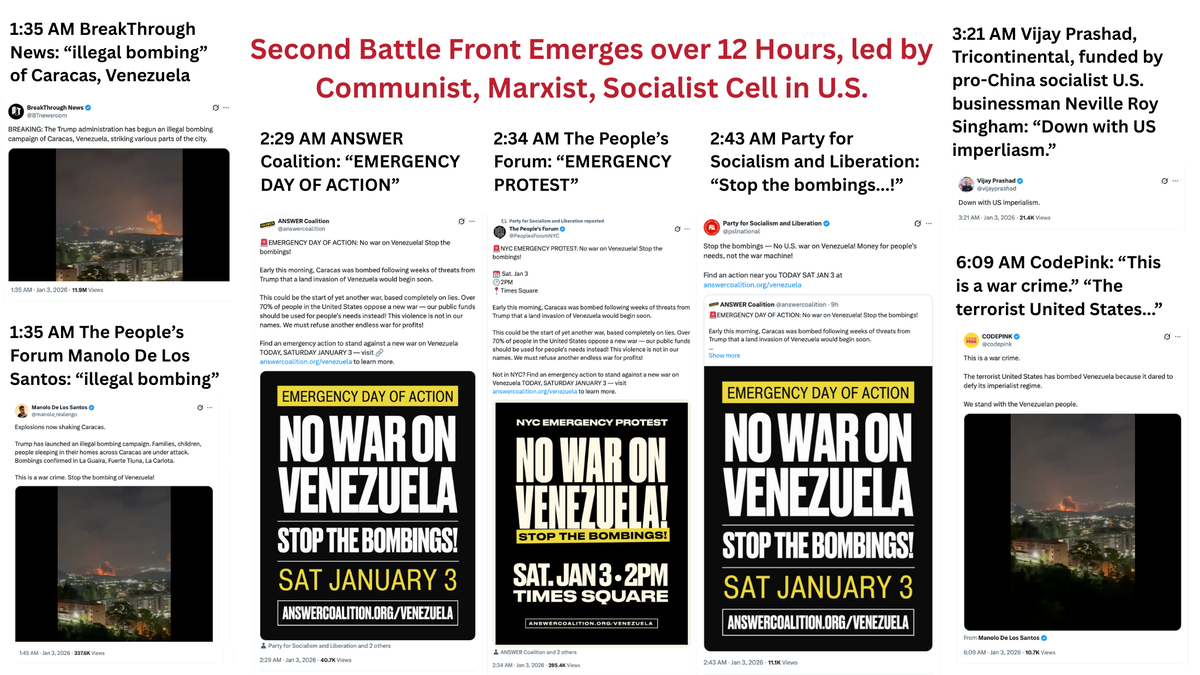
Over 12 hours, a network of self-described socialist, communist and Marxist organizations used social media to launch an anti-American propaganda and street campaign in the U.S. to support Venezuelan President Nicolás Maduro.

Over 12 hours, a network of self-described socialist, communist and Marxist organizations used social media to launch an anti-American propaganda and street campaign in the U.S. to support Venezuelan President Nicolás Maduro. (@BTNewsroom/X, @manolo_realengo/X, @answercoalition/X, @PeoplesForumNYC/X, @PSLNational/X, @VijayPrashad/X, @CodePink/X)

At 1:35 a.m., as U.S. special forces teams had just landed in Venezuela, BreakThrough News, a socialist propaganda arm of the network, published some of the first video from the U.S. military strikes, blasting the Trump administration for waging an "illegal bombing campaign of Caracas," the capital of Venezuela. It was a talking point that was going to stick.

TRUMP REVEALS VENEZUELA’S MADURO WAS CAPTURED IN ‘FORTRESS’-LIKE HOUSE: ‘HE GOT BUM RUSHED SO FAST’

Ten minutes later, at 1:45 a.m., one of the key leaders of this network, Manolo De Los Santos, executive director at The People's Forum, a proudly socialist 501(c)(3) nonprofit based in New York City, echoed the narrative on social media of an "illegal bombing." 

Less than an hour later, at 2:29 a.m., the ANSWER Coalition, a nonprofit co-founded by a proud Marxist, Brian Becker, published a red siren alert on the social media platform X with a slick new poster, calling supporters to the streets in Times Square for a protest Saturday to support Maduro.

"NO WAR ON VENEZUELA! STOP THE BOMBINGS," the poster screamed, on brand.

EXPLOSIONS HEARD IN VENEZUELAN CAPITAL OF CARACAS: REPORTS

Minutes later, at 2:34 a.m., The People’s Forum shared the call-to-action, screaming: "EMERGENCY PROTEST"

Soon after, at 2:43 a.m., the Party for Socialism and Liberation shared the poster on X, saying, "Stop the bombings…!" 

Congressional lawmakers are already investigating this socialist network for its ties to Neville Roy Singham, a United States-born technology executive who relocated to Shanghai after selling his software firm and starting work that critics say is aligned closely with interests of the Chinese Communist Party. Singham didn’t respond to a request for comment.

MADURO MET CHINESE ENVOY HOURS BEFORE US CAPTURE FROM CARACAS AS BEIJING SLAMS OPERATION

By 3:21 a.m., Vijay Prashad, director of Tricontinental: Institute for Social Research, a research institute chaired by Singham that examines issues through the lens of "national liberation Marxism," posted a message, denouncing the military action, declaring, "Down with US imperialism."

Within a few hours, at 6:09 a.m., CodePink, a 501(c)(3) nonprofit founded by Singham’s wife, Jodie Evans, condemned the "terrorist United States…"

MADURO JAILED AT NEW YORK DETENTION CENTER THAT HELD DIDDY, GHISLAINE MAXWELL, AND SAM BANKMAN-FRIED

From a military intelligence perspective, experts say the overnight sequence bears the hallmarks of a pre-positioned influence network executing a rapid-response operation. The synchronization of messaging, the staggered release of content across aligned platforms and the immediate transition from online agitation to physical mobilization point to an ecosystem designed not for spontaneous protest, but for ideological warfare.

In this framework, experts say, the nonprofit leaders are foot soldiers in Maduro’s war on the United States, acting as civilian operatives advancing the strategic interests of a foreign ideological project. Their role is not to fight with weapons, but to contest legitimacy, shape public perception, apply internal pressure on U.S. decision-making during moments of external conflict and further the cause of communism, experts say.

At the center of this domestic front is an international coordination structure known as the International Peoples’ Assembly, which functions as an umbrella organization and political command-and-control hub linking communist parties, socialist movements, activist organizations and state-aligned media outlets worldwide. 

One of its media arms, the People’s Dispatch, has explicitly framed its mission as mobilizing global resistance against "American imperialism," including repeated calls to action on behalf of Venezuela. It lists Singham’s Tricontinental as one of its "partners." The North America members of its "coordinating committee" include CodePink; the Popular Education Project, an initiative of The People’s Forum; and the Party for Socialism and Liberation. Its Venezuelan member is a group called Francisco de Miranda Front, which works closely with its U.S. allies.

At 7:49 a.m., the International People’s Assembly shared the poster for the "EMERGENCY DAY OF ACTION."

It quickly published a statement condemning the U.S. military action as reflective of the country’s "increasingly militaristic and hyper-imperialist orientation" and calling on members to "resist this pursuit of hegemony by any means necessary."

TRUMP VOWS US WILL 'RUN' VENEZUELA UNTIL 'SAFE' TRANSITION OF POWER

The assembly operates in close alignment with Tricontinental, the SIngham organization that functions as an ideological production center, generating narratives, research and messaging disseminated through aligned media platforms and activated through street-level organizations. Singham’s wife, Evans, sits on the International People’s Assembly, tightening the operational loop between messaging, mobilization and leadership.

Experts say the ideological doctrine guiding this network is shaped in part by Prashad, who also serves as editor of People’s Dispatch. 

On the operational side, De Los Santos, executive director at The People’s Forum, has emerged as a visible field organizer. He is listed as a researcher at Tricontinental and has repeatedly appeared at regime-aligned events in Venezuela, functioning as a liaison between the ideological center and street-level mobilization abroad and at home.

MADURO GAVE STATE TV ADDRESS AS US STRIKES IN VENEZUELA BEGAN: REPORT

In 2003, Cuban leader Fidel Castro and Venezuelan leader Hugo Chávez backed a new group in Venezuela, the Francisco de Miranda Front, laying the groundwork for an international solidarity apparatus that joined the International People’s Assembly, working with U.S. groups. That infrastructure matured over time into a durable support system for Maduro when he was elected president in 2013.

By March 2019, that relationship was well-entrenched when De Los Santos organized a pro-Maduro protest outside Venezuela’s consulate in New York, physically denying opposition figures access to the building.

TRUMP CASTS MADURO’S OUSTER AS ‘SMART’ MOVE AS RUSSIA, CHINA ENTER THE FRAY

That month, the Party for Socialism and Liberation’s Claudia De la Cruz jetted to Venezuela for a four-day conference of the International Peoples’ Assembly in Caracas, urging socialists to "collectivize" their efforts to fight the "capitalist crisis" in the world, according to a video shared from the meeting with the hashtag #HandsOffVenezuela..

"Venezuela is the epicenter," she declared. "Venezuela is the personification of the anti-imperialist struggle."

The next month, The People’s Forum hosted Venezuelan Foreign Minister Jorge Arreaza during a talk in which he demanded the U.S. end sanctions on the country, according to an article in "Fight Back! News," a publication by members of the Freedom Road Socialist Organization. "The evening concluded with Arreaza thanking the crowd and urging people to keep fighting and protesting," the article noted. "Manolo de los Santos, the executive director of The People’s Forum, took up Arreaza on his request and called the crowd to action."

WHAT IS DELTA FORCE AND WHAT DO THEY DO? INSIDE THE ELITE US ARMY UNIT THAT CAPTURED MADURO

In May 2019, when a coup attempt failed, De Los Santos appeared on teleSUR, the state-funded TV network in Caracas, saying he’d organized a press conference with religious leaders in New York City to "engage in the battle of ideas" against "imperialist aggression."
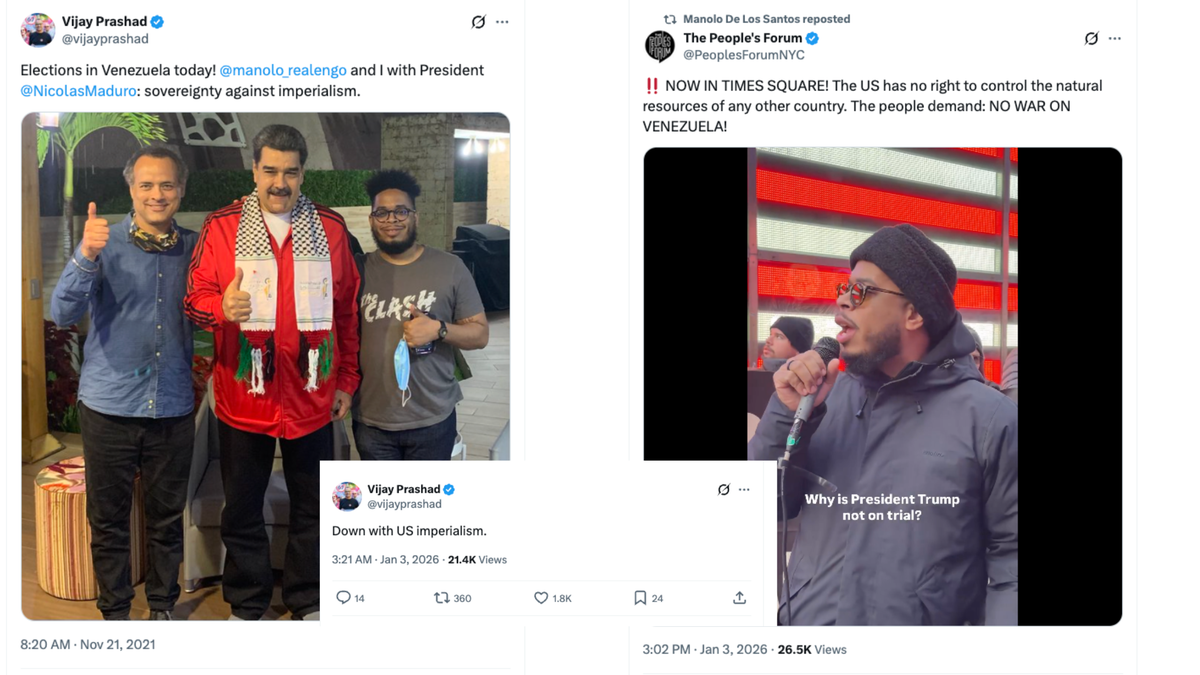
socialist leaders

Two leaders in the global socialist network, Vijay Prashad and Manola De Los Santos, stand with Nicolás Maduro on election day in 2021. They emerged as outspoken leaders in the pro-Maduro protests after Maduro's arrest by U.S. military forces. (@VijayPrashad/X, @manolo_realengo/X)

Two years later, in November 2021, Prashad and De Los Santos shared a photo with Maduro, all of them flashing a thumbs-up, with Prashad writing, "Elections in Venezuela today!" He noted that he stood with De Los Santos and Maduro, supporting "sovereignty against imperialism." 

The next month, De Los Santos participated in a Caracas conference livestreamed on Maduro’s X account, speaking at the 59-minute mark and holding up a manifesto, "Plan para salvar la humanidad," or "Plan to save humanity."

He returned to Caracas in April 2022 for the International Anti-Fascist Summit, posting a photo with Eugene Puryear, a senior figure in the Party for Socialism and Liberation, further reinforcing the operational linkage between U.S.-based activists and foreign political structures.

HOUSE DEMOCRAT CALLS TRUMP'S MADURO CAPTURE 'WELCOME NEWS' AS LEFT ACCUSES HIM OF 'ILLEGAL ACTIONS'

The pattern intensified the next year when De Los Santos and De la Cruz attended a conference sponsored by the Maduro government to explicitly preserve the ideological legacy of "Comandante Chávez," their term of reverence for Chávez.

In late April 2024, Maduro even recognized De Los Santos as he thanked attendees of a conference of the "Bolivarian Alliance for the Peoples of Our America," established by Cuba and Venezuela in 2004 to unite communist economic interests.

This past fall, a wide network that included the Communist Party USA, the All-African People’s Revolutionary Party and the Struggle for Socialism Party supported an "urgent call for a week of coordinated protests" to support Maduro. Last month, the network took action again, organizing "NO WAR ON VENEZUELA" protests.

RUBIO TO CUBA: 'I'D BE CONCERNED' AFTER US MILITARY ARRESTS VENEZUELAN LEADER MADURO

The newest overnight campaign to support Maduro will likely send foot soldiers into the streets to support Maduro and his wife during any trials they face, not just as an expression of protest but as a continued campaign of information warfare on the domestic front. 

Experts say the network that spent decades legitimizing and defending communist regimes abroad and now functions as a rapid-response influence force inside the United States is a new threat matrix that amounts to something the FBI and intelligence agencies investigate as malign foreign influence.

Its members operate as ideological foot soldiers, advancing a foreign-aligned narrative during moments of conflict, seeking to fracture public consensus, delegitimize U.S. action and apply pressure from within.

SEE PICS: VENEZUELANS WORLDWIDE CELEBRATE AS EXILES REACT TO MADURO’S CAPTURE
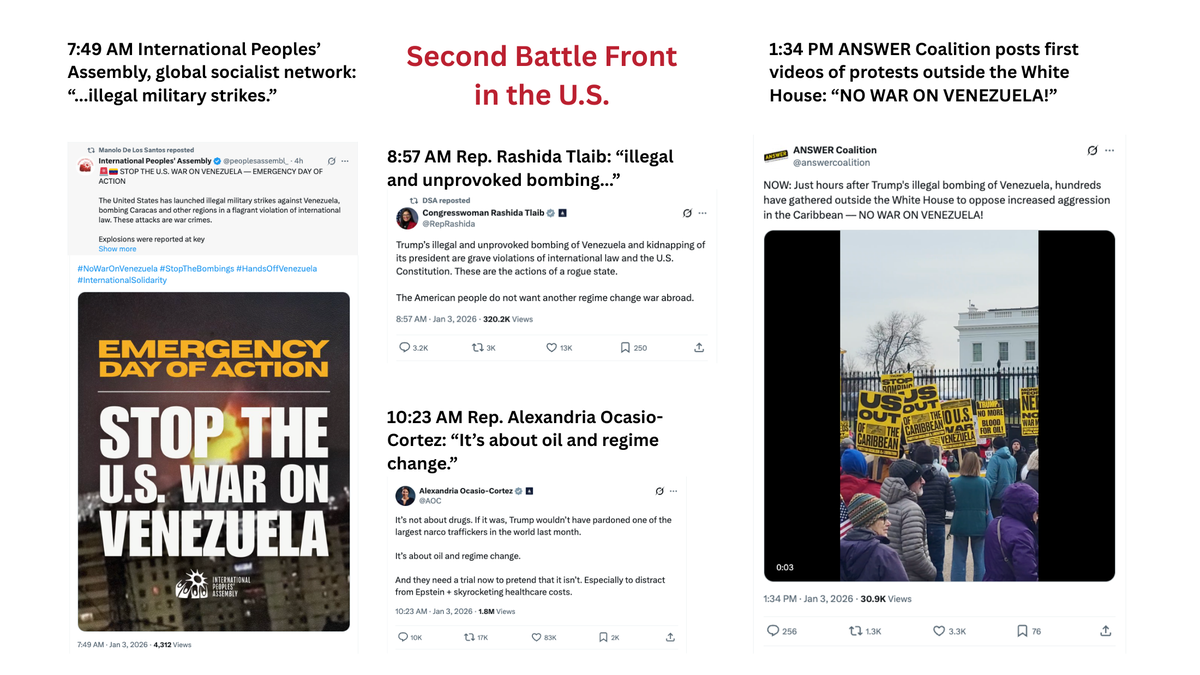
attack criticism

Over the 12 hours of activation to support Maduro, politicians endorsed by the Democratic Socialists of America echoed criticism of the U.S. action as illegal, and socialist pro-Maduro organizations in the U.S. activated members to join street protests. (@PeopleAssembl_/X, @RepRashida/X, @AOC/X, @AnswerCoalition/X)

By daylight Saturday morning, at 8:49 a.m., CodePink invoked a slogan used last year as a theme in anti-Trump protests, declaring, "HANDS OFF VENEZUELA," and issuing a statement dismissing criminal proceedings against Maduro as a "sham" prosecution. 

By 8:57 a.m., the Democratic Socialists of America, which just saw its star politician, Zohran Mamdani, inaugurated as mayor of New York City, shared a message from U.S. Rep. Rashida Tlaib, a member of the organization, condemning the U.S. strike as "illegal." 

At 10:29 a.m., Rep. Alexandria Ocasio-Cortez, another member of the Democratic Socialists of America, chimed in, saying, "It’s about oil and regime change."

On cue, at 1:06 p.m, Mamdani repeated the refrain established overnight by the socialist network that brought him to the mayor’s office in New York City, blasting the U.S. for the "military capture" of Maduro, calling it an "act of war" and "blatant pursuit of regime change." 

The talking points of politicians, activist groups and foot soldiers in the socialist, communist and Marxist network in the U.S. echoed the statements that the two strongest communist powers in the world expressed about their ally, Maduro. China issued a statement saying it opposed the "blatant use of force" by the U.S. in Venezuela. Russia called the news an "act of aggression" against Venezuela.

By afternoon, within 12 hours of first hearing about the military operation in Caracas, the pro-Maduro network started churning out fast clips of its information war on the Trump administration.

MADURO-BACKED TDA GANG’S EXPANSION INTO US CITIES EMERGES AS KEY FOCUS OF SWEEPING DOJ INDICTMENT

At 1:34 p.m., the social media team at the ANSWER Coalition posted a closely cropped video of protesters, holding the ANSWER Coalition’s distinctive yellow-and-black signs and chanting in front of the White House, "Stop the war machine!" The Party for Socialism and Liberation immediately shared the video.

A little over an hour later, at 2:42 p.m., The People’s Forum shared a video of Becker, the co-founder of the ANSWER Coalition, from Times Square in New York City, a camera filming him from behind, as he declared, "This is a capitalist war! It’s a rich man’s war! The kidnapping of Maduro is an imperialist war for a capitalist class!"

MS Now, the new name for MSNBC, reported from the Times Square protest and its reporter only shared a throwaway line about the ANSWER Coalition having a "speakers’ program going on behind us," without cluing viewers into the group’s proud Marxist politics. 

Online, at 3 p.m., wearing a black-and-white checkered collared shirt, the Party for Socialism and Liberation’s Puryear hosted a YouTube livestream, joined by Tricontinental’s Prashad and others. BreakThrough News promoted the livestream with a new piece of graphic propaganda, showing Trump with a mouth gaping open and Maduro with his chin high, appearing stoic and regal.

IRAN AND MADURO TIES SUFFER MAJOR BLOW FOLLOWING US OPERATION AND CAPTURE OF VENEZUELAN DICTATOR

At 3:02 p.m., The People’s Forum shared a video clip on its X account of De Los Santos at the Times Square protest, a microphone in his hand as he scanned the crowd and railed against the U.S., calling the Trump administration a "criminal enterprise" for "kidnapping" Maduro.

"Shame!" the crowd responded, in a typical refrain for the group’s protests.

Back on the BreakThrough News livestream, Puryear asked Becker about the "quick turnaround" on organizing the protests.

NYC MAYOR STRONGLY CONDEMNS TRUMP'S CAPTURE OF VENEZUELAN LEADER MADURO AS 'ACT OF WAR'

Becker spoke about the night before like a field marshal. 

"A few of us stood up all night last night when we heard the news, conferring with each other, conferring with other organizers and, by 3:30, 4 o’clock this morning, we put out the call for demonstrations to happen today, Saturday, Jan. 3," he said. 

Between 10 a.m. and 11:30 a.m., he said, leaders of anti-Trump groups, including 50501, which organized "HandsOff" and "TakedownTesla" protests, reached out to the pro-Maduro organizers to join their protests, and the protest numbers swelled with the "entrance" of the groups more closely aligned with the Democratic Party.

Now, he bragged, the results were protests in "100-plus cities."

As the jet with Maduro and his wife touched down in the U.S. at Stewart Airport in New Windsor, New York, agents with "DEA" across their jackets boarding the plane, the caption on the livestream said proudly: "ANTI-WAR PROTESTS SWEEP U.S."

"We should be raging!" Becker declared, stoking the "working class" to join the "class war, global war, anti-imperialist war." 

The protests today, he warned, "are a harbinger of what’s coming."


Asra Q. Nomani is the author of "Woke Army: The Left-Green Alliance That Is Undermining America’s Freedom," and the founder of the Pearl Project, a nonprofit journalism initiative. She is co-founder of the Clarity Coalition and Muslim Reform Movement, opposing Islamic extremism and advocating for Muslim reform. She can be reached at asra@asranomani.com and @AsraNomani on X.

Source: https://www.foxnews.com/politics/second-front-how-socialist-cell-us-mobilized-pro-maduro-foot-soldiers-within-12-hours

Follow Middle East and Terrorism on Twitter

For Hamas Actually to Disarm, Trump Must Forget About All of Its Supporters: Turkey, Qatar, Pakistan, Iran – and the Palestinian Authority - Con Coughlin


by Con Coughlin

Israeli officials believe that Turkey, and Qatar, which does not have diplomatic relations with Israel, are instead working on alternative solutions that would not require Hamas to disarm. The Turks and Qataris have proposed that Hamas either transfer its weapons to the Palestinian Authority (PA), or to some kind of "secure storage under oversight." Behind both proposals lies the aim of preserving Hamas' influence in Gaza and ability to rearm. Israel insists, however, that Hamas must be weapons‑free.


  • Ever since Trump succeeded in implementing the first stage of his 20-point plan for ending the Gaza conflict, Hamas has received widespread backing from its supporters in Ankara, Doha, Islamabad and Tehran for ignoring demands to surrender its weapons.

  • Hamas's recalcitrance on the disarmament issue, moreover, has been reinforced by the support it has received from its backers in Turkey, Qatar, Pakistan and Iran to ignore the Trump administration's disarmament demand.

  • Israeli officials believe that Turkey, and Qatar, which does not have diplomatic relations with Israel, are instead working on alternative solutions that would not require Hamas to disarm. The Turks and Qataris have proposed that Hamas either transfer its weapons to the Palestinian Authority (PA), or to some kind of "secure storage under oversight." Behind both proposals lies the aim of preserving Hamas' influence in Gaza and ability to rearm. Israel insists, however, that Hamas must be weapons‑free.

  • Instead, all of Hamas's backers -- as well as the Palestinian Authority waiting in the wings to displace the group -- continue playing their dangerous double game of trying to be allies of both the Trump administration and Hamas's terrorist leadership at the same time.

  • In addition, Turkey, Qatar, Iran and Pakistan have never designated Hamas as a terrorist organisation – and believe that it is entitled to continue its "resistance" -- meaning terrorism –- against Israel.

  • It is commendable that the US president, rather than acting rashly, has continually offered adversaries -- such as Russia, China and Iran -- time to consider his requests. Hamas's allies, however, including the Palestinian Authority in its current form, have little incentive ever actually to comply with Trump's demands.

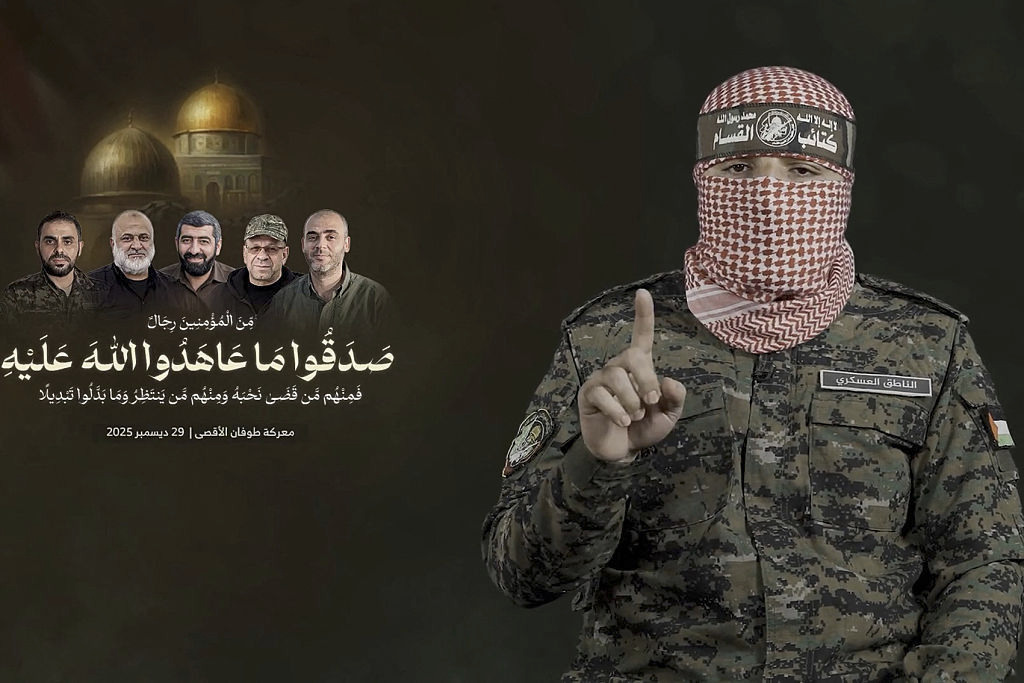
US President Donald Trump's demand that Hamas terrorists completely disarm will only happen if the White House is prepared to pressure countries such as Turkey, Qatar and Iran, which have historically backed the terror group, to force Hamas militants to lay down their arms. Pictured: A Hamas spokesman appears in a recorded statement to the media, in the Gaza Strip on December 29, 2025. (Photo by AFP via Getty Images)

US President Donald Trump's demand that Hamas terrorists completely disarm will only happen if the White House is prepared to pressure countries such as Turkey, Qatar and Iran, which have historically backed the terror group, to force Hamas militants to lay down their arms.

Ever since Trump succeeded in implementing the first stage of his 20-point plan for ending the Gaza conflict, Hamas has received widespread backing from its supporters in Ankara, Doha, Islamabad and Tehran for ignoring demands to surrender its weapons.

Requiring Hamas to disarm and end its malevolent presence in Gaza was one of Trump's key stipulations when drawing up his peace plan, with the disarmament process expected to begin as soon as all the remaining Israeli hostages had been released in return for hundreds of Palestinian prisoners.

While the initial phase of Trump's peace plan has proved to be a success, with all but one of the fallen Israeli hostages being returned, Hamas has shown scant interest in complying with the disarmament requirement.

Back in August, when the Trump administration was working hard to implement its Gaza ceasefire plan, Hamas issued a statement rejecting the demand to disarm, insisting that it would only consider doing so once an "independent, fully sovereign Palestinian state with Jerusalem as its capital" was established.

The group has maintained this uncompromising position ever since, declaring in a rare interview with The Times of Israel earlier this month that the group will only agree to give up its weapons through negotiations that result in the establishment of a Palestinian state.

"This cannot be done by force or ultimatums. Israel used all of its military might for two years [to try and disarm Hamas], and it didn't work," the Hamas source said in a rare engagement with an Israeli media outlet.

Hamas's recalcitrance on the disarmament issue, moreover, has been reinforced by the support it has received from its backers in Turkey, Qatar, Pakistan and Iran to ignore the Trump administration's disarmament demand.

Israeli officials believe that Turkey, and Qatar, which does not have diplomatic relations with Israel, are instead working on alternative solutions that would not require Hamas to disarm. The Turks and Qataris have proposed that Hamas either transfer its weapons to the Palestinian Authority (PA), or to some kind of "secure storage under oversight." Behind both proposals lies the aim of preserving Hamas' influence in Gaza and ability to rearm. Israel insists, however, that Hamas must be weapons‑free.

At the same time, Iran, which is quietly continuing to build its nuclear and missile programmes after the devastating setback it suffered during last summer's military confrontation with Israel and the US, is reportedly maintaining its military and financial support for Hamas's terrorist infrastructure.

Hamas's refusal to disarm, which has been strengthened by the support it has received from its regional backers, certainly poses a significant obstacle for Trump and his efforts to make sure his ceasefire plan for Gaza survives.

Israel has indicated its willingness to resume the war if the Palestinian terror group does not give up its weapons, while Hamas's refusal to disarm has discouraged a number of pro-Western Arab governments, such as Jordan, from supporting Trump's plan to create an "international stabilization force" (ISF) to keep the peace in Gaza while peace talks continue.

In August 2024, Jordan, Qatar and Saudi Arabia were approached about joining the planned ISF in Gaza, but solidly rebuffed the idea.

Jordan's King Abdullah II has been particularly outspoken about contributing to the force so long as Hamas retains its terrorist infrastructure. He warned in a recent BBC interview that, "If we're running around Gaza on patrol with weapons, that's not a situation that any country would like to get involved in."

In such circumstances, it is hardly surprising that Trump is losing patience with the Hamas leadership, warning that there would be "hell to pay" if it does not disarm within a "very short period".

Trump issued his warning following talks with Israeli Prime Minister Benjamin Netanyahu at the president's Mar-a-Lago resort in Florida, insisting that Hamas "will be given a very short period of time to disarm...If they don't disarm, as they agreed to do... then there will be hell to pay for them."

If Trump is really serious about getting Hamas to disarm, then he needs to forget about the terror group's key backers -- most notably Turkey, Qatar and Iran, as well as Pakistan, who clearly will never actually force Hamas to fulfil its disarmament commitments. Instead, all of Hamas's backers -- as well as the Palestinian Authority waiting in the wings to displace the group -- continue playing their dangerous double game of trying to be allies of both the Trump administration and Hamas's terrorist leadership at the same time.

A good way to pressure Turkey to play a more constructive role in persuading Hamas to disarm, instead of endlessly trying to devise ways for the terror group to hold on to its weapons, would be for the White House to suspend its controversial plan to sell F-35 stealth fighters to Ankara.

Unfortunately, that sale could easily incentivise Turkey to agree to a deal in order to acquire the aircraft; then, when "stabilising" Gaza, simply look the other way at Hamas violations, or even assist the terrorist group -- possibly after the F-35s have been safely delivered to Ankara.

Similarly, Trump could increase the pressure on Qatar to play ball by threatening to rescind the executive order he signed in September committing the US to protect the Gulf state. Entitled "Assuring the Security of the State of Qatar", the order recognizes the "enduring alliance" between the US and Qatar and provides Qatar an explicit security guarantee in the event of "external attack," stating that:

"[T]he United States shall take all lawful and appropriate measures—including diplomatic, economic, and, if necessary, military—to defend the interests of the United States and the State of Qatar and to restore peace and stability."

However, after Qatar's exorbitant generosity to the US – pledged investments of $1.2 trillion as well as a $400 million 747-jumbo jet -- the probability of Trump's exerting any pressure on Qatar to do anything is likely close to zero.

Pakistan, teeming with jihadi organisations, has steadfastly refused even to recognise Israel, unless there is a Palestinian state with East Jerusalem as its capital and unless Israel withdraws to the indefensible 1949 armistice line.

As for Iran, both Trump and Netanyahu made it abundantly clear during their Mar-a-Lago summit that they were fully prepared to undertake further military action against the ayatollahs if they persisted with their nuclear activities as well as other "weapons." If Iran wants to avoid further humiliation at the hands of the US and Israel, it would be well-advised not to interfere in Trump's peace efforts in Gaza.

In addition, Turkey, Qatar, Iran and Pakistan have never designated Hamas as a terrorist organisation – and believe that it is entitled to continue its "resistance" -- meaning terrorism –- against Israel.

As for the Palestinian Authority, it supports Phase II of Trump's 20-point plan, most likely because Hamas has been its rival, even violently ousting the PA from Gaza in 2007. However, not only are the PA's security forces evidently involved in terror, but for decades, its senior officials and leading figures have openly said that Israel has no right to exist (such as here, here, here and here). In July, the Qatari government daily Al-Sharq was obliquely careful to quote a Palestinian journalist as saying that by 2027, Israel will cease to exist.

Trump may think that threatening Hamas directly will help him to achieve his goal of forcing the terror group to disarm. His efforts, however, are far more likely to succeed if, as he stated on December 30, Hamas does not follow his recommendation to disarm by a certain date. It is commendable that the US president, rather than acting rashly, has continually offered adversaries -- such as Russia, China and Iran -- time to consider his requests. Hamas's allies, however, including the Palestinian Authority in its current form, have little incentive ever actually to comply with Trump's demands.


Con Coughlin is the Telegraph's Defence and Foreign Affairs Editor and a Distinguished Senior Fellow at Gatestone Institute.

Source: https://www.gatestoneinstitute.org/22173/hamas-disarm

Follow Middle East and Terrorism on Twitter

Trump ‘unequivocal’ that Hamas must disarm for Gaza truce to proceed, Netanyahu says - JNS Staff


by JNS Staff

"This is a necessary and fundamental condition for the implementation of his 20-point plan," said the Israeli premier.


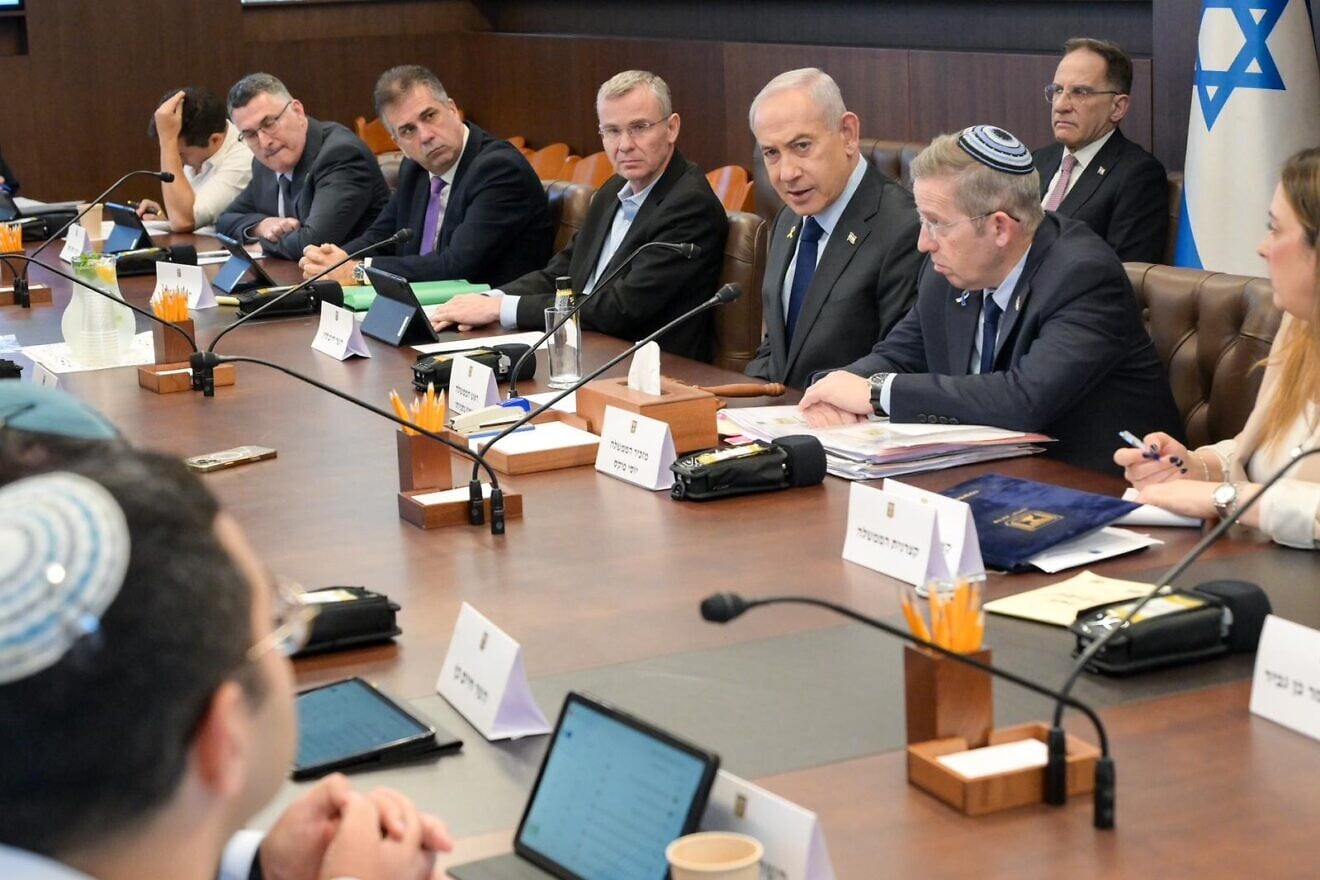
Israeli Prime Minister Benjamin Netanyahu addresses a Cabinet meeting in Jerusalem, Jan. 4, 2025. Photo by Maayan Toaf/GPO.


President Donald Trump has been “unequivocal,” both in private and in public, that Hamas needs to disarm as a condition for his 20-point peace plan to proceed, Israeli Prime Minister Benjamin Netanyahu said on Sunday.

“This is a necessary and fundamental condition for the implementation of his 20-point plan. He made no concessions on this and showed no flexibility on this matter,” Netanyahu stated, addressing journalists ahead of the weekly Cabinet meeting in Jerusalem on Sunday.

Netanyahu’s visit last week to Trump’s Mar-a-Lago club in Palm Beach, Fla., contributed to “deepening the dual relationship—between Israel and the United States, and of course the personal bond,” he added.

During the visit, Trump told journalists that Hamas would be allowed a “very short period of time” to demilitarize or “there will be hell to pay for them.” While the president said he wants to move to Phase 2 “as quickly as we can,” he stopped short of offering any concrete timeline.

The prime minister said on Sunday it was “very moving for my wife and me to stand alongside the president and his wife and celebrate the entry of the new year, which we hope will be even better than the past year.

“President Trump asked me: ‘Tell me, do you like fireworks?’ I told him: ‘It’s preferable to other things that explode in the sky, but with that too we have learned to deal very well.’ Of course, he understood.”

Netanyahu told Fox News last week that progress toward the next phase hinges on Hamas disarming, calling the terrorist group’s refusal to give up its weapons the central obstacle to stabilizing the territory in 2026.

The prime minister told Fox that he believed a different future for Gaza was still possible in the year ahead “if we disarm Hamas, whether with an international force or by any other means.” He added, “If it can be done the easy way, fine. And if not, it’ll be done another way.”

The Palestinian terrorist organization still has around 20,000 operatives and 60,000 rifles, Netanyahu revealed.

“That’s what disarmament means—got to take all these rifles, take them away from them, and break up those terror tunnels that they have, still hundreds of kilometers of terror tunnels,” the premier told Fox News.

Hamas leader Khaled Mashaal on Dec. 6 repeated calls for the Jewish state’s destruction, rejecting U.S.- and U.N.-backed demands to disarm the Iranian-supported terrorist group and demilitarize the Gaza Strip.

“The resistance and its weapons are the honor and pride of the ummah [the Islamic nation],” Mashaal told an anti-Israel summit in Turkey. “A thousand statements are not worth a single projectile of iron.”

The IDF on Saturday carried out a precise strike on a Hamas tunnel shaft in the northern Gaza Strip containing a rocket launcher “loaded and ready to be launched toward the city of Sderot,” the military said. It added that the terror group’s action was a “blatant” truce violation.

Meanwhile, the Israeli Foreign Ministry said on Sunday that Hamas was violating the ceasefire “every day” by refusing to return the remains of Israel Police Master Sgt. Ran Gvili, the last remaining hostage, whose body was taken after fighting terrorists during the Oct. 7 massacre.

The Palestinian terrorist organization slow-walked the release of the hostages’ remains, despite being obligated to return all 28 bodies on Oct. 13 in accordance with the ceasefire agreement it agreed to.


JNS Staff

Source: https://www.jns.org/trump-unequivocal-that-hamas-must-disarm-for-gaza-truce-to-proceed-netanyahu-says/

Follow Middle East and Terrorism on Twitter

A weakened regime, fragmented protests: Iran at a critical juncture - analysis - Yonah Jeremy Bob


by Yonah Jeremy Bob

A weakened regime and deep economic anger have created an opening, but scattered protests now face a decisive moment


 Iran's Supreme Leader Ayatollah Ali Khamenei speaks during a meeting in Tehran, Iran January 3, 2026.
Iran's Supreme Leader Ayatollah Ali Khamenei speaks during a meeting in Tehran, Iran January 3, 2026.
(photo credit: Office of the Iranian Supreme Leader/WANA (West Asia News Agency)/Handout via REUTERS)

In 2009, 2017, 2019, and 2022, major protests in Iran shook the regime, but were eventually put down by a mix of the Supreme Leader Ayatollah Ali Khamenei's Islamic Revolutionary Guard Corps and Basij stormtroopers, who are willing to kill and beat their own citizens without a second thought.

The coming days will probably dictate whether the recent protests, which began on December 28, will finally be the wave that cracks Khamenei's 36-year rule, or whether the demonstrators meet the same fate as the prior rounds.

There have been two major advantages for the protesters this time as opposed to prior rounds.

One is that the regime's military power is at a decades-long low.

After Israel attacked Tehran in June 2025, Khamenei not only lost most of his nuclear program, half of his ballistic missiles, 80% of his air defense, and over 30 top military and IRGC commanders, but the IRGC and the Basij also took specific hits from the IDF in the final days of the campaign.

FILE PHOTO: People walk past closed shops, following protests over a plunge in the currency's value, in the Tehran Grand Bazaar in Tehran, Iran, December 30, 2025. (credit: MAJID ASGARIPOUR/WANA (WEST ASIA NEWS AGENCY) VIA REUTERS)
This included striking the infamous Evin prison, facilitating some prisoners' fleeing, and forcing the Islamic Republic to relocate 1,500 prisoners elsewhere.

Finally, Khamenei himself hid for much of the war, harming his brand of having absolute control.

In that sense, Khamenei is at his weakest militarily, both in actual physical terms of having lost many assets of repressive power and also in psychological terms regarding his perceived status.

Second is that the protests have been spurred on by broad economic problems that impact all Iranians, including the regime's Shi'ite supporters and merchants from the bazaar who are often viewed as influential for political trends.

This is as opposed to some protests, which involved mainly Sunni, Kurds, reformers, and other minorities and weaker critics of the regime.

People are protesting high fuel prices, inflation, and a lack of running water.

In other words, no one really disagrees with the arguments of the protesters or feels their complaints are invalid. 

Possibly because of all of these above factors, while Khamenei has started to use some IRGC and Basij oppression to date, crackdowns have not yet reached the viciousness of earlier protest periods.

Despite these positives, there are plenty of counter reasons to think that the chances of regime change are even smaller this time than in some prior protests.

No central leader

The current protests have no central leader or figures.

This makes it difficult to achieve a specific outcome.

Merely protesting in public with no defined end goal and no specific program to reach it is usually a recipe for not achieving much.

Further, the protests, while widespread, have been relatively small.

There have been no protests yet of hundreds of thousands or even close to that.

There is little potential for protests to achieve regime change, if they don't reach the hundreds of thousands or more level, as some prior rounds did.

Protesters need to start reaching much higher numbers in the coming days if they want a real chance to topple the regime and to maintain momentum.

Next, paradoxically, the war with Israel, or its aftermath, may have strengthened Khamenei's hand.

There really was a brief moment after the war ended on June 24, 2025, when Khamenei and his supporters were terrified that they might lose control.

Had the world and the Iranian nation taken advantage of that moment, Khamenei might have been much weaker.

But when Khamenei saw that no one, global or domestic, was seeking to topple him, he ordered one of the widest and most brutal crackdowns in years.

Many regime opponents were killed, beaten, or detained indefinitely.

This is likely one of the reasons there is no central leader this time.

Many of the figures who might have taken charge were dealt with by Khamenei this past summer, immediately after the war.

No one came to their aid in those critical moments.

Moreover, while having the bazaar involved in the protests is helpful, this is not the first time they have helped with demonstrations, and there have been other times that this did not turn the tide.

Instead, the protesters would need elements of the Iranian military to defect to their side of the conflict in order to protect them from crackdowns by the IRGC and the Basij.

All signs after a recent speech from Khamenei, who had waited out the first week before commenting publicly, are that a crackdown is on the way.

It seems he wanted to size up and analyze the protests and also show some flexibility and sympathy to the economic anger underlying them, before launching his crackdown.

If he launches the crackdown now, and whether some Iranian military elements finally defect to help protesters for the first time since the Islamic Revolution of 1979, could be decisive.

There is a twist with recent comments by US President Donald Trump that he would intervene if Iran starts cracking down on its protesters, and some are taking this seriously after he bombed the Islamic Republic in June 2025 and abducted Venezuelan leader Nicolas Maduro on Saturday.

But those excited by Trump's statement should recall his statement on December 29, when asked about the chances of regime change, in which he implied the chances were low because he expected Khamenei to crack down on the protesters, leaving no hint that he would intervene.

Yes, Trump ordered the bombing of three Iranian nuclear sites this past June.

But that was when Israel was doing the lion's share of the work, including eliminating Iranian radar and air defenses.

Israel has no plans to intervene for Iranian regime change, so Trump would be on his own this time, risking American lives against an enemy far more formidable than Maduro and Venezuela.

Also, right or wrong, Trump has framed his conflict with Venezuela as a counterstrike against a quieter, steadier drug war that the country and other Latin American countries have waged with the US.

In contrast, Trump has run in the other direction any time someone mentioned helping build democracy or nation-building in the Middle East.

It is hard to see him using sufficient and sustained US power to prevent the regime from a domestic crackdown within its own territory.

All of this makes the coming days critical for the protests.

Either they will increase in size, focus, leadership, and gain some kind of military support, or they will likely start taking a much harsher hit from the regime, which will cap their size and momentum, and eventually lead to them petering out like prior protests, even if that process may take time.  


Yonah Jeremy Bob

Source: https://www.jpost.com/middle-east/iran-news/article-882207

Follow Middle East and Terrorism on Twitter

Marco Rubio voices concern that Americans may someday be arrested for social media posts when visiting Europe - Alexander Hall


by Alexander Hall

'Are we going to live in a world where some American puts up a social media post and then gets to some airport somewhere and is arrested?' Rubio asked 


Secretary of State Marco Rubio warned during a press briefing that he is concerned about American tourists being arrested for old social media posts.

Since the inauguration, one of the key foreign policy priorities of President Donald Trump’s administration has been freedom of speech in Europe. While America and its people have a close relationship with Europe, particularly the United Kingdom, the crackdown by ostensibly liberal western democracies on free speech has been a key source of conflict.

Rubio was asked during a Dec. 19 press briefing, "The State Department mentioned earlier this year some free speech concerns, particularly in Europe.  What are some goals you have in regards to that in 2026?"

"Well, I mean, broadly, we’re concerned about any place first and foremost where American free speech could be implicated, all right," he said. 

JOE ROGAN THINKS HE'D GET ARRESTED IF HE HOSTED HIS SHOW FROM THE UK DUE TO SPEECH LAWS

"Are we going to live in a world where some American puts up a social media post and then gets to some airport somewhere and is arrested?" Rubio asked. "We’re also concerned about the impact that some of their policies are having on our social media platforms, as you recently saw. X is facing this massive multimillion-dollar fine that they’re going to have to pay, I guess, if they want to continue to operate.

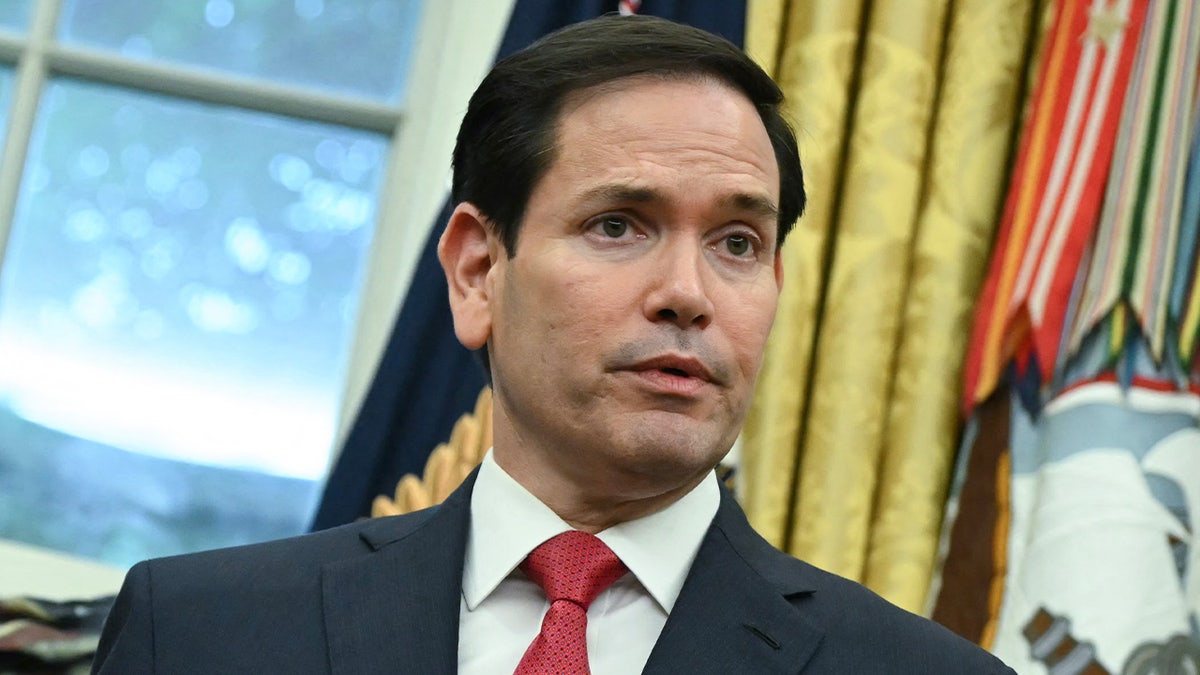
Marco Rubio in the Oval Office

U.S. Secretary of State Marco Rubio warned of a concerning scenario in which American tourists are arrested in a foreign airport for past social media posts. (Andrew Caballero-Reynolds/AFP via Getty Images)

"But I think, more importantly, I think it touches on the broader question that was asked a little bit earlier. We all talk about how these alliances — in many cases, our alliances with our European partners — are built on our common principles, our common values, as much as anything else. These are just a geopolitical arrangement. It is an alliance with like-minded countries with whom we share values and principles. And one of those values and principles, we hope, is freedom and the freedom of expression. And we are concerned that that is eroding."

One recent example of European officials threatening to punish Americans was in August 2024, when a prominent London police commissioner made headlines for threatening to extradite U.S. citizens to be tried in the U.K. for breaking hate speech laws online. Citizens there routinely encounter police on their doorstep for politically incorrect comments made on social media.

Vice President JD Vance criticized European leaders directly at the Munich Security Conference in February, saying the continent's recent censorship activities were a bigger threat to its existence than Russia.

"Within living memory of many of you in this room, the Cold War positioned defenders of democracy against much more tyrannical forces on this continent. And consider the side in that fight that censored dissidents, that closed churches, that canceled elections," Vance said. 

DAN GAINOR: ENGLAND DOESN’T HAVE FREE SPEECH AND WANTS TO TAKE OURS AWAY, TOO

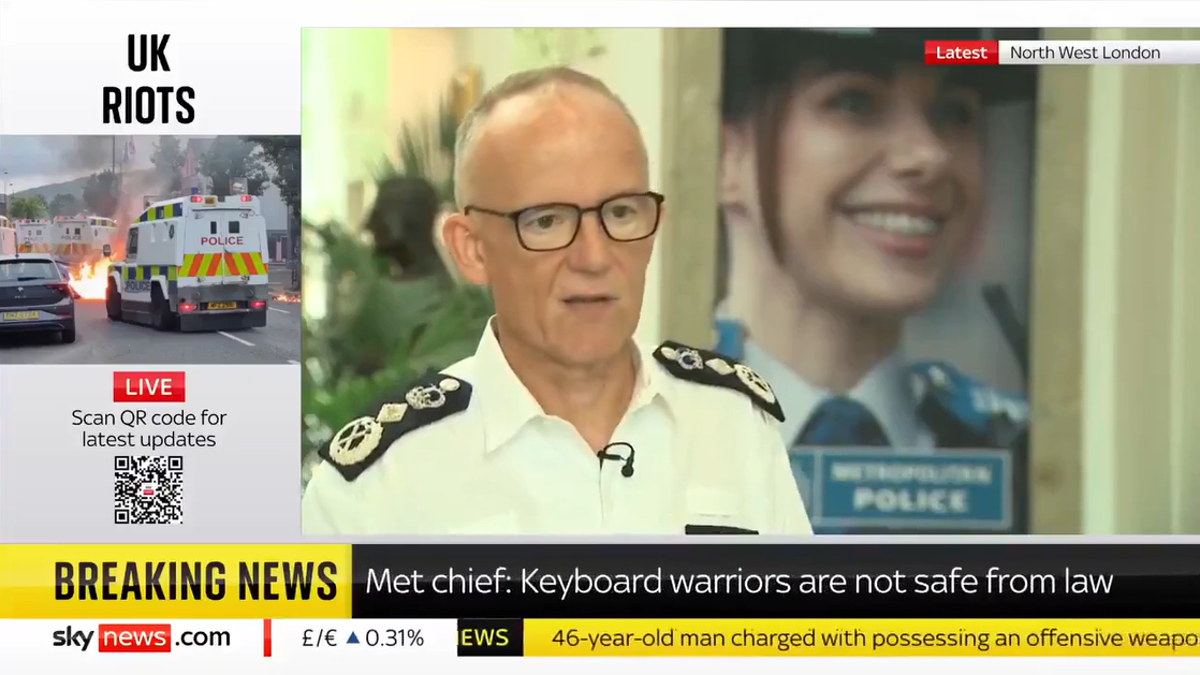
Metropolitan Police Commissioner Sir Mark Rowley

The British government announced it will not only be cracking down on British citizens for commenting on the riots in the U.K., but on American citizens as well. (Sky News)

"Unfortunately, when I look at Europe today, it's sometimes not so clear what happened to some of the Cold War's winners," he continued. "I look to Brussels, where EU commissars warn citizens that they intend to shut down social media during times of civil unrest the moment they spot what they've judged to be ‘hateful content’ or to this very country where police have carried out raids against citizens suspected of posting anti-feminist comments online as part of ‘combating misogyny on the internet.’"

The Trump administration also imposed visa bans on former European Union Commissioner Thierry Breton, who was behind the Digital Services Act (DSA), and four fellow anti-disinformation campaigners, accusing them of censoring American platforms.

"The State Department is taking decisive action against five individuals who have led organized efforts to coerce American platforms to censor, demonetize and suppress American viewpoints they oppose," Rubio said in a statement.


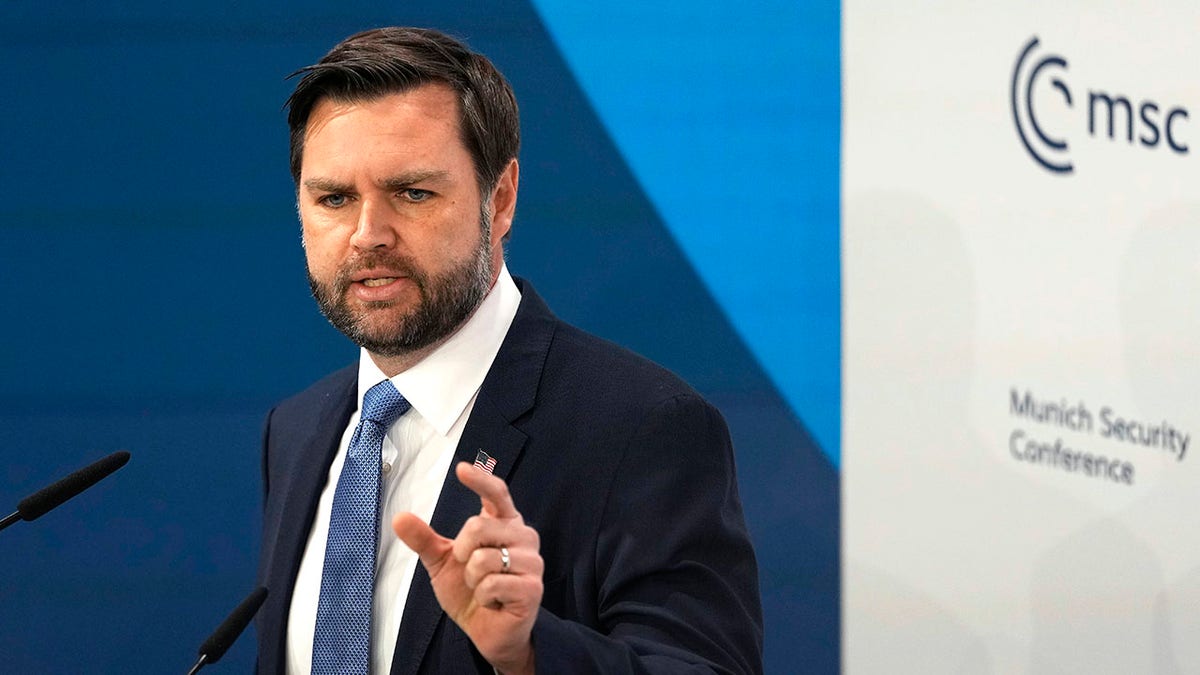
Vance addresses Munich Security Conference

Vice President JD Vance addresses an audience during the Munich Security Conference at the Bayerischer Hof Hotel in Munich, Germany, Feb. 14, 2025.  (AP Photo/Matthias Schrader)


Alexander Hall is an associate editor for Fox News Digital. Story tips can be sent to Alexander.hall@fox.com.

Source: https://www.foxnews.com/media/marco-rubio-voices-concern-americans-may-someday-arrested-social-media-posts-when-visiting-europe

Follow Middle East and Terrorism on Twitter

Trump Ended Venezuela’s Dictatorship in a Single Night - Roger Kimball


by Roger Kimball

Trump’s lightning seizure of Maduro was not recklessness but doctrine in action: the Monroe Doctrine revived, enforced, and demonstrated—decisively—on the ground.


To understand the extraordinary operation conducted by the U.S. military and law enforcement over the night of January 2-3—an operation that extracted the Venezuelan dictator Nicolás Maduro and his wife, Cilia Flores, from the presidential palace and whisked them to the USS Iwo Jima bobbing off the coast of Caracas for extradition to the United States—the first thing you should read is the National Security Strategy released by the White House last month.

Among other things, this closely reasoned, 29-page document articulates an updated commitment to the Monroe Doctrine, named for the country’s fourth president, James Monroe, who first articulated the policy in 1823. In brief, the Monroe Doctrine held that the United States would look on foreign involvement in the Western Hemisphere as a direct challenge to America’s national interest. The National Security Strategy reaffirmed and extended America’s commitment to the Monroe Doctrine:

After years of neglect, the United States will reassert and enforce the Monroe Doctrine to restore American preeminence in the Western Hemisphere, and to protect our homeland and our access to key geographies throughout the region. We will deny non-Hemispheric competitors the ability to position forces or other threatening capabilities, or to own or control strategically vital assets, in our Hemisphere. This “Trump Corollary” to the Monroe Doctrine is a common-sense and potent restoration of American power and priorities, consistent with American security interests.

The world just witnessed what the application of the Trump Corollary of the Monroe Doctrine—what Trump himself referred to as the “Donroe Doctrine”—looks like “on the ground” when the Army’s Delta Force and Night Stalkers, supported by more than 150 manned and unmanned aircraft, mounted their astonishing assault.  Trump announced the operation in a post on Truth Social at 4:21 a.m. on Saturday. Attorney General Pam Bondi followed up with a post introducing the legal context.

Nicolás Maduro and his wife, Cilia Flores, have been indicted in the Southern District of New York.  Nicolás Maduro has been charged with Narco-Terrorism Conspiracy, Cocaine Importation Conspiracy, Possession of Machine guns and Destructive Devices, and Conspiracy to Possess Machine guns and Destructive Devices against the United States.  They will soon face the full wrath of American justice on American soil in American courts.

She later released the indictment prepared by the U.S. Attorney Jay Clayton. (This 25-page document supersedes a 2020 indictment against Maduro.)

Naturally, the New York Times and other irrelevant honkers in the media reacted with stunned outrage. “Trump’s Attack on Venezuela Is Illegal and Unwise,” thundered a fraught column by the Editorial Board of the Times. (In case you did not know, the editorial board of the Times is “a group of opinion journalists whose views are informed by expertise, research, debate, and certain longstanding values.” I hope you are impressed.) “Mr. Trump,” these repositories of expertise clucked, “has not yet offered a coherent explanation for his actions in Venezuela. He is pushing our country toward an international crisis without valid reasons. If Mr. Trump wants to argue otherwise, the Constitution spells out what he must do: go to Congress. Without congressional approval, his actions violate U.S. law.”

In fact, President Trump offered an eminently coherent explanation for his action, both in his first post and then in the press conference he held on Saturday, in which he, Secretary of Defense Pete Hegseth, Chairman of the Joint Chiefs of Staff Dan Caine, and Secretary of State Marco Rubio described the operation and answered questions from the press.  As for Congressional Authorization for the Use of Military Force, well, Ronald Reagan invaded Grenada in 1983 without Congressional authorization, and George H. W. Bush invaded Panama to nab the strongman and drug trafficker Manuel Noriega at the end of 1989-1990, also without an AUMF.  (Coincidentally, the U.S. got Noriega on the same day we got Maduro, January 3.)

Beyond such precedents, President Trump made the important point that, given the secrecy and logistical complexity that the operation required, he could not practically have consulted with Congress without jeopardizing the mission.  Moreover, he added, Congress had a habit of leaking, something else that would have threatened lives and the success of the operation.

In his remarks, Secretary Rubio reminded the press that that Maduro’s 2024 election was widely seen as illegitimate.  Even Joe Biden’s State Department condemned the election as fraudulent. So did the Carter Center. So did many countries around the world. The true winner of that election was Edmundo González Urrutia.

The New York Times and kindred organs are consumed with rage at President Trump’s action in Venezuela. Already the left is fielding “free Maduro” protests. Anti-Trump libertarians like Thomas Massie and  Marjorie Taylor Greene are crying in their milk.  For their part, the Venezuelans themselves  are delighted that the dictator who had oppressed them for so many years is gone.  The internet—though not those portions policed by the left—is full of jubilant scenes of celebration. One of my favorites showed a huge image of Maduro being removed from a billboard as the crowd cheered.

This weekend’s precision strike, though amazingly successful—we lost not a single American life or aircraft—is not the end of the story.  A corrupt dictator who terrorized and impoverished his people, exported murderers and drug dealers to the United States, and made Venezuela a haven for anti-American interests from China, Russia, Iran, and even Hamas, has been taken off the chessboard.  But the country he left behind is a festering ruin.

Venezuela sits atop the world’s largest known oil reserves as well as huge reserves of gas, gold, and other mineral wealth. The United States essentially built its oil industry, which was expropriated by Maduro’s predecessor, Hugo Chavez. Earlier in the day that he and his wife were seized, Maduro entertained a special envoy from China, which has a strong interest not only in Venezuela’s oil but also in its potential as a destabilizing force in the Western Hemisphere.  That project has been tabled.

In the coming months, President Trump explained in his press conference on Saturday, the United States is going to step in, help rebuild the country’s infrastructure, and put the country back on the road to prosperity and free government. There is talk of Edmundo González returning from his exile in Spain.  Who will run Venezuela in the meantime? In two words, we will.  Is this a return of the neocon practice of “nation building” and exporting democracy? No.  Rather, it is an instance of that newly revitalized Monroe (or “Donroe”) doctrine that Trump’s National Security Strategy laid out. President Trump’s watchword is common sense. Common sense dictates that we not allow Venezuela to become a springboard for entities hostile to the United States. Therefore, we won’t. 


Roger Kimball

Source: https://amgreatness.com/2026/01/04/trump-ended-venezuelas-dictatorship-in-a-single-night/

Follow Middle East and Terrorism on Twitter

Few dozen U.S. House contests will decide control of Congress in 2026 - Andrew Rice


by Andrew Rice

Analysts predict only 66 House seats have at have at least a slight chance of becoming close races.


(The Center Square) -

The 2026 midterm elections promise to bring fierce competition as Democrats and Republicans battle for control of Congress.

All 435 seats in the U.S. House of Representatives are up for election in 2026. However, analysts predict only 66 have at least a slight chance of becoming close races.

The U.S. House of Representatives is currently split 220-213 in favor of Republicans, with two vacancies.

The Cook Political Report rates 17 of the 66 races as being true political toss-ups. These include competitions in Arizona, California, Pennsylvania and Washington.

The general Midterm election is Nov. 3, 2026.

Here is a look at some of those competitions before primary elections.

Arizona

The first Congressional district in Arizona is shaping up to be a competitive race in 2026, with incumbent Republican Rep. David Schweikert running for governor.

A crowded field has emerged from those looking to fill Schweikert’s seat. Schweikert narrowly defeated Democrat Amish Shah in 2024 by a margin of about 16,500 votes, just under 4%.

Shah is running for the Congressional seat again, alongside 23 other candidates who expressed interest in running for the seat. An expression of interest is not a formal declaration of candidacy and does not mean a candidate will appear on the ballot for a particular election.

Gina Swoboda, chair of Arizona’s Republican Party, also filed an expression of interest in the congressional race. Swoboda earned an endorsement from President Donald Trump when she entered the race.

“I am deeply honored to have the endorsement of President Trump as we embark on a campaign that will be centered around the common-sense conservative principles of economic growth and prosperity, strong and secure borders, and protecting taxpayers,” Swoboda wrote in a statement.

Arizona faces another competitive race as incumbent Republican Rep. Juan Ciscomani looks to retain his seat in District 6. Nine Democrats have filed statements of interest to challenge Ciscomani for the seat. In 2024, the district went for Trump as president and Democrat Ruben Gallego for U.S. Senate.

Arizona’s primary election is Aug. 4.

California

Following the passage of Proposition 50, several candidates are vulnerable to toss-up races in California. Congressional District 13 was already seen as a swing district before approval of the redistricting measure.

In 2024, Democrat Rep. Adam Gray was elected to Congress by a margin of less than 200 votes, unseating Republican John Duarte.

Kevin Lincoln II, a Republican and former mayor of Stockton, Calif., is also running in District 13 after switching from a run in District 9 due to the passage of Proposition 50. Lincoln has received endorsements from Trump and U.S. House Speaker Mike Johnson.

In the 2024 election, Lincoln lost to incumbent Democrat Josh Harder in California’s 9th Congressional District.

District 22 in California will see incumbent Republican David Valadao trying to retain the seat after the passage of Proposition 50. Democrats Jasmeet Bains, a state assemblywoman, and Randy Villegas, a school board trustee, have announced their candidacy in the area.

“I will fight for my community every day, and work with anyone, to ensure that economic opportunity reaches every part of our community, and that families have access to the essential government programs that keep children fed and healthcare accessible,” Villegas said.

California’s 48th Congressional district will also see incumbent U.S. Rep. David Issa, a Republican, face a slew of Democratic challengers for control of the redrawn district.

Ammar Campa-Najjar, a Democrat who lost to Issa in 2020, is running again.

“Ammar is uniquely positioned to flip this must-win seat from red to blue,” his campaign website reads.

California's primary election is June 2.

Pennsylvania

Districts 7 and 10 in Pennsylvania are likely to see fierce competition between Democrats and Republicans in 2026.

In 2024, Republican Ryan Mackenzie flipped the seat red. Pennsylvania Gov. Josh Shapiro endorsed firefighter union head Bob Brooks, a Democrat.

“Ryan is keeping his promise to the people of the 7th Congressional District by supporting policies that grow our economy, protect taxpayers, address affordability, address illegal immigration, improve our nation’s safety, and preserve services for those who truly need them,” Mackenzie’s website reads.

District 10 will also see incumbent Republican Rep. Scott Perry defending his seat. Perry first won election to Congress in 2018. Perry narrowly defeated Democrat Janelle Stelson in 2024, retaining the seat.

Stelson is running again for the seat in Pennsylvania’s 10th district.

Pennsylvania's primary is May 19.

Washington

In Washington’s third congressional district, Republican John Braun is looking to challenge incumbent Democrat Rep. Marie Gluesenkamp Perez.

Perez first won the seat in 2022, after defeating Republican Joe Kent. She again defeated Kent in 2024.

Braun is a fourth-term state senator and Senate minority leader in Washington.

Washington's primary election is Aug. 4. 


Andrew Rice

Source: https://justthenews.com/nation/states/center-square/us-house-contests-decide-control-congress-2026

Follow Middle East and Terrorism on Twitter