The "Middle East and Terrorism" Blog was created in order to supply information about the implication of Arab countries and Iran in terrorism all over the world. Most of the articles in the blog are the result of objective scientific research or articles written by senior journalists.
From the Ethics of the Fathers: "He [Rabbi Tarfon] used to say, it is not incumbent upon you to complete the task, but you are not exempt from undertaking it."
According to Census data, the African American poverty rate has gone up since 2019 and remained high during Biden's presidency.
At
the time that A. Phillip Randolph, Rev. Martin Luther King, and others
organized the now-celebrated March on Washington for Jobs and Freedom,
the U.S. Census Bureau
estimated that under the Kennedy administration, more than 45% of
"nonwhites" were living under the "poverty line." The lowest-ever
recorded percentage (and without the anachronistic nomenclature) of
Black families living under the threat of hunger, crime and disease
shrank to 16.13% in 2019 under the Trump administration.
In 2020,
the year that the COVID-19 pandemic hit, the poverty rate among African
Americans crept up to 19.5% as the lockdown shut down untold thousands
of businesses across the American ethnic spectrum. Researchers at the
University of Chicago Booth School of Business have said the lockdown cost
"more than the drop during and after the Great Recession. In addition,
44 percent of the population experienced a decline in earnings and 54
percent experienced a decrease in savings."
Although the U.S. Census Bureau has not released official poverty data for 2022, in 2021,
Biden's first year in office, the African American poverty rate
remained stagnant at 19.5%. Today, on the 50th anniversary of that
historic gathering in Washington, that rate under the Biden
administration may yet climb higher.
If economic trends persist, the historic low recorded under the Trump
administration may stay in the rear-view mirror. "The nation," USAToday notes, "has endured a two-year inflation spike that
has eased somewhat but remains historically high. Just 33% of adults
say they approve of his handling of the economy, according to a poll
last month from The Associated Press-NORC Center for Public Affairs Research."
During an event marking 60 years since Dr. Martin Luther King delivered his historic "I Have a Dream"
speech, Maryland Gov. Wes Moore (D), the first Black governor of that
state, said that too many people are working multiple jobs and still
living below the poverty line.
In an interview on ABC News
last November, Moore said "It means being able to make sure that people
are being paid a fair wage for the work that they are doing and ending
this idea that we should have people who are working jobs, in some cases
multiple jobs, and still living at or below the poverty line."
Moore has been campaigning heavily for a state "Fair Wage Act", tweeting in March that "We’ve got to incentivize work and make sure people are getting paid fairly."
Rev. Al Sharpton, head of the National Action Network, said part of
King's speech about unfulfilled process is often overlooked today.
"We leave that out because to talk about that part of the speech, the
bounced check, to the unfulfilled promises, is to then have to deal
with policy, rather than poetry. We like the poetry, we have a dream,
that's good poetry. But what about the bounced check?" he said at the
discussion before the 60th anniversary event taking place in Washington,
D.C. "What about the equality? What about the fairness? What about
being able to have the same equal footing that challenges to do
something?"
Biden is reportedly losing support among Black voters. According to YouGov/Economist
polling data, Biden’s "favorability ratings among Black voters have
shifted from 84% right after he took office in 2021 to 74% at the end of
March 2023." Startup news website The Messenger added
this week that "Biden’s 2020 margin among Black voters was smaller than
for any other Democratic presidential nominee over the past two
decades, and the latest data suggests that support has eroded since the
election."
Reuters reported
that "one in five Black people under the age of 50 voted Republican in
the 2022 midterms, roughly double the number of their elders," according
to an exit polling analysis conducted by HIT Strategies.
There was a 10 point decrease in Black voter turnout in the 2022 midterm election compared to the 2018 election, which has Democrats concerned heading into the 2024 election cycle.
According to the results of a Reuters/Ipsos poll conducted from July
11 to 17, 18% of Black Americans would vote for Trump over Biden in a
hypothetical general election race.
Hezbollah's criminal activities range from drug trafficking, to cigarette smuggling, document and identity card forgery, and money laundering through Iran's and Lebanon's banking systems.
In recent decades, Hezbollah has established itself not only
as one of the world's leading terrorist groups and Lebanon's effective
master, but also as a prominent transnational crime syndicate.
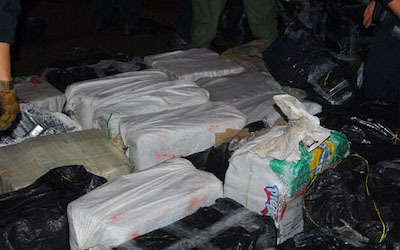
Hezbollah's criminal activities range from drug trafficking in cocaine
and heroin, to cigarette smuggling, document and identity card forgery,
and money laundering through Iran's and Lebanon's banking systems. These
criminal enterprises fill its coffers, facilitate its domination of
Lebanon's political system, and underpin the buildup of the
organization's global terrorist and intelligence infrastructure. This is
so much the case that, in October 2018, U.S. attorney general Jeff
Sessions designated Hezbollah as one of the world's leading
transnational criminal organizations alongside four Latin American drug
cartels.[1]
A Complex Criminal Web
Hezbollah's international criminal activity dates back to the 1980s
when the newly-established organization began laundering money for drug
cartels through Lebanese immigrants in Latin America. Since then, it has
become one of the world's largest drug suppliers and money laundering
organizations, working in close cooperation with a string of Latin
American paramilitary and criminal organizations, including Colombia's
Medellin cartel, La Oficina de Envigado, North Valley cartel, and the
Revolutionary Armed Forces of Colombia (People's Army, FARC),[2] as well as Brazil's First Command of the Capital (PCC)[3] and the Mexican Los Zetas.[4]
The terrorist group establishes, operates, and maintains
cells and networks of activists, logistical warehouses where stolen and
counterfeit goods are stored, and supply chains around the world,
particularly in Africa and Latin America. Hezbollah operatives are also
deployed throughout the United States and Europe where they distribute
the organization's criminal goods and services—primarily by trafficking
drugs, counterfeiting consumer products, and laundering money.[5]
Hezbollah's criminal network operates relatively independently from
the organization's political and military wings, which are closely
aligned with Tehran. The network is strategically managed and led by a
chain of senior officials but maintains an intricate system of buffers
to avoid linking the organization to criminal activity. At times,
operatives carry out criminal activities on direct orders from Hezbollah
officials; at other times, they share their activities with these
officials without necessarily seeking direct orders.[6]
This allows Hezbollah to maintain ambiguity, deniability, and obscurity
regarding its activities as a transnational criminal organization.
This criminal network is managed by the business unit of the
Organization for External Security (Unit 910), Hezbollah's external
operations mechanism. Founded by Imad Mughniyeh, head of Hezbollah's
military wing until his assassination in 2008, Unit 910 is headed by
Talal Hamia, one of the organization's most seasoned military commanders
who served as Mughniyeh's deputy. Hamia's father-in-law was implicated
in the 1994 attack on the Jewish community building in Buenos Aires in
which eighty-five people were murdered, and Washington has offered a $7
million reward for information leading to his arrest. The business unit
is currently managed by Abdullah Safi ad-Din, a cousin of Hezbollah's
leader Hassan Nasrallah and former liaison officer to Iran.[7]
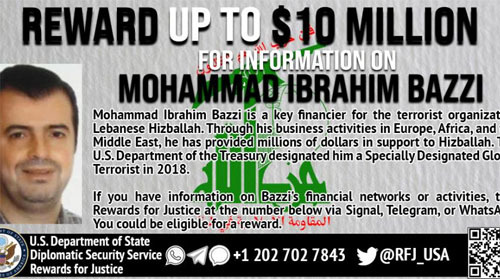
In 2021, the U.S. State Department offered a $10 million reward for information on Hezbollah financier Mohammad Ibrahim Bazzi.
One prominent member of the unit is Adham Hussein Tabaja,
owner of one of the largest and most successful real estate companies in
Lebanon, who uses his legitimate-seeming business activities to funnel
funds to Hezbollah and to help the organization circumvent U.S. and
European sanctions.[8]
Identified by U.S. officials as one of Hezbollah's top five financiers,
in October 2015, Tabaja was designated by the U.S. Treasury Department
as having direct ties with senior Hezbollah officials—including military
wing commanders—and holding assets in Lebanon on behalf of the
terrorist organization.[9]
Another prominent Hezbollah financier is Hassan Dehghan Ebrahimi, an
Iranian citizen and owner of the Maher trading company. A Beirut-based
member of the Islamic Revolutionary Guards Corps' Quds Force, Ebrahimi
funneled millions of dollars to Hezbollah through his company, which
serves as a conduit for money laundering and goods smuggling for the
organization.[10] A string of other businessmen play a similar role as Ebrahimi,[11]
including Muhammad Ibrahim Bazzi, owner and chairman of large energy
companies in Belgium, Gambia, and Lebanon with close relations to
international drug barons; Ali Youssef Charara, chairman and CEO of the
Lebanese telecommunications company Spectrum, which provides
communication services to Hezbollah; Ali Tajideen, a businessman and
international arms dealer; and Muhammad Jafar Qasir, a senior Hezbollah
operative responsible for the organization's logistics and procurement
These individuals and others like them form the intricate network of
financiers and operatives that enables Hezbollah's transnational
criminal activity.
The Iranian-Hezbollah Partnership
Hezbollah operatives carry out robberies around the world and send
the proceeds to Iran from where they are subsequently transferred to the
organization's Lebanese bank accounts. Profits from drug deals of Latin
American cartels in Europe and the United States are also sent to
Hezbollah, which deducts a commission before laundering the rest of the
money and returning it to the drug cartels. According to the U.S Drug
Enforcement Administration (DEA), this laundering activity is done
through the purchase and sale of luxury cars, as well as by other means.
In some cases, the money is hidden in the cars themselves when they are
transported to locations around the world.[12]
Since Hezbollah's budget is not open to public scrutiny, it is
difficult to ascertain the share of the organization's criminal profits
in its overall budget. According to Israeli security sources, about 90
percent of Hezbollah's annual budget (an estimated $700 million) comes
from Iran. Brian Hook, U.S special envoy for Iran in 2018-20, estimated
that Tehran provides 70 percent of the organization's budget while
Lebanese anti-Hezbollah sources set the figure at 70-80 percent. This
means that at least 10-30 percent of Hezbollah's budget emanates from
its criminal activities. The figure could be higher if one counts the
money laundered via Iranian banks that none of the estimates appears to
have considered.[13]
Indeed, the vicissitudes in Hezbollah's criminal activities
over the past decades seem to have been related to the desire to reduce
its financial dependence on Tehran, which, in turn, was forced to cut
funding to its Lebanese proxy because of the debilitating effects of
international sanctions and its decade-long intervention in the Syrian
civil war. As a result, Hezbollah will likely increase its transnational
criminal activities in the foreseeable future not only because of
Tehran's worsening economic predicament and the growing domestic
resistance to the mullahs' regime, but also because of Lebanon's
spiraling economic crisis and the reported worsening of Hezbollah's
financial standing (e.g., reflected in reports of slashed salaries
within the group).[14]
These factors will combine to increase its collaboration with Latin
American drug cartels, an alliance already driven by the drop in oil
prices and reduced Iranian support.
Hezbollah's Long Reach
Hezbollah is deeply involved in transnational organized crime
activities with tentacles spreading from the Americas, to Africa, to
Europe. In 1997, for example, the Canadian Security Intelligence Service
informed a Canadian court of the existence of a Hezbollah
"infrastructure" in the country comprising individuals who "receive and
follow orders from the Hezbollah leadership in Lebanon." A former senior
Canadian intelligence official estimated the organization's covert
network at 50-100 operatives "directly involved in Hezbollah activities
in Canada." The intelligence service also revealed that the organization
had a procurement network in Canada linked to cigarette smuggling from
the United States.[15]
In July 2000, the U.S. authorities broke up a North Carolina-based
smuggling ring that was suspected of raising money for Hezbollah. Court
documents indicate that the group had "allocated several thousand
dollars in cash for Hezbollah, derived from the proceeds of smuggling
illegal cigarettes" and had collected donations from local Hezbollah
members and supporters through fundraising activities.[16]
Four years later, nineteen members of the Farhat/Berro family in
Dearborn, Michigan, were indicted in a widespread conspiracy to defraud
banks and credit card issuers. At least one defendant admitted that the
fraud scheme was conducted on behalf of Hezbollah and that the proceeds
were transmitted to the terrorist group. Court filings from the U.S.
Justice Department also reveal that one of the defendants had "extensive
contacts" with the Iranian government as well as Hezbollah.[17]
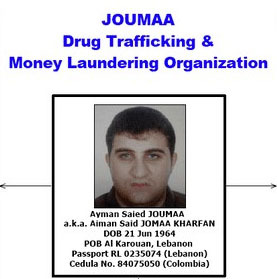
In 2011, the Eastern District of Virginia indicted
Ayman Joumaa for his role as leader of one of Hezbollah's global
criminal networks.
In 2011, the United States designated Ali Muhammad Saleh, a
Hezbollah operative, as a narcotics kingpin and, in 2012, as a global
terrorist. A former Hezbollah fighter, Saleh, served as a money
launderer for a criminal organization while acting as "a key facilitator
for Hezbollah who directed and coordinated Hezbollah activity in
Colombia." He maintained contacts with suspected Hezbollah operatives in
various locations around the world, including Venezuela, Germany,
Lebanon, and Saudi Arabia. Also in 2011, the Eastern District of
Virginia indicted Ayman Joumaa for his role as leader of one of
Hezbollah's global networks used to sustain its financial needs. A
Lebanese-Colombian dual national, Joumaa operated a global network of
companies in Latin America, West Africa, and Lebanon accused of
laundering money for Mexican and Colombian cartels at a rate of some
$200 million per month in drug proceeds.[18]
On October 8, 2015, Hezbollah operative Iman Kobeissi was arrested in
Atlanta, Georgia, after telling a DEA undercover agent with whom she
was in contact that an acquaintance of hers in the terrorist
organization was interested in purchasing cocaine, weapons, and
ammunition. On the same day—as part of a joint international
operation—Joseph Asmar was arrested in Paris, having told an undercover
agent that he could use his connections with Hezbollah to provide
security for drug smuggling. The two told the undercover agents that
they provided money laundering services to drug smugglers, terrorist
organizations, and criminal organizations in at least ten countries,
thus underscoring the wide scope of Hezbollah's transnational criminal
activities. They also told the agents that they could organize a plane
with a large load of cocaine in Latin America that would land safely in
Africa as a stopover for the transfer of the drugs and their
distribution in Europe and the United States.[19]
A year later, in September 2016, the DEA filed a lawsuit
against three Hezbollah operatives on charges of money laundering and
drug trafficking in collaboration with Colombian drug cartels. One of
them, Muhammad Amar, son of a Los Angeles-based Hezbollah operative, was
implicated in the transfer of $500 million of drug money from Australia
and Europe to an American bank in Miami for laundering purposes. In the
past, Amar had laundered money through Holland, Spain, Britain,
Australia and Africa. Another activist, Hassan Mohsen Mansour, a
Lebanese citizen, was charged with laundering hundreds of millions of
dollars in drug trafficking funds around the world. Mansour was a major
money launderer and drug trafficker for Hezbollah. The third indicted
person was Ghassan Diab, a senior Hezbollah operative with access to
many international bank accounts.[20]
Similarly, in August 2019, a federal court in Washington sentenced
Qassem Tajeddine, a Lebanese citizen and Hezbollah operative, to five
years in prison and a fine of $50 million. Arrested in March 2017 in
Morocco and extradited to the United States, Tajeddine was believed to
have provided Hezbollah with $1 million in cash funding. Back in 2003,
he and his wife were arrested in Belgium and accused of transferring
tens of millions of Euros to Hezbollah through his brother, who was a
commander in the terrorist organization.[21]
In January 2016, Ali Khalife, a Lebanese citizen, was arrested in the
Colombian capital of Bogota on charges of involvement in the cocaine
trade and money laundering for Hezbollah while, in September 2018, Assad
Ahmad Barakat, a Lebanese-born Hezbollah operative who had lived in
Latin America for years, was arrested in Brazil after Paraguay issued an
arrest warrant against him. Apart from the suspicion of identity theft
in Paraguay, the Brazilian authorities revealed that Barakat was accused
in Argentina of laundering $10 million through a casino in the city of
Puerto Iguazú, near the Argentinian-Brazilian border.[22]
Across the Atlantic, in February 2016, France, Germany, Italy, and
Belgium—with U.S. support—conducted a large-scale international
operation against Hezbollah's criminal activities in Europe, arresting
fifteen Hezbollah operatives and others associated with the organization
on drug trafficking and money laundering charges. In a string of raids
across the continent, the law enforcement agencies seized some €500,000
in cash, seventy watches worth an estimated $9 million, weapons, and
properties valued at millions of dollars.[23]
Apart from the desire to boost its financial standing and
self-sufficiency, it can be assumed that Hezbollah views its
transnational criminal activities as a way to weaken its enemies by
spreading drug addiction in Western societies. In its perception, a
drug-afflicted society is a weak society that can be exploited for the
establishment of terrorist networks and the recruitment of operatives;
can be attacked from within if necessary; and can be more effectively
defended against in the event of interstate conflict. Furthermore, law
enforcement and intelligence agencies that dedicate most of their time
and resources to fighting criminal activity may be less attentive to
stymying terrorist activities.[24]
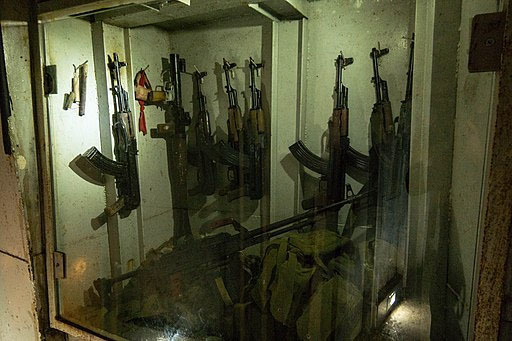
Hezbollah weapons, Mleeta, Lebanon, October 2013.
Hezbollah purchases light weapons, ammunition, assault and sniper
rifles, and machine guns through its transnational criminal activities.
(Photo: Frode Bjorshol)
Against this backdrop, it is hardly surprising that the U.S.
Treasury Department described Hezbollah's transnational criminal
activities as inextricably linked to the organization's global terrorist
network.[25]
Thus, for example, alongside the steady buildup of its massive rocket
and missile arsenal by Tehran, Hezbollah has striven to independently
purchase light weapons and ammunition, including assault rifles, sniper
rifles, and machine guns, through its transnational criminal activities.
Over time, the organization has also begun to acquire dual-use
technologies that could be useful for terrorist activities, such as
computer software, laser rangefinders, night vision devices, and more.[26]
According to former DEA deputy director Jack Riley, the criminal
proceeds seized during the agency's years-long operation against
Hezbollah's drug trafficking to the United States, codenamed Project
Cassandra, were designed to serve the organization's worldwide terrorist
activities and military intervention in the Syrian civil war.[27]
Similarly, many of the funds used for Hezbollah's weapons acquisitions
were laundered by the U.S.-indicted trio, Amar, Mansour, and Diab.[28]
Further evidence of the connection between Hezbollah's
criminal and terrorist activities was provided by the arrest of Iman
Kobeissi, who planned to purchase weapons, not only for Hezbollah but
also for Tehran. According to the U.S Justice Department, Kobeissi told a
DEA undercover agent that she had Iranian clients who were interested
in purchasing heavy weapons. Among other things, she presented the agent
with a list of demands from her clients in Iran and Hezbollah, which
included assault rifles, grenades, pistols, and sniper rifles. On
another occasion, Kobeissi discussed the possibility of illegally
supplying Tehran with fighter jet parts so as to circumvent the
international sanctions against Iran.[29]
Similarly, the Treasury Department has identified Ali Zeaiter and
brothers Kamel and Issam Amhaz as responsible for a major Hezbollah
procurement network through a Lebanon-based electronics company that
purchased, among other things, technology for the organization's drones
program. Other operatives implicated in the illegal procurement of
sensitive technology for Hezbollah's drone program were Fadi Hussein
Serhan and Adel Muhammad Cherri while the Lebanese businessman Abdul Nur
Shalan was designated by the Treasury Department as a key member of
Hezbollah's weapons procurement network with close ties to the
organization's leadership.[30]
Small wonder that U.S. administrations sought to combat Hezbollah's
terrorism by curbing its criminal activities. In January 2018, for
example, the Justice Department created the Hezbollah Financing and
Narcoterrorism Team that targeted the organization's criminal activities
and, in October 2018, established a special task force to combat
Hezbollah and other transnational organized crime organizations.[31]
That same month, the U.S. Congress passed the Hezbollah International
Financing Prevention Amendments Act of 2018 that sought to sever its
sources of funding. Strengthening and expanding the economic and
financial sanctions imposed on the terrorist organization three years
earlier, the new legislation targeted foreign governments, businesses,
and individuals that provided financial support to Hezbollah or assisted
its activities (e.g., recruiting operatives, laundering money,
collecting donations), enabling international law enforcement agencies,
such as Interpol and Europol, to disrupt Hezbollah's global financial
network. The amendment also required the U.S. administration to provide
information on Hezbollah's illegal activities to the House of
Representatives.[32]
Conclusion
The significance of Hezbollah's transnational criminal activities
cannot be overstated. While the lion's share of the organization's
funding still comes from Tehran, its steadily growing criminal network
boosts its maneuverability vis-à-vis its patron and its political
leverage in the Lebanese political scene. It is regrettable, therefore,
that the EU and some U.S. administrations have turned a blind eye to
Hezbollah's criminal activities—the Obama administration even obstructed
Project Cassandra in its eagerness to lure Tehran into a nuclear deal[33]—at
a time when the organization is working hand-in-hand with Iran against
Western interests and allies in the Middle East, first and foremost
Israel. This state of affairs is particularly galling for Jerusalem
given the transformation of Iran and its Hezbollah proxy into the
foremost threat to its national security, and potentially—to its very
existence.
Hence, while sustaining its decade-long effort to prevent Tehran from arming Hezbollah,[34]
Israel should intensify its fight against the organization's criminal
network. It can do so, among other things by providing quality
intelligence to police and law enforcement agencies around the world and
initiating worldwide covert operations, especially in Latin America.
No less importantly, the EU should drop the artificial distinction
between Hezbollah's "political" and "military" wings—which the
organization itself rejects. Washington, too, must ramp up designating
and sanctioning activists, associates, companies, and groups related to
Hezbollah and Iran. Without undercutting Hezbollah's crime syndicate,
the fight against its global terrorist activities is doomed to failure.
Omer Dostri is a research associate at the Jerusalem
Institute for Strategy and Security (JISS) specializing in military
strategy and national security.
[1] News release, Office of Public Affairs, U.S. Justice Dept., Oct. 15, 2018.
[2]
"Terrorist Groups in Latin America: The Changing Landscape," testimony,
U.S. House Foreign Affairs Subcommittee on Terrorism, Nonproliferation
and Trade, Washington, D.C., Feb. 4, 2014,
pp. 21-2; "State Sponsors of Terrorism: An Examination of Iran's Global
Terrorism Network," testimony, U.S. House Homeland Security
Subcommittee on Counterterrorism and Intelligence, D.C., Apr. 17, 2018, p. 8; Los Angeles Times, Oct. 22, 2008.
[5] Matthew Levitt, "Hezbollah's Criminal Networks," in Hilary Matfess and Michael Miklaucic, eds., Beyond Convergence: World without Order (Washington, D.C.: National Defense University, 2016), pp. 155-79.
[10] Associated Press, Feb. 25, 2023; Reuters, Jan. 7, 2016; "Treasury Targets Hizballah Financial Network," U.S. Treasury Dept., Washington, D.C, Dec. 9, 2010; "Treasury Targets Hizballah Financial Network's Abuse of the Business Sector," U.S. Treasury Dept., May 19, 2022.
[11]
"Sanctions Evasion and Money Laundering Charges Unsealed against
Specially Designated Global Terrorist Mohammad Bazzi and Talal Chahine,"
U.S. Attorney's Office, Eastern District of New York, Feb. 24, 2023;
"Treasury Sanctions Hizballah Financier and His Company," U.S. Treasury
Dept., Washington, D.C., Jan. 7, 2016; "Treasury Targets Hizballah
Financial Network," U.S. Treasury Dept., Dec. 9, 2010; Ya Libnan (Beirut), June 18, 2022.
[12]
U.S. Attorney's Office Eastern District of New York, Oct. 9, 2015;
Emanuele Ottolenghi, "The Laundromat: Hezbollah's Money-Laundering and
Drug-Trafficking Networks in Latin America," Begin-Sadat Center for
Strategic Studies, Mideast Security and Policy Studies, no. 194, July 2021; CNN, Feb. 1, 2016.
[17]
Anyssia S. Kokinos et al, "Hezbollah's Operations and Networks in the
United States: Two decades in review," The Program on Extremism at The
George Washington University, Washington D.C., June 2022, pp. 18-9.
[19] "Two Hezbollah Associates Arrested
on Charges of Conspiring to Launder Narcotics Proceeds and
International Arms Trafficking," U.S. Justice Dept., Washington, D.C.,
Oct. 9, 2015.
[21] Nada Atallah Maucourant, "How did the network of Tajeddine companies circumvent US sanctions against Hezbollah?" L'Orient Le Jour (Beirut), Nov. 24, 2021.
[22]
David Asher, "Attacking Hezbollah's Financial Network: Policy Options,"
Congressional testimony, House Foreign Affairs Committee, Washington,
D.C., June 8, 2017; Voice of America, Sept. 22, 2018.
[23] "DEA and European Authorities Uncover Massive Hizballah Drug and Money Laundering Scheme," U.S. Drug Enforcement Administration (DEA), Arlington, Va., Feb. 1, 2016.
[26] Matthew Levitt, "Hezbollah's Procurement Channels: Leveraging Criminal Networks and Partnering with Iran," CTC Sentinel (West Point), Mar. 21, 2019.
[30]
"Treasury Sanctions Procurement Agents of Hizballah Front Company Based
in Lebanon with Subsidiaries in the UAE And China," U.S. Treasury
Dept., Washington, D.C., July 10, 2014; U.S. Treasury Dept., July 21, 2015; "Treasury Sanctions Hizballah Procurement Agents and Their Companies," U.S. Treasury Dept., Nov. 5, 2015.
[31]
"Attorney General Sessions Announces Hezbollah Financing and
Narcoterrorism Team," U.S. Treasury Dept., Washington, D.C., Jan. 11,
2018; Eric Halliday, "Transnational Organized Crime and National
Security," Lawfare Blog (Washington, D.C.), Apr. 29, 2019.
[32] "Hizballah International Financing Prevention Amendments Act of 2018," S.1595, U.S Congress, Washington, D.C., Oct. 2018.
[34] Jonathan Schanzer, "The Quiet War between Israel and Iran," Middle East Quarterly, Winter 2023.
Omer Dostriis a research associate at the Jerusalem
Institute for Strategy and Security (JISS) specializing in military
strategy and national security.
Bad Hombres and Proud Latinas Reject Economic Stagnation and Cultural Radicalism
A growing cohort of Hispanics find themselves political orphans.
Many of them have yet to fully align with the Republican Party, but they
increasingly turn away from the economic mismanagement and leftist
social extremism of the 2020’s Democrats.
As such, Biden finds a new and worsening problem headed into election
year: hemorrhaging support among Hispanics, and especially among
working-class Latino voters.
Per the latest NY Times/Sienna poll, his general election lead among non-college educated minorities has collapsed.
Back in 2020, Biden captured a blowout 48% winning margin among
blue-collar minorities, but that lead has plummeted to only 16% right
now, asking voters their preference for 2024. For further context,
consider that Obama won that demographic of working-class non-whites by a
landslide 67% in 2012.
This worsening decline understandably alarms Ruling Class
powerbrokers and Democrat partisans who previously took Hispanic
allegiance for granted. Even Politico, the effective print PR arm of the DNC, recently ran a story headline wondering “What’s Behind Biden’s Latino Voter Problem?”
So, let’s answer that question for Politico!
The economy and culture are the macro forces that explain this
tectonic shift among Hispanics away from Biden and toward the political
Right.
First, on the economy, middle- and lower-income workers suffer the
ravages of rising prices most severely. Because Hispanics overwhelmingly
fall into this economic category, inflation inflicts particular
financial misery on Latino households. Granted, the pain of
out-of-control prices for the staples of life knows neither color nor
ethnicity. This harsh reality explains why only 16% of Americans overall
report that their wages can keep pace with inflation, per the latest Investor’s Business Dailysurvey.
Nonetheless, Hispanics more acutely feel this financial pinch and
subsequently reject the intense economic mismanagement of Biden and the
Democrats. For example, Biden’s “strong approval” rating among Hispanics
is only 14%, which is the lowest of any demographic group. Digging into
the NY Times poll crosstabs,
the clear driver of the dissatisfaction is the economy. Specifically, a
paltry 4% of Hispanics describe the economy as “excellent” while a
whopping 47% malign it as “poor.”
Hispanic Americans proudly boast the highest entrepreneurship rate in the country. Hispanic men claim the highest workforce
participation rate of any group in the United States. We are a
community of laborers and risk-takers, but the economic malaise of Biden
shrinks Latino wallets and saps start-up spirits.
Perhaps Hispanics could stomach some of the economic abuses from the
radical Democrats if Biden and his media cronies showed some semblance
of respect for the traditional sentiments and deeply-held religious
beliefs of millions of Hispanics, overwhelmingly Catholic and
Evangelical believers. But instead, Biden and the Democrats insist on a
sustained campaign of radical secular humanist assaults upon communities
that believe in such universal truths as the existence of two sexes. In
Democrat-run states like Washington, children can be surgically, permanently sex-changed without parental approval.
Hispanics, more than other groups, recoil at such extremism. For
example, on the political hot-button issue of abortion, Hispanics are
the most pro-life demographic in America. Right now, 24% of Hispanics
“strongly support” state bans of abortion after six weeks, almost twice
the pro-life support found among black Americans. Similarly, 20% of
Hispanics believe abortion should “always be illegal” compared to only
5% of blacks.
Precious few “bad hombres” can respect a commander in chief who
pushes cultural radicalism constantly from the White House, especially
when that extremism increasingly pollutes the armed forces of our great
land, where so many brave Hispanics have honorably served.
Biden does indeed have a serious Hispanic problem…one sure to worsen
into 2024. Conversely, this opening presents a historic opportunity for
the patriotic populist movement to earn majority support from Latinos
across America.
Steve Cortes is national spokesman for the Ron DeSantis PAC and former senior advisor to President Trump.