The "Middle East and Terrorism" Blog was created in order to supply information about the implication of Arab countries and Iran in terrorism all over the world. Most of the articles in the blog are the result of objective scientific research or articles written by senior journalists.
From the Ethics of the Fathers: "He [Rabbi Tarfon] used to say, it is not incumbent upon you to complete the task, but you are not exempt from undertaking it."
While the UNGA cannot formally grant UN membership, the vote could grant Palestinians similar rights.
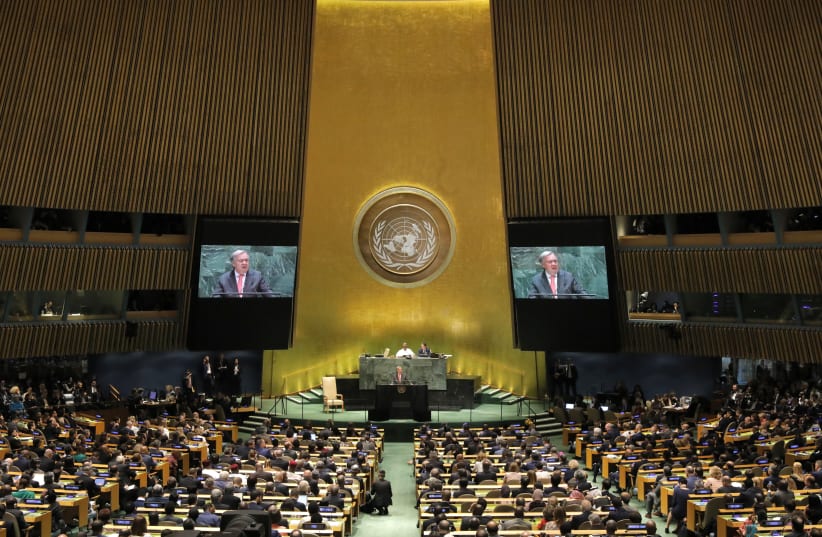
United Nations Secretary General Antonio Guterres
addresses the opening of the 74th session of the United Nations General
Assembly (photo credit: REUTERS/LUCAS JACKSON)
The United Nations
General Assembly (UNGA) is expected to upgrade the Palestinian status
at the UN, granting it almost all statehood rights within its plenum
short of allowing it to vote.
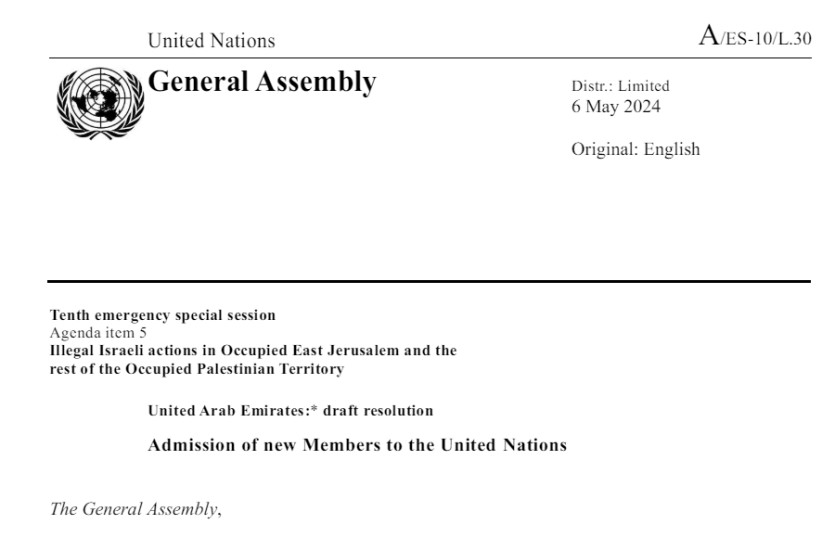
The United Arab Emirates is expected to submit a resolution, a draft text of which was seen by The Jerusalem Post, calling on the United Nations Security Council to grant Palestine full membership status in the UN.
The
text, which is likely to have majority support, states that “Palestine
is qualified for membership in the United Nations in accordance with
article 4 of the Charter and should therefore be admitted to membership
in the United Nations.”
The
Palestinian Authority, through the UAE, turned to the General Assembly
after the United States vetoed its membership application to the United Nations Security Council (UNSC) last month. The US is one of five permanent UNSC members with veto power.
The
UAE resolution “recommends” that the Security Council “reconsider the
matter favorably,” but in essence, its text seeks to circumvent the
UNSC's sole power to determine UN membership.
Excerpt from the draft of the UNGA resolution expected to be passed on Friday. (credit: Courtesy)
UNGA
resolutions, however, cannot be vetoed, and the PA has automatic
majority support in the UNGA, where some 140 of its members already
independently recognize Palestine as a state.
The
UNGA does not have the formal power to grant Palestinians UN
membership, but it can provide them with de-facto recognition that
allows them to operate as a state within the UN system.
In
2012, the UNGA voted 138-9 to grant the Palestinians the status of a
non-member observer state. This move allows them to participate in UN
forums and sign many of its statutes and treaties, including the Rome
State, which governs the International Criminal Court.
Not statehood, but similar status
According
to the current draft of the resolution, this Friday, the UNGA would
grant Palestine the right to operate within its plenum as a member
state, granting it almost everything but the right to vote, which would
need UNSC approval.
The
resolution affirms “the right of the Palestinian people to
self-determination, including the right to their independent State of
Palestine.”
In
practice, the State of Palestine could be seated among the member
states and be granted broad rights to address the plenum on its behalf
or that of groups.
The
Palestinians could submit resolutions, proposals, and amendments on
their own behalf or on behalf of groups within the UN system.
If
the resolution is approved, the Palestinians could also participate in
high-level meetings and international conferences, where they would have
voting rights.
Western
states, especially the United States, have opposed unilateral
recognition of Palestinian statehood, believing that it should be
granted upon completion of a final status peace agreement for the two
states.
Given
that negotiations for a two-state resolution to the Israeli-Palestinian
conflict have been frozen for a decade and in light of the Gaza war,
there is growing support among Western states for unilateral Palestinian
statehood.
Israel’s
government has opposed Palestinian statehood, but in stating unilateral
Palestinian statehood, it agreed that such statehood should only be
achieved through a negotiated process.
It
has argued that Palestinian recognition, in the aftermath of the Hamas
attack on southern Israel in which over 1,200 people were killed and
another 252 seized as hostages, was a reward for terror.
“Recognizing a Palestinian State after October 7 means rewarding Hamas for murdering over 1,000 Israelis,” Israel’s Foreign Minister Israel Katz said in a post on X on Wednesday.
Recognizing a Palestinian State after October 7 means rewarding Hamas for murdering over 1,000 Israelis.
It means giving a prize to the Iranian Regime.
It means living with the possibility of another October 7.
Israelis know that withholding munitions to prevent the IDF from entering Rafah and recognizing a virtual Palestinian state will not end 76 years of Palestinian rejectionism.
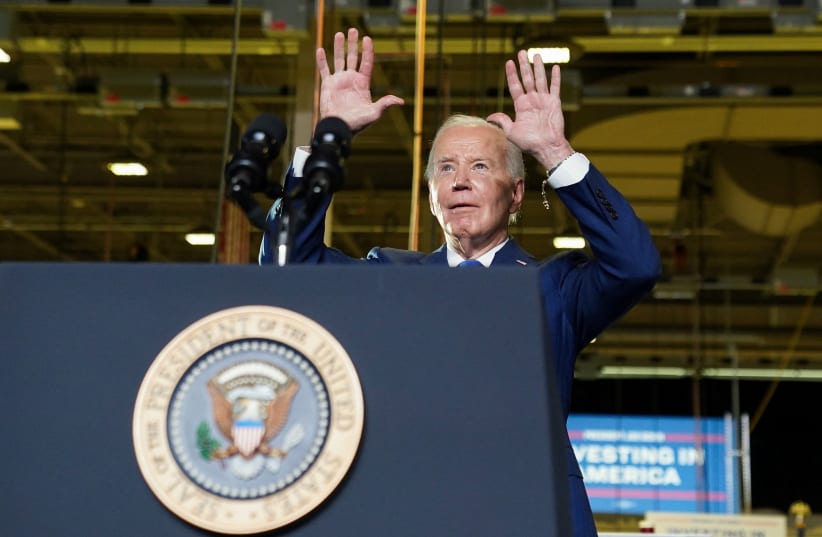
US President Joe Biden delivers remarks during a visit to Gateway Technical College in Sturtevant, Wisconsin, US, May 8, 2024(photo credit: REUTERS/KEVIN LAMARQUE)
“The worst crisis in decades” scream the pundits as President Biden
blocks delivery of crucial weapons to Israel in order to stop the push
into Rafah. Moreover, if Israel goes forward over the American
objections, Biden threatened to freeze other “offensive weapons.” The
ostensible reason is concern over civilian casualties and images of
hunger (even starvation) expected from a full-scale Israeli attack and
siege of southern Gaza.
On
CNN, Biden declared “I’ve made it clear to Bibi and the war cabinet:
They’re not going to get our support if they go [into] these population
centers.”
Many
Israelis, and not only Netanyahu and his supporters, as well as
American politicians and Jewish leaders, denounced Biden for going back
on his emphatic pledges to do everything necessary to help Israel
defend itself, defeat Hamas and return the hostages. House Speaker
Johnson and Senate Minority Leader McConnell condemned the policy that
“flies in the face of assurances provided regarding the timely delivery
of security assistance to Israel” and “call[s] into question your pledge
that your commitment to Israel’s security will remain ironclad.”
Did Biden get spooked?
Did Biden suddenly do a 180 degree flip,
and if so, why? Were the humanitarian concerns for the innocents in
Gaza (as well as the many Hamas supporters who cheered the brutal
October 7 slaughter and rape) the reason, as indicated by Secretary of
Defense Austin? Or was Team Biden spooked by the campus mobs into caving-in to their demands?
Most
likely, the correct answer is “none of the above.” A look at the
details suggests a carefully planned strategy, under the heading of a
Grand Bargain for the Middle East. This dream scenario has been in the
background (and at times, foreground) of Administration policies for
months. The essential elements include “irrevocable commitment” to
Palestinian statehood and “end of conflict;” large-scale Israeli
withdrawal on the West Bank, and a formal Saudi-Israeli peace agreement
echoing the Abraham Accords.
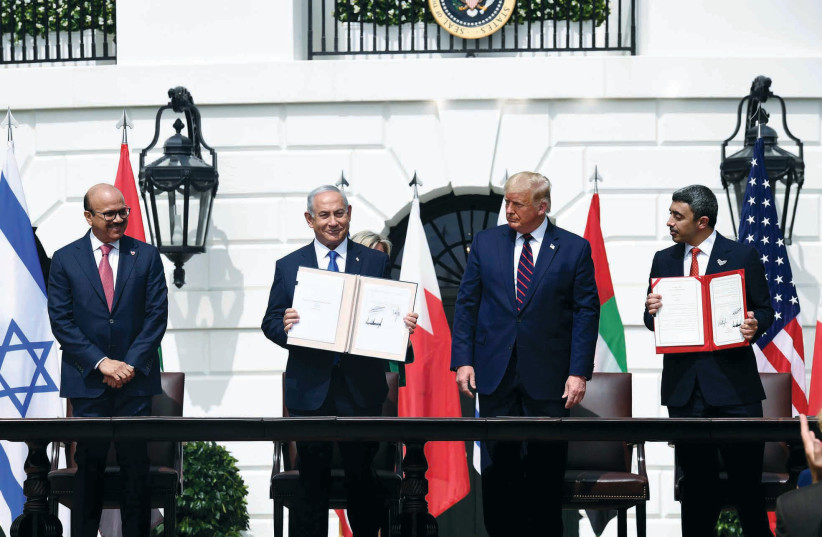
THE ABRAHAM ACCORDS signing ceremony at the White House in September
2020: It was an erroneous perception that peace agreements and
normalization with our Arab neighbors could be achieved without paying
any political price to our Palestinian neighbors, says the writer.
(credit: Avi Ohayon/GPO)
In other words, Biden
and Secretary of State Blinken are aiming for the diplomatic equivalent
of a moon shot, the Nobel Peace Prize, and, not incidentally, victory in
the November elections. The script for redrawing the map was written by
Tom Friedman, the veteran New York Times columnist who has been
promoting versions of this for decades.
And
it begins in Rafah, through orchestrating a stalemate and ceasefire
that prevents Israel from totally defeating and uprooting Hamas as the
dominant Palestinian terror organization and the rulers of Gaza.
The
problem (and it is a very big one) is that the entire scenario is built
on a foundation of wishful thinking, not history and political realism.
Similarly, the triumphant 1993 Oslo “peace” plan was based on the same
illusions, and ended in the disaster known as the Second Intifada, in
which over 1000 Israelis were murdered in mass bombings, and thousands
more died on the Palestinian side. It turned out that Yasser Arafat and
the PLO, as well as Hamas leaders never bought into the “shared
interests” that were taken for granted by the optimistic Israelis and
the Clinton administration.
For
Hamas, the freezing of weapons deliveries, the wider conflict between
Washington and Jerusalem, and demands for a ceasefire on their terms are a huge gift,
including continuing to use every last brutalized Israeli hostage to
squeeze out more concessions. Their propagandists, including the campus
groups, interpret the Biden freeze as a great victory, encouraging these
activists to continue and escalate the campaign of chaos and hate.
Watching
closely, Iran and its proxies also see these developments as weakening
the IDF’s capability to use its military superiority offensively. And as
long as Hezbollah’s terror squads remain in southern Lebanon, the
50,000 or so Israeli civilians that were evacuated from their homes
after October 7 will continue to be “displaced.” In Tehran, regime
leaders draw strength from the very visible American constraints placed
on Israel, including after the Iranian missile attack on the night of
April 13. Thus, instead of encouraging restraint and cooperation, as the
dream scenario envisions, greater instability and violence are far more
likely. As with Oslo, when this happens, Biden, Blinken and the others
will be gone.
Most
Israelis understand the massive gap between optimistic dream scenarios
and political realism. With one notable exception, every Israel
territorial withdrawal - West Bank cities in 1994; southern Lebanon in
2000; and Gaza in 2005 - has ended with mass terror and slaughter. The
exception is the 1979 peace between Israel’s Menachem Begin and Egypt’s
Sadat, based on the “land for peace” tradeoff that has held fast for 45
years. But unlike Hamas or most of the “moderates” headed by Mahmoud
Abbas, Sadat’s objectives ended with the return of the territory lost in
the 1967 war.
Israelis,
including Netanyahu’s most vocal critics, know that withholding
munitions to prevent the IDF from entering Rafah and recognizing a
virtual Palestinian state will not end 76 years of Palestinian rejectionism.
More likely, the determination to attack Israel will increase,
accompanied by Iranian support. The addition of a Saudi-Israeli peace
package will not change this reality.
For
all these reasons, successful diplomacy must be based on realism, in
contrast to wishful thinking and illusions of a “grand bargain.” Peace
between Israel and the Palestinians will only come when the expectations
overlap with political realism. Until then, Israel, under Netanyahu and
whoever comes next, will do what is necessary to defend its citizens.
Gerald M. Steinberg is emeritus professor of politics at Bar Ilan University,
president of NGO Monitor, and author (with Ziv Rubinovitz) of Menachem
Begin and the Israel-Egypt Peace Process: Between Ideology and Political
Realism
Israel's government is set to meet to discuss how to prosecute the war after the U.S. leader warned of an arms embargo.
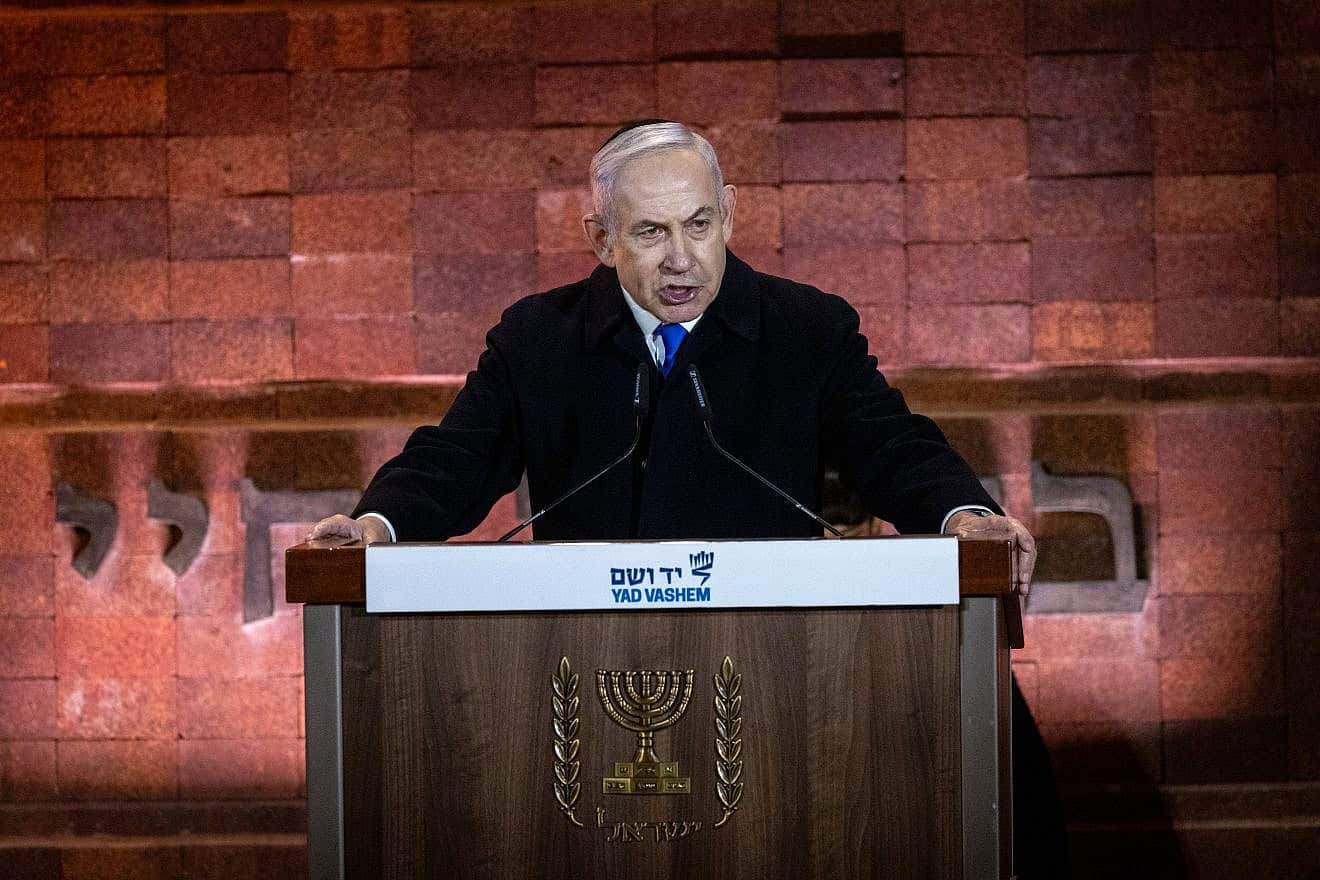
Prime Minister Benjamin Netanyahu marks the
beginning of Holocaust Remembrance Day at Yad Vashem in Jerusalem, May
6, 2024. Photo by Chaim Goldberg/Flash90.
Amid the Biden administration’s decision
to withhold arms from Israel, Prime Minister Benjamin Netanyahu on
Thursday reaffirmed Jerusalem’s resolve to defeat Hamas, even if it has
to fight without U.S. backing.
Sharing a clip of his May 5 speech at the
Yad Vashem Holocaust Memorial Museum in Jerusalem, the premier sought to
reiterate that “no amount of pressure, no decision by any international
forum will stop Israel from defending itself.”
“Eighty years ago, in the Holocaust, the
Jewish people were totally defenseless against those who sought our
destruction,” Netanyahu says in the speech, which was delivered on the
occasion of the first Holocaust Martyrs’ and Heroes’ Remembrance Day
(Yom HaShoah) since the Oct. 7 Hamas massacre.
“Today, we again confront enemies bent on
our destruction,” the premier continues. “As the prime minister of
Israel, the one and only Jewish state, I pledge here today, from
Jerusalem, on this Holocaust Remembrance Day, if Israel is forced to stand alone, Israel will stand alone.”
U.S. Secretary of Defense Lloyd Austin confirmed the
pause in testimony at a Senate Appropriations Committee hearing on
Wednesday about the Defense Department fiscal 2025 budget request.
Meanwhile, President Joe Biden told CNN that
Washington would stop providing weapons to the Jewish state if Israel
goes into Rafah, the last Hamas terrorist stronghold located in the
southernmost Gaza Strip.
Israel’s War Cabinet, as well as the
broader Security Cabinet, is set to meet on Thursday to discuss the
latest developments in the relationship with the United States.
A source in Jerusalem told Israel Hayom that the Cabinet is united in its view that the IDF should expand its operation in Rafah and occupy the city.
“Israel must do this to show the Biden
administration and the entire international community—and of course also
Iran and Israel’s other enemies—that we are not an American
protectorate, but rather an independent country,” the source said.
According to the official, Washington’s
steps could lead to a further deterioration on the northern front,
sending a message to the Hezbollah terrorist group that Israel is weak
and that the U.S. is not coming to its aid.
At a Defense Ministry ceremony on Thursday
ahead of Israel’s Memorial Day, which will be marked next week, Defense
Minister Yoav Gallant vowed to achieve all war goals in the country’s
north and south.
“I appeal to our enemies and our friends:
It is impossible to subdue us,” said Gallant. “We will ensure Israel’s
existence, whatever the cost may be, and keep clearly in mind the pledge
we signed just a week ago at the Holocaust Day ceremony: Never again.”
[I]mmensely disturbing is that "massive" amounts of advanced Chinese military equipment were found in Gaza by the IDF during its military operations there.
"The Chinese are imposing a
kind of sanction on us. They don't officially declare it, but they are
delaying shipments to Israel.... In electronic products, there are tens
of thousands of components, but if even one component doesn't arrive, we
cannot deliver the product." — Unnamed senior figure in a factory, Ynet, December 24, 2023.
Also immensely disturbing is that "massive" amounts of advanced
Chinese military equipment were found in Gaza by the IDF during its
military operations there.
"[I]f you set up systems with technology for critical
infrastructure, like electricity, energy, water, transport, these are
tied to one another. One can be used to bring the other down." — Harel
Manshari, Head of Cyber at the Holon Institute of Technology and
research fellow at the Institute for Counter-Terrorism, JNS, January 8,
2024.
China recently hosted delegations from Hamas and the Palestinian
Authority's ruling Fatah faction, ostensibly to facilitate "unity"
between the two factions, all the while pretending to be a neutral
mediator interested in peace in the region.
Is the enemy, already inside Israel's gates, also inside the US?
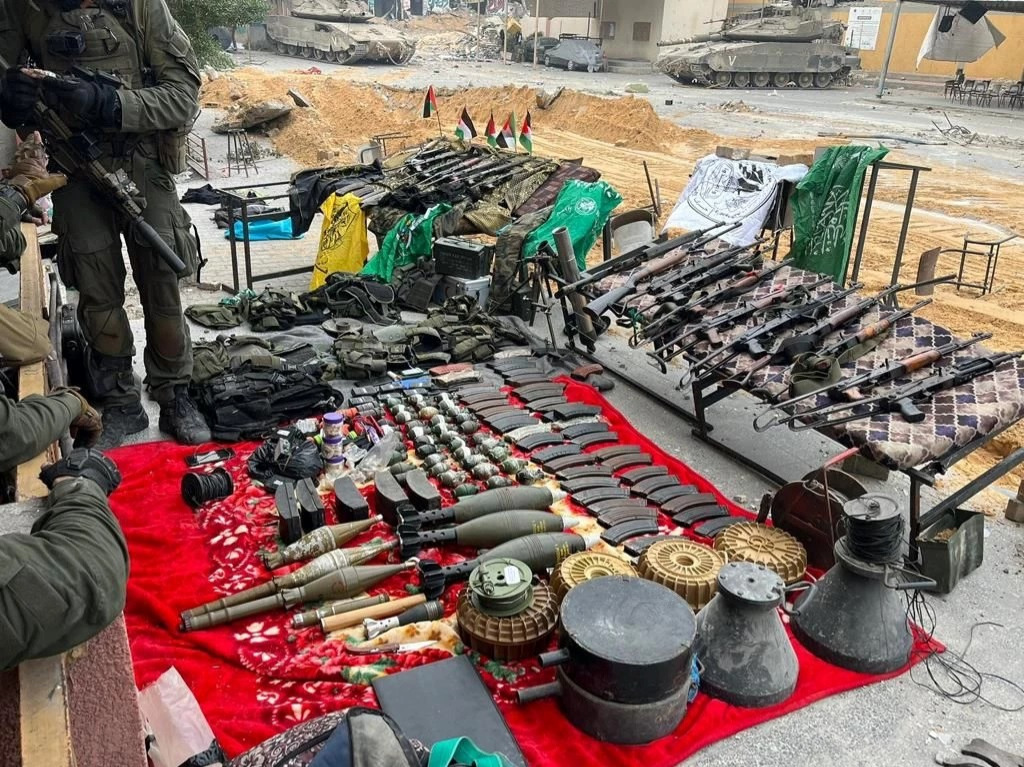
Immensely disturbing is that "massive" amounts of advanced
Chinese military equipment were found in Gaza by the IDF during its
military operations there. Pictured: A Hamas weapons cache discovered by
Israel Defense Force soldiers in the Gaza Strip, in December 2023.
(Image source: IDF)
The Iranian-orchestrated Hamas attack on Israel on October 7 -- which
resulted in mass rapes, the murders of 1,200 men, women, children and
infants; taking more than 250 hostages and firing thousands of rockets
at Israeli towns and cities -- has shown that China, which Israel might havethought was an ally, turned out to be, sadly, more of an enemy.
China refused to condemn Hamas and its terrorist invasion of Israel,
choosing instead to condemn Israel just a week after the massacre and
before Israel had even launched its ground operation in the Gaza Strip.
Israel's actions in Gaza have gone "beyond the scope of self-defense"
and the Israeli government must "cease its collective punishment of the
people of Gaza," China's Foreign Minister Wang Yi said on October 15.
In contrast to earlier conflicts between Hamas and Israel, China has now openly embraced Hamas.
On March 17, in Qatar, Chinese diplomat Wang Kejian met Hamas leader Ismail Haniyeh, and said:
"... China's firm positions towards the Palestinian issue
and its standing by the just demands of the Palestinian people for
freedom, independence, and statehood.... Hamas is part of the
Palestinian national fabric and China is keen on relations with it."
At the International Court of Justice (ICJ) in the Hague, where South
Africa and other countries accused Israel of "genocide," the Chinese
Foreign Ministry's legal advisor, Ma Xinmin, defended Hamas:
"Palestinian people's use of force to resist foreign
oppression and complete the establishment of an independent state is an
inalienable right... Armed struggle in this context [the October 7
massacre] is distinguished from acts of terrorism."
China has used Chinese-owned TikTok
to incite and brainwash Western children, teenagers and young adults to
hate Israel and to "free Palestine." The less-than-charming results can
be seen on university campuses and even high schools across the US. One Chinese social media video bragged
that "TikTok Has Won Big for Palestine." China is evidently seeking to
undermine the United States as much -- or more -- as it is seeking to
undermine Israel.
According to Michael Singh, head of The Washington Institute for Near East Polic:
"This approach is a stark departure from Beijing's past
impassivity toward Middle East conflicts in which Chinese officials had
usually sought to avoid entanglement. Rather, it reflects the
government's new inclination to use far-flung conflicts as opportunities
to undermine the United States."
"China has changed its attitude to Israel dramatically and it's gone
totally towards a position of anti-Semitism now," an unnamed Israeli
intelligence source said.
"Before October 7, the Chinese loved Israel and Jews and
felt a sense of admiration [for them] but now, the media coverage hasn't
even shown the Chinese public what happened on October 7, only the
aftermath. The regime is brainwashing the public in a totally different
direction and it's happening at an unprecedented pace."
"It's just pure maths," said Tuvia Gering, a specialist in China at Israel's Institute for National Security Studies.
"There's only one tiny Israel, and there's only one
country that supports it, which is the US. Well, you have today 57
members of the Organisation of Islamic Cooperation, and that's a lot of
votes in the [UN] General Assembly."
Israel has had diplomatic ties with China for more than three
decades, and has cultivated increasingly close-knit ties with it for the
past decade, especially after Prime Minister Benjamin Netanyahu's 2017 visit to China which led to 25 cooperation agreements,
including in science, technology, transport, food and agriculture, at
an estimated value of $2 billion. At that time, Netanyahu expressed
interest in joining China's Belt and Road Initiative and invited China
to build infrastructure projects in Israel.
Netanyahu's invitation has since led to China's deep involvement
in Israeli infrastructure. That includes building the new automated
deep-sea port in Haifa Bay; the Carmel Tunnels in Haifa; a railway
tunnel in northern Israel; a port in Ashdod, and the Tel Aviv light rail
system. China also manages
some desalination and electricity infrastructure in Israel. Between
2002 and 2020, Chinese companies, including Alibaba and Huawei, invested in 463 Israeli companies, predominantly in the technology sector,
especially in the life sciences, software development and IT sectors.
Fifty-three percent of the Chinese investors in Israeli companies were
state-owned, according to a 2021 study. China controls
Tnuva, Israel's milk and dairy giant, as well as the crop-protection
company Adama Agricultural Solutions. In addition, Israeli universities
all have partnerships with Chinese universities.
China's energetic embrace of Hamas -- whose officials have vowed
to repeat the October 7 attack, time and again, until Israel is
annihilated -- therefore, appears to have come as something of a shock
to Israel, mixed, apparently, with deep disappointment.
In December 2023, Israeli tech companies and manufacturers reported
that while China had not officially announced sanctions against Israel,
Chinese suppliers had begun to make it difficult for them to import
necessary materials.
"The Chinese are imposing a kind of sanction on us. They don't
officially declare it, but they are delaying shipments to Israel," one
unnamed senior figure in a factory told Ynet.
"They have various excuses and pretexts, such as
requiring suppliers from China to obtain export licenses to Israel that
did not exist before. Additionally, they demand that we fill out
numerous forms, causing significant delays. This has never happened to
us before. We are talking about many different types of components. In
electronic products, there are tens of thousands of components, but if
even one component doesn't arrive, we cannot deliver the product."
In January 2024, COSCO, China's state-owned shipping giant, cut ties with Israel. The company announced that it would cease operations in Israel. According to Ynet, the decision seemed "a principal decision by the Chinese to no longer operate with ports in Israel."
The decision by COSCO is all the more remarkable, because Chinese
state-owned companies built, own and operate Israel's new automated
container port in Haifa. The port, which opened to much fanfare in
September 2021, was built by the China Shanghai International Port Group
(SIPG), another Chinese state-owned giant, which Israel granted the right to operate the port until 2046. COSCO is a shareholder in the port.
"In practice it is maintaining a trade boycott on Israel," wrote
Shaul Schneider, chairman of the board of another port in Israel,
Ashdod Port, about COSCO's decision to cut ties with Israel. Schneider
threatened that in response, Ashdod Port would not be sharing
information with SIPG.
China, however, gets all the information it needs and more from
simply spying on Israel. The US warned at the time against the new
Chinese terminal in Haifa Bay, by announcing that U.S. Navy ships would
not dock in the nearby Israeli naval base due to the threat of China's
surveillance of the port, including the collection of data about joint
Israeli-American operations.
Then US Secretary of State Mike Pompeo cautioned on a visit to Israel in May 2020:
"We don't want the Chinese Communist Party to have access
to Israeli infrastructure and to Israeli communication systems – all of
the things that put Israeli citizens at risk, and in turn – put the
capacity for America to work alongside Israel on important projects at
risk as well."
In 2022, Nir Ben Moshe, former director of Security of the Defense
Establishment in the Israeli Ministry of Defense and a researcher in the
Israel-China program at the Institute for National Security Studies warned
that it was "not impossible" that alongside its official public
cooperation with Israel, China was engaged in espionage activity against
Israeli civilian, military, and government targets.
"Israel's advanced capabilities in elite technology,
cyber, medicine, agriculture, and more have the potential to contribute
technologically to almost every aspect of China's buildup plans. Thus,
Israel is an attractive source of technologies needed in China, as
explicitly expressed by the Comprehensive Partnership for Innovation
signed between the countries in 2017...
"The security establishment and the Israeli Defense Forces (IDF) are
likely a target of said Chinese intelligence efforts, both in themselves
and considering their deep connections with their counterparts in the
United States. The objects of these efforts would include major weapon
systems in Israel that are developed in cooperation with the United
States or produced by it, with some of the Israeli industries having
subsidiaries in the United States, while others produce components that
are integrated in American weapon systems. It is likely that advanced
Israeli military technology designated for export is also a target of
Chinese intelligence activity, including within the territories of the
countries that have acquired it."
China's deep involvement in Israel's infrastructure, technology, food
and agriculture industries is deeply concerning, especially because
Iran and China are close partners. In 2021, the two regimes signed a
massive 25-year comprehensive strategic cooperation deal amounting to a
total of $400 billion, which included military cooperation, joint
training, research and intelligence sharing, in exchange for Iran's sale
of oil and gas to China at a heavily discounted price.
"One of the most worrying clauses in the agreement between Iran and China is the intelligence sharing," said
Amos Yadlin, former IDF chief of Military Intelligence and the head of
Israel's Institute for National Security Studies, at the time of the
signing.
Also immensely disturbing is that "massive"
amounts of advanced Chinese military equipment were found in Gaza by
the IDF during its military operations there. An Israeli intelligence
source toldThe Telegraph:
"This has come as a big surprise as before the war,
relations were very good, but we have found massive amounts of Chinese
weaponry and the question is, did it come directly from China to Hamas
or not?... This is top-grade weaponry and communications technology,
stuff that Hamas didn't have before, with very sophisticated explosives
which have never been found before and especially on such a large
scale."
Guermantes Lailari, a visiting Scholar at National Chengchi University in Taiwan and a retired US Air Force Officer, wrote in a recent report for the Jewish Policy Center:
"The IDF found Chinese military equipment in Hamas
warehouses, including large numbers of assault rifles (QBZ assault
rifles) and grenade launchers (QLZ87 automatic grenade launchers),
telescopic sights for rifles and cartridges for M16s, high-end
communications equipment, listening devices, tactical military radios,
and sophisticated explosives. The discovery of massive quantities of
sophisticated Chinese explosives was alarming because Hamas only
recently acquired such lethal explosives. Additionally, the IDF
discovered Chinese rocket technology in one of Hamas' laboratories.
"In January 2024, the PRC denied providing Hamas with high-quality
military equipment. Even if the Chinese military supplies discovered in
Gaza were provided by Iran, PRC officials knew that Iran forwarded
equipment to Hamas. Certainly, Iran provided funding and training to use
the equipment."
Lailari appeared to suggest that China had an even more direct role in supporting Hamas terrorism:
"One source noted that PLA [China People's Liberation
Army] military advisors and tunnel warfare specialists helped design and
build these [Hamas] tunnels. What other PLA personnel have helped Hamas
and to what extent?"
China does not consider itself an ally of Israel, said
Harel Manshari, an Israeli expert in cyber warfare, who is the Head of
Cyber at the Holon Institute of Technology and a lecturer at Bar-Ilan
University, as well as a Research Fellow at the Institute for
Counter-Terrorism (ICT). In January, Manshari sent a letter to Yuli
Edelstein, the chairman of the Knesset Foreign Affairs and Defense
Committee, in which he warned about the risk that China poses to Israeli infrastructure:
"Despite warnings from the security establishment, in the
last decade, the Chinese government has invested extensively in
strategic assets in Israel... We see, clearly, more extreme conduct
against Israel by China... I believe that Israel must prepare itself and
decrease Chinese involvement in Israeli infrastructure... if you set up
systems with technology for critical infrastructure, like electricity,
energy, water, transport, these are tied to one another. One can be used
to bring the other down."
China recently hosted
delegations from Hamas and the Palestinian Authority's ruling Fatah
faction, ostensibly to facilitate "unity" between the two factions, all
the while pretending to be a neutral mediator interested in peace in the
region.
All China's actions show the reality to be quite different. China,
while exerting deep involvement in Israeli infrastructure, business and
technology, is actively working against Israel.
Is the enemy, already inside Israel's gates, also inside the US?
Robert Williams is a researcher based in the United States.
Major delays in the majority of the court cases against former President Trump bode well for his campaign, and the "confidential documents" case is on "indefinite" hold because of possible prosecutorial misconduct.
At one time, unfavorable outcomes
in the four court cases against former President Donald Trump seemed
likely to be politically damaging for the three-time campaigner, but as
the cases have faced scrutiny and delays, public opinion has recently shifted.
Yesterday, the Georgia Appeals Court agreed to hear an appeal in the
state election case brought by controversial Fulton County District
Attorney Fani Willis. Earlier this week, a Florida judge indefinitely
suspended the federal trial in the classified documents case.
With the federal January 6 case delayed until the Supreme Court rules
on an immunity argument it heard this spring, Trump is now set to see
significant delays in three of the four court cases arrayed against him
by both state and federal prosecutors. Only the New York so-called “hush
money” trial is ongoing, though key witnesses such as porn star Stormy
Daniels have appeared to undermine aspects of the case.
The delays come as the 2024 election fast approaches. The former
president—and now the presumptive Republican nominee—has been plagued by
the court cases since early 2023
frequently hampering his efforts to campaign. After recent
developments, three of those cases appear increasingly likely to be
delayed until after the November election, which bodes well for his
campaign.
“President Trump has established a commanding polling lead in the
battleground and Crooked Joe Biden is on the ropes. His Democrat party
allies know it, so they continue to ramp up their ongoing Witch-Hunts,
further abusing and misusing the power of their offices to interfere in
the presidential election,” Steven Cheung, Communications Director for
the Trump 2024 campaign said in a statement to Just the News Wednesday.
"President Trump and his team will continue to fight these
unconstitutional hoaxes in the courts and the American People will
ultimately hold Crooked Joe and his comrades to account this Fall,” he
added.
When the Georgia Appeals Court on Wednesday agreed to hear
an appeal from Trump's lawyers in his Georgia election interference
case, it marked the latest in a series of delays in the state case.
The first delay came when one of Trump’s co-defendants in the case raised accusations
that District Attorney Fani Willis had engaged in an improper romantic
and financial relationship with the lead prosecutor, Nathan Wade. She is
alleged to have benefited personally from that relationship.
Fulton County Superior Court Judge Scott McAfee, who is presiding
over the case, held hearings to assess calls for Willis to be
disqualified. McAfee ultimately ruled that the District Attorney’s
conduct was improper and that either Willis or her prosecutor, Wade,
would have to step down from the case. Wade complied with the order,
leaving Willis in place.
Trump and his co-defendants immediately moved to appeal his decision, which McAfee granted. Now that the Georgia Appeals Court has accepted that interlocutory appeal, it is likely to lead to even further delays.
Earlier this week, U.S. District Court Judge Aileen Cannon postponed the May 20 start date of the classified documents trial indefinitely in the face several pre-trial motions occupying the calendar.
“The Court also determines that finalization of a trial date at this
juncture—before resolution of the myriad and interconnected pre-trial
and CIPA [Classified Information Procedures Act] issues remaining and
forthcoming—would be imprudent and inconsistent with the Court’s duty to
fully and fairly consider the various pending pre-trial motions before
the Court, critical CIPA issues, and additional pretrial and trial
preparations necessary to present this case to a jury,” Cannon wrote in
her order.
“The Court therefore vacates the current May 20, 2024, trial date
(and associated calendar call), to be reset by separate order following
resolution of the matters before the Court, consistent with Defendants’
right to due process and the public’s interest in the fair and efficient
administration of justice," she added.
This announcement marked a win for the Trump team, which had
previously asked the judge to delay the case until after the 2024
election, which she declined at the time.
The Trump team brought forward another issue this week that could also further hold up the trial.
On Monday, Trump filed a new motion in the case drawing attention to
the government’s admission that “the prosecution team has failed to
maintain the integrity of the contents of at least some of the boxes
obtained from Mar-a-Lago.”
In a filing submitted in response to an effort by Trump co-defendant
Walt Nauta to further delay the case, Smith admitted that this team did
not properly preserve the evidence collected during the Mar-a-Lago raid.
“Because these inventories and scans were created close in time to
the seizure of the documents, they are the best evidence available of
the order the documents were in when seized. That said, there are some
boxes where the order of items within that box is not the same as in the
associated scans,” the prosecutors wrote.
In the footnote explaining this, the government also admitted that
this “is inconsistent with what Government counsel previously understood
and represented to the Court.”
Getting to the bottom of this admission, which the Trump legal team
alleges is “an extraordinary breach of [the prosecutors’] constitutional
and ethical obligations,” threatens to take up more of Judge Cannon’s
available time even as the election approaches. PJ Media reported
that the FBI "staged" photographs after the raid on Trump's Florida
Mar-a-Lago estate, saying that the DOJ claimed in an August 2022 court
filing, "[Thirteen] boxes or containers contained documents with
classification markings, and in all, over one hundred unique documents
with classification markings… were seized. Certain of the documents had
colored cover sheets indicating their classification status."
According to PJ Media, it turns out that the Department of Justice
released a photograph depicting alleged contraband seized from Donald
Trump’s Palm Beach estate that day; the image showed colored sheets
representing classification levels attached to files purportedly
discovered in Trump’s private office. Now the DOJ says "[If] the
investigative team found a document with classification markings, it
removed the document, segregated it, and replaced it with a placeholder
sheet. The investigative team used classified cover sheets for that
purpose."
The former president’s other federal case, in which Trump was charged
with conspiracy to defraud the United States and various types of
obstruction related to alleged efforts to overturn the 2020 election
results, has also faced speed bumps.
The trial was originally scheduled
to begin on March 4, but Trump appealed to the Supreme Court of the
United States, asking them to grant him broad immunity from prosecution
related to the privileges of the presidential office.
The high court announced in February that it would hear the case and
examine "whether and if so to what extent does a former president enjoy
presidential immunity from criminal prosecution for conduct alleged to
involve official acts during his tenure in office," according to NBC News. Trump’s claims were originally rejected by an appeals court that he was not immune.
The court heard arguments in the case in late April, but has not yet ruled on the matter. In questioning, analysts believed
the Justices seemed hesitant to grant broad immunity claims, but
appeared likely to grant narrow immunities stemming from the office.
Regardless of the court’s ruling, the proceedings have significantly
delayed the start of the trial, now more than two months since the
original planned start date.
“What’s very concerning about these hearings is that we’re getting lip service but a lack of enforcement, a lack of accountability,” said Rep. Elise Stefanik.
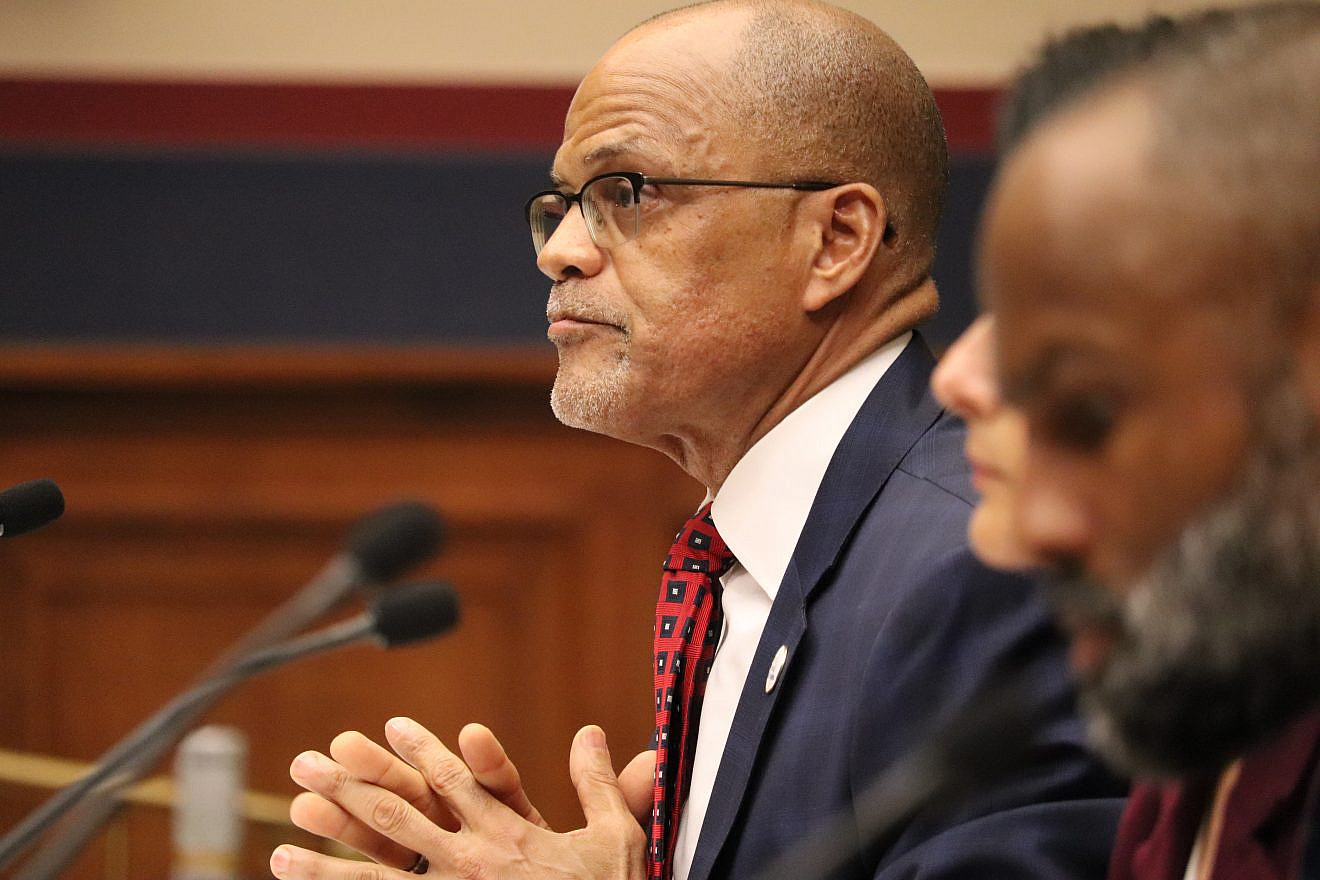
David Banks, chancellor of New York City Public Schools, testifies
before a House hearing on antisemitism in K-12 schools on May 8, 2024.
Credit: House Committee on Education and the Workforce Democrats.
Members of Congress grilled education
officials from New York, California and Maryland on Wednesday about
“pervasive” antisemitism in K-12 schools.
Members of the House Committee on
Education and the Workforce’s subcommittee on early childhood,
elementary and secondary education repeatedly asked David Banks, the
chancellor of the New York City Public Schools, about a student-led rampage at Hillcrest High School in the borough of Queens that targeted a Jewish teacher.
“We suspended students. We removed the
principal of the school. We engaged the Simon Wiesenthal Center for a
deeper dive into the education of those kids,” Banks said. “What’s
happening at that school now has transformed in significant ways. We’re
not fully arrived. This is a work in progress.”
A Hillcrest graduate, Banks said that the
teacher who was targeted after attending a pro-Israel rally decided to
return to the school, which he called “one of the most heroic things
I’ve ever heard.”
Rep. Elise Stefanik (R-N.Y.), one of the committee’s leading voices challenging
Jew-hatred in the U.S. education system, pressed Banks for reassigning
the Hillcrest principal to another role within the city’s Department of
Education rather than firing him.
“That’s concerning to me that you have him
in a senior position,” Stefanik said. “What’s very concerning about
these hearings is that we’re getting lip service but a lack of
enforcement, a lack of accountability.”
“These rules and policies matter, whether it’s teachers, administrators or students violating the rules,” she said.
Stefanik also asked about an alleged
incident at Origins High School in Brooklyn, N.Y., where she said 40 to
50 students marched through the halls chanting “death to Israel” and
“kill the Jews.”
Banks denied that the march and chants had taken place.
“We’ve done our investigation. We have
found no evidence that there was any movement through the hall saying
‘death to the Jews,’” Banks said. “We have found no evidence that that
actually happened, but we have found a wide range of deeply troubling
antisemitic things that have happened at Origins High School.
“This is the one case that has troubled me the most, congresswoman,” he added.
A teacher and security officer at the school are suing
Banks, the school and New York City for antisemitic harassment and
retaliation. The two allege that Banks, the school and the city failed
to prevent students from engaging in “a broad campaign of hate speech
while on school premises.”
Banks testified on Wednesday that several students were suspended at Origins but that he could not discuss ongoing litigation.
Lawmakers also heard from Enikia Ford
Morthel, superintendent of the Berkeley Unified School District, which
is the subject of a complaint
from the Anti-Defamation League and the Louis D. Brandeis Center for
Human Rights Under Law for violating the civil rights of Jewish
students.
“Antisemitism is not pervasive in Berkeley
Unified School District,” said Ford Morthel, who defended a teacher who
created a slideshow about Oct. 7 that claimed that “for some
Palestinians, ‘from the river to the sea’ is a call for freedom and
peace.”
“We definitely believe that it’s important
to expose our students to a diversity of ideas and perspectives, and if
it was presented as a perspective, I do think it’s appropriate,” she
said of the slogan.
Earlier in the hearing, she had said that
“from the river to the sea” is antisemitic “if it is calling for the
elimination of the Jewish people in Israel.”
“I will also say that I recognize that it does have different meaning to different members of our community,” she said.
Rep. Kevin Kiley (R-Calif.) said students
repeat “from the river to the sea,” because their teachers tell them
it’s an acceptable phrase.
“You said earlier you thought this was
antisemitic and you put this on a slide in the classroom, and then
students go around the halls saying it,” Kiley said. “I don’t think
there’s any anything surprising about that.”
Some Democrats on the committee questioned
whether the Republican-led investigation into Jew-hatred was failing to
address other forms of bigotry.
“We’ve also been unable to get any
hearings on other forms of hate,” said Rep. Bobby Scott (D-Va.). “I’d
ask Chancellor Banks, do you deal with other forms of hate other than
antisemitism, like homophobia or racism? Do transgender students have a
right to be safe in school?”
‘A wake-up call for your school districts’
Rep. Jamaal Bowman (D-N.Y.), a former New
York City schoolteacher who is one of the harshest critics of Israel in
Congress, said his congressional colleagues are accusing teachers
hypocritically.
“I have members of Congress talking about
teachers teaching hate. None of them have an education background, by
the way,” Bowman said.
“I work in Congress. When you go in the
rotunda and you look at American history, you see colonists coming in
and taking over America from the Native Americans,” he said. “There is
no reference to the black people who built this country in our rotunda.
But we’re scolding you about teaching hate.”
“Do you know how many black statues there
are in the Capitol? Three,” Bowman added. “You know how many Confederate
statues there are in the Capitol? 12.”
“I work in an institution that teaches hate—and with our policy,” he said.
Bowman also said that schools are failing
to teach about “a part of the history where the Jewish people and
Muslims and Christians lived together in harmony in the Middle East and
different parts of the world.”
Rep. Aaron Bean (R-Fla.), who chaired the
subcommittee hearing, said that he hopes that the discussion will be an
example for school districts across the country to address Jew-hatred.
“Hopefully it’s not only a wake-up call
for your school districts, but to everybody that’s watching across
America,” Bean said. “It’s 2024. There’s no place for this at all in
America.”
University president Jay Bernhardt said protesters would not face disciplinary hearings and sent staff to bail them out after they were arrested.
Emerson College occupies this row of buildings
across from the corner of Boston Common. Photo by John Phelan via
Wikimedia Commons.
Boston Mayor Michelle Wu on Tuesday
defended the police against charges by student protesters at Emerson
College that officers had engaged in extreme brutality while removing
their anti-Israel tent encampment, which had commandeered a city street.
The mayor said a city review found no protesters had been hospitalized. They “wanted to get arrested,” she added.
She noted that the school had offered the
protesters rooms to use 24 hours a day but the response of the student
organizers was to “keep the tents up to get arrested.”
The mayor’s no-nonsense response
contrasted sharply with that of Emerson College president Jay Bernhardt,
who has assured the protesters he “could feel the pain.”
His approach has won him little love among the student population, judging from recent meetings.
Many students called on the president to
resign at a town hall meeting held on April 29, which centered around
events leading up to the April 25 arrest of 118 students by the Boston
Police Department. Police acted after protesters at the “Popular
University Encampment” at 2 Boylston Place Alley refused to vacate the
public street.
Student calls for the president’s
resignation echoed a Student Government Association general assembly
meeting on April 26, when students unanimously voted no-confidence in
Bernhardt, who is Jewish, demanding he resign.
“Get him out,” some chanted, according to the school’s student newspaper, The Berkeley Beacon.
Bernhardt, who retains the support of
Emerson’s Board of Trustees, has continued his placatory approach. In a
campus-wide email on the Monday after the town hall meeting, Bernhardt
wrote: “As I listened to the 100-plus stories, passions ran high, and I
could feel the pain expressed by those arrested, those who cared for
them, and those who were adversely affected by the encampment.
“I certainly heard and now better
understand the pain these recent experiences have caused our community. I
deeply regret that despite our best efforts, our students’ activism
resulted in police action over their encampment, especially in the
heartbreaking way it occurred,” he wrote.
What “heartbreaking way” the police acted is unclear. Boston police gave students fair warning to leave the area. Bodycam footage shows an officer cautioning students on April 25 at about 1:30 a.m.
“We don’t want to arrest anybody. We
support your right to protest. I’m indifferent. OK? I don’t have a side
either way. I want you to be able to peacefully do this. However, with a
popular street, I can’t have that. I need you to open up. Leave it
open. Otherwise, I have to uproot you from there,” the officer said.
No students were hurt during the operation, though four officers were injured, one seriously, the police said.
Students disputed the police account at the Student Government Association and town hall meetings.
At the Student Government Association
event, students took turns at the microphone describing in high-strung
tones how they “watched our friends bleed.”
“I will never forget being able to see fluorescent yellow through the umbrella I was holding,” said one.
“Why is it so hard for not just the people
here and our politicians and our fellow human beings to care about
other human beings?” said another.
“It was an incredible escalation of
violence, but I’m so proud of our community for showing up today,” said
Nandan Nair, incoming executive president of the Student Government
Association.
Students at the town hall expressed anger
at the press for not reporting their version of events. “To the media,
[we] will not forget the lies you distributed and the woeful failure of
your journalism,” a student said.
“What happened on that day was completely
unconstitutional,” said a student joining via Zoom. “Class [action suit]
should be started.”
“I got charged with trespassing on my
college,” said one indignant student. (Police noted that 2 Boylston
Place Alley is not owned by Emerson College and the protesters were
violating city ordinances.)
Students mainly held Bernhardt responsible for the encampment’s dismantlement and for not ceding to their demands.
“Show us action. Show us anything. You
have already failed us,” said a student at the town hall. “But if you
cannot respect us enough to concede to our demands and resign, then
prove yourself. We are waiting. We are watching, history is watching,
history will remember where you stand.”
Protesting students demand Emerson call
for an immediate ceasefire in Gaza, disclose all financial investments,
and divest from entities supporting Israel.
They also insist that all disciplinary
charges be dropped against the organizers, a demand Bernhardt met,
announcing in an email to Emersonians last week that the college
wouldn’t bring “any campus disciplinary charges against the protestors
and will encourage the district attorney not to pursue charges related
to encampment violations.”
Emerson is covering bail costs for 108 of their student protesters who were arrested for illegal encampments and may face court appearances. The school is recommending no prosecution.
Higher education should not be coddling this kind of activism.
— American Jewish Committee (@AJCGlobal) May 7, 2024
‘The most extreme voices’
He also revealed the school had sent staff
to police precincts and posted bail for “arrested students, canceling
and modifying classes so our community could process what had occurred,
and providing additional care and support for our community to heal.”
Bernhardt’s decision brought criticism from Anti-Defamation League CEO and national director Jonathan Greenblatt.
“The president of Emerson is going out of
his way to make sure students who broke the law and violated Emerson’s
own policies face no consequences,” Greenblatt said. “This capitulates
to the most extreme voices and rewards their disruptive conduct.”
The ADL called on Bernhardt to reverse his decision and “urges the Suffolk District Attorney to enforce the law.”
Although similar encampments at other
schools have been rife with antisemitism, Emerson’s protesters insisted
theirs was different.
“I have not heard one utterance of
anti-Jewish hate speech. That’s just not what we do,” Owen Buxton, a
member of Emerson’s chapter of Students for Justice in Palestine, told The Boston Globe in a video on YouTube, even as he called for a boycott of “all Zionist entities.”
Later in the video, protesters chanted,
“Palestine will be free. From the sea to the river,” generally regarded
as a genocidal call for Israel’s destruction.
Emerson student Roni Moser, 19, a freshman
from Israel, who said that her parents warned her not to speak Hebrew
or tell anyone she was Israeli, nevertheless spoke out, taking the
podium at a pro-Israel rally in Boston on April 28.
She described a situation in which Jewish
students were intimidated, “to the point where many had to be removed
from campus and temporarily placed in hotels.”
Emerson Student Roni Moser speaking at a rally to support Jewish students, April 28, 2024. Source: YouTube.
“Friends of mine were called terrorists,
were compared to the KKK and were harassed and offended for believing
Israel has the right to exist,” Moser said.
“People have the right to protest, and
people have the right to protest things we don’t necessarily agree with.
People shouldn’t and don’t have the right to use such violent and
antisemitic speech.”
Examples of hateful speech Moser provided:
“Long live the intifada,” “Israel is antisemitic,” “From the river to
the sea” and “F*** Zionists.”
The Palestinians actually owe Israel a huge debt of gratitude for finally driving Hamas out of the Palestinian side of the Rafah border crossing.
Hamas and Egypt were quick to
issue statements denouncing the capture of the Rafah border crossing,
claiming that the move would "threaten" the lives of the Palestinians
and hinder the entry of humanitarian and relief aid into the Gaza Strip.
The Egyptians and Hamas have good reason to be angry with the
presence of the IDF at the Palestinian side of the Rafah border
crossing. For several years, Palestinians who wanted to exit the Gaza
Strip via the terminal have alleged that they had to bribe Hamas and
officials. Hamas and Egypt are now afraid of losing the Palestinian
milk-cow.
"It is our right to travel without bribes and without corruption.
We are living under a [Hamas] dictatorship." Abu Amr was later arrested
by Hamas security officers, who confiscated her mobile phone and
ordered her to delete the Facebook post. — Noha Abu Amr, Palestinian
journalist, 24.ae, January 24, 2024
[A] Palestinian man in the US [said] he paid $9,000 to get his
wife and children on the list. On the day of travel, he was told his
children's names were not listed and he would have to pay an extra
$3,000. He said the brokers were "trying to trade in the blood of
Gazans".
[T]he company [Hala Consulting and Tourism Services] owned by an
influential Egyptian businessman and ally of President Abdel Fattah
el-Sisi] is estimated to have made a minimum of $118 million from
desperate Palestinians trying to leave the Gaza Strip. "By the end of
this year, if the April average continues, the company may earn well
over half a billion dollars from the so-called VIP list of people Hala
is transferring across the Gaza-Egypt border. " — Middle East Eye, May 1, 2024.
An international charity [that does not want to be named] with
extensive experience in providing emergency aid in wars...is also being
forced to pay $5,000 per truck to a company linked to Egypt's General
Intelligence Service (GIS) to get aid into the Gaza Strip. — Middle East Eye, January 30, 2024.
The Palestinians actually owe Israel a huge debt of gratitude for
finally driving Hamas out of the Palestinian side of the Rafah border
crossing.
Egypt and Hamas are, it seems, indifferent to the pain endured by
the Palestinians they are effectively imprisoning. All that matters to
them is making more money off anyone desperate to leave the Gaza Strip.
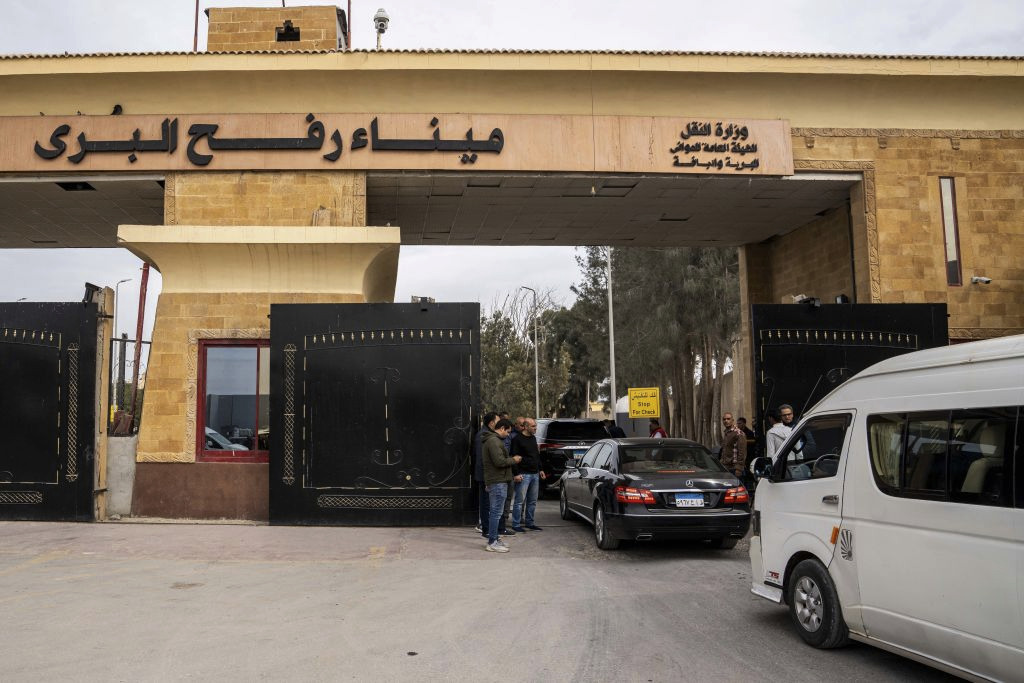
Pictured: The Rafah border crossing terminal, seen from the
Egyptian side, on January 17, 2024. (Photo by Ali Moustafa/Getty Images)
On May 6, the Israel Defense Forces (IDF) captured the Palestinian
side of the Rafah border crossing between the Gaza Strip and Egypt,
drawing condemnations from the Iran-backed Hamas terrorist group and
Egypt.
The IDF said
it had "intelligence that terrorists were using the border crossing for
terror purposes." A day earlier, Hamas terrorists fired rockets from
near the Rafah terminal toward the Kerem Shalom area (near the
Israel-Gaza border), killing four Israeli soldiers and wounding several
others.
In response to the Israeli military operation, Hamas and Egypt were quick to issue statements denouncing the capture of the Rafah border crossing, claiming that the move would "threaten" the lives of the Palestinians and hinder the entry of humanitarian and relief aid into the Gaza Strip.
"Egypt condemns in the strongest terms the Israeli military
operations in the Palestinian city of Rafah, and the resulting Israeli
control over the Palestinian side of the Rafah crossing," read a statement by the Egyptian Ministry of Foreign Affairs.
"This dangerous escalation threatens the lives of more
than a million Palestinians who depend primarily on this crossing as it
is the main lifeline of the Gaza Strip, and the safe outlet for the
wounded and sick to exit to receive treatment, and for the entry of
humanitarian and relief aid to our Palestinian brothers in Gaza."
Hamas and other Palestinian terrorist groups in the Gaza Strip also
expressed outrage over the Israeli move and said they would not accept
the presence of any non-Palestinian party on the Palestinian side of
their terminal.
"We will not accept from any party the imposition of any form of guardianship over the Rafah crossing," the terrorist groups cautioned.
They urged the Arab and Islamic states "to reject any plans and
attempts that affect Palestinian-Egyptian sovereignty over the Rafah
crossing."
The Egyptians and Hamas have good reason to be angry with the
presence of the IDF at the Palestinian side of the Rafah border
crossing. For several years, Palestinians who wanted to exit the Gaza
Strip via the terminal have alleged that they had to bribe Hamas and officials. Hamas and Egypt are now afraid of losing the Palestinian milk-cow.
In 2015, Egyptian journalist Ahmed Moussa revealed that Hamas received bribes worth $6,000 from Palestinians for passing through the Rafah border crossing.
A year later, Palestinian journalist Noha Abu Amr wrote on her
Facebook page about the plight of her 50-year-old mother, who was unable
to travel through the Rafah crossing, but she did not pay a bribe to
Hamas officials. She said
that her mother sat on the floor and kissed the hands and legs of the
crossing officials in full view of the people and begged them to allow
her to travel. "They treated her like animals," Abu Amr recounted.
"It is our right to travel without bribes and without corruption. We
are living under a [Hamas] dictatorship." Abu Amr was later arrested by Hamas security officers, who confiscated her mobile phone and ordered her to delete the Facebook post.
Arab and Western media outlets have reported
that since the start of the Israel-Hamas war in October 2023,
Palestinians who want to leave the Gaza Strip through the Rafah terminal
are being compelled to bribe
Egyptian officials with thousands of dollars. The war erupted after
Hamas terrorists invaded Israel and massacred, decapitated, raped and
dismembered 1,200 Israelis on October 7. Additionally, more than 240
Israelis were abducted by the terrorists and taken to the Gaza Strip; 132 hostages, many of whom are believed to have been killed, are still being held there by the terrorist group.
"To leave Gaza, people are paying a $5,000 bribe to Egypt," the Gaza-based Palestinian journalist Hind Khoudary wrote on X on November 23, 2023.
Palestinians who try to leave the Gaza Strip through the Rafah border
crossing have to pay bribes to brokers of up to $10,000, the British
newspaper The Guardianreported on January 8, 2024.
"Very few Palestinians have been able to leave Gaza
through the Rafah border crossing but those trying to get their names on
the list of people permitted to exit daily say they are being asked to
pay large 'coordination fees' by a network of brokers and couriers with
alleged links to the Egyptian intelligence services."
It quoted a Palestinian man in the US as saying
he paid $9,000 to get his wife and children on the list. On the day of
travel, he was told his children's names were not listed and he would
have to pay an extra $3,000. He said the brokers were "trying to trade
in the blood of Gazans".
"It's very frustrating and saddening," he said. "They are trying to exploit people who are suffering, who are trying to get out of the hell in Gaza."
"A network of brokers, based in Cairo, helping
Palestinians leave Gaza has operated around the Rafah border for years.
But prices have surged since the start of the war, from $500 for each
person."
The Guardian interviewed a number of Palestinians who have
been told they would have to pay between $5,000 and $10,000 each to
leave the Gaza Strip, with some launching crowdfunding campaigns to
raise the money.
A Palestinian living in the UK was quoted as saying:
"People are making money off the misery of others.
They're desperate to get out to save their lives and instead of helping
they're trying to make money. If there's a way to get people out, then
why not just help?"
A company owned by an influential Egyptian businessman and ally of
President Abdel Fattah el-Sisi is making around $2 million a day from
Palestinians fleeing the Gaza Strip, according to the Middle East Eye (MEE), a UK-based news website, on May 1, 2024
"Hala Consulting and Tourism Services, a firm owned by
Sinai tribal leader and business tycoon Ibrahim al-Organi, has been
charging Palestinians crossing from Gaza's Rafah to Egypt at least
$5,000 per adult and $2,500 for children under 16.
"It has a monopoly on providing transfer services at the Rafah
crossing, the only Gaza exit not bordered with Israel and the single
route out of the coastal enclave for Palestinians."
In the past three months alone, the company is estimated to have made
a minimum of $118 million from desperate Palestinians trying to leave
the Gaza Strip, according to MEE.
"By the end of this year, if the April average continues,
the company may earn well over half a billion dollars from the
so-called VIP list of people Hala is transferring across the Gaza-Egypt
border...
"Palestinian and Egyptian sources told MEE that several
intermediaries were involved in coordinating the exit of Palestinians in
a haphazard, decentralised way.
"Before February, Palestinians were charged up to $11,000 per adult
to leave Gaza, until Hala monopolised the business and standardised
fees.
"Prior to the war, Hala charged everyone exiting Gaza via the Rafah
crossing $350 per person, but the price has increased 14-fold for
Palestinians."
According to the Palestinian ambassador in Cairo, Diab Allouh, an estimated 80,000-100,000 Palestinians have fled Gaza via Egypt since the war began.
Earlier this year, MEE reported
that an international charity with extensive experience in providing
emergency aid in wars, famines and earthquakes throughout the Middle
East and in Afghanistan is also being forced to pay $5,000 per truck to a
company linked to Egypt's General Intelligence Service to get aid into
the Gaza Strip.
"The charity, which does not want to be named to avoid
obstruction to its relief efforts in Gaza, spoke to Middle East Eye in
outrage at having to pay what it openly describes as a bribe to a
state-linked agent."
MEE quoted a spokesman for the charity as saying:
"We have worked around the world in times of war,
earthquakes and other disasters, but we have never been treated like
this by a state that is profiteering from the dispatch of humanitarian
goods. It's draining a lot of our resources and the bribe being paid is
per truck."
According to MEE:
"The charity's statement to MEE is the first concrete
evidence of Egypt or Egyptian government-linked parties demanding a cut
from the humanitarian aid going into Gaza..."
MEE said
it spoke to five Palestinian families who all confirmed that they had
paid fees in the thousands, mostly in US dollars or euros, to mediators
who then facilitated their exit from Gaza.
Nadia Atawy, an Egyptian woman trapped in the Gaza Strip since the beginning of the war, said
in a video that she is unable to pay a $650 bribe to return to her
family in Egypt though the Rafah border crossing. "I don't have the
money to pay," Atawy complained. "I have children with me and I can't afford to pay [the bribe]. I don't know what to do."
The Palestinians actually owe Israel a huge debt of gratitude for
finally driving Hamas out of the Palestinian side of the Rafah border
crossing. Since the terrorist organization took over the Gaza Strip in
2007, the crossing has been under its control. Hamas used the crossing
to collect money for its corrupt officials and their families. In a
similar vein, Palestinians are now being forced to pay thousands of
dollars to Egyptians to escape the Gaza Strip.
One can understand why Egypt and Hamas strongly oppose having the IDF
stationed at the border crossing: the millions of dollars they have
been receiving may disappear. Egypt and Hamas are, it seems, indifferent
to the pain endured by the Palestinians they are effectively
imprisoning. All that matters to them is making more money off anyone
desperate to leave the Gaza Strip.
Bassam Tawil is a Muslim Arab based in the Middle East.