The "Middle East and Terrorism" Blog was created in order to supply information about the implication of Arab countries and Iran in terrorism all over the world. Most of the articles in the blog are the result of objective scientific research or articles written by senior journalists.
From the Ethics of the Fathers: "He [Rabbi Tarfon] used to say, it is not incumbent upon you to complete the task, but you are not exempt from undertaking it."
Have those who lectured us about democracy in danger now decided to save it by destroying it?
The 2023-2024 campaign season is not just the strangest on record, it’s also arguably the most anti-democratic.
Ostensibly, the Democratic Party has claimed over the last decade
that Donald Trump posed a continued and existential threat to the
republic.
That allegation subsequently justified a variety of anti-democratic
means to neuter his first two presidential candidacies, his presidency,
and now his third and final run for the White House.
A near decade ago, we witnessed the 2015-2016 Hillary
Clinton/Democratic National Committee/FBI-assisted effort to plant the
false accusation of Trump-Russian collusion to warp the 2016 election.
That gambit centered around the fraudulent Steele dossier and nearly
fatally crippled the Trump 2016 campaign. That hoax would later
sidetrack 22 months of his presidency before being proven a fantasy.
On the eve of the 2020 election, the left next birthed the Russian laptop disinformation campaign.
That hoax also warped a presidential debate with false charges that
Hunter Biden’s own incriminating laptop was once again the work of
Russians seeking to conspire with Trump.
Those unusual efforts continued during the Biden administration.
For the first time in election history, the allies of one campaign
sought to persuade some 16 states to try to remove a major party’s
likely nominee from their primary and general election ballots.
The plan was to smother a Trump third presidential bid in its
infancy, and thus once again not allow the people to accept or reject
his candidacy.
Nearly simultaneously, four federal, state, and local prosecutors filed dozens of felony charges against Trump.
They all shared some strange similarities.
These indictments would likely not have been filed, had Trump not run
for office. Nor would any of them have proceeded had Trump not been a
controversial conservative Republican seeking reelection.
Almost all the charges had not been filed against any other prior candidate and rarely a private citizen.
Some of them could just as easily have been lodged against Joe Biden and his son.
Some indictments and convictions may still achieve their objectives
of bankrupting, jailing, or keeping Trump inert during the final weeks
of the campaign.
One of the Georgia prosecutors had undisclosed meetings with the Biden White House counsel.
President Biden himself, on the eve of the federal prosecutor Jack
Smith’s indictment, all but declared his campaign rival Trump guilty.
Biden’s own chief of the White House had also met privately and secretly with Smith.
In an unprecedented fashion, Smith rushed his prosecution to ensure it synchronized with the 2024 campaign.
Similar federal charges could just as easily have led to the
indictment of President Joe Biden—if the special counsel in that case
had not claimed that he could not convince a jury to convict a culpable
but cognitively challenged Biden.
Another Biden prosecutor mysteriously left his top position at the
Justice Department to join the Alvin Bragg Manhattan prosecutorial
staff.
Nonetheless, Trump had survived collusion, disinformation,
de-balloting, lawfare, and a subsequent assassination attempt to surge
far ahead of Biden in the June presidential polls.
Biden’s poll collapse prompted Democratic donors and high-ranking
politicos to force a stress-test presidential debate before either
candidate was even nominated at their respective conventions.
When Biden imploded in the debate, a supposedly once-fit president
was suddenly declared impaired. And a previously uninspiring Vice
President Kamala Harris was abruptly transmogrified into a superb
replacement candidate.
Biden was forced to resign his candidacy to save his last five months in office from a Democrat threatened removal via the 25th Amendment.
The primary votes of nearly 15 million voters were abruptly nullified.
Harris who had neither won a primary nor a single delegate through an
election was suddenly coronated as the new Biden-replacement
candidate—and without an open convention contest or vote.
The donor-politico class further decided that, like a challenged
Biden in 2024, Harris could not be allowed to hold press conferences.
She would do few if any live interviews, unscripted town halls or any
other venue given fears her visible liabilities might endanger her
candidacy.
So, the Party that had proclaimed democracy dies in darkness now
favors the shadows as the preferable means to obtain and retain
power—whether by ignoring primary voters, open conventions, or
transparent venues with the voters.
Add up the last decade’s purchased collusion caper, unprecedented two
impeachments, orchestrated disinformation hoax, efforts to de-ballot
Trump, warping of the legal system to jail him and destroy his
candidacy, forced removal of an unpopular but unwilling President Biden
from the Democrat ticket, virtual anointing of Harris by fiat in his
place, and the current collusion with a compliant media to avoid public
scrutiny and cross-examination of Harris.
And the conclusion?
Have those who lectured us about democracy in danger now decided to save it by destroying it?
Conservatives and animal rights activists have become strange bedfellows in recent years on First Amendment, FOIA issues. Exposed interview with lab operator verifies "Beaglegate" allegations Fauci long denied with Washington Post's help.
The National Institutes of Health
doesn't want you to use the words "animal," "testing" or "cruel" in
comments on its social media pages. Too bad, the U.S. Court of Appeals
for the D.C. Circuit told the agency.
Animal experimentation is at the heart of First Amendment and Freedom
of Information Act litigation against the feds, with People for the
Ethical Treatment of Animals recently defeating NIH in court and
Judicial Watch suing the Department of Health and Human Services (HHS)
for stonewalling its requests for communications about an alleged
COVID-19 coverup.
Neither agency responded to Just the News queries for their response to the legal developments.
Conservatives and animal rights activists have become strange
bedfellows in recent years, sometimes on the same issue or just the same
principle.
PETA and Animal Outlook supported Project Veritas
this year in a friend-of-the-court brief at the 9th Circuit against an
Oregon law that prohibits "unannounced audiovisual recording" in public,
except when the target is an on-duty cop or a life-threatening felony
is taking place.
Like the undercover conservative sting organization, known for exposing a Pfizer executive discussing its plans to "mutate" COVID
to protect its "cash cow," the animal rights groups go undercover to
document and expose cruelty and crimes against animals, they said.
The Post "spent years publishing flattering profiles on this
group and its innovative bipartisan strategies" until it endangered
Fauci's reputation, journalist Glenn Greenwald noted then.
Last week WCW published an Oct. 25, 2021 radio interview
in which the director of the Tunisian lab that performed the puppy
experiments said they were funded by NIH "throughout [sic] the institute
Dr. Fauci is managing."
The group obtained the recording through a FOIA lawsuit against the
State Department because the interview was "circulated that day among
U.S. Embassy staff in Tunisia, including the U.S. Ambassador," WCW said Monday.
It also got a same-day email thread within State, whose subject line
mentions an article on NIH funding a project "unnecessarily 'drugging
puppies,'" that recounts the Tunisian researcher telling a handler that
he and his family were receiving "hate phone calls and threats on social
media" for his work on the "NIH-funded project."
The D.C. Circuit struck down NIH's prohibition
of "off-topic posts" by visitors to its Facebook and Instagram pages as
implemented through "custom keyword filters" – which hid comments using
NIH-chosen words, not platform-offered defaults, from the public – and
instructed the lower court that upheld the speech restrictions to instead enter summary judgment for PETA.
The agency's comment threads are "limited public forums because the
government has signaled its intent to limit the discussion on those
threads to specific subjects," President Biden-nominated Judge Bradley
Garcia wrote for the panel.
But the off-topic restriction is "not reasonable in light of the
purpose of the forum and is therefore unconstitutional," he wrote,
joined by Obama nominee Patricia Millett and George H.W. Bush nominee
Karen Henderson.
"Typically, the user who posted the filtered-out comment is not
notified," the opinion said. NIH-suppressed words – some misspelled or
in Spanish – included variations of "PETA," "torment" and "torture,"
common research animals including chimps and cats, the names of two
monkey-experiment researchers, anti-testing hashtags and even "four
emojis."
NIH hid a comment by one of the animal-rights activists who sued as
an individual, Madeline Krasno, on its Instagram post depicting a
COVID-infected cell. She wrote: "It’s time we had an open conversation
about all the animal testing you fund. What a waste of life and
resources."
Because NIH used an automatic method to filter comments, it did not
"affirmatively decide not to enforce its guidelines" but rather
"imperfect[ly]" sought to block comments against its policy, making its
social media pages a limited public forum, the opinion said, siding with
the feds.
But a "substantial portion" of its posts talked about "research
conducted using animal experiments or researchers who have conducted
such experiments," so hiding critical comments using the same words
"defies common sense," the opinion said.
"Worse, the government fails to provide any definition of 'off-topic'
in its Comment Guidelines, to its social media moderators, or even in
this litigation," Judge Garcia wrote, referring to oral argument in
which NIH said the meaning of "off-topic" is "commonly understood" and
that moderators use their "experience" to decide what to prohibit.
That it stopped blocking anti-testing hashtags mid-litigation – which
NIH said it belatedly realized "may have signaled a certain viewpoint" –
confirmed to the D.C. Circuit that the policy doesn't provide
"objective, workable standards" to its enforcers, Garcia wrote.
NIH neither considers "the topic of any given post or the context in
which a comment is made" in its keyword filter, nor manually reviews
comments "to restore otherwise on-topic comments," turns off filters
depending on the topic or "even routinely review[s] its keyword list to
consider whether its keywords should be removed (at least absent a
lawsuit)," the opinion said.
Judicial Watch filed its new FOIA lawsuit
two months after HHS acknowledged receipt of its request and assigned a
tracking number – a month past the agency's deadline to "make a final
determination" and avoid court, the conservative watchdog said.
The request sought communications from Fauci and senior scientific
adviser David Morens "soliciting help, advice, or assistance" from NIAID
or NIH's FOIA office "to circumvent, avoid (i.e. through use of private
email, phone calls, deleting emails, etc.), or otherwise not respond"
to lawful FOIA requests.
Previous disclosures showed Morens told scientists in the early days
of the pandemic, when NIAID faced heavy scrutiny for funding the Wuhan
Institute of Virology's bat research and potentially facilitating a
possible leak of the novel coronavirus, that he intentionally evaded FOIA with help from NIAID's "foia lady," later identified as Margaret Moore.
Judicial Watch named Moore and fellow FOIA office employees Robin
Schofield and Marianne Manheim as employees from whom Fauci and Morens
might have sought help, adding NIH's Karen Lampe in a request for
communications among FOIA staff on withholding FOIA requests regarding
WIV and the EcoHealth Alliance, which passed through U.S. taxpayer
funding.
It gave a laundry list of sought Morens communications, including his
use of private email or advising anyone – including Fauci and outside
scientists – to communicate using private email for "official government
business" when discussing subjects such as EcoHealth, its President
Peter Daszak, "kickbacks" and "Tony," a common internal reference for
Fauci.
Harris's new Jewish "liaison" opposed every single pro-Israel move by both Republicans and Democrats, whether it was moving the US Embassy to Jerusalem, recognizing Israeli sovereignty over the Golan Heights, or even cutting off aid to the "pay-for-slay" program of the Palestinian Authority. Instead, he urged anti-Israel moves, including a unilateral recognition of a "Palestinian" state on Israel's territory.
A member of John Kerry's team
under President Barack Obama, whose biased attacks on Israel and
support for Iran and Islamic terrorists in Israel helped lead to the
current regional crisis, [Ilan] Goldenberg had spent the years leading
up to October 7, 2023 doing everything possible to make the Hamas attack
happen.
He had urged that more money should go into the Hamas territory
and argued that Israel should allow in workers from Gaza. "You used to
have 25,000, 100,000 Gazans working inside Israel. That needs to happen
again." That led to Oct 7.
Harris's new Jewish "liaison" opposed every single pro-Israel
move by both Republicans and Democrats, whether it was moving the US
Embassy to Jerusalem, recognizing Israeli sovereignty over the Golan
Heights, or even cutting off aid to the "pay-for-slay" program of the
Palestinian Authority. Instead, he urged anti-Israel moves, including a
unilateral recognition of a "Palestinian" state on Israel's territory.
Goldenberg had been a vocal proponent of the Iran nuclear deal,
and attended an event by National Iranian American Council (NIAC): the
Iran lobby. He had argued that, "In the aftermath of a successful
nuclear deal, U.S. relations with Iran should shift from that of an
adversary to that of a competitor."
And Goldenberg had been part of the team that was responsible for
and had defended the Obama administration's opposition to Israel at the
UN.
Previous Jewish liaisons were usually involved with Jewish
communal life and could speak to a variety of issues. Goldenberg is
simply an anti-Israel activist whose only issues are empowering Iran and
Hamas.
Instead of selecting someone from the Jewish community or any of
her political aides, Harris chose someone whose sole function will be to
justify her anti-Israel policies to the Jewish community, and who will
filter any efforts by the Jewish community to push back against them.
During the 2021 battles with Hamas, Goldenberg explained why Biden was only pretending to support Israel.
Lies, deceit and manipulation with the aim of empowering Hamas and destroying Israel.
The Kamala campaign and her political allies are leading a
fundamental break with Israel, even before the election, while
disguising it with happy talk for the benefit of some of their donors.
The appointment of one of the most persistently hostile foreign
policy figures as a 'liaison' to the Jewish community sends a powerful
message that this administration will be as anti-Israel as him and that
Kamala will reconfigure her relationship with American Jews around her
anti-Israel policies. Not even Obama went that far. What does it say
that Kamala is already doing it now?
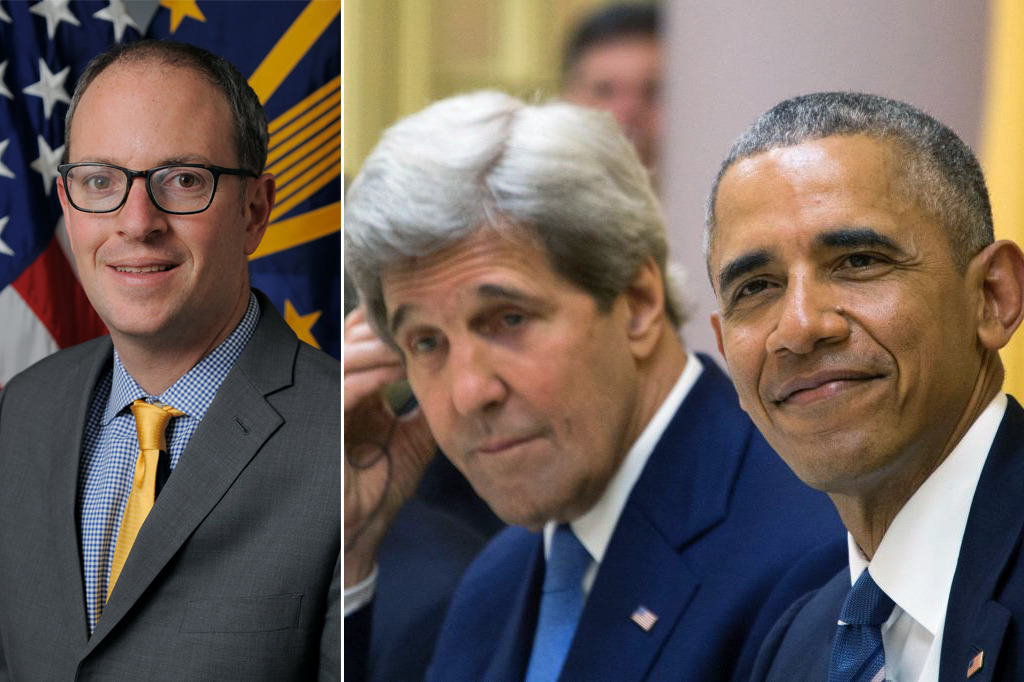
The Harris-Walz campaign has picked Ilan Goldenberg (left)
as its "liaison" to the Jewish community. A member of John Kerry's team
under President Barack Obama, whose biased attacks on Israel and support
for Iran and Islamic terrorists in Israel helped lead to the current
regional crisis, Goldenberg had spent the years leading up to October 7,
2023 doing everything possible to make the Hamas attack happen. (Image
sources: Obama and Kerry - Jim Watson/AFP via Getty Images. Goldenberg -
US Department of Defense)
"Pressure is building in Congress for Biden to do more to halt
Israel's assault on Gaza," he was asked in a 2021 interview as fighting
raged to stop Hamas assaults on Israel.
"Hopefully he can use it as leverage to get the Israelis to stop,"
Ilan Goldenberg, Kamala's future Middle East advisor and new "liaison"
to the Jewish community, answered.
Could a Harris administration be any worse for the Jews than the Obama administration?
An early answer arrived with the announcement that the Harris-Walz
campaign has picked Goldenberg as its "liaison" to the Jewish community.
Freedom Center Investigates had previously profiled Goldenberg when he was serving as Harris's Middle East advisor.
A member of John Kerry's team under President Barack Obama, whose
biased attacks on Israel and support for Iran and Islamic terrorists in
Israel helped lead to the current regional crisis, Goldenberg had spent
the years leading up to October 7, 2023 doing everything possible to
make the Hamas attack happen.
And the time afterward serving as a Harris adviser and imposing sanctions on Israelis.
Goldenberg had previously advocated for a deal in which "Hamas would retain some of its military capabilities" and argued:
"I think half the root causes are Israeli actions, in
terms of — especially just focusing on Gaza, on the blockade. And the
other half is Hamas' choice to use violence and arm itself in response."
He had urged that more money should go into the Hamas territory and argued that Israel should allow in workers from Gaza. "You used to have 25,000, 100,000 Gazans working inside Israel. That needs to happen again." That led to Oct 7.
Harris's new Jewish "liaison" opposed every single pro-Israel move by
both Republicans and Democrats, whether it was moving the US Embassy to
Jerusalem, recognizing Israeli sovereignty over the Golan Heights, or
even cutting off aid to the "pay-for-slay" program of the Palestinian
Authority. Instead, he urged anti-Israel moves, including a unilateral recognition of a "Palestinian" state on Israel's territory.
Goldenberg had been a vocal proponent of the Iran nuclear deal, and attended an event
by National Iranian American Council (NIAC): the Iran lobby. He had
argued that, "In the aftermath of a successful nuclear deal, U.S.
relations with Iran should shift from that of an adversary to that of a
competitor."
And Goldenberg had been part of the team that was responsible for and had defended the Obama administration's opposition to Israel at the UN.
A recent Tablet article
by Michael Doran of the Center for Peace and Security in the Middle
East had described Goldenberg as playing a "very enthusiastic role" in
the Biden administration's program to sanction Jews in Israel. So far
those sanctions have targeted an Israeli goat farm, an Israeli baker who shot a terrorist, and an Israeli mother of 8 who works with survivors of sexual assault and led protests against Biden administration policies that rewarded Hamas.
Rather than being associated with the Jewish community, Goldenberg
was tied to anti-Israel groups including J Street, Americans for Peace
Now and the Israel Policy Forum: which hailed the pick. Goldenberg had a
scant history with Jewish groups, but he had attended an event for
NIAC, the Iran lobby, and had been a vigorous champion of the deal that
empowered Iran's terrorism.
But all of that may not even be the most disturbing part of the move by Vice President Kamala Harris.
Previous Jewish liaisons were usually involved with Jewish communal
life and could speak to a variety of issues. Goldenberg is simply an
anti-Israel activist whose only issues are empowering Iran and Hamas.
Harris just reduced the Jewish community to support for her anti-Israel
program without even any acknowledgement that there are American Jews.
A Harris aide stated that Goldenberg would be "the campaign's main
liaison with Jewish community leaders and stakeholders and advise the
campaign on issues related to the U.S.-Israel relationship, the war in
Gaza and the broader Middle East."
There's no mention of anything American Jews might be interested in inside America.
American Jews are not the Israeli government or an arm of it. And yet
to Harris, that is all they are. Harris's aide couldn't think of
American Jews except in terms of foreign policy.
Harris's mouthpieces in the Jewish community claimed that because her
husband is of Jewish ancestry, that she understands Jews. If anything,
American Jews are apparently alien to her.
Instead of selecting someone from the Jewish community or any of her
political aides, Harris chose someone whose sole function will be to
justify her anti-Israel policies to the Jewish community, and who will
filter any efforts by the Jewish community to push back against them.
What can American Jews expect from Goldenberg and by extension from Harris?
During the 2021 battles with Hamas, Goldenberg explained why Biden was only pretending to support Israel:
"What Biden has decided to do for the moment is privately
tell the Israelis to stop or to stop soon while publicly continuing to
support them. This helps him build political support... but when there
does come a moment, hopefully soon... where Biden says, 'OK, enough is
enough, you must stop or our public position is going to start to shift.
Our position at the UN Security Council where we've been defending you
is going to start to shift. You need to make this end.'
"But if he had just started by publicly criticizing, I think that the
belief, at least in the Biden administration, is that it might have
actually been a moment for Prime Minister Netanyahu to stand up to the
United States and say 'we don't take our orders from the United States.
We have to do what's best in our security,' and kind of use the
disagreement with the U.S. as a political rallying cry for himself at
home. And so I think this is one of the reasons why the Biden
administration chose to, at least at the beginning, publicly support
Israel."
Lies, deceit and manipulation with the aim of empowering Hamas and destroying Israel.
Every single "rabbi" featured on the "Jewish Americans for Kamala Harris" virtually rally
organized by Haile Sofer, Harris's former adviser, and her Jewish
Democratic Council of America (JDCA), was an anti-Israel activist. Sofer
and the JDCA, who had formerly hailed Senator Chuck Schumer's demand
that Israel stop fighting Hamas, celebrated Goldenberg's appointment.
Harris's campaign and her political allies are leading a fundamental
break with Israel, even before the election, while disguising it with
happy talk for the benefit of some of their donors.
The appointment of one of the most persistently hostile foreign
policy figures as a "liaison" to the Jewish community sends a powerful
message that a Harris administration will be as anti-Israel as
Goldenberg and that Harris will reconfigure her relationship with
American Jews around her anti-Israel policies. Not even Obama went that
far. What does it say that Harris is already doing it now?
Daniel Greenfield is a Shillman Journalism Fellow at the David Horowitz Freedom Center. This article previously appeared at the Center's Front Page Magazine.Source: https://www.gatestoneinstitute.org/20888/kamala-harris-jewish-liaison
Mohsen Sazegara, who set up the Islamic Revolutionary Guards Corps, has spent the past 20 years living in the US after he became a dissident against the Iranian regime.
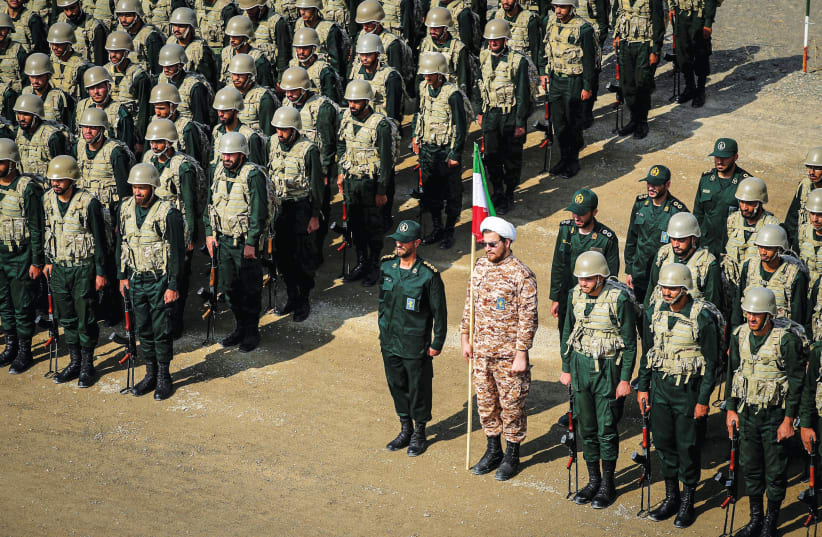
‘A MONSTER’ – Members of the IRGC attend a ground forces military drill in the East Azerbaijan province of Iran in 2022.(photo credit: IRGC/WANA (West Asia News Agency)/Handout via REUTERS)
Mohsen Sazegara has been many things in his life: student,
revolutionary, founder of the Islamic Revolutionary Guards Corps (IRGC),
journalist, politician, dissident criminal, and exile. But first and
foremost, he is a proud Iranian.
There
is a fire that burns behind Sazegara’s eyes when he talks about a
homeland he has not seen for over 20 years; a place he cannot return to
while the current regime holds power, for fear of death.
In a wide-ranging exclusive interview with The Jerusalem Post, the former revolutionary-turned-politician discussed his role in the Iranian Revolution of 1979, his relationship then with Ayatollah Ruhollah Khomeini,
the founding of the IRGC, and how his political views evolved against
the state-religion axis that rules in the Islamic Republic, leading to
his being barred from the 2001 Iranian presidential elections.
Speaking
from the US, where he is now based, Sazegara also touched upon internal
conflicts within the Islamic Republic and the problems facing Supreme Leader Ayatollah Ali Khamenei.
Born
in Tehran in 1955, Sazegara entered the prestigious Aryamehr University
of Technology in 1973 before continuing his studies in 1975 at the
Illinois Institute of Technology in Chicago, where he was an active
member of the Muslim Student Association and, perhaps more ominously,
joined the Liberation Movement of Iran (LMI – also known as the Freedom
Movement of Iran.)
SAZEGARA, seated on the far right, sits behind Ayatollah Ruhollah
Khomeini, during his time at Neauphle-le-Château, France in 1978.
(credit: Courtesy Mohsen Sazegara)
The LMI was banned at the time in his homeland, Sazegara told the Post -
“If [the authorities] knew that you were a member of that organization,
you would be arrested. During the three years that I was studying in
the US, I traveled to Iran four times, and I was very active in
underground activities.”
DESPITE
THE revolutionary zeal common to students, there was no sign of what
was to come in 1979, when Sazegara was plucked from Illinoisan obscurity
and thrust onto the world stage.
He
was called to join Khomeini, a fellow Iranian exile and Muslim cleric,
who had become the de-facto leader of protesters against the Shah of
Iran, Mohammad Reza Pahlavi. Khomeini was exiled to Iraq in 1964 before
taking up residency in the commune of Neauphle-le-Château, 18 miles
outside of Paris, in 1978.
Khomeini
is described by Sazegara as having been “very clever, very smart. When
you talk to somebody about something that he has no background knowledge
on, from his questions and his reactions, you can find out how fast he
got it and absorbed the idea. He was a very good listener, too. When you
were talking to him, he looked down, put his hands together, and
listened very carefully, and then he had very good questions.”
The ayatollah persistently called for the Shah’s removal and the introduction of Sharia law as the legal code for a future Iran.
“When Khomenei went to Neauphle-le-Château, Dr. Ebrahim Yazdi was his
top adviser, and Yazdi was one of the leaders of the LMI,” Sazegara
recalled. “He called me and said, ‘Mohsen, we have brought the ayatollah
to France, and we need you.’ He called me at four o’clock in the
afternoon, and I was on the plane at eight o’clock that night.
“I
was at the commune for about 100 days, and I was responsible for
different jobs before we returned to Iran. I returned to Iran on what
they called the ‘Victory Flight.’”
The
Victory Flight on February 1, 1979, gave the world one of the most
defining images of the Iranian Revolution. The Shah had fled Iran due to
the civil unrest two weeks earlier, never to return, and the sight of
an elderly Muslim cleric being helped down airplane steps by an Air
France captain (the plane was specially chartered), greeted by an
adoring crowd, signified the moment of transition when Iran abandoned
its 2,500-year-old monarchy and embraced Islamic republicanism.
There
were fears that forces loyal to the Shah would shoot the plane down,
such was the hatred for Khomeini in some quarters. But when asked about
such worries, Sazegara chuckled.
“I didn’t think they would shoot down the plane,” he stated. We had about 150 [international] reporters on board!”
SPEAKING
TO the BBC in 2019, Sazegara described how his entire family, except
for his father, went out to the streets to welcome Khomeini back to
Iran, and this was a common feeling across the city as millions greeted
the cleric.
Some
would hold Sazegara accountable for being complicit in the
establishment of a regime and an organization responsible for bringing
so much misery and terror into the world. However, the West has often
misunderstood the Iranian Revolution.
While
all revolutions are complex, Iran’s in 1979 is often portrayed as some
form of working-class revolution – the poor rising up against the Shah,
or the religious Islamists rising up against modernization and
Westernization.
However,
the intricate relationships in Iranian society – between the urban and
the rural populations, the middle and lower classes, the religious and
irreligious, the ulema (clergy) who headed the Islamic schools of
thought and the powerful bazaari merchant class, Marxists and
democratists, men and women – meant that there was no guarantee of a
successful successor state to the monarchy.
Still,
a referendum overwhelmingly supported the creation of an Islamic
Republic and the appointment of Khomeini as supreme leader. Islamic law
would now guide the new state, and Khomeini would be its guardian.
It
was in this volatile atmosphere of post-revolutionary Iran, where power
struggles and ideological clashes were rampant, that the Islamic
Revolutionary Guard Corps was created.
IRGC
The
IRGC is best known today for its ruthless enforcement of the republic’s
will, military and intelligence sectors, terror designation, and
regional influence through its relationship with Iranian proxy groups
such as Hezbollah, Hamas, and the Houthis.
(credit: agusraharj, natanaelginting, Rizkreativ)
It
was founded shortly after the revolution to protect the Islamic
Republic’s religious control over the country and to act as a
counterbalance to the regular Iranian Army, many of whose officers were
still loyal to the Shah of Iran, and therefore could not be trusted by
the revolutionary regime.
“Ayatollah
Hassan Lahouti, who was released from jail during the revolution, got
an order from Khomeini to gather weapons from the hands of the people,”
Sazegara recounted.
“At
the final stage of the revolution, everybody had guns, so for the
country’s security, we decided to collect the guns from the people. I
went to one of the garrisons in Tehran, and I wrote a statement for
national radio inviting the people to bring back their weapons. That was
the first step in establishing a people’s army, which became the IRGC.”
Sazegara
had established connections while in Neauphle-le-Château with militant
Iranians, some of whom he sent to camps across the Middle East for
training, including Palestinian ones. He predicted at the time that the
revolution would be a five-to-seven-year guerrilla war to gain power.
As
with other revolutions, the number of different political groups
holding weapons, plus the threat of the Iranian Army, was one the new
authorities wanted to protect against.
“It
took a week as a group of five; we worked on the charter of this
People’s Army. We had three goals in establishing this new
organization,” Sazegara explained.
“First,
the security of the country: to collect the guns,” he said. “Second, to
defend the country if we came under foreign attack as the fear was that
the US would attack Iran [to restore the Shah].
Sometimes,
as a joke, I say that the Shah didn’t stay long enough for us to fight
against him. Third, we had the bitter experience of a plot against the
national government of Mohammad Mosaddegh in the 1953 military coup, a
plot designed by the British and US Secret Services, and we were afraid
of a military coup.”
THERE
WAS also a surprising influence in the decision to create a people’s
army, Sazegara revealed.“We knew that we would rebuild the army of Iran,
but we thought that if we have a people’s army defending the country,
it would mobilize the people to help the Iranian Army, and in peacetime,
people would have training like the Israeli army and volunteers in
Israel. That was one of the models that we were thinking of then.
“I
was one of the five members of the provisional board of commanders,” he
recalled.”Three months after it was established and the charter was
passed, I said to myself that I don’t like this job, and I left the
Guards.”
Senior officers of the Islamic Revolutionary Guard Corps. (credit: natanaelginting via CanvaPro, Wikipedia)
Sazegara
is quick to recognize, however, that the organization that exists today
and has such a prominent role in global terror is far from the
idealistic people’s army he helped to create in 1979.“Our idea of a
revolutionary guard was not the idea of the current one,” he stated.
“This
is a monster right now. [The modern] IRGC is not a unified
organization. It’s like a dragon with seven different heads that are
independent from each other. There is a classic army, the terrorist
group, the suppression machine with intelligence like the KGB, and at
the same time [the Corps] is like a Western cartel involving hundreds of
companies and like the mafia, involved in drug smuggling, brothel
running and running gambling houses. This is completely different from
the original idea.”
Sazegara
describes the current leadership as behaving “like a theocracy or
totalitarian regime or a dictatorship, but the main nature of this
regime is a kleptocracy right now.” He estimates that up to half of the
Iranian economy may be tied in some way to current Supreme Leader Ali
Khamenei’s personal fortune, whether through embezzlement or
misappropriation.
IRAN’S SUPREME Leader, Ayatollah Ali Khamenei has made billions of
dollars through control of the Iranian economy, Sazegara claimed. Here,
Khamenei speaks during a meeting at the IRGC Aerospace Force
achievements exhibition in Tehran in 2023. (credit: Office of the
Iranian Supreme Leader/WANA (West Asia News Agency) via REUTERS)
The Wilderness Years
However,
as the new regime solidified its power, Sazegara’s disillusionment
began to grow. Serving as managing director of Iran’s National Radio
until 1981, and in various political roles throughout the 1980s, he
witnessed firsthand the regime’s divergence from the revolution’s
original ideals.
He
served as political deputy in the prime minister’s office, deputy
minister of heavy industries, chairman of the Industrial Development and
Renovation Organization of Iran, and vice minister of planning and
budget.
Real
disillusion with the regime began for him in 1988 as he described his
realization that “the problem of this regime is not accidental: It’s
essential. It’s in the theory of this regime. It’s in Islamism, and in
running a country based on Islamic sharia and ideological leftist
ideology regarding the economy.”
After
nearly a decade spent battling the regime to keep open several
publications that Sazegara ran, he was now firmly in the reformist
political camp, determined to change the status quo of the Islamic
Republic’s constitution.
As
the 1997 presidential elections approached, the reformists were looking
for a way to “break the shell, which is the constitution of the Islamic
Republic, and establish a democratic regime.
“That was the plan of the reform movement – and we chose [Muhammad] Khatami,” he said.
Khatami
was a reformist cleric who swept to the presidency in a shock result
with around 70% of the public vote, and his presidency promised much
change in its formative months.
However,
the new president consistently found himself battling the authorities.
Part of Iran’s political system is that the supreme leader and a Council
of Guardians have the ultimate say on who can run for the Iranian
parliament and in presidential elections, often leading to
cherry-picking of favored candidates.
AHEAD
OF the 2001 presidential elections, Sazegara intended to stand himself
on a reformist ticket – with only one policy. If elected, he would have
held a referendum on the Iranian constitution. After declaring his
candidacy, despite knowing that Khamenei would ban him from running, he
then had three months to speak to as many people as possible and get his
message across.
Universities and students welcomed his message and soon he found himself in further trouble with the authorities.
“When
they arrested me, they arrested about 800 students with me – including
my son, who was a student in University of Tehran – and then I went on
hunger strike,” he told the Post from Washington.
“The
intelligence ministry arrested me first, but then released me because
of my hunger strike and the pressure from many of my friends still in
the parliament.”
Just
two months later, however, Sazegara was arrested again, this time by
IRGC intelligence officers.“I was arrested by IRGC intelligence and they
didn’t release me. I went on two long hunger strikes, for 79 days in
total; after that, I was released for poor health. I damaged my heart
and my eye so when I was released, my eye doctor and heart doctor
recommended that both of them needed surgery.”
After
a $600,000 bail, Sazegara attempted to leave the country for surgery in
the UK, and was only granted permission to leave after asking the IRGC.
He believes the permission to leave Iran came from Khamenei himself,
but figured the authorities would rather have him out of the country
than inside causing trouble.
The
dissident spent a year in London before continuing on to the US, where
he still resides, completing fellowships at several American
universities before settling in Washington. He was sentenced to six
years in absentia in Iran for crimes against the state.
AS A CANDIDATE in the 2001 presidential elections, Sazegara was banned
from standing by Ayatollah Khameini. (credit: Courtesy Mohsen Sazegara)
Modern Iran
As
the political landscape in Iran has evolved, so too has Sazegara’s
perspective. Now a vocal critic of the regime from his exile in the US,
he offered a stark analysis of his homeland’s current predicament,
particularly its precarious stance against Israel. The republic is in no
position to fight a long-term war with Israel, he said, and even asked the US to intervene to prevent a possible large-scale Israeli retaliation to any Iranian attack.
“What
Israel did – I mean the alleged assassination of [Hamas Chief] Ismail
Haniyeh, in the heart of Tehran, in one of the most protected places –
was a humiliation for the intelligence organizations of Iran,” Sazegara
stated. “This has created a problem for Khamenei among his main power
base: the intelligence services.
“[Khamenei’s]
first reaction was that we retaliate and don’t stop. But when he
referred to his military commanders and the experts in the IRGC, and
that they should present the options of what to do, they told him that
Iran is not in a position to fight Israel. They don’t have any strategic
balance. They can send missiles toward Israel, especially hypersonic
missiles that can reach Israel in six to eight minutes. ‘But when Israel
retaliates, then we can’t defend the country, especially air defense,’
Khamenei’s commanders told him.
They
told him that “Iran is not in a position to fight Israel,” Sazegara
said. “They emphasized that ‘even if we launch an attack, we should
immediately consider a ceasefire with international mediators.’”
SPEAKING
ABOUT the US role in the growing conflict between Israel and Iran,
Sazegara stated that, “As far as I know, Iran, behind the scenes,
negotiated with the US and the Biden administration and asked them to
talk to Israel, stating that Iran would attack somewhere in Israel – and
promise that nobody will be killed – but Israel should not retaliate.
“Iran
asked the US to put pressure on Israel not to retaliate enough to
escalate,” he said, “but this time, the US did not agree, and told them
that ‘we can’t prevent Israel’” from retaliating.
For
Sazegara, Khamenei faces multiple challenges in considering any
military action against Israel. First, a limited attack risks provoking a
significant Israeli retaliation, which could lead to the defeat of
Iran’s armed forces. Such a defeat could threaten Khamenei’s power,
since historically, humiliated armed forces often bite the hand that
feeds them.
Secondly,
Iran’s economy is fragile, struggling with issues like energy
production, inflation, unemployment, and daily strikes. This economic
instability further complicates the prospect of engaging in war.
Lastly,
Khamenei lacks the support of the Iranian people for a war with Israel.
Intelligence gathered indicates that the majority of Iranians oppose
any conflict with the Jewish state, leaving the supreme leader
potentially isolated if he chooses to pursue military action.
Although
he knows the forcefulness with which the regime cracks down on dissent,
that thought may be far from the ayatollah’s mind.
Three
senior Iranian officials told Reuters last week that only a ceasefire
deal in Gaza could prevent Iran from directly retaliating against Israel
for Haniyeh’s assassination. Diplomatic envoys have been working
tirelessly behind the scenes to de-escalate the situation.
This
is a face-saving measure to allow the regime to fall back and present
the people with some form of a pyrrhic victory, according to the exiled
dissident.
“I’m
sure that in Iran, the propaganda will say that ‘Israel was actually
afraid of us and accepted the ceasefire,’” should a deal be agreed to,”
he told the Post. “They have to do something to say to their followers that this was a show of power: that [Israel] accepted a ceasefire.”
And
if these [Israel-Hamas] negotiations go nowhere and there is no
ceasefire, I don’t know what Khamenei will do – but I guess that he
would consider using Iran’s proxy groups to retaliate against Israel.”
AND
WHAT of the future for Sazegara and Iran? In the meantime, he says, he
will continue fighting the regime just as he did during the Green
Movement of 2009 when pro-democracy Iranians protested the re-election
of president Mahmoud Ahmadinejad and during protests following the death
in police custody of Mahsa Amini, a young girl arrested by the Guidance
Patrol (morality police) in September 2022 for allegedly violating
Iran’s mandatory hijab law.
Sazegara
points to women and Generation Z as the two main cohorts who can bring
the Islamic regime down, perhaps ironically since the youth and women
were two of the groups who gained the most from the shah’s policies of
modernization.
As
the Shah himself stated, “Iran is the land of great contradictions and
unforeseen events, especially this regime. Maybe tomorrow, something
will happen that we cannot foresee right now.”
Now 69, Sazegara’s life has often mirrored the turbulence and chaos of the regime.
This is a story of a man and a nation caught in the throes of revolution, repression, and the enduring hope for freedom.
The
question remains: Will Sazegara, a man who fought and is still fighting
hard for a better future for Iranians, ever see his homeland again?
Some 1,200 people signed up to see the installation, B’nai B’rith International said.
A B'nai B'rith International-sponsored exhibition
in Boston simulating the experiences of hostages in Gazan tunnels in
August 2024. Credit: B'nai B'rith.
Some 1,200 people signed up to visit a
multimedia tunnel exhibition on City Hall Plaza in Boston that simulates
the experiences of hostages whom Hamas continues to hold underground in
Gaza.
The exhibit, which ran for three days
earlier this week and which B’nai B’rith International sponsored, was
previously presented in Washington, D.C., and across Europe. Organizers
plan to bring it to other cities.
The show was developed in “close
coordination” with the Hostages and Missing Families Forum and hostages
released from Gaza in November. It “aimed to raise awareness of the
suffering of the 109 who still remain in captivity, including eight
Americans,” according to B’nai B’rith.
Daniel
Mariaschin, CEO of B’nai B’rith International, at a B’nai
B’rith-sponsored exhibition in Boston simulating the experiences of
hostages in Gazan tunnels in August 2024. Credit: B’nai B’rith.
“The hostages were quickly forgotten. The
posters of these hostages were quickly torn down as soon as they were
put up,” said Daniel Mariaschin, CEO of B’nai B’rith whose cousin was
kidnapped from Kibbutz Nir Oz by Hamas, at the exhibit opening. “These
hostages have been held in unimaginable deplorable conditions.”
“The objective of Hamas is to destroy the
State of Israel,” Mariaschin added. “That glimpse that we had in the
beginning on Oct. 7, similar to what was seen every day for six years in
the Holocaust, was indeed reminiscent of all the other attempts in
history that have been made to erase our people and to erase the State
of Israel.”
“We wanted to increase awareness and
amplify visibility of the hostages,” Douglas Hauer-Gilad, an organizer
of the exhibit, told JNS.
“Time is of the essence,” the Boston lawyer added. “We need to bring the hostages home now.”
Daniel
Mariaschin (far right), CEO of B’nai B’rith International, with hostage
families at a B’nai B’rith-sponsored exhibition in Boston simulating
the experiences of hostages in Gazan tunnels in August 2024. Credit:
B’nai B’rith.
The exhibit includes audio footage from body cameras worn by Hamas terrorists.
“Visitors were given a glimpse of the
roughly 300 miles of underground tunnels beneath Gaza and gained insight
into the horrors of Hamas captivity,” per B’nai B’rith. “For a moment,
they experienced the terror that hostages have endured over the past 10
months.”
Ed Flynn, a member of the Boston City Council, recognized the exhibit’s significance in a resolution, and Latvian, German, Japanese and Israeli diplomats and Boston Jewish and Catholic leaders visited the show.
“I joined with many members of the greater
Boston Jewish community to visit the exhibit due to its importance in
understanding the horrors of Hamas captivity, as well as the recognizing
the dignity and humanity of the hostages and their families,” Flynn
told JNS.
“I also had the opportunity to visit
Israel earlier this year in January and witness the aftermath of the
Oct. 7 terrorist attack by Hamas,” the councilman added. “Boston City
Hall Plaza is the epicenter of civic life in Boston, where local, state
and federal responsibilities overlap. This made City Hall Plaza the
appropriate location to amplify the visibility of the hostages.”
Flynn added that “we must continue to
stand with our Jewish American neighbors and call out and denounce
antisemitism when we see it.”
The “Boston Unites Against Terror” exhibit is now at City Hall Plaza. It is a powerful exhibit of the horrors of Hamas captivity. It’s not about politics or elections. We believe in justice, dignity and humanity for the hostages held in captivity since October 7. @RedCrosspic.twitter.com/wWunZNjoAx
Trump and Harris put out their competing economic agendas in recent weeks with Trump particularly focusing on his past record in office. Harris is stuck defending "Bidenomics," which saw inflation wipe out any gains it may have made.
As Vice President Kamala Harris
ramps up her campaign, she has targeted key traditionally Democratic
constituencies such as Hispanics, black Americans, and women to bolster
her cause, but with the economy top of mind for most voters, she will
face a daunting task of convincing those who remember the Trump economy
to put their trust in her on the issue.
Trump and Harris put out their competing economic agendas
in recent weeks with Trump particularly focusing on his past record in
office. He has repeatedly highlighted economic statistics showing record
unemployment among certain minority groups, as well as job and wage
growth during his tenure.
Harris, by contrast, is largely stuck with the Biden administration’s
economic record, which has seen considerable price increases and drawn
poor ratings from the public. To be sure, Harris can point to
record-breaking performances on key stock indices and a handful of other
positive metrics, but the “Bidenomics” message did not resonate with
voters and the president currently boasts an average 38.6% approval
rating on the economy, according to RealClearPolitics. A further 58.5% disapprove of the administration’s handling of the issue.
The RCP averages don’t break down Biden’s job approval by
demographics. Though certain groups may vary in their estimation of the
nation’s economic well being, the relatively poor public view of the
economy overall is likely to translate to some extent within specific
subsets of the population.
The Trump and Harris campaigns face different hurdles in pitching
their economic records. For Harris, inflation is the albatross around
her neck that undercuts many of the relatively positive topline economic
data under the current administration. For Trump, the impact of the
COVID-19 pandemic plays that role.
Trump’s own sales pitch on the economy has largely ignored the
pandemic and pointed to his stewardship of American markets under
relatively normal circumstances. The Biden administration, meanwhile,
has repeatedly attempted to claim credit for record job growth, though
Trump has said such numbers represent “bounce back” jobs from the
pandemic’s end.
Ultimately, however, whether appealing to women, Latinos, or black
Americans, the campaigns will largely be at the mercy of those groups’
perceptions of their respective economies and the data seems to suggest
Trump will have an easier time of it.
Women
Republican Conference Chair Elise Stefanik this week took issue with
Harris’s economic pitch, calling the claim that “a Kamala Harris
presidency will deliver historic economic opportunity for working women”
to be “one of the most egregious” lies from Democrats.
In an op-ed with RealClearPolitics
this week, Stefanik made the case that working women were materially
better off under the Trump economy than under the existing Biden-Harris
administration.
“The oft-asked question about balancing work and family life is: Can
women have it all? Under President Trump’s leadership, the answer was a
resounding yes,” she wrote. Stefanik specifically pointed to an 8.2%
real increase in average weekly earnings for women and record median
income for women in 2020.
In 2017, women took home median weekly earnings of $770, moreover, according to the Bureau of Labor Statistics. In 2020, that figure reached $891, for an increase of 15.7%. By contrast, that figure stood at $912 in 2021
and at $996 in 2023, an increase of 9.2%. Adjusted for inflation,
however, those wages rose 7.5% under Trump, but declined by 6.8% under
Biden and Harris. While the figure continued to increase in terms of raw
numbers, inflation ultimately left women with less purchasing power at
the end of the week.
Stefanik further highlighted Trump’s doubling of the child tax
credit, his creation of a paid family leave tax credit, his expansion of
child care and development block grants, and his creation of a
provision allowing parents to withdraw up to $5,000 in retirement
savings without penalty when they have a new child.
Of the Harris administration, she cited price increases that directly
affected childcare, such as diapers, and recalled the baby formula
shortage of 2022.
Hispanics
With the Hispanic/Latino population, Harris is likely to face more
difficulty as that bloc is increasingly moving toward the GOP and Trump
has already invested heavily in winning them over to his cause. The
campaign launched the Latino Americans for Trump coalition in June with a message heavily emphasizing his economic message.
"President Trump understands the challenges Hispanic Americans are
facing under the Biden Administration. Everything costs more,” Sen.
Marco Rubio, R-Fla., said at the time. “His focus is on rebuilding this
country and making life better for you and your family.”
Median weekly earnings among Hispanic/Latino Americans has steadily increased
since Trump took office in 2017, albeit at varying rates. At the end of
Q1 of that year, median weekly earnings stood at $649 for that
demographic bloc. At the end of Q1 of 2021, they stood at $750. By Q1 of
this year, they rose to $879. The Trump years witnessed a raw increase
of 15.6% while under Biden, the figure rose 17.2%. But adjusted for
inflation, the data tells a different story. The Trump years saw a real
increase of 6.4% while the Biden years witnessed a real decrease of just
under 0.6%.
In July of 2024, it stood at 5.3%,
up from the lows under Trump, but still significantly down from
pandemic-era figures. Such data could provide Harris some much needed
economic ammunition with which to appeal to the Hispanic/Latino
community, but Trump has previously cast doubt on the veracity of BLS
data.
Fueling his concerns was a revision of the jobs report
this week in which the administration revised the total number of jobs
created from April 2023 to March 2024 down by 818,000. It remains
unclear how that revision could affect past unemployment rates.
But Trump has accused the Biden-Harris team of essentially cooking the books
to provide favorable data, saying it has been “caught fraudulently
manipulating Job Statistics to hide the true extent of the Economic Ruin
they have inflicted upon America.”
The ripple effect of misleading jobs reports in recent months makes
for an even more tenuous situation for the Federal Reserve and its
weighing of interest rate cuts, a key element in the control of
inflation.
Black Americans
Another key constituency of interest to both campaigns is the black community. Trump managed to win only 8% of that bloc
in 2020, posting a modest increase from his 6% in 2016. But some
polling has shown him clearing 20% in this cycle, albeit against Biden.
The typically monolithic voting bloc has overwhelmingly backed the
Democratic Party for decades, but even a modest uptick in black support
for the GOP could swing key battlegrounds, such as Georgia, for Trump.
With this voter group, Trump’s economic record could resonate effectively in light of favorable data. For black Americans, median weekly earnings
were $679 in Q1 of 2017 and rose to $799 in Q1 of 2021 before reaching
$908 in Q1 of this year. The Trump years saw a raw increase of 17.6%,
which comes in at 8.3% when adjusted for inflation. Biden’s time in
office, meanwhile, saw a raw increase of 13.6%, a 3.6% drop when
adjusted for inflation.
Unemployment data for black Americans follows a similar trend to
Hispanic/Latino Americans. In January 2017, unemployment among black
Aemricans stood at 7.7%. By January 2021, that figure was 9.2%. Prior to the pandemic, the figure was 5.8% in February of 2020. Black unemployment came in at 6.3% in July of this year.
That data presents a less volatile metric than Hispanic/Latino
unemployment, which nearly doubled during the pandemic, but the overall
trend remains the same. Prior to the pandemic, black unemployment
declined under Trump, subsequently increased due to the pandemic, but
has settled down, albeit at higher levels than pre-pandemic lows, under
Biden.
The Trump campaign has further sought to highlight Trump’s economic record with the black community, launching the Black Americans for Trump
coalition in June as well. Closely resembling the pro-Trump Latino
coalition, the campaign centered its messaging around economic issues.
"President Trump knows that Black voters prefer lower taxes, which he
delivered in his first term, and like all Americans, oppose Biden’s
hiking tax rates. Ultimately, President Trump's economic policies
offered more opportunities to build generational wealth for Black
families,” Trump Campaign Black Media Director Janiyah Thomas told Just the News at the time.
Ben Whedon is an editor and reporter for Just the News. Follow him on X.
According to the indictment, numerous media files were found on the doctor's phone, including executions, beheadings, and mutilated bodies, and more.
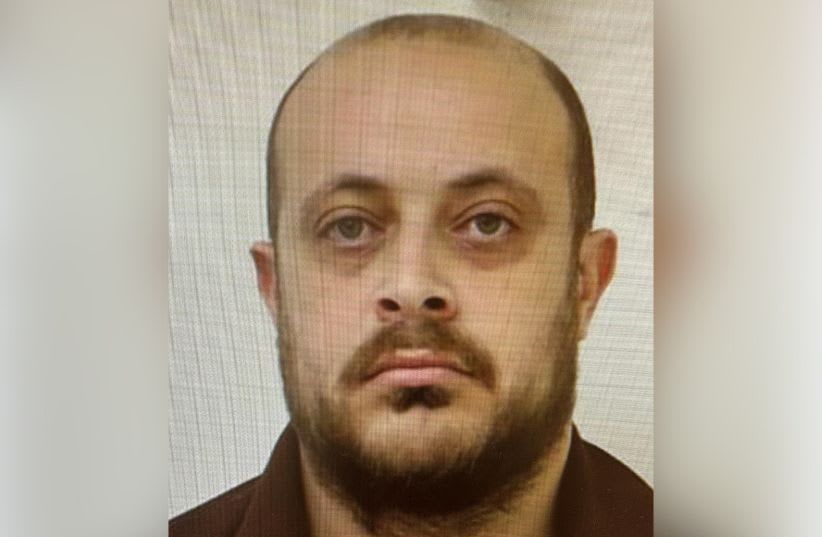
Soroka Medical center doctor, Muhammad Azzam, 34, was arrested for pledging allegiance to ISIS, August 22, 2024.(photo credit: Via Maariv)
A doctor at Soroka Medical Center
in Beersheba who pledged allegiance to ISIS has been arrested, and an
indictment was filed against him, the Israel Police reported Thursday.
In a joint operation, the Israel Police and the Shin Bet (Israel Security Agency) arrested Beersheba resident Muhammad Azzam, 34, originally from Nazareth, the police said in a statement.
The Shin Bet detained Azzam, an Israeli citizen, for questioning in July on suspicion of engaging in activities inspired by ISIS.
“The
hospital administration takes the allegations very seriously and is
shocked by them,” Soroka Medical Center said in a statement, according
to Maariv. “The case is being investigated and handled by the relevant
legal authorities, and we are confident in their handling of the
matter.”
Azzam joined ISIS and pledged allegiance to it, the police said.
Iraqi Shiite militia fighters hold the Islamic State flag as they
celebrate after breaking the siege of Amerli by Islamic State militants,
September 1, 2014. (credit: REUTERS/YOUSSEF BOUDLAL)
The
investigation found that he had been reading ISIS-affiliated extreme
online content since 2014, the Justice Ministry said in a statement.
Following the investigation, the Southern District Prosecutor’s Office filed an indictment against Azzam on August 8.
The indictment noted his mockery and celebration of October 7 atrocities
According
to the indictment filed by Attorney Hofit Kantorovich, numerous media
files were found on the doctor's phone, including executions,
beheadings, and mutilated bodies, as well as folders titled "Explosive
Materials" and "Poison Preparation" with files such as "Ricin," "Rotten
Meat Poison," and more.
Following
October 7, Azzam decided to join ISIS officially and pledged allegiance
to Abu Hafs al-Hajri al-Qurashi, the new caliph of the organization.
Furthermore,
following October 7, Azzam sent his friends footage of October 7
atrocities with a tone of mockery and joy, according to the indictment.
Azzam has been detained until all legal proceedings are finished, per
the prosecution's request. The detention request noted that his
behavior indicates that he is a danger to the public, especially in his
role as a doctor in a hospital.
On
December 11, when wounded IDF soldiers arrived at Soroka Medical
Center, in messages exchanged on WhatsApp, the defendant's friend wrote,
"May Allah extinguish his light," after Azzam told him of a specific
case.
Azzam responded, "Haha, Amen."
In
April, police and Shin Bet thwarted terrorist attacks planned by two
supporters of ISIS in east Jerusalem, and four residents of Tarqumiyah
in the West Bank were arrested for plotting an Islamic State-inspired
attack.
Another two east Jerusalemites were arrested for plotting a terror attack in the name of ISIS in January.
There
have been several other cases over the years, and several others
responsible for terror attacks in Israel later joined ISIS.
The Canadian Union of Public Employees' National Executive Board passed a resolution on Tuesday calling for General Vice President and Ontario CUPE President Fred Hahn to resign.
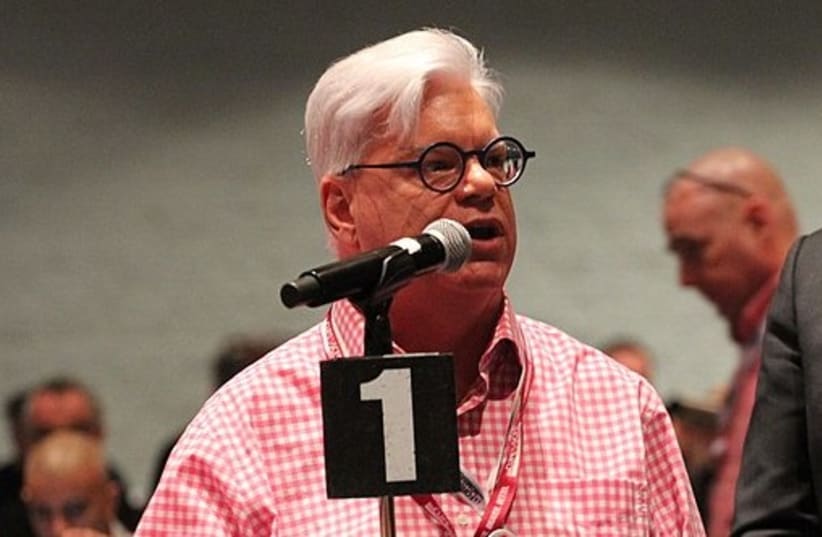
Illustrative: Fred Hahn at Ontario conference, March 2029.(photo credit: WIKIMEDIA)
Canada’s largest union called on its vice president to resign on
Tuesday after he published a video on social media of a Jewish Olympic
diver turning into an exploding bomb, according to union members,
politicians, and Jewish organizations.
The Canadian Union of Public Employees’
(CUPE) National Executive Board passed a resolution on Tuesday calling
for General Vice President and Ontario CUPE President Fred Hahn to
resign and was waiting for his response, CUPE said in a Wednesday letter
to members.
“The
National Executive Board has lost confidence in the ability of Fred
Hahn to represent the national union in his role as General Vice
President, and consequently calls for his resignation from that
position,” the motion said according to the letter.
CUPE
said that the move followed Hahn’s Aug. 11 Facebook post depicting a
Paris Olympics athlete with a Star of David tattoo turning into a bomb
and exploding as he dove into a pool.
Hahn
deleted the video and said in a Sunday social media post that he
regretted the painful reaction it caused for some viewers, explaining
that he had intended to call to attention a double standard in which the
Russian Federation was barred from competing but the State of Israel
had been permitted.
“My
intent was never to associate Jewish people with the violence enacted
by the state of Israel. It remains my strongly held view that it is a
terrible mistake, and antisemitic, to conflate abhorrent actions by the
state of Israel with Jewish humanity or identity,” said Hahn.
“The horrors that continue to unfold in Gaza
and the ongoing colonization of the West Bank are deeply troubling and
continue to cause so much anguish and pain for so many. Our collective
focus should be on the unfolding genocide, on the continued contravention of international law by the state of Israeli -- not on me or my social media posts.”
The
Centre for Israel and Jewish Affairs (CIJA) said in response to the
statement on Tuesday that Hahn hadn’t truly apologized as he had said
that he regretted the reaction of viewers. CIJA said that he had shared
the video without consideration of impact to imply “Jews are killers.”
On Wednesday it praised CUPE for its response and called on Hahn “to
resign immediately for his blatant antisemitism.”
Ontario
Labor Minister David Piccini confronted Hahn in a video he published on
Tuesday, telling him that he was not representing working and had to
“stop hating on Jews.” Hahn accused Piccini of engaging in a publicity
stunt, and said that he opposed Israel’s actions, not Jews.
At
a Wednesday press conference at a St. Catherine’s shipyard, Ontario
Premier Doug Ford Praised Piccini and called on CUPE to discipline the
“disgusting” Hahn. Ford later that day took to X applauded CUPE for
asking Hahn to resign. Ford said during the press conference that many
CUPE members had contacted the premier to complain about Hahn.
A Vineland, Ontario CUPE branch for developmental support Workers,
recreation, maintenance and cleaning staff on Wednesday said on X that
Hahn’s statements were “harmful, hurtful and divisive” and his stance on
the Israel-Hamas War did “not reflect the opinions of our local nor the
spirit of our union.”
Typical behaviour from Hahn
CIJA
said on Tuesday that the Aug. 11 post was part of a pattern of behavior
for Hahn. The union leader on Oct. 8 liked a McMaster University
workers CUPE branch social media post quoting Popular Front for the
Liberation of Palestine spokesperson Ghassan Kanafani and praising the Oct. 7 Massacre
by stating “Palestine is rising, long live the resistance.” Hahn
regularly makes statements decrying the state of Israel’s actions.
“Hahn
has ignored and dismissed the lived experiences of Jewish CUPE
members,” CIJA said Tuesday. “He has turned his back on many in his
union – Jews and non-Jews alike, including some Local Presidents — who
have asked him to stop spreading hatred and return to the business of
union leadership.”