The "Middle East and Terrorism" Blog was created in order to supply information about the implication of Arab countries and Iran in terrorism all over the world. Most of the articles in the blog are the result of objective scientific research or articles written by senior journalists.
From the Ethics of the Fathers: "He [Rabbi Tarfon] used to say, it is not incumbent upon you to complete the task, but you are not exempt from undertaking it."
If one read only legacy news media, they'd come away with a narrative of failure, but the hard data shows otherwise. The poverty rate is at an all-time low, and on the jobs front, "Little change over the month," one agency said in a statement that went on to say "employment across all major industries remain[s] largely steady."
Positive U.S. economic indicators have been left out of much of the mainstream media's reporting on the state of the economy. Despite gas prices at nearly $4.50 per gallon, economists Larry Kudlow and Stephen Moore argue that Republicans can win the "affordability" battle heading into the November election against Democrats due to the state of the overall U.S. economy.
The economists pointed out in an opinion piece published by The New York Post that "median household incomes jumped to an all-time-high of $87,500 in 2025, while poverty rates fell to an all-time low." The real median household income went up 2.6% to $87,460, the highest level since 1967 when adjusted for inflation. The economists also noted that the latest economic figures show that layoffs and jobless claims are currently at historically low levels.
According to the Census Bureau, the poverty rate fell to 10.2% in 2025, which was the lowest ever recorded.
The job data is encouraging
For example, in July, jobless claims were at 187,000, which was the lowest number seen since September 1969. The unemployment rate is currently at 4.2%, about the same as it was in September 2024, which was 4.1%. The unemployment rate was approximately 4.4% in September 2025, according to the Bureau of Labor Statistics.
"Little change over the month," the agency said in a statement. "Both measures changed little over the month, with employment across all major industries remaining largely steady." There was not much of a change in key sectors, including "construction, manufacturing, and financial activities," the BLS said.
Second quarter economic growth trends also reveal positive economic developments
The latest jobs report shows 29,000 jobs were added in September 2026, according to the U.S. Labor Department, which was below expectations, but there are other economic statistics not being widely reported.
The Department of Labor reported that initial jobless claims came in at 197,000 for the week ending Sept. 26, which was a decrease of 1,000 from the prior week, and the four-week average dropped to 200,000 from 202,500.
Gross domestic product growth was 2.2% for the second quarter of 2026, up from the Commerce Department's initial projection of 1.5%, and consumer spending, which accounts for about 70% of the U.S. economy, has increased at a 3.8% annual pace from the 0.7% rate in the first quarter. Real gross domestic product (GDP) increased at an annual rate of 2.2 percent in the second quarter of 2026 (April, May, and June), according to the third estimate released today by the U.S. Bureau of Economic Analysis (BEA).
The designations are part of a broader, multi-jurisdictional operation led by the Federal Bureau of Investigation to dismantle several Hamas fundraising ventures, including those active inside the United States.
The Department of the Treasury’s Office of Foreign Assets Control (OFAC) announced Friday it designated a member of Hamas’s military wing, along with two France-based individuals and two affiliated entities that provide critical financing to Hamas.
These designations expose a sophisticated, multi‑year financing architecture that moved more than $2 million to Hamas through deceptive charitable fronts and cryptocurrency channels, demonstrating the organization’s persistent ability to adapt its fundraising mechanisms to evade detection, according to the Treasury.
The designations are part of a broader, multi-jurisdictional operation led by the Federal Bureau of Investigation to dismantle several Hamas fundraising ventures, including those active inside the United States.
"Terrorist organizations like Hamas rely on sophisticated financial facilitators and fraudulent schemes designed to exploit the public to sustain their operations. Treasury will continue to identify, isolate, and impose consequences on those who provide Hamas with the financial lifelines it needs to survive," Treasury Secretary Scott Bessent said in a post on X.
Green Party leader Zack Polanski, who is Jewish, did not vote on the motion while campaigning in north London, but has declined to condemn it.
A SIGN supporting the Green Party political party is displayed in a residential street on the eve of local and mayoral elections in England and devolved parliamentary elections in Wales and Scotland on May 7, in London, Britain, May 6, 2026. (photo credit: REUTERS/TOBY MELVILLE)
The Green Party has become the first mainstream party in Europe to declare itself openly anti-Zionist after voting in the controversial "Zionism is Racism" motion at its party conference in Brighton, UK, on Sunday, passing the motion 1,022 votes to 813.
Amendment III - which would have protected Jewish people from being expelled if they belong to synagogues that define themselves as Zionist - also failed to pass, with 684 votes in support and 1,026 against.
Israel's Foreign Ministry issued a statement on social media in response to the resolution on Sunday, claiming that the Green Party was "legitimising armed struggle against Israel, and calling for the establishment of a Palestinian state “from the river to the sea” - meaning the destruction of the State of Israel."
"The resolution constitutes a clear antisemitic text according to the IHRA definition," the Foreign Ministry added, "as it denies the Jewish people’s right to self-determination."
Today, the Green Party in Britain adopted a resolution equating Zionism with racism, legitimising armed struggle against Israel, and calling for the establishment of a Palestinian state “from the river to the sea” - meaning the destruction of the State of Israel.
The resolution constitutes a clear antisemitic text according to the IHRA definition, as it denies the Jewish people’s right to self-determination.
Therefore, as a first step, Foreign Minister Gideon Sa’ar has decided this evening to declare Green Party leader Zack Polanski barred from entering Israel. The decision has been coordinated with the relevant authorities.
Co-Deputy Leaders of the Green Party Mothin Ali and Rachel Millward attend a Green Party conference in Brighton, Britain, October 2, 2026. (credit: REUTERS/CARLOS JASSO)
The motion recognizes Zionism as Israel’s foundational ideology that has created and maintains an apartheid regime between the Jordan River and the Mediterranean Sea.
It further affirms the right to self-determination and liberation of the Palestinian people and supports the establishment of a “single democratic Palestinian state in all of historic Palestine, with Jerusalem as its capital.” This would effectively eradicate the State of Israel.
On Saturday, Zack Polanski told the conference, "We stand with one voice now as we say: 'Drop the charges. End the genocide. Deproscribe Palestine Action.'"
However, according to The Telegraph, Polanski did not vote on the motion, as he was on the campaign trail in north London ahead of Thursday's Holborn and St Pancras by-election.
Polanski, who is Jewish, has nevertheless failed to condemn the motion.
Jewish Greens remain split on motion
The Jewish Greens - a Jewish group within the party - remain split on the Zionism is Racism motion. Ahead of the conference, the group answered a survey about key conference issues.
On a 0–10 scale measuring whether Jewish Greens should collectively oppose the motion, the average was 5.1, indicating an almost exact split. Consequently, Jewish Greens said it will not take an official position on the motion.
Most Jewish Greens (81%) identify as anti-Zionist or non-Zionist. Of the Zionist respondents, 80% of Zionist respondents oppose the Zionism as Racism motion. Interestingly, however, the anti-Zionist Greens were divided on the motion too.
A majority of 70% strongly support de-proscribing Palestine Action, and 64% strongly support Palestinians' right to "resist apartheid, occupation and genocide through all available means within international law.”
Exactly half support criminal prosecution of UK citizens who fight with the Israeli military.
'Safe-rooms' designated for Jews during the conference
Another shocking revelation came when Jewish members of the party told the Mail on Sunday that a designated 'safe-room' has been set aside during the conference for Jewish members who feel they are in danger.
“We have been given a ‘safe room’ for Jewish members to use in an emergency,” a member told the Mail on Sunday.
“It was used on the first day of the conference to host a meeting between a rabbi and some Jewish members. It’s a deeply upsetting situation, but that’s the reality.”
Rabbi Charley Baginsky and Rabbi Josh Levy, Co-Leads of the Movement for Progressive Judaism, told The Jerusalem Post Sunday that the motion is "antisemitic in its formulation and intention."
"By adopting it, the Green Party has made antisemitism party policy and become a racist party," the two said.
"Jewish self-determination is a right. Declaring it racist is an attack on Jews. The Green Party has chosen to brand Jews who hold this belief as racists and make their equal participation in the party conditional on renouncing it."
Baginsky and Levy said Jews should not have to justify their connections to Israel to be entitled to equal treatment, nor should they have to disown their communities to participate in British politics.
"Support for this motion from some Jewish members does not excuse discrimination against other Jews."
"We stand with Jewish members and our communities. We will challenge this policy and hold the Green Party’s leadership accountable for the discrimination it has endorsed."
Yaakov Hagoel, the Chairman of the World Zionist Organization, told the Post that the Green Party of England and Wales's decision to adopt a resolution defining Zionism as racism is a "shameful, scandalous resolution tainted with severe antisemitism."
"Zionism is the national movement of the Jewish people and expresses its historical, legal, and moral right to self-determination in its homeland. The attempt to portray it as racist is a recycling of modern blood libels and dark UN resolutions (such as Resolution 3379), which have long since been repealed and thrown into the dustbin of history," he said.
Israel's Foreign Ministry said that, with the vote, the Green Party in Britain has "ceased to act as a political party and became a body that gives legitimacy to terrorism."
"The Greens have adopted not only the green of Hamas, but also its ideology: the elimination of the State of Israel through armed struggle."
The shocking resolution adopted today legitimizes armed struggle, calls for a Palestinian state “from the river to the sea” - meaning the destruction of the State of Israel - and labels as “racist” the aspiration of the Jewish people for self-determination.
"Every political party in Britain, first and foremost the governing Labour Party, must unequivocally reject this twisted resolution," the ministry added.
The decision comes after British authorities arrested suspects near the U.S.-used air base over an alleged plot targeting the facility.
The Defense Department is pulling its B-1B bombers out of Britain and returning them to the United States, following a security concern at RAF Fairford that has raised new questions about the safety of American military operations in Europe.
The decision comes after British authorities arrested suspects near the U.S.-used air base over an alleged plot targeting the facility.
President Donald Trump has described the suspected threat as serious, while British and American authorities continue investigating the incident.
“I had to shake the pilots.” “We put an Israeli guard on every crew member.” Tal reconstructs the minutes aboard the flydubai flight and what happened after passengers regained control.
“There was nobody in the cockpit,” Tal says, almost matter-of-factly. Then comes the next part: “I had to shake the pilots.”
And after the aircraft was back under control: “We put an Israeli guard on every crew member.”
Several days after the attack aboard a flydubai flight bound for Israel, those three sentences help fill in what happened inside the aircraft during the moments that remain hardest to reconstruct.
Tal, an Israeli businessman who lives abroad, met with The Jerusalem Post Editor-in-Chief Zvika Klein at the Carlton hotel on Tel Aviv’s beachfront, overlooking the city skyline, to walk through the sequence and review footage from inside the aircraft.
Tal remarked on how strange it felt to see Tel Aviv from there. The previous day, he and the other passengers had been desperate simply to land and finally reach Israel.
He had been sitting in row six, directly behind business class. Two additional flydubai pilots were seated nearby as passengers.
Tal noticed them when he boarded.
“I’m a frequent traveler,” he said. “I realized immediately when I boarded the flight that they are next to me.”
That observation became crucial when the crisis began.
According to Tal, there was a period during the confrontation when nobody was in the cockpit. One pilot had been wounded, another was involved in the fight, and the aircraft was descending.
The two men capable of taking control were still sitting among the passengers.
Tal shouted at them to move.
They did not, he said.
“I had to shake them to get them to move to the front and take control of the plane, because it was diving.”
One eventually went forward and took control, while the second took longer to recover from the shock, Tal said.
He has consistently played down his own role. In an earlier WhatsApp exchange with the Post from Saudi Arabia, he described what he had done as “combat support,” while emphasizing that three other Israelis had physically subdued the attacker.
That “support” included getting the pilots forward and helping find something to restrain the attacker.
The solution was improvised.
Charging cables.
“In the desert, every thorn is a flower,” Tal wrote.
An Israeli dentist meanwhile treated the wounded pilot, whom Tal described as being in serious condition.
‘We’re running the flight now’ According to Tal, the next stage began after the attacker had been subdued and pilots were back in the cockpit.
The Israeli passengers still did not know whether the danger was over.
Tal said they moved crew members away from the immediate scene and told them: “From now on, we’re running the flight.”
They then placed an Israeli beside each crew member.
While reviewing footage with Klein, Tal explained the thinking behind that decision.
“All the Israelis are aligned that we should have only Israelis in key points,” he said.
He was particularly concerned about the cockpit.
“That’s a point when I’m trying to make sure that you have an Israeli in the cockpit.”
The passengers were improvising a security system in real time.
There was no formal chain of command and no plan. People simply took on roles.
Some fought the attacker. Tal dealt with the pilots. The dentist treated the wounded. Others watched crew members and secured what Tal called “key points.”
The footage reviewed during the interview showed fragments of that period.
Flight attendants moved through the cabin. A man with blood on his clothing passed through the frame. Tal himself could be seen near the front.
“This is me looking at... trying to understand what’s going on,” he said.
He remembers the event primarily through tasks.
Get the pilots forward.
Find restraints.
Secure the cockpit.
Work out who is where.
Tal said he had very little sense of time.
“I was also... in acting mode, like doing things,” he said. “So I didn’t really notice the time.”
There was one moment, however, when he stopped.
A girl’s father was among the Israelis fighting the attacker. Tal remembered her screaming that she did not want him to die.
“That was the only moment when I stopped and thought about my own children.”
Tal had been traveling alone. His children live abroad and at the time did not yet know what had happened.
Days later, Tal remains careful about what he did and did not witness.
When reports circulated that the attacker had shouted “Allahu akbar,” Tal said he had heard no such thing despite standing close to the cockpit.
“None of us heard it.”
His account remains that of an eyewitness, and parts of the sequence require independent corroboration.
But the details he describes offer a clearer picture of the minutes after the initial violence: an empty cockpit, pilots still sitting among passengers, improvised restraints, a dentist treating the wounded, and Israeli passengers assigning themselves positions until the aircraft was safely on the ground.
The Iranian economy isn't going to collapse as Bessent hopes, for several reasons.
The Iranian economy isn't going to collapse as Bessent hopes, for several reasons.
First, we don't have an economy in the normal sense of the term in any of its versions.
An ersatz diplomatic accord of the kind successive US administrations have craved will only prolong the regime's shaky tenure.
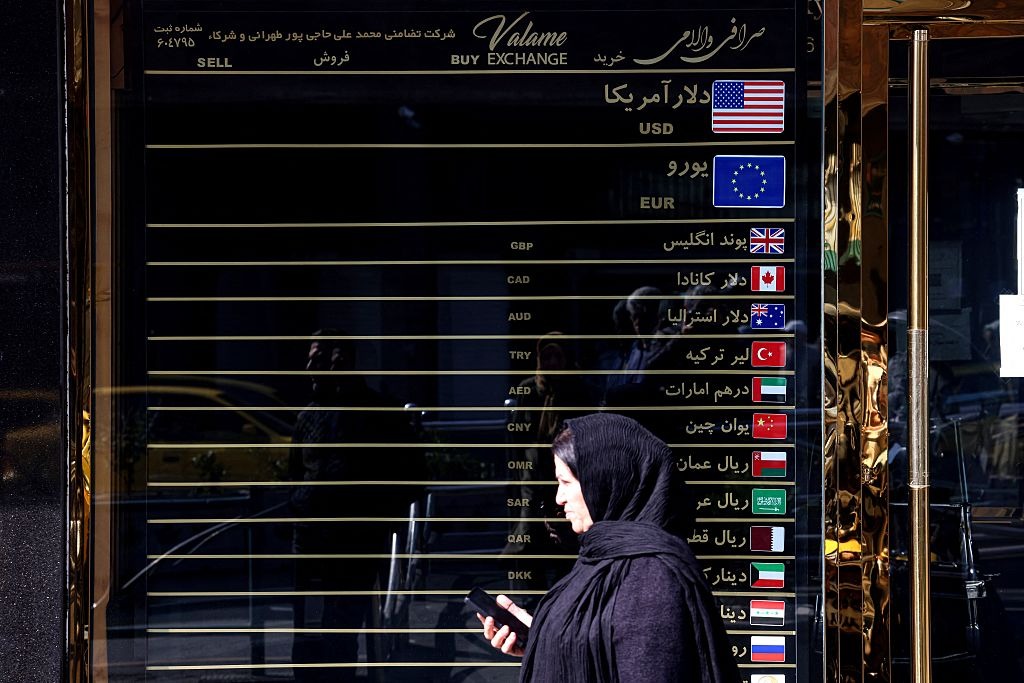
Pictured: A currency exchange booth in Tehran, Iran on February 22, 2026. (Photo by Atta Kenare/AFP via Getty Images)
By the time you read this column, the Iranian economy will have just one week before it collapses, thus bringing down the regime established by Ruhollah Khomeini in 1979. That is, if you believe US Treasury Secretary Scott Bessent, who last week predicted the collapse in two weeks' time.
Don't tell anyone, but I don't believe that is going to happen. At the same time, I am glad that Bessent has replaced War Secretary Pete Hegseth as the talking head on the stalled war with Iran.
Why am I glad? Because it halts wanton but far from adequate military action that has turned this war into a series of tragicomic gesticulations while inflicting untold hardship on Iranian people and doing serious damage to the world economy.
At the same time, the halt in bombing deprives the leftover Khomeinist regime of a chance to wrap itself in the patriotic tricolor masquerading as defender of the nation rather than the faith.
My guess is that part of the President Donald Trump's team that has realized that the war as designed and pursued so far won't produce anything resembling a victory convinced the boss that it had better be halted at least until the midterm election in the US.
The Iranian economy isn't going to collapse as Bessent hopes, for several reasons.
First, we don't have an economy in the normal sense of the term in any of its versions. This is not a market economy as found in regular free-market societies, because it functions through different and at times rival markets: white, brown and black, each of which responds to the current challenge in different ways. Alongside that, we have seen the emergence of a parallel barter-based economy with its own rules, especially in border provinces.
More importantly, Iran is self-sufficient in energy, something that is the Achilles' heel of modern free-market societies.
If it reduces exports of gas and electricity to Iraq, Armenia and recently to Russia, the regime is unlikely to face a big shortage in that field.
Even then, rationing remains an option.
Iran is also unlikely to face mass famine because it produces 89 percent of the food it needs while exporting to several neighboring nations, including Russia.
If continued long enough — but how long is a piece of string? — Trump's "maximum pressure" could lead to a further fall in the value of the Iranian currency, fanning the fires of inflation higher.
But that, too, may have unintended consequences. Iranians, for as long as records have existed, have always been great in saving. Decades ago that took the form of collecting gold and jewelry or buying land because there was no stock exchange and no culture of investing in stocks. There was no bond market because the government had massive revenues from oil exports and didn't need to borrow.
Even today, Iran is one of the few countries unburdened by massive debts and/or budget deficit. Today, much of private savings in Iran comes in the form of buying foreign currency, Bitcoin, gold and silver.
And that benefits the government, which is the main supplier of foreign currency earned through oil exports. This means the state earns dollars while most of its expenditures are in rials.
The Islamic Revolutionary Guard Corps, with its tentacles in Mafia -land, also benefits because they run a massive smuggling and bootlegging network across Iran and other countries.
Bessent's belief that economic warfare as the talisman for victory is one version of the old Marxian misconception that poverty and hunger lead to popular uprising and political change.
The experience of the past year has shown that Iran, even if crushed in material terms, cannot be defeated in political terms with a short sharp shock-and-awe campaign as designed by Hegseth.
Today, perhaps for the first time in decades, there is a realistic chance of thinking of regime change in Tehran. But for that chance to be translated into reality, the leftover Khomeinist regime must be defeated politically. And that requires intervention by the Iranian people. That intervention, however, cannot take place under bombs or a steep rise in quotidian hardship.
The recent lull in bombing showed that many Iranians are prepared to return to the domestic political battlefield against a regime that has led them into conflict virtually with the whole world.
Last week, we witnessed demonstrations by university students in Tehran, teachers in more than a dozen cities and healthcare workers in four provinces. There is talk of bazaars planning shutdowns in dozens of cities within the next week or so.
That signals a possibility that if the lull endures, Iran may return to the nationwide rebellious mood it had shown before the bombing stopped it thus bringing the regime back from the brink.
The leftover Khomeinist coterie cannot solve Iran's domestic economic, social and political problems. At the same time, no military and/or diplomatic scenario can solve the regime's problems with the outside world.
At home, the regime is digging its own grave by responding to the deepening economic crisis with desperate not to say suicidal measures. They are talking of raising bank interest rates from 22% to perhaps 30% when the rate of inflation is in the high 60s.
The Islamic Prosecutor in Tehran says he has fielded a special squad to crack down on buyers and sellers of foreign currency, gold and jewelry.
The Islamic Chief Justice suggests that shopkeepers who raise prices should be hanged.
Regime economists suggest issuing bonds for the sale of part of the oil industry, and a number of other public monopolies to siphon back the US dollars that millions of Iranians have been hoarding for years if not decades. It is like putting the Titanic's furniture up for auction before it hits the iceberg.
Iranian people need a chance to catch their breath and resume their fight for freedom and dignity.
An ersatz diplomatic accord of the kind successive US administrations have craved will only prolong the regime's shaky tenure. A resumption of aimless bombing will force Iranian people back into the defensive in the name of protecting the country.
With Hegseth told not to brag, Bessent is fielded to play the same tune in a different tone.
Gatestone Institute would like to thank the author for his kind permission to reprint this article in slightly different form from Asharq Al-Awsat.
Amir Taheri was the executive editor-in-chief of the daily Kayhan in Iran from 1972 to 1979. He has worked at or written for innumerable publications, published eleven books, and has been a columnist for Asharq Al-Awsat since 1987. He graciously serves as Chairman of Gatestone Europe.
"What brings Islamists and the revolutionary left together is their intention to tear down Western civilization. The French Interior Ministry's May 2025 report on the Muslim Brotherhood described the movement's project in France as 'a long process of political conquest' with 'systematically priority investment at the local level.'" — Michael Shellenberger, October 2, 2026.
"The French Left has waged war on schools while building an alliance with Islamist leaders who hope to radically transform them. For both, the fight starts with the schools. 'Clearly, religious and politico-religious organizations "work on" these pupils, sometimes from primary school, as well as their family, their social milieu and their neighborhood, and some try to set them against the school,' the Education Ministry inspectorate's June 2004 report on religion in schools said." — Michael Shellenberger, October 2, 2026.
"What brings Islamists and the revolutionary left together is their intention to tear down Western civilization. The French Interior Ministry's May 2025 report on the Muslim Brotherhood described the movement's project in France as 'a long process of political conquest' with 'systematically priority investment at the local level.'" — Michael Shellenberger, October 2, 2026.
[W]hen thousands of French citizens said they could no longer afford both the fuel to travel to work and the food to feed their families, [French President Emmanuel] Macron replied that while some people might struggle with money, he must take care of something more important: "the risk of facing the end of the world".
Deindustrialization continues full-on. Punitive regulations have caused factories to close. They are replaced not by other businesses but by an increasingly costly welfare system, which now accounts for more than 40% of total public spending.
[S]uccessive French governments have pumped up spending without restraint.... This enormous difference means that the French government continues to spend far more than it raises in revenue.... Interest payments on the debt have been devouring an increasingly large share of the country's annual budget and, as in the United States, now exceed the national defense budget. The difference is that the US may still be able to grow its way out of such a hole -- $40 trillion, with interest at $7.1 billion a day -- whereas France, crushed by overregulation, cannot.
On another front, while Macron, in 2020, denounced "Islamist separatism," he has done nothing to prevent, or even slow down, the Islamist conquest of France. For a decade, the full-powered Islamization of the country has stormed on. Millions of people from the Muslim world have settled in France, both legally and illegally.
Most Muslims in France do not assimilate, and a growing proportion -- roughly 38% -- place Islamic sharia law above the laws of the Republic....
No-go zones, where radical imams and Muslim gangs hold sway, have grown since 2016. They now featured in the suburbs of the major cities of France. Muslim gang members raid and go looting several times a year,
In recent years, Macron has also been increasingly targeting freedom of expression, making use of Arcom — an institution he created in 2022 to regulate and control French audiovisual media — to do so.... CNews was fined twice in 2026: once because a guest stated that anthropogenic global warming does not exist; another time because a guest stated that "history shows that Islam is still a religion of conquest."
Macron might want a successor who would continue his programs, such as they are, but that does not seem about to happen. Marine Le Pen, for the first time in her political career, leads in polls, which indicate that in 2027 she could win.... All of her legal troubles, however, appear to have had no effect on her voters, who appear to understand that justice in France has now been politicized.
If Le Pen is elected president in the spring, the shockwaves will be heard across Europe. A Le Pen presidency would mean a victory for a political party that champions Western civilizational values — a party that every incumbent leader in Western Europe -- except Italy's Giorgia Meloni — seeks to keep out of power by any means necessary.
The situation in France differs little from the general situation in Western Europe.
Many other Europeans are just as dissatisfied with their leaders as are the French. They all see the economic destruction, the ongoing Islamization of their countries, the threat from China to undercut their automobile industries, and the growing impossibility of discussing certain subjects without being demonized or put on trial.
Many Europeans see Islamization gaining ground in their countries and enjoying support from Marxists: each thinks the other will bring it to power. They see their leaders doing nothing to remedy a situation that has become increasingly alarming. They appear to prefer having their Western civilization protected and saved.
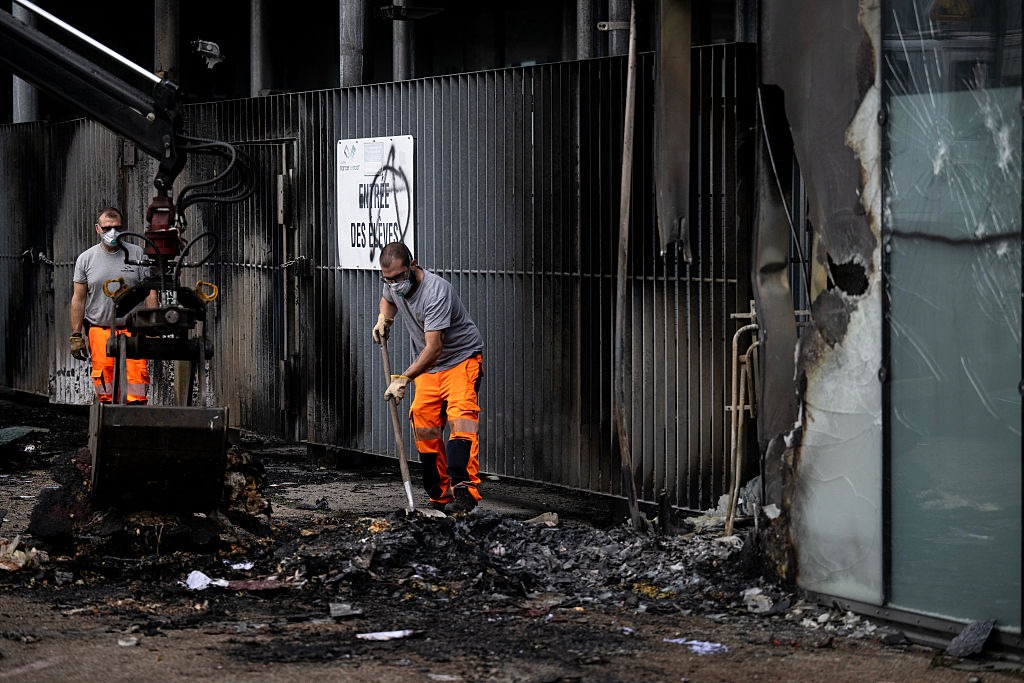
The French government was reportedly "taken by surprise" when students began rioting roughly two weeks ago. Many Europeans see Islamization gaining ground in their countries and enjoying support from Marxists: each thinks the other will bring it to power. They see their leaders doing nothing to remedy a situation that has become increasingly alarming. Pictured: Municipal workers clean up around Marcel Sembat Secondary School in Rouen, France on October 1, 2026, after it was torched by rioters. (Photo by Guillaume Saligot/AFP via Getty Images)
"Who didn't see that coming? Oh yeah ....the politicians," noted "The Great Gats" on X.
The French government was reportedly "taken by surprise" when students began rioting roughly two weeks ago to protest conditions — overcrowded classes, dilapidated buildings, vermin and rats, lack of heating and air-conditioning, shortage of teachers — in their schools.
"But," American journalist Michael Shellenberger writes, " French schools have more money per pupil today than at any earlier time.... The French government spends 4.5% of gross domestic product on educational institutions, and Germany spends 3.7%.
The violent riots, which started on Paris's Ile de France and spread throughout the country, appear, according to investigations, to have been instigated by the French political party La France Insoumise (France Unbowed) headed by Jean Luc Melenchon, a far-left candidate in the French presidential elections scheduled for the spring of 2027. La France Insoumise denies the charges; however, according to Shellenberger, "the evidence clearly shows that La France insoumise (LFI)... instigated and led the protests."
"The protest had 'the involvement from the start of elected officials of La France insoumise and ultra-left collectives,' an anonymous security official told Le Point. A readout of the prime minister's October 1 crisis meeting, given to Reuters by a person close to him, described the movement as 'an operation organised by LFI (France Unbowed) and its proxies on the far left' in the 'shared assessment' of the intelligence services....
"'Parents, Insoumis [party] activists, mobilize to interpose yourselves against police savagery,' said Mélenchon, blaming the police, not the students, for the violence....
"In Marseille, hundreds of young people forced firefighters to flee their truck outside a lycée and then set it alight. In Paris, about ten protesters chased a trainee police lieutenant, threw her to the ground and kicked her amid cries of 'Kill her!....'
"'We're not entirely sure that they are even high-school students themselves,' said the French Justice Minister of the people arrested...."
"The French Left has waged war on schools while building an alliance with Islamist leaders who hope to radically transform them. For both, the fight starts with the schools. 'Clearly, religious and politico-religious organizations "work on" these pupils, sometimes from primary school, as well as their family, their social milieu and their neighborhood, and some try to set them against the school,' the Education Ministry inspectorate's June 2004 report on religion in schools said.
"What brings Islamists and the revolutionary left together is their intention to tear down Western civilization. The French Interior Ministry's May 2025 report on the Muslim Brotherhood described the movement's project in France as 'a long process of political conquest' with 'systematically priority investment at the local level.'
"The children of Muslim immigrants are often more radical than their parents. 'There is first of all a generational revolt,' wrote Olivier Roy, a French scholar of Islam, in 2015 of French jihadists...."
"LFI openly courts Muslim voters, and a parliamentary inquiry said that made it a target for Islamist networks....
"'LFI's commitment to a clientelist strategy toward the Muslim electorate may have made this movement a privileged target,' said Matthieu Bloch, rapporteur of a National Assembly inquiry into parties and Islamist networks, in December 2025....
"Polls 'all show [Mélenchon] losing massively in a run-off against Le Pen,' noted the BBC."
So far, around 2,000 students have been arrested and more than 1,000 schools affected. The violence has included "schools set on fire and teachers beaten and doused in petrol."
French President Emmanuel Macron, who is serving his second term of office and cannot run again, is ending his presidency facing widespread rejection from the public. According to a recent poll, only 21% support his policies, although up from 19% a few months ago.
Macron's numbers are not surprising. He has repeatedly shown contempt for the poorest members of French society.
A few weeks into his first term, which began in May 2017, he spoke of "those who made it" and "those who are nothing." Less than a year and a half later, in November 2018, while citing anthropogenic climate change, he raised France's already exorbitant gasoline taxes, a move that immediately triggered the "Yellow Vests" movement, when thousands of French citizens said they could no longer afford both the fuel to travel to work and the food to feed their families. Macron replied that while some people might struggle with money, he must take care of something more important: "the risk of facing the end of the world".
The Yellow Vests movement lasted more than a year — subsiding only in January 2020 with the onset of the COVID-19 pandemic. Throughout, Macron remained contemptuous, responding to the grievances of nonviolent protestors with police crackdowns inflicting deaths and mutilations. Meanwhile, he permitted left-wing agitators who had infiltrated the movement to riot and commit arson without asking the police to intervene. Many in France saw that Macron could be pitiless toward people expressing their distress, but lenient toward criminals so long as they were of his preferred political bent.
During the pandemic, Macron initiated some of the most authoritarian measures in Europe. The French were ordered to stay indoors and leave their homes for only one hour a day — within a half-mile radius — provided they filled out a form stating their name, address, and time of departure. The police, omnipresent, arrested thousands and fined them heavily simply for venturing slightly beyond the permitted distance or lingering a bit longer than one hour. All conversations outdoors were strictly prohibited.
The Macron years were additionally marked by a profound economic decline in France and a severe drop in the standard of living. For the past decade, France's per capita wealth has fallen below the EU average and now trails behind that of Cyprus. Ten years ago, in 2016, France's GDP per capita was globally ranked at 23; today, it ranks at 33. The unemployment rate, now at 8.3% , is increasing. For people between the ages of 15 and 24, it is an extremely high 21.1%.
Deindustrialization continues full-on. Punitive regulations have caused factories to close. They are replaced not by other businesses but by an increasingly costly welfare system, which now accounts for more than 40% of total public spending. In 2025, the poverty rate in France climbed to 15.4%, representing 9.8 million people living below 60% of the national median income and struggling every month just to meet their basic needs.
At the same time, successive French governments have pumped up spending without restraint. While the GDP growth in France from 2016 through 2026 was 13.17% in total, the increase in public spending in the same period was 35.6%. This enormous difference means that the government continues to spend far more than it raises in revenue. The national debt, which has grown continuously, reached 117.5% of GDP in January 2026, and will reach 119.3% by the end of the year. Interest payments on the debt have been devouring an increasingly large share of the country's annual budget and, as in the United States, now exceed the national defense budget. The difference is that the US may still be able to grow its way out of such a hole -- $40 trillion, with interest at $7.1 billion a day -- whereas France, crushed by overregulation, cannot.
On another front, while Macron, in 2020, denounced "Islamist separatism," he has done nothing to prevent, or even slow down, the Islamist conquest of France. For a decade, the full-powered Islamization of the country has stormed on. Millions of people from the Muslim world have settled in France, both legally and illegally. Around 2016, the approximate number of Muslim citizens and foreign Muslims living in France was 5.7 million (8.8%); now, officially, it is estimated at possibly 7 million out of a population of roughly 67 million, but the real figures are undoubtedly higher. Most Muslims in France do not assimilate, and a growing proportion -- roughly 38% -- place Islamic sharia law above the laws of the Republic (the figure is higher among Muslims aged 15 to 24: 57%).
Laws against illegal immigration are not enforced. Every year, only 7% of illegal aliens in France who were notified by the police to leave -- by the OQTF (Obligation to Leave French Territory) -- are expelled. This laxity means that more than 93% remain in the country. Many are criminals. Some of the most sickening murders in France during the Macron years have been committed by illegal aliens who had ignored their OQTF. Lola Daviet, age 12, for instance, was raped, tortured, and murdered in a Paris apartment by an Algerian thief and occasional prostitute, Dahbia Benkired. On August 21, 2022, Benkired had been arrested, issued an OQTF, and then released. Two months later, on October 14, she murdered the child.
No-go zones, where radical imams and Muslim gangs hold sway, have grown since 2016. They now featured in the suburbs of the major cities of France. Muslim gang members raid and go looting several times a year, especially when there is sports match with a French soccer team, and recently during the 2025 World Cup. The police have orders to intervene only minimally. If they hurt or kill a Muslim criminal, they have seen that their careers and lives can be destroyed. On June 27, 2023, Nahel Merzouk, a young Muslim criminal, refused to obey to a police officer, who then shot him by accident. Riots, which erupted all over the country, only began to calm when the police officer, Florian M., was placed in pre-trial custody and charged with first-degree murder. He now faces up to 20 years in prison.
After Hamas's October 7, 2023 massacre in Israel, Islamic and leftist protests in support of Hamas and "Palestinian resistance" were organized within days. La France Insoumisedescribed the October 7 massacre as an "armed offensive by Palestinian forces" without ever mentioning that Hamas is a terrorist movement. One of the leaders of LFI, Rima Hassan, a French citizen, defines herself as "French-Palestinian", not French. She constantly falsely accuses Israel of "genocide" and claims that that "Hamas's actions are legitimate."
The massive surge of antisemitic assaults, threats, and insults has lasted until today.
In recent years, Macron has also been increasingly targeting freedom of expression, making use of Arcom — an institution he created in 2022 to regulate and control French audiovisual media — to do so. In 2025, Arcom shut down the television channel C8: the stated reason was a "lack of pluralism," and that too many conservatives had been invited to speak. On June 15, 2026, another television channel, CNews, received a formal notice from Arcom, also accusing it of a "lack of pluralism". CNews could soon shut down as well. It is the last major television channel in France that still invites right-of-center commentators whom other channels no longer invite. CNews was fined twice in 2026: once because a guest stated that anthropogenic global warming does not exist; another time because a guest stated that "history shows that Islam is still a religion of conquest."
In December 2025, France requested that two commentators — Jacques Baud and Xavier Moreau — be sanctioned by the European Union for their "pro-Russian remarks." Their bank accounts and assets within the EU were frozen, and their credit cards cancelled. They are no longer permitted to travel within the EU. Any financial assistance provided to them by anyone would be subject to sanctions. These measures are extrajudicial, but there is no avenue of appeal or recourse.
In May 2024, Macron's political party, Renaissance, lost the European Parliament elections. While France's main right-wing party, Rassemblement National (National Rally), received 31.37% of the vote, Macron's received only 14.6%. He spoke angrily about the result, dissolved the National Assembly and called for snap legislative elections. In the first round, the National Rally received more than 33% of the votes and was about to win a majority of the seats in the second round. Macron quickly created an alliance of all other political parties aimed at defeating the National Rally. He spoke of a "republican front," and implied that the National Rally is a danger to the republic. Voters supporting centrist or moderate-right candidates were encouraged to vote for a left-wing candidate if that candidate was best positioned to win. Voters supporting left-wing candidates were encouraged to vote for a centrist or moderate-right for the same reason. The result was that the National Rally secured the largest share of votes, but the "republican front" parties received the largest number of seats in the National Assembly, which was fragmented into multiple parties, none of which could form a coherent majority. Since then, the country has had several powerless governments, and no important decisions could be made. Macron made the country ungovernable.
Macron might want a successor who would continue his programs, such as they are, but that does not seem about to happen. Marine Le Pen, for the first time in her political career, leads in polls, which indicate that in 2027 she could win. Other candidates belong to parties that are now associated with the disaster into which France has plunged.
Le Pen was even prosecuted for allegedly allowing parliamentary assistants of Members of the European Parliament (MEPs) from her party to work in Paris for the MEPs who employed them. When centrist candidate François Bayrou and left-leaning Jean-Luc Mélenchon were accused of the same offense, the charges against both were dropped. Not for Le Pen. On March 31, 2025, she was sentenced to four years in prison and a five-year ban from holding public office, presumably to prevent her from becoming a candidate.
After she appealed the verdict, on July 7, 2026, her sentence was reduced to three years in prison -- one year of which was to be served under house arrest, wearing an electronic monitoring tag -- and a 45-month ban from holding public office, 30 months of which were suspended. The new ruling enables her to run for office. She has lodged an appeal with France's highest court and execution of the judgment has been suspended. She will not have to wear the monitoring tag during the election campaign. The court is scheduled to issue its ruling on her appeal before the election and could reverse its decision. Le Pen would then be required to wear a monitoring tag during the final days of her campaign and, should she be elected, at the Élysée Palace upon taking office.
All of her legal troubles, however, appear to have had no effect on her voters, who appear to understand that justice in France has now been politicized.
If Le Pen is elected president in the spring, the shockwaves will be heard across Europe. A Le Pen presidency would mean a victory for a political party that champions Western civilizational values — a party that every incumbent leader in Western Europe -- except Italy's Giorgia Meloni — seeks to keep out of power by any means necessary.
The economic, financial and social situation Le Pen would face in the event of her victory would be harsh. All available data indicate that France is almost bankrupt at almost every level. A recovery will be highly complex and difficult.
Most leaders of LFI have already declared that they would refuse to accept a Le Pen victory: if she wins, they would call for an insurrection. Several political analysts think that in such an event, widespread riots involving leftist groups and Islamist gangs might break out across the country.
Several other French politicians attempting to stoke panic will do so with increasing intensity right up until the election. It is not at all certain that these obstructions would be enough to defeat Le Pen.
A recent poll commissioned by the center-right Foundation for Political Innovation shows that 78% of voters believe that "the French way of life, its traditions, and its lifestyle habits are under threat." Available data indicate that, unfortunately, this is true. Another recent poll shows that 85% of voters think France is in decline. They are quite right. France is in sharp decline and large majority of the French see it.
The situation in France differs little from the general situation elsewhere in Western Europe. The policies pursued in most other Western European countries do not fundamentally differ from those adopted by Macron -- and lead to the same results.
Many other Europeans are just as dissatisfied with their leaders as are the French. They all see the economic destruction, the ongoing Islamization of their countries, the threat from China to undercut their automobile industries, and the growing impossibility of discussing certain subjects without being demonized or put on trial.
Many Europeans see Islamization gaining ground in their countries and enjoying support from Marxists: each thinks the other will bring it to power. They see their leaders doing nothing to remedy a situation that has become increasingly alarming. They appear to prefer having their Western civilization protected and saved.
Political parties in Western Europe with platforms close to that of Le Pen's National Rally, such as Germany's Alternative für Deutschland (AfD), are gaining momentum despite attempts by leaders in power and the media to demonize them.
On September 6, 2026, in a state-level election in Germany's Saxony-Anhalt, the AfD won 43.8% of the vote -- twice as much as five years earlier. In May 2025, German Chancellor Friedrich Merz came to power at the head of a grand coalition united solely by the desire to halt the rise of the AfD. His coalition did nothing to combat Germany's deep industrial slowdown and the growing non-integration of Muslims living in the country. The situation is now worse. Merz is currently more unpopular in Germany than Macron is in France (only 14% of Germans consider him worthy of holding the office of Chancellor). The AfD is now the most popular party nationwide in Germany. A recent poll puts its support at a record 30%.
In the UK, in May 2026, the Reform Party won many local and municipal elections, inflicting heavy defeats on both the ruling Labour Party and the Conservative Party. Recent polls indicate that if an election for Parliament were held today, it would secure the highest number of seats.
A political groundswell in Western Europe is taking shape. Most mainstream media commentators dismissively label it "populist."
"What they call populism," wrote Éric Zemmour, former columnist and president of the right-wing Reconquest party, "is the cry of people who do not want to die."
Dr. Guy Millière, a professor at the University of Paris, is the author of 27 books on France and Europe.
Trump is the great magnetic north of our political metabolism.
Harold Macmillan, prime minister of Great Britain from 1957 to 1963, was once asked by a journalist what was the most troubling problem he faced during his prime ministership. “Events, my dear boy, events,” was his reply.
It was ever thus, of course. But in the great pudding of life, the currents of events seem to cluster more thickly in some moments than in others. I understand that every age is naturally inclined to exaggerate the importance and vividness of its own dramas. The incessant beat of our 24-hour news cycle abets that sense of perpetual emergency. One of the great lessons of history is that no period, whatever its reputation for stability, is really free from an obligato of successive crises. That said, some moments seem to be marked “presto” even as they are orchestrated for booming timpani and blaring horns. Is not America living through such a moment now?
I think it is. Forget about the midterm elections. The party in power has gained seats in both houses of Congress only twice in modern history. In 1934, as the country began the slow climb out of the Great Depression, FDR made gains in both houses. In 2002, in the aftermath of the 9/11 Islamist terror attacks, George W. Bush likewise saw gains in both houses. Most pollsters, and nearly all pundits, believe that the Democrats will retake the House in November. Many believe the Senate is up for grabs as well. Having elevated my moistened finger into the air, I discern some contradictory crosscurrents. Back in 2022, I agreed with the conventional wisdom that the election would be a blowout for Republicans. I was wrong. This time, I suspect that the conventional wisdom has failed to price into its calculations the astonishing number of victories the Trump administration has racked up in its first 18 months.
It is a long list. The Dems recently learned the word “affordability” and have been practicing saying it aloud early and often. News from many quarters is undercutting their complaints. Yes, gas prices, which peaked in 2022 under Biden, are still elevated because of the war in Iran. But they are on their way down and will plummet in coming weeks as markets begin to register Iran’s defeat. Recently, the Atlanta Fed predicted that real growth in the third quarter will come in at a blistering 5.0–5.1 percent. At the same time, the Census Bureau released data showing that the poverty rate fell to 10.2 percent, the lowest in our history. Blue-collar income has jumped between 4 and 5 percent since January 2025, when Trump began his second term. Manufacturing—and manufacturing jobs—are flooding back into the United States.
On the foreign policy front, it is hard to keep up. At the beginning of the year, Trump nabbed Nicolás Maduro and his wife from their supposedly impregnable fortress in Caracas. He then made what the White House called “the biggest oil deal in world history, delivering U.S. majority control of more than 65 billion barrels of proven oil reserves in Venezuela.” Last month, Trump signed a permanent security deal with Denmark and Greenland. The agreement recognized official “Danish sovereignty and Greenlandic self-determination.” It is an odd or “lite” version of sovereignty, however, since the agreement also grants to the United States the exclusive right to maintain and expand military bases in Greenland. The deal also grants the U.S. exclusive say about access to Greenland’s extensive mineral wealth and “sensitive sector investment.”
Then there is technology. Trump recently convened a meeting at the White House with the crème de la crème of America’s high-tech titans. As is so often the case with presidents, the ceremony involved a naming-the-animals moment. What had been called “AI” or “artificial intelligence” was rebaptized “SI,” “super intelligence.” It is too soon to say whether the change of name will catch on. I think it might. I will do what I can to encourage the change of rubric.
One of the main reasons Trump convened the meeting was to address concerns about the safety of SI. It is something that Elon Musk broached several years ago. Like any powerful technology, SI can and doubtless will be abused. Trump and his team want to make sure that reasonable guardrails are in place. But the biggest news coming out of that meeting was Elon Musk’s prediction that SI would usher in not just an age of abundance but also an age of superabundance. That, he said, is the “most likely” scenario.
Trump also just launched a new government website, America.gov. Described as a digital “front door” to government information and services, the SI-powered site will obviate the roughly 29,000 federal, state, and local websites that hover over the populace like a paralyzing net. It is early days yet, but soon one will be able to do everything on the new chatbot-style website, from renewing a passport and applying for Medicare to getting park permits, business registrations, or changing your name when you get married. Readers with long memories will want to compare the rollout of this new user-friendly utility to the disastrous rollout of the Obamacare website in 2013.
You may also have noticed, Dear Reader, a marked uptick in ads, video clips, and social media memes disseminated by Trump World. Some are official administration products; some are produced independently. As I write, the midterm elections are exactly 30 days away. Expect that uptick to crescendo in the coming weeks. The legacy media will do what it can to keep the spotlight off the president as the midterms approach. But they will fail. Trump is the great magnetic north of our political metabolism. He will be crisscrossing the country over the course of October to hold his signature rallies and support GOP candidates. How strong his determination to reach out to his supporters and rally the troops became apparent the other day when the Secret Service warned him that the weather was too inclement to fly from Texas, where he attended an event for Senate candidate Ken Paxton, to a long-planned event in Oklahoma. “How fast does the Beast [the presidential limo] travel?” he asked his entourage. “Almost 100 miles an hour,” he was told. “Get your asses in that car,” he said. “We’re going to Oklahoma.”
I think I can hear the anti-Trump sorority sniff at that demotic locution. Very unpresidential, you know, to use such language. But in the rushing stream of “events, my dear boy, events,” the kaleidoscope of Trump’s indefatigable ministrations is a piercing beacon in the storm.
Photo: MEDINAH, ILLINOIS - SEPTEMBER 27: U.S. President Donald Trump waves to the crowd during the trophy ceremony after the U.S. Team wins 17-13 following the Sunday's Singles on day four of the Presidents Cup 2026 at Medinah Country Club on September 27, 2026 in Medinah, Illinois. (Photo by Kevin Dietsch/Getty Images)