Tuesday, October 6, 2026

Are We Becoming Gondor? - Victor Davis Hanson


by Victor Davis Hanson

J.R.R. Tolkien’s vision of a declining Gondor offers a warning for the troubled West—but also a message of hope that renewal remains possible.


The Despair and Hope of J. R. R. Tolkien

The novelist J. R. R. Tolkien (1892–1973) repeatedly insisted that his epic fantasy The Lord of the Rings, written from 1937 to 1949, was not allegorical.

But some scholars have argued otherwise, detecting contemporary, 20th-century influences in his storytelling.

Tolkien fought at the nightmarish Battle of the Somme in World War I. He witnessed the slaughter of the youth of Europe in the trenches that lived with him the rest of his life. In the 1930s, he despaired over both the rise of the godless Communist Soviet Union and the transformation of a once-enlightened Germany into a monstrous fascist regime.

Tolkien, a devout Catholic, was dismayed not only by the growing power of these totalitarian empires but also by the West’s urbanized industrialism and secularized modernism on the eve of World War II. In middle age, he lived through the even greater slaughter of World War II. Adding to his concerns, he finished his novel at the height of Soviet expansionism, as the Cold War began and nuclear weapons emerged.

The catastrophic decades of the 1930s and 1940s not only shaped his overall worldview but plausibly helped inspire at least some of the most dramatic elements of his novel.

In The Lord of the Rings, Gondor’s capital, Minas Tirith, is the most hallowed city of men. It remains renowned for its indomitable stone walls, its age-old defense of the west from the evil of Mordor on its eastern border, and the legacy of its great kings, who long ago galvanized alliances of free peoples to thwart totalitarian evil.

But all that is now in the past.

Gondor’s once-majestic line of kings died out long ago. The population is in steady decline. Gondor’s former greatness survives only in ancient statues and songs. Gone are the hardy people of legend who once built that shining city on a hill.

Internal conflict and bickering have long since shattered the kingdom’s strength. Gondor is surrounded by a growing sea of enemies. Stewards bent on appeasement and lacking real legitimacy are mere placeholders for the old kings.

In sum, Gondor seems like a fictional version of the decaying 15th-century Byzantine Empire, an outpost of the West about to be buried by the onslaught of Ottoman jihadism.

In the novel, an outnumbered Gondor is fighting a seemingly hopeless war for its very existence–and the survival of the West itself. Its salvation hinges in part on the aid of the rough-and-tumble riders of Rohan, supposedly less sophisticated and less civilized men who remain vigorous and defiant, sworn to save a declining Gondor.

(In perhaps similar fashion, Churchill in the early years of World War II saw “the New World” of the upstart United States as coming to the rescue of the beleaguered, war-torn Old World of Europe.)

A Pandora’s Box of Western Ills

So, is the West now a teetering modern Gondor?

It too faces both an external threat from a rising communist China of 1.4 billion people that seeks global domination and internal apostasy from a new, nihilistic, anti-Western alliance of socialism and Islamism.

Western borders, with the recent exception of those of the United States, are mostly shattered.

Immigrants and their children together account for more than 30 percent of the population in many Western countries. Thousands of young people from immigrant neighborhoods are currently rioting in the streets of France—attacking churches, indigenous French passersby, and anyone who challenges them. The same sort of violence, once sporadic, now threatens to sweep Europe.

Modern France has never quite recovered from its soldiers’ heroic, blood-soaked victory at Verdun—“Ils ne passeront pas”—which stopped the Kaiser’s assault over a century ago. And after two world wars, an exhausted, postcolonial France gave birth to poststructuralism and postmodernism, which postulate that eternal truths are relative and bothersome historical facts are mere social constructs.

Millions, mostly from the Islamic world, have flooded Europe’s borders in search of security, prosperity, and freedom—but rarely do they seek to become European. Instead, far too many reject integration and assimilation. They treat their magnanimous hosts as naïve, weak, unarmed, infertile, godless—and deserving of replacement by them and their religion.

These immigrants would certainly answer our initial question in the affirmative: they see that the entire European continent is becoming something like a teetering fifteenth-century Constantinople, soon to implode under its own decadence amid a sea of enemies.

Politically allied with these immigrant Islamists are Europe’s homegrown hard Left and radical environmentalists. The latter are responsible for such suicidal policies as shutting down Germany’s nuclear power program during the energy crisis following Russia’s invasion of Ukraine, to say nothing of opposing wider access to air conditioning despite estimates of tens of thousands of heat-related deaths across Europe.

An ossifying Europe is belatedly rearming to meet the Russian threat in the east—but largely in response to the intense pressure and vehement remonstrations of Donald Trump, who is publicly reviled even as his earlier warnings to a virtually unarmed Europe are privately acknowledged as prescient. Yet, after years of pacifism, the military readiness of NATO’s European members remains underwhelming.

The postmodernism and globalism, or faux cosmopolitanism, of Western elites dictate that, in the crumbling West, the very ideas of “defense” and “deterrence” are as archaic as borders. A national military is deemed at odds with the morally superior collectivist peacekeeping role of the United Nations and its corrupt affiliated international agencies.

Culturally, Europe also seems bent on confirming its critics’ charges of decline and decadence. European affluence and leisure have created a culture of cynicism, if not nihilism—with new generations mocking Europe’s illustrious past, ridiculing its legacy, and rejecting the entire Western tradition—its singular art, music, monuments, literature, history, and values.

Fewer than half of all Britons now report being proud of their country and its history, and the figures are even worse for young people. But after decades of this sort of nihilism, even Europeans are finding it hard to discover new sins of their ancestors for which to apologize.

One in four European pregnancies ends in abortion. In Western Europe, France alone nearly matches the United States’ dismal fertility rate of 1.7, while the other shrinking and aging European Union countries have a much lower rate of 1.3.

The great universities of Europe are crumbling under low admission standards, a dearth of funding, and a preference for profitable international students—quite apart from the pernicious effects of destructive leftist and postmodern ideologies on academia. (Their American counterparts, needless to say, are nearly as bad.)

The West’s New World is also in crisis. Canada may be the furthest gone of all Western nations. Forty-five percent of its population consists of first- or second-generation immigrants. Many newcomers also reject the now-reviled idea of the melting pot there too.

Canada’s defenses are laughable: the vast, continent-sized country can put a mere 82 aging fighter jets in the air. It is kept afloat only by the $32 trillion economy and huge military of neighboring America—a nation the left-wing globalist Canadian government increasingly despises and targets with whipped-up nationalist hatred.

Canada’s “assisted suicide” program accounts for more than 5 percent of all Canadian deaths. Recent Canadian per capita GDP growth has often been among the weakest in the industrialized world. Canada has refused to fully use its abundant natural resources, such as oil, natural gas, timber, and minerals.

Nor has the rot spared the United States. During Joe Biden’s tenure, millions of aliens illegally crossed the American border and entered without any vetting. Crime was rampant. The military fell 40,000 recruits short of its recruiting goals. We were told that there were at least three genders, that biological males have a natural right to compete in girls’ sports, that theft under $950 is not really theft, that racial identity must be essential, rather than incidental, to American citizenship, and that our renowned Founding Fathers were fatally flawed, if not downright evil.

The Democratic Party has been transmogrified into an Islamist-sympathizing, socialist Jacobin movement. It is intent on rejecting America’s past while remaking its present into something the Founders would find abhorrent.

While the First Amendment has so far mercifully spared us the hate-speech prosecutions seen in Europe, America suffers as much as Europe from a new precivilizational and self-hating racialism. Under the Marxist-inspired framework of diversity, equity, and inclusion, the majority-white populations of Europe and the United States are mindlessly and indiscriminately damned as oppressors. In contrast, anyone claiming nonwhite status ipso facto can instantly become an oppressed victim—with supposedly legitimate demands for recompense in hiring, promotion, and admissions.

The ancient bane of antisemitism—for centuries a reliable symptom of a society’s inner sickness—has resurfaced even in the United States. This time, it is fueled by the DEI lobby, socialists, and Islamists. The socialists hate the material success and influence of supposed Jewish cabals. The Islamists both despise and envy the astounding economic and military rise of an ascendant Israel.

On American campuses, crowds of homegrown leftists and foreign students from the Middle East chant “From the River to the Sea,” dreaming of the destruction of the Jewish state of Israel, a mere 80 years after the Holocaust. Few immigrants and visitors from the Middle East can explain why they fled the homelands they now long for. Yet after finding safety, freedom, and prosperity from their magnanimous hosts in the West, they seem to hate them even more.

An equally unhinged, albeit smaller, right-wing American cohort all but welcomes the implosion of the current West as a supposedly deserved fate for its decadence and other assorted sins. The podcaster Tucker Carlson argues that the West was culpable or stupid, or both, for fighting against Hitler and his Nazis in World War II and currently opposing Putin’s Russia. He believes that Britain might have been better off had Hitler conquered it—revealing his ignorance of Nazi aggrandizement and doctrine as well as Hitler’s postwar plans for a conquered Western Europe (let alone for Europe’s eastern lands and the surviving Jews).

Hope Springs Eternal

And yet, as in Tolkien’s world, hope persists.

Even as maladies fly out of Pandora’s box, hope remains, silent and forgotten, at the bottom.

Italy’s Giorgia Meloni has at least introduced some genuinely conservative reforms. Conservative and traditional political movements are sweeping both Latin America and Europe.

America is staging a true counterrevolution, intended not only to stop socialism, Islamism, pacifism, globalism, and nihilist postmodernism but also to restore the economic, technological, military, and political preeminence of Western civilization. Some Europeans, Canadians, and Australians are beginning to voice fears that the West will end unless they, too, undertake a restoration.

Again, J. R. R. Tolkien was no fatalist.

At the end of his epic, the inherently sensible common people of Middle-earth band together on the eve of the apocalypse and rise up under new or invigorated leaders who embody the ancient values needed to thwart their societies’ inner decay, Sauron’s external threat, and the internal apostasy of his henchman Saruman. Middle-earth is changed, but not lost to evil.

So, Gondor is saved at the last minute by Rohan, by its long-lost future king, and by forgotten ordinary people—the hobbits—all of whom rise to the occasion.

Tolkien’s ultimate optimism may yet prove prescient today.

Millions of the forgotten and despised in Europe and the rest of the West are slowly recognizing that open borders and mass, unvetted immigration from culturally alien societies are a prescription for national suicide.

They are belatedly learning about the true agendas and methods of communist China. They are beginning to agree that the war waged by socialists and communists on capitalism, fossil fuels, the military, law enforcement, and meritocracy is tantamount to collective self-destruction.

A younger generation is beginning to take pride in Western civilization rather than apologize for it, and to rediscover its strength.

And so perhaps it will agree with Tolkien that in the end, Gondor is to be saved. 


Victor Davis Hanson

Source: https://amgreatness.com/2026/10/06/are-we-becoming-gondor/

Follow Middle East and Terrorism on Twitter

While Others Talked, America Acted - Jay Rogers


by Jay Rogers

A conservative's case for results over rhetoric at the United Nations.


Last week at the United Nations, President Donald Trump stood before the same institution that laughed at him in 2018. That year, he warned the General Assembly that Germany was making itself dangerously dependent on Russian energy through Nord Stream 2. German officials smirked on camera. European diplomats rolled their eyes. Then, in February 2022, Russia’s tanks rolled into Ukraine, and Germany scrambled for alternatives while energy prices strained European households. I watched last week’s speech after a long day of client meetings with one of my sons. The message was the same as 2018: while others talked, America acted. The difference is, now we have the receipts.

I’m not a foreign policy academic. After more than 30 years of running hedge funds, private equity strategies, and family office mandates, I know the difference between people who identify problems and people who solve them. Trump is good at identifying problems with a verified track record. That combination makes the foreign policy establishment deeply uncomfortable. It also happens to be exactly what a sclerotic international bureaucracy needs to hear.

The Prophecy Problem

Trump’s 2018 energy warning was not an outlier. He has spent years telling European leaders that their immigration policies were a slow-motion civilizational disaster, and they spent years dismissing him for it. Speaking at the UN General Assembly in September 2025, he described open-border approaches as destroying European cultures and warned that governments admitting people “with little in common” without proper vetting would see their nations fail. He said political correctness was making Europe “weak.” His December 2025 National Security Strategy went further, warning of “the stark prospect of civilizational erasure” and stating that Europe would be “unrecognizable in 20 years or less” if present trends continued.

The mainstream reaction was predictable: dismissal, condescension, lectures about xenophobia. Then both the reality and data arrived.

The turning point was 2015. More than one million people, primarily from Syria, Afghanistan, and Iraq, entered the EU that year. Angela Merkel’s “Wir schaffen das” (translated: “we can do this”) became the symbol of optimistic open-door policies. Viktor Orban and a handful of European conservatives were pilloried for questioning it. Critics warned about specific, measurable outcomes: higher rates of violent crime, welfare dependency, the growth of parallel societies, and eventual political backlash. Those warnings received the same smirk Germany had aimed at Trump’s energy speech.

The decade that followed bore those warnings out. Swedish government data showed significant concentration of foreign-born individuals among rape and violent crime convictions. German federal crime statistics documented rising public-space insecurity in areas with concentrated migrant populations. Studies from the Netherlands, France, and Germany showed high welfare dependency and unemployment among recent non-Western migrants years after entry. The Alternative for Germany went from a marginal party to a leading opposition force. Sweden, France, Italy, the Netherlands, and the UK all shifted rightward, not because those voters turned xenophobic, but because they were living with consequences their leaders refused to recognize.

Mainstream European parties have since adopted border controls and accelerated-return policies they once condemned as extremist. That says everything about who was reading reality correctly.

The UN’s Accountability Deficit

Back at the UN itself, the funding picture is its own indictment. The United States remains the largest assessed contributor to the regular UN budget at 22 percent and carries the highest share of peacekeeping costs, a tab running into the billions annually. What do American taxpayers get for it?

The Human Rights Council seats serial abusers while directing disproportionate attention at Israel. The International Criminal Court applies selective enforcement that generates American and Israeli scrutiny and European applause. UNESCO carries its own archive of politicized decisions. Secretary-General Antonio Guterres has overseen a decade of bureaucratic expansion serious enough to produce a rare no-confidence vote from his own staff on reform plans in 2025. When the people inside the building lose confidence in the leadership, the people writing the checks are entitled to ask what their return on investment is.

Argentina’s President Javier Milei showed up at the same 2026 General Assembly and bluntly delivered an assessment the UN press office won’t be adding to its promotional materials. He called the organization “a useless organization whose only purpose is to sustain a caste of fatally arrogant parasites masquerading as well-intentioned bureaucrats.” He added that “there’s no shortage of words or resolutions. What is lacking is consequences.” When a sitting head of state delivers that verdict from the institution’s own podium, to its face, the polite diplomatic fictions are finished. Trump and Milei come from different traditions, but they’re reading the same ledger.

The UNRWA Standard

Nowhere is the accountability gap sharper than in the UN Relief and Works Agency. Israeli intelligence reported that roughly 10 percent of UNRWA’s Gaza workforce had ties to Hamas or allied terrorist groups. Some participated directly in the October 7, 2023, atrocities. The UN eventually dismissed a fraction of the accused after sustained donor pressure. Past UNRWA leadership once described Hamas members on the payroll as simply “part of the social fabric.”

I coached youth sports for years. If I left a player on the field who had attacked a teammate, I’d be fired and with justification. Every parent in the league would demand it. Yet American taxpayers fund an agency that cannot, or will not, police its own ranks against the very terrorists it claims to help civilians escape. Call it what it is: institutional failure hiding behind humanitarian language.

Results vs. Process

Trump’s approach combines direct pressure, funding leverage, and bilateral deal-making outside multilateral frameworks. Whatever its imperfections, it generates measurable outcomes. The Abraham Accords were built entirely outside the UN’s infrastructure. The Armenia-Azerbaijan peace accord signed at the White House on August 8, 2025, came through direct U.S. mediation, not the Security Council process. One can apply appropriate skepticism to the less-formalized arrangements and still see the contrast: American engagement built around accountability produces agreements. Engagement built around consensus produces communiques.

Congress should codify that leverage: condition U.S. contributions on transparent staffing audits for agencies operating in conflict zones, independent review of senior appointments, and enforceable reforms to Human Rights Council membership criteria. Member states that refuse basic accountability should face reduced voting weight or funding. Milei put it plainly: cooperation and subordination are not the same thing. The Security Council veto is a feature of the original great-power bargain. The broader bureaucracy’s immunity from democratic accountability is an accretion that no one voted for. Limited government at home demands the same discipline abroad. American sovereignty is the constitutional starting point, not a slogan.

The Mirror

I tell my kids that character shows up in results, not speeches. When I watched Trump at the UN last week, I didn’t see a polished diplomat offering global governance poetry. I saw someone holding up a mirror to an institution that has spent 80 years perfecting the former and neglecting the latter. Milei named what was looking back. The working families who balance budgets, coach teams, and pay taxes to fund all of this deserve to know what they’re getting for their money.

If the United Nations looks in that mirror and sees a PR problem, its relevance will keep shrinking. If it sees a results problem, there is still time to matter. The Germans who smirked in 2018 eventually had to face the energy crisis they were warned about. The diplomats who dismissed concerns about Europe’s migration wave eventually had to adopt the policies they once called extreme. The institution that keeps ignoring these lessons will find the United States increasingly unwilling to keep paying for the privilege of being dismissed. As Milei reminded the chamber, no nation is guaranteed a place in history. Neither is any institution. 


Jay Rogers

Source:https://amgreatness.com/2026/10/05/while-others-talked-america-acted/

Follow Middle East and Terrorism on Twitter

‘Raging desire for revenge’: How does the Arab world remember Hamas’s October 7 invasion? - Danielle Greyman-Kennard


by Danielle Greyman-Kennard

Hamas has continued to deny targeting civilians, carrying out sexual assaults, and mistreating hostages in captivity, claiming that investigations have disproved the allegations.


An Islamic Waqf member cleans the area outside the Dome of the Rock, at Al-Aqsa compound, in Jerusalem, September 13, 2026.
(photo credit: REUTERS/SINAN ABU MAYZER)


Three years after Hamas's October 7 invasion of Israel, Arab media coverage of the anniversary has focused heavily on the devastation in Gaza, often making little or no mention of the Israeli civilians killed in the attack that sparked the war and sometimes going as far as to celebrate it.

The Jerusalem Post has not identified a statement from an Arab leader expressing sympathy for Israeli victims of the October 7 attack as of Tuesday. However, Hamas shared a condemnation of the statement issued by UN Secretary-General António Guterres on the invasion.

Hamas has continued to deny targeting civilians, carrying out sexual assaults and mistreating hostages in captivity, claiming that investigations had disproved the allegations. However, a UN mission that visited Israel concluded that there were reasonable grounds to believe conflict-related sexual violence occurred during the October 7 massacre and that there was clear and convincing information that hostages had been subjected to sexual violence in captivity.

Former hostages have also repeatedly described the torture, starvation, and sexual violence they experienced while they were held against their will in Gaza.

Hamas demanded Guterres retract his statement, which acknowledged Hamas and other Palestinian terrorists “brutally” killed more than 1,200 Israelis and foreign nationals, deliberately targeted civilians and sexually assaulted and tortured hostages in captivity.

A drone view of Al-Aqsa compound, also known to Jews as Temple Mount, as Jewish worshippers attend the Priestly blessing during the Jewish holiday of Sukkot, at the Western Wall, Judaism's holiest prayer site, in Jerusalem's Old City, September 28, 2026.
A drone view of Al-Aqsa compound, also known to Jews as Temple Mount, as Jewish worshippers attend the Priestly blessing during the Jewish holiday of Sukkot, at the Western Wall, Judaism's holiest prayer site, in Jerusalem's Old City, September 28, 2026. (credit: REUTERS/ILAN ROSENBERG)

Articles from the Arab world support 'Al-Aqsa Flood' massacre 

Though Guterres expressed sympathy for the victims of October 7, his statement also addressed the “untold suffering on Palestinians in Gaza” and insisted that both Hamas and Israel need to enter the next stage of the ceasefire agreement.

The Egyptian state-owned Maspero marked the anniversary of Hamas’s October 7 attack using the terrorist group’s name for the assault, publishing an article titled “New details emerge about the Al-Aqsa Flood... and the region’s involvement in a chaos plot” that featured exclusively Palestinian and Egyptian professors.

The article failed to share the number of Israelis killed during the “crushing blow,” instead reporting only that Hamas was able to “occupy the settlements located in the envelope” and kill “hundreds of soldiers and officers of the Zionist entity.”

Unmentioned in the report was that more than 800 of those killed on October 7 were civilians. The youngest known victim was Naama Abu Rashed, a Bedouin-Israeli newborn who died just 14 hours after she was delivered by emergency Cesarean section after her pregnant mother was shot in the stomach while being driven to hospital.

“Events did not end with the clashes of October 7th. As expected, they escalated into a war of extermination waged by the Zionist entity against the Gaza Strip, during which approximately 74,000 Palestinians were killed, and about 100,000 others were wounded,” the report continued.

“Around 90 percent of Gaza's buildings were destroyed, and its infrastructure was almost completely obliterated. The war did not stop at Gaza; it extended to wars against Lebanon and then against Iran, leading to subsequent changes in the map of the Middle East.”

The state media did not mention Hezbollah’s attacks on October 8, 2023, which led to the war on the northern front, instead focusing on the view of Dr. Emad Mohsen, who alleged Israel “unleashed the killing machine accompanied by intense hatred, loathing, and a raging desire for revenge,” which resulted in “genocide, famine, crimes against humanity, and the most heinous forms of violent behavior on a human level.”

'Thirst for Palestinian and Arab blood... genocide, murder, displacement'

“Above all, the true face of Zionist extremism, its expansionist desire, its thirst for Palestinian and Arab blood, its call for displacement, genocide, murder, settlement, and the undermining of the Palestinian dream of freedom and national independence, was revealed,” the paper published.

Al Ghad, the first independent daily Arabic newspaper in Jordan, also failed to mention the specific number of victims in its article on the massacre, instead focusing on Israel closing the crossing from Gaza and the West Bank for two days.

“On the morning of October 7, 2023, Hamas surprised Israel with an unprecedented attack on 11 military bases and 22 settlements along the Gaza Strip, resulting in the death, injury, and capture of hundreds of Israelis,” it reported on Sunday, adding that the explanation that Hamas argued it committed the attack "to end the unjust siege on Gaza and to thwart Israel's plans to liquidate the Palestinian cause and impose its sovereignty over the Al-Aqsa Mosque."

It also focused on the civilian deaths in Gaza, relying on figures by the Hamas-run Gaza Health Ministry, which doesn’t distinguish between combatant and civilian deaths.

The independent Lebanese news website Janoubia published a practical analysis of the threats facing Israel and its military successes since October 7 in an article titled “8 dangers threatening Israel on ‘October 7th!’”

Although the article referred to the attack as “Operation Al-Aqsa Flood” and did not mention its victims, it focused on Israel’s security situation and acknowledged several of the IDF’s achievements. It also mentioned the displacement of Israelis from communities near the northern and southern borders following the attacks, an aspect of the war that has received relatively little attention in much international media coverage.

Asharq Al-Awsat, a Saudi-owned media group headquartered in London, published an article stressing that assassinated Hamas leader Yahya Sinwar had warned Israel in 2022 that Hamas would respond if Israel continued “attacks” on Al-Aqsa Mosque and Jerusalem.

The article attributed the launch of “Operation Al-Aqsa Flood” on October 7, 2023, to Israeli actions and focused on whether Hamas had achieved its objectives. It noted that Sinwar had promised to empty Israel’s prisons of security prisoners, thousands of whom were released as part of hostage-prisoner exchanges during the war.

The article also acknowledged Israel’s “unprecedented” success in assassinating Hamas’s leadership, while accusing the IDF of conducting “an indiscriminate bombing campaign across the Gaza Strip” and, citing a UN committee, claiming that “Israel has sought to wipe out Gaza through a genocide operation.”

At the same time, Asharq Al-Awsat quoted Gaza-based Palestinian political analyst Mustafa Ibrahim criticizing Sinwar, saying that “popular criticism of Sinwar and anger over his ill-considered decision continue,” alongside the suffering of Gaza residents who lost their homes and property. Ibrahim added that Palestinians outside Gaza might support Sinwar’s actions because they had not experienced the same destruction, killing, and displacement.

Another recurring theme in Arab coverage was whether Netanyahu had received advance warnings of the attack from Arab states, shifting attention from Hamas’s actions to alleged Israeli intelligence and political failures. Haaretz first reported that Netanyahu denied receiving advance warning from the United Arab Emirates, while The Wall Street Journal later reported that Egyptian intelligence chief Abbas Kamel had warned Netanyahu of Hamas’s plans. Netanyahu has denied receiving such a warning. 


Danielle Greyman-Kennard

Source: https://www.jpost.com/middle-east/article-910815

Follow Middle East and Terrorism on Twitter

The real lesson of Oct. 7? Stop appealing for sympathy - Jonathan S. Tobin


by Jonathan S. Tobin

After three years of rejection and antisemitism, Jews must cease asking for pity and second-guessing failed efforts at explaining themselves, and instead project strength.


A convoy of Israel Defense Force tanks heads to the southern Israeli border with Gaza on Oct. 12, 2023. Photo by Chaim Goldberg/Flash90.

After three years of failure, it’s time to try something else. That’s the lesson that Jews and those who purport to speak for them and/or the pro-Israel community should be thinking about on the third anniversary of the Oct. 7 massacre.

For three years, the Jewish world has been stunned by the reaction to the Hamas-led Palestinian Arab terror attacks on Israeli communities on Oct. 7, 2023. But it’s time to stop. More to the point, it’s also necessary to cease appealing for sympathy or understanding.

The expectation on the part of most Jews and Israelis, as well as those who are their friends in the days that followed, was that world opinion would swing behind the Jewish state in the aftermath of that horrific orgy of mass murder, torture, rape, kidnapping and wanton destruction. And there was, in fact, some initial sympathy for Israel, even in the media that is so quick to denounce it.

The turn against Israel

Within days, however, that changed. Once it was clear that Israelis were not going to simply accept their victimization and would act to end the threat of more such atrocities, what passes for enlightened liberal opinion, along with some elements on the far right, voiced outrage. That outrage was not aimed at the crimes of the Palestinians. Nor was it a response to the evidence that their leaders and most of the population have meant what they said when they repeatedly rejected an independent state alongside Israel and would settle for nothing less than the destruction of the Jewish state.

Instead, the spectacle of Jews defending themselves and moving to eliminate a threat that no sovereign nation would tolerate on its border was too much for a world that has largely regarded Jewish power of any kind as intolerable. Even before the Israel Defense Forces began their offensive into Gaza to attempt to eliminate Hamas’s ability to make good on their promises to repeat Oct. 7-style massacres, anti-Israel protests began. More importantly, world leaders called for caution and restraint that they would never demand of their own countries under similar circumstances.

The United States was an initial exception to that rule. Yet within weeks, the administration of President Joe Biden, which had supported Israel’s goal of eliminating Hamas, shifted to a more equivocal stance. What ensued was a year-long dance in which the United States sought to pressure the government of Israeli Prime Minister Benjamin Netanyahu to stop seeking victory. Washington even demanded that Jerusalem accept an outcome in which the continued hold on power on the part of the Islamist terrorists who had ruled Gaza as an independent Palestinian state in all but name since 2007 was to be tolerated.

Biden’s shift was clearly a reaction to liberal and left-wing opinion in his own Democratic Party. After Oct. 7, Democrats, who had already been turning against Israel over the course of the previous decade under the administration of President Barack Obama, overwhelmingly took the side of the Palestinians against the Israelis.

The same was true around the globe as Western European nations—influenced by both the influx of Muslim immigrants from the Middle East and North Africa, and by Marxist and left-wing parties that reviled Zionism—expressed their horror at the idea of Israel pursuing a war to defeat Hamas.

Disingenuous ‘criticism’

Israel’s foes claim that the revulsion was the product of an unusually harsh and “disproportionate” offensive in Gaza in which its military indiscriminately killed large numbers of civilians, including women and children. The Jewish state was accused of “genocide” and causing mass starvation. Indeed, so ubiquitous were these accusations in mainstream media outlets and popular culture that few liberals or left-wingers dared to question them or consider them debatable.

This critique was—and remains—entirely disingenuous. Israel’s military used more restraint in the difficult conditions of urban warfare and, as impartial military experts testified, killed a far lower percentage of civilians than in any other such confrontation in modern-day history.

Hamas hid behind Palestinian civilians and did everything to expose them to death. They stored weapons in schools and hospitals. They stole food meant for residents that the Israelis moved from one part of the Strip to another to keep them out of the way of airstrikes and other military efforts to bring back men, women and children dragged by Hamas on Oct. 7 into the coastal enclave. With the international aid it had received prior to Oct. 7, Hamas had built a tunnel network under Gaza that might be termed the world’s largest bomb shelter, the size of the New York City subway system. But no civilians (other than the hostages, many of whom were hid there) were allowed into them. They were only for terrorist fighters, their commanders and their supplies.

There was no “genocide” or Gaza famine. There isn’t any such thing going on today. Nonetheless, much of the world believes it.

Pro-Palestinian Protest in London
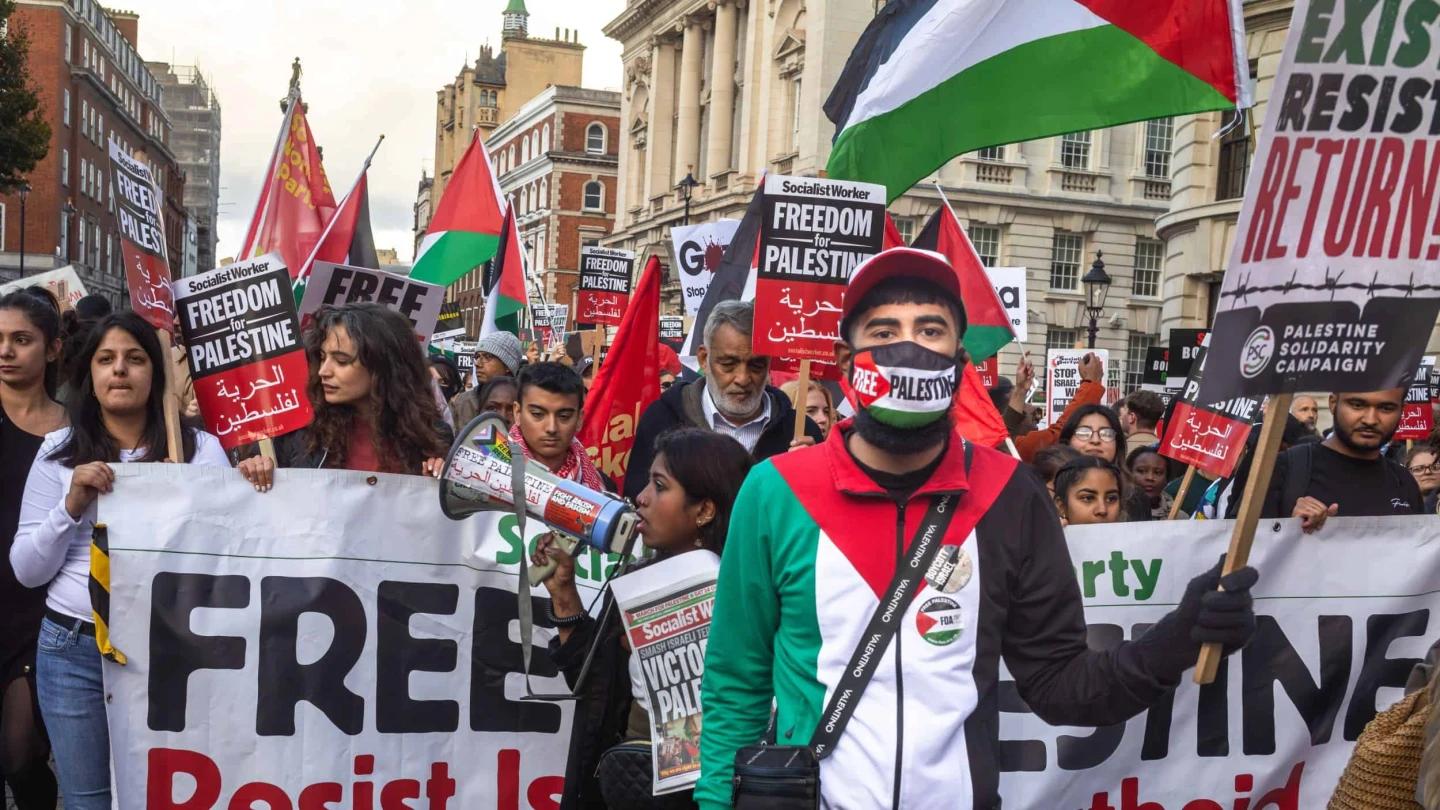
Anti-Israel and pro-Palestinian demonstrators march through central London in support of the Hamas terrorist group, Oct. 14, 2023. Credit: Andy Soloman/Shutterstock

The atrocities of Oct. 7 were denied, even though Hamas and other Palestinian terrorists had documented them with GoPro cameras and social-media uploads (one infamously called his parents to brag about how many Jews he killed that day). The victims, including raped women and men, were ignored or not believed. Posters of the kidnapped, even of a 9-month-old baby, were torn down on the streets of American and European cities. Mass rallies were held to bolster support for Hamas on the streets of those cities and on college campuses.

The main reason for the lack of sympathy for Israel wasn’t because Netanyahu or members of his cabinet were unlikable or too truculent, or because his government failed to mount an effective public diplomacy campaign (though it should have done better). Nor was it because pro-Israel supporters in the United States were equally ineffective in making the case for the Jewish state or against intransigent Palestinian Arabs and their terrorist leaders.

The deck was stacked against Israel long before Oct. 7. Like the American education system, the corporate media had largely been captured by left-wing ideologues who believed in political activism, not journalism. And it, too, adopted the skewed ideas of critical race theory, intersectionality and settler-colonialism that exacerbated racial tensions among the general population, as well as falsely labeled Israelis and Jews as “white” oppressors and their Palestinian opponents as “people of color.” That meant the former were always in the wrong, no matter what they did, and the latter in the right, no matter how awful their crimes.

They’re not listening

While Israel and its supporters might have done better in their efforts to inform the world about Oct. 7 and the century of Palestinian rejectionism that preceded it, the notion that the global audience or even the bulk of the base of the Democratic Party was open to being educated about any of this was unfounded. The red-green alliance of Marxists and Islamists that are skewing European politics and ideas about Israel and the Jews has also secured a beachhead in America, as the success of antisemitic figures like New York City Mayor Zohran Mamdani and Michigan Democratic U.S. Senate nominee Dr. Abdul El-Sayed demonstrates.

A world that had decided that the Jews and their state were singular villains, and thus guilty of horrible crimes, was certainly influenced by social-media algorithms and biased media. But their receptiveness to the blood libels about genocide and famine in Gaza or to the lie that Israel is an “apartheid” state wasn’t due to the lack of a proactive information task force in the Israeli prime minister’s office or the failure of much of the organized Jewish world. Having been marinated in the toxic doctrines that taught them the Israelis were the bad guys, liberal opinion was already lost to the Jewish state even before the bodies were buried after Oct. 7.

The only sectors of global or American society that remain impervious, or at least less vulnerable, to the onslaught of Hamas propaganda masquerading as progressivism are among those on the right who have already rejected these doctrines. That’s provided that they are not also being seduced by the wave of Jew-hatred on the far right that employs traditional antisemitic tropes.

Once we acknowledge all of this, the question remains: What do we do about it?

The first thing is for the Jews to stop appealing for sympathy that isn’t coming.

It should have been apparent from the outset that centering pro-Israel advocacy on the victimization of Jews on Oct. 7 or on the appalling treatment of the hostages taken that day was a mistake. It only excited antisemites. And, rather than elicit empathy, it seems to have convinced many others to believe that the Palestinians had a good reason to murder the Jews.

A futile quest

In this sense, it was much like Israel’s misguided and failed efforts to trade “land for peace” throughout the previous three decades. That did more to convince world opinion that the Jews were possessors of stolen property, rather than high-minded people who were willing to compromise their rights and even their security to achieve an end to the conflict. But now, the pleas for understanding seem only to have reinforced the growing chorus of those who believe Zionism—the anti-colonial and national liberation movement of the Jews—equals racism.

Unlike the recent past, the real debate about the Middle East isn’t about a two-state solution the Palestinians never wanted. It now centers on whether all of the Jewish state, including the kibbutzim and other communities near the Gaza Strip whose liberal-minded inhabitants were slaughtered along with everyone else on Oct. 7, is stolen land. That goes hand in hand with the idea that its occupants are foreign colonizers in their homeland, where they are the indigenous people who are only getting what they deserve.

Rather than members of the Jewish community wracking their brains trying to solve the puzzle about how to convince those who aren’t listening to hear sound historical arguments, they need to stop centering so much of their efforts on this futile quest.

It’s true that losses in the information world have real consequences, and that the attempts to isolate Israel diplomatically and economically pose a grave danger to it. But if the Jews should have learned anything in the last century when the world stood by as the Holocaust went on for years, it’s that the most important task facing them is to strengthen their state and its ability to defend Jewish life.

As horrible as the catastrophe of Oct. 7 was, in the three years that have followed, Israel’s defeats of Hamas and Hezbollah—plus the fall of a longtime brutal dictator in Syria—and their Iranian paymasters and sponsors have done more to make Jewish lives safer than all of the clever arguments put forward by its most able public information advocates.

That doesn’t give the Israeli government—or Diaspora leaders and groups—a pass for doing so poorly at explaining the situation. And it certainly doesn’t excuse a tech-savvy Jewish state for not being as nimble as it should have been in employing new media and Internet technologies to make their arguments against those spreading blood libels and antisemitism.

Still, delusions should be discarded about the chances that appeals aimed at inspiring sympathy for Jewish victims will move the needle on international or even American public opinion for those who have bought the pro-Hamas narrative hook, line and sinker. As Dara Horn has written, the world may “love dead Jews,” but what that really means for us today is that their abhorrence of Jews with power is undiminished.

A just cause

What Israel and its defenders must exude is strength, confidence in their justice of their cause, and a willingness to be undaunted by the lies and smears spread about them. Rather than seeking to debate or persuade those crying “genocide” primarily to give the world a pass for permitting the actual genocide of European Jewry during the Holocaust, we must dismiss them as hate-mongers unworthy of intellectual refutations.

As much as Jews everywhere must continue to mourn the victims of Oct. 7, as well as the heroic soldiers of the Israel Defense Forces who fell or were wounded in the ongoing effort to defeat terrorists, they should quit waiting for others to join them.

The real lesson of Oct. 7 is no different from that of the thousands of years of Jewish history that preceded it. Weakness and faith in the kindness of those ready to believe that Jews are the cause of whatever it is they fear most or the greatest societal problems they face is a formula for disaster.

Just as in the past, those who think that destroying the Jewish state will be the first step toward the liberation of the world’s oppressed peoples are not persuadable. But they can be defeated.

A proud declaration of Jewish rights and faith is far more likely to inspire friendship and alliances. That’s a lesson that should resonate for Israelis. But it must also be one adopted by Diaspora Jews perplexed by a wave of bigotry and vitriol they never anticipated and struggle to cope with. Unless and until they realize that they must defend themselves first—and worry about what everyone else thinks later—will they find a way to live in a world where Jew-hatred has again become fashionable. 


Jonathan S. Tobin is editor-in-chief of JNS, a columnist for Newsweek and a contributor to other publications. He covers the American political scene, foreign policy, the U.S.-Israel relationship, Middle East diplomacy, the Jewish world and the arts. He hosts the JNS “Think Twice” podcast, both the weekly video program and the “Jonathan Tobin Daily” program, available on major audio platforms and YouTube. Previously, he was executive editor, then senior online editor and chief political blogger, for Commentary magazine. Before that, he was editor-in-chief of The Jewish Exponent in Philadelphia and editor of the Connecticut Jewish Ledger. He has won 60-plus awards for his columns, commentary, art criticism and other writing. He appears regularly on television, commenting on politics and foreign policy. Born in New York City, he studied history at Columbia University.

Source: https://www.jns.org/opinion/column/jonathan-s-tobin/the-real-lesson-of-oct-7-stop-appealing-for-sympathy

Follow Middle East and Terrorism on Twitter

Hamas plotting October 7 attacks on IDF soldiers in Gaza, Israeli intelligence indicates - Jerusalem Post Staff


by Jerusalem Post Staff

Defense Minister Israel Katz: Israel observed intent by Hamas to launch terror attacks on the anniversary of October 7, Hamas and Gazan population will pay "a heavy price beyond all proportion."


Soldiers from the IDF's 7th Armored Brigade operating in the Gaza Strip, January 14, 2026; illustrative.
(photo credit: IDF SPOKESPERSON'S UNIT)


Defense Minister Israel Katz on Tuesday instructed the IDF to heighten its alert and be prepared for any possible scenario in Gaza ahead of October 7, which falls on Wednesday, in light of intelligence regarding Hamas's intentions to try to carry out attacks against Israeli soldiers in Gaza on that day.

This comes "in light of intelligence regarding Hamas's intentions to launch attacks against our forces in the area on that day," the ministry said.

Katz stressed that the IDF must prepare for the worst and act with great force in response to any intelligence and warning to thwart any threat, beyond the intensive activity already underway. "If, God forbid, our troops are harmed, Hamas and the population of Gaza will be the ones to pay a heavy price, beyond all proportion," Katz said.

A similar message was also issued when Prime Minister Benjamin Netanyahu, accompanied by Katz, visited Kissufim on the Gaza border together with the head of the IDF Southern Command, who warned Hamas later on Tuesday that "any attempt (to kidnap Israeli soldiers) will be met with a sharp and powerful response."

Shin Bet (Israel Security Agency) Director David Zini warned the Security Cabinet on Monday that Hamas is planning to kidnap soldiers, The Jerusalem Post reported on Monday.

Defense Minister Israel Katz at Jerusalem City Hall, December 15, 2025.
Defense Minister Israel Katz at Jerusalem City Hall, December 15, 2025. (credit: CHAIM GOLDBERG/FLASH90)

Eisenkot ties Katz's announcement to government's failure on October 7

Former IDF chief of staff and Yashar party head Gadi Eisenkot responded to the defense minister's announcement ordering heightened alert in light of intelligence regarding Hamas's intentions to carry out an attack.

"The defense minister's announcement this morning is an indictment against the government of October 7," Eisenkot said.

"It is a reminder to every citizen of Israel: The government responsible for the failure has suffered a resounding failure in achieving the goals that it itself set. Three years after October 7, Hamas is still the sovereign in the Gaza Strip, and its terrorists still pose a threat to the citizens of Israel," he added.

Amichai Stein contributed to this report. 


Jerusalem Post Staff

Source: https://www.jpost.com/israel-news/defense-news/article-910754?utm_source=activetrail&utm_medium=email&utm_campaign=October62026

Follow Middle East and Terrorism on Twitter

Watchdog concludes Biden risked security by letting millions overstay visas, including threats - John Solomon


by John Solomon

The report exposes Biden strategy that de-emphasized tracking down foreigners overstaying their permission to stay in the country, leaving a staggering statistical mess.


The Biden administration risked national security by letting millions of foreigners illegally overstay their nonimmigrant visas, including 104,000 who posed threats, while launching fewer than 500 investigations to remove violators, according to a bombshell report by the Homeland Security Department’s internal watchdog.

“From fiscal years 2021 to 2024, U.S. Immigration and Customs Enforcement (ICE) took few enforcement actions using targeted leads concerning foreign nationals who overstayed or otherwise violated their nonimmigrant visa terms of admission,” the inspector general reported.

“As a result, foreign nationals who potentially posed threats to the United States remained at large despite their illegal status,” the report added.

The report laid bare a Biden strategy that de-emphasized tracking down foreigners overstaying their permission to stay in the country, leaving a staggering statistical mess that included:

  • 3,145,375 nonimmigrant visa overstays
  • 104,049 foreigners who were deemed national security and public safety concerns
  • ICE conducted just 496 investigations and arrested just eight foreigners

The watchdog traced the crisis to a September 2021 policy change that directed Homeland Security Investigations (HSI) “to only investigate “Priority 1” leads — those potentially posing the highest threat to national security or public safety.

“Of the 1,769 viable Priority 1 leads, HSI initiated only 84 investigations (about 5 percent), resulting in two arrests,” it added. “The other 3,041,326 (96.7 percent) overstay leads were deemed Non-Priority.”

The IG recommended that ICE “develop and implement a plan to increase the number of investigations and enforcement actions on foreign nationals who overstay or otherwise violate their nonimmigrant visa terms of admission and whom ICE determined to be Priority 1 on its risk rating scale.”

The Trump administration agreed with the findings. 


John Solomon

Source: https://justthenews.com/government/security/tuewatchdog-concludes-biden-risked-security-letting-millions-overstay-visas

Follow Middle East and Terrorism on Twitter

Ballot Box Jihad: The Non-Violent Conquest of the West - Robert Williams


by Robert Williams

"An Egyptian cleric, Dr. Talat Zahran, proclaimed that it is 'obligatory to cheat at elections, a beautiful thing' -- meaning that voting is a tool, an instrument, the only value of which is to empower Sharia." — Raymond Ibrahim, Gatestone Institute, May 22, 2012.


  • "The majority of those granted citizenship were from outside Europe.... Immigration to Sweden has not only brought crime, social problems and unemployment – now the government that was successfully starting to solve these problems has been voted out because of immigration itself." — Fredrik Karrgolm, Swedish MP and author of Gangster Violence, September 15, 2026.

  • Sweden, in short, had been on the road to becoming Swedish again – but if the election results lead to a new socialist government, that will no longer happen: The Left Party alone is deeply infiltrated by Islamists and terrorist supporters, with several of its politicians caught celebrating the October 7, 2023 Hamas invasion of Israel..

  • "In the Middle East, democracy and elections are various means to one end: the establishment of a decidedly undemocratic form of law — Islamic, or Sharia Law." — Raymond Ibrahim, author and historian, Gatestone Institute, May 22, 2012.

  • "An Egyptian cleric, Dr. Talat Zahran, proclaimed that it is 'obligatory to cheat at elections, a beautiful thing' -- meaning that voting is a tool, an instrument, the only value of which is to empower Sharia." — Raymond Ibrahim, Gatestone Institute, May 22, 2012.

  • The same tactic applies to the Islamist project of nonviolent conquest of the West.

  • Sameh Egyptson, an Egyptian-Swedish academic, writer and expert on political Islam, has been warning about Islamist infiltration of the political system for years. He has recently cautioned, among other things, against clan voting as an erosion of democracy.

  • This outcome is possibly what many socialists have been planning all along: To stay in power forever by importing new voters from the Third World.

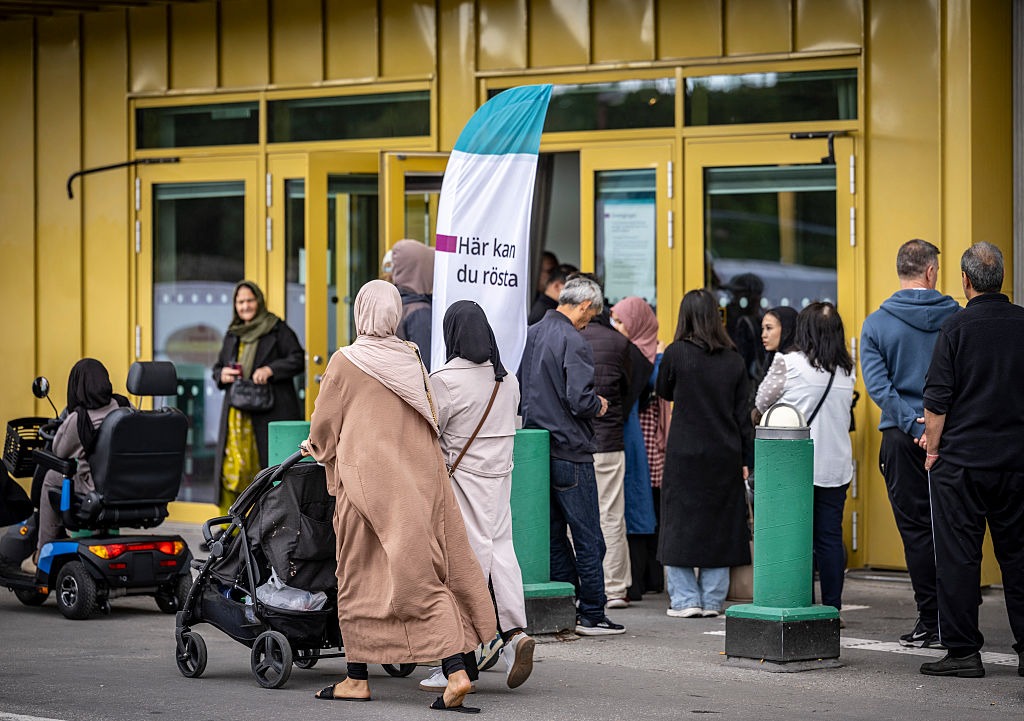
The tiny socialist majority was won in Sweden's elections last month through heavy voter mobilization within immigrant communities, which tipped the balance. Turnout rose around 3 points to 67.5% in the almost exclusively urban districts, where mainly Muslim immigrants live. Pictured: People wait in line at a polling station to cast their early vote in Malmö on September 11, 2026. (Photo by Johan Nilsson/TT News Agency/AFP via Getty Images)

"This could be the first election in Sweden where the Muslim immigration that we have had is decisive in a parliamentary election," predicted the leader of the Sweden Democrats, Jimmie Åkesson, days before Sweden's election on September 13.

He was right. Sweden's center-right Sweden Democrats government indeed lost the elections by a razor-thin margin – reportedly just 50,000 votes – corresponding to just three seats in parliament.

The next government will almost certainly be a socialist one.[1]

"Voters who, or whose parents, grew up outside Europe overwhelmingly favoured the Left," Brussels Signal wrote in its analysis of an exit poll by SVT, Sweden's national public broadcaster:

"The Social Democrats received 38 per cent of their votes, the Left Party 21 per cent, the Greens 7 per cent and the Centre Party 4 per cent. Together, these parties accounted for 70 per cent, against 27 per cent for the four parties of the outgoing right-wing bloc."

The tiny socialist majority was won through heavy voter mobilization within immigrant communities, which tipped the balance. Turnout rose around 3 points to 67.5% in the almost exclusively urban districts, where mainly Muslim immigrants live.

"This election has in part been about voter mobilisation, which is unusual ​in Sweden," noted to Gustav Karreskog Rehbinder, founder of AI analysis firm Vera Policy, which broke down the election results for Reuters.

According to Fredrik Karrholm, a member of the Swedish parliament and the author of Gangster Violence:

"A poll by the respected Novus institute before the election found that of Muslim respondents, around 80 per cent intended to vote for either the Social Democrats or the Left party.

"In some districts with large immigrant populations, the results are striking. For example, in Rosengård Centrum in Malmö, the Social Democrats and Left Party together received, according to the preliminary count, 95.2 per cent of the vote...

"This pattern predates the present government...

"During the last parliamentary term, around 200,000 people were given citizenship under rules that imposed very few demands on applicants – not even a requirement to speak or write Swedish. The majority of those granted citizenship were from outside Europe....

"Immigration to Sweden has not only brought crime, social problems and unemployment – now the government that was successfully starting to solve these problems has been voted out because of immigration itself."

For a brief moment, it had seemed as if Sweden was finally beginning to turn things around. In 2022, Sweden voted in a center-right government that ruled with the parliamentary backing of the Sweden Democrats – a first in Swedish politics. This government sought to implement the most restrictive overhauls of Swedish asylum and immigration policies in Swedish history with crackdowns on asylum and migrant flows, while making it harder for immigrants to acquire permanent residence and Swedish citizenship.

After decades of lawlessness, the center-right government, now voted out, had also sought to crack down on crime by finally openly linking migration to gang violence, parallel societies, and integration failures.

The results were dramatic: In December 2025, Reuters reported:

"The number of shootings in Sweden has more than halved since hitting a peak in 2022, reflecting new policing approaches introduced by the right-wing government, which is readying for parliamentary elections next year. Shooting incidents fell to 147 so far this year, a 63% decrease compared to 2022 when there were 390 shootings and a 49% decrease compared to 2024, according to a Reuters analysis of official figures."

The government also began to scrutinize the detrimental effects of Islam in Sweden, including the launch of a government investigation into the Islamist infiltration of Swedish society. This past spring, the government announced that it would be dropping the entire concept of "Islamophobia."

Sweden, in short, had been on the road to becoming Swedish again – but if the election results lead to a new socialist government, that will no longer happen: The Left Party alone is deeply infiltrated by Islamists and terrorist supporters, with several of its politicians caught celebrating the October 7, 2023 Hamas invasion of Israel, with some handing out candy on the streets to mark their joy at the massacres of Israelis. In addition, several candidates were found to have shared content praising or expressing support for designated terrorist organizations, including Hamas, Hezbollah, the PFLP and Al-Qaeda, while multiple candidates shared classic antisemitic tropes, Holocaust denial and homophobia.

These revelations, all dug up by the Swedish press, forced the Left Party to remove at least 33 of its most extremist candidates, an astounding number.

Many other radicals within the party kept their parliamentary seats, including MPs Ilona Szatmári Waldau and Samuel Gonzalez Westling, who sent open letters of support to Palestinian terrorists held in Israeli prisons for serious offenses, such as ordering suicide bombings and torturing and murdering an Israeli soldier. In October 2025, the party's top leadership, including party leader Nooshi Dadgostar, hosted two visiting Palestinians from the Fatah Revolutionary Council inside the Swedish Parliament. The two guests were known for having publicly praised terrorist acts and spreading Jew-hatred.

If you think any of this harmed the party, you would be wrong: The scandals actually served to boost it: they gained the party six new seats in the election.

There is a name for what just happened in Sweden: Ballot box jihad. It is an Islamist tactic, favored by the Muslim Brotherhood.

"In the Middle East, democracy and elections are various means to one end: the establishment of a decidedly undemocratic form of law — Islamic, or Sharia Law," Raymond Ibrahim wrote about the Egyptian elections in 2012, which, for a brief moment, brought the Muslim Brotherhood to power.

"An Egyptian cleric, Dr. Talat Zahran, proclaimed that it is 'obligatory to cheat at elections, a beautiful thing' -- meaning that voting is a tool, an instrument, the only value of which is to empower Sharia. Another cleric, Hazim Shuman... issued a fatwa that likened voting for Islamist candidates to a 'jihad,' or a holy war, adding that paradise awaits whoever is 'martyred' during the electoral campaign."

The same tactic applies to the Islamist project of nonviolent conquest of the West. The late spiritual leader of the Muslim Brotherhood, Yusuf al-Qaradawi, speaking in Qatar in 2007, said that "Islam will conquer Europe without resorting to the sword or fighting. The conquest will be through da'wah [proselytizing] and ideology."

Ballot box jihad is part of achieving this conquest. Sameh Egyptson, an Egyptian-Swedish academic, writer and expert on political Islam, has been warning about Islamist infiltration of the political system for years. He has recently cautioned, among other things, against clan voting as an erosion of democracy. Clan voting is when extended families and even entire ethnic communities vote collectively as a bloc for the same candidate or party. Although clan voting as such is not illegal in Sweden, two newly elected Muslim candidates from the Left Party are already suspected of electoral fraud, including bribing or unduly influencing voters to vote for them and pre-marking their own names on ballots.

This outcome is possibly what many socialists have been planning all along: To stay in power forever by importing new voters from the Third World.

Sweden is a warning, not only to the rest of Europe but to the Western world at large.

[1] Sweden's new government will likely consist of the Social Democrats (99 seats), Sweden's Communist party, which changed its name to the Left Party (Vänsterpartiet) in 1990 (30 seats), the radical Green Party (22 seats) and the more centrist Center Party (25 seats).


Robert Williams is based in the United States.

Source: https://www.gatestoneinstitute.org/22893/sweden-election-conquest-jihad

Follow Middle East and Terrorism on Twitter

The looming crisis no one in Israel is preparing for - Amit Segal


by Amit Segal

A hostile Democratic administration will pile on sanction after sanction.


Israeli President Isaac Herzog visits the Judea and Samaria Division headquarters of the Israel Defense Forces near the settlement of Beit El in the West Bank, Sept. 30, 2026. Photo by Jonathan Shaul/Flash90

It’s still too early to know whether 2026 will be the new 1977. But even before the coalition packs up and goes home, one thing is already clear: Oct. 7 sent the opposition home.

The last poll before Oct. 7 gave Benny Gantz’s camp, with Gadi Eisenkot and Gideon Sa’ar, 29 seats. Yair Lapid was already trending down but still had 18. There was no Avigdor Liberman, no Naftali Bennett and no Yair Golan. The poll tested what would happen if the Kaplan Street protest movement registered as a party. The result: 10 seats.

In the coalition, it’s still the same figures and the same parties, but the opposition is almost unrecognizable. Of Lapid and Gantz’s combined 47 seats, the polls now show barely five left. On the ruins of Labor and Meretz rose a unified party made up mostly of protest-movement figures but led by a man who reinvented himself after jumping south on Oct. 7.

Bennett, though he’s dropped significantly from last year’s peak, is offering right-wing policy to center-left voters alongside Liberman, and together they’re pulling roughly three times the votes they had before the massacre. So, it used to be the State Camp, Yesh Atid, Meretz and Yisrael Beiteinu. Now it’s Yashar, Together, the Democrats and Yisrael Beiteinu.

Gantz has been replaced by Eisenkot, on the surface not a particularly meaningful change, one chief of staff swapping for another at the head of the camp. And yet the shockwaves of Oct. 7 are felt here, too. Eisenkot is, as is well known, a bereaved father from the war. The opposition back then focused on judicial reform; today’s opposition would be smart to focus only on the Haredi issue. The public has moved significantly away from the people who drove the protest movement, who are now all concentrated in the Democrats Party (HaDemokratim).

The massacre has pushed the possibility of a second change of government much further out of reach, because of the wariness around the Arab parties and their refusal to call Hamas and Hezbollah terror organizations. This week’s Channel corporation poll found that even within the opposition, a third support disqualifying Ra’am, the very party without which neither Bennett nor Lapid would have become prime minister.

The yes-or-no question of sitting with Netanyahu spares everyone the need to publish a clear plan for the territories’ future.

As is well known, the assumption that the elections at the end of the month will be the most decisive in the country’s history hasn’t been voiced here; if anything, it’s the opposite.

One reason is the enormous gap between where the public stands and the politicians who claim to represent them. The public has shifted sharply rightward, exactly as disgust, fatigue and disappointment with right-wing leaders have peaked, and the head-on meeting of these two contradictory currents won’t produce a pretty picture, or any kind of brave new world. In fact, Netanyahu did the opposition a favor by insisting on running again. Without him, it would have struggled badly to agree on a shared agenda and would have had to put forward an alternative plan of its own instead of the right’s.

Netanyahu’s long shadow is crowding out the need to say anything decisive, for instance, on the major challenge of the next term: the international fallout over the Palestinian question. The last term was defined by Gaza; the next will be defined by Judea and Samaria. The yes-or-no question of sitting with Netanyahu spares everyone the need to publish a clear plan for the territories’ future.

A hostile Democratic administration, and ahead of it, anti-Israel European governments, won’t hesitate to pile on sanction after sanction. Anyone with sense who listened to the British foreign secretary’s auto-antisemitic speech and watched Israeli travelers get searched in Amsterdam in case they were carrying halva from Samaria understands that this is bearing down on us in giant strides. Right now, no one is preparing to head off the coming trouble; everyone is simply clinging to the desperate effort to grab the 61st seat from one side or the other.

Keeping it stable

Deep down, everyone knows it: The only stable government that could plausibly form, by most polls, is a unity government with rotation.

True, Netanyahu and Gantz’s last one collapsed loudly after just eight months. But one could argue the last two rotation governments, Gantz-Netanyahu and Bennett-Lapid, collapsed because they weren’t truly equal: One side was a very large bloc, and the other small, and the government buckled under that imbalance. If the polls hold and the two blocs end up light-years from an absolute majority, an equal government made up of both blocs, minus the Haredim and the Arabs, minus Golan and Itamar Ben-Gvir, may be the way out of an endless string of elections with no end in sight.

The public is less impressed. Perhaps that’s only natural in an election period, which tends to sharpen positions rather than convene reconciliation councils. And yet, only 17% support a Netanyahu-Eisenkot rotation, against 64% strongly opposed. In the coalition, support is a little higher (24% versus 45%), and in the opposition, lower still (16% to 77%).

The most opposed, naturally, are Arab voters: only 9% in favor, against 70% opposed. They understand that in a national reconciliation of this kind, they’re cast as the sacrificial lamb.

Originally published by Israel Hayom. 


Amit Segal is an Israeli journalist, radio and television personality. He serves as the political commentator of Israel’s Channel 12 news (N12 News company) and anchors Israel’s highly watched “Meet the Press” show on Channel 12.

Source: https://www.jns.org/opinion/amit-segal/the-looming-crisis-no-one-in-israel-is-preparing-for

Follow Middle East and Terrorism on Twitter