Thursday, October 29, 2026

Unity, defections or another election: Israel’s paths out of deadlock - Shimon Sherman, Canaan Lidor


by Shimon Sherman, Canaan Lidor

The country’s next government will depend on whether its political leaders can reconcile their competing commitments, or whether voters will again be asked to resolve a deadlock that negotiations could not.


A view of the Knesset, Israel’s parliament, in Jerusalem on the day of Israel’s general elections, Oct. 27, 2026. Photo by Yonatan Sindel/Flash90.
Yonatan Sindel/Flash90

Israeli Prime Minister Benjamin Netanyahu emerged from Tuesday’s election with Likud still Israel’s largest party, and his political bloc ahead of Gadi Eisenkot’s opposition alliance, reversing the advantage projected for his opponents in several major pre-election polls. Yet that stronger-than-expected showing has left him without a parliamentary majority.

With over 93% of votes counted as of Thursday morning, Netanyahu’s bloc was projected to win 53 seats, compared with 48 for Eisenkot’s change bloc and 19 for the Arab parties. Hundreds of thousands of ballots remained uncounted, leaving the distribution provisional. Netanyahu is currently eight seats short of the 61 needed for an absolute majority, while his principal opponents have also fallen well short of securing one independently.

“I would call these elections the elections of mutual disappointment,” Daniel Ayalon, former deputy foreign minister, former ambassador to the U.S. and chairman of Silver Road Capital financial advisory firm, told JNS.

Winners and losers

Netanyahu’s strongest achievement was outperforming his principal challenger. Thursday’s 10:30 a.m. projections put Likud at 26 seats against Yashar’s 21, reversing Channel 12 News’ final pre-election forecast of 21 and 23, respectively. Likud nevertheless remains below the 32 seats it won in 2022, distinguishing its success against polling expectations from its losses since the previous election.

For Eisenkot, the disappointment extends beyond finishing second. B’Yachad is projected at 12 seats against Channel 12’s forecast of 15, the Democrats at eight against 10, and Yisrael Beiteinu at seven against eight. Together, the four parties lack both a majority and the lead over Netanyahu’s bloc anticipated by that survey. “We’d hoped for a better result,” Manuel Trajtenberg, a Yashar co-founder and former Labor lawmaker, told JNS.

Netanyahu’s partners also suffered uneven losses. Shas stands at seven seats, down from 11 in 2022, while United Torah Judaism retains its previous seven-seat strength. Otzma Yehudit and Religious Zionism together hold 13, compared with their Joint List’s 14 in 2022. Meanwhile, Yoaz Hendel’s Reservists–Economic list and Ofer Winter’s People of Israel have failed to cross the electoral threshold in the partial count.

The polling discrepancy is substantial: Channel 12’s six-seat opposition advantage became a five-seat deficit. But pollsters differed sharply; i24NEWS’s final survey correctly projected Likud at 26. Professor Gideon Rahat, a senior fellow at the Israeli Democracy Institute, identified Arab turnout as a forecasting difficulty: “I think that they can hardly predict what will happen with the Arab vote, and this is a major influence,” he told JNS.

The Arab parties recorded the election’s clearest projected parliamentary gains. Ra’am and the Joint List together stand at 19 seats, nearly double the Arab parties’ combined 10 seats in the outgoing Knesset. If confirmed, that would surpass the previous record of 15 won by the unified Joint List, then including Ra’am, in 2020.

Channel 12 estimates Arab voter turnout at approximately 80%. Ayalon attributed the mobilization partly to anger over crime in the sector and as a reaction to the policies of Israel’s national security minister and the leader of the Otzma Yehudit Party, Itamar Ben-Gvir. “I think the chief factor was Itamar Ben-Gvir,” he explained.

Whether that participation will endure remains uncertain. “It may be a one-time burst, but it may be something that will change the Israeli system in the long run,” Rahat said.

Forming a government

With the final election picture solidifying, the various parties have already begun maneuvering in reaction to the unexpected outcome. The change bloc and Arab parties together hold a projected 67 seats, enough to command a Knesset majority if they cooperate and likely securing the mandate to form a government for Eisenkot.

Ayalon pointed to the distinction between parliamentary leverage and the ability to form a government. “Eisenkot has the advantage of a majority in the Knesset, but his position is in some sense weaker than Netanyahu,” he said.

Joint List chairman Yousef Jabareen said Wednesday that his faction was prepared to help replace Netanyahu’s government, while insisting that opposition parties engage with it. These calls have been met with hesitancy from members of the opposition bloc who expected to consider cooperation with the Arab parties from a stronger position. The Arab parties’ electoral gains have significantly expanded their parliamentary influence, which counter-intuitively makes translating that strength into executive power through partnership with the opposition bloc more complicated.

Speaking to JNS at Yashar’s headquarters on election night, Matan Kahana, a former cabinet minister under Naftali Bennett and deputy minister under Yair Lapid, described the possibility of external Arab-party support for an initial vote. “There may be one singular vote, in which we move Netanyahu out of the prime minister’s office, but without a stable government after that,” he said.

Trajtenberg similarly outlined a two-stage approach. “The first stage will be a minority government without the Arab parties,” he said. “Then everything is open.”

However, the partial results have sharply undermined Eisenkot’s minority-government proposal. With his bloc projected at 48 seats against Netanyahu’s 53, abstentions by the Arab parties would no longer suffice. If Netanyahu’s camp voted together against him, Eisenkot would need active Arab-party support or defections from Netanyahu’s bloc to take office.

Before the election, Eisenkot had discussed establishing a government with 58 or 59 seats and subsequently expanding its parliamentary base. At that strength, Arab-party abstentions could have enabled an initial confidence vote to pass. The substantially smaller bloc emerging from the count would instead require at least six Arab-party lawmakers to vote in favor, assuming the remaining Arab representatives abstained and all 48 opposition lawmakers supported the government. The dependence would expand beyond Ra’am, with whom political cooperation has precedent, to active coordination with the even more radical Joint List.

That requirement conflicts directly with the positions of essential prospective partners. Bennett has rejected dependence on Arab-party votes or abstentions, while Liberman has ruled out supporting a minority government even temporarily. Excluding Arab representatives from ministerial positions would not remove that dependence.

“They need active support,” Rahat said. “I mean, the whole minority government idea is not an option anymore, really.”

The arrangement remains legally possible, but under the projected distribution it would require opposition leaders to reverse explicit commitments and Arab lawmakers to affirmatively support the government’s formation. Without those changes, Eisenkot’s proposed interim route to power has no viable parliamentary majority.

With a minority government likely off the table, the opposition may instead choose to reap the short-term benefit of their legislative majority together with the Arab parties. Channel 12 reported on Wednesday that Eisenkot’s bloc was seeking Arab-party support to replace Likud’s Amir Ohana as Knesset Speaker, although no agreed candidate had emerged. Joint List lawmaker Ahmad Tibi had already publicly pledged support for an opposition candidate before the election.

Electing a new speaker would give Netanyahu’s opponents greater influence over the legislative agenda, potentially facilitating legislation establishing an Oct. 7 state commission of inquiry or limiting prime-ministerial tenure. Each measure would still require its own parliamentary majority; agreement on replacing Ohana would not guarantee agreement on those initiatives.

Martin Sherman, a senior researcher at the Israeli Defense and Security Forum, told JNS that opposition control of the speaker’s office would pose a serious threat to the current coalition. “The left wing, together with the Arabs, can remove the chairman of the Knesset and basically have the Knesset in the hands of an adversarial individual who can control the agenda of the Knesset,” he said.

“The opposition may start with the blitz,” Ayalon observed, suggesting that an early legislative offensive could precede negotiations over a broader political compromise as a way to strengthen the opposition bloc’s position before coalition negotiations proceed. From that stronger position, he said, “they can start compromising” and seek a “modicum of understanding.”

Despite the possible political gains of an early legislative offensive, it will not resolve the critical issue of actually forming a government. With the option of a minority government undermined by the opposition’s poor performance, a coalition spanning Likud and major opposition factions offers another route to a parliamentary majority. Wednesday’s 2 p.m. projections gave Likud, Yashar, B’Yachad and Yisrael Beiteinu a combined 66 seats, sufficient to govern without the Arab, ultra-Orthodox or religious-nationalist parties.

“If I am pushed to the wall to guess, I say unity government is currently the most likely outcome,” Ayalon said.

Israeli President Isaac Herzog’s determination to prevent another election adds pressure for compromise. Before the vote, he publicly identified unity as an option he would pursue, while acknowledging uncertainty regarding its feasibility. On Wednesday, he urged party representatives to approach consultations with open minds and work to avoid another election.

Netanyahu’s larger party and stronger bloc give him a basis to press for retaining the premiership. Eisenkot, however, has explicitly rejected serving under Netanyahu, including through rotation, while leaving open cooperation with Likud under different leadership. “Netanyahu cannot serve in a leadership role after Oct. 7; we’ve said this all along,” Kahana declared.

A rotation arrangement would therefore require Eisenkot to reverse an unequivocal commitment. A government led by another Likud figure would instead require Netanyahu’s party to accept a leadership change. Neither compromise is very likely.

Dan Diker, president of the Jerusalem Center for Security and Foreign Affairs (JCFA), told JNS that “it is very hard to see Eisenkot working together with Netanyahu or under a Netanyahu-led government.”

Resistance also extends beyond the two leaders. Ben-Gvir has warned against unity with Eisenkot, while Bennett and Lapid have rejected serving alongside Netanyahu. Herzog can encourage negotiations, but assembling the potential majority would require the parties themselves to reconsider their commitments.

If unity negotiations fail, Netanyahu would in turn likely get the mandate and could seek additional partners through factional splits or individual defections. ‘I think Netanyahu’s best strategy at this point is to try to recruit defectors,” Sherman explained. With his bloc projected at 53 seats, he needs eight additional lawmakers to establish a 61-seat coalition. Eisenkot could pursue the reverse strategy during his turn.

“I think it would be difficult to get defectors from either bloc,” Ayalon noted.

Failure to recruit additional support would leave both camps facing the statutory government-formation process. Herzog’s first nominee receives 28 days, with a possible 14-day extension. If that effort fails, the president may appoint a second candidate for another 28 days or declare that he sees no possibility of forming a government. If the second attempt also fails, or Herzog declines to appoint another candidate, lawmakers have 21 days to nominate a candidate backed by at least 61 Knesset members, who would then receive a final 14 days to form a government. If all avenues are exhausted, another election follows.

“I think a second election is not a very popular idea among the voters. It’s an exhausting prospect,” Sherman said.

Rahat suggested that Netanyahu might ultimately prefer that outcome: “He might decide that he wants to have another election.” A repeat vote would offer another opportunity to seek a majority, but no assurance of securing one. Netanyahu would remain caretaker prime minister until a successor government takes office.

Diker also raised the possibility that Netanyahu would prefer to wait out the impasse with a “caretaker government under his leadership” and potentially face another election. However, Diker warned that “the current security situation makes a second election politically difficult. It would cost hundreds of millions of shekels, and would be distracting politically,” he explained

Ayalon, however, emphasized continuity in security decision-making during the political transition. “I would say that there is continuity in terms of the executive power,” he said. He argued that the military would continue answering to the government and taking action when needed.

The provisional results leave Netanyahu ahead of his principal opponents, Eisenkot short of the parliamentary strength his strategy anticipated, and the Arab parties with substantially increased representation. None has secured an agreed governing majority. Israel’s next government will depend on whether its political leaders can reconcile their competing commitments, or whether voters will again be asked to resolve a deadlock that negotiations could not. 


Shimon Sherman, Canaan Lidor

Source: https://www.jns.org/analysis/unity-defections-or-another-election-israels-paths-out-of-deadlock

Follow Middle East and Terrorism on Twitter

Why Do They Despise Musk? - Victor Davis Hanson


by Victor Davis Hanson

Elon Musk’s shift to the right, support for Trump, and defense of free speech have turned a former liberal darling into a target of the Left’s growing hostility toward billionaires.


As the midterms approach, the Left has gone nearly berserk in its hatred of trillionaire entrepreneur Elon Musk. Yet its escalating venom would have been almost inconceivable before 2022, when Musk publicly declared that he would be voting Republican.

Before Musk’s recent political reversal (he voted for both Hillary Clinton in 2016 and Joe Biden in 2020), he was beloved by the Left as the first successful upstart challenger to the century-long dominance of the Big Three fossil-fuel automakers. Liberals once loved his revolutionary, electrically powered Teslas and drove them proudly as a green virtue signal.

Not now. Far-left podcaster Jennifer Welch has run out of Nazi epithets for Musk. Alexandria Ocasio-Cortez—ironically, given her own limited talents—trashed Musk as “probably one of the most unintelligent billionaires I have ever met or seen or witnessed.”

Fellow multibillionaire Bill Gates smeared Musk for supposedly “killing the world’s poorest children” by promoting cuts to U.S. foreign aid programs.

Just this week, former Clinton labor secretary Robert Reich even demanded that Musk’s SpaceX and Starlink be nationalized and run by the government—a move more associated with Cuba or the old Soviet Union than with the United States of America.

Such unhinged venom can contribute to violence. In early 2025, leftists launched more than 80 attacks against Tesla cars and dealerships—and sometimes even individual Tesla drivers. Similar cases of vandalism and arson have continued into 2026.

So why did the Left go from hailing Musk as the next Thomas Edison to treating him as public enemy No. 1 and targeting him with death threats?

The Left once loved all the tech and Wall Street billionaires who ensured that Democrats always had more money than Republicans.

Billionaire George Soros and his various foundations have channeled well over half a billion dollars to left-wing candidates and causes in just the last six years alone. Billionaires like Reid Hoffman, Tom Steyer, and the now-imprisoned Sam Bankman-Fried gave hundreds of millions to the Democratic Party and its candidates.

But Elon Musk now embodies everything the enraged Left hates.

First and most obviously, Musk no longer endorses Democrats. Instead, in 2024 and 2026, he donated hundreds of millions of dollars to help Republican candidates.

Second, Musk gave lavishly to the hated 2024 Trump campaign, especially in critical swing states. Furious Democrats actually blame him for Trump’s victory.

Third, Musk paid billions of dollars to buy the liberal social media company Twitter. He eliminated censorship, renamed it X, and turned it into a free-speech platform that no longer catered to left-wing dogmas.

Fourth, Musk was instrumental in conducting the 2025 DOGE cuts that reduced the federal workforce by some 270,000 employees. DOGE also helped slash USAID programs that had often been involved in politicking abroad to support globalist and left-wing causes.

Fifth, the spurned Left has started hating billionaires as much as it once worshipped them. Its members now talk openly about confiscating wealth, nationalizing private corporations, taxing net worth and unrealized gains, and regulating and suing large companies to drive them out of business.

In 2020, Mark Zuckerberg and his wife, Priscilla Chan, donated some $420 million to help ensure greater Democratic turnout—and they were deified for helping to defeat Trump.

Now Zuckerberg has been talking about fleeing left-wing California if it passes a “billionaire tax” on net worth.

Billionaires like Amazon’s Jeff Bezos, Oracle’s Larry Ellison, and Palantir’s Alex Karp—along with other Silicon Valley magnates such as Marc Andreessen, Ben Horowitz, and David Sacks—have drifted rightward, fearing the new agenda of the Islamist-sympathizing socialist Democratic Party.

Sixth, and perhaps most important, Musk—one of the greatest entrepreneurs of the last hundred years—is not shy about his own talents and spectacular successes, ensuring even more left-wing envy and venom.

Musk not only brought stranded U.S. astronauts home but also helped revive the moribund NASA space program.

This year, his company will launch more satellites than all other countries and private corporations combined. Indeed, by June 2026, it had sent into space more satellites than humanity had launched in total since Sputnik. SpaceX’s behemoth Starship, the most powerful rocket in history, dwarfs its Chinese, European, and Russian rivals.

The upstart Tesla has the highest market capitalization ($1.5 trillion) of any car company in the world. Musk’s social media platform X may have nearly 600 million monthly active users.

His artificial intelligence company, SpaceX Super Intelligence, and its Grok model are among the world’s best-known.

Musk’s Neuralink may become the first company that allows the paralyzed and the blind to regain their lost abilities.

His Boring Company has created a subterranean transport service in Las Vegas and is building another in Nashville.

Musk is history’s first trillionaire. He is a mechanical and business genius, and he may well be one of the most brilliant technological entrepreneurs, not just of the last hundred years but of all time.

So is it any wonder that the new democratic socialist Left, with its insistence on equality of results, despises everything that Musk does and represents?

Photo: President Trump Meets With AI Executives At White House WASHINGTON, DC - SEPTEMBER 29: Tesla, SpaceX and X CEO Elon Musk (C) speaks as U.S. President Donald Trump (L) holds a press briefing with AI executives following a meeting on artificial intelligence outside the West Wing of the White House on September 29, 2026 in Washington, DC. The meeting comes as some have called for a slowdown in AI development amid rising safety concerns. (Photo by Kevin Dietsch/Getty Images)


Victor Davis Hanson is a distinguished fellow of the Center for American Greatness and the Martin and Illie Anderson Senior Fellow at Stanford University’s Hoover Institution. He is an American military historian, columnist, a former classics professor, and scholar of ancient warfare. He has been a visiting professor at Hillsdale College since 2004, and is the 2023 Giles O'Malley Distinguished Visiting Professor at the School of Public Policy, Pepperdine University. Hanson was awarded the National Humanities Medal in 2007 by President George W. Bush, and the Bradley Prize in 2008. Hanson is also a farmer (growing almonds on a family farm in Selma, California) and a critic of social trends related to farming and agrarianism. He is the author of the just released New York Times best seller, The End of Everything: How Wars Descend into Annihilation, published by Basic Books on May 7, 2024, as well as the recent  The Second World Wars: How the First Global Conflict Was Fought and Won, The Case for Trump, and The Dying Citizen.

Source: https://amgreatness.com/2026/10/29/why-do-they-despise-musk/

Follow Middle East and Terrorism on Twitter

Wednesday, October 28, 2026

Who Verifies Artificial Intelligence? When AI Learns Jew-Hate - Pierre Rehov


by Pierre Rehov

After submitting OpenAI's ChatGPT, Anthropic's Claude, Google's Gemini and Meta's Llama to more than 34,000 queries about Jews, Israel, the Holocaust and antisemitic tropes, a March 2025 study by the Anti-Defamation League (ADL) of the four leading large language models (LLMs) found measurable anti-Jewish and anti-Israel bias in every model tested.


  • Artificial intelligence (AI) is quietly replacing the institutions through which the West once transmitted knowledge. Students who a generation ago consulted teachers and libraries now consult with often extremely unreliable chatbots.

  • After submitting OpenAI's ChatGPT, Anthropic's Claude, Google's Gemini and Meta's Llama to more than 34,000 queries about Jews, Israel, the Holocaust and antisemitic tropes, a March 2025 study by the Anti-Defamation League (ADL) of the four leading large language models (LLMs) found measurable anti-Jewish and anti-Israel bias in every model tested.

  • Whatever humanity has written in sufficient volume, the machine absorbs, including its pathologies. If enough people write that the Earth is flat, AI will tell you that the Earth is flat.

  • The contradictions never matter: the accusations are never sustained by evidence in the first place. Repetition keeps them alive, and repetition is precisely what the modern information ecosystem industrializes.

  • The enormity and volume of that repetition would have been unimaginable to earlier generations. Iranian state media, Russian influence operations, China's gargantuan, poisonous TikTok, Hamas media outlets, Holocaust-denial platforms and legions of anonymous accounts produce a continuous stream of fabrication surrounding Israel and the Jewish people.

  • A debunked falsehood does not vanish; it settles into thousands of web pages and waits there, inside the corpus from which the next generation of AI frontier models will "learn."

  • A machine has no concept of propaganda. It recognizes statistical regularities, and a lie repeated across a sufficient share of its training data acquires the weight of a fact. An answer about the Arab-Israeli conflict can therefore appear scrupulously balanced while quietly granting credibility to claims manufactured by a state disinformation service. What emerges carries the appearance of judgment but the substance of arithmetic.

  • [A] parallel ADL investigation... identified at least 30 senior editors at Wikipedia who coordinated for a decade to reshape entries on Israel and the Arab-Israeli conflict, stripping citations to peer-reviewed research on Palestinian terrorism, burying Hamas's designation as a terrorist organization and recasting Zionism as a colonial land grab, while the Arabic-language edition of Wikipedia openly glorifies the perpetrators of October 7. Wikipedia's own arbitration committee has since banned some editors from the entire topic area, a tacit admission of the manipulation.

  • The source from which artificial intelligence learns history is resolutely being rewritten by terror-supporting militants in real time: every model trained tomorrow will inherit today's falsifications as settled fact.

  • A joint study by the United Nations and UNESCO found that roughly one-sixth of Holocaust-related content on major platforms denies or distorts the facts...

  • AI answers arrive coherent, articulate and serenely assured. Users assume they have been verified, when even the most advanced systems still hallucinate, contradict themselves and err on elementary matters of fact. When the subject is a restaurant or a line of code, the cost is trivial. When it is the Holocaust, terrorism or the legitimacy of the Jewish state, the error feeds directly into debates already poisoned by decades of ideological warfare and state-sponsored propaganda.

  • A society that accepts fiction about the Jews has already most likely begun accepting fiction about everything.

  • The civilization that taught machines to diagnose disease and decode ancient languages now carries the responsibility of ensuring they do not also recycle its oldest lie, its youngest lie, and the trillions of lies in the middle.

(Image source: OpenAI)

Artificial intelligence (AI) is quietly replacing the institutions through which the West once transmitted knowledge. Students who a generation ago consulted teachers and libraries now consult with often extremely unreliable chatbots. Reportedly 54% of American teenagers already use AI apps such as ChatGPT and its peers for schoolwork. Journalists, lawyers and civil employees are following the same path.

This deserves serious attention. After submitting OpenAI's ChatGPT, Anthropic's Claude, Google's Gemini and Meta's Llama to more than 34,000 queries about Jews, Israel, the Holocaust and antisemitic tropes, a March 2025 study by the Anti-Defamation League (ADL) of the four leading large language models (LLMs) found measurable anti-Jewish and anti-Israel bias in every model tested. One detail stands out for its clinical precision. Asked whether the American government orchestrated the attacks of September 11, all four systems dismissed the alleged conspiracy theory without hesitation, but asked whether "the Jews" did, all but one wavered. Somewhere in their oceans of training data, the machines had learned that this particular lie deserved a hearing.

Anyone who understands how these systems are built will find the result unsurprising. An LLM model investigates nothing and weighs no evidence. It has digested a corpus larger than any one civilization has ever assembled, drawn from scientific literature and reference works, but also from the news media, discussion forums, activist blogs, propaganda outlets and billions of web pages whose accuracy no engineer can vouch for. Filtering exists, and companies invest heavily in it, yet no human team can read hundreds of billions of words. Whatever humanity has written in sufficient volume, the machine absorbs, including its pathologies. If enough people write that the Earth is flat, AI will tell you that the Earth is flat.

Antisemitism is a pathology that has survived every century. It moved from the medieval sermon to the printing press, the pamphlet, newspapers, movies, radio and television, the internet social media -- recycling in each era familiar accusations, including that of hidden Jewish "manipulation." During the Black Death, Jews were accused of poisoning wells; in the twentieth century they somehow controlled both capitalism and communism at the same time; today they ostensibly control governments, the media, the banks, Western foreign policy and even perpetrate massacres against themselves. The contradictions never matter: the accusations are never sustained by evidence in the first place. Repetition keeps them alive, and repetition is precisely what the modern information ecosystem industrializes.

The enormity and volume of that repetition would have been unimaginable to earlier generations. Iranian state media, Russian influence operations, China's gargantuan, poisonous TikTok, Hamas media outlets, Holocaust-denial platforms and legions of anonymous accounts produce a continuous stream of fabrication surrounding Israel and the Jewish people. Researchers at the Atlantic Council's Digital Forensic Research Lab have traced how, within hours of the October 7, 2023 massacre, recycled footage, clips lifted from video games and invented claims flooded the platforms faster than anyone could verify or debunk them. Exposure changes little. A debunked falsehood does not vanish; it settles into thousands of web pages and waits there, inside the corpus from which the next generation of AI frontier models will "learn."

Herein lies the trap. A machine has no concept of propaganda. It recognizes statistical regularities, and a lie repeated across a sufficient share of its training data acquires the weight of a fact. An answer about the Arab-Israeli conflict can therefore appear scrupulously balanced while quietly granting credibility to claims manufactured by a state disinformation service. What emerges carries the appearance of judgment but the substance of arithmetic.

The contamination reaches the very source the machines are taught to trust most. The Wikimedia Foundation itself acknowledges that every LLM is trained on Wikipedia, almost always the largest source of data, weighted above ordinary websites despite its massive bias and unreliability (also here, here, here and here). Where Jews and Israel are concerned, a parallel ADL investigation, published the same month, identified at least 30 senior editors at Wikipedia who coordinated for a decade to reshape entries on Israel and the Arab-Israeli conflict, stripping citations to peer-reviewed research on Palestinian terrorism, burying Hamas's designation as a terrorist organization and recasting Zionism as a colonial land grab, while the Arabic-language edition of Wikipedia openly glorifies the perpetrators of October 7. Wikipedia's own arbitration committee has since banned some editors from the entire topic area, a tacit admission of the manipulation.

The source from which artificial intelligence learns history is resolutely being rewritten by terror-supporting militants in real time: every model trained tomorrow will inherit today's falsifications as settled fact.

Holocaust memory shows what is at stake. A joint study by the United Nations and UNESCO found that roughly one-sixth of Holocaust-related content on major platforms denies or distorts the facts, a share that climbs to nearly half on largely unmoderated Telegram. The Claims Conference's survey of eight countries found that 48% of Americans cannot name a single concentration camp or Jewish ghetto out of the more than 40,000 the Nazis established and that in France, 46% of adults under the age of 30 were not sure they had ever heard of the Holocaust.

These are the very cohorts for whom an AI chatbot is becoming the first, and often the only, source of historical knowledge. A system that hedges where reputable historians have assembled overwhelming proof, or that presents Holocaust denial as one perspective among others, delivers manufactured doubt with the fluency of a train schedule, and in seconds erodes certainties built on decades of testimony and scholarship.

To this technological weakness must be added a psychological one, which researchers call automation bias: the human tendency to trust a computer's conclusion more readily than a colleague's. AI answers arrive coherent, articulate and serenely assured. Users assume they have been verified, when even the most advanced systems still hallucinate, contradict themselves and err on elementary matters of fact. When the subject is a restaurant or a line of code, the cost is trivial. When it is the Holocaust, terrorism or the legitimacy of the Jewish state, the error feeds directly into debates already poisoned by decades of ideological warfare and state-sponsored propaganda.

The tech giants are aware of the problem, and it would be dishonest to pretend otherwise. OpenAI, Anthropic, Google, Meta, Microsoft and SpaceXAI spend fortunes on safety research, red-teaming and "alignment," and the ADL has acknowledged real progress over earlier generations of LLMs. Progress, however, leaves the essential question unanswered: who verifies? As these systems settle into classrooms, courtrooms, newsrooms and government agencies, independent audits by historians, specialists in antisemitism and researchers in information integrity should become as routine as penetration testing in cybersecurity, with methodologies and results open to public scrutiny. A civilization cannot outsource its historical memory based on corporate assurances.

Why single out antisemitism when LLMs can and do reproduce many prejudices and many inaccuracies? History has assigned it a diagnostic function. Anti-Jewish conspiracy theories have repeatedly served as the early-warning system of a broader collapse of the evidence on which free societies depend. The misinformation does stop at the Jews. There have also been acres of disinformation spreading the charms of socialism, climate change as an apocalyptic threat, how benign Communist China is, and how irrefutably accurate the number of eligible voters and ballots are in US elections.

The same intellectual habits that turned Jews into a universal explanation for every ailment in the world with the possible exception of climate change are also devouring freedom of expression and the rule of law. A society that accepts fiction about the Jews has already most likely begun accepting fiction about everything.

Human beings, not their machines, created this hatred; what the machines transform is its speed, reach and authority. The medieval preacher poisoned one village at a time, and the 20th-century propagandist needed a broadcast tower. The 21st-century propagandist needs only a smartphone or a laptop to reach nations, and a single AI platform answers hundreds of millions of users in dozens of languages within seconds. At that scale, accuracy stops being a technical objective and the AI systems can, and probably will, threaten democratic life.

The civilization that taught machines to diagnose disease and decode ancient languages now carries the responsibility of ensuring they do not also recycle its oldest lie, its youngest lie, and the trillions of lies in the middle. Once distorted versions of Jewish history, the Holocaust and Israel settle into systems that the public, erroneously or not, believes it can trust, extracting them will prove immeasurably harder than keeping them out.


Pierre Rehov, who holds a law degree from Paris-Assas, is a French reporter, novelist and documentary filmmaker. He is the author of six novels, including "Beyond Red Lines", "The Third Testament" and "Red Eden", translated from French. His latest essay on the aftermath of the October 7 massacre " 7 octobre - La riposte " became a bestseller in France. As a filmmaker, he has produced and directed 17 documentaries, many photographed at high risk in Middle Eastern war zones, and focusing on terrorism, media bias, and the persecution of Christians. His latest documentary, "Pogrom(s)" highlights the context of ancient Jew hatred within Muslim civilization as the main force behind the October 7 massacre.

Source: https://www.gatestoneinstitute.org/22873/artificial-intelligence-jew-hate

Follow Middle East and Terrorism on Twitter

Netanyahu’s right-wing bloc ahead of opposition as post-election vote count continues - Charles Bybelezer, Akiva Van Koningsveld


by Charles Bybelezer, Akiva Van Koningsveld

Partial results projected Netanyahu’s bloc securing the most seats, with Likud the largest party, albeit without a clear path to a governing majority.


Israeli Prime Minister Benjamin Netanyahu at his Likud Party’s election headquarters at Binyanei HaUma in Jerusalem, following Israel’s general elections, early on Oct. 28, 2026. Photo by Chaim Goldberg/Flash90.
Israeli Prime Minister Benjamin Netanyahu and his wife, Sara Netanyahu, cast their ballots at a polling station in Jerusalem, Oct. 27, 2026. Credit: Prime Minister’s Office.

Israeli Prime Minister Benjamin Netanyahu’s right-wing bloc appeared to outperform most exit polls following Tuesday’s national election, pulling ahead of the opposition overnight, according to partial results published by Israel’s Central Elections Committee.

Netanyahu’s Likud party had 917,371 votes (20.84%) after 4,421,561 votes had been counted at 10,156 voting stations, the CEC said as of 12:32 p.m. on Wednesday.

Netanyahu’s bloc, which includes United Torah Judaism (266,553, 6.06%), Otzma Yehudit (240,905, 5.47%), Shas (240,739, 5.47%) and Religious Zionism-Zehut (208,499, 4.74%), had a collective 1,874,067 votes, or 42.57%.

Gadi Eisenkot’s Yashar had 723,703 votes (16.44%). With his allies, B’Yachad (402,265, 9.14%), the Democrats (292,761, 6.65%) and Yisrael Beiteinu (266,200, 6.05%), he garnered a total of 1,684,929 votes, or 38.28%.

Based on partial results, Netanyahu’s right-wing bloc was projected to secure 54 seats, compared with 49 for the opposition and 17 for the Arab parties, though the figures remained subject to change, according to Israeli media.

While Netanyahu still lacked a clear path to the 61 seats needed to form a governing coalition, the partial results, if sustained, could put him in prime position to receive the first opportunity to form Israel’s next government.

Exit polls varied widely when polling stations closed at 10 p.m. on Tuesday, with Channel 14 projecting 30 Knesset seats for Likud, compared with 24 and 25 in projections by Channel 12 and Channel 13, respectively. Channel 14 projected 60 seats for Netanyahu’s bloc, while other exit polls showed a stronger performance by the opposition bloc led by Eisenkot.

Channel 12’s exit poll had projected 50 seats for Netanyahu’s bloc, 52 for the opposition and 18 for the Arab parties, whereas Channel 13’s had projected 50 seats for Netanyahu’s bloc, 53 for the opposition and 17 for the Arab parties.

Exit polls are often revised as votes are counted, while surplus-vote agreements between parties can also affect final seat totals. The counting of double-envelope ballots—cast by soldiers, evacuees and other eligible voters voting outside their regular polling stations—is expected to continue into Thursday. The final tally is expected by Friday.

‘Likud is the largest party’

Netanyahu on Tuesday night hailed the results of the vote, saying it showed beyond any doubt that the “Likud is the largest party in Israel.”

“Do you remember how the propaganda channels manipulated public opinion? Likud—18 seats, 19 seats—they knew all along that it was a lie,” Netanyahu said, referring to surveys published by various Israeli news channels.

“They tried to discourage you, simply discourage you, from going to the polls. That’s what happened here. Well, the first thing that has become unequivocally clear is that Likud is the largest party in Israel. There is no disputing that,” he continued.

The second thing that has become clear, according to the premier, “is that the right-wing bloc has a clear, overwhelming majority among the Zionist public, among the Jewish public, and among all those who support a Jewish state.”

Netanyahu stated, “And that is why I said, and I say again, that we must establish a strong national right-wing government ... We must not, absolutely must not, put Israel at risk by forming a government that relies on anti-Zionist parties—parties that oppose our very existence.”

Israeli Foreign Minister Gideon Sa’ar said in an X post on Tuesday night that “the left’s celebration is premature.”

“The certainties of biased commentators are ludicrous,” Sa’ar, a Knesset candidate for the Likud Party, wrote in Hebrew.

“One thing is reasonably clear: Likud is the biggest party in Israel,” he added.

In his post, Sa’ar shared archival footage of Menachem Begin, Likud’s founder and its first prime minister. In it, Begin is seen urging patience with results on the eve of the party’s historic 1977 breakthrough election victory.

Meanwhile, Eisenkot claimed that initial exit polls amounted to “a complete vote of no confidence” in Netanyahu and his government.

“If these are the final results, this is a victory for Israel’s statist Zionist majority,” Eisenkot wrote on X in Hebrew.

He pledged to act immediately to carry out “the people’s decision,” replace Netanyahu and form a “Zionist conscription government” as soon as possible.

Next steps

Once the official results are published on Nov. 4, Israeli President Isaac Herzog will consult party leaders before tasking the lawmaker he believes is best positioned to form a government with doing so.

That need not be the leader of the largest party, meaning Netanyahu is not guaranteed the opportunity.

Although no Israeli government has ever been formed by a minority coalition immediately after an election, Eisenkot told Ynet on Oct. 10 that he would seek to lead one if he fell short of a parliamentary majority, necessarily relying on the tacit outside support of Arab parties.

The government-formation process follows a timetable set by law. The first candidate Herzog designates receives 28 days, with a possible 14-day extension, to form a coalition. If he or she is unsuccessful, the president can assign another candidate 28 days. If that attempt also fails—or the president determines there is no possibility of forming a government—a coalition of at least 61 MKs have 21 days to request that the president designate an alternative candidate. That candidate then has 14 days to form a government.

Failure to establish a government would trigger another election approximately 90 days later. Herzog has pledged to try to avoid that outcome, declaring: “I really, truly will do all I can so there won’t be repeat elections.”

Some 7.33 million Israelis were eligible to vote on Tuesday, according to Israeli Central Elections Committee figures dated Sept. 6. That is an increase of 543,177 since the previous election in 2022.

Some 330,000 young Israelis were eligible to vote for the first time.

A total of 12,018 regular polling stations opened nationwide at 7 a.m. and closed at 10 p.m.

Election Day in Israel is a national holiday, with schools, kindergartens and most workplaces expected to close. Voters choose party lists rather than directly electing a prime minister. Lists must receive at least 3.25% of valid votes to enter the Knesset.

Military voting began on Oct. 21 at Israel Defense Forces bases and outposts across operational arenas, including in Gaza, Lebanon and Syria. Eligible Israeli diplomats serving abroad and their family members began voting on Oct. 15.

The vote for the 26th Knesset marked the Jewish state’s first general election since the Hamas-led massacre on Oct. 7, 2023. 


Charles Bybelezer, Akiva Van Koningsveld

Source: https://www.jns.org/news/israel-news/netanyahus-right-wing-bloc-ahead-of-opposition-as-post-election-vote-count-continues

Follow Middle East and Terrorism on Twitter

Home is where the legacy is: Trump’s housing accomplishment that could remake neighborhoods - Amanda Head


by Amanda Head

The new Treasury rule would, with few exceptions, block large investors from purchasing single-family homes and converting them into multifamily housing, preserving the neighborhood atmosphere in diverse communities across the country.


President Trump has filled the first half of his second term instituting legacy-establishing policies and agendas, but a new measure restricting real estate investors may be his biggest legacy yet, according to Bill Pulte, director of the Federal Housing Finance Agency.

On Thursday, the Treasury Department proposed a rule implementing elements of the 21st Century ROAD to Housing Act. Starting January 7, 2027, investors controlling at least 350 single-family homes generally can't buy more unless an exception applies. 

Pulte: 'Not allowing corporations to dominate our subdivisions'

"This is going to be one of President Trump's biggest legacies in terms of making sure that the American people are reflected in their own communities. And I think you're going to see it happen here in the next 6, 12, 18 months," Pulte predicted in an interview on the "Just the News, No Noise" TV show.

Pulte, who also chairs Fannie Mae and Freddie Mac, continued, "But you're also going to see it for, you know, 5, 10, 15 years from now. He's forever changed the makeup of the nature of American neighborhoods by not allowing corporations to dominate our subdivisions."

The exceptions to the new rule include newly built homes bought within 18 months of completion and renovate-to-rent deals where investors fix code violations. Violations could cost from $1 million to as much as three times the home's purchase price. Treasury Secretary Scott Bessent has touted the rule as a booster to homeownership for working families.

U.S. shortfall is as high as 10 million single-family homes

America's housing crunch comes down to too few homes and costs that have outpaced incomes. How big the gap is depends on who's counting: the White House's Economic Report of the President estimates a shortage of 10 million single-family homes, while in 2024 Freddie Mac put it at 3.7 million units and Realtor.com more recently pegged it at just over 4 million. Construction hasn't caught up: Housing starts peaked near 2.5 million in 1972, about 1 million above early-2026 levels.

Renters feel it most. Harvard's Joint Center for Housing Studies found a record 22.7 million renter households, about 49%, were cost-burdened in 2024, including 12.1 million paying half or more of their income for housing. 

Buyers face their own wall: The income needed to qualify for a median-priced home rose from $79,600 in 2021 to $126,700 in 2024, and the typical first-time buyer's age hit 40, a record in the National Association of Realtors' tracking. Rising property taxes, insurance, prices, and mortgage rates keep squeezing owners and would-be buyers alike.

U.S. housing market in 1950s a very different picture

The postwar era built the modern American dream. Homeownership jumped to 55% in 1950 and 61.9% by 1960, powered by Federal Housing Administration and Department of Veterans Affairs mortgages, and Levitt & Sons borrowed auto assembly-line methods to build up to 30 houses a day. By 1960, a quarter of the nation's housing stock hadn't existed a decade earlier. 

That boom excluded many: The FHA and VA kept redlining, denying mortgages to black and other minority buyers, and no federal law banned housing discrimination until the Fair Housing Act of 1968.

Mortgage rates hit the mid-teens in the early 1980s, and recessions plus high rates pushed homeownership down to 63.8% in 1986. Rates then fell steadily, and ownership peaked at 69% in 2004. Prices peaked in early 2005, and rising foreclosures set off a crisis that rippled through Wall Street, banking, and homebuilding. Homebuilding fell dramatically after 2008, a slowdown many link to today's shortage.


Amanda Head
is White House Correspondent for Just the News. You can follow her here. 

Source: https://justthenews.com/government/federal-agencies/trump-housing-legacy

Follow Middle East and Terrorism on Twitter

Europe: The New Totalitarians - Robert Williams


by Robert Williams

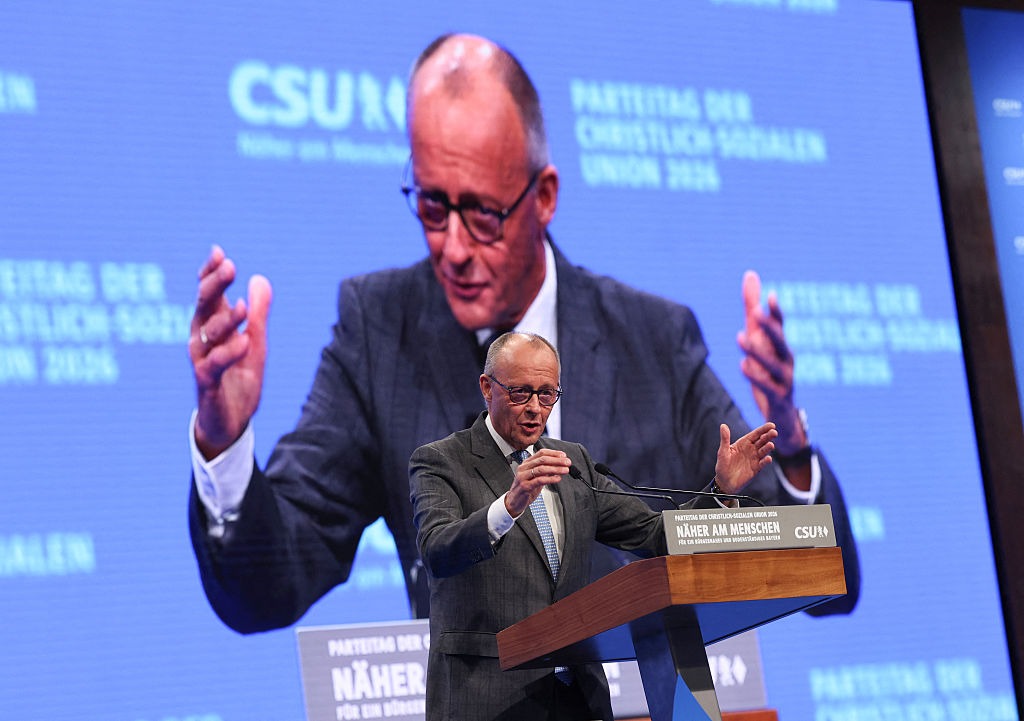
[German] Chancellor Friedrich Merz has made it clear that he wants to end anonymity on the internet.


  • Internet anonymity makes it harder to arrest people for inconvenient speech -- "hate speech" and "insults" -- and Germany's police have been raiding the homes of such internet participants for years. Merz himself has filed hundreds of criminal complaints against ordinary German citizens perceived to have insulted him online, including against a 71-year-old pensioner who committed the unconscionable crime of calling him "Pinocchio" on Facebook....

  • Meanwhile, in the United Kingdom, the totalitarian strain has become just as strong, if not worse. The government has been making examples of citizens who protest the mass migration, which has been continuing across the UK's open borders.

  • By contrast, the men who were arrested on September 27 for what is believed to have been an Iranian-orchestrated attempted attack on England's RAF Fairford air base, used by U.S. warplanes to carry out strikes on Iran, were all released on bail the next day.

  • [T]he UK government has released more than 70,000 criminals early since 2024 under the Labour government's plan to "combat jail overcrowding." So far, since their release, a third of those released have committed new crimes. One man sexually assaulted a woman the day he was freed. Some of the victims of the criminals released early have fled the country.

  • The room they are eager to make in prisons seems to be for ordinary citizens fed up with how their country is run and had the gall to state it. That is how it works in totalitarian systems. Criminals are freed so that dissidents can take their places.

  • Over three years of pro-Hamas protests inciting violence in the form of calling for a "global intifada" and "intifada revolution is the only solution" on the streets of Britain, not a single protester even came close to that kind of sentencing, even though Hamas is a proscribed terrorist organization in the UK. Protesters who wore the Hamas paraglider symbol or the Hamas headband were convicted of terrorism offenses but discharged by friendly judges and never served any time in prison.

  • It is evidently all right to be carried away by emotion in favor of Hamas' mass slaughter, dismemberment and rape of Jews. The judge even seems to be saying that their view is understandable... When it comes to trying to protect your family from predatory third-world illegal male migrants arriving by the thousands on the shores of your country, that is not all right.

  • This seems to be how the UK "justice" system works. If you support Hamas, a terrorist organization, it is considered either not really support at all, or not to cause "serious harm." Instead, protesting illegal immigration must immediately be punished with unconditional prison sentences. If this is not an example of the state emboldening terrorism, it would be hard to say what is.

German Chancellor Friedrich Merz has made it clear that he wants to end anonymity on the internet. "I want to see real names on the internet. I want to know who is speaking," he said. In other words, he wants the government, and the big tech companies, to know exactly who is behind every single comment, tweet, and meme on the internet. Pictured: Merz delivers a speech in Munich on October 24, 2026. (Photo by Alexandra Beier/ AFP via Getty Images)

Germany's governing coalition of the Christian Democratic Union (CDU) and Social Democratic Party (SPD), increasingly desperate to cling to power as the Alternative für Deutschland (AfD) continues to hammer them in the polls, is turning ever more totalitarian.

For a start, Chancellor Friedrich Merz has made it clear that he wants to end anonymity on the internet.

"I want to see real names on the internet. I want to know who is speaking," Merz said back in February. "In politics, we engage in debates in our society using our real names and without visors."

In other words, Merz wants the government, and the big tech companies, to know exactly who is behind every single comment, tweet, and meme on the internet.

Internet anonymity makes it harder to arrest people for inconvenient speech -- "hate speech" and "insults" -- and Germany's police have been raiding the homes of such internet participants for years. Merz himself has filed hundreds of criminal complaints against ordinary German citizens perceived to have insulted him online, including against a 71-year-old pensioner who committed the unconscionable crime of calling him "Pinocchio" on Facebook, and others who called him "Lügenfritz" ("Lying Fritz") and "Lackaffe" (a poseur or slick monkey).

Insulting a politician is considered an especially monstrous crime in Germany – it carries a sentence of up to three years in prison or a fine. German police have entire specific departments, whose task it is to comb through the internet to detect people who dare to insult the Great German Leader or engage in other incommodious speech.

It appears that the end of internet anonymity in Germany may be fast approaching. On October 14, the government officially approved a policy framework establishing a roadmap to block children under 13 from major social media networks. This ban, however, would most likely to make it impossible for anyone to access social media without first identifying themselves. The most logical outcome will be identification taking place by means of a "Digital ID," which the European Union has demanded that every member country implement by the end of 2026.

The desire to see an end to internet anonymity is rife among European governments. The European Commission itself is currently working on a bill, known as the EU KIDS Act, that will ban social media for teenagers under a certain age, "to restrict social media platforms' access to children in the EU." Paired with the Digital ID, it is the easiest road to end anonymity on the internet. It may not happen immediately, but the EU train is barreling towards that goal.

Meanwhile, in the United Kingdom, the totalitarian strain has become just as strong, if not worse. The government has been making examples of citizens who protest the mass migration, which has been continuing across the UK's open borders. Most recently, Daniel Thomas, known as Danny Tommo, was arrested for criminal damage after he slashed an inflatable dinghy at sea, the kind of boat in which illegal migrants arrive. The government did not simply arrest him, but locked him in prison and refused to release him bail until his trial 17 months from now -- in March 2027.

By contrast, the men who were arrested on September 27 for what is believed to have been an Iranian-orchestrated attempted attack on England's RAF Fairford air base, used by U.S. warplanes to carry out strikes on Iran, were all released on bail the next day. Then again, the UK government has released more than 70,000 criminals early since 2024 under the Labour government's plan to "combat jail overcrowding." So far, since their release, a third of those released have committed new crimes. One man sexually assaulted a woman the day he was freed. Some of the victims of the criminals released early have fled the country.

"The early release scheme is necessary because without it prisons would get so full that police would not be able to make arrests" stated Jake Richards, the parliamentary under-secretary of state for sentencing. "Without intervention we risk running out of prison places, leaving courts unable to sentence offenders and police unable to make arrests."

The room they are eager to make in prisons seems to be for ordinary citizens fed up with how their country is run and had the gall to state it. That is how it works in totalitarian systems. Criminals are freed so that dissidents can take their places. In addition to Tommo, a man was recently arrested who protested against the arrival of a large dinghy carrying illegal immigrants by throwing a small empty plastic bottle into the air at a police line and then shouted "f--k off" at them. For this outrage he was arrested; his case was processed through the justice system at record speed, and he was sentenced to an unconditional two years in prison.

"Throwing a plastic bottle is simply about inflaming the actions of others. He lobbed it in that general direction. He is chucking something," the judge ruled.

"It is important to distinguish the right to peaceful protests and offences when people cease to protest peacefully. Many of those were wearing face coverings adding to the air of intimidation. The community impact of that night's violence has been profound.... this offence is so serious that the only punishment can be immediate imprisonment."

You don't say.

Over three years of pro-Hamas protests inciting violence in the form of calling for a "global intifada" and "intifada revolution is the only solution" on the streets of Britain, not a single protester even came close to that kind of sentencing, even though Hamas is a proscribed terrorist organization in the UK. Protesters who wore the Hamas paraglider symbol or the Hamas headband were convicted of terrorism offenses but discharged by friendly judges and never served any time in prison.

Judge Tan Ikram told the three women who used the paraglider symbols:

"You crossed the line, but it would have been fair to say that emotions ran very high on this issue. Your lesson has been well learned. I do not find you were seeking to show any support for Hamas."

It is evidently all right to be carried away by emotion in favor of Hamas' mass slaughter, dismemberment and rape of Jews. The judge even seems to be saying that their view is understandable, not a sign of support for terror. When it comes to trying to protect your family from predatory third-world illegal male migrants arriving by the thousands on the shores of your country, that is not all right.

"The offence here was Mr Hajsaad wearing a bandana at a demonstration," Judge Nina Tempia ruled in a Hamas headband case.

"In respect to harm, I agree with the prosecution that there was harm as the conduct linked to support of a proscribed organization. The offence was committed after (the October 7 attacks). Not days or weeks later, but seven weeks later. I would not classify the harm as serious." The terrorist supporter was spared both prison and fines "on account of his 'extremely limited budget' of £49 per week used for food and travel."

This seems to be how the UK "justice" system works. If you support Hamas, a terrorist organization, it is considered either not really support at all, or not to cause "serious harm." Instead, protesting illegal immigration must immediately be punished with unconditional prison sentences. If this is not an example of the state emboldening terrorism, it would be hard to say what is.

When ordinary citizens are imprisoned for standing up for the safety of their families and their country, while terrorist supporters are coddled, you know that your country is being ruled by what the late Polish psychiatrist Andrzej Łobaczewski, in his book Political Ponerology: The Science of Evil, Psychopathy, and the Origins of Totalitarianism, labeled them: "psychopaths."


Robert Williams is based in the United States.

Source: https://www.gatestoneinstitute.org/22942/europe-new-totalitarians

Follow Middle East and Terrorism on Twitter

The Road to Hell: Is There Really a Material Solution to Birth-Rate Decline? - Raw Egg Nationalist

by Raw Egg Nationalist

We’re stuck in a 2,000-year-old loop, repeating the same failed solutions with the same failed outcomes.


It’s been an interesting seven days for people who care about birth rates.

First, China’s State Council decreed that the government must offer greater support to families if more children are to be born. China currently has one of the world’s lowest fertility rates, about one birth per woman, well below the 2.1 replacement rate needed to maintain a stable population.

In January, it was announced that the country’s birth rate had fallen for the fourth consecutive year, reaching a record low as the population continues to shrink. The official birth rate fell 17 percent, from 9.54 million to 7.92 million, or 5.63 per 1,000 people, while the population fell by 3.39 million to 1.405 billion. China’s death rate—8.04 per 1,000 people—is the highest it’s been since 1968, in the third year of Mao’s Cultural Revolution, which may have killed as many as eight million Chinese.

According to one demographer, Dr. Yi Fuxian, at the University of Wisconsin-Madison, births in 2025 were “roughly the same level as in 1738, when China’s population was only about 100 million.”

Reuters reports that, at a meeting held on October 23, the State Council decided “the government should refine policies including those related to marriage, childbirth, child-rearing, and education, and optimize taxation, social security, and housing.”

The goal is to make China a “fertility-friendly society.”

The pledges, Reuters says, are a clear “sign that policymakers are concerned about the strain a shrinking and aging population could put on the country’s social insurance system and overall economic growth, which has been weighed down by weak domestic consumer demand.”

“Population is the foundational condition for economic and social development,” officials proclaimed.

The Chinese government has already attempted to make having children more affordable, introducing a nationwide childcare subsidy system and reducing preschool tuition fees. To make marriage more desirable, it relaxed a law that forced couples to marry in their place of residence. Three-and-a-half decades of anti-child conditioning, the fruits of the one-child policy, which only ended in 2015, have to be undone in the minds of ordinary Chinese. Many still remember the forced abortions and sterilizations.

Then came news that the U.S. is also experiencing a record decline in fertility. The general fertility rate—the number of births over the number of women of childbearing age—fell 1 percent from the previous record low in 2024 to 53.2 births per 1,000 women, or a birth rate of about 1.6 per woman, again well below the replacement rate, although still not as bad as China’s.

The U.S. teen birth rate, ages 15–19, dropped 7 percent. The rate fell 6 percent for women aged 20–24 and 4 percent for women aged 25–29. Only women aged 30 and over experienced an increase in births, and even then it was modest: 3 percent for women 30–34, 2 percent for 35–39, and 1 percent for 40–44.

Third and finally, a new scientific study showed that, far from increasing the birth rate, allowing women to work from home has the opposite effect. Demographers and social scientists have long believed that giving women more time to spend at home instead of being stuck in traffic or working late at the office would give couples more quality time together and reduce their stress—and more kids would naturally follow. Earlier comparative studies of multiple countries found that couples who work from home for at least one day a week have more children over their lifetimes than couples who don’t.

The pandemic, which drove an office exodus on an unprecedented scale, should have sparked a baby boom.

In reality, allowing significant numbers of women to work from home reduced annual birth rates among college-educated women, at the same time as increasing their employment levels and their earnings. Otherwise, the fertility rate didn’t budge an inch.

The study used data from close to 4 million American men and women aged 18 to 50 to reach its conclusions.

“Instead of increasing family size, greater access to remote work lowered birth rates. Between 2021 and 2024, each 15-point step up in a major’s remote-work score reduced annual births among college-educated women by 1.9 percent. The decline was driven entirely by married women, whose annual birth rates fell by about 2 percent, while birth rates for unmarried women and fertility rates for men showed no statistically significant change.

“At the same time, married women in remote-friendly fields stepped up their career commitments. For each 15-point increase in a major’s remote-work score, full-time employment among married women rose by 1.3 percent, and wage income among those with earnings climbed by 2.6 percent. Married women also increased their share of their couples’ combined income and became more likely to out-earn their husbands.”

By comparing pre- and post-pandemic data, the researchers were able to show that the move to full-time employment by women accounted for about half the decline in births. They debunked a number of theories for why remote work should increase the birth rate, including the theory that working from home allows men to share more of the parenting load, making it easier for mothers to have more children. Using housing data, they also showed that space was a key variable. In a house with three bedrooms or fewer, annual birth rates fell by more than 3 percent. In houses with four or more bedrooms, the rate stayed the same.

The implication, backed up by the data, is that sending women back to the office would actually increase birth rates. Fancy that.

Three big data points, all pointing towards the same worrying conclusion: The road to hell, by which I mean an aging, shrinking population, is paved with good intentions. Try as you might, you’re unlikely to make a meaningful difference, and in fact you’ll probably make things worse. That’s not a happy thought if you’re a social planner.

There’s something about fertility we just don’t seem to understand. I’ve been writing about it for years now with a particular focus on lifestyle factors like obesity, lack of exercise, and, in particular, exposure to hormone-disrupting chemicals known as endocrine disruptors, which are a ubiquitous part of modern life because of plastics, pesticides, food additives, personal-care products, and industrial pollution.

I made endocrine disruptors the subject of my appearance at the first Natal Conference, held in Austin, Texas, by Kevin Dolan’s EXIT Group, a Mormon fraternity that was formed to create alternative networks and new approaches to some of the West’s most pressing issues, including population decline. Like many religious groups, the Mormons still seem to be good at having children, although not as good as they used to be. Their current birth rate is 2.42, above replacement, but it’s fallen in recent decades and continues to fall. In 1981, it was 3.31.

As a repeat guest at the second conference, in 2025, I was billed as something more like a provocateur or a disruptor, which was fine by me. I forget the exact term that was used, but I was one of the last speakers on the last day, and my speech was intended to stick in people’s minds. The organizers wanted me to say something you weren’t going to hear from any of the economists, social scientists, venture capitalists, podcasters, or “hipster eugenicists” (The Guardian) in attendance, most of whom presented an optimistic vision of a future where having children is made easier and cooler by a range of carefully targeted material interventions.

And so this is what I said.

Although there are material causes of fertility decline, there is clearly something that evades our grasp, something less physical, less tangible but no less real: call it a moral or spiritual thing if you want. Until we get a real sense of it, nothing we try to do will work and, in fact, may prove counterproductive.

There couldn’t be a better example of the failure of conservative pro-natalism, as it’s often called, than Viktor Orban’s Hungary, which for 15 years served as the poster child for an “illiberal” new way of doing politics without mass immigration to maintain the human churn. Despite much-touted measures like the abolition of income tax for Hungarian women with more than four children, Hungary saw only a very modest bounce in birth rates, and nobody can really be sure it wasn’t just the long recovery from the Financial Crash of 2008.

But then, exactly the same thing happened in the first century AD, when the Roman emperor Augustus tried to promote motherhood and penalize men and women for being unmarried. A hundred years after the great emperor’s leges Iuliae, the Roman historian Tacitus would complain of exactly the same problems and look bitterly across the Rhine to the ancient Germans. There, at least, Tacitus remarked, “childlessness has no rewards.”

One of the most daring reformulations of the infertility problem in recent years has come from the once-anonymous internet figure Bronze Age Pervert in his book Bronze Age Mindset. It’s worth quoting the relevant passage in full.

Chimp in state of nature never jerks off, but in captivity he does, what does this mean? In state of nature he’s too busy, to put plainly. He is concerned with mastering space: solving problem of life in and under trees, mastering what tools he can, mastering social relations in the jockeying for power and status. Deprived of this drive to development and self-increase he devolves to pointless masturbation, in captivity, where he senses he is in owned space and therefore the futility of all his efforts and all his actions. The onanism of modern society is connected with its supposed “hyper-sexualization” and its infertility. It’s not really hyper-sexualization, but the devolution of the spirit to the lassitude of a diffuse and weak sexuality.

Don’t be fooled by the apparent ridiculousness of the image or the internet patois. This is deeply profound.

First, what he says is true at the base level. Chimps really do “devolve to pointless masturbation” in captivity. Recent studies have even shown them manufacturing primitive sex toys from rocks, something they’ve never been known to do in the wild. More broadly, we know that confinement has deleterious effects on the health, especially reproductive health, of a wide variety of animals. Pandas, who must be coaxed by zookeepers through a range of ingenious means to have sex, are of course the most famous example of this.

The deeper point, though, is that maybe we’re chimps in a zoo as well. A great big open-air zoo with all sorts of very complicated entertainments and diversions—sportsball, international travel, elections, movies-on-demand, AI chatbots we think are conscious, 4K HD porn, and burgers delivered to your front door by a man on a little bike—but a zoo nonetheless.

The idea that societies can become like zoos or even prisons, and that the modern world may be a uniquely fiendish zoo-prison, isn’t a new one. In fact, most people today have probably felt that claustrophobia and sense of encroaching confinement, the walls closing in, in their daily lives and given voice to it. “I’m trapped”—and maybe you are.

Ted Kaczynski, aka the Unabomber, described modern man as uniquely engaged in a series of “surrogate activities” that at best simulate but never match the satisfaction of the real struggles of life. The anthropologist David Graeber said most people now work “bullshit jobs,” but Kaczynski’s point is broader: It’s all bullshit, your job and everything else besides.

Other captive situations and experiments present even more worrying parallels with our present situation. Most notably, there’s the so-called “mouse utopia” experiment, where mice were allowed to breed for generations in a specially constructed environment with complete freedom from want and danger. After a certain number of generations of blissful hedonism, there was an explosion of morbid symptoms. The mouse utopia became mouse hell on earth. The fertility rate collapsed, and the mice began displaying aberrant behaviors that look uncomfortably familiar today. A new class of mice, dubbed “the beautiful ones,” emerged and would spend all their time grooming themselves, losing all interest in anything else, including reproduction. As I type, young men across the Western world are hitting their cheekbones with hammers in an attempt to “looksmaxx” and “mogg” lesser men.

My point isn’t that the modern world must be dismantled brick by brick to the ground, but that we’ve undergone radical changes to the way we live in, human terms, the blink of an eye, and we haven’t taken proper stock of what has changed, why, or the effects those changes have had on human beings as the complex animals we are, the emphasis being as much on our animality as on what separates us and makes us unique from chimps and pandas and mice in a lab. Statements like “Young people don’t have enough money to buy a home” or “Perhaps if women didn’t have to commute to work they’d be less stressed and more inclined to have children” may have some truth to them, but a simple-minded insistence that technical solutions alone can address our predicament just won’t do. The Augustus approach becomes the Orban approach, and things just continue to get worse.

We’re stuck in a 2,000-year-old loop, repeating the same failed solutions with the same failed outcomes. If that doesn’t fit the famous Einsteinian definition of insanity, I’m not sure what does.

The world has been, in Max Weber’s famous phrase, disenchanted, and our only hope, as far as I can see, will be to weave some fresh magic into our lives. I’m sorry I can’t be more precise than that. 


Raw Egg Nationalist is 
Dr. Charles Cornish-Dale, an Oxford- and Cambridge-educated historian and anthropologist. He has a large social media following, is a bestselling author, has appeared on national television, and has influenced debates on health, fitness, politics, and culture. His latest book is 'The Last Men: Liberalism and the Death of Masculinity.'

Source: https://amgreatness.com/2026/10/28/the-road-to-hell-is-there-really-a-material-solution-to-birth-rate-decline/

Follow Middle East and Terrorism on Twitter