by Con Coughlin
Operation Epic Fury has certainly dealt the ayatollahs a devastating blow, one that might still enable the oppressed Iranian people to achieve their ultimate objective of regime change in Tehran, but only if the US administration does not foolishly exchange a ruthless religious tyranny for a ruthless military one.
The enduring barbarity of the clerical regime's attempts to subjugate the Iranian people to its will demonstrates why the Trump administration's decision to launch fresh military action was justified.
It also exposes the moral bankruptcy of the opponents -- both left and right wing -- of Trump's military intervention who fail to grasp how ordinary Iranians are suffering at the hands of Iran's brutal clerical dictatorship.
Operation Epic Fury has certainly dealt the ayatollahs a devastating blow, one that might still enable the oppressed Iranian people to achieve their ultimate objective of regime change in Tehran, but only if the US administration does not foolishly exchange a ruthless religious tyranny for a ruthless military one.
If both Iran's ruthless Islamic Revolutionary Guard Corps (IRGC) and the former Shah's army -- now strictly supervised by the IRGC and downgraded to border control -- have guns while the citizens of Iran, held hostage by their own government, do not, the regime's ferocity and disregard for due process will undoubtedly continue.
Trump's promise to the Iranian people that "Help is on its way" will appear, instead, as a betrayal -– and no doubt be extensively used to harm the chances of Republicans in America's upcoming midterm election this November.
Similarly, it is difficult to see how impoverishing the present government in Iran -- through the naval blockade, sanctions and secondary sanctions -- will somehow automatically cause its "collapse." A change of regime, where the government have weapons and the citizenry do not, could "take years."
The self-defeating tendency of the US -- failing successfully to resolve the final stretch of conflicts, from North Korea to Iraq to Afghanistan -- has repeatedly caused the US to "pull defeat from the jaws of victory." Wars were won, often brilliantly, but quickly lost just after.
It is understandable that the Iranian people, much as they loathe their regime, are reluctant to submit themselves to another such mass slaughter again.
The time has come for the US administration to work with the Iranian public-- not just its intolerable leadership -- to find a better alternative, even if other countries along the Gulf might prefer a "weak Iran" to a "strong democracy" to protect their own hold on power.
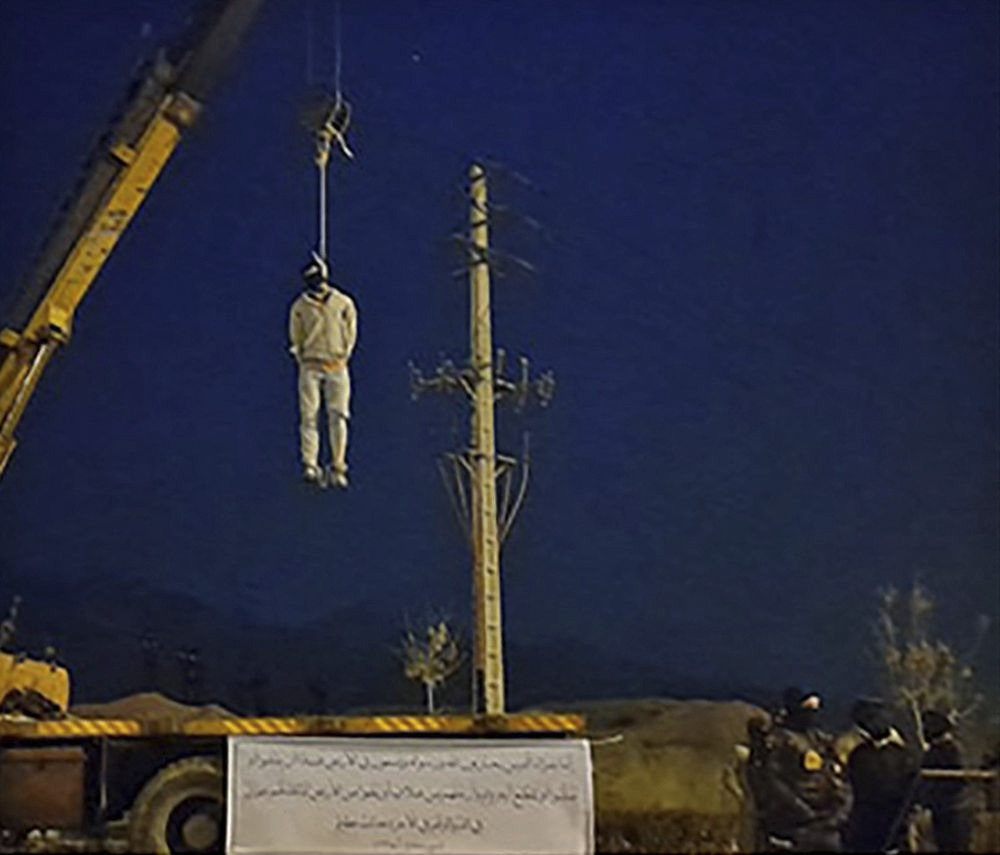
While the world's attention has been focused on diplomatic efforts to end the Iran war, the Iranian regime -- whatever is left of it, that is -- has been busy doing what it does best: brutalising its own people.
At the same time that the Trump administration has been repeatedly offering Tehran the possibility of a diplomatic resolution to the conflict, the Islamic hardliners still running the country are seeking to reassert their stranglehold over the Iranian people by embarking on a fresh round of executions.
Despite giving US President Donald Trump assurances in January that Tehran would not carry out the planned executions of around 800 protesters detained during the wave of anti-government protests that erupted at the start of the year, the Islamic regime has now resumed its barbaric execution programme, with most of the accused first being subjected to torture before being led to the gallows.
At least 14 Iranians are reported to have been executed since Trump launched Operation Epic Fury at the end of February, including an 18-year-old protester who took part in the anti-government protests in January, which resulted in the deaths of an estimated 30,000 Iranian civilians.
In one of the more controversial demonstrations of the regime's determination to crush anti-government activity, Iran executed Kouroush Keyvani, a dual Iranian-Swedish national, on charges of spying for Israel.
The execution took place despite official protests from the Swedish government, which claimed that Keyvani, who had been arrested during the 12-day war between Iran and Israel last year for allegedly photographing sensitive areas, had not received a fair trial and proper legal representation.
"It is clear to us," said Sweden's Foreign Minister Maria Malmer Stenergard, "that the legal process that led to the Swedish citizen being executed has not been fair."
Other Iranians executed during the past month include several people who were hanged on charges of rebellion over membership in the People's Mujahedin of Iran (MEK), a banned opposition group, as well as the country's 19-year-old wrestling champion, Saleh Mohammadi, with two others. The regime has announced that it will also carry out this year's first execution of a female demonstrator, Bita Hammati, accused of having thrown concrete blocks at the Basij.
Additionally, the deliberate targeting of opposition groups such as the MEK, which is said to have close ties with the West, is being seen as an attempt by the regime to persuade ordinary Iranians that the country is facing a Western-inspired plot to effect regime change in Iran.
Other executions have involved three young men accused of involvement in mass protests in January, the first hangings Iran carried out directly related to the nationwide demonstrations that ended in a bloody clampdown. Among those executed was 18-year-old Amirhossein Hatami, detained during the nationwide unrest in January.
Iranian security forces have still not returned Hatami's body, in what may be an unwillingness to disclose signs of torture, or what informed sources described as further pressure on relatives already reeling from his death.
Human rights experts believe that only seven percent of executions in Iran are officially announced, with the real number likely much higher. Some opposition groups claim that more than 300 people have been executed in Iran so far this year.
Charges such as "waging war against God", "armed rebellion", "corruption on Earth", espionage and "acting against national security" are frequently brought without sufficient evidence in courts that lack transparency and fair trial standards.
There are now fears that Iran's executioners will be kept busy implementing the regime's brutal tactics of repression after Gholamhossein Mohseni Ejei, Iran's judiciary chief, called for the current rate of executions in Iran to be expedited.
Sentences involving "confiscation of property and execution" for those linked to enemy groups should be carried out more quickly, Ejei said in a recent statement. "A full-scale war is under way against us".
The Iranian regime's decision to resume executions represents a complete reversal of its pledge to the Trump administration back in January to halt the planned execution of an estimated 800 protesters accused of participating in some of the biggest anti-government protests in the history of the Islamic Republic.
The upsurge in executions, together with other tactics such as rounding up those accused of opposing the Islamic Republic, is part of the regime's desperate bid to cling to power after the devastating losses it has suffered at the hands of the US and Israel.
The enduring barbarity of the clerical regime's attempts to subjugate the Iranian people to its will demonstrates why the Trump administration's decision to launch fresh military action was justified.
It also exposes the moral bankruptcy of the opponents -- both left and right wing -- of Trump's military intervention who fail to grasp how ordinary Iranians are suffering at the hands of Iran's brutal clerical dictatorship.
Operation Epic Fury has certainly dealt the ayatollahs a devastating blow, one that might still enable the oppressed Iranian people to achieve their ultimate objective of regime change in Tehran, but only if the US administration does not foolishly exchange a ruthless religious tyranny for a ruthless military one.
If both Iran's ruthless Islamic Revolutionary Guard Corps (IRGC) and the former Shah's army -- now strictly supervised by the IRGC and downgraded to border control -- have guns while the citizens of Iran, held hostage by their own government, do not, the regime's ferocity and disregard for due process will undoubtedly continue.
Trump's promise to the Iranian people that "Help is on its way" will appear, instead, as a betrayal -– and no doubt be extensively used to harm the chances of Republicans in America's upcoming midterm election this November.
Similarly, it is difficult to see how impoverishing the present government in Iran -- through the naval blockade, sanctions and secondary sanctions -- will somehow automatically cause its "collapse." A change of regime, where the government have weapons and the citizenry do not, could "take years."
The self-defeating tendency of the US -- failing successfully to resolve the final stretch of conflicts, from North Korea to Iraq to Afghanistan -- has repeatedly caused the US to "pull defeat from the jaws of victory." Wars were won, often brilliantly, but quickly lost just after.
In an attempt to prevent any further outbreaks of anti-government protests, members of Iran's Basij militia, the paramilitary group responsible for safeguarding the regime, have been patrolling the streets at night, putting up checkpoints across cities in what is widely seen as a way to deter citizens from gathering in a repeat of the unrest in January, when thousands of people took to the streets and more than 35,600 unarmed civilians were slaughtered.
It is understandable that the Iranian people, much as they loathe their regime, are reluctant to submit themselves to another such mass slaughter again.
The time has come for the US administration to work with the Iranian public-- not just its intolerable leadership -- to find a better alternative, even if other countries along the Gulf might prefer a "weak Iran" to a "strong democracy" to protect their own hold on power.
It is for this reason that the Israelis, in particular, have been deliberately targeting Basij bases, as well as other institutions, such as the Islamic Revolutionary Guard Corps, whose primary function is to ensure the survival of Iran's Islamic autocracy at any cost.
Con Coughlin is the Telegraph's Defence and Foreign Affairs Editor and a Distinguished Senior Fellow at Gatestone Institute.
Source: https://www.gatestoneinstitute.org/22461/iran-regime-change-peace

No comments:
Post a Comment