by Lawrence Kadish
It is important to acknowledge that confronting China's intention to "own" the Pacific is not a Republican position or a Democratic one. Our national response to this threat is not about politics but about identifying the greatest 21st-century challenge facing the United States: China.
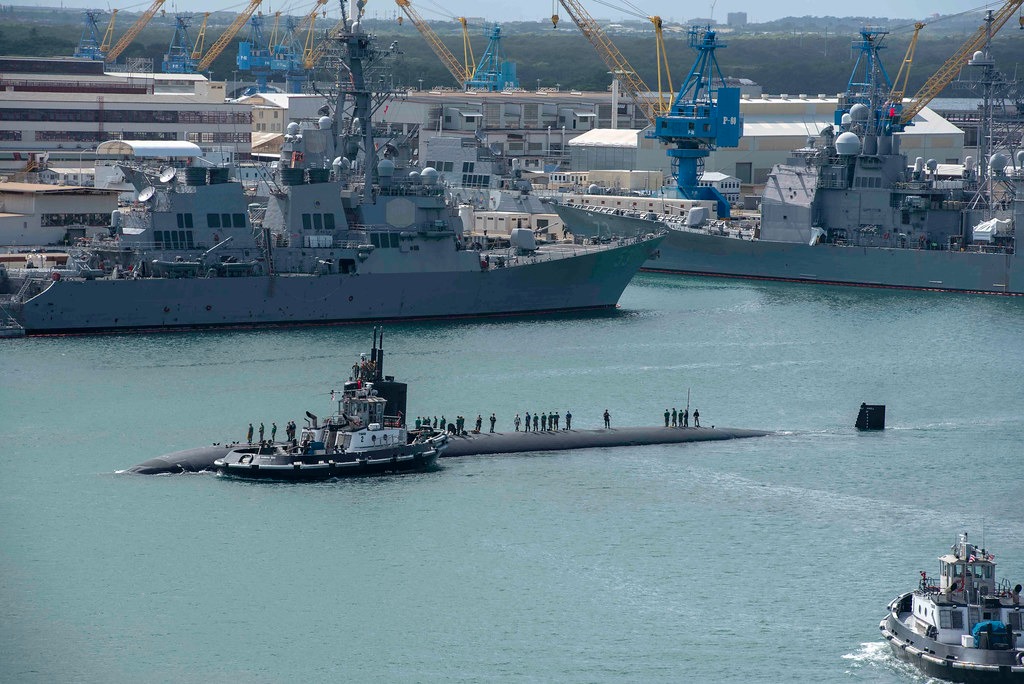 |
| Eighty years ago we learned costly lessons in the Pacific regarding just how difficult it is to supply, fight, and win in this part of the world. Lessons learned, lessons remembered, and lessons for our foes: never underestimate the United States. Pictured: The fast-attack submarine USS Springfield arrives at Joint Base Pearl Harbor-Hickam, in Hawaii, on October 21, 2019. (U.S. Navy photo by Michael Zingaro) |
Not so very long ago, the Pacific was the scene of some of the bloodiest battles of World War II, where no quarter was given.
While the guns have long since gone quiet, that vast area of the globe remains a source of intense military brinksmanship. This time it is the giant of Communist China seeking to dominate the Pacific's democratic nations that range from Japan in the north to Australia in the south. In between those nations is the U.S. Seventh Fleet, along with an island chain with American outposts such as Okinawa and Guam.
It is important to acknowledge that confronting China's intention to "own" the Pacific is not a Republican position or a Democratic one. Our national response to this threat is not about politics but about identifying the greatest 21st-century challenge facing the United States: China. Nowhere is that threat more evident than in the Pacific. Military strategists will tell you that deterring this foe from open conflict requires a credible military presence -- which means being sure that the region always has robust US naval and air assets, primed and always on alert. Analysts will remind us that without this presence, the 6,000 miles between the United States and our allies become vulnerable to Chinese military assaults that would determine the outcome.
The Japanese understood this threat during WWII, which is why in the weeks after their attack on Pearl Harbor, they occupied a series of Pacific islands and the Philippines. They sought to create a Pacific rim of strongpoints designed to keep the United States far from their homeland. The U.S. Marines can still tell you how costly that strategy was to the Corps, whose soldiers had to take those island bases yard by yard.
Today our nation faces multiple threats from China -- from their intent to create super versions of artificial intelligence, to their reach for the Moon, to a "blue water" navy that has the means to show the flag three miles off San Francisco if they so choose.
The most likely target of Chinese military power is obviously Taiwan, and one supposes that the Chinese regime believes the U.S. is too stretched and distracted to pose a credible threat to their potential invasion fleet. They would, however, be making a serious error in judgment. The current president of the United States has demonstrated a level of steely resolve long missing from previous White House occupants.
Military experts say this is the window of opportunity for Washington to negotiate new military basing agreements with our Pacific allies and thereby send a clear message to Beijing that we will not be intimidated. Eighty years ago we learned costly lessons in the Pacific regarding just how difficult it is to supply, fight, and win in this part of the world. Lessons learned, lessons remembered, and lessons for our foes: never underestimate the United States.
Lawrence Kadish serves on the Board of Governors of Gatestone Institute.
Source: https://www.gatestoneinstitute.org/22592/never-underestimate-usa

1 comment:
So Mr. Kadish by omitting the threat of North Korea (now allied to both Russia & PRC) apparently believes it poses no direct threat to either US or ally South Korea? This then is sloppy jingoistic reporting
Post a Comment