by Pierre Rehov
How do trained police officers, standing over a boy bleeding out onto the pavement, become incapable of seeing what lies in front of them?
The murder of Henry Nowak did not reinforce the reigning story. It contradicted it. This contradiction, more than any failure of policing, explains why one death summoned a global movement while the other is being swiftly filed away as an inconvenience.
How do trained police officers, standing over a boy bleeding out onto the pavement, become incapable of seeing what lies in front of them?
Sigmund Freud and Stanley Milgram, among others, have noted how readily ordinary people defer to an authority that relieves them of responsibility. The lesson was never that monsters walk among us. It was that the instinct to comply, to belong, to escape the punishment reserved for those who break ranks, can override even the evidence of one's own eyes.
When... fear of the word "racist," grows so large that it eclipses a dying man on the ground, morality itself has been hollowed out. No order need be issued; the response becomes a reflex. After years of training and disciplinary precedent, a career can be ended by a single allegation. It is safer to doubt a white victim than to risk the accusation that can destroy one's life.
This failure to adhere to fact-based reality should disturb anyone who values a free society more than any question about the private convictions of the officers involved. The danger is not that policemen harbor secret prejudice in either direction. It is that an entire culture has been trained to pass every event through an ideological filter before it consults the facts, so that reality becomes negotiable and a boy can plead that he has been stabbed while the men sworn to protect him decide, on the strength of his attacker's word, that he has not.
Nowak's murder tells the "wrong" story. It tells of a white victim, a non-white attacker who weaponized the accusation of racism, and a police force paralyzed by the very fear that this accusation was designed to exploit.
A civilization that is now calibrating its compassion to political utility and that makes decisions on whose suffering counts by whether it flatters the prevailing creed, has already begun to rot from within.
The scholars who studied conformity after 1945 left a warning: The gravest threat to human reason is not open hatred. It is the longing to remain inside the lines of permitted opinion, to be spared the cost of seeing clearly.
When George Floyd died in Minneapolis on May 25, 2020, the Western world convulsed. Within days, European capitals were burning, corporations were confessing to sins they could not name, governments were rewriting their codes, and great institutions were lowering themselves to one knee before a doctrine that had arrived without debate.
Three words — "I can't breathe" — became the liturgy of an age that had at last identified its original transgression: whiteness, policing, the inherited architecture of the West. One could accept or reject every conclusion drawn from Floyd's death and still concede the plain fact that he became a planetary icon, his name stenciled on walls from Berlin to Sydney.
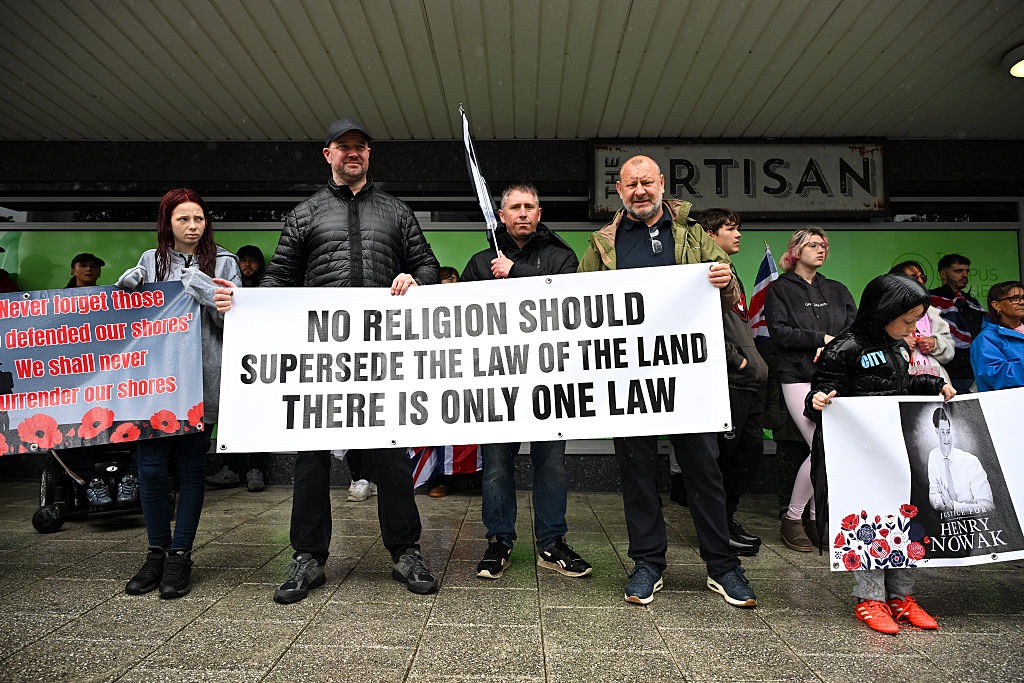
Five years later, a teenager spoke nearly the same words as he bled out on an English street. The murder of Henry Nowak did not reinforce the reigning story. It contradicted it. This contradiction, more than any failure of policing, explains why one death summoned a global movement while the other is being swiftly filed away as an inconvenience.
Henry Nowak was 18, a first-year accountancy student at the University of Southampton and the first in his family to reach university. Friends described a young man who lit up a room, who played football with two university clubs, and whose arrival was greeted, one teammate said, as though someone had just scored a goal. On the night of December 3, 2025, as Nowak was walking home in the suburb of Portswood, 23-year-old Vickrum Digwa stabbed him five times with a traditional Sikh dagger. One blow of the knife punctured Nowak's lung and severed a major vein. Another struck the back of his legs as he tried to run.
When officers arrived, Digwa told them he was the victim, that "he had been racially abused," and forced to defend himself. The police handcuffed Nowak as he was bleeding to death. Bodycam footage, released on June 1, the day Digwa was sentenced, shows Nowak on the ground saying repeatedly that he had been stabbed, to which a police officer replied, "I don't think you have, mate." Nowak said that he could not breathe and pleaded for help. He was handcuffed and died shortly after.
The racism allegation was a fabrication; Judge William Mousley said so with no ambiguity. The charge was wholly at odds with everything known of Nowak. The court heard that Digwa and his brother, conversing in Punjabi while officers listened, had agreed to invent a story of "racial abuse" and self-defense. Digwa drew a "life sentence" with a minimum prison term of 21 years. His mother was convicted of assisting an offender.
Nowak's father, Mark, described how his son was treated in those final moments as inhumane and degrading. He then said what no official statement has been able to answer: that his murderer had been believed by police. This single sentence holds the whole horror: How do trained police officers, standing over a boy bleeding out onto the pavement, become incapable of seeing what lies in front of them?
The 20th century supplied the vocabulary. Hannah Arendt gave us the banality of evil. Christopher Browning showed how the middle-aged reservists of Germany's Police Battalion 101, men of no particular conviction, became executioners through conformity, the dread of standing apart from their fellows. Sigmund Freud and Stanley Milgram, among others, have noted how readily ordinary people defer to an authority that relieves them of responsibility. The lesson was never that monsters walk among us. It was that the instinct to comply, to belong, to escape the punishment reserved for those who break ranks, can override even the evidence of one's own eyes.
Every society ranks its terrors. In contemporary Britain, the accusation of racism sits near the summit of that ranking — more ruinous to a career than incompetence, more frightening to an institution than the loss of a life. Racism, of course, is real and must be fought wherever it appears. When, however, fear of the word "racist," grows so large that it eclipses a dying man on the ground, morality itself has been hollowed out. No order need be issued; the response becomes a reflex. After years of training and disciplinary precedent, a career can be ended by a single allegation. It is safer to doubt a white victim than to risk the accusation that can destroy one's life. In Southampton, this reflex produced precisely the outcome one might have forecast — credibility extended to the non-white murderer, suspicion turned on the dying white person.
This failure to adhere to fact-based reality should disturb anyone who values a free society more than any question about the private convictions of the officers involved. The danger is not that policemen harbor secret prejudice in either direction. It is that an entire culture has been trained to pass every event through an ideological filter before it consults the facts, so that reality becomes negotiable and a boy can plead that he has been stabbed while the men sworn to protect him decide, on the strength of his attacker's word, that he has not.
The contrast with Floyd is the whole point. His death slotted seamlessly into a story the culture was already telling itself, so it was amplified beyond measure. Nowak's murder tells the "wrong" story. It tells of a white victim, a non-white attacker who weaponized the accusation of racism, and a police force paralyzed by the very fear that this accusation was designed to exploit. The episode therefore is granted a fraction of the attention and a fraction of the fury.
A civilization that is now calibrating its compassion to political utility and that makes decisions on whose suffering counts by whether it flatters the prevailing creed, has already begun to rot from within.
The reaction since has confirmed as much. Britain's Prime Minister Keir Starmer called the footage "harrowing" and said he "felt sick watching it." The Hampshire & Isle of Wight Constabulary has referred itself to the police watchdog agency, and senior officers have begun reviewing a mindset of anti-racism that is just as racist, only in reverse. It is a racist mindset that instructs them not to treat everyone the same. The very establishment that built these racist mindsets nevertheless professes shock at the result. Meanwhile, the call to revisit this doctrine of racist anti-racism is treated as the provocation rather than the question.
Protesting in the streets of Southampton, the crowds understood the symmetry before the commentators did, and chanted the three words: "I can't breathe." Some among them may have come looking for a different fight. The family itself begged not to have their grief exploited. Their views, however, do not erase the recognition that the only way to stop racism is to stop racism -- to stop seeing everyone and everything in terms of racism.
The scholars who studied conformity after 1945 left a warning: The gravest threat to human reason is not open hatred. It is the longing to remain inside the lines of permitted opinion, to be spared the cost of seeing clearly.
Henry Nowak's final minutes, preserved by a camera worn by one of the police officers who failed him, are evidence that the warning is unfolding now, and if it goes unheeded, there will be more like him, pleading on the ground while the eyes above them refuse to look.
Pierre Rehov, who holds a law degree from Paris-Assas,
is a French reporter, novelist and documentary filmmaker. He is the
author of six novels, including "Beyond Red Lines", "The Third
Testament" and "Red Eden", translated from French. His latest essay on
the aftermath of the October 7 massacre " 7 octobre - La riposte "
became a bestseller in France. As a filmmaker, he has produced and
directed 17 documentaries, many photographed at high risk in Middle
Eastern war zones, and focusing on terrorism, media bias, and the
persecution of Christians. His latest documentary, "Pogrom(s)"
highlights the context of ancient Jew hatred within Muslim civilization
as the main force behind the October 7 massacre.
Source: https://www.gatestoneinstitute.org/22590/hierarchy-of-acceptable-victims

No comments:
Post a Comment