Monday, November 9, 2015

The Media is Free, and is Everywhere Chained to a Narrative - Steve Apfel


by Steve Apfel

What the media passes off as hard news is an aggravated protest over Palestinian rights and Israeli wrongs.


If there ever was a real line between news and opinion, it stopped being real in 1967. That was the year Israel licked belligerent Arab powers and took whole chunks of territory off them. The West marveled, but not for long. Humanity’s implanted fixation with the “Jewish problem” boiled up from an after-Holocaust slumber like a bubbling sea beast. Millennial antipathies were back at full strength. The media packed them into a narrative that conditions voting blocs and electorates down to this day. What the media passes off as hard news is an aggravated protest over Palestinian rights and Israeli wrongs. Anchors and editors slave away at a narrative garbled by animosity. None bother to hide it anymore. The narrative may have convinced audiences, but even more, opinion formers have convinced themselves that juggernaut Jews make life intolerable for underdog Palestinians who only want sovereignty. A brittle hysteria has settled on the media in every free country.A brittle hysteria has settled on the media in free countries, imparting an aura of menace.

To get the narrative across, to direct fury at Israel for being top dog, the media plays any number of games. I explained media games here and more in the book Hadrian’s Echo. Spiking stories, obscuring facts, reinventing the laws of war -- these are other tricks of the trade. Man is born free, and is everywhere in chains. The media is free, and is everywhere chained to a narrative that beggars belief. The narrative depends a lot on media-imposed censorship. Fear and bias impart the impetus. 

Eason Jordan, a CNN executive, disclosed the fear in a New York Times piece in April 2003. Writing of the Iraqi war that deposed Saddam Hussein, Eason disclosed that CNN routinely canned “dangerous” items of news. Reports of murder and torture, wrote Jordan, were censored by CNN for the sake of the Baghdad bureau. “Awful things could not be reported because doing so would have jeopardized the lives of Iraqis, particularly those on our Baghdad staff… The secret police terrorized Iraqis working for international press services. Some vanished, never to be heard from again. Others disappeared and then surfaced later, with whispered tales of being hauled off and tortured in unimaginable ways. Obviously, other news organizations were in the same bind we were when it came to reporting.” There it is. For the sake of a continued CNN presence in Baghdad, the corporation canned news that could put its bureau at risk. Discretion was the better part of valor.

And so it is further afield. If Gaza and the West Bank are not Baghdad, they’re not havens for the media either. Threats, kidnapping, and occasionally murder are commonplace means of keeping reporters on a tight rein. Ramallah controls what the media may cover. After a double-suicide bombing in Tel Aviv, Palestinian policemen arrested al Jazeera's Gaza correspondent Seif al Din Shahin when he reported Fatah’s claim of responsibility for the atrocity. He was charged with "inflicting damage to the interests and reputation of the Palestinian people and their struggle."

A particularly brazen case of censorship occurred in the aftermath of the 9/11 attacks. When news of the horror broke, ecstatic Palestinians took to the streets. Yasser Arafat’s men arrived to break up the party before incriminating images could go viral. Photo journalists were trapped inside a Nablus hotel while the carnival in the streets went on. A cameraman for Associated Press Television News was taken to an office and threatened by Arafat's cabinet secretary, Ahmed Abdel Rahman, who hinted darkly that should any footage be broadcast, the PA could not “guarantee his life."

Widespread manipulation and control of the media -- foreign and local -- is amply documented. A 2001 report by The Independent Committee for Protection of Journalists wrote: “In the seven years since the Palestinian Authority took control over parts of the West Bank and Gaza, Chairman Yasser Arafat and his security apparatus have muzzled local press critics via arbitrary arrests, threats, physical abuse, and the closure of media outlets. Over the years, the Arafat regime has managed to frighten most Palestinian journalists into self-censorship.” 

Further afield and years later, fear and cowardice stalk corridors in South Africa. Janet Smith, Deputy Editor of mass daily, the Star, phoned me. The paper was due to run my op-ed. Smith explained the bind it put her in. The Star received death threats when they published anything that offended Muslims. There’d also been a threat to burn down the Star’s building. In Smith’s own words, “It would be more than (her) life is worth” to publish the op-ed. As a sop the paper ran the article on the Letters Page. And for extra caution it renamed the letter writer: Steve became Ebrahim.

Then last month the selfsame Janet Smith interviewed the political head of Jihadi terrorist group, Hamas. Meshaal was in South Africa on an official visit -- the first country outside the Muslim world to give the terrorist leader red carpet treatment. Janet Smith, with fear and favour, drooled over Meshaal. 

Janet Smith: “Hamas has long been in the vanguard of the struggle for the freedom of Palestinians, and armed struggle is familiar to South Africans. It is partly the reason why we have the freedom we have today. Our own president was a leader in that armed struggle. Yours is not very different to the armed struggle of the ANC. Before taking up arms, they had tried other means, but the regime was unmoved. However, you have made it very clear that your armed struggle doesn’t exist ubiquitously. You don’t have militia on a daily basis going into Israel or foreign territory. It exists as part of warfare and on specific targets. Is this correct?”

One thinks of four possibilities why a senior journalist of Christian background would transform an Islamic Jihadist into a noble freedom fighter. One, Smith was paid by Hamas to write the whitewash. Two, the Star’s Muslim employer twisted Smith’s arm; three, it provided outlet for Smith’s kindred anti-Jewish bigotry; or four, the paper was enticed, with dollars, to paint the billionaire international criminal, Meshaal, as white as snow.   

Then came another sequel; and a different newspaper was caught up. A group calling itself South African Friends of Israel paid the Sunday Times to run a full page advert, setting out ugly facts about Hamas. The intention, SA Zionist Federation Chairman Ben Swartz explained, was to educate South Africans and members of the ruling party on what Hamas is about. The paper pulled the ad a day before publication, citing worries about offending some parts of the community. A week later the paper flip-flopped, agreeing to run the advert, albeit without the image of a Jihad-dressed, gun-toting fighter in Hamas colors.
“We received the advert very late last week and is common practice with adverts of this nature, needed to satisfy ourselves that it was within the bounds of the law,” said a spokesman for the Sunday . On why it now wanted the image of a Hamas fighter to be removed, the answer was: “We have a responsibility to ensure that content that is published in our newspapers does not stoke racial tension and discord and have always reserved the right not to accept certain adverts.”
Anton Harber, being a professor of journalism, can be no lover of Israel. Yet Harber was moved to opine that “if the Sunday Times had good reason not to carry (or to amend the advert) then we need to hear it. If they can’t give a good reason, it will look like they are just censoring opinions they are uncomfortable with.” Quite right. The media is free, and is everywhere chained to a mendacious narrative.


Steve Apfel

Source: http://www.americanthinker.com/articles/2015/11/the_media_is_free_and_is_everywhere_chained_to_a_narrative_.html

Copyright - Original materials copyright (c) by the authors.

Hillary Clinton, Arms Dealer - Arnold Ahlert


by Arnold Ahlert

The dirty deals that put illegal arms shipments into the hands of Libyan jihadists.


In a scathing column Fox News contributor Andrew Napolitano makes the convincing case that Hillary Clinton sold weapons to Libya in a direction violation of the U.N. arms embargo, and then lied about it under oath during her testimony before the House Select Committee on Benghazi Oct. 22.

"To pursue her goal of a ‘democratic' government there, Clinton, along with Obama and a dozen or so members of Congress from both houses and both political parties, decided she should break the law by permitting U.S. arms dealers to violate the U.N. arms embargo and arm Libyan rebels whom she hoped would one day run the new government,” Napolitano explains. "So she exercised her authority as secretary of state to authorize the shipment of American-made arms to Qatar, a country beholden to the Muslim Brotherhood and friendly to the Libyan rebels and a country the U.S. had no business arming—unless the purpose of doing so was for the arms to be transferred to the rebels.”

Memos recovered from the incinerated compound in Benghazi give great weight to the assertion. The documents were obtained by the Washington Times and they reveal the American diplomats stationed there were keeping track of numerous potential U.S.-sanctioned weapons shipments aimed at arming our allies, "one or more of which were destined for the Transitional National Council, the Libyan movement that was seeking to oust Gadhafi and form a new government,” the paper reports.

A file marked “arms deal” reveals that one of those shipments was supposed to be sent by Dolarian Capital Inc. of Fresno, CA, one of many arms sellers that work with U.S. intelligence. The file contained an end use certificate from the State Department’s office of defense trade controls licensing, and Dolarian confirmed one of the licensing requests the State Department initially approved in 2011 was an authorization to send weapons to Libya via Kuwait. The certificate was inexplicably revoked before Dolarian could ship rocket and grenade launchers, 7,000 machine guns and 8 million rounds of ammunition originally manufactured by former Soviet-bloc nations in Eastern Europe.

“Dolarian Capital submitted the end user certificate in question to the U.S. Department of State for review and issuance of a license to transfer the arms and ammunition to Libya,” one of the company's attorneys said in a statement issued to the Times. "The U.S. Department of State responded with a approval, which was revoked shortly thereafter. As a result no arms or ammunition was shipped or delivered to Libya under the end user certificate.”

Nonetheless, federal court documents obtained by Fox News reveal arms sales to Libyan rebels that occurred during Clinton’s tenure as Secretary of State were ultimately transacted. "It was then, and remains now, my opinion that the United States did participate, directly or indirectly, in the supply of weapons to the Libyan Transitional National Council,” stated career CIA officer David Manners in a sworn declaration to the District Court of Arizona on May 5, 2015.

Manners' testimony was part of a grand jury investigation into American defense contractor Marc Turi and his company Turi Defense Group, another entity licensed by State to sell and transport weapons worldwide. The investigation was focused on both the source and user of weapons defined in court documents as "end user" or "end use”  that were entering Libya in 2011 while Qaddafi's regime was collapsing--but before any Libyan opposition groups were formally recognized by the United States.

Turi illuminated what occurred in the midst of that chaos, including the reality that poor oversight of the operation allowed America’s enemies to obtain weapons. "When this equipment landed in Libya, half went one way, and the half went the other way,"  Turi said. "The half that went the other way is the half that ended up in Syria.”

Turi admitted to Fox he had criminal past that included stealing a computer, his roommate's car, and writing several bad checks including one for $100,000 dollars. They verified his arrest, conviction and a stint in an Arizona jail, all of which seemingly conflict with what Fox characterizes as the "painstaking compliance” required to get the "necessary approvals set by strict US government regulations” to become a licensed arms contractor.

Turi was one cog in a rather large machine of State Department-licensed contractors awarded a record number of contract during Clinton’s tenure. "More than 86-thousand licenses with a value of $44.3 billion dollars were granted in 2011... a surge of more than $10 billion dollars from the previous year,” the news site reports.

Turi, who provided documents to Fox revealing exchanges with officials inside and outside the government, including high level members of Congress, the military, and State Department employees, explains he was part of a “zero footprint” supply chain whereby one Arab nation would supply another. "If you want to  limit the exposure to the US government, what you simply do is outsource it to your allies," Turi explained. "The partners-the Qataris, and the Emiratis did exactly what they were contracted to do.” Turi claims he never sent weapons to Qatar and that such transactions are handled by the government and the State Department's Bureau of Political and Military Affairs headed by Clinton aide Andrew Shapiro, who oversaw State’s export control process.

On March 14, 2011, Clinton and Ambassador Chris Stevens met with Mustafa Jibril in Paris. Jibril was a senior member of Libya's Transitional National Council (TNC). This occurred while a $267 million contract with Turi was working its way through channels. He insists Clinton was provided a copy of the application a day later when she and aide Huma Abedin were in Cairo, meeting with Egypt's new foreign minister Nabil el Arabi. The information was given to the TNC, who subsequently gave it to Clinton. "That's what was told to me...and emailed, “ Turi insists. Turi also alerted Stevens in an email, and received a reply from the ambassador thanking him and stating, "I'll keep it in mind and share it with my colleagues in Washington.

A day later, a heavily redacted email provided to the Benghazi Committee revealed Clinton’s “newfound” interest in supplying weapons to rebels via contractors. "FYI. The idea of using private security experts to arm the opposition should be considered," Clinton wrote. In May, Turi got State Department approval for supplying Qatar. Two months later, federal agents raided his home.

The feds are alleging Turi tried to arm Libyans directly by submitting false documents for weapons shipments to Qatar as a cover up. Turi insists the feds are prosecuting an innocent man to cover for Clinton.

Prior to her testimony on Oct. 22, Clinton only had to address the subject on one previous occasion, during an exchange with Senator Rand Paul (R-KY) in 2013. "Well, Senator you’ll have to direct that question to the agency that ran the annex,” Clinton answered at the time, apparently alluding to the CIA. "And, I will see what information was available.

During her Oct. 22 testimony she was equally duplicitous, stating, “I think the answer is no” when asked a direct question about supplying Libyan rebels, insisting that arming private militias may have been considered, but not "seriously considered,” and ultimately answering “no” when asked if she was aware the U.S. was shipping weapons Libyan rebels directly or indirectly.

Napolitano shreds those assertions. "How could she answer ‘no’?” he writes. "She not only knew about the sending of arms to rebels but also personally authored and authorized it…The FBI and CIA advised her —in documents that are now public—that U.S. arms were making their way to known al-Qaida operatives.”

The documents to which Napolitano refers were obtained by Judicial Watch (JW) via court order last May. They were "the first official confirmation that shows the U.S. government was aware of arms shipments from Benghazi to Syria,” JW revealed. "Once this plot was hatched, Clinton and her fellow conspirators realized that some of these rebel groups were manned by al-Qaida operatives; and selling or providing arms to them is a felony -- hence the reason for months' worth of missing and destroyed Clinton emails,” Napolitano explains.

Based on this additional evidence, which comes on top of the FBI investigation into Clinton’s failure to secure classified information—that now includes an email released Oct. 30 by the State Department demonstrating irrefutable proof she sent classified information—her obstruction of justice arising from the wiping of her server, and her perjured testimony before U.S. District Court Judge Emmet Sullivan last August, when she insisted she had turned over all of her work-related emails to the State Department, Napolitano believes an FBI indictment is a virtual certainty. "When those recommendations are made known, no ballot will bear her name,” he concludes.

Perhaps. Yet nagging developments suggest otherwise. The endemic corruption of the FBI and the Justice Department, most recently manifested in the dropping of a criminal investigation against the IRS—despite documents obtained by Judicial Watch showing both entities were involved in the scandal itself—is extremely troublesome. So is the reality that two-term Vice President Joe Biden announced his intention not to run for president the day before Hillary’s testimony, suggesting he might have already known Democrats weren’t about to be saddled with the terminally-addled Bernie Sanders as their only presidential candidate. There is also the Benghazi Committee’s incomprehensible decision not to ask Clinton about a story that appeared in the Daily Mail on Oct. 17, revealing her unsecured server contained a 2002 email written by former Secretary of State Colin Powell to George W. Bush, marked “Secret/NoForn” as in confidential and not for foreign eyes. At the very least this demonstrates Clinton was extracting secure information from the State Department server. For what purpose, and why didn’t a single American mainstream media source pick up the story?

Clinton remains a virtual lock for the Democratic presidential nomination. As the National Journal’s Ron Fournier explains, "Demo­crats are eager to for­give Clin­ton’s lapses in judg­ment and honesty,” and despite the fact that Americans find her inherently untrustworthy (an NBC/WSJ poll re­veals that 53 per­cent of re­gistered voters don’t believe she is “be­ing hon­est and straight­for­ward,” while just 27 percent do), it is likely nothing short of a criminal indictment will derail her presidential ambitions. Sadly, that says as much about the American public as it does about Clinton herself.


Arnold Ahlert is a former NY Post op-ed columnist currently contributing to JewishWorldReview.com, HumanEvents.com and CanadaFreePress.com. He may be reached at atahlert@comcast.net.

Source: http://www.frontpagemag.com/fpm/260718/hillary-clinton-arms-dealer-arnold-ahlert

Copyright - Original materials copyright (c) by the authors.

Quality will defeat the boycotts - Eli Hazan


by Eli Hazan

Globalization may have generated challenges for our image, but it also allows us to highlight the greatest Israeli qualities.


There is no doubt. The boycott movement against Israel is growing and strengthening.
In an era when financial interests play a key role, when bad can be portrayed as good and moral values can be made to seem negative, when the murders of innocent people can be portrayed in such a skewed light and disconnected from their context, it would appear that Israel has no chance of winning the war of delegitimization that is being waged against it, the world's only Jewish state, and, not coincidentally, the only real democracy in the Middle East. "Appear" being the operative word. 

But we need to take a hard look at reality, without any embellishment, with a controlled and clear-headed perspective that takes into account all the negative factors that affect our situation for the worse, as well as all the positive factors that grant us the ability to deal with the seemingly impossible situation. In this context, one can't help but recall the words spoken by late Zionist leader Ze'ev Jabotinsky: If it is difficult, then it is possible.

Many of the media outlets in Israel do their job well enough, presenting the complex reality of the boycotts against Israel -- but they do only half the work. They should also present the other side of the coin. For every boycott movement and initiative against Israel there is the Israeli creativity, endless investment in development, originality, extraordinary human capital, rapid comprehension, productivity and outside-the-box thinking that stands in our favor. There is also our self-criticism, which at times can be excessive. All of this creates a unique mixture that increasingly allows us to break down the misguided perceptions about us. 

This, for example, was evident when Transportation and Intelligence Minister Yisrael Katz (Likud) signed a joint transport security agreement with newly appointed British Ambassador to Israel David Quarrey last week. Katz works hard to tighten cooperation in areas related to aviation agreements and building the light rail, but he also goes beyond this, and he's not they only one. 

And anyway, it seems that those who have such a pessimistic outlook on the boycott movement have lost all perspective. Israel's international standing is better than it has ever been. We have a tendency to forget the Arab boycott that impacted Israel for decades and the intense international criticism that we faced long before we controlled Judea and Samaria. Globalization may have generated new challenges for our image, but it also allows us to highlight the Israeli qualities that benefit so many people around the world. Not just the IDF emergency rescue missions, but also medical and scientific inventions and innovations in technology and medicine that have led many to prefer quality over criticism. 

In the coming days, the fate of the natural gas industry outline will be decided. Now especially, passing the outline carries with it great significance. It is not only about the flow of economic capital to be put towards critical needs that will benefit Israeli society, but also the capital that will advance research and development to help us deal not only with the boycott against Israel, but also to let us persevere and become a superpower -- albeit one small in land, but great in its people.


Eli Hazan is the Likud party's director of communications and international relations.

Source: http://www.israelhayom.com/site/newsletter_opinion.php?id=14279

Copyright - Original materials copyright (c) by the authors.

The next level of Islamic State - Prof. Eyal Zisser


by Prof. Eyal Zisser

Murderous jihadi group's Sinai-based offshoots pose a threat not only to Egypt, but also to the West, Russia and Israel.


The Islamic State group has been touting the killing of "Russian crusaders," namely the downing of Metrojet Flight 9268 over the Sinai Peninsula on Oct. 31 with 224 people aboard, as a major achievement in its retribution campaign against Russian President Vladimir Putin over the Russian involvement in the Syrian civil war.

Putin could not have imagined that his gambit in Syria would exact such a heavy price, but his considerations are not the issue. The issue is the leap in the level of threat Islamic State's offshoots in Sinai pose to the Egyptian regime, the Sinai tourism industry, and to Israel, which is no stranger to terrorist attacks on its southern border.

Al-Qaida and its nefarious ilk have been struggling to replicate the horrific success of the 9/11 attacks, no doubt because of the security clampdown worldwide, but also because terrorist groups have lost territorial strongholds that allowed them to prepare for an operation of that scope. At the time, Taliban-controlled Afghanistan was the logistic point of departure for the terrorists, but the American invasion of Afghanistan left the terror group devoid of its main base of operations. 

Islamic State's considerable grip on Iraq and Syria, in the heart of the Middle East, and the abundance of foreign funding it is given have a significant effect on the threats in the bigger regional picture. Islamic State uses the expansive territory it controls to continue targeting Arab nations, but it also has the West, Russia and Israel in its sights. 

Islamic State's offshoot Wilayat Sinai, formerly Ansar Beit al-Maqdis, has become the strongest player among the terrorist groups roaming the desert peninsula.

The past few years have seen Wilayat Sinai stage several deadly attacks against Israeli interests, proving that having a strong physical presence on the ground on the one hand, and a direct line to logistical and financial support from a parent terrorist group in Syria and Iraq on the other, is a lethal combination.

Moscow and Cairo are likely to spend the next few days wrestling over questions of egos and the affront they suffered at the hands of London and Washington, whose officials were quick to announce they had evidence suggesting it was a bomb that caused the Russian airliner to disintegrate in midair; but sooner or later, the Russians and the Egyptians will have to admit what the global community already knows -- this was an act of terrorism. 

Egypt is concerned, and rightfully so, over the crippling blow such an admission would deal to its tourism industry, invaluable to the country's struggling economy. Nevertheless, Cairo knows that whoever was able to sneak an explosive device onto a foreign airliner will be able to carry out equally sophisticated attacks in Egypt proper, and therefore it must confront the issue head on.

The main questions still unanswered are how the device was made, how it was smuggled into Sharm el-Sheikh International Airport, and most importantly, how it was planted on the Russian plane. Much as when the smuggling industry in Sinai was flourishing, before the Egyptian crackdown on Hamas and its grid of tunnels, there is no shortage of security officials -- corrupt or simply inept -- willing to turn a blind eye for a price. 

While the immediate problem is that of Egypt and Russia, it may soon become an issue plaguing the international community, including Israel. Islamic State's recent video, issuing a series of threats in broken Hebrew, was dismissed by the Israeli defense establishment, but it has become clear that this jihadi group is able to both aim high and follow through.


Prof. Eyal Zisser

Source: http://www.israelhayom.com/site/newsletter_opinion.php?id=14281

Copyright - Original materials copyright (c) by the authors.

Is the FBI Closing in on Hillary? - Amil Imani and James Hyde


by Amil Imani and James Hyde

What applies to Petraeus applies to Clinton -- or does it?

In an administration known for its disdain for accountability and appalling disregard for justice, FBI Director James Comey sets himself apart as a straight shooter and strong adherent of the equal application of the law. To those who know and/or have worked with him, Comey’s character is unimpeachable, his integrity unique, and his pursuit of justice determined, focused, and incorruptible in a capital where such traits are routinely eschewed.

According to Dr. Monica Crowley, quoted below, Comey is closely overseeing his crack cyber-forensic team, which has masterfully managed to do what many claimed couldn’t be done: they accessed the files on Hillary Clinton’s “wiped” email server. If they find ample evidence to indict her, as Crowley intimates below, and the Justice Department decides not to pursue charges, many political pundits foresee Comey resigning, or looking the other way when whatever illegal activity they found starts to leak.

Most observers agree that going after General David Petraeus, a true national treasure, for having some “Confidential” -- not “Top Secret” -- documents stored in a desk drawer, but not pressing charges on Clinton if she sent and received “Top Secret” documents would be seen as, at best, a blatant double standard, and at worst the same kind of collusive corruption we’ve seen for far too long in Washington.

But has the FBI found criminal offenses in their quest for justice? Apparently so. During an appearance on the "O’Reilly Factor", Dr. Monica Crowley was granted an extremely rare waiver: she was allowed to cite “anonymous sources” on the progress of the investigation. She had managed to find two unnamed investigation insiders, who gave her solid information that should result in an indictment of Mrs. Clinton for violations stemming from the use of her private email server.

According to Crowley:
“As of now, at least 671 emails that Mrs. Clinton sent or received through her private server contained classified material. Of those, at least four emails are extremely problematic in this investigation. Of those, two reached the highest classified designation which is Top Secret. One of those, which has been publicly disclosed, contained satellite data about North Korea’s nuclear weapons program. I am told that that particular document is an open and shut violation. I am also told that FBI Director James Comey is personally overseeing and directing this investigation, and as of now they do have enough to build a case against her if they so choose on two grounds: One, gross negligence of the mishandling of classified data, and two, obstruction [of justice] -- multiple counts.”
“…you are talking about classified material that may or may not have been stamped classified at the time, but that material, in intelligence circles, is known as ‘born classified’ at the time [it was sent or received], meaning that the information contained therein was so sensitive that it was assumed to be classified, and as secretary of state, she must have known that.”
It should be remembered that on March 10, 2015, when Hillary Clinton gave her first explanation about her server during a presser at the U.N., she clearly stated, “I did not email any classified material to anyone on my email. There is no classified material, so, I am certainly well aware of the classification requirements and did not send any classified material.”

Later realizing her error, as is the custom with Mrs. Clinton, she’s now amending her words to claim that she did not send any email that was “marked classified.” But, that’s not the case either.
On Friday, the State Department released a security agreement Clinton signed on January 23, 2009. The agreement states:
“I have been advised that the unauthorized disclosure, unauthorized retention, or negligent handling of SCI by me could cause irreparable injury to the United States or be used to advantage by a foreign nation.”
Clinton never told or asked the State Department about whether or not she could use her own, home-based email server, especially one not set up by the State Department. By storing those emails at home, she violated the “unauthorized retention” clause. General David Petraeus pled guilty to having “confidential” material (which comprised his own personal documents) in a desk drawer in his home. If having those files at home were an indictable offense, Clinton’s emails kept at her home is also an indictable offense. Then, there’s negligent handling.

According to the AP,
“The private email server running in Hillary Rodham Clinton's home basement when she was secretary of state was connected to the Internet in ways that made it more vulnerable to hackers while using software that could have been exploited, according to data and documents reviewed by The Associated Press.”
The story continues:
“Experts said the Microsoft remote desktop service wasn't intended for such use without additional protective measures, and was the subject of U.S. government and industry warnings at the time over attacks from even low-skilled intruders.” Thus the less-than-secure server constitutes “negligent handling.”
It seems pretty clear that violations far beyond those committed by David Petraeus have been perpetrated in this case. But is Clinton “too big to jail,” as one attorney claims? Perhaps -- but if the FBI’s cyber-forensics team has found “multiple counts” of violations -- indictable violations -- one can be certain that FBI Director Comey will recommend that the Justice Department file charges. If an action is not pursued, it will be even worse for Clinton than if she had been indicted. Attempts to cover up are always worse than a crime(s) itself.

Whether or not she’s charged, if that FBI report finds evidence of multiple counts of violations, as well as numerous federal statutes enumerated by ex-NYC Mayor Rudi Giuliani, who counts as many as 15 violations. Hillary Clinton may well fall off the merry-go-round just before she is about to grab the brass ring for which she’s been long reaching.


Amil Imani and James Hyde

Source: http://www.americanthinker.com/articles/2015/11/is_the_fbi_closing_in_on_hillary.html

Copyright - Original materials copyright (c) by the authors.

Prisons: Microcosms of Islamic Supremacy and Western Idiocy - Raymond Ibrahim


by Raymond Ibrahim

Another example of Islam’s Rule of Numbers.


Islam’s Rule of Numbers holds that, wherever and whenever Muslims grow in numbers, the same acts of “anti-infidel” violence that are endemic to the Islamic world grow with them.

This has become especially evident in one Western institution that has a disproportionately large number of Muslims: prisons.  Several anecdotes just surfaced last month alone.

Whitemoor prison in Cambridgeshire recently became the first Muslim-majority prison in Britain.  Between the ages of 22 and 39, Muslims now represent 56 per cent of the population there.  “Prisoners and staff found the Muslim presence overwhelming” says a recent report. Non-Muslims “were often bullied into converting to Islam, and those who resisted were too scared to cook pork in communal kitchens in case it caused offence.”

As for those non-Muslim inmates who refuse to convert, they are being pressured to pay a “protection tax”—or in Islamic parlance, jizya—to Muslim gangs.  Along with Whitemoor prison, the collection of jizya is taking place in at least three other of Britain’s largest prisons.  According to a new investigation “religious extremists in prison are using bullying tactics and violent threats to force prisoners to convert or pay money.  Tobacco and other luxury commodities smuggled inside prisons are often used by non-Muslims to pay the tax, while some victims said they had to ask friends and family for money….  Faced with the option of paying up or suffering at the hands of the radicals, some prisoners have been pressured into converting to Islam to ease their time in prison.”

A Whitehall source said that “the tax may have been inspired by the actions of ISIS, who are well known to demand jizya from non-Muslims living in Syria and Iraq.”

In fact, it is the Koran, Islam’s holy book, that calls for the collection of jizya from subdued Christians and Jews:

Fight those among the People of the Book [Christians and Jews] who do not believe in Allah nor the Last Day, who do not forbid what Allah and His Messenger have forbidden, and who do not embrace the religion of truth [Islam], until they pay the jizya with willing submissiveness and feel themselves utterly subdued” (Koran 9:29).

In other words, Muslim prisoners are not copying ISIS; rather, both they and ISIS are obeying the Koran.

Meanwhile, down under, in Australia’s highest security prison, “an extremist ISIS gang … has threatened to behead correctional officers and inmates unless they convert to radical Islam.”  At least 30 Muslim gang members residing in Goulburn jail “have engaged in warfare against ‘infidel’ that oppose their religious ideologies.”

“They were going to take a hostage — one of the six Christians in the yard — and behead them,” reported a prison guard.

Bullying and threatening non-Muslims into converting to Islam or else demanding money (jizya) from them if they refuse is a regular occurrence around the Muslim world, wherever “infidel” minorities live side by side with Muslim majorities.  As Muslims make for disproportionately large numbers in Western prisons—another fact that speaks for itself—it should come as no surprise that coercion, threats, and extortion in the name of Islam are also becoming a regular occurrence.

Ironically, one may have supposed that, if anywhere, it would be in prisons that the Muslim sense of supremacism would be broken.  Far from it; Western prison policies—whether banning pork for all inmates to appease Muslims (in an Ohio prison), allowing prayer mats where knives are concealed and used, spending thousands of tax payer dollars to rebuild toilets to face away from Mecca, apologizing for serving non-halal food to Muslim criminals, or possibly accommodating the Salafi beard against prison policies—all serve to confirm Muslims in their sense of supremacy. 

This is to say nothing about the fact that lax and politically correct policies have made prisons prime recruiting grounds for the jihad.  One U.S. prison was referred to as a “terrorist university” for the Islamic State and one U.K prison allowed the distribution of a jihadi book calling on the slaughter of non-Muslim “infidels.”

Thus prisons have become microcosms of Islamic behavior vis-à-vis “infidels”—replete with a sense of violent Islamic supremacism on the one hand and craven political correctness on the other.


Raymond Ibrahim is a Shillman Fellow at the David Horowitz Freedom Center, a Judith Friedman Rosen Writing Fellow at the Middle East Forum and a CBN News contributor. He is the author of Crucified Again: Exposing Islam’s New War on Christians (2013) and The Al Qaeda Reader (2007).

Source: http://www.frontpagemag.com/fpm/260704/prisons-microcosms-islamic-supremacy-and-western-raymond-ibrahim

Copyright - Original materials copyright (c) by the authors.

Europe Cannot Begin Again - Jon N. Hall


by Jon N. Hall

If anything good can come out of the current invasion, it would be the breakup of the European Union.


Some of Europe’s current invaders drop by the Greek island of Lesbos before continuing on to Germany and Sweden, where the welfare benefits are more to their liking. But where the heck is Lesbos? It’s in the Aegean Sea, right, but where? About all I know about the Aegean is that that’s where Sophocles long ago heard the “turbid ebb and flow of human misery.”

Anyway, I thought Lesbos would be in the Cyclades islands near Naxos, where Ariadne was abandoned. But no, Lesbos is right up against Turkey (map). The invaders from the Middle East aren’t like those from Africa who are sailing across the Mediterranean; they’re merely crossing a narrow strait. Why can’t the Greeks just send the invaders back to Turkey, whence they came? (Perhaps the Greeks are shunting the invaders northward as payback for the “austerity” terms of their German bailout loans. The Greeks always were big on revenge.)

In “How Long Can Europe’s Welfare States Welcome Refugees and Migrants?” at National Review, John Fund reports that the “190,000 refugees expected in Sweden this year would be the equivalent of 6.5 million people arriving in the U.S. -- the population of Indiana.” American Thinker’s Thomas Lifson reports that Chancellor Merkel’s “open-door policy for Muslim migrants” could quadruple Germany’s Muslim population by 2020 -- to 20 million. In “Brigitte Gabrielle: ‘Europe is Eurabia Right Now’” by Robert Wilde at Breitbart, Middle East expert Brigitte Gabrielle predicts “Europe will no longer be Europe by 2050.”

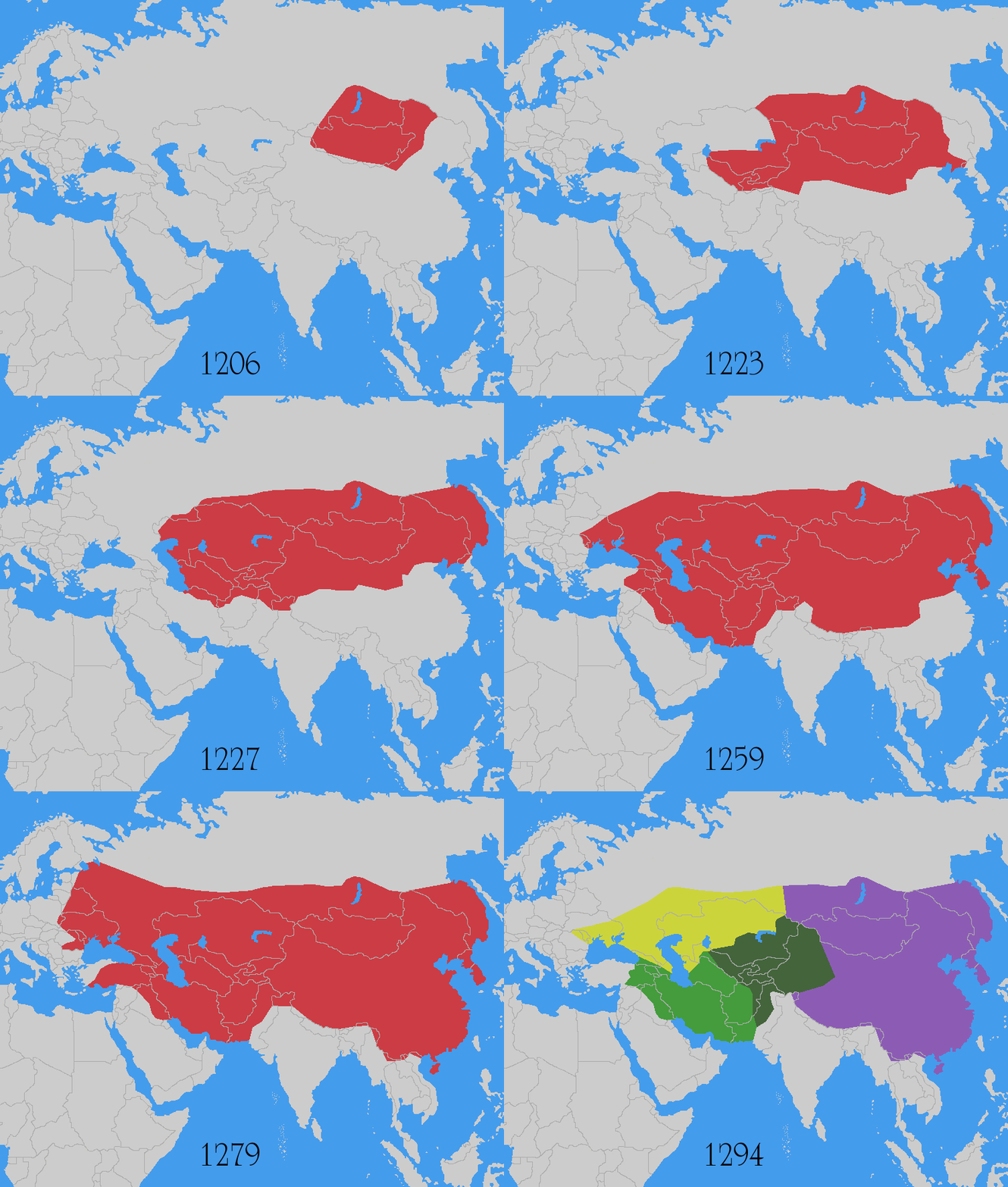
The ongoing invasion of Europe by millions of “refugees” from non-Western countries makes one wonder whether Western Civilization is finally at the end of its tether. The invasion may be the biggest threat to Europe since the Mongols came a-knocking, (watch this animated graphic to see how that went).

In September at American Thinker, Clarice Feldman wrote about The Camp of the Saints, “a novel of Europe being overrun by refugees from the Third World.” It reminded me of a 1990s article by Matthew Connelly and Paul Kennedy and I finally managed to find it: “Must It Be the Rest Against the West?” It ran in the December 1994 edition of the Atlantic; its subtitle: “Absent major changes in North-South relations, the wretched should inherit the earth by about 2025.”

The words “Islam,” Muslim,” and “jihad” don’t appear in the 8,399-word article. But the point is that invasion is something Europe’s leaders should have had on their radar. Yet, they seem to have been caught with their pants down. That or Europe’s leaders actually want the invasion. Perhaps they think the invasion is an opportunity to demonstrate that multiculturalism really works. But the invasion is just a continuation of the “stealth jihad” that’s been going on for decades.

Europeans should try to understand that Americans are repulsed and horrified by what’s happening to the Old Country. We love Europe. We would hate to see Europe become Eurabia, part of some hideous caliphate. We see commercials on TV for Viking River Cruises, and they beckon. All over America, we celebrate our European roots with festivals, such as Oktoberfest, St. Patrick’s Day parades, etc. Americans are obsessed with genealogy (video), and tracing our ancestors back to “the old sod,” back to Europe.

Some of my own fond notions about Europe were formed by watching old films, like Cinema Paradiso, La Dolce Vita, and The Umbrellas of Cherbourg. But in today’s Europe, some Muslims feel free to murder filmmakers.

Europeans shouldn’t forget what America has sacrificed for them. That includes 116,000 American military lives lost in World War I, and 405,000 in WWII. America has spent countless billions of Yankee dollars since 1917 on behalf of their suicidal continent. But Americans seem to have made such sacrifices just so Europe could be taken over by barbarians. What patsies we’ve been.

Not all Europeans passively accept the ugly situation their idiot leaders have put them in. In groups such as Stop Islamisation of Europe (SIOE) there may be some hope, (here’s SIOE’s website and Facebook page). A newer group is PEGIDA, which translates as Patriotic Europeans Against the Islamization of the Occident.

Europe’s political leaders, especially Germany’s clueless Angela Merkel, need to be removed from office. The snag in removing officials from power is that there are few mechanisms by which to do so. Citizens can mount protests, if that’s still allowed, but they’ll just be ignored by those in power. And by the time of the next regularly scheduled election, more destruction will have been done.

Europe was already too fractious to add millions more unassimilable aliens to the populace. The scariest aspect of the invaders is that 70 percent of them are single males traveling alone. The invaders need to be sent home, repatriated, or put in safe havens away from Europe.

Europe’s “leaders” have made an historic mistake of monumental proportions. Decent Europeans are watching in real time as their nations and their entire continent go to hell. Their elected leaders are throwing away their heritage and their future. How does a nation swap out its monstrous leaders while the damage is being done? A military coup in Germany may sound ominous, but a takeover by the military would be preferable to the current chaos.

If anything good can come out of the current invasion, it would be the breakup of the European Union. I keep waiting for some European nation led by someone with half a brain (or maybe half a pair) to finally throw in the towel and secede from the ill-conceived misbegotten experiment called “the EU.” Perhaps the breakup of the EU is the only way to save Europe from further Islamization.

In a 1978 speech, Margaret Thatcher invoked Benjamin Disraeli in telling her fellow Conservatives to remember that “England cannot begin again.” Invoking those two great British prime ministers, I presume to tell my fellow citizens of the West across the pond … Europe cannot begin again.

Jon N. Hall is a programmer/analyst from Kansas City. 


Source: http://www.americanthinker.com/articles/2015/11/europe_cannot_begin_again.html

Copyright - Original materials copyright (c) by the authors.

Do Israel's New Fighter Jets Mean Stealth Is Going Out of Style? - Ryan Faith


by Ryan Faith

The F-15SE, or Silent Eagle, that Israel is looking to buy is a pretty classic 4.5 gen design.

Israel just did something a wee bit nutty with their most recent wish list of US war goodies. It's one of those nerdtastically insider geek things that might actually mean some really interesting stuff.

So — drumroll please — reports have just emerged that Israel wants to buy a proposed, but as yet unmade, version of the F-15 fighter jet called the F-15SE Silent Eagle, in addition to several F-35s.

Okay, so it's not that exciting, unless you've been following the Israeli Air Force. But if you have, this purchase tells you something interesting about what advice those guys are getting from their strategic-planning Ouija boards on the topic of stealth.

To understand why this matters, let's roll the flashback reel. Right now, the Israeli Air Force flies a sizable fleet of US-made F-15 and F-16 aircraft (in various configurations). They've proven to be good, solid aircraft. (In 1983, an Israeli pilot was able to bring his F-15D back home after losing a wing in a mid-air collision. Yes, you read that right: a wing.) In technological terms, they're "fourth generation" or 4th gen jets, meaning they first came into service during the 1970s and have things like computers, advanced avionics, and other such stuff that their third generation predecessors lacked. 

So how do you level up from there? While there's no complete and universally agreed-upon list of everything that makes fifth-generation aircraft legit 5th gen, there is one inescapable requirement: that the plane be designed from the ground up as a stealth aircraft.

There are a lot of things that go into making an aircraft stealthy, but making an aircraft truly stealthy basically means baking stealth features into the design from day one. Mostly, this is because a huge part of stealth is about geometry, and if being the stealthiest jet in Stealth Town is your objective, you have to make some pretty complex aerodynamic and performance trades. While it's possible to do a whole lot of aftermarket stuff to a jet to make it stealthier, without incorporating those design features from the start, you'll always end up being a bit easier to spot on radar than a true 5th gen aircraft. After-market stealth bling will, to some extent, always be a matter of putting lipstick on a pig.
Which brings us to the notion of 4.5 gen (or 4+ gen) jets, which are, as the name would suggest, more advanced than 4th gen, but not full-on 5th gen aircraft. Some of these 4.5 gen jets are older 4th gen aircraft designs with aftermarket stealthification. Others skip the stealth stuff altogether and just incorporate all the super sweet, top-end electronic sensor-fusion gear of a 5th gen fighter without doing that clean-sheet all-stealth design stuff. But the one thing that is clear is that they're more advanced than 4th gen and less advanced than 5th gen aircraft.

The F-15SE, or Silent Eagle, that Israel is looking to buy is a pretty classic 4.5 gen design. The basic F-15 first flew in 1972, but this version has been marketed by Boeing as a competitor to the 5th gen F-35. But it's lost every competition where it's gone head-to-head against the F-35. The F-15SE has been tweaked to be stealthy against air-to-air radars, but it's not quite as invisible to larger ground-based radars. If you look at the F-15SE from any direction other than head-on, it's a great deal less stealthy than the F-35.

Cost doesn't seem to be much of a factor here. The two jets are within shouting distance of each other. The Israelis are picking up their brand-new F-35s at about $110 million each; the F-15SE comes in just a bit below that, at about $100 million per jet. And really, what's another $10 million or so between friends?

It's important to note at this point that, to many people, it's an absolute article of faith that the F-35 is a terrible, horrible, no good, very bad plane. If that's the case, they might expect the Israelis to skip the F-35 altogether in favor of getting more F-15SEs. 

Advocates of the F-35, who claim it is the best thing since powered flight, similarly have a hard time explaining why the Israelis — who are already committed to buying a bunch of F-35s — would turn around and buy the F-15SE, the plane that keeps losing in competitions to the F-35. 

Now, sure, the Israelis could reverse-engineer the F-15SE and also do homebrew modifications to their existing fleet of F-15 aircraft to upgrade them all to 4.5 gen. But that still leaves them with a large number of F-16s, and if they wanted to upgrade those as well, then they should have asked for a squadron of the newest 4.5 gen F-16s. They haven't. In fact, the long-term plan is for Israel to replace all of its F-16s with newer F-35s. Replacing the F-16s with F-35s and upgrading F-15s to F-15SE. Well, maybe, maybe not. The Israeli Defense Ministry isn't sharing all of its top-secret plans with me right now, so let's move on.

Watch VICE News' short War Games: Israeli Urban Warfare

The long and short of it is that, overall, it doesn't make a lot of sense for Israel to buy both the planes that won and lost in head-to-head competition, and there are a few theories about what's going on. This one probably won't explain all of it, but may shed some light on some of the decision-making.

There's a dirty little secret that's just barely starting to bubble up. It'll be a few years before it's widespread conventional wisdom, but if you listen very, very closely, you can hear it being whispered: Stealth ain't gonna be around forever, folks.

In a speech last February, then-Chief of Naval Operations Admiral Jonathan Greenert was quoted by the US Naval Institute News as saying: "I don't want to necessarily say that [stealth is] over but let's face it, if something moves fast through the air and disrupts molecules in the air and puts out heat — I don't care how cool the engine can be — it's going to be detectable."

And it's not just the heat generated by air friction that could be stealth's undoing. This Aviation Week article notes: "Low radar cross section is a niche capability, and new sensor technology advances can make it less important. China, India and Russia are already finding weaknesses in stealth as they develop it for their own advanced strike aircraft." The story then goes on to quote a senior Israeli Air Force official as saying (of the F-35) "We think the stealth protection will be good for 5–10 years, but the aircraft will be in service for 30–40 years."

In terms of technology programs, five to 10 years is more or less an appropriate length of time to develop a new, medium-to-high complexity system based on well-understood physics. So, if the Israeli guy isn't just pulling a number out of thin air, it would suggest that somewhere folks have just about cracked the stealth code and are now beginning work on operationalizing it somehow. Granted, it may not have anything to do with that air-friction trick Greenert mentioned, but a lot of very smart people all over the world have been working on defeating stealth, so it's only a matter of time before someone figures out how to beat it.

And this gets back to something inherent in 5th gen designs. Remember how 5th gen aircraft need to be designed from the ground up as stealth aircraft to maximize their ninja-like ability to avoid radar? Well, that design choice comes at a price. A 4th gen aircraft might be designed to balance speed, range, and payload. But if you add an additional requirement, like stealth, it makes the design more complicated. It won't perform as well in terms of speed, range, and payload. It doesn't matter what the specific capability you're adding happens to be: it could be air-to-air capability, ability to pound ground targets, sensors, what have you. The bottom line is the same, adding performance objectives leads you ever closer to being a jack of all trades and master of none. And in this case, 4.5 gen aircraft have a key advantage: they were never built with stealth in mind.
In other words, once you throw all the stealth stuff out the window, a 4.5 gen aircraft may be able to outperform a 5th gen aircraft. Thus, if stealth didn't matter at all, maybe the F-15SE could beat the F-35 head-to-head. But even something that degrades stealth capability somewhat won't mean that the stealthiness is completely going to disappear. So, right now, buying both the F-35 and F-15SE means that whether stealth is degraded only a tiny bit or a lot, they're covered.

The Israeli Air Force may find itself operating over countries with vastly different technological capabilities. At one end, you have places like Iran sporting some serious high-end Russian air defenses. At the other end of the spectrum, some countries in Israel's neighborhood, like Yemen, do not even have a proper air force. 

By adding the 4.5 gen Silent Eagle into the mix, Israel will have a whole host of planning options. In a super intense environment, they could pair F-35s with F-15SEs and leave everyone else at home. If the threat was intermediate, they could treat both the F-35 and F-15SE as the high-end aircraft and pair them with the older 4th gen stuff. Even without doing all the number-crunching, it seems that this purchase will just about double the number of Israel's deployment options.

If adding the not-quite-top-of-the line 4.5 gen stuff to the mix really does double the fun, then countries like Russia and China that are developing both 4.5 gen and 5th gen aircraft may find that they can do a whole lot more with the mix than they can by limiting themselves to either one or the other.

This, in turn, has further implications for US decision-makers on what they need to plan for down the road. But that's a whole different discussion about aircraft buys and industrial base and all that stuff. If I were an industry watcher, I'd be paying very close attention to how countries are thinking about balancing 5th gen, 4.5 gen, and 4th gen aircraft over the next five or so years as a very early leading indicator of how we should all place our bets about when we'll see the end of the decades-long dominance of stealth technology.

Follow Ryan Faith on Twitter:@Operation_Ryan
Photo via Boeing


Ryan Faith

Source: https://news.vice.com/article/do-israels-new-fighter-jets-mean-stealth-is-going-out-of-style

Copyright - Original materials copyright (c) by the authors.

Iran: Poets Face 99 Lashes and Prison - Amir Taheri


by Amir Taheri

  • "She writes something but means something else." — Tehran Islamic Prosecutor.
  • The irony in all this is that Ekhtesari is not a political poet. In fact, she has written that those who try to use poetry for politics betray both.
  • The sentencing was made easier thanks to a recent lecture by "Supreme Guide" Ayatollah Ali Khamenei, laying down the rules of what he believes "good Islamic poets" should observe when writing poetry.
  • The poet Sa'id Sultanpour was abducted on the day of his wedding and shot dead in a Tehran prison. Rahman Hatefi-Monfared had his veins cut and was left to bleed to death in the notorious Evin Prison.
  • "I hope to see the day when no one is sent to jail in this land for writing poems." — Mehdi Mussavi, convicted poet.

Does a seminar on reforming the meter and rhyme schemes of Persian poetry violate "Islamic values" and threaten the foundations of the Islamic Republic of Iran?

That is the view of the Islamic Court in Tehran, which last month sentenced two poets, Fateme Ekhtesari and Mehdi Mussavi, to nine and 11.5 years in prison respectively, plus 99 lashes of the cane for each in public.

One of the two, Mrs. Fateme Ekhtesari, was sentenced to 11.5 years for "undermining the security of the Islamic state" by composing and reciting in public a number of "poems full of ambiguity and capable of being read in deviant and dangerous ways."

The Islamic Court in Tehran sentenced two poets, Fateme Ekhtesari (left) and Mehdi Mussavi (right), to nine and 11.5 years in prison respectively, plus 99 lashes. Ekhtesari was charged with reciting "poems full of ambiguity and capable of being read in deviant and dangerous ways." Mussavi was charged with "insulting sacred values of the Islamic ummah."

Ekhtesari is a surrealist poet whose verse could, and indeed is intended to, be read in many different ways. One of her diwans (collections of verse), for example, is called "Crying on the Shoulder of An Egg". Another comes under the title "A Feminist Discourse Before Baking Potatoes."

Feminism is a strong theme with Ekhtesari, who insists that, as God created both men and women from the same "red mud" mentioned in the Koran, there is no reason to prevent the latter from enjoying any freedoms available to the former.

The Tehran Islamic Prosecutor, however, insisted that Ekhtesari's "ambiguous poems" were meant to pass "dangerous political messages that could encourage people to distance themselves from the True Faith."

"She writes something but means something else," the prosecutor claimed. "Her trick is to avoid saying anything in a straightforward way, creating space for all manner of dangerous thinking."

The prosecutor based part of his case on the claim that what matters in Islam is "zikr," that is to say, a constant remembrance of God by repeating, if necessary in silence and to oneself, the formula "There is no God but Allah". Those who abandon "zikr" for its opposite -- which is "fikr", that is to say, thinking -- move away from the Path of Faith.

The irony in all this is that Ekhtesari is not a political poet. In fact, she has written that those who try to use poetry to advance political ideals betray both.

As editor of the monthly literary magazine Only One Tomorrow, Ekhtesari offered space to writers and poets across the ideological spectrum, including some Khomeinists. Her magazine was shut down soon after Hassan Rouhani became president.

However, as a poet, Ekhtesari cannot but be affected by the ambient social and political order in her homeland. She cannot turn her face the other way when she sees ugliness, oppression and terror -- themes that force their way into some of her poems.

Ekhtesari is also an original theoretician of poetic modes. Her collection of essays entitled "Linguistic Tricks in Postmodern Sonnet" is both intriguing and instructive.

Ekhtesari's fellow convict-cum-poet is Mehdi Mussavi, who received a six-year sentence. Mussavi is the founder and principal animator of a poetry workshop in Tehran where Ekhtesari has often spoken and recited her poems. The workshop is supposedly dedicated to developing a new form that Mussavi calls "postmodern ghazal." The classic form of Persian sonnet, ghazal, has been the subject of numerous attempts at modernization, notably by Simin Behbahani, one of Iran's greatest contemporary poetesses.

Like Behbahani, Mussavi argues that, having experimented with modern forms, including European-style prose-poetry, for almost a century, Persian poets need to return to traditional forms, albeit with changes to reflect modern realities.

Mussavi rejects the argument of the older generation poets such as Ahmad Shamlou, who claimed that the traditional ghazal is so beholden to the musicality of its meter and rhyme schemes that it cannot relay any meaning in a powerful way.

According to Mussavi, once the Persian poet has learned to play by the traditional rules, he could invent virtually countless meters and rhymes capable of expressing any sentiment.

Literary opponents of Mussavi's theories, especially on the left, argue that he, like Behbahani and other reformers of the ghazal before them, suffers from a sense of insecurity in a changing world where the Iran they knew is being remolded into something repulsive in the name of Islam.

The Islamic Court, however, charged Mussavi with propagating "immoral images" in his poetry and thus "insulting sacred values of the Islamic ummah."

Equally painful is the Islamic Court's decision to impose a blanket ban on the publication and recital of any poems by Ekhtesari and Mussavi. Under an edict issued by the Islamic Guidance Ministry in 2003, people like Ekhtesari and Mussavi, who are found guilty of "insulting Islam" and thus put on the official index, become "non-persons" -- even their names and pictures are banned.

Both Ekhtesari and Mussavi had spent several months in prison two years ago, but were released after the Islamic Prosecutor Ayatollah Ra'isi failed to prove any political crime.

That is why this time, the prosecutor focused on a claim that the poets had attacked "the sacred tenets of the faith".

The sentencing was made easier thanks to a recent lecture by "Supreme Guide" Ayatollah Ali Khamenei laying down the rules of what he believes "good Islamic poets" should observe when writing poetry.

However, as exiled poet Yadallah Roya'i notes, one could write an advertising text or a police report on demand, but not poetry. "Even the poet cannot order himself to write poetry," Roya'i noted." The poet is like a tree, shedding its leaves and flowers so that there is room for future leaves and flowers."

Iran is one of the few countries in the world where poetry has always been regarded as the highest form of literary creation. In Iranian cities, streets and parks were more often named after poets than conquerors or empire-builders or, until the mullahs seized power, Islamic saints and/or theologians. If an Iranian home has at least one book, it is likely to be a collection of poems.

And yet, with the seizure of power by mullahs in 1979, Iran has experienced one of the most dangerous phases in its long history, as far as poets -- and intellectuals in general -- are concerned.

Another irony is that both the founder of the regime, the late Ayatollah Ruhollah Khomeini, and his successor as "Supreme Guide" Ali Khamenei, cast themselves as amateur poets. Khomeini banned publication of his own divans while he was alive, believing that appearing as a poet might soften the dour persona he was building as leader of a revolution that could execute 4000 people on a weekend.

Since his death, however, hundreds of his poems, most of them traditional-style sonnets (ghazals) have been published by the foundation bearing his name. Ali Khamenei does not publish his poems, but organizes private readings with a few dozen "appreciators" once or twice a year and is reportedly "in seventh heaven" when his entourage quote one of his verses.

Ekhtesari and Mussavi have been sent to jail, not killed. Other poets have not been so lucky.
Hashem Shaabani was hanged on the eve of President Rouhani's visit to Ahvaz in 2014. Shaabani was not the first Iranian poet to be murdered by the mullahs. The left-wing poet Sa'id Sultanpour was abducted on the day of his wedding on Khomeini's orders, and shot dead in a Tehran prison. Rahman Hatefi-Monfared, writing under the pen-name of Heydar Mehregan, had his veins cut and was left to bleed to death in the notorious Evin Prison. Under President Hashemi Rafsanjani, a plan to kill a busload of Iranian poets on their way to a festival in Armenia failed at the last minute. Nevertheless, Rafsanjani succeeded in eliminating more than a dozen writers and poets. The worst spate of killings happened under President Khatami, when more than 80 intellectuals, including the poets Mohammad Mokhtari and Mohammad-Ja'far Pouyandeh, were murdered by the Islamic regime's security agents.

Let's give the final word to Mussavi: " I hope to see the day when no one is sent to jail in this land for writing poems." Inshallah!


Amir Taheri

Source: http://www.gatestoneinstitute.org/6839/iran-poets-prison

Copyright - Original materials copyright (c) by the authors.