Tuesday, June 20, 2017

Syrian Warplane Bombing: A Turning Point In The Conflict? - Joseph Klein


by Joseph Klein


The US sends Assad and Russia a message.


In what may turn out to be a major inflection point in the Syrian conflict, an American fighter jet on Sunday shot down a Syrian warplane, which was said to be dropping bombs near U.S.-supported Kurdish and Arab ground forces fighting ISIS in the vicinity of ISIS’s de facto capital of Raqqa. It was the first time during the six year Syrian conflict that a U.S. jet had shot down a Syrian jet. In fact, it has been approximately 18 years since the U.S. had shot down a warplane belonging to any country since a Serbian plane was shot down over Kosovo in 1999.

The U.S. Central Command leading the anti-ISIS coalition effort said the Syrian jet was "immediately shot down... in accordance with rules of engagement and in collective self-defense of Coalition partnered forces." The statement added that the coalition’s mission was to defeat ISIS in Iraq and Syria and was not to fight the Syrian regime or its allies. However, it added that the coalition would not hesitate to defend itself or its partner forces “from any threat,” and that “[T]he demonstrated hostile intent and actions of pro-regime forces toward Coalition and partner forces in Syria conducting legitimate counter-ISIS operations will not be tolerated.”

According to a spokesman for the U.S. Central Command, the U.S. had first warned the Syrian plane away from the area, but to no avail. An F/A-18 “Super Hornet” thereupon shot down the Syrian plane.

Syria claimed its plane was targeting ISIS militants at the time, a dubious claim in light of the Assad regime’s long record of bombing civilians and all rebel groups indiscriminately in the name of combating “terrorism.”

Syria’s principal ally Russia regarded the U.S. attack on the Syrian warplane as a hostile act. It said that it would treat U.S.-led coalition planes and drones operating west of the Euphrates River where Russia’s air forces operate as “targets.” Russia also said it would suspend indefinitely the use of the communications channel that had been set up between the two countries for the purpose of reducing the potential for direct military confrontation between U.S. and Russian warplanes. Russia had made a similar threat after the U.S. missile strike on a Syrian airfield in retaliation for the Syrian regime’s alleged chemical attack on civilians last April, which turned out to be a hollow threat.

"All kinds of airborne vehicles, including aircraft and UAVs of the international coalition detected to the west of the Euphrates River will be tracked by the Russian SAM systems as air targets," the Russian Defense Ministry said in a statement. "The US’ repeated combat operations under the guise of ‘combating terrorism’ against the legitimate armed forces of a UN member-country are a flagrant violation of international law and an actual military aggression against the Syrian Arab Republic."

The Pentagon responded with a stern warning to the Russians that the U.S. would not be deterred in its support of coalition operations against ISIS. Department of Defense spokesperson Maj. Adrian J.T. Rankine-Galloway said coalition aircraft would continue conducting "operations throughout Syria, targeting ISIS forces and providing air support for Coalition partner forces on the ground."

General Jack Keane (Ret.), a Fox News military analyst, believes Russia is bluffing. "That's rubbish,” Keane said on "Fox & Friends."They're not gonna shoot at U.S. airplanes. They're not gonna take on the United States. They have very limited capability in Syria by comparison to U.S. capability."

General Keane may be underestimating Russia’s defense capabilities in Syria, which include surface-to-air missiles. In particular, Russia’s S-400 air defense system is highly sophisticated, with a range of more than 200 miles. Nevertheless, the correct response to Russian President Vladimir Putin’s bullying is to push back in no uncertain terms. The United States cannot allow Russia to declare what amounts to a no-fly zone in Syria that would undermine the U.S.-led coalition’s fight against ISIS. The U.S. has not interfered with Russian aircraft operating in Syria. Nor should Russia interfere with ours. Not only would a surrender to Russian threats simply invite more Russian aggression. It would send a signal of weakness to ISIS and al Qaeda. And it would embolden Iran, a staunch ally of the Syrian regime along with Russia, to continue its quest for hegemony in the Middle East region.

In fact, Iran added to the seething Syrian cauldron on Sunday with its own launching of missiles into Syria. The Iranian Revolutionary Guards Corps claimed the missiles were aimed at “the headquarters and meeting place and suicide car assembly line” of “ISIS terrorists.” However, nothing the Iranian regime says can be taken completely at face value. Iran is no doubt also sending a message to the U.S.- led coalition members and Israel that the gains the Syrians and Hezbollah forces have been making with Iran’s support in southern Syria, near the Israeli and Jordanian borders, would be defended with Iranian missiles if necessary. "The Saudis and Americans are especially receivers of this message," Gen. Ramazan Sharif of the Revolutionary Guard told Iranian state TV in an interview, as quoted by the Associated Press. Moreover, whatever territory Iran helps Syrian forces and Hezbollah militia take away from rebel control, including from ISIS, increases Iranian control over strategic positions bridging Iraq and Syria. This in turn would enhance Iran’s so-called “Shia crescent.”

Whether the U.S. downing of the Syrian plane turns out to be just another bump in the road of the long conflict in Syria or represents a true inflection point, accelerating a potential direct collision between the United States and Russia, remains to be seen. However, the Trump administration needs to be clear-eyed in the strategic objectives it seeks to achieve in Syria to avoid getting drawn into a prolonged ground war. Regime change in Syria must not become the objective for its own sake. The disastrous outcomes in Iraq and Libya prove what can lie over the cliff of regime change.

Defeating ISIS should remain the number one objective. Containing Iran is also a key strategic objective, given its hegemonic ambitions and its state sponsorship of terrorism. We should not be fooled into thinking that Iran’s assistance in fighting ISIS will come without a heavy price that may turn out to be even more dangerous in the long run than ISIS to the U.S. national security interest.

As for Russia, we have little choice at this point but to live with its presence in Syria in support of the Assad regime, lest we risk an all-out military confrontation that could spin out of control. Efforts are already underway behind the scenes to lower tensions from the latest incident. A Russian official has clarified that Russia would only threaten coalition jets that "take action that pose a threat to Russian aircraft." We can take reasonable steps to demonstrate that striking Russian aircraft is not our intention. However, the U.S. should not permit Russia to interfere in any way with the U.S.-led coalition fight against ISIS, which means not allowing Russia to put into effect its own version of a no-fly zone against coalition aircraft operating in support of coalition forces fighting ISIS anywhere in Syria. Russia should also not be permitted to shield the Syrian regime from a further military response if it once again uses lethal chemical weapons against its own people.   

Most importantly, we need to stop being reactive and start thinking strategically. As Daniel Nidess, a guest columnist, wrote recently in Foreign Policy:
“We need to get back to playing chess — to deliberately planning several moves ahead and accepting that achieving some interests may mean temporarily sacrificing others. The alternative is to continue the trend of the last decade and a half of U.S. foreign policy, which has alternated between half-heartedly committing to our stated goals and sleepwalking through shortsighted escalations that lack clear objectives, both of which have left the U.S. worse off strategically.”

Joseph Klein is a Harvard-trained lawyer and the author of Global Deception: The UN’s Stealth Assault on America’s Freedom and Lethal Engagement: Barack Hussein Obama, the United Nations & Radical Islam.

Source: http://www.frontpagemag.com/fpm/267046/syrian-warplane-bombing-turning-point-conflict-joseph-klein

Follow Middle East and Terrorism on Twitter

Copyright - Original materials copyright (c) by the authors.

Is Syria Wagging the Russian Dog? - Stephen Bryen


by Stephen Bryen

This is very tricky waters for the United States too. A big confrontation with the Russians is a very bad idea with unforeseeable and dangerous consequences.

The U.S. has shot down a Syrian Su-22 near Ja'Din and close to the strategic dam at Al Tabqa. The Sukhoi 22M series, the model in the Syrian inventory, is an old and relatively slow aircraft primarily used for bombing targets. First produced in 1970, the Russians improved the model over the twenty years it was manufactured (until 1990). It is entirely noncompetitive against top U.S. jet fighters including the F-18 that shot down the Syrian Sukhoi.

It is unlikely the Syrian pilot had any warning before being shot out of the sky. Indeed, the warning issue is what is at the heart of the dispute between Russia and the United States, and it may tell us more than the Russians would like us to know about their unstable relationship with Syria.

According to the Combined Joint Task Force official report, at around 4:30 P.M. Syria time, there was a Syrian attack on Ja'Din which was held by the Syrian Democratic Forces, or SDF. The SDF is "multi-ethnic and multi-religious alliance of Kurdish, Arab, Assyrian, Armenian, Turkmen and Circassian militias." The SDF took a number of casualties before Coalition aircraft chased the Syrians away. Immediately on the heels of the Syrian attack, the U.S. made use of what is called the deconfliction hotline and called the Russians. A little more than two hours later, another Su-22 was bombing in the same area and this is the plane that the U.S. shot down. There was no further call to the hotline, and while not precisely stated it is nearly certain that the Su-22 was not warned in any way by the approaching F-18. 

The U.S. action is consistent with the agreements reached with the Russians. However, the Russians are claiming the U.S. did not use the hotline. Without saying so, they are likely treating the second incident as one that was separate from the first. Of course, this is something of a reach on their part, but it is probably the only response the Russians could have given under the circumstances because the Syrians went ahead with another airstrike on their own after the deconfliction warning was initially given.

Why would the Syrians do this? It boils down to an argument between the Russians and the Syrians over how to treat the Kurds. Last year, the Russians sponsored a peace proposal for the Kurds that would have given them autonomy inside a new Syrian constitution that ultimately would have divided the country into cantons, keeping the appearance of central Syrian Alawite control but in reality changing the nature of the existing unitary state into something different and perhaps acceptable to all sides in the conflict. Moscow flew in a delegation of experts from the Foreign Ministry and Defense Ministry to meet with the regime and Kurdish representatives. It appears to have been Moscow's view, which is largely President Putin's idea, that this solution would achieve a number of important goals: move the peace process forward and separate the Syrian Kurds from the Americans. Apparently, the Russians failed to do their homework, for while the Syrian Kurds appeared to be onboard, the Assad regime was contemptuously against the deal and rejected it out of hand, the result being the Moscow delegation was sent home emptyhanded or worse. The current Syrian regime attack on the Kurds near Ja'Din should be seen exactly in this context. 

Assad does not want to be pushed into any deal by his sponsors. Neither do the Iranians or Hizb’allah. But the Russians have repeatedly signaled that they want the Syrian problem resolved. The reasons for this are not hard to see. The Russians, even though their arms sales have spiraled up thanks to their successful show of force in Syria, are bleeding money. They can ill afford to stay in Syria for very long. Furthermore, there are Russian casualties and this information, though suppressed has a way of getting around in Russia and undermines Putin's popularity. There is also the risk of a big confrontation with the United States, something the Russians really want to avoid; and an equal risk that if the Russians lose control there can be provocations by Iran and Hizb’allah plus Syria against Israel that will trigger a general war that would wipe out the Syrian regime. That would be a terrible defeat for the Russians.

This is very tricky waters for the United States too. A big confrontation with the Russians is a very bad idea with unforeseeable and dangerous consequences. The U.S. interest in Syria is not at all strategic; ISIS, as much as it is a threat to stability in some countries, doesn't amount to much and in any case is slowly being defeated. Indeed, with far less military commitment, the U.S. is objectively doing far better against ISIS than against the Taliban in Afghanistan. The best policy for the United States is to stay the current course and destroy ISIS. At the same time, the U.S. is obliged to protect its allies, especially the Kurds (even strong-arming the Turks) and this is precisely the point of the shoot down this week.

For Putin, the shoot down of the Su-22 is a defeat, but not a defeat against the Americans. It is a defeat handed to Putin by the Syrians who have boxed him in and made his hotline and his efforts to find a bridge to the Americans a failure so far.

Now Putin has to decide if he can do an end run on Assad. It is too bad that the U.S. administration, under fire by the Congress over Russia, has its hands tied.

Stephen Bryen

Source: http://www.americanthinker.com/articles/2017/06/is_syria_wagging_the_russian_dog.html

Follow Middle East and Terrorism on Twitter

Copyright - Original materials copyright (c) by the authors.

Giving Terrorists a Heads-Up - Heather Mac Donald


by Heather Mac Donald


A proposed law would force the NYPD to publicize the details of its surveillance technology.


Reprinted from City-Journal.org.

A bill in New York’s city council would require the New York Police Department to reveal crucial details about every surveillance technology that the department uses to detect terrorism and crime. Ninety days before the NYPD intends to implement a new surveillance technology, it would have to post on the Internet a technical description of how the new tool works, and how the department plans to use it. The public would have 45 days to comment on the proposed technology; the police commissioner would then have 45 days to respond to the public comments before he could actually start using the new capacity.  Existing technologies would also have to be retroactively submitted to public review.

Perhaps aware that this moment may not be ideal for promoting what would be, in effect, a terrorists’ manual on how to evade discovery in New York City, the bill’s supporters have hilariously taken to casting it as a pro-illegal alien, anti-Trump gesture. New York is a “sanctuary city, now in open resistance to the Trump administration,” two members of the Brennan Center for Justice wrote in an op-ed advocating for the so-called Public Oversight of Surveillance Technology (POST) Act.  (The Brennan Center wrote the POST Act for council members; the center has pushed similar bills across the country, including in Seattle and Oakland, two cities that have been particularly vulnerable to “anti-fascist” violence.) The city council press release claims that the bill “strengthens New York City’s commitment as a sanctuary city . . . as the Trump administration seeks to increase surveillance across America.”

In fact, the proposed law has nothing to do with New York’s deplorable status as a sanctuary city. Criminal illegal aliens avoid lawful deportation in New York because city and police officials release them back to the streets in defiance of Immigration and Customs Enforcement detainer requests, not because of sophisticated surveillance technologies. But though the bill would have no effect on the city’s campaign to thwart immigration enforcement, it would impede the city’s ability to stay one step ahead of terrorist planning. Memo to the council: counterterrorism is not a leisurely activity compatible with lengthy public review and administrative red tape. It requires nimbleness and speed in the face of a rapidly evolving threat. And disclosing to the enemy the extent of, and details about, your surveillance capacities provides an invaluable blueprint for foiling those capacities.

Supporters of the bill are playing the race card as well, claiming that the bill is necessary to counter the NYPD’s historic tendency to oppress minorities. The managing director of the Bronx Defenders claims, without evidence, that the NYPD has illegally surveilled Black Lives Matter activists. Council members Dan Garodnick and Vanessa Gibson argue that “Surveillance technology often has a disproportionate, harmful impact on communities of color.” This claim is ludicrous. The radiation detectors that ring the city looking for nuclear threats, say, or the network of public cameras that protect critical infrastructure and sensitive buildings, have no disproportionate impact on minorities or any other group, other than on someone looking to do the city harm.

As for privacy concerns, the anti-surveillance Left has never grasped the constitutional principle that the Fourth Amendment has no bearing on activities conducted in the open. A police officer does not need a warrant to observe a suspicious individual on a street casing a target; the police department does not need a warrant to erect a camera in a public space capturing activities visible to other members of the public. The NYPD does need to persuade a court that it has probable cause to surveil any activity involving a legitimate expectation of privacy, such as a cell-phone conversation, and the department complies with those warrant requirements. Any surveillance that could implicate political activity already is subject to extensive judicial and civilian oversight. 

Pretending to have expertise on terror tactics, the Brennan Center declares that none of the information disclosed through the POST Act will be of value to a potential terrorist or criminal. The chance that Brennan Center lawyers understand better than the NYPD’s counterterrorist experts how terrorists leverage information is zero.

The council press release frankly acknowledges that the bill is just a “first step” toward “limiting the unchecked use of surveillance technologies that . . . feed into a broader national surveillance state.”  In other words: If we get this bill, we’re coming for more.  Many of the law’s supporters, such as the Electronic Frontier Foundation, oppose all government secrecy, no matter how essential to public safety. But the agenda of the POST Act is broader even than shutting down lawful surveillance. It is the latest outgrowth of the movement to eviscerate all policing, a movement that encompasses the council’s ongoing effort to end public-order enforcement (also known as broken-windows policing). That movement now drapes itself in anti-Trump fervor. If it succeeds, the public will have much more to fear than the fictitious “national surveillance state.”

Heather Mac Donald is the Thomas W. Smith Fellow at the Manhattan Institute, a contributing editor of City Journal, and the author of The War on Cops.

Source: http://www.frontpagemag.com/fpm/267038/giving-terrorists-heads-heather-mac-donald

Follow Middle East and Terrorism on Twitter

Copyright - Original materials copyright (c) by the authors.

Pre-Schoolers Stage Terror Display At A Gaza Kindergarten Graduation Ceremony - MEMRI


by MEMRI

The footage, which was posted on the kindergarten's YouTube channel on May 29, includes Hebrew lyrics threatening Israelis with missiles and terror attacks and mocking IDF soldier Oron Shaul, whose body has been held by Hamas since 2014.

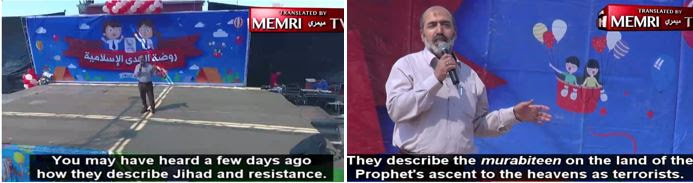
In a graduation ceremony at the Al-Hoda Islamic Kindergarten in Gaza, pre-schoolers, wearing uniforms and carrying mock guns and posters of Islamic Jihad leaders, staged a display of terror attacks against Israelis. The footage, which was posted on the kindergarten's YouTube channel on May 29, includes Hebrew lyrics threatening Israelis with missiles and terror attacks and mocking IDF soldier Oron Shaul, whose body has been held by Hamas since 2014. The graduating class is called "Pioneers of Tomorrow." For MEMRI TV clips of similar displays, see here and here. The ceremony is held annually at the Al-Hoda kindergarten, which is affiliated with the Islamic Jihad. Omar Fora, the head of the kindergarten association and a leader of the Islamic Jihad, delivered an address, and Islamic cleric Taher Al-Lulu slammed Saudi Arabia for "standing behind Israel and America."
 
MTV6077.JPG

Singer (in Hebrew): "Oh, for my Zionist enemy I have prepared all kinds of missiles, which will reach him where he lives. He will die if he does not leave my country immediately. I will make him drink from the cups of death – oh, what a bitter drink! You have reached Gaza, you have reached your death. If you haven’t been killed yet, captivity is all yours. Fida'i... Prepare to shoot. Oh Zionist, a missile will reach you where you live. You are dead, whether you are asleep or awake at home, or on a mountaintop.
"I will make you drink from the cup of death – what a bitter taste! You have reached Gaza, you have reached your death. If you haven't been killed yet, I will tear you to pieces. 
MTV60771.jpg

"Shoot accurately... You will hit the Kirya [IDF base in Tel Aviv]. Whether Nahal Brigade or Golani Brigade, whoever you may be, I will surprise you real good until you will beg for your life. 
MTV60772.JPG

"I will eat you without salt, Zionist, because you are most tasty this way. Yes, you, I'm talking to you: I have cooked death for you. You have sinned, made a mistake, so taste your bitter fate."
[…]
Audience: "Happy birthday to you. Happy birthday to you. Happy birthday, dear Oron. Happy birthday to you."
[…]
The children perform a choreographed routine featuring mock weapons and riot shields as well as basic military concepts such as moving in formation, reloading a weapon, and dropping down on the ground. At one point a small drone can also be seen flying over the stage. 
[…]
MTV60773.JPG

Taher Al-Lulu: "You may have heard a few days ago how they describe Jihad and resistance. They describe the murabiteen on the land of the Prophet's ascent to the heavens as terrorists. As for the millions and billions [of dollars] – they are given [by KSA] to the U.S., the number one criminal, which supports Israel.
[…]
MTV60774.JPG

"We are satisfied with the company of Allah, and we do not want millions and billions [of dollars] from the traitors and hypocrites who stand behind Israel and America."


MEMRI

Source: https://www.memri.org/tv/gaza-kindergarten-terror-display

Follow Middle East and Terrorism on Twitter

Copyright - Original materials copyright (c) by the authors.

Gaza's Humanitarian Crisis Is Fake News - Prof. Hillel Frisch


by Prof. Hillel Frisch

-- indicators such as life expectancy, growth in imports, and electricity demand suggest that the Gazan standard of living is rising, not declining.


BESA Center Perspectives Paper No. 503, June 20, 2017

EXECUTIVE SUMMARY: One of the most widespread myths about Gaza is that it is wallowing in poverty and forever on the verge of a humanitarian crisis as a result of the Israeli and Egyptian blockade. But indicators such as life expectancy, growth in imports, and electricity demand suggest that the Gazan standard of living is rising, not declining. If a genuine humanitarian crisis were to loom, the solution would be simple: disarm Hamas and divert its considerable expenditures on terrorism to the improvement of the welfare of Gaza’s inhabitants. 

The internet and social media have made the creation, rapid dissemination, and perpetuation of myths a feature of political life. One of the most widespread is the myth that Gaza is wallowing in poverty and forever on the verge of a humanitarian crisis as a result of the Israeli and Egyptian blockade.

There is no shortage of compelling evidence to dispel this myth. Life expectancy, for example, is highly correlated with the good life. Japan, Singapore, and Norway lead the world in life expectancy. The bottom of the list contains countries in sub-Saharan Africa and Southeast Asia, for example Bangladesh.

The myth-makers would like you to think Gaza is also towards the bottom of the list, but it isn’t. Quite the opposite, in fact. Gaza’s life expectancy of 74 is above both the world average (68 in 2010) and the average in the Arab states. This means that more than 3.8 billion people are living shorter, and probably harsher, lives than Gazans.

The difference in life expectancy between Gaza and those at the bottom of the list is in fact quite staggering. Life expectancy in Angola, Sierra Leone, Somalia, Cote D’Ivoire, and other countries ranges from 50.1 to 55 years, according to the World Health Organization.

Were Gaza on the list, it would rank 86th out of 189 countries. That would place it alongside Paraguay and Samoa, hardly states that conjure images of abject poverty. But why resort to facts?

Perhaps, one might argue, life expectancy in Gaza is a quirk of fate. Or perhaps it is declining because of the blockade imposed on Gaza. The blockade was put in place because Hamas, the murderous terrorist organization that took over Gaza ten years ago, specializes in bombing buses full of Israeli citizens, fires missiles from hospitals (as the United Arab Emirates Red Crescent Society accused Hamas of doing), and launches assaults against Israeli civilian neighborhoods.

Reality check: life expectancy in Gaza has not declined, and the blockade no longer exists. Before the brief curtailment of goods into Gaza from Israel in 2007, 10,400 trucks laden with goods entered Gaza monthly from Israel (these figures are from OCHA, the bitterly anti-Israeli UN agency). In 2016, 14,460 trucks of produce crossed from Israel into Gaza per month, a 34.6% increase from before the imposition of the so-called blockade. This means the purchasing power of Gazans has not declined (taking into account demographic growth).

Even the electricity crisis in Gaza points to a high, and rising, standard of living. The crisis is partly the result of the gap between supply and increasing demand. According to Muhammad Abu Amarayn, the spokesperson of the Gaza Energy Commission, there is a need for 450 MW of electricity – way above the maximum of 280 MW that Israel, a local energy supply station, and Egypt collectively supply.

OCHA estimated peak demand in Gaza in 2010 at 280 MW. This means that if Abu Amarayn is correct, demand for electricity in Gaza has increased by 60% in six years. Economists often use energy demand as a proxy for economic growth in the absence of accurate macroeconomic data, as in the case of Gaza. Increasing demand for electricity suggests prosperity, not a humanitarian crisis.

So why is this myth so widespread? The answer lies with those who have a vested interest in perpetuating it. By far the most important of these is Hamas. The terrorist group taxes all incoming goods to pay the salaries of its 30,000 terrorists and the bureaucracy that feeds them, as well as for training, missile production, and the digging of tunnels into Israel.  The budget supports 20,000 more on the public payroll whom Hamas has hired since 2007 – mostly teachers who preach jihadism in Gaza’s public schools. Hamas hopes that claims of a humanitarian crisis will bring in more aid, more demand for goods, and a greater flow of goods, all of which it will tax for its own benefit.

Hamas is not the only culprit. The international “humanitarian” relief industry has an obvious stake in perpetuating the myth. In few places in the world can relief agency workers live in a cosmopolitan hive such as Tel Aviv, enjoy a world class symphony, museums, and night life, and commute to the allegedly stricken areas. In Zimbabwe, you’re stuck in Zimbabwe. Championing the humanitarian crisis in Gaza is to champion a personal lifestyle at the expense of East African countries that need the aid much more desperately than Gaza.

Even if the purported humanitarian crisis were in fact to loom, the solution is simple. According to the budget and expenditures for the 2013 fiscal year released by the last official Hamas government in 2014, a mere 2% of total expenditures of $348 million went to development and only 11.2% to social welfare transfers (compared to 25% in Egypt, which has a similar socio-economic profile). The rival PA estimates that over two-thirds of Hamas expenditures went to the production of terror.

The answer to any humanitarian crisis would be for the world community to join forces with the Palestinian Authority, Israel, and by now most of the Gaza inhabitants to force Hamas to dismantle its military infrastructure and spend its money on human welfare rather than terrorism.

The worst thing that can be done is to increase humanitarian aid before the disarming of Hamas, as many Israeli officials and politicians foolishly suggest. Putting the cart before the horse will backfire. It will result in more terrorism, more missiles, and more tunnels into Israel, which will in turn result in a massive Israeli response that will be borne by Gaza’s population, as were the last three bouts of conflict in the past decade.

To be humanitarian means disarming Hamas, pure and simple.

View PDF

BESA Center Perspectives Papers are published through the generosity of the Greg Rosshandler Family


Prof. Hillel Frisch is a professor of political studies and Middle East studies at Bar-Ilan University and a senior research associate at the Begin-Sadat Center for Strategic Studies.

Source: https://besacenter.org/perspectives-papers/gazas-humanitarian-crisis-fake-news/

Follow Middle East and Terrorism on Twitter

Copyright - Original materials copyright (c) by the authors.

Livni and Dangers of Peace Theater - Caroline Glick


by Caroline Glick


Is Netanyahu building bridges with left-wing Israeli leadership?


Originally published by the Jerusalem Post. 


The homes of the terrorists who murdered Border Police officer Hadas Malka on Friday evening are now bedecked with Fatah flags and banners reading, “Our heroes.”

Far from condemning the terrorist attack, Palestinian Authority chairman and Fatah leader Mahmoud Abbas and his comrades are condemning Israel. Its security forces, they allege obscenely, committed a “war crime” when they killed the three terrorists to stop their rampage.


The only reason that these actions are not enough to warrant the US and the rest of the West – not to mention the Israeli Left – treating Fatah/PLO as the terrorist group they are and have always been, is because doing so would require them to stop playacting at peace making.


And they couldn’t have that.


Instead, they mimic or recycle “peace process” lingo about “windows of opportunity,” and reincarnate failed peace processors.


In apparent bid to do the latter, last Friday Channel 10 first reported that Prime Minister Benjamin Netanyahu asked MK Tzipi Livni to join his government with her Knesset faction and serve as his foreign minister.


While Likud denied the report, Livni claims Netanyahu made the offer through mediators that have been carrying out indirect negotiations between the two politicians.


Livni also has said that she rejected Netanyahu’s offer because she doesn’t believe he is willing to adopt her expansively pro-PLO positions.


Assuming that Livni is telling the truth and Likud’s denial is false, we need to ask why Netanyahu made the attempt.


There’s certainly no love lost between the two. Netanyahu’s last campaign centered on Livni’s radicalism.


The fact that the Labor Party formed a joint candidates list with Livni radicalized the party, he argued. Livni, for her part, was the main reason Netanyahu’s last government fell apart. She was disloyal and subversive throughout her brief tenure as justice minister.


Politically Livni has nothing to offer Netanyahu. As things stand today, Livni has no future in politics. She is unpopular in the Labor Party. And if she as an independent list, she is unlikely to even pass the four-seat threshold to be reelected to Knesset.


Yair Lapid, whose Yesh Atid Party has been leading Labor as the most popular Center-Left political party, has evinced no interest in joining forces with Livni.


So why would Netanyahu be interested in resuscitating her political career by making her his foreign minister? There are, it would seem, three possible explanations for the reported move.


First, Netanyahu may have decided to bring Livni into his government to ensure that he has a Knesset majority for some incipient peace deal with the PLO.


Leaving aside the plausibility of such a deal the fact is that if it were concluded, Netanyahu wouldn’t need Livni. Any credible deal with the PLO would receive the support of at least three quarters of the members of Knesset, including that of Livni and her faction members.


So it cannot be that he wants her for political cover.


Then there’s the possibility that he wants her because he wants to cut a deal with Abbas the terrorism supporter and Livni has lots of experience negotiating with Abbas and his deputies.


But then again, Livni’s vast experience aside, she’s never concluded a deal with the PLO. The only deal she ever concluded was with Hezbollah. And it was terrible for Israel.


As foreign minister during the 2006 war with Hezbollah, Livni negotiated the cease-fire agreement that became UN Security Council resolution 1701.


Her deal was a diplomatic and strategic disaster for Israel. Resolution 1701 legitimized Hezbollah – a terrorist organization and an Iranian proxy army – on the world stage. Resolution 1701 treated Israel and Hezbollah as peers. It also pretended that the Lebanese Armed Forces were a credible military force that operated independently of Hezbollah, when the truth was that Hezbollah worked hand in glove with the LAF during the war.


Even worse, the resolution effectively surrendered south Lebanon to Hezbollah control and paved the way for Hezbollah’s open takeover of the Lebanese government – and armed forces – the following year.


Livni claimed she had secured Israel’s interests by expanding UNIFIL, the UN forces under whose nose Hezbollah set up its bases in southern Lebanon and opened the war against Israel by killing and abducting the bodies of IDF reservists patrolling the border.


The notion that UNIFIL could be trusted to block Hezbollah from expanding its control over the border with Israel was a ridiculous and dangerous fantasy.


And it was a fantasy Livni enthusiastically embraced.


As for her negotiations with the Palestinians, both prime minister Ehud Olmert and Netanyahu placed her in charge of negotiating a peace deal with the PLO.


She failed to secure a deal despite the fact that she was willing to surrender Israel’s strategic interests to achieve one.


Her repeated failures reinforced the already self-evident conclusion, brought home yet against this week with the PA’s celebration of Hadas Malka’s murderers, that the PLO will not reach an accord with Israel, ever.


Given Livni’s serial incompetence and recklessness, it is hard to believe Netanyahu would dare to put the nation at risk by appointing her to head its negotiating team, yet again.


This leaves us with the third and frankly only plausible reason that Netanyahu may have decided to offer Livni the foreign ministry: US pressure.


This week, US President Donald Trump has sent his top negotiations people – Senior Adviser Jared Kushner and Senior Representative for International Negotiations Jason Greenblatt – to Israel to push Israel into negotiations with the PLO.


The White House’s press release ahead of their trip proclaimed, “President Trump has made it clear that working towards achieving a lasting peace agreement between the Israelis and Palestinians is a top priority for him. He strongly believes that peace is possible.”


Assuming that the White House is serious, it appears Netanyahu has decided to play along with the delusion Trump and his advisers share regarding the prospects of achieving peace.


Recognizing that the same PA that celebrates Hadas Malka’s killers’ as “heroes” and pays salaries to tens of thousands of other “heroes” every month will never, ever make peace with Israel, Netanyahu has all the same decided to play along with Trump and his advisers.


Doing so, he assumes, is less costly than trying to explain why their belief that a deal is possible is pure delusion.


And so he offered Livni the job.


The problem is that Netanyahu’s move – assuming that he did in fact make it – is not risk free. Indeed, it is downright dangerous.


It is dangerous first because it feeds the American delusion that peace is possible. This delusion has caused the US to pretend for 24 years that there is a difference between terrorism directed against Israelis and terrorism directed against the rest of the world.


This delusion has caused the US to fund Palestinian terrorism and train Palestinian terrorists and legitimize the PLO terrorist organization.


This delusion has caused the US to wrongly blame Israel for the absence of peace. And, as has happened hundreds and hundreds of times, last Friday this delusion took a human toll as Malka was murdered by members of Abbas’s US-supported Fatah terrorist group.


Hopefully, Likud’s denial really was true and Netanyahu never offered Livni the job.


Perhaps Livni made up the story to make herself look relevant at the twilight of her failed political career.


Probably the truth is somewhere in the middle.


But true or false, the story makes clear that Netanyahu has not met the central challenge he faces with the Trump administration.


Netanyahu’s central challenge is not to humor Trump, Greenblatt and Kushner by joining their peace theater. His challenge is to convince them that chances of reaching a deal with those who celebrate and reward Hadas Malka’s murderers are even smaller than Livni’s chances of getting reelected to the Knesset.


Caroline Glick is the Director of the David Horowitz Freedom Center's Israel Security Project and the Senior Contributing Editor of The Jerusalem Post. For more information on Ms. Glick's work, visit carolineglick.com.

Source: http://www.frontpagemag.com/fpm/267045/livni-and-dangers-peace-theater-caroline-glick

Follow Middle East and Terrorism on Twitter

Copyright - Original materials copyright (c) by the authors.
Bangladesh Turning More Radical - Mohshin Habib


by Mohshin Habib

"The Quran says: You [women] should stay at your home... Your duty is to stay at the husband's house and safeguard property. Your primary duty is to stay home and look after your family and children only. Do not go out even for shopping".

  • "Bangladesh is a Muslim country, no culture of statue establishment would be allowed by the people here... all of them must be removed." — Nur Hossain Quashemi, president, Dhaka branch of Hefazat-e-Islam.
  • "The Quran says: You [women] should stay at your home... Your duty is to stay at the husband's house and safeguard property. Your primary duty is to stay home and look after your family and children only. Do not go out even for shopping." — Shah Ahmed Shafi, chief of Hefazat-e-Islam.
  • Millions of Bangladeshi youths are increasingly wearing Islamic attire; and freedom of speech and freedom of movement are fast becoming a luxury -- if not a threat to the safety -- of Bangladesh's more secular-minded people, already feeling themselves a minority of sorts.
The government of Bangladesh, led by historically known secular political party Awami League, has completely surrendered to the country's radical forces regarding the demands, made by Hefazat-e-Islam and some other Islamic political and religious organizations, including the removal of the sculpture that was designed with the theme of the Greek goddess of justice. The statue was installed in last December following a decision taken by the Chief Justice. On May 26, at night, Bangladeshi authorities, in the name of the "consent of the chief justice", removed the sculpture from the front side of the Supreme Court. The current chief justice, incidentally, is the ever first non-Muslim to hold the constitutional post.

In reaction, the next day, after Friday prayers, Islamists, led by Hefazat-e-Islam, arranged a rally and expressed joy and satisfaction over removal of the sculpture and demanded further removal of all existing idols/statues/sculptures -- whatever one might call them -- across the country. "Bangladesh is a Muslim country, no culture of statue establishment would be allowed by the people here... all of them must be removed," said Nur Hossain Quashemi, the president of Dhaka branch of Hefazat-e-Islam, to the media.


The Supreme Court of Bangladesh, in Dhaka. (Image source: F2416/Wikimedia Commons)

Before the removal of the sculpture, a group of Islamist leaders, on April 11, led by Hefazat-e-Islam, met Prime Minister Sheikh Hasina at her official residence in Dhaka and demanded that she remove the sculpture.

"I don't like it myself," the prime minister said. "It is being called a Greek statue, but how will a Greek statue get here?"

She also said, "I will sit with the Chief Justice very soon. Have patience and don't create a situation about the issue. Have some faith in me; I will do whatever necessary about the matter." In the same meeting, she also recognized Dawra degree of Qawmi Madrasa education as equivalent to Master's degree of general education, even though it does not allow science or technology. The system is basically based only on Arabic-language learning.

The statue was eventually returned to the court, although on its rear side, but the problem remains.

Hefazat-e-Islam, a pressure group based in Chittagong, the second largest city of Bangladesh, has become the most aggressive voice in the country. In 2013, half a million Islamists in Dhaka and demanded implementation of 13 points that they launched including banning sculptures in public places. They were supported by almost all the Islamist organizations. Their points were:
  • Reinstate the phrase "Absolute trust and faith in the Almighty Allah" in the constitution as one of the fundamental principles of state policy.
  • Pass a law keeping a provision of capital punishment for maligning Allah, Islam and Prophet Muhammad and smear campaigns against Muslims.
  • Punish the "atheist" leaders of Shahbagh, bloggers and anti-Islamists who make "derogatory comments" about Prophet Muhammad (pbuh).
  • Stop killing, attacking and shooting Islamic scholars and madrasa students.
  • Free all the arrested Islamic scholars and madrasa students.
  • Lift restrictions on mosques and remove obstacles to holding religious programmes.
  • Declare Qadianis (Ahmadiyyas) non-Muslim and stop their publicity and conspiracies.
  • Ban all foreign culture including free mixing of men and women and candlelit vigils.
  • Stop setting up sculptures at intersections, colleges and universities across the country.
  • Make Islamic education mandatory from primary to higher secondary levels after scrapping women's policy and education policy.
  • Stop threatening teachers and students of Qawmi madrasas, Islamic scholars, imams and khatibs.
  • Stop creating hatred against Muslims among young generation by misrepresentation of Islamic culture in the media.
  • Stop anti-Islam activities by NGOs, evil attempts by Qadianis and conversion by Christian missionaries at Chittagong Hill Tracts and elsewhere in the country.
Common people as well as followers hear the sermons of Hefazat's leaders. In his preaching, Hefazat chief, Shah Ahmed Shafi, tells his followers not to educate girls and not to let women become financially independent:
"The Quran says: You [women] should stay at your home... Your duty is to stay at the husband's house and safeguard property. Your primary duty is to stay home and look after your family and children only. Do not go out even for shopping".
Considering the politics of voting and the Islamic sentiment, the government has omitted poems and stories from textbooks written either by secular writers or non-Muslims. Bangladesh now resembles the beginning of Iran's revolution. Millions of Bangladeshi youths are increasingly wearing Islamic attire; and freedom of speech and freedom of movement are fast becoming a luxury -- if not a threat to the safety -- of Bangladesh's more secular-minded people, already feeling themselves a minority of sorts.

According to the Institute for Policy Analysis of Conflict (IPAC), Southeast Asian and Bangladeshi extremism are becoming increasingly intertwined. The latest report of the institute examines how extremists come together in different ways. The report says:
  • Radicalized Bangladeshi migrant workers in Singapore and Malaysia are forming cells to plan violence at home (they apparently are not interested in attacking their host countries);
  • Bangladeshi students in Malaysia are forming partnerships with pro-ISIS groups in Bangladesh;
  • Bangladeshi and Southeast Asian ISIS fighters are meeting in Syria;
  • Pro-ISIS Malaysian and Filipinos are recruiting Bangladeshis to fight in southern Philippines; and
  • Indonesians and Malaysians are seeking to assist persecuted Muslims in Myanmar through contacts with members of the Bangladesh-based Rohingya.
Many fear that the country may soon be pressured into allowing more and more extreme versions of Islam.

Mohshin Habib, a Bangladeshi author, columnist and journalist, is Executive Editor of The Daily Asian Age.

Source: https://www.gatestoneinstitute.org/10528/bangladesh-radicalization

Follow Middle East and Terrorism on Twitter

Copyright - Original materials copyright (c) by the authors.

Judicial Watch: Susan Rice ‘Unmasking’ Documents Moved from NSC to Obama Library - Kristina Wong


by Kristina Wong

The National Security Council cannot hand over records relating to former National Security Adviser Susan Rice’s surveillance of Americans, because they have been moved to the Obama presidential library and may be sealed for as many as five years, conservative watchdog Judicial Watch announced Monday.

The NSC informed Judicial Watch in a letter dated May 23 that materials related to Rice’s requests to know the identities of Americans swept up in surveillance of foreign targets, including any Trump campaign or transition officials, have been moved to the library.
The NSC’s Director of Access Management John Powers said in the letter:
Documents from the Obama administration have been transferred to the Barack Obama Presidential Library. You may send your request to the Obama Library. However, you should be aware that under the Presidential Records Act, Presidential records remain closed to the public for five years after an administration has left office.
Judicial Watch earlier this year filed a Freedom of Information Act (FOIA) request for those documents, including of communications between Rice and any intelligence community member or agency regarding any Russian involvement in the 2016 elections, the hacking of Democratic National Committee computers, or any suspected communications between Russia and Trump officials.
Judicial Watch President Tom Fitton said the group will seek to find out when the records were moved, and warned of legal actions. He said:
Prosecutors, Congress, and the public will want to know when the National Security Council shipped off the records about potential intelligence abuses by the Susan Rice and others in the Obama White House to the memory hole of the Obama Presidential Library. We are considering our legal options but we hope that the Special Counsel and Congress also consider their options and get these records.
In April, blogger Mike Cernovich, Bloomberg, and Fox News revealed that Rice had requested to “unmask” — or unveil the hidden names of — Trump transition officials who were caught up in surveillance of foreign targets.

Typically, in surveillance of foreign targets’ communications, U.S. citizens mentioned or participating in them would have their names “masked,” or hidden, due to ethical, legal, and privacy concerns. However, government consumers of the intelligence can request to have their names unmasked if it is important to understanding the communications.

According to Cernovich, The White House Counsel’s office identified Rice as the person who had requested the unmasking, after examining her log requests, Cernovich reported on April 2. Bloomberg and Fox News would later corroborate the report. The revelation lent credence to Trump’s assertion that the Obama administration had been surveilling his transition team.

The Wall Street Journal editorial board has argued Rice had no reason to request the unmaskings. Since then, the House intelligence committee has also subpoenaed the intelligence community for information on unmasking requests by Rice, former CIA Director John Brennan, and U.S. Ambassador to the United Nations Samantha Power.

The misuse of unmasking came under media scrutiny after U.S. officials illegally leaked to the Washington Post a private conversation between former Trump National Security Adviser Michael Flynn and Russian Ambassador Sergei Kislyak on December 24. Flynn resigned after those communications, not because anything inappropriate was found, but because he had misrepresented those communications to Vice President Mike Pence.

https://html1-f.scribdassets.com/1il9hpcr285xed58/images/1-d2595d99c8.jpg

Kristina Wong

Source: http://www.breitbart.com/big-government/2017/06/19/judicial-watch-susan-rice-unmasking-documents-moved-from-nsc-to-obama-library/

Follow Middle East and Terrorism on Twitter

Copyright - Original materials copyright (c) by the authors.

Hidden trove of suspected Nazi artifacts found in Argentina - AP and Israel Hayom Staff


by AP and Israel Hayom Staff

Historic find "could offer irrefutable proof of the presence of top leaders who escaped from Nazi Germany," says Jewish community leader.


Police with a Nazi statue at Interpol headquarters in Buenos Aires over the weekend
|Photo credit: AP


AP and Israel Hayom Staff

Source: http://www.israelhayom.com/site/newsletter_article.php?id=43241

Follow Middle East and Terrorism on Twitter

Copyright - Original materials copyright (c) by the authors.