Sunday, March 25, 2018

Bolton’s appointment is a brilliant America first move - Caroline Glick


by Caroline Glick

The combination of Trump and Bolton no doubt puts fear in the hearts of America’s enemies, and heartens America’s allies.


John Bolton

President Donald Trump’s decision to appoint former UN Ambassador John Bolton to serve as his National Security Advisor is arguably the most significant single step he has taken to date toward implementing his America First foreign policy.

The news hit America’s enemies and competitors — from Pyongyang to Teheran to Moscow to Beijing — like a wall of bricks Thursday night.

Early criticisms on the political right of Bolton’s appointment have centered on two points. First, it is argued that Bolton, who has been involved in U.S. foreign policymaking since the Reagan administration, is a creature of the Washington foreign policy swamp.

While it is true that Bolton is from Washington – or Baltimore, to be precise – and although it is true that he held senior foreign policy positions in both Bush administrations, he has always been a thorn in the side of the establishment rather than a member of that establishment.

For the better part of three decades, Bolton has bravely held positions that fly in the face of the establishment’s innate preference for appeasement. He was a vocal critic, for example, of then-President Bill Clinton’s disastrous nuclear diplomacy with North Korea.

The 1994 “Agreed Framework” that Clinton concluded with Pyongyang was touted as a peaceful resolution of the nuclear crisis with North Korea. In exchange for shuttering – but not destroying — its nuclear installations, North Korea received light water reactors from the U.S. and massive economic relief. As Bolton warned it would, North Korea pocketed the concessions and gifts and continued to develop its nuclear weapons. In other words, far from preventing North Korea from developing nuclear weapons, the Agreed Framework preserved the North Korean nuclear program and enabled the regime to develop it effectively with U.S. assistance.

For his warnings, Bolton has been reviled as a “warmonger” and a “superhawk” by the foreign policy elite, which has gone out if its way to undercut him.

President George W. Bush appointed Bolton to serve as UN ambassador in 2005 in a recess appointment. Three moderate Republicans on the Senate Foreign Affairs Committee, Lincoln Chafee (RI), Chuck Hagel (ND), and George Voinovich (OH), signaledthat they would oppose Bolton’s confirmation, blocking it.

At the time, rumors surfaced that then-Secretary of State Condoleezza Rice had quietly undercut Bolton’s confirmation in private conversations with senators. Those rumors were denied, and Rice publicly supported Bolton’s confirmation. But in 2016, Rice, along with her mentor, former secretary of state James Baker, and her deputy and successor as National Security Advisor, Stephen Hadley, openly opposed President Trump’s intention to appoint Bolton Deputy Secretary of State. At the same time, all three lobbied Trump to appoint outgoing Secretary of State Rex Tillerson.

Bolton was a vocal opponent of Rice’s nuclear diplomacy with North Korea, undertaken after Pyongyang conducted its first nuclear test in 2006. He also opposed Rice’s pursuit of diplomatic ties with Iran through negotiations in Iraq. In both cases, as events showed, Bolton’s criticisms were all in place.

Rice’s nuclear diplomacy with North Korea emboldened the regime, and enabled its continued testing of nuclear weapons and development of ballistic missiles.

In Iran’s case, Rice’s negotiations with the Iranians in 2007 and 2008 set the stage for president Barack Obama’s nuclear talks with Tehran, which led to the 2015 nuclear deal. That deal, like the 1994 Agreed Framework with North Korea, preserves, rather than dismantles, Iran’s nuclear program while providing Iran with the financial means to expand its regional power through its terrorist proxies.

On the other hand, Bolton’s actions while in office brought extraordinary benefit to US national security. For instance, as Bush’s undersecretary of state for arms control and international security, in 2003 Bolton conceptualized and launched the Proliferation Security Initiative (PSI). The purpose of the PSI was to empower nations to interdict ships suspected of carrying weapons of mass destruction, delivery systems, and related materials from states and non-state actors of proliferation concern. Originally launched with 11 state members, today the PSI has 105 state members. Its members have interdicted multiple ships suspected of transferring illicit weapons systems to other states and to non-state actors.

Like Trump, Bolton is an opponent of international treaties that bind the U.S. in a manner that may be antithetical to its national interests, and prefers bilateral agreements that are tailor-made to defend America’s national interests. Bolton was a firm opponent of the Rome Treaty, which established the International Criminal Court. He worked avidly to vacate America’s signature from the treaty. Due largely to his cogent opposition, the Bush administration decided not to submit the treaty to the Senate for ratification. Bolton concluded 100 bilateral treaties with nations committing them never to present complaints against U.S. military personnel before the tribunal.

Bolton’s nationalist convictions, and his refusal to join the foreign policy elite in its adoration of diplomacy, whatever the substance, over a firm, fact-based pursuit of America’s national interests lies at the heart of the foreign policy establishment’s opposition to him.

Indeed, the level of hostility the foreign policy establishment has directed towards Bolton over the years has been so ferocious, it is a testament to his diplomatic skills, and success, that he has managed to persevere in Washington, in and out of office for forty years.

As to the second charge by conservative critics, that Bolton is a neoconservative interventionist, the fact is that he is neither a neoconservative nor is he a knee jerk interventionist. Rather, Bolton supports the judicious use of American power in the world to advance U.S. national security and economic interests when the use of force is the best way to achieve those interests.

It is true that Bolton supported the U.S. invasion of Iraq in 2003. But it is also true that he opposed the nation-building strategy that stood at the root of America’s failure to achieve its aims there.

It is also true that like many of the neoconservatives, Bolton is a firm supporter of Israel. However, Bolton is actually far more supportive of Israel than the neoconservatives are. As a nationalist, he supports U.S. allies because he understands that the stronger America’s allies are, the better able they are to defend their interests. Since American allies – particularly Israel – share America’s interests, the more powerful they are, the more secure America’s interests are, and the less the U.S. needs to assert its power abroad. Bolton supported — indeed, urged — Israel to destroy Iran’s nuclear installations during the Obama presidency. Rather than treating Israel as what Rice referred to patronizingly as America’s “special friend,” Bolton views Israel as America’s most powerful ally in the Middle East. He opposes Palestinian statehood and an Israeli withdrawal from the West Bank.
The neoconservative movement asserts that America’s values of liberal democracy are universal, and that as a consequence, when given the opportunity to choose their leaders in open elections, everyone everywhere will choose leaders that are liberal democrats.

This view, for instance, stood at the root of Rice’s demand that the Hamas terrorist group participate in the Palestinian elections in 2006. It was also the root of her decision to pressure then-Egyptian president Hosni Mubarak to permit the Muslim Brotherhood to participate in parliamentary elections in Egypt in 2005.

Since the neoconservatives asserted that all people believe in American values, they assessed that at the end of the day, even Hamas would govern responsibly. Bush famously raised what became known as the “pothole theory” of the moderating power of elected office.

Bush said, “I like the idea of people running for office. There’s a positive effect when you run for office. Maybe some will run for office and say, vote for me, I look forward to blowing up America. I don’t know, I don’t know if that will be their platform or not. But I don’t think so. I think people who generally run for office say, vote for me, I’m looking forward to fixing your potholes, or making sure you got bread on the table.”

Rice heartily concurred.

Bolton, in contrast, rejected the notion that American values are universally applicable, and argued that nation building and humanitarian intervention are both antithetical to American national security interests. In other words, while he agreed with certain policies that neoconservatives also supported, he opposed the basic assumptions of the neoconservative outlook.

Bolton’s opposition to nation-building and humanitarian interventionism was all borne out by events. As the so-called Arab Spring showed — and indeed, as Turkey’s democratic transformation into an Islamic theocracy also demonstrates — American values are not universal values at all. Supporting democratic processes with no concern about the values and culture those processes empower is unwise and irresponsible, and as the rise of Islamist regimes in Gaza, Egypt, Turkey, and beyond make clear, it is also antithetical to American national security interests.

Bolton’s healthy skepticism for international agreements; his support for a foreign policy that prioritizes the advancement of American national interests over multilateral diplomacy; and his belief that Obama’s signature diplomatic achievement, the nuclear deal with Iran, is a disaster, all make him the senior diplomat most aligned with President Trump’s America First agenda in Washington.

The combination of Trump and Bolton no doubt puts fear in the hearts of America’s enemies, and heartens America’s allies. Given the hatred Bolton inspires in the Washington swamp, it took great courage for Trump to appoint him. America and its allies will be the primary beneficiaries of this bold move.

Originally published at Breitbart.com. 


Caroline Glick

Source: http://carolineglick.com/boltons-appointment-is-a-brilliant-america-first-move/

Follow Middle East and Terrorism on Twitter

Copyright - Original materials copyright (c) by the authors.

NGOs use children's rights to harm Israel instead of protecting them - Ronn Torossian


by Ronn Torossian

The New Israel Fund pursues a false narrative claiming Israel harms Palestinian Arab children.


New Israel Fund organizations continue their work on multiple fronts against the State of Israel. A few days ago, we had a new B’Tselem report entitled “Minors in Jeopardy: Violation of the Rights of Palestinian Minors by Israel’s Military Courts” which attacks the Israeli Army and legal system for harming Palestinian Arab children.

As NGO Monitor rightfully noted: “B’Tselem’s report was funded by UNICEF, and is part of a broader political advocacy campaign to falsely accuse the IDF of violating the rights of Palestinian minors, with the goal of imposing sanctions against Israel. B’Tselem recycles allegations from NGOs such as Defense for Children International-Palestine that have ties to the Popular Front for the Liberation of Palestine (PFLP) terrorist organization, designated as such by the US, EU, Canada, and Israel.

Other than an appendix of four anecdotal “testimonies,” B’Tselem does not contribute anything substantive that has not been previously published. NGO Monitor’s analyses of the previous reports used by B’Tselem shows that they are replete with numerous false and misleading claims about the IDF and Israeli Military Courts, and repeat allegations without verification or meaningful statistical analysis.

The timing of the report’s release coincides with B’Tselem’s and other NGOs’ celebration of Ahed Tamimi, reflecting how the NGOs exploit children’s rights to demonize Israel instead of protecting children.”

As Noah Pollak previously wrote, B’Tselem is truly dedicated to the “delegitimization of Israel and its existence as a Jewish state. B’Tselem is merely one player, albeit a leading one, in a political movement that has developed over the past decade that seeks to place the very legitimacy of the Jewish state in question. It is joined by dozens of other groups in Israel and abroad that operate under the pretense of promoting human rights and civil society.”

The New Israel Fund is a major backer of B’Tselem and one can only wonder if American Jews such as David Myers of the Center for Jewish History, and organizations including the Jim Joseph Foundation, the Leichtag Foundation, the Lopatin Family Foundation, the Jewish Communal Fund and others should be funding projects which fundamentally harm Israel.


Ronn Torossian  is one of the most well respected Public Relations professionals in the world, and founded 1 of the 15 largest PR firms in the U.S.. Read his writings on Arutz-7 Here.

Source: https://www.israelnationalnews.com/Articles/Article.aspx/21898

Follow Middle East and Terrorism on Twitter

Copyright - Original materials copyright (c) by the authors.

Why did sponsors of ‘March for our lives’ spend so much money to hide their identities? - Thomas Lifson


by Thomas Lifson

The people who sprang into action after the Parkland, Florida shooting and made David Hogg into an instant celebrity, culminating in the mass rallies yesterday, want to make sure that you do not find out who they are.

The people who sprang into action after the Parkland, Florida shooting and made David Hogg into an instant celebrity, culminating in the mass rallies yesterday, want to make sure that you do not find out who they are. 

There are people rich enough to not care about money very much standing behind their latest useful demagogue:


Stephen Gutowski and Joe Schoffstall reported:
March For Our Lives, a demonstration involving survivors of the Parkland school shooting that will take place Saturday in Washington, D.C., and across the country, registered a 501(c)(4) nonprofit advocacy organization that is not required to disclose its donors.
The March for Our Lives Action Fund, a 501(c)(4) "social welfare" nonprofit organization, was registered on March 8 with the D.C. Department of Consumer and Regulatory Affairs, records show. The action fund lists its business address in Encino, Calif., and its agent as CT Corporation System, a D.C.-based firm that offers agent, incorporation, and corporate business compliance services.
The choice of this nonprofit vehicle means that donors lose tax deductibility for their donations. Those who live in high tax states like California and New York, can lose almost half the value of their donations that could have been deducted from their state and local tax burden.

By no means are they done with the dark money-financed activities:
The organization said on its website it chose to incorporate the group this way because it plans to lobby for new gun-control legislation even after Saturday's march.
"March for Our Lives Action Fund is tax-exempt under section 501(c)(4) of the Internal Revenue Code," it said. "Unlike section 501(c)(3) charitable organizations which have restrictions on their lobbying activities, section 501(c)(4) organizations are permitted to conduct unlimited lobbying for federal tax purposes. This form of entity gives the students maximum flexibility to conduct high-impact legislative advocacy during the Day of Action and beyond."
They said the donations being made to the group now will be used to cover expenses for the march and also future lobbying efforts.
Glenn Reynolds of Instapundit quips: “I remember when ‘dark money’ was bad.”

But it is no mystery, of course. The only principle that that the left consistently adheres to is its drive for controlling and expanding the power of the state.

So, just who do you suppose is willing to almost double the cost of its donations in order to remain hidden from the public?

Hat tip: The Daily Wire

Thomas Lifson

Source: https://www.americanthinker.com/blog/2018/03/why_did_sponsors_of_march_for_our_lives_spend_so_much_money_to_hide_their_identities.html

Follow Middle East and Terrorism on Twitter

Copyright - Original materials copyright (c) by the authors.

Improving Israeli Military Strategy Through Avant Garde Analysis - Prof. Louis René Beres


by Prof. Louis René Beres

There are several ways in which Israeli strategic studies could benefit from the creativity of an explicitly avant garde orientation.


BESA Center Perspectives Paper No. 779, March 25, 2018

EXECUTIVE SUMMARY: In strategic studies, just as in art, music, or literature, avant garde means an imaginative willingness to take conceptual leaps. There are several ways in which Israeli strategic studies could benefit from the creativity of an explicitly avant garde orientation.

One normally thinks of the avant garde with reference to artistic exploration, but it can also be applied to other fields of human learning, including military strategy. A French expression, it is by its very nature activist, and suggests in any context the energizing idea of “marching forward.” This idea represents a continuously dynamic and creative process. Avant garde, therefore, is never merely a static endpoint of accumulated facts nor the fully fashioned product of some already concluded inquiry.

In both art and literature, the avant garde’s raison d’être has always been a disruption of the status quo, a challenging prod intended to uncover hidden truths. These creative sorts of rebellion have generally tended to leave orthodox political activism to others, and to “change the world” instead by fashioning innovative fusions of intellect and imagination. It is just this cutting-edge form of rebellion that could significantly enrich Israeli strategic studies.

But what does all this “rebellion” truly signify? What sort of creative impulse or leitmotif should we seek among strategists who are plainly more comfortable with intricacies of weapons hardware and cyber-technology than with any alleged utilities of Surrealism or Dada? Poets and artists have traditionally focused their efforts on alterations of “high culture.” What, exactly, are we asking Israeli strategists to confront and change in their own lines of work?

There is a ready answer. We require an infusion of avant garde thinking into Israeli strategic studies in order to broaden our essential understanding of strategic possibilities of both enemy-generated misfortune (e.g., war, terror, genocide), and of corollary possibilities concerning Israeli response (e.g., improved national policy orientations to nuclear deterrence, intelligence/counterintelligence, ballistic missile defense, diplomacy).

When informed by avant garde thinking, strategic theories, like abstract theories of art, can become an efficient “net.” Those who “cast” imaginatively will likely enjoy a better “catch.” This fragile net must then be intricately rewoven and then delicately recast.

Without a markedly more innovative system of strategic theory, the IDF could become unable to conform its critical order of battle to the constantly changing and increasingly lethal correlation of forces now mustering on both the physical and cyber battlefields.

To be sure, not all IDF strategic planning problems are purely theoretical or conceptual. Even where strategic studies do proceed on a sound intellectual foundation – i.e., one that involves dialectical reasoning rather than sterile accumulations of collected data – they still need to be sheltered from the distorting effects of unsound political judgments.

So what needs to be done? Here are some answers:
  • Israeli strategists must look at their country’s manifestly existential threats and then identify them as the central object and rationale of all their related inquiries. They must, therefore: (a) prepare an unambiguous hierarchy of what is most important to safeguard; and (b) subsequently adhere to these rankings. This is not to suggest any lack of policy flexibility in shifting from one threat problem or region to another, but rather a clear obligation to offer a conceptual determination of applicable risk.
  • Israeli strategists must understand that (a) Israel is a system; (b) existential threats confronting Israel are themselves interrelated; and (c) the complex effects of these interrelated threats upon Israel must always be examined together. A good example of what such an understanding must actually entail is the importance of certain prospective “synergies,” such as determining the cumulative consequences of Palestinian statehood and Iranian nuclear capacity appearing at more or less the same time.
  • Israeli strategists must understand that the entire world arena is best understood as a system, and that any disintegration of power and authority structures within this wider macro-system will affect the Israeli micro-system. Since the seventeenth century and the Peace of Westphalia (1648), all world politics have been anarchic. Still, anarchy is not the same as chaos, and questions will need to be answered in Tel Aviv about pertinent differences. Although counterintuitive, there are elements of chaos that might be positive for Israel.
  • Israeli strategists must begin to acknowledge the diminishing utility of “victory” and “defeat” as meaningful criteria of operational success. In the first place, it will become increasingly difficult or perhaps even impossible to determine in any tangible fashion whether a particular war has been won or lost. In the second place, it will be important to understand the growing discontinuity between alleged victory and genuinely enhanced national security. This is because a national, sub-state, or hybrid adversary may be able to inflict extraordinary harm upon Israel without first defeating the armies of the Jewish State. It is also plausible that Israel will be able to inflict consequential harm upon certain adversaries without first having to defeat their armed forces.
  • Israeli strategists must turn away from predictable or mainstream strategic analysis. Such assessments might please their military and political “consumers,” but they might be valueless or even counter-productive for vital Israeli policy formulations.
  • A principal assumption of current Israeli strategic studies (and of all strategic studies, for that matter) is the core assumption of rationality in enemy calculations. Because the functioning of nuclear deterrence depends upon this assumption, Israeli strategists could turn away from circumstances in which rationality is not expected to operate. The dangerous result could be that those strategists accomplish too little to prepare the political leadership in Jerusalem for increasingly plausible confrontations with irrational enemy states, sub-states, or hybrid proxies. How might “cutting edge” strategic thinking apply here? One example concerns the need to answer more precisely how to deter non-rational adversaries, including states, sub-state terror organizations, and hybrid adversaries. It will also need to be asked what might be done if certain enemies go from rational to irrational in the midst of a crisis, or from irrationality to madness.
  • Israeli strategists must learn to consider actual literature – not just the narrowly technical materials normally generated by professional (academic and military) strategists, but the authentically creative and artistic product of writers, poets, and playwrights. The broadly intellectual insights that can be gleaned from real literature can provide a fundamentally better source of strategic understanding than the visually impressive, but often misleading, matrixes, mathematics, metaphors, and “hard” scenarios of military experts. This observation extends, of course, not only to Israel, but to all major national military forces.
  • True erudition must finally be given pride of place in strategic studies. Perhaps the most obvious example of an academic discipline enriched by serious literature is psychology. Goethe, Dostoyevsky, Shakespeare, Sophocles, Nietzsche, Heine, and E.T.A. Hoffman are just a few of the prominent writers and thinkers who figured importantly in the creation of Sigmund Freud’s still unparalleled intellectual opus.
  • Israeli strategists need to better understand the occasional advantages of private as opposed to collective thought. They should recall Aristotle’s early view: “Deception occurs to a greater extent when we are investigating with others than by ourselves, for an investigation with someone else is carried on quite as much by means of the thing itself.” There is a suitable time for collaborative or “team” investigation, but in matters concerning Israeli security, we can find great conceptual value in the private musings of talented individuals.
  • Israeli strategists need to reopen, and with greater diligence and insight, the question of nuclear ambiguity. It must be understood that examining the “bomb in the basement” is not merely a matter of belaboring the obvious, but rather of optimally exploiting appropriate levels of nuclear disclosure for purposes of enhanced nuclear deterrence and, quite possibly, non-nuclear preemptions. How can this be accomplished from an avant garde point of view?
  • Israeli strategists must widen their consideration of broader national questions of nuclear weapons and national strategy. This should be done in concert with all the above-listed strategic studies requirements. Key issues will be nuclear targeting doctrine and ballistic missile defense. Corollary concerns should center on investigations of a refined “Samson” doctrine.
  • Israeli strategists must stop contemplating a genuine end to national existence in a purely dispassionate or “objective” manner. Right now, it appears that these strategists can contemplate the literal end of Israel in their formal studies and yet still persevere calmly in their routine day-to-day affairs. This ironic and potentially counterproductive juxtaposition would no longer obtain if these scholars began to contemplate the actual moment of Israel’s disappearance. Sometimes, even science needs a personal conceptual “push.
  • Israeli strategists should pay special attention to the requirements of scholarly audacity – that is, of seeking, self-consciously, to avoid the comfortable intellectual middle ground. Individual strategists will need to take risks, both personal and professional, if they are to find serious policy answers to vital strategic questions. This will require courage. From the beginning, Israelis have exhibited remarkable and even unique levels of personal bravery in war. As yet, however, there have been fewer examples of bravery in Israeli strategic scholarship. For the most part, this scholarship has been narrowly technical, and too often imitative of its American antecedents.
To best implement the expected utilities of an avant garde orientation, Israeli strategists are urged to heed these suggestions. In each, there is considerable room for creative personal interpretation and application. By definition, the avant garde not only tolerates imaginative thinking – it demands it.


BESA Center Perspectives Papers are published through the generosity of the Greg Rosshandler Family


Prof. Louis René Beres is Emeritus Professor of International Law at Purdue and the author of twelve books and several hundred articles on nuclear strategy and nuclear war. His newest book is Surviving Amid Chaos: Israel’s Nuclear Strategy (Rowman & Littlefield, 2016).

Source: https://besacenter.org/perspectives-papers/improving-israeli-military-strategy-through-avant-garde-analysis/

Follow Middle East and Terrorism on Twitter

Copyright - Original materials copyright (c) by the authors.
Mainly McCabe - Clarice Feldman


by Clarice Feldman

It’s clear that the FBI, NSA, and CIA were operating in the Soviet style -- appropriating to themselves the right to run the government.


It appears on the record that Andrew McCabe, the FBI’s recently fired deputy director, was a vicious man who used the power of his office to attack an FBI agent and General Michael Flynn, who rose to her defense. George Parry writes at American Spectator:
He admitted under oath that the FBI had started an internal investigation into [Robyn] Gritz’s personal conduct after learning that she “had filed or intended to file” a sex discrimination complaint against her supervisors. This bone-headed statement constituted an unequivocal and legally fatal admission that the FBI had illegally retaliated against Gritz for exercising her protected right to file such a complaint.
This was not McCabe’s only unforced error. Two weeks after Gritz filed her EEOC complaint, McCabe had her investigated by the FBI’s Office of Professional Responsibility for “time card irregularities”. This inspired move constituted yet another illegal retaliatory act and pure gold for Gritz’s case.
For someone with a law degree, McCabe had made a complete fool of himself.
As these events unfolded, McCabe became Deputy Director of the FBI. In that capacity, he was a central figure in the Trump-Russia collusion investigation, and it was then, according to reports, that he saw his chance to get back at Flynn. Citing three anonymous FBI employees (who themselves fear retaliation), Circa.com reports that McCabe expressed such intense dislike for Flynn that these employees became “uncomfortable as the Russia probe began to unfold and pressure built to investigate Flynn.” One employee was so concerned that he consulted private legal counsel for guidance.
Despite his underlings’ concerns, McCabe’s plan of retaliation against Flynn proceeded apace. According to Joseph diGenova, the newest member of President Trump’s legal team, McCabe set up Flynn for the interview that led to the general’s indictment for lying to the FBI.
In a twist of fate, the prosecution of Flynn seems to be falling apart, but McCabe is in serious legal jeopardy for a series of illegal acts which the author details.
“McCabe is about to find out what it is like to be on the receiving end of the federal criminal justice system. If that happens, losing his pension will seem like a paper cut compared to the legal chainsaw massacre that awaits him. Just ask General Flynn.”
This week his perfidy was further exposed. Mollie Hemingway sets out the latest serious charges against McCabe. Finding himself under fire, McCabe leaked to ABC that Attorney General Jeff Sessions himself had been under investigation for "Russian collusion," a charge as ridiculous as the investigation was unwarranted, in a leak clearly designed to suggest there was an effort to obstruct the investigation by firing him. 

The Washington Post based its story on leaks from -- well , you can guess the source, can’t you? And the “suspicious” conduct consisted of this, reports Hemingway:
Sessions attended a Heritage Foundation event in July on the sidelines of the Republican National Convention that was attended by about 50 ambassadors. When the event was over, a small group of ambassadors approached Sessions as he was leaving the podium, and [Russian Ambassador] Kislyak was among them, the Justice Department official said.
Oh. In this light, the March 2017 leak to the Washington Post from Andrew McCabe “Justice Department officials” looks more like a set-up to force a recusal than a legitimate concern about Russian takeovers.
(This is doubly ridiculous because the FBI had informed Sessions that his meetings with foreign contacts while he was a senator carrying out his duties did not have to be disclosed. So they told him he need not disclose these on his security form, but then found something nefarious about perfectly innocent contacts.)

McCabe’s boss James Comey testified to the Senate Intelligence Committee that he had not informed Sessions about the investigation. Hemingway continues:
NBC News’ Ken Dilanian reported “Comey confirmed that he had been talking about a story that NBC News and other outlets had already reported -- about classified intelligence suggesting an undisclosed meeting between Sessions and the Russian ambassador to the U.S. in April 2016 at the Mayflower Hotel in Washington. That’s according to two sources familiar with what Comey said.”
This leak of an explosive, shocking third meeting with Kislyak turned out to be -- and you’ll want to sit down for this one -- that both Kislyak and Sessions attended the same foreign policy address by candidate Trump and -- again, please tell me you’re sitting down for this classified intelligence I’m about to share with you -- they both attended the same short VIP reception just before the event for ambassadors and senators and other important figures. I’ll give you a few minutes to collect your thoughts about this.
We already know that former DNI James Clapper lied to Congress. Now we have Comey and McCabe plotting to undermine Sessions. It seems that the top officials of our intelligence apparatus were doing everything in their power to keep their skullduggery from coming to light. It’s of a piece with the NSA wiretapping Congressional members who would be expected to have fought the no-deal “Iran deal.”

It’s clear to me that these agencies, under these former officials, were operating in the Soviet style -- appropriating to themselves the right to run the government. All three branches of it.

Had Trump not been elected president, we would have been kept in the dark as to what they had been up to. And sadly, the media failed in its duty to expose them, acting instead as the recipients and megaphones of self-serving leaks from the corrupt deep state.

This adds special gravity to this week’s passage of the Omnibus Bill, a monstrous text that gives the Democrats everything they wanted. Drudge headlined the events:

TRUMP SIGNS MONSTER SPENDING BILL...
BUDGET BLOWS INTO OBLIVION...
VOWS 'NEVER AGAIN'...
Congress Gives Self Bonus!
Planned Parenthood Gets $500 Million...
Lawmakers Had 1,000 Minutes to Read 2,232 Pages...
FLASHBACK: Ryan, McConnell LIE About Funding Border Wall...
Pelosi, Schumer declare victory... 

It is dispiriting in the face of so much administrative agency corruption to see on the internet so many people critical of the president for not vetoing the bill. He needs us now, for if he fails in the sweeping out of this evil, we are truly doomed, with the Constitution relegated to a merely historic document from a better age.

The bill, as it turns out was truly bipartisan:

Extraneus explains:
The House passed the $1.3 trillion omnibus spending bill, 256-167, with 145 Republicans and 111 Democrats voting “yes.” The “no” votes came from 90 Republicans and 77 Democrats…
In the Senate it was 25 Rs and 39 Ds for, with 23 Rs and 8 Ds against.
So, a majority of Rs voted for the bill in both chambers.
I think a veto would have been a bad move, even if sustained. It was a bipartisan bill and Trump would clearly have been responsible for any resulting shutdown, and would have been without the backing of either chamber's leadership, who were enthusiastic supporters of the bill.
And the refusal to veto was a responsible choice for, among other things, our military is in desperate shape and the Democrats had a hook -- funding it only through this bill;

Tom R lays it out::
When I was in the Army my entire career was spent as a logistics/maintenance officer. I was in Desert Storm and saw firsthand what kind of negative impact a long-term deployment, especially in harsh desert conditions, had on the materiel readiness of the equipment. IMO GEN Mattis is not exaggerating when he says the military is in desperate need of this funding.
Obama and the Democrats knew full well the significant negative impact that resorting to continuing resolutions every year would have on long-term military readiness. The sequestration on spending they imposed was brutal. I think the Democrats with malevolent intentions refused to agree on annual fiscal year budget deals because they knew the continuing resolutions were damaging military materiel readiness and national security.
Last night I was watching Rand Paul on Fox News and I felt like reaching thru the TV screen and bitchslapping him. He may not like all the spending he felt was unnecessary (that he documented in his tweets yesterday) but he knew full well that the $700+ billion allocated to the Pentagon was justified.
I don't know if Trump intended to veto the bill or not but if he did intend to veto it, my guess is that GEN Mattis talked him out of it.
I’m with Don Surber on this:
Now to discuss why President Trump did not veto the budget bill.
This is a battle he cannot win.
The power of the purse belongs to Congress, and every presidential budget is dead on arrival.
Every year, the opposition party reminds the president of that.
This budget is the first truly bipartisan measure to pass during the Trump Era when America became great again.
The children got to order the meal, and it is all candy, candy, candy.
Funding for the Democratic Party via money laundered at Planned Parenthood continues. The abortionists get the money to cover "free" abortions (billed as women's health services) and then donates much of it back to Democrats. The Hyde Amendment be damned.
Republicans have done this for years. They never stopped. Why should they stop now?
Ryan stiffed funding for the wall, causing Ann Coulter to have palpitations.
But what was the president supposed to do? Really shut down the federal government for two weeks until surrendering. He has no base in Congress. His base is among the American people.
So the swamp critters won a round.
By failing to abolish the filibuster and riding the pork train, the Republicans in Congress have handed a minority party the governing oar.

They are saying we have a majority but we don’t want to act like we do -- you do what you want. And the Democrats did.

Clarice Feldman

Source: https://www.americanthinker.com/articles/2018/03/mainly_mccabe.html

Follow Middle East and Terrorism on Twitter

Copyright - Original materials copyright (c) by the authors.

The Real Cost of Afrin - Amir Taheri


by Amir Taheri

"The capture of Afrin, even supposing it will be permanent, will not solve Turkey's Kurdish problem. But, with the law of unintended consequences being triggered, it could lead Turkey into a whole new maze of problems"

With the Turkish flag hoisted on top of the municipal building in Afrin the other day, President Recep Tayyip Erdogan and his supporters are in triumphal mood.

In a sense they have the right to be, as this is the first time in almost 100 years that Turkey has scored a military victory against an adversary ready to fight. (Turkey's occupation of part of Cyprus in 1974 was achieved without major fighting.)

However, the euphoria inspired by what Erdogan terms "an historic victory" would have to be tempered by reality. That NATO's largest army in Europe should win a war against a ragtag band of lightly armed Kurds is no surprise. This is neither Alp Arsalan, after Malazegrd, nor Sultan Muhammad Fatih after capturing Byzantium.

The capture of Afrin represents a 19th century solution for a 21st century problem that Turkey faces.

Judging by official statements from Ankara, Erdogan is trying to create what 19th century strategists termed a cordon sanitaire or a glacis, supposedly to protect Turkey against incursions by Kurdish "terrorists".

However, military history, at least since the debacle of the Maginot Line enterprise in 1939, shows that such concepts as cordon sanitaire and glacis are no longer relevant to modern warfare, especially of the asymmetric kind to which Turkey remains vulnerable.

The classical concepts of glacis and cordon sanitaire triggered a process that would lead either to further expansion and empire-building or ultimate irrelevance. To protect a glacis you have to create another glacis next to it, and so on, ad infinitum.

Thus, Erdogan's glacis in Syrian-Kurdish territory would need protection from neighboring areas in the rest of Syria as well as Kurdish provinces in Iraq, not to mention Iran which could, as it has done for decades, offer the Kurdistan Workers Party (PKK) safe haven or even operational bases against Turkey. On a more mundane level, the Kurdish "terrorists" that pose a threat to Turkey could always cross the border with little difficulty, a practice that terrorists of all ilk excel in across the globe.

Paradoxically, sole reliance on force and a determined attempt at humiliating the adversary could help rekindle the PKK's narrative of victimhood as a justification for violence and terror. That is especially regrettable because Turkey's Kurdish minority has done rather well under Erdogan.

Those familiar with the situation on the ground in Turkey know that during Erdogan's stewardship of the state, the country's Kurdish-majority areas have come out of abject poverty and enjoy a measure of prosperity they had never known before.

Empirical and anecdotal evidence indicate that the PKK's Marxist-Leninist ideology and its chimera of a proletarian state replacing the Turkish Republic have limited appeal among Turkey's Kurds.

What sympathy the PKK attracts is rooted in the cluster of so-called "identity issues", the "them against us" that feeds secessionism even in Scotland or Catalonia.

By removing many of those "identity issues", Erdogan in the first phases of his leadership succeeded in depriving the PKK of much of its ideological fodder. That great achievement was dramatically illustrated by the public change of tone and course by a significant segment of the PKK leadership, notably its founding father the imprisoned Abdullah Ocalan.

The capture of Afrin, even supposing it will be permanent, will not solve Turkey's Kurdish problem. But, with the law of unintended consequences being triggered, it could lead Turkey into a whole new maze of problems. Already a good part of Turk's elite troops are bogged down in Cyprus with no end in sight. The glacis that Erdogan wants to build in Syria could end up pinning down even more of Turkey's elite troops, provoking a strategic imbalance in the nation's overall defense doctrine and the means needed to sustain it. And that is without mentioning economic cost of such involvements.

The Syrian glacis would also implicate Turkey in any project for recreating a new Syria out of the bits and pieces of a broken state. Other nations currently involved in the Syrian quagmire, including Russia, Iran and the United States, could easily walk away, as their presence does not have a territorial expression. Even if it decided to hang on to a base in Syria, Russia would be able to defend the enclave on the Mediterranean without seeing is own territory threatened by enemy infiltration. Iran could also withdraw its Lebanese and other mercenaries without exposing its own territory to perennial terrorist threats.


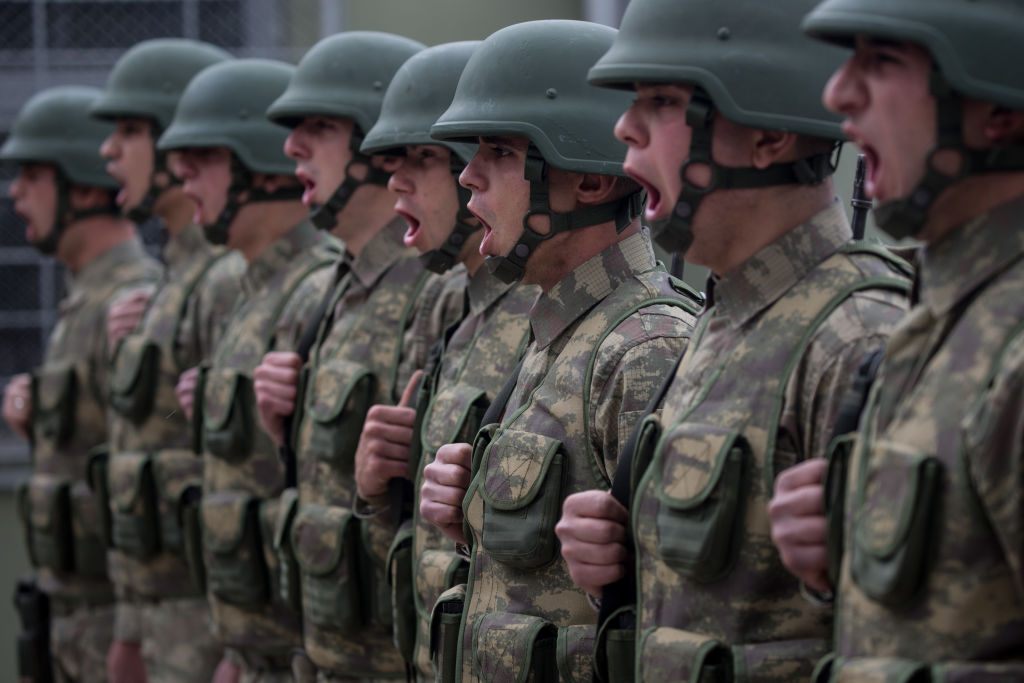
Pictured: Turkish soldiers at a military post on the border with Syria. (Photo by Chris McGrath/Getty Images)

Turkey, however, could get locked in the Syrian fate as Rwanda is in Congo-Kinshasa's interminable turmoil.

Getting entangled in Syria's Kurdish areas could also wreck the tight relationship, built over decades, which exists between Turkey and the autonomous Kurdistan in Iraq. And that, in turn, could undermine Turkey's grand plan for playing a leading role in Iraq's ambitious reconstruction plans.

Over the past decade, Turkish businesses have lost major markets in Tunisia, Libya, Egypt and Syria.

The prospect of Iraq emerging as a new market is one of the few good news items Turkish businesses now cling onto -- a fact illustrated by the signing of contacts worth more than $20 billion.

However, Erdogan's new image as an enemy of the Kurds could deprive Turkey of its surest allies in Iraqi Kurdistan, while Iran will play the Shi'ite card to curb Turkish influence. Erdogan's Kurdish adventure could also exert some pressure on Ankara's relations with its NATO allies.

Having turned a blind eye to Turkey's campaign against Syrian Kurds, the US is unlikely to totally abandon its Kurdish allies who helped defeat ISIS. Thus, Erdogan may soon find out that his victory in Afrin isn't as uncontested as he wants us to believe. To be sure, no one could dislodge him by force -- at least not in the near future. But the US and others could easily help raise the cost of his "great victory".

Almost two decades ago, Erdogan told us that the Kurdish problem was a political problem with no military solution. In his first term as prime minister he showed that he can apply that vision with patience and forbearance. Now, however, that patience and forbearance seem to have evaporated. What he is offering now is a banal fast-food of ultimately hollow military victory.

The mise-en-scene of hoisting the Turkish flag in Afrin was copied from that of US Marines raising the Star-Spangled Banner in Iwo Jima. However, as every Hollywood buff knows, remakes are never as good as the original and often end up bankrupting the studio.
This article first appeared in Asharq Al Awsat

Amir Taheri, formerly editor of Iran's premier newspaper, Kayhan, before the Iranian revolution of 1979, is a prominent author based on Europe. He is the Chairman of Gatestone Europe.

Source: https://www.gatestoneinstitute.org/12092/turkey-afrin-cost

Follow Middle East and Terrorism on Twitter

Copyright - Original materials copyright (c) by the authors.

Hating for the ‘Sake of Allah’ - Raymond Ibrahim


by Raymond Ibrahim

The doctrinally-mandated animus that begets jihad.


After launching a successful terror attack to free a fellow jihadi that left several slain policemen in its wake last month, the militant commander of Kashmir’s Hizb al-Mujahidin—“the Party of Jihadis”—justified the murders by saying,  “We love and hate for the sake of Allah.”

In this otherwise cryptic assertion lies the root of Islam’s conflict with the rest of the world.  “Loving and hating for the sake of Allah” is one of several translations of the Islamic doctrine of al-wala’ wa al-bara’ (which since 2006 I have generally translated as “Loyalty and Enmity”).  

The wala’ portion—“love,” “loyalty,” etc.—requires Muslims always to aid and support fellow Muslims (including jihadis, for example through funds or zakat).  As one medieval Muslim authority explained, the believer “is obligated to befriend a believer—even if he is oppressive and violent toward you — while he must be hostile to the infidel—even if he is liberal and kind to you” (The Al Qaeda Reader, p. 64 ).   This is a clear reflection of Koran 48:29: “Muhammad is the Messenger of Allah; and those with him are forceful against the disbelievers, merciful among themselves.”

But it is the bara’—the “hate”—that so regularly manifests itself that even those in the West who are not necessarily acquainted with the particulars of Muslim doctrine sense it.  For instance, in November 2015, after a series of deadly terror strikes in the West, then presidential candidate Donald Trump said, “I think Islam hates us.  There’s something there that — there’s a tremendous hatred there. There’s a tremendous hatred. We have to get to the bottom of it. There’s an unbelievable hatred of us.”

This “tremendous” and “unbelievable hatred” is not a product of grievances, political factors, or even an “extremist” interpretation of Islam; rather, it is a direct byproduct of mainstream Islamic teaching.  Koran 60:4 is the cornerstone verse of this doctrine and speaks for itself.  As Osama bin Laden once wrote: 


As to the relationship between Muslims and infidels, this is summarized by the Most High’s Word: “We renounce you. Enmity and hate shall forever reign between us—till you believe in Allah alone” [60:4]. So there is an enmity, evidenced by fierce hostility from the heart. And this fierce hostility—that is, battle—ceases only if the infidel submits to the authority of Islam, or if his blood is forbidden from being shed [i.e., a dhimmi], or if Muslims are at that point in time weak and incapable. But if the hate at any time extinguishes from the heart, this is great apostasy!… Such, then, is the basis and foundation of the relationship between the infidel and the Muslim. Battle, animosity, and hatred—directed from the Muslim to the infidel—is the foundation of our religion.  (The Al Qaeda Reader, p. 43).

Similarly, the Islamic State confessed to the West in the context of Koran 60: 4 that “We hate you, first and foremost, because you are disbelievers.”  As for any and all political “grievances,” these are “secondary” reasons for the jihad:


The fact is, even if you were to stop bombing us, imprisoning us, torturing us, vilifying us, and usurping our lands, we would continue to hate you because our primary reason for hating you will not cease to exist until you embrace Islam. Even if you were to pay jizyah and live under the authority of Islam in humiliation, we would continue to hate you.

Koran 58:22 goes as far as to praise Muslims who kill their own non-Muslim family members: “You shall find none who believe in Allah and the Last Day on friendly terms with those who oppose Allah and His Messenger—even if they be their fathers, their sons, their brothers, or their nearest kindred.”  According to Ibn Kathir’s mainstream commentary on the Koran, this verse refers to a number of Muslims who slaughtered their own non-Muslim kin (one slew his non-Muslim father, another his non-Muslim brother, a third—Abu Bakr, the first revered caliph of Islamic history—tried to slay his non-Muslim son, and Omar, the second righteous caliph, slaughtered his relatives).   Ibn Kathir adds that Allah was immensely pleased by their unwavering zeal for his cause and rewarded them with paradise. (The Al Qaeda Reader, 75-76).

In fact, verses that support the divisive doctrine of al-wala’ wa al-bara’ permeate the Koran (see also 4:89, 4:144, 5:51, 5:54, 6:40, 9:23, and 60:1).  There is one caveat, captured by Koran 3:28: when Muslims are in a position of weakness, they may pretend to befriend non-Muslims, as long as the hate carries on in their hearts (such is taqiyya; see here, here, and here for examples; for other Islamic sanctioned forms of deception, read about tawriya, and taysir).

Little wonder, then, that America’s supposed best Muslim friends and allies—such as Saudi Arabia and Qatar—are on record calling on all Muslims to hate us.  According to a Saudi governmental run website,  Muslims must “oppose and hate whomever Allah commands us to oppose and hate, including the Jews, the Christians, and other mushrikin [non-Muslims], until they believe in Allah alone and abide by his laws, which he sent down to his Prophet Muhammad, peace and blessings upon him.”

Indeed, because enmity for non-Muslims is so ironclad in the Koran, mainstream Islamic teaching holds that Muslim men must even hate—and show that they hate—their non-Muslim wives, for no other reason than that they are “infidels.”

If Muslims must hate those closest to them—including fathers, sons, brothers, and wives—simply because they are non-Muslims, is there any surprise that so many Muslims hate foreign “infidels” who live oceans away—such as Americans, who are further portrayed throughout the Islamic world as trying to undermine Islam?

In short, jihad—or terrorism, war on non-Muslims for no less a reason than that they are non-Muslims—is but the physical realization of a metaphysical concept that precedes it: Islam’s command for all Muslims to hate all infidels.


Raymond Ibrahim is a Shillman Fellow at the David Horowitz Freedom Center, a Judith Friedman Rosen Writing Fellow at the Middle East Forum and a CBN News contributor. He is the author of Crucified Again: Exposing Islam’s New War on Christians (2013) and The Al Qaeda Reader (2007).

Source: https://www.frontpagemag.com/fpm/269675/hating-sake-allah-raymond-ibrahim

Follow Middle East and Terrorism on Twitter

Copyright - Original materials copyright (c) by the authors.

IDF warns Gazans: Do not approach security fence - Gary Willig


by Gary Willig

IDF planes drop leaflets warning Gaza residents to stay away from border fence during demonstrations this week.


IDF planes dropped leaflets over the Gaza Strip warning Gazans not to approach the fence on the border with Israel.

A social media campaign dubbed 'The Great Return March' has attempted to bring thousands of Gazans together to March on the Israeli border this Friday, March 30, which the Palestinian Arabs mark as 'Land Day.'

The leaflets dropped by the IDF call on Gazan families not to come within 300 meters (985 feet) of the fence during the demonstration, warning that "whoever comes near will put himself at risk."

The leaflets also included a map of Gaza in which the line residents should not cross is marked in grey.

One Arab journalist mocked the IDF's efforts to prevent confrontations this Friday on Twitter, calling the leaflets "a waste of ink and paper."

On Saturday the IDF foiled an attempt to infiltrate Israel from Gaza. The infiltrators attempted to set fire to an IDF vehicle used to combat the threat of terror tunnels.

The Israeli Air Force struck a Hamas target in southern Gaza in response to the infiltration and attempted sabotage.

Further demonstrations and clashes in other parts of the country are expected in the days leading up to Land Day.


Gary Willig

Source: https://www.israelnationalnews.com/News/News.aspx/243585

Follow Middle East and Terrorism on Twitter

Copyright - Original materials copyright (c) by the authors.