Monday, February 20, 2023

'Only God Can Make a Tree': Brooklyn's Tribute to Joyce Kilmer - Lawrence Kadish


by Lawrence Kadish

Kilmer's legacy is found within all of us if we only take the time to embrace his devotional words

 

(Images' source: Wikimedia Commons)

Amidst the unrelenting stories of carnage, corruption and incompetence comes a reminder there is good news if you look long enough to find it.

And it should come as no surprise that this reminder comes from Brooklyn.

Generations ago, the New York City Department of Parks took a triangular piece of park property along Kings Highway in Midwood and renamed it "Sgt. Joyce Kilmer Square." It lies along a historic Indian trail that became a major thoroughfare for European settlers traveling between rural communities called Flatbush, Gravesend, and New Utrecht.

In time, New York City would acquire the parcel as the arrival of the automobile required the realignment of many Brooklyn streets, resulting in this modest triangle. It was dedicated as parkland in 1934, and named "Sergeant Joyce Kilmer Square" in 1935.

Today it is lined with benches shaded by large oak trees, with a flagpole along East 12th Street. It is a respite for local neighbors seeking a moment's relief from the challenges of the day.

It is a modest tribute to a giant of an American – and he likely would have had it no other way.

Kilmer was born in New Jersey before the start of the 20th Century and educated at Rutgers University and Columbia University, from where he earned his degree. Kilmer married and had four children. After teaching Latin for a year at Morristown High School in New Jersey, Kilmer began his career in 1909 as a dictionary editor with Funk & Wagnall's Company. In 1912, he served as the Literary Editor of The Churchman, an Anglican newspaper, also contributing freelance articles and poems to several other publications. On the eve of World War I, he joined the staff of the New York Times and subsequently converted to Catholicism.

It was at this time that Joyce Kilmer became one of America's best known and beloved poets. His masterpiece "Trees," would be recited by millions of children and it remains a cherished literary work to this day.

I think that I shall never see
A poem lovely as a tree.

A tree whose hungry mouth is pressed
Against the earth's sweet flowing breast;

A tree that looks at God all day
And lifts her leafy arms to pray;

A tree that may in summer wear
A nest of robins in her hair;

Upon whose bosom snow has lain
Who intimately lives with rain.

Poems are made by fools like me,
But only God can make a tree.

When the United States entered World War I, Kilmer enlisted to fight as a private and would quickly become a sergeant. He would be assigned to the dangerous job of gathering intelligence on the enemy while on patrol in "No Man's Land." While stationed in France, he also wrote for Stars and Stripes, the Army's then weekly newspaper.

On July 30, 1918, Kilmer was mortally wounded by a German sniper's bullet and died later that day.

He is buried in a French cemetery.

But in Brooklyn, on a small triangular piece of park property, a strand of trees shelter the weary visitor. It is a modest but powerful reminder of a great American who wrote words of exquisite beauty before going off to battle, where he witnessed the horrors of modern warfare. Despite his self-deprecating tone, "Poems are made by fools like me...", Kilmer's legacy is found within all of us if we only take the time to embrace his devotional words that remind us: "Only God can make a tree."


Lawrence Kadish serves on the Board of Governors of Gatestone Institute.

Source: https://www.gatestoneinstitute.org/19430/joyce-kilmer

Follow Middle East and Terrorism on Twitter

Sunday, February 19, 2023

Republicans urge Biden to veto anti-Israel UNSC resolution on Monday - Jerusalem Post Staff


by Jerusalem Post Staff

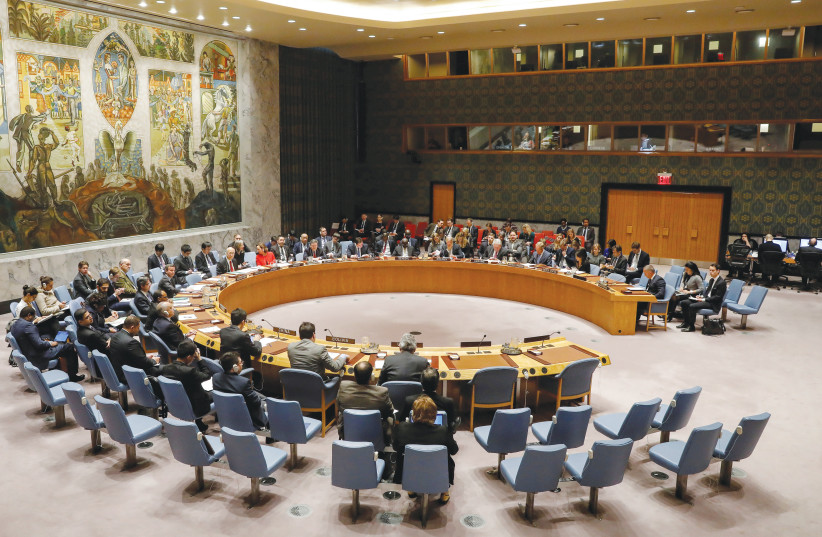
Members of the Security Council have been negotiating a draft resolution on Israeli settlements in the West Bank drafted by the United Arab Emirates in coordination with the Palestinians.


 THE UNITED NATIONS Security Council holds a regular meeting on the situation in the Middle East, focusing on Israel in relation to the Palestinians.  (photo credit: BRENDAN MCDERMID/REUTERS)
THE UNITED NATIONS Security Council holds a regular meeting on the situation in the Middle East, focusing on Israel in relation to the Palestinians.
(photo credit: BRENDAN MCDERMID/REUTERS)

Republican members of Congress are calling on President Joe Biden to veto an anti-Israel resolution expected to be brought on Monday to the United Nations Security Council and to unequivocally declare that his administration opposes such unilateral moves at the international forum.

“As the UN Security Council once again moves to consider another one-sided, biased, anti-Israel resolution, it is imperative that the United States maintain its position that only direct negotiations between Israelis and Palestinians can yield progress,” Speaker of the House Kevin McCarthy wrote in a letter to the president that was also signed by Steve Scalise, the Majority Leader and House Foreign Affairs Committee Chairman Michael McCaul.

Members of the Security Council have been negotiating a draft resolution on Israeli settlements in the West Bank drafted by the United Arab Emirates in coordination with the Palestinians.

A vote on the resolution is expected to take place on Monday amid Palestinian fears that it would be vetoed by the US. 

US Secretary of State Antony Blinken meets with Palestinian leader Mahmoud Abbas in Ramallah in the West Bank, January 31, 2023. (credit: RONALDO SCHEMIDT/POOL VIA REUTERS)US Secretary of State Antony Blinken meets with Palestinian leader Mahmoud Abbas in Ramallah in the West Bank, January 31, 2023. (credit: RONALDO SCHEMIDT/POOL VIA REUTERS)

What do the Republicans think of the draft?

Senator Tom Cotton of Arkansas wrote that “if the UN Security Council takes action on Monday to punish Israel, President Biden should stand beside them and block the ridiculous, politically-motivated measure.”

Congressman Max Miller, a new Jewish republican from Ohio, wrote that “this resolution is the UN’s latest attack on Israel’s sovereignty. Biden must veto this measure in the security council and reaffirm that the United States will always stand beside our ally.”

On Saturday, Secretary of State Antony Blinken called Palestinian Authority President Mahmoud Abbas to discuss the upcoming Security Council session on the situation in the Middle East. 

During the phone call with Blinken, Abbas stressed the need “to compel Israel to stop all its “unilateral measures, including settlements, house demolitions, incursions into cities, villages, camps and Al-Aqsa Mosque, and killings,” the PA’s official news agency Wafa said.

Senator Bill Hagerty of Tennessee said: "Rather than focus on grave threats posed by China, Russia, Iran & North Korea, the UN continues its anti-Israel obsession. Biden should stand with Israel & veto this resolution. Do not repeat the shameful Obama-Biden abstention on UNSCR 2334 in Dec 2016."

And Senator Jim Risch of Idaho said: The Biden Administration must use its veto in the UN Security Council to defend our ally #Israel. This resolution will not lead to peace and only furthers anti-Israel actions at the UN."


Jerusalem Post Staff

Source: https://www.jpost.com/arab-israeli-conflict/article-732025

Follow Middle East and Terrorism on Twitter

Why that Ohio town is named 'East Palestine' - Dr. Rafael Medoff


by Dr. Rafael Medoff

Towns such as East Palestine, Ohio, were established by 19th-century religious Christian settlers; they chose those names to express their spiritual attachment to the land and people of the Bible, not today's Palestinian Arabs.

A toxic spill has drawn the nation’s attention to the little town of East Palestine, Ohio, just as another tragedy, the explosion of the space shuttle Columbia in 2003, turned the nation’s gaze upon the town of Palestine, Texas, where much of the debris landed.

The tragic spotlight now shining on Ohio’s “East Palestine” naturally leaves some people curious as to why it has such as unusual name. The answer is that it’s not a very unusual name at all.

Elsewhere in Ohio, there are towns named Hebron, Gilboa, Canaan, and Shiloh (two of them, in fact). There’s even a Sodom, which was given its name after a prohibition advocate, disappointed at the small turnout for his lecture in 1840, jokingly compared the locale to that infamous biblical center of sin.

In Texas, in addition to Palestine, there are towns named Hebbronville and Joshua. There is a Hebron in North Dakota and a Sinai in South Dakota, a Jerusalem in Arkansas, a Jericho in Vermont, a Bethlehem as well as a Nazareth in Pennsylvania, and a Zion in Maryland. Nearly every state has one or more towns named after biblical sites or individuals. Altogether, there are more than 1,000 biblically-named towns from coast to coast.

Towns such as East Palestine, Ohio, were established by 19th-century religious Christian settlers; they chose those names to express their spiritual attachment to the land and people of the Bible. When they thought of Palestine, they recalled the Jewish kingdoms and temples of ancient times, as well as the events surrounding the origins of Christianity in the Jewish town of Bethlehem. In their prayers, they prayed for the return of the Jews to the Holy Land, which they understood to be inextricably linked to the coming messianic age. They did not expect that in the second half of the 20th century, Arabs now living in the Holy Land would rename themselves Palestinains.

The area that became East Palestine was originally known as Mechanicsburg. There are a number of towns in the U.S. that were originally settled by mechanics of various types. But in the case of Ohio, “Mechanicsburg” was changed in 1836 because—according to an early history of the region—“the wife of Dr. Robert Chamberlin desired a more euphonious appellation and desired it [be] called ‘Palestine,’ the quiet beauty of the little town, and the earnest, virtuous, simple life of its people suggesting to her a name recalling holy memories.”

Since there already was a town named “Palestine” in the western part of the state—likewise founded by religious Christians who wanted to infuse their town with “holy memories”—government officials, in assigning the new post office, added the prefix “East.”

That early account of East Palestine’s founding was published in 1905, when it was common for a married woman’s name to be hidden behind that of her husband. But a historical marker in front of the log house where the Chamberlins once lived tells us that the name of the doctor’s wife was Rebecca—an appropriately biblical name for a woman who took her Bible seriously.

Not surprisingly, numerous churches quickly sprung up in East Palestine and its environs. Lutheran and Reformed congregations established the Salem Church, choosing a name derived from “Jerusalem.” Evangelical Lutherans founded the St. Paul’s Evangelical Lutheran Church, while Methodists originally held their services in a local school—the separation between church and state was still rather fuzzy in those days—before eventually erecting their Methodist Episcopal Church. East Palestine also had a United Presbyterian Church and, later, another house of worship with a biblically-inspired name, the Zion Evangelical Lutheran Church.

When America’s religious Christian settlers thought of the Holy Land, they thought of the Hebrew bible and the area’s 3,000 years of Jewish inhabitation, not the Koran or the more recently-arrived Arab residents of the area. They thought of the many Jews who appear in the accounts of the birth of Christianity (including its founder), texts that do not mention any Palestinian Arabs since there were none..

Certainly Americans were aware that there were Arabs living in Palestine by the 19th century. Mark Twain, for example, had mentioned them in his account of his visit to the Holy Land, The Innocents Abroad (1869). So had Herman Melville in his famous Clarel: A Poem and the Pilgrimage in the Holy Land (1876).

But it was common knowledge that the Arab population of Palestine was relatively small and unsettled, and that the Arab residents of 19th-century Palestine regarded themselves as part of southern Syria, not as a separate nationality. H. Allen Tupper, Jr. wrote in the New York Times in 1896, after having “ridden on horseback more than four hundred miles through Palestine and Syria,” that virtually the only local people he encountered were “merchantmen with their long camel trains” and “wild Bedouin tribes” that “reside in one locality not more than two months.”

Today’s residents pronounce East Palestine “Palesteen,” but the original settlers undoubtedly pronounced it the more common way. Because it was the Holy Land, with its deep Jewish roots, that burned bright in the hearts and prayers of the founders of the many biblically-named towns across America. And it is for the same reason that Bible-believing Christians today—probably including more than a few residents of East Palestine, Ohio—constitute one of the major sources of pro-Israel sentiment in the United States.

Reposted from the Jewish Journal of Los Angeles


Dr. Rafael Medoffis the author of more than 20 books about Jewish history and Zionism, including The Historical Dictionary of Zionism [with Chaim I. Waxman]

Source: https://www.israelnationalnews.com/news/367681

Follow Middle East and Terrorism on Twitter

Airstrikes in Syria could lead to escalation by pro-Iran axis - analysis - Seth J. Frantzman


by Seth J. Frantzman

This incident was different and indicates the Syrian regime wants to spotlight the attack. This may be linked to other issues.


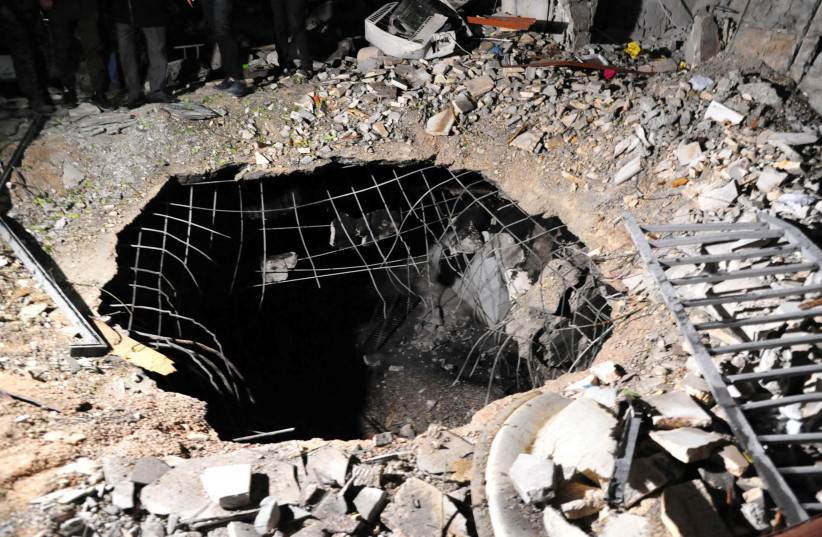
 A view shows damage at the site of a rocket attack, in central Damascus's Kafr Sousa neighborhood, Syria, in this handout picture obtained by Reuters on February 19, 2023. (photo credit: SANA/HANDOUT VIA REUTERS)
A view shows damage at the site of a rocket attack, in central Damascus's Kafr Sousa neighborhood, Syria, in this handout picture obtained by Reuters on February 19, 2023.
(photo credit: SANA/HANDOUT VIA REUTERS)

The pro-Iran axis in the Middle East – consisting of groups sympathetic to Iran and its proxies or directly linked to the Islamic Revolutionary Guard Corps – slammed Israel for airstrikes in Syria early on Sunday. 

Hamas, for example, said it “strongly condemns the Israeli occupation’s aggression against the Syrian Arab Republic and the targeting of civilian populations in the Syrian capital of Damascus, leaving many killed and injured.”

Fars News in Iran, which is close to the IRGC, wrote, “As Zionist fighters attacked a radar site in the north of As-Suwayda Province, a residential building in the south of Damascus was also targeted, as a result of which several people were martyred and injured.”

Al-Mayadeen media also reported on the attacks in detail, saying Syrian air defenses responded to "Israeli aggression,” and further noting that its Damascus correspondent “reported hearing explosions in the sky of the Syrian capital.... ‘The Israeli attack targeted the Kafr Souseh area in Damascus and the Tal al-Masih area near the city of Shahba, north of As-Suwayda.’”

The report also claimed that five people were killed, and that “a Syrian military source said that at exactly 00:12 a.m. today [Sunday], the Israeli enemy carried out an air attack with bursts of missiles from the direction of the occupied Syrian Golan, targeting points in Damascus and its surroundings, including residential neighborhoods inhabited by civilians.” The report called the Syrians who were killed “martyrs.”

 Police officers stand on the rubble of a damaged building at the site of a rocket attack, in central Damascus' Kafr Sousa neighborhood, Syria, February 19, 2023.  (credit: FIRAS MAKDESI/REUTERS) Police officers stand on the rubble of a damaged building at the site of a rocket attack, in central Damascus' Kafr Sousa neighborhood, Syria, February 19, 2023. (credit: FIRAS MAKDESI/REUTERS)

Meanwhile, reports of rockets fired by pro-Iran proxies targeting US troops near Conoco in eastern Syria circulated as well. Conoco and the Omar field area were last targeted on Tuesday, and two weeks ago, Iran allegedly attacked a commercial vessel off the coast of Oman.

What does this indicate?

Sunday’s airstrikes in Syria were unusual in that there was a significant number of casualties, something that doesn’t usually happen in this scenario. Syria has, in the past, accused Israel of carrying out attacks, but tends not to elaborate much.

It also doesn’t mobilize its friends in pro-Iranian media or in Hamas to condemn the attacks – something that did happen this time, indicating that the Syrian regime wants to focus on the attack more than usual.

Syria knows that Israeli Foreign Minister Eli Cohen visited Ukraine last week, as it is working on rekindling its ties with the Gulf. Additionally, the deadly earthquakes that struck Turkey and Syria put Damascus in a different kind of spotlight.

It also comes as Iranian President Ebrahim Raisi visited China last week. Russia is facing pressure from the US over claims of crimes against humanity amid its invasion of Ukraine. While Israel has consistently said that it wants to prevent Iranian entrenchment and movement of weapons through Syria, the Syrian regime might also consider that its support from Iran and Russia will shift the balance of these strikes.

According to a report in the Saudi Arabian Arab News on Thursday, “Tehran has identified a significant number of Diaspora Jews worldwide to assassinate in the event of a war with Israel, a French journalist specializing in Iranian affairs has warned.” It is unclear how legitimate this threat is, but it comes amid assertions by Israel, reported in Saudi Arabia’s Elaph newspaper two weeks ago, that Israel would strike weapons sent by Iran to Syria.

Syria might want to secure Russia’s backing now, and it would use Cohen’s visit to Ukraine as leverage. This also wouldn’t be the first time it did this. In November 2019, Russia revealed that Israel was carrying out airstrikes in Syria.  


Seth J. Frantzman

Source: https://www.jpost.com/middle-east/iran-news/article-732044

Follow Middle East and Terrorism on Twitter

Congress takes first shot at federal censorship: a moratorium on DOJ payments to social media - John Solomon


by John Solomon

House Republicans introduce ELON Act, which would require an audit of all DOJ funds that flowed to Big Tech and a one-year moratorium.

Stunned by a growing body of evidence showing federal pressure to silence Americans' voices online, House Republicans have unleashed their first legislation to slow government requests to Big Tech to censor content.

The ELON Act, introduced this month by Rep. Lauren Boebert (R-Colo.) and backed by nine other cosponsors, would impose a one-year moratorium on taxpayer payments from the Justice Department to social media firms as well as require an audit on how much money changed hands since the start of 2015 between DOJ and Big Tech firms.

The legislation comes weeks after the blockbuster revelation that the FBI paid more than $3 million to Twitter to compensate that firm for handling a large number of censorship requests dating to the 2020 election.

"Who would ever have thought that the FBI would be paying Big Tech companies, you know, for their 'advice' or their counsel to the tune of millions upon millions of dollars?" asked Rep. Andrew Clyde (R-Ga.) in an interview with Just the News.

"What they're doing is what the government cannot do directly," he added. "And that is they are doing government by proxy, or censorship by proxy. And this is 100% a violation of the Constitution."

Boebert said the body of evidence that has emerged in the Twitter Files released by Elon Musk shows the FBI and other agencies have engaged in far deeper censorship than just the October 2020 blocking of stories related to Hunter Biden's laptop.

"Big Tech is in bed with the FBI and other agencies to the point where Congress can't tell where one ends and the other begins," Boebert said. "The millions of dollars sent to Twitter that we know of during an election cycle, when they were at the same time censoring the Hunter Biden laptop from hell, is incredibly concerning.

"We must expose the incestuous relationship between Big Tech and the federal government. My bill does exactly that."

At a hearing earlier this month, former Twitter executives said it was an egregious mistake to have censored the true stories about Hunter Biden's laptop. But the censorship exposed by Musk since he took over the social media giant goes far deeper.

"Government paid Twitter millions of dollars to censor info from the public," Musk tweeted, referring to a bombshell report by independent journalist Michael Shellenberger that exposed an internal Twitter email with the subject line "Run the business - we made money!" The message informed then-Twitter Deputy General Counsel Jim Baker that the FBI paid Twitter $3.42 million between October 2019 and February 2021.

The FBI confirmed payments, saying they were a "reimbursement" for the "reasonable costs and expenses associated with their response to a legal process ... For complying with legal requests, and a standard procedure." FBI officials also stated that Twitter wasn't the only social media company to get tax dollars. "We don't just reimburse Twitter," the bureau said.

The Exposing Lewd Outlays for Social Networking Companies Act, or ELON Act, requires the U.S. comptroller general to submit a report to Congress on all taxpayer payments made by DOJ since Jan. 1, 2015, to Twitter, Meta, Google, Microsoft, and Apple. 

The proposed legslation also places a one-year moratorium on any new DOJ payments to these companies.


John Solomon

Source: https://justthenews.com/nation/free-speech/congress-takes-first-shot-federal-censorship-moratorium-doj-payments-social

Follow Middle East and Terrorism on Twitter

VA, Medicare make 425,000 duplicate payments costing taxpayers $307 million: watchdog report - Mary Lou Lang


by Mary Lou Lang

The root of the "long-standing" problem, according to the VA inspector general, is the lack of shared healthcare claims data between the VA and the Centers for Medicare and Medicaid Services.

The Golden Horseshoe is a weekly designation from Just The News intended to highlight egregious examples of wasteful taxpayer spending by the government. The award is named for the horseshoe-shaped toilet seats for military airplanes that cost the Pentagon a whopping $640 each back in the 1980s.

The Department of Veterans' Affairs (VA) and the Centers for Medicare and Medicaid Services (CMS) paid for the same services for veterans leading to more than 425,000 duplicate payments, which cost taxpayers $307 million, according to a federal watchdog report in December. 

The VA inspector general found that the Veterans Health Administration, which oversees veterans' healthcare for the department, made the duplicate payments in conjunction with CMS, with the two agencies mutually unaware of payments made by the other due to their lack of shared healthcare claims data. 

The VHA and Medicare made payments on 140,869 duplicate claims from Jan. 1, 2017 through Sept. 30, 2019, with VHA paying over $103 million and Medicare paying over $79.8 million, according to the IG report. From October 1, 2019 to March 31, 2021, duplicate claim payments totaled 285,956, with VHA paying over $204 million and Medicare paying about $163.6 million.

When a veteran is eligible for both VA and Medicare benefits, the VHA is responsible for paying for the veteran's care even when Medicare covers the same service, which led to the duplicate payments.

The duplicate payments have been known to government auditors for more than 40 years, according to the VA inspector general, yet the issue remains unresolved.

"Potential duplicate payments by Medicare and VHA have been a long-standing issue," according to the IG report. "In 1979, the General Accounting Office reviewed a sample of Medicare-eligible veterans in Florida and California, identified duplicate claim payments, and recommended better coordination between the two agencies. However, as of May 2022, VA and the Centers for Medicare and Medicaid Services had not yet developed a data-sharing agreement or process to prevent or identify duplicate claim payments." 

The root of the double payment problem is the mutual independence of the two agencies' healthcare claims reporting systems.

"Because VHA and the Centers for Medicare and Medicaid Services do not share healthcare claims data, neither agency is aware of claims paid by the other agency," the IG report explains. "Without an interagency system, the risk of duplicate payments is increased, and it is difficult to determine which agency should pay the claim and which agency can collect overpayments."

"These problems could have been avoided if the [VHA], which receives $52.9 billion in funding, had simply implemented the accounting controls that any private sector business would have in place," wrote OpentheBooks.com Founder/CEO Adam Andrzejewsk. "Our veterans deserve better than an agency that can't bother to implement basic accounting controls."

The inspector general made three recommendations. The VA concurred entirely with two of the three and concurred in principle with one, namely the core recommendation that it work with the CMS "to establish a data-sharing agreement with VA to limit potential duplicate claim payments."

"In collaboration with VHA Office of Business Oversight and Centers for Medicare and Medicaid Services (CMS)," wrote VA undersecretary for health Dr. Shereef Elnahal, "the VHA Office of Integrated Care (IVC) intends to support efforts already in progress to establish a data-sharing agreement; however, VHA IVC does not have the authority to ensure a sharing agreement is established and therefore concurs in principle with this recommendation."


Mary Lou Lang

Source: https://justthenews.com/accountability/waste-fraud-and-abuse/sunva-medicare-make-42500-duplicate-payments-costing-taxpayers

Follow Middle East and Terrorism on Twitter

Pentagon’s Anti-White Diversity Chief Comes up With a Novel Way to Excuse Her Own Racism - Robert Spencer


by Robert Spencer

It's all about privileged victimhood status.


The diversity, equity, and inclusion chief for the Defense Department’s schools is in hot water over what are being termed “racially disparaging” remarks, but Kelisa Wing is no Bull Connor. Wing, who actually describes herself as a “woke administrator,” has indulged in today’s most culturally acceptable form of racism: hatred of white people. She has belatedly drawn the attention of lawmakers for remarks she made back in 2020 and 2021 and is fighting back with an interview published Friday in Military Times. Her defense? She made her hate-filled and racist remarks as a private citizen, not as an employee of the Department of Defense. There, now, don’t you feel better?

Wing said flatly: “No, I did not make disparaging comments against white people. I would never categorize an entire group of people to disparage them.” Really? Let’s see. According to a Sept. 2022 Fox News report, Wing, who has since deleted her rancid Twitter feed, tweeted in June 2020: “I’m so exhausted at these white folx in these PD [professional development] sessions this lady actually had the CAUdacity to say that black people can be racist too … I had to stop the session and give Karen the BUSINESS … we are not the majority, we don’t have power.”

Wing was misusing the Left’s insane lexicon here, for “folx,” as Merriam-Webster, which is now as woke as everyone else, tells us is a spelling that is “used especially to explicitly signal the inclusion of groups commonly marginalized.” So the exhausting white people in Wing’s meetings couldn’t have been “folx,” but Wing had more than enough racist anti-white tweets to maintain her woke bona fides.

Wing frequently expressed exasperation with how insolently white people dared to behave in her presence. “If another Karen tells me about her feelings,” she exclaimed in one tweet, “I might lose it.” When a critic took issue with Wing’s claim that “racism is ingrained in the very fabric of our country,” the diversity, equity, and inclusion chief’s response was succinct: “Bye Karen.”

Now, however, Wing has tried to explain all this away by insisting that she was not speaking in her official capacity: “I’m speaking now as a private individual, about my private free speech from July of 2020.” She also attempted to justify her remarks by claiming privileged victimhood status:

I was in a space where I was the only person of color. The purpose of that was people wanting to reconcile what was happening at the present time. In the middle of that session, someone just called out, “Well, Black people are racist, too.” It didn’t have any context to what we were talking about, and I started to explain to her that yes, everybody can be racist. But we’re talking about systemic racism and how that impacts people and their ability for housing, their ability for a lot of things. That’s something that I thought we were there to discuss….I can’t advocate for equity and access and opportunity and then not be willing to advocate for myself when an injustice is happening for myself. I have to stand up at some point, and this is the right time.

Well, great. But she is supposed to be the “diversity, equity, and inclusion” supervisor for the Department of Defense Education Activity (DoDEA), which, according to Fox, “provides K-12 education to the DoD community in the U.S. and all over the world.” How will Wing avoid bringing her own racism into her work?

With just that concern, according to Military Times, “20 Republican lawmakers, including members of the House Armed Services Committee, wrote to Secretary of Defense Lloyd Austin, demanding to know whether DoD officials were aware of Wing’s tweets before they placed her in her current position. Lawmakers also asked Austin whether DoDEA endorses ‘the ideology’ in those tweets and whether it’s been incorporated into the curriculum proposed by DoDEA.” These are important questions. Yet the lawmakers sent Austin two letters about this in January and have received no response. The ostensibly marginalized and oppressed, you see, don’t think they have any obligation to address the concerns of their putative oppressors.

In reality, of course, Austin and Wing are cosseted elitists, not oppressed at all. Austin apparently doesn’t deign to answer questions from those who have no power to cause him any professional difficulty. And if they get too close, he, like Wing, can just cry “racism.” Works like a charm.


Robert Spencer is the director of Jihad Watch and a Shillman Fellow at the David Horowitz Freedom Center. He is author of 26 books including many bestsellers, such as The Politically Incorrect Guide to Islam (and the Crusades), The Truth About Muhammad and The History of Jihad. His latest books are The Critical Qur’an and The Sumter Gambit. Follow him on Twitter here. Like him on Facebook here.

Source: https://www.frontpagemag.com/pentagons-anti-white-diversity-chief-comes-up-with-a-novel-way-to-excuse-her-own-racism/

Follow Middle East and Terrorism on Twitter

Russia increases production of Kinzhal hypersonic cruise missiles - Michael Starr


by Michael Starr

The Kh-47M2 Kinzhal is an air-launched hypersonic missile typically loaded on specialized MiG-31K warplanes.


 A Russian Air Force MiG-31 fighter jet releases Kinzhal hypersonic missile during a drill in an unknown location in Russia, in this still image taken from video released February 19, 2022. (photo credit: RUSSIAN DEFENSE MINISTRY/HANDOUT VIA REUTERS)
A Russian Air Force MiG-31 fighter jet releases Kinzhal hypersonic missile during a drill in an unknown location in Russia, in this still image taken from video released February 19, 2022.
(photo credit: RUSSIAN DEFENSE MINISTRY/HANDOUT VIA REUTERS)

Russia has increased the production of Kinzhal hypersonic cruise missiles, state defense corporation Rostec said on Saturday according to Interfax.

"It went into production a long time ago, initially we didn’t need such a quantity. We are now increasing,” Rostec CEO Sergey Chemezov reportedly said in a Zvezda Plus TV channel interview.

Chemezov said that the defense company had increased the production of some munitions by 50 times.

The Kh-47M2 Kinzhal is an air-launched hypersonic missile typically loaded on specialized MiG-31K warplanes. MiG-31Ks have been seen in Belarus on training missions in recent months, as well in Kaliningrad following tensions with Lithuania.

The hypersonic missile, capable of delivering conventional and nuclear warheads at high speeds while evading modern air defense systems, was first reportedly used to strike a Ukrainian position early in the war.

A missile is launched during what state media report is a hypersonic missile test at an undisclosed location in North Korea, January 11, 2022, in this photo released January 12, 2022 by North Korea's Korean Central News Agency (KCNA). (credit: KCNA VIA REUTERS/FILE PHOTO)A missile is launched during what state media report is a hypersonic missile test at an undisclosed location in North Korea, January 11, 2022, in this photo released January 12, 2022 by North Korea's Korean Central News Agency (KCNA). (credit: KCNA VIA REUTERS/FILE PHOTO)

Another hypersonic missile system, the anti-ship 3M22 Zircon, caught the attention of security services in early January when it was deployed for the first time, aboard the frigate Admiral Gorshkov in the Atlantic Ocean. Admiral Gorshkov is set to engage in joint naval exercises with China and South Africa from February 17-27.

An air-launched version of the Zircon was also planned but was delayed in March to advance the maritime version as the Kremlin already had the Kinzhal in service.

The importance of hypersonic weapons in Russia is growing

The growing importance of hypersonic weapons in the Russian military and the navy, in particular, was emphasized by Navy chief Admiral Nikolai Yevmenov in a Saturday ceremony for a Northern Fleet missiles ship division.

Yevmenov also highlighted the importance of nuclear missile cruisers. This comes as Norwegian intelligence reports claimed that the Northern Fleet had deployed while armed with tactical nuclear weaponry for the first time since the Cold War.

Russian media reports on the increased production of munitions come not long after a Wednesday United Kingdom's Defense Ministry assessment that the Russian defense industry was having difficulty replenishing equipment.

Western intelligence has long reported that international economic sanctions have restricted the Russian defense industry's capability to make advanced guided munitions since it relied heavily on foreign electronics and materials for the production process.

On Sunday, the Ukrainian Military claimed that a batch of S-300 anti-aircraft missile systems had to be returned to the manufacturing plant.


Michael Starr

Source: https://www.jpost.com/international/article-732030

Follow Middle East and Terrorism on Twitter

Ukraine: The Unintended Consequences - Amir Taheri


by Amir Taheri

The most significant unintended consequence of the Ukraine tragedy may be the derailing of the so-called globalization process.

  • It is, perhaps, more interesting to study the unintended consequences of this tragic saga. One such consequence is to bring war back into international conversation as a here-and-now reality.

  • The idea that war could somehow be scripted out of the human story as were incest or slavery is exposed for what it is: a dangerous fantasy. This has led to musings about flashbacks to military doctrines that many believed or hoped had faded away.

  • Today, however, some form of return to the draft system is publicly debated in several capitals. Defense spending that had been considered as a luxurious conceit is now regarded as vital for national security and independence.

  • In 2022, however, more than 40 nations increased their defence budgets while embarking on massive programs to renew their arsenals and develop more advanced weapons systems.

  • The most significant unintended consequence of the Ukraine tragedy may be the derailing of the so-called globalization process. Two decades ago, all the talk was about comparative advantage and delocalization. Today people talk of re-localization and rebuilding "our own industry".

  • Well, spring isn't far away and Putin may have his offensive. But the question remains: then what?

Pictured: Russian President Vladimir Putin speaks with Defence Minister Sergei Shoigu (R) and Chief of the Russian General Staff Valery Gerasimov (L) at the National Defence Control Centre in Moscow, on December 21, 2022. (Photo by Mikhail Klimentyev/Sputnik/AFP via Getty Images)

What do you do when you are stuck in a war that you can neither win nor lose? This is the question that Russian President Vladimir Putin faces as his "Special Operations" against Ukraine enters its second year. The answer is: you stage trompe l'œil shows to hide the fact that you are stuck and going nowhere fast.

Last December, Putin and his propaganda machine harped on the theme of victory thanks to General winter which was supposed to clinch victory with its frozen claws. When that didn't happen they bought a few favorable headlines by sacking their commander in Ukraine and throwing their top military chief, General Valery Gerasimov, into the lion's den. However, it is now clear that Gerasimov, a bureaucrat in uniform with as many medals as a general in an operetta, is no miracle worker.

This is why we now hear a new tune from the Kremlin: the spring offensive, which is supposed to present Russia with full victory on a platter. The fantasy that, just as it revives nature, spring would also offer victory to any side that it favors is as old as the history of war itself.

Over 2,000 years ago, the Roman consul Marcus Licinius Crassus, the richest man in the world in his time, gambled on a spring offensive in Carrhae and ended up having his head cut off and sent to the Parthian king on a golden platter.

In the 14th century war between England and France, the English King Edward III thought that his spring offensive would close the bloody saga. He defeated the French in Poitiers and captured their king. But the fat lady refused to sing the end of the longest war in history.

In the American Civil War, General Philip Henry Sheridan's cavalry went deep into "enemy territory" as part of General Ulysses S. Grant's spring offensive. Doing a Sheridan became a military proverb but the fratricidal war didn't end there.

In 1918, we had the German version of the spring offensive, which morphed into Thanatos on a national scale.

The tragedy in Ukraine, call it special operation if you wish to please Putin, has evolved into a positional war of small incremental advances and retreats reminiscent of World War I rather than a 21st century war. In fact, the war front that was established in 2014, with the Russian annexation of the Crimean Peninsula and establishment of secessionist enclaves in Donbass, has largely remained unchanged. The spring offensive that Russian propaganda is beating the drums for is unlikely to change that.

It is, perhaps, more interesting to study the unintended consequences of this tragic saga. One such consequence is to bring war back into international conversation as a here-and-now reality.

The idea that war could somehow be scripted out of the human story as were incest or slavery is exposed for what it is: a dangerous fantasy. This has led to musings about flashbacks to military doctrines that many believed or hoped had faded away.

Almost half a century ago, the US abolished the draft in favor of an all-volunteer force. Most other Western democracies and some developing nations followed the example. Today, however, some form of return to the draft system is publicly debated in several capitals. Defense spending that had been considered as a luxurious conceit is now regarded as vital for national security and independence.

Before the Ukraine tragedy, reducing military expenditure was a standard device for cutting budget deficits.

In 2022, however, more than 40 nations increased their defence budgets while embarking on massive programs to renew their arsenals and develop more advanced weapons systems.

Thus, one unintended consequence of the Ukraine tragedy may be a new arms race that Russia is visibly unable to win. It could also face China with a hard choice between joining the race and thus limiting the resources needed for bringing more of its people out of poverty or staying out and scaling down its ambition for global leadership.

Another unintended consequence may be the downgrading of diplomacy as the chief tool of conflict resolution on global scale. With the United Nations already marginalized, the ability of international diplomacy to end or at least moderate many small or big regional conflicts would be reduced further.

The Ukraine tragedy has also boosted a trend that started in the early days of the new century towards privatization of war. The best information available shows that private war has become a lucrative global business employing tens of thousands of people and affecting more than a dozen countries in Latin America, Africa and the Middle East. In some places, such as the eastern regions of Congo-Kinshasa, privatized war has become a key factor in controlling access to rare mineral resources of strategic importance.

Another unintended consequence is the emergence of a big question mark about Russia's integration as a major player into what Mikhail Gorbachev and Boris Yeltsin described as "our common European home." The classical Russian debate between Slavophiles and Westernizers reflected the Russian reality with its inherent contradictions. Putin offers an ersatz version of Slavophilia which -- the Slavic nations already integrated into "the common European home"-- leaves Russia with no choice but to look east to China and accept to play second fiddle to a power with structures and ambitions alien to the average Russian.

The most significant unintended consequence of the Ukraine tragedy may be the derailing of the so-called globalization process. Two decades ago, all the talk was about comparative advantage and delocalization. Today people talk of re-localization and rebuilding "our own industry". This may turn out to be a return to the corn-law economic mentality and protectionism, which could spell disaster for many countries or offer an overdue correction to globalization gone too far.

Invading Ukraine was an unnecessary move which, in Talleyrand's view, is worse than making a mistake. It has let too many genies out for anyone to control let alone push them back into their bottles.

Well, spring isn't far away and Putin may have his offensive. But the question remains: then what?

This article originally appeared in Asharq Al-Awsat


Amir Taheri was the executive editor-in-chief of the daily Kayhan in Iran from 1972 to 1979. He has worked at or written for innumerable publications, published eleven books, and has been a columnist for Asharq Al-Awsat since 1987.

Source: https://www.gatestoneinstitute.org/19412/ukraine-unintended-consequences

Follow Middle East and Terrorism on Twitter

Eating Their Own in the Golden State - Claruce Feldman


by Claruce Feldman

Can the pencil-neck vote outweigh the DEI Left on behalf of Adam Schiff?

History shows that leftists always end up eating their own, as they continually jockey for the top rung on their political ladder. This week’s target is the odious Congressman Adam Schiff. He has been a congressman for 22 years and this year has decided to run for the seat being vacated by Senator Dianne Feinstein, whose staff, apparently without her prior knowledge, has announced she will not run again in 2024.

He is a consummate liar and misused his perch as the ranking member of the House Intelligence Committee to spread disinformation which could not until recently be proven falsehoods, hiding them under a cloak of secret intelligence information, claiming Donald Trump had colluded with the Russians to win the 2016 election. He was Nancy Pelosi’s pick to head the Ukraine impeachment charge against Trump, which failed.

Rolling Stone observes that he is a heroic figure to many Democrats. 

To a certain cadre of loyal MSNBC viewers, Adam Schiff is the platonic ideal of a Democrat. The California congressman supports universal health care. He eschews corporate PAC money (these days, at least). He’s an understated former prosecutor who takes his job seriously even as Washington often descends into fundamental unseriousness. Look no further than his management of then-President Donald Trump’s first impeachment as proof.

You’d imagine in blue state California, he’d be a shoo-in.

Unfortunately for Schiff, in the days of DEI, he apparently is the wrong color and sex. Suddenly, establishment Democrats who support Schiff are not so keen on identity politics, although others remain so, as long as the identity for this generational seat in a uniparty state, is a woman, and -- even better – a black woman.

The anti-Schiff sentiment is fomenting at the beginning of the “insiders primary,” as Rose Kapolczynski, longtime campaign manager for former Sen. Barbara Boxer, calls it -- the behind-the-scenes chatter among the donors, consultants, and activists who lend credibility to nascent campaigns. Some Democratic donors have been strategizing on how to ensure the two women in the race, Reps. Katie Porter (D-Calif.) and Barbara Lee (D-Calif.) -- both liberal stalwarts in their own right -- persevere against Schiff. Progressive activists have launched a nascent disparagement campaign, carried out in the open on Twitter and in private over group chats, that knocks Schiff’s past positions on healthcare and criminal justice reform. Others have publicly undermined Schiff’s pro-democracy brand by highlighting reports that he hadn’t been as eager to impeach Trump as he claims.

As for the concerns about identity politics, too much focus on them have “gotten us in a lot of trouble,” California Assemblymember Tina McKinnor, a Black progressive who represents Inglewood and endorsed Schiff. “People who look like me may not carry my progressive values. I want the best person for the job.”

Where was he when the goofy Kamala Harris was selected at the Left’s insistence for the post of Vice-President?

Why has Schiff’s entry into the 2024 Senate race ignited such a tempest? Well, in California’s uniparty state this post is a generational sinecure. For almost 30 years both of California’s Senate seats have been held by women: Barbara Boxer held one of them , succeeded by Kamala Harris. Dianne Feinstein held the other.

The anti-Schiffniks may actually win, aided not only by the DEI crowd but as well by the ridiculous ranked voting the Democrats have embraced.

Electing Women Alliance plans to hold events for both Lee and Porter and has been encouraging donors to give to both campaigns. They’re strategies oriented toward California’s “jungle primary” system that advances the top two vote-earners, regardless of party, to the general election “to ensure a woman would hold this seat,” says Stacy Mason, EWA’s executive director. “We find it unconscionable that two men could represent California in the U.S. Senate after the historic role this state has played.” 

Others view Lee’s candidacy as an opportunity to send a Black woman to the Senate, a body with none at present and only two in its entire history (Harris and former Illinois Sen. Carol Moseley Braun). “California provides a unique path to sending this woman to the Senate that Florida and North Carolina couldn’t do [in 2022],” says Aimee Alison, a California-based Democratic strategist and founder of She the People, which supports women of color running for office. To Lee’s backers, her run is about more than simply representation: Lee’s quarter-century in Congress prepares her best, they argue. “If this really was a country whose politics were based on meritocracy as to who was the most qualified, the most experienced, then that would be Barbara Lee,” says Kimberly Ellis, a Bay-area Democratic strategist.

It'll be fun to watch this play out.

Schiff is likely to have more than the support of establishment Democrats though the desire to keep this seat in a woman’s hands is not his only obstacle.

As a former prosecutor, Schiff will have to tread a delicate path similar to the one current Vice President Kamala Harris attempted to navigate when she ran for president in 2020 -- explaining a prosecutorial background at a time marked by significant concerns among liberal voters about the treatment of people of color in the criminal justice system. As a white man, Schiff faces an additional challenge among some California Democratic voters who hope to diversify the Senate’s ranks.

On the other hand. ”Among Democrats, Schiff is a fundraising juggernaut. He had nearly $21 million in the bank in late November and has raised significant money since announcing his Senate bid.”

No nationally prominent Republican has yet announced, but per the Los Angeles Times, there are two possibilities, neither of whom has yet announced an interest in running: Brian Dahle, a state senator, and  private attorney Mark Meuser. Under ranked choice voting, a Republican might actually have a shot at it, because if the Democrats cannot unify behind a single candidate and the Republicans do, they might just pull it off.


Claruce Feldman

Source: https://www.americanthinker.com/articles/2023/02/eating_their_own_in_the_golden_state.html

Follow Middle East and Terrorism on Twitter