Monday, December 1, 2025

Why Qatar Should Have No Role in Gaza - Khaled Abu Toameh


by Khaled Abu Toameh

One does not need to be an "expert" to understand that Qatar, despite its attempt to present itself as a neutral mediator between Israel and Hamas over the past two years, continues to be affiliated with the extremist ideology of the Muslim Brotherhood and Hamas. Unfortunately, this ideology considers non-Muslims (and Israel) as Enemy No. 1.


  • The meeting underscores Qatar's apparent eagerness to play a central role in post-war Gaza. As a long-time supporter and funder of the Muslim Brotherhood organization, the Qatari regime's main goal seems to be ensuring that Hamas remains in power in the Gaza Strip. Hamas describes itself as "one of the wings of the Muslim Brotherhood in Palestine."

  • One does not need to be an "expert" to understand that Qatar, despite its attempt to present itself as a neutral mediator between Israel and Hamas over the past two years, continues to be affiliated with the extremist ideology of the Muslim Brotherhood and Hamas. Unfortunately, this ideology considers non-Muslims (and Israel) as Enemy No. 1.

  • In his October 19 column in the Qatari government daily Al-Sharq, Ahmad al-Muhammadi, an imam and preacher in Qatar's Waqf Ministry, explained that the enmity between the Muslims and the Jews and Christians is existential and deeply rooted, and presented Islam as the truth and Christianity and Judaism as falsehood and heresy.

  • He went on to call on Muslims to beware of slogans of tolerance that are aimed at uprooting belief in Islam, and asserted that Islam is "a religion that neither compromises nor reconciles."

  • "Qatari Shura Council member Essa Al-Nassr said that October 7 was the beginning of the end of the Zionist state, presenting this as a divine promise mentioned in the Quran. He added that there can be no peace with the Jews, because their faith condones 'deception, the violation of agreements and lies' and they are 'slayers of the prophets.'" — MEMRI, September 15, 2025.

  • Researcher and political analyst Eitan Fischberger recently uncovered a series of posts in which Majed al-Ansari, advisor to the Qatari prime minister and spokesman for Qatar's Foreign Ministry, openly praised suicide bombings and called for Tel Aviv to burn.

  • In a recent speech, the Emir of Qatar, Tamim bin Hamad al-Thani, said that the five Hamas members Israel killed in an airstrike in Doha last September were "our brothers."

  • Qatari Education Minister Lowlah al-Khater has called Israel and the West an "ugly, racist, and vile civilization" She described Israel and its Western backers as a "mixture of ugliness, entrenched racism, and vile materialistic civilization."

  • Saudi Arabia, the United Arab Emirates and Bahrain are said to be "frustrated" by Washington's growing concessions to Qatar, their regional rival and a longtime supporter of the Muslim Brotherhood.

  • "It's a mistake to rely on Qatar, which backs the Muslim Brotherhood... [Qatar] will undermine deradicalization efforts and try to ensure that Hamas remains in the picture and returns to power in the not-so-distant future." — Unnamed Saudi diplomatic source, Israel Hayom, October 12, 2025.

  • Bringing Qatar into the Gaza Strip is effectively placing the fox inside a chicken coop. If Qatar is allowed to play a civilian or security role inside the Gaza Strip, this privilege would be seen by many Palestinians as a reward for Hamas and other Islamist terror groups. It will allow the terrorists worldwide to rearm and regroup, and enable Qatar to continue reasserting the policies of the Muslim Brotherhood throughout the Middle East – as well as in the US, where it has already exorbitantly bought influence. That purchase includes "economic commitments worth at least $1.2 trillion" in the US, the $400 million "flying palace" Boeing 747 jet, and "at least $100 billion" pumped into US universities.
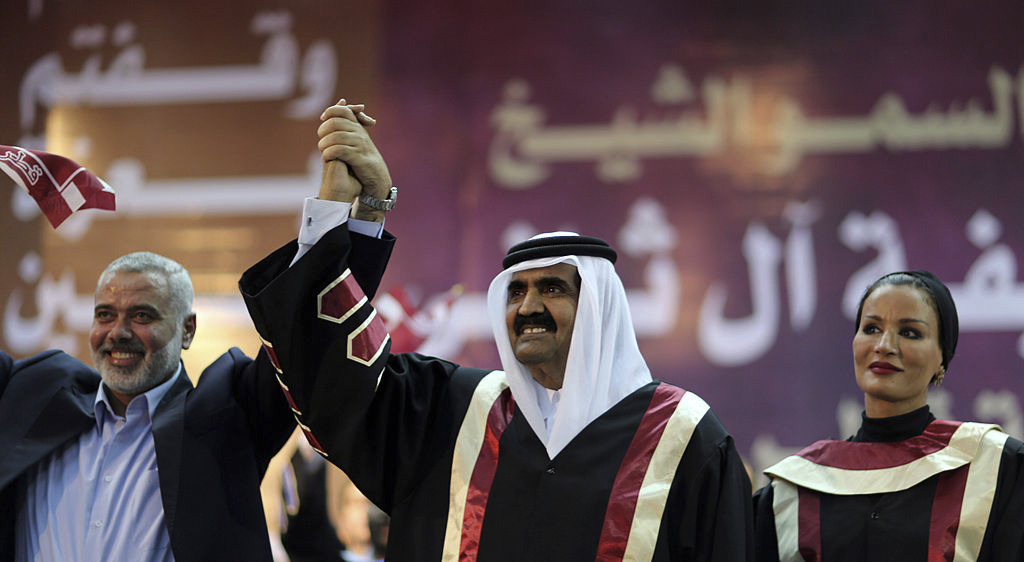
One does not need to be an "expert" to understand that Qatar, despite its attempt to present itself as a neutral mediator between Israel and Hamas over the past two years, continues to be affiliated with the extremist ideology of the Muslim Brotherhood and Hamas. Unfortunately, this ideology considers non-Muslims (and Israel) as Enemy No. 1. Pictured: Qatar's then Emir, Sheikh Hamad bin Khalifa al-Thani holds hands with then Hamas leader Ismail Haniyeh during their visit to the Islamic University in the Gaza Strip on October 23, 2012. (Photo by Wissam Nassar/AFP via Getty Images)

Delegations from Qatar, Egypt and Turkey met in Cairo on November 25 to discuss implementation of the second phase of US President Donald J. Trump's plan for ending the war in the Gaza Strip, which erupted with the October 7, 2023 Hamas-led attack on Israel.

According to media reports, the meeting included the heads of the Egyptian and Turkish intelligence agencies, along with the prime minister of Qatar. They discussed "ways to intensify joint effort to ensure the successful implementation of the second phase of the plan," which includes the disarmament of Hamas, the establishment of a transitional Palestinian governance committee, and the deployment of an International Stabilization Force in the Gaza Strip.

The meeting underscores Qatar's apparent eagerness to play a central role in post-war Gaza. As a long-time supporter and funder of the Muslim Brotherhood organization, the Qatari regime's main goal seems to be ensuring that Hamas remains in power in the Gaza Strip. Hamas describes itself as "one of the wings of the Muslim Brotherhood in Palestine."

Qatar is the only Arab country that hosts the entire leadership of Hamas and that has been providing political and financial aid to the terror group since 2007.

In 2012, former Qatari Emir Sheikh Hamad bin Khalifa Al-Thani was the first leader of a country to visit Gaza under Hamas rule. He pledged $400 million in assistance, and that same year Hamas was permitted to open a political office in Doha.

It is this Qatari (along with Iranian) support that enabled Hamas to stay in power for the past 18 years and launch its October 7, 2023 massacre, which resulted in the murder of some 1,200 Israelis and foreign nationals, the wounding of thousands, and the kidnapping of 251 hostages, the remains of two of whom have yet to be returned by Hamas.

Without Hamas, Qatar would lose a critical means of influence not only in the Palestinian areas but also in the region. The assumption that Qatar could play a role in maintaining peace or launching a process of deep deradicalization in the Gaza Strip is delusional.

One does not need to be an "expert" to understand that Qatar, despite its attempt to present itself as a neutral mediator between Israel and Hamas over the past two years, continues to be affiliated with the extremist ideology of the Muslim Brotherhood and Hamas. Unfortunately, this ideology considers non-Muslims (and Israel) as Enemy No. 1.

In his October 19 column in the Qatari government daily Al-Sharq, Ahmad al-Muhammadi, an imam and preacher in Qatar's Waqf Ministry, explained that the enmity between the Muslims and the Jews and Christians is existential and deeply rooted, and presented Islam as the truth and Christianity and Judaism as falsehood and heresy.

Stating that anyone who thinks this enmity – which he said stems from a variety of reasons involving a combination of faith, interests, history and geography – is transient is deluding himself, he went on to clarify that it would continue as long as Islam exists and "as long as the communities of unbelief persist in their deviation."

He stressed that a devout Muslim "realizes that today's conflict between Islam and its enemies is not just a battle over borders or interests, but a battle over values, ways of action, and the future." He went on to call on Muslims to beware of slogans of tolerance that are aimed at uprooting belief in Islam, and asserted that Islam is "a religion that neither compromises nor reconciles."

Such statements by Qatari officials should not surprise anyone. Since Hamas's October 7 massacre and throughout the Gaza war, Qatar, its media, and institutions affiliated with it have consistently expressed unreserved support for Hamas and for terrorism and armed violence against Israel. This support finds expression on all levels: in statements by officials and religious clerics, in the media and in Qatar's education system.

According to an investigative report by the Middle East Media Research Institute (MEMRI):

"Despite its ostensible role as a mediator between Hamas and Israel, Qatar, which has for years sheltered Hamas leaders within its borders and funded this organization with billions of dollars, has taken a blatantly pro-Hamas and anti-Israel line, as reflected in statements by members of the royal family and by Qatari politicians. Sheikha Moza bint Nasser, the mother of the Qatari Emir and the chair of the Qatar Foundation, implied that Israel had fabricated reports about Hamas' atrocities, and accused Israel of spreading false historical narratives that 'have taken over the collective mind of the world.' After the death of Hamas leader Yahya Sinwar, the architect of the October 7 massacre, Sheikha Moza eulogized him, saying that 'he will live on' while Israel will perish. Shortly after the October 7 massacre, Sheikha Hind, the Emir's sister and CEO of the Qatar Foundation, condemned Israel's 'murder and destruction' in Gaza while making no mention of the atrocities perpetrated by Hamas. Qatari Shura Council member Essa Al-Nassr said that October 7 was the beginning of the end of the Zionist state, presenting this as a divine promise mentioned in the Quran. He added that there can be no peace with the Jews, because their faith condones 'deception, the violation of agreements and lies' and they are 'slayers of the prophets.'

"Al-Jazeera, Qatar's flagship media network, has been operating as a propaganda outlet in the service of Hamas. It expresses unreserved support for this organization, justifying its October 7 attack, showing footage from it obtained from the terrorists' bodycams, and celebrating it as a victory that has brought pride and honor to the Islamic nation. The network has provided an unlimited platform for messages and threats by Hamas' leaders and spokespersons, and for their calls on Muslims worldwide to join the jihad against Israel. To wit, Hamas leader in Gaza Yahya Sinwar described Al-Jazeera as 'the best pulpit that accurately gives voice to our positions...'

"Moreover, it has been shown that some Al-Jazeera reporters took an active part in Hamas' October 7 invasion of Israeli localities, and some even served as Hamas field commanders. On their personal social media accounts and various other online platforms, Al-Jazeera's presenters and reporters are even more explicitly pro-Hamas and anti-Israel. They have openly praised Hamas and its October 7 attack, and expressed hope that this attack presages the complete liberation of Palestine and Israel's demise.

"A similar line is taken by other Qatari media and journalists, which likewise support and glorify Hamas and terror against Israel in general. This is conveyed in reports, opinion pieces, cartoons and even poems published by the various outlets, which describe October 7 as 'a magnificent and historic day' and call for further attacks of this sort, and claim that Israel's demise is a divine promise and is therefore inevitable. The articles also encourage Hamas to continue its missile attacks on Israel and kidnap more Israelis, and oppose the disarming of this organization."

Researcher and political analyst Eitan Fischberger recently uncovered a series of posts in which Majed al-Ansari, advisor to the Qatari prime minister and spokesman for Qatar's Foreign Ministry, openly praised suicide bombings and called for Tel Aviv to burn. In one post, al-Ansari praised the Second Intifada – the 2000-2005 Palestinian terror campaign – against the "Zionist enemy" and its "martyrdom operations" -- a euphemism for terrorist attacks.

In a recent speech, the Emir of Qatar, Tamim bin Hamad al-Thani, said that the five Hamas members Israel killed in an airstrike in Doha last September were "our brothers."

Qatari Education Minister Lowlah al-Khater has called Israel and the West an "ugly, racist, and vile civilization" She described Israel and its Western backers as a "mixture of ugliness, entrenched racism, and vile materialistic civilization."

Qatar poses a threat not only to Israel and the West, but also to many Arabs who are opposed to Islamist terror groups.

Saudi Arabia, the United Arab Emirates and Bahrain are said to be "frustrated" by Washington's growing concessions to Qatar, their regional rival and a longtime supporter of the Muslim Brotherhood. According to an October 12 report in the newspaper Israel Hayom:

"Over the past month, several key moderate Gulf states—Saudi Arabia, the UAE, and Bahrain—have found themselves sidelined. While they support Trump's initiative to end the war, they are unhappy with the major concessions made to Qatar, still their regional rival and a supporter of the Muslim Brotherhood, the Islamist movement that undermines Arab regimes. They are also uneasy about Washington's expanding defense agreements with Doha."

An unnamed Saudi diplomatic source told the newspaper: "It's a mistake to rely on Qatar, which backs the Muslim Brotherhood." He warned that "excessive Qatari involvement in the next stages of the plan and Gaza's reconstruction will cause Trump's plan to collapse," adding:

"Qatar's interests are different, it will undermine deradicalization efforts and try to ensure that Hamas remains in the picture and returns to power in the not-so-distant future."

Bringing Qatar into the Gaza Strip is effectively placing the fox inside a chicken coop. If Qatar is allowed to play a civilian or security role inside the Gaza Strip, this privilege would be seen by many Palestinians as a reward for Hamas and other Islamist terror groups. It will allow the terrorists worldwide to rearm and regroup, and enable Qatar to continue reasserting the policies of the Muslim Brotherhood throughout the Middle East – as well as in the US, where it has already exorbitantly bought influence. That purchase includes "economic commitments worth at least $1.2 trillion" in the US, the $400 million "flying palace" Boeing 747 jet, and "at least $100 billion" pumped into US universities.


Khaled Abu Toameh is an award-winning journalist based in Jerusalem.

Source: https://www.gatestoneinstitute.org/22082/qatar-role-in-gaza

Follow Middle East and Terrorism on Twitter

Israel set to fully deploy 'game-changing, cutting-edge' Iron Beam laser system this month - Yonah Jeremy Bob


by Yonah Jeremy Bob

Israel will fully deploy the Iron Beam on December 30, introducing a laser system designed to intercept drones, rockets, missiles, and mortars at high speed.


Defense Ministry research and analysis chief Dani Gold on Monday announced that Israel's Iron Beam paradigm-shattering laser defense will be rolled out in the field on December 30.

In mid-September, the Defense Ministry announced that Iron Beam was operational and that a full series of batteries would be fanning out across the country to provide cutting-edge new air defense capabilities within the coming months.

Already in June, the ministry and Rafael, the lead company of multiple defense tech companies involved, including also Elbit and others, had announced that Lite Beam, a smaller relative of Laser Dome (formerly known as "Iron Beam,") was operational.

At the time, the ministry also disclosed that Israeli laser defense systems had shot down around 40 Hezbollah drones in October 2024.

However, Monday's news signalled the final jumps forward.

Security officials have stated that Laser Dome also has the capacity to take on barrages of simultaneous aerial threats and is not merely limited to shooting down one or two at a time. (credit: IDF SPOKESPERSON'S UNIT)
First, Iron Beam has more power, a longer range, and can be used to defend against a wide array of threats as compared to Lite Beam.

Second, Iron Beam can specifically shoot down not only drones, but also missiles, rockets, and mortars, making it far more formidable than if it were only capable of shooting down drones, a relatively slow-moving threat.

Third, the announcement means that Iron Beam batteries will be produced and dispersed around the country at scale, as opposed to serving in just one or two locations where their impact would take time to be judged.

The ministry and the IDF expect Iron Beam to immediately start reducing the cost of shooting down aerial threats, an issue that has been out of control for Israel during this war, in which tens of thousands of threats have been launched through the air at Israel on six fronts.  

Firing the Iron Beam is as cheap as turning a light on

Firing Arrow interceptors can cost millions of shekels, Iron Dome interceptors can cost tens of thousands of shekels, but firing the Iron Beam is as cheap as turning a light on.

Defense Ministry Director-General Amir Baram has previously said that Iron Beam will lay the foundation stone to start the process, which will change battle zones worldwide until they are invariably filled with cheaper laser platforms.

Security officials said that Iron Beam also has the capacity to take on barrages of simultaneous aerial threats and is not merely limited to shooting down one or two at a time.

Head of the directorate’s R&D Division, Brig.-Gen. Yehuda Elmakayes previously said that the Knesset already approved an extensive budget two years ago to cover as many Laser Dome batteries as will be needed at this stage of deployment.

In June, IDF M. Sgt. "A" told The Jerusalem Post in an exclusive interview that his time on the laser team protecting the country with this game-changing, cutting-edge system has been "incredible."

A is a reservist who was stationed in the North to work on how to operate the laser in real combat situations, and who had spent time in the IDF's air defense units mostly over a decade ago, but returned to assist when the current war broke out.

He said that he and everyone else had to learn how to best operate the laser in real time in the field since it is essentially something that no one has ever done before.

"We received the system, we made adjustments while operating in the field, and we improved with the industry developers [Rafael] after we got a better understanding of what we needed to increase our shoot-down success," said A.

Although Raytheon in the US, as well as England, Russia, China, Germany, and Japan, are all at various stages of developing laser defense systems, the ministry has said that the Iron Beam is the only one that has moved beyond test firings to actual use in the field.

Defense sources also previously revealed that the new family of lasers could eliminate the need for Israelis to run to bomb shelters versus most aerial threats.

They explained that a major advantage of lasers: Iron Beam, Iron Beam M, and Lite Beam, are that they can shoot down enemy rockets and drones much earlier in the threat process. This means that most of the time no siren warnings or bomb shelters would be necessary.

How does this work?

The reason would be because the light energy of the laser travels much faster than any interceptor in Israel's arsenal and would already potentially destroy the enemy aerial threat shortly after it launches, and invariably while still in enemy territory.

In fact, because the laser fires so much faster, the IDF will also likely have more chances to hit a target which it initially misses, since it will know it has missed earlier on in the process.

That means that Israelis would likely only hear a siren and need to run to bomb shelters in those rare cases where the laser system missed its target, then likely missed it multiple more times

The Lite Beam is the smallest and most local short range system of Israel's three laser systems, which can be placed on individual ground forces vehicles and fires a 10 kilowatt beam.

Iron Beam M fires a 250 millimeter 50 kilowatt beam and can be mounted on large trucks for mobility, but cannot be placed as a minor additional system on individual vehicles.

Sources have also indicated that the Iron Beam M is not only generally mobile, but can even be fired while moving.

The full size Iron Beam fires a 450 millimeter 100 kilowatt beam, is designed to remain stationary for periods of time, and cannot be fired while moving. However, it can, with advance planning, be moved around just as Iron Dome batteries, over time, can be moved around.


Yonah Jeremy Bob

Source: https://www.jpost.com/israel-news/defense-news/article-876798

Follow Middle East and Terrorism on Twitter

'Defense-Tech Nation': Israel prepares new spectrum of weapons for next Iran war - Yonah Jeremy Bob


by Yonah Jeremy Bob

Defense Ministry's Amir Baram warned that "Iran's rapid force buildup in air defense and ballistic missile capabilities" driven by "its extremist ideology" means that "all fronts are still open."


Artificial intelligence and humanity.
(photo credit: SHUTTERSTOCK) 

Israel is working on new technologies for the next potential war with Iran, Defense Ministry Director-General Amir Baram said on Monday.

Speaking from the Defense Tech conference jointly sponsored by the ministry and Tel Aviv University, Baram warned that "Iran's rapid force buildup in air defense and ballistic missile capabilities" driven by "its extremist ideology" means that "all fronts are still open" and the IDF must be ready for additional rounds of fighting.

"Enemies are learning and adapting. We are at a pivotal point before a new paradigm takes place," said Baram.

Separately, Baram revealed for the first time what led the ministry and the IDF to finally deploy the Iron Beam laser defense system in the field in October 2024.

On October 13, Hezbollah succeeded in killing a large number of soldiers from the Golani Brigade, when a drone it launched struck them in their mess hall in their base in the North.

IDF soldiers operating in the Gaza Strip, August 1, 2025. (credit: IDF SPOKESPERSON'S UNIT)

Israel deploys Iron Beam, turns into 'defense-tech nation'

Within days, Baram said the decision came down to taking the risk to deploy the Iron Beam.

The rationale was that the risk of deployment was not lower than the risk of non-deployment, in which Hezbollah was succeeding in striking Israel with many drones.

Iron Beam shot down nearly 40 drones over the coming two weeks, and the IDF recently announced the full-scale deployment of the tool.

Next, Baram addressed Israel's uniqueness in advanced defense technologies and noted, “For years, Israel was known worldwide as a 'Cyber Nation.' Today, we have evolved into a true 'Defense-Tech Nation.'

Our innovation portfolio now spans the full spectrum of advanced capabilities: Aerial Defense Systems, Unmanned Vehicles, Electronic Warfare, Quantum-Resistant Communications, Intelligence and Surveillance Systems, Cyber Defense, and Space Technologies."

He added, "In 2024 alone, we signed 21 Government-to-Government agreements worth billions, and the Ministry invested 1.2 billion shekels in startups alone. Of the 300+ startups working with the DDR&D, remarkably, over 130 joined operations during this war."

Moreover, Baram stated, "Tel Aviv now ranks as the world's third leading Defense-Tech hub. Israel's major defense companies have secured significant international contracts across Europe, Asia, and North America. Small and mid-sized companies have achieved remarkable growth, with contracts worth hundreds of millions of dollars each."

Further, he said Israel promotes a unique ecosystem that only a few can replicate, born of existential security challenges and shaped over decades of operational experience.

Direct feedback loops connect the frontline, engineers, and industry partners, creating a robust chain from battlefield needs to deployed solutions. These are combat-proven systems. This is what Defense-Tech means in Israel."


Yonah Jeremy Bob

Source: https://www.jpost.com/israel-news/defense-news/article-876796

Follow Middle East and Terrorism on Twitter

The War in Ukraine: Lots of Questions and a Few Answers - Victor Davis Hanson


by Victor Davis Hanson

Putin gambled on Western hesitation, and now a war born of miscalculation grinds on because neither Moscow nor NATO is willing—or able—to force a decisive end.


Why did the war in Ukraine start in 2021?

As in 2008 and 2012, but unlike 2017 to 2021, Vladimir Putin sensed an American president would not or could not deter him, so he invaded a former Soviet republic. Under past presidents, Putin saw no downside to grabbing Ossetia, the Donbas, and Crimea.

Putin was also led to believe the West or Joe Biden would not challenge him following the recent humiliating U.S. withdrawal from Kabul. Biden’s unfortunate remark that a “minor” Russian invasion might not invoke a U.S. response did not help.

Based on past experience, Putin saw no real obstacle to a quick victory.

Why didn’t NATO deter Russia?

NATO members have only recently agreed to the earlier Trump demand to meet their 2% of GDP defense spending promises. Most were still poorly armed in 2022 and had mocked Trump’s effort to berate them into meeting their promised defense expenditures.

Europe, Germany in particular, was dependent on cheap imported Russian natural gas. Many European leaders were somewhat compromised by such dependency on and profits from Putin’s oil companies.

Lax and haughty Western Europeans also typically did not heed frontline, less utopian Eastern European warnings about Russian intentions and the need to rearm to meet them.

Additionally, when Trump warned the Europeans in his first term not to buy and become dependent on imported Russian gas, they ignored him. When he bullied and hectored them further to increase their defense spending, they scoffed at him.

Thus, Putin digested all that.

Why does Putin keep fighting when he cannot take Ukraine?

Putin is now in a 1967 Vietnam, no-good-choices dilemma. The stagnant status quo is at least considered preferable to either a humiliating withdrawal and admission of defeat or an escalation that would only increase the human and material costs without the likelihood of breaking the stalemate.

There is some imaginary DMZ line west of the Russian-Ukrainian border, which Putin has not yet reached, but feels will constitute enough Ukrainian territory to justify to the Russian and oligarchic classes his otherwise foolhardy failed attack on Kyiv. Even dictators have masters in the shadows.

Putin feels he has not yet achieved sufficient gains to justify his ruination of the Russian military reputation, the loss of more than one million Russians killed or wounded, and the destruction of the Russian economy.

He feels he has not yet reached his envisioned DMZ line that will save his dictatorship. And he fantasizes that with a few more thousand rockets or a million more drone launches, he can still break Ukraine’s will.

Putin also senses that his new de facto alliance with China and tensions between Europe and the U.S. are attributable to his war, and thus, in part, he claims it was worth the cost.

Why don’t the NATO powers give Ukraine enough support to win the war?

Russia may be laughed at as a mere gas station with nukes. But it still has over 6,000 nuclear weapons. Its periodic empty nuclear bluster is certainly 98% bluff. But a 2% chance of a serious nuclear exchange can still deter peaceful, affluent Western nations. Proxy wars between nuclear powers are dangerous propositions, especially when one is directly involved.

Moreover, neither the U.S. nor NATO members have enough sophisticated missiles and drones yet to supply Ukraine in tit-for-tat fashion against Putin’s limitless barrages. NATO and the U.S. are rearming, but not frantically so in World War II-like fashion, or even in the way that Putin is.

Trump ran and has governed as a peacemaker. His avoidance of foreign entanglements is central to his MAGA brand.

Of course, some fringe MAGA voters may strangely even favor Putin over Zelensky in alt-right terms as not being a European-like, atheist-socialist-globalist with the attendant hard left, green, DEI baggage.

Other supporters would like to see Russia join the U.S. in a triangulation move against China, and so do not wish to see Moscow completely estranged from the West and end up in the lap of Beijing.

Consequently, for a variety of political reasons, it remains problematic for Trump to either guarantee Ukraine’s independence or send enough weapons and personnel for Ukraine to win the war. After all, the Europeans in toto have a larger population and GDP than does the United States, and the war is on their own doorstep.

For example, it would be absurd for the U.S. to ask Europe to help stop the 70,000 annual American deaths from Mexican cartel-imported fentanyl or the 10 million on Mexican soil who were recently waved in by Mexican authorities to cross our borders illegally. We don’t ask NATO for help to deal with the Mexican-Chinese skullduggery that creates cartel fentanyl factories and trade work-arounds that result in a $171 billion Mexican trade surplus. All NATO members have the primary responsibility to address existential threats on their doorsteps.

The specters of the Afghanistan misadventure and the Iraq slog are not yet in America’s rear window, and it is reluctant to get into hellholes again.

Americans, in addition, have some sense that the war started years ago as a post-Soviet border dispute between Russian-speaking, Russian-Orthodox rivals. They know Ukraine’s borders have not historically been sacrosanct but have been altered and changed by wars over the last 100 years. Much of today’s Western Ukraine was Polish until 1939. Crimea had been Russian since 1783. Russia gave up the Donbass to Ukraine, but only as a Soviet jurisdictional gesture to a fellow Soviet republic in 1954.

So some shrug and say, “Keep us out of their ‘same old, same old’ problems over there.”

Isn’t Ukraine corrupt, so why are we supporting it?

It certainly is corrupt, but in that part of the world, it is seen as less corrupt and immoral than Russia.

Also, Russia invaded Ukraine, not vice versa.

Zelensky understands the Western mindset and knows how to gain its sympathy for the underdog. Putin does not, but instead radiates Stalin-like ruthlessness.

Ukraine is also seen as quasi-European and certainly friendlier toward the U.S. than is Russia, our former Cold War enemy.

After the Kabul disaster, the U.S. cannot afford to cut off all aid completely and then get blamed for “losing Ukraine” if it falls to Putin. Trump does not wish to see the military reputation of the U.S. tarnished as in 2021 Kabul fashion—and that would happen if he cuts off all aid and Putin were to take Kyiv.

Ukraine also just wants its own country; Putin, in contrast, may want back all the former Soviet republics, especially the entire Ukraine breadbasket, as well as his Eastern European buffer zone.

Finally, like Israel, Ukraine is also a rare, militarily competent ally that can do a great deal of damage to America’s rivals and enemies in such proxy wars. No one has done more harm to our adversaries than have Ukraine and Israel.

Isn’t it amoral to keep supplying arms to a Verdun-like inferno that may soon see 2 million casualties?

Yes, but Trump alone seems to think so.

Certainly, it is odd how he is the only major political figure decrying the senseless death and destruction in Ukraine—and yet equally damned by mostly disarmed left-wing European globalists for not being bellicose enough!

Is there any way to stop this Stalingrad meat grinder?

In fact, the general outlines of a peace deal have been known for years:

Each side is made to feel that it “won” the war if an exact DMZ line near the current front can be agreed upon. Ukraine cedes (unofficially) any further claims to its Donbass and Crimean regions stolen by Russia in 2014.

It swears off NATO membership and agrees to a DMZ somewhere near the current battle lines.

In turn, Zelensky becomes a hero for saving 90 percent of 2022 Ukraine against overwhelming odds. Ukraine is rearmed. It has now become the most militarily lethal European state.

NATO also, as a result, becomes stronger and united with new capable members like Finland and Sweden.

As for Russia, it agrees to stop fighting along a negotiated DMZ. Putin brags that he institutionalized his prior theft of Crimea and the Donbass.

He further claims he stopped NATO expansion into the former Soviet Republics by barring Ukraine from the alliance. He points to a new China-Russian, anti-American alliance and growing cracks in European-American solidarity.

Why not a peace deal now, then?

It depends on Putin feeling he has stolen enough territory to agree to the proposed peace deal, to justify to his rivals in the Kremlin the enormous costs Russia has incurred in his foolhardy war. For a Russian dictator, failure or humiliation is not loss of office alone—but sometimes being thrown out of a high-rise window.

Also, can Ukrainian forces at present be rearmed and retrained sufficiently to deter another Russian aggression? And will Europe guarantee Ukraine’s autonomy—with a vague assurance of military aid and logistical support from the U.S.?

These are still all still hypotheticals. Security guarantees and the actual DMZ line must be hammered out.

How long would any peace last?

Only as long as Putin or his autocratic replacement conjectures that, in a cost-benefit analysis, invading Ukraine for a fourth time would be a bad idea and a losing proposition.

The ultimate solution—a liberalizing, consensual Russian government—is simply not on the horizon.

It will be a 40-60 proposition even to see a non-corrupt, democratic Ukraine emerge from the war.

So far, any peace hinges not on Russian intent but on the ability to thwart Russia’s proven expansionary agendas by demonstrating to it in advance that invading again would become another Russian nightmare.

Ukraine, if it wishes to be free, autonomous, Western, and not a puppet of Russia, will have to see Russia as Israel sees Iran, Hezbollah, Hamas, the Palestinian Authority, and the Houthis. That is, as permanent enemies, all ready to strike in concert at any sign of Ukrainian weakness, requiring constant military readiness and vigilance.


Victor Davis Hanson

Source: https://amgreatness.com/2025/12/01/the-war-in-ukraine-lots-of-questions-and-a-few-answers/

Follow Middle East and Terrorism on Twitter

Kaine to refile resolution to require congressional approval for military action in Venezuela - Nicholas Ballasy


by Nicholas Ballasy

He predicted that the "numbers will change" this time around in terms of the amount of support among senators


Sen. Tim Kaine, D-Va., revealed on Sunday he is going to refile a war powers resolution that would require congressional approval for any possible military action taken against Venezuela.

“I will move with colleagues, Senator Schumer, Senator Paul, Senator Schiff, immediately should there be military action,” Kaine said  on CBS News’s “Face the Nation," referring to Senate Minority Leader Chuck Schumer, D-N.Y., as well as Sens. Rand Paul, R-Ky., and Adam Schiff, D-Calif.

Kaine said the prior version of the resolution “failed, but that was before all of these assets have amassed around Venezuela, and before President Trump said that the airspace needs to be closed.”

He predicted that the "numbers will change" this time around in terms of the amount of support among senators.


Nicholas Ballasy

Source: https://justthenews.com/government/congress/kaine-refile-resolution-require-congressional-approval-military-action

Follow Middle East and Terrorism on Twitter

Northwestern admits no wrongdoing on Jew-hatred, agrees to settle with Trump admin, pay $75 million - JNS Staff


by JNS Staff

“Today’s settlement marks another victory in the Trump Administration’s fight to ensure that American educational institutions protect Jewish students and put merit first,” stated Pam Bondi, the U.S. attorney general.


U.S. President Donald Trump holds a press conference with Attorney General Pam Bondi and Deputy Attorney General Todd Blanche, June 27, 2025. Credit: Abe McNatt/White House.


Northwestern University, a highly ranked private school in Evanston, Ill., became the latest school to settle a federal probe over alleged Jew-hatred and pay a large sum of money without admitting wrongdoing.

The U.S. Departments of Education, Justice and Health and Human Services stated on Friday that Northwestern had agreed to pay $75 million to the U.S. Treasury through 2028.

The settlement “marks another victory in the Trump administration’s fight to ensure that American educational institutions protect Jewish students and put merit first,” stated Pamela Bondi, the U.S. attorney general. “Institutions that accept federal funds are obligated to follow civil rights law. We are grateful to Northwestern for negotiating this historic deal.”

Harmeet Dhillon, the U.S. assistant attorney general for civil rights, stated that “universities that receive federal funding have a responsibility to comply with the law, including protecting against racial discrimination and antisemitism,” and Linda McMahon, the U.S. education secretary, called the agreement “a huge win for current and future Northwestern students, alumni, faculty and for the future of American higher education.”

Henry Bienen, the interim Northwestern president after Michael Schill quit in early September, stated that the settlement “reserved Northwestern’s unique environment for research that advances human understanding, improves lives in myriad ways and makes us one of the world’s great universities.”

“We expect federal funds to resume flowing within days and be fully restored within 30 days,” Bienen stated. “This is not an agreement the university enters into lightly, but one that was made based on institutional values.” He added that the school’s red lines were that “we would not relinquish any control over whom we hire, whom we admit as students, what our faculty teach or how our faculty teach.”

“I would not have signed this agreement without provisions ensuring that is the case,” he stated. “Northwestern runs Northwestern. Period.”

In a question-and-answer page on the school’s website, Northwestern added that the “agreement explicitly states the university admits no wrongdoing.”

“The board of trustees and university leadership weighed Northwestern’s set of very difficult options and determined this agreement was the best way not only to restore federal funding but also to safeguard our institution and preserve our values and principles,” it said.

Under the agreement, the federal government, which had frozen some $790 million in funds to the school in April, agrees to close its civil rights probes of the school over Jew-hatred and hiring practices and to pay out overdue grants and consider the school eligible for future ones.

The $75 million payment, according to Northwestern, is “not an admission of guilt but simply a condition of the agreement.” The school also agrees to create a special board committee to ensure compliance with the deal, to provide anonymized admissions statistics to the government to show compliance with bars on race-based admissions decisions, to provide all-female housing and gym facilities “defined on the basis of sex” and to train international students about the “norms of a campus dedicated to inquiry and open debate.”

Northwestern also agreed to “terminate the 2024 Deering Meadow agreement” that it established with anti-Israel protesters who formed an encampment and to “reaffirm our commitment to the steps the university has taken to protect Jewish members of our community.”

Northwestern said that it will continue participating in the “scholars at risk” program, which “has brought students from war-torn regions, such as Ukraine and Afghanistan, to Evanston.” (It wasn’t clear what impact, if any, the Trump administration’s ban on visas for Afghans would mean for that program.)

The school also said that it reversing the 2024 Deering Meadow agreement meant that the “temporary spaces previously designated for the Middle Eastern and North African Student Association and the Muslim Cultural Student Association is no longer available for either organization.”

“MENA, McSA and all student organizations are encouraged to continue engaging with Campus Life and Norris to identify available reservable spaces that support their programming and community needs,” it said.

It added, in response to a question about renovation of a house Middle East, North African and Muslim students, that “the university remains committed to fostering inclusive spaces and will continue to support student belonging and engagement through existing campus facilities and organizations, while partnering with alumni to explore off-campus, privately owned locations that could further support community connection and programming.”


JNS Staff

Source: https://www.jns.org/northwestern-admits-no-wrongdoing-on-jew-hatred-agrees-to-settle-with-trump-admin-pay-75-million/

Follow Middle East and Terrorism on Twitter

Supreme Court ruling next year could reshape transgender rights beyond sports - Carleen Johnson


by Carleen Johnson

Current Washington state policy allows transgender students to participate in sports programs consistent with their gender identity.


(The Center Square) -

In seven weeks, the U.S. Supreme Court will hear oral arguments in two cases involving challenges to the constitutionality of laws in Idaho and West Virginia that prohibit transgender women and girls from participating on women’s and girls’ sports teams. A decision in these cases could have far-reaching implications nationwide.

On Jan. 13, 2026, the nation’s highest court will review lower court decisions in favor of transgender athletes from Idaho (Little v. Hecox) and West Virginia (West Virginia v. B.P.J.) who challenged the bans in their respective states. The Idaho case involves the 14th Amendment's Equal Protection Clause. The dispute over West Virginia's law involves the Constitution's guarantee of equal protection and Title IX, the landmark civil rights law that prohibits sex-based discrimination in education.

Beth Parlato is the senior legal advisor at the Independent Women's Law Center, which is a project of the Washington, D.C.-based Independent Women’s Forum.

According to her, a broad ruling by the Supreme Court could have nationwide implications.

“The broad ruling, what that would do, is clarify what the definition of sex means. That it’s biologically male and female and that it's immutable, and that specifically it does not mean gender identity,” Parlato explained. “So, we are hopeful that the court is going to give us a broad ruling to clarify the meaning of sex.

“What that means is that girls will be protected in all 50 states. So those 24 states that do not have legislation that protect girls’ sports, they will now be under this Supreme Court [order] and that’s all the girls in the United States [who] will be protected, including those in your state of Washington.”

Parlato acknowledges that the court could issue a narrower ruling that doesn’t impact other states.

“That would be bad news for the blue states, because it doesn't really do anything for girls in those states,” she said. “So, we are remaining very hopeful that we're getting a broad ruling that's going to clarify the definition of sex, and that dividing athletics by sex, and sex segregated sports, is what rightfully is supposed to happen under Title IX. And it's legal and constitutional to have sex separated sports.”

Current Washington state policy allows transgender students to participate in sports programs consistent with their gender identity.

But the issue has become increasingly political on both sides of the aisle recently, especially now, in light of President Donald Trump's Feb. 5 executive order, "Keeping Men out of Women's Sports."

The Center Square reached out to the Washington Office of Superintendent of Public Instruction for comment on the pending cases before the Supreme Court.

“OSPI will continue to uphold and enforce our state law unless or until the law changes,” OSPI Chief Communications Officer Katy Payne said in an email to The Center Square.

Let’s Go Washington, the political action group behind IL26-638, to “require students to undergo a routine physical examination prior to participation in interscholastic sports,” sent a statement via text to The Center Square on Monday.

“We respect and appreciate the efforts being made by IWF,” LGW found Brian Heywood wrote. “Fairness in girls’ sports is under attack at the federal, state and local level, and it is critical that we fight back on all fronts against an ideology that is unfair and unsafe for girls. We believe the national tide is turning and the policy of allowing boys in girls' sports should and will be thrown out with the appropriate derision it deserves.”

A ruling in the cases is not expected until late spring.

“So, when we get this from the Supreme Court … it has implications well beyond just athletics, and this can now go into all the other areas that we have been working on,” said Parlato. “It’s unbelievably great for athletics to keep girls’ sports for girls, not only for fairness, but really for safety.

“But then let's look at the locker rooms and showers and all-girl sororities and all-female prisons and the other areas where females deserve private spaces. We need the Supreme Court to clarify that sex is male and female, and it does not include gender identity. This will then stop the males from trying to continue to enter into female spaces. This would be a huge generational win for us, and we're looking forward to it.” 


Carleen Johnson

Source: https://justthenews.com/nation/states/center-square/watch-supreme-court-ruling-next-year-could-reshape-transgender-rights

Follow Middle East and Terrorism on Twitter

Food stamp data show thousands of liquor, smoke shops are approved for EBT, raising fraud concerns - Steven Richards


by Steven Richards

More than 5,000 liquor and smoke shops were approved as retailers under SNAP, raising fraud concerns. There's no way to determine how much alcohol, tobacco, or other "non-compliant" goods have been sold nationwide. At least 20 states refuse to share data with the feds.


Food stamps were first issued in 1939 as an assistance program to prevent starvation during the Great Depression.  But 86 years later, thousands of liquor stores and smoke shops have become approved retailers, increasing the possibility of fraud, new research shows. 

The longest ever government shutdown, which ended after 43 days of deadlock, thrust the federal food stamp program into the national spotlight as millions of recipients went without benefits. But, it also laid bare many abuses in the system.   

Even before the shutdown, the Trump administration planned to crack down on fraud in the Supplemental Nutrition Assistance Program (SNAP) program and ensure any government assistance is used for healthy and nutritional foods, not junk. The One Big Beautiful Bill Act made specific changes to qualifying for the program, as well as a redefined list of products for which SNAP cannot be used.

An analysis of SNAP retailer data by the Foundation for Government Accountability published on Monday found that more than 5,000 liquor and smoke shops were approved retailers under the program, meaning they can accept food stamps, according to research findings shared exclusively with Just the News.  

Breaking down the data, more than 4,000 stores promoted alcohol in their title and another 1,000 did so for tobacco. The foundation told Just the News the real numbers could be even higher, considering researchers only counted stores that referenced those products in their titles.

"Hotbeds of fraud": Benefits used for tobacco, alcohol

Food stamps cannot be used for purchases of either alcohol or tobacco. However, the FGA says the prevalence of stores that sell these products raises concerns about the potential for different kinds of SNAP fraud. These stores “become hotbeds of fraud” where benefit cards are bought and sold in exchange for alcohol or tobacco products, Senior Data Analyst at FGA Kristi Stahr told Just the News. 

The Food Stamp Act of 1964, which first established the SNAP program in its modern form, permitted funds to be used for all items for human consumption except alcohol. That prohibition still stands. Recipients are also prohibited from buying cigarettes, tobacco products, and other items like pet food and cosmetics. 

A review of SNAP fraud cases by a law firm shows that food stamp recipients and store owners have been involved in schemes to illegally sell benefits or swap them for non-eligible purchases at stores, such as alcohol or tobacco. 

“Food stamps are meant to provide supplemental nutrition for vulnerable populations: low-income kids, the elderly, and people with disabilities,” said Michael Greibrok, Senior Research Fellow at FGA. “Letting smoke shops and liquor stores cash in on the program is not the safety net taxpayers envisioned and only funnels assistance away from the truly needy.”

Liquor and tobacco stores are not new to the SNAP list of approved vendors, but the data shows the majority of stores listed have only been approved in the last five years. According to FGA, half of all liquor and tobacco stores were approved as vendors during the four years of the Biden administration. 

Smoke shops not likely to sell nutritional food products

Additionally, the prevalence of liquor and smoke shops on the approved vendor list raises questions about health. These stores are unlikely to provide food products of substantial nutritional value that SNAP is designed to supplement, FGA says.  

“At best, places to buy your weekend six-pack and vape are unlikely to provide much nutritional value. At worst, smoke shops and liquor stores are ripe targets for scammers and fraud schemes. Keeping them on the ‘authorized retailers’ list makes defrauding and fleecing federal taxpayers easier and sends the wrong message to hardworking Americans,” Greibrok said. 

High-risk retailers get approved as “authorized retailers” for SNAP/EBT even though they primarily sell alcohol and tobacco, which cannot be purchased with food stamps.

According to FGA, these kinds of stores should be considered “high-risk retailers” because of their vulnerability to food stamp fraud that puts a financial burden on the program and U.S. taxpayers. Even though these retailers would not normally be considered food vendors, they receive approval for SNAP/EBT benefits. But, because these benefits cannot be used to purchase alcohol or tobacco, they are ripe for fraud. 

There have been many documented cases of illegal buying, selling, and trading of food stamp benefits. Both food stamp recipients and store owners have been involved in schemes to buy and sell benefits. 

Just a handful of examples illustrate the problem. In 2018, one North Carolina grocery store was caught accepting SNAP benefits for non-food products in a $200,000 fraud scheme. The following year, a Virginia grocery store owner was sentenced to 20 years for trafficking more than $1.5 million in SNAP benefits. In 2020 in California, a man was convicted for selling SNAP benefits in exchange for cash, which resulted in a hefty fine and prison time.

According to the report from FGA, more than 70% of all food stamp traffickers are convenience stores like the liquor and smoke shops found in the database and about half of all liquor and smoke shops identified by the group were approved as retailers during the Biden administration. 

Program costs explode

Costs for the federal food stamp program have soared. In 2025, the costs of the program are estimated to be just over $100 billion, up from the mere $17.1 billion cost for food stamps in 2000, U.S. Department of Agriculture data analyzed by FGA shows. 

Department of Agriculture Secretary Brooke Rollins and the White House are working on reforming the SNAP program to eliminate waste and abuse. 

Earlier this year, Rollins proposed changes to the program to increase the variety of staple foods like dairy and protein and to eliminate loopholes that allow stamps to be used for snack foods. 

To understand the scope of the problems with the program, Rollins asked each state to send their SNAP data to the USDA. The secretary said that in the data already shared with the agency, the department has uncovered “massive fraud.” However, many states have refused to turn over their SNAP data on privacy grounds. 

Reuters reported that more than 20 of those states sued the Trump administration this summer over the data request. California, the state with the greatest number of SNAP recipients at 5.3 million, led the lawsuit. California was joined by many Democrat-controlled states across the country, including New Jersey, New York, Michigan, and Illinois. In September, the District Court for Northern California issued a temporary restraining order blocking the Trump administration from enforcing SNAP cuts to states that refused to turn over the data. The court has yet to rule on the challenge. 

Nearly half of all the alcohol and smoke shop retailers are located in California, FGA told Just the News. 

In order to crack down on fraud without the full data, the Trump administration recently mandated that recipients of food stamps must reapply to the program to ensure eligibility, although the Agriculture Department’s timeline for implementing these changes is not clear. 


Steven Richards

Source: https://justthenews.com/accountability/waste-fraud-and-abuse/mon-new-food-stamp-data-show-thousands-liquor-and-smoke-shops

Follow Middle East and Terrorism on Twitter

Dozens in Israel's Abu Latif, Hariri crime families detained in covert police operation - Jerusalem Post Staff


by Jerusalem Post Staff

The operation followed an investigation which aimed to combat both extortion and "protection money" paid to these crime families in northern Israel, police explained.


Border Police officers in Jerusalem, March 30, 2025 (illustration).
(photo credit: Chaim Goldberg FLASH90)


Israel Police arrested dozens of people from the Abu Latif and Hariri crime families in an operation with the Border Police, police said in a statement on Sunday.

The operation followed an investigation which aimed to combat both extortions and "protection money" paid to these crime families in northern Israel, police explained.

Police targeted dozens of members from these families, including their homes, as well as locations in the West Bank.

The police statement explained that the operation was planned for more than a year, using undercover agents, under the leadership of the Northern District Command and the State Attorney's Office economic department.

Israeli border police officers seen during an operation in the West Bank city of Jenin, February 23, 2025. (credit: CHAIM GOLDBERG/FLASH90)

Hariri and Abu Latif crime families

Both the Hariri and the Abu Latif families are among the most powerful and dangerous crime organizations in Israel. According to Kan, they are involved in public tenders, takeover of businesses, extortion, numerous incidents of violence, and shootings.

They are also suspected of being linked to a number of brutal murders of recent years.

Back in February, 38 members of the Abu Latif family were detained by the Israel Police, resulting in 24 indictments for allegedly using blackmail and extortion to obtain local government contracts.

Several infamous members of the family were caught in the operation, including family head Suleiman Abu Latif and former chairman of soccer club Hapoel Ironi Arraba, Nissim Sah, who was sentenced to 14 years in prison for killing a police officer and injuring another in 2021.

The investigation focused on the extortion and blackmail of local contractors to monopolize the market. The family also extorted local businesses for protection money.

Yuval Barnea contributed to this report.


Jerusalem Post Staff

Source: https://www.jpost.com/israel-news/crime-in-israel/article-876781

Follow Middle East and Terrorism on Twitter

Aliyah Minister Sofer vows to vote against haredi draft bill, 'even if Netanyahu fires me' - Keshet Neev


by Keshet Neev

RZP's Ofir Sofer to oppose draft legislation, defying faction head Bezalel Smotrich • Bismuth brings new haredi draft bill outline to Foreign Affairs and Defense Committee


Aliyah and Integration Minister Minister Ofir Sofer holds a press conference at the Knesset, the Israeli parliament in Jerusalem, December 1, 2025
(photo credit: YONATAN SINDEL/FLASH90)


Aliyah and Integration Minister Ofir Sofer, of the Religious Zionist Party (RZP), vowed on Monday that he would vote against the proposed haredi (ultra-Orthodox) draft law even at the risk of being dismissed from the government, calling the current outline "shameful."

He pledged to persuade fellow party members to oppose the legislation, citing the heavy burden on reserve soldiers, whom he described as Torah-observant and dedicated.

Until now, members of the coalition’s Religious Zionist Party had been silent on their stance regarding the bill.

The party stated on Thursday that it was necessary to review the recently published new outline of the controversial legislation thoroughly before deciding its stance.

Two other members of RZP, MK Michal Woldiger and MK Moshe Solomon, also spoke against the bill at the Knesset’s Foreign Affairs and Defense Committee (FADC) meeting on Monday morning.

MK Boaz Bismuth seen at a Foreign Affairs and Defense Committee meeting at the Knesset, the Israeli Parliament in Jerusalem, December 1, 2025 (credit: YONATAN SINDEL/FLASH90)

Bismuth brings new haredi draft bill outline to top Knesset committee

The new outline of the bill was presented in the FADC meeting, led by committee chairperson MK Boaz Bismuth (Likud), marking long-anticipated progress in advancing the legislation. 

Support from the members of the Religious Zionist Party is considered key in determining if the bill will be able to pass its second and third readings in the Knesset’s plenum to become a law.

Several other members of the coalition have also announced they will not vote in favor of the bill in its current form.

Other vocal critics of the legislation in the coalition include Deputy Foreign Minister Sharren Heskel (New Hope-United Right), MK Dan Illouz (Likud), and former FADC committee chair MK Yuli Edelstein (Likud). 

Bismuth's bill has drawn wide criticism for introducing changes that critics claim fail to enforce haredi conscription into the IDF, as the military lacks manpower.

This outline "will not bring conscription,"  Edelstein told the Knesset panel. "If the goal is conscription, the entire bill needs to look different," he said.

The panel was also packed with opposition lawmakers speaking against the bill, as Bismuth stated that his outline was a "clear, stable, empirical framework based on targets, established through productive dialogue with the army."

Opposition leader Yair Lapid (Yesh Atid) slammed the proposal, telling Bismuth and the panel, “Boaz, what you’ve put on the table here is a disgraceful law of draft evasion. It is a betrayal of our soldiers. It is a betrayal of everyone who fought and sacrificed over the past two years. More than 920 killed, more than 20,000 wounded, and today you are betraying them."

“Look around you. The prime minister isn’t here, the defense minister isn’t here, [Shas MK Arye] Deri isn’t here. No one wants to touch this law. They left you alone to carry this shame.”

Progress on the bill had previously stalled due to the lack of a “green light” from Prime Minister Benjamin Netanyahu and the haredi parties.

A Foreign Affairs and Defense Committee meeting at the Knesset, the Israeli Parliament in Jerusalem, December 1, 2025 (credit: YONATAN SINDEL/FLASH90)

Haredi draft law 'dangerous,' bereaved father of slain IDF soldier says

The discussion opened with statements from bereaved family members, who spoke about the urgency of creating legislation that would ensure haredi enlistment in the IDF.

Haggai Lober, father of fallen soldier Yonatan, warned the panel that the “law is dangerous, from a security perspective, a social perspective, and a leadership perspective. The army needs combat soldiers, and you know it.”

“You know that this law doesn’t even begin to meet the army’s needs. You in this committee know what challenges the State of Israel faces, and you are not providing what the army requires,” he told the panel.

“My son had a life’s mission called the State of Israel. With this law, you distinguish between one blood and another,” he added.

The two haredi parties left the government in July over disagreements surrounding the bill, which had previously been advanced by Edelstein.

Edelstein was later removed from his position following the parties’ departure from the government, allowing Bismuth to take over the committee and spearhead a new outline that introduced significant changes to earlier versions.

Critics of the revised bill argue that it still fails to enforce haredi conscription, stalls time, and attempts to appease the haredi parties to return to the government.

Earlier this month, the High Court ruled that the state cannot simultaneously avoid drafting tens of thousands of yeshiva students and continue funding their institutions. It ordered the government to craft a genuine enforcement plan within 45 days.

Sarah Ben-Nun contributed to this report.


Keshet Neev

Source: https://www.jpost.com/israel-news/politics-and-diplomacy/article-876807

Follow Middle East and Terrorism on Twitter