Sunday, November 7, 2010
Arab Repression of the Media
by Khaled Abu Toameh
Can anyone imagine the reaction if Israel had sentenced a journalist to 50 lashes for writing an "instigating report"?
Can anyone imagine the reaction if Israel were to ban Al-Jazeera from operating in its territory?
Can anyone imagine the reaction if the Israeli government were to ban TV channels from broadcasting live events from Israel?
These are legitimate questions in light of what has been happening recently in some Arab countries.
In Saudi Arabia, a journalist was recently sentenced to 50 lashes for allegedly instigating protests against a government electricity company following a series of power cuts.
Fahd al-Jukhaidib, who works for the daily Al-Jazeirah newspaper, was also sentenced to two months in prison for his "crime." He will be whipped in public in front of the electricity company offices.
The verdict has drawn little attention in the West and prominent organizations that claim to defend freedom of the media have yet to voice their opinion on this matter.
The silence of the international media and the absence of a strong response from human rights and media organizations have obviously encouraged Arab dictators to continue and even step up their repressive measures against journalists and various media outlets.
The case is unlikely to spark widespread protests in the West, most likely because Israel is not involved. Had the poor journalist been sentenced by an Israeli court, his case would have made it to the front pages of the mainstream media in Europe and North America.
Who cares if an Arab government mistreats or tortures an Arab journalist? Besides, which Western journalist would have the courage to travel to Saudi Arabia to cover a story that could get him or her into trouble with Saudi authorities?
Earlier this week, the Moroccan government suspended the operations of the Qatar-based Al-Jazeera news network over what it called "unfair reporting."
The Moroccan government accused the TV channel of "seriously distorting Morocco's image and manifestly damaging its interests, most notably its territorial integrity."
The decision was taken in response to Al-Jazeera's reporting on the Western Sahara, a former Spanish Colony that was taken over by Morocco in 1975.
While the latest measure against Al-Jazeera drew sharp protests from the station and some Arab journalists, most Western journalists and media organizations chose not to respond.
But when Israel announced a few years ago that it was considering punitive measures against some Al-Jazeera journalists, the move triggered an international outcry and drew strong condemnations from Western media outlets.
Egypt, the largest Arab country, deserves an award for excellence in suppressing freedom of the media and harassing journalists. Egyptian authorities have banned satellite channels from broadcasting live events or distributing news reports to other television stations.
The Egyptians have also blocked the transmissions of four privately owned stations, issued warnings to two others, and canceled a popular talk. Last month, newspaper editor Ibrahim Issa was fired for publishing an article written by one of President Hosni Mubarak's political rivals.
The crackdown on Egyptian journalists and media outlets comes ahead of the parliamentary elections in the country.
Such practices against the media have always been commonplace in the Arab world. But the feeling among Arab journalists is that the Arab dictators have decided to step up the campaign against the media. As long as the West continues to turn a blind eye to such practices, independent and brave journalists will become an endangered species in the Arab world.
Khaled Abu Toameh
Copyright - Original materials copyright (c) by the authors.

Iran and Latin America, as seen by Teheran
by Anna Mahjar-Barducci
While the United States has focused its attention on Iranian activities in the Middle East, Iran is working to expand its influence in Latin America.
Iranian president Mahmoud Ahmadinejad is trying to strengthen the anti-American bloc of Venezuela, Bolivia, Ecuador, Cuba, and Nicaragua and is tightening its ties with Brazil. Iran has now financed new port facilities in Nicaragua to the tune of $350 million; and has given Bolivia $1 million in economic aid, and opened a Bolivian embassy in Tehran[1]. This support has been translated into reciprocal support for Iran's nuclear program.
Iran's presence in Latin America, however, goes back to the 1990s. Terrorists with connections to Iran are responsible for the bombing of the Israeli embassy in Buenos Aires in 1992, and a Jewish community center there in 1994. In 2006, former Iranian president Ali Akbar Hashemi Rafsanjani was charged with ordering and masterminding those attacks.
Recently, Ahmadinejad said that the Islamic Republic "gives high priority to expanding its relations with all the Latin American nations." Even though the Obama administration expressed concern over Iran's growing influence in Latin America - U.S. Secretary of State Hillary Clinton said that it was "a really bad idea" - no clear policy was drawn.
From the Iranian Press:
- Ecuador not to let third parties interfere in ties with Iran
- Iran hopes to forge closer ties with Nicaragua
- Brazil says Tehran Declaration can solve dispute between Iran, West
- Iranian President, Brazilian FM Meet in New York
- Iran, Cuba aim to bolster ties
- Ahmadinejad underlines Iran-Bolivia Resistance against 'Arrogant Powers'
- 'Iran, Latin America ties a priority'; Expansion of ties between Iran and Peru
Ecuador not to let third parties interfere in ties with Iran
Ecuadorian President Rafael Correa underscored that Quito will not allow other countries to interfere in that country's relations with Iran. Correa made these remarks in a telephone conversation with Iranian President Mahmoud Ahmadinejad. The Ecuadorian president went on to say that Iran and Ecuador should seize the existing opportunities for promotion of bilateral cooperation. Ahmadinejad, for his part, called for fostering bilateral and brotherly ties between the two countries, and said nothing can separate the two nations from one another. Fars News Agency (Iran)
September 28, 2010
Iran hopes to forge closer ties with Nicaragua
Iran's foreign minister, Manouchehr Mottaki, on the sidelines of the 65th conference of the UN General Assembly in New York, had a meeting with Nicaraguan Foreign Minister Samuel Santos Lopez. Mottaki elaborated on Iran's potentialities in different areas and expressed hope for forging closer ties with Nicaragua. Press TV (Iran)
September 24, 2010
Brazil says Tehran Declaration can solve dispute between Iran, West
Foreign Minister of Brazil Celso Amorim suggested that the Tehran Declaration could help resolve the nuclear dispute between Iran and the West. Based on the Tehran Declaration, signed between Iran, Turkey, and Brazil on May 17, Iran would ship 1200 kilograms of its low-enriched uranium to Turkey to be exchanged for 120 kilograms of 20% enriched nuclear fuel rods to power the Tehran research reactor, which produces radioisotopes for cancer treatment. Amorim, who was addressing the United Nations General Assembly session in New York, complained that the 5+1 group did not heed the Tehran Declaration and instead adopted a new resolution against Iran. Mehr News (Iran)
September 23, 2010
Iranian President, Brazilian FM Meet in New York
Iranian President Mahmoud Ahmadinejad and Brazilian Foreign Minister Celso Amorim held a meeting to discuss bilateral relations and the latest regional and international developments. Amorim expressed hope that the future negotiations of Iran and members of the Group 5+1 would be fruitful. Fars News Agency (Iran)
September 22, 2010
Iran, Cuba aim to bolster ties
Iranian President Mahmoud Ahmadinejad calls for bolstering ties with Cuba, noting that the two countries have enjoyed sustained ties for more than three decades. Ahmadinejad made the remarks in a meeting with Cuban Foreign Minister Bruno Rodriguez on the sidelines of the UN General Assembly's annual session in New York. Press TV (Iran)
September 22, 2010
Ahmadinejad underlines Iran-Bolivia Resistance against 'Arrogant Powers'
Iranian President Mahmoud Ahmadinejad reiterated that Iran and Bolivia are on the same front in their resistance against the expansionist policies of the arrogant powers. Iran and Bolivia enjoy deep friendly relations and we are ready to develop ties with the country in various sectors, including agriculture, trade and industry, Iranian President Mahmoud Ahmadinejad said in a meeting with Bolivian ministries. Fars News Agency (Iran)
August 24, 2010
'Iran, Latin America ties a priority;' Expansion of ties between Iran and Peru
Iranian President Mahmoud Ahmadinejad says the Islamic Republic gives high priority to expanding its relations with all the Latin American nations. President Ahmadinejad made the remarks at a meeting with the new Peruvian accredited ambassador to Iran, Javier Paolini Velarde. "There is a great potential for expansion of mutual ties (between Iran and Peru) which can be employed to the interests of the two nations". Press TV (Iran)
Anna Mahjar-Barducci
Copyright - Original materials copyright (c) by the authors.
From the Qur'an
by Salah Uddin Shoaib Choudhury
Following are quotes from Qur'an, in which it says that Israel is the Land for Jewish only:
"To Moses We [Allah] gave nine clear signs. Ask the Israelites how he [Moses] first appeared amongst them. Pharoah said to him: 'Moses, I can see that you are bewitched.' 'You know full well,' he [Moses] replied, 'that none but the Lord of the heavens and the earth has revealed these visible signs. Pharoah, you are doomed.'"PROFESSOR SHAYKH ABDUL HADI PALAZZI OF ITALY COMMENTS:
"Pharoah sought to scare them [the Israelites] out of the land [of Israel]: but We [Allah] drowned him [Pharoah] together with all who were with him. Then We [Allah] said to the Israelites: 'Dwell in this land [the Land of Israel]. When the promise of the hereafter [End of Days] comes to be fulfilled, We [Allah] shall assemble you [the Israelites] all together [in the Land of Israel]."
"We [Allah] have revealed the Qur'an with the truth, and with the truth it has come down. We have sent you [Muhammed] forth only to proclaim good news and to give warning."
[Qur'an, "Night Journey," chapter 17:100-104]
God wanted to give Avraham a double blessing, through Ishmael and through Isaac, and ordered that Ishmael's descendents should live in the desert of Arabia and Isaac's in Canaan.THE LAND OF ISRAEL IN QUR'ANIC EXEGESIS
The Qur'an recognizes the Land of Israel as the heritage of the Jews and it explains that, before the Last Judgment, Jews will return to dwell there. This prophecy has already been fulfilled.
The fundamentalist Muslim program to use Islam as an instrument for political warfare against Jews finds a major obstacle in the Qur'an itself. Both the Bible and the Qur'an state quite clearly that the right of the Israelites to the Land of Israel does not depend on conquest and colonization. This right flows from the will of almighty God Himself.
Both the Jewish and Islamic Scriptures teach that God, through His chosen servant Moses, decided to free the offspring of Jacob from slavery in Egypt and to constitute them as heirs of the Promised Land. Whoever claims that Jewish sovereignty over the Land of Israel is something new and rooted in human politics denies divine revelation and divine prophecy as explicitly expressed in our Holy Books (the Bible and Koran).
The Qur'an relates the words by which Moses ordered the Israelites to conquer the Land:
"And [remember] when Moses said to his people: 'O my people, call in remembrance the favour of God unto you, when he produced prophets among you, made you kings, and gave to you what He had not given to any other among the peoples. O my people, enter the Holy Land which God has assigned unto you, and turn not back ignominiously, for then will ye be overthrown, to your own ruin.'" [Qur'an 5:20-21]Therefore, from an Islamic point of view, there is NO fundamental reason which prohibits Muslims from recognizing Israel as a friendly State.
Moreover - and those who try to use Islam as a weapon against Israel always conveniently ignore this point - the Holy Qur'an explicitly refers to the return of the Jews to the Land of Israel before the Last Judgment - where it says: "And thereafter We [Allah] said to the Children of Israel: 'Dwell securely in the Promised Land. And when the last warning will come to pass, we will gather you together in a mingled crowd.'" [Qur'an 17:104]
Sheikh Palazzi says:
"PLO documents can in no way be regarded as Islamic. The PLO leaders are a gang of criminals and thieves, and Arabs will be the main victims of any supposed "Palestinian State" under their leadership.Dr Al-Husseini is a British imam who teaches a course on the Koran as part of interfaith studies at the Leo Baeck College, the Progressive rabbinic college in Finchley, north London. One of the texts he has taught is the following verse in the Koran (5:21), "O my people! Enter the Holy Land which God has decreed for you, and turn back on your heels otherwise you will be overturned as losers."
"I do not believe that Islam is the factor preventing normalization between Arabs and the State of Israel. The real problem is that members of the ruling classes in Arab countries believe their authority and power would be threatned by democracy, modernization, and education in the Arab world. They use a distorted interpretation of Islam as a political tool, and unfortunately the majority of uneducated Arabs believe their poisonous propaganda.
"We read:
"...They would not follow thy direction of prayer (qiblah), nor art thou to follow their direction of prayer; nor indeed will they follow each other's direction of prayer..." (Koran 2:145)"All Qur'anic commentators explain that "thy qiblah" [direction of prayer for Muslims] is clearly the Ka'bah of Mecca, while "their qiblah" [direction of prayer for Jews] refers to the Temple Mount in Jerusalem.
"To quote only one of the most important Muslim commentators, we read in Qadn Baydawn's Commentary:
"Verily, in their prayers Jews orientate themselves toward the Rock (sakhrah), while Christians orientate themselves eastwards..." ( M. Shaykh Zadeh Hashiyaah 'ali Tafsir al-Qadn al-Baydawn (Istanbul 1979), Vol. 1, p. 456)"In complete opposition to what "Islamic" fundamentalists continuously claim, the Book of Islam [the Qur'an] - as we have just now seen - recognizes Jerusalem as the Jewish direction of prayer.
"Some Muslim commentators also quote the Book of Daniel (Daniel 6:10) as a proof for this.
"After reviewing the relevant Qur'anic passages concerning this matter, I conclude that, as no one denies Muslims complete sovereignty over Mecca, from an Islamic point of view - despite opposing, groundless claims - there is no reason for Muslims to deny the State of Israel - which is a JEWISH state - complete sovereignty over Jerusalem."
Salah Uddin Shoaib Choudhury
Copyright - Original materials copyright (c) by the authors.
Why Do Christians Remain Silent About the Persecution of Christians in Muslim-Majority Societies?
by Barry Rubin
Christians in Iraq have been, and not for the first time, deliberately targeted in a major terrorist attack. Indeed, from Indonesia to Pakistan to Iraq, from the Gaza Strip to Egypt to Sudan to Nigeria, Christians are being assaulted, intimidated, and murdered by militant Muslims.
Yet virtually never do Christians in any of these countries-perhaps with some occasional exceptions in India--attack Muslims. In the West, there have been no armed terrorist attacks on Muslims or the deliberate killing of Muslims. There does not exist a single group advocating such behavior.
Have you seen any of this in the Western mass media? Have any Christian church groups-some of which find ample time to criticize Israel-even mentioned this systematic assault? Indeed, on the rare occasions that the emigration of Christians is mentioned, somehow it is blamed on Israel, as one American network news show did recently.
I'm not writing this to complain about double standards, since one takes this problem for granted, but out of sheer puzzlement. Presumably, much of the Western media and intelligentsia-along with a lot of the church leadership, assumes that it is impossible for a non-Western, "non-white" group to ever be prejudiced. There is also a belief that if one dares report the news about pogroms carried about by Muslims against Christians it will trigger pogroms by Christians against Muslims.
The Catholic Church is quiet because it fears that complaints will increase persecution. Indeed, at a recent high-level Synod for the Middle East, leading Catholic clerics from the region blasted Israel and talked about how wonderfully Christians are treated in Muslim-majority countries. Iraq was singled out as a country where there were no problems in Muslim-Christian relations. Apparently, though, appeasement isn't working.
The al-Qaida terrorists said that all Iraqi Christians would be "exterminated" if two "Muslim women" in Egypt were not freed. Apparently, these were two young women, both married to Coptic Christian priests, unlikely candidates for conversion to Islam. They were in fact kidnapped and forcibly converted.
Thus, aggression against Christians is turned into a rationale to persecute Christians, a pattern we have often seen used elsewhere by Islamists. Yet many of the attacks in these countries are not carried out by revolutionary Islamist groups but simply by regular people, sometimes in large groups.
Here's a very partial chronology of such attacks and for the situation in Egypt go here.
According to the Iraqi terrorists' statement, the church was a, "Dirty place of the infidel that Iraqi Christians have long used as a base to fight Islam." Increasingly, Islamists are making it clear that any presence of Christians in Muslim-majority countries is unacceptable, just as the existence of a Jewish state in the Middle East is unacceptable.
I just cannot understand how this factor and these attacks so often go unnoticed, and certainly unprotested. Isn't it time for Christians to try to help their persecuted brethren before they are wiped out--or at least forced to flee--altogether?
PS: I'm tempted to write an article entitled, "Why Do Feminists Remain Silent About the Persecution of Women in Muslim-Majority Societies." But Phyllis Chesler has already covered that subject extensively.
Copyright - Original materials copyright (c) by the authors.
Ibrahim and Ibn-Rabah
by Sarah Honig
Quite incredibly, representatives of Western democracies on UNESCO’s executive delivered a self-destructive blow to their own heritage when demanding that Rachel’s Tomb in Bethlehem and the Cave of the Patriarchs in Hebron be removed from the inventory of Jewish heritage sites. UNESCO’s resolution redefined them as mosques – as if Muslim from time immemorial. It sought to detach seminal biblical place-names from any Jewish connections.
It’s one thing to willfully subscribe to mind-blowing colossal deception; it’s quite another to shake the foundations beneath one’s own civilization.
Politically incorrect as it may be in our postmodern, multicultural existence, Europe’s and America’s democracies are constructed on Christian foundations. By accepting Muslim deconstructionist diktats, the West not only injures the Jews, it injures its own legacy.
To be fair, the world’s current most inveterate revisers of the past, the Muslims, are relative newcomers to the fanciful world of fabricated historiography. Long before Islam existed, Christians were obsessed with their own retrospective rewriting and they were preceded by pagans. Perhaps it was all already foretold by the biblical Balaam, who prophesied (Numbers 23:9) that Israel shall be “a people who dwells alone and shall not be counted among the nations.”
Consequently Christianity could expend so much effort on cleansing the historic Jesus of his Jewishness. But telltale vestiges remain in the New Testament attesting to the truth which volumes of convoluted rationalizations and distortions couldn’t quite erase. Just turn to Mark 12:28-30, where Jesus is asked which is the most important commandment of all. He replies without equivocation: “Hear, O Israel, the Lord our God is one; and you shall love the Lord your God with all your heart, with all your soul and all your might.”
Any Jew would instantaneously recognize this as the primary article of Jewish faith, a direct quotation from Deuteronomy 6:4-9. For observant Jews it is an obligatory prayer each morning and evening. It’s the Jewish bedtime prayer. It’s the prayer inscribed within the mezuza on every Jewish doorpost. It’s the final prayer uttered by the faithful before death. It is the prayer with which Jewish martyrs perished at the hands of their executioners – whether from the ranks of the Catholic Inquisition, Muslim jihadists or Hitler’s henchmen. It is what Jesus valued most.
He surely would unreservedly identify Hebron and Bethlehem as incontestably Jewish and the tombs therein as unquestionably sacred to Jews like him. Thus when Christians voted as they did to call the Cave of the Patriarchs the Ibrahimi Mosque and Rachel’s Tomb the Bilal ibn-Rabah Mosque, they thereby also belied and betrayed Christianity. Their narrative cannot stand apart from Jewish history.
SINCE ISLAM’S debut on the world stage, however, Muslims have made it their routine custom to expropriate the holy sites of others. When Muslim conquistadors first invaded Jerusalem, they called it Bayt al-Maqdis, their adaptation of the Hebrew Beit Hamikdash – the Holy Temple. Al Quds – the contemporary Arabic contraction for this original appellation – daily highlights the very Jewish heritage which Arabs now take inordinate pains to obliterate.
Their latest claim is that the very inclusion of the Hebron and Bethlehem tombs among Jewish heritage sites will somehow compromise Muslim freedom of worship.
The irony is that Arab notions of freedom don’t extend to others. One hundred years ago Yitzhak Ben-Zvi (in time Israel’s second president) and his wife Rachel Yana’it Ben-Zvi hiked to Hebron. Each described, in separate books, how they were barred from the cave.
Ben-Zvi wrote: “The entrance to the Patriarchs’ Cave was prohibited to non-Muslims. Jews were allowed to climb no higher than the seventh step in the courtyard. Only brave-hearted Jewish women dared enter, masquerading in Arab garb and their faces veiled according to Arab custom.”
Rachel recalled: “Hebron’s Jewish women would sometimes infiltrate the cave veiled and costumed like Arabs. Only by stealth could they pray at our forefathers’ tombs. When Hebron’s Arab fanaticism escalated, Jews were forbidden even to glance into the cave. Hate spewed from the Arab guards’ eyes and from Arab worshipers who brushed against us on their way in. We arrived at the steps and stood silent. I refused to climb the seven permitted stairs. The insult was too searing.”
So much for Arab pluralism and tolerance. Actually, the Arabs don’t demand liberal equality of us, which we anyway grant. They want it all and they want us out, as they did when their forebears descended in 1929 on peaceful homes in Hebron’s ancient Jewish community and hideously hacked their innocent inhabitants to death to glorify Allah.
Were Israelis to unconditionally submit to ever-mutating Arab historiography, all attachments to the Western Wall and Mount of Olives would have to be abjectly relinquished. By the wisdom of reworked Arab chronicles and UNESCO, it behooves us to obey. Hence Jerusalem isn’t one whit different from Hebron or Bethlehem.
Bethlehem’s case is the most enlightening. Until 1996 Bethlehem Arabs themselves spoke of Rachel’s Tomb.
Only then, at the height of their terror offensive, did they switch to calling it the Bilal Ibn-Rabah Tomb.
Ibn-Rabah was an African slave and Muhammad’s muezzin, reputed to have fallen in battle in Syria. Indeed Damascus’s Bab Saghir Cemetery has dibs on what’s said to be his grave.
In July 2000 Yasser Arafat insisted to Bill Clinton at Camp David that no Jewish temple ever existed. This is now an official PA mantra. PA headliner cleric Sheikh Taissir Tamimi proclaims repeatedly that “Jerusalem has always only been Arab and Islamic.” The Cave of the Patriarchs, he declared, “is a pure mosque, which Jewish presence defiles. Jews have no right to pray there, much less claim any bond to Hebron – an Arab city for 5,000 years. All Palestine is holy Muslim soil. Jews are foreign interlopers.”
In 1950 poet Natan Alterman penned a tongue-in-cheek reply to a near-identical proclamation (“Palestine is an Arab country and always was. Foreigners have no part in it.”) Entitled “An Arab Land,” Alterman’s verses appeared on the Labor daily Davar’s front page. By replacing biblical Hebrew names with Arabic adaptations, Alterman appeared to amplify the spirit of progressive Arab scholarship. I translated it two decades ago:
A clear night. Treetops shiver,
Vibrating the view with an airy whisper.
From above, Arab evening stars
Sparkle over an Arab land.
The stars wink and flicker
And bestow their quivering glitter
Upon the tranquil city Al-Quds
In which once reigned King Daoud.
And from there they gaze and witness
The city of El Halil in the distance.
The city of Father Ibrahim’s tomb,
Ibrahim who begat Is’hak.
And then the clever rays so fast
Rush the golden glow to cast
Where the waters of the river El Urdun flow,
Where Ya’acub once did go.
A clear night. With an airy wink
The stars legitimately blink
Over the mountains of an Arab land
Which Mussa from afar beheld.
Sarah Honig
Copyright - Original materials copyright (c) by the authors.
Senator: Consider taking out Iran's military
by Associated Press
A leading US senator on defense issues said Saturday any military strike on Iran to stop its nuclear program must also strive to take out Iran's military capability.
Sen. Lindsey Graham, a South Carolina Republican who sits on the Armed Services Committee and the Homeland Security Committee, said the US shouldn't just consider a surgical strike on Iran's nuclear infrastructure.
"My view of military force would be not to just neutralize their nuclear program, which are probably dispersed and hardened, but to sink their navy, destroy their air force and deliver a decisive blow to the Revolutionary Guard.
"In other words, neuter that regime," added Graham, who spoke at the Halifax International Security Forum.
Graham said he hoped that would help Iranians have a chance to take back their government. He said he still believes there is time for economic sanctions to work, but said sanctions currently in place are not "crippling."
The Obama administration, through top military officials, has made it clear that all options are on the table.
The US and Iran are at odds over the goals of Iran's nuclear program. Iran contends that it's aimed at peaceful uses of nuclear energy while the US claims Iran is gearing up to create a nuclear weapon.
Iran repeatedly has threatened to target the heart of Tel Aviv, the second-largest city in Israel, should the U.S. or Israel take military action against it.
Associated Press
Copyright - Original materials copyright (c) by the authors.
Israel to withdraw from village on Lebanon border
by Tovah Lazaroff
PM to announce plan in meeting with UN Secretary General on Monday; Ghajar is on the border between Israel and Lebanon.
Israel intends to withdraw from the northern part of Ghajar village located by the Lebanese border, Israeli officials announced overnight Saturday.
Prime Minister Binyamin Netanyahu is expected to inform United Nations Secretary General Ban Ki-moon of this plan, when the two men meet in New York on Monday, during Netanyahu's five day visit to the United States, according to officials.
The withdrawal plan has been discussed with senior members of the United Nations Interim Force in Lebanon.
Upon his return from the United States, Netanyahu is expected to ask the Security Cabinet to approve the plan, officials said.
The village of Ghajar has 2,200 residents and is located on the border between Israel and Lebanon.
Tovah Lazaroff
Copyright - Original materials copyright (c) by the authors.
Turning the tables on BDS
by G. Steinberg and J. Edelstein
Don’t just react; undermine the credibility and influence of groups promoting boycott, divestment and sanctions.
The North American Jewish community has taken an important step to counter the delegitimization campaigns targeting Israel. Directed by the Jewish Federations of North America (JFNA) in partnership with the Jewish Council of Public Affairs (JCPA), the Israel Action Network should be a vital resource to combat these assaults.
To emerge victorious in this political war, the network must be armed with detailed information about the opposition, and implement an effective counterstrategy on this basis. This involves distributing information to college students and active community members, so they can name and shame the groups that lead and fund demonization. NGO Monitor and other groups can provide the Israel Action Network with this information without reinventing this particular wheel.
The challenge is formidable. In 2001 at the UN World Conference Against Racism in Durban, South Africa, more than 1,500 anti-Israel NGOs adopted a plan of action that highlights the boycott, divestment and sanctions (BDS) movement. In the decade that followed, these groups exploited human rights rhetoric and international legal claims to push this immoral objective.
The Jewish community has been largely playing catch-up ever since. When the NGOs and BDSers invade campuses, Jewish students and local communities scramble to respond. Similarly, when the demonizers publicize calls for boycotts at local food co-ops, the community responds.
While the need to refute their allegations is clear, students and community groups must also adopt a proactive strategy to undermine the credibility and influence of these groups. This strategy will marginalize many of the BDS movement’s central actors, and expose the lie that BDS is a grassroots protest against Israeli policy.
WITH LIMITED resources, NGO Monitor has demonstrated that this approach can be very effective. Based on detailed research, the government of Canada cut funding ostensibly provided for human rights and development, but which was actually used for hatred and incitement. Similar discussions are under way in European governments regarding funding for some of the more poisonous NGOs involved in BDS.
And in the Jewish communities, this information has allowed donors to make informed decisions, providing funds for groups that contribute to Israel in a positive way, as distinguished from demonizers and BDS proponents. The new JFNA initiative will provide much-needed resources to expand this process.
For example, the organization known as Electronic Intifada is very active in BDS efforts, routinely abusing terms like “apartheid” and “ethnic cleansing.” Nigel Parry, a cofounder of EI, conflates victims of terror with terror leaders, and justifies Palestinian mortars fired into Israeli settlements by stating: “The dilemma in which the Palestinians find themselves is like that of a man who, falsely imprisoned for most of his life and demonized by society, finds himself in a dark room being raped by a highly decorated prison guard, when... he suddenly notices a rocket launcher lying within reach.” Parry also compared Israel’s targeted killing of Hamas head Ahmed Yassin to a “bus bombing.”
EI’s other founder, Ali Abunimah, who appears on many campuses to promote BDS, calls for a one-state solution, meaning the elimination of Israel. Abunimah also compares Israel to Nazi Germany, referring to the Israeli press as “Der Sturmer.”
Other BDS groups must be exposed for their overtly anti-Semitic language. Leaders of Sabeel, a Palestinian Christian group, employ “Palestinian liberation theology,” which identifies Palestinians with Jesus and revives the concept of Jewish deicide for political gains. In an Easter message, Sabeel founder Naim Ateek told followers: “It seems to many of us that Jesus is on the cross again with thousands of crucified Palestinians around him... The Israeli government crucifixion system is operating daily.”
This rhetoric, fraught with deep-seated anti-Semitic imagery, is common at Sabeel events in churches throughout North America. This needs to be confronted systematically.
In addition, an expanded framework for combating the BDS movement will allow for the distinction between hard-core anti-Israel campaigners and those who have been persuaded to lend their names to this cause. It is important to develop alliances with the latter group, including labor union members, Protestant churchgoers, students and university professors who will find the hatred that emanates from the demonizers repulsive. If we can convince these individuals to end their passive support for BDS, the NGOs that promote these campaigns will find themselves exposed as the fringe groups they really are.
The committed and organized Jewish community will be a great asset in these efforts. With federations and community relations councils throughout the country, the infrastructure exists to implement this proactive strategy. We need to face our opponents strategically, rather than on an ad hoc reactive basis.
Exposing their abuses and funding sources, and forcing their campaign leaders and participants to respond to us will change the dynamic in this battle.
Gerald Steinberg is professor of political studies at Bar-Ilan University and president of NGO Monitor, a Jerusalem-based research institution that promotes accountability and transparency among nongovernmental organizations that claim to protect human rights in the Middle East. Jason Edelstein is communications director of NGO Monitor.
Copyright - Original materials copyright (c) by the authors.
Column One: We are not for sale
by Caroline Glick
I
Prime Minister Binyamin Netanyahu is playing with fire. And Israel is getting burned. Over the past week, it has been widely reported that the Obama administration and the Netanyahu government are conducting secret negotiations regarding future Israeli land surrenders to the Palestinians in the Jordan Valley and Jerusalem. According to the reports, the Obama administration has presented Netanyahu with a plan whereby Israel will cede its rights to eastern Jerusalem and the Jordan Valley to the Palestinians and then lease the areas from the Palestinians for a limited period.
The reports on the length of the lease vary. Some claim that the White House is offering a seven-year rental. Others claim the Americans are offering Israel leases for Jerusalem and the Jordan Valley for several decades before it relinquishes them completely.
Netanyahu has reportedly accepted Obama’s proposal in principle. The only remaining dispute is the length of the lease. Netanyahu is demanding that Israel be permitted to lease Jerusalem and the Jordan Valley from the Palestinians for somewhere between 40 and 99 years. The Americans foresee a shorter timeframe.
The fact that these discussions are taking place is deeply disturbing both for what they tell us about the Obama administration’s view of Israel and for what they tell us about Netanyahu’s wisdom and character.
By calling for Israel to cede the Jordan Valley to the Palestinians, US President Barack Obama is ignoring the most fundamental reality of the Middle East: Israel is besieged by its neighbors who seek its destruction. Without the Jordan Valley, Israel would become the modern day equivalent of Czechoslovakia stripped of the Sudetenland in 1938. It would be utterly indefensible.
None of Israel’s neighbors has accepted Israel’s right to exist. The absolute majority of the Arabs in all of the states neighboring Israel wish to see Israel destroyed. By relinquishing the Jordan Valley, Israel would be committing national suicide by inviting an invasion it would be incapable of staving off.
This is the truth today, and given the depth of Arab hatred of Jews, in all likelihood, it will remain the case in 40 years and in 99 years. At any rate, Obama’s suggestion that Israel entrust its future to an unsubstantiated hope that the Arab world will be fundamentally transformed is both ignorant and dangerous.
As for Netanyahu, he has no right to gamble away Israel’s future. He has no right to commit future generations to strategic suicide on the basis of Obama’s strategic myopia.
The very notion that Israel ought to ever surrender control over the Jordan Valley is egregious and unacceptable. And by proposing that Israel do so, the Obama administration is destroying the last vestiges of its credibility as an ally to the Jewish state. But that is not the worst aspect of the reported US proposal to Israel.
The worst aspect of the US proposal is that it calls for Israel to cede Jerusalem and the Jordan Valley to the Palestinians and then lease them from the Palestinians.
Speaking to Army Radio, Science Minister Daniel Herschkowitz explained, “If we agree to the offer, we will be broadcasting to the Palestinians that the land is actually theirs.”
Indeed, we would. But it is worse than that.
Jerusalem is the center of Jewish history, civilization, culture and faith. It is the lifeblood of the Jewish state and the Jewish people. As for the Jordan Valley, Jerusalem cannot be defended without it. When the US asks Israel to lease the areas from the Palestinians, what the US is telling Israel is that it rejects the very notion of Jewish national rights to the State of Israel.
Perhaps one day Israel’s leaders may be foolish enough to withdraw from Jerusalem and the Jordan Valley. Perhaps one day they will be stupid enough to withdraw from the Galilee and the Negev. But no Israeli leader has the right to cede the Jewish people’s national rights to the Land of Israel to anyone.
At heart, the US proposal entails an Israeli submission to the Palestinians. It requires Israel’s leaders to say that the Palestinians have all the rights. We just have some minor security and political considerations. These considerations in turn are of limited duration and once they are settled, we will be out of everybody’s way. The Palestinians will be free to enjoy all of their rights without the troublesome Jews around bothering them.
NETANYAHU KNOWS full well that Israel cannot survive without the Jordan Valley. He also knows that the Land of Israel belongs to the Jewish people and that we are the rightful owners of this land. So what explains his actions?
In acting as he is, Netanyahu is clearly trying to avert yet another crisis with the Obama administration. No doubt he believes that the Palestinians will save the day again by refusing to make a deal with Israel. Just as the Palestinians refuse to accept Israel’s right to exist, just as they refuse to give up on their demand that Israel destroy itself by accepting millions of foreign-born Arabs as full citizens in the framework of a “peace” agreement; and just as they refuse to accept any limitations on the sovereignty of a future Palestinian state, so Netanyahu believes, they will refuse to lease the Jordan Valley and Jerusalem to Israel for 40 or 99 years.
Netanyahu may be right to think this. The Palestinians may reject the deal. But he is taking an enormous risk.
Yasser Arafat didn’t have a problem lying to Yitzhak Rabin in 1993. To get Rabin to set up the Palestinian Authority, arm the PLO, raise billions of dollars in international aid for the PA, and allow it to expand to the outskirts of Israel’s major cities, Arafat lied and said that the PLO recognized Israel and would live at peace with the Jewish state.
It is easy to imagine Mahmoud Abbas, Arafat’s deputy of 40 years, acting in a similar fashion.
And then what would Netanyahu do?
If Netanyahu’s tactics could only cause Israel tactical damage, his gamble that the Palestinians will also refuse this deal might be defensible. But his tactics cause Israel strategic harm even if the Palestinians reject this deal as well. And so they are inexcusable.
Israel cannot survive without the Jordan Valley. By negotiating a surrender of the Jordan Valley, Netanyahu makes it acceptable for the US and the rest of the world to demand that Israel commit national suicide.
Even worse than that, Netanyahu’s willingness to negotiate with the US on the basis of a plan that rejects the Jewish people’s right to the Land of Israel confuses Israel’s friends and so dooms their defenses of Israel to failure.
By accepting the legitimacy of this proposal, Netanyahu is telling Israel’s supporters abroad that the Palestinians are right. Israel belongs to the Arabs more than it belongs to the Jews. With this message, the only thing supporters of Israel can do is encourage the Israeli government to make territorial concessions that are suicidal for the country.
This disastrous belief has been engendered since the inception of the Oslo process in 1993. Its deleterious influence abroad is evidenced by the flood of statements over the years by Israel’s supporters claiming that Israel must vacate Judea, Samaria, Jerusalem, the Jordan Valley and the Golan Heights.
Take a recent statement by the American pollster Frank Luntz. Luntz often advises American pro-Israel groups about how to improve Israel’s image in the world. Yet as this friend of Israel sees things, “The only way for Israel to create sympathy is to be the side working hardest for peace. The best case for Israel is to demonstrate that she is willing to go twice as far as her neighbors to establish peace.”
AND WHILE moves like Netanyahu’s confuse Israel’s friends abroad, his willingness to consider a plan that denies Jewish rights to Israel and calls for Israel to make suicidal withdrawals demoralize Israelis at home. For evidence of this demoralization, one need only look to the Kadima Party.
As Kadima’s leader Tzipi Livni reminds us every time she opens her mouth, Kadima’s plan is for Israel to destroy itself by withdrawing to the indefensible 1949 armistice lines as quickly as possible.
Livni says day in and day out that Israel’s interests are best served by surrendering Judea, Samaria, Jerusalem and the Jordan Valley as quickly as possible. To the extent that Netanyahu tries to withstand US pressure to surrender all these areas, Livni accuses him of endangering the country.
Livni’s most recent broadside came on Wednesday at the Knesset. There she attacked the Netanyahu government for purportedly reacting with happiness to the news that the Republicans won control of the US House of Representatives in Tuesday’s elections.
As she put it, “For those of you who believe that Obama’s loss is good for Netanyahu, I ask myself have you all gone crazy?... He who says that a... weak American president is good for Israel is not just speaking stupidly, they are encouraging something that endangers Israel itself.”
Obviously Livni is wrong. Israel is not best served by preferring the political fortunes of a hostile US president to its national interests and rights. If Netanyahu and his associates expressed happiness at the outcome of the US elections they would be fully justified in doing so. The overwhelming majority of Israelis – who rightly view Obama as hostile – understand this.
But despite the idiocy of Livni’s arguments and the lunacy of Kadima’s policy, consistent opinion polls show Kadima closely trailing Likud. And Netanyahu deserves a large share of the blame for this state of affairs.
When Netanyahu agrees to negotiate from a position of moral weakness and strategic blindness, the message he sends the public is that we should take the likes of Livni seriously. He tells us that the difference between Kadima and Likud is one of tone, not substance.
They are all shoving us off the same cliff, so we might as well go with Blondie.
For 17 long years, successive Israeli leaders have come into office committed to defending the country, only to be reduced within a few short months to quibbling over the price of surrender. Leaders from the Right hoped that the Palestinians would scuttle the deals. Leaders from the Left begged the Palestinians to accept them.
If Netanyahu wishes to be remembered as something more than another hack, no different from Livni and all the rest, he should end these destructive talks and tell the Obama administration the truth: Israel’s survival is nonnegotiable and the rights of the Jewish people are not for sale.
Caroline Glick
Copyright - Original materials copyright (c) by the authors.
Zahar: Jews will soon be expelled from Palestine
by Khaled Abu Toameh
Hamas leader says Jews were kicked out by France, Britain, Russia and Germany “because they betrayed, stole and corrupted these countries."
The Jews will soon be expelled from Palestine that same way they were kicked out by France, Britain, Belgium, Russia and Germany, Hamas leader Mahmoud Zahar said over the weekend.
“The only nation that received the Jews after they were expelled was the Islamic nation, which protected them and looked after them,” Zahar said in a speech in Khan Yunis in the southern Gaza Strip over the weekend.
“But they have no place here amongst us because of their crimes. They will soon be expelled from here and we will pray at the Aqsa Mosque [in Jerusalem].”
Zahar claimed that Jews were expelled in the past “because they betrayed, stole and corrupted these countries.”
Zahar called for unity with Fatah as representatives of the two parties prepare to hold another round of reconciliation talks in the Syrian capital of Damascus this week.
“Let’s join ranks and speak in one voice,” Zahar said in his appeal to Fatah. “Together, with blood, we could liberate our lands and holy sites. You have tasted the bitterness of arbitrary negotiations.” He said that Hamas was making “big efforts” to ensure the success of reconciliation talks with Fatah.
Meanwhile, Ramadan Shallah, leader of Islamic Jihad, called on Palestinian Authority President Mahmoud Abbas to step down for abandoning the armed struggle against Israel. Shallah was speaking in Damascus on the 23rd anniversary of the establishment of his group.
“The negotiations [with Israel] have ended and there’s no alternative to jihad and resistance,” Shallah said. “The present leadership of the Palestinian Authority is not authorized to negotiate on behalf of the Palestinians. If Mahmoud Abbas can’t adopt the option of Yasser Arafat, resistance, we recommend another option which is more honorable: to quit and sit at home.”
The Islamic Jihad leader said that “Palestine is all ours and we won’t give up one inch of it. We won’t participate in or accept any settlement that limits our rights only to the 1967 borders.”
In response, Abbas’s Fatah faction accused Shallah of serving the agenda of Iran. “We urge Shallah to adopt a constructive approach and not a destructive one,” said Fatah spokesman Ahmed Assaf. “Many Arabs and foreigners have tried to hijack the Palestinians’ independent decision-making process, but Fatah has preserved all Palestinian achievements despite internal and external conspiracies.”
Khaled Abu Toameh
Copyright - Original materials copyright (c) by the authors.
Saturday, November 6, 2010
Israel Supreme Court….Muslims may continue the destruction of Jewish artifacts.
by Maayana Miskin
The High Court ruled against the Israel Law Center this week in a petition aimed at stopping the destruction of Jewish artifacts dating back to the Temple era. The court ruled that the destruction cannot be stopped using private prosecution. In addition to rejecting the private case against the Islamic Wakf Authority on the Temple Mount, the High Court rejected the Israel Law Center’s demand that the attorney general be ordered to take action against the Temple Mount destruction.
The Israel Law Center (Shurat HaDin) had filed suit against the Wakf on behalf of 150 Israeli citizens. Charges were filed over the Wakf’s use of bulldozers to carry out unauthorized construction in the area, despite archaeologists’ warnings that the machinery was demolishing ancient Jewish artifacts.
Attorneys from the Israel Law Center accused the Wakf of deliberately destroying Jewish artifacts in order to eradicate evidence of the Jewish claim to the Temple Mount. By neglecting to take action to stop the demolition of ancient historical finds, the Israel government has been “abandoning the millenniums-long Jewish claim over the Temple Mount and allowing Islamic extremists to re-write Jerusalem’s history,” they said.
The attorney general’s office had tried to get the Israel Law Center suit dismissed, arguing that private citizens should not be allowed to prosecute in a case that affects the general public. The Law Center responded by accusing the attorney general of caving in to political pressure.
The Islamic Wakf has been carrying out illegal construction on the Temple Mount for more than a decade. The work has been allowed to continue despite archaeologists’ protests that ancient artifacts are being crushed.
The Wakf has denied that any First Temple-period artifacts are located on the Temple Mount.
The Israel Law Center released a statement saying, “It is absurd that while the Israeli government is mounting an international campaign against UNESCO to protest its labeling Rachel’s Tomb and the Cave of the Machpelah [Tomb of the Patriarchs - ed.] in Hevron as Muslim mosques and denying their Jewish origins, it obstructs Shurat HaDin from acting to safeguard the status of the Jewish people’s holiest site.”
Law Center head Attorney Nitzana Darshan-Leitner said the High Court ruling in the case “gave the Islamic Wakf a free pass to continue its destruction of Israel’s sacred heritage sites.”
Copyright - Original materials copyright (c) by the authors.
Saudi prince rules out engagement with Israel until Arab land is returned
by Glenn Kessler
Saudi Arabia will refuse to "directly or indirectly engage Israel" until it leaves all land captured during the 1967 Six-Day War, a leading member of the Saudi royal family said Thursday, dashing any hopes the Obama administration might have had for rapprochement before a final peace deal.
"For us to take any steps toward any form of normalization with the Israeli state before these Arab lands have been returned to their rightful legitimate owners would undermine international law and turn a blind eye to immorality," Prince Turki al-Faisal, the former Saudi ambassador to the United States, said in a speech at the Carnegie Endowment for International Peace.
Turki, though out of government, is considered a candidate to succeed his ailing brother, Saud al-Faisal, as foreign minister.
In his speech, which came as the Obama administration is trying to breathe new life into stalled Israeli-Palestinian peace talks, Turki emphasized that since 2002 Saudi Arabia has led an Arab effort to recognize Israel if it reaches agreements on the return of the territories, including East Jerusalem, and arrives at a "just settlement" of claims by Palestinian refugees.
In an unusual detour into U.S. politics, Turki also warned against a return of the "neoconservative philosophy." He said that under the policies of President Obama, many Americans may have believed "that the neocon movement has died, the victim of its own failed, delusional ambitions." But, he said, "this recent election will give more fodder for these warmongers to pursue their favorite exercise, war-making."
As an example of what he labeled neoconservative thinking, Turki dissected in detail a recent article on foreignpolicy.com by Robert Satloff, the executive director of the Washington Institute for Near East Policy. Satloff warned Obama about actions that he thought might be counterproductive to reaching a peace deal, including failing to make clear that a military option remains on the table in confronting Iran's nuclear ambitions.Satloff's advice "threatens to start a new conflict as a pretext for ending another," Turki said.
Satloff, in an interview, said he is "nonpartisan to the bone" and his organization includes thinkers from across the political spectrum. "I will take it as a compliment that I am read in Riyadh," he said.
Copyright - Original materials copyright (c) by the authors.
A "Greater Understanding" of NPR's Kid-Glove Approach to Islamists
by IPT News
National Public Radio, which fired news analyst Juan Williams last month after pressure from the Council on American-Islamic Relations (CAIR), has featured the Islamist group's leaders on air nearly two dozen times in the past three years, while never addressing CAIR's designation as a cog in a Hamas-support network, a review of NPR transcripts shows.
Earlier this year, the Department of Justice stood by its inclusion of CAIR on a list of unindicted co-conspirators in the terror-financing prosecution of the Texas-based Holy Land Foundation for Relief and Development (HLF). That list became public in June 2007, but never has been discussed in any of the NPR broadcasts featuring CAIR Executive Director Nihad Awad, national spokesman Ibrahim Hooper and other officials.
For the past two years, NPR has enjoyed a $400,000 grant from the Carnegie Corporation as part of an overall program aimed at "gaining greater understanding of the role of Muslim communities in America's national life." NPR was to "report on the state of Islam in the U.S. and internationally, including profiles of prominent Muslim leaders and experts on Islam."
There's nothing wrong with the grant. But a review of NPR's record covering radical Islamist groups in America shows it routinely invites representatives on air but rarely challenges their premises or questions documented links to extremists.
The strongest example is CAIR, which issued a statement just before Williams was fired demanding that NPR "address the fact that one of its news analysts seems to believe that all airline passengers who are perceived to be Muslim can legitimately be viewed as security threats."
NPR responded to a list of questions sent to Ombudsman Alicia Shepard with a form e-mail response: "Thank you for your thoughts about NPR's termination of Juan Williams. NPR Ombudsman Alicia Shepard wrote this column in response to listener concerns: NPR's Firing of Juan Williams Was Poorly Handled. Please add to the discussion by posting your comments at the end of the blog."
CAIR representatives often appear on NPR news and talk shows, but a Lexis search does not find any examples in which they have been challenged about evidence linking them to a Hamas-support network or to law enforcement's decision to cut off communication with CAIR.
Alex Cohen did have a report on the issue, quoting the FBI's spokesman explaining why the Bureau cut off communications with CAIR. But there was no follow-up detailing the specifics behind John Miller's assertions "that two of the founding members of CAIR, who were still in those positions at the time, were related to Hamas organizers."
For example, CAIR Executive Director Nihad Awad has been on NPR programs seven times since August 2007, and spokesman Ibrahim Hooper has been heard another eight times. It was August 2007 that an FBI agent first testified that Awad participated in a 1993 gathering of Hamas supporters in Philadelphia which sought ways to disrupt the U.S.-brokered Oslo accords. Lara Burns' testimony came in the Hamas-financing trial of the Holy Land Foundation for Relief and Development.
Evidence in that case showed Awad and CAIR co-founder Omar Ahmad were part of a network of Hamas supporters in the U.S. Each appears on the internal telephone list of the "Palestine Committee" (entries 25 and 32). The committee, other exhibits show, was created by the Egyptian-based Muslim Brotherhood to help Hamas politically and financially.
To date, no NPR reporter or host has asked Awad, Hooper or any other CAIR official about the evidence. Awad has not been asked what he was doing in Philadelphia, referring to Hamas by the simple code word "Samah."
Neither has anyone been asked to explain why CAIR is listed among Palestine Committee entities weeks after its creation.
To the FBI, these records raise a question about CAIR's purpose, and "whether there continues to be a connection between CAIR or its executives and HAMAS."
NPR had CAIR officials on air at least five times to discuss their role in reporting the disappearance last year of five northern Virginia men who turned up in Pakistan hoping to wage jihad against American troops in Afghanistan. A Weekend Edition story headline indicated "FBI-Muslim Cooperation" led to the men's arrests.
"The council has been outspoken in condemning terrorism and calling on American Muslims to cooperate with government authorities in investigations," host Scott Simon said to Hooper Dec. 12.
Tell that to Minneapolis Somali Muslims, who demonstrated against CAIR for what they considered interference into an investigation involving missing young Somali men who joined the Al-Shabaab terrorist group.
The network has not reported on CAIR's campaign against the use of informants in terror-related investigations beyond citing the group's grievance in a California case. Reporter Alex Cohen did balance the June 2009 report by quoting Miller defending the practice. "The FBI has used informants for its hundred years of service," he said. "If you want to know what is going on inside a terrorist group, you're not going to get that information just by coming up and asking people, will you please tell me all the laws you're breaking or violating."
CAIR's opposition persists even after convictions are won in court.
NPR has some outstanding journalists. But its watchdog role shouldn't stop at the door of national Islamist groups because of ideology or any other reason, including grants to promote a "greater understanding of Islam."
IPT News (Investigative Project on Terrorism)Copyright - Original materials copyright (c) by the authors.
The Arab Lobby: The European Component
by Steven J. Rosen
In the early 1980s, there was a palpable concern among staffers at the American Israel Public Affairs Committee (AIPAC) of the looming rise of an Arab-American lobby aimed at challenging the pro-Israel community. The National Association of Arab-Americans (NAAA), founded in 1972, was at a high point, and in 1980, former U.S. senator James Abourezk established the American-Arab Anti-Discrimination Committee (ADC). In 1985, James Zogby added the Arab American Institute. Some pundits predicted that AIPAC had finally met its match, and a few of AIPAC's own top supporters were alarmed. The Arab-American lobby looked as if it was on an upward trajectory.
An Arab-American Lobby?
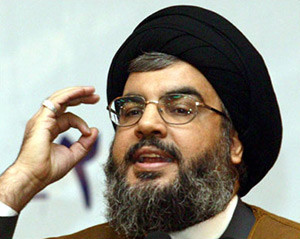 Hezbollah's secretary general Hassan Nasrallah publicly admitted that without European Union aid and backing, "our funding [and] moral, political, and material support will ... dry up." |
The largest Arab-American group, the American-Arab Anti-Discrimination Committee (ADC), attracts recruits by combating anti-Arab bias and stereotyping inside the United States, a cause understandably closer to the hearts of many mainstream Arab-American families than importing into the United States the struggle against Israel that brought so much misery in their countries of origin. The National Association of Arab-Americans, which focused on the Israel agenda, has ceased to exist altogether since it merged into ADC in 2001.[2] Today, Arab-American organizations are a factor in the Middle East debate but certainly have not risen to a level that can challenge the influence of the American friends of Israel.
A Petrodollar Lobby?
Another issue that raised concern in the pro-Israel community in the 1980s was the growth of a "petrodollar lobby" in the United States, fueled by the giant oil companies and embassies of Middle East countries such as Saudi Arabia, awash in a flood of money since the Organization of Petroleum Exporting Countries (OPEC) quadrupled oil prices in the 1970s. AIPAC founder Isaiah Kenen had described the Arab lobby as a "petro diplomatic complex."[3] Steven Emerson wrote about the petrodollar lobby in his 1985 best-seller, The American House of Saud, revealing how Arab embassies and firms that seek Arab contracts employ prominent U.S. figures such as former Senate Foreign Relations Committee chairman William Fulbright, former White House aide Frederick G. Dutton, former secretary of the treasury William Simon, former Texas governor John Connally, former budget director Bert Lance, and former vice president Spiro Agnew.
Yet it is difficult to see significant evidence of the impact of the petrodollar lobby in the Arab-Israeli sphere or any major effort on their part to interfere in the bilateral relationship between the United States and Israel. Oil firms, Arab embassies, and their lobbyists do have considerable influence in the sphere of energy policy, and on some Persian Gulf issues, including arms sales to Arab gulf states.[4] But their main focus is on the rich and comparatively moderate Arab countries, not Israel's less prosperous neighbors such as Egypt, Jordan, Syria, Lebanon, and the Palestinians.[5] And they have shown no signs of seeking to do battle against AIPAC and the friends of Israel. In fact, on a few select projects (notably Turkey policy and the Baku-Ceyhan Caspian pipeline), AIPAC and their interests have aligned and the two lobbies have in fact cooperated with each other. Even when they differed, as on Iran, it was a clash of interests about economic sanctions rather than an ideological dispute about Iran itself.
Europe as the Real Arab Lobby
Long experience in Washington leads to a different and somewhat surprising conclusion. The strongest external force pressuring the U.S. government to distance itself from Israel is not the Arab-American organizations, the Arab embassies, the oil companies, or the petrodollar lobby. Rather, it is the Europeans, especially the British, French, and Germans, that are the most influential Arab lobby to the U.S. government. The Arabs know this, so their preferred road to Washington often runs through Brussels or London or Paris. Nabil Shaath, then Palestinian Authority "foreign minister," said in 2004 that the European Union is "the ally of our choice."[6]
The Arabs consider Europe to be the soft underbelly of the U.S. alliance with Israel and the best way to drive a wedge between the two historic allies.
The Europeans are particularly formidable in their influence over U.S. Middle East policy because of four advantages. First, although there exist subtle differences, many European leaders share a broad set of common beliefs about Israel, the Palestinians, the Arab world, and the Middle East conflict that are considerably closer to the Arab perspective than to Jerusalem's point of view, and closer to the Arab end of the spectrum than the prevailing views of U.S. policymakers.
Second, they—especially representatives of Britain, Germany, and France—have easier and closer access to U.S. officials up to and including the president than do either the Arabs or the Israelis.
Third, the Europeans couch their presentations within a wider framework of shared values and interests and mutual trust with the United States, so the message is taken more seriously than if it came from an unelected leader of an Arab society vastly different from the United States.
Fourth, U.S. officials believe that it is in the national interest to keep the European allies happy, lest they change to an independent European policy toward the Middle East, falling under the sway of such Europeanists as former European Union commissioner for external affairs Christopher Patten. Thus, for example, Patten said in July 2010, "The default European position should not be … if the Americans don't do anything, to wring our hands. We should … be more explicit in setting out Europe's objectives and … try to implement them." [7]
The direct access to the president that is available to the prime minister of the U.K., the president of France, and the chancellor of Germany has less to do with the personal chemistry that may exist between them and any given U.S. president than with the objective importance of their countries to the United States. Britain, France, and Germany are three of the top six economies in the world and three of the top six military powers, as ranked by defense expenditures.[8] Two of them—France and Britain—are among the five permanent members of the U.N. Security Council who hold the power to veto. The same two are among the world's leading nuclear powers. Four European countries—France, Germany, Britain, and Italy—sit among the Group of Eight (G8), a forum also including the United States, Canada, Russia, and Japan. The British, French, and German governments have the greatest influence over the foreign policy of the European Union and the greatest influence over Europe's voice in the Middle East Quartet (which consists of the United States, the EU, Russia, and the U.N.).
The United States also has a longer and deeper history of shared values and common interests with the major European countries, and fewer conflicting interests, than with Russia, China, or any Arab nation. For sixty-five years, Britain, France, and Germany have been our key allies in the United States' principal military and political alliance, the North Atlantic Treaty Organization (NATO). Their opinions are stated in a moderate tone and are deemed to be more reasonable than the majority of Arab countries. There is a presumption on both sides that they are America's principal partners, the ones whose interests Washington must always take into account, and who can be expected to give greater deference to America's own needs.
This presumption of shared interests also gives European counterparts privileged access and enhanced credibility with senior members of the U.S. bureaucracy
at the National Security Council, the Department of State, the Pentagon, and within the intelligence community and other agencies. Assistant secretaries, office directors, and senior advisers give special weight to the opinions of their French, German, and British counterparts and spend more time with them than they do with the Arabs. These Europeans also have easy access to members of Congress and their senior staffs.
1,000 Lobbyists vs. One Lonely Guy
A dramatic example of how European intervention can drive a wedge between the United States and Israel occurred nearly twenty years ago in the sharp confrontation between President George H.W. Bush and Jerusalem. The untold story about this was the role of a European leader, British prime minister John Major, in provoking what may have been the worst episode ever to occur between a U.S. president and the government of Israel. It was a famous clash but one that might well not have occurred but for the European leader's intervention.[9]
The Kuwait war had just ended in 1991, and President Bush announced on March 6 his intention to convene an international conference on peace in the Middle East.[10] At the same time, the Soviet Union was in its final stages of collapse, and Soviet Jews who had been prevented from emigrating were flooding out. More than 200,000 had already arrived in Israel, and a tidal wave of more than one million was expected to follow imminently. Israel faced grave challenges to absorb such an enormous influx, equal to 20 percent of its existing population. On May 5, 1991, the Israeli ambassador to the United States, Zalman Shoval, announced that Israel would soon ask Washington for $10 billion in loan guarantees to help provide housing for one million Soviet immigrants expected to arrive during the next five years.[11]
The Palestinians feared that the new immigrants would settle in the disputed territories.[12] President Bush and his secretary of state, James A. Baker, declared that if any new loan guarantees were to be granted they would have to be linked to a commitment by Israel not to use the money in the territories.[13] A mechanism would have to be found to ensure that the loan guarantees would not be used to support settlement activity, lest the international conference announced by the president be undermined.
To permit time to find a formula, Prime Minister Yitzhak Shamir agreed to delay Israel's official request for the loan guarantees for three months until September 6.[14] During the summer of 1991, Secretary Baker made numerous trips to the region, looking for a way to avoid a collision between the loan guarantees and the peace process.[15] A few AIPAC colleagues and I were involved in some of the behind-the-scenes negotiations, conducted primarily by Elyakim Rubinstein, the Israeli government secretary, Secretary Baker and his staff, and Senator Robert Kasten, Jr. (Republican of Wisconsin) on behalf of pro-Israel members of Congress, and Ambassador Shoval.
By mid-August, we were relieved to learn, via communication with Baker and his staff, that a solution acceptable to Washington had been devised. The president had not yet approved it, but Baker was confident that he had a formula that would be acceptable to all sides. For AIPAC, this was a matter of paramount importance because it affected the fate of a million imperiled Jews, a historic effort to initiate a peace process, and the bilateral relationship between Israel and its most important ally.
George H. W. Bush was vacationing at his family's summer home in Kennebunkport, Maine, in late August 1991 when British prime minister John Major and his wife Norma visited. It was the kind of informal quality time directly with the president, unmediated by aides and advisers, that makes European leaders so influential on issues like the Middle East. Major had just told the Egyptian press that Israeli settlements, including those in East Jerusalem, were "illegal" and "damaging" to the peace process, and he wanted Bush to stand up to Israel.[16] Baker was pressing the president to compromise, but the British leader urged him to take an absolute stand.
Bush returned from Kennebunkport with his mind changed according to subsequent reports from U.S. officials. To Baker's surprise, the president rejected the package of assurances the secretary had carefully assembled and decided to throw down the gauntlet to Israel and its supporters. On September 6, 1991, he asked Congress for a 120-day delay on the loan guarantees "to give peace a chance."[17]
Six days later, Bush went a step further. On September 12, more than 1,000 Jewish leaders from around the country descended on Capitol Hill to lobby lawmakers for the loan guarantees. President Bush responded by calling a news conference the same day to warn that he would veto loan guarantees if Congress insisted on approving them despite his plea for a 120-day delay. He also criticized the pro-Israeli lobbyists, saying,
We're up against very strong and effective … groups that go up to the Hill … There were something like a thousand lobbyists on the Hill working the other side of the question. We've got one little guy down here doing it. … The Constitution charges the president with the conduct of the nation's foreign policy … There is an attempt by some in Congress to prevent the president from taking steps central to the nation's security. But too much is at stake for domestic politics to take precedence over peace.[18]
Asked what was the lowest point in the history of U.S.-Israel relations, many experts would pick this clash over the loan guarantees.[19] It was, at the very least, one of the most serious setbacks in the relationship. But the role of a British prime minister in undoing months of effort by the mediators and instigating the clash has never been exposed until now. It is an example of the way a key European can interact with the highest decision-maker in the United States and move him toward the Arab point of view and away from Israel.
Europe Is Closer to the Arabs
This kind of European influence is difficult to track because it occurs behind-the-scenes, invisible to the public. It covers a wide range of Middle East issues: pushing Washington to pressure the Israelis to make concessions to the Palestinians; urging engagement with terrorist organizations such as Hamas on the theory that it will moderate them; getting Washington to restrain Israeli security measures such as the "fence," targeted killings, the blockade of Gaza, and allegedly excessive use of force; and provoking intensified opposition to Israeli settlement activity, especially in Jerusalem.
There are many suppositions why Europeans tilt against Israel and toward the Arabs. For one thing, the Middle East is a place where Europeans can flaunt their foreign policy independence from the United States without responsibility for causing catastrophic results because they assume that the United States will protect Israel from any dire consequences such may produce. For another, Europe depends more heavily on trade with the Arab world and on Arab oil exports than does the United States.
For example, the Arab gulf states are a $300 billion import market for world products,[20] compared to Israel's $50 billion imports.[21] Europe may also have a desire to appease the "strong horse" in the region (e.g., Israel has but one vote in the U.N.; the Arabs have twenty-five votes, the Muslim nations, fifty votes). Then there is the guilt among many Europeans over their discredited imperial past, leading them to falsely view Israelis as oppressing Third World peoples. Then, again, it may be the growing influence of Europe's own Muslim populations (e.g., Arabs in France, Turks in Germany, South Asians in Britain) and their need to keep such segments of their domestic populations as quiescent as possible. Some analysts suggest that there may also be an element of satisfaction at being free to censure Jews in Israel, relieving European guilt over responsibility for the Holocaust. Finally, it may be that the Europeans simply do not understand that Israel is a democracy at war, living in a mortally dangerous neighborhood, which must act in self-defense in ways that may seem excessive to onlookers in a benign environment such as twenty-first-century western Europe (even though the Western democracies and the United States have used harsher means than Israel in wars far removed from their own territory).
Deadlines for a Palestinian State
One of the things the Europeans want from Washington is intensified pressure on Jerusalem to make concessions in peace negotiations, in order to get an agreement with the Palestinians. Europeans like the idea of deadlines, international conferences, verbal and economic pressure on Israel, and other devices, to dislodge the Israeli government from what they tend to see as its "intransigence."
For example, in 2002, the Europeans hatched the idea of a "road map" with deadlines for the creation of a Palestinian state to force Israeli-Palestinian negotiations to a conclusion. On September 17, 2002, European officials presented a plan to Washington that they had drafted with Palestinian participation and endorsement.[22] Jerusalem strenuously objected to deadlines that ignored Palestinian noncompliance with past signed obligations, and U.S. officials expressed reservations about the European approach because the blueprint was too detailed at too early a stage.[23] But Secretary of State Colin Powell, nonetheless, joined the EU, the secretary general of the United Nations, and Russian foreign minister Igor Ivanov in signing the Quartet statement announcing "a concrete, three-phase implementation road map that could achieve a final settlement within three years."[24] German foreign ministry spokesman Andreas Michaelis said that the content of the Quartet pact was "nearly identical" to proposals put forward by EU foreign ministers.[25] EU Middle East envoy Miguel Angel Moratinos said it was "a European idea and not an American idea."[26] It was a vehicle for European and U.S. pressure on Israel.
Washington was able to condition the road map deadlines, however, by insisting that the plan be "performance based." While the road map announced "clear phases, timelines, target dates, and benchmarks,"[27] the Bush administration forced the Quartet partners to agree that
progress between the three phases would be strictly based on the parties' compliance with specific performance benchmarks to be monitored and assessed by the Quartet … Progress … will be based upon the consensus judgment of the Quartet of whether conditions are appropriate to proceed, taking into account performance of both parties.[28]
However, by 2010, the road map has still not produced a Palestinian state, and the Europeans are again growing impatient about the slow pace of negotiations. European leaders are beginning to revert to their original concept of deadlines and a date certain to force an earlier result. In July 2009, Europe's foreign policy chief Javier Solana called for the U.N. Security Council to recognize a Palestinian state by a certain deadline even if Israelis and Palestinians had failed to agree among themselves:
After a fixed deadline, a UN Security Council resolution should proclaim the adoption of the two-state solution ... set a calendar for implementation ... [and] accept the Palestinian state as a full member of the UN ... If the parties are not able to stick to it [the timetable], then a solution backed by the international community should be put on the table. [29]
Solana's plan is a classic example of the pressure paradigm: Frustrated by the slow pace of direct negotiations between the parties, the world powers seek to dictate a final status outcome, especially to Israel.
French foreign minister Bernard Kouchner moved in the same direction in February 2010: "One can imagine a Palestinian state being ... recognized by the international community, even before negotiating its borders. I would be tempted by that."[30] Kouchner and his Spanish counterpart Moratinos wrote that the European Union "must not confine itself to the … outlines of the final settlement;" it "should collectively recognize the Palestinian State ... There is no more time to lose. Europe must pave the way."[31]
The EU as a whole has not gone this far yet. In November 2009, the Palestinians formally asked the EU to urge the U.N. Security Council to recognize a unilaterally declared state,[32] only to be told that conditions were not yet ripe for such a move.[33] But in March 2010, under EU pressure, the Quartet set a 24-month deadline for final settlement of the conflict and the creation of an independent Palestinian state.[34] Kouchner said: "France supports the creation of a viable, independent, democratic Palestinian state ... by the first quarter of 2012."[35]
Engagement with Terrorist Organizations
Another persistent theme of European policy is pressure on U.S. administrations to engage with terrorist organizations on the theory that such engagement will moderate their behavior.
The PLO: For years, the U.S. government had a strict policy of not negotiating with the PLO until it renounced terror. The Ford administration affirmed it in writing in 1975: The United States "will not recognize or negotiate with the PLO so long as the PLO does not recognize Israel's right to exist and does not accept U.N. Security Council Resolutions 242 and 338."[36] In 1985, President Reagan signed it into law.[37] In November 1988, Yasser Arafat finally bowed to the U.S. conditions and renounced armed struggle, and Reagan authorized the first contacts between U.S. officials and the PLO.[38]
The Europeans never accepted the idea that recognition of the PLO should be conditioned on it renouncing terror and accepting Israel's right to exist. Fully eight years before Arafat seemingly renounced terror and recognized Israel, the European Economic Community, including the governments of Britain, France, and Germany, warned Washington in the 1980 Venice declaration, that the PLO had to "be associated with [peace] negotiations ... to exercise fully [the Palestinian] right to self-determination."[39] Throughout the period that U.S. administrations shunned the PLO as a form of pressure to induce it to renounce terror, European leaders condoned contact with the organization and various forms of recognition and tried to move the U.S. policy.[40]
Hezbollah: A similar tension exists today between European and U.S. policies toward Hezbollah. The U.S. State Department designated Hezbollah as a foreign terrorist organization in 1997,[41] and U.S. officials have repeatedly called on EU governments to implement a similar ban to allow their own law enforcement and intelligence agencies to curb Hezbollah operations.[42] Hezbollah's secretary general Hassan Nasrallah publicly admitted that if the EU did this, "our funding [and] moral, political, and material support will ... dry up."[43] But EU foreign policy chief Solana claimed in July 2006 that the EU did not have enough evidence to determine whether Hezbollah should be listed as a terror organization. Two-hundred and thirteen members of Congress wrote to Solana in protest.[44] In June 2009, Solana went even further and met with a Hezbollah official who had been elected to the Lebanese parliament, saying that "Hezbollah is a member of the Lebanese society."[45]
Likewise, several European countries, led by France, have told Washington that Hezbollah is a legitimate Lebanese political party with a military wing, not primarily a terrorist organization, as if the idea of an armed political party is not a contradiction in terms. In 2005, French president Jacques Chirac rebuffed a U.S. request to add Hezbollah to the EU terrorist blacklist, arguing that it is an important part of Lebanese society.[46] In 2006, Italian foreign minister Massimo D'Alema said that "apart from their well-known terrorist activities, they also have political standing and are socially engaged."[47] In July 2007, French foreign minister Kouchner hosted a meeting that included Hezbollah in an effort to broker a Lebanese political compromise, in spite of objections expressed by ninety-one U.S. congressmen. A Ministry of Foreign Affairs spokesperson declared, "Hezbollah is an important political group [that should be] fully integrated into the political scene."[48] The spokesperson was prompted to make this statement only two years after the assassination of former Lebanese prime minister Rafik al-Hariri, for which Hezbollah leader Nasrallah has stated that he expects a U.N. tribunal to indict members of his group,[49] and twenty-two years after the October 1983 attack on the Beirut barracks where fifty-eight French paratroopers were killed,[50] an act for which Hezbollah leader Imad Mughniyah was indicted by a U.S. grand jury in 1985[51] and for which a U.S. federal judge found Hezbollah to be guilty in 2003.[52]
Although the Europeans may not yet have succeeded in getting Washington to accept Hezbollah as a legitimate political party, they have contributed to an environment in which such a shift will be a growing temptation for U.S. leaders as Hezbollah tightens its noose around Lebanon.
Hamas: European policy toward Hamas is somewhat different than its stance toward Hezbollah. Under U.S. pressure, the military wing of Hamas was put on the EU terror list in December 2001,[53] and its "political" wing was added to the list in September 2003.[54] Hamas's violent takeover of Gaza in June 2007 placed conflicting pressures on the Europeans. The violence of the Hamas putsch, the organization's fierce ideological doctrine, and the firing of thousands of Qassam rockets into Israel since the Gaza takeover,[55] cast doubts even among the most gullible Europeans that the organization was in fact evolving in a moderate direction. But the reality that Hamas has control over the people of Gaza, a population for whom many Europeans feel a special responsibility, reinforces the belief that it must be deemed a partner, both for the delivery of humanitarian aid (even if a terrorist organization might siphon off funds) and for political negotiations over the future of Gaza.
Many Europeans still believe that engagement with Hamas will result in a moderation of its position; for them, the terror listing is an impediment. In August 2007, Italian prime minister Romano Prodi called for dialogue with Hamas:
Hamas exists. We should not ignore this fact. It's a complex structure that we should help to evolve toward pro-peace positions ... One must push for dialogue so that it happens ... There will be no peace in the Middle East as long as the Palestinians are split in two.[56]
Javier Solana, then the European Union's foreign policy chief, said in 2006 that it was "not impossible" for Hamas to change. "I don't think the essence of Hamas is the destruction of Israel. The essence of Hamas is the liberation of the Palestinians."[57] This idea is disputed by statements by Hamas itself, reiterating its longstanding commitment to Israel's destruction as a prerequisite to the establishment of an Islamic state in the whole of Palestine.[58]
French foreign minister Kouchner thinks there will not be an Israeli-Palestinian peace agreement without Hamas at the table. He said in January 2009 that "we realized this long ago— that Hamas was one of the interlocutors" in the Middle East peace process and that "we believe we will have to talk to them when they ... agree to start negotiations." A ministry spokesman said that Paris would be ready to talk to a Palestinian unity government that included Hamas as long as it "respects the principle of the peace process."[59]
Lord Patten, EU commissioner for external relations, 2000-04, says the sole condition for talks with Hamas should be an agreement to a ceasefire even if Hamas refuses to accept past signed agreements.[60] Massimo D'Alema, Italy's foreign minister, 2006-08, believes that Hamas is more like the Irish Republican Army (IRA) than akin to al-Qaeda.[61] Sweden granted a visa to a Hamas minister in 2007,[62] and the former Finnish foreign minister, Erkki Tuomioja, claimed that Hamas "is not the same party it was" before it won the 2006 elections.[63] Benita Ferrero-Waldner, the EU's external relations commissioner, 2004-09, announced that she would review the EU ban on direct aid to the Hamas-led Palestinian government[64] though she backed away from this position after Hamas seized control of Gaza and arrested Fatah officials in June of 2007.[65]
These European voices advocating political negotiations with Hamas have not yet convinced either EU officials or Washington. The main obstacle is not Jerusalem's objections but reluctance to undermine the Palestinian Authority headed by Mahmoud Abbas and Salam Fayyad. But if the "moderates" led by these two slip, resistance to pressure from supporters of negotiations with Hamas may begin to erode. Many Europeans may simply not have the fortitude for a long struggle with implacable foes and may be easily lulled into wishful thinking that the West can moderate Islamic extremists simply by talking to them.
Israel's Security Fence Is "Illegal"
A third continuing theme of the Europeans is that many of the measures that Israel employs to assure its security are excessive and disproportionate if not actual violations of international law. This is how Europe sees Israel's security barrier, its targeted killings of known terrorists, its blockade of Gaza, its campaign against Hezbollah in Lebanon, and its settlements in the West Bank. Europeans are constantly urging Washington to restrain Israel.
Israel's security fence against terrorist infiltration, under construction since 2003, has strong support among the Israeli public because the barrier has been effective in preventing suicide attacks. A recent public opinion poll finds that "it is hard to find any issue in Israel about which there is so wide a consensus."[66] When there was no fence, during the first three years after the launch of Arafat's al-Aqsa intifada in September 2000, Israel suffered ninety-three suicide attacks that left 447 Israelis dead and 4,343 Israeli civilians wounded. In the most recent four years, since most of the fence has been completed, the number of attacks has declined to fewer than five a year, and the number of Israelis killed by terrorists has averaged fewer than ten per year.[67]
Washington has acknowledged the importance of the barrier for Israel's security but expressed concern about its route wherever it deviates from the pre-1967 line.[68] In the words of President George W. Bush:
The barrier being erected by Israel as a part of its security effort must be a security, rather than political, barrier. And its route should take into account, consistent with security needs, its impact on Palestinians not engaged in terrorist activities ... It should be temporary rather than permanent, and, therefore, not prejudice any final status issues, including final borders.[69]
The Europeans, on the other hand, have been unanimous and firm in opposing the construction of the fence since its inception. On November 18, 2003, the European Council urged Israel "to stop and reverse the construction of the so-called security fence inside the occupied Palestinian territories, including in and around East Jerusalem, which is in departure of the armistice line of 1949," adding that the fence was not only unacceptable but also "in contradiction to the relevant provisions of international law."[70] On July 20, 2004, all twenty-five members of the European Union voted for a resolution in the U.N. General Assembly, opposed by the United States, demanding the barrier's removal.[71] The European Council reiterated in its "Conclusions" of December 8, 2009, that the "separation barrier where built on occupied land [is] illegal under international law."[72]
Europe affected U.S. policy on the fence by funding a sophisticated PLO diplomatic team, the elite Palestinian unit known as the Negotiation Support Unit of the PLO (NSU), headed by Palestinian chief peace negotiator Saeb Erekat. The NSU is funded by Britain's Department for International Development and has also received financial support from the governments of Denmark, the Netherlands, Norway, and Sweden.[73] It consists of more than twenty professionals who periodically lobby Washington policymakers on behalf of the PLO with the participation of Palestinian advisers including Diana Buttu (Canadian-Palestinian), Michael Tarazi (American-Palestinian), Omar Dajani, and Amjad Atallah. A high point in the work of the NSU was a dramatic PowerPoint presentation on Israel's security fence given to National Security Adviser Condoleezza Rice by the NSU's Stephanie Koury (a Lebanese American from Texas) during a visit to the West Bank on June 28, 2003. Hours later, Rice shocked and angered members of the Israeli cabinet when she asked them to "reconsider" the fence. Koury's presentation caused the Bush administration to become much more critical of the security fence. A few days after the Koury briefing, an AIPAC colleague and I met with Rice privately and heard an unfiltered expression of her reaction to Koury. Three weeks later, the NSU team flew to Washington to make the presentation to other U.S. officials and members of Congress.[74] Rice's anger over the fence was the low point of relations between Washington and Jerusalem during the George W. Bush years, and Palestinian lobbying funded by the Europeans achieved it.
Israel's Targeted Killing of Terrorists Is "Illegal"
Israel follows a policy of targeted killings of terrorists who are preparing specific acts of violence or operationally engaged in organizing, planning, financing, and arming such operations. The purpose is to prevent imminent attacks when Israel does not have the means to make an arrest or foil the attacks by other methods. Israeli security officials believe that this policy keeps potential bomb makers on the run and serves as a deterrent to militant terrorist operations. Israelis also believe that targeted killings have less impact on Palestinian non-combatants than would a military incursion into a Palestinian population center aimed at their capture.[75] On December 13, 2006, the Supreme Court of Israel ruled that targeted killing was a legitimate form of self-defense against terrorists within specified rules of conduct.[76] The Israeli public strongly supports the policy of targeted killing: 90 percent in one poll, 75 percent in another.[77]
U.S. State Department spokespersons have at times expressed disagreement with the Israeli policy of targeted killings, for example, on August 8, 2001,[78] November 5, 2002,[79] and April 17, 2004.[80] In reality, Washington accepts the Israeli policy as long as it seeks to neutralize imminent threats.[81] The United States itself has become the world's leading practitioner of targeted killings according to a recent report by the U.N.'s special rapporteur on extrajudicial executions.[82] The George W. Bush administration used drones to attack militant targets forty-five times.[83] The Obama administration has increased the attacks to fifty-three in 2009 and to thirty-nine in the first half of 2010 in Pakistan alone, according to the New America Foundation,[84] which also found that drone strikes since Obama took office had accounted for approximately 450 deaths, about one-quarter of them civilians.[85] Michael E. Leiter, head of Obama's National Counterterrorism Center, defended the policy on July 1, 2010, saying that it would be "wholly irresponsible" not to stop those plotting to harm Americans.[86] Like the Israeli public, majorities of Americans support targeted killings of terrorists.[87]
But the Europeans have shown less tolerance than do Americans for the Israeli policy. On December 13, 2002, the European Council called upon Israel "to stop excessive use of force and extrajudicial killings, which do not bring security to the Israeli population."[88] On November 18, 2003, the council said targeted killings were unlawful and urged Israel "to abstain from any punitive measures which are not in accordance with international law, including extrajudicial killings and destruction of houses."[89] On January 17, 2004, EU spokesman Diego Ojeda said that the "European Union has spoken on several occasions against [Israel's] so-called extrajudicial killings of suspected terrorists."[90] In February 2010, President Nicolas Sarkozy declared France's "irrevocable condemnation of what is nothing less than an assassination" by Israeli agents of a Hamas commander in Dubai.[91] In December 2007, the Palestinian Centre for Human Rights produced a harshly critical paper on the illegality of "extrajudicial execution" by Israel, a publication "produced with the assistance of the European Union."[92]
There is an element of hypocrisy in the European claim that Israel's use of targeted killings is unlawful because some of the European governments that approve these statements engage in the practice themselves. In July 2010, a British official revealed that a U.K. spy agency pinpoints the hiding places of al-Qaeda and Taliban chiefs in Afghanistan and Pakistan for targeted killings by U.S. drones.[93] British agents attempted to kill German field marshal Irwin Rommel during the North African campaign[94]and did kill SS Obergurppenführer Reinhard Heydrich in 1942.[95] In May 1987, in Loughgall, Northern Ireland, a British special operations unit killed eight Irish Republican Army (IRA) militants who were preparing to attack a police station.[96] A year later, on March 7, 1988, British security forces killed three IRA militants in Gibraltar as they walked toward the border with Spain.[97] In July 2010, the French government acknowledged that its security forces assisted in killing six terrorists in Mali linked to al-Qaeda to prevent a terrorist attack in Mauritania.[98]
Israel's Blockade of Gaza Is "Illegal"
On May 31, 2010, French ambassador Gérard Araud told the U.N. Security Council that Israel's blockade of Gaza is illegal and unsustainable and should be lifted. Araud added that Israel's use of force against the Turkish flotilla was unjustifiable and disproportionate.[99] British prime minister David Cameron agreed: "The Israeli attack on the Gaza flotilla was completely unacceptable ... Gaza must not be allowed to remain a prison camp."[100] Meanwhile Foreign Secretary William Hague told the House of Commons that the blockade of Gaza was "unacceptable and unsustainable."[101] The British ambassador to the U.N. demanded that Israeli restrictions on access to Gaza be lifted to allow unfettered access and the unimpeded flow of humanitarian aid, commercial goods, and persons to and from the enclave, which, he said, was among the highest international priorities of the new British government.[102] Former EU commissioner Patten argued that the Israeli blockade was "immoral, illegal, and ineffective."[103]
Here again the European position is hypocritical. From 1993 to 1996, twelve European navies participated in a NATO-Western European Union blockade known as "Sharp Guard," enforcing both an arms embargo and economic sanctions on the former Yugoslavia. This involved the navies of Belgium, Denmark, France, Germany, Greece, Italy, the Netherlands, Norway, Portugal, Spain, Turkey, and the U.K. Some 74,000 ships were challenged; almost 6,000 were inspected at sea, and more than 1,400 were diverted and inspected in port.[104] Had there been violent resistance to this blockade, all the parties enforcing it were committed to the use of force. The fact that no one dared to challenge this powerful blockade prevented violence from occurring, not any principled objection to the use of force. Nonetheless, the Europeans at the U.N. Security Council continue to put Israel on the defensive about its Gaza blockade, making it more difficult for Washington to support Israel's right to self-defense under article 51 of the United Nations charter.[105]
The Europeans evidenced a similar attitude in July 2006 when Israel went into Lebanon in response to Hezbollah attacks. An agreed statement by the EU presidency stated, "The European Union is greatly concerned about the disproportionate use of force by Israel in Lebanon in response to attacks by Hezbollah on Israel."[106] French foreign minister Philippe Douste-Blazy agreed that Israel's strikes were "a disproportionate act of war" and said that the French government supported "Lebanon's demand for a referral to the United Nations Security Council as soon as possible."[107]
Israeli Settlements Are "Illegal"
President Ronald Reagan said in 1981 that Israel's settlements were "ill-advised," "unnecessarily provocative," and "an obstacle to peace," but he also said that they were "not illegal."[108] This distinction has been the implicit policy of all successive U.S. administrations since Reagan.[109] The George W. Bush administration added a further distinction between settlement blocs on territory that the Palestinians are expected to cede to Israel in a land swap in future negotiations (as Arafat agreed as part of the Clinton parameters negotiated at Camp David in 2000), versus isolated settlements deeper in the West Bank interior on land expected to fall under eventual Palestinian sovereignty. President Bush considered that the settlements in the West Bank interior were more problematic while the blocs on land to be swapped could be accommodated. Barack Obama apparently has rejected these Bush refinements, and his administration seems to consider all Israeli settlements equally problematic. But even Obama has not returned to the pre-Reagan assertion that the Israeli settlements are illegal.[110]
However, on this issue, again Europe is closer to the Arab side and is more critical of Israel than the United States is. On June 13, 1980, the European Economic Community, the precursor to the EU, affirmed in its Venice declaration that "these settlements, as well as modifications in population and property in the occupied Arab territories, are illegal under international law."[111] On December 8, 2009, the EU Council reiterated this belief: "Settlements ... demolition of homes and evictions are illegal under international law."[112]
The juridical premise on which the European policy is based is that Israel is occupying land taken from another sovereign power. But the pre-1967 boundary was nothing more than a demarcation of the positions held by opposing armies when the fighting stopped in 1949, never recognized by either side as a permanent political border. Nor has the Jordanian occupation of the West Bank prior to 1967 been recognized by any country apart from Britain and Pakistan. The West Bank is disputed rather than occupied territory, so the Geneva Convention cannot be applied[113] as the Europeans seek to do. The Europeans are reifying a temporary holding line that existed for less than eighteen years (1949-67) while ignoring realities that have lasted for twice as long (1967-2010).
For Israelis, more important than an arcane legal dispute is the practical impact of declaring all Jewish communities across the pre-1967 line to be equally illegal. That statement, if true, would mean that more than half the Jews in Jerusalem, the nation's capital, are living unlawfully on somebody else's land[114] in homes the Israelis built and paid for in completely Jewish, established communities including Gilo, French Hill, and Pisgat Ze'ev, which are across the previous armistice line. Israelis do not consider these to be settlements at all.[115] It would mean that Maale Adumim, a sprawling metropolis of 36,500 people, is lumped together with nearly unpopulated dots on the map. It would also mean that the militarily indefensible pre-1967 line is recognized under international law as permanent, in contravention of a fact that was implicitly acknowledged by Security Council Resolution 242,[116] which envisaged Israel's retention of some territories captured in the 1967 war.
European intervention often inflames controversies over settlements between Washington and Jerusalem, frictions that have had a particularly destructive effect in the case of the Obama administration. Martin Indyk, an adviser to Obama's secretary of state Hillary Clinton and Middle East envoy George Mitchell, said recently: "I don't think that ... Barak Obama, Hillary Clinton or George Mitchell—want to get waylaid again by an argument about settlements [instead of] the main challenge which is to reach an agreement on what the borders of the Palestinian state will be ... The settlement issue will be resolved as a result of that."[117] European pressure has pushed the Obama administration to emphasize the thorniest part of the settlement issue, Jewish housing in Jerusalem. Bill Clinton wisely avoided this minefield even when, in 1995, the Yitzhak Rabin government gave approval for 5,000 new housing units to go up in East Jerusalem because, as an adviser said, "To take action now ... would be very explosive in the negotiations, and frankly, would put us out of business as a facilitator of those negotiations."[118]
Conclusion
European leaders are the most effective external force urging the U.S. government to move away from Israel and closer to the Arabs. Europe is not hostile to Israel on every issue, and not every European intervention with U.S. officials is meant to move U.S. policy in the Arab direction. But, on the whole, the Arab road to Washington runs through Paris, London, and Berlin.
Steven J. Rosen served for twenty-three years as a senior official of the American Israel Public Affairs Committee. He is now director of the Washington Project of the Middle East Forum.
[1] "Arab Americans," US4Arabs.com, accessed Aug. 16, 2010; "Arab Americans," Arab American Institute, accessed Aug. 16, 2010.
[2] "Press Statement on ADC NAAA Merger," Arab-American Anti-Discrimination Committee, Dec. 29, 1999.
[3] Isaiah Kenen, The Jewish Digest, Dec. 1975.
[4] Steven Emerson, The American House of Saud (New York: Franklin Watts, 1985).
[5] Ibid.
[6] Ha'aretz (Tel Aviv), Jan. 9, 2004; Reuters, Jan. 9, 2004.
[7] The Guardian (London), July 18, 2010.
[8] "Military Defense Spending and Budgets by Country," GlobalFirepower.com, accessed Aug. 16, 2010.
[9] Donald Neff, "Israel Requests $10 Billion in U.S. Loan Guarantees for Soviet Immigrants," Washington Report on Middle East Affairs, Apr./May 1995, pp. 79-80.
[10] George H.W. Bush, address before joint session of Congress, Mar. 6, 1991.
[11] Neff, "Israel Requests $10 Billion."
[12] The New York Times, Jan. 31, 1990.
[13] Neff, "Israel Requests $10 Billion"; The Christian Science Monitor, Jan. 11, 2010.
[14] Leon T. Hadar, "Showdown at the Settlements Corral: Can Obama Remake the Bush-Baker Classic?" Foreign Policy, Mar. 25, 2010.
[15] "The Arab-Israeli Peace Process Progress Report - 8 Apr. 1992," Israel Ministry of Foreign Affairs, Jerusalem, Apr. 8, 1992.
[16] "Al-Aqsa Intifada," The Jerusalem Forum, Amman, accessed Aug. 16, 2010.
[17] Los Angeles Times, Sept. 7, 1991.
[18] Neff, "Israel Requests $10 Billion."
[19] Foreign Policy, Mar. 25, 2010.
[20] "GCC: Trade in Goods," Europa, European Union, Brussels, accessed Aug. 19, 2010.
[21] "Middle East: Israel, Economy," 2010 World Fact Book, U.S. Central Intelligence Agency, McLean, Va., Aug. 3, 2010.
[22] Reuters, Sept. 17, 2002.
[23] Ha'aretz, Sept. 18, 2002.
[24] "Quartet Roadmap to Israeli-Palestinian Peace," MidEast Web, Rehovot, Sept. 17, 2003.
[25] Agence France-Presse, Sept. 18, 2002.
[26] "Chronological Review of Events Relating to the Question of Palestine, November 2002," United Nations Information System on the Question of Palestine (UNISPAL), New York, accessed Aug. 16, 2010.
[27] "Quartet Roadmap to Israeli-Palestinian Peace," MidEast Web, Rehovot, Apr. 30, 2003.
[28] "Quartet Statement on the Middle East," European Union @ United Nations, European Commission, Sept. 17, 2002.
[29] Reuters, July 12, 2009.
[30] Ibid., Feb. 21, 2010.
[31] Bernard Kouchner and Miguel Angel Moratinos, "A Palestinian State: When?" Le Monde (Paris), Feb. 23, 2010.
[32] The Guardian, Nov. 16, 2009.
[33] Voice of America, Nov. 17, 2009.
[34] "Statement by Middle East Quartet," U.N. Secretary-General, New York, Mar. 19, 2010.
[35] Palestine Note (Washington, D.C.), July 27, 2010.
[36] Israel-United States Memorandum of Understanding, Congressional Record, Washington, D.C., Sept. 1, 1975.
[37] The International Security and Development Cooperation Act of 1985, 22 U.S.C. 2151 note, Public Law 99-83, sect. 1302, Oct. 1, 1985.
[38] "U.S. opens dialogue with PLO - Ronald Reagan, George Shultz statements," U.S. Government Printing Office, Washington, D.C., Dec. 14, 1988.
[39] "Venice Declaration," archives, The State of Israel, Jerusalem, June 13, 1980.
[40] Rory Miller, "The PLO factor in Euro-Israeli relations, 1964-1992," Israel Affairs, Oct.-Dec. 2004 , pp. 123-55, ftnt. 33.
[41] "Hezbollah," International Terrorist Symbols Database, accessed Aug. 17, 2010.
[42] "Adding Hezbollah to the EU Terrorist List," hearing before the Subcommittee on Europe, Committee on Foreign Relations, U.S. House of Representatives, Washington, D.C., June 20, 2007.
[43] Muriel Asseraf, "Prospects for Adding Hezbollah to the EU Terrorist List," American Jewish Committee, New York and Washington, D.C., Oct. 1, 2007.
[44] Softpedia, Aug. 2, 2006; European Jewish Press (Brussels), Aug. 1, 2006.
[45] France 24 TV news, June 14, 2006.
[46] Ha'aretz, Aug. 2, 2005.
[47] Egypt.com News (Cairo), Apr. 15, 2009.
[48] Briefing, French Ministry of Foreign Affairs, Paris, July 10, 2007.
[49] Reuters, July 22, 2010.
[50] Pierre Tristam, "The 1983 Attack on U.S. Marines in Lebanon," About.com, accessed Aug. 17, 2010; "23 October 1983: A Blast that Still Echoes," U.S. Naval Institute, Annapolis, no. 22, Oct. 2009.
[51] Muhammad Sahimi, "The Fog over the 1983 Beirut Attack," Frontline, Public Broadcasting Service, Oct. 24, 2009.
[52] USA Today, May 30, 2003.
[53] "Freezing Funds: List of Terrorists and Terrorist Groups," Europa, European Union, Brussels, Dec. 27, 2001.
[54] Journal of the European Union, C70E/140, Mar. 20, 2004.
[55] "The Hamas Terror War against Israel," Israel Ministry of Foreign Affairs, accessed Aug. 17, 2010.
[56] European Jewish Press, Aug. 13, 2007.
[57] "EU's Solana: 'Hamas Doesn't Want to Destroy Israel,'" Jihad Watch, Oct. 30, 2006; Israel News Agency (Jerusalem), Jan. 15, 2009.
[58] Reuters, Mar. 12, 2007.
[59] France 24 TV news, Jan. 21, 2009.
[60] The Guardian, July 18, 2010.
[61] YNet (Tel Aviv), Aug. 29, 2006; The Irish Times (Dublin), Jan. 28, 2009.
[62] Rory Miller, "Why the European Union Finally Sidelined Hamas," inFocus Quarterly, Fall 2007.
[63] EUobserver (Brussels), Sept. 1, 2007.
[64] European Jewish Press, May 14, 2007.
[65] Miller, "Why the European Union Finally Sidelined Hamas."
[66] YNet, June 7, 2007.
[67] "Suicide and Other Bombing Attacks in Israel Since the Declaration of Principles (Sept 1993)," Israel Ministry of Foreign Affairs, Jerusalem, accessed Aug. 17, 2010.
[68] "U.S. Policy on the Separation Barrier and Statements from Church Leaders," Churches for Middle East Peace, Washington, D.C., accessed Aug. 17, 2010.
[69] George W. Bush to Ariel Sharon, Ariel Sharon to George W. Bush, in Ha'aretz, June 6, 2009.
[70] "Declaration of the European Union," Fourth Meeting of the Association Council EU-Israel, Brussels, Nov. 17-18, 2003, p. 5.
[71] Res. ES-10/15, U.N. General Assembly, New York, July 20, 2004.
[72] "Council Conclusions on the Middle East Peace Process," European Union, Brussels, Dec. 8, 2009.
[73] "Development Assistance and the Occupied Palestinian Territories," Second Report of Session 2003–04, International Development Committee, House of Commons, London, p. 21; "About Us," PLO Negotiations Affairs Department, accessed Aug. 18, 2010.
[74] The Forward (New York), July 18, 2003.
[75] Gal Luft, "The Logic of Israel's Targeted Killing," Middle East Quarterly, Winter 2003, pp. 3-13.
[76] "HCJ 769/02 Summary Judgement," The Public Committee against Torture in Israel v. The Government of Israel, Israeli Supreme Court, Jerusalem, Dec. 13, 2006.
[77] Steven R. David, "Fatal Choices: Israel's Policy of Targeted Killing," Begin-Sadat Center for Strategic Studies, Bar-Ilan University, Ramat Gan, Sept. 2002, p. 7.
[78] News briefing, U.S. Department of State, Washington, D.C, Aug. 8, 2001.
[79] BBC News, Nov. 6, 2002.
[80] Ha'aretz, Apr. 17, 2004.
[81] Chris Toensing and Ian Urbina, "Israel, the US and 'Targeted Killings,'" Middle East Report, Feb. 17, 2003.
[82] Philip Alston, "Report by the Special Rapporteur on Extrajudicial, Summary or Arbitrary Executions," United Nations, New York, May 28, 2010.
[83] CNN, Apr. 28, 2010.
[84] National Public Radio, Mar. 25, 2010.
[85] "The Year of the Drone," New America Foundation, Washington, D.C., and Sacramento, Calif., accessed Aug. 18, 2010.
[86] Los Angeles Times, July 1, 2010.
[87] David, "Fatal Choices: Israel's Policy of Targeted Killing," p. 18.
[88] "Conclusions of the Copenhagen European Council," Brussels, Dec. 13, 2003.
[89] "Declaration of the European Union," Nov. 17-18, 2003, p. 4.
[90] International Middle East Media Center (West Bank), Jan. 17, 2004.
[91] The Tehran Times, Feb. 23, 2010.
[92] "Position Paper: Extra-Judicial Execution," Palestinian Centre for Human Rights, West Bank, Dec. 2007.
[93] Fox News, July 25, 2010.
[94] Time, May 19, 1980.
[95] "The Assassination of Reinhard Heydrich," Central Intelligence Agency, McLean, Va., Sept. 22, 1993.
[96] "Special Air Service (SAS) - Loughgall, Northern Ireland," British Special Forces and Elite Units, Kent, U.K., accessed Aug. 18, 2010.
[97] "1988: IRA Gang Shot Dead in Gibraltar," BBC, accessed Aug. 18, 2010.
[98] Reuters, July 23, 2010.
[99] "Security Council Condemns Acts Resulting in Civilian Deaths during Israeli Operation against Gaza-bound Aid Convoy," U.N. news office, New York, May 31, 2010.
[100] The Guardian, July 27, 2010.
[101] Ibid., June 2, 2010.
[102] "Security Council Condemns Acts Resulting in Civilian Deaths," May 31, 2010.
[103] The Jewish Chronicle (London), July 19, 2010.
[104] "NATO/WEU, Operation Sharp Guard," North Atlantic Treaty Organization, Brussels, Oct. 2, 1996.
[105] Charter of the United Nations, San Francisco, June 26, 1945, art. 51.
[106] Deutsche Welle (Bonn), July 14, 2006.
[107] Gerald M. Steinberg, "Europe's Disproportionate Criticism," The Wall Street Journal, July 17, 2006.
[108] "Quotes from U.S. Government Officials on Israeli Settlements," Churches for Middle East Peace, Washington, D.C., accessed Aug. 18, 2010.
[109] The Washington Post, June 17, 2009.
[110] Steven J. Rosen, "Tough Love Is No Love at All," ForeignPolicy.com, July 21, 2009.
[111] "Venice Declaration," June 13, 1980.
[112] "Council Conclusions on the Middle East Peace Process," Dec. 8, 2009.
[113] Jeffrey Helmreich, "Diplomatic and Legal Aspects of the Settlement Issue," Jerusalem Issue Brief, Jan. 19, 2003.
[114] The Yale Globalist (New Haven), July 4, 2010.
[115] CNN, Mar. 23, 2010.
[116] "The Situation in the Middle East," U.N. Security Council Res. 242, Nov. 22, 1967.
[117] Natasha Mozgovaya, "Martin Indyk: I Think the Settlement Issue Will Be Resolved," Ha'aretz, July 28, 2010.
[118] Steven J. Rosen, "Obama's Foolish Settlements Ultimatum," Foreign Policy, Apr. 1, 2010.
Steven J. Rosen
Copyright - Original materials copyright (c) by the authors.
Subscribe to:
Posts (Atom)