Saturday, June 13, 2026

Trump claims Iran deal reached, Tehran says no "final decision" - Barak Ravid


by Barak Ravid

According to sources, Iranian officials told several countries on Thursday that the Tehran talks produced an agreement in principle, but Khamenei still needed to give final approval.
 

Trump
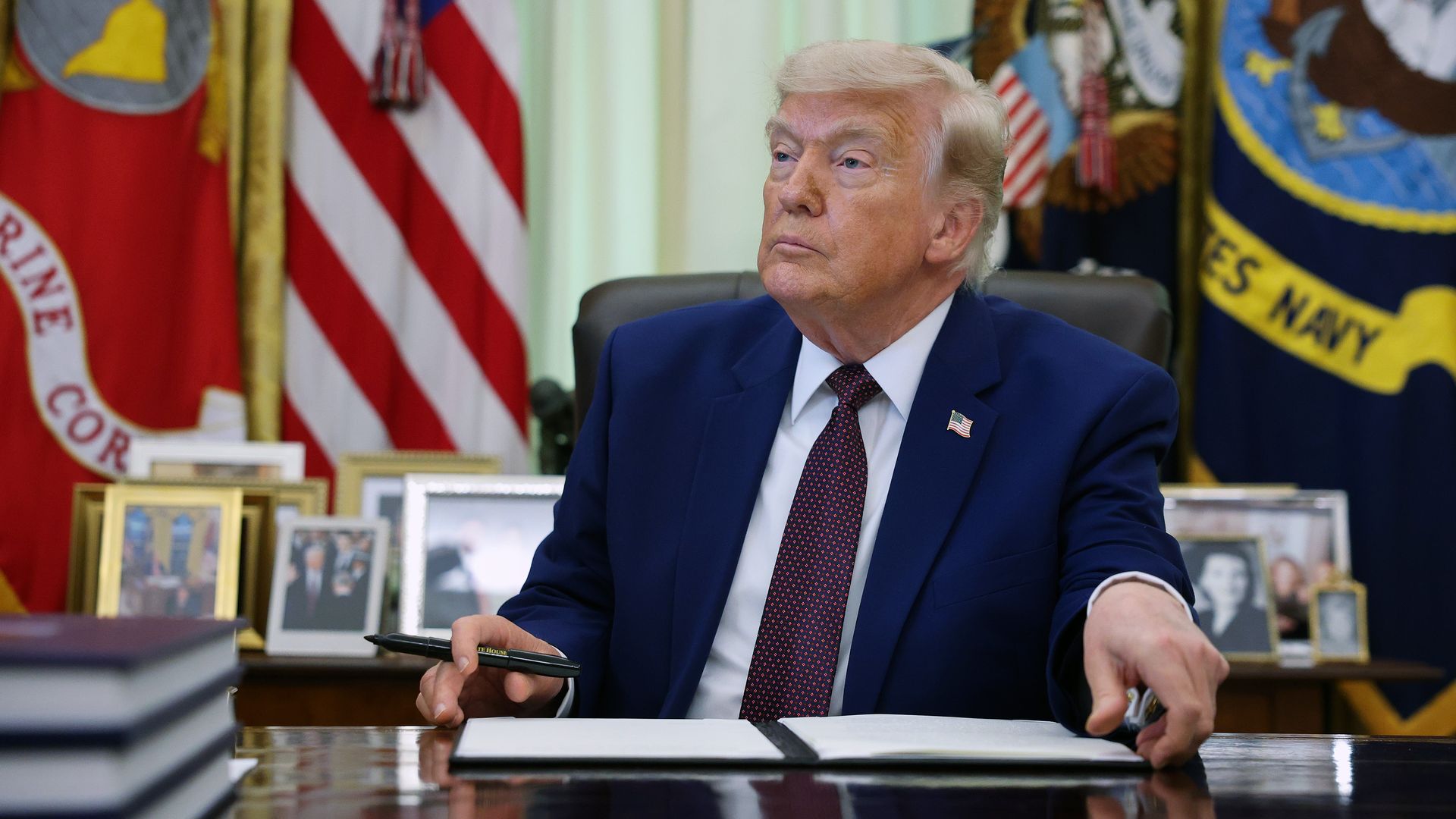
Trump signs an executive order last week. Photo: Kevin Dietsch/Getty Images

President Trump announced that he canceled planned strikes against Iran on Thursday and claimed Iran's leadership "approved" a draft agreement that would extend the ceasefire, reopen the Strait of Hormuz and launch 60 days of negotiations on Iran's nuclear program.

Why it matters: Trump has claimed an agreement was close multiple times before, and Tehran said in response to Trump's latest claim that there had been no "final decision." However, three sources briefed on the talks told Axios that key gaps were narrowed during talks between Iranian officials and Qatari mediators on Wednesday.

  • Iran's Fars news agency denied any deal had been agreed, but said there was a "possibility" Tehran would consider signing off.
  • Trump told reporters in the Oval Office on Wednesday afternoon that his understanding was that the Iranian Supreme Leader Mojtaba Khamenei had given his approval.
  • While the memorandum of understanding under negotiation is intended to open the strait and lift the U.S. blockade, any agreements on Iran's nuclear program and the lifting of U.S. sanctions would require further negotiation.

What he's saying: "Based on the fact that discussions with the Islamic Republic of Iran have been brought to the highest level of Iranian leadership and approved, I have, as President of the United States of America, cancelled the scheduled strikes and bombings against Iran this evening," Trump wrote on Truth Social.

  • He added that the final points of the deal have been, "in both concept and great detail, approved by all parties involved," including the U.S., Israel, Saudi Arabia, UAE, Qatar, Turkey, Pakistan, Bahrain, Kuwait, Jordan and Egypt.
  • Trump also said the blockade would remain "until this transaction is finalized," and that Iran would agree to never have a nuclear weapon.

The other side: Fars, a semi-official news agency affiliated with Iran's Revolutionary Guards, quoted an "informed source close to Iran's negotiation team" as saying that "no text for a preliminary memorandum of understanding with the United States has been approved."

  • But a later report claimed the U.S. had accepted "Iran's proposed text," and as a result the regime could "reconsider and review the agreement once again."
  • Iranian Foreign Ministry Spokesperson Esmail Baghaei said an agreement hasn't been finalized yet. "Most of the text had already been finalized, but the Americans kept changing their positions," he said.
  • "Iran has demonstrated that it does not compromise on what it has defined as its red lines," he added. "Iran has not yet reached a final decision regarding an agreement."

Behind the scenes: Negotiations continued late into Wednesday night in Tehran as Qatari envoy Ali Al-Thawadi and Iranian Foreign Minister Abbas Araghchi worked to bridge the remaining gaps between the U.S. and Iran.

  • According to three sources briefed on the talks, the Qataris and the Iranians believed on Wednesday that they had reached an agreed-upon text that the U.S. would also accept.

The sources said the gaps were narrowed on three key issues:

  • The mechanism for releasing Iran's frozen assets — the most important issue for the Iranians.
  • Arrangements for reopening the Strait of Hormuz during the 60-day ceasefire period.
  • How negotiations over Iran's nuclear program would be conducted during the 60-day ceasefire period.

According to the sources, Iranian officials told several countries on Thursday that the Tehran talks produced an agreement in principle, but Khamenei still needed to give final approval.

  • The sources noted that both the Iranians and the Qataris had emphasized that the U.S. strikes overnight significantly increased Iranian suspicions about Trump's real intentions.
  • Earlier on Thursday, Trump had announced the U.S. would "be hitting Iran VERY HARD TONIGHT."

The latest: Trump said he spoke on the phone with Israeli Prime Minister Benjamin Netanyahu, Qatari Emir Tamim al-Thani and other regional leaders.

  • "Although Israel is not a party to the memorandum of understanding, the Prime Minister expressed his appreciation for President Trump's commitment that the final agreement resulting from the negotiations will include the removal of enriched nuclear material, the dismantling of enrichment infrastructure, limits on missile production, and an end to Iran's support for its terrorist proxies in the region," the Israeli prime minister's office said.
  • Trump told Qatar the understandings reached "have received the approval of all relevant parties," the emir's office said in a statement.

The intrigue: Netanyahu did not have advanced notice and was caught by surprise when Trump released his initial statement about the deal, according to a source with knowledge.

What to watch: Trump said the memorandum of understanding could be signed over the weekend in Europe and that Vice President Vance was expected to lead the U.S. delegation.

  • "The documents are in very final shape so we will see," he said.
  • The White House has believed a deal was imminent at several points during the conflict, only to see negotiations break down again.

Go deeper: Trump boils over after Tehran kept him waiting

This is a breaking news story and has been updated throughout. 


Barak Ravid

Source: https://www.axios.com/2026/06/11/trump-cancel-iran-strikes-deal-strait

Follow Middle East and Terrorism on Twitter

Trump says Iran deal to be signed tomorrow, Hormuz to open 'immediately after' - Jerusalem Post Staff, Reuters


by Jerusalem Post Staff, Reuters

Pakistani Prime Minister Shehbaz Sharif said earlier on Saturday that the US and Iran have agreed to a framework for a peace deal to end the months-long conflict in the Middle East.


US President Donald Trump speaks before signing a proclamation in the Oval Office of the White House in Washington, DC, on June 11, 2026.
(photo credit: Kent NISHIMURA / AFP via Getty Images)

US President Donald Trump said on Saturday that a deal with Iran is set to be signed on Sunday and that the Strait of Hormuz will immediately open following the signing, according to a Truth Social post.

"The Deal is scheduled to get signed tomorrow, and immediately after it is signed, the Hormuz Strait is OPEN TO ALL," wrote Trump.

Trump emphasized that the deal was significantly different than that of the Obama administration, which he described as "an easy, beautiful, smooth road to a Nuclear Weapon, which Iran would have had six years ago, and would have used long before now."

"My Agreement with Iran is the exact opposite, A WALL TO NO NUCLEAR WEAPON!" said Trump. "In fact, they no longer want a Nuclear Weapon, nor will they have one, either through purchase, development, or any other form of procurement."

He added that "no money will exchange hands," attempting to further differentiate the deal from the Joint Comprehensive Plan of Action (JCPOA), with Trump accusing then-president Barack Obama of paying "Hundreds of Billions of Dollars" to Iran, "including 1.7 Billion Dollars in green, cold cash."

Pakistan's Prime Minister Shehbaz Sharif arrives for a meeting with Chinese President Xi Jinping at the Great Hall of the People on May 25, 2026 in Beijing, China.
Pakistan's Prime Minister Shehbaz Sharif arrives for a meeting with Chinese President Xi Jinping at the Great Hall of the People on May 25, 2026 in Beijing, China. (credit: Tingshu Wang - Pool/Getty Images)

"At the appropriate time, when all is calm, we will go in and get the Nuclear Dust, buried deep under the powerful sunken granite mountains, thanks to our beautiful B-2 Bombers and their brilliant pilots, and downblend and destroy it, whether in Iran, or the United States," Trump added.

"We look forward to working with Iran, and the entire Middle East, long into the future," continued Trump. "Hopefully, this process will all work out quickly, easily, and smoothly. If it doesn’t, we have the ultimate alternative, hopefully never to be used again!"

Pakistan PM: US-Iran deal signing expected within 24 hours

Pakistani Prime Minister Shehbaz Sharif said earlier on Saturday that the US and Iran have agreed to a framework for a peace deal to end the months-long conflict in the Middle East, with the final text of the deal reached.

Pakistan is now preparing for an electronic signing expected within the next 24 hours, followed by technical-level talks next week, Sharif added.

Also on Saturday, Iran's Foreign Ministry spokesperson Esmaeil Baghaei denied that the Islamabad memorandum would take place on Sunday, according to state media.

Baghaei said the possibility of signing the Islamabad memorandum in the coming days could not be ruled out, but cautioned against commenting on the signing date, given the other side's hesitation.

He later added that the regime will charge for services provided in the Strait of Hormuz, according to Iran's Fars News Agency, saying that the steps taken by the Islamic Republic to manage safe traffic in the strait align with the protection of national security and the common good of the world community.

Iran: Release of frozen funding part of deal

According to Fars, Baghaei further stated that the release of Iran's frozen funds is an integral part of the pending agreement.

Baghaei added that the presence of foreign militaries and their bases in the region must end. 


Jerusalem Post Staff, Reuters

Source: https://www.jpost.com/middle-east/iran-news/article-899262

Follow Middle East and Terrorism on Twitter

There Is No 'Good Deal' to be Made with Iran's Regime - Eric Levine


by Eric Levine

Iran's regime will only make a deal with the US if Iran's rulers believe the survival of the regime is guaranteed. No matter what is agreed to by Trump, Iran's rulers are sure to violate the agreement. Maybe not today or tomorrow, but as soon as Trump leaves office.


  • The Obama strategy was apparently to make any deal and call it a "good deal."

  • In exchange for these concessions to the Ayatollah, the Obama Administration agreed to lift economic sanctions on Iran at a time when its frozen overseas assets totaled approximately $115 billion, and delivered $400 million of cash on a pallet as ransom for American hostages being illegally held by the Islamic Republic.

  • In short, Obama gave away everything and got nothing in return. Now that is a really bad deal.

  • Obama and his lead negotiator, Secretary of State John Kerry, must have understood that the money Iran received was to be used to fund its military, its international terror network, and to advance its hegemonic goals in the region.

  • Obama rammed the deal down the throats of a skeptical American public and implemented it in the face of overwhelming bipartisan congressional opposition. Moreover, Israel and the Gulf Arab states -- the countries most directly impacted by the deal and that strenuously opposed it -- were not consulted.

  • The Obama propaganda machine also understood that it could not tell the truth about the terms of the deal if they wanted any support from the American people. So they simply lied about them.

  • The current hostilities with Iran are a direct result of Obama's failed policy. Obama did not just save the Iranian regime; he empowered it.

  • Iran's regime will only make a deal with the US if Iran's rulers believe the survival of the regime is guaranteed. No matter what is agreed to by Trump, Iran's rulers are sure to violate the agreement. Maybe not today or tomorrow, but as soon as Trump leaves office.

  • If Trump makes a deal, even a great one, it will last no longer than his presidency. The Gulf states will hedge their bets. Trump will be gone but the Iranian regime, perhaps with the support of a new American administration, will still be in their midst.

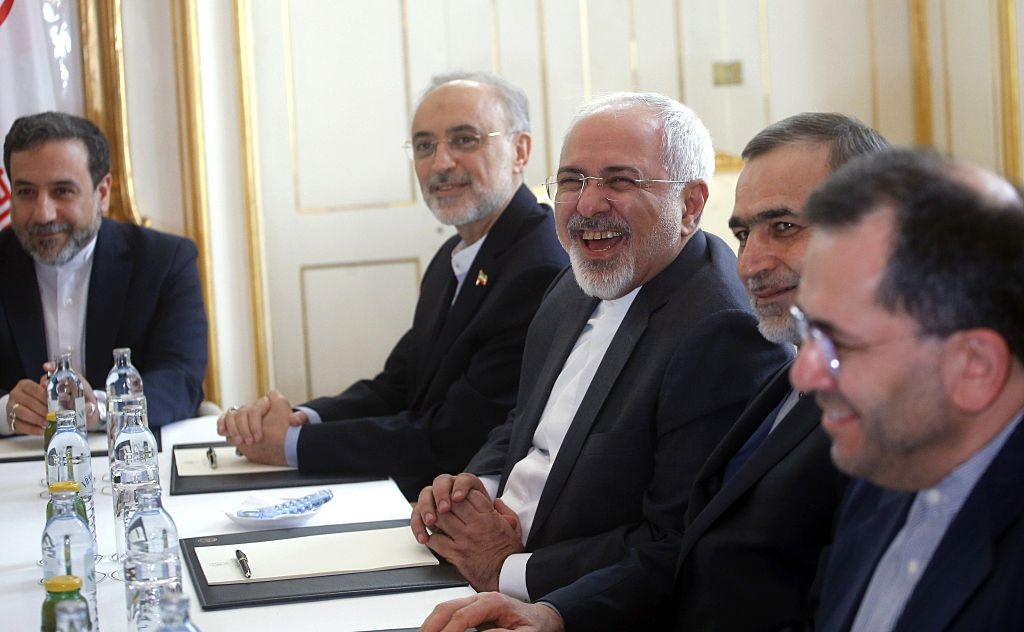
The current hostilities with Iran are a direct result of Obama's failed policy. Obama did not just save the Iranian regime; he empowered it. The Obama strategy was apparently to make any deal with Iran and call it a "good deal." Obama and his lead negotiator, Secretary of State John Kerry, must have understood that the money Iran received was to be used to fund its military, its international terror network, and to advance its hegemonic goals in the region. Pictured: Iran's then Foreign Minister Mohammed Javad Zarif (center) shares some laughs with his delegation during nuclear deal negotiations with Kerry in Vienna, Austria, on June 30, 2015. (Photo credit should read Carlos Barria/AFP via Getty Images)

Before agreeing to the JCPOA (the Iran "nuclear deal") in 2015, President Barack H. Obama assured the American people that he understood, in the words of his press secretary, Josh Earnest, that "no deal is better than a bad deal."

Obama then proceeded to make a historically epic terrible deal.

Because Obama made it clear to friend and foe alike that he would never use military force to prevent Iran from obtaining nuclear weapons, the only possible outcome was a "bad deal."

As Obama told a skeptical and worried Israeli public on June 1, 2015:

"I can, I think, demonstrate, not based on any hope but on facts and evidence and analysis, that the best way to prevent Iran from having a nuclear weapon is a verifiable, tough agreement.... A military solution will not fix it. Even if the United States participates, it would temporarily slow down an Iranian nuclear program but it will not eliminate it."

The Obama strategy was apparently to make any deal and call it a "good deal."

President Donald J. Trump is assuring the American people that he will only make a "good deal." Trump, unlike Obama, has demonstrated his willingness to use military force. Because of the nature of the Iranian regime and the damage done to America's national security interests in the region, not to mention the distrust Obama's nuclear deal engendered among our Arab allies, it is not possible for Trump to make a "good deal" with Iran's current regime.

Trump's only alternative for a positive outcome is regime change, which can only be achieved by resuming kinetic military action. It appears that Trump has reached the same conclusion, and renewed military operations against the Iranian regime have commenced this week.

Obama, while purposely misleading the average American about the terms of his deal and the nature and goals of the Iranian regime, may well have believed that he made a "good deal." It seems that for Obama, the goal of the deal (any deal) justified the lies.

The Obama deception was not the good deal/bad deal dichotomy. The lie was the motivation behind the deal and how it was sold to the American people.

For Obama, even a deal like the one he negotiated that empowered the Iranian regime and fundamentally changed the security architecture of American policy in the Middle East from an Israel-centric system to an Iranian-centric or bi-polar Israeli-Iranian geopolitical paradigm, was a "good deal."

On March 24, 2007, the United Nations Security Council unanimously adopted Resolution 1747, imposing sanctions on Iran for violating its obligations under the Treaty on the Non-Proliferation of Nuclear Weapons.

On March 3, 2008, the UN Security Council adopted Resolution 1803, imposing additional sanctions on Iran for its refusal to suspend its uranium enrichment.

On June 9, 2010, the UN Security Council adopted Resolution 1929, noting that Iran had failed to abide by previous resolutions designed to stop its uranium enrichment program, and prohibiting it from outsourcing its nuclear program.

The UN Security Council also seems to have understood that a nuclear weapon without the means to deliver it was of limited use. Therefore, the international community sought to frustrate Iran's ability to launch a nuclear warhead, and included the following provision in Resolution 1929:

"... Iran shall not undertake any activity related to ballistic missiles capable of delivering nuclear weapons, including launches using ballistic missile technology, and that States shall take all necessary measures to prevent the transfer of technology or technical assistance to Iran related to such activities."

Obama allowed Iran to continue developing nuclear weapons. He refrained from enforcing the UN resolutions or supporting the popular uprisings of the Iranian people in 2009 and 2015 that sought to overthrow Ayatollah Ali Khamenei's Islamic Republic. Instead, Obama agreed to a deal that allowed the mullahs to violently crush the popular protests, and required the repeal of each of the UN resolutions. Obama's deal provided for all limitations on Iran's uranium enrichment and development of its "civilian" nuclear program to expire in 2030, and permitted Iran, the world's leading state sponsor of terrorism for 39 straight years, to enrich uranium and legitimately develop a ballistic missile system designed to deliver nuclear weapons at the expiration of the agreement in October 2025.

In exchange for these concessions to the Ayatollah, the Obama Administration agreed to lift economic sanctions on Iran at a time when its frozen overseas assets totaled approximately $115 billion, and delivered $400 million of cash on a pallet as ransom for American hostages being illegally held by the Islamic Republic.

In short, Obama gave away everything and got nothing in return. Now that is a really bad deal.

Obama and his lead negotiator, Secretary of State John Kerry, must have understood that the money Iran received was to be used to fund its military, its international terror network, and to advance its hegemonic goals in the region.

Obama rammed the deal down the throats of a skeptical American public and implemented it in the face of overwhelming bipartisan congressional opposition. Moreover, Israel and the Gulf Arab states -- the countries most directly impacted by the deal and that strenuously opposed it -- were not consulted.

The Obama propaganda machine also understood that it could not tell the truth about the terms of the deal if they wanted any support from the American people. So they simply lied about them.

We were famously told by Kerry that the Iran deal "closed off all paths to a bomb." Obama told an identical fib when he announced to the world that America had reached a "[c]omprehensive long-term deal with Iran that will prevent it from obtaining a nuclear weapon... Every pathway to a nuclear weapon has been cut off."

There was talk of "[c]onstant international supervision," "24/7 access to key nuclear facilities," and "access where necessary, when necessary."

Obama and his lackeys left out the part of the deal that effectively prevented inspectors from searching Iranian military sites and the requirement of almost one month's notice by international inspectors concerning locations they found suspicious. That allowed ample time for Iran to cover its tracks.

Obama could not but appreciate that the deal was problematic. It could never pass the Senate as a treaty. There was no possibility of getting 67 votes (two-thirds of the Senate) to approve it.

With the help of Kerry and the complicity of Senate Democrats, in particular Chuck Schumer, Obama turned the Constitution on its head and implemented a protocol requiring 67 votes to disapprove the nuclear deal. The fix was in.

The current hostilities with Iran are a direct result of Obama's failed policy. Obama did not just save the Iranian regime; he empowered it. Every pathway to an Iranian nuclear weapon was not cut off. To the contrary, Obama guaranteed Iranian success. He helped Iran fund its military and its terror proxies -- the same ones that have killed and maimed thousands of American service members. Obama's nuclear deal helped fund the October 7 attack against Israel. The attack drones and ballistic missiles that Iran launched at American service members, at Israel, and at our Gulf Arab allies, were paid for in large part by Obama's nuclear deal.

Yet, the nuclear deal did have one positive unforeseen consequence. It persuaded many of the Arab states looking for a reliable ally that an alliance with Israel was their best geopolitical hedge against an ascendant Iran and a schizophrenic America.

To his credit, Trump understood the dynamic and seized the opportunity. The Abraham Accords was born.

Iran's regime will only make a deal with the US if Iran's rulers believe the survival of the regime is guaranteed. No matter what is agreed to by Trump, Iran's rulers are sure to violate the agreement. Maybe not today or tomorrow, but as soon as Trump leaves office.

The regime will test the next president.

If it is a Democrat, whatever Trump agrees to will be meaningless. Can anyone imagine a President Harris or Buttigieg using military force against Iran? These people are rooting for Iran to win the war just so they can say "Trump lost."

Depending on who the next president is, it is more likely that American policy will be to move away from, weaken, and isolate Israel. Israel will be cut loose, and with it, the safety net the members of the Abraham Accords are looking to build.

The principal beneficiary of such an "agreement" will be Iran. The Gulf Arab states understand that all too well.

If Trump makes a deal, even a great one, it will last no longer than his presidency. The Gulf states will hedge their bets. Trump will be gone but the Iranian regime, perhaps with the support of a new American administration, will still be in their midst.

The Arabs no doubt are planning for that possibility now and will make accommodations with Iran at a time when we need them to stand with us against this predatory death cult. Rather than join the Abraham Accords, Saudi Arabia and other Gulf states will run from it. Joining the Abraham Accords under those circumstances would be tantamount to suicide.

Trump's only long-term "good deal" is no deal. Regime change is his only option.

Our enemies are watching.


Eric Levine
, a New York attorney, represents both plaintiffs and defendants. His clients range from individuals to Fortune 100 companies. He served formerly at the U.S. Department of Treasury, Office of Thrift Supervision, where he prosecuted Savings and Loan fraud. Mr. Levine then worked at the international law firm, Proskauer Rose, before starting his own firm in New York City, Eiseman Levine. He has appeared multiple times on FOX Business News, FOX News, and CNN. Mr. Levine is also a co-host of the Sunday morning WABC radio show, Let the Record Show, where he discusses local, state, federal, and national security issues. He has appeared on BBC radio and been quoted in the New York Times, the Washington Post, Le Monde and other international publications concerning his views on the American political landscape.

Source: https://www.gatestoneinstitute.org/22597/no-good-deal-with-iran

Follow Middle East and Terrorism on Twitter

UNRWA fires 70 Gaza workers over links to Hamas - Elad Benari


by Elad Benari

Following a critical USAID investigation linking over 100 personnel to Hamas, UNRWA dismisses 70 Gaza employees.


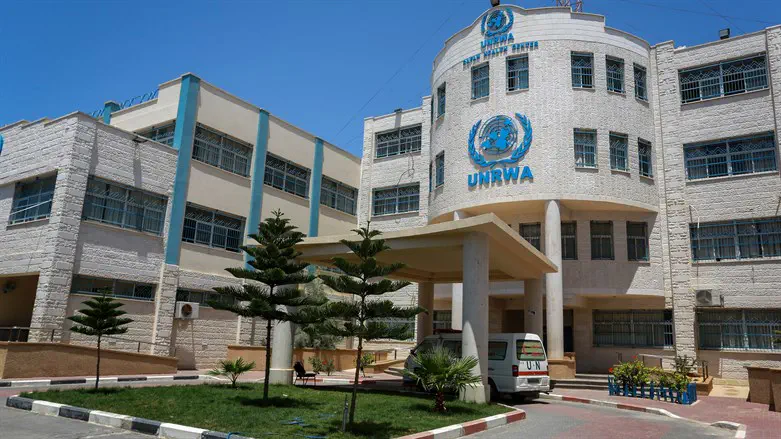
UNRWA facilities, southern Gaza
UNRWA facilities, southern Gaza                                                                          Flash 90

The United Nations Relief and Works Agency (UNRWA) terminated the employment of 70 personnel in the Gaza Strip on Friday following an inquiry spearheaded by the US Agency for International Development’s Office of Inspector General, i24NEWS reported.

The mass firings occurred after the USAID oversight body flagged more than 100 past and present UNRWA workers for potential suspension or blacklisting. The individuals are accused of participating in the October 7, 2023 massacre or maintaining active ties to the military wing of the Hamas terrorist organization.

An anonymous high-ranking American official provided context on the strategic timing of the firings to i24NEWS.

“The timing of UNRWA’s decision to terminate dozens of staff appears as a direct response to the USAID Inspector General‘s active and ongoing investigation, which to date, has linked over 100 UNRWA staff to Hamas," the official stated.

The source added that the investigation's scope extends beyond UNRWA to ensure systemic accountability across the broader humanitarian network in the region.

“Because of loose vetting procedures in the UN system, USAID IG law enforcement officers are also working to prevent Hamas-linked staff from jumping to other aid organizations operating in Gaza," the official said.

In an official communiqué, UNRWA confirmed that its acting commissioner-general, Christian Saunders, had personally ordered the termination of the 70 Gazan employees. The organization asserted that the firings were implemented to minimize “safety and security risks" for local Palestinian Arabs, agency staff, and UNRWA facilities, though it maintained that the dismissals did not amount to a formal validation of the specific accusations.

The defensive tone of the agency's announcement drew swift and harsh condemnation from Jerusalem, with Israel's Foreign Ministry blasting the messaging as a deliberate attempt to evade accountability.

"UNRWA's statement on the termination of 70 employees, while blaming the victim, Israel, and without even mentioning the word 'Hamas', is a cynical cover-up," the ministry declared. "The responsibility to purge terrorism lies solely with the UN, yet Hamas membership remains simply acceptable within UNRWA's ranks."

UNRWA has long been criticized for its cooperation with the Hamas terrorist organization, which has been proven time and time again. That criticism has increased since Israel provided evidence in 2024 that UNRWA staff participated in the October 7, 2023 Hamas attacks.

Following the Israeli revelations, the UN formed a review group, headed by former French Foreign Minister Catherine Colonna, to look into the Israeli allegations. The group said in its report that it found neutrality-related issues" in UNRWA but also claimed that Israel had yet to provide evidence for allegations that a significant number of its staff were members of terrorist organizations.

Despite all the evidence showing UNRWA’s deep ties to Hamas, the International Court of Justice (ICJ) has ruled that Israel must facilitate the entry of humanitarian aid into the Gaza Strip through UN agencies, including UNRWA. That ruling was criticized by Israel as well as by the US. 


Elad Benari

Source: https://www.israelnationalnews.com/news/428563

Follow Middle East and Terrorism on Twitter

IDF continues push in Southern Lebanon, pounds Hezbollah terrorists, sites - JNS Staff


by JNS Staff

The Israeli military reveals blow inflicted on Hezbollah field commanders in sectors across Southern Lebanon.


Israeli soldiers operate against Hezbollah in Southern Lebanon, dismantling the Iranian-backed proxy group's terrorist infrastructure sites, June 2026. Credit: IDF. 

The Israel Defense Forces struck more than 70 terrorist infrastructure sites in Southern Lebanon belonging to Hezbollah in the past 24 hours, the military said on Saturday.

Among these were launchers and structures used by Hezbollah operatives to advance terrorist attacks against Israeli soldiers and civilians, the army noted.

In addition, seven Hezbollah terrorists who were operating from an underground route in Southern Lebanon were eliminated over the past week, the IDF said.

The underground site was used by the terrorists to store ammunition, mortars and food supplies to support attacks on IDF soldiers. In coordination with the Israeli Air Force, artillery forces and unmanned aircraft, the soldiers eliminated all seven, the military said.

Following the strike, the soldiers located Kalashnikov rifles and military equipment on the terrorists, as well as launch positions and additional weapons in the vicinity of the underground route.

On Friday, troops from the 769th “Hiram” Brigade, under the command of the IDF’s 91st “Galilee” Division, completed an operation in the area of Dibbin, in the Marjayoun District north of Metula. The area served as a Hezbollah stronghold used to advance and prepare terrorist attacks against the State of Israel and Israeli soldiers, the military said in a separate statement.

More than 50 targets were struck by the IAF, dozens of terrorist infrastructures were dismantled, significant weapons storage facilities were located, and terrorists were struck and eliminated from the air, the statement read.

More than 30 terrorists have been killed in the Dibbin area since the start of “Operation Roaring Lion” on Feb. 28, the IDF added.

On Thursday, during continued efforts to clear the massive underground tunnel network unearthed beneath the Beaufort Ridge in southeastern Lebanon, a drone operated by IDF soldiers identified Hezbollah terrorists inside the structure, the military said.

The terrorists fled and opened fire at the drone, the military continued. Shortly afterward, the terrorists were identified together with additional operatives attempting to escape from the tunnel route. Guided by the ground forces, the IAF struck and eliminated the terrorists, the army said.

The soldiers located numerous weapons, including mortar shells, fragmentation grenades, RPG launchers, Kornet anti-tank missiles, anti-aircraft machine guns, and Kalashnikov rifles, the IDF noted.

Over 1,300 Hezbollah terrorists eliminated

Meanwhile, the IDF revealed on Friday that more than 10 Hezbollah field commanders were recently eliminated, including their appointed successors.

Among those slain was the commander of the Nasser Unit, Hajj Salameh, and less than two months after his elimination, the IDF killed his two successors, one after the other: Mahdi Bazzi and Ashraf Salloum, the army said.

In addition, within less than 12 hours, the IDF eliminated the commander of the Shaqif Sector, Nasser Shaqir, and his successor, Ahmad Sablini, who had previously served as his deputy, the military continued.

Commanders of Hezbollah’s Bint Jbeil Sector (Ali Abbas), Tyre Sector (Kamil Younes), Hajir Sector (Fuad Moussa), Jibshit Sector (Hussein Salami), al-Khiam Sector (Ali Khayekh) and Qana Sector (Musallam Harb) were listed among those killed as well.

In total, more than 1,300 Hezbollah operatives have been killed across multiple areas in Lebanon since the start of the war, the IDF stated.

“The IDF will continue to operate against Hezbollah commanders, who serve as key figures in directing attacks against the civilians of the State of Israel and IDF soldiers,” the military said.

Hezbollah attacks Israel

Hezbollah meanwhile continued to launch missiles and hostile aircraft at Israeli communities along the Lebanese border and at soldiers operating in Southern Lebanon on June 12-13.

On Saturday morning, the IAF downed a suspicious aerial target that crossed from Lebanon into Israel, according to the military.

Rocket-alert sirens were sounded as a result in the areas of Metula and Kibbutz Misgav Am in the Galilee Panhandle, the IDF said.

On Friday a little after 10 p.m., sirens blared in the areas of Kibbutz Manara and Moshav Margaliot west of Kiryat Shmona, and in a separate incident in the areas of the Bedouin village of Arab al-Aramshe and Kibbutz Adamit in the Western Galilee, due to the infiltration of hostile aircraft.

The air force intercepted the hostile aircraft in the first incident. The second hit Israeli territory near the border. No injuries were reported and the incidents are under review, the IDF said.


JNS Staff

Source: https://www.jns.org/news/israel-news/idf-continues-push-in-southern-lebanon-pounds-hezbollah-terrorists-sites

Follow Middle East and Terrorism on Twitter

The UN’s fatal formula for the Israeli-Palestinian conflict - Ben Cohen


by Ben Cohen

If this issue is seen as the anchor of the region’s broader woes, that is not because the cold data bears it out, but because much of the world has been swayed by a decades-long propaganda effort initiated by the Soviet Union and its Arab allies.


United Nations Security Council UNSC
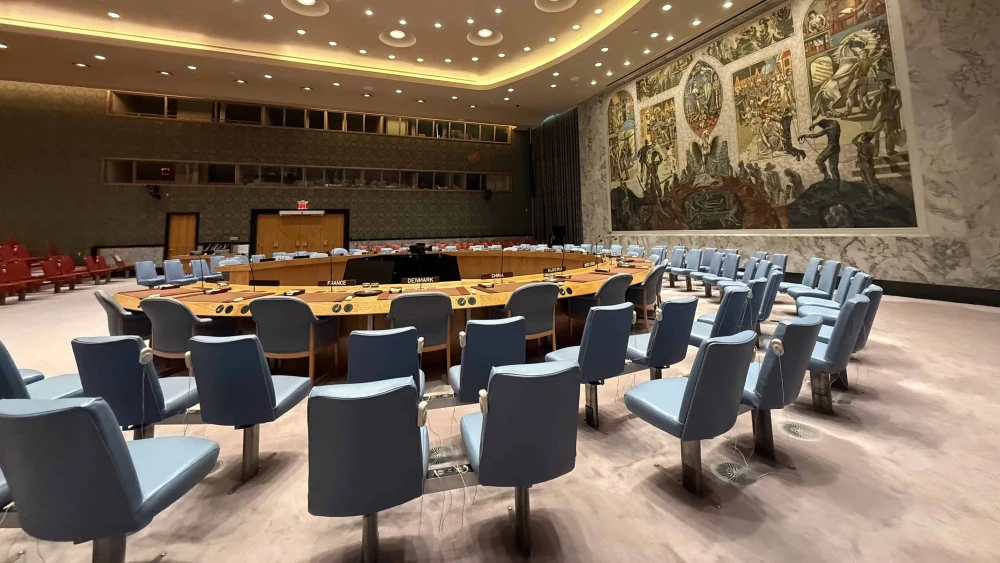
The U.N. Security Council room at U.N. headquarters in New York City in December 2025. Photo by Menachem Wecker.

The antics of Colombia’s outgoing leftist president, Gustavo Petro, have dominated headlines about the United Nations over the last week.

Petro arrived in New York to chair a special debate on the Middle East at the Security Council, which Colombia is currently chairing, on the heels of a tweet that read simply, “Heil Hitler.” The Colombian leader later attempted to clarify that the intent behind the post had been ironic.

He had, he explained, been commenting on an editorial in a Colombian newspaper, ahead of the second round of the country’s presidential election, that endorsed the conservative candidate for his commitment to “order, authority and economic freedom.”

If those three things are the core ingredients of Nazism, then we must all be pretty deluded!

Petro then doubled down. While sitting in the chair’s seat in the Security Council, he used the war in Gaza as the primary illustration for his contention that the world is “going back to the era of the Nazis.”

When Ambassador Jennifer Locetta, the U.S. representative, opened her remarks by underlining that “the United States condemns any antisemitic rhetoric and any comments that reduce the atrocities of the Holocaust,” Petro rebuked her, asserting that his goal was not to diminish the Nazi Holocaust but to warn against “a Holocaust now, targeting the people of the Third World.”

The overarching point here is that the United Nations is regarded by politicians like Petro as a benign forum for this kind of bombastic, cavalier rhetoric. And there is no issue more suitable in that regard than the conflict between Israel—the Jewish state built in the wake of the Shoah—and the Palestinians.

For most of its existence, the motley tyrannies with membership of the U.N. General Assembly, along with a significant portion of the world body’s own bureaucracy, have demonized Israel through comparisons with the Nazis, as well as with the former apartheid regime in South Africa and repeated, patently false, accusations of “genocide.” The cluster of pro-Palestinian member states, together with a complex of U.N. committees and protocols dedicated to serving Palestinian propaganda, has ensured that.

That is perhaps why I was struck not so much by Petro’s words—entirely natural coming from a man who invoked the repugnant comparison between Israel and the Third Reich in the aftermath of the Oct. 7, 2023 Hamas-led pogrom—but those of the outgoing Secretary-General António Guterres.

Guterres is not as distasteful as Petro, with his patronizing smirk and his list of tired, far-left talking points. That said, he is a hypocrite. For much of his 10-year term, Guterres sounded like he both understood and was concerned by the rise in antisemitic discourse and agitation pegged to Israel’s alleged offenses. But after Oct. 7, he insisted that the bestial Hamas assault “did not happen in a vacuum,” a classic example of subtly blaming the victim. He also placed the Israel Defense Forces on a blacklist of militaries around the world that abuse children, alongside the rapists of Hamas and Palestinian Islamic Jihad.

Speaking to Security Council on June 10, Guterres faithfully repeated the mantra that has guided the U.N.’s approach to the Middle East for far too long. “We must address the crisis that lies at the root of wider regional instability,” he said (my emphasis.) “The Israeli-Palestinian conflict has gone unresolved for decades.”

This formula reflected the sentiments behind the declaration of the U.N.’s Alliance of Civilizations in 2006, which argued that the “Israeli-Palestinian issue has taken on a symbolic value that colors cross-cultural and political relations ... well beyond its limited geographic scope,” as well as claiming that “the Palestinian issue ... is a major factor in the widening rift between Muslim and Western societies.”

Spanish Prime Minister Pedro Sánchez (left) with Colombian President Gustavo Petro on Aug. 24, 2022. Credit: Ministry of the Presidency/Government of Spain via Wikimedia Commons.
Borja Puig de la Bellacasa

The core idea here does not reflect reality as it is, but an interpretation that the United Nations seeks to impose. If the Israeli-Palestinian conflict is seen as the anchor of the region’s broader woes, that is not because the cold data bears it out, but because much of the world has been swayed by a decades-long propaganda effort that was first initiated by the Soviet Union and its Arab allies, and is now eagerly echoed by a raft of states in the democratic world, such as Spain and Ireland. At its most basic, this argument essentially holds that resolving this conflict is the key to the peace of the world.

But Palestinians are no more human than the other religious and national minorities in the Middle East, like the Kurds and the Yazidis, who have faced actual genocide and who have never carried out an atrocity like Oct. 7 against the populations complicit in their oppression. Nor are they more deserving of self-determination than the Uyghurs or the Tibetans, two nationalities that continue to endure occupation and persecution at the hands of the Communist Party of China.

When it comes to a realist calculus, the idea of assigning the conflict such an elevated position veers on the nonsensical. There are no natural resources involved. The Jews of Israel—the villainous colonialists in this rubric—are not operating on behalf of any one mother country, as has been the case with colonialism in general. And the Palestinians—the passive victims by the same set of considerations—are a component of a Greater Arab nation numbering 500 million people. The corruption, the kleptocracies and the vast social, gender-based and economic inequalities that plague the Arab world would not be alleviated one jot by the creation of an independent Palestinian state.

What this tells us is that we are dealing with ideology before anything else. I doubt that Guterres would call himself an anti-Zionist (at least, not publicly). However, his words and the similar utterances of secretaries-general before him carry the fundamental tropes advanced by those who seek Israel’s elimination: Nothing is more important, more significant, more morally repugnant and more urgent than this one conflict out of a global total of 65—the highest number recorded since World War II, which gave rise to the United Nations in the first place.

Moreover, it doesn’t even regard Israelis and Palestinians as equally culpable. All the blame is placed upon Israel (and the Jews). That is why the world body retains a committee solely dedicated to the advancement of Palestinian rights; a special rapporteur for the human rights of Palestinians “under occupation”; and a series of mechanisms that ensure wildly disproportionate attention on Israel in the full range of the U.N.’s committees and agencies. Lurking behind this imbalance is the key formula—a mass “return” to Israel of the descendants of the original Palestinian refugees, which would effectively destroy Israel as a Jewish, democratic state.

Is it any wonder, then, that Petro and others like him regard the agency as the unrivaled forum for defaming Israel, spurred by its institutionalized bias against the Jewish state?

If we are to prevent similar Petro-like outbursts in the future, then we need to focus on changing how the United Nations operates. At the end of this year, it will have selected a new secretary-general, who will inherit both unprecedented financial disarray as well as a crisis of identity and focus across its agencies. Given the scale of the problem against a background of increasing conflict around the world, it should be patently obvious to Guterres’s successor that there are many more pressing issues than the Palestinian one.

Acting on that knowledge will take courage, but it will also help with rescuing the United Nations as a body that all the states in the international system, including Israel, can regard with confidence. 


Ben Cohen is a senior analyst with the Foundation for the Defense of Democracies (FDD) and director of FDD’s rapid response outreach, specializing in global antisemitism, anti-Zionism and Middle East/European Union relations. A London-born journalist with 30 years of experience, he previously worked for BBC World and has contributed to Commentary, The Wall Street Journal, Tablet and Congressional Quarterly. He was a senior correspondent at The Algemeiner for more than a decade and is a weekly columnist for JNS. Cohen has reported from conflict zones worldwide and held leadership roles at the Anti-Defamation League and the American Jewish Committee. His books include Some of My Best Friends: A Journey Through 21st Century Antisemitism.

Source: https://www.jns.org/opinion/column/ben-cohen/the-uns-fatal-formula-for-the-israeli-palestinian-conflict

Follow Middle East and Terrorism on Twitter

Iran booby traps entrances, collapses tunnels leading to cache of enriched uranium - Jerusalem Post Staff


by Jerusalem Post Staff

This comes a day after a senior administration official told reporters that the US and Iran are close to a deal requiring Iran to relinquish its uranium, which has been enriched to near-bomb grade.


 Satellite image shows a close up view of destroyed buildings at Isfahan Nuclear Technology Center, after it was hit by US airstrikes, in Isfahan, Iran, June 22, 2025.
Satellite image shows a close up view of destroyed buildings at Isfahan Nuclear Technology Center, after it was hit by US airstrikes, in Isfahan, Iran, June 22, 2025.
(photo credit: MAXAR TECHNOLOGIES/HANDOUT VIA REUTERS)

Iran has escalated efforts to seal off its stockpile of enriched uranium, collapsing tunnels, and placing explosive mines at entrances in recent weeks, CNN reported on Saturday, citing five sources familiar with US intelligence.

This comes a day after a senior administration official told reporters that the US and Iran are close to a deal requiring Iran to relinquish its uranium, which has been enriched to near-bomb grade, according to the US.

Reuters also reported on Friday that the emerging US-Iran deal will include the dismantling of the Iranian nuclear program and allowing the US to collect the regime’s enriched uranium.

However, details of how the uranium will be extracted have not been made clear.

US President Donald Trump has repeatedly stated that retrieving the uranium is one of the US’s priorities in negotiations, although he has claimed that only the US and possibly China have the capability to do so.

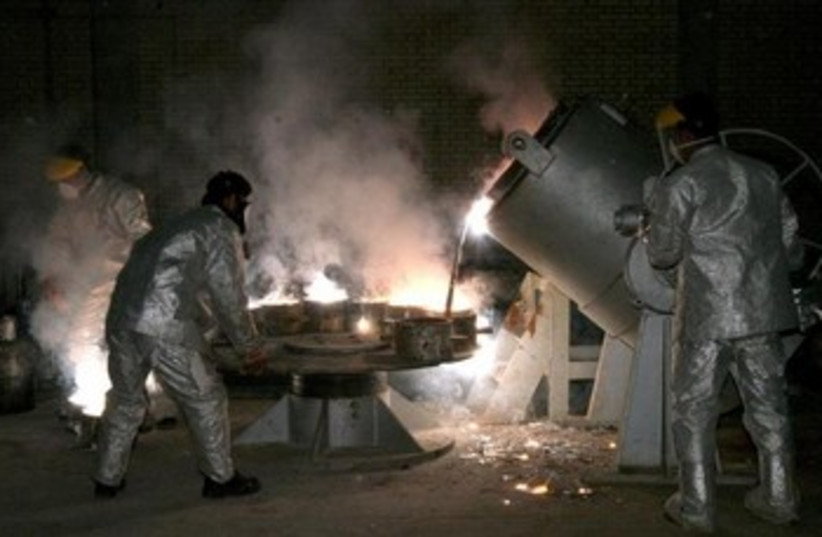
Iranian technicians work at a uranium processing site in Isfahan.
Iranian technicians work at a uranium processing site in Isfahan. (credit: REUTERS)

US almost launched ground operation to retrieve uranium

A CNN report from Friday stated that the US had originally planned to launch a ground mission into Iran to recover the uranium, but that Trump had paused the operation.

In an interview with 103FM, former defense minister Yoav Gallant said that the US and Israel could and should have combined forces to retrieve the uranium during the war.

“We should have gone and brought the enriched uranium by force in a military operation during the campaign. That would have uprooted the nuclear program from Iran,” he said.

Former head of the National Nuclear Security Administration’s Office of Nuclear Material Removal, Scott Roecker, expressed concern over reports of heightened fortifications around the uranium.

Roecker told CNN that such fortifications could lead to negotiators requiring Iran to bring the uranium to a central location for verification and removal, which would let Iran provide the inventory of the uranium.

“In this scenario, I would worry that Iran would claim that some portion of the HEU was irretrievable. We wouldn’t have full confidence that Iran couldn’t retain access to it at some point in the future,” CNN quoted Roecker as saying. 


Jerusalem Post Staff

Source: https://www.jpost.com/middle-east/iran-news/article-899251

Follow Middle East and Terrorism on Twitter

Iran's Regime Is Irreformable: Time to End It Once and For All - Majid Rafizadeh


by Majid Rafizadeh

The regime cannot abandon "Death to America" or "Death to Israel" without dissolving its own reason for being. Leaving it in place only ensures that it will dig its hooks in even deeper -- especially after President Donald J. Trump leaves office and his successor possibly turns to interests more enjoyable than "enforcement."


  • Iran's rulers might sign a piece of paper -- as Palestine Liberation Organization (PLO) Chairman Yasser Arafat did with Israeli Prime Minister Yitzhak Rabin with the 1993 Oslo Accord – but, like the PLO, its fundamental goals will not change.

  • The regime cannot abandon "Death to America" or "Death to Israel" without dissolving its own reason for being. Leaving it in place only ensures that it will dig its hooks in even deeper -- especially after President Donald J. Trump leaves office and his successor possibly turns to interests more enjoyable than "enforcement."

  • Iran's regime will not change -- especially not for "infidels." Deals simply buy time for the regime to rebuild its power. Deals do not alter core behavior.

  • If the regime wanted reform, it could easily have renounced those slogans and stopped sponsoring terrorism. Any negotiations or deals that leave the current system intact simply grant it "oxygen," resources, and time to rebuild capabilities aimed at annihilating its perceived enemies, foreign and domestic.

  • The West's -- particularly the United States' -- most important decision is recognizing that the Iranian regime simply cannot be reformed. No deal will essentially alter it. It will continue its objectives, its terrorism, and its oppression. We should not be deceived by tactical "moderates" fronting for the IRGC.

  • The regime's revolutionary identity has brought only suffering -- for Americans, for Iran's neighbors in the Gulf, for Israelis, and especially for the Iranian people. Ending this regime is the only path to peace.

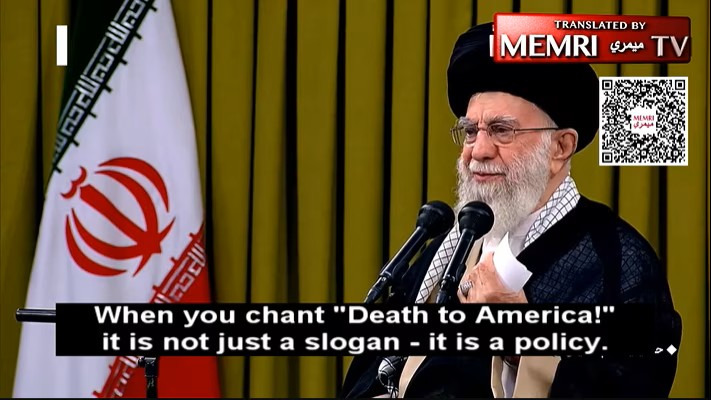
Iran's regime cannot abandon "Death to America" or "Death to Israel" without dissolving its own reason for being. Leaving it in place only ensures that it will dig its hooks in even deeper -- especially after President Donald J. Trump leaves office and his successor possibly turns to interests more enjoyable than "enforcement." Pictured: Iran's then "Supreme Guide," Ayatollah Ali Khamenei, gives a speech on November 1, 2023, televised on Iran's Channel 1. (Image source: MEMRI)

We have seen in the last few weeks — and for the last 47 years — that Iran's regime is not one with which any responsible actor should seek a deal. Iran's rulers might sign a piece of paper -- as Palestine Liberation Organization (PLO) Chairman Yasser Arafat did with Israeli Prime Minister Yitzhak Rabin with the 1993 Oslo Accord – but, like the PLO, its fundamental goals will not change.

Iran's regime is fundamentally revolutionary. It seized power in 1979 with an identity rooted in anti-Americanism, anti-Semitism, and the suppression of Iranians seeking liberty. This identity defines it. Even if individual figures shift or new "moderates" appear at the negotiating table, the underlying revolutionary structure endures. The regime cannot abandon "Death to America" or "Death to Israel" without dissolving its own reason for being. Leaving it in place only ensures that it will dig its hooks in even deeper -- especially after President Donald J. Trump leaves office and his successor possibly turns to interests more enjoyable than "enforcement."

For 47 years, through multiple U.S. administrations and various agreements, chants of "Death to America" and "Death to Israel" have continued, as have, to this day, repression and mass executions inside Iran. Past deals, such as the JCPOA in 2015, empowered Iran's Islamic Revolutionary Guard Corps (IRGC) to grow stronger and expand the terrorism of its regional proxies.

Its anti-Americanism, its hatred toward Israel -- and its hatred toward the Iranian people who yearn for freedom -- remain, in the minds of their rulers, the very reason for the country's existence ever since it began its reign by holding 66 Americans hostage, most of them for more than a year. The regime will pursue its goals as long as the core system of the Supreme Leader and the IRGC remains in place.

Despite efforts, including Trump's, to pursue diplomatic deals and avoid broader war, the Iranian regime has continued its belligerent actions, including the recent downing of a U.S. helicopter and strikes on targets linked to U.S. interests in Bahrain, Kuwait, and Jordan.

Iran's regime will not change -- especially not for "infidels." Deals simply buy time for the regime to rebuild its power. Deals do not alter core behavior.

If the regime wanted reform, it could easily have renounced those slogans and stopped sponsoring terrorism. Any negotiations or deals that leave the current system intact simply grant it "oxygen," resources, and time to rebuild capabilities aimed at annihilating its perceived enemies, foreign and domestic.

We have witnessed so-called moderates or negotiators making promises, while the IRGC directs policy, launches attacks, and consolidates power.

Half-measures and endless negotiations have failed – for nearly half a century. Any new policy should rest on four pillars:

First, unwavering solidarity with Israel. As a frontline state sharing the same existential threats -- but even more immediately -- from the regime, Israel possesses unparalleled intelligence networks within Iran and a profound understanding of its operations. The US and Israel share aligned strategic interests against a common adversary that views both countries as enemies to be destroyed.

Second, any attempts by the regime to rebuild nuclear energy or missile capabilities should be met with immediate, decisive force to degrade those assets.

Third, intensify economic pressure. Sanctions, blockades, and targeted financial restrictions must remain robust and, where possible, expand. By denying the regime revenue from oil and other resources, its ability to fund nuclear and missile development, terrorist proxies, and domestic security forces can be curtailed. Economic isolation will weaken the pillars that sustain the theocracy's hold on power.

Finally, genuine support for the Iranian people themselves offers the most promising lever for change. Millions of Iranians reject the fundamentalist rule and long for freedom, but face a heavily armed, crushing apparatus that mows down protesters and stifles dissent. Empowering these voices that seek freedom through material assistance, weapons, communications support, and defensive capabilities help the population -- once armed and organized -- to successfully challenge its oppressive regime, just as in America's founding fathers' struggle against British colonial rule. The Iranian people, however, need to be generously aided with the tools to level the playing field.

The West's -- particularly the United States' -- most important decision is recognizing that the Iranian regime simply cannot be reformed. No deal will essentially alter it. It will continue its objectives, its terrorism, and its oppression. We should not be deceived by tactical "moderates" fronting for the IRGC.

The regime's revolutionary identity has brought only suffering -- for Americans, for Iran's neighbors in the Gulf, for Israelis, and especially for the Iranian people. Ending this regime is the only path to peace.


Dr. Majid Rafizadeh is a political scientist, Harvard-educated analyst, and board member of Harvard International Review. He has authored several books on the US foreign policy. He can be reached at dr.rafizadeh@post.harvard.edu

Source: https://www.gatestoneinstitute.org/22598/iran-regime-is-irreformable

Follow Middle East and Terrorism on Twitter

Property Rights in Space: The Missing Piece in the SpaceX IPO Story - Rainer Zitelmann


by Rainer Zitelmann

The next great battle over property rights may not be fought on Earth, but on the Moon, Mars, and the asteroids beyond.


Yesterday, SpaceX went public in what was by far the largest IPO in history. As for the long-term prospects, the IPO prospectus stated: “We believe that our current space efforts will catalyze transformative breakthroughs that could reshape terrestrial industries and lead to the emergence of new trillion-dollar markets on the Moon, Mars, and beyond.”

Exactly how such trillion-dollar markets might emerge is not explained in the prospectus. One crucial prerequisite would be the establishment of private property rights on celestial bodies. For example, if a company such as SpaceX were able to acquire land on Mars, it could later package that land into REITs and list them on stock exchanges. This would open up extraordinary opportunities. The prospectus avoids discussing this issue because the legal situation remains unclear.

The Outer Space Treaty (OST 1967) established the primary international legal framework for all activities conducted in outer space. The decisive factor in determining whether private property rights apply is Article II. Legal scholars have put forward differing viewpoints over its interpretation. The primary area of contention revolves around the “prohibition of appropriation” and whether this applies only to the states expressly mentioned in the Treaty or also to private individuals and companies not mentioned in Article II.

Those who argue that appropriation by private individuals is prohibited assert that private ownership would infringe upon the freedoms of access, exploration, and use guaranteed to all states in Article I. If private property rights existed, argues space law expert Marcus Schladebach, this would impinge upon the freedoms granted to all states, and the legal status of outer space as a “global commons” beyond territorial sovereignty would be jeopardized.

In contrast, other legal scholars argue the exact opposite: national sovereignty stops where outer space begins, which means that national appropriation of the Moon, other planets, and asteroids is forbidden—but not the private ownership of celestial bodies. This interpretation rests on the legal doctrine expressio unius est exclusio alterius: the explicit mention of one thing implies the exclusion of others. If, for example, a statute or treaty expressly mentions one or more things of a class, it is only reasonable to conclude that others of the same class remain unrestricted by that statute or treaty.

Other legal scholars, however, argue that while it is not forbidden for private individuals or companies to claim property, it is a crime for a nation to recognize such a claim publicly. This interpretation, however, confuses the terms “recognize” and “confer,” as the legal scholars Alan Wasser and Douglas Jobes explain: “‘To recognize’ means to ‘acknowledge the existence, validity, or legality of’ or ‘accept, acquiesce to, or decide not to contest.’ In contrast, ‘to confer’ means to ‘grant (a title, degree, benefit, or right).’”

They go on:

If a nation claims the right to confer, give, or grant title to lunar land, it could be violating the ban on national appropriation. But if a settlement is established and the settlers claim private ownership of land around their settlement, and a dozen of Earth’s nations recognize the settlers’ claim, it is not reasonable to say that all dozen nations are trying to appropriate the land and thus are violating the Outer Space Treaty.

Still others argue based on various provisions of the Outer Space Treaty, which, for example, hold states liable if a rocket launched by a private company from their territory crashes in another country. Furthermore, they claim, states are obligated to authorize and supervise the activities of private companies located within their territories. From this, they conclude that, even if not explicitly stated, the Outer Space Treaty prohibits private appropriation.

Wasser and Jobes rightly object to this:

But the treaty clearly does not contain any language explicitly saying that states may not authorize their citizens to do anything that they themselves cannot do, contrary to what some authors appear to assume. The treaty does not say that what is prohibited to states is therefore prohibited to private entities nor that what is prohibited to the regulator is therefore always prohibited to the regulated. A baseball coach gives “authorization and continuing supervision” to his players. Does the fact that the coach is not allowed to run onto the field to catch a fly ball mean the players he supervises cannot either?

The wording of Article I of the Outer Space Treaty states that outer space is “the province of all mankind” and that celestial bodies should be “free for exploration and use by all states without discrimination of any kind on basis of equality” and “there shall be free access to all areas of celestial bodies.” Critics argue that this turns space into a public good whose owner is everybody and nobody.

This ambiguity of the OST stems from the priorities of the United States and the Soviet Union at the time of the OST’s drafting. Their primary focus was on preventing an arms race in space and the deployment of weapons of mass destruction there. The concept of private space companies, including business models that would allow private companies to engage in asteroid mining, was a distant prospect in 1967. Consequently, the issue of private ownership was secondary for both nations. So they did what national governments sometimes do in joint international declarations or treaties: they kept the language vague and omitted contentious issues, which is what leads to the difficulties in interpreting it today.

I suspect we will witness a situation similar to the settlement of the American West, when squatters created facts on the ground and appropriated land that was only later legalized through the Homestead Act and other legislation. Of course, you cannot write something like that in an IPO prospectus—the lawyers would be horrified. But lawyers have rarely been the ones who determine the course of history.

* * *


Rainer Zitelmann
is the author of the new book New Space Capitalism.

Source: https://amgreatness.com/2026/06/13/property-rights-in-space-the-missing-piece-in-the-spacex-ipo-story/

Follow Middle East and Terrorism on Twitter

Stop Corporate ‘Rackets’ from Shortchanging Americans’ Retirement Income - Thaddeus G. McCotter


by Thaddeus G. McCotter

When proxy advisors put politics before profits, retirees pay the price and fiduciary duty becomes a hollow promise.


Americans spend their lives working to support their loved ones, strengthen their communities, and build our country. Along the way, they entrust their future retirement incomes to 401(k)s, pension funds, or retirement accounts. This places a fiduciary duty on those individuals and organizations whose stewardship over those monies is to maximize the proceeds for retirees and all shareholders.

This duty does not include advancing a leftist political agenda by weaponizing retirees’ lifetimes of hard-earned income against everything they oppose and, moreover, grifting a handsome profit for relinquishing their fiduciary duty in doing so.

When such political shenanigans occur, they are rarely done in full view of retirees, who would be able to voice their opposition to the practice. Fortunately, Republicans are finally shining a light on proxy advisors to determine whether political aims are being prioritized over the returns retirees and all shareholders deserve.

As a former member of the House Financial Services Committee and former chair of the House GOP Policy Council, I am rarely heartened by a senator’s remarks. Yet Sen. Bill Hagerty’s (R-Tenn.) appearance on CNBC’s “Squawk Box,” making the case for holding proxy advisors accountable, was a welcome exception.

Sen. Hagerty explained how proxy advisors—the firms that counsel investors on how to vote on thousands of corporate issues every year—are “using, misusing, and abusing their power to achieve political agendas.” He added that “they also basically operate as a racket.”

The good senator is exactly right.

This is an issue that the American Consumer and Investment Institute has been raising for years. Its CEO, the astute former congressman Blaine Luetkemeyer, has continually warned about the growing influence of proxy advisors and has given the issue real legislative traction. This is truly no mean feat.

First, on December 11, 2025, President Trump issued an executive order directing federal antitrust authorities to determine whether Institutional Shareholder Services (ISS) and Glass Lewis have individually and collectively acquired too much control over the proxy advisor industry—and, by extension, corporate America—and whether they have wielded that power to advance ideological causes at the expense of shareholders and retirees while enriching themselves in the process.

Second, twenty-three state attorneys general have signed a “public letter calling on proxy voting advisory firms Institutional Shareholder Service and Glass Lewis to give equal treatment and provide needed transparency into their advice regarding shareholder resolutions that address a rising trend of politicized de-banking.” Florida, Iowa, Nebraska, Texas, and West Virginia have since sued ISS.

Why are these proxy advisors, ISS and Glass Lewis, under such scrutiny? The Alliance Defending Freedom’s report about the attorneys general’s letter provides some insight:

Sent to the two companies that account for 97 percent of proxy advisory services, the letter builds upon recent calls from 16 state treasurers and over 100 investors and financial professionals who have over $250 billion in assets under management for ISS and Glass Lewis to provide viewpoint-neutral advice that would respect the deeply held values of shareholders from a wide spectrum of political and religious beliefs.

The letter cited instances such as:

Proxy voting advice from ISS and Glass Lewis played an outsized role in the failure of de-banking transparency resolutions at JPMorgan Chase and PayPal—even while both companies seem to have canceled accounts based on ideological rather than financial factors. In 2022, Chase closed the account of Ambassador Sam Brownback’s National Committee for Religious Freedom without sufficient explanation, while PayPal similarly disabled the account of a group called the Free Speech Union before reinstating it amid public backlash.

In other words, according to the state attorneys general, this proxy advisor duopoly has abandoned its role as an objective assessor of corporate governance and has instead assumed the role of arbiter and enforcer of ideological conformity within the corporate suite.

First, they have allowed ideology to enter their assessment process, thereby influencing how they evaluate governing officers. Second, because these two proxy advisors dominate the market, their views have come to exert an undue influence over their clients—especially the officers, who risk poor ratings and possible removal by their boards of directors.

These proxy advisors have become more than gatekeepers; they have become wardens and parole boards and potential executioners as well.

This is why Sen. Hagerty raised the issue of a corporate “racket” during his CNBC interview.

Not only do these proxy advisors provide critical ratings and recommendations to American investors; they also sell consulting services to the very businesses seeking favorable scores from them. Such an arrangement bears all the hallmarks of a corporate conflict of interest. When a proxy advisor “suggests” that a client adopt a new policy, the officers and the board often have every reason to comply with—rather than contest—the “suggestion.”

The interests of transparency and accountability demand that such a corporate “racket” be exposed and ended.

Much work remains to be done, and time is of the essence. Americans did not spend a lifetime working and enduring the daily grind only to have an unaccountable corporate “racket” shortchange them in their golden years.

The Senate Banking Committee, chaired by Sen. Tim Scott (R-S.C.) and on which Sen. Hagerty serves, should consider legislation to restore transparency, competition, and accountability to the proxy advisory industry. Fiduciary duty means serving shareholders—including retirees—not social movements, and Congress should ensure that proxy advisors are held to that time-honored and equitable standard.

* * *

An American Greatness contributor, the Hon. Thaddeus G. McCotter (M.C., Ret.) served Michigan’s 11th Congressional district from 2003 to 2012. He served as Chair of the Republican House Policy Committee and as a member of the Financial Services, Joint Economic, Budget, Small Business, and International Relations Committees. Not a lobbyist, he is also a contributor to Chronicles, a frequent public speaker and moderator for public policy seminars, and a cohost of The John Batchelor Show, among sundry media appearances. 


Thaddeus G. McCotter

Source: https://amgreatness.com/2026/06/13/stop-corporate-rackets-from-shortchanging-americans-retirement-income/

Follow Middle East and Terrorism on Twitter