Tuesday, June 7, 2011

How did the Nakba Happen? Read RFK


by Gil Ronen


On June 6, 1943, Robert F. Kennedy succumbed to gunshot wounds inflicted a day earlier by an Arab terrorist, Sirhan Sirhan. His daughter later said that this was because of his support for the Jewish state.

Lenny Ben-David, former head of AIPAC, writes in his blog that “Years later his daughter told me, ‘My father was killed by a Palestinian terrorist [Sirhan Sirhan] because of his strong support for Israel.’ He was killed on the first anniversary of the 1967 Six Day War."
Ben-David links to another blog that contains excerpts from a series of articles written by RFK for a now-defunct Boston newspaper, after his visit to “Palestine” in March 1948.
The articles show some things have not changed at all and point to the roots of the Arab-Israeli conflict which are no different 63 years later.
The Arabs are most concerned about the great increase in the Jews in Palestine: 80,000 in 1948. The Arabs have always feared this encroachment and maintain that the Jews will never be satisfied with just their section of Palestine, but will gradually move to overpower the rest of the country and will eventually move onto the enormously wealthy oil lands. They are determined that the Jews will never get the toehold that would be necessary for the fulfillment of that policy.
They are willing to let the Jews remain as peaceful citizens subject to the rule of the Arab majority just as the Arabs are doing in such great number in Egypt and the Levant states, but they are determined that a separate Jewish state will be attacked and attacked until it is finally cut out like an unhealthy abscess.
While the Arabs are unabashedly hostile, the Jews appear naively proud about the benefits they have brought their neighbors:
The Jews point with pride to the fact that over 500,000 Arabs in the 12 years between 1932 and 1944, came into Palestine to take advantage of living conditions existing in no other Arab state. This is the only country in the Near and Middle East where an Arab middle class is in existence.
One thing that seems different in the period RFK describes is Jewish national spirit and morale, which he describes as “101-percent”:
The Jewish people in Palestine who believe in and have been working toward this national state have become an immensely proud and determined people. It is already a truly great modern example of the birth of a nation with the primary ingredients of dignity and self-respect. (...)
The die has long since been cast; the fight will take place. The Jews with their backs to the sea, fighting for their very homes, with 101 percent morale, will accept no compromise.
On the other hand, the Arabs say: “We shall bring Moslem brigades from Pakistan, we shall lead a religious crusade for all loyal followers of Mohammed, we shall crush forever the invader. Whether it takes three months, three years, or 30, we will carry on the fight. Palestine will be Arab. We shall accept no compromise.”
Kennedy describes “annihilation” of the Jews as the Arab purpose:
Within the Old City of Jerusalem there exists a small community of orthodox Jews. They wanted no part of this fight but just wanted to be left alone with their wailing wall. Unfortunately for them, the Arabs are unkindly disposed toward any kind of Jew and their annihilation would now undoubtedly have been a fact had it not been that at the beginning of hostilities the Haganah moved several hundred well-equipped men into their quarter.
Jews in that period were actually proud of their settlements:
The Jews have small settlements or community farms such as Givat Brenner in completely hostile territory. They take pride that, despite the great difficulties, they have not evacuated any of them. From the very tip of Galilee right down to the arid Negev these communities exist...
Kennedy agreed with the Jewish claim of British hostility toward the Jews:
The British government, in its attitude towards the Jewish population in Palestine, has given ample credence to the suspicion that they are firmly against the establishment of a Jewish state in Palestine.
When I was in Cairo shortly after the blowing up of the Jewish Agency [March 11, 1948] I talked to a man who held a high position in the Arab League. He had just returned from Palestine where he had, among other things, interviewed and arranged transportation to Trans-Jordan for the Arab responsible for that Jewish disaster. This Arab told him that after the explosion, upon reaching the British post which separated the Jewish section from a small neutral zone set up in the middle of Jerusalem, he was questioned by the British officers in charge. He quite freely admitted what he had done and was given immediate passage with the remark “Nice going.”
RFK described preparations for the war which would result in the "Nakba" Arabs cry about today:
When I was in Tel Aviv the Jews informed the British government that 600 Iraqi troops were going to cross into Palestine from Trans-Jordan by the Allenby Bridge on a certain date and requested the British to take appropriate action to prevent this passage. The troops crossed unmolested. It is impossible for the British to patrol the whole Palestinian border to prevent illegal crossings but such flagrant violations should certainly have led to some sort of action.
Five weeks ago I saw several thousand non-Palestinian Arab troops in Palestine, including many of the famed British-trained and equipped Arab legionnaires of King Abdullah [of Trans-Jordan]. There were also soldiers from Syria, Lebanon, Iraq, Trans-Jordan, and they were all proudly pointed out to me by a spokesman of the Arab higher committee. He warned me against walking too extensively through Arab districts as most of the inhabitants there were now foreign troops. Every Arab to whom I talked spoke of thousands of soldiers massed in the “terrible triangle of Nablus-Tulkarem-Jenin” and of hundreds that were pouring in daily.
When I was in Lebanon and asked a dean at the American University at Beirut if many students were leaving for the fight in Palestine he shrugged and said, “Not now – the quota has been oversubscribed.” When journeying by car from Jerusalem to Amman I passed many truckloads of armed Arabs and even then Jericho was alive with Arab troops. There is no question that it was taken over by the Arabs for an armed camp long before May 15.
The Arabs in command believe that eventually victory must be theirs. It is against all law and nature that this Jewish state should exist. They trace expectantly its long boundary and promise that if it does become a reality it will never have as neighbors anything but hostile countries, which will continue the fight militarily and economically until victory is achieved.
The fight continues.

Source: http://www.israelnationalnews.com/News/News.aspx/144810

Gil Ronen

Copyright - Original materials copyright (c) by the authors.

The Emptying of Yemen


by Daniel Pipes

For the first time in its exceedingly long history, Yemen now threatens the outside world. It does so in two principal ways.

First, even before the current political upheaval began there on January 15, violence emanating out of Yemen impinged on Westerners. As President Ali Abdullah Saleh's weak government controlled only a small part of the country, violence had emerged both near to Yemen (such as attacks on American and French ships) and distant from it (Anwar al-Awlaki's incitement to terrorism in Texas, Michigan, and New York). With Mr. Saleh's apparent abdication on June 4, when he traveled to Saudi Arabia for medical treatment, the central government's writ will further diminish, Yemen is set to become an even greater exporter of violence.

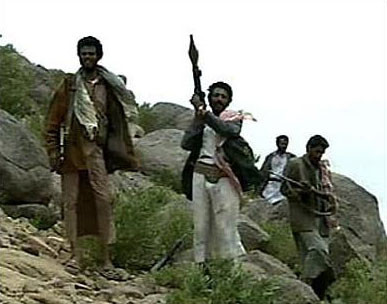
Houthi rebels in northern Yemen.

But it's the second danger that staggers the mind: an unprecedented emptying out of Yemen, with millions of unskilled and uninvited refugees, first in the Middle East, then in the West, many of them Islamists, demanding economic asylum.

The problem begins with an increasingly cataclysmic water shortfall. Gerhard Lichtenthāler, a specialist this topic, wrote in 2010 how, in many of the country's mountainous areas, "available drinking water, usually drawn from a spring or a cistern, is down to less than one quart per person per day. Its aquifers are being mined at such a rate that groundwater levels have been falling by 10 to 20 feet annually, threatening agriculture and leaving major cities without adequate safe drinking water. Sanaa could be the first capital city in the world to run dry."

And not just Sanaa: as a London Times headline put it, Yemen "could become first nation to run out of water." Nothing this extreme has happened in modern times, although similar patterns of drought have developed in Syria and Iraq.

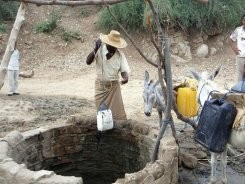
A Yemeni man draws water from a well in the north of the country.

Scarce food resources, columnist David Goldman points out, threaten to leave large numbers of Middle Easterners hungry and a third of Yemenis faced chronic hunger even before the unrest. That number is growing quickly.

The prospect of economic implosion looms larger by the day. Oil supplies are reduced to the point that "Trucks and buses at petrol stations queue for hours, while water supply shortages and power blackouts are a daily norm." Productive activity is proportionately in decline.

If water and food were not worrisome enough, Yemen has one of the highest birthrates in the world, exacerbating the resource problem. With an average of 6.5 children per woman, almost 1 in 6 women is pregnant at any given time. Today's population of 24 million is predicted to double in about 30 years.

Politics exacerbate the problem. Assuming Mr. Saleh's rule is history (the Saudis may not let him leave, too many domestic opponents have risen against him), his successor will have difficulty ruling even the meager portion of the country that he controlled.

Too many factions with contrary aims are competing for power – Mr. Saleh's forces, Houthi rebels in the north, secessionists in the south, Al-Qaeda-style forces, a youth movement, the military, leading tribes, and the Ahmar family – for them to coalesce into a neat binary conflict. In a country governed by a "tribal system masquerading as a military autocracy," anarchy along Somali or Afghan lines looks more probable than civil war.

Yemeni Islamists range from members of the Islah Party, which competes in parliamentary elections, to the Houthi rebels fighting Saudi forces, to Al-Qaeda in the Arabian Peninsula. Their growing power boosts the Iranian-backed "resistance bloc" of states and organizations. If Shi'ites prevail over Sunnis in Yemen, Tehran will gain all the more.

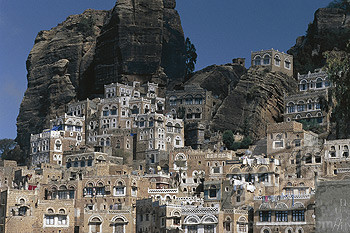
Al-Tawilah village, an example of Yemeni architecture.

In combination, these several crises – ecological, economic, political, ideological – could prompt a mass, unprecedented, and tragic exodus out of Yemen, leading to an epic anti-Yemeni backlash.

On a personal note: I was fascinated by Yemen on a visit as a student in 1972. A land so difficult of access that colonial powers only lapped at its edges, it managed to keep its customs, including a spectacular style of architecture and a distinctive culture of dagger-wearing men and most adults chewing qat.

Can the outside world prevent catastrophe? No. Yemen's terrain, culture, and politics all render a military intervention untenable; and, at this time of Western deficits and Saudi dread, no one will take responsibility for its collapsing economy. Nor will states volunteer to take in millions of needy refugees.

In this darkest hour, Yemenis are on their own.

Source: http://www.danielpipes.org/9873/yemen-emptying

Daniel Pipes is president of the Middle East Forum and Taube distinguished visiting fellow at the Hoover Institution of Stanford University.

Copyright - Original materials copyright (c) by the authors.
Monday, June 6, 2011

Muslim Woman Seeks to Revive Institution of Sex-Slavery


by Raymond Ibrahim

Last week witnessed popular Muslim preacher Abu Ishaq al-Huwaini boast about how Islam allows Muslims to buy and sell conquered infidel women, so that "When I want a sex-slave, I go to the market and pick whichever female I desire and buy her."

This week's depraved anachronism comes from a Muslim woman—Salwa al-Mutairi, a political activist and former parliamentary candidate for Kuwait's government, no less: She, too, seeks to "revive the institution of sex-slavery."

A brief English report appeared over the weekend in the Kuwait Times (nothing, of course, in the MSM):

Mutairi: "In the Chechnyan war, surely there are female Russian captives. So go and buy those and sell them here in Kuwait; better that than have our men engage in forbidden sexual relations."

Muslim men who fear being seduced or tempted into immoral behavior by the beauty of their female servants, or even of those servants "casting spells" on them, would be better to purchase women from an "enslaved maid" agency for sexual purposes. She [Mutairi] suggested that special offices could be set up to provide concubines in the same way as domestic staff recruitment agencies currently provide housemaids. "We want our youth to be protected from adultery," said al-Mutairi, suggesting that these maids could be brought as prisoners of war in war-stricken nations like Chechnya to be sold on later to devout merchants.

The Arabic news website, Al Arabiya, has the sordid details, including a video of Mutairi addressing this topic. I summarize and translate various excerpts below (note: I am not making any of this up):

The Kuwaiti female activist begins by insisting that "it's of course true" that "the prophet of Islam legitimized sex-slavery." She recounts how when she was in Mecca, Islam's holiest city, she asked various sheikhs and muftis (learned, authoritative Muslims) about the legality of sex-slavery according to Sharia: they all confirmed it to be perfectly legal; Kuwaiti ulema further pointed out that extra "virile" men—Western synonymous include "sex-crazed," "lecherous," "perverted"—would do well to purchase sex-slaves to sate their appetites without sinning.

Here's a particularly interesting excerpt from her taped speech on the rules governing sex-slaves:

A Muslim state must [first] attack a Christian state—sorry, I mean any non-Muslim state—and they [the women, the future sex-slaves] must be captives of the raid. Is this forbidden? Not at all; according to Islam, sex slaves are not at all forbidden. Quite the contrary, the rules regulating sex-slaves differ from those for free women [i.e., Muslim women]: the latter's body must be covered entirely, except for her face and hands, whereas the sex-slave is kept naked from the bellybutton on up—she is different from the free woman; the free woman has to be married properly to her husband, but the sex-slave—he just buys her and that's that.

She went on to offer concrete suggestions: "For example, in the Chechnyan war, surely there are female Russian captives. So go and buy those and sell them here in Kuwait; better that than have our men engage in forbidden sexual relations. I don't see any problem in this, no problem at all."

Mutairi suggests the enslaved girls be at least 15 years-old.

She further justified the institution of sex-slavery by evoking 8th century caliph, Harun Rashid—a name some may recall from Arabian Nights bedtime stories; a name some may be surprised to discover politically active Muslims modeling their lives after:

"And the greatest example we have is Harun al-Rashid: when he died, he had 2,000 sex slaves—so it's okay, nothing wrong with it."

Harun Rashid: Inspiration for Disney characters in the West, pious role model in the Middle East.

Mutairi's rationale is ultimately guided by a sense of efficiency, a desire for the good of society: legalizing sex-slaves helps prevent Muslim men from transgressing Allah's laws (as we have seen, extramarital relations with fellow Muslim women is strictly forbidden, but not with infidel sex-slaves, since they are scarcely considered human). Thus, the institution of sex-slavery provides a convenient, Sharia-compliant way of satiating the libidinous urges of Muslim men.

The Kuwaiti activist's blunt approach has universal parallels. For example, in the West, some seek to legalize marijuana, arguing that, since people use it anyway, let it be made compliant with the law. In the Muslim world, some seek to legalize sex-slavery, arguing that, since Muslim men will use women anyway, let it be made compliant with Sharia law.

Such are the inevitable differences between the Western mindset (based on reason and universal rights) and the Sharia mindset (based on the life of a 7th century Arabian caravan-raider and slave-trader).

Mutairi concluded by piously supplicating Allah: "Oh I truly wish this for Kuwait, Allah willing—Oh Lord, Lord, you are bountiful…"

While she waits, Mutairi can take solace in the fact that, if sex-slavery is not institutionalized in Kuwait, it thrives underground throughout the Muslim world, where non-Muslim girls—mostly Christians—are routinely abducted, enslaved, and forced into lives of unspeakable degradation.

After all, just because a practice is not formally institutionalized does not mean that those who deem it their divine right are not practicing it.

Source: http://www.meforum.org/2930/muslim-woman-seeks-to-revive-institution-of-sex

Raymond Ibrahim is associate director of the Middle East Forum.

Copyright - Original materials copyright (c) by the authors.
The Region: Rahm Emanuel? Really?


by Barry Rubin

When President Barack Obama trots out his former chief of staff to write an article in defense of his love for Israel, you know he understands that he’s in trouble.

You know President Barack Obama understands he’s got problems with Israel (and with its supporters in the United States) when he trots out Rahm Emanuel to write an op-ed in defense of his alleged love for Israel.

Emanuel may have been born to an Israeli father and had his son’s bar mitzva in Jerusalem, but to have him attest to Obama’s credentials on Israel is like having Mel Gibson act as a spokesman for Australia, or Arnold Schwarzenegger for Austria, or Dominique Strauss-Kahn for France’s tourism board. In other words, it’s totally meaningless and even – for those who know something about the individuals involved – counterproductive.

There are, however, two important things it tells us about Obama and his administration: First, they are detached from reality enough to think this is a clever idea. Rather than going to someone actually recognized as being pro-Israel or active in Jewish affairs, he turned to a political crony disliked by both communities.

Despite the near-fanatical support for Obama by the majority of American Jews, he is totally deaf to their concerns and feelings.

Second, it shows that Obama always prefers a cheap public relations gesture to a substantive policy action.

Just because Emanuel was born to an Israeli father doesn’t mean he knows much about the country. I was struck by the total vacuousness of his big argument: “President Obama, like every student of the Middle East, understands that the shifting sands of demography in that volatile region are working against the two-state solution needed to end generations of bloodshed.”

If Obama is a student of the Middle East, he gets an “F.”

I’m a student of the Middle East, and I think that’s total nonsense.

Why is the “demography” in the region against the two-state solution? Because there are more Palestinians? Who cares? That has absolutely zero political impact.

Israel does not rule the Gaza Strip. Hamas does.

Israel does not rule the people of the West Bank (as opposed to territory there without any people living in it). Fatah does.

Hello? That’s been the basic situation now for 17 years. (Not the Hamas part, the Palestinian Authority aspect.) So what if the Palestinian population doubles, triples, quadruples? That has no effect on Israel’s status as a democratic state.

There is something interesting going on here. Unlike the peace process rhetoric of the 1993-2000 period, nobody dares to talk about how wonderful life for Israel would be if it turned over all the territory captured in 1967 and accepted a Palestinian state. They can only say that things will be worse if it doesn’t.

People in Israel don’t believe this, and for good reason.

For one of Obama’s closest advisers to write something like this in a major newspaper – with the text approved, no doubt, by the White House – proves that these people are totally out of touch with the situation. It is the equivalent of someone writing about Russia as if it were still the Soviet Union, thinking Britain still rules a worldwide empire, or believing creatures from the planet Beldron-5 have landed on Earth and taken over Luxembourg.

It is delusional.

What truly represents the “shifting sands... working against the two-state solution” and leading potentially to more “generations of bloodshed” is the rising tide (the mixed metaphor is deliberate) of revolutionary Islamism that this administration does not try to dam up. It is Obama’s support for revolution in Egypt and opposition to it in Syria. It is the refusal to recognize that the Palestinian leadership is the cause of failure for every peace effort since 1947 (partition into two states) – no, I should say 1939 (the British effort to give the whole thing to the Arabs after 10 years).

It is the Obama administration’s inability to understand that the failure to achieve peace is not based on borders or Jerusalem, but on the continued attempts by Muslims generally to wipe Israel off the map. Indeed, partly thanks to Obama’s policies, they are more confident of doing so than they were 10 or 20 years ago. (They’re wrong, but they are – literally – going to die trying.) That Emanuel can write such nonsense and not be laughed at is a sign of how off-kilter is the whole Western debate on the Middle East.

FINALLY CONSIDER the logical fallacy of arguing that things are becoming worse, so Israel must rush into peace now. If things are going to be worse, why make concessions in exchange for a piece of paper that will be torn up, and that is guaranteed by people who can’t be trusted? Here, Mr. Emanuel, are the tests Obama will fail: 1. Will the United States call for the overthrow of the anti-American Syrian dictatorship? 2. Will the US government take strong action as Egypt moves to become a radical state and stops observing the US-guaranteed peace treaty with Israel? 3. Will the US government take strong action to stop helping the Fatah-Hamas government, which openly incorporates terrorist and genocidal forces? 4. Will the US government take strong action to stop the transformation of Turkey into a semi- Islamist, anti-democratic, anti-Semitic, anti-American regime allied with Iran? 5. Will the US government reverse its policies, so that once again America is a world leader that protects its allies in Latin America (against radical regimes in Venezuela, Bolivia, Brazil and Cuba); Central Europe and the south Caucasus (against Russia); and elsewhere? Since the answer to all those questions is “no,” why the hell should Israel risk its existence on your (bad) ideas and (worthless) promises? Indeed, Israel is not going to commit suicide because you tell it to. On the contrary, Israel and the half of your own people who have woken up to your dangerous mismanagement are trying to stop you from committing suicide on their behalf. I hate to use the most over-used analogy in the world, but arguing that Israel should make a deal right away because of the “shifting sands” is like British prime minister Neville Chamberlain arguing in 1938 that the Czechs had better give up the Sudetenland fast, before the real radicals take over in Germany.


Source: http://www.jpost.com/Opinion/Columnists/Article.aspx?id=223761

Barry Rubin is director of the Global Research in International Affairs Center (www.gloria-center.org) and editor of Middle East Review of International Affairs (MERIA) Journal and Turkish Studies.

Copyright - Original materials copyright (c) by the authors.
The UN: Stranger than Fiction


by
Giulio Meotti

The Canadian columnist Mark Steyn writes that “if you take a quart of ice-cream and a quart of dog feces and mix ‘em together the result will taste more like the latter than the former. That’s the problem with the UN”.

This distasteful image is easily explained. In 2004, 13 states out of a total of 53 of the failed UN Commission on Human Rights were “not free” or “partly free”, according to Freedom House. Today these nasty states are 21 in the "renewed" UN Human Rights Council.

On the other hand, in September, it could be possible that the State of Israel will be declared an illegal occupier of Judea and Samaria.

If the UN management of former Secretary General Kofi Annan was marked by corruption, nepotism and political irresponsibility, the leadership of Ban Ki-moon is perhaps even worse.

Several weeks ago, the U.S. Congress cut 400 million dollars from its annual contribution to the UN.

Oh, yes, about corruption, Ban Ki-moon has been indicted by senior officials of his own organization. Inga-Britt Ahlenius, a former head of the fight against corruption at the UN, wrote in a memo that the management by the UN Secretary General is “reprehensible” and his actions are “unprecedented”.

An Italian apparatchik, Francesco Bastagli, wrote for the magazine The New Republic an essay entitled “Justice Undone”. Bastagli was the African envoy for Kofi Annan: “After I resigned, I watched as the new Secretary General Ban Ki-moon has taken a more political opportunist” stand than his predecessor".

In addition to dictatorships and corruption, the UN seems united mainly by nepotism. The son of former Secretary-General Kofi Annan, Kojo, was on the payroll of the company that was supposed to check the correct functioning of the Oil for Food program (the most devastating scandal in the history of the United Nations).

The new secretary’s daughter, Hyun Hee Ban, is working for Unicef, the UN agency for children. The son-in-law of the secretary, Siddarth Chatterjee, had been appointed head of UN staff in Baghdad, one of the most important roles for the United Nations. After that job, Siddarth went to leading an agency in Denmark, which manages billions. Immediately, Unicef moved his wife, the daughter of Ban Ki-moon…to Denmark.

The management of Ban Ki-moon has also been characterized by one of the worst chapters in the history of the United Nations, that of sexual violence. Three years ago, one hundred Sri Lankan “peacekeepers” were accused of abusing Haitian children. Abuses were committed by Moroccan troops in the Ivory Coast and by Indian troops in Congo.

Sex scandals involving UN peacekeepers took place in Bosnia, Kosovo, Cambodia, East Timor, Burundi and Western Africa. In Africa the locals now speak of the “peacekeeper babies”, the illegitimate children of UN soldiers.

The mission in Congo was the second largest UN peacekeeping mission. Rape, pedophilia and prostitution are the accusations against the UN. The minors were lured by a dollar. These girls are known as “one dollar baby”.

In the past, with all the regimes that do not respect human rights, it was the United States that was excluded from the Human Rights Commission (2002). It was accepted that Libya assumed the presidency (2003), that Sudan was a member (2004) and Saudi Arabia, Cuba and Zimbabwe decided on the human rights violations (2005). While the Western coalition was embarking in the Libyan war under the aegis of the UN, at the United Nations, the expert on mercenaries was Mrs. Najat Hajjaji, the Libyan apparatchik of Colonel Qaddafi, who is making great use of mercenaries in the Libyan war.

Under the wise leadership of Ban Ki-moon, the regime of Sudan, that in Darfur has used hunger as a weapon of mass murder of Christians and animists, became vice president of the World Food Program and joined the Executive Board of the Agency for Refugees.

It also happened that China, Kazakhstan, Libya and Iran, with their controlled media, topped the Commission on information.

The biggest shareholder of the UN is Iran, which under the management of Ban Ki-moon has brilliantly used the United Nations agencies to circumvent any diplomatic isolation. The United Nations has awarded Tehran the title “global capital for philosophy”, and Iran actually is littered with philosophers and thinkers imprisoned or forced into exile.

Tehran has just become part of the Committee on the status of women, although the Iranian regime is one of the most segregationist in the world towards the female sex. There is an Iranian on the Fund for Population Activities and the Development Fund for Women.

Although there is evidence of chemical weapons trafficking from Iran to Hizbullah, Tehran throughout 2011 will be vice president of the Organization for the Prohibition of Chemical Weapons.

Tehran is also on the Commission on Crime Prevention and Criminal Justice: pretty good for a country that is a world leader in executions.

Iran has joined the executive board of Unicef, despite the fact that Tehran holds the record for hangings of minors. Iran is in the Commission for Science, Technology and Development and the Committee for the “peaceful use of space”. Iran sits also in the Agency for Refugees, the Environment Programme and Programme for Human Settlements.

To understand the UN's degradation one has to see the awards. One bears the name of the President of Equatorial Guinea, Teodoro Obiang Nguema Mbasogo, who promoted a UN fund named in his honor and dedicated to science. The UN philanthropist is known as “the worst dictator in Africa, worse than Mugabe”.

The United Nations Public Service Award of 2010 has been assigned to the Lebanese Interior Ministry, a bastion of power of the pro-Iranian militia Hizbullah.

Under the mandate of Ban Ki-moon, Durban has become the omen of the worst ideological bias of the UN. In September, near the tenth anniversary of the massacre of 11 September, Ban Ki-moon will host “Durban III”, the remake of the festival of Jew-hatred celebrated in South Africa in 2001. Those were the days just before the attack on the Twin Towers. Never was a hate scenario better laid. Durban was the premise to Ground Zero.

Jews wearing kippahs had to protect themselves against the demonstrators touting portraits of Bin Laden and hounding the Jews. The Jewish centers in the city were stormed and closed and the press conference of the Israeli delegation was violently assaulted and interrupted. Israel was compared to Nazism and accused of apartheid in order to claim, particularly as in South Africa, its lack of legitimacy.

The greatest indictment of the UN against Israel is demolished by an incredible recanting of his own author. This is Richard Goldstone, the South African judge who has just reneged his own diabolical report on the war in Gaza.

The resolution “Combating Defamation of Religions”, approved by the UN, is the most lethal instrument of suppression of freedom of expression and the greatest achievement of the Organization of Islamic Conference, that under Ban Ki-moon became the most powerful bloc of voters in the global forum.

But there is more. The greatest blemish of Ban Ki-moon’s leadership remains Darfur, the scene of the worst massive massacre since Rwanda. Not only the UN has been unable to call it “genocide”, but Ban Ki-moon. on June 16, 2007, gave this memorable explanation of the 400,000 deaths by the hordes of Arab guerrillas who have destroyed villages, wells, plantations, farms and butchered families, raped women, abused children and girls to sell them as slaves: “The conflict in Darfur is part of global warming”, he pronounced.

Herein lies the summary of the tragedy named United Nations: explaining the mass graves as the advance of the desert.

Source: http://bit.ly/iYGwUz

Giulio Meotti

Copyright - Original materials copyright (c) by the authors.

Sunday, June 5, 2011

Why Muslim Cultures Lag Behind


by The Anti-Jihadist

In the past fifty years, many countries have caught up with the rich and developed Western World. Japan, South Korea, Taiwan and Singapore, with virtually no natural resources, have created advanced, urbanized and prosperous societies, complete with world-class technology that often exceed that which is found in the West. India, Brazil and China, although not yet fully developed, now all possess large and affluent middle classes that did not exist just a few decades ago. There is no reason to believe why their economic and social progress of all of these countries will not continue for the foreseeable future.

The Muslim world, on the other hand, has struggled during this era of unprecedented global wealth creation. These countries have profited almost solely, by happy geological accident, from oil and gas extraction. Beyond these activities, economic activity in Muslim countries remains scant, low tech and strictly oriented towards local consumption. Despite trillions of dollars in oil revenue over the past sixty years, Muslim progress in many other areas, such as scientific research, social issues and education, lags badly behind the rest of the world.

How could this be the case? The answer, which the major media dares not touch, lies in the very culture of Muslim countries themselves. Consider the following cultural traits which are all typically found in majority Muslim countries:

Belief in magic. State-owned Malaysian newspapers and television stations routinely run breathless stories about witch doctors (‘bomoh’), evil spirits and other forms of the supernatural. Visitors to Malaysia get a good laugh out of such quaint cultural practices, until they realize with a shock that Malaysian belief in such superstition is absolutely sincere. But it’s not just here in Malaysia where this happens. In Saudi Arabia, witchcraft is considered very real and a capital offence. In Iran, laws are on the books that make ‘sorcery’ a crime. And in Iraq, many of the locals are absolutely convinced that American soldiers wear sunglasses that can see through clothing and have bases protected by force fields. A culture that is eager to embrace the supernatural takes a giant step away from rationality and deceives itself fundamentally. Self-deception is always, sooner or later, the path to failure.

Belief in conspiracies. Muslims take it as an Article of Faith that various groups of so-called infidels or other outsiders are engaged in various conspiracies to keep Muslims down, make Islam look bad, or are otherwise up to No Good. The lack of evidence means little to a society where ‘skepticism’ is already an unusual and foreign concept. For instance, even well-educated Muslims will tell you, with total earnestness, that the 9-11 terror attacks were actually perpetrated by Zionists, or the CIA, or the U.S. Government, or some other nefarious group. Never mind the vast amount of evidence to the contrary. When presented with rebuttals from non-Muslims, Muslims will usually just shrug it off and carry on with their nonsensical conspiracy theories.

Lack of innovation. Here in Malaysia, it is telling that the word in the Malay language for innovation (“inovasi”) did not exist until it came from English, quite recently, as a loan word. Innovation, meaning to create something without precedent, is a risky and therefore dangerous business in the Islamic world. The reason for this is because Islam already has a word for innovation, “bid’ah”. In Islam, this word is essentially the same in meaning as ‘heresy’, which is yet another capital crime under Islamic law. Hence creativity and individuality are utterly stifled in a totalitarian fashion, even in Muslim countries where Islamic law has not yet been fully implemented. Improvisation is also discouraged for similar reasons. This is a major reason why Islamic countries are usually characterized by a near-total lack of scientific research and reluctance to embrace technology in general.

Lack of devotion to non-family/non tribal/non-clan organizations. In most Muslim societies, loyalty often runs no farther than one’s tribe or sect. People from the far-off central government, or those from the next valley over for that matter, are foreigners to be met with suspicion or hostility. Afghanistan is a perfect example of this sort of chaos. Even if these differences are eventually papered over, so to speak, by the force and coercion of a dictatorship, the lack of cohesion and distrust remain. Muslim leaders usually come into and stay in power by exploiting this very characteristic, by playing one tribe or group off another. Patriotism amongst the general public is another foreign concept, taken for granted in the West. Muslims may remain loyal to Islam in general, but more importantly, to the tribe in particular.

Lack of empowerment of women. The future, no matter what form it may take, is almost certainly going to involve more technology, not less. How well equipped is a society for this future if half of its members are only (at best) grudgingly given their rights? In many Islamic countries, women are often illiterate and have no rights in essential critical life decisions, such as those involving child-rearing, marriage or education. And why should they? Various Quranic verses, age-old Islamic traditions, and core Islamic teachings render women as nothing more than chattel and the property of their male relatives—never the equal of men. And no one can ‘reform’ these teachings to something more enlightened—see the penalty for “bid’ah” above.

Lack of personal responsibility. Muslim leaders often lie to or deceive their own people, to subordinates, or to allies in order to advance their own personal agendas. Remember that most Muslim countries are a patchwork of tribes who barely tolerate one another in the best of times. Loyalty to one’s country as a whole is next to non-existent. So, the main objective of these leaders, whether at the top, middle or bottom, is to steal as much as they can, while they can, in order to enrich themselves and their families, clans or tribes—’national interest’ be damned. If you’re one of the rare incorruptible types, or are otherwise too stupid to steal when presented with the opportunity, then more the fool you are. Other tribes or groups are useful as scapegoats when the need arises or when blame must be deflected.

Lack of skilled labour. Rich, developed and successful countries like Germany, Japan and others do not just spring into existence. It takes the efforts of millions, skilled specialists toiling endlessly in dangerous and/or monotonous drudgery for decades, to build and also maintain the ever-growing complex web of systems that modern nations depend on to function. But Muslim countries, even the ones with trillions from oil revenue, have consistently failed to create large enough castes of technical specialists that modern nations must have. As there are never enough people willing or able to work within their own borders, Muslim nations are forced to outsource their labour needs. In Saudi Arabia and most Arab states, for instance, cleaners and maids come from India or the Philippines, while engineers and others in the technical trades come from America, Europe and increasingly east Asia. This trend is accelerating, paradoxically enough, at a time when the governments of the burgeoning Arab world are having an increasing problem just feeding their exploding populations.

Lack of meritocracy. The West has thrived not only because they have learned to hold people responsible for their actions, but also they have learned to give out rewards based on individual achievement. Hence higher–performing individuals tend to be eventually in charge and reap the most rewards (in prestige, rank, money, etc.). Westerners do not always manage to live up to these ideals, but the concepts themselves are not questioned. In the Islamic world, however, what counts is personal loyalty, personal connections, and tribal/sect membership. Incompetent leaders are preferable to competent ones, so long as they are properly loyal. Such a state of affairs makes for incredible inefficiency on a normal day and catastrophic consequences when any sort of crisis arises. Muslims are fond of saying “it’s God’s will” at difficult times, which for Muslims seems like most of the time. Actually, it’s not so much “God’s will” but more like the inevitable consequences of their dysfunctional culture.

If you’ve read up to this point, no doubt that you could add a few more things to this list. But remember, political correctness dictates that all cultures are somehow “equal,” and Muslims are convinced their cultures are somehow superior, never mind the reams of evidence to the contrary. So while I want to be optimistic, the smart money is not riding on the would-be reformers of the under-performing societies of the Muslim world. At least not yet.

Source: http://frontpagemag.com/2011/06/03/why-muslim-cultures-lag-behind/

The Anti-Jihadist
is the pseudonym of a counter-jihad writer, activist and critic of Islam who resides in a majority Muslim country. His work can also be found at Jihad Watch, Infidel Bloggers Alliance and Pedestrian Infidel.

Copyright
- Original materials copyright (c) by the authors.

Mr. President, There Can Be No ‘Two-State Solution’


by Louis René Beres

Mr. President, the “two-state” approach to peace between Israel and “Palestine,” strongly reaffirmed in your recent meetings with Israeli Prime Minister Benjamin Netanyahu, accepts the position of an Israeli “occupation.” Yet, even the most cursory look at pertinent world history would reveal several compelling reasons to reject any such position. Organized Arab terrorism against Israel began on the very first hour of Israel’s independence, in May 1948. Indeed, virulent anti-Jewish terrorism in the British Mandate period had even taken place many years before Israel’s statehood.

What about the Palestine Liberation Organization (PLO)? It was founded in 1964, three years before Israel came to control the West Bank (Judea/Samaria) and Gaza. Mr. President, what was the PLO planning to “liberate” between 1964 and 1967? The answer, of course, must be all of Israel within the “green” armistice lines” of 1949. These are precisely the 1967-borders that you have recently identified as the appropriate starting point for current peace negotiations.

What should we now know about the PLO? Significantly, it was declared a “terrorist organization” in a number of U.S. federal court decisions, including Tel-Oren v. Libyan Arab Republic (1984).

More than five years ago, Prime Minister Ariel Sharon, seeking peace with the always-recalcitrant Palestinians, forcibly expelled over 10,000 Jews from Gaza and northern Samaria. Immediately, these areas were transformed by Hamas from productive growing and living areas to terrorist rocket launching sites. Today, in obvious synergy with a new regime in Cairo – a military governing council soon to be intimate with powerful elements of the Muslim Brotherhood – Egypt’s newly reopened Rafah border is creating an unobstructed terrorist path directly into Israel.

Mr. President, why aren’t the Palestinians reasonably expected to cease deliberate and random violence against Israeli civilians before being admitted into the community of nations? Isn’t it already clear that they seek something other than an “end to occupation.” Isn’t it already very likely that both Fatah and Hamas still regard all of Israel as “occupied” territory. After all, their official maps, long familiar in Washington, still include all of Israel as part of “Palestine.”

Mr. President, without an alleged “occupation,” there could remain no possible legal or moral justification for Palestinian policies of relentless terror.

Nonetheless, the fact that “occupation” is a contrived legal fiction has had little or no impact upon your own administration’s position on Palestinian statehood.

Nor, somehow, has it occurred to your administration that both Hamas and Fatah still find their common ideological mentors in Hitler and Goebbels, two figures for whom the prospective rulers of a nascent “Palestine” are ardent objects of unhidden admiration.

Mr. President, at its core, your policy toward Israel and “Palestine” reveals certain incremental bewitchments of language. Over the years, Arab patience in building an expanding Palestinian state upon mountains of Israeli corpses has been achieved systematically by linguistic victories. However untrue, the ritualistic canard of an Israeli “occupation” has been repeated so often that it is now generally taken as irrefutable fact.

Mr. President, why is it simply disregarded that Israeli “occupation” followed the multistate Arab aggression of 1967. Egypt, Syria and Jordan (now in the throes of a so-called “Arab Spring”) have never even denied this aggression. And who bothers to recall that these very same Arab states were also the principal aggressors in the explicitly genocidal Arab attacks that began on May 15, 1948, literally moments after the new Jewish State’s UN-backed declaration of independent statehood.

Mr. President, please recall that a sovereign state of Palestine did not exist before 1967, or before 1948. Nor did UN Security Council Resolution 242 ever promise a state of Palestine. A state of Palestine has never existed. Never.

Even as a non-state legal entity, “Palestine” ceased to exist in 1948, when Great Britain relinquished its League of Nations mandate. During the 1948-49 Israeli War of Independence, West Bank and Gaza came under incontestably illegal control of Jordan and Egypt respectively. These Arab conquests did not put an end to an already-existing state or to an ongoing trust territory. What these aggressions did accomplish was the intentional prevention of any Arab state of Palestine.

From the Biblical Period (ca. 1350 BCE to 586 BCE) to the British Mandate (1918 – 1948), the land named vengefully by the Romans after the ancient Philistines was controlled only by non-Palestinian elements. A continuous chain of Jewish possession of the land was legally recognized after World War I. At the San Remo Peace Conference in April 1920, a binding treaty was signed in which Great Britain was given mandatory authority over “Palestine.” This authority was based on the expectation that Britain would prepare the area to become the “national home for the Jewish People.” Previously, since 1516, the Ottoman Turks had ruled the area cruelly, as an undesirable provincial backwater.

Palestine, according to the Treaty, comprised territories encompassing what are now the states of Jordan and Israel, including the West Bank and Gaza. Present day Israel, Mr. President, comprises only twenty-two percent of Palestine as defined and ratified at the San Remo Peace Conference.

In 1922, Great Britain, unilaterally and without any lawful authority, split off seventy-eight percent of the lands promised to the Jews, all of Palestine east of the Jordan River, and gave it to Abdullah, the non-Palestinian son of the Sharif of Mecca. Eastern Palestine now took the name “Transjordan,” which it retained until April 1949, when it was renamed “Jordan.” From the moment of its creation, Transjordan was closed to all Jewish migration and settlement, a clear betrayal of the British promise in the Balfour Declaration of 1917, and a patent contravention of its Mandatory obligations under international law.

On July 20, 1951, a Palestinian Arab assassinated King Abdullah in reprisal for the latter’s hostility to Palestinian aspirations and concerns. Regarding these aspirations, Jordan’s “moderate” King Hussein, nineteen years later, during September 1970, murdered thousands of defenseless Palestinians under his jurisdiction.

In 1947, several years prior to Abdullah’s killing, the newly formed United Nations, rather than designate the entire land west of the Jordan River as the long-promised Jewish national homeland, enacted a second partition. Ironically, because this second fission again gave complete advantage to Arab interests, Jewish leaders reluctantly accepted the painful and unjust division. The Arab states did not. On May 15, 1948, exactly twenty-four hours after the State of Israel came into existence, Azzam Pasha, Secretary General of the Arab League, declared to a tiny new country founded upon the still-glowing ashes of the Holocaust: “This will be a war of extermination, and a momentous massacre.”

This declaration has been at the very heart of all subsequent Arab/Islamist (now including Iranian) orientations toward Israel, including those of the “moderate” and U.S.-supported Fatah. Even by the strict legal standards of the Convention on the Prevention and Punishment of the Crime of Genocide, Arab actions and attitudes toward the microscopic Jewish state in their midst have remained authentically genocidal. Jurisprudentially, what they have in mind for Israel is formally called crimes against humanity.

In 1967, the Jewish State, as a result of its unexpected military victory over Arab aggressor states, gained unintended control over West Bank and Gaza. Although the inadmissibility of the acquisition of territory by war is codified in the UN Charter, there still existed no authoritative sovereign to whom the Territories could possibly be “returned.” Israel could hardly have been expected to transfer them back to Jordan and Egypt, which had exercised unauthorized and terribly harsh control since the Arab-initiated “war of extermination” in 1948-49. Moreover, the idea of Palestinian “self-determination” had only just begun to emerge after the Six Day War; it had not even been included in UN Security Council Resolution 242, which was adopted on November 22, 1967.

The Arab states convened a summit in Khartoum in August 1967, concluding: “No peace with Israel, no recognition of Israel, no negotiations with it[.]” The Palestine Liberation Organization had been formed three years earlier, in 1964, before there were any “Israeli Occupied Territories.”

Mr. President, your proposed two-state solution derives from an historical misunderstanding of Israel and “Palestine.” Even if Prime Minister Netanyahu were to agree to a complete cessation of all so-called “settlement” activity, no quid pro quo of any kind would be forthcoming from any quarter of the Arab/Islamic world. On the contrary, for Israel, any two-state solution would conclusively codify another Final Solution.

Source: http://frontpagemag.com/2011/06/03/mr-president-there-can-be-no-two-state-solution/

Louis René Beres (Ph.D., Princeton, 1971) is the author of many books and articles dealing with military affairs and international law. His columns appear regularly in several major U.S., European and Israeli newspapers and magazines.

Copyright - Original materials copyright (c) by the authors.

Corrupt Language Breeds Bad History and Bad Policy


by Bruce Thornton

As the history of communism and fascism both illustrate, modern political tyranny has relied on fabricated history to legitimize its claims and actions, and such history in turn relies on the debasement of language. Nowhere is this axiom more evident than in the conflict between Israel and the Arabs––so much so that, as Obama’s recent remarks about Israel show, the false history and its false vocabulary are now taken for reality and made the basis of policy.

Start with the use of “borders” to describe what is in fact the armistice line marking the farthest advance of the five Arab armies that invaded Israel in 1948. That line is not an international “border” in the strict sense of a line dividing one sovereign state from another. The territory in question was never a state. Once a state is established, then the international border will be settled by negotiations. As Israeli ambassador Dore Gold points out, U.N. resolution 242, as well as later agreements such as the 1993 Oslo Accords, preserves this “flexibility for creating new borders.”

Then there’s “occupation,” used to describe the Israeli presence in the West Bank, itself a misleading term that obscures the historical fact that this region is Judea and Samaria, the heartland of the ancient Jewish state. Aside from that, using “occupation” to describe Israel’s control over a disputed territory whose final status will be determined by negotiation evokes misleading analogies with historical events like the Nazi occupation of France during World War II, or the Soviet occupation of the Eastern bloc during the Cold War. But that analogy is false: Germany and Russia invaded and then occupied sovereign nations defined by international borders. Israel ended up in the West Bank territories as the result of a defensive war against aggressors. Israel’s continuing control is a defensive necessity, just as after World War I the traditional launching pad for German aggression against France, the Rhineland, was demilitarized and subject to Allied military control. Indeed, the Allied decision to evacuate their forces from the Rhineland was one of many mistakes that led to World War II. Given that central Israel is only 9 miles wide from the Mediterranean to the West Bank, it is understandable that it is cautious about losing control over the traditional Arab launching pad for invasion.

“Palestinian homeland” is another particularly loaded and historically false phrase. “Palestine” was the name of a multi-ethnic Roman, Byzantine, Arab, and Ottoman province, not a people. The name itself reflects Rome’s attempt to alter historical reality with language. After the destruction of Israel as a political entity and the scattering of its people in the 2nd Century A.D., the Romans renamed the territory “Palestine” after the Philistines, a people that once lived in the region but had been absorbed into other groups for centuries. Thus the Romans subjected the Jews to a collective damnatio memoriae, the practice of erasing all public mention or record of an enemy to the Roman state––exactly what the Arabs have been trying to do to Israel for the last 60 years by denying its historical ties to the land.

Likewise, just as the Romans named the land after a people that no longer existed, so too calling the current Arab inhabitants “Palestinians” perpetuates a similar historical fraud. What constitute a people are a shared language, culture, customs, traditions, and history distinct enough to set them apart from others. By these criteria, there is no such thing as “Palestinians.” The average Arab living in Israel or the West Bank is no more significantly distinct from one living in Syria, Jordan, or Egypt than a resident from California is significantly distinct from a resident of Arizona or Nevada. Whatever differences that do exist do not trump the more important similarities, and reflect rather the refusal of surrounding Arab nations to integrate their Arab brothers into their own countries, instead constructing a Palestinian identity based on victimhood, humiliation, and failure.

That’s why before 1967, no one talked about “Palestinians” as a distinct people deserving a homeland, and the Jordanians did not create a Palestinian state when they controlled the West Bank. That notion of a “Palestinian state” arose after the Arab defeats in the 1967 Six Day War and the 1973 Yom Kippur War. Once those debacles made it clear the Arabs could not destroy Israel by force, the tactic shifted to making the issue one of national self-determination as a way of chipping away at Israel’s territorial integrity and international support.

Finally, the claim that the territory inhabited by Israel is the traditional “homeland” of those whom we call Palestinians is false. The majority of Arabs who have lived or are living in Israel and the West Bank are there as the descendants of conquerors, colonizers, and immigrants. Many of them came after Zionists began in the 19th Century to develop a mostly desolate, neglected land and to create economic opportunities. History and archaeology tell us that the territory comprising Israel and the West Bank is the traditional homeland of the Jewish people, not a mythical Palestinian people.

The misleading and false language used to describe the conflict between Israel and the countries that have tried to destroy it obscures the actual causes of Arab hatred of Israel, which in turn creates bad policies pursuing false solutions. A Palestinian state will not bring peace to the region, for the simple reason that a critical mass of Arabs does not want Israel to exist.

Source: http://bit.ly/mAV3tb

Bruce Thornton

Copyright - Original materials copyright (c) by the authors.

Canada: Israel’s Greatest Friend in the World


by Seth Mandel

The sharp-witted Jewish leader-turned-columnist Isi Leibler wrote a piece in November 2010 praising Canadian Prime Minister Stephen Harper’s emerging pro-Israel leadership. But Leibler’s article contained two statements that should have served as a wake-up call to President Obama. They didn’t, and tensions continue to rise between the American president and the Israeli prime minister, Binyamin Netanyahu.

The first statement was delivered early in the article: “Prime Minister Stephen Harper has unquestionably emerged as Israel’s greatest friend in the world, effectively assuming the role previously occupied by former Australian prime minister John Howard.”

The latter part of that sentence was a sharp rebuke to the White House. It wasn’t surprising that Leibler would acknowledge Harper’s new role as the head of state that was Israel’s most reliable advocate. But Leibler was actually claiming that Harper had taken the spot not of the American president, but of the Australian prime minister.

Later in the article, Leibler notes that Canada’s bid for a seat on the Security Council was defeated after Harper criticized the UN’s record on Israel. “For some,” Leibler wrote, “Canada’s defeat under such circumstances will be viewed as a badge of honor. But what made Canada’s defeat even more outrageous was the role of the US. According to Richard Grenfell, a former press officer with the US mission to the UN, ‘US State Department insiders say that US Ambassador Susan Rice not only didn’t campaign for Canada’s election but instructed American diplomats to not get involved in the weekend leading up to the heated contest.’… The US betrayal of its neighbor and long-standing ally is a chilling indication of the depths to which the Obama administration has stooped in its efforts to ‘engage’ and appease Islamic and Third World rogue states.”

This set the stage, rather predictably, for how both countries would react to Obama’s suggestion that Israeli-Palestinian final-status negotiations begin with, and then build upon, the 1967 ceasefire lines. After Obama made the suggestion in a speech May 19, members of Congress from both parties criticized the president, as did Netanyahu and pro-Israel groups. Obama responded by doubling down on the concept in his speech to the annual America-Israel Public Affairs Committee Policy Conference the following Sunday.

Obama’s language on the conflict was roundly criticized again by both parties, and the president took his Mideast plan to last week’s meeting of the G-8 countries—the United States, Russia, France, Britain, Germany, Italy, Japan and Canada—where he submitted it for approval by the group. Worried that a public statement by the G-8 countries would reinforce international pressure on Israel to withdraw to the 1967 lines, Netanyahu called Harper, according to Haaretz (a Harper spokesman denied any orchestration between the two leaders). The Israeli daily reported that every G-8 country aside from Canada approved of the 1967 language; Harper responded by insisting the language be omitted from the final statement.

Harper said he supports Obama’s speech on the Mideast, but that “You can’t cherry pick elements of that speech.” Harper has come under some partisan criticism for the move. “We are not talking about being at odds with Sweden, we are being at odds with our fundamental allies, like the British or the French,” Mike Molloy, former Canadian Mideast diplomat, told Canada’s Embassy magazine.

But David Cooper, director of government relations for the Canada-Israel Committee, the country’s organized Jewish community’s liaison to the Canadian government, said the criticism rings hollow. When George W. Bush was in office, Cooper said, the Canadian leadership would field complaints that it was in lock step with the American government. Yet now, an Obama presidency has inspired a concern for the need to be neighborly.

“There’s a lot of hypocrisy,” Cooper said. “And I think a lot of it is because it revolves around the issue of Israel, which is always something that causes people to have very sharp opinions.”

Cooper said that foreign policy issues rarely dominate an election, so the prime minister’s support is not poll-driven. Nonetheless, the Jewish community—though barely 1 percent of the population—did participate in the Conservative party’s decisive general election victory last month, in which the Conservatives increased their seats in parliament to 166, giving the party a majority.

“The Jewish community has gone over significantly,” Cooper aid. “One poll that I saw said that 52 percent of Jews voted conservative, 24 percent voted for the liberal party, 16 percent for the NDP (New Democrat Party).”

And Cooper also noted that Harper’s opinion on the G-8 statement could not have been too controversial among the other nations if it prevailed and informed the language of the joint statement.

“I think at any of these international summits, it doesn’t matter what the country is, or what the issue is, there are always countries that have a particular point of view,” Cooper said. “And they express it, and sometimes it shapes—and sometimes it doesn’t shape—the final communiqué. And I think in this case the prime minister was persuasive in his argument.”

But to Canada’s Jewish community, as well as the pro-Israel movement worldwide, none of this comes as much of a surprise. Two years ago, Canada was the first to announce it would boycott the second Durban conference, the first of which in 2001 quickly devolved into an anti-Israel hate fest, and the second was shaping up to be similar. Canada also led the opposition to the appointment of Richard Falk, a 9/11 conspiracy theorist who compares Israeli Jews to Nazis, as the U.N.’s special rapporteur on the Palestinian territories.

Cooper also noted the Canadian government’s strong opposition to the Iranian nuclear program. “Iran continues to be a big issue and the government has gone quite far in terms of initiating sanctions, and is very conscious of the issue,” he said.

Conscious of that issue and more, Harper is getting noticed as the go-to advocate for Israel on the international stage.

Source: http://frontpagemag.com/2011/06/03/canada-israel%E2%80%99s-greatest-friend-in-the-world/

Seth Mandel is a writer specializing in Middle Eastern politics and a Shillman Journalism Fellow at the Horowitz Freedom Center.

Copyright - Original materials copyright (c) by the authors.

Will There Be a Third Intifada?


by Robert Wargas

Back in March, the social site Facebook took down a page calling for a Third Intifada, or “uprising,” against Israel. The page had all the necessary embellishments for an expression of radical rage: a fist, for instance, colored red, white and green, raised in the style of leftist solidarity. There was also a religious prediction: “Judgment Day will be brought upon us only once the Muslims have killed all of the Jews.” These sentiments were attractive enough to net the page more than 340,000 fans.

Acknowledgements of such fanaticism have crept into the press lately, but they have largely been ignored. The Jerusalem Post has reported that “seventy percent of Palestinians expect a third intifada similar to those of 1987 and 2000 if Israeli-Palestinian peace talks fail.” The article then assures us that twenty-five percent said they oppose another intifada; notwithstanding, the numbers do reveal a kind of begrudging acceptance of a culture of perpetual rage among Palestinians, whether they support it or not. For instance, the recent “Nakba Day” skirmishes in the Golan Heights and along the border with southern Lebanon were born of the same nothing-to-lose psychosis as last year’s flotilla incident, and this type of thinking has not been exhausted. One Palestinian official, Nabil Sha’ath, said a few days ago that Israeli Prime Minister Benjamin Netanyahu’s speech before the U.S. Congress could have been construed as an act of war. Sabri Saidam, deputy speaker of the Fatah Council, threw in his own innuendo. According to the Huffington Post, Saidam predicted that the recent border violence is only a “rehearsal” for other uprisings. He even mentioned the likelihood of a “third intifada,” although it’s not clear from the context of the article whether he supports the idea or is simply anticipating it.

This brand of rhetoric is nothing particularly new or interesting; what is significant, however, are the context and circumstances. Come September, when the Palestinians apply for membership to the United Nations, they will once again find themselves in a situation in which defeat might be more valuable than victory. Technically, a vote in their favor at the UN would not confer statehood as such, only membership into the body. But a vote for membership would mean a de facto Palestinian state, with the “international community” sanctifying the so-called 1967 borders. This stunt is almost certain to fail, and the Palestinian leaders know this and perhaps even desire it. To be successful, the motion for membership would first have to clear the Security Council (with United States veto power) in order to be brought to a vote in the General Assembly.

Some countries, like Spain, have already declared their support for recognizing Palestine as a member of the UN. The decrepit and double-dealing Arab League has done so as well. This works out especially well for Amr Moussa, the league’s secretary general, who gets to beef up his credentials for the Egyptian presidency by using the U.S. and NATO to do his organization’s wetwork in Libya, while also croaking out criticisms of the West and Israel on the side. In this way, he simultaneously gets to benefit from and denounce Western interventionism, offering everything to everybody.

Although a vote in the Palestinians’ favor is unlikely, the point is that violence, being an effective public-relations implement, is likely to erupt in any case. One of the leitmotifs in this debate, for instance, is how best to navigate the presence of Hamas, which controls Gaza. One keeps hearing that Hamas doesn’t “recognize” Israel’s right to exist, but this statement implies that their attitude is merely one of agnosticism. On the contrary, the question of existence has elicited a much more forthright answer from the “Islamic Resistance Movement,” namely, that the terrorist group is dedicated to the immolation and absorption of Israel into a mini-caliphate. Ever since George Habash, the late founder of the Popular Front for the Liberation of Palestine, realized in the sixties that terrorism pays, the “international community” has shelled out the dividends. Hijacking planes and murdering Olympians got the PLO non-voting “observer status” at the UN. So we must ask: what would a few more bodies get them, especially at this opportune time of Arab renaissance and global anti-Israel sentiment?

To be sure, this was Yasser Arafat’s preferred method, and it worked beautifully after the Camp David and Taba summits. Last year, Mahmoud Zahar, a Hamas leader, told university students that Arafat ordered “military operations” when he felt the negotiations weren’t going his way. Is there any other group in the world that could essentially cancel peace negotations, walk away without making a counter-offer, begin a terrorist campaign immediately, and still have most of the “international community” on its side? Launching the Second Intifada seemed only to prove to the world that Arafat and his camp were still the victims. Violence works for the Palestinians. When the world rewards malevolence, it ought to expect to get more of it.

So the stars could be aligning for another episode of madness and terrorism followed by lots of shoulder-shrugging over why the “peace process” hasn’t worked. Will there be a Third Intifada? There’s something so foreboding in the air I almost don’t want to give an answer.

Source: http://frontpagemag.com/2011/06/03/will-there-be-a-third-intifada/

Robert Wargas

Copyright - Original materials copyright (c) by the authors.

Saturday, June 4, 2011

The Story of Arab Apartheid


by Ben-Dror Yemini


The real “nakba,” the Palestinian-termed great “catastrophe” of the creation of Israel, is the story of Arab apartheid. Tens of millions, among them Jews, suffered from the “nakba,” which included dispossession, expulsion and displacement. Yet only the Palestinians remained refugees because they were treated to abuse and oppression by Arab countries. Below is the story of the real “nakba.”

In 1959, the Arab League passed Resolution 1457, which states as follows: “The Arab countries will not grant citizenship to applicants of Palestinian origin in order to prevent their assimilation into the host countries.” That is a stunning resolution, which was diametrically opposed to international norms in everything pertaining to refugees in those years, particularly in that decade. The story began, of course, in 1948, when the Palestinian “nakba” occurred. It was also the beginning of the controversy of the Arab-Israeli conflict, with the blame heaped on Israel, because it allegedly expelled Palestinian refugees, turning them into miserable wretches. This lie went public through academe and the media dealing with the issue.

In previous articles on the issue of the Palestinians, I explained that there is nothing special about the Israeli-Arab conflict. Here’s why:

First, Arab countries refused to accept the proposal of Israel-Palestine partition, and they launched a war of annihilation against the State of Israel, which had barely been established. All precedents on this matter show that the party that starts the war — and with a declaration of annihilation — pays a price for it.

Second, this entails a population exchange: indeed, between 550,000 and 710,000 Arabs fled the area (the most precise calculation is that of Prof. Ephraim Karash, who calculated and found that their number ranges between 583,000 and 609,000). A minority were expelled because of the war, and a larger number of about 850,000 Jews were expelled or fled from Arab countries (the “Jewish nakba”).

Third, the Palestinians are not unique in this story. Population exchanges and expulsions were the norm at that time. They occurred in dozens of other conflict points, and about 52 million people experienced dispossession, expulsion and uprooting (see: ”And the World Is Lying”).

And fourth, in all the population exchange precedents that occurred during or at the end of an armed conflict, or against the backdrop of either the establishment of a national entity or the disintegration of a multinational state and the establishment of a national entity, there was no return of refugees to the previous region, which had turned into a new national state. The displaced persons and the refugees, with almost no exceptions, found sanctuary in the place in which they joined a population with a similar background. For example, the ethnic Germans who were expelled from Central and Eastern Europe assimilated in Germany, the Hungarian refugees from Czechoslovakia and other places found sanctuary in Hungary, the Ukrainians who were expelled from Poland found sanctuary in Ukraine, and so forth. The affinity between the Arabs who originated in mandatory Palestine and their neighbors in Jordan, Syria and Lebanon, was, in fact, similar or even greater than the affinity between many ethnic Germans and Germany, sometimes after a disconnect of many generations.

Only the Arab states acted completely differently from the rest of the world. They crushed the refugees, despite the fact that they were their coreligionists and members of the Arab nation. In the words of Mahmoud Abbas, the Palestinian leader: “The Arab armies entered Palestine to protect the Palestinians from the Zionist tyranny, but instead they abandoned them, forced them to emigrate and to leave their homeland, imposed upon them a political and ideological blockade and threw them into prisons similar to the ghettos in which the Jews used to live in Eastern Europe” (from the official journal of the PLO, Falastin el-Thawra, “What We Have Learned and What We Should Do,” Beirut, March 1976).

They Arab states, not Israel, instituted a régime of apartheid. So, we must remember that the “nakba” was not caused by actual dispossession, which had also been experienced by tens of millions of others. The “nakba” is the story of the apartheid and abuse suffered by the Arab refugees (it was only later that they became “Palestinians”) in Arab countries.

Apartheid in Egypt

Throughout many eras, there was no real distinction between the inhabitants of Egypt and the inhabitants of the coastal plain. Both were Muslim Arabs, who lived under Ottoman rule. According to the researcher Oroub El-Abed, commercial ties, mutual migration, and intermarriage between the two groups were commonplace. Many of the residents of Jaffa (now in Israel) were defined as Egyptians because they arrived in many waves, like the wave of immigration to Jaffa during the rule of Muhammad Ali and his son over many parts of the coastal plain. Inhabitants of the Ottoman Empire, which became mandatory Palestine, did not have an ethnic or religious identity that differed from that of the Egyptian Arabs.

Various records from the end of 1949 show that 202,000 refugees went to the Gaza Strip, primarily from Jaffa, Beer Sheva and Majdal (Ashkelon). That number may be exaggerated because the local poor also joined the list of aid recipients. The refugees went to the place where they were part of the majority group from all standpoints: ethnic, national and religious. Egypt, however, did not think so. At first, back in September 1948, a “government of all Palestine” was established, headed by Ahmad al-Baki. However, it was an organization under Egyptian auspices due to the rivalry with Jordan. The nascent Palestinian government gave up the venture after a decade.

What happened to the people in the Gaza Strip? How did the Egyptians treat them? Strangely, there is almost no research dealing with those days. But it is a bit difficult to hide that not so distant past. The Gaza Strip became a closed camp. It became almost impossible to leave Gaza. Severe restrictions were imposed on the Gazans (the originals and the refugees) in everything connected with employment, education and other matters. Every night, there was a curfew until dawn the next day. There was only one matter in which the Egyptians assisted to the best of their ability: the school books contained serious incitement against Jews. Already in 1950, Egypt notified the UN that “due to the population crowding,” it would not be possible to assist the Palestinians by resettling them. That was a dubious excuse. Egypt thwarted the UN proposal to resettle 150,000 refugees in Libya. Many of the refugees who had fled in the earlier stages and were within Egypt were also forced to move to the giant concentration camp that was forming in the Gaza Strip. In effect, all the settlement arrangements proposed for resettling the refugees were blocked by the Arab countries.

Despite the absolute isolation, there is testimony about what happened in the Gaza Strip during those years. The important American journalist Martha Gellhorn paid a visit to the refugee camps in 1961. She also went to the Gaza Strip. It wasn’t simple. Gellhorn described the bureaucratic ordeal involved in obtaining an entry permit to the Gaza Strip and the days of waiting in Cairo. She also described the “sharp contrast between the amiability of the clerks, and the anti-Semitic propaganda that blossomed in Cairo.” “The Gaza Strip is not a hole,” Gellhorn stated, “but rather one big prison. The Egyptian government and is the warden.” She described a harsh military régime with all the elite of the Gaza Strip expressing enthusiastically pro-Nasser positions. Thus, for example, “For 13 years (1948-1961) only 300 refugees managed to obtain temporary exit visas.” The only thing that the Egyptians gave the Palestinians was hate propaganda.

That is not the only testimony. In 1966, a Saudi newspaper published a letter by one of the inhabitants of the Gaza Strip:

I would be happy if the Gaza Strip would be conquered by Israel. At least that way we would know that the one violating our honor, hurting us and tormenting us – would be the Zionist oppressor, Ben Gurion, and not an Arab brother whose name is Abdel Nasser. The Jews under Hitler did not suffer the way we are suffering under Nasser. In order to go to Cairo or Alexandria or other cities, we have to go through an ordeal.

Radio Jedda in Saudi Arabia broadcast the following:

We are aware of the laws that prohibit Palestinians from working in Egypt. We have to ask Cairo, what is the Iron Curtain that Abdel Nasser and his gang have raised around the Gaza Strip and the refugees? The military governor in Gaza has prohibited every Arab from traveling to Cairo without a military permit, which is valid for only 24 hours. Imagine, Arabs, how Nasser, who claims to be the pioneer of Arab nationalism, treats the wretched Arabs of Gaza, who are starving to death while the military governor and his officers enjoy the riches in the Gaza Strip.

Even assuming that those were exaggerated descriptions in the struggle between Saudi Arabia and Nasser, we are still left with an oppressive régime of two decades. And it is worth noting another fact: when Israel arrived in the Gaza Strip, the life expectancy there was 48 years of age. After a little over two decades, the life expectancy has jumped to 72 years of age, past that of Egypt. More than the fact that this awards points to Israel, it also shows the abyss in which the Gaza Strip found itself during the days of the Egyptian régime.

Refugees from mandatory Palestine also lived in Egypt itself. Many of them did not even feel that they were Palestinians and preferred to assimilate. The Egyptians prevented them from doing so. Except for a short period of time that was considered the “golden age,” during some of the years of Nasser’s rule, which did not include the Gaza refugees. Even those who were in Egypt suffered from restrictions on purchasing land, engaging in certain professions and education (for example, there was a prohibition on the establishment of a Palestinian school). The Egyptian citizenship law allowed citizenship for someone whose father was Egyptian, and later, the law was expanded to anyone whose mother was Egyptian. In actuality, however, restrictions were imposed on anyone considered a Palestinian. Even the decision of an Egyptian court canceling the restrictions did not help.

The new régime in Egypt has recently promised change. The change, even if it happens, cannot erase many years of discrimination, which was tantamount to collective punishment. Thus, for example, in 1978, Egyptian Minister of Culture Yusouf al-Shib’ai was murdered in Cyprus by a member of Abu Nidal’s group. In reprisal, the Palestinians suffered a new wave of attacks, and the Egyptian parliament renewed legislation restricting the Palestinians in education and employment services.

Apartheid in Jordan

Precisely like the identification and unity between the Arabs of Jaffa and southern Israel and the Arabs of Egypt, similar identification exists between the Arabs of the West Bank and the Arabs of Jordan. Thus, for example, the Bedouin of the Majalis (or Majilis) tribe from the al-Karak region are originally from Hebron. During the days of the Ottoman Empire, Eastern Jordan was part of the Damascus district, like other parts of what later came under the auspices of the British Palestinian Mandate. According to the Balfour declaration, the area now called Jordan was supposed to be part of the Jewish national homeland.

The initial distress of the refugees on both sides of the Jordan River was enormous. For example, Iraqi soldiers controlled the area of Nablus, and there is testimony about “the Iraqi soldiers taking the children of the rich for acts of debauchery and returning the children to their families the next day, the inhabitants are frequently arrested.” Indeed, Arab solidarity.

It seemed that Jordan treated the refugees differently. Under a 1954 Jordanian law, any refugee who lived in the area of Jordan between 1948 and 1954 was given the right to citizenship. However, that was only the outward façade. Below is a description of the reality under the Jordanian régime in the West Bank:

We have never forgotten and we will never forget the nature of the régime that degraded our honor and trampled our human feelings. A régime that was built on an inquisition and the boots of the desert people. We lived for a long time under the humiliation of the Arab nationalism and it hurts to say that we had to wait for the Israeli conquest in order to become aware of humane relations with civilians.

It should be noted that these statements were published in the name of critics of the Israeli occupation of the West Bank in an interview with the Lebanese newspaper Al Hawadith on April 23, 1971.

As in all other Arab countries, Jordan did not do a thing to dismantle the refugee camps. While Israel was absorbing hundreds of thousands of refugees from Europe and the Arab countries in similar camps (transit camps), and undergoing a punishing process of rehabilitation, building new settlements and dismantling the camps, Jordan did exactly the opposite and prevented any process of rehabilitation. During those same two decades, not one institution of higher learning was established in the West Bank. The flowering of higher education began in the 1970s, after the Israelis took control.

Even the citizenship that was given to the refugees was mainly for the sake of appearances. Despite the fact that the Palestinians number over 50% of the inhabitants of Jordan, they hold only 18 seats – out of 110 – in the Jordanian parliament, and only 9 senators out of 55, who are appointed by the king. It should also be recalled that during just one month, September 1970, in one confrontation, Jordan killed many more Palestinians than all the Palestinians who have been hurt in the 43 years of Israeli rule over the West Bank and Gaza Strip.

Apartheid in Syria

The first Congress of Muslim-Christian Associations, the first Palestinian Arab conference, was held in Jerusalem in 1919. At the conference, it was decided that Palestine, which had just been conquered by the British, was southern Syria — an integral part of greater Syria. Over the years of the mandate, the immigration from Syria into the British mandate territory increased, for example, the Al-Hourani family, which arrived from the Houran in Syria. The idea of “greater Syria,” which included mandatory Palestine, was also reflected in the growing involvement of Syrians in the great Arab rebellion and in the gangs that arrived from Syria during the War of Independence. The refugees, therefore, were not strangers politically, religiously or ethnically. To the contrary, their fate should not have been different from the fate of other ethnic groups who were expelled to a place in which they constituted the national and cultural majority.

Between 70,000 and 90,000 refugees arrived in Syria, the decisive majority of them from Safed, Haifa, Tiberias and Acre. Thus, in 1954, they were granted partial rights, which did not include political rights. Until 1968, they were prohibited from holding property. Syrian law enables any Arab citizens to obtain Syrian citizenship, provided that his permanent residence is in Syria and he has a proven capacity for economic subsistence. However, the Palestinians are the only ones outside the applicability of the law. Even if they are permanent residents and possess means, the law prevents them from obtaining citizenship.

Only 30% of those who, for some reason, are still considered “Palestinian refugees in Syria” still live in refugee camps. Actually, they should long ago have been considered Syrians for all intents and purposes. They were part of the national Arab identity, they are connected by family ties, they should have been assimilated into the economic life of the country. But despite that, as a result of political brainwashing, they remain in Syria as a foreign element. They daydream about the “right of return,” and are kept perpetually in their inferior status. Most of them are at the bottom of the employment ladder, in the service (41%) and construction (27%) professions. Twenty-three percent do not even go to elementary school and only 3% reach academic education.

Apartheid in Lebanon

In the Gaza Strip, the Palestinians suffered for only two decades because of the Egyptian régime. In Lebanon, the apartheid continues to this day. The result is poverty, neglect, and enormous unemployment. Up to 1969, the refugee camps were under the stringent military control of Lebanon. According to the descriptions of Martha Gellhorn, most of the refugees were in a reasonable situation. Many even improved their standard of living compared with the days before the “nakba.” But in 1969, the Cairo Agreement was signed, which transferred control of the camps to the refugees themselves. The situation only grew worse. Terrorist organizations took control of the camps, which turned them into arenas of conflict — mostly violent — among the various groups.

A new study that was published in December 2010 presents data that makes the Gaza Strip look like paradise compared with Lebanon. Indeed, there was some scant publicity about it here and there, but as far as we know, there was no worldwide protest, not even a Turkish or international flotilla.

In contrast to Syria and Jordan, in which most of those defined as refugees are no longer in refugee camps, two thirds of the Palestinians in Lebanon live in camps, which are “enclaves outside the control of the state.” The most stunning data is that, despite the fact that about 425,000 refugees are registered with UNRWA, the study found that only between 260,000 and 280,000 Palestinians live in Lebanon. The paradox is that UNRWA is receiving financing for more than 150,000 people who are not even in Lebanon. This figure alone should have led to a serious inquest by the financing countries (primarily the US and Europe), but there is no chance that that will happen. The issue of the refugees is fraught with so many errors and lies that one more lie doesn’t really change anything. And so UNRWA can demand a budget for 425,000 people from the international community, while its website has a link to the study that shows that it’s all a fiction.

According to the study, the refugees are suffering from 56% unemployment. That seems to be the highest figure, not just among the Palestinians, but in the entire Arab world. Even those who are working are at the bottom of the employment ladder. Only 6% of those in the workforce have some kind of academic degree (compared with 20% of the workforce in Lebanon). The result is that 66% of the Palestinians in Lebanon live below the poverty line, which was set at six dollars per day per person. That is double the number of the Lebanese.

This dismal state of affairs is a result of apartheid for all intents and purposes. A series of Lebanese laws restrict the right to citizenship, to property, and to employment in the fields of law, medicine, pharmaceutics, journalism, etc. In August 2010, there was a limited amendment to the labor law, but the amendment did not actually lead to any real change. Another directive prohibits the entry of building materials into refugee camps, and there are reports of arrests and the demolition of houses resulting from construction in the refugee camps. The partial and limited prohibition of some building materials imposed by Israel on the Gaza Strip stemmed from the firing of rockets at population centers. As far as we know, no prohibition was imposed in Lebanon due to a similar firing of rockets at population centers. And despite that, again, beyond the dry reports of human rights organizations, as part of the outlook that “they are permitted to do as they please,” no serious protest was recorded and no “apartheid week” was held against Lebanon.

Apartheid in Kuwait

In 1991, the Palestinians constituted 30% of the country of Kuwait’s population. Relative to other Arab countries, their situation there was reasonable. Then Saddam Hussein invaded from Iraq. As part of the attempts at compromise that proceeded to first Gulf War, Saddam made a “proposal” to retreat from Kuwait in exchange for Israel’s retreat from the Gaza Strip and the West Bank. The PLO, headed by Yasir Arafat, supported Saddam’s proposal. That support was the opening salvo in one of the worst events in Palestinian history. After Kuwait was liberated from the Iraqi conquest, an anti-Palestinian campaign commenced, which included persecution, arrests and show trials. The terrible saga ended in the expulsion of 450,000 Palestinians. Incidentally, some of them had settled there back in the 1930s, and most of them had no connection to Arafat’s support for Saddam. Nevertheless, they were subject to collective punishment, a transfer of proportions similar to the original nakba in 1948, which barely earned any mention in the world media. There are endless academic publications on the expulsion and flight in 1948. There are close to zero studies on the “nakba” of 1991.

* * *

These are the main countries in which the refugees are located. Apartheid is also rampant in other countries. In Saudi Arabia, the refugees from mandatory Palestine have not received citizenship. In 2004, Saudi Arabia announced some changes, but clarified that the changes do not include the Palestinians. Jordan also prevents 150,000 refugees, most of them originally from the Gaza Strip, from receiving citizenship now. In Iraq, the refugees were actually given preference under the leadership of Saddam Hussein, but since he fell from power, they have become one of the most persecuted groups. Twice, both on the Libyan-Egyptian border and on the Syria-Iraqi border, thousands of expelled Palestinians lived in temporary camps and not a single Arab state agreed to take them. That was a formidable show of “Arab solidarity,” in making the “Arab nation.” And it continues. Palestinians from Libya, refugees from the civil war, are now arriving at the border of Egypt, which refuses to grant them entry.

Time after time, the Arab countries have rejected proposals to resettle the refugees, despite the fact that there was room and there was a need. The march continues. In 1995, the ruler of Libya, Muammar Gaddafi, decided to expel 30,000 Palestinians, just because he was angry about the Oslo accords, about the PLO, and about the establishment of the Palestinian Authority. A Palestinian doctor, Dr. Ashraf al-Hazouz, spent 8 years in a Libyan prison (together with Bulgarian nurses) on false charges of spreading AIDS. In August 2010, before the present uprising, Libya passed laws that made the lives of the Palestinians impossible. It was at precisely the same time that Libya dispatched a “humanitarian aid ship” to the Gaza Strip. There is no limit to hypocrisy.

The following is a summary of the apartheid against minorities in the Arab world in general, and against the Palestinians in particular. But there is a difference. While the Copts in Egypt or the Kurds in Syria are, indeed, minorities, the Arabs from mandatory Palestine were supposed to be an integral part of the Arab nation. Two of the symbols of the Palestinian struggle were born in Egypt – Edward Said and Yasir Arafat. Both of them tried to fabricate their birthplace as Palestine. Two other prominent symbols of the struggle by the Arabs of mandatory Palestine are Fawzi al-Qawuqji (who competed with the mufti to lead the Arab struggle against the British) and Izz al-Din al-Qassam – the former Lebanese and the latter Syrian. There is nothing strange about this, because the struggle was Arab, not Palestinian. And despite that, the Arabs of mandatory Palestine became the most downtrodden and spurned group of all, following the Arab defeat in 1948. The vast majority of the descriptions from those years talks about Arabs, not about Palestinians. Later, only later, did they become Palestinians.

The Arab countries are well aware that their treatment of the refugees from mandatory Palestine was no less than scandalous. To that end, they signed the “Casablanca Protocol” in 1965, which was supposed to grant the Palestinians the right of employment and movement, but not citizenship. Some relief was almost within their grasp. But like other documents of that type, this one did not change a thing. The abuse continued.

Comparatively, it seems that the Palestinian group that underwent the most significant growth is the one that is under Israeli sovereignty — both the Israeli Arabs who received Israeli citizenship, whose situation is far better, and the Arabs of the territories. Despite the harsh living conditions in Lebanon and Syria, and before that also in Egypt and the Gaza Strip, the Palestinians under Israeli rule, beginning in 1967, have enjoyed a steady rise in their standard of living, in employment, in health services, in life expectancy, in the dramatic drop in infant mortality, and in the enormous growth of higher education.

For example, in all the territories captured by Israel in 1967, there was not one institution of higher education. In the 1970s, academic institutions began to sprout one after the other, and today there are at least 16 institutions of higher education. The growth in the number of students has continued for three decades, including during the years of the Intifada in the last decade. Within six decades, the Palestinians — only those under Israeli rule — have become the most educated group in the Arab world.

The same is true in the political arena. After decades of political oppression, it was only under Israeli rule that the Palestinian national consciousness sprang up. For two decades after the War of Independence, the Arabs could have established a Palestinian state in the Gaza Strip and the West Bank. They did not do so — until Israel arrived and released them from the oppression of two decades. That didn’t make the occupation desirable. It doesn’t mean that there weren’t injustices and dispossessions. There were. But it seems that after the first two decades following the “nakba,” it was actually the era of Israeli rule that caused the enormous flourishing growth in every field. We should, and we must, criticize the negative aspects of the occupation. But we should, and we must, also remember the aspect that is ignored.

In the past decades, the lie has arisen again and again about Israel’s responsibility for the distress of the Palestinians, so it is advisable to set matters straight. The Palestinians went through a terrible experience of uprooting and expulsion. Most of them fled. Some of them were expelled. But, again, that type of occurrence was experienced by tens of millions of others. The difference lies in the fact that all the other tens of millions were absorbed by the countries to which they went. That has not been the case with the Palestinians. They have gone through ordeals of oppression, abuse, and denial of rights. That was the work of the Arab countries, which decided to perpetuate the situation. Many proposals to resolve the problem of the Palestinians and resettle them have been rejected again and again. The open wound has festered. Yet, time after time, the Arabs themselves have claimed that the Arabs are one nation.

The borders between the countries, and of this there is no dispute, are a fiction of the colonial government. After all, there is no difference, either ethnic, or religious, or cultural, or national, between the Arabs of Jaffa and Gaza and the Arabs of El Arish and Port Said, or between the Arabs of Safed and Tiberias and the Arabs of Syria and Lebanon. Despite that, the Arab refugees have become the forced victims of the Arab world. The “right of return,” which is primarily a propaganda invention, has become the ultimate demand. Behind this demand was hidden, and still hides, one single intention: the annihilation of the State of Israel. The Egyptian Foreign Minister, Muhammad Salah al-Din, said back in 1949 that the “demand for the right of return was actually intended to achieve the purpose of annihilating Israel.”

That was also the case at a conference of refugees that was held in 1957 in Homs in Syria, where it was declared that “any discussion of the refugee issue that does not promise the right to the annihilation of Israel will be deemed a desecration of the Arab nation and treason.” There is no confusion here between the “right of return” and the “right of annihilation.” It is the same “right.” Identical words about return, whose purpose is the annihilation of Israel, were stated in 1988 by Sacher Habash, Yasir Arafat’s adviser. So, too, in our day, is the BDS campaign, whose platform supports the “right of return,” and whose leaders, such as Omar Barghouti, explained that the real objective is the annihilation of Israel.

Already back in 1952, Alexander Galloway, a senior official in UNRWA, stated that “the Arab countries do not want to resolve the problem of the refugees. They want to leave them like an open wound, as a weapon against Israel. The Arab rulers don’t care at all if the refugees live or die.” The Palestinian historiography has erased all expressions of this type, just as it has erased the absorption of tens of millions of refugees in other places, and as it has erased the “Jewish nakba,” the story of the dispossession and expulsion of Jews from Arab countries, and as it has erased the story of the Arab apartheid. But the truth must be told. Indeed, there was a nakba, but it is a nakba that is recorded primarily in the name of the Arab apartheid.

Source: http://frontpagemag.com/2011/06/03/the-story-of-arab-apartheid/

Ben-Dror Yemini
is a researcher, a lecturer and a journalist. He can be reached at bdyemini@gmail.com.

Copyright
- Original materials copyright (c) by the authors.