Thursday, July 7, 2011

"War on Islam" Fuels Plots on Military Recruiting Center


by IPT News

Newly unsealed court documents reveal new details about a plot to attack a military recruiting center in Seattle. Items seized by federal investigators from the home of accused lead conspirator Abu Khalid Abdul-Latif include plans to attack a U.S. military facility and motivational materials related to alleged atrocities committed by American soldiers overseas.

The attack on the Seattle military installation is yet another example of a terrorist plot in which American military personnel in the United States have been targeted by Islamist radicals opposed to U.S. military operations in Iraq, Afghanistan and elsewhere. In each case, the perceived oppression of Muslims by U.S. forces overseas and the belief that Islam is under attack from the West has been the primary motivation behind the plots.

Among the recent cases is the 2009 Fort Hood massacre carried out by Army psychiatrist Nidal Hasan, the killing of an Army recruiter in Little Rock, Ark earlier that year by a convert to Islam who described his actions as "a jihadi attack on infidel forces," and a Maryland man who hoped to attack a recruiting office.

Last month, Abdul-Latif (a.k.a. Joseph Anthony Davis) of Seattle and coconspirator Walli Mujahidh (a.k.a. Fredrick Domigue Jr.) of Los Angeles were arrested and charged with planning to use grenades and machine guns in an assault on the Seattle Military Entrance Processing Center (MEPS). The center recruits prospective candidates to the U.S. military, some of whom are subsequently deployed overseas.

Another person recruited by Abdul-Latif to join the conspiracy reported the plot to the FBI and became a paid informant. The informant promised to help obtain weapons for the attack. What he supplied had been rendered inert by federal investigators.

In secretly-recorded conversations, Abdul-Latif said that their attack would "deter" individuals from joining the military and inspire other Muslims to carry out similar attacks.

"Imagine how many young Muslims, if we're successful, will try to hit these kinds of centers. Imagine how fearful America will be and they'll know they can't push Muslims around," Abdul-Latif said.

The conspirators were upset about American military actions in Afghanistan, Iraq, and Yemen. Abdul-Latif criticized the U.S. military for "invading our lands…stealing our resources…locking up our brothers and sisters, you're raping our sisters in Guantanamo Bay…you're in Islamic countries and even when you're asked to leave, you won't leave…"

Abdul-Latif also confided in the government informant that he wanted to die a martyr in the attack. If that happened, his son would be proud he died fighting the "non-believers." He said he admired Osama bin Laden and argued that jihad in America should not just be a "media jihad" but also a "physical jihad."

The initial target for the attack was the Joint Base Lewis-McChord ("Fort Lewis") in Tacoma, Wash. Abdul-Latif talked to the informant about ongoing military proceedings for suspected crimes in Afghanistan by soldiers posted at Fort Lewis. He said he did not trust the legal system with providing justice for the alleged crimes.

Prosecutors say the defendants wanted to drive a "truck that looks like the Titanic" through the base's "front gate." The truck was described as a 'battering ram' that would "guard" the plotters while they carried out their "duties" (a reference to the attack). Abdul-Latif declared the "objective" of the attack was to "take out anybody wearing green or a badge."

But then the group switched plans, forgoing attacking Fort Lewis and targeting the MEPS facility in Seattle, the complaint says. Abdul-Latif served briefly with the U.S. Navy in the mid-1990s and explained to the government informant the strategic advantages of attacking MEPS: "It's a confined space, not a lot of people carrying weapons and we'd have an advantage." He also said soldiers were deployed from the MEPS facility to Iraq or Afghanistan.

The inspiration for the planned attack came from the November 2009 Fort Hood shootings by Army psychiatrist Nidal Hasan that left 13 people dead. Abdul-Latif reasoned that if a single gunman could kill 13 people, the complaint says, then three attackers could kill many more.

Like Abdul-Latif, Hasan viewed the U.S.-led war against terror as being a war against Islam. "It is getting harder and harder for Muslims in the service to morally justify being in a military that seems constantly engaged against fellow Muslims," Hasan said at a June 2007 presentation at the Walter Reed Army Medical Center.

Following the Fort Hood massacre, al-Qaida ideologue Anwar al-Awlaki hailed Hasan as "a hero."

"The US is leading the war against terrorism which in reality is a war against Islam," Awlaki said in an online posting. "Its army is directly invading two Muslim countries and indirectly occupying the rest through its stooges." Hasan has been alleged to have been radicalized by Awlaki's teachings.

Last December, 21-year-old Antonio Martinez (a.k.a Muhammad Hussain) was arrested and charged with scheming to attack a military recruiting station in Catonsville, Md., and kill as many Americans as possible.

Martinez, a U.S. national from Nicaragua and convert to Islam, was inspired by extremist Internet postings of Awlaki and radical Muslim Brotherhood cleric Omar Bakri Muhammad that justified violence against the United States in retaliation for its presence in Muslim lands.

"When American bombs Sudan, Somalia, and Iraq, and sows destruction, the Muslims have the right to retaliate." Muhammad said.

Martinez posted a statement on his Facebook account calling for violence to end the oppression of Muslims. He also publicly posted a message expressing his dislike for anyone who opposed Allah and his prophet.

Lacking the funds to travel overseas to fight jihad, Martinez confided to an FBI informant that he would "make a mujahideen here, Insha' Allah, and we gonna fight against them…until they stop the oppression…fight the disbelievers until there is no more oppression and the religion is only for Allah…"

In April 2009, four men were sentenced to life in prison and one man to 33 years for plotting to use assault rifles to kill American soldiers at the Fort Dix Army base in New Jersey. Evidence presented at the trial included secretly recorded videotapes of the defendants undergoing small-arms training at a shooting range in the Pocono Mountains in Pennsylvania.

As part of their training, the defendants also watched videos of American soldiers being killed in Iraq and Afghanistan and listened to Islamic radicals calling for jihad against the United States.

Abdul Hakim Mujahid Muhammad (a.k.a. Carlos Bledsoe), an American Muslim convert, was charged with shooting two soldiers outside a military recruiting center at Little Rock, Ark., killing one and wounding another.

In a letter to the judge, Muhammad justified the shooting as a "Jihadi attack on infidel forces."

He also declared he was affiliated with Al-Qaida in the Arabian Peninsula (AQAP), and claimed that Islamic law justifies fighting "those who wage war on Islam and Muslims."

Muhammad subsequently pleaded not guilty but has not yet been tried.

Seven individuals led by Daniel Patrick Boyd were accused of plotting an attack on a Marine Corps Base located in Quantico, Va., among other charges. Boyd also claimed to have fought in the war in Afghanistan. The indictment alleged the defendants were "prepared to become 'mujahideen' and die 'shahid'—that is, as martyrs in furtherance of violent jihad."

Other cases have seen Americans leave the country in hopes of fighting American troops in Afghanistan. Five young men from suburban Washington, D.C. are serving 10 years in prison after Pakistani authorities arrested them as they tried to join the jihad.

Law enforcement officials consider the portrayal of the war on terror as an attack on Islam to be one of the most effective messages in radicalizing young Muslims. These cases reinforce that theory, although it is not a phenomenon restricted to Islamist radicals plotting violent attacks on American military bases as retaliation for U.S. counterterrorism policies. American Islamist organizations led by the Council on American Islamic Relations (CAIR) that claim to be mainstream civil rights groups have routinely described the U.S. as being engaged in a war with Islam. For other examples, see here and here.

IPT News

Source: http://www.investigativeproject.org/3026/war-on-islam-fuels-plots-on-military-recruiting

Copyright - Original materials copyright (c) by the authors.

Britain Debates Muslim Forced Marriage


by Soeren Kern

After years of kowtowing to multicultural sensitivities, Britain is now debating whether or not to make the act of forcing someone into a marriage a specific criminal offense.

Supporters of the anti-forced marriage legislation, which may be unveiled by the British government within the next few weeks, say it would be an important first step in combating a cycle of Islamic honor-related kidnappings, sexual assaults, beatings and murder that is spiralling out of control in Britain.

Recent studies show that honor-based violence (which differs from more common forms of domestic violence because it can also be carried out by a victim's children, siblings, in-laws and extended family) is far more prevalent in Britain than originally thought.

According to the London-based Association of Chief Police Officers, up to 17,000 women in Britain are victims of honor-based violence -- forced marriages, honor killings, kidnappings, sexual assaults, beatings, female genital mutilation and other forms of abuse -- every year. This figure is 35 times higher than official figures suggest and British detectives say it is "merely the tip of the iceberg" of this phenomenon.

Research commissioned by Britain's Department of Education shows that an estimated 8,000 young women in Britain are the victims of forced marriages each year. Some women's groups say the actual number is far higher because many victims are afraid to come forward.

In 2010, 1,735 victims of forced marriages sought help from the Forced Marriage Unit, a special agency established by the British government. Some of those cases involved girls as young as 13, and there were 70 instances involving women with learning or physical disabilities. Around 85 percent of the cases involved females; 15 percent involved boys or men.

Another study titled "A Statistical Study to Estimate the Prevalence of Female Genital Mutilation in England and Wales" says that more than 65,000 women in Britain have undergone female genital mutilation, and at least 15,000 girls under the age of 15 are at high risk of the procedure. The report, which was funded by Britain's Department of Health, says girls and adult women often are forced to undergo female genital mutilation as a condition of marriage. Although the practice is prohibited in the United Kingdom under the Female Genital Mutilation Act of 2003, to date not a single person has been prosecuted for the offense.

At least a dozen women are believed to victims of honor killings in Britain every year, but the exact number is not known -- partly because there is no clear definition of what constitutes an honor-killing -- and many believe the true figure could be higher. Often honor-killings cannot be resolved due to the unwillingness of family, relatives and communities to testify. For example, one in ten young British Asians believes honor-killings can be justified, according to a BBC poll.

The research literature shows that honor-based violence in Britain is most prevalent among Muslim immigrants from South Asia, the Middle East and North and West Africa. According to the Domestic Violence Intervention Project in West London, for example, up to 60 percent of Arab families suffer from honor-related violence. According to the Lantern Project in Birmingham, honor-based violence is equally common wealthy families as among unemployed or unskilled immigrants.

Honor-related violence in Britain is not limited to older, first-generation immigrants. According to a 174-page report titled "Crimes of the Community: Honor-Based Violence in the UK," honor-based violence is "not a one-time problem of first-generation immigrants bringing practices from 'back home' to the UK. Instead honor violence is now, to all intents and purposes, an indigenous and self-perpetuating phenomenon which is carried out by third and fourth generation immigrants who have been raised and educated in the UK."

British Prime Minister David Cameron has promised to "outlaw the practice of forced marriage." In a campaign speech in Bradford in February 2008, Cameron said thousands of young Britons were being forced to marry someone against their will every year, with some cases involving assaults and kidnaps. "It seems utterly bizarre, and frankly unacceptable, that this goes on in Britain but it does," Cameron said.

He also said existing legislation to tackle forced marriages needs to be strengthened to make the practice a specific criminal offense: "At the moment, the Forced Marriages Act, which we supported, only makes it possible to pursue civil prosecutions. The argument runs that it is unlikely that victims will come forward if it means pressing criminal charges against their parents. But we shouldn't close this door and if the current legislation doesn't work in ending forced marriages, the Conservative Party would consider making them a criminal offence."

In April 2011, Cameron in a major speech on immigration, stated: "There are forced marriages taking place in our country, and overseas, as a means of gaining entry to the UK. This is the practice where some young British girls are bullied and threatened into marrying someone they don't want to. I've got no time for those who say this is a culturally relative issue -- frankly it is wrong, full stop, and we've got to stamp it out."

In February, Cameron declared Britain's long-standing policy of multiculturalism to be a failure. "Under the doctrine of state multiculturalism, we have encouraged different cultures to live separate lives, apart from each other and apart from the mainstream. We have even tolerated these segregated communities behaving in ways that run completely counter to our values." Cameron cited "the horror of forced marriage" as one of the specific negative consequences of multiculturalism.

In May, the Home Affairs Select Committee, a cross-party group of British MPs, published a new report recommending that forced marriage be turned into a criminal offense to send a stronger message that it will not be tolerated. The committee, which took soundings from a variety of different groups working to counter forced marriage, said it was "not at all clear" that current legislation was protecting those at risk.

"We believe that it would send out a very clear and positive message to communities within the UK and internationally if it becomes a criminal act to force -- or to participate in forcing -- an individual to enter into marriage against their will. The lack of a criminal sanction also sends a message, and currently that is a weaker message than we believe is needed. We urge the Government to take an early opportunity to legislate on this matter," the committee said.

In June, a new bill was introduced in the House of Lords that would force Islamic courts to acknowledge the primacy of English law. The Arbitration and Mediation Services (Equality) Bill would make it an offense punishable by five years in jail for anyone to falsely claim or imply that Sharia courts or councils have legal jurisdiction over family or criminal law.

The bill, proposed by Lady Caroline Cox-Johnson, and backed by women's rights groups, was drawn up because of "deep concerns" that Muslim women are suffering discrimination within closed Sharia law councils. Cox said she had found "considerable evidence" of women, some of whom are brought to Britain speaking little English and kept ignorant of their legal rights, suffering domestic violence or unequal access to divorce, due to discriminatory decisions made. "We cannot continue to condone this situation. Many women say: 'We came to this country to escape these practices only to find the situation is worse here.'"

Britain is not the only European country coming to grips with the problem of forced marriage. Belgium outlawed the practice in 2007, and those convicted of forcing someone into marriage by violence or coercion face a prison sentence of up to two years and a fine of up to €2,500 ($3,500). Norway amended its Penal Code in 2003. It is now a crime punishable by up to six years in prison to force a person into marriage; it is also a punishable offense to enter into marriage with a person under the age of 16.

Germany became the latest European country to outlaw forced marriages. In March 2011 the German government made the practice a crime punishable by up to five years in prison. French law forbids forced marriages and allows prosecution of anyone who mutilates the genitals of a girl with French citizenship or resident status, even if the operation is conducted in another country. But the practices continue to thrive in secret.

Soeren Kern

Source: http://www.hudson-ny.org/2249/britain-forced-marriage

Copyright - Original materials copyright (c) by the authors.
The View from Syria and Lebanon


by Hilal Khashan

Demands for democracy are unlikely to make headway in fragmented societies such as Syria and Lebanon. While Egypt and Tunisia are historically and geographically well-defined entities with fairly homogeneous populations and national attributes, Syria is dominated by a small minority sect whose fate hinges on the survival of President Bashar al-Assad's regime, which will not flinch from crushing pro-reform demonstrations, even if these do not demand a systemic change. Nor is political reform conceivable in Lebanon—a country suffering from a serious sovereignty deficit resulting from deep-seated sectarian divisions.

Democracy and Its Critics

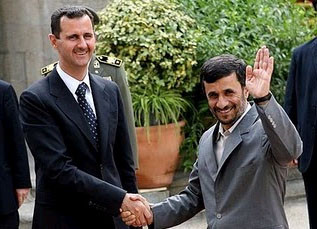
Having publicly precluded the spread of the Tunisian and Egyptian upheavals to Syria, President Bashar Assad (left, with Iranian president Mahmoud Ahmadinejad) has been loath to acknowledge the true nature of the rapidly spreading discontent in his own country, repeatedly attributing it to foreign attempts to subvert Syria.

Lebanese analysts and politicians have unabashedly claimed credit for the Arab uprisings, which, in their view, are bound to culminate in the establishment of democratic political systems throughout the region. Speaking on the sixth anniversary of the Cedar Revolution last March, its politically battered leader Saad Hariri asserted that the popular uprisings in Tunisia, Egypt, and Libya were all inspired by those Lebanese who in 2005 converged in downtown Beirut to demand the departure of Syria's occupying army from the country.[1] This process, according to a London-based Lebanese publication, amounted to nothing short of "the beginning of the collapse of the Arab equivalent of the Berlin Wall … a new Arab order in which political authority is transferred periodically and peacefully."[2]

At the same time, this rhetorical hype has been marred by apologetics and blatant misrepresentation. Thus, for example, columnist Hassan Sabra entreated Arab youths "to take revenge for their grandparents who unsuccessfully rebelled against despotism and their fathers who regrettably appeased it and bequeathed them shame and sorrow." This, however, did not prevent him from empathizing with Egypt's Husni Mubarak, "who served his country in peace and war and seemed ready to step down,"[3] or from commending Saudi King Abdullah for "launching his own revolution several years ago for the sake of transforming his society long before the spring of reform has crept up many Arab publics' list of priorities."[4]

For their part, Assad's supporters in Syria and Lebanon dismissed Hariri's claim to parenthood of the Arab uprisings (ridiculing the Cedar Revolution as the Gucci Revolution due to the presence of many high-heeled young women in the daily sit-ins following the February 2005 assassination of former Lebanese prime minister Rafiq Hariri),[5] equating the public demand for freedom not with a yearning for democratic participation but with standing up to the alleged machinations of the United States and Israel. "The Arab publics admire the Syrian policy line because it arrested Arab collapse and is currently well-positioned to take the initiative to win back usurped Arab rights," argued the prominent anti-Hariri journalist Nizar as-Sahli[6] while Subhi Ghandour, a Lebanese analyst and director of the Arab Dialog Center in Washington, reduced the Egyptian uprising to "an endeavor to restore for Egypt its leading role in advocating the just causes of the Arab nation."[7]

Trouble in Assad's Satrapy

On March 12, 2011, the Arab League urged the U.N. Security Council to impose a no-fly zone over Libya to protect the civilian population from strikes by Mu'ammar al-Qaddafi's air force. The move was opposed by Yemen, Algeria, and Syria—probably the league's most fragmented countries: Yemen is divided along tribal, sectarian, and regional lines; Algeria's political fault line pits Arabs against Berbers and Islamists against secularists; and in Syria, the divide is most pronounced in that it places the ruling Alawite minority, no more than 12 percent of the population, against the rest of the country's ethnic-religious mosaic. Small wonder, therefore, that the regime's supporters condemned the no-fly zone in harsh Baathist rhetoric, reminiscent of the pan-Arab discourse of the 1950s and 1960s: "This weird decision appeared as if it was issued by the U.S. Congress or Israeli Knesset."[8]

Assad's resentment of the international protection of Libyans from their heavy-handed ruler is not difficult to understand. Evidently equating democracy with regime change, the Syrian dictator has been loath to loosen his grip on his long suffering subjects lest even the most modest political reform might lead to his undoing.[9] The Damascus regime may digress from David Ignatius's assertion that "if the experience of other countries over the past two months shows anything, it's that delaying reform too long in a one-party state like Syria is potentially a fatal mistake,"[10] yet it has missed no opportunity to underscore Assad's personal commitment to reform despite the foreign conspiracies confronting him: "Mr. President Bashar Assad perseveres in his reform mission and cannot possibly be sidetracked by those who bear malice against Syria and wish to destabilize it."[11]

To be sure, the road to reform is rarely easy or smooth, and even the most thorough reforms hit the occasional snag. As an editorial in the official mouthpiece of the regime put it: "There is no doubt that the march of reform, begun several years ago, has made progress at different levels, but at the same time, it has not been unblemished or corruption-free."[12] Yet this does not mean that the authorities will put up with "a foreign conspiracy" masquerading as public protests and "aimed at destabilizing Syria and the rest of the region," to use the words of Buthaina Sha'ban, Assad's advisor for political and media affairs.[13]

It is doubtful whether the official clichés about Assad's unwavering commitment to reform have struck a responsive chord with ordinary Syrians. Even some of the regime's supporters have become increasingly disillusioned with its neglect of the real issues pertaining to reform. One such critic is veteran Lebanese analyst and former Arab League official Clovis Maksud. Noting that, as early as April 2005, Assad requested the executive director of the U.N. development programs to propose reform policies for presentation before the Tenth Baath Party Congress, which convened two months later, Maksud expressed his astonishment at the failure to act on these reforms "that were adopted by the congress and the Syrian cabinet."[14] Nor could he hide his disapproval of the regime's derision of the demonstrators as "lackeys of foreign agents."[15]

The fact of the matter is that despite his inner insecurity, Assad seems to have concluded that the Western intervention in Libya is not repeatable in the Syrian context, apparently drawing some comfort from Hillary Clinton's assurance after the killing of dozens of protesters in the northern port city of Latakia that "the USA will not interfere in Syria in the way it has in Libya."[16] Moreover, judging by his defiant speech of March 30, in which he laid the blame for the protests on "saboteurs [who] tried to undermine and divide Syria and push an Israeli agenda," Assad seems to believe that he has received a new lease to rule Syria as he sees fit whereby "reforms are not a wave that we ride, and we will not proceed hastily."[17]

Ribal al-Assad, director of the London-based Organization for Democracy and Freedom in Syria, dismissed his cousin's declared intention to reform the Syrian political system as "a big, deceptive campaign in the name of democratic reform."[18] Therefore, "it seems inevitable that protest may soon crack the regime's brittle political immobility … the birth of freedom … is not easily forgotten—or trumped by state handouts and vacuous statements by a distant, self-isolated leadership."[19]

What may be working in Bashar al-Assad's favor is that the protest movement, while spreading from the southern border city of Dar'a to other parts of Syria, including Damascus, still appears too weak to seriously challenge his regime, owing to the heterogeneity of Syrian society, which discourages cohesion among the opposition.[20]

Official statements and press editorials leave no doubt regarding the regime's readiness for an all-out showdown: "We are in the midst of a confrontation and not on a picnic. The country is facing a real battle with foreign forces spending tens of millions of dollars, whose aim is to destabilize Syria."[21] This decision came only three days after the authorities had promised to exercise maximum restraint in dealing with public protests: "There are orders from the highest echelons to all security agencies to refrain from opening fire on demonstrators, even if they deliberately wound or kill politically disinterested countrymen."[22]

It is highly unlikely that these contradictory statements demonstrate a shift of course in dealing with the protests since the government's vacillation has had little impact on the scale and intensity of regime repression. Confronted with the gravest domestic challenge to the Assad dynasty since 1982, when Bashar's father, Hafez, killed tens of thousands of civilians in the northern city of Hama in an attempt to suppress the ongoing, nationwide Islamist revolt, the regime decided to invoke terrorism as a dominant factor overshadowing the demands for reform.

Accordingly, the government has repeatedly claimed that armed gangs keep opening fire on protesters, army troops, and security forces. Oddly enough, these armed gangs have conspicuously failed to open fire on demonstrators and security personnel when regime-organized, pro-Assad rallies caused traffic congestion in major Syrian cities. As Anis Karam, the Lebanese chairperson of the American-Middle Eastern Congregation for Freedom and Democracy, put it, the regime has been "labeling demonstrators as outlaws to justify its mass killings."[23] Indeed, the authorities have clearly indicated that they have no intention of desisting from their excessive force in quelling the disturbances. Assad even fired Samira al-Masalima, editor in chief of the state-run Tishrin daily, after she told al-Jazeera television that opening fire on demonstrators in Dar'a was "a security breach because it violates the explicit orders of President Assad."[24]

The Syrian protests may intensify, but they are unlikely to create a wholly new political reality. Though winning some seemingly major concessions, notably the lifting (on April 19) of Syria's 48-year-old state of emergency,[25] the balance of power overwhelmingly favors the regime for now.

Lebanon: No Door to Knock on

Some Lebanese writers expect the Arab uprisings to reach Lebanon. Nasser al-As'ad, a member of Hariri's party and a former activist in the defunct Communist Action Movement, believes that "the ultimate goal of the Arab risings is the installation of modern democracies and the emergence of a pluralist Arab order." Since Lebanon is a mirror image of the state of affairs in the region, he reasoned, any positive developments there were bound to have a similar impact on Lebanese politics.[26] Lebanese intellectual Karim Pakraduni has been similarly upbeat, arguing that Lebanese youths are no less capable of effecting change than their Arab counterparts elsewhere and prophesying the "eventual demise of Lebanon's confessional political system and the inauguration of a civil polity on its ruins."[27] Likewise, the communist-minded Lebanese Youths Movement called for a mass demonstration to spark the process of bringing down the country's confessional system: "Why do we accept to be ruled by a confessional system that has lasted longer than the combined regimes of Mubarak, Ben Ali, and Qaddafi?"[28]

Very few people showed up for the demonstration and repeated calls failed to attract a significant number of participants. This did not surprise prominent columnist Talal Salman, who lamented the Lebanese exception in the age of Arab revolutions: "The nature of the country's political system prevents the Lebanese from ridding themselves of the shackles of quiescence and attaining their natural right of becoming citizens, and not just subjects or hapless followers of confessional leaders."[29]

For his part, political analyst Ahmad Ayyash sees no chance for the Lebanese people to follow the Egyptian example "since the country does not have a solid and cohesive regime to rebel against. The Lebanese political system amounts to nothing more than a small bourgeoisie and sectarian interests patronized by conflicting regional and international powers."[30] Likewise, Lebanese commentator Michael Young finds the Arab upheavals unworkable in the context of the country's sectarian divide, making a case for shielding Lebanon against its vagaries in fear that the destabilization of the Arab world lead to a "Sunni-Shiite conflict in the country [that] would be devastating for all."[31]

As much as the Lebanese are focused on developments in the Arab countries, very few of them are eager to start an uprising of their own. Attributing their country's travails to foreign meddling, they content themselves with considering the regional changes as a positive development without expecting them to affect their own country.

The Future of Arab Democracy

Until very recently, most political scientists and commentators considered the Arab world impervious to change. They were wrong. Arab publics have been gathering enormous pent-up frustration for at least two generations, and all that was needed for its release was an appropriate spark. This was provided by the self-immolation of an ordinary Tunisian, which served as a devastating, political indictment of the magnitude of ordinary people's suffering at the hands of self-aggrandizing ruling elites and set in train the momentous chain of events sweeping the Middle East.

Yet it is one thing for the Arab uprisings to get started; it is quite another for them to reach the ultimate goal of empowering the people and introducing true democracy. These uprisings are making the Arab world as unstable as ever. Heightened instability is likely to persist for years to come.

[1] An-Nahar (Beirut), Mar. 14, 2011.
[2] Al-Hawadith (London), Feb. 11, 2011.
[3] Ash-Shiraa (Beirut), Feb. 7, 2011.
[4] Ibid., Mar. 28, 2011.
[5] Al-Akhbar (Beirut), Mar. 14, 2011.
[6] Ath-Thabat (Beirut), Jan. 21, 2011.
[7] Nabd Suria (Beirut), Feb. 10, 2011.
[8] Ath-Thabat, Mar. 18, 2011.
[9] Ash-Shiraa, Apr. 4, 2011.
[10] The Daily Star (Beirut), Feb. 28, 2011.
[11] As-Siyasa (Kuwait), Apr. 10, 2011.
[12] Tishrin (Damascus), Mar. 20, 2011.
[13] BBC Arabic, Mar. 26, 2011.
[14] An-Nahar, Apr. 13, 2011.
[15] Ibid., Apr. 3, 2011.
[16] The Guardian (London), Mar. 27, 2011.
[17] As-Safir (Beirut), Mar. 31, 2011.
[18] BBC Monitoring, Feb. 5, 2011.
[19] The Daily Star, Mar. 3, 2011.
[20] Ibid., Mar. 19, 2011.
[21] Al-Watan (Damascus), Mar. 24, 2011.
[22] Ibid., Mar. 21, 2011.
[23] Al-Muharrir al-Arabi (London), Apr. 2, 2011.
[24] As-Siyasa, Apr. 10, 2011.
[25] BBC News, Apr. 20, 2011.
[26] Now Lebanon (Beirut), Mar. 5, 2011.
[27] Al-Hawadith, Mar. 25, 2011.
[28] Al-Jadeed TV (Beirut), Mar. 3, 2011.
[29] As-Safir, Mar. 7, 2011.
[30] Ash-Shiraa, Mar. 7, 2011.
[31] The Daily Star, Mar. 24, 2011.

Hilal Khashan is a professor of political science at the American University of Beirut.

Source: http://www.meforum.org/2983/syria-lebanon-upheavals

Copyright - Original materials copyright (c) by the authors.

Pakistan's Christian 'Sex-Slaves': A Case Study


by Raymond Ibrahim

Earlier we saw Egyptian preacher Huwaini and Kuwaiti political activist Mutairi call for the reinstitution of sex-slavery. Before dismissing their position as aberrant, that is "radical," for the record, here are respected Muslim scholar Majid Khadduri's thoughts on the matter:

The term spoil (ghanima) is applied specifically to property acquired by force from non-Muslims. It includes, however, not only property (movable and immovable) but also persons, whether in the capacity of asra (prisoners of war) or sabi (women and children). … If the slave were a woman, the master was permitted to have sexual connection with her as a concubine.

Still, some may seek to dismiss the notion of sex-slavery in Islam as theory, not actual practice, arguing that even if Sharia permits the sexual enslavement of infidel women, neither Egypt nor Kuwait formally permits it.

Let us therefore make an important distinction: While few Muslim governments would formally institute sex-slavery—thereby egregiously undermining their ongoing and very successful efforts at duping the West—the sort of supremacist culture Sharia breeds, wherein seizing anything from the infidel, including his women and children, is an everyday fact of life.

Thus in Huwaini's Egypt, the increasingly Islamist-leaning government does not have an institution to buy and sell infidel women; yet Egypt's Christian girls are constantly being abducted and, as one recent report puts it, "kept as virtual slaves." Likewise, in Gulf countries: while sex-slavery may not be formally recognized, the dirty little secret there is that impoverished and desperate women from places like the Philippines are often hired as "servants," effectively performing the functions of sex-slaves.

To better demonstrate that this Sharia-induced worldview permeates the Muslim world—that infidel women are seen as little better than sex-objects for Muslim men—let us briefly focus on one Muslim nation: distant Pakistan, where Christians make a tiny minority of less than 2%, and where at least 700 Christian girls are abducted annually.

Consider the following stories that never make it to the MSM—a sampling limited to just last month's grab-bag of atrocities committed against Pakistan's Christians (since anymore than that would be too immense to list):

  • A 9-year-old Christian girl was abducted, gang-raped, and murdered by repeated blows to her head, and then dumped into a canal.
  • A 24-year-old Christian woman who was kidnapped, forced to convert to Islam, and forced to marry a Muslim, is now reportedly on the verge of being "sold abroad."
  • At the same time that Muslims were desecrating a Christian cemetery, a Christian mother was abducted, drugged, and gang-raped all night long.
  • After brutally attacking a priest and his family, another young Christian woman was abducted and raped over several days by a man claiming to be a police officer.
  • Yet another Christian girl was raped by a Pakistani army major at gunpoint and then dumped off.
  • A powerful Muslim businessman had two Christian sisters kidnapped, forced them to convert to Islam, and marry him.

One may argue that rape is a phenomenon that affects every society, yet the fact that most women raped in Pakistan come from the mere 2% Christian minority speaks for itself.

Moreover, if you go to the links of these anecdotes, you will find that in every single case the Pakistani police either did nothing to apprehend the culprits or, more often, actually helped them while turning against the victims.

After all, even though Pakistan is not a full-blown Sharia state—you know, to save face in front of the international infidel—Sharia has nonetheless conditioned even the police to see infidel Christian women as little better than violable objects of pleasure, and to always side with fellow Muslims, according to the doctrine of wala wa bara, which commands Muslims to always be loyal to fellow Muslims against non-Muslims.

Nor are such atrocities confined to Pakistan; even in Europe, a Pakistani man recently raped a Norwegian woman, informing her that "he had the right to do exactly as he wanted to a woman."

Focusing on Pakistan has the added bonus of demonstrating one more thing: that Pakistan is a non-Arab country dispels the notion that seeing women as sex-objects is an "Arab" phenomenon; that Pakistanis do not know Arabic dispels the notion that they are being "radicalized" by the likes of Huwaini or Mutairi.

What, then, does Pakistan share with these other Arab nations that advocate the institution of sex-slavery and are in the habit of abducting and raping Christian women? Islam.

Raymond Ibrahim is a Shillman Fellow at the David Horowitz Freedom Center and an Associate Fellow at the Middle East Forum.
Source: http://www.meforum.org/2979/pakistan-christian-sex-slaves

Copyright - Original materials copyright (c) by the authors.

Wash. Post's Weekly Israel-Bashing Pieces --


by Leo Rennert

In his latest weekly Israel-bashing installment, Washington Post Jerusalem correspondent Joel Greenberg turns his attention to Israel's demolition of makeshift Bedouin shelters put up on public lands or in military zones in the Jordan Valley ("Razings leave mark in Jordan Valley -- Israel underlines claim in area with demolition of Palestinian homes" page A5, July 6)

Greenberg's article is illustrated copiously with two color photographs -- a huge, four-column one showing a family amid the wreckage of their home and the other depicting Bedouins leading away sheep as Israeli troops prepare to raze some shacks, plus a map pointing to the Jordan Valley.

The entire spread is unmistakably intended to depict Israel as callous in its treatment of Palestinians, while Palestinians are presented as Israel's victims. This kind of anti-Israel, pro-Palestinian, two-hankies reporting by Greenberg has become a predictable weekly presence in the Post. With such regularity that you can set your calendar by it.

Even if Greenberg has to bend the truth to meet his weekly Israel-bashing quota.

For example, in his latest piece, Greenberg waits until the 13th paragraph to cite Israeli officials who point out that similar demolition measures are also taken against wildcat building on state lands or military zones by Jewish settlers.

But how many Post readers get past the 12th paragraph? The headline, the pictures, the first dozen paragraphs convey a totally erroneous impression that only Bedouins and Palestinians get their unauthorized shelters razed by Israel.

So Greenberg has it both ways. He can deliver one of his trade-mark weekly Israel-bashing pieces, but still claim objectivity by hedging his bets far down in his articles, pretending to present both sides of the story.

He similarly buries -- in the 14th paragraph -- Israeli plans for more home construction in existing Palestinian villages in areas until total Israeli control along with Israeli plans to provide water and power hookups for Bedouin encampments there. But how many Post readers, having had their weekly dose of Israel-bashing in the Post, get as far as the 14th paragraph of a Greenberg story?

And for those readers who plow through his entire article, Greenberg leaves them with a final, concluding and conclusive slap at Israel with this emotional tug: "We need a solution," said Abed Yassin, standing near the wreckage of his shelter. "We need a place to live."

Greenberg could claim some credibility if for every one of his Palestinian-pain pieces, he did a similar number of Israeli-pain articles.

For example, a real reporter -- not a propagandist like Greenberg -- might also report on how hundreds of thousands of Israeli residents in towns and communities near the Gaza border still shudder and run to shelters when rockets are fired in their direction. There are plenty of Israeli children in Sderot, who bear the psychological scars of years of such terrorization by Hamas who also might warrant some in-depth coverage.

A real reporter -- not a propagandist like Greenberg -- might also report that Mahmoud Abbas continues to name Palestinian public places and institutions after Dalal Mughrabi, a terrorist who led an attack that killed 37 Israelis, including 12 children -- the most lethal terrorist attack in Israel's history. Abbas exols Mughrabi as a model for Palestinian children. In his latest glorification of Mughrabi, he named a summer camp for children and girls' college after her. A real reporter might want to let Post readers know about the real -- not the phony "moderate" -- Abbas. But not Greenberg.

A real reporter would have an equal-opportunity agenda -- covering both Israel and the Palestinian with the same critical lens, focusng on both Palestinian and Israeli pain.

But Greenberg is not that kind of reporter.

Leo Rennert

Source: http://www.americanthinker.com/blog/2011/07/wash_posts_weekly_israel-bashing_pieces_--.html

Copyright - Original materials copyright (c) by the authors.

Muslim Brotherhood: We must Implement Sharia in Stages


by Robert Spencer

I tried to tell you. "Article on Muslim Brotherhood Website: Implement Shari'a in Phases," from MEMRI, July 5:

In a June 11, 2011 article on the website of the Egyptian Muslim Brotherhood, veteran movement member Sheikh Ahmad Gad argued that the implementation of shari'a in Egypt must be achieved gradually, by preparing the peoples' hearts and minds for it and introducing it in stages. He proposed learning from the methods of the early Muslim Brotherhood, which worked in a step-by-step fashion, and called on Al-Azhar to focus on promoting the implementation of shari'a.

The following are excerpts from the article:[1]

"There Is No Hope for Reform Without a Return to Divine Rule"

"Following the blessed popular revolution on January 25, 2011, there was a debate between the majority, which hopes and yearns for the implementation of Allah's shari'a, and the minority, which uses Islam as a tool of intimidation and fears the Islamists and a return to the Middle Ages.

"This minority, which denies the results of the referendum while calling for democracy,[2] is made up of those who oppose a religious state or a caliphate state, and advocate a return to the tyrannical secular regime that corrupted the land and the people – a minority [that receives] prominent media coverage...

"Islamic shari'a ruled for centuries, but became distant and absent for centuries more. The various forms of imperialism were a burden on the [Muslim] nation in various ways, and caused people to change... In that dark period, the state alternately mimicked Eastern and Western regimes. Corruption developed, grew, and accumulated... [Nowadays], there is no hope for reform without a return to divine rule, which the Creator chose for man. This nation will have no chance of success, [except] by that which caused it to succeed in its beginning.

"[However,] we must not impose Islamic shari'a, forcing the people to adopt something about which they are ignorant and with which they are unfamiliar... If we do this, [various] ploys will be used to circumvent it, and there will be hypocrisy. [People] will exhibit Islamic [behavior] only outwardly... [...]

"There is no other way but gradual action, preparing the [people's] souls and setting an example, so that faith will enter their hearts... Gradual action does not impose Islam at once, but rather step by step, in order to facilitate understanding, studying, acceptance, and submission. [...]

"The Prophet, peace be upon him, acted in a gradual manner, by first preparing the people, and then [preparing] family, society, state, and finally the caliphate... This gradual method is also employed in the Koran [itself] with respect to the prohibition on [drinking] wine...[3] It was also employed in presenting the duties of Islam... First, there were two prayers – at noon and in the evening – and after people grew accustomed to them, Allah ordered five prayers during the day and night...

"At the [Muslim Brotherhood's] fifth conference, [the movement's founder,] Imam [Hassan] Al-Banna, spoke about gradual action and reliance on education, and clarified the stages [of implementing the shari'a]. They [i.e., the movement's founding members] believed that da'wa must come in phases: The phase of reading, learning the idea, and delivering it to the public; the phase of forming [the idea]; and the phase of implementation, work and results. At that same conference, Al-Banna said, addressing the hasty: 'Listen to what I say in a loud, resounding voice: This way of yours, whose phases are written and whose boundaries are defined, is long, but there is no alternative [way]. I am not with those who want to pick the fruit before it has ripened. Those who wait patiently for the seed to sprout, the tree to grow, the fruit to ripen, and the harvest to arrive – their reward will be with Allah... May that be the payment of those who do good.'"

The Islamic Streams Should Unite to "Restore the Caliphate"

"I ask the honorable Al-Azhar to rally the Islamic streams in order to unite the Muslim word and effort, restore the caliphate, and prepare a practical plan to implement the law of Allah the Exalted. This is the goal of the honorable Al-Azhar and of all Islamic streams. And Allah will help.

"O Allah, guide us, open our hearts to faith, and restore this [Muslim] nation to its previous self – one united nation worshipping You and You alone."

Robert Spencer

Source: http://www.jihadwatch.org/2011/07/muslim-brotherhood-we-must-implement-sharia-in-stages.html

Copyright - Original materials copyright (c) by the authors.

Wednesday, July 6, 2011

The Near Lynching of Prof. Benny Morris


by Steven Plaut

In the old novel Cat’s Cradle by Kurt Vonnegut, there is a bizarre character in the story, a man who had been a Nazi war criminal, but after the War trained as a medical doctor and came to the Caribbean in order to save sick impoverished island people. He saves about a dozen people a week and he figure it will only take about 600 years to save more people than he had killed as a war criminal during the War.

I am reminded of that story whenever I examine the peculiar career of Prof. Benny Morris. Now don’t take this the wrong way, ­ Morris was never any murderer or war criminal and I do not mean to imply that he was as evil as a Nazi. But he did have to spend the second half of his career undoing the damage from the first half.

Benny Morris was one of the original, and in some ways the most destructive, of Israel’s “New Historians.” The “New Historians” are actually pseudo-historians, who seek to revise history to make it jive with Arab propaganda. Those who denounce the “New Historians” as charlatans are sometimes called the “New New Historians.” The far leftists call them McCarthyists and fascists.

For many years Morris was the leading “New Historian” revisionist. Born on an Israeli socialist kibbutz and son of a diplomat, Morris did his PhD on Anglo-German relations at Cambridge. He seemed to think that this qualified him to be a Middle East historian and Orientalist. The academic world disagreed. He returned to Israel from Cambridge and mainly worked as a newspaper journalist at the Jerusalem Post.

Morris’ main venture into historic revisionism came with the publication of his book, The Birth of the Palestinian Refugee Problem, published by Cambridge University Press in 1988. It was by and large a retelling of the “Arab narrative” about the creation of Palestinian “refugees.” The alternative narrative, also knows as the truth, was that any Palestinians who became refugees resembled the ethnic German refugees at the end of World War II who became refugees. Both sets were people who had supported the losing side of a genocidal war of aggression or who had fled the battle zones of the victorious armies in the war they had started.

In those days Morris was essentially a pseudo-historian, inventing historic “narratives” to reflect Arab propaganda and to dabbling in the demonization of Israel. And he was good at it. He collaborated with academic haters of Israel like British (Israeli expatriates) Ilan Pappe and Avi Shlaim. Because he was so viciously anti-Israel and because so much of his “scholarly” work consisted of nothing more than anti-Israel propaganda, Morris at first had trouble finding an academic position in Israel. He was eventually hired by Ben Gurion University, which cannot get enough of leftist anti-Israel propagandists serving as its faculty members. Rumor has it that the president of the university at that time, leftist Avishai Braverman (today a politician in Israel’s Labor Party), personally intervened so that Morris could get hired. While far less vulgar and infantile than the “books” of Norman Finkelstein, Morris turned out Bash-Israel and Bash-Zionism treatises, a lot about the 1948-9 Israeli war for independence.

All this made Morris the darling of the radical campus Left in Europe and the US. They loved citing Morris to prove how evil Israel is and was. About 12 years ago Morris would have been one of the most obvious targets for righteous Zionist rage and for being exposed, attacked and denounced as a pseudo-scholar and a charlatan, something like a Neve Gordon or Ilan Pappe.

But then something happened.

Morris suddenly appeared to have second thoughts. He repented. He largely repudiated his earlier anti-Israel radicalism and started espousing pro-Israel and pro-Zionist opinion, especially regarding the 1948-9 Israeli war of independence. Not everyone is convinced that Morris has really wised up, and Efraim Karsh from the University of London is the leading proponent of the view that Morris has not and is simply engaged in pragmatic maneuvering and cynical posturing. (See this and this, as well as several Karsh articles in the NY Times and Commentary Magazine). Karsh is particularly critical of the fact that Morris has not outright renounced in total his earlier “histories” of the “Palestinian refugees.”

I was skeptical of Morris’ “conversion” at first, but over time it seems to me to be genuine. I think his very first public break with the Bash-Israel Left took place in Berkeley in the late 90s, when I happened to be in town. Invited to speak in a church, the place was packed with the usual Berkeley jihadists and Hitlerjugend expecting from Morris a blistering demonization of Israel. Instead, Morris spent the entire talk explaining that the Middle East conflict is the fault of the Arabs, including any “refugee” problem. You can imagine the hysterical reactions in the local Berkeley drug-infested media. These days the Bay Area has its own specialized anti-Morris hate organizations, such as this one, devoted to demonizing Morris. This is all so amusing. The jihadists love citing from the old writings of Benny Morris about how Israel was somehow to blame for “Palestinian sufferings,” but refuse to listen when Morris himself repudiates those claims.

Later Morris would give interviews and make statements that not only were unabashedly Zionist, but he went so far as to argue that any expulsions by Israel of any Arabs that took place in 1948 were entirely justified. He largely apologized for and repudiated his early claims about Palestinian “refugees,” pleading that he had not had access to the right documents when he wrote his early book. Today he is opposed to the so-called “Two State Solution,” which would create a Palestinian state, arguing that it is not viable.

As a result of all this, in recent years Morris is the Israeli historian that the moonbats and the anti-Semites most love to hate. They have special contempt for him because, after all, he used to be one of them and “betrayed” them.

Morris is frequently singled out for the venom of the barbarians. When invited a few months back to speak at Cambridge, the local anti-Semites made a fuss and insisted that Morris be dis-invited because he is a “racist.” After all, anyone thinking Israel has the right to defend itself is considered a “racist” in such circles. His talk was canceled. This is academic freedom in Britain.

This past week, Morris was invited to speak at the London School of Economics, which ­- despite its name – ­ is an institutions crawling with leftist varmints. On the way to the talk he was almost lynched by a mob of leftists and jihadists.

That full story was published in Israel’s Makor Rishon, June 24, 2011. It describes the attack on Morris as a virtual attempt at lynching. It describes how Morris was accosted on his way to the building in which the lecture was to be held by a mob of anti-Israel “activists” from the local BDS movement of economic aggression against Israel (BDS stands for “boycott, divest and sanctions”) and by local radical Islamists. They pushed and cursed him. They had gathered in the area around the building earlier and were handing out fliers accusing Morris of being an “old racist.” The paper cites Morris: “As soon as they saw me I was surrounded by a mob of Moslem hooligans, screaming and cursing at me as I advanced toward the building.” Morris added,

“I had the feeling that I was surrounded by Nazis, except that instead of black shirts these were wearing Arab scarves on their heads. They were unambiguously Islamofascists. Some of them screamed in their broken foreign English that the UK should never have allowed me into the country. I am no racist, but that term could be correctly applied to the inciters and critics I ran across at LSE.”

Once he reached the hall, the lecture proceeded, under heavy security and with police guards. Morris managed to escape and under heavy security presence he did give a talk to 300-400 students at LSE. A gay conservative blogger describes the harassment of Morris by the pro-terrorists and leftists thus:

As I walked down Kingsway, a major London thoroughfare, a small mob—I don’t think any other word is appropriate—of some dozen Muslims, Arabs and their supporters, both men and women, surrounded me and, walking alongside me for several hundred yards as I advanced towards the building where the lecture was to take place, raucously harangued and bated me with cries of “fascist,” “racist,” “England should never have allowed you in,” “you shouldn’t be allowed to speak.” Several spoke in broken, obviously newly acquired, English. Violence was thick in the air though none was actually used. Passersby looked on in astonishment, and perhaps shame, but it seemed the sight of angry bearded, caftaned Muslims was sufficient to deter any intervention. To me, it felt like Brownshirts in a street scene in 1920s Berlin—though on Kingsway no one, to the best of my recall, screamed the word “Jew.”

The Jewish Chronicle, the main Jewish weekly in the UK, described how anti-Zionists in LSE kept attacking Morris as a “racist”, “theologian” and a “social darwinist.” It describes how Morris held his own and made monkeys of those attempting to discredit him during the lecture. In particular, he silenced the trolls by documenting the fact that there was no Israeli policy at all in 1948-9 to expel “Palestinians.” His full lecture and performance can be viewed here.

What does the one-time Post-Zionist and one-time “New Historian” Morris make of almost being lynched for being a Zionist?

I do not know, but I would like to think that the odds are good that he is rededicating himself to expunging his old propaganda and doing real research that promotes the truth, or what some pseudo-academics prefer to call the “Zionist narrative.”

Steven Plaut

Source: http://frontpagemag.com/2011/07/06/the-near-lynching-of-prof-benny-morris/

Copyright - Original materials copyright (c) by the authors.

Radical Islamist Group Tries to Branch Out


by IPT News

One of America's most radical homegrown Islamist groups has opened two new centers focused on the "Zionist American" threat, a thinly-veiled reference to the group's anti-Semitic and anti-American message. Under the leadership of extremist Abdul Alim Musa, the Sabiqun organization has tried to blur the line between attacking Jews and criticizing Israel, as well as striking out against America.

"For 30 years, Masjid Al-Islam [Sabiqun's mosque] has been carrying on a direct, face-to-face struggle against the monolithic Zionist American regime," Abdul Alim Musa said in an "Urgent Appeal" to support the new "Islamic Institute of Counter Zionist American Psychological Warfare (IICZAPW)."

"We are an anti-Zionist American psycho-guerrilla warfare movement, the appeal said. "We use all available tools found in our environment in exposing the anti-Islamic, anti-human policies of this Zionist American system."

Other flyers explain that the IICZAPW's primary goal is "to counter the concerted efforts of the enemies of Islam to sustain a false characterization of Islam and Muslims as a dangerous threat to global stability and tranquility." That mission has already led Sabiqun to deny the involvement of Islamist terrorists in 9/11 and to characterize the acts of Hamas and Hizballah as a justified war on Jews. The Institute is the group's primary project to keep its movement going, after the loss of several branches in California.

As part of its ideology, Sabiqun and the IICZAPW are also actively preparing for the death of the United States. Sabiqun, which currently runs two active mosques in D.C. and Oakland, espouses a self-reliant and anti-assimilation ideology that appeals to its community of poor African-American converts.

"It seems that the once all-powerful USA could suffer a global stroke sometime during the 2020s or even sooner," said a flyer promoting an IICZAPW event called "The Decline and Fall of the American Empire" Sunday in Washington.

"We view America's decline as a global power as a present reality," it reads. "Should we not prepare for its fall?"

The flyer shows much of Sabiqun's core ideology. The beginning of America's fall didn't start with George Bush, the 2001 invasion of Afghanistan, or the 2003 war in Iraq. Rather, the group believes the rise of Iran in the 1979 revolution illustrates the ability of a dedicated group of "Islamic workers" to collapse non-Muslim governments.

The new centers in Washington and Oakland are designed to raise the group's profile and counter its decline. The goal is to train a new generation of the movement's ideologues and expand the group's presence, "to analyze the Zionist grip on humanity established via the media and economics."

The IICZAPW also features a new "College in Islamic Movement Studies," which focuses on spreading its leader's jumbled philosophy. Musa's unique take on Islamism mixes elements from a variety of ideologues, including: Syed Abul Ala Maududi, the founder of an extremist South Asian group, Jamaat-e-Islami; Uthman dan Fodio, who founded a caliphate in north Nigeria that continues to inspire African Islamists; Hasan al-Banna, the founder of the Muslim Brotherhood; Sayyid Qutb, the inspiration of al-Qaida ideologues Osama bin Laden and Anwar al-Awlaki; Kalim Siddiqui, a South Asian extremist who advocated for an Islamic world order to overthrow the West; and Imam Ali Khomeini, who led Iran's 1979 Islamist Revolution.

The college will also feature a course on "Strategic Management under Conditions of Repression," recounting the experiences of Musa and his 30 years of struggle against the "Zionist American cabal." It will focus on the group's enemies, such as the FBI, Zionist groups, the Anti-Defamation League, Investigative Project on Terrorism Executive Director Steven Emerson, and others, "who have sought to isolate us from mainstream Muslims and derail and destroy the progress of our schools, places of worship, and businesses."

The IICZAPW extends Sabiqun's long tradition of violent anti-Semitic and anti-American rhetoric, which is part and parcel of the group's educational curriculum, reading materials, and speeches.

Musa also often uses the terms 'Jews' and 'Zionist' interchangeably, highlighting his belief that the Jews and Zionists are the same.

"The world now sees the Jews for what they are: not the victims but the victimizers," Musa said in a 2006 speech called "Basheera," which Sabiqun's website describes as a "message of hope" about Hizballah's "ultimate victory" over Israel. "The Jews are using the dirtiest criminal tactics on a people that you have ever seen in your life, worse than the Nazis… The Jews may have been oppressed by the Nazis, but they adopted 100% the practice[s] of the Nazis. "

"The Yahud [Jews], the criminal Zionist entity known as Israel, which has no right whatsoever in the Middle East. The biggest mistake that the United Nations ever made, in 1947, was allowing the Jews to reestablish a homeland on the land that people already owned," he added, noting that Allah had given permission to the Palestinian to fight for their land. "The rest of the world now sees the Jews for what they are: vulnerable. The Palestinians proved it and now [the same] with the Hizballah."

His Zionist American conspiracies are staples of Sabiqun's philosophy.

"Who's monitoring the Zionist, right? Who's standing up to the people who are killing the Muslims all over the world? Nobody, nowhere – only one masjid [mosque] in the United States. Tell the truth, you don't hear nobody else openin' they [sic] mouth, do you? That mean [sic] we special," Musa told followers in a speech hosted on the group's website.

"The American government and the Israelis are finished. It is our duty to point these issues out for the people; that's our duty and that's our responsibility. Right? That's your duty that's your responsibility," he added. "The United States government is your responsibility. The Hindu-stani government is the Kashmiri's responsibility. The Israelis is the responsibilty of the Palestinians, it's what Allah gave 'em. And it is our duty to help them. But the monster, the global monster that is now in the decline, is our job."

Sabiqun's most violent "anti-Zionist" materials support terrorism. "When they go out and strike at the heart of Zionism, they are not suicide bombers, they are heroes, they are she-roes. Isn't that right? That's a part of our Deen, that's a part of our religion. Let's not become weak-boned and apologetic…" Musa said in a June 2002 speech about Palestinian suicide bombers.

Educational materials from the group reinforce anti-Semitic and anti-American sentiments, particularly the Crescent International magazine, which the group calls "regular reading" for Sabiqun members.

"Given the craven attitude of US politicians that cringe at the thought of offending the American Jewish lobby or standing up to the Zionist bully, more billions will be siphoned off to the Zionist settler entity to oppress, displace and murder Palestinians in their own land rather than force it to agree to some internationally accepted behavior," an article by Zafar Bangash says in the June 2010 issue.

"Zionism cloaked in Judaism has occupied the religious territories of Europe and America. Nothing much can be expected from an ailing America and an expiring Europe who have for centuries now been in a progressive chock-hold by the Zionist political class," a guest editorial article said in the June 2010 issue. "The issue of Israel hence is a Zionist/"Jewish"-Islamic issue par excellence; Christianity has been effectively domesticated by evangelical Christians and secular politicians who report to their Zionist spiritual and financial bosses respectively."

The institute plans to continue the hateful and violent rhetoric that has become essential to Sabiqun's ideology, whether reinforced through speeches or educational material. As the flyer for Sunday's event notes, the movement "must consciously subject itself to an evolutionary process… to propel us to emerge out of the gravity of self-imposed stagnation." Building on its young base, Sabiqun plans to implant anti-Zionist and anti-American ideas into another generation, which it hopes will sustain the legacy of Imam Musa.

IPT News

Source: http://www.investigativeproject.org/3025/radical-islamist-group-tries-to-branch-out

Copyright - Original materials copyright (c) by the authors.

Does Europe Want the Destruction of Israel?


by Guy Millière

Israelis to whom I spoke during a recent visit there all said the same thing: the Muslim world is a proven enemy, but they are now facing a second enemy that shows more and more its true face: the European Union and its main members.

The European Union, France, the UK, and some other European countries -- Spain for example -- are not only the scene of rising anti-Semitism; they also behave as if one of their primary objectives now is the demonization and destruction of Israel.

European boats will apparently join the pro-Hamas flotilla, should it sail. Boycotts against Israeli products -- most recently and conspicuously in Scotland -- Israeli scientists, Israeli books and Israeli movies are being organized over the continent.

A report released in 2010 by the British Coalition against Hate Education shows that the EU and countries such as France and the United Kingdom still fund «Palestinian» textbooks promoting hate and violence against Israeli Jews.

Recently, the EU announced the transfer of 45 million euros to the Palestinian Authority to «enable payment of salaries,» despite the fact that shortly before this payment was authorized, the PA had enacted a law granting a « monthly salary» to «all Palestinians imprisoned in Israel » for terror crimes."

The EU, France and the United Kingdom are also funding non-governmental associations that work inside Israel to undermine and delegitimize the country; a parliamentary panel of inquiry into NGO funding by foreign governments was formed in Jerusalem a few month ago. Later, the Knesset passed a law requiring NGO funding transparency. European Union High Representative, Catherine Ashton, said she «regretted » the decision."

A German writer stated two decades ago that «Europeans will never forgive the Jews for Auschwitz»: it is clear that Europeans intend to get rid of all traces of guilt for the crime Europeans committed against Jews seven decades ago. Demonizing Israel and contributing to its destruction helps them move in that direction.

Europe also has created economic and financial ties with the Muslim world and is now prisoner of these ties. Many Europeans want to demonstrate their willingness to atone for the colonial past of Europe and are ready to use Israel as a scapegoat.

Europe is steeped in moral relativism and in contempt for what made the greatness of Western civilization. As it lies down and submits, it can only hate a country that stands up and is ready to fight to stay free.

It is also now clear to Israeli authorities that a new tactic was born: the invasion of the country by « peaceful » people who will cross the borders en masse, and push Israeli soldiers to shoot at them. This tactic was already been used by « humanitarian flotillas » last year, and a new flotilla will possibly still sail towards Gaza later this month. Those aboard are hoping to get mugged or shot by Israelis. If they are, it will be a success for them: they will have shown how the Israelis are « barbaric » and « cruel. » If they are not mugged or shot, it will also be a success for them: Israel will look defeated.

When Israel recently celebrated its 63rd anniversary, it was a day when the Israelis and friends of Israel had reasons to feel proud: despite wars, hatred, terrorism, the Israelis have built a free, strong and democratic society. They have also built a modern economy, one of the first worldwide in the high technology sector.

It was also a day when the Israelis had reason to feel concerned: most of them, according to polling, think that the present occupant of the White House is the most anti-Israeli President of the United States since the rebirth of the State of Israel in 1948. The recent speeches of Barack Obama about the « 1967 borders » did not persuade them to change their mind.

Most of them also see the entire Middle East sliding towards the predominance of radical Islam.

The potential closeness of the Palestinian Authority with Hamas indicates a reorientation of Palestinians toward a much harder line. The «Nakba Day» (Catastrophe Day), that Palestinian movements have organized since 1998 and that is supposed to «commemorate» the «catastrophe» -- the Arabs' failure to annihilate Israel in 1948 --was particularly rough this year, and accompanied by attempts to invade Israeli territory from Lebanon and Syria. On «Naksa Day» (Day of the Setback), that was supposed to «commemorate» the defeat of Arab countries by Israel in 1967, hundreds of people tried again to invade Israel, only this time just from Syria.

Israeli authorities said they know that even if flotillas do not create any major incident, the Palestinian Authority might decide unilaterally to create a Palestinian State, if the General Assembly of the United Nations votes to support its creation, and if the Palestinian Authority is not overly concerned about forfeiting US funding.

Israeli authorities also said they are preparing for all eventualities; they know anything can happen, and that journalists from the rest of the world are hungry for images that would allow them to drag Israel into the mud.

Even if the United States vetoes the resolution at the Security Council, many countries have already said they would give full recognition to the new State. Several European countries seem ready to go in this direction and to step up their pressure on the Israeli government.

Political philosophers used to say that two sets of values are in competition in human societies: resentment and achievement. Israel is fundamentally a society of achievers. Resentment is ubiquitous in the Muslim world today -- and oozing through Europe as well.

Guy Millière

Source: http://www.hudson-ny.org/2241/europe-destruction-of-israel

Copyright - Original materials copyright (c) by the authors.

Obama's Iraq Withdrawal Flip-Flop


by Gavriel Queenann


President Barack Obama has offered to leave 10,000 troops in Iraq next year despite his pledge that all US forces would be withdrawn by the end of 2011.

Any extension of US military presence in Iraq depends on receiving a formal request from Baghdad, which must weigh the questionable readiness of Iraqi security forces against fears of increased terror attacks and unrest if US soldiers remain in 2012.

Baghdad is not expected to decide until September at the earliest when the 46,000 US troopes who remain in the country will start heading home, but senior White House officials say they have worked out options to keep 8,500-10,000 active duty troops in-country to continue traiing Iraqi security forces in 2012.

The figures also were noted by foreign diplomats in Baghdad briefed on the issue. All spoke on condition of anonymity to frankly discuss the sensitive matter during interviews over the past two weeks.

Political Confrontations Expected
Any change in the US military withdrawal timetable in Iraq - after more than eight years and more than 4,450 US military deaths - may spark difficult political confrontations for Obama as pressure builds to close out the Iraq mission and stick to pledges to draw down troops in Afghanistan as well.

Senator Harry Reid, the top senate democrat and majority leader, told reporters the cost of keeping US troops in Iraq, given a mounting US debt crisis and Iraq's fledgling security gains, is no longer necessary.

"As Iraq becomes increasingly capable, it is time for our own troops to return home by the end of the year and for these precious resources to be directed elsewhere," Reid said in the statement.

"There is no question that the United States must continue to provide support for the Iraqis as they progress, but now is the time for our military mission to come to a close."

Reid estimated nearly $1 trillion has been spent in Iraq since the US invaded in 2003, including $50 billion this year alone.

Election Worries
Reid's is the first statement by a top democrat to oppose Obama's policy in Iraq, and may signal splintering Democratic support over his war planning just as he ramps up his 2012 re-election campaign.

Iraq has flown under Washington's political radar for much of the past year, and democratic politicians and fund raisers who want Obama to end the war on-schedule are vowing to exert more pressure on the White House.

"With a false declaration that combat operations are over in Iraq, what is now Operation New Dawn has ironically become a forgotten war," said Ashwin Madia, a former Marine who served in Iraq in 2005-06 and is now interim chairman of VoteVets.org. "That is about to change."

The group has raised millions of dollars for Democratic Party candidates.

Gavriel Queenann

Source: http://www.israelnationalnews.com/News/News.aspx/145487

Copyright - Original materials copyright (c) by the authors.