by Jonathan S. Tobin
A company that is too big to be allowed to fail is essential to both the Jewish state’s and America’s economy. But the political implications of the scandal may be daunting.
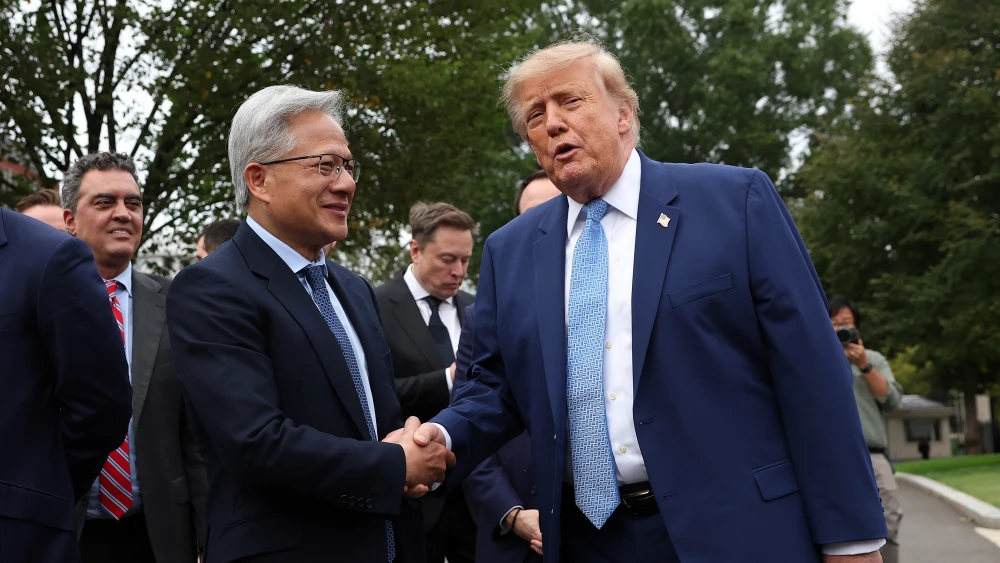 |
Kevin Dietsch/Getty Images |
One of the curious sidebars of the NVIDIA/Jensen Huang scandal was the way in which Israel’s leaders welcomed the controversial CEO’s return to the helm at one of the world’s most powerful companies. This aspect of the story was mostly ignored in the international media in the midst of a torrent of commentary.
The focus of the press, which initially pointed to Huang’s extramarital misbehavior and the question of whether he was a target of a Communist Chinese intelligence operation, shifted. It has since been dealing with President Donald Trump’s decisive role in reinstating him as the head of NVIDIA.
That Israeli Prime Minister Benjamin Netanyahu and President Isaac Herzog would be pleased by Huang’s return to power, with the latter calling him personally to congratulate him, might strike some as odd. But Israel has as large a stake as the United States in the well-being of a company whose headquarters are in Santa Clara, Calif. And that’s why the Jewish state and its friends cannot regard the certain prospect of congressional investigations about Trump’s decision and NVIDIA’s conduct with anything but concern.
As a hostile article in Al Jazeera pointed out, the close ties between NVIDIA and Israel are liable to be brought up as part of the discussion about the scandal. The rapturous reception afforded the libelous documentary, “Naza,” was a foretaste of what may soon happen to this topic. The importance of AI to the Jewish state’s economy, and even its efforts to defend itself against Iran and its Hamas, Hezbollah and Houthi terrorist proxies, is bound to become integrated into the general anger about NVIDIA, China and data centers in the United States.
Luddite fears
The essentially Luddite critique of AI, along with the apocalyptic fears the technology generates among those who believe it threatens the future of humanity, is clearly overblown; few really know where it will take us or whether its ultimate impact will be deleterious. But Israel’s connection to a discussion that can veer between rational concerns and conspiracy theories isn’t likely to help those attempting to hold back the tsunami of antisemitic blood libels that have undermined the Jewish state’s reputation in the West.
Yet if NVIDIA becomes part of the Democrats’ efforts to impeach Trump and/or other figures in the administration, the company’s ties to Israel are bound to be raised. And that’s something both the administration in Washington and the Israeli government—no matter who is leading it in the final years of Trump’s presidency—need to be prepared to counter. Moreover, if all of this winds up undermining the company, the backwash from such a development will do great harm to Israel, too.
Some economists and observers praised Trump for acting in what many believe is the best interests of the global economy by preserving the value of a company that has become the main engine of growth in the United States. As the primary supplier of hardware for the artificial-intelligence boom, NVIDIA is the principal propeller of the rise in stock-market values and wealth, as well as key to investment in manufacturing infrastructure.
That’s because it is at the center of the semiconductor industry, the main element of computing that allows modern manufacturing to continue. Without semiconductor chips, everything grinds to a halt. Their production, therefore, is a strategic resource at the heart of 21st-century geopolitics and economics.
In short, anything that is that important to the Gross Domestic Product of the world’s largest nation and all who trade with it is simply too big to fail.
An end to the AI boom?
Despite a record of misbehavior and a dalliance that rendered him vulnerable to being in thrall to Beijing, Huang’s undoubted talents and abilities seem to have made him indispensable at the company he built. Or at least that’s what investors think. And since a dramatic slide in the company’s value could set off a chain reaction of failure throughout the global economy, it is tantamount to being objectively true that the company would fail without him.
If it were just a matter of forgiving him for offenses—the kind that go beyond garden-variety #metoo infractions that would be unforgivable for the head of a lesser company—the whole episode might have been chalked up to nothing more than a bad example it sets for the corporate world.
The problem is that Trump’s intervention in the affair and the imminent Democratic Party takeover of Congress make the discussion about NVIDIA and Huang one that transcends issues of sexual immorality. Instead, it now revolves around potential conflicts of interest relating to whether Trump’s personal finances were involved in his pressure to have Huang reinstated. There are also the security implications of the Commerce Department winking at some of NVIDIA’s dealings that might undermine U.S. security and benefit America’s leading geostrategic rival.
It’s impossible to predict where this will lead. The Democrats’ majorities in both houses of Congress present an irresistible temptation not merely to satisfy themselves with damaging investigations, but to make another attempt to impeach, convict and throw Trump out of the White House before his term is up. The odds of a conviction are still low, but the size of the Democrats’ Senate majority—56 seats—makes it theoretically possible to get to the required two-thirds vote necessary for such an outcome if they can get 11 Republicans to join them.
Trump’s supporters likely figure that another impeachment, like every previous modern impeachment, will help him more than hurt him. In the same way that the Democrats’ lawfare efforts to bankrupt and imprison him during President Joe Biden’s administration set in motion the events that led to his re-election in 2024, another impeachment would be seen as an overreach.
But the impact this debate would have on NVIDIA will affect more than Trump’s prospects of beating back his opponents. The general unpopularity of data centers and the fears about AI—whether rational or irrational—could play a role in sabotaging the benefits the growth of the industry provides to the U.S. economy.
Combine that with the prospect of what the eminent economic historian, Niall Ferguson, writes in The Free Press about the inevitable end to the AI boom. He thinks the great technological revolution of artificial intelligence is running into “powerful, structural headwinds” that would have arisen no matter whom Jensen Huang slept with or what he did to its employees at its corporate headquarters.
And that will deeply affect Israel’s economy as well as support for it in the United States.
The Israel connection
NVIDIA’s purchase of the Israeli high-tech firm Mellanox, which was finalized in April 2020 at a staggering price of $7 billion, is believed to have been key to the firm’s success in recent years. The integration of Mellanox’s innovations and technology into NVIDIA’s operations enabled it to sell complete high-speed AI data-center systems rather than standalone parts.
This is a tribute to the genius of Israel’s “Start-Up Nation” high-tech economy and its outsized contribution to the global economy. It’s also made the Jewish state dangerously dependent on one company.
According to various sources, including the Bank of Israel, NVIDIA’s operations added 2.2 percentage points to the projection for Israel’s Gross Domestic Product growth in 2026. That raised the prediction for Israeli GDP to 5.6%, as opposed to its being 3.4% without the company’s contributions. The same forecasts say it will add 2.4 percentage points in 2027. In 2025, NVIDIA accounted for about 40% of Israel’s economic growth.
The fact that NVIDIA employs approximately 6,000 people makes it important but not necessarily vital for a country whose population is more than 10 million. But it also generates more than 10 billion shekels—approximately $3 billion—in Israeli tax revenue, giving a major boost to the country’s tax receipts and its potential growth.
That’s even more important when you consider that this has largely taken place during a time of war, when Israel’s economy has been under severe strain and the burden this has placed on its national treasury. The fact that Israel’s finances have not only not collapsed despite the massive costs of three years of war, but remained strong during this time period, can be credited at least in part to NVIDIA’s contributions and those of other high-tech companies that benefit from its presence in the Jewish state.
The fact that Netanyahu and Herzog agree about how important NVIDIA is to Israel, with no one in any of the other major parties now contending to lead the next government complaining about their siding with Trump and Huang in this controversy, speaks to a consensus about the issue in the Jewish state.
Nor is there any easy solution available to the Israelis to make themselves less dependent on NVIDIA. Like the United States, Israel appears fated to ride the AI boom wherever it may lead. Doomsayers notwithstanding, this doesn’t necessarily mean that it’s condemned to suffer an economic crash, which could potentially do even more harm to Jerusalem than Washington.
Yet not holding a company that large accountable for its conduct undermines democracy and renders the West even more vulnerable to subversion from China and its Russian, Iranian and terrorist allies.
The consequences of NVIDIA hysteria
We do need to understand, however, that the general enthusiasm for tarring and feathering Trump and Huang for what happened with NVIDIA that may well cross party lines in the United States will have fallout that goes beyond its impact on either man or even the administration.
The more we encourage hysteria about AI, the less intelligent the discourse will be about a subject that is of vital importance to global economics and stability. Halting AI research or development is bad for the United States and a gift to China. Why else would Beijing operate in this fashion, attempting to undermine the dominance of a company that is a global asset to the West?
Moreover, that hysteria is also bound to cross over into the same antisemitic tropes that have been mainstreamed by some of the same media outlets that are eager to demonize AI.
Those who will seek to exploit the NVIDIA scandals for political gain once the Democrats take over Congress should be held accountable if their hunger for taking down Trump winds up fueling a parallel effort to hold Israel responsible for all the ills associated with AI data centers.
Antisemitism’s adaptability stems from the way its advocates always claim that the Jews are going to take away whatever they value most or impose upon them what they fear most. It would be surprising if those in the media and in politics who hate Trump and Israel, regardless of their opinions about AI, didn’t wind up playing this card in the struggles over this issue that lie ahead.
Jonathan S. Tobin is editor-in-chief of JNS, a columnist for Newsweek and a contributor to other publications. He covers the American political scene, foreign policy, the U.S.-Israel relationship, Middle East diplomacy, the Jewish world and the arts. He hosts the JNS “Think Twice” podcast, both the weekly video program and the “Jonathan Tobin Daily” program, available on major audio platforms and YouTube. Previously, he was executive editor, then senior online editor and chief political blogger, for Commentary magazine. Before that, he was editor-in-chief of The Jewish Exponent in Philadelphia and editor of the Connecticut Jewish Ledger. He has won 60-plus awards for his columns, commentary, art criticism and other writing. He appears regularly on television, commenting on politics and foreign policy. Born in New York City, he studied history at Columbia University.
Source: https://www.jns.org/opinion/column/jonathan-s-tobin/dont-drag-israel-into-the-nvidia-and-jensen-huang-scandal

No comments:
Post a Comment