Sunday, November 22, 2026

The Calm After the Storm—or Before the Next One? - Roger Kimball


by Roger Kimball

Are we in post-tempest territory? Or is the real storm yet to come?


We all know about the proverbial “calm before the storm,” that aura of premonition that precedes a tempest. The wind dies down a bit, then shifts, pushing the leaves on the undulating tree branches in unaccustomed ways. The stillness is pregnant, palpable, ominous. The birds notice it and cease their songs.

There is an analogous hiatus, what the philosopher Edmund Husserl might have called an “ἐποχή,” a “bracketing” or calculated suspension of judgment, that follows many storms. Then the stillness is fresh and reassuring, not ominous. Often, the clouds are dissipating, and high up patches of blue sky start peeking through.

The midterm elections were certainly a storm. And many people have commented on the shift in the emotional weather following the midterms. It was a rout for Republicans. Many saw it coming. I did not. But what are we to make of this shift in the mood, the atmosphere, temperament of the times now? Are we in post-tempest territory? Or is the real storm yet to come?

Some people are saying it’s celebration time for the Democrats, fletus-et- stridor-dentium time for the Republicans.

I don’t think it is that simple. As President Trump’s trip to Shenzhen, China, showed (for those capable of being shown), the administration is firing on all cylinders to bring peace and prosperity to the world. There were trade deals, reaffirmations of alliances, declarations of friendship among the big three, i.e., the United States, China, and Russia. Some anti-Trump chatterers claim to have been offended that President Trump should have embraced President Xi and called Putin “my friend.”

“Oh, but they are bad men,” the Karens pout. “It’s awful that the President of the United States should hob-nob with such evil characters.” The great Don Surber was on the case. The president, he noted, said this of Putin. “He is smart, tough, shrewd. He is unsentimental. He thinks in terms of what’s good for Russia and will pursue interests aggressively, but he also wants to approach U.S.-Russian relations in a pragmatic way.” Are you offended?

What if I told you that the president in question was Barack Obama in 2009, not Donald Trump a few days ago? Query: Is it better to treat important world leaders with politeness or disdain? “Joe Biden” tried disdain. As Surber notes, when Biden visited Saudi Arabia in 2022, “he told Saudi Arabia’s Crown Prince Mohammed bin Salman that he held him responsible for the murder of journalist Jamal Khashoggi, shortly after exchanging a fist bump with the kingdom’s ruler. Earlier, he had called Saudi Arabia a pariah, even though the crown prince denied involvement in the murder and said he had held those responsible to account.”

Biden went on to ask Saudi Arabia to increase its oil output in the coming weeks. Guess what? They didn’t. Said CBS: “The Saudis declined, and in early October OPEC+—which includes non-OPEC oil exporters like Russia—announced its largest supply cut since 2020, to the tune of 2 million barrels per day starting from November. That means tighter supplies and higher prices at a time of already high inflation and worries of a global recession, which angered U.S. lawmakers who are now calling for a re-evaluation of relations with the Saudi kingdom.”

Surber put on his hat marked “litotes”: “Bidenplomacy is so much better. It gets you nowhere, but you get to experience that self-assuring smugness of unearned moral superiority every time you fill your gas tank.”

Ah, yes, the intoxicating ichor of “unearned moral superiority.” Get it by the truckload at a Democrat dispensary near you. And don’t forget what your mother told you about the relative advantages of honey versus vinegar as a lure to attract flies.

But let’s come back to the eldritch note in the political atmosphere. How should we understand it? When President Trump replaced Susie Wiles with Stephen Miller as chief of staff just after the midterms, many pundits said that was like that scene in The Godfather when the Corleones dismiss their longtime lawyer for a tougher specimen after Vito Corleone is shot. “You’re not a wartime consigliere,” he’s told. “Things may get rough.”

So what is going to happen? To listen to James Howard Kunstler at ZeroHedge, the calm we sense is definitely the calm before the storm. Warning about the activities of the “Bolshevik-Jacobin-Jihad Party,” known familiarly by some as the “Democrat Party,” Kunstler advises that we stock up on essentials and batten down the hatches. Did you know about Executive Order 13848, “Imposing Certain Sanctions in the Event of Foreign Interference in a United States Election”? I didn’t. It’s been on the books since 2018 and has been renewed yearly since then, most recently by President Trump in September. The order requires the Director of National Intelligence, in consultation with the heads of other intelligence agencies, to “conduct an assessment of any information indicating that a foreign government . . . has acted with the intent or purpose of interfering” in a U.S. election and to report back within 45 days.

Do you suppose there is anything to this? It may be hard to believe. Kunstler cites the “visible chicanery on display in the numbers themselves, the motor-voter registration of countless illegal migrants, the vast and exorbitant labors by Democratic Party activists to hide blue state voter rolls, the continued deployment of vote tabulation machines proven to be hackable, and the refusal to pass the common sense SAVE Act.”

We’ve seen this movie before, of course. But Kunstler shows that there is some of what H.W. Fowler called “elegant variation” this year’s entertainments. President Trump, he says, “is dismantling the party’s epic racketeering operations, without which there is no Democratic Party.” As has been widely reported, the Dems had hoped “to lure the president into declaring the election false and invalid, slap the label ‘illegitimate’ on him, bolster it with Antifa riots, and arrogate presidential power to a panel of blue state governors—in what would amount to a coup d’état, a color revolution.”

Sounds pretty extreme. But let’s see what happens. Jay Clayton, the Director of National Intelligence, is supposed to report by December 17 on the integrity of the midterm elections. According to Kunstler, “At some point this winter the US will be under a kind of martial law while the president and his administration sort out the terms for re-running the election and dealing with the crimes that queered it going into Nov. 3.” Really? It could just be the latest wild conspiracy theory. It probably is. But, as the poet Delmore Schwartz once observed, even paranoids have enemies. Probably Kunstler’s imagination has got the better of him.

That said, this is probably true:

You can’t believe for a New York minute that Donald Trump will allow a replay of the persecutions he and many others endured at the hands of “Joe Biden,” Norm Eisen, Chris Wray, Merrick Garland, Jack Smith, Jamie Raskin, Adam Schiff, Mary McCord, Letitia James, Alvin Bragg, Fani Willis, Judges Arthur Engoron, Lewis Kaplan, and Juan Merchan, et al. The president is not going to sit in a courtroom again and listen to some put-up job of a lying whore spin ridiculous 30-year-old rape stories, or brook the aspersions of arrant rogue lawfare artists.

I think that much is true. How about this next bit?

This president has been called by history to put down the Bolshevik-Jacobin-Jihadi takeover of our country. What’s coming, as Donald Trump has said, a thousand times, perhaps risibly, in other contexts, is like something the world has never seen before. Not in America, anyway. Some extreme happenings are possible in the course of all this: outages of the Internet, of commercial TV and radio, possibly even the electric grid down, food and water scarcity, cold houses.

We’ll know pretty soon whether all this is just a fever dream. In the meantime, Happy Thanksgiving.

Photo: JOINT BASE ANDREWS, MARYLAND - NOVEMBER 16: U.S. President Donald Trump boards Air Force One on November 16, 2026 at Joint Base Andrews, Maryland. Trump is traveling to the Philippines and then to China later in the week, where he will participate in a "trilateral meeting" with Chinese President Xi Jinping and Russian President Vladimir Putin in Shenzhen. (Photo by Win McNamee/Getty Images)


Roger Kimball is editor and publisher of The New Criterion and the president and publisher of Encounter Books. He is the author and editor of many books, including The Fortunes of Permanence: Culture and Anarchy in an Age of Amnesia (St. Augustine's Press), The Rape of the Masters (Encounter), Lives of the Mind: The Use and Abuse of Intelligence from Hegel to Wodehouse (Ivan R. Dee), and Art's Prospect: The Challenge of Tradition in an Age of Celebrity (Ivan R. Dee). Most recently, he edited and contributed to Where Next? Western Civilization at the Crossroads (Encounter) and contributed to Against the Great Reset: Eighteen Theses Contra the New World Order (Bombardier).

Source: https://amgreatness.com/2026/11/22/the-calm-after-the-storm-or-before-the-next-one/

Follow Middle East and Terrorism on Twitter

AI Sell-Off Drags Dow, S&P 500 Into Correction as Nasdaq’s Gains for the Year Vanish - AG News Staff


by AG News Staff

“It was a brutal day in the stock market with AI fears taking center stage,” Fox Business anchor Gerri Willis said on “Special Report.”


U.S. stocks suffered one of their worst trading days in years on Friday, as a heavy sell-off in artificial intelligence companies dragged the Dow Jones Industrial Average and the S&P 500 into correction territory and erased the Nasdaq’s gains for the year, Fox Business reported.

The Dow fell nearly 950 points. The S&P 500 lost 3.7 percent, and the tech-heavy Nasdaq Composite dropped 5.28 percent. A correction means an index has fallen at least 10 percent from its recent record high, a line both the Dow and the S&P 500 crossed Friday.

The Nasdaq’s slide was its second-largest single-day point drop on record.

“It was a brutal day in the stock market with AI fears taking center stage,” Fox Business anchor Gerri Willis said on “Special Report.”

Willis said investors aimed much of their selling at technology names. “Investors saved their real wrath for the tech-heavy Nasdaq,” she said.

Two of the biggest names in the AI industry took heavy losses. Nvidia, the chipmaker at the center of the AI boom, closed down about 14 percent at $125.53, a drop of $20.45 per share. Anthropic, the AI developer that went public this week, fell about 9 percent to $88.91 in only its second session as a publicly traded company.

The losses came even though Nvidia had just posted strong earnings and Anthropic’s market debut had drawn enormous investor interest. Neither was enough to calm worries over sky-high AI valuations and the massive sums companies are spending on the technology.

Willis also pointed to a string of technology failures at major companies and institutions over the past 10 days as a source of unease on Wall Street.

“Much of the investor anxiety [has been] spiking this week on reports of tech meltdowns at companies as diverse as United Airlines and JPMorgan Chase,” she said.

Friday’s rout capped a punishing week. The S&P 500 posted its worst weekly percentage loss since April 2025, and the Nasdaq suffered its largest weekly percentage decline since March 2020. The Dow also recorded its steepest weekly drop since April 2025, according to Reuters.

The S&P 500 has now fallen for seven straight sessions, its longest losing streak since February 2020.

Fear spread across the market. The VIX volatility index, often called Wall Street’s “fear gauge,” closed at its highest level since April 2025. Gold prices climbed as investors moved money into safer assets, Willis said. 

Photo: NEW YORK, NEW YORK - NOVEMBER 19: Traders work on the floor of the New York Stock Exchange (NYSE) on November 19, 2026 in New York City. Stocks continued steep losses across markets Thursday as investors remained concerned about AI profits and the ongoing turmoil at chipmaker Nvidia. The Dow Jones Industrial Average was down more than 1,000 points at the end of the trading day. (Photo by Spencer Platt/Getty Images)


AG News Staff

Source: https://amgreatness.com/2026/11/21/ai-sell-off-drags-dow-sp-500-into-correction-as-nasdaqs-gains-for-the-year-vanish/

Follow Middle East and Terrorism on Twitter

The Fifth Wave of Terrorism Is Upon Us - Part 1 - A.J. Caschetta


by A.J. Caschetta

Rubio proclained that “today, we face a new wave of this old evil. Here in the United States, the share of left-wing terrorist attacks and plots has risen to levels not seen in decades.”


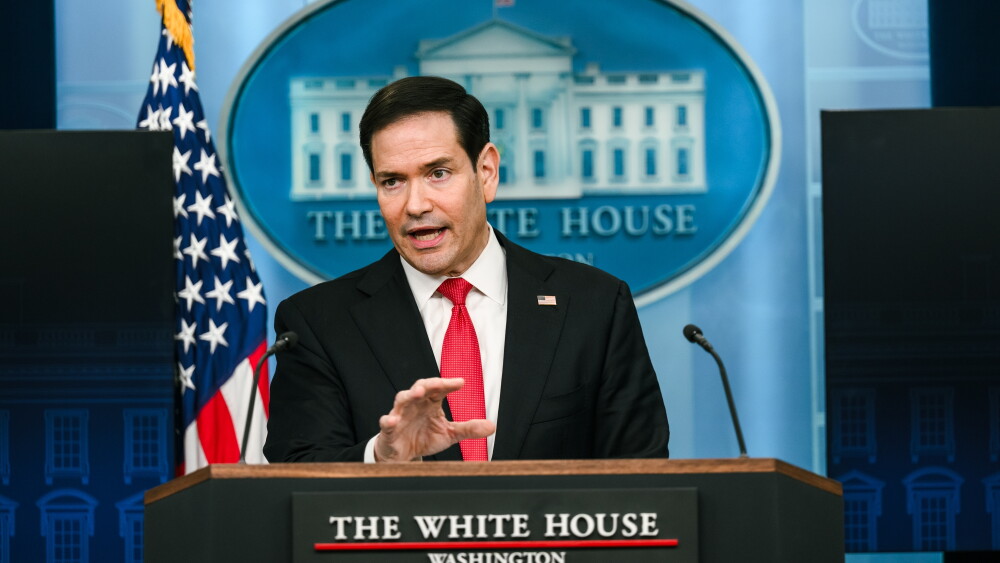
On July 16, 2026, Marco Rubio gave perhaps the most important speech of his tenure as Secretary of State when he spoke to the Ministerial on the Resurgence of Political Terrorism. Image: Secretary Rubio in the James S. Brady Press Briefing Room, May 5, 2026.

On July 16, 2026, Marco Rubio gave perhaps the most important speech of his tenure as Secretary of State when he spoke to the Ministerial on the Resurgence of Political Terrorism. Image: Secretary Rubio in the James S. Brady Press Briefing Room, May 5, 2026. Shutterstock

On July 16, 2026, Marco Rubio gave perhaps the most important speech of his tenure as Secretary of State when he spoke to the Ministerial on the Resurgence of Political Terrorism. In it, he told the assembled intelligence and law enforcement leaders from over 60 nations what many people have known for years: that left-wing political violence is surging, at levels not seen in decades.

Rubio didn’t cite David C. Rapoport in his speech, but he was using the language that the late UCLA political science professor made famous.

After Rubio reminded his audience about the numerous Soviet-inspired terror organizations responsible for most non-state political violence in the West in the 1970s, he proclaimed that, “today, we face a new wave of this old evil. Here in the United States, the share of left-wing terrorist attacks and plots has risen to levels not seen in decades.”

First published in 1999 under the heading “Terrorism” in the Encyclopedia of Violence, Peace and Conflict, Rapoport introduced the world to the wave model that would come to dominate the academic discourse on terrorism. His largely-overlooked essay acquired new relevance after 9/11, and he quickly published “The Fourth Wave: September 11 in the History of Terrorism” in December 2001, followed by an expanded and updated version in 2004, under the title “The Four Waves of Modern Terrorism.”

The wave model soon became canonical in terrorism studies, and the seminal study grew larger and more thorough over the years, culminating in a book titled Waves of Global Terrorism: From 1879 to the Present published in 2022, two years before Rapoport’s death at age 95.

The Wave Model

Rapoport divided modern international terrorism historically into four distinct periods, each named for the dominant ideology motivating the violence. Rather than calling them “periods,” “eras,” or the like, he chose a metaphor to provide flexibility to his model and to indicate each period’s wave-like “cycle of expansion and contraction phases.” He focused only on big waves, terrorism with an “international character ... [where] similar activities occur in several countries, driven by a predominant energy that shapes the participating groups’ characteristics and mutual relationships.” Rapoport named each wave for that energy and provided dates:

  1. Anarchist Wave, 1879-1920s
  2. Anticolonial Wave, 1919-1960s
  3. New Left Wave, 1960s-1990s
  4. Religious Wave, 1979-2020s?

The names are accurate enough, though one might quibble with calling the Fourth Wave the “Religious Wave” instead of the “Islamist Wave” since, as Rapoport puts it, “Islam is at the heart of the Fourth Wave.” The dates reflect how difficult, sometimes impossible, it is to determine precisely when a wave begins and ends. Three dates, however, stand out: 1879, 1919, and 1979. The Russian terrorist group Narodnaya Volya (“People’s Will”), which eventually assassinated Tzar Alexander II, was founded in 1879, marking the onset of the Anarchist Wave. The Treaty of Versailles was signed in 1919, marking the beginning of the Anticolonial Wave. And 1979, a tumultuous year that began with the Iranian Revolution and ended with the Soviet invasion of Afghanistan, marks the beginning of the Religious Wave.

In the 2004 version, Rapoport noted that “the fourth wave may last longer than its predecessors,” but added, “If history repeats itself, the fourth wave will be over in two decades.”

Academia Sees a Right-Wing Fifth Wave

After George W. Bush’s presidency ended, Barack Obama sought to end the “Global War on Terrorism” and shift attention away from jihadi groups. He infamously minimized ISIS, insisting it “is not ‘Islamic’” and “is certainly not a state,” and called it “the JV team” as he exaggerated the threats of right-wing terrorism. His administration popularized the euphemism “violent extremism” and purged references to jihad and Islamism from federal discourse.

Donald Trump tried to reverse Obama’s course in his first presidency by taking aim at ISIS, but the media, academia, and even some elements of the Intelligence Community remained obsessed with right-wing violence.

After George W. Bush’s presidency ended, Barack Obama sought to end the “Global War on Terrorism” and shift attention away from jihadi groups.

Soon it was widely argued throughout academia that a Fifth Wave of terrorism would come from, or was already evident in, the Right.

In 2020, the journal Perspectives on Terrorism published “Right-Wing Terror: A Fifth Global Wave?” by Vincent A. Auger; in 2021, it published “A New Wave of Terrorism? A Comparative Analysis of the Rise of Far-Right Terrorism” by Jonathan Collins. That same year, the journal Terrorism and Political Violence published “Right-Wing Waves: Applying the Four Waves Theory to Transnational and Transhistorical Right-Wing Threat Trends” by Amber Hart. Many others followed the trend.

Unfortunately for his legacy, even Rapoport jumped on the bandwagon.

His book’s concluding chapter, titled “The Fifth Wave?”, insinuates that “the explosion of far-right terror in the West” might be part of an emerging Fifth Wave. It disappointingly repeats many left-wing bromides, cites the SPLC and Joe Biden as reliable sources, and insists that Antifa is “not the left-wing body Trump described” but rather “a movement of autonomous groups aiming to achieve their objectives through demonstrations largely inspired by reactions to far-right groups.” At least he didn’t repeat former FBI Director Christopher Wray’s infamous description of Antifa as “more of an ideology or a movement than an organization.”

Rubio Suggests a New Wave

In his July speech, Rubio recounted U.S. success fighting Fourth Wave groups: “we destroyed the ISIS Caliphate; we killed al-Baghdadi, and al-Zawahiri, and bin Laden. And we built intelligence and law enforcement systems capable of anticipating and stopping attacks before the public even hears about them.” But he stopped short of announcing that the Fourth Wave is over, acknowledging that while “the threat has not disappeared ... [it] has been severely diminished.”

The Fifth Wave is in fact an amalgamation of all four waves, under a left-wing umbrella. Perhaps we should call it the New, New Left Wave.

Instead, Rubio focused on the Third Wave, likening today’s atmosphere to the era when the American Weather Underground, the Italian Red Brigades, the German Red Army Faction, the Japanese Red Army, the Greek November 17 Organization, the Peruvian Shining Path, the French Action Directe, and others terrorized the world. “Between 1970 and 1980,” Rubio said, “93 percent of terrorist attacks in the West came from the far extremist left.”

He suggested that the new wave was a reiteration of this old one. “It may wear various different slogans and ideologies across place and time,” he said, but "[i]t is always the same.”

But the Fifth Wave is more than merely a reenactment of the Third Wave. And it is more than a fusion of the Third and Fourth Waves as the “Red-Green Alliance” rhetoric would suggest.

The Fifth Wave is in fact an amalgamation of all four waves, under a left-wing umbrella. Perhaps we should call it the New, New Left Wave.

Like the First Wave, it has strong anarchist and anti-capitalist elements. Rapoport calls the First Wave “The Golden Age of Assassination,” and indeed assassination is back in the Fifth Wave with multiple assassination attempts against candidate and then President Donald Trump. Before that came the shooting of Republican members of Congress at a baseball practice and the attempted assassination of Supreme Court Justice Brett Kavanaugh. Then came the assassination of UnitedHealthcare CEO Brian Thompson and the glorification of his anarchist-leftist assassin. Then came the assassination of conservative media star Charlie Kirk.

Like the Second Wave, the Fifth Wave is anti-colonial, but it goes even further. Today’s terrorists are not only anti-colonial but postcolonial. Their goal of “decolonizing” the world means destroying anything they consider to be a colonial power—including the U.S., which the Left derogatorily refers to as “Turtle Island.”

Their goal of “decolonizing” the world means destroying anything they consider to be a colonial power—including the U.S., which the Left derogatorily refers to as “Turtle Island.”

Like the Third Wave, the Fifth Wave is motivated by a leftist ideology, and, also like the Third Wave, it primarily targets Americans.

Since the Fourth Wave has yet to end, Islamism still plays a significant role in the Fifth Wave.

The Fifth Wave of terrorism is anti-Zionist, antisemitic, anti-law enforcement, anti-capitalist, anti-conservative, anti-Republican, and anti-Trump. Everything that its adherents favor is defined by what they oppose. Their environmentalism is defined by their anti-industrialism. Their Marxism-Leninism is predicated on their disdain for capitalism. And their Palestinian advocacy, including support for the PLO, Hamas, and Hezbollah, is defined by their hatred of Israel.

Published originally on November 17, 2026.


A.J. Caschetta

Source: https://www.meforum.org/mef-online/the-fifth-wave-of-terrorism-is-upon-us-part-1

Follow Middle East and Terrorism on Twitter

From Yalta to Shenzhen - Amir Taheri


by Amir Taheri

[T]he Shenzhen three are mired in a cesspool of differences on almost all key issues from limiting nuclear arsenals to reforming the United Nations and harmonizing their tariff and trade policies.


  • The Shenzhen three... are already bogged down in crises they seem unable to manage, let alone to resolve.

  • Trump is caught in the Iranian quagmire, plus tension-ridden relations with the European Union, Canada, China and even Australia and South Korea. Putin is bearing the Ukrainian cross he carved for himself, unable either to win the war or even end it. Xi has put himself in a Cold War-style cage with his obsession with one day marching in triumph in Taipei.

  • [T]he Shenzhen three are mired in a cesspool of differences on almost all key issues from limiting nuclear arsenals to reforming the United Nations and harmonizing their tariff and trade policies.

  • More importantly, almost everywhere, people are learning that no one can scratch their back except their own fingers. Any insurance policy marketed by big-power salesmen needs to be closely examined.

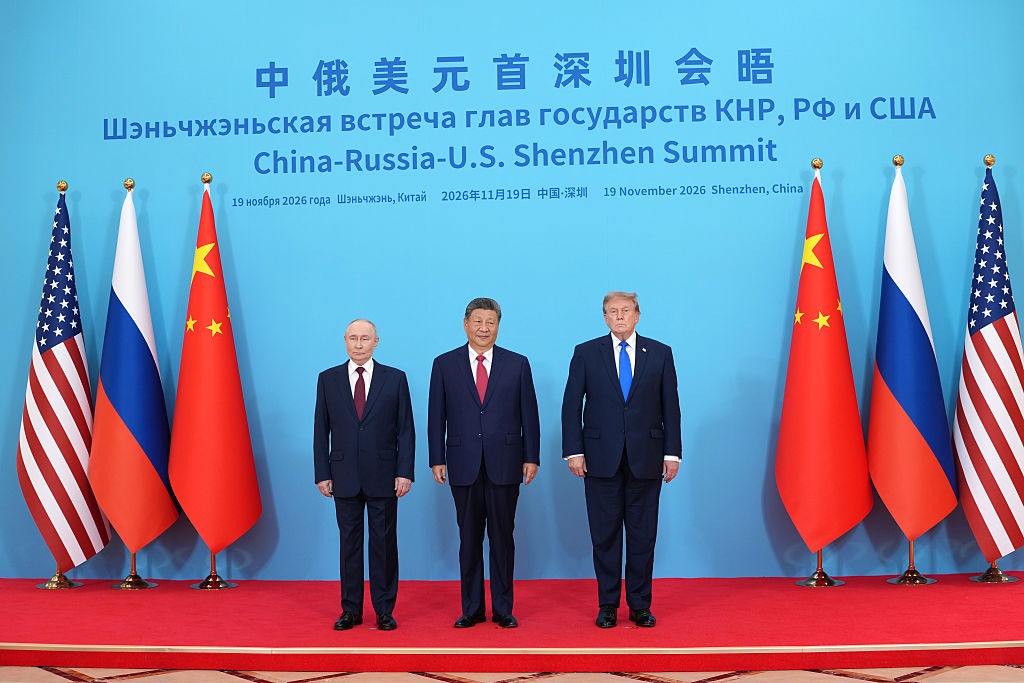
The Shenzhen three are mired in a cesspool of differences on almost all key issues from limiting nuclear arsenals to reforming the United Nations and harmonizing their tariff and trade policies. Pictured: US President Donald Trump, Chinese President Xi Jinping and Russian President Vladimir Putin meet in Shenzhen, China on November 19, 2026. (Photo by Doug Mills/Pool/Getty Images)

Yalta II is the sobriquet chosen by Ukrainian President Volodymyr Zelensky for the recent meeting of the US, Chinese and Russian presidents in the Chinese city of Shenzhen. Zelensky's reference was to a meeting held by US President Franklin D. Roosevelt, British Prime Minister Sir Winston Churchill and Soviet leader Joseph Stalin in the Russian resort of Yalta in February 1945, during World War II.

Surprisingly, many commentators on both sides of the Atlantic have taken up Zelensky's quip as a proper description of the Shenzhen rendezvous. Some pundits claim that just as the Big Three of Yalta divided the world into zones of influence, the new Big Three will decide a new carve-up of the globe.

The sub-script of that assumption is that Donald Trump, Xi Jinping and Vladimir Putin are looking for ways to end the current wars and disorder and throw the weight of the Big Three behind a new world order.

Among those who propagate that analysis are some European pundits who think the Old Continent is definitely scripted out of international relevance and must learn a thing or two from a new model of rule set by "strongmen" like Trump, Xi and Putin. Some even talk of "authoritarian democracy", an oxymoron if ever there was one.

Advocates of "authoritarian democracy" remind one of some 19th-century European physiocrats who admired the imperial Chinese and Tsarist Russian models of governance, both of which emphasized the absolute authority of the state even beyond limits imagined by Hobbes in his seminal treatise "The Leviathan".

In that fantasyland China, those who ran the state were not chosen by clueless and fickle voters of a democracy but according to merit established through rigorous examinations that decided who could become Mandarin. Voltaire, and other admirers of Tsarina Catherine II of Russia, admired a model in which state power was exercised by a robust and resourceful aristocracy with the talent for rule woven into its genetics.

Today, however, the picture is somewhat different.

China is ruled by a Communist Party that over the past three decades has morphed into the centerpiece of a giant holding with economic, business and military wings, with entry tickets obtained fundamentally through loyalty rather than merit alone. Putin's Russia is more of a trompe-l'oeil because it allows a strictly-controlled electoral process as a façade for what is basically a politico-business oligarchy.

The third angle of the Shenzhen triangle or triumvirate, the United States was always admired, albeit at times grudgingly, for its partly real and partly imaginary dependence on what Count Alexis de Tocqueville described as "the sovereignty of the people".

Today, however, the so-called "sovereignty of the people" is exercised through countless lobby groups, sectarian alliances and special interests engaged in disabling the Leviathan through a thousand cuts. To see Trump as a model of "strongman" is to miss the tremendous process of change underway in the American politico-cultural system.

In short, the Shenzhen troika doesn't resemble the Yalta one. At that time, Roosevelt, Churchill and Stalin had real, if not absolute power. They had tens of millions of troops occupying over 20 countries on three continents at a time when, leaving aside Latin America, there were few independent nations in the world. The Yalta trio represented almost 53% of global gross domestic product (GDP) and were on the eve of the greatest military victory in history.

Today, the Shenzhen trio accounts for 44% of global GDP, with the majority of that generated by the United States. But there are other big players including the European Union, which represents the world's second-largest economy, as well as Japan, India, Brazil and a dozen other fast-moving-up nations in Asia, Africa and Latin America.

In Yalta, the Big Three knew that once the Axis had been destroyed, they faced no serious challenge in deciding the fate of Europe, indeed as we later saw, the whole world. The Shenzhen three, however, are already bogged down in crises they seem unable to manage, let alone to resolve.

Trump is caught in the Iranian quagmire, plus tension-ridden relations with the European Union, Canada, China and even Australia and South Korea. Putin is bearing the Ukrainian cross he carved for himself, unable either to win the war or even end it. Xi has put himself in a Cold War-style cage with his obsession with one day marching in triumph in Taipei.

More importantly, perhaps, the Shenzhen three are mired in a cesspool of differences on almost all key issues from limiting nuclear arsenals to reforming the United Nations and harmonizing their tariff and trade policies.

In the past decades, both Russia and China have tried their hand at classical-style imperialism and emerged with burned fingers. Russia threw a vast net into sub-Saharan Africa, harvesting nothing but shark bones, and was forced to flee after sustaining heavy financial and human losses.

In any case, the Shenzhen shindig was for all Asia-Pacific area nations, none of whom, not even South or North Korea, are ready to play poodle to any of the Big 3. The post-World War II order guaranteed by a few big powers is over. We have entered an era of nation-states, each trying to act according to its national interests.

Today, economic, diplomatic, cultural and military power is more widely distributed than ever before in history. The fact that no nation is too small to be included in efforts to shape the world order highlights the importance of bilateral relations among the 193 UN members. In many cases, there may be small leaders, never small nations.

More importantly, almost everywhere, people are learning that no one can scratch their back except their own fingers. Any insurance policy marketed by big-power salesmen needs to be closely examined.

To be sure, small states can also make big mistakes, often under the influence of flatterers and carpet-baggers from the big nations. But even then, the good news is that almost everywhere, we see people claiming a bigger say in decision-making. In major economies, hundreds of multinational concerns are in a position to deprive the state of the kind of power it exercised in the post-Yalta world.

In the now-emerging world, still chaotic as every birth is at first, the politics of persuasion could become more effective than the choice of coercion.

History seldom repeats itself, and on rare occasions that it does, we get a caricature of the original. Thus, Shenzhen is a caricature of Yalta. Remember you first read it here: there will never be another Yalta.

Gatestone Institute would like to thank the author for his kind permission to reprint this article in slightly different form from Asharq Al-Awsat.


Amir Taheri was the executive editor-in-chief of the daily Kayhan in Iran from 1972 to 1979. He has worked at or written for innumerable publications, published eleven books, and has been a columnist for Asharq Al-Awsat since 1987. He graciously serves as Chairman of Gatestone Europe.

Source: https://www.gatestoneinstitute.org/23007/from-yalta-to-shenzhen

Follow Middle East and Terrorism on Twitter

They Will Never Assimilate. They Will Take Over. That Is the Plan - Majid Rafizadeh


by Majid Rafizadeh

In the Islamist and Sharia environment in which we were raised, .. those who are not like us are najis — religiously impure.


  • [A]sking an Islamist or a Sharia-follower to assimilate into Western culture is basically asking them to set aside what they consider the essence of who they are. They will not do it. Their view of themselves is totally bound up with the promise that their way of life will inevitably cover the earth. Assimilation would mean abandoning that central promise.

  • In many Western moral traditions, there is a strong emphasis on treating others as you would be treated, and on judging your neighbor as you would judge yourself. These sayings shape the culture of the West. In the Islamist and Sharia environment in which we were raised, the foundational vision is different. Those who are not like us are najis — religiously impure.

  • The word najis is not mild. As a child, if something was called najis, you did not touch it. If you did, you washed. It was regarded as extreme filth, like excrement, that carried fear and disgust. The same category is applied to the entire population of people who are not Islamists, or pure Sharia followers. God does not favor them. They are headed for hell. You avoid them, do not even touch them, and do not form bonds with them — unless taqiyya, dissimulation, applies. Then you may lie, smile, and befriend them long enough to advance the larger goal of furthering Islam and eventual dominance.

  • The late Sheikh Yusuf al-Qaradawi, a leading scholar of Islam who was forced to flee from Egypt to Qatar, admitted in 2013 on his popular Al Jazeera television program, "Sharia and Life," which boasted approximately 60 million viewers, that "If they had gotten rid of the apostasy punishment Islam wouldn't exist today."

  • The underlying assumption is superiority: we are higher in God's eyes; you are najis; if God had favored you, you would have been born one of us.

  • Even if many followers of Sharia might not be strict about it, the societal pressure on them, at all times, to avoid showing it, especially in front of other Muslims, is unimaginable.

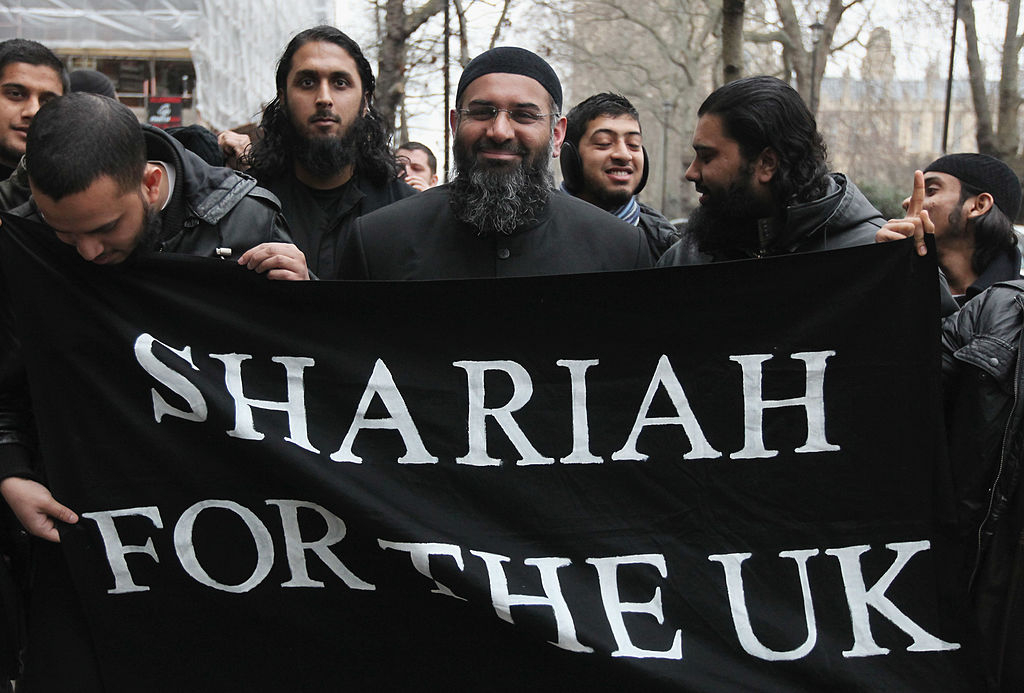
Asking an Islamist or a Sharia-follower to assimilate into Western culture is basically asking them to set aside what they consider the essence of who they are. They will not do it. Their view of themselves is totally bound up with the promise that their way of life will inevitably cover the earth. Assimilation would mean abandoning that central promise. Pictured: Anjem Choudary (center), a British radical Islamist, leads a demonstration demanding the imposition of Islamic sharia law, on January 12, 2010 in London, England. (Photo by Dan Kitwood/Getty Images)

In much of the West, there is a deep assumption that if you bring in immigrants from different ethnic or religious backgrounds, they will eventually assimilate. It takes time, the thinking goes, but history shows it works. European immigrants arrived in the United States, faced pressure and prejudice, and over generations their children and grandchildren became "American." The pattern is taken as the expected human story.

What this view does not understand about Islamists and Sharia-followers is that their entire identity, everything that defines them, contains one core idea: it is actively opposed to assimilation. The entire project in Islam is not to blend into the majority but to make the majority become like them.

When Islam conquered Persia and, later, regions of Europe, the message was never "I practice my religion privately; the rest is your business." That is how Christianity or Judaism function in the modern West. One of the central pillars taught to followers of Sharia is that everyone must ultimately follow its rules. The final state of the world is one in which everyone submits. Every believer's duty includes jihad in the sense of exporting the word of Allah and converting others. That goal is not a side project. It is the core identity.

Therefore, asking an Islamist or a Sharia-follower to assimilate into Western culture is basically asking them to set aside what they consider the essence of who they are. They will not do it. Their view of themselves is totally bound up with the promise that their way of life will inevitably cover the earth. Assimilation would mean abandoning that central promise.

A second, deeply-implanted idea is the category of "the other." In many Western moral traditions, there is a strong emphasis on treating others as you would be treated, and on judging your neighbor as you would judge yourself. These sayings shape the culture of the West. In the Islamist and Sharia environment in which we were raised, the foundational vision is different. Those who are not like us are najis — religiously impure.

The word najis is not mild. As a child, if something was called najis, you did not touch it. If you did, you washed. It was regarded as extreme filth, like excrement, that carried fear and disgust. The same category is applied to the entire population of people who are not Islamists, or pure Sharia followers. God does not favor them. They are headed for hell. You avoid them, do not even touch them, and do not form bonds with them — unless taqiyya, dissimulation, applies. Then you may lie, smile, and befriend them long enough to advance the larger goal of furthering Islam and eventual dominance.

We saw this constantly. If we would bring a foreigner around relatives, the first question was almost always whether the person was Muslim. The entire emotional and social temperature changed based on the answer. In societies based on Sharia, the "other" is highly visible: women without a hijab, public behavior that violates the code. The judgment of impurity is constant, and so is the expectation that, one day those people, one way or another, will convert and become pure.

The system is also structured to prevent exit. A Muslim who abandons his identity and becomes like the others is treated as an apostate. In classical rulings this requires the death penalty. The late Sheikh Yusuf al-Qaradawi, a leading scholar of Islam who was forced to flee from Egypt to Qatar, admitted in 2013 on his popular Al Jazeera television program, "Sharia and Life," which boasted approximately 60 million viewers, that "If they had gotten rid of the apostasy punishment Islam wouldn't exist today."

The architecture is deliberate. It does not merely discourage assimilation; it criminalizes it and surrounds it with fear. Marriage rules reinforce the same hierarchy. A Muslim man may marry a non-Muslim woman because he is expected to convert her. A Muslim woman may not marry a non-Muslim man because she is not expected to have the power to convert him. The underlying assumption is superiority: we are higher in God's eyes; you are najis; if God had favored you, you would have been born one of us.

Sadly, the Western hope that these communities will assimilate the way earlier immigrant groups did rests on a misunderstanding of the ideology. Assimilation would require them to dismantle their entire concept of who they are, as if you were asking a man (who enjoyed being a man) to be a woman, or a woman (who enjoyed being a woman) to be a man. That is experienced as death, as infidelity. So it does not happen. Instead, when large numbers of Sharia-followers move to Western countries, the pattern is the reverse of classic assimilation. They establish or take over neighborhoods and cities that operate by their rules, while a smaller number of Westerners convert into the system. The ideology is built like a locked box with many chains. It is not designed to open outward. It is designed to expand.

Even if many followers of Sharia might not be strict about it, the societal pressure on them, at all times, to avoid showing it, especially in front of other Muslims, is unimaginable.

That is the reality we were taught and lived. The West can continue to live in an illusion and believe otherwise if it wishes. The ideology itself does not.


Dr. Majid Rafizadeh is a political scientist, Harvard-educated analyst, and board member of Harvard International Review. He has authored several books on the US foreign policy. He can be reached at dr.rafizadeh@post.harvard.edu

Source: https://www.gatestoneinstitute.org/23006/they-will-take-over

Follow Middle East and Terrorism on Twitter

Trump orders federal contractors to restrict contact with Congress - Arjun Singh


by Arjun Singh

Democrats have vowed to conduct broad investigations of Trump and his administration in the 120th Congress.


President Donald Trump on Friday signed an executive order directing federal contractors to notify the White House of any congressional inquiries and possibly withhold information from Congress on grounds of executive privilege.

"Federal contractors must immediately ... notify the White House and the contracting agencies of any pending or future congressional request respecting the contractors’ communications or work with the executive branch," the order reads. 

It also directed contractors to "abide by any instructions received from the White House and contracting agency related to the withholding of communications that the White House or the agency has determined are protected by executive privilege."

If contractors fail to comply with the order, their contracts may be terminated and they may be suspended from receiving future government contracts. The United States government is the world's largest public contracting body and spends around $800 billion on them every year.

In the upcoming 120th Congress, where Democrats will have majorities in both houses, they have vowed to launch investigations of the Trump administration's policies as well as the Trump family personally. The administration has warned Congress against broad investigations, suggesting they may violate the law and incur prosecution.

Democrats have defended their plans, citing Congress's constitutional authority to investigate the executive branch.  


Arjun Singh

Source: https://justthenews.com/government/white-house/trump-orders-federal-contractors-restrict-contact-congress

Follow Middle East and Terrorism on Twitter

Eisenkot's Yashar, Netanyahu's Likud hold 'marathon of talks' on unity government - Keshet Neev


by Keshet Neev

Yashar said on Saturday that the planned "marathon of talks" was part of efforts to "form a new government and exhaust every possible avenue."


MK Ofir Katz, chairman of the Likud parliamentary faction and a member of the party’s negotiating team, arrives for coalition talks with representatives of Gadi Eisenkot’s Yashar party in Herzliya, November 22, 2026
(photo credit: AVSHALOM SASSONI/FLASH90)


Negotiating teams representing the Yashar party, led by Gadi Eisenkot, and Prime Minister Benjamin Netanyahu’s Likud met on Sunday afternoon to continue talks on a potential unity government.

Likud sent MK Ofir Katz and Michael Rabello, Netanyahu’s former personal attorney, who recently withdrew his candidacy for state comptroller amid controversy over the integrity of the election process, to represent the party. Yashar sent MK Chili Tropper alongside Yoav Horowitz and Guy Gutman.

Representatives from the Eisenkot-led bloc met with Likud last Sunday as part of efforts to explore the possibility of forming a unity government, later announcing that the talks would continue and describing the initial discussions as “businesslike.”

A representative from Naftali Bennett's B'Yachad party, who was present during the meeting last week, did not join the fresh round of negotiations on Sunday.

Katz reportedly said ahead of the meeting that the Likud negotiating team was hoping for genuine talks that were "not just for appearances."

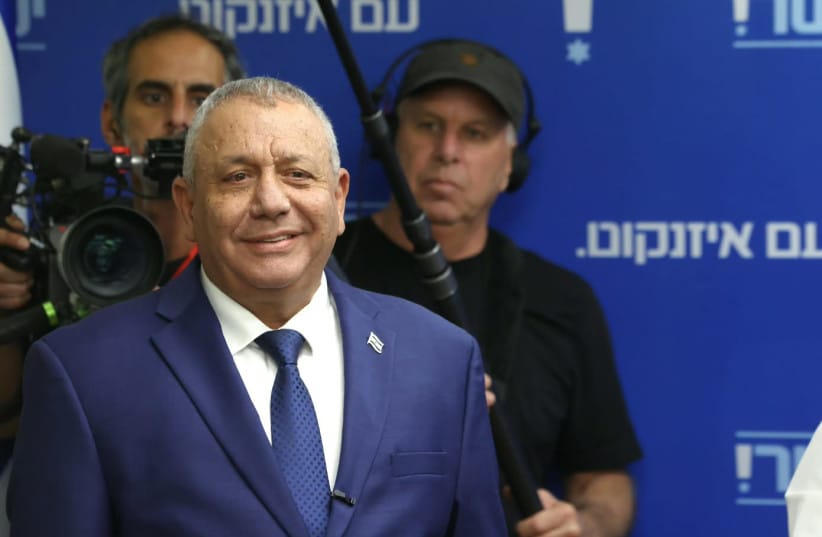
Yashar head MK Gadi Eisenkot speaks during a faction meeting at the Knesset, in Jerusalem, November 17, 2026
Yashar head MK Gadi Eisenkot speaks during a faction meeting at the Knesset, in Jerusalem, November 17, 2026 (credit: MARC ISRAEL SELLEM/THE JERUSALEM POST)

Planned talks part of effort to form new gov't 

Yashar said on Saturday that the planned "marathon of talks" was part of efforts to "form a new government and exhaust every possible avenue."

"The Yashar negotiating team will work to turn over every stone, enable bold moves, and achieve a breakthrough that will lead to the formation of a government," the statement added.

Eisenkot had previously drawn a red line against serving in a government headed by Netanyahu and has laid out four key principles that MKs must accept if they wish to join his coalition.

Netanyahu has repeatedly called for a unity government after his bloc lost its parliamentary majority to the Eisenkot-led bloc following the October 27 election. 

On November 8, Eisenkot received the mandate from the president to form the next government, giving him 28 days to do so, with the option of requesting an additional 14-day extension.

The party leaders of the Eisenkot-led bloc – Bennett (B'Yachad), Avigdor Liberman (Yisrael Beytenu), and Yair Golan (the Democrats) – all said last week that Netanyahu must be ousted. However, they have separately expressed differing views on how a government should be formed following the political deadlock that emerged after the election.

Liberman and Golan have drawn a red line against joining a unity government led by Netanyahu.

As the negotiations were taking place on Sunday, Golan reiterated his opposition to a unity government, instead calling for the formation of a minority government.

A minority government could potentially be formed with the backing of the Arab parties, through a Knesset confidence vote that secures a simple majority rather than an absolute majority of 61 seats.

"A minority government is currently the only realistic alternative. If the delays are part of a negotiating tactic, it is time to end the games," Golan stated.

He added that anyone seeking to form a unity government with Netanyahu would be "stabbing their voters in the back."

The Democrats chairman stated that the party leaders in the Eisenkot-led bloc "were elected to replace Netanyahu, not to sit with him. Therefore, the Democrats will oppose any such unity arrangement."

Golan further called for cooperation with the Arab parties – Ra’am and the Joint List – saying that the possibility of working with them “must be examined seriously, rather than ruled out in advance, certainly not for ulterior motives that reek of racism.”

Liberman has meanwhile opposed the possibility of forming a minority government, saying that such an arrangement would be unstable and ultimately lead to another round of elections. Instead, he has called for partnering with the haredi (ultra-Orthodox) parties and forming a government with them.

The Yisrael Beytenu leader's stance has drawn criticism, as ahead of the elections, Liberman had taken a hardline position against partnering with the haredi parties, demanding legislation to draft all haredim into the IDF.

Golan's statement on Sunday also said that the formation of a government should not be solely dependent on reaching an agreement with the haredi parties.

"If there is no agreed framework for cooperation with the haredi parties, negotiations with them must not become a condition for forming the government. It is possible to form a government and negotiate with them afterward, from a position of strength as an incumbent government," Golan stated.

Though party leaders in the Eisenkot-led bloc have recently opened the door to coalition negotiations with the haredi parties - Shas and United Torah Judaism -  they have been key partners in Netanyahu's coalition, making it unclear whether they would agree to join a government led by Eisenkot.

Bennett openly backs unity gov't with Likud, led by Eisenkot

Meanwhile, Bennett on Saturday openly backed the formation of a unity government with Likud, provided it was led by Eisenkot, while stating that he was committed to not joining Netanyahu's bloc “under any circumstances.”

Bennett's statement on his position came after he met with Netanyahu in the prime minister's Knesset office last week, without Eisenkot's prior knowledge, sparking speculation over his intentions. The B'Yachad leader had remained silent on his stance immediately after the meeting.

The October 27 election results showed that the bloc seeking to replace Netanyahu won 67 seats, including 19 held by the Arab parties, while Netanyahu's bloc secured 53 seats.

No government has been formed yet, as most party leaders have drawn a red line against partnering with the Arab parties.

Nevertheless, Arab party support has allowed the bloc to advance key legislation in the Knesset even while Netanyahu heads a caretaker government.


Keshet Neev

Source: https://www.jpost.com/israel-news/politics-and-diplomacy/article-915687

Follow Middle East and Terrorism on Twitter

Families sue far-left states to stop penalizing religion, geography in school benefits and choice - Greg Piper


by Greg Piper

Minnesota denies "subtraction and credit" tax benefit to families whose educational expenses are "too religious" as determined by one official, suit says. Another demands Vermont's oft-litigated town tuitioning program be available statewide.


The Supreme Court has repeatedly told states in the past decade they cannot favor the secular over the religious, or a particular kind of religion but not another, in the provision of generally available public benefits, from school tuition assistance in rural areas and playground revamps to unemployment compensation tax exemptions.

Families in the upper Midwest and New England, a recurring target for religious discrimination claims in the provision of educational benefits, are going to their respective states' courts to secure the school-choice benefits they claim the courts have already granted them, one for explicitly religious reasons and the other on more novel grounds.

Minnesota fathers Nathan Colestock and Joseph Osburn argue the Land of 10,000 Lakes owes them the same "K12 Education Subtraction and Credit" for Christian curricula that it gives families for secular education, to "offset the cost of tutoring, textbooks, instructional materials, and enrichment classes," in a state tax court complaint.

"In every respect but one, both the Colestock and Osburn families are exactly who Minnesota’s tax education benefits were written for," yet the state disqualifies them solely "because their children’s education is Christian," violating the First and Fourteenth amendments and Minnesota Constitution's conscience clause, says their lawyers at Alliance Defending Freedom.

Five Vermont families are challenging the Green Mountain State's exclusion of them from its Reconstruction-era town tuitioning program, which gives families in areas without public schools money to spend on other education, on the basis that their home districts have public schools. Previous challenges have focused on religious exclusions in programs.

Their addresses doom their children to inferior education, according to the Vermont Superior Court complaint, citing independent research the families commissioned on academic outcomes for students eligible for town tuitioning versus those who aren't. The state constitution guarantees "substantial equality of educational opportunity" throughout the state.

Three of the five families, in fact, want to put their kids in different public schools, their lawyers at the Liberty Justice Center note. Their home districts suffer from mediocre academics, lack of accelerated programs, disruptive environments, few extracurricular options and special education shortfalls, the complaint alleges.

A negative outcome in court for either Minnesota or Vermont could prompt bureaucrats and lawmakers to attempt an end-run, as Maine did when SCOTUS agreed to review its exclusion of "sectarian" schools from its own town tuitioning program, a restriction subsequently struck down.

The Legislature amended the Maine Human Rights Act to force religious schools to choose between keeping their sexual-orientation and gender-identity exemptions under MHRA and participating in the town tuitioning program.

Bangor Christian Schools' lawyers at the First Liberty Institute pledged to appeal to SCOTUS this summer when the 1st U.S. Circuit Court of Appeals refused to strike down the Legislature's so-called poison pill.

Revenue commissioner gets to decide what is 'too religious' to qualify

When SCOTUS last year ruled against Wisconsin's designation of Catholic Charities as a secular entity for tax purposes – on the basis that it serves everyone, not just Catholics – the precedent cited the high court's prior ruling against Maine's favoritism for "more watered down" religious education in town tuitioning, as Justice Samuel Alito described it.

Just as Maine deprived religiously fervent families of access to taxpayer dollars they themselves were still forced to pay, Minnesota compels Colestock and Osburn to "strip the faith that animates their lives from their children's education" to be treated the same as other parents who lower their taxable income by claiming credits for educational expenses, the suit says.

In a separate filing, they ask the tax court, which "lacks original jurisdiction to decide constitutional questions," to refer the case to a state district court to authorize the former to evaluate the state and federal constitutional questions.

Between the two fathers, they have six children old enough to "receive qualifying K12 education-related expenses" and four more too young to attend school currently.

They seek the taxable-income subtraction – $1,625 per K-6 child and $2,500 per grade 7-12 child – which the U.S. Supreme Court upheld against an Establishment Clause challenge in 1983, and a separate "refundable credit" of 75% of qualifying expenses up to $1,500 per child for earners below a certain income.

Guidance by Revenue Commissioner Paul Marquart, the defendant, puts few non-religious limits on what parents can claim as educational expenses, with even "field trips" and musical instruments covered but not athletic expenses, the suit says. It specifically excludes materials "primarily religious in nature" from approved homeschooling expenses.

Being ineligible for the benefits means Colestock, a pastor, cannot afford theater, "tumbling" and athletics for his kids, and Osburn, who also works for a Christian ministry, cannot afford pottery classes, math tutoring and gymnastics for his kids, or to pay for his youngest to attend the classical Christian academy his siblings attend.

Because they refuse to deceive the state by claiming their expenses are unrelated to teaching "religious tenets, doctrines, or worship," even if the state might view some as secular, they are deprived the same benefits as other parents, the suit says.

The state violates their constitutional free exercise of religion and due process, including the religious upbringing of their children, through a law that is not neutral or generally applicable because it grants the tax commissioner discretion to determine what is "too religious" to be covered, the fathers argue.

They seek only injunctions against the state denying or conditioning the benefits on "removing religion from otherwise-qualifying educational materials, fees, or tuition," and nominal but not compensatory damages.

'Substantially below proficient' more common without school choice

The Vermont litigation seeking school choice statewide, via town tuitioning, includes maps that show what the plaintiffs' school districts look like compared to their peers with access to town tuitioning when it comes to academic performance. The former have higher percentages of "substantially below proficient" on state competency exams and math.

A study by the Friedman Foundation, named after the pioneering free-market economist, found school choice in the Vermont context has far greater influence on standardized test scores than poverty, urbanization or per-pupil spending, according to the suit. 

In another foundation report examining a dozen "gold standard" studies, none found "access to independent schools had a negative impact on student academic achievement."

The plaintiffs seek injunctions against the geography-based exclusion rule. 


Greg Piper

Source: https://justthenews.com/government/state-houses/families-sue-far-left-states-stop-penalizing-religion-geography-school

Follow Middle East and Terrorism on Twitter

The next generation’s connection to Israel is built far from the spotlight - Eyal Dror


by Eyal Dror

On campus, one conversation at a time, students gain the knowledge and confidence to speak up for the Jewish state.


Members of the Israel Defense Forces transport an injured Syrian civilian to get medical attention as part of “Operation Good Neighbor.” Credit: IDF website.


After a recent talk on an American campus, a Jewish student approached me. “Because of your visit, I want to tell my friends more about Israel,” he said. It was a brief exchange, but it captured why I had spent another day moving between airports, highways, hotels and lecture halls.

This month, Jewish Federations of North America held its General Assembly, and Jewish National Fund-USA held its annual global conference. These gatherings bring leaders, donors and communities together to confront crucial challenges.

Their work matters. But another essential task is taking place far from the main stage, often before just a few dozen students, with no cameras and little public recognition.

A speaking tour, organized with Students Supporting Israel, had me visiting nine campuses across North America. It is demanding, unglamorous work. Yet if we want young American Jews to remain connected to Israel and their non-Jewish peers to understand it, we cannot afford to neglect it.

The story too few have heard

My talks begin with “Operation Good Neighbor,” the humanitarian mission I commanded along Israel’s border with Syria during the Syrian civil war. Israel treated thousands of Syrian civilians, including children, and delivered food, medicine and other essential supplies across a border long associated with hostility. Israeli soldiers helped people whose country had been at war with ours for decades.

For security reasons—particularly the need to protect our forces and Syrian partners—much of the operation remained undisclosed while it was underway. Even after it ended, the full story was rarely told. After leaving active service, I made it part of my mission to tell that story. I wrote a book published in Hebrew and English, with a German translation now underway.

I believe there is another front that deserves sustained attention: the struggle for knowledge and understanding.

A book can reach readers around the world. But a face-to-face conversation can do something different. Students can question the person who was there, challenge what they hear and discover details that do not fit the familiar slogans about Israel.

“Operation Good Neighbor” doesn’t settle every argument about Israel. It does, however, complicate a one-dimensional picture. A country often discussed on campus only through war and conflict also risked lives and devoted resources to helping Muslim civilians across an enemy border. That fact deserves a place in any serious understanding of Israel.

The resistance to being heard

Some would rather these conversations never take place. At the University of Michigan, roughly 70 protesters gathered against my appearance within hours. Some called me a “war criminal” before hearing what I had come to discuss. In Canada, a student council canceled a planned university event. Whatever reasons were given for that decision, students who wanted to attend lost the opportunity to hear a firsthand account and ask questions.

There is an important distinction here. Criticizing Israel, including its government or military decisions, is legitimate. Antisemitic abuse, intimidation and efforts to prevent an invited speaker from being heard are something else entirely. Universities should be places where difficult claims are examined, not where disagreement is settled by shutting down a conversation. What I witnessed was telling: Energy was mobilized to oppose a talk about Israelis saving Syrian lives. That alone is reason enough to keep showing up.

The students in these rooms may someday lead Jewish communities or hold influential positions in American civic life. They are young people making sense of Israel now, often amid intense pressure and conflicting claims.

A Jewish student confronted with the assertion that Israel is nothing but a murderous state needs more than an instinctive defense. That student needs history, context, verifiable facts and the confidence to distinguish legitimate criticism from distortion. The same is true for non-Jewish students who may never have met an Israeli willing to discuss the country’s achievements, failures and dilemmas openly.

That is why I prefer the language of education to the Hebrew word hasbara, usually translated as “public diplomacy” or “explaining.” To my ear, hasbara can sound as though Israel is perpetually on trial, and its representatives must plead their case. Education asks more of us. It requires knowledge, honest answers and the willingness to face difficult questions without slogans.

In Israel, we often speak of the many security fronts our country faces. I believe there is another front that deserves sustained attention: the struggle for knowledge and understanding. Not every student will leave agreeing with me, and agreement is not the only measure of success.

The real test comes after I leave. Can students challenge a false claim with evidence, explain complexity without apologizing for Israel’s existence and continue a conversation with someone who disagrees?

After almost every talk, someone asks: “Why doesn’t Israel tell these stories?” I admit that I find it hard to answer. But that question is part of the reason I keep coming. I hope Israel will learn to do better on this front, and I know that tours like this one contribute their share.

After the travel and the protests comes the reason I make the journey: the encounter itself. The questions are often about far more than Syria. Students ask about military service, life near Israel’s borders, the choices leaders face and what it means to live with people who see the same events differently.

Their gratitude for someone simply coming to speak with them brings back what I felt while commanding “Operation Good Neighbor”: that I am simply doing the right thing. A student’s new willingness to speak about Israel may not make headlines. It can still change what happens in a dormitory conversation, a classroom discussion or a friendship.

After almost every talk, someone asks: “Why doesn’t Israel tell these stories?”

These encounters are also about building bridges between Israelis and young American Jews, and between Israelis and their non-Jewish friends. Many Jewish students feel isolated on campus today. Meeting an Israeli who listens as well as speaks can remind them that the relationship is personal, not merely political.

A bridge of trust is not built by a campaign alone. It is built when people sit in the same room and look each other in the eye.

A task bigger than any organization

I have one request for our communities and organizations, and I include myself in it: cooperate more and compete less. All of us—speakers, campus groups and national organizations alike—sometimes invest energy in who hosts an event or who receives the credit. Those questions should never matter more than reaching another student.

Student groups, federations, campus organizations and donors can coordinate schedules, share resources and welcome audiences beyond those already committed to Israel. Success should be measured not only by attendance, but also by how many new people we reach, what they learn and whether a relationship continues after the event.

I have seen how quickly opponents can mobilize against an Israeli speaker. Imagine what we could achieve with the same determination and coordination among those who believe these conversations matter—not to silence critics, but to ensure that students have the chance to hear, question and decide for themselves.

The speeches at major conferences matter. So do the small rooms where a student hears an unfamiliar story and leaves ready to talk about Israel with greater knowledge and confidence.

This work is slow and exhausting, and its effects are rarely visible right away. But the relationship between Israel and the next generation will be built, in no small part, one encounter at a time.


Lt. Col. (res.) Eyal Dror lives with his family in Kibbutz Dafna, a northern Israeli border community near Lebanon. He has served in the Israel Defense Forces for more than 30 years and is an active reserve officer in the Golan Division. He previously founded and commanded “Operation Good Neighbor” on the Israeli-Syrian border. Author of Embracing the Enemy: The Inside Story of Israel’s Secret Humanitarian Mission to Rescue Syrian Civilians From Civil War, he lectures in Israel and abroad on security, the Middle East, humanitarian aid, leadership and communal resilience.

Source: https://www.jns.org/opinion/eyal-dror/the-next-generations-connection-to-israel-is-built-far-from-the-spotlight

Follow Middle East and Terrorism on Twitter

Likud sets conditions for national unity government with Eisenkot - Natan Galula


by Natan Galula

Netanyahu’s party demands an end to “all personal attacks and incitement” against the incumbent prime minister.


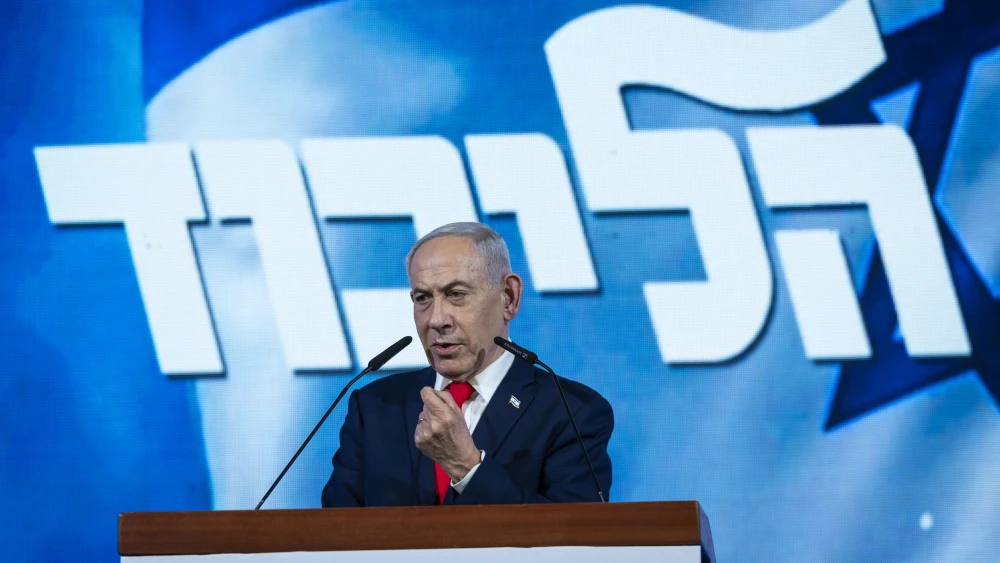
Israeli Prime Minister Benjamin Netanyahu at his Likud Party’s election headquarters at Binyanei HaUma in Jerusalem, following Israel’s general elections, early on Oct. 28, 2026. Photo by Chaim Goldberg/Flash90.
Israeli Prime Minister Benjamin Netanyahu at his Likud party’s election headquarters at the Jerusalem International Convention Center following Israel’s general election, Oct. 28, 2026. Photo by Chaim Goldberg/Flash90.


Israel’s Likud party on Saturday published its conditions for forming a national unity government, demanding an end to political boycotts of Israeli Prime Minister Benjamin Netanyahu and a public declaration committing not to form a government with parties it describes as supporting terrorism and opposing the country’s Jewish character.

The proposal calls for recognition of Israel as the nation-state of the Jewish people, rejection of Palestinian statehood, preservation of existing security arrangements in Gaza, Lebanon and Syria, and a broad agreement with Haredi leaders on the conscription status of Torah students.

After an agreement on these fundamental principles is settled, negotiations over a series of policies can start, among them Israel’s security policy and regarding the judicial and law enforcement systems, organized crime and governance in Arab communities, and an investigation into the events of Oct. 7, 2023.

Earlier on Saturday, Yashar leader Gadi Eisenkot instructed his party’s negotiating team to invite Likud representatives on Sunday for “marathon talks,” in a bid to reach an agreement over a national unity government.

Yashar in a statement described the decision as a “genuine and sincere effort to form the broadest possible government,” saying it is willing to “turn over every stone” and “enable bold moves.”

Shortly after Yashar’s statement, former Prime Minister Naftali Bennett, leader of the B’Yachad party, said in a Facebook post that he is committed to ensuring that Netanyahu “is not the next prime minister of Israel, and that my party will not join him or his bloc under any circumstances.”

Bennett said that he remains committed to forming, “together with our partners, a government of reform led by Gadi Eisenkot.”

He then mentioned lawmakers Elisha Medan of Likud, who lost his legs in an explosion while fighting in Gaza in 2023, and Yonatan Shalev of B’Yachad, who founded “Shoulder to Shoulder,” an organization representing IDF reservists who advocate for an end to exemptions from military service.

Bennett stressed that if these two men could fight side by side in Gaza, “surely they can sit side by side in the government.”

“We must turn over every stone to form a Zionist unity government led by Eisenkot,” he continued. “I am not naive. The suspicion of Netanyahu is justified. For years, Netanyahu has deceived his partners and acted against them. That is why, in this case, Eisenkot would be at the helm.”

The former prime minister then laid out three principles for the government he is willing to join: establishing a state commission of inquiry into the Oct. 7, 2023, massacres, limiting prime ministers’ terms to eight years and enacting a “revolution of those who serve,” referring to equalizing the burden of military conscription.

Liberman: Netanyahu’s bloc must be broken up

Also on Saturday, Yisrael Beiteinu chairman Avigdor Liberman vowed once again not to join a coalition backed by Arab parties’ MKs, calling on his political partners to build a stable coalition with the ultra-Orthodox parties.

Those who truly want to put an end to Netanyahu’s rule in politics must understand that “the only way to do so is by breaking up his bloc,” Liberman tweeted in Hebrew.

“Netanyahu can only be replaced from the right, not from the left. Therefore, the only way to break up Netanyahu’s bloc is to form a coalition with Shas and United Torah Judaism,” Liberman argued.

He said that such a coalition would come with a political price, and he would be the first to pay it, having pledged in his political campaign to enlist Haredi men into the Israel Defense Forces, ending their decades-long draft exemption.

Liberman’s and Bennett’s conditions for joining the next government seem to be at odds, which places significant obstacles before Eisenkot’s effort to build a coalition. His 28-day period for forging the next government ends on Dec. 6. Israeli President Isaac Herzog can then extend his effort by another 14 days.

On Friday, Eisenkot said that talks were ongoing with the Haredi parties, which constitute one potential avenue toward forming a government.

The second avenue, he continued, involves “genuine” efforts in negotiations with Likud, but a wide gap exists between the latter’s rhetoric and what Netanyahu’s faction is actually willing to do.

“Nevertheless, I intend to give this track another chance. We must try to persuade Likud members to rise to the occasion,” Eisenkot said.

If these two avenues toward a broad-based government fail, he went on to say, he will resort to a “national emergency government—which I will work to expand before or after it is sworn in.”

This option would put the next government up for a Knesset vote of confidence, he explained.

The success of this route could depend on lawmakers from the predominantly Arab parties voting in favor of Eisenkot’s proposed coalition.

Jabareen: Joint List “ready and prepared”

Joint List chairman Yousef Jabareen stated that his party is “ready and prepared” to replace Netanyahu’s “bad government” as soon as possible.

He described the current moment as “historic,” saying that Jewish and Arab cooperation could bring about a new government.

Jabareen stressed that just as the opposition bloc cooperated with the predominantly Arab parties in the Knesset, voting to appoint interim committees and a new Knesset speaker, “we can continue working to bring down this bloodstained, neglectful government, even if there are gaps between us and even if we disagree.”

He added, “This is an emergency for our public and for the public as a whole.”

On Nov. 19, Jabareen spoke with Arabic-language Israeli-based outlet Panet, and said that the MKs of the Joint List are willing to support an Eisenkot-led government for the purpose of ousting Netanyahu.

Jabareen noted that the Joint List is not asking for ministerial roles, and will back the coalition from the outside, in the same manner in which the Yitzhak Rabin minority government in 1992 was backed by Arab factions that were not part of the coalition, according to Panet.

The chairman was also asked what would happen in the event that a war in Gaza or in Judea and Samaria were to restart under an Eisenkot government backed by his party.

Jabareen said that the Hebrew media keeps asking this question to “incite us.” He said that the Joint List’s position is clear, and calls for the cessation of hostilities and the implementation of the Trump administration’s initiative to rehabilitate Gaza, even though it has some reservations about it.

He added that Netanyahu is the one who is preventing the end of the war and further highlighted the problems facing Israeli Arabs, such as surging crime.


Natan Galula

Source: https://www.jns.org/news/israel-news/likud-sets-conditions-for-national-unity-government-with-eisenkot

Follow Middle East and Terrorism on Twitter