by Natan Galula
Netanyahu’s party demands an end to “all personal attacks and incitement” against the incumbent prime minister.
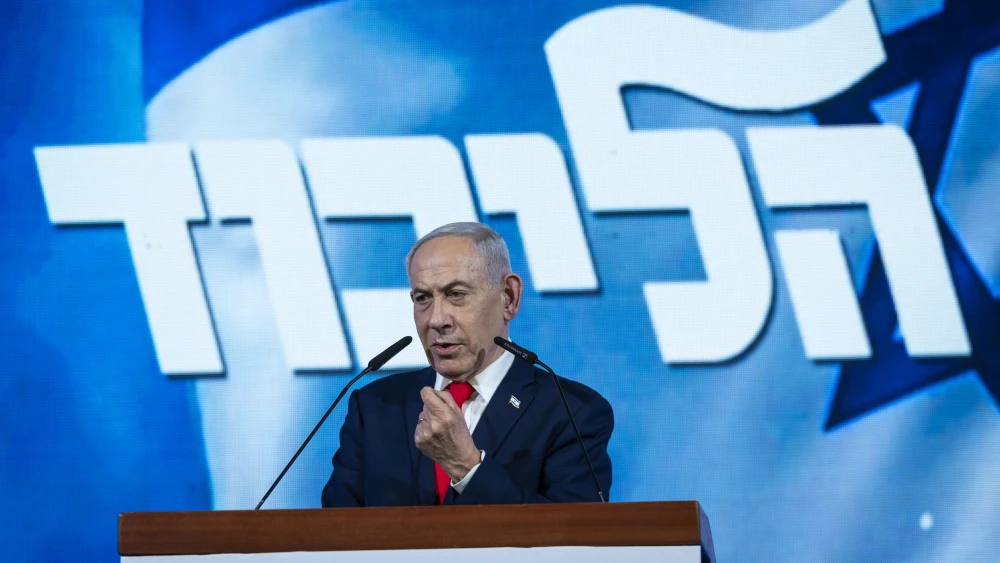 |
| Israeli Prime Minister Benjamin Netanyahu at his Likud party’s election headquarters at the Jerusalem International Convention Center following Israel’s general election, Oct. 28, 2026. Photo by Chaim Goldberg/Flash90. |
Israel’s Likud party on Saturday published its conditions for forming a national unity government, demanding an end to political boycotts of Israeli Prime Minister Benjamin Netanyahu and a public declaration committing not to form a government with parties it describes as supporting terrorism and opposing the country’s Jewish character.
The proposal calls for recognition of Israel as the nation-state of the Jewish people, rejection of Palestinian statehood, preservation of existing security arrangements in Gaza, Lebanon and Syria, and a broad agreement with Haredi leaders on the conscription status of Torah students.
After an agreement on these fundamental principles is settled, negotiations over a series of policies can start, among them Israel’s security policy and regarding the judicial and law enforcement systems, organized crime and governance in Arab communities, and an investigation into the events of Oct. 7, 2023.
Earlier on Saturday, Yashar leader Gadi Eisenkot instructed his party’s negotiating team to invite Likud representatives on Sunday for “marathon talks,” in a bid to reach an agreement over a national unity government.
Yashar in a statement described the decision as a “genuine and sincere effort to form the broadest possible government,” saying it is willing to “turn over every stone” and “enable bold moves.”
כחלק מהמאמצים לכינונה של ממשלה חדשה ומיצויו של כל ציר אפשרי, הנחה יו״ר ישר! גדי איזנקוט את צוות המו״מ של המפלגה להזמין את צוות המו״מ של הליכוד למרתון שיחות שיחל בפגישה שנקבעה בין הצוותים למחר (ראשון). זאת, כחלק מהמאמץ הכן והאמיתי להקים ממשלה רחבה ככל הניתן. צוות המו״מ של ישר! יפעל להפוך כל אבן, לאפשר מהלכים נועזים ולהביא לפריצת דרך שתוביל להקמת ממשלה.
— ישר! עם איזנקוט. (@yashar_eisenkot) November 21, 2026
Shortly after Yashar’s statement, former Prime Minister Naftali Bennett, leader of the B’Yachad party, said in a Facebook post that he is committed to ensuring that Netanyahu “is not the next prime minister of Israel, and that my party will not join him or his bloc under any circumstances.”
Bennett said that he remains committed to forming, “together with our partners, a government of reform led by Gadi Eisenkot.”
He then mentioned lawmakers Elisha Medan of Likud, who lost his legs in an explosion while fighting in Gaza in 2023, and Yonatan Shalev of B’Yachad, who founded “Shoulder to Shoulder,” an organization representing IDF reservists who advocate for an end to exemptions from military service.
Bennett stressed that if these two men could fight side by side in Gaza, “surely they can sit side by side in the government.”
“We must turn over every stone to form a Zionist unity government led by Eisenkot,” he continued. “I am not naive. The suspicion of Netanyahu is justified. For years, Netanyahu has deceived his partners and acted against them. That is why, in this case, Eisenkot would be at the helm.”
The former prime minister then laid out three principles for the government he is willing to join: establishing a state commission of inquiry into the Oct. 7, 2023, massacres, limiting prime ministers’ terms to eight years and enacting a “revolution of those who serve,” referring to equalizing the burden of military conscription.
Liberman: Netanyahu’s bloc must be broken up
Also on Saturday, Yisrael Beiteinu chairman Avigdor Liberman vowed once again not to join a coalition backed by Arab parties’ MKs, calling on his political partners to build a stable coalition with the ultra-Orthodox parties.
Those who truly want to put an end to Netanyahu’s rule in politics must understand that “the only way to do so is by breaking up his bloc,” Liberman tweeted in Hebrew.
“Netanyahu can only be replaced from the right, not from the left. Therefore, the only way to break up Netanyahu’s bloc is to form a coalition with Shas and United Torah Judaism,” Liberman argued.
He said that such a coalition would come with a political price, and he would be the first to pay it, having pledged in his political campaign to enlist Haredi men into the Israel Defense Forces, ending their decades-long draft exemption.
Liberman’s and Bennett’s conditions for joining the next government seem to be at odds, which places significant obstacles before Eisenkot’s effort to build a coalition. His 28-day period for forging the next government ends on Dec. 6. Israeli President Isaac Herzog can then extend his effort by another 14 days.
On Friday, Eisenkot said that talks were ongoing with the Haredi parties, which constitute one potential avenue toward forming a government.
The second avenue, he continued, involves “genuine” efforts in negotiations with Likud, but a wide gap exists between the latter’s rhetoric and what Netanyahu’s faction is actually willing to do.
“Nevertheless, I intend to give this track another chance. We must try to persuade Likud members to rise to the occasion,” Eisenkot said.
If these two avenues toward a broad-based government fail, he went on to say, he will resort to a “national emergency government—which I will work to expand before or after it is sworn in.”
This option would put the next government up for a Knesset vote of confidence, he explained.
The success of this route could depend on lawmakers from the predominantly Arab parties voting in favor of Eisenkot’s proposed coalition.
Jabareen: Joint List “ready and prepared”
Joint List chairman Yousef Jabareen stated that his party is “ready and prepared” to replace Netanyahu’s “bad government” as soon as possible.
He described the current moment as “historic,” saying that Jewish and Arab cooperation could bring about a new government.
Jabareen stressed that just as the opposition bloc cooperated with the predominantly Arab parties in the Knesset, voting to appoint interim committees and a new Knesset speaker, “we can continue working to bring down this bloodstained, neglectful government, even if there are gaps between us and even if we disagree.”
He added, “This is an emergency for our public and for the public as a whole.”
אנחנו נמצאים ברגע היסטורי. שיתוף הפעולה בין יהודים לערבים יכול באמת להביא להחלפת הממשלה הרעה הזו, שאנחנו רואים בה סכנה קיומית לחברה הערבית ולחברה בישראל כולה. לכן, אנחנו מוכנים וערוכים לאפשר את החלפת ממשלת נתניהו–בן גביר–סמוטריץ׳ בהקדם האפשרי. וזה אפשרי. כפי שהצלחנו לשתף פעולה בענייני הכנסת, אפשר להמשיך לפעול להדחת ממשלת הדמים וההפקרה, גם אם יש בינינו פערים וגם אם יש אי-הסכמות. וכך צריך להיות. זהו מצב חירום עבור הציבור שלנו ועבור הציבור כולו. אנחנו מוכנים גם לאפשר את הזמן הנחוץ כדי לתקן את מערכות המדינה, אחרי שנים קשות כל כך לכולנו. שנים של הרס, מוות, מלחמות וייאוש. אנחנו רוצים לתרום לתיקון ולשינוי המתבקשים. ואני רוצה להציע לכל האזרחים תקווה לעתיד טוב יותר. מגיע לנו. מגיע לכולנו.
— Yousef Jabareen (@DrJabareen) November 21, 2026
On Nov. 19, Jabareen spoke with Arabic-language Israeli-based outlet Panet, and said that the MKs of the Joint List are willing to support an Eisenkot-led government for the purpose of ousting Netanyahu.
Jabareen noted that the Joint List is not asking for ministerial roles, and will back the coalition from the outside, in the same manner in which the Yitzhak Rabin minority government in 1992 was backed by Arab factions that were not part of the coalition, according to Panet.
The chairman was also asked what would happen in the event that a war in Gaza or in Judea and Samaria were to restart under an Eisenkot government backed by his party.
Jabareen said that the Hebrew media keeps asking this question to “incite us.” He said that the Joint List’s position is clear, and calls for the cessation of hostilities and the implementation of the Trump administration’s initiative to rehabilitate Gaza, even though it has some reservations about it.
He added that Netanyahu is the one who is preventing the end of the war and further highlighted the problems facing Israeli Arabs, such as surging crime.
Natan Galula
Source: https://www.jns.org/news/israel-news/likud-sets-conditions-for-national-unity-government-with-eisenkot

No comments:
Post a Comment