Sunday, February 24, 2019

Stifling the National Security Debate: A Response to Shabtai Shavit - Maj. Gen. (res.) Gershon Hacohen

​
by Maj. Gen. (res.) Gershon Hacohen

Proponents of concessions and withdrawals are traditionally cast as guided entirely by professional considerations, while opponents of such ideas are dismissed as driven by ulterior motives and political agendas. This presentation is not only false but the inverse of the truth.


BESA Center Perspectives Paper No. 1,095, February 24, 2019

EXECUTIVE SUMMARY: In the public debate on Israel’s national security in general and a desirable Israeli-Palestinian settlement in particular, the dividing line between “political” and “professional” has been drawn by old elites and interest groups. Proponents of concessions and withdrawals are traditionally cast as guided entirely by professional considerations, while opponents of such ideas are dismissed as driven by ulterior motives and political agendas. This presentation is not only false but the inverse of the truth.

Former Mossad Director Shabtai Shavit dismisses my opinion piece “Benny Gantz’s Dangerous Ambiguity on West Bank Disengagement” as a political treatise undeserving of publication by an academic research institute. He derides the BESA Center for Strategic Studies, which published the paper and where I serve as a senior research associate, as “painted since its foundation by political colors in line with the number of its skullcap-wearing associates.” Had Shavit done his due diligence, he would have quickly learned that even by the parameters of his perverse logic, the BESA Center should be painted by quite different “political colors” given that over 80% of its research associates are not “skullcap-wearers.”

This mindboggling stigmatization notwithstanding, it is not the first time I have been accused of subordinating professional considerations to a political agenda. In a 2005 war game at the IDF’s General Staff, contemplating possible military responses to rocket/missile attacks from the Gaza Strip after the looming unilateral disengagement, I argued that the IDF’s operational maneuverability would be severely constrained and that decisions on operating in Palestinian territory across the border fence would be complex and difficult to make. I further maintained that the IDF would find it exceedingly difficult to respond effectively to Hamas missile attacks launched from densely populated areas. I was immediately accused of speaking “politically” rather than “professionally.” The same occurred three years later, when I told my fellow General Staff officers of my doubts about the IDF’s ability to defend Israel in the event of total withdrawal from the Golan Heights. The formula is clear: officers who downplay the security risks of territorial withdrawals do so on “professional” grounds; those who underscore the dangers attending such withdrawals are driven by “political” considerations.

There lies the crux of the matter. In the debate on Israel’s national security in general and a desirable Israeli-Palestinian settlement in particular, the dividing line between the “political” and the “professional” has been drawn by old elites and interest groups that exert overwhelming influence on the public discourse. Thus, proponents of concessions and withdrawals have long been cast as guided exclusively by professional considerations, while their opponents have been dismissed as driven by ulterior motives and political agendas. It is no coincidence that the piece that attracted Shavit’s mudslinging – free of rebuttal of a single fact or assertion – has been translated and thoroughly discussed by the influential Palestinian newspaper, al-Quds al-Arabi.

In reality, it is difficult to find national decisions – in the social, economic, political, educational, and security fields, among others – that are completely value-free and made on professional grounds alone. A medical prognosis is a strictly professional matter; public health policy decisions reflect a socioeconomic worldview and value system.

This in turn means that when former security officials justify far-reaching territorial concessions “because the preservation of certain values overrides the importance of land,” they do so from a clear political vantage point. As such, they have no intrinsic advantage over fellow citizens who hold a different view despite the manipulative substitution of a “professional” prognosis for a politically motivated view.

In these circumstances, Israelis must demand an open and critical public debate that takes the “assessments” and “recommendations” offered by former security officials for what they are: preconceived political views masquerading as impartial professional prognoses.


An earlier Hebrew version of this article was published in Israel Hayom on February 21, 2019.


Maj. Gen. (res.) Gershon Hacohen is a senior research fellow at the Begin-Sadat Center for Strategic Studies. He served in the IDF for forty-two years. He commanded troops in battles with Egypt and Syria. He was formerly a corps commander and commander of the IDF Military Colleges.

Source: https://besacenter.org/perspectives-papers/stifling-the-national-security-debate-a-response-to-shabtai-shavit/

Follow Middle East and Terrorism on Twitter


Putin to Join the Mullahs' Deception Club - Amir Taheri

​
by Amir Taheri

Russia is about to discover the duplicity that has marked the mullahs' diplomacy for four decades.

  • "Talk to Iran" was tried by successive US administrations, starting with Jimmy Carter's. In 1980, the mullahs signed an accord with Carter not to seize any more American hostages in exchange for unfreezing Iranian assets blocked by Washington after the 1979 capture of the US Embassy in Tehran. Yet, to this day, Iran has always held American hostages, and today is holding 14.
  • The Saudis helped Iran organize the Islamic Summit in Tehran, hoping to persuade the mullahs to become part of the normal world. They coordinated oil policies and, as a further sign of goodwill, granted Iran an unprecedented Hajj quota. The reward was the Khomeinist attack on Khobar and, later, the ransacking of the Saudi Embassy and consulates in Iran.
  • Now here is a scoop: Russia is about to discover the duplicity that has marked the mullahs' diplomacy for four decades. The Caspian Sea Legal Status Convention was just a piece of paper, signed to please Putin, who now can join the club of those deceived by the mullahs. There he would find Germany's Foreign Minister Heiko Maas, an enthusiastic novice.

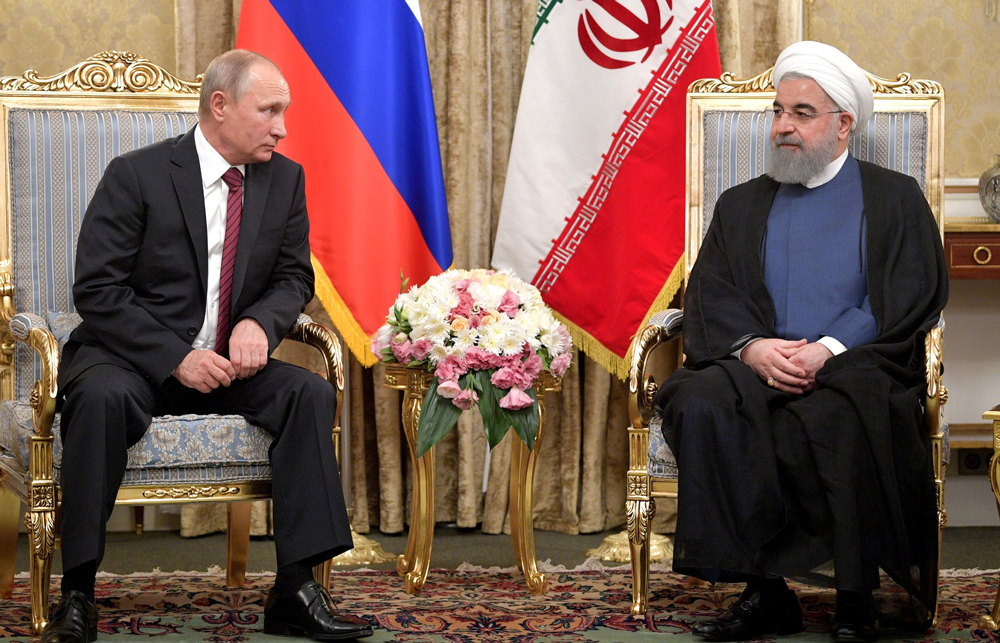
Russia is about to discover the duplicity that has marked Iran's diplomacy for four decades. The Caspian Sea Legal Status Convention was just a piece of paper, signed to please Russian President Vladimir Putin, who now can join the club of those deceived by the mullahs. Pictured: Putin meets with Iranian President Hassan Rouhani in Tehran, on November 1, 2017. (Image source: kremlin.ru)

"Talk to Iran!" This is the advice some Western politicians have bandied around since 1979, when the mullahs seized power in Tehran. The 40th anniversary of the Khomeinist regime has provided fresh opportunity for that slogan to be promoted again in the European Union and the United States.

The argument is that the alternative to "talk to Iran" is war, something which few would desire. It is also claimed that "talk to Iran" helps a never-defined "moderate reformist faction" to defeat "hardliners" in the power struggle that has raged in the Islamic Republic from the start.

I have exposed those claims as fallacious and need not repeat my arguments here. I thought to return to the topic because the new German Foreign Minister, Heiko Maas, repeated the "slogan" as if he were Columbus discovering the New World.

At the annual Munich Security Conference last week, Iranian Foreign Minister Mohammed Javad Zarif revived talk of "critical dialogue" to lead a debutant Maas up the garden path.

By the mid-1980s Hans-Dietrich Genscher's "critical dialogue" had morphed into a process in which the Europeans and the mullahs came together to criticize the United States. In Genscher's "dialogue," the mullahs promised not to conduct terrorism in Europe. They broke their pledge by launching attacks, including assassinations, in Austria, France, Britain, Germany, Italy and Switzerland. They also promised not to seize more European hostages, but went on doing so regardless. Since then hardly a day has passed without the mullahs holding some European hostages.

"Talk to Iran" was also tried by successive US administrations, starting with Jimmy Carter's. In 1980 the mullahs signed an accord with Carter not to seize any more American hostages in exchange for unfreezing Iranian assets blocked by Washington after the 1979 capture of the US Embassy in Tehran. Yet, to this day, Iran has always held American hostages, and today is holding 14.

Western powers aren't alone in having tried the "talk to Iran" formula in the hope of forging a modus vivendi with a regime that, because it is not at peace with its own people, cannot be at peace with anyone else. At one point, the Saudis tried to improve ties with the Khomeinist regime.

They helped Iran organize the Islamic Summit in Tehran, hoping to persuade the mullahs to become part of the normal world. They coordinated oil policies and, as a further sign of goodwill, granted Iran an unprecedented Hajj quota. The reward was the Khomeinist attack on Khobar and, later, the ransacking of the Saudi Embassy and consulates in Iran.

Turkey had a similar experience. It created a security commission with Iran and closed its borders to Iranians fleeing to exile. Iranian opposition figures were expelled or, in some cases, left to be kidnapped by hit squads from Tehran.

Turkey also became a major element in Tehran's sanctions-busting operations. The mullahs repaid Turkey by granting the Kurdistan Workers' Party (PKK) bases in the Qandyl Mountain region just inside the Iranian border. They also created a Turkish branch of Hezbollah, smashed by the Turks a decade later.

The "talk to Iran" slogan reached a summit with the so-called "nuclear deal".

To concoct it, President Barack Obama circumvented the United Nations Security Council, ignored the Nuclear Nonproliferation Treaty (NPT), and sidelined the International Atomic Energy Agency (IAEA), to produce something tailor-made to please the mullahs.

As a further sweetener, he also smuggled cash to Tehran. And yet, by the time Obama left the White House, the mullahs had not fulfilled their commitments under the "historic deal."

Some analysts affirm that the mullahs wouldn't dare treat Russia in a cheat-and-retreat way because Russians are not so easily fooled. To back that view, they cite an incident in Beirut in 1984, when Tehran ordered Hezbollah agents to capture four Russian hostages to punish Moscow for its support for Saddam Hussein.

The narrative is that the Russians called Ayatollah Ali-Akbar Mohtashami-pour, Khomeini's ambassador in Damascus, who was also the founder of the Lebanese Hezbollah, and made him an offer he couldn't refuse: Release the Russian captives or we'll seize four hostages from your staff!

Not desiring a taste of their own medicine, the mullahs relented and Russian hostages were released. Now here is a scoop: Russia is about to discover the duplicity that has marked the mullahs' diplomacy for four decades.

Last August, President Hassan Rouhani signed the Caspian Sea Legal Status Convention, a text written by Moscow to give Russia a monopoly on military presence in the inland sea. President Vladimir Putin hailed that as a major victory for Russian diplomacy. However, it is now clear that the mullahs have put their machinery of deception in high gear to do to Putin what they did to many American, European, Turkish and Arab leaders.

To start with they refused to present the "convention" to the Islamic Majlis, the ersatz parliament, as a draft law to secure its legal status, something that the other littoral states, Russia, Kazakhstan, Turkmenistan and Azerbaijan have done. The foreign ministry has also withdrawn a Persian translation of the text, promising a more accurate version.

This week the Iranian Foreign Ministry's legal department declared that the "convention" Rouhani signed becomes "operational only after all littoral states have established their borders in territorial waters", a process that could take years.

According to Reza Nazar Ahari, Iran's point man on Caspian Sea issues, negotiations would be held two or three times a year in the five littoral capitals until agreement is reached.

Speaking in Baku, Azerbaijan, Ahari insisted that a common Caspian space, beyond territorial waters, should be established in which activity is possible only with the unanimous approval of littoral states.

Russian military monopoly is made conditional on agreements that may never be reached.

In other words, the "Convention" was just a piece of paper, signed to please Putin, who now can join the club of those deceived by the mullahs. There he would find Heiko Maas, an enthusiastic novice.

This article was originally published by Asharq al-Awsat

Amir Taheri was the executive editor-in-chief of the daily Kayhan in Iran from 1972 to 1979. He has worked at or written for innumerable publications, published eleven books, and has been a columnist for Asharq Al-Awsat since 1987.

Source: https://www.gatestoneinstitute.org/13789/putin-iran-deception

Follow Middle East and Terrorism on Twitter


The Plague of Anti-Semitism Spreads in France - Michael Curtis

​
by Michael Curtis


Radical surgery is essential to correct the severe cancerous threat to society in France as elsewhere.

The disease of anti-Semitism is not new to France, and it has been spreading. But a new threshold in response to it was set by the displays of outrage as a result of the verbal assault on Alain Finkielkraut, a well known intellectual who was walking on the Boulevard du Montparnasse in Paris on February 16, 2019. The perpetrators were a small group, members of the gilets jaunes, the yellow vest movement. The main suspect is a salesman from Mulhouse in eastern Alsace. The group shouted at Finkielkraut, in non-academic terms, "Dirty Zionist s---" and "Go back to Tel Aviv" and "France belongs to us," among other choice expressions. 

Alain Finkielkraut is a 69-year-old Jewish philosopher, an eminent man of letters, and a public intellectual — a distinguished academic, since 2014 a member of the Académie Française, the prestigious council of 40 concerned with matters related to the French language. Contrary to the fabrications of the yellow vest attackers, he was born in Paris, though his father was a Polish Holocaust-survivor of Auschwitz. Ironically, Finkielkraut initially supported the Y.V. movement when it started two months ago, but then he criticized its members for destruction without regard for anyone or anything. 

Finkielkraut emerged in public in the May 1968 student revolt and in 1987 with his book, The Defeat of the Mind, that was critical of postmodern philosophy and cultural relativism. He is a controversial figure, appearing on TV, writing articles for prominent newspapers, and giving interviews, known as an opponent of mass migration into France, a critic of multiculturalism, and a defender of the West. He is a concerned with Jewish identity in postwar Europe and is a strong advocate of Israel. Since he was addressed by the Y.V. attackers as a "dirty Jew," the Paris prosecutor is inquiring whether this is a crime, a public insult related to origin, ethnicity, race, or religion.

Finkielkraut is not the only prominent Jewish figure to be assaulted. Another was Simone Weil, survivor of Auschwitz and Bergen-Belsen, French minister of health, proponent of women's legal rights, advocate of legislation for abortion in 1975 and for a ban on smoking, president of the European Parliament, appointed to Académie Française in 2008. She is the fifth woman in history to be given, in July 2018, a burial in the Pantheon in Paris. Swastikas were painted on public postboxes that had her face on them. 

On February 18, 2019, a group of French members of the National Assembly introduced a bill to make anti-Zionism a criminal offense in the same way that anti-Semitism is illegal in France. This touches on a controversial issue. For many years, critics of the State of Israel or its actions or political figures have argued that such criticism is appropriate and that conflating this with anti-Semitism is misguided. Others have responded that though criticism of Israeli actions or policies is legitimate, calls for the destruction of the State and espousers of BDS can be regarded as a manifestation of anti-Semitism. 

Central to the issue is the accurate and acceptable definition of the disease of anti-Semitism. A valuable, if still controversial, working definition has been provided by the IHRA, the International Holocaust Remembrance Alliance, a group of 31 countries. It started in October 2013 as a statement on Holocaust denial and discrimination, followed at a meeting in Bucharest on May 26, 2016 by a fuller definition of anti-Semitism. All parties agree that anti-Semitism is a certain perception of Jews which may be expressed as hatred toward them. All can also agree that criticism of Israel similar to that leveled against any other country cannot be regarded as anti-Semitism. 

The basic problem is that not all parties agree that a double standard exists for many countries and organizations by requiring of Israel a pattern of behavior not expected or demanded of any other democratic nation. The significant, though controversial, contribution of the IHRA to the definition is that anti-Semitism includes targeting the State of Israel conceived as a Jewish collectivity. Because of the international incessant condemnation of Israel, anti-Zionism is one of the modern forms of anti-Semitism. The IHRA declaration is not legally binding, but it is a guideline, and one that was accepted by Britain and Germany in 2016.

It was also accepted by President Macron on February 20, 2019. "We must name the evil: anti-Semitism is hiding behind the mask of anti-Zionism. The time has come for action." Macron acted immediately by declaring no toleration of anti-Semitism, ordering the French Interior Ministry to dismantle three neo-Nazi groups. He visited the Holocaust memorial in Paris. Macron responded immediately to the attack on Finkielkraut, asserting that the anti-Semitic insults are the complete negation of "who we are" and what makes France a great nation. Anti-Semitism is a repudiation of the Republic. Other prominent public figures followed his example: François Hollande and Nicolas Sarkozy joined the demonstration of thousands of people in the Place de la République in Paris, who displayed banners with Ça suffit (that's enough). 

Macron denounced the unacceptable increase in acts and hate speech, which he linked to the recent wave of demonstrations against his government, by the yellow vest rallies. Anti-Semitism is not a slogan of the Y.V. movement, but there are extremists among its members responsible for racist and anti-Semitic remarks, as well as attacks on legislators. It is sad that some in the Y.V. movement believe in a Zionist plot or conspiracy. In a sense, their behavior resembles that of the black American actor Jussie Smollett, charged in Chicago on February 21, 2019 with filing a false report that he was attacked for racial reasons. In both cases, the perpetrators took advantage of justifiable anger at expressions of racism and existing discrimination to spread their message of hate.

More attention is now being paid in France to anti-Semitism, which Christophe Castaner, minister of the interior, says is spreading like a poison. In 2018, there were 641 anti-Semitic acts and threats, an increase of 74% from 311 in 2017. 

A few can be mentioned. Graves, more than 90, of Jews were vandalized with swastikas in the cemetery in the small village of Quatzenheim, a village near Strasbourg. Macron, wearing a skullcap, attended a ceremony at the gravesite. 

Among the more egregious previous anti-Semitic attacks in 2012 were the killing of four people, a rabbi and three children, in the Jewish school in Toulouse in southwest France, and the murder of Ilan Halimi, a 23-year-old phone salesman, of Jewish Moroccan ancestry, who was kidnapped and tortured for three weeks in 2006 and died from burn injuries on the way to the hospital. A tree planted in his memory in the Paris suburb of Sainte-Geneviève-du-Bois was chopped down. On February 19, 2019, two teenagers were arrested after firing, by air rifle, at a synagogue in the Paris suburb of Sarcelles. The next day, February 20, two swastikas accompanied by a phrase denying the Holocaust were painted on a monument in a Jewish cemetery in Champagne-au-Mont-d'Or, near Lyon.

You don't have to be Jewish to like bagels, but a bagel factory, of the Bagelstein chain, in the east of Paris, in the Ile Saint-Louis district, was defaced with the word "Juden" in German painted in yellow across the window. It is unclear whether the color referred to the Y.V. movement or to the Star of David arm bands Jews were forced to wear by Nazi Germany. 

French politicians have asserted that anti-Semitism is deeply rooted in French society. The country is familiar with attacks on Jews and Jewish institutions by political extremists and Islamists, but the link to the yellow vests came as a surprise.

The disease of anti-Semitism may be turning into a plague. We must recognize, as Albert Camus, wrote in The Plague, that the next plague will "rouse up its rats again." Radical surgery is essential to correct the severe cancerous threat to society in France as elsewhere.

Michael Curtis

Source: https://www.americanthinker.com/articles/2019/02/the_plague_of_antisemitism_spreads_in_france.html

Follow Middle East and Terrorism on Twitter


Chipping away at the status quo - Nadav Shragai

​
by Nadav Shragai

-- unless something happens to reverse the narrative, the Palestinian gambit comprises another step in their yearslong campaign to chip away at the status quo on the Temple Mount

Palestinians in Jerusalem achieved the victory they had been longing for on Friday: Muslim worshippers crowding into the Golden Gate area of the Temple Mount, which has been under a closure order since 2003 because of Hamas activity there.

The police, who accepted the reality in order to avoid widespread, violent clashes, did carry out dozens of arrests, but unless something happens to reverse the narrative, the Palestinian gambit comprises another step in their yearslong campaign to chip away at the status quo on the Temple Mount, mostly for the benefit of the Palestinians and to the detriment of the Jews. Two new mosques have been built at Solomon's Stables and at the site of the ancient Al-Aqsa mosque; restrictions on when and where Jews are allowed to visit the Mount; and almost no enforcement of planning and construction and antiquities laws for years. Now they have focused on the Golden Gate.

The latest calculated move was initiated by the waqf council in its new, more radical makeup, which now includes Sheikh Ikrama Sabri, a former mufti of Jerusalem and now a Muslim Brotherhood member and an ally of Turkish President Recep Tayyip Erdoğan and Sheikh Raed Salah, leader of the outlawed Northern Branch of the Islamic Movement. Other than Sabri, the new expanded council includes a number of officials from the Fatah movement and the Palestinian Authority.

This is a bad turn of events for Israel. The Jordanians have installed opponents of Israeli hegemony on the Temple Mount on the waqf council, the Jordanian administrative body that oversees the Temple Mount and its mosques. There is one goal behind this: to make it clear to the U.S. and Israel that they will not agree to their status on the Mount, which is anchored in agreements with Israel, being reduced. What frightened the Jordanians and prompted them to take this unusual step were reports that U.S. President Donald Trump's peace plan, which also touches on the status of Jerusalem, calls for pan-Islamic management of the Temple Mount in which additional Arab countries – including Saudi Arabia – would participate. Saudi Arabia already controls the holiest two places in Islam, the cities of Mecca and Medina.

The target for the Jordanians' message is the area around the Golden Gate, which has already been the site of conflict. The police put an end to illegal Muslim burials outside the gate, and there were also tussles with the Israel Antiquities Authority about what would happen to the ancient wooden beams near the Golden Gate, some of which date back to the First and Second Temple periods, which were removed from the roof of Al-Aqsa mosque after it was leveled by an earthquake in 1927. These beams had been lying near the Golden Gate for years, vulnerable to the elements.

Jerusalem got the message but it seems as if it's too late. The new waqf council and Hamas are spreading lies about Israel planning to build a synagogue at the Golden Gate. They are determined to annex the area to the Muslim prayer area of the Mount, which is constantly being expanded. The first battle, which took place on Friday, went to them. We can expect another round.


Nadav Shragai

Source: http://www.israelhayom.com/opinions/chipping-away-at-the-status-quo/?redirected=344397

Follow Middle East and Terrorism on Twitter


AIPAC is being irresponsible - Dror Eydar

​
by Dror Eydar

For the sake of its important work, the lobby – which is not the American Jewish community – must refrain from making an ill-informed leap into Israeli politics, especially at such a sensitive time.

First of all, the American Israel Public Affairs Committee is not the American Jewish community. It is a Jewish-American lobby. In comparison, the organizations that actually represent the Jewish community have thus far refrained from intervening in Israeli elections or politics, especially at such a sensitive time. In the past few days, we have witnessed a concentrated attack by most of the Israeli media, which of course affects the disinformation that American Jewry receives. We aren't talking about an ideological partnership with the far Right but rather a legitimate ad hoc merger to establish a bloc that can prevent the Left from taking power. Immediately after the election, members of Otzma Yehudit intend to separate from Habayit Hayehudi-National Union and join the opposition. So if AIPAC doesn't want to meet with Otzma Yehudit, they shouldn't meet with them. What does it matter to us? Unwittingly, AIPAC is irresponsibly playing into the hands of elements in the media and the Israeli political system who want to attack the Right. For the sake of their important activity, they mustn't jump into the Israeli political morass.

But it's hard to ignore the supposedly moral disgrace that has been heaped upon us. For years, all the coalition math by the Left included the radical, pro-Palestinian Left. This included the Arab parties that are working to eradicate the Jewish character of Israel, claiming that it is "racist"; MKs that encourage an international boycott of their country and support the policies of Palestinian Authority President Mahmoud Abbas, who compensates those who murder Jews and increases the payments based on how horrific the killings are. Where has AIPAC been? Why haven't we heard them preaching morality to the Israeli Left for those alliances? In the 1999 election, Ehud Barak took part in a conference with Sheikh Raed Salah, who even them rejected Israel's right to exist, and not surprisingly, the morality glands of the leftist media failed to secrete. Let us remember that the government of Yitzhak Rabin, which brought us the blood accords in Oslo, was established based on a similar alignment of left-wing blocs.

It's lucky that Otzma Yehudit leader Itamar Ben-Gvir exists; otherwise, whom would we accuse of being far right? Thus far, MK Bezalel Smotrich has had the role, and until not too long ago it was Moshe Feiglin, and even Prime Minister Benjamin Netanyahu has been called a "Kahanist" by the Haaretz newspaper. What a disgrace. And Saturday evening, the poet Yitzhak Laor, who writes for Haaretz, posted to Facebook, calling journalist Amit Segal "Adolf Hitler"!  That is the standard discourse with these guys; the way they see it, we're all Kahanists.

This fuss should show the various facets of the Right that once and for all, they must smash the equation of the enslaved, according to which the Left dictates the limits of the Right's legitimacy while failing to apply the same moral standards to itself. We don't live by their orders and they certainly have nothing to teach us when it comes to morality.

I'll say it again: I was the only Israeli journalist who wrote in this paper against the sanctions taken against Joint Arab List MK Hanin Zoabi following the Mavi Marmara flotilla – Israeli democracy is strong enough to contain her, I wrote. I also objected to disqualifying the Balad party from running in the election. It is even more vital to object to the total rejection of the radical Right. We can cooperate with them on certain things and there are things they do that we must oppose. The Left is expert at disqualifications and boycotts but the Right is directed to be cautious and address the issue rather than the person.


Dror Eydar has been appointed Israeli ambassador to Italy.

Source: http://www.israelhayom.com/opinions/aipac-is-being-irresponsible/

Follow Middle East and Terrorism on Twitter


Climate Science, Red in Tooth and Claw: Yapping Hyenas Attack a Lion - Norman Rogers

​
by Norman Rogers

What everyone may not know is that climate science is an industry, and the product is the global warming scare.

William Happer is one of the most important scientists in the United States. He is an emeritus professor of physics at Princeton and a long-serving adviser to the federal government. His scientific discoveries and inventions are extensive. Currently, he serves in the White House as a senior adviser to the National Security Council.

The Trump administration is thinking of forming a "Presidential Committee on Climate Security." The press has been told to direct questions to Dr. Happer. That is enough to bring out the climate hyenas. They can't stand the thought that Trump might have some solid scientific advice concerning climate change. The hyenas are running an all-out attack against Dr. Happer.

Following Alinsky's Rules for Radicals, the camp followers of the global warming industry try to create polarization. In a Time magazine article, a former admiral says Happer is a fringe figure. A climate scientist at Georgia Tech says Happer has "false, unscientific notions." We are reassured that the global warming scare is absolutely solid science, as everyone except climate deniers knows.

What everyone may not know is that climate science is an industry, and the product is the global warming scare. If the global warming scare is discredited, the huge industry will collapse. Climate scientists used to be unimportant academics in an unimportant academic field. The global warming scare made them into celebrities jetting around the world. They won't give up the glory without a fight.

Climate computer models, the basis of the doomsday predictions, disagree with each other and disagree with the climate of the Earth. But according to the climate science mafia, anyone who brings up such embarrassing information is a tool of the fossil fuel industry. As far as the climate mafia is concerned, the business plan of the fossil fuel industry is to wreck the Earth and wreck the global warming industry. The reality is that the fossil fuel industry is wimpy and not inclined to take on the global warmers.

Climate science has gone off the rails. President Eisenhower nailed the problem in his 1961 farewell address. He expressed the fear that because science had become heavily dependent on federal financial support, scientists would color the science in order to increase the flow of federal money. Nothing works better for increasing the flow of federal scientific money than predicting a future disaster. If scientists predict a disaster, we have to give them more money to research methods of preventing the disaster.

Since Eisenhower's address, we have been treated to a parade of scientific doomsday predictions, none of which measured up to the hype. There was global cooling that preceded global warming. There were acid rain, DDT, the ozone layer, overpopulation, and many others. It is not only scientists who use a parade of disaster predictions. Environmental organizations need doomsday predictions, too, in order to keep their members interested. The press has a bias for sensationalism, so it too promotes the latest doomsday predictions.

Many professions are supposed to adhere to high ethical standards. For example, lawyers are supposed to put the interests of their clients above their own interests. Doctors are supposed to put their patients' welfare above their own pecuniary interests. Journalists are supposed to be objective and not color their work with their own political preferences. We know that not every professional adheres strictly to his ethical code. Scientists are not different. They are supposed to search for scientific truth and to exercise objectivity in their work. They are not supposed to hype weak theories in order to improve their professional standing. But these things happen.

Most scientists are not in a position to contradict global warming hype. Science is a profession characterized by ideological schools and groupthink. Groupthink is worst in sciences where the rules are not clear and the data are confusing — for example, climate science. Young scientists depend on older, more senior scientists for recognition and promotion. They are in no position to contradict groupthink. They have families to feed. The senior scientists may be running large scientific enterprises financed by federal money. To express doubts about the mission or the truth of the groupthink would be to threaten their money and the jobs of people in their organization.

The consequence of the groupthink atmosphere is that dissenters come from the ranks of scientists removed from the pressure to conform — for example, retired scientists, amateur scientists, and scientists so accomplished as to be immune to threats and group pressure. There are thousands of such scientists who are skeptical of the global warming hype. When they speak out, they are attacked, and the attacks are usually vicious. The members of the global warming establishment will almost never debate skeptics. When this was done years ago, the skeptics were too credible.

Science is great, and our modern world is a product of science. But scientists are humans, not gods. They play the same games that other beneficiaries of federal money play. We have been fooled over and over again by fake predictions of disasters or one sort or another. The fake predictions are never completely fake. There is usually some real science buried in all the hype. For example, it is reasonable to expect that some global warming might be caused by adding CO2 to the atmosphere. What is probably a modest effect has been twisted and exaggerated into a doomsday scenario that demands that we save the planet. The good effects of CO2 that are well known and that are solid science are ignored. Increasing CO2 in the atmosphere makes plants grow better with less water. Greenhouse-operators use CO2-generators in their greenhouses. CO2 is greening deserts. How often to you hear about these benefits of CO2?

DDT was banned because it supposedly thinned birds' eggs and perhaps because some people screamed cancer. But DDT is highly effective against mosquitos that cause malaria. The World Health Organization finally lifted the ban on DDT because thousands of children were dying in Africa. DDT will never be rehabilitated in the U.S. because the propaganda has been permanently imprinted in the minds of the populace.

Science has created institutions that serve to enhance the image of science. For example, peer review often degenerates into pal review. Scientific journals are often filled with papers of dubious value generated by a system that values quantity over quality. The National Academy of Science pretends to give objective advice to the government, but often the advice is to appropriate more money for science.

Typically, when science invents a new doomsday theory, the environmental organizations embellish it with unscientific flourishes. The scientist inventors of the theory don't correct the environmental organizations because that would slow the momentum toward a new surge of federal money. That should be an ethical violation. Scientists should have a duty to set the record straight in such circumstances.

There is no simple solution to the parade of doomsday theories. It would help if the government understood better that throwing more money at an alleged problem may exaggerate rather than alleviate the problem. Massive spending may not solve difficult scientific problems, but massive spending always creates bureaucracies that exist to sustain the spending.

Norman Rogers is the author of the book Dumb Energy: A Critique of Wind and Solar Energy.

Source: https://www.americanthinker.com/articles/2019/02/climate_science_red_in_tooth_and_claw_yapping_hyenas_attack_a_lion.html

Follow Middle East and Terrorism on Twitter


Gallup: Liberals outnumber conservatives in only 6 states despite media blitz against the right - Rick Moran

​
by Rick Moran

What is the real data regarding the proportion of liberals vs. conservatives?

You could be forgiven if you thought that the media onslaught against conservatives the last few years would have an effect on how most of the country views the right.

That media campaign - directed against Donald Trump but also against conservatives - has been unprecedented in its scope and intensity. Conservatives are routinely portrayed as racist, sexist, homophobic, anti-Muslim, and paranoid xenophobes.

But Gallup found some remarkable conservative strength all across the country. Their latest survey shows that liberals outnumber conservatives in only 6 states and that there are 25 states where conservatives are polling above their national average.

Washington Examiner:
The number of states where liberals outnumber conservatives has dropped more than 30 percent, with just six now in that category: Massachusetts, Hawaii, Vermont, Washington, New York, and New Hampshire.
According to the latest Gallup survey, in every other state but California, where conservatives and liberals split 29 percent to 29 percent, conservatives lead.
Nationally, those who identify themselves conservative hold a nine-point lead.
The map is telling:


“The residents of most U.S. states are more likely to identify as conservative than as liberal in their political ideology. In 25 states, the conservative advantage is significantly greater than the national average, including 19 ‘highly conservative’ states in which conservatives outnumber liberals by at least 20 percentage points,” said Gallup.
Translating those numbers into political power is a different matter. The right's problem is that big states are mostly less conservative or about average. Even Texas is about 50-50 conservative vs. moderate/liberal. In a national election, that matters and Trump's razor thin victory in several large midwestern states in 2016 negated some of that Democratic advantage. Can he do it again? He certainly has a shot given that Wisconsin, Michigan, Ohio, and Pennsylvania are all still very competitive for the right.

This map is also a warning to Democrats. If they insist on pushing Medicare for all, the Green New Deal, and reparations for slavery, they will probably get buried in 2020. If Ocasio-Cortez and the radicals continue to gain strength and influence in the Democratic party, it will lead to a Republican rout.

Rick Moran

Source: https://www.americanthinker.com/blog/2019/02/gallup_liberals_outnumber_conservatives_in_only_6_states.html

Follow Middle East and Terrorism on Twitter


War will likely rise from the south - Prof. Eyal Zisser

​
by Prof. Eyal Zisser

Palestinian Islamic Jihad, operating out of Gaza, has chosen to put its fate in Iran's hands, which is uncustomary not only in the Palestinian arena but in the entire Sunni world.

In his speech at the Munich Security Conference last week, Iranian Foreign Minister Mohammad Javad Zarif warned that the risk of war with Israel was greater than ever. This remark shouldn't be taken lightly, even when it comes from a position of weakness and distress. After all, Zarif launched his warning, or threat rather, amid the backdrop of Iran's severe economic crisis, and it is part of Tehran's efforts to exacerbate the growing rift between Europe and the Trump administration over the international community's approach to the Iranian threat.

Europe, as we know, believes in conciliation (only when it comes to dictators, of course), while the Americans want to amplify the pressure – strictly economic for now – on Iran.

Furthermore, we should note that Zarif, along with his boss, Iranian President Hassan Rouhani, are not in the inner circle of Iran's true decision makers when it comes to the country's national security, foreign subversion, and terrorist efforts. These questions are discussed and answered by Iran's supreme leader, Ayatollah Ali Khamenei, together with the commanders of the Islamic Revolutionary Guard Corps, who do as they please without heeding Rouhani or his foreign minister. It could very well be that Zarif, perhaps fearing the direction things are going, is actually warning the international community about the intentions of his superiors.

Either way, it appears that Washington's pressure on Iran is working, to the chagrin of Europe. In Syria, the Iranians are temporarily pulling their forces away from the Israeli border, although they have not conceded their strategic goal of establishing a foothold there and turning the war-torn country into a forward base of operations against Israel.

In Lebanon, too, Iran's local client, Hezbollah, has seen better days. The economic crisis in Iran is eroding support for the organization even among Shiites. Regardless, they don't want another war with Israel that is sure to be just as devastating, or even more so, than the previous one. In his recent speeches, Hezbollah leader Hassan Nasrallah has looked like someone whose prime has passed. It isn't surprising that Israeli journalists are the only one paying attention to him anymore, and even they are dubious about his performances. Indeed, even Nasrallah can fool some of the people all of the time, and all of the people some of the time, but he cannot fool all of the people all the time.

The only arena where there is a real concern of violence or even conflagration is the Gaza frontier. The IDF, it was reported last week, believes Hamas could ignite the flames along the border and beyond, in an effort to improve its negotiating position and perhaps spur international intervention forcing Israel to allow money and other aid into Gaza. The resurgence of border riots and the recent trickle of rockets from Gaza into Israel are a testament to this assessment.

It appears that the understandings, reached on the basis of allowing Qatari cash into Gaza, have rather crumbled and failed to facilitate peace and quiet. While protection money can buy temporary quiet, it always awakens the appetite for more money.

In this case, too, Hamas is speaking but Iran is pulling the strings. Hamas has good reasons to spark flames, even at a low intensity, because it wants to improve its negotiating position. Palestinian Islamic Jihad, on the other hand, is fanning the flames under the encouragement and perhaps even orders of Tehran. This terrorist organization has chosen to put its fate in Iran's hands, which isn't only uncustomary in the Palestinian arena but the entire Sunni world.

The Palestinian Authority feared confronting Hamas back in the day, for which it lost control of Gaza. Hamas, too, could come to learn that its attempts to dance at two weddings – on the one hand to reach understandings with Israel and on the other to escalate tensions along the border, either on its own or through Islamic Jihad – will only strengthen the rival group and make it a far more significant force; perhaps one that could even compete with Hamas.

Consequently, it appears we will not have peace and quiet on the Gaza border. The coming months, before Israel's general election in early April and after, will continue to see rising tensions, outbreaks of violence and concerns of an impending all-out conflagration.


Prof. Eyal Zisser is a lecturer in the Middle East History Department at Tel Aviv University.

Source: http://www.israelhayom.com/opinions/war-will-likely-rise-from-the-south/

Follow Middle East and Terrorism on Twitter


Lebanese Philosopher Dr. Ali Harb: We Need To Change How We See The World - MEMRI

​
by MEMRI

Dr. Harb said that the Arab world does not produce knowledge or participate in the creation of civilization and added that Arabs needs to change the way they think, see the world, and deal with their heritage and religion.

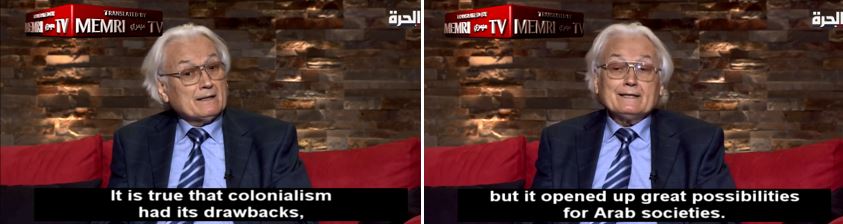
Lebanese philosopher Dr. Ali Harb was featured in a two-part series on Al-Hurra TV (U.S.) that aired on February 3 and 10, 2019. He said that while colonialism had its drawbacks, it created great opportunities for the Arab world and Arab societies to join modernity and emerge out of the Middle Ages. He said that Pan-Arabism, left-wing thought, and other ideologies caused an overall decrease of freedom in Arab societies relative to the era of liberalism and enlightenment, and that the return of religion brought about the hijab, civil wars, the age of terrorism, and the return of colonialism. Dr. Harb said that the Arab world does not produce knowledge or participate in the creation of civilization and added that Arabs needs to change the way they think, see the world, and deal with their heritage and religion.
To view the clip of Dr. Ali Harb on MEMRI TV, click here or below.


"It Is True That Colonialism Had Its Drawbacks, But It Opened Up Great Possibilities For Arab Societies"

Dr. Ali Harb: "The Arab world wanted to be liberated from colonialism. What was the result, 200 years later? Religion has made a barbarous comeback.


[...]

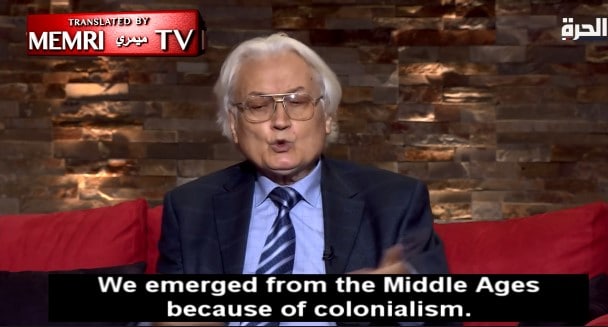
"All of us – our ideology, our clothes, and our new values – are the fruit of modernity. It is true that colonialism had its drawbacks, but it opened up great possibilities for Arab societies. It gave them the opportunity to join modernity, ever since Napoleon arrived in Egypt, and ever since the first publishers arrived at Mount Lebanon... So today, we are the fruit of the modern world. We emerged from the Middle Ages because of colonialism.


[...]

"The best era of the Arab world was the age of revival, enlightenment, and liberalism.

[...]

"So when the ideological era arrived – be it the Pan-Arabs, the left wingers, or whatever... The level of freedom declined compared to the days of Taha Hussein."

[...]

"We Need To Change The Way We Think And The Way We See The World, We Need To Change Our Way Of Dealing With Our Heritage And Religion... I No Longer Define Myself By A Religious Label"

Interviewer: "The terrorism emerged from within us. The ideology and heritage is ours. [The West] has exploited it all, but that's a different story. We cannot exculpate ourselves and say that it is all made in America or the West."


Dr. Ali Harb: "The return of religion invited Western colonialism and the superpowers back. It brought about the return of the hijab, drowned us in civil wars, and established the age of terrorism.

[...]

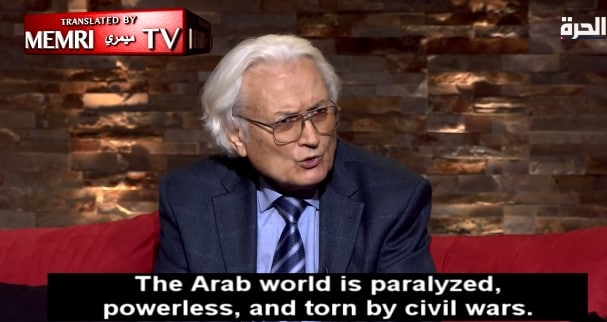
"The Arab world is paralyzed, powerless, and torn by civil wars."


Interviewer: "By God, it is more contemptible than that."

Dr. Ali Harb: "It does not produce knowledge or participate in the creation of civilization by generating knowledge and technology – unless one lives in a European country, where he can be more productive."

Interviewer: "So what is the solution?"

Dr. Ali Harb: "First of all, we need to change the way we think and the way we see the world. We need to change our way of dealing with our heritage and religion. I, for example, started with myself. I no longer define myself by a religious label."


MEMRI

Source: https://www.memri.org/reports/lebanese-philosopher-dr-ali-harb-colonialism-brought-arabs-out-middle-ages-modernity-we-need

Follow Middle East and Terrorism on Twitter


Iran: Mounting Persecution of Christians - Majid Rafizadeh

​
by Majid Rafizadeh

What will it take for these endlessly preening moralists to act against those human rights violations?

  • "We created a people's army to defend the country and also help in emergencies, but it turned into a monster." — Mohsen Sazegara, on the Islamic Revolutionary Guard Corps, which he helped establish.
  • Under international law, the Iranian government has an obligation to respect freedom of religion. Yet, while the rights of Christians are being violated in Iran at an unprecedented level, how long will the international community remain silent?
  • What will it take for these endlessly preening moralists to act against those human rights violations?

One objective of the violations against Christians by Iran's Islamic forces seems to be to threaten and intimidate the entire Christian community, whose ancestors have lived in this country for thousands of years, to flee in fear of imprisonment, torture and death. Pictured: St. Mary's Church in Khuygan-e Olya, Isfahan Province, Iran. (Image source: Arteen Arakel Lalabekyan/Wikimedia Commons)

The persecution of Christians in Iran in 2018 increased to a new level, according to an in-depth report jointly released by Open Doors, Middle East Concern, Article 18, and Christian Solidarity Worldwide.

"The end of 2018 saw an unprecedented wave of raids on private house gatherings, leading to a large number of arrests. Many Christians received prison sentences, or had sentences upheld by the Court of Appeal," noted the report.

Despite this roaring abuse, and violations and attacks against Christians being significantly ratcheted up, the international community continues to label the Iranian government, run by President Hassan Rouhani, as "moderate.

What is puzzling is that while the Iranian authorities boast that Christians and other religious minorities are treated fairly under Islam, the Iranian regime is, in fact, increasingly targeting Christians solely for daring peacefully to practice their faith.

Even though these actions are frequently documented, their claims do not match up with the ever-increasing numbers of arrests and punishments suffered by those practicing a religion other than Islam. For example, in a single recent week, more than 100 Christians were arrested. There was also an unprecedented "surge during November and December 2018 as arrests were reported in the cities of Ahvaz, Chalus, Damavand, Hamedan, Hashtgerd, Karaj, Mashhad, Rasht, Shahinshahr and Tehran. In one week alone, one hundred and fourteen Christians were reported to have been arrested."

Two of the Islamic Republic's state organs seem to responsible for initiating these violations against Christians. The Ministry of Intelligence and its affiliated agents carry out sophisticated surveillance of the Christian communities, and their actions are documented and recorded throughout their daily lives. The information is then passed to the Islamic Revolutionary Guard Corps (IRGC), a security service that has morphed into a terror group. As the Guardian reports:
"Mohsen Sazegara was a founding member of Khomeni's sepah [IRGC], but is now an exiled dissident and an outspoken critic of the organisation he helped establish. 'We created a people's army to defend the country and also help in emergencies, but it turned into a monster.'"
Acting on the information they receive, the Revolutionary Guards unleash raids throughout the Christian community, and make sweeping arrests of the citizens. The abuse does not stop with surveillance and arrest; these innocent citizens are then denied fair and due process or access to their own counsel. To solicit a confession, the interrogators resort to violence and, according to Open Doors, solitary confinement and an assortment of physical and psychological torture techniques:
"Prisoners are often tortured physically and mentally. They are subjected to near-daily interrogations, including prolonged beatings, and forced to endure twisted acts of persecution. While he was in prison, church teacher and ex-prisoner Morad recounted how the guards would bring him tea but not allow him to go to the bathroom. Ex-prisoners report sleep deprivation and threats of harm to family members — as well as pressure to recant their faith."
The IRGC does not limit itself to individuals. It has repeatedly raided entire churches, shut them down, or confiscated the Christians' properties. As a result of this runaway torment, an increasing number of Christians have resorted to practicing their faith privately in their homes, a practice known as hosting "house churches". Even being in their own homes provides no safety: the IRCG continue to increase their crackdown on any Christian religious practice.

The regime's authorities then usually create trumped up charges against Christians such as, "endangering the national security" of the country. Shamiram Issavi Khabizeh, the wife of Rev. Victor Bet Tamraz, for instance, was sentenced to five years' imprisonment for "membership in a group with the purpose of disrupting national security." The Sharia court also added another five years in prison to her sentence for "gathering and colluding to commit crimes against national security." Their only evidence for this charge was that she was caught practicing her religion. How can reading a gospel in one's private home be such a grave threat to the national security of the country?

One objective of these kind of violations against Christians by Iran's Islamic forces seems to be to threaten and intimidate the entire Christian community, whose ancestors have lived in this country for thousands of years, to flee in fear of imprisonment, torture and death. The Revolutionary Guards strategy seems to be to continue to apply pressure on the Christian community to decrease the number of Christians living in Iran, allowing the proportion of Muslims to increase, thereby affording the majority an even greater level of control.

Another objective seems to be driving the practice of Christianity into the shadows. Their mistreatment not only keeps Christians on edge and terrified; it also prevents them from spreading their gospel in a public manner and adding others to their faith. The Iranian government views Christians who stay in the country as outsiders, so it treats them as such.

Under international law, the Iranian government has an obligation to respect freedom of religion. Yet, while the rights of Christians are being violated in Iran at an unprecedented level, how long will the international community remain silent?

What will it take for these endlessly preening moralists to act against those human rights violations so that one day people will not have to hide their gospel, or live their daily lives in fear of severe persecution? If the Iranian government refuses to take steps to protect the rights and freedom of the Christians, these innocent people can only plead for humanitarian aid from the community outside their borders, in the hope that one day they might live in a land where their beliefs and prayers are not a reason for imprisonment and torture.
  • Follow Majid Rafizadeh on Twitter

Dr. Majid Rafizadeh is a business strategist and advisor, Harvard-educated scholar, political scientist, board member of Harvard International Review, and president of the International American Council on the Middle East. He has authored several books on Islam and US Foreign Policy. He can be reached at Dr.Rafizadeh@Post.Harvard.Edu

Source: https://www.gatestoneinstitute.org/13757/iran-persecution-christians

Follow Middle East and Terrorism on Twitter