Sunday, September 8, 2019

Mueller Helped Saudis Cover Up Involvement In 9/11 Attacks: Lawsuit - Tyler Durden

​
by Tyler Durden

Hat tip: Dr. Jean-Charles Bensoussan

More evidence of malfeasance on the part of a highly placed figure in the US security apparatus?
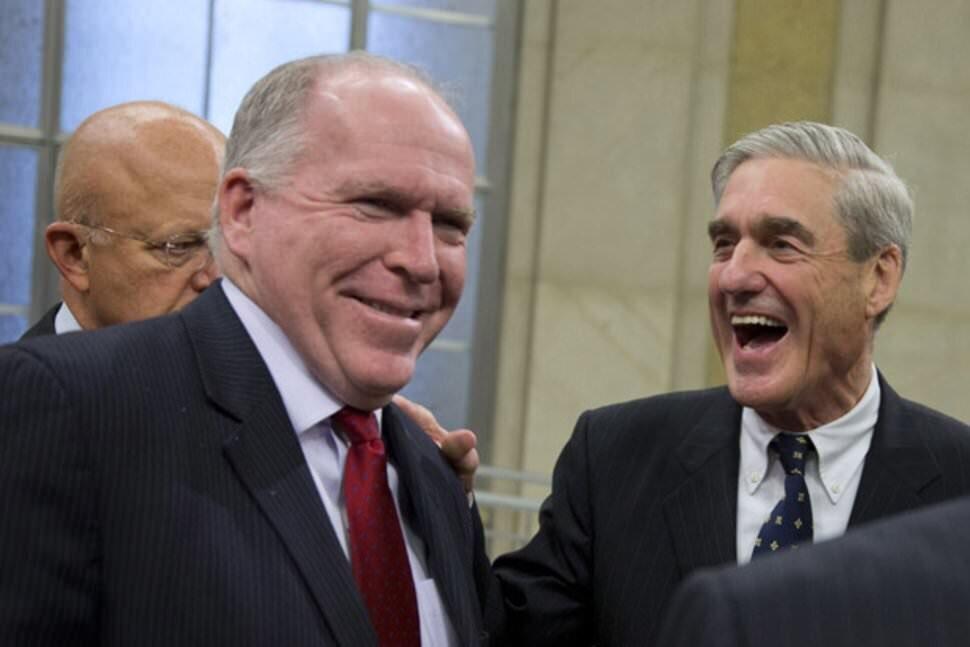
Robert Mueller - pitched as an incorruptible beacon of justice when he was tasked with (unsuccessfully) hunting down ties between Donald Trump and Russia - was nothing more than a hatchet man for the deep state, who participated in a coverup of Saudi Arabia's role in 9/11 according to a new report by the New York Post's Paul Sperry - citing former FBI investigators and a new lawsuit by 9/11 victims. 


According to Sperry, Mueller stonewalled after FBI agents discovered evidence of "multiple, systemic efforts by the Saudi government to assist the hijackers in the lead-up to the 9/11 attacks," while the former FBI director allegedly "covered up evidence pointing back to the Saudi Embassy and Riyadh — and may have even misled Congress about what he knew."

"He was the master when it came to covering up the kingdom’s role in 9/11," said Sharon Premoli, a September 11th survivor who was pulled out of the rubble of the World Trade Center, and is now suing Saudi Arabia as a plaintiff in a new lawsuit.


"In October of 2001, Mueller shut down the government’s investigation after only three weeks, and then took part in the Bush [administration’s] campaign to block, obfuscate and generally stop anything about Saudi Arabia from being released," she added. 

"Any letting the Saudis off the hook came from the White House," said former Agent Mark Rossini, adding "I can still see that photo of Bandar and Bush enjoying cigars on the balcony of the White House two days after 9/11."

Speaking with multiple FBI case agents, Sperry lists a series of incidents describing Mueller 'throwing up roadblocks' in front of his own investigators - "making it easier for Saudi suspects to escape questioning." And according to the lawsuit, Mueller "deep-sixed what evidence his agents did manage to uncover." 

Via the NY Post:


  • Time and again, agents were called off from pursuing leads back to the kingdom’s embassy in Washington, as well as its consulate in Los Angeles, where former FBI Agent Stephen Moore headed a 9/11 task force looking into local contacts made by two of the 15 Saudi hijackers, Moore testified in an affidavit for the 9/11 lawsuit. He concluded that “diplomatic and intelligence personnel of Saudi Arabia knowingly provided material support to the two hijackers and facilitated the 9/11 plot.” Yet he and his team were not allowed to interview them, according to the suit.
  • In Washington, former FBI Agent John Guandolo, who worked terror cases out of the bureau’s DC office, said then-Saudi Ambassador Prince Bandar “should have been treated as a terrorist suspect” for giving money to a woman who funded two of the 9/11 hijackers. But he was never questioned either, Guandolo said.
  • Instead, Mueller obliged what Guandolo called an “outrageous request” from Bandar within days of the attacks to help evacuate from the country dozens of Saudi officials, including at least one Osama bin Laden relative on the terror watch list. Mueller assured their safe passage to planes, using agents as personal escorts, according to FBI documents obtained by Judicial Watch. Agents who should have been interrogating the Saudis instead acted as their bodyguards.
  • In 2002, Mueller prevented agents from arresting the Saudi-sponsored al Qaeda cleric who privately counseled the Saudi hijackers, said Raymond Fournier, an agent with the Joint Terrorism Task Force in San Diego at the time. “He was responsible for vacating the arrest warrant for Anwar al-Awlaki for passport fraud,” Fournier said. He even ordered agents who detained the fiend at JFK to release him into the custody of a “Saudi representative,” Fournier said. The FBI closed their investigation of Awlaki, who was allowed to leave the US on a Saudi plane. “Shortly thereafter, the Fort Hood shooting occurred and Awlaki’s fingerprints were all over that incident,” said former FBI Agent Michael Biasello, who helped work the Texas terror case.
  • At the same time, Mueller removed a veteran agent from investigating a tip that an adviser to the Saudi royal family had met with some of the Saudi hijackers at his home in Sarasota, Fla., effectively killing the case, according to the lawsuit. The home was suddenly abandoned two weeks before 9/11.
  • Mueller even tried to shut down a congressional investigation into the Saudi hijackers and their contacts in LA and San Diego, said Bob Graham, who led the joint inquiry as Senate Intelligence Committee chair. “The strongest objections” to his staff investigators visiting FBI offices there came from the FBI director himself, said Graham, in a 2017 interview with Harper’s magazine. Among other things, Mueller refused their demands to question a paid FBI informant who roomed with the hijackers and even moved him to a safe house where they couldn’t find him, Graham said. Mueller, with the White House, redacted 28 pages detailing Saudi-9/11 ties from the congressional report.
  • He also gave testimony to Congress that was, at the very least, misleading. In an October 2002 closed-door hearing, Mueller claimed he found out about Saudi-9/11 connections only as a result of the joint inquiry’s investigative work: “[S]ome facts came to light here and to me, frankly, that had not come to light before.” Only, Moore said he gave Mueller “daily” briefings on such connections in 2001. Mueller also testified the hijackers “contacted no known terrorist sympathizers in the United States,” even though the FBI’s own case files showed they had contact with at least 14 terrorist suspects and sympathizers in the US prior to 9/11, including some working for the Saudi government. (In later testimony, he tried to walk this back, insisting he “had no intent to mislead.”)
***

"He’s a villain, and an arrogant one to boot," said former FBI agent Mark Wauck, who called Mueller a "servant of the deep state."
 

Tyler Durden

Source: https://www.zerohedge.com/news/2019-09-07/mueller-helped-saudis-cover-involvement-911-attacks-lawsuit

Follow Middle East and Terrorism on Twitter


Media bias called out -- and not by a conservative - Thomas Lifson

​
by Thomas Lifson

Ball’s complaint is that the media are ignoring and obscuring the standing in polls of candidates that threaten the establishment of the Democrats


We welcome to the club of media skeptics a former MSNBC host and Dem congressional nominee.& Conservatives can take a small degree of satisfaction that not all Democrats are oblivious to the toxic level of media bias. An article in The Hill by a progressive commentator named Krystal Ball, who ran for Congress unsuccessfully as the Democrat-endorsed candidate in 2010, and who has been a media figure for many years, including as an MSNBC host, calls out some striking examples of misreporting… the sort of thing that President Trump would call “fake news,” though Ball scrupulously avoids using that term.

Ball, second from the left, with her co-hosts of MSNBC's The Cycle& in 2013
Photo credit: Anthony Quintano

Ball’s complaint is that the media are ignoring and obscuring the standing in polls of candidates that threaten the establishment of the Democrats:
CNN recently displayed a curious graphic. It looked ordinary enough, a listing of top Democratic presidential candidates in a new national poll, but with a glaring omission. The graphic listed what appeared to be the top six candidates, except that& it didn’t quite get it right. Rather than listing the sixth-place candidate,& Andrew Yang, who was polling at 3 percent,& it skipped right over him and& instead included former& Rep. Beto O’Rourke (D-Texas), who had garnered only 1 percent in the poll. Yang was left off entirely.&
Now this may have been chalked up to a simple error if it seemingly weren’t part of a persistent pattern of ignoring Yang’s candidacy. One of Yang’s supporters,& Scott Santens, has been keeping track of the apparent slights via Twitter: an MSNBC graphic with other candidates polling at 2 percent but not Yang, oddly unbalanced graphics that seem to include just enough candidates to get in the media favorites but exclude Yang. As Axios& recently pointed out, Yang is sixth in the polling average yet 14th in terms of the number of articles written about his candidacy.&
The other candidates that are being slighted, in her eyes, are Tulsi Gabbard, Bernie Sanders, and Marianne Williamson. I think she is as correct in all of her cases, as she is in her critique of the treatment of Yang. Her progressive favorites are receiving a mild version of the treatment conservatives experience nearly all the time. I was surprised that she didn’t bother to mention the DNC ignoring polls as “unqualified” that showed Gabbard met the criterion of 2% support, which is a glaring thumb-on-the-scale move to keep her off the debate stage.

I wish, however, that she had explained why the Democrat establishment is threatened by Bernie Sanders but finds Elizabeth Warren, who is quite similar to Sanders in the degree to which she embraces far left schemes, acceptable. Is it her academic pedigree? Or do they think she is so phony that she is faking far left progressivism the same way she faked Native American heritage? (For the same reason: personal advantage.)

Update. My colleague Monica Showalter may have an aswer to this question: So Hillary Clinton is the éminence grise behind Elizabeth Warren?
Ball correctly diagnoses the reason that the media obey the Democrats’ power elite. It is not a conspiracy, per se, but rather a system of incentives that operate on prominent journalists:
When you are a threat to the political establishment, you are inherently a threat to the careers of journalists who rely on access to that political establishment. There may not be an edict coming down from on high to “destroy” those candidates who threaten the system, but there are natural defense mechanisms that kick in. And so, strange graphics are made that just happen to exclude you, fact checks are written that don’t seem to arrive at the facts at all, coverage vacillates from total blackout to wild smears.&
Welcome to the club of people who distrust the media, Ms. Ball.

Thomas Lifson

Source: https://www.americanthinker.com/blog/2019/09/media_bias_called_out_by_former_msnbc_host_and_dem_congressional_nominee.html

Follow Middle East and Terrorism on Twitter


Christians Massacred, Media Look the Other Way - Giulio Meotti

​
by Giulio Meotti

The Vatican and Pope Francis have a choice: to shed light on these persecuted Christians or be accused of willful blindness

  • "In the same week as the awful attack on the mosque in Christchurch, New Zealand... more than two hundred Christians were killed in Nigeria. There was hardly any mention of the latter in the news. There were no marches for martyred Christians, no tolling of church bells ordered by governments, no 'Je suis Charlie' t-shirts... no public outrage at all." — Fr. Benedict Kiely, Crisis Magazine, September 4, 2019
  • NASA's satellites observed the Amazon fires, prompting world leaders to pledge to protect the rainforest. But the burning, chopping and murder of Christians is not tracked by satellites and their suffering is not seen on our televisions and newspapers. Actually, it seems in the West as if the persecution of Christians does not even exist.
  • The Vatican and Pope Francis have a choice: to shed light on these persecuted Christians or be accused of willful blindness.... The Vatican should dedicate the next synod to them.

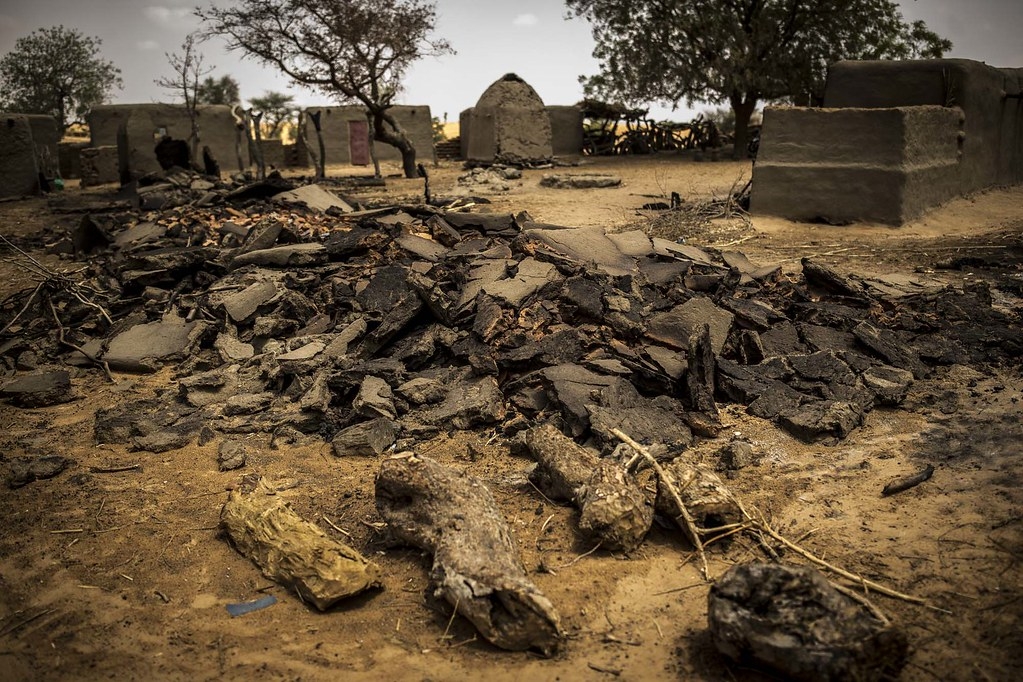
Pictured: Sobame Da, a mainly Christian village in Mali, after the June 2019 attack by Fulani gunmen in which 100 men, women and children were slaughtered. (Image source: United Nations/MINUSMA/Flickr)

"In the Amazon rainforest, which is of vital importance for the planet, a deep crisis has been triggered by prolonged human intervention, in which a 'culture of waste' (LS 16) and an extractivist mentality prevail", the Vatican stated.
"The Amazon is a region with rich biodiversity; it is multi-ethnic, multi-cultural, and multi-religious; it is a mirror of all humanity which, in defense of life, requires structural and personal changes by all human beings, by nations, and by the Church."
That is why a Synod of Bishops for the Pan-Amazon region has been scheduled to meet in Rome from October 6 to 27. In an interview with Italian paper La Stampa, Pope Francis said that one of the biggest challenges to the Amazon region is the "threat to the life of the populations and territory which derives from the economic and political interests of the dominant sectors of society."

The program for the Amazon's synod in Rome talks about "life threatened", "inculturation and interculturality", "extractivist destruction" and "indigenous peoples", among other matters. There is, however, another group of "indigenous people" whose life has been "threatened" and who live under an existential physical "destruction." They are the persecuted Christians, and the Vatican should dedicate the next synod to them.

"They asked him to deny Christ and when he refused they cut off his right hand; then he refused [again], they cut to the elbow. In which he refused, before they shot him in the forehead, the neck, and chest," a Nigerian Christian, Enoch Yeohanna, recently recounted about his father's murder in 2014. The trial of Nigerian Christians has been defined "a global nightmare." But it is happening in many countries.

"The persecution of Christians throughout the world is one of the great evils of our time", Fr. Benedict Kiely, the founder of Nasarean.org, dedicated to relieving the persecution of Christians, recently wrote.
"The mainstream media is remarkably silent about attacks on Christians. In the same week as the awful attack on the mosque in Christchurch, New Zealand—a heinous and unconscionable crime—more than two hundred Christians were killed in Nigeria. There was hardly any mention of the latter in the news. There were no marches for martyred Christians, no tolling of church bells ordered by governments, no "Je suis Charlie" t-shirts... no public outrage at all."
Boko Haram terrorists recently cut off the ears of Christian women after snatching them from their homes during a night-time raid on a mainly Christian town in northern Cameroon. The organization Barnabas Fund explained that "the Islamist extremists broke into homes, grabbed the women and dragged them to the outskirts of Gagalari town in the district of Yagoua where they sliced off one ear from each victim." A few days later, also in Cameroon, a Bible translator, Angus Fung, was butchered to death and his wife's arm cut off. Then, a Catholic priest, David Tanko, was killed in Nigeria and his car and body set ablaze. Last month, another Nigerian priest, Paul Offu, was murdered. Last year, two Catholic priests and 13 worshippers were among the victims in a single attack in Nigeria.

Four Christians in Burkina Faso were recently murdered for wearing crosses. "The Islamists arrived and forced everybody to lie face down on the ground," recounted Bishop Laurent Birfuoré Dabiré of the Diocese of Dori.
"Then they searched them. Four people were wearing crucifixes. So they killed them because they were Christians. After murdering them, the Islamists warned all the other villagers that if they did not convert to Islam they, too, would be killed."
Hundreds of Christians, including 433 children, are "facing attacks or fleeing from rampaging Islamist extremists in Mali," where in June, 100 men, women and children were slaughtered in Sobame Da, a mainly Christian village.

David Curry, the president of Open Doors, an American non-governmental organization (NGO) that tracks the persecution of Christians, has defined Christian women as "the most persecuted group in the world." Their oppression and mutilation is astonishing. In Nigeria, Boko Haram is still holding a kidnapped girl, Leah Sharibu. She could have been freed along with her schoolmates, but Leah refused to renounce her Christian faith. Christian women are also kidnapped and enslaved in Pakistan. "Every year at least a thousand girls are kidnapped, raped, and forced to convert to Islam, even forced to marry their tormentors," said Tabassum Yousaf, a Catholic lawyer linked to the Italian NGO, St. Egidio. This is a recurring pattern also in Egypt, where Christian women are facing an "epidemic of kidnapping, rape, beatings and torture."

The most famous of these persecuted Christian women, Asia Bibi, unjustly spent nearly a decade in Pakistani prison for "blasphemy" -- much of that time on death row -- before she was freed. In May, she was flown to Canada, where she was reunited with her family. According to Bibi:
"When my daughters visited me in jail, I never cried in front of them, but when they went after meeting me in jail, I used to cry alone filled with pain and grief. I used to think about them all the time, how they are living."
NASA's satellites observed the Amazon fires, prompting world leaders to pledge to protect the rainforest. But the burning, chopping and murder of Christians is not tracked by satellites and their suffering is not seen on our televisions and newspapers. Actually, it seems in the West as if the persecution of Christians does not even exist. The Vatican, Pope Francis, other clerics and the media have a choice: to shed a light on these persecuted Christians or be accused of willful blindness.

Giulio Meotti, Cultural Editor for Il Foglio, is an Italian journalist and author.

Source: https://www.gatestoneinstitute.org/14827/christians-massacred-media-ignore

Follow Middle East and Terrorism on Twitter


Did Boris Johnson Just Rope-a-Dope His Way into a Hard Brexit? - Mark Hanna

​
by Mark Hanna

If this is indeed his plan, it's a brilliant one. And it involves the queen.


As of Friday, September 6, an extension of three months to prevent the U.K. leaving the E.U. without a deal passed the Houses of Commons and Lords. In order for that legislation to become law, there must be consent by the monarch — in this case, Queen Elizabeth II. Once she assents, the bill becomes law.

While most everyone is considering her assent a formality on Monday, it should not quite yet be considered a fait accompli. The queen can lawfully refuse assent or delay her approval, which would effectively veto the bill and keep it from becoming law, thereby paving the way to a No Deal Brexit on October 31.

There are two occasions when the monarch can and should, according to most academic experts in the matter, refuse assent.

According to Anne Twomey, professor of constitutional law at the the University of Sydney in her book The Veiled Sceptre, the first occasion is that where a "serious error is discovered in the bill." No one is arguing that there is an error in the Remainers' meticulously crafted bill of extension.

But the second occasion in relation to royal assent, "the predominant academic view ... is that the Sovereign ... must act upon the advice of responsible ministers."

Professor of public law at the University of Glasgow School of Law Adam Tomkins concurs. From his book Public Law: "If the monarch were given clear and firm Prime Ministerial advice that she should withhold her royal assent to a Bill which had passed through the Houses of Parliament, it seems to be the case that the monarch should follow that advice."

As Robert Craig noted, Twomey uses the example of where a new government that has the confidence of the House and "objects to a bill passed ... by a defeated predecessor ... then its advice to refuse assent to a bill should be accepted."

While this is not the exact set of circumstances the U.K. is facing, Boris Johnson has demonstrated he has the confidence of the House, triumphantly pointing out that "this is the first time in history that the opposition has voted to show confidence in Her Majesty's government" by refusing to allow an election and refusing to table a vote of no confidence. Now all that's left is for Johnson to give clear and firm advice to the queen, who should then refuse to assent to the opposition's legislation to stop a No Deal Brexit.

If this is indeed BoJo's strategy, the U.K. Parliament has cut off its nose to spite its face. Hyper-leftist and self-avowed Marxist Jeremy Corbyn, opposition leader of the Labor Party, has gleefully led this self-mutilation, stating, "When No Deal is off the table, once and for all, we should go back to the people in a public vote or a General Election to decide our country's future."

Using the limited time the U.K. Parliament had to address the possibility of a No Deal Brexit, Corbyn, the other opposition parties, and 21 Tories clearly decided to spend their few days left in Parliament obsessed with passing a law that demands that BoJo, against his own will and government, ask the E.U. for an extension of Article 50 until January 31, 2020.

But Johnson may have been way ahead of them. He launched the epic play by proroguing parliament, which is basically closing the current Parliament session, until mid-October with the queen's approval. This means that all Parliament business must be concluded by Monday (or at latest Thursday). Once proroguing had occurred, the Remainers went into a Boris-induced tizzy to make sure a law was passed to stop him from taking the U.K. out of the E.U. without a deal on October 31, as long as no deal had been reached with the E.U. by October 19.

This is precisely where the PM has likely wanted them all along. Employing a "rope a dope" strategy, Johnson has effectively forced Parliament to use all the time left, now that the proroguing has occurred and been declared legal by the U.K. courts, to mire itself in passing the Article 50 extension law. Like the boxer Muhammad Ali, who made rope-a-dope famous, BoJo leaned back into parliament's ropes and took hit after hit, causing the opponents to not only wear themselves out, but provide time for him to get ready for his final counter-punch.

If the above analysis is correct, Johnson's knockout blow is happening now, as he meets the queen this weekend in order to clearly and firmly advise the queen to withhold assent.

Beautifully orchestrating and executing his stratagem, BoJo will have outwitted his opponents again in this well thought out fight plan by 1) forcing the opposition to spend the very short time they had to stop a No Deal Brexit mired in creating the extension legislation, then 2) sifting out the twenty-one traitors within his own Tory Party who voted against him, while at the same time 3) casually scheduling a meeting with the queen this weekend in order that 4) he can quietly advise the Queen not to assent to the bill he has called the "surrender" bill.

His opponents were so busy patting themselves on the back for their seemingly witty and unstoppable legislative efforts to thwart the will of the U.K.'s people (who voted 52% to 48% to leave the E.U. in 2016), heaping insults, lies, and half-truths on the prime minister and arguing among themselves how to take power, that they failed to see that Boris was, like any great boxer, simply setting them up.

His arguments to the queen are strong. First, a group of disingenuous Tory traitors betrayed the government by voting with the non-government opposition. The U.K. system is a parliamentary government, not a system of parliamentary rule. The queen can reinforce this distinction by refusing assent upon receiving the P.M.'s advice, proving that the government elected by the people ultimately has the power.

Second, extensions have been passed before under Theresa May, but to no avail in bringing the U.K. to a better deal with the E.U. What good would another extension to January 31, 2020 bring? Even France's President Macron agrees here and has indicated he'll veto an extension anyway. Germany's Chancellor Angela Merkel is also under pressure to veto any request for an extension. Any one of the 27 E.U. member-leaders can veto an extension, thereby virtually assuring a No Deal Brexit on October 31.

Finally, the current House of Commons has tacitly given its vote of confidence to Boris Johnson as prime minister by not agreeing to an election and not tabling a motion of no confidence. The Commons chose instead to focus on creating legislation that is opposed by the government, thereby giving Johnson an effective argument that the government was defied, not rejected.

And so we'll know in the next few days if this was the plan all along. For if the prime minister is truly committed to his promise to bring the U.K. out of the E.U. on October 31, he'll advise the queen to refuse the bill. In accordance with the unwritten constitution of the U.K., the queen will agree with her prime minister's advice.

If the queen agrees, Boris Johnson will have turned the Remainers' nightmarish Halloween Day extension ploy into a historic Reformation Day, indeed.


Mark Hanna holds an M.A. in international studies and has provided briefings to government officials on immigration, radical Islam, and other national security issues. He has worked for CNN as well as NBC and PBS affiliates and has been published in Real Clear Politics, PJMedia, ZeroHedge, and The Investigative Project. He can be reached at mhanna@protonmail.com.
Image: Boris Johnson via Flickr.

Source: https://www.americanthinker.com/articles/2019/09/did_boris_johnson_just_ropeadope_his_way_into_a_hard_brexit.html

Follow Middle East and Terrorism on Twitter


The Environmentalist Pope Issues a Warning - Discover The Networks

​
by Discover The Networks

Pope Francis again laments the alleged environmental consequences of capitalism.


In anticipation of the U.N. Climate Action Summit which will be held in New York later this month, Pope Francis has released a written message stating that this is “a season to reflect on our lifestyles,” to become fully aware of how people “act like tyrants with regards to creation,” and to take “prophetic actions” to save the planet. “Now is the time to abandon our dependence on fossil fuels and move, quickly and decisively, towards forms of clean energy and a sustainable and circular economy,” writes the pope. “Let us also learn to listen to indigenous peoples, whose age-old wisdom can teach us how to live in a better relationship with the environment.... We have caused a climate emergency that gravely threatens nature and life itself, including our own.”

The pope's message is merely the latest in his long line of public pronouncements regarding manmade climate change and its purported relationship to the evils of capitalism.


In June 2015, for instance, Francis released the first-ever papal encyclical devoted entirely to environmental issues. Lamenting that industrial pollution was causing great damage to “our oppressed and devastated earth,” he claimed that “plenty of scientific studies” had already attributed “the bulk of global warming” to “the great concentration of greenhouse gases” generated by “human action.” “If present trends continue, this century may well witness extraordinary climate change and an unprecedented destruction of ecosystems, with serious consequences for all of us,” wrote Francis. As a remedy, the pope proposed an increased reliance on “renewable energy sources” such as wind and solar: “We know that technology based on the use of highly polluting fossil fuels—especially coal, but also oil and, to a lesser degree, gas—needs to be progressively replaced without delay.” Moreover, he exhorted the wealthy to take “urgent action” to “change [their] lifestyles” and their reckless “consumption” patterns.

The pope’s encyclical also framed environmental concerns as legitimate justifications for a massive, compensatory redistribution of wealth from prosperous, industrialized countries to poorer ones: “The foreign debt of poor countries has become a way of controlling them, yet this is not the case where ecological debt is concerned. In different ways, developing countries, where the most important reserves of the biosphere are found, continue to fuel the development of richer countries at the cost of their own present and future. The developed countries ought to help pay this debt by significantly limiting their consumption of non-renewable energy and by assisting poorer countries to support policies and programmes of sustainable development.”
In a February 17, 2017 speech, Francis warned that “the ecological crisis” caused by anthropogenic climate change “is real,” and that “a very solid scientific consensus indicates that we are presently witnessing a disturbing warming of the climatic system.” Claiming that catastrophe could result if “we deny science and disregard the voice of Nature,” he said: “Let us not fall into denial. Time is running out. Let us act. I ask you again—all of you, people of all backgrounds including native people, pastors, political leaders—to defend Creation.” The root of the problem, the pope added, was “a social and political process that flourishes in many parts of the world and poses a grave danger for humanity”—a reference to capitalism and industrialization.

In September 2017, in the immediate aftermath of four hurricanes that had formed in the Caribbean and Gulf of Mexico regions, reporters asked Pope Francis about climate change and the role it may have played in the development of those storms. He replied, “Those who deny this must go to the scientists and ask them. They speak very clearly.” Asserting that politicians as well as ordinary citizens had a “moral responsibility” to do whatever they could to reduce the impacts of climate change, the pope added: “These aren’t opinions pulled out of thin air. They are very clear. Then they [political leaders] decide, and history will judge those decisions.”


The pope's views on environmentalism grow out of his deeply held belief that capitalism is not merely a moral abomination, but is also inherently destructive to the earth's air and water. Indeed, in the first major document of his papacy—a 67-page Apostilic Exhortation titled Evangelii Gaudium (The Joy of the Gospel), he characterized capitalism as an economic system where “exclusion and inequality” are ubiquitous; “where the powerful feed upon the powerless”; where “idolotry” that worships “the god of money” leads inevitably to “the greedy exploitation of environmental resources”; and where it is customary to “plunder nature [in order] to sustain the frenetic rhythm of consumption” and “unbridled consumerism” that is “inherent” in free-market systems.

* * *

Photo by Benhur Arcayan at Wikimedia Commons


Discover The Networks

Source: https://www.frontpagemag.com/fpm/274850/environmentalist-pope-issues-warning-discover-networks

Follow Middle East and Terrorism on Twitter


Leftist Gestapo: 'No Laughing at Chappelle Jokes!' - Daniel Greenfield

​
by Daniel Greenfield

Progressives fly into a totalitarian rage after a comedian dares to mock their sacred cows.


It wasn’t all that long ago that standup comedian Dave Chappelle was brilliant.

Take it from Slate, which in 2014 called him “brilliant” and in 2017 described his Netflix specials as “electrifying.” Now Slate complains, “he went away for a long time, and while you changed with the times, he fashioned himself a badge of honor for defiantly not doing so.” That long time is 2 years.

Two years isn’t a long time chronologically, but it’s an eternity in politically correct dog years.

Sticks and Stones is full of jokes about school shootings, child molestation, and transgender sensitivities.

Chappelle casually swipes at the “#MeToo headache”, LGBT lobbying, “you are never, ever allowed to upset the alphabet people”, and “my money, my choice,” his rejoinder to abortion’s “my body, my choice.” “If you decide to have the baby, a man should not have to pay,” he snaps.

"Dave Chappelle on Broadway: The Joke Is Getting Old," the New York Times whined in July. If anyone knows what old and unfunny is, it’s a 170-year-old newspaper read by aging Upper East Side lefties.

IMDB ratings demographics showed Sticks and Stones performing best with viewers 18 and under. It performs worst with media hacks who believe comedy exists to tell people what to believe.

The media’s problem is that Chappelle is popular and he’s saying some politically incorrect things.

The snippy shots from the media’s cultural gatekeepers turned into a hailstorm of snowflakes when Chappelle’s Netflix special, Sticks and Stones debuted. The issue, the gatekeepers claimed, was that Chappelle wasn’t funny. The hit pieces were really confessions admitting they don’t know funny.

They liked Chappelle because the only black comedians they can relate to service their racist countercultural ‘fight the man’ fantasies. Chappelle isn’t out of step comedically, but politically.

Dave Chappelle sets up his audience by accusing the Founding Fathers of racism before asking them to guess who’s “gonna try to take everything away from you” if “you do anything wrong in your life.”

The audience, primed by hours of tepid lefty clapter comedy, shouts, “Trump, Trump.”

Chappelle responds with, “You.”

It’s the moment early on in Sticks and Stones that sets the tone for the comedy and the backlash that he knows is coming. And, like Kanye West, Chappelle is courting it. He picked a side in the culture wars and, like every comedian, it’s his own side. His taunt doesn’t just ridicule audiences for their role in social justice mobbing, but for their laziness in assuming that he’s just another unimaginative shill.

The Founding Fathers line is the politically correct setup for a politically incorrect punchline.

Audiences want to be surprised by comedy. The media wants comedy to be politically predictable. That’s why there’s such a wide ratings gap on Rotten Tomatoes between the critics, mostly negative, and the audience, mostly positive. Chappelle is entertaining audiences and upsetting the gatekeepers.

Why does Slate think that Chappelle isn’t brilliant or electrifying anymore? Take it from their sad headline. “Dave Chappelle’s Sticks & Stones Fights for the Rights of the Already-Powerful,” it complains.

Somehow, Slate thought that Chappelle was a civil rights crusader instead of a comedian.
Audiences know better. The people paying to see Chappelle want to laugh. The political elites want comedy to be an exercise in indoctrination and they hate it when the punch lines don’t go their way.

"Dave Chappelle Once Tore Down the Establishment. Now He Represents It," The Advocate objects. "Dave Chappelle Doesn't Need to Punch Down," BuzzFeed moans. The Atlantic accuses him of being driven by fear of the "social movements shaping the country." It applauds when he calls the Founding Fathers racists. It boos when he turns the spotlight on social justice mobs, #MeToo, and the Left.

And then it pleads with audiences to stop laughing.

The Atlantic and dozens of other media publications owned, run and read by wealthy white lefties complain that Chappelle isn’t “irreverent” anymore. Their complaints are proof of his irreverence. If Chappelle were the establishment, wouldn’t the establishment media be singing his praises?

Lefty gatekeepers think that irreverence is when a comedian makes fun of someone else’s beliefs while paying homage to the “social movements” they support. That’s not irreverence. It’s reverence.


Dave Chappelle was always irreverent. And irreverence, unpredictably ridiculing anything and everything, is what comedy used to be until it turned into Hannah Gadsby’s social justice tantrums.

Sticks and Stones, like Chappelle’s other comedy specials, was funded by the African-American standup comedian, and brought to Netflix as a finished product which the streaming service could take or leave. In the ‘clapter’ era, when Stephen Colbert’s CBS audience applaud his political views like trained seals, Chappelle is raw, offensive and unpredictable. It’s the work of a freewheeling comedian, not a party line.

Chappelle’s Netflix specials carry the energy of Eddie Murphy’s Raw. But they’re the work of a comedian who didn’t want to turn into Eddie Murphy. Instead, Chappelle dumped his show, vanished for a decade, and resurfaced untouched by the Hollywood bubble. That gives him the freedom that Kevin Hart and other black comedians who want to work in Hollywood don’t have. The freedom to say anything.

That’s a freedom that the cultural elites who politicized comedy and everything else have quashed.

Chappelle embraces the freewheeling freedom to joke about celebrities, abortion, pedophilia, gay rights, feminism, gun control, and racism, tackling charged topics with disdain and skewed punchlines. It’s not new. It’s what comedy used to be like. It feels raw and fresh only because comedy isn’t anymore.

On Colin Quinn’s Red State Blue State tour, the comedian sardonically responds to being told to "evolve with your audience" with "that's actually why I got into comedy so I could march in lockstep with society's contemporary convention, I wanted to conform to the status quo."

Comedians don’t want to conform. But they’re pressured to be relevant. And to be relevant is to lecture.

Despite namechecking everything from abortion to gay rights to gun control to school shootings, Chappelle isn’t trying to be relevant. He’s making jokes by putting the absurd pieces of society together in awkward, offensive and obscene ways. And that’s what comedians have always done.

“If I’m wrong, then perhaps we’re wrong,” he rambles during a bit on abortion. “I can’t live in this new world you’re proposing.”

Comedians question everything. Political fanatics hate any questions except the ones they want asked.

But Chappelle is immune from the rules, the pressure and the intimidation. He won his freedom by walking away from a $50 million Comedy Central contract. He did it then, he can do it again. And when he jokes about Kevin Hart’s apology tour, it’s coming from a comedian who will never do one of those. He can’t be cancelled because he isn’t afraid to get on a plane and walk away from everything. He’s part of a black community immune to the cultural obsessions of social justice critics, and he turned his back on Hollywood to work in clubs making him immune to the pressures on Hart or Tracy Morgan.

The real message of Sticks and Stones is in the title. “What are you gonna do to me?”

Even in the Hannah Gadsby age, where professional comedians are falling one by one, Dave Chappelle is going to unload his stream of consciousness on a stage knowing that, unlike Gadsby, it’ll get real laughs.

And that’s what worries the media gatekeepers working overtime to convince audiences that they shouldn’t laugh. Leftist power in America doesn’t come from the barrel of a gun, but from a camera lens.

The Left gets to decide what literature, music, entertainment and all the other elements of culture are. It gets to decide what people should be watching, reading and listening to. And what they shouldn’t.

It gets to decide what cool is.

That is why it has a political death grip on younger people that washes away in a few decades.

Chappelle’s Sticks and Stones performance is impervious to the cultural gatekeepers. And that worries them. The greatest trick of the elites is pretending to be anti-establishment. It’s making their totalitarian system seem like the cool project of rebels rather than the shoddy bureaucracy of egomaniacs.

But this fake culture doesn’t hold up when it’s exposed to an actual counterculture.

That’s what the wide gap between critic and audience ratings on Sticks and Stones really means. It’s what the frenzy of media hit pieces accusing Chappelle of being part of the establishment are about.

It’s not anger. It’s not even jealousy. It’s fear.

Politically correctness is about intimidation. It’s less about the things being banned, than the power to ban. It depends on keeping celebrities and entertainers too afraid to break its always changing rules.

The media’s power is in the words it uses to lie, to smear and to intimidate. When people stop being afraid of its words or even stop being influenced by them, what remains of the media’s power?

What, The New York Times and the rest of the media wonder, if they can’t get Chappelle to shut up?


Daniel Greenfield, a Shillman Journalism Fellow at the Freedom Center, is an investigative journalist and writer focusing on the radical Left and Islamic terrorism.

Source: https://www.frontpagemag.com/fpm/274852/leftist-gestapo-no-laughing-chappelle-jokes-daniel-greenfield

Follow Middle East and Terrorism on Twitter


Moscow Divided Between Two Proverbs - Amir Taheri

​
by Amir Taheri

The impression one gets in Moscow these days is that reality may have started to bite at the edges of the hubris nurtured by Putin's opportunistic tactics and the weakness of the Western, especially European, response.

  • Putin has also succeeded in establishing Russia as the key player in war-torn Syria by marginalizing not only Iran but also Turkey and the United States. Putin adulators are especially proud of his success in playing the Iran card against the United States while squeezing the Tehran mullahs for unprecedented concessions.
  • The impression one gets in Moscow these days is that reality may have started to bite at the edges of the hubris nurtured by Putin's opportunistic tactics and the weakness of the Western, especially European, response.
  • Well-to-do Russians, the backbone of Putin's system, are sore about the fact that they are no longer treated as welcome friends in the Western world, to which they think they belong. The less privileged Russians are equally unwilling to find their nation grouped together with a number of "Third World" countries such as Syria, Iran, Venezuela and North Korea.

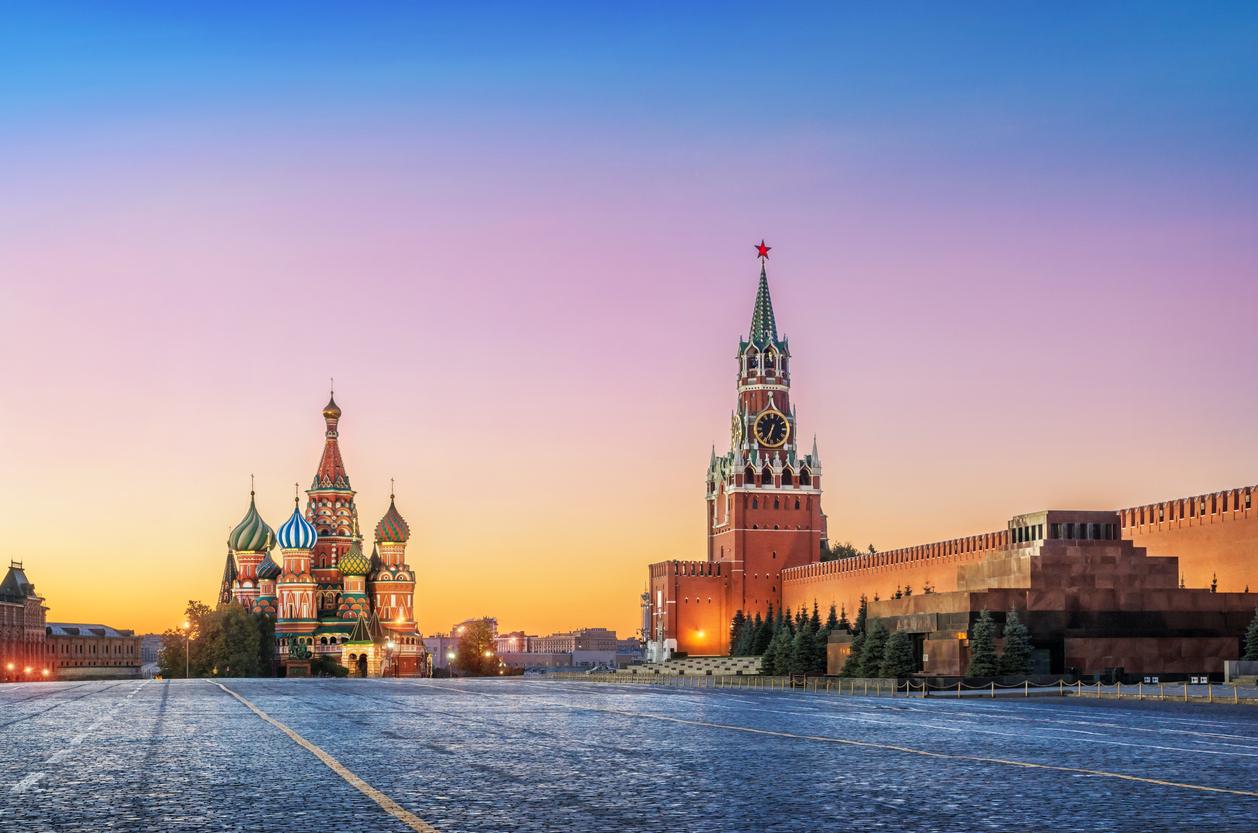
The impression one gets in Moscow these days is that reality may have started to bite at the edges of the hubris nurtured by Putin's opportunistic tactics and the weakness of the Western, especially European, response. (Image source: iStock)

In Russia, August is often regarded as the uncertain season closing the short summer and opening the path to the long duet of autumn and winter. It was, therefore, no surprise in a recent visit to Moscow to see that sense of uncertainty reflected in the political mood of the Russian elites.

To be sure, the uncertainty one notices is still in filigree. Officials and intellectuals supporting the current government are still full of self-confidence, not to say bombast, defending President Vladimir Putin's "strongman" politics. Nevertheless, conversations regarding the political situation in Russia soon reveal three sources of uncertainty, perhaps even anxiety.

The first is an as yet tentative concern that though Putin's current presidential term has some four more years to conclude, it is not at all certain that the current ruling elite could find someone of similar stature to carry the torch. In other words, Putinism may end as other "isms" formed around a charismatic leader, something like Gaullism, Peronism or even Titoism.

The second concern is generated by anxiety about the durability of some of Putin's trademark "successes," especially in the field of foreign policy. To be sure, he seems to have gotten away with annexing not only the Crimean Peninsula but also South Ossetia and Abkhazia, chunks of Georgian territory captured in 2008. He has also managed to prevent Kosovo, the latest Muslim-majority nation to gain independence, from becoming a member of the United Nations. Putin has also succeeded in establishing Russia as the key player in war-torn Syria by marginalizing not only Iran but also Turkey and the United States. Putin adulators are especially proud of his success in playing the Iran card against the United States while squeezing the Tehran mullahs for unprecedented concessions.
The question is how durable, and profitable, those successes are?

With the initial glow of victory fading, the Crimean Peninsula is turning out to be as costly as a profligate mistress becomes as she ages. Counting infrastructure costs, including a new bridge, Crimea is costing Russia around $18 billion a year, of which only a fraction is covered by revenue from tourism, which is in sharp decline because of Western restrictions on travel by their citizens to the peninsula.

Return on Russia's investment in blood and treasure trying to save President Bashar al-Assad's shaky regime may appear meager on a second count. To be sure, Assad has given Russia long lease for a major aero-naval base on Syria's Mediterranean coast. However, in military terms at least, the base could hardly be regarded as an asset for two reasons.

First, it is not at all certain that a future Syrian regime, something inevitable in the medium-term, would remain committed to the signature of a despot who controlled only a fraction of the country at the time of signing. Secondly, a base located in a territory where inhabitants are hostile would always be too vulnerable to count as an asset in a game of strategic brinkmanship.

Putin is also admired for his success in persuading the mullahs of Tehran to sign a convention that turns the Caspian Sea into a backyard under Russian hegemony. Rajab Safarov, a member of the Putin circle close to the Russian delegation that sold the convention to the littoral states, including Iran, openly wonders how the master of the Kremlin managed to get the mullahs to abandon all of Iran's historic rights in the Caspian and sign a text prepared by the Russian Ministry of Defense without any Iranian input. And, yet, even this "Caspian victory" may not prove durable. Its signature by Iranian President Hassan Rouhani has led to an upsurge of anti-Russian sentiments across Iran, forcing the ruling mullahs to slow down the process of legislation needed to give a legal basis to the so-called convention. In any case, it is possible is that a future Iranian regime will denounce the convention with reference to the principle of signing under duress and sic rebus stantibus or change of circumstances. Since the other littoral states, Azerbaijan, Kazakhstan and Turkmenistan, are equally unhappy about the Russian diktat, Iran may lead a Caspian coalition demanding a more equitable regime for the inland sea.

The third cause of anxiety in Moscow these days is related to the lethargic performance of the Russian economy. After declining between 2012 and 2016, the number of households in poverty has risen to around 18%, a three-point increase since 2010. Worse still, according to the latest World Bank report, the Russian economy has almost ceased creating new jobs. Sanctions imposed by Western powers are also beginning to bite, reducing Russian access to global capital markets at a time massive investment is needed to keep the vital energy industry, the nation's main source of foreign income, going.

The impression one gets in Moscow these days is that reality may have started to bite at the edges of the hubris nurtured by Putin's opportunistic tactics and the weakness of the Western, especially European, response. Well-to-do Russians, the backbone of Putin's system, are sore about the fact that they are no longer treated as welcome friends in the Western world, to which they think they belong. The less privileged Russians are equally unwilling to find their nation grouped together with a number of "Third World" countries such as Syria, Iran, Venezuela and North Korea. In Moscow's political circles, talk of a review of foreign policy is no longer taboo, even if the main theme is woven around "one-step-back, two-steps-forward" tactic formulated in the old days of Communist rule.

And, that provides an opportunity for Western powers to revisit their Russia policies in the hope of bringing Putin's rogue state back into the fold. That aim may seem fanciful at present, so strong is the hubris inspired by Tsar Vladimir. However, visiting Moscow these days, one gets the feeling that Russia may be getting ready to switch from one old proverb "better do and regret!' to another old proverb, "Do nothing you might regret!"
This article was originally published by Asharq al-Awsat

Amir Taheri was the executive editor-in-chief of the daily Kayhan in Iran from 1972 to 1979. He has worked at or written for innumerable publications, published eleven books, and has been a columnist for Asharq Al-Awsat since 1987. He is the Chairman of Gatestone Europe.

Source: https://www.gatestoneinstitute.org/14828/moscow-divided

Follow Middle East and Terrorism on Twitter


Saturday, September 7, 2019

The U.S.-Taliban Negotiations: A Deadly Qatari Trap - Yigal Carmon

​
by Yigal Carmon

Mr. Trump -- is unfortunately empowering his Taliban enemy by protracted negotiations, where America makes successive concessions and ultimately throws its Afghan allies under the bus.

  • One can understand President Donald Trump's wish to leave Afghanistan. There are, however, ways to leave without losing people, respect, and allies. Mr. Trump, instead of leaving unilaterally, while reinforcing the democratically elected government in Kabul without boots on the ground, is unfortunately empowering his Taliban enemy by protracted negotiations, where America makes successive concessions and ultimately throws its Afghan allies under the bus.
  • Afghan officials are the first to sense that the sellout of the Kabul government is impending, and are scurrying to defect to the Taliban (in July alone there were 800 defections).
  • As opposed to what many Americans think, Qatar did the US no favors in building the base in the mid-1990s. It needed an American base for its own self-protection and this dependence still persists. Without this base, this Lilliputian energy Gulliver would be taken over by its neighbors (whether Iranian or Saudi) within a day. The US military establishment ignores this reality to its own detriment, and behaves as if America is in Qatar's debt rather than the reverse.
  • Qatar is already threatening to limit potential operations against Iran from Al-Udeid, should they be needed, and Qatar's Tamim told Rouhani that "only countries [placed] along the coast [of the Persian Gulf] should keep security in the region."
This is an edited and shortened version of an article recently in MEMRI.

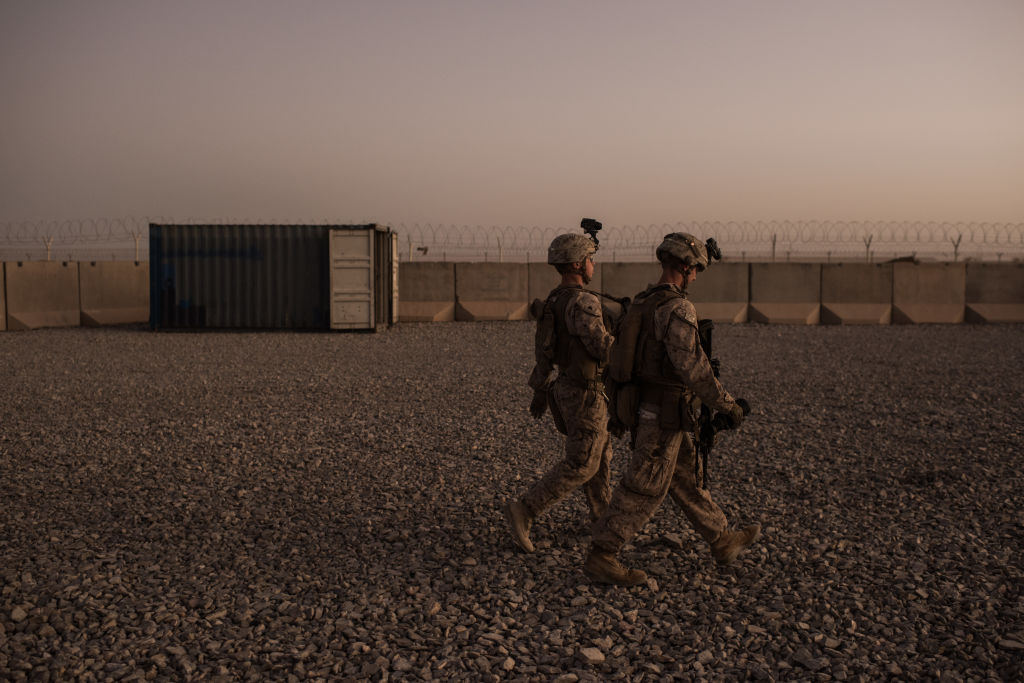
Pictured: U.S. Marines at Camp Shorab on September 11, 2017 in Helmand Province, Afghanistan. (Photo by Andrew Renneisen/Getty Images)

What is happening in Afghanistan is already beyond grief. The United States is negotiating with the Taliban, without the Taliban first agreeing to a cease-fire as a precondition for talks, and although President Trump has emphatically announced his determination to withdraw from the country, American soldiers are still being killed (in recent days, three American servicemen died). [1]

One can understand President Donald Trump's wish to leave Afghanistan. Whether the US can sustain its strategic and economic leadership in the context of an isolationist policy, is a legitimate debate. This is the president's and Congress's purview. There are, however, ways to leave without losing people, respect, and allies. Mr. Trump, instead of leaving unilaterally, while reinforcing the democratically elected government in Kabul without boots on the ground, is unfortunately empowering his Taliban enemy by protracted negotiations, where America makes successive concessions and ultimately throws its Afghan allies under the bus.[2] Afghan officials are the first to sense that the sellout of the Kabul government is impending, and are scurrying to defect to the Taliban (in July alone there were 800 defections).[3]

Some enemies have no interest in anything but an American withdrawal and will not pay anything for such a withdrawal; on the contrary, they will exact payment for each day the Americans remain until they exit with their tails between their legs. Apparently, the president and his administration are unable to see this. According to leaks to the media, the Americans are trying to negotiate with the Taliban a dialogue with the elected Kabul government. However, even if the Taliban sign on the dotted line, our experience in the Middle East shows time and again that there is no way to ensure that they keep their word. President Trump insists that the Taliban promise not to attack the US following its departure. The Taliban can definitely affix their empty signature: in the Middle East, people use proxies. Like the Iranians, the Taliban can be seemingly uninvolved, but 9/11 was hatched in Afghanistan by Muslim-Arab Al-Qaeda members.

Who blinded brilliant, shrewd and goal-oriented people such as President Trump and the people around him, as they did also during his first year in office? Why do they prefer to overlook the public announcements by the Taliban such as: "the reason behind war... in Afghanistan is the presence of Americans forces and it will only find an end when American forces leave Afghanistan."[4] The answer (surprise) is Qatar, which talked the U.S. administration into this self-destructive process. The administration bought into it on the assumption that a country that built and hosts the CENTCOM base is therefore an ally with shared interests and therefore its recommendations must be benevolent and bona fide. Little do they understand -- Qatar is an enemy in allied clothing -- and its interests are antithetical to America's.

Qatar supports every major terrorist organization: the Muslim Brotherhood (it hosts their chief inciter for terror, Sheikh Yusef Al-Qaradawi) and its offshoots such as Al-Qaeda and now the Taliban in order to buy protection for the ruling Al-Thani clan. It also sustains Muslim governments antagonistic to America such as Erdogan's Turkey. The Al-Thani family-owned Al-Jazeera news network has for decades served as an efficient weaponized media outlet targeting the US and its interests in the region and beyond.[5]

According to Richard A. Clarke, National Coordinator for Security and Counter-terrorism in the Clinton and Bush (43) administrations, the previous Qatari Emir, father of the current one, personally snatched from the Americans an arch-terrorist named Khalid Sheikh Muhammad, (who plotted terror attacks against America) and spirited him away from Qatar to foil his arrest by the Americans, thus enabling him to mastermind the 9/11 attacks a few years later. Clarke concluded: "Had the Qataris handed him over to us as requested in 1996, the world might have been a very different place."

As opposed to what many Americans think, Qatar did the US no favors in building the base in the mid-1990s. It needed an American base for its own self-protection and this dependence still persists. Without this base, this Lilliputian energy Gulliver would be taken over by its neighbors (whether Iranian or Saudi) within a day. The US military establishment ignores this reality to its own detriment, and behaves as if America is in Qatar's debt rather than the reverse.

By enlisting America, Qatar protects itself.


The Qataris won President Trump's friendship the same way they purchase anything in the West, from think tanks to World Cup competitions. They insinuated themselves into his good graces by promising a reported $85 billion for rehabilitating America's infrastructure. President Trump's eagerness for American jobs and prosperity understandably fed his enthusiasm for the Qatari emir:
"Tamim, you've been a friend of mine for a long time, before I did this presidential thing, and we feel very comfortable with each other... Investments that you make in the United States -- one of the largest in the world -- but the investments that you make are very much appreciated. And I know the planes you're buying and all of the other things you're investing in. And I view it differently; I view it as jobs. Because for me, it's jobs. And today, we set a new record for jobs. We're setting it almost on a daily basis."
Even more unfortunate is Qatar's ability to buy off the US military on the cheap by expanding the Al-Udeid base on its dime to allow more comfortable housing for the servicemen's families; so far, no American commander has arisen to challenge the price in American blood and honor that Doha's largesse is demanding. Instead, we get Brigadier General Daniel H. Tulley, the Al-Udeid base commander, cluelessly saying: "It never ceases to amaze Americans how gracious our hosts are here."

Years ago, a senior administration official explained to me why the US turns a blind eye to Qatar's nefarious activities. "We have in the Al-Udeid base total freedom of operations," he said. "The Al-Udeid base is like a USAFB in Alabama." This too is no longer true; Qatar is already threatening to limit potential operations against Iran from Al-Udeid, should they be needed, and Qatar's Tamim told Rouhani that "only countries [placed] along the coast [of the Persian Gulf] should keep security in the region."[6] One can imagine the Qatari ruling family laughing in the safety of their US-protected palace, and prizing their good fortune in having such useful idiots as allies and protectors.
Yigal Carmon is the President and founder of MEMRI [Middle East Media and Research Institute].

[1] Belatedly, only after the continuous killing of American soldiers by the Taliban after all signs pointed to an imminent deal, Khalilzad awoke to tell the Taliban "violence like this must stop. Has the chief US negotiator forgotten that the Taliban has long demanded a complete withdrawal of foreign troops in order to "end the occupation" of Afghanistan and that there will be no ceasefire until a US troop withdrawal?
[2] In addition to agreeing to the conduct of negotiations under fire, the US: 1. Agreed to exclude the elected Afghan government from the talks (this belies Khalilzad's claim in footnote 3 that the US will not throw Kabul under the bus). 2. Absolved the Taliban of being a terror organization and extended this blanket absolution to any terror organization worldwide operating within a specific territory. 3. Agreed in principle to release 10,000 Taliban terrorists in exchange for 3,000 abducted Afghan officials, and 4. Totally ignored the Taliban declaration that elections are un-Islamic thus rendering a possible Taliban signature on a clause mandating democratic dialogue with the Afghan government a dead letter.
[3] AlemarahEnglish.com (Afghanistan), August 10, 2019. Indeed Zalmay Khalilzad, the US negotiator with the Taliban has recently tweeted that "We will defend Afghan forces now and after any agreement w/ the Talibs." The facts on the ground belie such assurances. The US has acquiesced to a veritable Taliban embassy in Doha, the ultimate brush-off to the Kabul government.
[4] AlemarahEnglish.com (Afghanistan), August 26, 2019.
[5] For a recapitulation of Qatar's double dealing featuring its weaponized Al-Jazeera network see: MEMRI Daily Brief No. 146, Qatar The Emirate That Fools Them All, And Its Enablers, January 18, 2018
[6] Mehrnews.com (Iran), August 12, 2019.


Yigal Carmon is the President and founder of MEMRI [Middle East Media and Research Institute].

Source: https://www.gatestoneinstitute.org/14816/us-taliban-negotiations-qatar

Follow Middle East and Terrorism on Twitter