The "Middle East and Terrorism" Blog was created in order to supply information about the implication of Arab countries and Iran in terrorism all over the world. Most of the articles in the blog are the result of objective scientific research or articles written by senior journalists.
From the Ethics of the Fathers: "He [Rabbi Tarfon] used to say, it is not incumbent upon you to complete the task, but you are not exempt from undertaking it."
Kuwait said its armed forces had engaged with a cruise missile, three ballistic missiles and 10 drones in its airspace, and that one person had been injured from falling shrapnel.
US Airforce (USAF) personnel work by a USAF B-1B bomber, at RAF
Fairford airbase, which is used by USAF personnel, amid the US–Israeli
conflict with Iran.(photo credit: REUTERS/PHIL NOBLE)
Sirens sounded across the Middle East as Iran launched retaliatory strikes on US assets in the Gulf Region on Thursday.
Iran's
air force scrambled fighter jets to "secure the skies over the funeral
procession" of the former supreme leader Ali Khamenei in Mashhad, the
regime-affiliated Fars news agency said.
The retaliatory strikes come after the US struck around 90 sites overnight from Wednesday to Thursday in Iran.
The
most recent round of US strikes was completed early Thursday morning in
Iran. The US military struck various sites throughout southern Iran "to
further degrade Iran's ability to attack commercial shipping and
innocent civil mariners in the Strait of Hormuz," the US Central Command
(CENTCOM) said in a statement on X/Twitter.
Iranian
officials said the US attacks had killed 14 people and injured 78
across five provinces on Wednesday and Thursday, state media reported.
Smoke
rises from a port, near Strait of Hormuz, following a U.S. strike in
Kuhestak, Hormozgan Province, Iran, July 8, 2026. (credit: Social
Media/via REUTERS)
Fars said one US strike had hit a rail bridge used for trade with Russia and China, while Mehr news agency reported several explosions in the Bushehr province, which is home to a Russian-built nuclear power plant.
Sirens sound through Middle East: Strikes, interceptions in Kuwait, Jordan, Bahrain
Iran's
army said in a statement released by state media that it had launched
attacks at US Patriot systems with drones in Kuwait, an early warning
site in Qatar (satellite antenna) and a fuel storage facility of the US
army in Bahrain.
Kuwait
said its armed forces had engaged with a cruise missile, three
ballistic missiles and 10 drones in its airspace, and that one person
had been injured from falling shrapnel.
Sirens
also sounded in Jordan on Thursday after missiles launched from Iran
were detected in Jordanian airspace, the state news agency reported.
Eight of ten missiles, which were fired at Jordan's Azraq military base,
were intercepted.
No injuries or damage were reported, the news agency said.
A
government spokesperson said the Jordanian Armed Forces are on high
alert and ready to deal with any threat targeting the kingdom's
security.
Sirens
were sounded in Bahrain on Thursday morning, the Interior Ministry
confirmed on X. Sirens were also sounded overnight as Iran launched
missile and drone attacks on the Gulf State.
The ministry called on citizens and residents to seek shelter.
The siren has been sounded.. Citizens and residents are urged to remain calm and head to the nearest safe place
— Ministry of Interior (@moi_bahrain) July 9, 2026
A drone attack hit a camp belonging to an Iranian Kurdish opposition group northeast of Iraq's Erbil, security sources told Reuters on Thursday.
No casualties were immediately reported in the attack.
Qatar calls for calm, Iran demands full control of Strait
Qatar,
which hosts the largest US military base in the region and has often
mediated between Washington and its adversaries including Tehran, called
for a return to diplomacy.
In
a phone call with Iranian Foreign Minister Abbas Araqchi, Qatar's Prime
Minister Sheik Mohammed bin Abdulrahman al-Thani also condemned attacks
against commercial shipping in the Strait of Hormuz.
While
Iran has not claimed responsibility for the ship attacks, analysts say
Tehran uses such actions to gain leverage in negotiations.
The
Strait of Hormuz handled about a fifth of global oil supplies before
the war erupted on February 28 with US and Israeli strikes against Iran.
Tehran
has since taken effective control of the strait, allowing it to force a
stalemate in its confrontation with the world's most powerful military.
"The
US has yet to learn that bullying and breaking its commitments no
longer come without a cost. Let me be clear: If you strike, you will be
struck back," Iran's top negotiator, Mohammad Baqer Qalibaf, wrote on
X.
"The Strait of Hormuz will be reopened only under Iranian arrangements, not through US threats."
However,
the US leader, who was attending a NATO summit in Turkey, also said he
did not think the latest military strikes would escalate into a
full-fledged conflict with Iran.
"Anything that happens is going to be over very quickly... and will only make it safer, including for oil," he told reporters in Ankara.
Asked
before the NATO summit on Wednesday whether the memorandum of
understanding with Iran was over, Trump said: "It's a very interesting
question. To me, I think it's over. I don't want to deal with them."
Jonah Davidov and Shoshana Baker contributed to this report.
Hamas is not dismantling its military wing. It is not surrendering its weapons. It is not disbanding its security apparatus. It is not ending its command structure.
The key question is not who sits in ministerial offices in the Gaza Strip. The key question is who holds the guns.
Nothing essential has changed.
Hamas is not dismantling its military wing. It is not
surrendering its weapons. It is not disbanding its security apparatus.
It is not ending its command structure. Thousands of Hamas employees and
loyalists will also remain embedded in the Gaza Strip's institutions.
"Hamas's apparent willingness to make room for a technocratic
government is designed to prevent its own disarmament.... [A]s long as
Hamas retains its weapons, any civilian government will of course
operate as Hamas dictates." — Israel's Foreign Minister Gideon Sa'ar,
Sa'ar warned that Hamas seeks to replicate the Hezbollah model in
the Gaza Strip: a civilian administration would be responsible for
garbage collection, public services, reconstruction, and salaries, while
Hamas would remain the dominant military force.
This is not peace and stability. It is simply outsourcing civilian responsibilities while preserving the machinery of jihad (holy war).
"The ceaseless headlines about Hamas 'ending its government' in
Gaza and 'preparing to give up control' are yet another ruse and a
nothing‑burger dressed up as a concession by the terror group, which has
zero intention of relinquishing real power or disarming.... None of
this resembles disarmament. Hamas's al‑Qassam Brigades are working
nonstop to repair tunnel networks and rebuild munitions stockpiles...
Yet the media coverage of this non‑event has already reframed Hamas as
cooperative, reasonable, even constructive; a narrative shift that
obscures Hamas's role as the primary obstacle to Gaza's recovery. And
this is landing successfully and working well for Hamas.... Ultimately,
Hamas 'dissolving its government' will be judged by simple metrics like
whether Gazans can share posts on Facebook without being tortured,
beaten, or dragged into hospital interrogation rooms, abuses that
continued from October 7 until just last week. Until that changes, the
headlines are theater, and Hamas's grip in Gaza remains intact." — Ahmed
Fouad Alkhatib, Palestinian political analyst, x.com, June 6, 2026.
A technocratic government financed by foreign donors would
relieve Hamas of the financial burden of governing while allowing the
terrorist group to concentrate on rebuilding its military machine.
The full implementation of the Trump peace plan requires the
dismantling of Hamas's military capabilities and the complete
demilitarization of the Gaza Strip. Allowing Hamas to establish a
Hezbollah-style state within a state would guarantee continued
instability and ensure that any future Palestinian administration
remained hostage to an armed terrorist organization.
The only meaningful solution is for Hamas to dissolve itself, and
not merely one of its governing committees. This means dismantling both
its political and military structures, surrendering all of its weapons,
disbanding its security apparatus, relinquishing every instrument of
coercion, and disappearing as an armed political force.
Until Hamas disappears as both a political movement and a
terrorist organization, declarations about dissolving committees amount
to little more than political make-believe designed to secure
international legitimacy, unlock billions of dollars in aid, and buy
time for the next war.
The key question is not who sits in ministerial offices in
the Gaza Strip. The key question is who holds the guns. Hamas is not
dismantling its military wing. It is not surrendering its weapons.
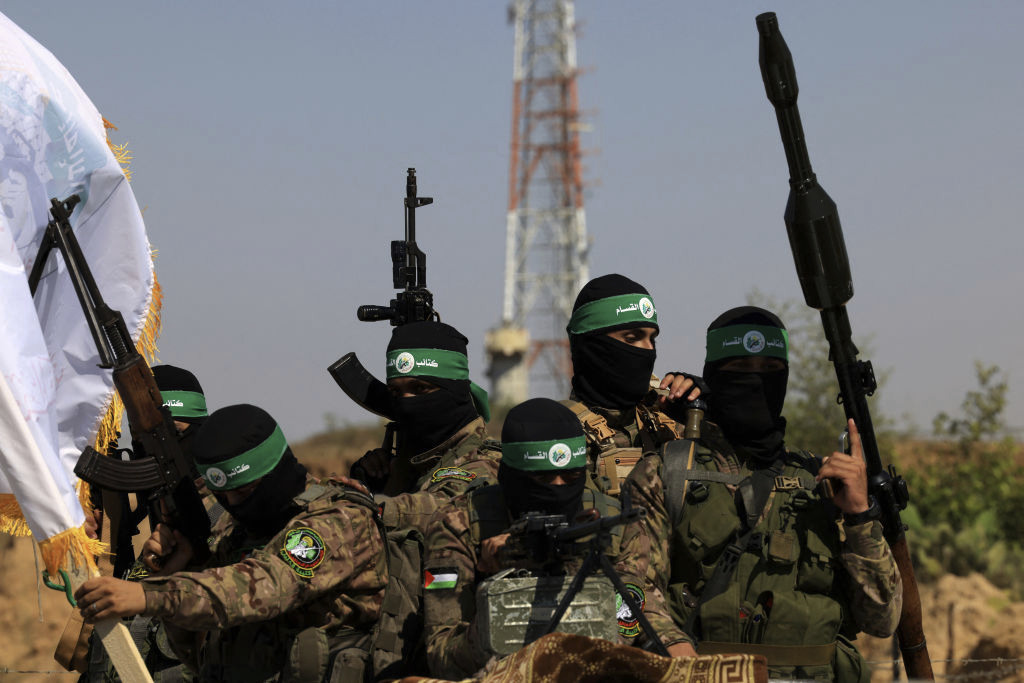
Pictured: Hamas terrorists take part in a military parade in the Gaza
Strip on July 19, 2023. (Photo by Mahmud Hams/AFP via Getty Images)
Nearly three years after the October 7, 2023 massacre and more than
six months after President Donald J. Trump's 20-point peace plan called
for the complete demilitarization of the Gaza Strip, Hamas has announced that it is dissolving its de facto governing body and is prepared to hand authority to a committee of Palestinian technocrats.
At first glance, the announcement appears to represent an important
concession. It is not. It is merely Hamas's latest attempt to deceive
the international community into believing that it is complying with the
requirements of the Trump peace initiative while preserving what
matters most to the terrorist organization: its military power.
The key question is not who sits in ministerial offices in the Gaza Strip. The key question is who holds the guns.
By Hamas's own admission, its ministries and thousands of employees will remain in place. Even more importantly, Hamas says it will continue overseeing security and policing in the areas still under its control.
In other words, Hamas is leaving government, not power. Nothing essential has changed.
Hamas is not dismantling its military wing. It is not surrendering
its weapons. It is not disbanding its security apparatus. It is not
ending its command structure. Thousands of Hamas employees and loyalists
will also remain embedded in the Gaza Strip's institutions.
Without these steps, dissolving a governing committee is little more than a cosmetic gesture.
So long as Hamas retains its military forces, every future civilian
administration in the Gaza Strip will operate under the shadow of
Hamas's guns.
No technocratic government can function independently while an armed
terrorist organization remains the strongest force on the ground.
Israel's Foreign Minister Gideon Sa'ar immediately recognized the danger. Hamas's trick is simple," he wrote. "Hamas's apparent willingness to make room for a technocratic government is designed to prevent its own disarmament."
Sa'ar warned
that Hamas seeks to replicate the Hezbollah model in the Gaza Strip: a
civilian administration would be responsible for garbage collection,
public services, reconstruction, and salaries, while Hamas would remain
the dominant military force. He noted that "as long as Hamas retains its weapons, any civilian government will of course operate as Hamas dictates."
That assessment goes to the heart of Hamas's strategy.
The terrorist group is trying to replicate Hezbollah's "state within a
state" model in Lebanon. Under that model, a civilian government
manages the country's daily affairs while the terrorist organization
retains its independent army, intelligence apparatus, and the power to
decide questions of war and peace.
The consequences for Lebanon have been catastrophic. Although
successive Lebanese governments formally governed the country, Hezbollah
remained the real power, using its vast arsenal and Iranian backing to
dominate political life and repeatedly drag Lebanon into destructive
wars with Israel.
Hamas now appears to be pursuing precisely the same formula in the
Gaza Strip. It wants someone else to rebuild hospitals, schools, roads
and homes, restore basic services, and pay the salaries of civil
servants, while Hamas quietly rebuilds its military capabilities,
recruits fighters, restores its tunnel network, manufactures rockets,
and prepares for another October 7-style massacre against Israel.
This is not peace and stability. It is simply outsourcing civilian responsibilities while preserving the machinery of jihad (holy war).
It is also not the first time Hamas has employed such tactics.
In 2014, after signing another reconciliation agreement with Mahmoud Abbas's Fatah faction, Hamas similarly agreed
to hand over the administration of the Gaza Strip to a Palestinian
unity government composed of technocrats. The belief back then was that
the arrangement would reduce Hamas's grip on Gaza. Instead, Hamas
maintained complete control over its military forces and security
agencies.
The unity government
never exercised genuine authority. The result was predictable. Hamas
remained the main ruler of the Gaza Strip while others (the Palestinian
Authority and the international community) carried responsibility for
administration and public services.
Twelve years later, Hamas is attempting to repeat precisely the same
formula. History should serve as a warning. The international community
has repeatedly accepted Hamas's promises at face value. It has
repeatedly convinced itself that Hamas was becoming more pragmatic, more
responsible, and more interested in governing than fighting. Many
Israeli and Western policymakers and political analysts believed Hamas
primarily wanted economic stability, reconstruction, and periods of
calm.
Those assumptions collapsed on October 7, 2023, when Hamas carried out the deadliest massacre of Jews since the Holocaust.
The lesson should have been obvious. Hamas has repeatedly used
ceasefires, reconstruction efforts, and diplomatic initiatives to
strengthen its military capabilities.
The latest Hamas announcement deserves to be examined through the same lens.
If Hamas genuinely wished to relinquish power, why wait until now?
Why not dissolve itself before the Gaza Strip suffered catastrophic
destruction? Why not step aside years ago to spare Palestinians the
enormous human and economic costs of another war?
The answer is straightforward.
Hamas is acting because it faces mounting international pressure to
comply with Trump's peace plan, whose central requirement is the
complete demilitarization of the Gaza Strip.
By announcing the dissolution of its governing committee, Hamas hopes
to create the impression that it is fulfilling its obligations while
shifting diplomatic pressure onto Israel.
The message Hamas wants the world to hear is simple: "We have done our part. Now Israel must do its part."
It is a clever public relations strategy. However, it does not
satisfy the fundamental requirement of the Trump plan. The issue has
never been who occupies government offices. The issue is whether Hamas
continues to exist as an armed terrorist organization.
So long as Hamas remains armed, no civilian government can function
independently. So long as Hamas retains thousands of loyal employees
embedded throughout Gaza's institutions, any new administration risks
becoming little more than a façade behind which Hamas continues ruling
from the shadows.
Palestinian political analyst Ahmed Fouad Alkhatib wrote on July 6:
"The ceaseless headlines about Hamas 'ending its
government' in Gaza and 'preparing to give up control' are yet another
ruse and a nothing‑burger dressed up as a concession by the terror
group, which has zero intention of relinquishing real power or
disarming. Similar announcements like this have happened frequently in
the past.
"The resignation of the head of the so‑called 'Emergency Committee,'
or Hamas's post–October 7 governing façade, is simply the removal of a
figurehead. His duties have already been quietly assumed by another
'temporary' Hamas administrator while everyone pretends to wait for
NCAG, the incoming Technocratic Committee, to take over. Hamas has
already announced that its administrative and technical staff will
continue working until NCAG arrives, fully aware that the new
transitional governing body will lack the capacity, personnel, or
infrastructure to run Gaza. This is Hamas's plan: recycle its
current/existing apparatus into the new administration expected to
emerge from the Trump Administration's transitional process overseen by
the Board of Peace.
"What we're seeing is the sloppy rollout of a long‑predicted
strategy: Hamas shifting from direct control to indirectly reigning,
Hezbollah‑style. It's cheaper, it shields the group from accountability,
and it allows new civilian faces to absorb public anger while Hamas
retains decisive control over every meaningful lever of power in the
Gaza Strip.
"None of this resembles disarmament. Hamas's al‑Qassam Brigades are
working nonstop to repair tunnel networks and rebuild munitions
stockpiles using unexploded ordnance and Israeli bombs from two years of
war. Yet the media coverage of this non‑event has already reframed
Hamas as cooperative, reasonable, even constructive; a narrative shift
that obscures Hamas's role as the primary obstacle to Gaza's recovery.
And this is landing successfully and working well for Hamas; not only
with outlets, voices, and platforms who are typically softer on the
terror group, but even in some mainstream political discourse, where
some are treating this as tantamount to the initiation of disarmament or
the start of Phase II of the ceasefire.
"The timing is no coincidence: this move by Hamas comes one week
after the Board of Peace met in Cyprus and agreed to pursue 'Plan B,'
the approach I've long advocated: moving Gaza's civilian population
across the 'Yellow Line' and draining Hamas of access to resources and
human shields it relies on.
"Ultimately, Hamas 'dissolving its government' will be judged by
simple metrics like whether Gazans can share posts on Facebook without
being tortured, beaten, or dragged into hospital interrogation rooms,
abuses that continued from October 7 until just last week. Until that
changes, the headlines are theater, and Hamas's grip in Gaza remains
intact."
Hamas's primary objective is survival. It understands that billions
of dollars in international reconstruction aid could soon flow into the
Gaza Strip.
A technocratic government financed by foreign donors would relieve
Hamas of the financial burden of governing while allowing the terrorist
group to concentrate on rebuilding its military machine.
The full implementation of the Trump peace plan requires the
dismantling of Hamas's military capabilities and the complete
demilitarization of the Gaza Strip. Allowing Hamas to establish a
Hezbollah-style state within a state would guarantee continued
instability and ensure that any future Palestinian administration
remained hostage to an armed terrorist organization.
The only meaningful solution is for Hamas to dissolve itself, and not
merely one of its governing committees. This means dismantling both its
political and military structures, surrendering all of its weapons,
disbanding its security apparatus, relinquishing every instrument of
coercion, and disappearing as an armed political force.
Anything short of that preserves the conditions that produced the October 7 massacre.
Both Israelis and Palestinians have already paid an unbearable price
for repeatedly believing Hamas's promises. They cannot afford to make
the same mistake again. The international community should not be fooled
by another carefully staged Hamas performance.
Until Hamas disappears as both a political movement and a terrorist
organization, declarations about dissolving committees amount to little
more than political make-believe designed to secure Hamas's
international legitimacy, unlock billions of dollars in aid for it, and
buy time for it to prepare its next war.
One-third say the Democratic Party supports them fairly well, while 41% say the party's support is "not very well" or "not well at all."
A new poll from the Associated Press-NORC Center for Public Affairs
Research found that nearly two thirds of Jewish Americans say prejudice
against Jewish people is an "extremely" or "very" serious problem in the
U.S.
The poll
also found that most Jewish adults don't feel well represented by
political leaders. Of those surveyed, 15% said that the Democratic Party
supports Jewish people in the U.S. "extremely" or "very well."
One-third say the party supports them fairly well, while 41% say the
party's support is "not very well" or "not well at all."
Half of Jewish adults, according to the poll, say that Trump and the
Republicans don't support Jewish people well in the U.S., while 40% say
the Republican Party supports Jewish people "somewhat," "extremely" or
"very well." The poll also found that 42% say the same of Trump.
The new survey of 1,022 Jewish adults — including people who identify
as Jewish by religion and religiously unaffiliated people who identify
as Jewish through culture, ethnicity or family background. The margin of
sampling error for Jewish adults is plus or minus 5.0 percentage points
U.S. government has conducted reviews that found tens of thousands of non-citizens have made it onto state voter rolls
The Justice Department's top election enforcement official has sent a
pointed warning to all 50 states that election administrators can be
criminally prosecuted if they knowingly allow noncitizens to vote in the
upcoming 2026 election.
Assistant Attorney General for Civil Rights Harmeet Dhillon sent the
letters Tuesday after the U.S. government conducted reviews that found
tens of thousands of noncitizens have made it onto state voter rolls,
and DOJ prosecuted a handful of foreigners who voted in federal
elections illegally, including an Australian citizen earlier this week.
“Every person who votes illegally that cancels your or my vote is one
too many for me, and I think it should be for every citizen, because
it’s a sacred right,” Dhillon told the Just the News, No Noise television show Wednesday night.
Dhillon's letters give states five days to explain how they will
comply with federal voter eligibility laws and identify what steps they
will take to maintain “clean voter lists" that remove noncitizens before
Election Day.
“Any election officer, including the chief election officer of the
state, who knowingly retains noncitizens on the state’s SVRL or
facilitates noncitizens in receiving and casting ballots could be
subject to criminal liability,” reads the letter sent to Michigan Secretary of State Jocelyn Benson.
The warning comes as the Trump administration makes a renewed push to
get the Senate to pass the SAVE America Act, which requires proof of
citizenship and photo ID to vote.
Dhillon said her office had listed criminal punishments written into
federal election laws such as the Voting Rights Act, the Help America
Vote Act, and the National Voter Registration Act.
“Look, I don't want to scare anybody, but if that's having the impact
of fear, that means that some people are worried that they're actually
violating the law, and we want them to stop,” Dhillon said.
“I hope no prosecutions are necessary," she added.
Moreover, Dhillon said that in states cooperating with the DOJ
"cleanup of the voter rolls,” the DOJ had discovered “hundreds of
thousands of dead people on the voter rolls,” as well as “tens of
thousands of non-citizens on the voter rolls.”
Recent data from individual states offers a closer look. The North Carolina State Board of Elections has identified around 34,000 dead people on the state’s voter rolls, while an ongoing audit in Ohio recently flagged 62 potential noncitizen registrations.
Verifying the DOJ's national figures remains difficult as the
department is currently suing more than 20 states, including California,
for refusing to turn over their unredacted voter files.
Dhillon said she was concerned that in large states like California,
there could be “hundreds of thousands of people” on voter rolls who did
not have citizenship records in the systems.
The DOJ also announced this week that it is dispatching election
monitors to six states: Arizona, Massachusetts, Michigan, Minnesota, New
Hampshire, and Virginia.
Dhillon said the monitors are being sent to counties and
jurisdictions that have previously had problems during federal
elections.
Dhillon noted Arizona experienced “glitches in their vote centers,”
where roughly 20% of Maricopa County had problems with ballot on-demand
printers, Apache County had “pretty much the whole voting system went
down” and Detroit, suffered "extremely long lines around universities
for students to have to wait to vote."
Local officials have pushed back against DOJ election monitoring letters. Detroit City Clerk Janice Winfrey recently called the department’s rationale “thin gruel” and “false assertions that form a baseless conclusion.”
Dhillon pushed back against such criticisms, saying election crimes victimize lawful voters.
“There isn't a culture of law enforcement caring about it. It's
viewed as a victimless crime. It is not a victimless crime,” she said.
“We are trying to empty the ocean with a teaspoon, because there isn't a
culture of US attorneys' offices going after this."
For nearly eight decades, the "two-nation theory" has provided the moral and political framework through which Pakistan has justified its authority over Kashmir. The Muslim crowds in Kashmir chanting "Pak Forces Out," however, have delivered their verdict on that claim.
Many jihadists, building on
the Palestinian model, increasingly see Kashmir as prime land to
conquer: the next great cause for global jihad.
Pakistan has actively enabled and amplified this jihadist
narrative by positioning itself as the foremost protector of Muslims,
effectively asserting ownership over Kashmir.
In June 2026, Pakistani paramilitary forces opened fire on
protesters in... Kashmir. The protesters were not armed rebels. They
were ordinary Muslim residents — traders, students, lawyers, transport
workers and women — demanding cheaper electricity, affordable wheat
flour and fairer treatment from the authorities that rule them.
Sit-ins drew more than 70,000 people chanting "Pak Forces Out."
What began as an economic protest gradually became a broader challenge to Pakistan's administration of the territory.
For nearly eight decades, the "two-nation theory" has provided
the moral and political framework through which Pakistan has justified
its authority over Kashmir. The Muslim crowds in Kashmir chanting "Pak
Forces Out," however, have delivered their verdict on that claim. What
made the protests politically significant was not their scale, but their
target: Muslim Kashmiris rising against Pakistan itself.
[T]he Organization of Islamic Cooperation (OIC)... has an
established mechanism for addressing the Kashmir dispute.... The OIC's
selective outrage — loud on India, silent on Pakistan's abuses — exposes
its hypocrisy.
Despite Pakistan's persistent claim that it is the rightful
protector of Kashmiri Muslims and that the Indian-administered portion
also belongs to it, Muslims in Pakistan-administered Kashmir are openly
rejecting this narrative, telling Pakistan that it is not their
protector -- that they are better off without its rule. This is
particularly striking given that Muslims in Indian-administered Kashmir
enjoy greater political rights, economic opportunities, and development
compared to those living under Pakistani administration.
By bravely confronting the very state that claims to embody
Muslim "purity" and protection, the Kashmiri Muslim protesters have
dismantled the moral foundation of Pakistan's narrative from within.
While jihadists, with Pakistan's active encouragement, have been
attempting to turn Kashmir into the next major jihadist stronghold and
battlefield against non-Muslims after Gaza, the voices of Kashmiri
Muslims chanting against Pakistani forces have been rejecting the idea.
The founding myth of Pakistan as the "pure" Islamic homeland and true
representative and protector of Kashmiri Muslims has visibly collapsed.
Many jihadists, building on the Palestinian model,
increasingly see Kashmir as prime land to conquer: the next great cause
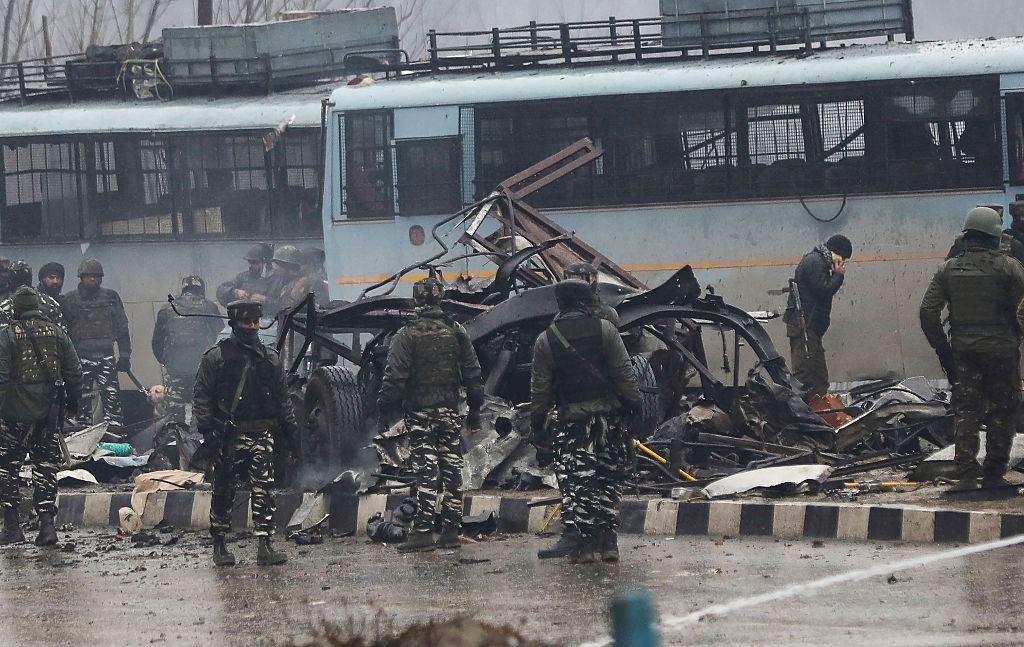
for global jihad. Pictured: Indian security forces in Kashmir inspect
the site of a jihadist terrorist attack carried out by Jaish-e-Mohammed (JeM), in which 40 Indian troops were killed, on February 14, 2019. (Photo by AFP via Getty Images)
Many jihadists, building on the Palestinian model, increasingly see
Kashmir as prime land to conquer: the next great cause for global jihad.
Hamas leaders themselves have explicitly framed the Palestinian and
Kashmiri causes as one struggle. High-ranking Hamas envoys who traveled
to Kashmir in 2025 to headline the "Kashmir Solidarity and Hamas
Operation 'Al-Aqsa Flood' Conference." The message stressed at the conference was "The mujahideen of Kashmir and Palestine have become united."
Soon after October 7, 2023, on November 6, during a meeting with
Pakistani politician Fazal-ur-Rehman in Qatar, Hamas leader Khaled
Mashaal framed
the "Palestine and Kashmir issues" as a shared "litmus test" for "human
rights" advocates. In international forums, Pakistan-based jihadi
groups and Pakistani political parties have long treated "Palestine and Kashmir" as aligned.
Pakistan has actively enabled and amplified this jihadist narrative
by positioning itself as the foremost protector of Muslims, effectively
asserting ownership over Kashmir. Their claim is rooted
in the "two-nation theory," articulated by the founding fathers of
Pakistan — Syed Ahmad Khan, Muhammad Iqbal, and Muhammad Ali Jinnah.
This ideology
framed Hindus and Muslims as two incompatible nations, with Pakistan
("the Land of the Pure") ordained as a superior homeland to safeguard
Muslim identity against Hindu-majority India.
It was Jinnah, the founder of Pakistan, however, who translated this into a concrete political demand. He argued
that Hindus and Muslims were two separate nations and that Muslims
required a sovereign homeland to safeguard their identity. This framed
the "two-nation theory" not just as a partition plan but as a claim
about the nature of cultures that are incompatible. Jinnah's view has
served as Pakistan's founding principle and permanent foreign policy.
This ideology does not belong to the past. Pakistan's army chief, Field Marshal Asim Munir, declared last year:
"Our forefathers believed that we were different from
Hindus in every possible aspect of life. Our religion is different. Our
customs are different. Our traditions are different. Our thoughts are
different. Our ambitions are different... That was the foundation of the
Two-Nation Theory. It was laid on the belief that we are two nations,
not one."
On another occasion, Munir said that Kashmir "was our jugular vein, it will remain our jugular vein, and that Pakistan was prepared to fight additional wars over the territory.
80 years after partition, however, the claim is collapsing in
Pakistan-occupied Kashmir —a region that is almost entirely Muslim. At
partition, Pakistan argued that the Muslim-majority Kashmir should all
be part of Pakistan. However, after the 1947-48 war, also known as the
first Kashmir war, the territory was divided between Indian- and
Pakistan-administered regions. Pakistan has continued to insist that the
Indian-administered part rightfully belongs to it. Today, it is Muslim
Kashmiris themselves who are clearly expressing their rejection of Pakistani rule.
In June 2026, Pakistani paramilitary forces opened
fire on protesters in Muzaffarabad and Rawalakot, the principal towns
of Pakistani-administered Kashmir. The protesters were not armed rebels.
They were ordinary Muslim residents — traders, students, lawyers,
transport workers and women — demanding cheaper electricity, affordable
wheat flour and fairer treatment from the authorities that rule them.
The International Human Rights Foundation accused
authorities of carrying out a "violent crackdown on peaceful protesters
in Pakistan-administered Jammu and Kashmir, which has resulted in over
32 civilian deaths, including at least one woman, between June 8 and 16,
2026."
Protest groups and local media claim the total number of wounded ranged between 200 and 300. Amnesty International documented
internet shutdowns, arbitrary mass arrests, and the application of
anti-terrorism law against a grassroots civic coalition. Sit-ins drew more than 70,000 people chanting "Pak Forces Out."
These were the very people Pakistan claims to represent internationally when it speaks on behalf of Kashmiris.
The events in Kashmir since 2023 challenge the "two-nation theory."
The unrest began with protests over electricity tariffs and flour
shortages in May 2023, organized through the Awami Action Committee, a
coalition of traders, lawyers, transporters, students and civil society
groups, which formulated a 38-point charter of demands, including subsidized essentials and local electoral reforms.
Years of economic
frustration boiled over when residents complained that although their
territory generates substantial hydroelectric power, they were being
charged electricity rates they considered unfair while also struggling
with rising food prices and shortages. What began as an economic protest
gradually became a broader challenge to Pakistan's administration of
the territory.
Pakistan's response has been harsh. The Awami Action Committee was banned
on June 5 under anti-terror provisions. Its leaders face sedition
charges. Internet and mobile communications were suspended. Federal
paramilitary forces were deployed. Reuters reported a 10-million-rupee ($36,000) bounty for the arrest of the committee's leaders.
Pakistan has built its international position on Kashmir on the
premise that it speaks for Kashmiri Muslims. This premise is now
contradicted by the conditions in the territory that Pakistan itself
administers.
For nearly eight decades, the "two-nation theory" has provided the
moral and political framework through which Pakistan has justified its
authority over Kashmir. The Muslim crowds in Kashmir chanting
"Pak Forces Out," however, have delivered their verdict on that claim.
What made the protests politically significant was not their scale, but
their target: Muslim Kashmiris rising against Pakistan itself.
The contrast between international responses to the areas of Kashmir
under Indian administration and those under Pakistani administration is
further underscored by the role of the Organization of Islamic Cooperation (OIC), which has an established
mechanism for addressing the Kashmir dispute. Its Contact Group on
Kashmir meets periodically and issues statements on the situation in
Indian-administered Kashmir. It did not convene specifically to address
the unrest in Pakistan-administered areas, or to issue a separate
condemnation of the massacre there. The OIC's Kashmir position has
historically been shaped by consensus language influenced heavily by
Pakistan, aligning the organization's public messaging with Islamabad's
diplomatic priorities. The OIC's selective outrage — loud on India,
silent on Pakistan's abuses — exposes its hypocrisy.
In the end, the courageous demonstrations by ordinary Muslim
Kashmiris represent a powerful popular rejection of the "two-nation
theory," exposing the failure and unsustainability of Pakistan's
founding ideology. That ideology underpins Pakistan's claim that it
should control the whole Muslim-majority region of Kashmir. Yet India
today is home to almost the same number of Muslims as Pakistan and
continues to administer part of Kashmir. Despite Pakistan's persistent
claim that it is the rightful protector of Kashmiri Muslims and that the
Indian-administered portion also belongs to it, Muslims in
Pakistan-administered Kashmir are openly rejecting this narrative, telling
Pakistan that it is not their protector -- that they are better off
without its rule. This is particularly striking given that Muslims in
Indian-administered Kashmir enjoy greater political rights, economic
opportunities, and development compared to those living under Pakistani
administration.
By bravely confronting the very state that claims to embody Muslim
"purity" and protection, the Kashmiri Muslim protesters have dismantled
the moral foundation of Pakistan's narrative from within.
While jihadists, with Pakistan's active encouragement, have been attempting to turn Kashmir into the next major jihadist stronghold and battlefield
against non-Muslims after Gaza, the voices of Kashmiri Muslims chanting
against Pakistani forces have been rejecting the idea. The founding
myth of Pakistan as the "pure" Islamic homeland and true representative
and protector of Kashmiri Muslims has visibly collapsed.
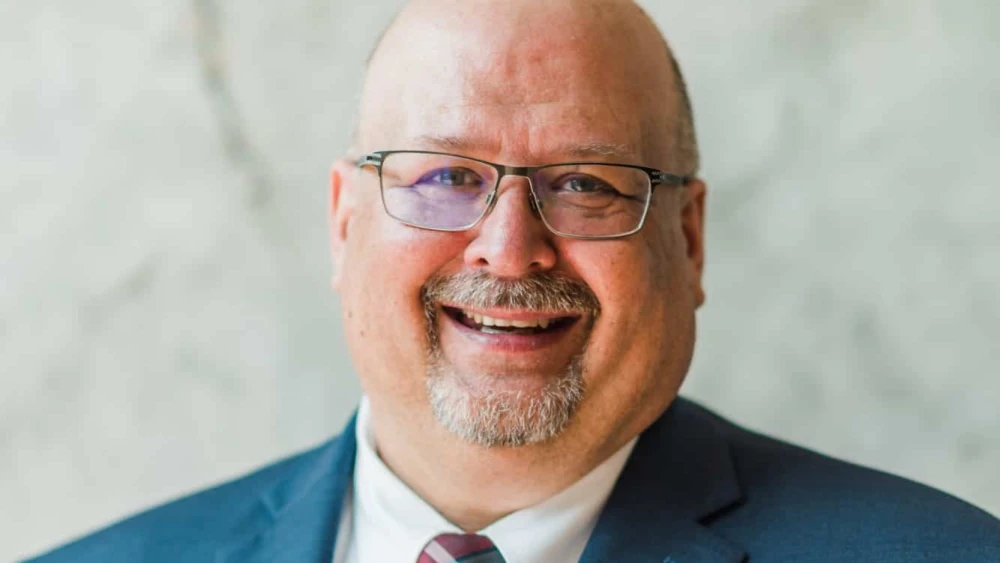
“The big battle is not on the left, which is far gone, but on the right,” Troy A. Miller, president and CEO of National Religious Broadcasters, said during a recent visit to Jerusalem.
Troy Miller, president and CEO of the National Religious Broadcasters. Credit: Courtesy.
American evangelical leaders are pushing back against a wartime drop
in Christian support for Israel, and have pledged to redouble their
efforts among the young generation in the postwar period by mixing the
Bible with Israeli innovation, as well as bringing more Christians to
visit.
The move comes amid polling which shows a drop in support
for Israel even among large supportive conservative evangelical groups
following the war in Gaza, and a very public fissure on the right
between the predominant supporters of the Jewish state and its vocal
opponents.
“The big battle is not on the left, which is far gone,
but on the right to be sure that the right doesn’t become far-right, but
it is not as big as it is made out to be,” Troy A. Miller, president
and CEO of National Religious Broadcasters, said during a visit to
Jerusalem last month.
The prominent group of American Christian
media broadcasters, which encompasses 1,500 media organizations across
America and reaches tens of millions of people on five continents, will
be hosting
its first-ever conference in Jerusalem this fall, seeking to unite
Christians and Jews in combating media misinformation following the
two-year war against Hamas in Gaza.
Miller cited recent internal
data showing that more than 60% of American adults follow Christian
media outlets, including 64% of Gen Z and 58% of Millennials, while
two-thirds of the general population view Christian media favorably.
“We are seeing a major trend with Gen Z coming back to church,” said Miller.
“Antisemitism
is part of the anti-globalist movement, and anti-Israel just happens to
be part of that,” said Pastor Larry Huch, founder and senior pastor of
the Dallas-based New Beginnings Church. “These are people who feel
disenfranchised from the American dream.”
“Israel is terrible at PR,” Huch told JNS, lamenting that the message being shown around the world is that “everything is war.”
“We need to combine biblical history with the benefits that Israel is bringing to the world through its innovations,” he said.
Still, relations between Israel and the evangelical community are necessarily centered on the Bible.
“The
less young people know the Bible, the further they drift away from
Israel,” Israeli Ambassador Naor Gilon told a delegation of hundreds of
pastors attending a conference organized by the International Christian
Embassy in Jerusalem last month. “You lose connection to the Bible, you
lose connection to our common roots.”
“I’ve been warning this has
been coming for 20 years; you can’t take evangelical support for
granted,” said Robert Stearns of the New York-based Eagles’ Wings
Ministries, which led a delegation of pastors to Israel last month in
coordination with the Israeli Foreign Ministry.
“Young people are
being pelted with new media and social media Monday-Saturday, and then
there is this level of fear and pushback of being vocally supportive,”
said Pastor Stephen Luna of Kansas.
“A lot of pastors lack
confidence about how to speak about Israel,” said Pastor Micah Wood of
Alabama. “The answer to global antisemitism is global philosemitism. You
don’t defeat antisemitism by fighting it but by providing the
opposite.”
Meanwhile, Israel’s newly appointed Special Envoy to
the Christian world this week slammed the General Assembly of the
Presbyterian Church for voting to identify Israel’s war in Gaza as
”genocide.”
“PCUSA has lost 67% of its members since the 1980s.
Meanwhile, the Christian population of Israel has grown by 110%,” said
George Deek, Israel’s special envoy to the Christian world, wrote on X.
“Maybe if they spent less time condemning the one country in the Middle
East where Christians are thriving, they’d have more Christians left to
do the condemning.”
Etgar Lefkowitz, an award-winning international journalist, is an Israel correspondent
and a feature news writer for JNS. A native of Chicago, he has two
decades of experience in journalism, having served as Jerusalem
correspondent in one of the world’s most demanding positions. He is
currently based in Tel Aviv.
The U.S. president slammed Tehran’s leaders as “scum” and dismissed further truce talks as a waste of time.
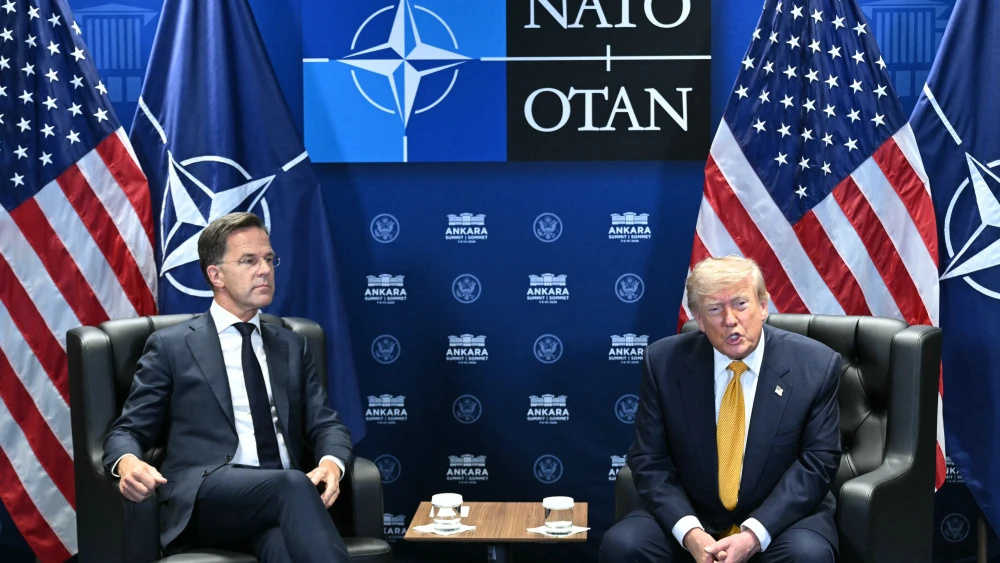
NATO Secretary-General Mark Rutte and
U.S. President Donald Trump meet on the sidelines of the NATO summit in
Ankara on July 8, 2026. Photo by Saul Loeb/AFP via Getty Images.
U.S. President Donald Trump on Wednesday effectively declared the
Iran ceasefire and its accompanying Memorandum of Understanding dead.
“To
me, I think it’s over. I don’t want to deal with them anymore,” he said
in response to a reporter’s question on day two of the NATO summit in
Ankara, Turkey.
The reporter had asked: “Is the ceasefire over? Is the ceasefire done? Is the MoU dead?”
“They’re
scum... they’re sick people,” Trump said of Iran’s leadership. The
Islamic Republic is “led by sick people, and they’re vicious, violent
people, and if they had a nuclear weapon, they’d use it. As far as I’m
concerned, it’s over,” he continued.
“I’ll speak to our
negotiators. They want to negotiate. They’re good people—Steve Witkoff,
Jared Kushner. But they have to come back to me. As far as I’m
concerned, it’s just a waste of time dealing with them. They’re [the
Iranians] liars. ... We make a deal, everyone’s agreed—no nuclear
weapon. We make a deal. They go outside and talk to the press and say,
‘We never even talked about it.’ There is something wrong with them;
they’re cuckoo. As far as I’m concerned, it’s over.”
Asked if this
means negotiations will not continue once the funeral proceedings in
Iran for slain Supreme Leader Ali Khamenei conclude on Thursday, Trump
again dismissed the prospects for a successful outcome. “I don’t care.
They can talk, but I think they’re wasting their time.”
He called
the leaders of the Islamic Republic “a bunch of lying guys. ... They’re
liars. They’re cheats. They’re sick people. They’ve hurt their people.
They killed 54,000 people as of now who were protesting. When people
say, ‘How come they haven’t taken over?’ They can’t take over because
they’re dead. They killed them. Nobody is going to take over. They have
no guns, and the other side has machine guns, and they’re killing them.
The press doesn’t report it. But they’re bad people. They’re bad people,
and frankly, I don’t want to waste my time with them. Now, I’ll let our
wonderful negotiators keep talking if they want to, but I don’t see it.
I don’t like these people, you know that?”
Trump told reporters later on Wednesday that the U.S. military was preparing to once more strike the Islamic Republic “hard.”
“We
hit them very hard last night, very, very. Probably hit them hard again
tonight,” Trump said. “I’ll give them a little warning. We’re going to
hit them hard tonight,” he added. “We’ll see how it all works out—no,
I’m not happy with them.”
US Central Command
American forces launched strikes
against the Iranian regime in response to the Islamic Republic’s
attacks on civilian-manned commercial ships on Tuesday, according to
U.S. Central Command, which said it hit more than 80 targets to degrade Iran’s ability to continue attacking international commerce.
Iran
fired missiles at commercial ships transiting the waterway between Iran
and Oman, reportedly causing significant damage but no casualties.
The strikes come as the U.S. Treasury Department reimposed sanctions on the export of Iranian oil in response to Iran’s attacks.
Sirens
sounded in Bahrain on Wednesday as the Gulf kingdom’s Interior Ministry
urged citizens to seek safety, according to a post on X. The warning
came after the IRGC said it launched missiles and drones at 85 U.S.
military sites across Bahrain and Kuwait in response to the latest wave
of American strikes.
Iranian Parliament Speaker Mohammad Baqer
Ghalibaf accused Washington of committing “major violations” of the
ceasefire deal known as the Islamabad Memorandum of Understanding
following the renewed strikes.
In a post on X on Wednesday,
Ghalibaf listed what he described as U.S. violations, including
“persistent threats of further strikes,” the reinstatement of oil
sanctions, attacks on southern Iran and continued Israeli military
action in Lebanon. “The era of bullying and extortion is over. It leads
nowhere. We don’t fold,” he wrote.
Iran’s deputy foreign minister
for legal and international affairs, Kazem Gharibabadi, accused the
United States of violating the Memorandum of Understanding, not only
with Tuesday’s renewed strikes but also due to recent “actions of the
Zionist regime in Lebanon and threatening statements against Iran.”
He warned that Iran “will take decisive actions to safeguard its national interests and security.”
NATO
Secretary-General Mark Rutte, who was alongside Trump on the sidelines
of the summit on Wednesday when the president shared his thoughts on the
state of the Iranian negotiations, voiced support for the American
attacks, calling them “absolutely necessary,” according to Reuters.
“When
you have a ceasefire and Iran is basically violating the ceasefire, I
think it is totally crucial that the U.S. forcefully react,” Rutte told
reporters.
As NATO leaders meet in Ankara, JNS spoke with former U.S. envoy James Jeffrey and JINSA’s Blaise Misztal about why U.S. and Israeli officials disagree about Turkey.
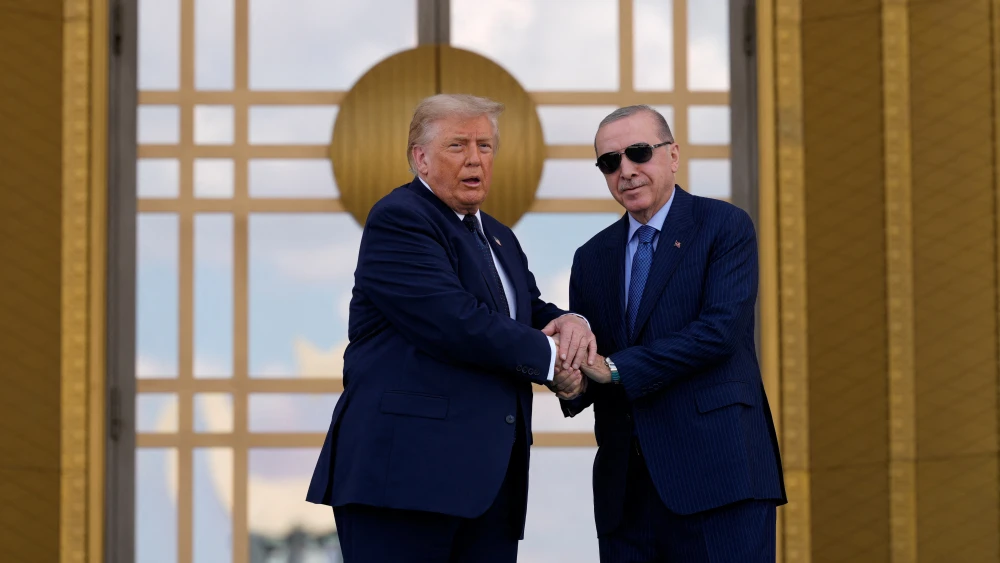
Turkish President Recep Tayyip
Erdoğan shakes hands with U.S. President Donald Trump during a state
arrival ceremony at Bestepe Presidential Compound in Ankara, on July 7,
2026, on the sidelines of the NATO Summit. Photo by Emrah Gurel
/POOL/AFP via Getty Images.
Amichai Chikli, Israeli minister for diaspora affairs and combating
antisemitism, leaves little doubt about what he thinks of Turkish
President Recep Tayyip Erdoğan.
“Greetings to the patron of Hamas
and ISIS, the dictator who jails every critical journalist, the man
behind the barbaric rapes and massacres of Kurdish, Druze and Alawite
minorities, the megalomaniac who has lost his mind, a grotesque hybrid
of Hitler and Sinwar,” the Israeli politician wrote on Monday.
Israeli
Prime Minister Benjamin Netanyhu avoided comparing Erdoğan to the
leaders of Nazi Germany and Hamas in an interview with CNN on
Tuesday. But he warned that the Turkish president runs “a regime that’s
infected with the Muslim Brotherhood, which hates the United States” and
has threatened to destroy Israel.
U.S. President Donald Trump,
leader of the country most closely allied to Israel, took a markedly
different tack as he sat beside Erdoğan in the Turkish presidential
palace in Ankara on Tuesday ahead of a two-day NATO summit.
“As
everybody knows, it’s been very much reported, we are great friends,”
Trump said. “From the very beginning, from the first moment, I said it
before, it’s a chemistry that works between us.”
“The relationship with Turkey right now is better, probably, than it’s ever been,” Trump added.
JNS
spoke with James Jeffrey, former U.S. ambassador to Turkey and a fellow
at the Washington Institute for Near East Policy, and Blaise Misztal,
vice president for policy at the Jewish Institute for National Security
of America, about whether Turkey and Israel are as deeply at odds as the
rhetoric from their leaders suggests and what it means for the U.S.
relationship with both countries.
“The Turks do not see Israel as an enemy state,” Jeffrey said. “I can say that authoritatively.”
Critics
have accused Turkey of backsliding away from democracy, particularly
following a coup attempt in 2016 and a constitutional referendum the
following year that gave Erdoğan more power and will let him stay in
office until at least 2028.
Despite that, Jeffrey told JNS that
the country’s democratic institutions are what drive the main wedge
between Israel and Turkey over Gaza.
“Turkey is a country that
actually has to listen to its own population,” Jeffrey said. “They’re
very unhappy about the treatment of the West Bank Palestinians, but Gaza
is the most important issue between them.”
One of the critical
topics of discussion in Ankara is Turkey’s potential purchase of F-35
fighter jets, after the United States barred it from doing so in 2019
during the first Trump administration when Turkey bought Russian S-400
surface-to-air missile defense batteries.
Erdoğan said
at a press conference with Trump on Tuesday that the U.S. president had
made a “promise” to let Turkey have the advanced stealth fighters,
which Israel and other close U.S. allies also fly.
JINSA’s Misztal
told JNS that despite its membership in the transatlantic alliance,
Turkey should not be considered one of those close partners.
“Turkey is a NATO member in name only,” Misztal said.
He
pointed to the country’s record of trying to block Sweden and Finland
from joining the alliance and Erdoğan’s purge of the Turkish officer
corps after the 2016 coup attempt.
“The idea that Turkey somehow
naturally fits into NATO and that it is a member of NATO in good
standing is very much open for dispute on the evidence over the past
decade,” Misztal told JNS.
Misztal said that he would not describe
Turkey as a “true enemy” of Israel, but the Israeli perception of
Turkey is driven by how Jerusalem’s view of threats changed after Oct. 7
and concern over Turkey’s role in Syria under Syrian President Ahmed
al-Sharaa.
“The lesson that Israel painfully learned on Oct. 7 is
that it can no longer watch major military capabilities amass on its
borders,” Misztal said. “The way the Israelis put this is they have to
focus on capabilities, not intents, and so they see Turkey both
significantly helping arm and train the new Syrian military, turning
that into a more capable fighting force and seeking to have its own
military in place in Syria.”
“From Israel’s new doctrine of not
wanting to have a buildup of military capabilities on or near its
borders, that looks problematic—especially given how big Turkey’s
military is,” he added. “That is a fundamental problem.”
Jeffrey,
who also served in U.S. special envoy roles for Syria and for the global
coalition to defeat ISIS, told JNS that even as Syria has become a
source of tension between Israel and Turkey, it is one of many areas
where Turkey and the United States have grown closer.
“In its
entire near abroad, either American policy has changed or Turkish policy
has changed, so that we are aligned in a way that we weren’t,” he said.
He
cited Erdoğan’s close work with Trump to try to resolve the conflict
between Azerbaijan and Armenia, the peace process with Turkey’s Kurdish
population and the warming ties between Washington and Damascus.
Those shifts have likely all contributed to Trump re-evaluating whether Turkey can once again join the F-35 partner program.
Despite
the sharp rhetoric from both Ankara and Jerusalem, Jeffrey pointed to
the long-term trends in Turkey that make real conflict or a full-blown
diplomatic rupture unlikely.
“After 25 years of Erdoğan, who is a
religious jerk, the country is still, if anything, more secular than it
was before,” he told JNS.
“Turks aren’t interested in the Middle
East,” Jeffrey said. “Turks are interested in Europe. They see
themselves as Europeans to some degree.”
Misztal agreed that the
potential for any sort of Israeli-Turkish conflict was remote but said
that the United States should do more to pressure Turkey in areas where
the two countries have disagreements, including areas of shared concern
with Israel.
“It’s important for the United States to get over
this idea that its partnership with Turkey is too big to fail, and that
therefore we need to turn a blind eye to the ways in which Turkey has
undermined U.S. interests in and around the Middle East,” he said.
“A
tougher line against Turkey on areas where we do have real
disagreements would actually, in the long term, be salutary to the
relationship and give us a chance of returning to some better
understanding between each other,” he added.
The SAVE system was enhanced under the Trump administration to better support state election integrity efforts, including maintenance of state voter rolls.
A federal judge in Florida on Tuesday ordered the
Department of Homeland Security to restore some of the key features of
its Systematic Alien Verification for Entitlements system, which states
use to verify citizenship and immigration status for voter rolls.
The ruling overturns a D.C. judge's ruling,
who determined that the SAVE system's features, including a feature
that allowed workers to verify citizenship status through a resident's
social security number, violated the Social Security Act and Privacy Act
by improperly aggregating and using Americans’ personal data.
The SAVE system was enhanced under the Trump administration to better
support state election integrity efforts, including maintenance of
state voter rolls.
U.S. District Judge T. Kent Wetherell II ruled that the DHS violated a
settlement with states, including Florida, by disabling the features.
Wetherell approved the settlement last year and has maintained
jurisdiction to enforce the settlement.
"Defendants are plainly in violation of the settlement agreement
because it is undisputed that they disabled the bulk-upload and
SSN-search features that the agreement expressly required the SAVE
system to have," he wrote in the order. "The fact that defendants
disabled those features to comply with [the judge's] order does not
change the fact that they violated the agreement."
Wetherell determined that the features did not violate federal law,
concluding the SSN-search functions align with 8 U.S.C. §1373, which
overrides other restrictions on sharing citizenship or immigration
status information, according to Florida's Voice News.
The judge ordered defendants to file a status report on its compliance with the latest order by July 14.
Misty Severi is a news reporter for Just The News. You can follow her on X for more coverage.
For the first time in Israel's nearly 80-year history, the government announced it would not abide by a Supreme Court ruling.
Well, it finally happened.
The executive branch – Israel's government – has apparently had enough
of the activist, self-selected Supreme Court endeavoring to micro-manage
policy decisions that have nothing to do with it.
For the first time in Israel's nearly 80-year history, the government announced it would not abide by a Supreme Court ruling.
The reality... is that the Supreme Court is itself guilty of
these allegations directed towards the government. The court has ignored
existing law, for reasons of its own ideological persuasions, and has
led the country to a constitutional crisis entirely of the court's own
making.
It was probably inevitable that a government of integrity would
one day resist the slew of biased Supreme Court decisions made against
it in an attempt by the court to insert itself into the executive's
policy-making function –- an action well outside the limit of judicial
authority.
Months of massive demonstrations – partially financed by the
Biden Administration in the hope of dislodging Prime Minister Benjamin
Netanyahu in order to replace him with someone more pliable --
indirectly led to the horrors of October 7, 2023.
Israel's leaders would do well urgently to draft legislation
clarifying the role and functions of the judiciary, as well as that of
the attorney general. Perhaps the nation's enemies will then understand
that the people of Israel stand together against their enemies as one.
Well, it finally happened. The executive branch – Israel's
government – has apparently had enough of the activist, self-selected
Supreme Court endeavoring to micro-manage policy decisions that have
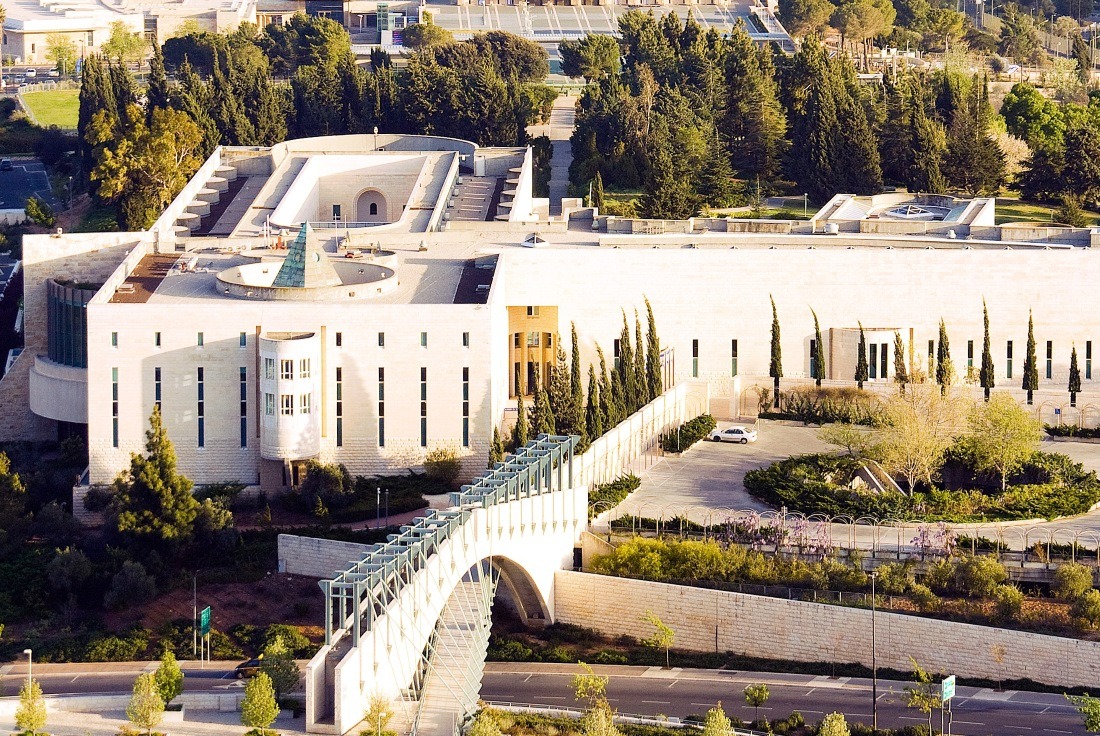
nothing to do with it. Pictured: The Supreme Court building, in
Jerusalem. (Photo by: Israeltourism/Wikimedia Commons)
Well, it finally happened. The executive branch – Israel's government
– has apparently had enough of the activist, self-selected Supreme
Court endeavoring to micro-manage policy decisions that have nothing to
do with it.
Just about every major government decision not to the court's liking
appears to be barred from implementation. This leads to months, if not
years, of appeals and counter-appeals, preventing the government from
moving forward with its programs for the nation.
The government, as the executive, is a body elected by the people;
the Supreme Court is not. It is therefore unaccountable to anyone except
itself. In a normal democratic environment, the legislature enacts laws
that are implemented as policy by the elected representatives of the
people -- Israel's parliament, the Knesset -- or by the executive.
In case of disputed matters involving law, the courts make rulings to
ensure justice. This is their role – to interpret and uphold the law
through judicial decisions. It is not their function to make laws (the
role of the legislature) or to determine policy (the role of the
executive), which they appear to be doing by negating governmental
implementation of executive decisions -- decisions that normally lie
beyond the scope of judicial authority.
In the instance of Israel, the separation of powers doctrine, which
determines the limitation of powers between each branch of government to
avoid confusion and overlap, is obscured by the fact that, as in the
United Kingdom, there are no clear guidelines defining the differing
authority of three branches: the legislative, the judiciary and the
executive.
This is due to two main factors -- the lack, as in the United
Kingdom, of a written constitution delineating powers between the three
branches, and the conflicted role of the attorney general, whose
apparent mandate is not only to advise the government on legal matters,
but also to represent it when necessary and to prosecute it when
appropriate.
It was predictable that one day a serious, dramatic clash between the
government and Israel's activist Supreme Court would lead to a
constitutional showdown. This happened on July 5, 2026. For the first
time in Israel's nearly 80-year history, the government announced it would not abide by a Supreme Court ruling.
The matter involved a blatantly wrong and openly slanted decision
by the court to the effect that the Council of the Second Authority
(Israel's regulatory body for commercial broadcasting) could continue to
conduct operations notwithstanding the fact that the council legally
lacked a quorum to do so.
"[Communications Minister Shlomo] Karhi accused the
judges of the High Court of being 'drunk with power,' and said their
rulings could not override explicit provisions of the law."
Karhi added that, "The rule of law is not the rule of judges. Today,
the government made it clear: When the High Court tramples the law, the
state will not comply with it".
"In a democratic state, the Knesset legislates the law,
and the court is obligated to apply it. When a ruling stands in direct
contradiction to the wording of the law, this is not judicial review but
rather a violation of the principle of the separation of powers."
To be expected, the opposition parties, scenting an opportunity to
vilify the government for their own ends, together with Attorney General
Gali Baharav-Miara and President Isaac Herzog, strongly criticized the government, accusing it of causing a constitutional crisis and of violating the rule of law.
In hand with the court, Baharav-Miara said
that the government's declaration "undermines the fundamental
principles of the rule of law." She no doubt looks forward to once again
prosecuting members of the government for their decisions.
Among the opposition parties, the leftist Democrats party claims that the government's stance is an attempt "to weaken democracy and keep its grip on power even if it loses at the ballot box."
The reality, however, is that the Supreme Court is itself guilty of
these allegations directed towards the government. The court has ignored
existing law, for reasons of its own ideological persuasions, and has
led the country to a constitutional crisis entirely of the court's own
making.
This particular issue is but one of many such problems that Israel's
elected government has had to face from the Supreme Court and the
attorney general. It was probably inevitable that a government of
integrity would one day resist the slew of biased Supreme Court
decisions made against it in an attempt by the court to insert itself
into the executive's policy-making function –- an action well outside
the limit of judicial authority.
There is a long history to the stark polarization between the Supreme
Court and Israel's conservative governments. Historically, the courts,
legal system, government, and major public servants were composed of
elitist-liberal-progressives. It was this way at the time of Israel's
independence in 1948, and for the first 30 years of Israel's political
life thereafter, the socialists were in power. For the last 50 years or
so, however, on and off, the conservative Likud Party and its coalition
partners have been elected to government and the die-hard institutional
voters on the left have not stopped trying to frustrate their policies
and return to political power.
Even so, the effect of a legal and political confrontation between an
elected government and an unelected, activist judiciary has the
potential to result in mass protests against, or for, those two branches
of government. Unless this issue is resolved satisfactorily, social
turbulence may follow -- which Israel's enemies would -- again --
undoubtedly misunderstand as a sign of the nation's weakness and
vulnerability. Months of massive demonstrations – partially financed
by the Biden Administration in the hope of dislodging Prime Minister
Benjamin Netanyahu in order to replace him with someone more pliable --
indirectly led to the horrors of October 7, 2023.
Consequently, in the interest of social harmony, Israel's leaders
would do well urgently to draft legislation clarifying the role and
functions of the judiciary, as well as that of the attorney general.
Perhaps the nation's enemies will then understand that the people of
Israel stand together against their enemies as one.
Nils A. Haug is an Attorney, author and columnist. He
is member of the International Bar Association, the National Association
of Scholars, the Academy of Philosophy and Letters. Among degrees in
Law, Philosophy, and English Literature, Dr. Haug holds a M.A.in Jewish
Studies (cum laude) and Ph.D. in Apologetical Theology. He is author of
'Politics, Law, and Disorder in the Garden of Eden – the Quest for
Identity'; and 'Enemies of the Innocent – Life, Truth, and Meaning in a
Dark Age.' His work has been published by First Things Journal, The
American Mind, Quadrant, Minding the Campus, Gatestone Institute,
National Association of Scholars, Jewish Journal,James Wilson Institute
(Anchoring Truths), Jewish News Syndicate, Tribune Juive,Document
Danmark, Zwiedzaj Polske,Schlaglicht Israel, The Australian Jurist, and
others.