Monday, February 7, 2011

U.S.-Egypt Relations Under Attack


by Ion Mihai Pacepa

We all want to see democracy succeed in Egypt, but there is good reason to believe that the current political crisis in that country is geared toward breaking Egypt's close ties with the United Sates, not toward installing democracy there. From my vantage point, I see this crisis as an updated version of the Kremlin's highly secret Cold War effort to turn the Islamic world into an enemy of the United States. In my other life as a top figure in the KGB intelligence community, I was involved in that effort, as I have described elsewhere ("Russian Footprints," National Review Online, August 24, 2006[1]).

It is noteworthy that the current Middle East rebellion is taking place only in Islamic countries that are pro-American and that the people demanding democracy there are burning the flag of the country symbolizing democracy for most of the world -- the United States. It is remarkable that these "mass uprisings" were so secretly planned that the entire U.S. intelligence community was taken completely by surprise -- President Obama admonished National Intelligence Director James Clapper for his "failure to predict the outbreak of these demonstrations" [2].
Even more significant is that the Hezb'allah representatives demonstrating on the first day of the Cairo uprising were carrying flags displaying the hammer and sickle. That was evidently a mistake caused by overzealousness -- my enthusiastic young subordinates in the Romanian foreign intelligence service (the DIE) sometimes used to make similar goofs. In Cairo, the error was quickly rectified, and now the hammer and sickle is nowhere to be seen.

We do, however, still have the weapons cases captured from Hezb'allah by the Israelis, which are clearly marked: "Customer: Ministry of Defense of Syria. Supplier: KBP, Tula, Russia." That was another goof, and such markings are no longer visible in Hezb'allah's arsenal. Nevertheless, it is impossible for Moscow to conceal the fact that Hezb'allah is carrying out its war against U.S. allies in the Middle East with Soviet Kalashnikovs and Katyushas, Russian Fajr-1 and Fajr-3 rockets, Russian AT-5 Spandrel antitank missiles, and Kornet antitank rockets.

Equally significant are the current efforts made by the ANSWER to organize Cairo-style anti-Mubarak demonstrations in the U.S. The ANSWER, a protest group whose name is an acronym for Act Now to Stop War and End Racism, is an offspring of the Workers World Party (WWP), an organization created by the KGB community while I was still living in Romania. The WWP had the express goal of creating a favorable atmosphere for Soviet-style socialism within the American trade unions and the "colored" population of the United States. The WWP newspaper Workers World, which was initially printed by my DIE and smuggled into the U.S., used to show Lenin and Trotsky holding up a banner reading, "Colored and White Unite and Fight for a WORKERS WORLD."

The ANSWER now poses as an American organization, with a national office in New York and eighteen regional headquarters, but it has the same leader as the WWP (Larry Holmes). The ANSWER is supported by numerous foreign Marxist organizations that in my day were financed by the KGB (e.g., the Lebanese Communist Party, the New Communist Party of the Netherlands, and the Partido Comunista de la Argentina) and by other anti-American organizations (the Italian Tribunal on NATO Crimes, the Green party USA, and the Canadian-Cuban Friendship) [3].

On September 15, 2007, the ANSWER organized a large anti-American demonstration in Washington D.C., to which it bussed in thousands of people from around the country to protest against General David Petraeus, at that time the U.S. commander in Iraq. Petraeus had come to Washington to report to Congress on the success of the military "surge," but success was not something the ANSWER wanted people to swallow. Its pre-printed posters, portraying the general as a traitor and another Vietnam-style butcher, were liberally distributed to the demonstrators.

Now the ANSWER has jumped into the Cairo crisis. On January 1, 2011, the ANSWER called for "the people of the United States" to join the anti-Mubarak demonstrations organized by the ANSWER in eleven major cities around the country [4], culminating in a February 5 March on the White House. All these "spontaneous" demonstrations have been prepared in the typical Soviet manner: the participants are bused in by the ANSWER, whose web site also contains ready-to-use anti-Mubarak flyers (e.g., "Down with the U.S.-backed Mubarak dictatorship!"), which can simply be downloaded, printed, and posted (instructions included) [5].

As I no longer live in the bear's lair, I do not have hard proof to document that the Kremlin has a hand in the current events in Egypt. I do know, however, that few things were more important for the leaders of the KGB community when I was one of them than kicking the United States out of the Middle East and helping Moscow to take control of the Arab oil reserves. The Kremlin wanted so desperately to achieve these goals that it even created an anti-American Palestinian leader out of whole cloth.

The KGB community went to great lengths to transform an Egyptian-born Marxist, Mohammed Abd al-Rahman Abd al-Raouf Arafat al-Qudwa al-Husseini, nom de guerre Abu Ammar, into a Palestinian-born Yasser Arafat. It took us years to credibly falsify his birth certificate and other IDs, to build him a new past, and to train him at the KGB Balashikha special-operations training school east of Moscow [6]. It took us more years and the help of former Egyptian ruler Gamal Abdel Nasser, another Soviet puppet [7], to catapult the newly-created Arafat into his position as chairman of the Palestine Liberation Organization (also created and financed by the KGB). It is no wonder that in 1970, when Nasser died, the whole leadership of the Soviet bloc attended his funeral. During those early years, Egypt was literally being run by Soviet advisers -- the KGB and the Red Army alone had some 18,000 advisers assigned there.

Now it seems that we are dealing with a new and better-looking Arafat: Mohamed Mustafa ElBaradei, who recently popped up in Cairo, just as the newly created Arafat had popped up in Cairo in 1966, where Nasser proclaimed him the "leader of the Palestinians." Previously, as director general of the International Atomic Energy Agency (IAEA), ElBaradei went out of his way to protect Arab efforts to secretly build nuclear weapons. In an article published in The New York Times, ElBaradei showed his true, anti-Western face: "We must abandon the unworkable notion that it is morally reprehensible for some countries to pursue weapons of mass destruction, yet morally acceptable for others to rely on them for security -- and indeed to continue to refine their capacities and postulate plans for their use" [8].

I never met Hosni Mubarak, but I knew his predecessor, Anwar Sadat, quite well. After a few years of continuing Nasser's policies, Sadat got religion -- as did I. He expelled the Soviet advisers from Egypt (1972), visited the U.S. (1975), invited the Evangelical pastor Billy Graham to Egypt (1975), went to the Vatican (1976), and became the first Egyptian president to visit Israel (1976).

In the spring of 1978, I went to Cairo for the purpose of twisting Sadat's arm to accept Ceausescu as mediator in a joint peace conference to be held together with Israeli Prime Minister Menachem Begin -- a meeting that Ceausescu dreamed of hosting at a former royal palace in the picturesque Romanian mountain town of Sinaia. "I'm ready to sign a treaty with Begin, general, but in the United States," Sadat told me. Ceausescu could not believe that Sadat would turn down his offer, so he sent me back to Cairo. Sadat did not budge. Then Ceausescu himself put in an unsuccessful appearance in Cairo, with me in tow. A few weeks later, I was granted political asylum in the U.S., and I cooperated with the U.S. authorities during the Camp David meetings between Sadat and Begin.

In 1981, Sadat paid with his life for his courageous decision to break with the Kremlin, but he was honored at his funeral by three former presidents of the United States (Gerald Ford, Jimmy Carter, and Richard Nixon). Now Washington has denounced Mubarak, who succeeded Sadat and continued his pro-American policy. In a New York Times op-ed published last Monday, the chairman of the powerful Senate Committee on Foreign Relations wrote, "Not just in Egypt, but throughout the Arab world the U.S. strategy must shift from supporting allied governments to providing support for the people of those countries" [9]. That amounts to a dramatic and irrational change in the foreign policy of the United States. We became the leader of the Free World because we stood by our allies.

In spite of the press coverage given to the Cold War's nuclear competition, we at the top of the Soviet bloc intelligence community waged that war to conquer minds -- in Europe, among the American left, in the third world -- because we knew we could win no military battles. Changing minds is in fact what Communism is all about. Unfortunately, we did make a dent.

The Cold War is indeed over, but, unlike other wars, that one did not end with the defeated enemy throwing down his weapons. In the last dozen years, post-Soviet Russia has been transformed in unprecedented positive ways. The barriers the Soviets spent over seventy years erecting between themselves and the rest of the world, as well as between individual Russians, are slowly coming down, and a new generation of intellectuals is struggling to develop a new national identity. But the KGB, which in the course of its existence slaughtered at least 20 million people at home and another 70 million throughout the rest of the Communist world, not only survived, but also transformed Russia into history's first intelligence dictatorship.

During the old Cold War, the KGB was a state within a state. Now the KGB, rechristened the FSB, is the state. Over 6,000 former officers of the KGB are now running Russia's federal and local governments, and nearly half of all top government positions are reportedly held by former officers of the KGB [10]. It is like running Germany with former Gestapo officers still in charge.

The ex-KGB officers who are now ruling Russia declared the demise of the Soviet Union a "national tragedy on an enormous scale" and began moving their country back into the encampment of the former Soviet Union's traditional clients -- which had been the deadliest enemies of the United States. They are quietly helping Iran's dictator, Mahmoud Ahmadinejad, to produce fissile material for nuclear weapons and to develop missiles that can carry a nuclear or germ warhead anywhere in the Middle East and Europe [11]. Then, just before September 2002, while the United States was preparing to mourn its victims of the previous year's terrorist attack, these ex-KGB officers received North Korea's despicable dictator in the Kremlin with grand honors [12]. And on July 2007, they predicted a new Cold War against the West. "War has started," the Kremlin announced on August 8, 2008, minutes after Russian tanks crossed into the pro-Western Georgia [13].

Rather than crucifying Mubarak for refusing to become a Moscow puppet -- as other Arab leaders did -- the government of the United States would do well to thank him for thirty years of loyal cooperation, and to work with him toward preparing Egypt for a smooth transition to an Egyptian version of democracy. Otherwise, Egypt may become another long-term nightmare in the Middle East. I hope the White House and the U.S. Congress will agree.

[1] http://www.nationalreview.com/articles/218533/russian-footprints/ion-mihai-pacepa.
[2] Kimberly Dozier, "US intelligence on Arab unrest draws criticism," The Washington Times, February 4, 2011.
[3] A complete list of "Coalition Co-signers" can be found on the Internet (internationalanswer.org/endorsers.html).
[4] http://www.answercoalition.org/national/campaigns/egypt/emergency-demonstrations-egypt.html
[5] http://www.answercoalition.org/national/campaigns/egypt/download-flyers-and-placards.html
[6] Christopher Andrew and Oleg Gordievsky, KGB: The Inside Story (New York: Harper Collins, 1990), p. 545.
[7] By 1969, Nasser's Egypt accounted for 43% of all Soviet aid to the third world.
[8] http://www.iaea.org/NewsCenter/Statements/2004/ebNYT20040212.html.
[9] John Kerry, "Allying Ourself With the Next Egypt," The New York Times, January 31, 2011.
[10] Garry Kasparov, "KGB State," The Wall Street Journal, September 18, 2003, Commentary.
[11] William Safire, "Testing Putin on Iran," The New York Times, May 23, 2002, internet edition.
[12] Ben Shapiro, "Keep an eye on Russia," townhall.com, August 23, 2002.
[13] "War in the Caucasus," The Wall Street Journal, August 9, 2008, p. A10.

Original URL:http://www.americanthinker.com/2011/02/usegypt_relations_under_attack_1.html

Lt. Gen. Ion Mihai Pacepa was head of Romania's Presidential House. In 1989, Ceausescu was executed at the end of a trial whose main accusations came out of Pacepa's book Red Horizons (Regnery Publishing, Washington DC, 1987).

Copyright - Original materials copyright (c) by the authors.

MEMRI: ElBaradei on the Egypt Uprising


by MEMRI

Following are excerpts from an interview with Mohamed ElBaradei, leader of the Egyptian National Association for Change, which aired on ON TV on February 6, 2011.

To view this clip on MEMRI TV, visit http://www.memritv.org/clip/en/2796.htm.

"[Mubarak] Should Leave Office in an Appropriate and Dignified Manner; He Can Remain and Live in Egypt"

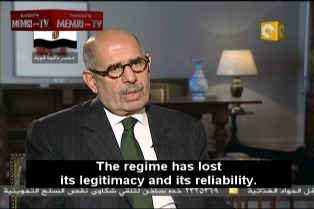
Mohamed ElBaradei: "The people waged this great peaceful revolution for the first time in its history, and wants to see a transition from an oppressive dictatorial regime to a democratic regime. [...]

"The regime has lost its legitimacy and its reliability. The [youth] consider President Mubarak to be responsible for that, because this regime was centered around a single person. This was a Pharaonic regime, as I've said in the past. Therefore, the [youth] believe that President Mubarak's retirement in a safe and dignified manner, worthy of the Egyptian president, would resolve many of the problems that we face today, and would lead us to a transitional phase. [...]

"I haven't changed what I say. At the end of the day, he is the president of Egypt, and he should leave office in an appropriate and dignified manner. He can remain and live in Egypt. I've said from day one that the Egyptian people, whose nature I know very well, seeks to move forward, not to settle the score. [...]

"The regime, as you can see, is being eaten away, vaporized. All the leaders of the NDP have resigned. We have seen many ministers taken to court. It is true that the regime has infiltrated everywhere in Egypt, but we shouldn't delude ourselves – the regime was based on President Mubarak, and when President Mubarak retires, we will be able to move to a new phase. [...]

"I am talking about institutions. The personalities are a secondary issue. The question whether someone who was part of the current regime can remain in place is a secondary issue. The change means transforming the Egyptian from being a slave to being free, and replacing the Pharaonic ruler with the sovereign rule of the people. This is a fundamental change in the very foundations of the regime, and the personalities are not what is important." [...]

"The American Position has Fluctuated Over the Past 10 Days… We Should Not Rely on the American or European Position"

"The American position has fluctuated over the past 10 days. Let me first say that we should not rely on the American or European position. The change will be carried out by the Egyptians and for the Egyptians, and the world has the right to sympathize with the problem of the Egyptian people. [...]

"I don't think that the Muslim Brotherhood will ascend to power. The Muslim Brotherhood told me and declared publicly that they would not present a candidate for the presidency of Egypt, so the Egyptian people can be assured of that at this point. They will not present more than 30% of the candidates to Parliament. The Muslim Brotherhood do not constitute a majority among the Egyptian people, and they say that they support a civil state, that they do not want a religious party, that they will operate within the limits of a constitution that calls for a civil state and equality among all Egyptians – Muslims and Copts.

"Many people have doubts about their reliability, but I say that we must consolidate this in the new constitution, about which all of us, as Egyptians, will agree."

"Israel Stands to Lose from a Democratic Egypt, because a Democratic Egypt would be a Capable Country"

"Obviously, Israel stands to lose from a democratic Egypt, because a democratic Egypt would be a capable country, which would deal with Israel on equal terms. This is what Israel and the West fear. They fear that Egypt, and the Arab world with it, will become a force that would equal them, and would strive to fulfill their interests, instead of making do with their leftovers. [...]

"Like in any other country, the constitution should have 'red lines': There cannot be a fascist party or a religious party, which discriminates among citizens on the basis of creed. We must agree on all this.

"The Muslim Brotherhood knows full well that we disagree on many ideological issues. I am a liberal, while they have a conservative religious source of authority, but they are a part of the Egyptian people, and it cannot be said about them that they are 'a forbidden group." [...]

"Change Must Not be Carried Out Only by the Military Establishment"

"The issue in question today is one of reliability. While the vice president was saying that they would release all political prisoners, they arrested nine young people who came to my home to talk to me. These people were doctors, lawyers, and engineers. When I see the prime minister saying: 'We arrested these people because they came out of the house of someone we have concerns about,' I want to say to him: 'If you have concerns about me, you should know that the people have concerns about all of you as a regime. The people want to topple you.' This reflects the same authoritarian military mentality that we want to replace. Therefore, they still have no reliability.

"In addition, change must not be carried out only by the military establishment. The president, the vice president, and the prime minister all come from the military establishment. There must be true participation of civil [figures] during that phase." [...]

"I Propose … that there be a Presidency Council Composed of Three Persons, in which Both Civil Elements and the Military Establishment will be Represented"

"Therefore, I propose – as I have been doing from the beginning of the revolution – that there be a presidency council composed of three persons, in which both civil elements and the military establishment will be represented. There will be a caretaker government composed of technocrats, who are not connected to politics in any way – reliable people with experience.

"Then, [in] over a year, we will take the necessary steps in order to hold democratic elections and parliamentary elections.

"We should forget about the current constitution, forget about the parliament, and disband all that, and declare a temporary constitution, which will enable us to act freely. We cannot return to democracy through a dictatorial constitution, which is not worth the paper it is written on. [...]

"This could be part of a deception. This is not only my opinion. The regime wants to reorganize, and then it will return to its old habits. I haven't heard anyone talk about the right to form political parties. [...]

"We haven't heard anything so far about issues that are essential, like international monitoring [of the elections], an independent judicial committee to supervise the elections, the right to form political parties, or the abolishment of the emergency law. All this makes me, as well as many others, wonder whether this is an attempt to thwart the revolution, or whether it is a genuine attempt by what is left of this vaporizing regime to internally reorganize and then become [part] of the Egyptian people again. [...]

"When I hear that representatives of the regime and the prime minister go to Al-Tahrir Square and invite whoever they see there to negotiate – this is no way to run a country. [...]

"Unless we see real and genuine change in the establishment, and not just in individuals, and true participation of the Egyptian people, of the civilians... The army is part of the people, and I have the greatest respect for it, but its mission is to defend Egypt, not to run the country."

"If [the Government] Continues to Suppress this Anger, or Tries to Manipulate It, We will See a Non-Peaceful Revolution"

"In a democratic regime, civilians must be at the forefront. Unless we see that, the demonstrations will continue. [...]

"I'd like the government to understand that if it continues to suppress this anger, or tries to manipulate it, we will see a non-peaceful revolution. President Kennedy said that if you suppress a peaceful revolution, a bloody revolution is bound to erupt. [...]

"I am willing to talk to any person who wants to talk to me. As I've mentioned, I am talking with the Muslim Brotherhood, as well as with the Marxist party. I believe that I can talk..."

Interviewer: "Did [VP Suleiman] call you?"

Mohamed ElBaradei: "He did not call me. If he calls me, I will talk with him, but I will say to him exactly what I am saying to you. What I say behind closed doors I say in the open too."

Interviewer: "Do you expect him to invite you, following what you've just said?"

Mohamed ElBaradei: "I've heard that he doesn't want to talk to me. This is up to him, but he should not be the one leading the change. [...]

"Whether or not he talks to me doesn't really matter. I always say Mohamed ElBaradei is not a person, but an idea. I will continue to talk about my ideas home and abroad. As I've said, I want to remain in the position of an observer until Egypt has the kind of regime I've been wishing for my country for many years. If this happens, my last wish will have been fulfilled." [...]


Original URL: http://www.memritv.org/clip/en/2796.htm.

MEMRI

Copyright - Original materials copyright (c) by the authors.

David Cameron Lifts the Lid


by Gregory Buls

Western luminaries descended on Munich this weekend for the 47th annual Munich Security Conference. On Saturday, representatives from forty nations listened to what should be remembered as the first reasonably coherent defense of Western values by a Western leader in the age of modern Islamic terrorism. If his speech is taken to heart, U.K. leader David Cameron may have opened Pandora's Box -- and perhaps none too soon.


He gave some indication that this was not the standard boilerplate speech right from the start, identifying radical Islam as the main terrorist threat:

But we should acknowledge that this threat comes overwhelmingly from young men who follow a completely perverse and warped interpretation of Islam and who are prepared to blow themselves up and kill their fellow citizens.

He further declared that "State multiculturalism" dead, saying that it enables extremism, and fails to offer young people the clear alternative to radicalism -- traditional Western culture and values. He acknowledged that some Muslims plot world dominion and argued that the West's cultural weakness is enervating, inviting extremism and aggression.

The speech was remarkable both in its content and its contrast to the normal platitudes we hear on this subject from elected officials. He began by identifying the problem:

At the furthest end are those who back terrorism to promote their ultimate goal: an entire Islamist realm, governed by an interpretation of Sharia.

Move along the spectrum, and you find people who may reject violence, but who accept various parts of the extremist world-view including real hostility towards Western democracy and liberal values.

This may be the most dangerous extremist element -- that which uses our institutions and openness against us. It is arguably as great a long-term threat as the violent extremists, who may create crises in which the rules change abruptly, against them. The badly-weathered rock of Western civilization is probably more likely to be broken down by erosion than blown apart in violence.

Cameron explicitly denied the wisdom of appeasement, drawing a distinction he says the left is unwilling to make:

On the other hand, there are those on the soft left who also ignore this distinction. They lump all Muslims together, compiling a list of grievances and arguing if only governments addressed them, this terrorism would stop.

Later:

But let's not fool ourselves, these are just contributory factors. Even if we sorted out all these problems, there would still be this terrorism.

This is bold talk, indeed -- it directly contradicts what almost every Muslim group is willing to publicly say. Mr. Cameron is arguing that even if we assuage every Islamist concern, we will still be attacked, that it is not merely a matter of geopolitics and sociology; it is a matter of philosophy. The leader of the United Kingdom appears to be acceding that there is something rotten at the core of Islam -- in its present form as an institution/worldview, it can't fully get along with others even in the best possible circumstances. Extremist elements will ostensibly find imagined justifications to recruit and act, based upon philosophy. Where can Mr. Cameron possibly go from there, having framed what may be an existential dilemma for the West?

So first, instead of ignoring this extremist ideology, we -- as governments and societies -- have got to confront it, in all its forms. And second, instead of encouraging people to live apart, we need a clear sense of shared national identity, open to everyone.

Broadly speaking, these must be the correct approaches, given what is possible and palatable to Western democracies in early 2011. The first would mark a distinct departure from the otherwise hollow rhetoric of most Western leaders -- the problem indeed goes far beyond violent Muslims. The second, while it may seem a slippery notion and hard to realize, is precisely what is needed if we expect Muslims to assist us in promoting stable societies. To have any effect, such an effort necessarily requires an affirmation and broader appreciation of what makes Western societies such ideal places to live and raise families. It is also a direct and flagrant repudiation of the egalitarian foundations of multiculturalism. What are we defending, and why does that defense require every ounce of our energy and ingenuity? Without a clear answer to that question, the endeavor is crippled from the outset.

Islam may in fact propose an existential problem for open cultures. The spread of destructive technologies accompanies the growth of a religion which many of its followers believe is destined to rule the world, by force if necessary. It sounds like the plot of a bad science fiction novel. From the perspective of outsiders looking in at the Earth, Islam would likely be recognized as the force most likely to significantly disrupt human civilization. Almost everyone else has a manifest interest in maintaining at least the appearance of stability.

We know that nations are able to hold and handle destructive technology responsibly and refrain from using it. We cannot expect the same from terrorist organizations. In the past, whole societies could be geared to war for years and walk away from conflict relatively unscathed. The destructive technologies Islamist groups admit to pursuing have the capacity to derail the entire centuries-long enterprise of Western civilization in a fortnight. It's likely, given the rest of what he said, that Mr. Cameron understands the ultimate nature of the threat. For now, he has taken the most sensible possible approach -- identifying the problem actors, isolating them to the extent possible, and encouraging everyone else to unite around shared interests and ideals, working together against the holdouts.

The theme of unity runs through Cameron's speech, but it's not the patronizing, feel-good (dis)unity of multiculturalist rhetoric. He traces the radicalization of English Muslims in part to the alienation from the greater English culture which results from multiculturalism:

But they also find it hard to identify with Britain too, because we have allowed the weakening of our collective identity. Under the doctrine of state multiculturalism, we have encouraged different cultures to live separate lives, apart from each other and the mainstream. We have failed to provide a vision of society to which they feel they want to belong.

This will sit well with the average English voter and should be viewed favorably by most English Muslims. Many Muslims have vested interests in English society, and none can be blind to the possibility of extremism overturning the apple cart. They also respect strength. Cameron displays it by calling out both Muslim communities and the multiculturalist infection which encourages the sense of otherness:

We have even tolerated these segregated communities behaving in ways that run counter to our values.

So when a white person holds objectionable views -- racism, for example -- we rightly condemn them. But when equally unacceptable views or practices have come from someone who isn't white, we've been too cautious, frankly even fearful, to stand up to them. The failure of some to confront the horrors of forced marriage, the practice where some young girls are bullied and sometimes taken abroad to marry someone they don't want to, is a case in point. This hands-off tolerance has only served to reinforce the sense that not enough is shared. All this leaves some young Muslims feeling rootless...

In our communities, groups and organisations led by young, dynamic leaders promote separatism by encouraging Muslims to define themselves solely in terms of their religion. All these interactions engender a sense of community, a substitute for what the wider society has failed to supply. You might say: as long as they're not hurting anyone, what's the problem with all this? I'll tell you why.

As evidence emerges about the backgrounds of those convicted of terrorist offences, it is clear that many of them were initially influenced by what some have called 'non-violent extremists' and then took those radical beliefs to the next level by embracing violence. And I say this is an indictment of our approach to these issues in the past.

Having identified some of the catalysts of violent Muslim extremism, Mr. Cameron then turned to solutions. Among the approaches he advocates are the following:

1. Refuse to deal with Islamist front groups: "Some organisations that seek to present themselves as a gateway to the Muslim community are showered with public money despite doing little to combat extremism. As others have observed, this is like turning to a right-wing fascist party to fight a violent white supremacist movement."

2. Establish standards for recognizing or subsidizing Muslim groups: "Do they believe in universal human rights -- including for women and people of other faiths? Do they believe in equality of all before the law? Do they believe in democracy and the right of people to elect their own government? Do they encourage integration or separatism? These are the sorts of questions we need to ask. Fail these tests and the presumption should be not to engage with organisations. No public money. No sharing of platforms with Ministers at home."

3. Deny the most extreme parts of Islamic prophecy: "We need to argue that their prophecies of a global war of religion pitting Muslims against the rest of the world are rubbish." The antecedent is "terrorists," so clearly he was not referring to those in the West who warn of such a war. Some Muslims will take this as a direct assault upon the Prophet's veracity. But they are unlikely to loudly condemn Cameron for it, as that puts them in the position of predicting just such a global war against nonbelievers. And it's not as though they're predicting that someone, sometime will do it -- they are the "someone," if anyone is.

4. Define what it means to belong to Western society:

A passively tolerant society says to its citizens: as long as you obey the law, we will leave you alone. It stands neutral between different values. A genuinely liberal country does much more. It believes in certain values and actively promotes them. Freedom of speech. Freedom of worship. Democracy. The rule of law. Equal rights regardless of race, sex or sexuality. It says to its citizens: this is what defines us as a society. To belong here is to believe in these things.

Here again Mr. Cameron goes out on a limb -- if you don't embrace these values, your way of thinking doesn't really belong in the West. The natural extension is that the individual does not belong in the West. But Mr. Cameron is not recommending widespread expulsion of ideological dissidents -- rather, he is saying that it is impossible to feel a part of Western society without respecting these beliefs. The alternative is mutual alienation.

5. Empower communities to unify them: "I also believe we should encourage meaningful and active participation in society, by shifting the balance of power, away from the state and to people. That way common purpose can be formed, as people come together and work together in their neighbourhoods. It will also help build stronger pride in local identity so people feel free to say yes, I am a Muslim, I am a Hindu, I am Christian but I am also a Londoner or a Berliner too. It's that identity -- that feeling of belonging in our countries -- that is the key to achieving true cohesion."

It's too much to ask, at this juncture, for a national leader to delve too far into the starker realities of Islamic theology and the implications it may have for the future of freedom. Hopefully, such frank talk will never be necessary -- perhaps there exists the prospect of so moderating Islam that it polices itself, as it ultimately must if it is to peacefully coexist alongside other worldviews. Prime Minister Cameron seems intent to find out if such moderation is possible. He speaks to that hope in strong and unapologetic terms which will command the respect of many Muslims. The ultimate measure of cultural decadence is the unwillingness of a culture to defend itself. Why should Muslims defend our civilization if we are too weak to do so? Cameron is not afraid to defend ours, and he calls on others to do the same.

Most Muslims and even many Islamists may eventually embrace, or at least reconcile themselves to, "Freedom of speech. Freedom of worship. Democracy. The rule of law. Equal rights regardless of race, sex or sexuality." But the theological and political totality of Islam as revealed by the Prophet Mohammed is difficult to reconcile with these Western institutions and ideals. Discussing this inescapable fact is a step too far for Mr. Cameron, and rightly so. At most, he hinted strongly at it when he stated bluntly that Islamic terrorism would still exist even in a climate of total accommodation. He recognizes, rightly, that we must marginalize the fanatics, and you don't do so by saying that they are the only ones who take the religion seriously -- that everyone else is biting off only what they are comfortable chewing.

David Cameron said more about Islam on Saturday, and he said it with greater insight, sensitivity, and realism than you'll find in virtually all of the platitudinous speeches on the subject delivered by all other Western leaders since 2001 combined. And he did so while defending our culture, our integrity, and our basic goodness. Pandora's Box is open -- the West may not be dessicated after all. People all over the world should take notice: A Western leader has finally emerged.

Original URL: http://www.americanthinker.com/2011/02/david_cameron_lifts_the_lid.html

Gregory Buls

Copyright - Original materials copyright (c) by the authors.

Obama's Role in Empowering the Muslim Brotherhood


by Ed Lasky

The Obama administration is claiming that the president has been out in front of the crisis in Egypt. The facts prove otherwise. He has been behind the curve and has badly damaged American interests -- perhaps irretrievably so.

Barack Obama's campaign was built on spin and speeches. His presidency has used these tools to present a false image. In this case, his chief spin maestro, David Axelrod, has been peddling the story that Barack Obama has been "out ahead of this" ("this" being the crisis in Egypt).

Politico Journalist Josh Gerstein was skeptical and fact-checked Axelrod's boastful claim. Press Secretary Robert Gibbs has parroted the same story line. Gerstein found it wanting:
To hear soon-to-depart White House senior adviser David Axelrod tell it, President Barack Obama has long taken a tough line with Egyptian President Hosni Mubarak over human rights and political reform issues in his country.

"The way [Obama has] confronted it, is he went to Cairo and talked about the need, the universal human rights of people. He's on several occasions directly confronted Pres. Mubarak on it. And pushed him on the need for political reform in his country," Axelrod told ABC's Jake Tapper Friday, on the adviser's last day of work at the White House.

"To get ahead of this?" Tapper asked.

"Exactly. To get ahead of this. This is a project he's been working on for two years, and today the president is working hard to encourage restraint and a cessation of violence against the people of Egypt," said Axelrod.

"Nice myth," said one human rights advocate I asked about Axelrod's description.

There are a couple of problems with Axelrod's account. First, there's little public evidence that Obama "confronted" Mubarak on these issues. White House officials have said the subjects were raised in meetings between the men, but when the two met publicly there was little indication that Obama was pressuring Mubarak on the issue.

During the 25-minute press availability during the pair's Oval Office meeting in August 2009, Obama didn't mention the issue. Mubarak was the one who brought it up, telling the press how "friendly" their exchange on the subject was and suggesting a rather leisurely timeline to make changes.

The other sleight-of-hand in Axelrod's comment is his suggestion that Obama's visit to Cairo in June 2009 was intended or perceived as speaking hard truths to Mubarak. To the contrary, many in the region, in other Muslim countries and the U.S. ( see here and here) saw the choice of Egypt for Obama's first speech to the Muslim world as a huge laurel for Mubarak, not an albatross. Obama's speech made no direct reference to political reform or human rights issues in Egypt, save for a passing reference to Christian Copts there. There were also reports that the U.S. eased up on democracy promotion there.

However confrontational the Obama administration's approach to this issue may have been over the past two years, I certainly don't remember Obama administration officials ever publicly suggesting, as White House press secretary Robert Gibbs did directly on Friday, that U.S. aid to Egypt was in jeopardy.

He was not ahead of the curve but, in an all-too-rare instance of budget-cutting, slashed aid to groups that might have been key players (and allies of the United States) when a new government is established.

The Los Angeles Times reports that Barack Obama had not just ignored Egyptian human rights issues over the past two years, but actually cut funding for activist groups trying to reform Egypt:

Although President Obama has sided firmly with pro-democracy protesters in Egypt, his administration spent its first two years easing the U.S. push for human rights reforms in that country.

Early in Obama's presidency, officials cut in half funding to promote democracy in Egypt. They also agreed to restrict certain grants only to organizations licensed by President Hosni Mubarak's authoritarian regime, reversing a Bush administration policy of funding groups at odds with the government.

Secretary of State Hillary Rodham Clinton, at a March 2009 meeting with Mubarak at an Egyptian resort on the Red Sea, seemed to downplay a State Department report documenting torture, rape and political detentions in Egypt.

"We issue these reports on every country," Clinton told a television interviewer. "And so we hope that it will be taken in the spirit in which it is offered, that we all have room for improvement."

Egyptian dissidents were distressed by the administration's message.

"All this sent a signal that was very damaging," said Stephen McInerney, executive director of the Project on Middle East Democracy, a Washington advocacy group.

Indeed, the reviled Bush administration was the administration that was ahead of the curve -- though its ardor for change cooled as time went on. But Obama regressed even further on the issue of reform and human rights.

Obama spoke in general terms about political rights in his seminal address to the Muslim world in Cairo in 2009, but did not explicitly demand reform in Egypt, as former Secretary of State Condoleezza Rice did in 2005. Rice's remarks reflected then-President George W. Bush's "freedom agenda" for the Middle East, which involved stepped-up pressure for democratic reforms.

The Bush administration pressured Mubarak into holding elections in 2005 that though flawed, were the fairest in the country's history, analysts say. But harsh interrogations of terrorism suspects, secret CIA prisons and the Iraq war tainted the Bush approach. And after Palestinian elections in 2006 that brought Hamas to power in Gaza, Bush's ardor for Arab democracy cooled.

Obama pulled back further.

Not only has Barack Obama been behind the curve, but he worsened the dynamic by slashing funding in half for groups that could have been our allies for true Democratic change. Why the budget-cutting? Obama did the same for a Boston-based Iran human rights group that had been monitoring and publicizing and recording for posterity Iranian human rights abuses -- except in that case, Obama terminated all funding. The man who has rung up trillion-dollar deficits tries to save a few million dollars by cuts to human rights groups?

Now, because of his multiple failures, Obama is playing catch-up. Obama is way behind the curve. How has he been playing his own badly self-dealt hand? By chumming up with one of the most radical groups of all, the radically anti-American, anti-Israel, anti-Christian, and anti-Semitic Muslim Brotherhood. His administration, while slashing aid to Egyptian human rights groups, actually courted the Muslim Brotherhood and invited members to attend his Cairo Speech. The engagement (and empowerment) has continued apace.

Robert Gibbs stated that the Obama administration was urging the inclusion of "important non-secular actors" in whatever government takes over from the Mubarak regime. This was widely interpreted to mean the Muslim Brotherhood (this group is by far the most influential and important "non-secular" actor in Egypt). Furthermore, the Obama team's proposal for the immediate transfer of power calls for the transitional government to include the Muslim Brotherhood, the New York Times reported on Friday.

David Horovitz of the Jerusalem Post notes that Barack Obama never delivered significant pressure on Mubarak to reform, and this apathy was starkly confirmed by December's massive fraudulent parliamentary elections. Horovitz writes:

Washington evidently failed to foresee that embittered Egyptians might then resort to the massed protests of the past two weeks, and it abandoned Mubarak with alacrity as it scrambled to avoid being caught on the wrong side of a largely spontaneous people's push for freedom and democracy.

But however one gauges the realpolitik involved in that dramatic recoil from a 30-year ally, the White House's subsequent reported moves to legitimate Egypt's Islamists -- whose outlook conflicts utterly with the democratic agenda -- make no sense, and suggest a frighteningly superficial understanding of the Muslim Brotherhood's intentions and potential achievements.

Far from learning the lessons of the Islamists' skilled subversion of other pro-democracy movements, working with potential leaders of an Egyptian transition to minimize the risk of such a process recurring, and making publicly plain that there will be no ongoing American alliance with an Egypt in which an unreformed Islamist movement has even a marginal role in government, the White House seems to be actively encouraging a transitional outreach to the Muslim Brotherhood.

Horovitz further outlines the history of Middle East regimes that incorporate groups similar to the Muslim Brotherhood. They burrow into governments and then take over, all but destroying the Democratic process that brought them to power -- often at the behest of Western powers. They become anti-American and become terror-supporting states. They fall out of the so-called American orbit -- perhaps for many years to come (as has Iran). They trample the rights of women, abuse their children by teaching the tools of Islamism and not the tools needed to live in the 21st century, and use their mosques and media to brainwash their people to hate America. They give rise to more terrorism that can wash up on our own shores.

Now history seems to be repeating itself as tragedy.

Abe Greenwald at Commentary Contentions notes that the Obama administration seems to be countenancing and endorsing a role for the Muslim Brotherhood in the new Egyptian regime:
Things could be taking a dangerous turn in Egypt. The Washington Post reports that the Muslim Brotherhood has new interest in participating in talks on the transition of leadership. "The Brotherhood had refused to join talks Saturday, insisting that Mubarak leave first. But leaders of the movement changed their minds Sunday, saying they wanted to play a role in shaping a transition of power and organizing free elections."

The American response has been less than inspiring. Secretary of State Hillary Clinton told National Public Radio: "Today we learned the Muslim Brotherhood decided to participate, which suggests they at least are now involved in the dialogue that we have encouraged." Yes, participation does suggest involvement, doesn't it? "We're going to wait and see how this develops," she said, "but we've been very clear about what we expect."

The only party that has actually been clear about what it expects is the Muslim Brotherhood - and it expects to rule.
Barack Obama failed to capitalize on his initial worldwide popularity to push for democratic reforms in the Muslim world. He could have funded, supported, and promoted a wide range of true human rights groups that could have brought about a stable Egypt that would uphold its treaties and still be a reliable ally of America. Instead, he slashed funding for these groups, gave them zero moral or diplomatic support, and is now -- with alacrity (as Horvitz notes) -- abandoning Mubarak and empowering the Muslim Brotherhood.

So has Barack Obama been ahead of the curve? Only if you think he wanted the Muslim Brotherhood to assume power.

Original URL: http://www.americanthinker.com/2011/02/obamas_role_in_empowering_the.html

Ed Lasky is news editor of American Thinker.

Copyright - Original materials copyright (c) by the authors.

Iran’s Deadly Intimidation


by Frank Crimi

As political unrest continues to spread throughout the Middle East, two of Iran’s top opposition leaders have accused the Islamist regime of rapidly increasing the number of executions in a deliberate effort to intimidate the country’s reform movement.

Specifically, the increase in executions is seen as a direct attempt by the Iranian government to stifle opposition by those who feel empowered by the ongoing upheaval in Egypt and Tunisia.

The accusations were levied by Mir Hossein Mousavi and Mehdi Karrubi, both former Iranian presidential candidates. In a statement released on Iran’s reformist website Tagheer, the men wrote that the Iranian government was increasing executions in order to “intimidate the nation and further isolate Iran on the international stage.”

Both men lost the June 2009 presidential election to incumbent President Mahmoud Ahmadinejad in a vote fraught with allegations of fraud and vote rigging. The subsequent public outcry spawned a wave of open protests against the Islamist regime, dubbed the Green Movement.

Mousavi and Karrubi’s charges come at the same time the United Nations released a report also condemning the Iranian regime’s record number of executions. The report cited the Iranian government’s execution of 67 people in January 2011, putting it on pace to quickly eclipse the 179 executions that took place in 2010.

However, since the Iranian government does not release information on the number of death sentences carried out, the UN figures were gleaned from Iranian press reports. As such, some have surmised that the number is far too low. The International Campaign for Human Rights in Iran has placed the number of executions in January 2011 at 97. Mousavi and Karrubi have placed the overall number of executions in 2010 at more than 300.

In addition to the high number of executions, the UN and opposition leaders fear that those being killed are not just criminals, but dissidents who have participated in the anti-government protests. According to UN spokesperson, Navi Pillay, “Dissent is not a crime. It is absolutely unacceptable for individuals to be imprisoned for association with opposition groups, let alone be executed for their political views or affiliations.”

Compounding the issue is the belief that those being executed have also not been given fair or complete trials. According to Aaron Rhodes, a spokesperson for International Campaign for Human Rights in Iran, “The issue is not whether crimes occur in Iran, but whether death sentences are based on real trials, with real evidence, and real cases presented by lawyers.”

For its part, the Iranian government has been adamant that those arrested and executed were so dealt with due to their criminal activities, mostly connected to charges of drug smuggling. Furthermore, the government claims that every legal option available for those defendants had been exhausted.

Despite those claims, Iran’s actions led Pillay to say, “I am very dismayed that instead of heeding our calls, the Iranian authorities appear to have stepped up the use of the death penalty.” However, for those who have been on the receiving end of Iranian beatings during the Green Movement, the allegations come as little shock.

Those anti-government protests, which had died down by February 2010 after brutal violent crackdowns by Iranian security forces, were followed by purges of opposition supporters in universities, government offices and media outlets. Since early 2010 the regime has prosecuted over 100 dissidents and political figures, placing most of them on televised mass trials.

arrested and sentenced to long prison terms. The most recent convictions were Iranian attorney Khalil Bahramian, who was sentenced to 18 years in prison, and Nasrin Sotoudeh, who was sentenced to 11 years.

Still, some observers suspect that the events in Tunisia and Egypt are linked to the government increase in public executions and persecution. They argue the Iranian regime is encouraged by the prospect of the overthrow of secular, pro-Western governments, and as proof point to the government’s ardent and public championing of the revolts.

These thoughts were best echoed by the speaker of the Iranian parliament, Ali Larijani, who told the Fars news agency, “The time has [been] reached to overcome puppet autocratic regimes by relying on the Islamic teachings.” Adding to the chorus was a top Iranian cleric, Ayatollah Ahmad Khatami, quoted as saying, “An Islamic Middle East is being created based on Islam, religion, and democracy with prevailing religious principles.”

While there is a disturbing irony in the Iranian government backing a process which it crushed back in 2009, it is a fact not lost on Mousavi. On his website, he wrote about the Egyptian government’s confrontations and clashes with protesters: “We can identify a similar pattern.”

For its part, Iran’s government opposition and its leadership have also been vocal cheerleaders for the uprisings, which they claim are a natural extension of their own democratic efforts and call a sign of “Arab maturity.”

To them, the Green Movement was the first democratization movement that helped launch the Tunisian riots and then the subsequent Egyptian uprising. While some may dismiss the fact there is no correlation, arguing that Iran’s anti-government protests were a Persian Shiite movement and not a Sunni Arab one, others disagree.

In fact, Tunisian activists have been open about borrowing tactics used by Iranians in the 2009 Green Movement in their battle against the regime of Zine El Abdine Ben Ali. Specifically, they cite using social technologies, like Facebook and Twitter, as a means of organizing.

So now, as autocratic regimes peppered throughout the region begin to crumble, Iranian opposition leaders pine to complete the job they started. As Mousavi has confidently said, “No power can outrun the people’s will and demands. We believe that if election protesters are allowed to rally in Iran, people will express themselves.”

Despite its public bravado, Iran’s Islamist leaders are fearful what form that expression will take. While they may hope that Iran remains immune to the forces of change currently sweeping the region, they are busily hedging their bets. As Iranians are coming to learn, an overworked hangman is a good indicator of those efforts.

Frank Crimi is a writer living in San Diego, California. You can read more of Frank’s work at his blog, www.politicallyunbalanced.com.

Original URL: http://frontpagemag.com/2011/02/07/irans-deadly-intimidation/

Frank Crimi

Copyright - Original materials copyright (c) by the authors.

Anatomy of a Revolution


by Nichole Hungerford

As the chaos in Egypt rages on, even the most ardent pro-democracy spectators are expressing skepticism with regard to the future of the country. Fellow traveler Nicholas Kristof pondered in The New York Times Saturday, “[I]f Egyptian protesters overcome the government, would this be 1979 or 1989?” In other words: are we witnessing the birth pangs of an Iranian-style theocracy or a vibrant free society? “No one can predict with certainty,” Kristof believes. But in fact, there are clear signs of where Egypt is headed, if we only look at the root of the current revolution. This evidence unfortunately shows that the Islamist Muslim Brotherhood stands to benefit handsomely from the turmoil. Even in the best case scenario, if the moderate wing assumes the seat of power, we can almost certainly expect the long-standing peace between Egypt and Israel, vital to regional stability, to disintegrate in short order. Perhaps worse.

What exactly do we know about the Egyptian revolution? Broadly speaking, the Egyptian opposition forces, those mobilizing against President Hosni Mubarak, are primarily a coalition of Islamists and socialists, and they have in fact been working together to undermine the Mubarak regime for quite some time. The principal opposition groups behind the uprising are: the Muslim Brotherhood, which is the largest; Mohamed ElBaradei and the National Association for Change; and the socialist youth movement, the foremost of which is the April 6th Movement.

Serious opposition to the 30-year Mubarak regime began to emerge during the second Palestinian Intifada in Israel’s Gaza Strip. The so-called “cold peace” between Egypt and Israel, which President Mubarak sustained, did not deter Egyptians from demonstrating in solidarity with warring Palestinians, creating a rift between the ostensibly pro-Israel president and the population. This only intensified in the following years with the 2003 U.S. invasion of Iraq. Egyptians took to the streets to protest the Iraq war, again putting the people at odds with the American-allied regime.

Between 2003-2005, in pursuit of its “freedom agenda,” the Bush administration began to put pressure on the Mubarak regime to institute democratic reforms, including by allowing multiparty elections. According to a report from the Rand Corporation, what emerged in opposition to Mubarak and his ruling National Democratic Party was a loose coalition of Egyptian Islamist and socialist groups, who united under the moniker “Kefaya” (“enough” in Arabic). While Kefaya constituencies were diverse, they coalesced around two related objectives: opposition to Israel, and opposition to Mubarak, who had maintained peace with Israel and who was bolstering his own executive authority (through, for instance, authoritarian revisions to the constitution and preparing his son Gamal to inherit the presidency). Kefaya, which eventually developed a strong youth wing, organized for non-NDP candidates in the 2005 election and protested for democratic reforms and against Mubarak and his maneuvers toward hereditary rule.

The results from this democratic movement were far from encouraging. It, in fact, acted as a catalyst for a huge Muslim Brotherhood power-grab. Out of the 444 seats in Egypt’s parliament, 88 seats went to Muslim Brotherhood members (running as independents), hundreds went to the NDP, while less than half the number of seats gained by the Brotherhood went to other reformers (neither Brotherhood nor NDP members). Thus, we have certainly seen in recent times what a more open democratic process looks like in Egypt. A well-organized, popular Islamist faction, working in conjunction with non-Islamist reformers, capably co-opted democratic momentum. It is these same actors — the same coalition — working to overthrow the Mubarak regime in Egypt today. What reason do we have to expect different electoral results?

Even in the best case scenario, one in which moderate reformers achieve perhaps equal gains with the Islamists, most of the anti-Mubarak opposition is nonetheless united with respect to its enmity toward the U.S. and Israel (in addition to its desire for genuine democratic reforms). The includes Kefaya’s socialist youth component. In fact, when Kefaya began to fall apart after the 2005 election, a youth group called Youth for Changed announced that it would withdraw because the coalition was not sufficiently anti-Israel and anti-American.

It was the socialist youth movement of Kefaya that spawned April 6th Movement, which is widely credited with igniting the current Egyptian uprising and is responsible for much of its organization. One of the key figures behind the April 6th Movement is Ahmed Maher, who had previously worked with Kefaya. The April 6th Movement seeks political and socialist reforms, such as a minimum monthly wage, and one of its major independent enterprises (whence it derives its name) was a successful national labor strike, organized in the spring of 2008. Like other sectors of the Egyptian youth movement, the April 6th Movement has a strong an anti-Israel component. Among its political demands, the group calls for an end to gas exports to Israel, according to its blog. Gas from Egypt is exported to many countries around the world, although the group only demands a cessation of exports to the Jewish State.

In January 2009, the April 6th Youth Movement joined in vicious protests against Israel for its retaliation against Hamas rocket attacks. According to a New York Times profile, the protests were mostly led by the Muslim Brotherhood. In their anger over Israel’s attack on the Hamas-controlled Gaza Strip, demonstrators condemned Mubarak for maintaining relations with Israel, exporting natural gas to Israel, and for restricting movement through Egypt’s border into Gaza.

In addition to joining with the Muslim Brotherhood in the past and during the current unrest, the internet-savvy, socialist youth movement has been very supportive of Mohamed ElBaradei, leader of the Egyptian umbrella-group, National Association for Change (NAC). According to a report from the Carnegie Endowment for International Peace, the NAC was formed in 2010 by ElBaradei to “rejuvenate the opposition scene,” presumably Kefaya. Other reports have noted that, sensing instability in the Mubarak regime, NAC’s purpose was to facilitate the president’s ouster and to serve as a “shadow parliament.”

Not only has the Muslim Brotherhood recently endorsed ElBaradei to lead the anti-Mubarak opposition, but it has a history of working with ElBaradei and the NAC in the past. In a 2010 petition campaign, the NAC received crucial support from the Brotherhood. In a show of the Islamist group’s clout among the Egyptian people, the Brotherhood was responsible for collection 2/3 of the petition’s 300,000 plus signatures, the Washington Times reported. ElBaradei himself is a controversial figure. Although it is true that he has had amicable relations with President Barack Obama in the past, as director general of the UN’s International Atomic Energy Agency, ElBaradei was a vocal critic of the Bush administration, who accused ElBaradei of “muddying” the issue of nuclear deterrence to Iran’s advantage. ElBaradei was hostile to the international community’s position on nuclear non-proliferation, claiming that the double standard of allowing some nations to have a nuclear arsenal (i.e. Israel), while forbidding others, has lost credibility in the Arab world. The Israeli government at the time viewed him as dangerous and said that he threatened world peace.

Thus, the major players of the anti-Mubarak opposition should give us a great deal of pause. Another power-grab by the Muslim Brotherhood and other Islamist factions, as is certainly within the realm of possibilities, would be a catastrophic loss for U.S. interests, the region, and for the Egyptian people themselves. On the other hand, the prospect of non-Islamist opposition in the seat of power is cold comfort to a weary Israel, a crucial bulwark of peace in the region, which stands to lose its most reliable Arab ally to pervasive anti-Israelism. Whether Mubarak’s reign will terminate sooner than later is rather immaterial in light of these seemingly unalterable alternatives.

Original URL: http://frontpagemag.com/2011/02/07/anatomy-of-a-revolution/

Nichole Hungerford

Copyright - Original materials copyright (c) by the authors.

Egypt's Two Sets of Books


by Tuvia Tenenbom

You must admit that Western journalists are smart. Just read what they write, or watch them on TV. They explain everything: It was only due to the ever increasing cost of ink, and the ever shrinking space of airtime, forever taken up by the life-saving commercials, that not a single of one them ever mentioned that a spontaneous uprising, locally known as an Intifada, was about to start up in late January, 2011.

The same applies to our Western leaders. Take our own "Let me be clear" President. He knows exactly what should be done, and this is why he constantly changes his mind. He presides over a country that gives billions to Egypt, because it is such a great country, but he wants this same country to change at once because it is such a bad country. Let me be clear: there is no contradiction at all here between the two. He also says he believes that America should not get involved in anybody else's business, and this is why he does not stop getting involved. No contradiction here either.

Other Western leaders agree with him. They say they believe that Egypt can be transformed into a democracy in just about 24 hours. How do they know? They read it in the papers. Yes, if you happened to read the Washington Post or The New York Times recently, you would have noticed that our government followed what the papers recommended within hours. The papers said to be tougher on Mubarak, the White House immediately followed – Great! Shows the power of democracy. It takes less than one day after an opinion is published for it to become government policy. We must export this wisdom overseas. Egypt should become democratic -- Today.

No, do not fear that the Muslim Brotherhood, or some other extremists, would take hold in Egypt. It will never happen. How do we know? The papers say so. Well, perhaps it did happen to the Palestinians and the Algerians: they held elections and the extremists won. But perhaps that is not really not happened; perhaps it just looked as if it did. Look at Turkey, what great democrat we have there: Erdogan. Soon women in Turkey will be allowed to wear the Burkah. Everywhere. Isn't this proof of democracy? You bet. How do you know? You read it in the papers -- Western papers and Western websites, by Western journalists; some of the best of them. How do they know? They wrote it.

If I write that Islamic societies are at the core completely secular, and that The Muslim Brotherhood, contrary to what people think, is a secular institution, this makes it true. How do I know? I just wrote it. Isn't Democracy great?

But imagine the day this brand of Democracy comes to Egypt, and the writers they follow are those of Al-Jazeera.

Here is what was in Al-Jazeera in Arabic yesterday:

One picture: two old Egyptian women, grandmas, are on their knees on a prayer mat laid on a dirty ground next to a row of tough, young Egyptian security men. Both women are praying, and seem to be crying as well. The title above: "Ya Egypt, You Mother of My Soul." Next picture: Hosni Mubarak and Benjamin Netanyahu, Both are well dressed, sit in a gorgeously decorated room, smile and shake hands: great friends. Taken "last month," the caption says. The choice between the two pictures is clear: You are either with the crying grandmas on the dirty floor or with the smiling Zionist in the rich room. Nothing in between. Choose.

The day before, Al-Jazeera's website in Arabic ran an article about why Israel prefers to have Omar Suleiman, Mubarak's choice, as the head of the Egyptian government. The day before that, it showed a picture of a demonstrator holding an image of Mubarak with a Star-of-David on his forehead.

There are no leaders in Egypt to follow Al-Jazeera, just plenty of demonstrators. And they do. They see these images and they know what they should do: Mubarak is a Jew-lover; he must go.

Two weeks ago, nobody knew what these demonstrations would become, but a Qatari knew – and made sure what they would become. This Qatari is Al-Jazeera. It pushed and pushed, and everybody fell into the pit -- including our best journalists. They watch Al-Jazeera in English; the demonstrators watch Al-Jazeera in Arabic. The English Al-Jazeera fights for freedom; the Arabic Al-Jazeera fights against the Jew-lover. This is how a world might change.

The West thinks that what it reads or watches exists. But the East is a land of magical stories: what you see is not what exists. Never.

The biggest story the Western can come up with is this: A country of 85 million -- mostly very religious people -- will be able to transform itself into a secular democracy at once. This is not imagination; this is naiveté. Well intentioned, perhaps, but still "let me be clear" naiveté.

The East, on the other hand, is different. It always has two sets of books, at least. Al-Jazeera is no different: it has one set for the naïve Westerners, and another for the brothers and sisters.

We think that our society is better, that we are smarter. What we fail to understand is that a story is more powerful than an argument, and imagination works more magic than logic. And an image is stronger than a word.

Unless we make a real effort to learn the ways of the East, we had better not get involved. A little humility might help, too. None of us knows where this story will end; no matter what takes place in the next few days in Cairo, the story of Egypt is far from over – let alone the story of the Arab world.

Al-Jazeera has more photos up its sleeves.

Original URL:http://www.hudson-ny.org/1864/egypt-two-sets-of-books

Tuvia Tenenbom

Copyright - Original materials copyright (c) by the authors.

What Waziristan Means for Afghanistan


by Andrew M. Roe

The Afghan conflict has refocused world attention on Waziristan. Once one of the British Empire's most volatile territories, the remote small province in northwestern Pakistan is now home to Taliban insurgents, al-Qaeda fighters, rogue elements within the Pakistani military, and Western jihadists, who use it as a base to rest, heal, rearm, train, and plan before they launch again across the porous border into Afghanistan. It is also the area where Osama bin Laden and many of his top lieutenants are probably hiding and a regular target for U.S. air strikes against key Taliban personnel. Pakistani military operations destroyed insurgent forces and caused mass civilian dislocation, yet efforts to produce a lasting peace deal with the local tribesmen and the Taliban have proved futile. Waziristan remains a dangerous and unpredictable region with the potential to unhinge President Hamid Karzai's fragile regime in Afghanistan, threaten the Pakistani government, and pose a major challenge to regional stability.
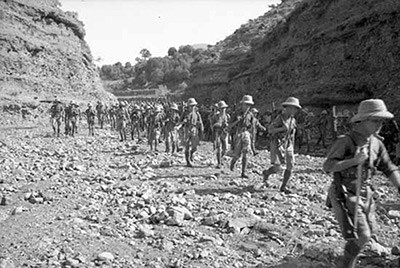
Photo courtesy of the Green Howards Museum, Richmond, N. Yorkshire, England. A British battalion patrols in Waziristan, 1938. Military operations were finite in duration and localized in their employment. Against a fiercely independent and fanatical foe, any enduring occupation of tribal territory by foreigners was hotly contested.

The pertinent lessons from Britain's experience in the region can help policymakers understand and address present-day challenges in the same geographical area, not least since the British faced the same issues and had several of the same internal arguments. To be sure, there are significant differences separating the British experience in Waziristan from that which now confronts the North Atlantic Treaty Organization (NATO), which in turn set restrictions to what can be derived from the past. As Captain John Girling, a south Waziristan scout veteran, recalled in 2009: "Up to ten years ago there were [contemporary] similarities, but since the coming of the Taliban, I can't see any similarities."[1]

However, despite the passage of time and the change in technological and geopolitical circumstances, some of the parallels between the British experience of Waziristan and NATO's remain pertinent and provide valuable insights to today's political and military strategists.

The British System of Control

During the nineteenth and early twentieth century, the British colonial administration was responsible for the complex task of maintaining law and order in Waziristan. After decades of unwanted and costly experimentation, the British decided that hands-off "containment" was the best policy. Control, as in the Indian states, was neither necessary, desirable, nor practicable. With limited resources, control was exercised by the distribution of allowances to sympathetic maliks (tribal representatives or elders) and by the employment of locally recruited kassadar (tribal policemen) and indigenous forces, known as scouts or the Irregular Frontier Corps.[2] Each proved invaluable in maintaining order and relieving regular troops of the expensive work of garrisoning frontier outposts. In the event of any situation escalating out of control, the army of India was the fallback force on the frontier. This multilayered structure brought effective governance to the fractious inhabitants via a sliding scale of violence: first enticements, rewards, and threats; next tribal kassadars, then the lightly-armed scouts; only in extremis, when outbreaks were too excessive to be controlled by the scouts, would the political authorities call on the army to conduct a punitive expedition in order to administer punishment. Working with the forces in society and grounding policy in regional realities offered the only hope of controlling the unpredictable and confrontational tribesmen.

Despite this deft approach, based on organizations that were relatively optimal to the demands of the region and sympathetic to local conditions, the constant threat of tribal unrest remained. In 1936, a compelling leader and frontier personality, known as the Fakir of Ipi, began a political career that tested the British administrative and military apparatus from the time he instigated a rebellion in Waziristan until Britain's departure in 1947.[3] Even though he possessed no formal military training, the fakir provided a charismatic figurehead to the rebellion and maintained his position through dogged determination, strength of personality, and an elevated religious position. As a rebel leader he was uncompromising and his hatred of the British celebrated. Such was his belief in local Muslim grievances and desire for an independent Pashtunistan that he possessed the nerve and courage to face considerable danger and privation. The more the fakir eluded government forces and guided the insurrection, the more his divine status was confirmed. Despite the employment of more than 40,000 British and Indian troops to locate his whereabouts in Waziristan, the fakir continued to evade capture and frustrate his pursuers. He died of natural causes in 1960, having never faced a magistrate's bench.

Despite injecting large numbers of military reinforcements into tribal territory in 1936-37 in pursuit of the fakir, the British never sought full control in the latter years of the colonial period. Military operations were finite in duration and localized in their employment. Against a fiercely independent and fanatical foe, any enduring occupation of tribal territory by foreigners was hotly contested. Political primacy remained paramount, and routine control occurred via the locally recruited scouts and kassadars. This approach was based on a light touch, commitment, and continuity but was underpinned by an early and firm response if the tribes stepped out of line. As a rule, the rights and customs of the tribesmen were respected; nothing was ever done to interfere with their religious beliefs and customs. Only a deep-seated knowledge of the region, gained through regular contact and an enduring desire to learn, helped point to the conditions necessary to help maintain tribal control.

Waziristan Has Changed Little

There are many aspects of Waziristan that remain the same. Predictably, the topography has altered little since the British departed in 1947, and the mountainous terrain still influences tribal culture and linkages.[4] Likewise, the region is still inhabited by a complex mixture of independent tribes that have changed little over the years. For the majority of tribesmen, life is still tedious, and opportunities for excitement and travel are rare. Moreover, the inaccessible terrain continues to make the region an impregnable base in which to hide, train, and launch attacks. Insurgent and fugitive forces have little difficulty in finding long-term sanctuary in the region; it is almost impossible to distinguish militants from peaceful tribesmen. Equally, the terrain helps to mitigate technological advances and frustrates regular forces. Accurate or timely intelligence is rarely available. The climate remains extreme, and the region still suffers from elevated levels of poverty and underdevelopment.[5] Unemployment, illiteracy, and infant mortality remain high. Access to medical facilities in many remote regions is almost nonexistent. It remains an area in desperate need of social and economic development. Likewise, the tribes remain particularly susceptible to blood feuds and religious extremists. As with their ancestors, the tribesmen continue to resist outside influence or control, regardless of its legitimacy, and regard any foreign presence as a personal affront to their independence. The Hindu and the Westerner are equally foreign to the tribesmen. Pashtunwali—the tribal code of honor—still usurps Islamic Shari'a (Islamic law), and internal politics still govern tribal behavior.

These similarities notwithstanding, there are a number of notable differences that have occurred over recent years. Perhaps the most disturbing is the number of maliks who have been intimidated or killed by the local Taliban. In a sustained process of creeping "Talibanization" across Waziristan, the militants have employed a reign of terror against tribal maliks and alleged government sympathizers. Such targeted violence has generated new tensions that have further added to the region's volatility and unpredictability. This is not without precedent. As one tribesman warned the British commander in the province, Mountstuart Elphinstone, in 1809: "We are content with discord; we are content with alarms; we are content with blood ... we will never be content with a master."[6] Nonetheless, many local leaders have been replaced by radicalized Taliban substitutes. Several have established tacit control over large areas, imposing a strict interpretation of Islam. Such leaders provide a recognized chain of command and a clear hierarchy. They also provide basic, if limited, training and engender tribal discipline. However, in overriding the traditional tribal hierarchy, the Taliban have unconsciously damaged long-established Pashtun civil society and reinforced ethnic suspicion. Fortunately, the damage is repairable and the foundations of society remain strong. It is not surprising, therefore, that Christian Tripodi, a lecturer at the U.K. Joint Services Command and Staff College, cautions that the difficulties experienced by Pakistan's political and military initiatives to control the federally administrated tribal areas indicate that the tribes are just as complex to handle today as they ever were in colonial times "even for those sharing the same religious and cultural affiliation."[7]

Significant parallels exist between the pursuit of the Fakir of Ipi and that of Osama bin Laden. These have not gone unnoticed, and the fakir's celebrated exploits have experienced a superficial renaissance in recent years. Several newspaper articles have suggested that bin Laden can draw lessons from the fakir's insurgency and the inability of the British to kill or capture him.[8] Others point to the practical frustrations of trying to capture a high profile outlaw in tribal territory. Or as one 2007 article cautioned:

For nearly a decade, the British army chased him [the Fakir of Ipi] and his followers through the remote reaches of Waziristan and the North-West Frontier Province—the same ground where allied troops have spent the past five years searching fruitlessly for bin Laden, and where the remnants of Afghanistan's Taliban fled to lick their wounds and recover their strength. The region was then, as it is today, a powder keg of fractious tribes and fundamentalist firebrands, and Britain's experience with trying to capture Khan mirrors the frustrating hunt for bin Laden.[9]

Despite well-developed political and military machinery, the British government consistently failed to kill or capture the fakir or fully negate his influence. Bombing raids by the Royal Air Force and several division-strength operations proved futile. The fakir's superior local intelligence, mobility, and ability to blend in with the indigenous tribesmen routinely thwarted British efforts despite the most troop-intensive British counter-insurgency of the twentieth century. Similarly, coalition forces, despite employing advanced technology, have failed to kill or capture bin Laden or eradicate al-Qaeda from the Pashtun tribal areas astride the border.[10] Yet far from being frustrated by this similarity, coalition forces can draw some comfort from one aspect of this important parallel. Both leaders experienced a high point in their popularity followed by a gradual decrease in their influence. In the case of the fakir, he lost most of his influence with India's independence and became little more than an irritant to the Pakistani government. Likewise, bin Laden's authority has diminished considerably in recent years. No longer the real impetus behind al-Qaeda, he remains the notional or spiritual head but has largely been eclipsed by his deputy, Ayman al-Zawahiri, who has emerged as the organization's strategist and driving force, supported by a network of independent and autonomous leaders.[11]

At the same time, this hydra-like insurgency, based on a highly decentralized and geographically localized approach, also highlights the difficulties of countering a distributed insurgency under local control. Delegating responsibility to a changing structure of loyal lieutenants, who have a profound interest in the continuation of hostile activities because their stature and raison d'être often depend on their militant activity, is particularly difficult to counter. They can exhaust and overstretch occupation forces and frustrate the penetration of the state. Decapitating any of the current leadership will therefore do little more than buy time. As recent history proves, there are always plenty of ambitious individuals in the wings ready to take on the challenge of leadership. Tackling the cause of the violence and not the symptoms is the key to lasting success.

The Significance of Cultural Acuity

Failure to understand cultural norms and practices or to dismiss their significance can lead to extreme danger and adversely affect campaign authority. In March 2006, Canadian soldiers conducting a routine meeting with tribal leaders in the Shah Wali Kot district in southern Afghanistan were assaulted by an axe-wielding tribesman who seriously wounded an officer. Members of the patrol had assumed that they would be relatively safe from assault while conducting the meeting "primarily because of the supposed protection and application of pashtunwali."[12] Immediately following the event, the resident Canadian unit undertook a highly focused information operations campaign, exploiting the pashtunwali tenet of hospitality (melmastia) to discredit both the attacker and the village in which the meeting occurred. At the tactical level, this approach experienced some success with the village losing honor with many of the tribesmen in the region. However, the incident exposed two important aspects of the tribal code:

First, the question must be asked as to whether or not the villagers saw the soldiers as legitimate guests, or as unwanted visitors? ... If guests, then the provision of pashtunwali should have applied and our [the Canadian army's] resultant actions can be seen as appropriate. If the soldiers and their leaders were not invited, then there is certainly scope to view the attack as justifiable in the mind of the attacker and his fellow insurgents.

Second, in using the principles and practices of pashtunwali to bring discredit to the village involved, one has to ask whether or not our actions reinforced the legitimate government of Afghanistan or eroded its authority in that particular district? Certainly there was nothing wrong with a response to the attack that would be understood by local villagers, as well as demonstrating that we understood elements of their cultural makeup. However, in reinforcing the legitimacy of the jirga [assembly or parliament of tribal representatives] and the code itself, we were not reinforcing the short-term perspective with regard to the authority of President Karzai in that one particular region of Kandahar province.[13]

As the British experienced in the colonial period, cultural acuity must extend beyond those engaged in everyday contact with the tribesmen. Since policy is often determined by those in distant capitals, politicians and senior military commanders must also understand regional culture, customs, ethnicity, and religion. This is equally true of nongovernmental organizations, such as private military companies and aid organizations. Failure to understand these complex dynamics can have a damaging effect on campaign consent.[14] Likewise, policymakers must be tolerant of indigenous assumptions, methods of behavior, and everyday life choices. These will undoubtedly pose moral dilemmas for foreign and regional governments. Western values, free markets, and standards of government are often alien to indigenous populations. Expecting either a strong centrist or Western-style administration to take hold in a conservative tribal region with no recent history of strong central government is unreasonable.

Cultural understanding between governmental and nongovernmental organizations is just as important and will help to reduce friction. It will also assist in building effective working relationships and negate procedural barriers. Linked to cultural understanding is the ability to communicate. As one commentator on the frontier noted, "The gain in personal influence, besides other advantages, which an ability to converse directly with the people gives an Englishman among Pathans is so obvious that I need not dilate on it."[15] The same is equally true today. However, due to the difficulty of learning Pashtu, few Western politicians or military commanders possess the ability to converse with the tribesmen without the use of an interpreter.

Cultural acuity remains an important but insufficiently resourced goal. Regular rotations of military commanders and political reshuffles continue to thwart an in-depth understanding of cultural norms and standards on the frontier. Not surprisingly, this has resulted in some Western policymakers disregarding or downplaying the primacy of cultural values in their efforts to shape policy along the Afghan-Pakistani border. In contrast, the Taliban and al-Qaeda cleverly exploit them for "recruitment, shelter, and social mobilization."[16] The key to success is translating cultural understanding into effective frontier policy, enabling NATO better to achieve its goals. However, to do this effectively requires a lifetime of specialized study and long periods of unbroken service. Creating an organization similar to the Civil Service of Pakistan in southern Afghanistan may be one initiative to help address the deficiency of cultural awareness and regional knowledge along the border.

The Importance of Border Control

The Afghan-Pakistani border, the Durand Line, is 1,640 miles long. It follows arbitrary geographical features and represents the historical limits of British authority in 1893. With little consideration for tribal or ethnic boundaries, the border divided the Pathan tribes between Afghanistan and Pakistan. Since its establishment, the artificial border has been viewed with disdain and is largely ignored by politicians and tribesmen on both sides of the divide. In practical terms, the border is not enforced and, arguably, not enforceable. In countless places, the line of demarcation remains contested. In others, it dissects villages and even individual homes between two opposing governments. Tribesmen from both sides of the border continue to cross freely, often using hidden mountain tracks. A significant number of tribesmen have family ties on both sides.

The Soviets, like the British, tried to exert greater control along the border in the 1980s, but their efforts proved futile. Due to growing frustrations, they resorted to draconian measures, including mining trade routes throughout the area.[17] This failed to bring an end to cross-border movement and the supply of vital aid. After the Soviet withdrawal, the security of the border was largely ignored, and both sides only saw fit to hold key entry and exit points. However, as a result of growing coalition pressure, this policy has changed. Increasing efforts are now being made to secure the border through a combination of manned crossing points, improved surveillance, and focused patrolling. Pakistani projects are also underway to "fence off" sections of the border and to restrict movement in and out of Pakistan, primarily through the use of antipersonnel mines. In the long term, this initiative aims to contain the Taliban and al-Qaeda in Afghanistan although in the short to medium term, it is expected to fuel more fighting on Pakistani soil.[18]

Restricted access and antipersonnel mines will only go so far. Atlantic Monthly correspondent and author Robert Kaplan points to one reason why: "Only Pathans could make walking through a minefield a test of manhood."[19] To overcome such realities, both governments should formally recognize the international border and place historical bitterness and mistrust behind them. They will also have to view the border as a joint problem, requiring joint solutions. Likewise, both armies must patrol their side of the border effectively and work together to monitor militant activity and provide early warning of cross-border movement. They should also combine the use of information operations to influence the local tribesmen.

Indigenous forces, like the paramilitary Frontier Corps, are best placed to undertake the difficult task of controlling the frontier.[20] Should regular forces be required, these must consist of Pashtun units—mixed battalions, as the British experienced, will have little success. Outsiders will not be tolerated in tribal territory. This will prove particularly challenging for the Pakistanis. Ethnic Punjabis dominate the army, and their presence in tribal territory will be a constant affront to the tribesmen. Moreover, efforts to control the border must not challenge the autonomy and freedom of the tribesmen. Communication, economic development, and cultural ties must not be severed. Achieving an effective balance will be difficult. In 1975, Wali Khan, the National Awami Party leader, was asked if he was "a Muslim, a Pakistani, or a Pashtun first?" His reply highlighted the complexity of the border problem. Khan responded by saying that he was "a six-thousand-year-old Pashtun, a thousand-year-old Muslim and a twenty-seven year old Pakistani."[21]

The coalition presence in Afghanistan continues to provide a visible target and rallying point for the extremists. As the British experience proved, the presence of Western forces in tribal territory is a constant affront to the tribesmen and provides a welcome opportunity to test their manhood and courage against a recognized foe. To overcome this, the coalition should give thought to reducing its footprint in the provinces along the Afghan-Pakistani border and make better use of locally recruited forces, for example, the nascent Afghan border police. Despite ethnic tensions and desertions, the Afghan National Army has the skill and weaponry to maintain stability along its side of the border. However, it lacks specialist technology, so intelligence, surveillance, reconnaissance, and communication assistance will be required in the short term. It should also conduct operations on terms that the tribesmen accept and understand. This will undoubtedly require compromise. The same shortfalls are equally true of the Pakistani army, which, in addition, can also rely on the highly skilled militias of the Frontier Corps.[22] Should Western coalition forces be required in tribal territory on the Afghan side of the border, they should only deploy for a finite period of time against a recognized target. Only in extremis should coalition forces cross the border into Pakistan. Advanced technology and long-range weapons should be used where possible to negate the need for inserting troops on the ground.

Lessons of History

The past provides a useful blueprint for adaptation, and Waziristan provides good proof of this. Certain combined measures worked to settle, suppress, and pacify the region during the colonial period. For example, the establishment of a robust network of roads, medical missions, the payment of allowances, and the employment of political officers, indigenous scouts, and tribal police all helped to control the region within recognized limitations. Predictably, this was not lost on the Pakistanis, and the established methods of British tribal control remained largely in place until late 2001.[23]

Growing U.S. political pressure resulted in President Musharraf resorting to greater military action, including the use of helicopter gunships and artillery, to quash the upsurge of violence emanating from tribal territory. Unfortunately, the Pakistani army was an organization structured and trained for a conventional fight against India, Pakistan's arch-rival, and ill-prepared for guerrilla warfare on the frontier. The army's ham-fisted approach to the unique problems of the frontier irritated and alienated the indigenous tribesmen. The ensuing breakdown in relations was entirely predictable.

A return to the British approach to tribal management has merit for the entire Pashtun tribal belt. A small number of politicians and military commanders have drawn valuable lessons from the British historical experience. Gen. Sir David Richards, commander of the International Security Assistance Force in Afghanistan from May 2006 to February 2007, for example, pointed to the contemporary utility of establishing influence through the "lavish use of money":

Our modern scruples might not permit it, but I think you could buy off 90 percent of the opposition tomorrow in the way our grandfathers would have done. Instead, today we seek influence through reconstruction and development—but that is in danger of not keeping pace with people's expectations. Nor does such an approach chime with the feudal nature of a society … Our colonial forebears understood the way feudal societies worked; for the most part, we don't.[24]

Richards went on to highlight another important historical parallel:

we always worked very hard on achieving and maintaining consent: Countless hours were spent talking to tribal elders and other influential people. We had to justify ourselves to them, explain what we were trying to achieve, and work to retain their support. That is an abiding lesson from our own historical experience, which we relearned and applied pretty aggressively.[25]

However, at the psychological level, the notion of a colonial model of control will be unacceptable to the tribesmen unless re-branded within a recognized, ethnic framework.[26] This is best achieved by electing empowered, provincial governors and providing them with clear jurisdiction. Selected individuals could be tasked with overseeing regional security and reconstruction. However, proficiency will be based on education, experience, and personality; selecting the right individual will be the key. Moreover, in addition to decentralized control, multiple lines of economic and social development will be central to controlling the region in the long term. These need to be approved by tribal leaders and have the consent of the tribesmen and their families. They must also reflect population densities. For example, the lines of development in sparsely populated rural areas must be different from those in the densely populated urban areas. One size will not fit all.

Pan-regional initiatives should focus on strengthening traditional tribal structures and on bringing rapid improvements to the lives of the tribesmen. Health programs and food aid are also essential and would go some way to addressing allegations of regional discrimination. Even a small amount of the US$80 million a month "coalition support fund," paid to reimburse Pakistan's military for the cost of their counterinsurgency operations, would help to redress the perceived imbalance.[27] But the reality is that social and economic development will take a long time, and patience is essential. Moreover, aid must be administered by the tribesmen themselves, no matter how haphazardly they do it. Outsiders operating in tribal territory would polarize the tribesmen and further add to the volatility of the region.

A Wider Regional Solution

The disturbing growth of al-Qaeda and the Taliban in the isolated Pashtun tribal belt astride the Afghan-Pakistani border is a major cause for concern. A growing alignment of the Pasthun nationalist movement and radical, militant leadership could lead to the unification of approximately forty million tribesmen on both sides of the Durand Line.[28] In theory, this could result in the breakup of Afghanistan and Pakistan, both fragile multiethnic states, and allow the emergence of a new radicalized state: Pakhtunistan. Fortunately, two prominent fault lines exist in this hypothesis. First, many of the tribesmen dislike the extremists and would not throw in their lot with religious fanatics and suicide bombers. The growing friction between the Taliban and the tribal leadership (both malik and mullah) is evidence of this growing rift.[29] Second, the notion of a unified Pashtunistan has always been predominantly symbolic. Trying to unite the fiercely independent and autonomous tribes into a cohesive whole would be difficult. This could only occur under extreme duress or under the inspiration of a charismatic leader. However, the signs are increasingly apparent that this might be possible. As the Pakistani ambassador, Mahmud Ali Durrani, cautioned in March 2007, "I hope the Taliban and Pashtun nationalism don't merge. If that happens, we've had it, and we're on the verge of that."[30]

Unlike the challenges faced by the British in the first half of the twentieth century, this is no longer simply a regional dilemma. Instead, the tribal complexities demand an international approach, based on shared security objectives. Political efforts must be made to succeed in driving an irreparable wedge between the moderate or reconcilable Taliban and extremist and irreconcilable Taliban associated with al-Qaeda. Provincial autonomy should also be considered. It worked well for the British and could help reinforce the long-term survival of Pakistan in its current form. Likewise, both governments must address the long-standing conflicts over the frontier region. In short, the border tribesmen must be a key part of the solution and not just the target audience.

Conclusion

If the past is prologue, the British experience of Waziristan points to a difficult and frustrating road ahead. A violence-truce-violence cycle can be expected along the border with cease-fires both fragile and short-lived. For the most part, government forces will not encounter direct military confrontation. Organized resistance will consist of sniping, ambushing, and the use of mines, homemade explosive devices, roadside bombs, and suicide bombers. Insurgents will not employ the rules of conventional warfare, and tactical errors will never go unpunished. Militant tribesmen will display remarkable levels of ingenuity, physical endurance, and tenacity; opportunities for decisive effect will be fleeting and unconventional. Initiative will be required at all levels. Government reprisals will struggle to achieve surprise, and tribesmen will regularly withdraw to isolated caves or remote valleys to seek sanctuary where it will be problematic to distinguish between friend and foe. The danger is that military operations will run at a tempo and a momentum that misleads commanders into thinking that they are succeeding. Only a holistic, joint, and measured approach, employing all the elements of national power, will offer the greatest opportunity for pacifying the region and gaining consent. This must be consistent, sensitive, agile, and coherent.

In the short term, perhaps the best that can be achieved is containment; a safe, democratic, and prosperous area may be too much for which to hope. Political objectives must be realistic and born of pragmatism. However, failure to address the long-term challenges of the region with a firm and consistent policy could be disastrous for both Afghanistan and Pakistan. The stakes are high, and it would be wise to heed Lord Curzon, a former viceroy: "No man who has ever read the pages of Indian history will ever prophesy about the frontier."[31] When governments are short of ideas, and the "Talibanization" of the frontier is gaining momentum, the historical British approach to Waziristan offers a number of valuable insights and practical measures worthy of consideration.

[1] Frank Ellis, "Arts and Books," The Salisbury Review, Sept. 2010.
[2] W. I. Moberly, Raj and Post-Raj (Edinburgh: Pentland Press, 1985), p. 69.
[3] Alan Warren, Waziristan, the Faqir of Ipi, and the Indian Army (Oxford: Oxford University Press, 2000).
[4] Hugh R.C. Pettigrew, Frontier Scouts (Selsey: privately printed, 1964), p. 100.
[5] Barnett R. Rubin and Abubakar Siddique, "Resolving the Pakistan-Afghanistan Stalemate," Special Report 176 (Washington, D.C.: United States Institute of Peace, Oct. 2006), p. 13.
[6] Stephen Tanner, Afghanistan: A Military History from Alexander the Great to the Fall of the Taliban (New York: Da Capo, 2002), p. 134.
[7] Christian Tripodi, "Cultural Understanding: Its Utility and Influence: The British Experience on the North-West Frontier, 1918-1939," British Army Review, Spring 2008, p. 26.
[8] T. Harding, "How the British Empire Failed to Tame the Terrorist Fakir of Ipi," The Daily Telegraph (London), Nov. 15, 2001; Newsweek, May 30, 2005.
[9] Time, Apr. 19, 2007.
[10] Pervez Musharraf, In the Line of Fire (New York: The Free Press, 2006), p. 220.
[11] "Profile: Ayman al-Zawahiri," BBC News, Sept. 27, 2004.
[12] Richard Tod Strickland, "The Way of the Pashtun: Pashtunwali," Canadian Army Journal, Fall 2007, p. 44.
[13] Ibid, p. 53.
[14] Montgomery McFate, "Does Culture Matter? The Military Utility of Understanding Adversary Culture," Joint Forces Quarterly, 38 (2005): 42-8.
[15] Septimus S. Thorburn, Bannu, Our Afghan Frontier (Whitefish, Mont.: Kessinger Publishing, 2004), p. 166.
[16] Thomas H. Johnson and M. Chris Mason, "No Sign until the Burst of Fire," International Security, Spring 2008, p. 64.
[17] Sean M. Maloney, Enduring the Freedom (Washington, D.C.: Potomac Books, 2005), p. 294.
[18] Usman Ansari, "Cobras over the Frontier," Air Forces Monthly, Apr. 2008, p. 66.
[19] Robert D. Kaplan, Soldiers of God: With Islamic Warriors in Afghanistan and Pakistan (New York: Vintage Books, 2001), p. 22.
[20] Robert F. Baumann, "Russian-Soviet Unconventional Wars in the Caucasus, Central Asia, and Afghanistan," Leavenworth Papers, no. 20, Combat Studies Institute, U.S. Army Command and General Staff College, Leavenworth, Kans., 1993, p. 167.
[21] Selig S. Harrison, "Pashtunistan: The Challenge to Pakistan and Afghanistan," Real Instituto Elcano, Madrid, Apr. 2, 2008, p. 3.
[22] Musharraf, In the Line of Fire, p. 271.
[23] Ibid., pp. 201-4; Maloney, Enduring the Freedom, p. 294.
[24] Richard Cobbold, "RUSI Interview with General David Richards," Journal of the Royal Artillery, Autumn 2007, p. 57.
[25] Ibid, p. 56.
[26] Rory Stewart and Sherard Cowper-Coles, "Are We Failing in Afghanistan?" British Army Review, Spring 2008, p. 10.
[27] The U.S. provided approximately $10.5 billion in aid to Pakistan from 2002-07. Just over $5.5 billion was earmarked by Islamabad for the tribal territory, but only 4 percent was used on nonmilitary projects.
[28] New World Encyclopedia, Nov. 27, 2008, s.v. Pashtun people.
[29] Abdulkader H. Sinno, Organizations at War in Afghanistan and Beyond (New York: Cornell University Press, 2008), pp. 237-45.
[30] Harrison, "Pashtunistan: The Challenge to Pakistan and Afghanistan," p. 5.
[31] George N. Curzon, Speeches as Viceroy and Governor-General of India, 1898-1905 (London: Macmillan, 1906), p. 43.


Original URL: http://www.meforum.org/2830/waziristan-afghanistan

Andrew M. Roe, a British infantry officer, who recently served as an Afghan kandak commander mentor for six months, is the author of Waging War in Waziristan (University Press of Kansas, 2010) from which this article is adapted.

Copyright - Original materials copyright (c) by the authors.