Sunday, July 26, 2026

Netanyahu: Iran to top agenda during Washington visit - JNS Staff


by JNS Staff

“I will fly to Washington to meet, at his invitation, with President Trump,” the premier said.


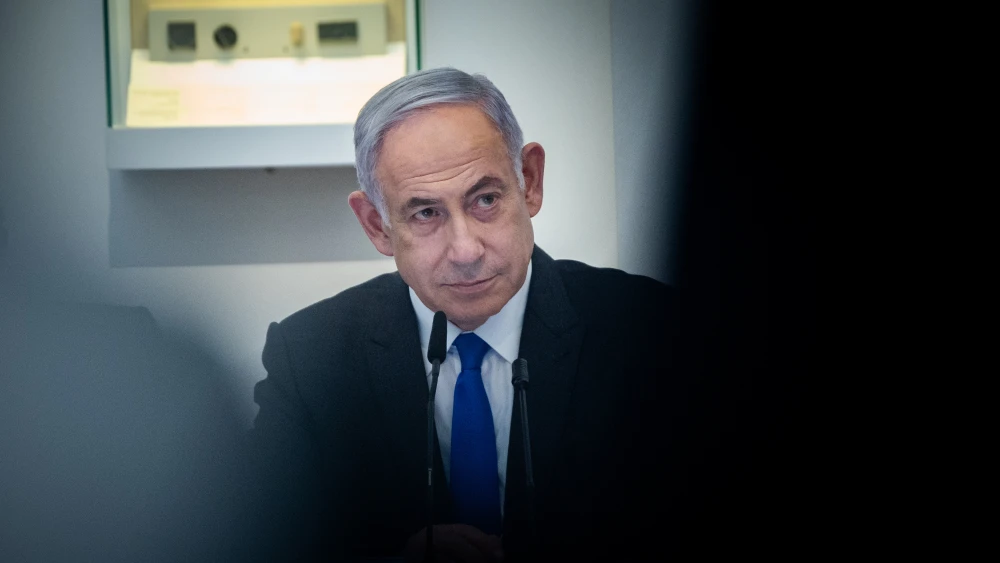
Israeli Prime Minister Benjamin Netanyahu leads a special government meeting for Jerusalem Day at the Bible Lands Museum in the capital city, June 5, 2024. Photo by Yonatan Sindel/Flash90.

Israeli Prime Minister Benjamin Netanyahu said on Sunday he would be discussing “all pending issues,” including the Iran war, during his visit to Washington this week.

“Tomorrow I will fly to Washington to meet, at his invitation, with President Trump,” Netanyahu said in opening remarks ahead of a government meeting in Jerusalem on Sunday.

The premier said he would also attend a memorial service for the late Sen. Lindsey Graham, whom he described as “one of Israel’s greatest friends since its inception.”

“It is fitting that we pay him this respect,” the premier continued.

Addressing the wave of terror attacks across Judea and Samaria, Netanyahu said the Israel Defense Forces continued to raid Palestinian villages, seize weapons and arrest suspects.

He said soldiers had entered a hospital in the Samaria city of Nablus (Shechem) to detain two accomplices to Friday’s deadly terrorist shooting near Havat Gilad.

The home of the gunman was sealed ahead of its planned demolition, he noted, adding that the residences of other suspects had also been mapped for possible destruction.

Jerusalem remains prepared to expand its military operations against “the terrorist nests” in Judea and Samaria, Netanyahu vowed.

Netanyahu also welcomed what he described as a decision “by a large majority of countries” to remove International Criminal Court Chief Prosecutor Karim Khan from office over allegations of sexual misconduct.

Netanyahu again accused Khan of advancing ICC arrest warrants against himself and former Defense Minister Yoav Gallant to deflect attention from the allegations against him.

“He did this to divert attention, to rally all of Israel’s haters around him, naturally, to give himself a protective shield,” he said. “This shield has now been torn apart, exposing his true motivation, the injustice, and the deep corruption that exists not only in the prosecutor’s office, but in the International Criminal Court as a whole.”

Netanyahu said he spoke with U.S. Secretary of State Marco Rubio on Saturday night, who reaffirmed Washington’s intention to act “firmly” against the ICC.

The ICC “endangers justice in the world and also threatens the right of democratic, sovereign states to exercise their sovereignty, and essentially attempts to subjugate their security to the decisions of a corrupt bureaucracy in The Hague,” he added. “I think this is a very positive development, and I think it is important that we echo this around the world.”

Netanyahu’s upcoming visit to Washington comes amid continued strategic coordination with the Trump administration following recent tensions with Iran and as the two allies discuss broader regional issues

According to Axios, Netanyahu has met with Trump in the Oval Office six times since the U.S. president returned to office, more than any other world leader. 


JNS Staff

Source: https://www.jns.org/news/israel-news/netanyahu-iran-to-top-agenda-during-washington-visit

Follow Middle East and Terrorism on Twitter

Trump is a puzzle, but he’s standing firm on Iran and the Saudis - Jonathan S. Tobin


by Jonathan S. Tobin

The president’s refusal to appease Tehran, along with his insistence that Riyadh recognize Israel if it wants a nuclear program, are potential political liabilities. But both stands are right.
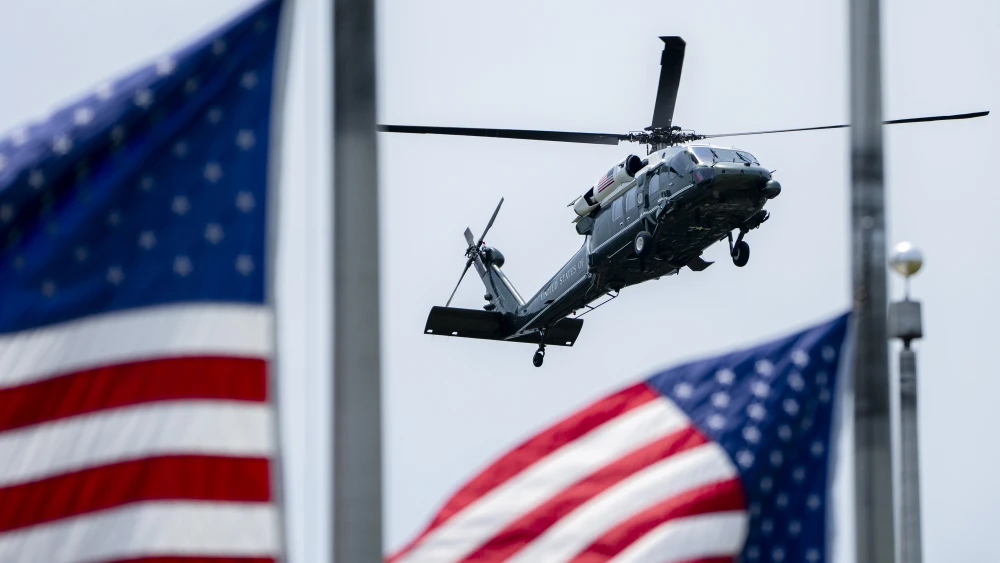
 

Marine one
U.S. President Donald Trump departs the Ellipse on Marine One in Washington, D.C., en route the U.S. Army War College in Carlisle, Pa., July 15, 2026. Credit: White House intern Austin DeSisto/White House.

As a man who has always prided himself on his unpredictability, President Donald Trump has achieved at least one goal in the Middle East of late. Few, if any, among his supporters or detractors (and perhaps not even the president himself) know exactly what he’s going to do next. As he zig-zags his way through the ongoing war with Iran while navigating the sometimes fractious relations with America’s main allies in the region—Israel and Saudi Arabia—he is, if nothing else, keeping friends and foes guessing.

But while it’s difficult to be sure where this is all heading, even his critics should concede that, for all of his erratic public statements and course shifts over the past few months, for the time being, Trump isn’t taking the expedient or even popular path with respect to the war. For the moment, he’s actually doing the right thing.

An unpopular war

That’s not the way most members of Congress see it. Democrats are united against his policies and the war. Republicans fear that the fallout from the conflagration is going to hurt them in the fall midterm elections; in fact, they are starting to worry about that more than being in Trump’s bad graces, with some even crossing the aisle to make their stance known.

The president’s declining poll ratings also demonstrate the war’s unpopularity, which has kept gas prices high for the past five months.

At the same time, the Iranians remain committed to their drive to achieve a nuclear weapon, and buoyed by opposition to the renewed war against them, rejected a U.S. ceasefire offer this week.

Meanwhile, the Saudis, who seem to be of two minds about the conflict, think that Trump double-crossed them. They’re angry because he first signed an accord that could let them enrich nuclear fuel. Then, only a day later, he said the deal was contingent on them joining the Abraham Accords and formally recognizing Israel.

For those who claim that Trump is an unprincipled cynic, his stand on both Iran and the Saudis makes no sense. After all, if doing the popular thing was his priority, he would have ended the conflict with Iran. An attempt by some in Congress to pass a war powers resolution that would hamstring the administration’s ability to carry on the fight has, to date, failed. It’s a reflection of the general lack of enthusiasm for a war the president struggles to explain clearly as much as it is about anti-Trump partisanship.

If he wanted to shore up America’s standing with a major ally in the Middle East that is also one of the world’s leading oil producers, then he might not have thrown a monkey-wrench into the nuclear agreement with Riyadh.

But Trump, who realizes that the final two years of his term in office could be turned into a nightmare if the Democrats win the midterms, chose not to do either of those things.

The war against Iran continues with no letup in sight. U.S. forces have been pounding Iranian targets for the last two weeks. Meanwhile, Tehran’s leaders continue to menace shipping in the Strait of Hormuz. They also continue to strike at America’s Arab friends in the region, including Jordan, Iraq, Kuwait, Bahrain, the United Arab Emirates and Oman, while conspicuously not targeting the two most powerful countries allied with Washington: Israel and Saudi Arabia.

Taking him seriously, not literally

Undeniably, Trump’s statements on the war have been all over the place.

One day, he’s predicting that Iran will soon come to its senses and make a deal with him over its nuclear project and perhaps other outstanding issues that he can accept. Only a few days later, he’s declaring that the deal the United States struck with them in June is “over”—and that the regime’s leaders are “scum” or “sick people being led by sick individuals” and that “negotiations are a waste of time” with them. That’s after having said only a month ago that the same bunch was a group of “very rational people.”

Part of the problem is that Trump watchers, especially in the media and among his political opponents, keep forgetting the basic insight about him that journalist Salena Zito famously wrote in 2016 and which remains true today: “The press takes him literally, but not seriously; his supporters take him seriously, but not literally.”

The point isn’t that he engages in hyperbole, as well as pays little attention to whether his statements are measured or entirely accurate. His threats, like his praise, are merely talking points and negotiating tactics.

Sometimes, that’s deeply unfortunate. His comments earlier this year that encouraged the Iranian people to revolt against their corrupt Islamist tyrants, saying “help was on the way” when it was not, were a tragic mistake. The result was that tens of thousands of protesters were slaughtered by a regime still in place.

Rejecting appeasement

But for all of his inconsistency, Trump still gets the big picture on Iran right.

He ended the joint Israeli military campaign against Iran in April with a ceasefire out of impatience with Tehran’s resilience, despite overwhelming losses, mainly because the hike in gas prices was a blow to the GOP’s hopes of holding onto Congress this fall. And he sent Vice President JD Vance, along with foreign-policy envoy Steve Witkoff and presidential adviser/son-in-law Jared Kushner, to Switzerland to negotiate a pact to end the war while allowing him to claim that he had also ended the Iranian nuclear threat.

Predictably, this exercise in essentially repeating past administration’s mistakes failed. The notion, put forward by Vance—that ending the war was a priority and that the United States could trust the Islamists to keep their word on nuclear issues—was soon exposed as a colossal blunder. Iran had no more intention of giving up its nuclear ambitions than it had of ceasing its role as the world’s leading state sponsor of terrorism, locked in a generational war against the West.

Trump could have accepted this humiliation. Indeed, all the experts urged him to do so because they argued that Iran could not be defeated. It was, they said, a struggle in which America’s refusal to accept any economic pain or even minimal casualties was matched against Tehran’s capacity to continually escalate the conflict and tolerate almost unlimited destruction. That’s something, establishment voices say, that makes them invincible.

But so far, Trump isn’t buying it.

He gave the Iranians a chance to make a deal that was extremely favorable to them. Had they abided by the Memorandum of Understanding negotiated by Vance, it would have been a triumph for the regime and a defeat for the United States. But, like former Presidents Barack Obama and Joe Biden, Vance learned that the Islamists don’t want a favorable settlement. They will never give up their quest for regional hegemony or their mission of spreading their brand of fanatical Islam across the globe. The difference between this administration and its predecessors is that the man in the Oval Office isn’t willing to accept that kind of humiliation.

While he may be deeply frustrated with the failure of the military campaign to bring the regime to its knees as quickly as he would like, he is equally determined not to give up and let a terrorist regime have its way.

Trump entered politics primarily as a critic of the failed “forever” wars in Afghanistan and Iraq. Although he is sensitive to critics who claim that he’s repeating the mistakes made by former President George W. Bush in those two unwinnable conflicts, he understands that while the United States might have been able to walk away, albeit disgracefully, from those battles, Iran is a different story.

The Islamic Republic has been at war with the United States since the Islamist regime seized power in 1979. It is responsible for killing hundreds of Americans and launching wars that caused the deaths of exponentially more people around the region, including the one that followed the Hamas-led Palestinian Arab assault in southern Israel on Oct. 7, 2023. Its nuclear ambitions are a direct threat to the United States as well as other countries in the Middle East.

Contrary to the arguments of those who claim that Washington can simply walk away from this problem—whether articulated by liberal pundits who hate Trump and are allergic to the exercise of U.S. power or antisemitic conspiracy-mongers like former Fox News host Tucker Carlson, who have become Islamist cheerleaders—this is a conflict where the defense of U.S. interests requires the defeat of America’s antagonist. Far from an illegal or immoral foreign adventure, it is a just war that needs to be fought to a successful conclusion.

Kicking the can down the road for a successor to deal with a dilemma that will almost certainly be harder to solve might lower fuel costs for now, as well as preclude any further casualties and bad press. But it would also be irresponsible and dangerous.

Ultimately, Trump may not stay the course on Iran. But for the moment, he is acting, if not always speaking, as if he knows that he must not let the Islamists triumph. The fighting will have to keep going until there is a government in Tehran that will accept American terms and be forced to abide by them.

It’s also true that Trump may have already concluded that his administration’s worries about the midterms won’t be fixed by letting the Iranians win. Whatever political capital he expended on the issue is, at this point, spilt milk and cannot be retrieved by adopting appeasement. Having lost a war to terrorists will be worse for the Republicans in November than to still be fighting one that is far from popular.

Standing his ground on Iran will be a better position for him and the GOP than waving the white flag. And in doing so, he will actually be rising to his responsibility of defending his nation and the West.

Saudi nuclear deal

The same is true for his reversal on the deal with the Saudis.

The Saudi monarchy was initially quietly in favor of the U.S.-Israeli war on Iran, which poses as great a threat to Riyadh as it does to Jerusalem. But it got cold feet once the Gulf states began to be hit by Iran, coupled with attacks on shipping that disrupted the oil trade.

Their interest in a nuclear deterrent to Iran—and approving the start of a nuclear project for the Saudis has no other purpose other than that—may be understandable. In a world where the United States punts on stopping the Iranian nuclear threat, this might seem rational. But save for Vance’s neo-isolationist rants, it has never been something Trump accepted as an option.

In contrast to Obama and Biden, Trump has rightly sought to maintain close relations with a nation that is—its flaws as an Islamist autocracy notwithstanding—key to keeping Iran in check and a Middle East that is friendly to the West. But giving it a pathway to nuclear weapons (safeguards in the proposed agreement with the United States notwithstanding) is frankly insane. There is always the possibility that the current leadership embodied by Crown Prince Mohammed bin Salman (MBS), who wants to modernize if not democratize his country, might be toppled by his radical foes. It is equally true that even under its current conservative leaders, the Saudis ought not to be trusted with the ultimate weapon.

Many in Israel and in the United States believe that it is only a matter of time before the Saudis join the Abraham Accords. But that sort of optimism, which was widespread after the normalization agreement was crafted in 2020, is almost certainly wrong.

The Saudis may have a relatively friendly relationship with Israel. They are tacit allies with it against Iran and open to the economic benefits of commerce with the Jewish state. But MBS and other Saudi leaders don’t need to extend themselves much further than that and rock the regional boat; they feel their current relationship with Israel is just fine.

Moving to full recognition and the exchange of embassies will bring them more problems than benefits. The core identity of the Saudi regime is inextricably linked to the Wahhabi sect of Islam, and its status as the guardian of the Muslim holy places in Mecca and Medina. That’s an insuperable obstacle to normalization. Moreover, their enthusiasm for closer ties with Jerusalem rises and falls in direct relation to the threat level from Tehran, which, as long as Washington is dedicated to ending the nuclear peril, is low.

By demanding normalization, Trump is essentially spiking the nuclear deal with the Saudis. Like the MoU with Iran, the pact with Iran was always a terrible idea. While there is clearly a faction inside the administration that, motivated by neo-isolationist sentiment, wants to retreat from the Middle East and likely pushed for this fiasco, Trump knew better.

Again, there is a political cost to this decision.

It is entirely possible that alienating Riyadh could contribute, either directly or indirectly, to oil-supply decisions that could contribute to rising prices—political poison for Trump. But to his credit, again he did the right thing after flirting with an unforced error that would have been a potential disaster.

Big picture decisions

Trump’s Middle East policies continue to be a mix of keen insight and puzzling decision-making. For example, his closeness with Turkey’s leader Recep Tayyip Erdoğan has led to mistaken policies with respect to the Kurds and Syria that are undermining the struggle against Iran and its terrorist auxiliaries.

And his on-again, off-again bromance with Israeli Prime Minister Benjamin Netanyahu is deeply frustrating for friends of the Jewish state and those who understand the stakes involved in nurturing the alliance between the two nations. Going back and forth from rightly praising Israel for fighting side by side with America against common foes—and then, inappropriately, using the prime minister as a scapegoat for the lack of immediate success against Iran—only encourages the war’s critics, and antisemites on the right and the left.

When looking at the big-picture decisions the president is making, the errors aren’t as serious as his determination to keep fighting against Iran and not to let the Saudis go nuclear, despite the potential political costs. Focusing on his inconsistent day-to-day statements on the war only adds to the confusion. But so long as he is standing his ground on Iran and protecting U.S. interests rather than doing the politically expedient thing, Trump deserves far more praise than criticism. 


Jonathan S. Tobin is editor-in-chief of the Jerusalem News Syndicate, a senior contributor for The Federalist, a columnist for Newsweek and a contributor to many other publications. He covers the American political scene, foreign policy, the U.S.-Israel relationship, Middle East diplomacy, the Jewish world and the arts. He hosts the JNS “Think Twice” podcast, both the weekly video program and the “Jonathan Tobin Daily” program, which are available on all major audio platforms and YouTube. Previously, he was executive editor, then senior online editor and chief political blogger, for Commentary magazine. Before that, he was editor-in-chief of The Jewish Exponent in Philadelphia and editor of the Connecticut Jewish Ledger. He has won more than 60 awards for commentary, art criticism and other writing. He appears regularly on television, commenting on politics and foreign policy. Born in New York City, he studied history at Columbia University.

Source: https://www.jns.org/opinion/column/jonathan-s-tobin/trump-is-a-puzzle-but-hes-standing-firm-on-iran-and-the-saudis

Follow Middle East and Terrorism on Twitter
How Israel kept Biden backing a Gaza war his administration wanted to end - report - Jerusalem Post Staff


by Jerusalem Post Staff

Former Biden admin. officials believe that their unconditional support of Israel emboldened Prime Minister Netanyahu to expand the war in Gaza to Lebanon and Iran, sources told The New Yorker.


US Vice President Joe Biden (L) shakes hands with Israeli Prime Minister Benjamin Netanyahu as they deliver joint statements during their meeting in Jerusalem March 9, 2016
(photo credit: REUTERS/DEBBIE HILL/POOL)

Biden administration officials have expressed regret that the former US president's support for Israel ultimately "enabled" Prime Minister Benjamin Netanyahu to broaden the war in the region, according to a long-form New Yorker investigation published last week.

Several former officials told the New Yorker they now view the confrontation with Iran as a direct extension of the Gaza war.

In a detailed long-form report for the magazine, several former administration officials said that former president Joe Biden reportedly believed that any pressure that the US put on Israel during the war in Gaza would lead to bigger attacks from Iran. This would mean that the US would have to step in to defend Israel, even if it caused a larger regional war.

Biden’s former White House coordinator for the Middle East, Brett McGurk, argued that immovable support for Israel would help contain Iran, and warned against any “daylight” between the allies.

Former Kamala Harris national security adviser Philip Gordon told the New Yorker that Washington created a "moral hazard" through its unconditional backing of Israel, allowing Netanyahu to steadily expand the conflict into other parts of the region.

According to the New Yorker, doubts began to emerge about Israel's strategy in Gaza almost as soon as the war started.

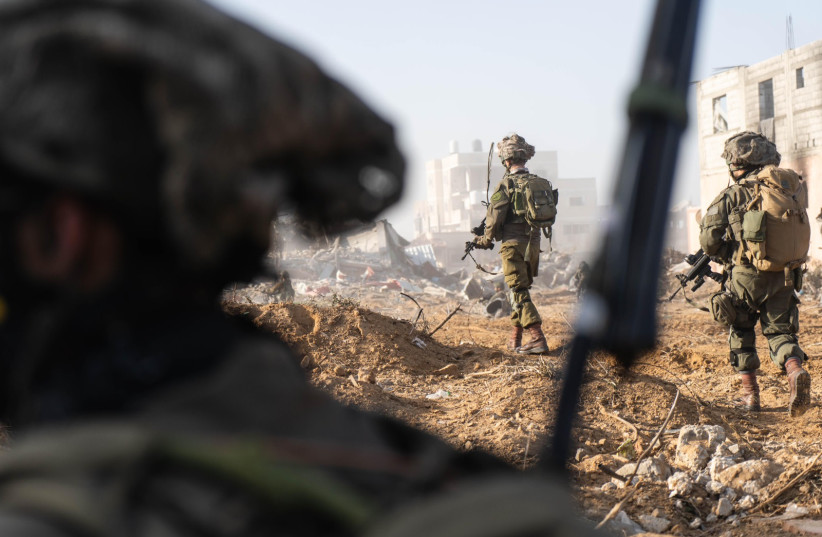
Israeli forces are seen operating in the Gaza Strip on January 29, 2024
Israeli forces are seen operating in the Gaza Strip on January 29, 2024 (credit: IDF SPOKESPERSON'S UNIT)

US officials were alarmed by Israel's Gaza strategy at start of war

Inside the administration, officials were stunned by the scale of Israel's opening air campaign. While the IDF maintained it was operating in accordance with international law, several officials questioned whether the intensity of the strikes could be reconciled with efforts to minimize civilian casualties.

The New York Times previously reported that Israel revised its rules of engagement after October 7, allowing mid-level officers to approve strikes risking up to 20 civilian deaths to eliminate a rank-and-file Hamas operative.

Notably, the IDF has never previously fully outlined what its redlines are in situations like these.

The Jerusalem Post learned in 2024 that the IDF has set ratios. It also views the message of the NYT report – that these ratios are essentially part of a carte-blanche strategy – as inaccurate.

The Post reported that the IDF’s view is that the NYT report confused various minimal parameters that may exist for setting at what level different-ranked IDF officials are mandated to sign off on certain strikes – with being the final call on approving a strike.

Officials questioned whether entire neighborhoods were being destroyed without sufficient distinction between military and civilian targets.

"We were all shocked at how aggressive and deadly it was, and asking, 'What the f**k are they doing?'" one senior State Department official told the New Yorker.

Palestinians collect aid supplies from a truck that entered Gaza, amid a ceasefire between Israel and Hamas, in Khan Younis, in the southern Gaza Strip October 12, 2025.
Palestinians collect aid supplies from a truck that entered Gaza, amid a ceasefire between Israel and Hamas, in Khan Younis, in the southern Gaza Strip October 12, 2025. (credit: Ramadan Abed/Reuters)

Humanitarian aid quickly became another major source of conflict between Washington and Jerusalem.

After Hamas's October 7 attack, Israel sealed Gaza's crossings, with then-defense minister Yoav Gallant declaring a "complete siege."

"No electricity, no food, no water, no fuel, everything will be closed," Gallant said. "We are fighting human animals, and we are acting accordingly."

Biden officials' pleas to allow more aid into Gaza fell on deaf ears, report alleges

According to the New Yorker, Secretary of State Antony Blinken urged Netanyahu and Gallant to allow aid into Gaza, arguing it was "a moral responsibility" as well as "a strategic imperative and a legal imperative."

Netanyahu reportedly resisted until Blinken threatened to cancel Biden's planned visit to Israel. Even then, Israel agreed only to limited aid deliveries through Rafah and, according to the report, Netanyahu wanted the decision kept quiet to avoid political backlash from Israelis who wanted no aid to enter Gaza.

Soon afterward, Netanyahu publicly declared Israel "will not allow humanitarian assistance" from "our territory into the Gaza Strip."

Aid negotiations became a constant feature of US-Israel contacts, with Blinken and Sullivan often negotiating the number of aid trucks entering Gaza and which supplies Israeli inspectors would permit.

Inspectors reportedly blocked items including fertilizer, tent poles, oxygen cylinders, X-ray machines and childbirth kits, while entire truckloads could be rejected if they contained a single prohibited item.

The disagreements extended beyond humanitarian aid.

While no senior Biden administration official questioned Israel's right to respond to Hamas's October 7 attack, officials increasingly believed the scope of the military campaign threatened broader US objectives in the region.

According to the New Yorker, Biden, Blinken and national security adviser Jake Sullivan feared that an extended war would endanger US troops, complicate hostage negotiations and increase the risk of a regional conflict involving Iran and Hezbollah.

Those concerns emerged within days of the war.

IDF troops operate in the Gaza Strip. September 24, 2024.
IDF troops operate in the Gaza Strip. September 24, 2024. (credit: IDF SPOKESPERSON'S UNIT)

Netanyahu reportedly ignored US requests to limit Israel-Hamas War to Gaza Strip

When Netanyahu ordered preparatory airstrikes against Hezbollah in Lebanon, Biden intervened directly, warning that the United States was not yet prepared for the consequences of a wider regional war. Netanyahu ultimately called off the operation. 

During Biden's visit to Israel days later, he publicly cautioned against allowing anger to dictate military decisions.

"While you feel that rage, don't be consumed by it," he said. "The vast majority of Palestinians are not Hamas."

Behind the scenes, however, the administration urged Israel to narrow its military campaign.

American officials argued that a large-scale ground invasion of Gaza would complicate efforts to free the hostages and make Hamas more difficult to defeat. Instead, they advocated intelligence-driven operations modeled on US campaigns against ISIS and al-Qaeda, and even dispatched senior military officers to share battlefield experience with the IDF.

Israeli leaders remained unconvinced.

According to New Yorker, former defense minister Benny Gantz outlined a vision in which Israeli troops would continue controlling security corridors across Gaza after the war so that "anyone looking into Gaza would see the backs of Israeli soldiers."

Administration officials repeatedly pressed Netanyahu to explain what victory would look like and how Hamas could be defeated without a political alternative to replace it.

Blinken also warned Israeli leaders that military operations alone could not eliminate Hamas's ideology.

When Netanyahu expanded his stated objective from destroying Hamas to achieving "total victory," officials increasingly concluded the war had no clear endpoint.

By late 2023, frustration within the administration was mounting.

Austin warned that excessive civilian casualties would ultimately undermine Israel's security.

"You create more terrorists," he said.

Later, as the fighting intensified, he sharpened the warning.

"If you drive them into the arms of the enemy," Austin said, "you replace a tactical victory with a strategic defeat."

Reportedly, everyone on the Biden team, including Austin, believed that Israel was killing more Gazan civilians than was necessary to achieve its goal of dismantling Hamas in Gaza.

One senior White House official told the New Yorker that the IDF “just operate totally differently than we [the US] operate as a ground force.”

Privately, officials also questioned whether they had any real leverage over Netanyahu.

"We tried, but we had no chance of success, in retrospect, because Netanyahu wasn't talking to us; he was talking to his own public," senior presidential adviser Amos Hochstein told the New Yorker.

The administration also came to believe it had misjudged Israel's timetable.

Blinken: "I don't want to hear that phrase 'two more weeks' ever again!" 

For months, Netanyahu and former strategic affairs minister Ron Dermer assured Washington that major combat operations were almost complete.

"Just two more weeks," they repeatedly told US officials.

Those assurances shaped Biden's calculations.

"If it is just a few more weeks, why have a huge fight with Israel?" one official recalled.

Another added: "We thought that this could, would, and should be over in December."

Instead, the campaign steadily expanded.

After operations in northern Gaza, Blinken warned Israeli officials: "Don't do in the south what you did in the north!"

Israel nevertheless launched major operations in Khan Yunis before preparing to move into Rafah.

When Sullivan warned Israeli officials that Rafah would be next, they insisted otherwise.

"No, no, no, we are not going to go after Rafah!"

Within weeks, Netanyahu announced plans for an operation there.

Several former officials said they eventually concluded the repeated promises of "two more weeks" were designed to delay a confrontation with Washington until facts on the ground had changed.

By early 2024, Blinken had lost patience.

"I don't want to hear that phrase 'two more weeks' ever again!" he told Dermer.

"OK," Dermer replied, "I will say 'fortnight.'"

Blinken later acknowledged he never fully determined whether Israeli officials had genuinely believed their own timelines.

"Were they being genuine, or were they being disingenuous?" he told the New Yorker. "I think it's a combination. I would take them at their word, certainly into very early ’24—less so as time went on, and that was a huge frustration.” 

As civilian casualties mounted, the administration turned to a question it had largely avoided during the war's opening months: whether US military aid should be used as leverage.

Biden's failed effort to change Netanyahu's course in Gaza War

Officials debated withholding some offensive weapons, particularly the 2,000-pound bombs used in densely populated areas, while others urged Biden to publicly challenge Netanyahu directly.

One proposal called for Biden to deliver a televised address to the Israeli public arguing that an unlimited war would isolate Israel internationally, jeopardize hostage negotiations and undermine prospects for regional normalization.

The speech was never delivered.

Privately, Biden administration officials would push Netanyahu on the Israeli-Palestinian conflict.

“No one’s going anywhere, no matter what some people on both sides want. So how does this end?” The former secretary of state reportedly told the prime minister.

But publicly, the White House adopted what one official described as a "no daylight" strategy, continuing to pressure Israel privately while avoiding an open breach with Netanyahu.

That approach began to unravel as the war dragged on and Israeli operations expanded despite repeated US objections.

By early 2024, the administration had begun openly debating whether continued military aid could be used to influence Israeli policy.

As civilian casualties mounted and humanitarian conditions deteriorated, officials considered withholding offensive weapons, particularly the 2,000-pound bombs used in densely populated areas. Others argued Biden should publicly confront Netanyahu after months of relying almost exclusively on private diplomacy.

The debate intensified after Sen. Chris Van Hollen pushed legislation requiring the administration to certify that recipients of US weapons were complying with international humanitarian law. Rather than oppose the measure, the White House incorporated much of its language into National Security Memorandum 20, which requires the State Department to assess whether countries receiving American weapons comply with the laws of war.

When did Biden's approach to Israel change?

At the same time, Biden's public tone toward Israel began to shift.

He described Israel's military campaign as "over the top," saying innocent civilians were "starving" and "dying." Privately, he warned Netanyahu not to launch an operation in Rafah without an "executable plan" to protect the more than one million Palestinians sheltering there.

The turning point came after an Israeli strike on April 1, 2024, killed seven World Central Kitchen aid workers, including a dual US-Canadian citizen.

For the first time, Biden publicly warned that future US support would depend on Israel taking "specific, concrete, and measurable steps" to reduce civilian suffering.

Blinken also sent former defense minister Yoav Gallant a previously undisclosed letter warning that continued military assistance would depend on Israel's compliance with US laws governing humanitarian aid and civilian protection.

When the State Department completed its legal review weeks later, it exposed deep divisions within the administration.

According to the New Yorker, several bureaus concluded Israel had likely used American weapons in ways inconsistent with the laws of war or had obstructed humanitarian aid. Others argued the available evidence did not justify suspending military assistance.

The disagreement became public after reports emerged that the administration had paused deliveries of thousands of 2,000-pound bombs.

Biden acknowledged the decision in an interview with CNN.

"Civilians have been killed in Gaza as a consequence of those bombs," he said. "If they go into Rafah, I'm not supplying the weapons."

Despite the warning, the New Yorker reports that Biden approved the transfer of accompanying shipments of 500-pound bombs after rejecting proposals for a broader suspension of military aid.

Israeli soldiers stand on rubble in Rafah in the southern Gaza Strip, December 8, 2025.
Israeli soldiers stand on rubble in Rafah in the southern Gaza Strip, December 8, 2025. (credit: REUTERS/NIR ELIAS)

Did Biden officials believe Israel committed war crimes in Gaza

Officials also struggled with a legal question that remained unresolved throughout the war.

Government lawyers concluded they lacked sufficient evidence to determine whether specific Israeli strikes constituted war crimes, despite widespread concern over civilian casualties.

One lawyer summarized the administration's dilemma.

"We don't have definitive proof, but we are very concerned that Israel is committing war crimes."

The State Department ultimately concluded it was "reasonable to assess" that Israel had used US weapons in ways "inconsistent" with international humanitarian law, but said the evidence was insufficient to suspend military assistance.

Some officials believed the administration had missed its best opportunity to influence Israeli policy.

Former Harris advisor Gordon argued National Security Memorandum 20 "could have been, and should have been, the tool that we used to get the Israelis to do things differently."

Instead, he said, after the report's release, "they knew that we wouldn't."

Officials involved in ceasefire negotiations also concluded that Netanyahu was prolonging the war for domestic political reasons.

According to the New Yorker, Biden abandoned plans to deliver a tougher public address after Israeli officials indicated they were prepared to pursue a phased ceasefire and hostage agreement. But several former officials said Netanyahu later added new conditions after Hamas signaled it was prepared to move forward.

"Bibi was playing games," one former White House official told the magazine.

Blinken and Austin later warned Israel that continued restrictions on humanitarian aid could trigger another review of US military assistance. Israel briefly increased aid deliveries, but after Donald Trump's election victory in November 2024, the administration's remaining leverage largely disappeared.

Looking back, former officials offered sharply different assessments of their own record.

Some believed sustained US pressure prevented an even greater humanitarian disaster by increasing aid deliveries and encouraging civilian evacuations.

Others concluded the administration's reluctance to confront Netanyahu publicly prolonged the conflict without substantially changing Israeli policy.

Blinken acknowledged the human cost of the war.

"How can you not have regrets given the toll that this took on innocent men, women and children?" he told the New Yorker.

He nevertheless defended the administration's intentions, repeating a phrase he often attributed to Biden: "Question my judgments. Don't question my motives."

Sullivan said officials repeatedly weighed whether to break more decisively with Israel, but each option carried significant risks.

"We'd get progress and backsliding, progress and backsliding, over and over again," he said.

"What about the hostages? What about Israel under attack from all sides? What effect would it have on the ceasefire talks and bringing this god-awful war to an end?"

By the administration's final months, officials prepared one last internal memorandum questioning the military necessity of Israel's continued operations and warning of "grave concerns" over the starvation and displacement of civilians.

But by that point, it was too late. Trump was already on the way to the White House.


Jerusalem Post Staff

Source: https://www.jpost.com/israel-news/defense-news/article-903681

Follow Middle East and Terrorism on Twitter

Families of some 9/11 victims push to keep Mamdani from 25th anniversary Ground Zero ceremony - Nicholas Ballasy


by Nicholas Ballasy

Organizers have said that the petition has attracted more than 1,100 signatures so far


A growing group of relatives of victims killed in the Sept. 11, 2001, terrorist attacks is urging organizers to prevent New York City Mayor Zohran Mamdani from attending this year’s 25th anniversary memorial ceremony at Ground Zero, arguing that his presence would be inappropriate.

The effort centers around a petition launched by Giovanni Galante, whose wife, Grace Catherine Galante, was killed in the attacks, the New York Post reported. 

Organizers have said that the petition has attracted more than 1,100 signatures so far, including roughly 300 family members of 9/11 victims, although the total has continued to grow. 

The petition describes Mamdani, the first Muslim mayor of the city, as an “unwelcome guest” and contends that his past statements and political associations make him an unsuitable participant in the ceremony.  


Nicholas Ballasy

Source: https://justthenews.com/government/local/families-some-911-victims-push-keep-mamdani-25th-anniversary-ground-zero-ceremony

Follow Middle East and Terrorism on Twitter

Dem frontrunners for 2028 in flux as party grapples with 'socialist' surge - Ben Whedon


by Ben Whedon

The progressive wave seems to have moderate and centrist Democrats worried for the party’s future.


The Democratic Party’s 2028 primary is shaping up to be a lead-change race, with conventional and outsider candidates moving in and out of the top slot amid an ongoing internal divide within the party over the surge of democratic socialists in down-ballot races.

A string of primary wins for democratic socialist candidates in New York City saw the progressive left remove two senior House Democrats, including the chair of the Congressional Hispanic Caucus, Rep. Adriano Espaillat, D-N.Y., and Rep. Dan Goldman, D-N.Y. Subsequent primary races in Colorado saw far-left candidates easily secure the party nominations for myriad House races.

Fetterman scolds Dems: "Don’t be weirdo socialists and don’t praise Mao and do crazy shit” 

The progressive wave seems to have some Democrats worried about the party’s future. Sen. John Fetterman, D-Pa., for instance, has been sharply critical of the rise of so-called "democratic socialist" candidates in the Democratic primary process. When pressed on what he believed the party should do for the 2026 midterms, he told the Gateway Pundit that “my strategy should be not be weird. Don’t be communists. Don’t be weirdo socialists and don’t praise Mao and do crazy shit.”

Fetterman and New York City Mayor Zohran Mamdani have emerged as foils within the party, with the topic of Israel representing one of their sharpest divides. Mamdani, whose meteoric rise has led to subsequent victories for the far-left with his backing, has openly floated arresting Israeli Prime Minister Benjamin Netanyahu. Fetterman, meanwhile, condemned such a prospective move and made clear that he believes the party should remain pro-Israel.

The growing tension between the opposite ends of the party, however, appears headed toward a tipping point that currently seems likely to favor the left-wing of the party. Recent polling has shown Rep. Alexandria Ocasio-Cortez, D-N.Y., as a potential frontrunner, with her taking an outright lead in the pivotal primary state of New Hampshire in a Granite State poll published by The Hill.

AOC’s rise predated the current wave of socialist candidates, and she was a founding member of the far-left “squad” that entered Congress in 2019. Her surge in New Hampshire saw her gain 8% support from October 2025, to 22% in July of this year. That surge also saw her move past former Transportation Secretary Pete Buttigieg, who went from 19% support to 21% support in the same period.

Notably, no major prospective candidate has announced an official bid for the party nomination and much of the polling remains speculative.

Two of the other major prospective candidates, notably Gov. Gavin Newsom, D-Calif., and former Vice President Kamala Harris, have also enjoyed brief periods atop the party's totem pole. In mid-July, for instance, a Harvard-Harris poll had Harris on top at the national level with 37% support to Newsom’s 24%, Buttigieg’s 10%, and ACO’s 9%.

In mid-May, it was AOC on top in an Atlas Intel survey, with Buttigieg and Newsom vying for second, and Harris in fourth. Some current surveys show Buttigieg in the number one slot, with Newsom in second, AOC in third, and Harris trailing behind other hypothetical candidates.

The see-sawing and jockeying for position of the myriad candidates, each of whom seems to represent one extreme faction or another of the Democratic coalition, suggests the overall battle for party direction is far from over.

Proxies for the socialists

Meanwhile, down-ballot races continue to offer more immediate proxies for the socialists and moderates to battle it out. The Maine Senate race, for example, recently pitted the establishment-backed Gov. Janet Mills, D-Maine, against the progressive Graham Platner, who won decisively after full-throated endorsements from Senator Elizabeth Warren, D-Mass. and Vermont Sen. I-Vt. Bernie Sanders.

Sen. Bernie Sanders, I-VT, and many progressive stalwarts had backed Platner, whose clear win led moderates to question Senate Majority Leader Chuck Schumer’s pro-Mills approach. But Platner then dropped out in the face of scandal, leading to former state Senate President Troy Jackson taking over as the presumptive nominee.

The subsequent race to replace Platner saw Schumer declare “I’m staying out of Maine,” with a strategist telling Politico at the time that a Schumer-backed candidate would not be well-received. Mainers ultimately opted for a comparably progressive candidate in Jackson, seemingly repeating their rebuke of the establishment’s involvement in the contest.

The first primary contest will not take place until early 2028, however, meaning both the establishment and the socialist wing of the Democratic Party will have plenty of time to vie for dominance, and establish convenient narratives to suit their aims.


Ben Whedon is the Chief Political Correspondent for Just the News. Follow him on X.

Source: https://justthenews.com/politics-policy/wkddem-frontrunners-2028-flux-party-grapples-socialist-surge

Follow Middle East and Terrorism on Twitter
The Exploding Islamization of the West: A Conversation with Alexandre del Valle, Part I - Grégoire Canlorbe


by Grégoire Canlorbe

[B]y launching barbaric jihadist attacks -- such as Bataclan, Charlie Hebdo, London, Madrid, Barcelona, Brussels, Berlin, or the July 14 Nice attacks -- radical Islamists in fact aim to induce hostility toward Muslims and provoke a clash between Muslims and non-Muslims, to motivate Muslims to separate from their non-Muslim environment and de-assimilate.


  • One of the great successes of Islamist movements appears to have been to convince much of the third generation of Muslim families to break with assimilation. Many of that generation were beginning to become more integrated than their parents or grandparents.

  • This strategy has been most effective. Islamic terrorism produces criticism of Islamism. The Islamists then say that the criticism is proof that they are victims of Islamophobia.... This community then functions as a counter-society against Western society, which is perceived as harmful, decadent, "Islamophobic," or "racist."

  • There are networks that organize Islamization – it seems, mainly of three kinds. The first network consists of Islamist movements themselves.... Some states play an extremely direct role in this process: Turkey, Qatar and Pakistan, among others.... The institutions involved include the Organization of Islamic Cooperation (OIC), which brings together 57 Muslim states and promotes an international Islamic order. One can also mention ISESCO, the Islamic counterpart of UNESCO. These structures help to spread a narrative that by adapting to Western culture... This narrative not only tries to adapt sharia to Europe, but tries to push Europe to adapt to sharia.

  • The third network is... the dominant current within Western societies themselves, shaped by "political correctness." Out of fear of conflict, fear of not getting votes, or Western postcolonial guilt, many Europeans conveniently manage not to see the Muslim colonization of Turkey, Egypt, Albania, Kashmir, Cyprus and Israel.

  • Sometimes, simply out of a desire to buy peace in their neighborhoods, Western elites accommodate Islamist demands. Local elected officials, confronted with "difficult" neighborhoods, come to implicit agreements with a community's representatives just in order to preserve a form of peace.

  • We are, in fact, creating "extraterritorial mini-caliphates."

  • US President Donald Trump has spoken of "civilizational erasure." He is absolutely right.

  • Many Islamists tell Muslims in Europe that their presence in a non-Muslim country can be justified only on two conditions. First, they must re-Islamize in order to protect themselves from the supposedly harmful influence of the unbelieving societies. Second, they must contribute to expanding the Muslim community until it one day becomes dominant. In this mindset, living in Europe becomes acceptable only if one works to transform it gradually into an Islamized space.

  • A great mistake of the Western elites seems to have been to reduce "national interests" only to material interests. Many in the West appear to have believed that democracy and human rights would seduce all of humanity. They passed over in silence the dimensions of religion and ethnic values of the West — its shared culture, language and history, and its anchoring in Judeo-Christian priorities—in order to present democracy and human rights as a model exportable to the entire world.

  • Much of the West no longer thinks of itself in cultural, religious, or civilizational terms. It thinks of itself rhapsodically as a space that is open to all ethnicities and religions, reduced to individual rights, democracy, and consumption -- and capable of extending over the entire world.

  • Much of the West also no longer believes in its own civilization; many no longer even believe it is a civilization. Under these circumstances, how could it be capable of pursuing a policy of defense of Western civilization and the Judeo-Christian heritage?

  • This loss of self-awareness might explain some serious strategic errors. If one believes that Europe has neither religion, history, shared values nor civilization, then Qatar, Saudi Arabia, Pakistan, Kuwait, or Turkey can appear merely as economic partners. Their investments, buildings, football clubs, and financial power are noticed; their ideological and religious roles are overlooked.

  • If the West had preserved a vision of itself as a civilization, it could have maintained economic relations with these countries while prohibiting any religious interference. It could have said clearly: "We cooperate, but you do not finance the Islamization of our territories." The West, having stopped seeing itself as a civilization, allowed Islamist powers to finance mosques, associations, and networks of influence on its own soil.

  • If you refuse to defend your civilization, you are disarming your nation. The West is a civilization shared by a number of ethnic groups, which is mainly the product of Judeo-Christian values. If a nation does not know its identity, how can it defend itself? If a nation renounces its value systems, its traditions, its historical religion, and its heritage, it implicitly accepts changing its population, identity and religion.

"[B]y launching barbaric jihadist attacks -- such as Bataclan, Charlie Hebdo, London, Madrid, Barcelona, Brussels, Berlin, or the July 14 Nice attacks -- radical Islamists in fact aim to induce hostility toward Muslims and provoke a clash between Muslims and non-Muslims, to motivate Muslims to separate from their non-Muslim environment and de-assimilate." — Alexandre del Valle. Pictured: The truck used by the terrorist Mohamed Lahouaiej-Bouhlel to murder 86 people in a July 14, 2016 ramming attack in Nice, France. (Photo by Anne-Christine Poujoulat/AFP via Getty Images)

Alexandre del Valle is a French author specializing in geopolitics.

Grégoire Canlorbe: What do we know, please, about the Islamization of Europe?

Alexandre del Valle: The Islamization of countries such as Belgium, France, the United Kingdom, Germany, Sweden, or the Netherlands has, in my view, reached a critical threshold, perhaps even a point of no return. The reasons are at once demographic, cultural, and ideological. These recent minorities have not only reached a significant numerical weight; they also have much higher fertility rates. Above all, for the past twenty years or so, there has been not only a failure of assimilation, but a form of de-assimilation among populations that, until then, had seemed assimilated.

One of the great successes of Islamist movements appears to have been to convince much of the third generation of Muslim families to break with assimilation. Many of that generation were beginning to become more integrated than their parents or grandparents. They had begun to adopt some codes of European societies: freedom of individuals, freedom of movement, separation between religion and politics, sometimes even emotional and sexual freedom. You could see young Muslim women dating Christians, atheists, or non-Muslims.

For a number of years, though, you can see a retreat, particularly during conversations on "Islamophobia." Islamists, often with the support -- or complacency -- of many on the "left," have managed to instill in many Muslims a mentality of mistrust, sometimes verging on paranoia, leading them to believe that they are surrounded by enemies -- that the non-Muslim society is fundamentally hostile to them, and that they must therefore not join it. In what turned out to be a bestseller in France, The Strategy of Intimidation, I explained that by launching barbaric jihadist attacks -- such as Bataclan, Charlie Hebdo, London, Madrid, Barcelona, Brussels, Berlin, or the July 14 Nice attacks -- radical Islamists in fact aim to induce hostility toward Muslims and provoke a clash between Muslims and non-Muslims, to motivate Muslims to separate from their non-Muslim environment and de-assimilate.

This strategy has been most effective. Islamic terrorism produces criticism of Islamism. The Islamists then say that the criticism is proof that they are victims of Islamophobia. Young people who were assimilated, or at least interested, are encouraged to withdraw voluntarily into an isolated Islamic community. This community then functions as a counter-society against Western society, which is perceived as harmful, decadent, "Islamophobic," or "racist." In this framework, withdrawal—whether it involves a veil, marrying only within one's religion, Muslim clothing excluded by non-Muslims from everyday life, or abstention from some democratic activities -- is then presented as a condition of survival in the face of a small minority community supposedly being oppressed by a large majority.

There is now a discourse in these Muslim communities that suggests it might be best if they separated themselves from the rest of society. The separation is being presented as a demand for protection, a right to difference, or even a right to reparations in the face of the supposedly "racist" attitude of Western society.

The discourse presents Western society as diabolically secular, anti-religious, perverse, Islamophobic, and, of course, Zionist. In this narrative, Christians are often described as the accomplices of Jews or Zionists -- a view that further reinforces the hostility toward the host society and the wish to separate from it.

Canlorbe: Is this Islamization spontaneous?

del Valle: Often it is not spontaneous. There are networks that organize Islamization – it seems, mainly of three kinds. The first network consists of Islamist movements themselves. These may be transnational organizations, such as the Muslim Brotherhood, Pakistani Tabligh, the Barelvi or Deobandi movements, the Europe-based Turkish movement Milli Görüş, or Salafist currents. Those networks are supported by associations, foundations, mosques, Islamic centers -- and also by states.

Some states play an extremely direct role in this process: Turkey, Qatar and Pakistan, among others. They sometimes act openly, sometimes through religious, diplomatic, consular, or associative intermediaries. Often Muslim states, transnational Islamist organizations, and international institutions converge into what appears to be the three major poles of re-Islamization.

The institutions involved include the Organization of Islamic Cooperation (OIC), which brings together 57 Muslim states and promotes an international Islamic order. One can also mention ISESCO, the Islamic counterpart of UNESCO. These structures help to spread a narrative that by adapting to Western culture, Muslims who have immigrated to Europe are betraying their parents, their religion and their ancestors. Muslims are told that their parents already began this betrayal by integrating, and that their dignity requires a form of redemption: becoming fully Muslim again, re-Islamizing themselves, and claiming a form of sharia adapted to Muslim minorities in Europe. This narrative not only tries to adapt sharia to Europe, but tries to push Europe to adapt to sharia. The process is made clear in two books by Bat Ye'or: Islam and Dhimmitude: Where Civilizations Collide, or her other major work on dhimmitude, The Dhimmi: Jews and Christians Under Islam.

The second network is not Muslim; it is a new, Marxist "far left." Out of hatred for the West, Jews and Israel, many seem to see radical Islam as an instrument for destabilizing and eradicating Western societies. Complicity with Islam appears to stem from their hostility to Jews, "Zionists" -- meaning Jews -- and Judeo-Christian values such as individual merit, opportunity, free-market economies, democratic self-rule as opposed to top-down rule by a government or religious decree, and so on. In this revolutionary logic, Islam is perceived as a force of rupture capable of shaking -- and eventually displacing -- Western, democratic, Judeo-Christian states. Marxist, Third-Worldist, and pro-Palestinian circles see this political pressure as a lever to confront the established order, with a view to revolution.

The third network is more diffuse but just as important: it is the dominant current within Western societies themselves, shaped by "political correctness." Out of fear of conflict, fear of not getting votes, or Western postcolonial guilt, many Europeans conveniently manage not to see the Muslim colonization of Turkey, Egypt, Albania, Kashmir, Cyprus and Israel.

This capitulation affects both the left and the right. Sometimes, simply out of a desire to buy peace in their neighborhoods, Western elites accommodate Islamist demands. Local elected officials, confronted with "difficult" neighborhoods, come to implicit agreements with a community's representatives just in order to preserve a form of peace. That appeasement is sometimes known as a "pax islamica": a momentary peace in the hope of avoiding the cost of escalating demands and even more concessions – which usually come soon enough, anyway.

These three networks — the Islamist, the alliance with the Marxist "far left," and a misguided, Western political correctness — allow Islam to advance by peaceful means, such as proselytizing, infiltrating, lobbying, revising education, legal pressure, political pressure, and community demands. What the great Islamic invasions failed to accomplish between the 7th and 15th centuries, Islam is achieving today through immigration, demography, ideological influence, and institutional conquest.

The great expert on Islam, Bernard Lewis, spoke of a third great wave of Islamization. We are witnessing it today not only in Europe but also in Africa and, gradually, in Canada, the United States, Venezuela, and Brazil. Across the West as a whole, the interweaving of Islam, the far left, and political correctness is successfully advancing the entrenchment of Islam.

We are, in fact, creating "extraterritorial mini-caliphates." This does not necessarily mean imagining that all of Europe will be transformed into a caliphate, but rather that many areas may cease to be culturally European. Many of England's major cities now have Muslim mayors who are working to advance the cause of Islam. US President Donald Trump has spoken of "civilizational erasure." He is absolutely right. In some neighborhoods marked by massive immigration, entire zones become at once Arab-African and Islamic, with their own norms, codes, courts, and informal authorities.

This process is difficult to curb. The more the number of Muslims influenced by Islam increases, the more a pattern of self-reinforcement develops: marriages only within the group, family reunification, meaning the arrival of cousins, spouses, in-laws, or other extended family members. Pierre Brochand, former director of France's DGSE [Directorate-General for External Security] from 2002 to 2008, noted that Islamic immigration eventually becomes self-sustaining.

Many Islamists tell Muslims in Europe that their presence in a non-Muslim country can be justified only on two conditions. First, they must re-Islamize in order to protect themselves from the supposedly harmful influence of the unbelieving societies. Second, they must contribute to expanding the Muslim community until it one day becomes dominant. In this mindset, living in Europe becomes acceptable only if one works to transform it gradually into an Islamized space.

In Europe, therefore, the more numerous Muslims influenced by Islam become, the more they seek to bring in other Muslims, who are then supervised by imams, associations, and re-Islamization networks. European laws on family reunification, religious freedom, and immigration facilitate this dynamic. Beyond some threshold, the increase ceases to be circumstantial: it becomes structural, cumulative, and self-sustaining.

Canlorbe: What then happens to national interests such as immigration policy or foreign policy?

del Valle: A great mistake of the Western elites seems to have been to reduce "national interests" only to material interests. Many in the West appear to have believed that democracy and human rights would seduce all of humanity. They passed over in silence the dimensions of religion and ethnic values of the West — its shared culture, language and history, and its anchoring in Judeo-Christian priorities—in order to present democracy and human rights as a model exportable to the entire world.

These elites may have believed that they could ensure the economic and political dominion of the Judeo-Christian West through exporting an abstract "West" belonging theoretically to everyone and empty of all ethical or religious content.

The West ended up believing its own lie -- through the media, advertising, universities, schools, popular culture, radio, and television -- it spread this vision of the West within its own space and among its own population. It forgot that this view might collide with the views of others.

Much of the West no longer thinks of itself in cultural, religious, or civilizational terms. It thinks of itself rhapsodically as a space that is open to all ethnicities and religions, reduced to individual rights, democracy, and consumption -- and capable of extending over the entire world.

Much of the West also no longer believes in its own civilization; many no longer even believe it is a civilization. Under these circumstances, how could it be capable of pursuing a policy of defense of Western civilization and the Judeo-Christian heritage?

This loss of self-awareness might explain some serious strategic errors. If one believes that Europe has neither religion, history, shared values nor civilization, then Qatar, Saudi Arabia, Pakistan, Kuwait, or Turkey can appear merely as economic partners. Their investments, buildings, football clubs, and financial power are noticed; their ideological and religious roles are overlooked.

If the West had preserved a vision of itself as a civilization, it could have maintained economic relations with these countries while prohibiting any religious interference. It could have said clearly: "We cooperate, but you do not finance the Islamization of our territories." The West, having stopped seeing itself as a civilization, allowed Islamist powers to finance mosques, associations, and networks of influence on its own soil.

The intelligence services were often immensely disconcerted by this indifference: they saw political authorities tolerate, for decades, the action of Islamist networks in suburbs and sensitive neighborhoods in the name of economic or diplomatic partnership.

If you refuse to defend your civilization, you are disarming your nation. The West is a civilization shared by a number of ethnic groups, which is mainly the product of Judeo-Christian values. If a nation does not know its identity, how can it defend itself? If a nation renounces its value systems, its traditions, its historical religion, and its heritage, it implicitly accepts changing its population, identity and religion.

National interests cannot be defended without being aware of who we are and what we stand for. Without knowing that, there can be no defense.


Grégoire Canlorbe, a journalist, currently lives in Paris. He has conducted interviews for journals such as Man and the Economy, founded by Nobel Prize-winning economist Ronald Coase, and think tanks such as Mises Institute and Gatestone Institute. Contact: gregoire.canlorbe@wanadoo.fr

Source: https://www.gatestoneinstitute.org/22688/islamization-of-the-west

Follow Middle East and Terrorism on Twitter