Sunday, September 13, 2020

Israel drawing up a defense tech wish list - Yoav Limor


by Yoav Limor


Group of 9 Congressional Democrats sign letter urging US government to ensure that Israel retains its strategic edge in the Middle East.


The Israel Defense Forces has set up a team tasked with assembling a "wish list" of technologies and systems to help it maintain its regional defensive superiority.

The list is to be submitted to the United States government, which is expected to approve the sale of F35 fighter jets and other advanced military technology to the United Arab Emirates under the Israel-UAE normalization deal. 

Prime Minister Benjamin Netanyahu is expected to broach the subject in an upcoming meeting with US President Donald Trump.

Israeli officials are worried about the US selling advanced military technology to the Emiratis, particularly the F35 stealth fighter, which thus far has been used in the Middle East only by Israel. The concern is not that the Emiratis would employ the aircraft, as well as other military technology they are slated to receive, against Israel, but rather that the sale of the F35 to the UAE will spark a Middle East arms race that would lessen Israel's qualitative strategic advantage.

Another concern, which is not being publicly voiced, is that a different government could take power in the Emirates or other Gulf states.

"Right now, we are benefitting from the winds of peace, but we live in an unstable region in which the winds can change quickly," said a senior defense official involved in these developments. "Therefore, we always take care to be at least one step ahead of all the other countries in the region, and preferably, more than that."

However, Israel understands that Washington is determined to sell the F35 to the Emiratis, and possibly to Saudi Arabia at some point in the future. Given that, recent weeks have seen a round of meetings and consultations that resulted in a decision not to "sit by" but to take action to ensure that Israel's retains its strategic advantage.

The defense official said the matter had already come up in meetings between high-ranking Israeli and American officials. A number of American officials, including Secretary of State Mike Pompeo, have made statements affirming the US commitment to Israel retaining its strategic advantage in the Middle East.

The leader of the IDF team is head of the Force Design Directorate, Maj. Gen. Tomer Bar, and includes senior commanders from a few IDF branches, with special emphasis on the Israeli Air Force. Bar himself is an IAF man and considered a leading candidate for the top IAF position when Maj. Gen. Amikam Norkin's term is over.
So what does Israel plan to ask for? An idea was floated to request F22 aircraft, but tossed because of the planes' high cost and expensive maintenance. The team is now looking into asking the Americans to approve the supply of advanced weapons systems to Israel, and move up the delivery date on which various other defense requests from Israel were due to be delivered, including fuel aircraft, V-22 Osprey helicopters, and another squadron of fighter planes, most likely F15s.

Until the list is finalized, it will not be approved by the political leadership. However, Netanyahu, Defense Minister Benny Gantz, and Chief of Staff Lt. Gen. Aviv Kochaci have approved the work of the team itself and the general direction it is taking.

The official who spoke to Israel Hayom said that during Netanyahu's meetings with Trump, he would bring up the subject and that some of the subjects could be moved forward at a later date.

Meanwhile, Congressional Democrats have called on Trump to ensure Israel's Qualitative Military Edge (QME) in any weapons sales to the United Arab Emirates.

The letter from nine congressional Democrats makes the legal and foreign-policy arguments for maintaining Israel's QME and reminds the administration that Congress must approve any pending arms sales that could have a detrimental effect on Israel's security.

"While we celebrate the recent agreement brokered between Israel and the UAE, and resolutely want it to succeed, we have to also ensure that Israel maintains its QME," the Democrats said.

"We must, therefore, carefully scrutinize any proposed sale of advanced military technology like the F-35 to any nation in the region and make certain that we will continue to fulfill our legal and strategic QME commitment to Israel's basic security needs," they wrote.

"This is especially troubling given the years of opposition to such a sale by the Israeli national security community, including strenuous opposition voiced recently by both Prime Minister Benjamin Netanyahu and Defense Minister Benny Gantz."

The letter was signed by Reps. Brad Schneider (D-Ill.), Ted Deutch (D-Fla.), Josh Gottheimer (D-NJ), Debbie Wasserman Schultz (D-Fla.), Ted Lieu (R-Calif.), Elaine Luria (D-Va.), Max Rose (D-NY), Gil Cisneros (D-Calif.) and Abigail Spanberger (D-Va.).

Part of this article was reprinted with permission from JNS.org.


Yoav Limor

Source: https://www.israelhayom.com/2020/09/13/israel-drawing-up-a-defense-tech-wish-list/

Follow Middle East and Terrorism on Twitter


The Threat of Orphan States to World Order - Amir Taheri


by Amir Taheri

Regardless of the obvious differences of belief systems and discourse, all ideology-driven movements from Lenin and Hitler to Khomeini and Abu-Bakr al-Baghdadi aim at replacing the biological human with an ideological one

  • The Third Reich and the USSR could not behave as normal nation-states.... Their prime interest was "exporting" their ideological brand, by war if necessary.
  • Regardless of the obvious differences of belief systems and discourse, all ideology-driven movements from Lenin and Hitler to Khomeini and Abu-Bakr al-Baghdadi aim at replacing the biological human with an ideological one, ostensibly to complete the work of nature or providence.
  • Lenin seized power in a Russian state that had become an orphan with the fall of the Tsarist state. Hitler inherited the orphan state left by the failed Weimar Republic. Khomeini came to power when the Shah simply left Iran as an orphan state.
  • At first glance, the same fate may look as if it is threatening Lebanon. A state manned by discredited elites seems on the verge of disintegration, with an armed group backed by Iran poised to seize control, just as the Taliban did in Afghanistan with Pakistani backing.


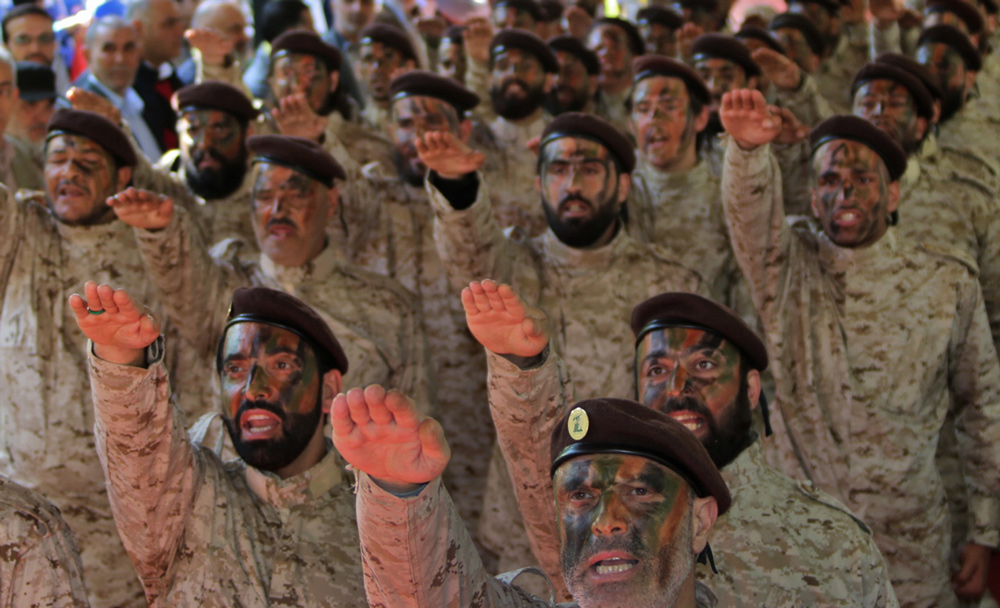
In Lebanon, a state manned by discredited elites seems on the verge of disintegration, with an armed group backed by Iran poised to seize control, just as the Taliban did in Afghanistan with Pakistani backing. Pictured: Hezbollah members in Baalbek, Lebanon on November 12, 2019. (Photo by AFP via Getty Images)

Remember 9/11, the catchphrase that was seen as a wake-up call for a world lulled into sweet slumber by "The End of History"? Nearly two decades ago today, the twin terror attacks on New York and Washington propelled a new threat to world order at the top of international concerns: the threat of non-state groups seizing territory for use as a base for advancing ideological aims through terror and war.

Though it contained some new features, the attack on the United States recalled a model used by other ideological movements on small and large scales. In a sense, both the Soviet Union and Nazi Germany had been built on a model that rejected the concept of nation-state as developed by the Westphalian treaties of the 17th century. The Third Reich and the USSR could not behave as normal nation-states concerned with the normal interests of nation-states such as security, trade, access to markets and resources, cultural exchanges and prestige. Their prime interest was "exporting" their ideological brand, by war if necessary.

Lenin, the founder of the Soviet Union, regarded Russia only as "a base for the world proletarian revolution". He was even prepared to accept the loss of Russia's European possessions through the Treaty of Brest-Litovsk in order to secure the "base" he had gained in Petrograd and Moscow. In his book The State and Revolution, Lenin argued that a state made sense only as a vehicle for revolution in the name of the proletariat. For Hitler, too, Germany was more of an abstract concept than a here-and-now reality, a base for world conquest in the name of the "Herrenvolk" (master race).

The same concept provided the intellectual motif of the group that planned and carried out the 9/11 attacks against the United States. Their aim was not to seize territory in the US but to promote their ideological brand. The group that had planned the attacks had originally been based in Afghanistan. Forced to leave Afghanistan, it transferred to Sudan where it enjoyed welcome for several years. Then, having been forced out of Sudan, it relocated back to Afghanistan. In both cases, it treated Afghanistan and Sudan as nothing more than chunks of land from which to "export" their ideological brand.

Using a piece of land as an ideological base, and not primarily as a nucleus for a state in the normal sense of the term, has been a model for many trans-national groups across the globe.

The most important example is provided by the victory of the Fedayeen Islam in Iran in 1979. In dozens of speeches, the leader of the revolution, Ayatollah Ruhallah Khomeini, made it clear that he was not bound by national boundaries. He wanted Iran for his revolution, not the other way round. The goal was, and for his heirs remains, the conquest of the whole world, starting with Muslim nations, for his ideological brand.

Lenin created the Comintern to "export" his revolution. Hitler had his outfit for "coordinating" with fascist parties in more than a dozen countries in Europe, South America and even in Iran of the 1930s. Khomeini set up an office to export his revolution, headed by Hojat al-Islam Hadi Khsrowshahian, while another Hojat al-Islam, Hadi Ghaffari, created the Hezbollah which went on to found branches in 17 countries, notably Lebanon, Iraq, and Yemen.

That ideology and not territory is the key factor for most similar groups is shown by the experience of Marxist guerrilla outfits in Latin America and Africa between the 1960s and the end of the last century. At one point, Latin American guerrillas even fought in Dhofar (Oman), Ethiopia and Somalia.

In the past two decades, however, the model has been mostly used by groups using or abusing Islam as an ideology. Flushed out of Afghanistan, the Taliban relocated in Pakistan's badlands in the Swat Valley and Baluchistan and villages in eastern Iran.

Driven out of Afghanistan, al-Qaeda also relocated in Pakistan and then created branches in Iraq. In conjunction with kindred groups, al-Qaeda even managed to set up the "Islamic State" in chunks of Iraqi and Syrian territory. To show that it was ideology, not location, that mattered the group later created branches in north and west Africa, notably in Libya and the Sahel. The group known as Boko Haram has had a similar trajectory. It started in Nigeria but has now spread to half a dozen West African countries, with offshoots even in Chad and the Central African Republic.

Regardless of the obvious differences of belief systems and discourse, all ideology-driven movements from Lenin and Hitler to Khomeini and Abu-Bakr al-Baghdadi aim at replacing the biological human with an ideological one, ostensibly to complete the work of nature or providence.

Long before Khomeini, Mullah Omar and Osama bin Laden, the Islamist revolt led by the Akhund of Swat in Pushtunistan and by Mullah Hassan in Somalia had provided models of using territory as a launching pad for ideology.

In that context, it is not surprising that the official media in Iran presents the current crisis in Lebanon as a fight between the Khomeinist revolutionary brand, on the one hand, and a coalition of "arrogant" powers led by the United States on the other.

The daily Kayhan, assumed to reflect the views of top decision-makers in Tehran, describes Lebanon as a "front-line bunker" for the Khomeinist Revolution with the local branch of Hezbollah as the forward unit. That analysis represents a perversion of the roles both of religion and state.

The fact is that Lebanon isn't just another chunk of land to be used as a launching pad for ideological conquests.

To be sure it shares some features with countries that fell to ideology-driven maniacs of different kinds. Lenin seized power in a Russian state that had become an orphan with the fall of the Tsarist state. Hitler inherited the orphan state left by the failed Weimar Republic. Khomeini came to power when the Shah simply left Iran as an orphan state.

Afghanistan after the fall of the Communist regime, Iraq after Saddam Hussein and Libya after Muammar al-Gaddafi were other examples of orphaned states creating vacuums filled by ideological terror groups.

At first glance, the same fate may look as if it is threatening Lebanon. A state manned by discredited elites seems on the verge of disintegration, with an armed group backed by Iran poised to seize control, just as the Taliban did in Afghanistan with Pakistani backing.

Fortunately, all options are not yet closed for Lebanon.

There is some talk of international "tutelage" led by France, an unworkable option in my opinion. There is also talk of a more direct Iranian suzerainty, something that Tehran, sinking in its own troubles, would be foolish to attempt. A third option is to return sovereignty to the Lebanese people. This means to help the orphaned family assume control of its own destiny.

This article was originally published by Asharq al-Awsat

Amir Taheri was the executive editor-in-chief of the daily Kayhan in Iran from 1972 to 1979. He has worked at or written for innumerable publications, published eleven books, and has been a columnist for Asharq Al-Awsat since 1987. He is the Chairman of Gatestone Europe.

Source: https://www.gatestoneinstitute.org/16490/orphan-states-world-order

Follow Middle East and Terrorism on Twitter


Michelle Deserves Pity, but the Rest of Us Deserve More - Mark DeVine


by Mark DeVine

With eloquence and feeling, Michelle Obama describes the devastating impact of the "daily slights" received from white people.


The equation "racial disparities = systemic racism" has achieved axiom status in the science of social justice. Recently, Michelle Obama upped the ante of racism's reach by lowering the bar for its detection even farther. Her recent podcast interview detailing the many racist blows and jabs she's absorbed and the pain inflicted thereby should evoke pity for her — and also for all who must contend with the societal fallout Michelle's particular brand of "suffering" portends.

Consider the white racist attacks Michelle recounts. "Daily slights. People talk over you." Buckle up. There's more. "People will come up and pet my dogs but will not look me in the eye." Then this: While waiting in line for ice cream with her daughters, Michelle O. tells us, "a white woman cut right in front of us." She reports that white students assigned to room with her in college changed their dorm assignments because they did not want to room with a black person.

With eloquence and feeling, Michelle describes the devastating impact of the "daily slights" received from white people — they "change the shape of your soul." In the parlance of social justice ideology and Critical Race Theory, the "soul change" Michelle undergoes is called "inheriting the wound" of America's systemic racism. Its effects are real in the sense that they may be sincerely felt.

Michelle's recounting of her experience of being a black woman in America is disturbing and even moving. "When I'm just a black woman, white people don't even see us. That is so telling of how white America views people who are not like them. We don't exist. And when we do exist, we exist as a threat. And that's exhausting." Departing the White House for the last time, she admits to Oprah, "when I got on the plane, I think I sobbed for like thirty minutes."

Both as FLOTUS and after settling into an 11-plus-million-dollar Martha's Vineyard mansion, Michelle found neither final escape nor permanent relief from racism and the pain it inflicts. How could she? She still resides in permanently and systemically racist America. But she did find strategies to help her cope. "It has been so important for me to have black women in my crew, throughout my life, because there is such a relief when you don't have to walk into your group and explain yourself."

Infantilization of a First Lady

Michelle is a product of the "infantilization" of black Americans John McWhorter so incisively warns of. The upshot of McWhorter's contention is that a victimhood culture flourishes among blacks that inhibits the maturity of blacks or people of any color who internalize a debilitating "blame others" and "depend upon others" ethos. "White people don't even see us!" What power over herself Michelle cedes to whites. And what bitterness and blame she harbors and feeds within her soul.

According to McWhorter and other un-woke blacks, this infantilization was nurtured by the post-MLK civil rights leadership in cahoots with a Democrat Party anxious to win black votes by posing as their protectors and providers and by a nation of whites desperate to dissociate from racism. Infantilization inhibits the cultivation of that one adult psychic instinct Shelby Steele insists is uniquely necessary to human flourishing in America — taking responsibility for oneself.

Fueled by Marxist Critical Race Theory, the rapid development of modern social justice ideology since 2012 has expanded the scope and deepened the debilitating consequences of post-MLK infantilization, giving rise to the concept of micro-aggressions and the need for white-free safe spaces.

Experience + Sincerity =/= Truth

The sincerity of Michelle's confessions of hurt over many years bears witness to the tragic, soul-shaping power of the infantilization lamented by McWhorter and Steele. Her pain also demonstrates that the reach of social justice infantilization respects no socio-economic boundaries, penetrating and punishing the heart and mind of one of the most beloved, wealthy, and powerful women on the planet.

The pity-evoking power of the former first lady's plight emerges not because the slights and discourtesies identified warrant the level of suffering and exhaustion experienced, but precisely because they do not. Michelle is a victim indeed — but not so much of the racism, real or imagined, she experiences. She suffers, rather, from the catastrophizing effect of the heightened race-consciousness produced by infantilization. The changed shape of Michelle's soul includes thin and ever thinning outrage-triggering tripwires.

Much of her suffering is unnecessary because its source resides far less in her experiences than in the meanings the social justice movement has trained her reflexively to draw from those experiences. The terror of the child fresh from taking in a horror movie who truly believes that a monster lurks under his bed is real even though the monster is not. Love pities and comforts the child. But it does not validate child's unwarranted fear; it debunks it.

Numerous alternative, non-race-related interpretations of Michelle's reported averted white eyes, the white queue-cutters, and even the white dorm room–changers are readily available, but not to the infantilized Michelle. For her non-racist readings are ruled out by social justice insistence that race poisons every interracial encounter in America. For adults, even where race plays a role in such encounters, the experience of micro-aggressions does not trigger outrage or much of anything, because they are adults, not children.

A National Pity Party

Pity for Michelle? Absolutely. But pity a-plenty also for any family, community, or nation increasingly populated by Michelle-like, race-obsessed, infantilized sufferers.

Widespread societal infantilization produces more like Michelle who seek shelter from the racist storm and succor for their racist-inflicted wounds in little enclaves inhabited by those similarly wounded who look and think like them.

Others, however, seek release in collective tantrums bent on rock-throwing and building-burning. They spit into the black and brown faces of police, screaming, "You're a racist"; kick in the skull of a white man attempting to rescue a man from the mob; and assassinate a black American life-long Democrat who decided he would vote Trump come November. Michelle has no corner on pity these days. Where infantilization takes hold, occasions for pity abound indeed. But unlike Michelle and her husband, no island mansion hideaway beckons to which the rest of us might repair.


Mark DeVine teaches at the Beeson Divinity School in Birmingham, Alabama and is the author of Bonhoeffer Speaks Today and Shalom Yesterday, Today, and Forever.

Source: https://www.americanthinker.com/articles/2020/09/michelle_deserves_pity_but_the_rest_of_us_deserve_more.html

Follow Middle East and Terrorism on Twitter


Democrats say climate change caused wildfire explosion in the West. Did it? - Morgan Phillips


by Morgan Phillips

California, in the middle of a 20-year drought - is experiencing more than two dozen wildfires, including three of its five largest ever.


California, in the middle of a 20-year drought, is battling more than two dozen wildfires, including three of its five largest ever.
Cal Fire, the state’s fire agency, reported Thursday that firefighters were battling 28 major fires across the state and more than 3.1 million acres have burned this year.
The sky on much of the West Coast has been painted an eerie burnt orange, and flames have left entire towns in dust.

Democrats lay blame on climate change.

“Mother earth is angry, she is telling us. Whether she’s telling us with hurricanes in the Gulf Coast, fires in the West, whatever it is, the climate crisis is real,” House Speaker Nancy Pelosi said this week on MSNBC.

“If anyone needed any proof of how disastrously and quickly climate change is affecting our globe, look out West,” Sen. Minority Leader Chuck Schumer told reporters this week.

“The data is self-evident, the experience that we have in the state of California just underscoring the reality of the ravages of climate change,” California Gov. Gavin Newsom said.

He used the fires to push for a more aggressive climate change goal, calling the state’s already-ambitious goal of using 100% clean energy by 2045 “inadequate.”


But Republicans blame decades of poor land management.

California Republican state Sen. Jim Nielsen and Assemblyman James Gallagher countered that the cause of recent devastating wildfires and blackouts “is decades of bad policy enacted by Democrats, not climate change.”

“The excuse of climate change cannot be used to deflect from the fundamental failure to address the fuels build-up in our forests that are the cause of these devastating fires,” they said in a statement. “These same misguided policy decisions have led to rolling blackouts and an energy grid that is falling apart.”

Others lay blame at those who sparked the fire - arsonists in Oregon or a gender reveal party gone wrong in California.

Experts point to poor land management, coupled with a population explosion and  dryer, hotter conditions.

Logging practices set the scene for today’s fires, according to Greg Giusti, forests and wildland ecology expert with the University of California Agriculture and Natural Resources.

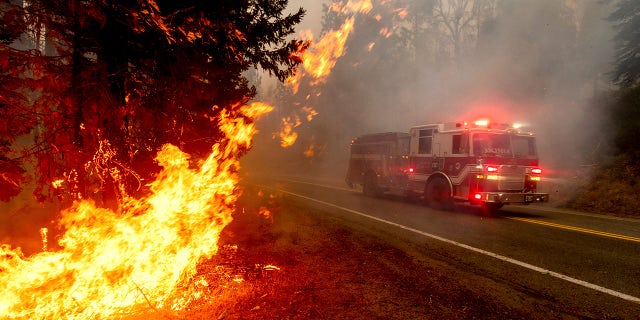
In this Sept. 7, file photo a firetruck drives along state Highway 168 while battling the Creek Fire in the Shaver Lake community of Fresno County, Calif. 
In this Sept. 7, file photo a firetruck drives along state Highway 168 while battling the Creek Fire in the Shaver Lake community of Fresno County, Calif.  
“A lot of it has to do with 20th-century logging practices that converted relatively resistant old-growth forests to something else - forests that have a lot more trees per acre and a lot more understory brush and flammable fuels,” Giusti told Fox News in an interview.

He said the cause of the spark, typically humans, is “really irrelevant.” “When conditions are right any little spark can start a conflagration.”

Harmful logging practices after World War II were followed by a population explosion in the Golden State. “People like their trees, they like to grow their trees, and they don't like to cut trees, which increases the level of burnable material,” Giusti said.

And while fires are destructive to human property, much of the plant life cycle depends on a burn. A century-long policy of complete and total fire suppression may be boiling over the surface.

“Many seeds won't germinate unless exposed to the heat of fire,” Giusti said. “From a human standpoint we look at fires as destructive. But from a plant’s perspective, fire is often an act of rejuvenation. Whole plant communities are waiting to be burned.”

Giusti added that while fires threatening human population need to be quelled, some of the flames ripping through national forest land are doing what they've always done.

But climate change has exacerbated blazes' intensity, Giusti added. Fewer foggy days on the California coast and a shorter rainy season have left the ground ideal for flames.

While Congress pays much lip service to climate change, it is slow to help maintain public lands, which make up nearly half of California’s space, and are owned mostly by the federal government.


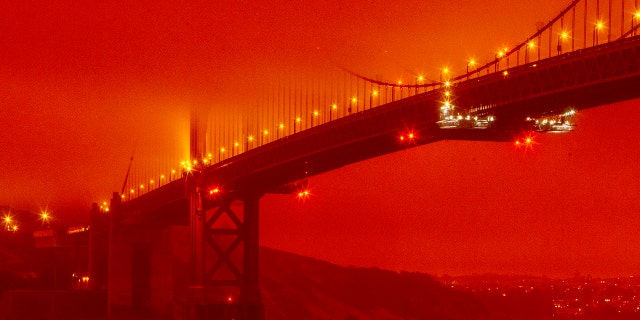
In this photo provided by Frederic Larson, the Golden Gate Bridge is seen at 11 a.m. PT, Sept. 9, in San Francisco, amid a smoky, orange hue caused by the ongoing wildfires. (Frederic Larson via AP)
In this photo provided by Frederic Larson, the Golden Gate Bridge is seen at 11 a.m. PT, Sept. 9, in San Francisco, amid a smoky, orange hue caused by the ongoing wildfires. (Frederic Larson via AP) 
Timber harvests have in the past been treated as a money-making operations, but the trees that need to be cleared are not lucrative on the commercial market.

President Trump signed the bipartisan Great American Outdoors Act in August, but before that, 84 million acres of National Park Service land faced billions in backlogged maintenance and repairs.

Giusti also noted that firefighting is a “huge jobs program” on the West Coast.

“Cal Fire is arguably the best firefighting force in the world. The men and women there put lives on the line every day,” Giusti said. “But firefighting in the West is a huge jobs program. California spends a half billion per year fighting fire.”

He called for a paradigm shift, where resources spent on fighting fires would be reallocated to preventing fires. “It’s going to be a rough pill for some people to swallow, I appreciate that,” he said. “But areas will keep being ready to burn again if you just let nature take its course.”

But one key oversight hinders fire prevention efforts - private land. Firefighters have the ability to enter private land to fight fires, but not to carry out fire prevention efforts. “You need the landowners permission and not everybody gives it. There’s a disconnect there,” Giusti said.


Morgan Phillips

Source: https://www.foxnews.com/politics/wildfire-democrats-climate-change

Follow Middle East and Terrorism on Twitter


The 1988 Massacres Still Haunt the Islamic Regime in Iran - Dr. Ardavan Khoshnood


by Dr. Ardavan Khoshnood

Newly published evidence from Amnesty International shows that Mousavi, despite his denials, was aware of the executions, casting a dark shadow over the reformist movement in Iran.


BESA Center Perspectives Paper No. 1,744, September 13, 2020

EXECUTIVE SUMMARY: In the summer of 1988, during the premiership of Mir-Hussein Mousavi, thousands of opponents of the Islamic Republic were extrajudicially executed while in prison. Newly published evidence from Amnesty International shows that Mousavi, despite his denials, was aware of the executions, casting a dark shadow over the reformist movement in Iran.

The Shah of Iran left the country in January 1979 after the Islamic revolution. A month later, the leader of the revolution, Aytaollah Ruhollah Khomeini, returned to Iran from exile in France.

In December 1981, Amnesty International issued a report stating that more than 3,000 individuals had been executed by the newly born Islamic Republic since Khomeini’s return. Two months later, in February 1982, the organization reported that in fact more than 4,000 individuals had been executed since the victory of the Islamic revolution in 1979.

As ugly as this history is, the darkest spot on the Islamic regime’s human rights record is the 1988 prison massacres.

In the summer of 1988, thousands of political opponents disappeared from the country’s prisons and were later reported to have been executed. Their bodies were never returned to their families. Many of them were buried in mass graves all over the country, among them the Khavaran cemetery in Tehran. Although it is still unknown how many were executed that summer, Amnesty International puts the figure at at least 5,000.

The executions were ordered by Ayatollah Khomeini himself, and they took place during the premiership of Mir-Hussein Mousavi. Mousavi, a Khomeini loyalist, initially took on the role of the Islamic Republic’s foreign minister. He then served as prime minister from October 1981 through August 1989.

In the 2009 presidential election, Mousavi was one of two reformist candidates who ran against the conservative Mahmoud Ahmadinejad. The latter was victorious, but Mousavi accused him of vote-rigging. This caused one of the largest crises in the history of the Islamic regime, with hundreds of thousands pouring into the streets in protest. Some supported Mousavi while others protested the very existence of the Islamic regime. Ever since then, Mousavi has been a symbol for both Iranians and the Western world of an Iranian advocate of reform and democratic change.

Over the three decades that have passed since the 1988 massacres, the Islamic regime has never officially acknowledged their occurrence. Mousavi, the man who was in charge at the time as Iran´s PM, says he had no clue that the executions were taking place, thus maintaining his image as a reformer and an alternative to the Supreme Leader and the conservatives.

The notion of Mousavi as a democratic alternative is often used to discredit Iranian opposition groups calling for the overthrow of the Islamic Republic. Supporters of reforms who back Mousavi continue to insist that he knew nothing about the 1988 massacres. But members of the democratic opposition claim that reforms by any member of the Islamic Republic are impossible, as today´s reformers are yesterday’s hangmen.

In December 2018, Amnesty International published a clip in which Mousavi was interviewed by the Austrian national public service broadcaster. The interview took place on December 13, 1988. Mousavi was asked about the executions and replied, “We repressed them.”

The clip was considered to be inconclusive, as it is difficult to hear both the questions and Mousavi’s answers. However, last month (August 2020), Amnesty International Iran researcher Raha Bahreini published archived Amnesty International letters proving that the Iranian authorities, including Mousavi, were very much aware of the extrajudicial executions being systematically conducted in Iran in the summer of 1988.

The letters are appeals written on August 16, 1988 by Amnesty International in regard to the executions and sent to a large number of individuals in the regime, including the Chief Justice, the Justice Minister, Iran’s ambassadors, and the Foreign Ministry. So from at least August 16, 1988, Iranian authority figures on all levels knew about the executions.

This revelation has naturally sparked a massive debate among Iranians all over the world about the country’s future.

Both members of the reformist camp and the regime urgently want to keep the myth of Mousavi alive. As long as Mousavi can be touted as the “only alternative to change in Iran,” the regime can combat opposition groups calling for its overthrow. The question is whether the regime and Mousavi’s supporters can continue presenting him as a democratic leader after the new revelation.
The reformist camp of the Islamic regime is in crisis. Its main symbol, Mousavi, was, according to Amnesty International, involved in a gruesome massacre. The current president, Hassan Rouhani, also a reformist, is responsible not only for bankrupting Iran but also for a brutal crackdown on protesters in December 2019 that killed more than 3,000 people.

As long as individuals like Mousavi and Rouhani represent the reformist camp, reforms are highly unlikely to take place. Whether so-called reformers or hardliners are at the regime’s helm, Iran will continue its destructive path of supporting terrorism, conducting espionage, and destabilizing the region.

After Khomeini’s death on June 3, 1989, former Secretary of State Henry Kissinger was asked about Iran´s future. He said, “If we have a political government with some religious authority, then in time a pragmatic approach is possible. If we have a religious government, which is what Khomeini did, then they will rely on the power of fundamentalism to begin to be dominant in the Persian Gulf and to turn against Western materialism and to some extent communism.”

Looking at Mousavi’s background with respect to the newly published evidence, and the brutality shown by Rouhani both as president of the Islamic regime and in his previous role as secretary of the Supreme National Security Council, it is apparent that fundamentalism was at the core of both reformers and conservatives.

The problem, therefore, is the Islamic Republic as an entity, not reformers versus conservatives.


Dr. Ardavan Khoshnood a non-resident Associate at the BESA Center, is a Criminologist and Political Scientist with a degree in Intelligence Analysis. He is also an Associate Professor of Emergency Medicine at Lund University in Sweden.

Source: https://besacenter.org/perspectives-papers/iran-1988-massacres/

Follow Middle East and Terrorism on Twitter


Turkish Hyper-Activity Reverberates throughout the Middle East - Yossi Kuperwasser and Lenny Ben-David


by Yossi Kuperwasser and Lenny Ben-David

To prevent ErdoÄŸan from provocations against Israel, it must be made clear to him the limits to the actions that Israel is willing to tolerate.


Turkish Hyper-Activity Reverberates Throughout the Middle East
President ErdoÄŸan receives Palestinian President Abbas with an Ottoman honor guard in 2015. (Turkish Presidential Office)

Institute for Contemporary Affairs
Founded jointly with the Wechsler Family Foundation

Vol. 20, No. 20

  • In recent months, Turkey has increased its efforts to enhance its position as a regional power following in the path of the Ottoman Empire, adopting daring measures that border on megalomania at home, in the region, and internationally.
  • A video with distinct nationalistic themes was recently broadcast by the Turkish Ministry of Information. The film is entitled, “The Red Apple [kizil elma],” which is a Turkish cultural concept describing Turkey’s ambition to achieve superpower status. Beyond the context of Turkey’s religious battles in Istanbul, the Turkish video also displays a troubling appetite for Jerusalem and Saudi Arabia’s holy sites in Mecca and Medina.
  • In the Persian Gulf, where Qatar is at odds with the Emirates and other members of the Gulf Cooperation Council, Turkey has allied itself with Qatar. Some 5,000 Turkish soldiers are stationed in Qatar to help Doha protect itself and deter enemies.
  • Turkey also displays considerable hyper-activity in Palestinian and Israeli issues. Turkey stands in solidarity with Hamas, Turkey’s partner and protégé in the Muslim Brotherhood camp. Turkish citizenship and passports were granted to a “dozen” Hamas activists, including convicted terrorists.1
  • For the United States, Turkey’s military acquisitions present a problem. ErdoÄŸan’s determination to acquire Russia’s advanced S-400 anti-aircraft missile system forced the United States to cancel a deal to supply F-35 Joint Strike Fighter aircraft to Turkey.
  • Do not underestimate President ErdoÄŸan’s ability to utilize Turkey’s strategic assets to advance his bold strategies. To prevent ErdoÄŸan from provocations against Israel, it must be made clear to him the limits to the actions that Israel is willing to tolerate.
In recent months, Turkey has increased its efforts to enhance its position as a regional power following in the path of the Ottoman Empire, adopting daring measures that border on megalomania at home, in the region, and internationally. These steps reflect President Recep Tayyip ErdoÄŸan’s worldview that sees himself – all at the same time – as the sultan of a resurgent empire, the leader of a modern and powerful Turkish nation, and an Islamic leader according to the “correct” theological interpretation, which he sees as that of the Muslim Brotherhood. He views himself as the pillar of the Brotherhood in the region.

This weltanschauung places ErdoÄŸan as the leader of the return to the Ottoman Empire’s glory days and protector of Muslims against the plots of local and regional enemies (such as the Turkish dissident leader Fethullah Gülen, pragmatic Muslims led by the United Arab Emirates, Egypt, Saudi Arabia), and foreign foes (Greece, Israel, Europe, and the United States).

A video with distinct nationalistic themes was recently broadcast by the Turkish Ministry of Information.2 The film is entitled, “The Red Apple [kizil elma],” which is a Turkish cultural concept describing Turkey’s ambition to achieve superpower status or some far-reaching goal no matter the sacrifice. Turkish policies reflect the official interpretation of the “Red Apple” and its implementation on a broad range of fronts.

Playing to Turkish and Islamic audiences, ErdoÄŸan’s crowning moment in the video was the transformation of the historic Hagia Sophia church (built in 537 CE in Constantinople/Istanbul) from a museum to a mosque on July 10, 2020, and his arrival for Friday prayers there on July 24. It was a show of power domestically and to the Christian world. The move was also to serve as a boost for Turkish patriotism and Islamic adherence.


Ottoman "warriors" enter the Hagia Sophia museum
Ottoman “warriors” enter the Hagia Sophia museum, once a church, and now a mosque. (MEMRI, screengrab from Turkish video)
Beyond the context of Turkey’s religious battles in Istanbul, the Turkish video also displays a troubling appetite for Jerusalem and Saudi Arabia’s holy sites in Mecca and Medina. The first screenshot below shows the holy Kaaba in Mecca; the second shows the green dome over Muhammed’s grave in Medina, and the last shot of the video shows the Temple Mount with al-Aqsa Mosque on it. Indeed, ErdoÄŸan ended a speech on July 10, 2020, saying that the “revival of the Hagia Sophia as a mosque is ushering the news for the liberation of al-Aqsa mosque in Jerusalem.”3

ErdoÄŸan’s Adventures

The following are some of the bold steps Turkey has recently taken:

  • Facing growing economic hardships, Turkey announced the discovery of a massive gas field in the Black Sea, which will ensure a bright and independent economic future and a robust international standing economically.
    Turkish fighter planes flying cover for a Turkish oil exploration ship
    Turkish fighter planes flying cover for a Turkish oil exploration ship. (screengrab from MEMRI)
  • Turkey continues to project its power to its Arab neighbors, particularly Syria and Iraq, in order to restrain the Kurds and strengthen radical Islamic forces who are battling against opponents supported by Iran and Russia, or the United States.
  • Regionally, ErdoÄŸan’s alliance with the Libyan Government of National Accord (GNA), headed by Prime Minister Fayez al-Sarraj, stands out. This places ErdoÄŸan in a confrontation with parties of the pragmatic Islamic camp, headed by Egypt and the Emirates, and indirectly with Russia, which supports his rival Marshal Khalifa Hafter of the Libyan National Army.
  • Turkey’s alliance with Libya’s Sarraj comes at a time of conflict over energy resources in the eastern Mediterranean that ErdoÄŸan launched against Greece, Cyprus, and Egypt, who are supported by France, Italy, and the Emirates. ErdoÄŸan’s agreement with Sarraj on the division of the economic zones of the sea between Turkey and Libya, ostensibly in reaction to an Israeli-Greece-Cyprus agreement on a gas pipeline from Israel to Europe, has led to growing military tensions. France, Italy, the Emirates, and Israel have rallied to assist Greece.
  • In the Persian Gulf, where Qatar is at odds with the Emirates and other members of the Gulf Cooperation Council, Turkey has allied itself with Qatar. Some 5,000 Turkish soldiers are stationed in Qatar to help Doha protect itself and deter enemies. A sizeable Turkish base is being built in the state. In 2019, ErdoÄŸan named the base after one of Mohammed’s famous military commanders in the seventh century, Khalid bin Walid.4 In an account in the Persian press, a new base will be “inaugurated” for the Qatar-Turkey Combined Joint Force Command adjacent to the “Tariq ibn Ziyad” camp. [Tariq was a 7th-century Islamic general who captured Gibraltar, originally called Jabal Tariq, “Tariq’s mountain.”]
    ErdoÄŸan greets Turkish troops in Doha, Qatar, in 2017
    ErdoÄŸan greets Turkish troops in Doha, Qatar, in 2017. (Turkish, Iranian Press)
  • Turkey has sent forces to the Horn of Africa region as well, particularly to Somalia, and to a lesser degree, to Djibouti. Some 200 Turkish sailors/soldiers are in Mogadishu. Turkey has also leased the Sudanese port of Suakin on the Red Sea, once a major Ottoman Port.
    The Turkish base in Mogadishu claims to have trained 10,000 Somali soldiers.
    The Turkish base in Mogadishu claims to have trained 10,000 Somali soldiers.5 (YouTube screengrab)6
  • For the United States, Turkey’s military acquisitions present a problem. ErdoÄŸan’s determination to acquire Russia’s advanced S-400 anti-aircraft missile system forced the United States to cancel a deal to supply F-35 Joint Strike Fighter aircraft to Turkey. Turkey also keeps close relations with Iran in a way that undermines the U.S. economic sanctions. On September 8, 2020, Erdogan and Rouhani led a joint leadership meeting aimed at widening the economic relations between the two countries.
    S-400 air defense missiles
    S-400 air defense missiles arrived from Russia in Ankara in July 2019. (Turkish Defense Ministry)
  • Turkey also displays considerable hyper-activity in Palestinian and Israeli issues. Turkey stands in solidarity with Hamas, Turkey’s partner and protégé in the Muslim Brotherhood camp. ErdoÄŸan met on August 23, 2020, with Hamas’ leadership and granted Turkish citizenship and passports to a “dozen” Hamas activists, including convicted terrorists.7
  • ErdoÄŸan's meeting with Hamas leadership.
    ErdoÄŸan’s meeting with Hamas leadership. (Raf Sanchez, Twitter)8
  • At the same time, Turkey is happy to provide support for the entire Palestinian governance. It is making its presence known in Jerusalem, both in the Islamic and economic sense, thereby challenging the traditional positions of Jordan and Saudi Arabia in the city. Turkish activities center on the al-Aqsa Mosque. The bellicose Turkish video mentioned above ends with a photo of the Temple Mount. (The Ottomans, of course, lost control of Jerusalem to the British in 1917.)
    The al-Aqsa Mosque and the Dome of the Rock.
    The closing picture from the Turkish video, showing the al-Aqsa Mosque and the Dome of the Rock.
    Enver Pasha and Jamal Pasha visiting the Dome of the Rock in 1916
    Ottoman leaders Enver Pasha and Jamal Pasha visiting the Dome of the Rock in 1916. (Library of Congress)
The American peace plan and the peace agreement between Israel and the United Arab Emirates, which both weaken the Palestinians’ bargaining ability, drew rage in Ankara. Turkey leveled fierce criticism even though it maintains diplomatic relations and a very extensive financial relationship with Israel, all the while trying to present itself as the Palestinians’ greatest supporter.

ErdoÄŸan’s Strategic Advantages

Turkish policies are under criticism for creating instability, for their pretentiousness and presumptuousness that do not always match Turkey’s real power or its few accomplishments, which actually show the limits of ErdoÄŸan’s power. But one should not underestimate President ErdoÄŸan’s ability to utilize Turkey’s strategic assets to advance his challenging strategy. ErdoÄŸan recognizes these assets at his disposal:

  • Turkey’s unique geo-strategic position as the link between Europe and the Middle East and as the bridge over which a large part of the Middle East refugees reach Europe. The European nations’ fear of waves of more refugees makes them vulnerable and potential extortion targets; it weakens their bargaining ability with Turkey, despite the growing criticism of ErdoÄŸan’s policies.
  • A large population of Turkish ex-pats in Europe has dual Turkish-European citizenship and is located in key countries in Europe, particularly Germany. It is clear to ErdoÄŸan that even if European countries increase their criticism of Turkey’s provocation of Greece, a member of the EU, Turkey can presume that Germany will prevent the imposition of any significant sanctions on Ankara.
  • Turkey’s situation as a member of NATO, especially the only Muslim and Middle Eastern country in the alliance, requires the West’s vigilance in reacting to ErdoÄŸan’s whims.
  • Turkey’s military strength gives it an advantage against any of its neighbors and in any course of action. Turkey, for instance, has a clear advantage in the naval order of battle against Greece.
  • Turkey has the political boldness and the readiness to invest military and economic assets to further its policies against other countries and players, many of whom are reluctant and hesitant to set clear limits on Turkey’s actions – for various reasons. Notable examples are Europe and the Christian world, who barely responded to the change of the status of the Hagia Sophia shrine, and Israel, who refused to respond to Turkish provocations and agreed to solve the Mavi Marmara ship crisis by acceding to most of Turkey’s demands, to placate the United States and prevent harm to economic ties with the Turks.
  • The apparent American interest expressed in both political parties to minimize military commitments in conflicts of secondary importance to the United States and the need to preserve freedom of action for U.S. aircraft based in the Turkish Incirlik airbase restrains American ability to act against Turkey.

Limited Achievements

Despite these strategic advantages, the data and statistics of the global and regional arena do not indicate Turkish achievements; rather, they reflect Ankara’s limited and accurate weight:

  • At home, the regime is facing acute economic difficulties that have led to a significant drop in the value of the Turkish lira. With the continuing pressures created by the coronavirus, major damage hit the tourism sector. In addition, although ErdoÄŸan’s status is solid, the political situation is uncomfortable for him, as his opponents have won in some of the local elections.
  • In the regional arena, the pragmatic camp has been strengthened because of the agreement between Israel and the Emirates. This allows Israel to back this camp more significantly than in the past. At the same time, the Muslim Brotherhood continues to weaken, both due to the agreement and because the parties representing the movement in Jordan and Egypt were outlawed.
  • Turkey’s allies in the region are suffering from weakness. This can be said both about the Palestinians who are at an unprecedented nadir and about the Government of National Accord in Libya that almost disintegrated recently and remained alive only because of Turkish intervention. Turkish pretensions in the Palestinian context, including the attempt to gain status in Jerusalem and in the al-Aqsa Mosque, currently have produced no tangible results.
  • In the face of the mobilization of Egypt, the United Arab Emirates (UAE), and Russia to halt Turkish moves in Libya, and with France, Italy, and the UAE mobilizing to defend Greece from Turkish threats, ErdoÄŸan must recalculate his steps and recognize the limitations of his power.
  • The United States is willing to deal with the Turkish provocations only to a certain extent, and the cancellation of the F-35 deal was evidence of that. In addition, against the background of Moscow’s sharp reaction to the downing of the Russian plane by Turkey in 2015, Russia also restricts Turkey’s freedom to act in northern Syria, given Moscow’s commitment to the survival of its ally, Assad.
So what is Turkey’s next step? The “Red Apple” video exposes the depth and roots of ErdoÄŸan’s aspirations for hegemony in the region. As any regional bully, Erdogan will not hesitate to expand his control and influence vis-à-vis those who are willing to bow down to him or those who, out of their weakness and ideological affinity to the Muslim Brotherhood, are ready to ask for his support in promoting their interests and are ready to pay by allowing Erdogan to gain a foothold and economic benefits.

On the other hand, when ErdoÄŸan is met with determination and willingness to set clear boundaries, he will try to avoid confrontation because, deep in his heart, he is aware of the limitations of his power. Thus, the policy that the EU will adopt towards Turkey at the expected meeting of the EU heads of states on September 23, 2020, will determine to a large extent how Turkey will act in regard to Greece in the conflict over oil exploration rights. The same is true for the other friction areas in which Turkey is involved.

Israel is perceived by ErdoÄŸan as a powerful rival that threatens Turkish and Islamic interests and promotes an ideology opposite to that of Turkey. This can be seen, among other things, through Israel joining the pragmatic Sunni camp in the region, led by the Emirates, Turkey’s sworn rival that does not hesitate to confront Turkey in every arena, including Libya, the eastern Mediterranean, Qatar, the Palestinian camp, and Saudi Arabia – the ultimate destination of Turkish hegemonic aspirations. That can also be seen in the video, which presents images of the Kaaba in Mecca, Mohammed’s grave in Medina, and the al-Aqsa Mosque in Jerusalem.

The Turkish provocation against Israel is unrestrained and is reflected in the Turkish opposition to Israel’s normalization of ties with the Arab world, its attempts to thwart the plan to lay a gas pipeline from Israel to Europe, and, of course, in its championing the Palestinians’ cause including that of the radical and murderous Hamas.

At the same time, ErdoÄŸan recognizes Israel’s military and political power (especially its relations with the United States, Europe, and Russia) and realizes that without relations with Israel, its ability to intervene in the Palestinian system would diminish. Turkey also recognizes the importance of diplomatic and economic ties with Israel. That is why ErdoÄŸan avoided irreversible moves that would damage his country’s diplomatic relations.

To prevent ErdoÄŸan from provocations against Israel, it must be made clear to him the limits to the actions that Israel is willing to tolerate. Legitimate criticism and political disagreements are certainly within the allowable limit, while harming Israel’s vital interests and aiding terrorist organizations may lead to a determined Israeli response.


* * *

Notes


Brig.-Gen. (res.) Yossi Kuperwasser is Director of the Project on Regional Middle East Developments at the Jerusalem Center. He was formerly Director General of the Israel Ministry of Strategic Affairs and head of the Research Division of IDF Military Intelligence. 

Lenny Ben-David is the Jerusalem Center’s Director of Publications. Ben-David served 25 years in senior posts in AIPAC in Washington and Jerusalem. He served as Israel’s Deputy Chief of Mission in the Embassy in Washington D.C. He is the author of the American Interests in the Holy Land Revealed in Early Photographs (Urim Publications). 


Source: https://jcpa.org/article/turkish-hyper-activity-reverberates-throughout-the-middle-east/

Follow Middle East and Terrorism on Twitter