Thursday, January 26, 2012

Barry Rubin: Israel Isn’t Going to Attack Iran and Neither Will the United States


by Barry Rubin

The radio superhero The Shadow had the power to “cloud men’s minds.” But nothing clouds men’s minds like anything that has to do with Jews or Israel. This year’s variation on that theme is the idea that Israel is about to attack Iran. Such a claim repeatedly appears in the media. Some have criticized Israel for attacking Iran and turning the Middle East into a cauldron of turmoil (not as if the region needs any help in that department) despite the fact that it hasn’t even happened.

On the surface, of course, there is apparent evidence for such a thesis. Israel has talked about attacking Iran and one can make a case for such an operation. Yet any serious consideration of this scenario — based on actual research and real analysis rather than what the uninformed assemble in their own heads or Israeli leaders sending a message to create a situation where an attack isn’t necessary — is this: It isn’t going to happen.

Indeed, the main leak from the Israeli government, by an ex-intelligence official who hates Prime Minister Benjamin Netanyahu, has been that the Israeli government already decided not to attack Iran. He says that he worries this might change in the future but there’s no hint that this has happened or will happen. Defense Minister Ehud Barak has publicly denied plans for an imminent attack as have other senior government officials.

Of course, one might joke that the fact that Israeli leaders talk about attacking Iran is the biggest proof that they aren’t about to do it. But Israel, like other countries, should be subject to rational analysis. Articles written by others are being spun as saying Israel is going to attack when that’s not what they are saying. I stand by my analysis and before December 31 we will see who was right. I’m not at all worried about stating very clearly that Israel is not going to go to war with Iran.

So why are Israelis talking about a potential attack on Iran’s nuclear facilities? Because that’s a good way – indeed, the only way Israel has — to pressure Western countries to work harder on the issue, to increase sanction and diplomatic efforts. If one believes that somehow pushing Tehran into slowing down or stopping its nuclear weapons drive is the only alternative to war, that greatly concentrates policymakers’ minds. Personally, I don’t participate — consciously or as an instrument — in disinformation campaigns, even if they are for a good cause.

Regarding Ronen Bergman’s article in the New York Times, I think the answer is simple: Israeli leaders are not announcing that they are about to attack Iran. They are sending a message that the United States and Europe should act more decisively so that Israel does not feel the need to attack Iran in the future. That is a debate that can be held but it does not deal with a different issue: Is Israel about to attack Iran? The answer is “no.”

Why should Israel attack Iran now? Because one day Iran will have nuclear weapons that might be used to attack Israel.

Does Iran have such deliverable weapons now? No.

If Israel attacks Iran now, does that mean Iran would never get nuclear weapons? No, it would merely postpone that outcome for at most a year or two more than it would take otherwise. And then it would ensure an all-out, endless bloody war thereafter.

If Israel attacks Iranian nuclear installations, would that ensure future peace between the two countries? Would it make it less likely that the Tehran regime uses such weapons to strike at Israel in the future? No. On the contrary, it would have the exact opposite effect. Again, it would ensure direct warfare between the two countries and make Iran’s use of nuclear weapons against Israel 100 percent probable.

Why is this different from Israeli attacks on Iraqi and Syrian nuclear facilities? Because in those cases a single strike by a small number of planes would be sufficient to destroy a single building. And the two regimes, precisely because of the strategic situation, would and could not respond. And if you believe Iran’s regime to be so totally irrational, then factor that point into how it would respond to a direct attack like that.

If Israel attacks Iran, would it have backing from anyone else in the world? No, in fact the United States strongly opposes such an operation. Iranian retaliation against oil shipping and terrorist attacks would lead (not overly brave and already appeasement-oriented) Western governments to blame Israel, not Iran. Launching such an attack would ensure a level of international isolation for Israel far higher than what exists today. The idea that a U.S. withdrawal from Iraq makes an Israeli attack more attractive is absurd. U.S. forces and interests are in the Gulf and an Israeli attack would — according to the Obama administration — endanger U.S. interests there.

Would such an attack by Israel be likely to succeed even in doing maximum damage to Iranian facilities? No, a great deal could go wrong, especially against multiple hardened targets at the planes’ maximum range. Planes could get lost or crash or have to turn back. Planes arriving over the targets could miss, or accidentally drop their bombs on civilians, or simply not do much damage. Many targets would remain unscathed.

Additional waves of attack would be needed in a situation where Iran would be better prepared to shoot down the planes. And the second wave would face huge Western opposition. But it would be too late either way since Israel would now be in a full war with Iran.

So given all of these factors, why should Israel possibly attack Iran? It is an absurd idea.

The counter-argument is this: Iran’s regime is irrational and wants to destroy Israel even if the resulting counterattack would kill millions of Iranians and wreck the country. Yet while that analysis should not be totally ruled out, it is far from a certainty. Tehran is seeking nuclear weapons to make itself invulnerable to the costs of its non-nuclear subversion and support for terrorist and revolutionary forces. And a lot of what the Iranian leadership says is demagoguery to build support for itself at home, and to convince the masses to ignore its incompetence and mismanagement.

Moreover, while you may have met Iranians whose grasp of reality is — let me put this politely — somewhat creative and even though the Iran regime evinces an extremist anti-Western, anti-American, and antisemitic ideology, the actual history of Iran (or more narrowly of the Iranian regime) does not show it to be an irrational actor. In other words, Iran tries to implement highly radical, nasty, and terrorist-supporting actions in a careful and cautious manner. Islamist Iran did not invade any of its neighbors and it has not taken big foreign policy risks. In saying this, I’m not being naive or ignoring what Iran’s leaders say or want but focusing on what they actually do.

Why does Iran want nuclear weapons? So it can go on sponsoring terrorism, spreading radical ideology, killing Americans through covert actions, and building a sphere of influence without anyone doing anything about it. In other words, the real threat is Iran’s conventional foreign policy safeguarded by nuclear weapons. Are there precedents for this? Sure. More recently, Pakistan and North Korea; going back further in time, the Stalinist USSR.

Yet given the points made above, even the Iran-as-irrational analysis — and even assuming it to be correct, the probability of being right about Iran ever trying to launch a nuclear attack is far lower than 100 percent — does not justify an Israeli attack at this time.

And, finally, Israel has other options. The alternative is this: As the Iranian regime works hard to get nuclear weapons and missiles capable of carrying them, Israel uses the time to build a multi-level defensive and offensive capability. These layers include:

U.S. early warning stations and anti-missile missile installations in the Gulf; Israeli missile-launching submarines; Israeli long-range planes whose crews have rehearsed and planned for strikes at Iranian facilities; different types of anti-missile missiles capable of knocking down the small number of missiles Iran could fire simultaneously; covert operations, possibly including computer viruses and assassinations, to slow down Iran’s development of nuclear weapons; improved intelligence; help to the Iranian opposition (though the idea of “regime change” in the near future is a fantasy); and other measures.

If and when there was a clear Iranian threat to attack Israel, then Israel could launch a preemptive assault. And if no such threat ever materializes, Israel need never attack. Any future Iran-Israel war will happen if Iran’s regime makes it unavoidable, not in theory but in actual practice.

Note that attacking a limited number of missiles and launch facilities, that must be located closer to Israel within Iranian territory, is easy. Attacking multiple nuclear facilities buried deep in the ground anywhere in Iran is hard.

Ah, but what if Iran gives small nuclear devices to terrorists? Well ask yourself two simple questions:

1. Would an Israeli attack on Iran ensure that this didn’t happen? Answer: Not at all.

2. Would an Israeli attack on Iran ensure that Iran would definitely give nuclear devices to terrorists and try to strike against Israel as quickly and as frequently as possible? Absolutely yes.

Does an Israeli strategy of not launching an attack assume that Iran’s regime is “rational” and “peace-loving” and will be deterred by Israel’s ability to strike back? Absolutely not. Indeed, quite the opposite. No such assumption is required. Israel will simply be ready and alert based on the assumption that Iran might attack some day. But such a war, however possible, is not inevitable. And since Israel cannot prevent Iran from obtaining nuclear weapons by attacking, there is no point in doing so.

Whether you hope for or fear an Israeli attack on Iran, it isn’t going to happen.

At the same time, a new theme in the America mass media is that the United States is headed toward war with Iran either by electing a Republican president, the inevitable weight of events, or through having sanctions so effective that a cornered Iran will attack. The fact is that neither country wants to have an armed conflict and such a battle is easily avoidable. Ironically, those who claim Iran is going to attack are using the crazy Tehran regime concept that they reject when it comes to nuclear weapons. And the “watch out for the warmongering Republicans” slogan is part of the election campaign.

Warning against tough sanctions is a way of avoiding tough sanctions. The argument boils down to saying that sanctions better not hurt Iran or else the consequences will be disastrous. We will be hearing the same argument soon about Hamas, Hizballah, Egypt, and maybe even Libya or Turkey. The effort to use U.S. leverage will be said as triggering war or an anti-American explosion among Muslims. Thus, for example, whatever the Egyptian regime does toward Israel or its own people, we will be told that reducing U.S. aid is not an option.

Going to war with Iran is a mistake and the hysteria on this issue, including claims the regime is about to fall, that it can easily be brought down, or that an Iranian nuclear attack on others is inevitable, should be reined in. That’s precisely why sanctions and other measures should be applied to the fullest extent possible.

And there isn’t going to be any war unless Iran’s regime tries to use them or makes a big mistake. It could, as Egypt did in 1967 or Saddam Hussein did in the late 1990s, rattle “nuclear sabers” enough to convince Israel that an attack is imminent. Even if it did not intend to attack, Tehran could push too hard and trigger an Israeli attack. By the same token, some Iranian attack on Western forces or on oil traffic in the Gulf — more likely triggered by a local commander without regime permission — could produce a slide into war with the United States.

But here’s what’s most likely going to happen: Iran will get nuclear weapons. Iran is not going to stop its nuclear drive (though it could stop short of actually building bombs or warheads ready to go). Western policies are not so bold or adventurous as to go to war; Israel’s interests and capabilities do not make attacking sensible. An attack would not solve but increase problems.

And no matter how crazy you think Iran’s regime is, the inescapable predicable threat is not high enough to force policymakers to risk getting hundreds of thousands, perhaps millions of people killed, when the chance of avoiding such an outcome is very high. I am not talking here about Hizballah firing a few rockets (Hamas might well do nothing) but a long term war that would guarantee the use of Iranian nuclear weapons.

PS: One reader has asked and others are no doubt thinking: But don’t you have to stop the possibility of an Iranian nuclear weapon being handed to terrorists against Israel or some how against the United States? Let’s be clear: An attack on Iranian facilities will not prevent this from happening and indeed will make such an event more likely than it would be otherwise. You can think up any scenario you want but if there is a war going on the Tehran regime or various parts of it has a much greater incentive to order or allow nuclear weapons to be used when it obtains them within a year or two of the initial attack.

Barry Rubin is director of the GLORIA Center, at IDC, and editor of MERIA Journal. His new book, Israel: An Introduction, has just been published by Yale University Press.

Source: http://www.gloria-center.org/2012/01/israel-isn%E2%80%99t-going-to-attack-iran-and-neither-will-the-united-states/

Copyright - Original materials copyright (c) by the authors.

Wednesday, January 25, 2012

Why Contemporary Western Elites Don’t Understand the World


by Barry Rubin

One of the benefits of spending much of my time talking to people from around the world is getting an original, fresh perspective on the United States, its policies, politics, and political culture.

Recently, I had a discussion with a brilliant academic who had grown up in a Communist country, has spent a lot of time in the United States, and studies this kind of thing. To explain how the U.S. conception of the world is shaped, he used the phrase “engineering mentality.”

The “engineering mentality” is one of the main factors in America’s brilliant success. I take it to mean that one approaches problems with a can-do (another American phrase) style. One rules out extraneous, distracting cultural and historical factors in order to figure out a practical way to fix things. Damn the torpedoes, full speed ahead! Construct buildings, roads, and bridges; invent new products; revolutionize production methods. Don’t be intimidated by the traditional; don’t be afraid of change; just because it has never been done before doesn’t mean it cannot be done now. Forget about ideology or preconceived notions. Just get the job done as quickly, cheaply, and efficiently as possible.

Such energetic and fearless pragmatism conquered a continent, industrialized an agrarian nation, and won wars. A century ago it allowed America to turn disparate ethnic and religious groups into a single nation. In recent decades, with remarkably little violence or disruption it broke down long-prevalent racial, gender, and other barriers.

In the face of all of these achievements, the currently prevalent view that America has a shameful history and is a failed society is ridiculous, notwithstanding past shortcomings.

But how does this “engineering” approach deal with the outside world? Not so well. By ignoring historical, cultural, ideological, religious, and other factors, one isn’t going to understand other countries. You can try to understand them or get them to change (“just do it!”), but these interpretations don’t work and the efforts to change fail. The idea that American know-how will go into a country like Iraq and Afghanistan and succeed in “nation-building” is, to say the least, greatly exaggerated.

How have American leaders in the past found ways to overcome this “engineering” bias? By acknowledging differences, comprehending that other countries and peoples have their own orientation, worldview, and culture. Far from being something objectionable, the idea of American exceptionalism was a very useful concept; knowing that the United States has been more successful than other countries was an important element in dealing with reality because one then had to ask why America had done so well which also implied why others had not followed this pattern.

For example, the burden of tradition in other societies was too powerful to permit easy change. Class distinctions were more rigid. Ideas and institutions that might have worked in the past were now blocking development. Change had to come from inside. Backwardness was not the result of external oppression but internal stagnation. All of these points are the opposite of the radical ideas currently prevailing in the West.

In contrast, America was a new society, an experiment, a relatively blank canvas on which, for example, the Founders had learned from the failures of democracy elsewhere and created a totally new kind of system.

How, in this context, can we understand the problem of racism? Racism is not thinking you are better than others. It is thinking that you are innately and forever better, that others cannot better themselves for reasons eternally set by biology. Racism is not thinking your society is superior. It is in failing to understand that others can take the elements that have worked for you, adapt them for themselves, and combine them with the best indigenous elements.

Racism is not believing there are differences, it is in failing to understand that up until now, at least, there are valid reasons — rooted in conditions, history, and many other factors — for those differences. Or, to put it graphically, racism was in thinking that Japan or China or others could not become modern, developed, and even democratic countries. But not in understanding that such success required time and change.

Racism would be to believe that Muslims are innately doomed to have unstable, undemocratic societies. But to understand that dramatic change — including in the ways Islam is effectively interpreted — is needed to achieve those goals is in no way racist.

And despite the importance of recognizing differences, it is perfectly appropriate and not the least bit racist to advocate a long-term convergence in terms of general goals. To hope that all of humanity can some day enjoy real human rights, freedom of speech, true democracy (and not just electing a dictatorship at the ballot box), equal treatment for women, and other such features of modern Western civilization is also not the least bit racist. It is the road that many in the Third World — and especially outside of the Middle East — want to take. Incidentally, if they yearn for such a society — with whatever adaptations to local history and improvements to avoid the problems faced by the West — isn’t that the best endorsement of all for Western democratic, free enterprise-based societies?

Today, however, racism has been so defined by the official culture and ideology as outlawing Americans’ pride in their own society or policymakers taking ideological-cultural-historical differences into account. In other words, it is supposedly “racist” to say that change is needed at all for progress or to suggest that only a victory by real moderate and liberal forces can bring better lives for people. This distortion encourages forgetting that there are powerful reactionary forces — often pretending to be leftist or legitimate or “progressive” — that favor stagnation or, worse, intensifying the mistakes that are holding back these societies.

When combined with America’s “engineering mentality,” this produces blindness and hence disastrous policy.

Ironically, the ”highly sophisticated” politically correct, Multiculturalism (how ironically named since it basically denies the conflicts among cultures) view has much in common with the worst American provincialism of the past. Everyone in the world is “just like” us — to think otherwise is a thought crime — which often means in practice to assert that they only care about their material well-being.

Yet in sharp contradiction to this supposed homogeneity, you are not allowed to challenge their customs. Treating women like chattel, for example, is their equally valid way of life that we cannot criticize. A Muslim Brotherhood leader must be moderate and pragmatic, because to define anyone in the Third World as bad must be racism! Only we are eligible to be the “bad guys.”

In the past, American thinking was far more sophisticated. Take “modernization theory.” In the 1950s and 1960s, Western social scientists asked how Third World countries could go from being poor and underdeveloped to becoming prosperous and stable. That was a totally “anti-racist” viewpoint. Anyone could succeed if they were only willing to implement the proper combination of internal reforms and changes.

There needed to be urbanization, better education, more democracy and citizen rights, a larger degree of private enterprise, and more equal treatment of women. Along with this were a series of economic steps, starting with import substitution and leading to industrialization. While modernization theory wasn’t completely accurate, it did offer a good description of what happened first in Japan and then in places like South Korea, Singapore, India, and China.

Today, the main theory — and one that Barack Obama wrote in his books — is that “underdevelopment” is merely the result of Western exploitation. Such a view, aside from its political implications, will do nothing to help countries improve themselves.

It makes the West a cheerleader for stagnation and reactionary forces. Endless aid is handed over to go either into subsidies to keep regimes in power or into the elites’ Swiss bank accounts. Such an approach is the welfare state on a global basis, with all the failings of that system.

So while America’s engineering approach — just do what works best — may be part of the problem for the United States in dealing with Third World countries, the far bigger problem is the contemporary refusal to discuss what’s wrong with other societies. That also implies understanding what’s right about America and the nature of America’s own problems.

As with so many issues, neither academia nor the mass media nor the policy elite is even discussing the need for an honest discussion of differences among countries or the road to development for the Third World. Yet without doing so, the world becomes incomprehensible and U.S. foreign policy fails.

Barry Rubin

Source: http://pjmedia.com/barryrubin/2012/01/22/why-contemporary-western-elites-don%E2%80%99t-understand-the-world-and-why-their-foreign-policies-fail/2/

Copyright - Original materials copyright (c) by the authors.

The New Hypocritical Stance of of Mahmoud Abbas


by Khaled Abu Toameh

The Palestinian Authority has expressed outrage over the arrest of Hamas officials in the West Bank by the Israel Defense Forces -- even though the Palestinian Authority itself has also been arresting Hamas supporters in the West Bank.

The Palestinian Authority claims that the Israeli arrests are aimed at sabotaging the "reconciliation" process between Fatah and Hamas. But the truth is that the Israeli clampdown on Hamas in the West Bank is first and foremost designed to help Abbas and Prime Minister Salam Fayyad.

The Palestinian Authority is fighting Hamas in the West Bank because it fears that the Islamist movement is working to undermine Abbas and Fayyad. Israel is fighting Hamas to prevent terror attacks and stop the movement from toppling the Palestinian Authority.

Abbas alone cannot fight Hamas; he needs Israel's help -- and gets it. He knows that without the Israeli security crackdown on Hamas in the West Bank, his regime would not be able to remain in power for one day.

Still, this has not stopped the Palestinian Authority from endorsing a hypocritical stance by condemning the arrests of Hamas figures and urging the international community to intervene with Israel to secure their release. Instead of condemning Israel, the Palestinian Authority should be thanking the IDF for making an effort to prevent Hamas from seizing control over the West Bank.

In the past two months, Palestinian security forces have arrested more than 70 Palestinians on suspicion of membership in Hamas. Dozens of others have been summoned for interrogation by various branches of the Palestinian security forces.

According to Hamas sources, thousands of Palestinians have been arrested by Palestinian security forces in the West Bank over the past four years. At least two detainees have died as a result of torture in Palestinian prisons.

The Palestinian Authority has also fired thousands of school teachers and government employees suspected of being affiliated with Hamas and other opposition groups.

The Palestinian Authority has, in addition, closed several institutions in the West Bank, such as charities and media offices funded by Hamas, for the same reason. This effort was undertaken as part of Abbas's efforts to undermine the Hamas infrastructure in the West Bank: Palestinian Authority officials believe that these institutions were being used as a cover for terror activities.

All this has been going on despite the talk about "reconciliation" between Hamas and Fatah -- the ruling party in the West Bank.

But when Israel last week arrested Abdel Aziz Dweik, speaker of the Hamas-dominated Palestinian Legislative Council, Palestinian President Mahmoud Abbas was the first to condemn the move and call for his immediate release.

Moreover, Abbas instructed his chief negotiator, Saeb Erekat, to present an official request to Israel to release Dweik and 20 other senior Hamas officials held in Israeli prisons.

At the same time that Erekat was submitting the request to Israeli envoy Issac Molcho, Abbas's security forces were rounding up university students in Ramallah, Nablus and Hebron for allegedly being affiliated with Hamas.

While those arrested by israel are permitted to see a lawyer and family members, detainees in Palestinian prisons often complain about torture and most are denied the right to consult with an attorney.

Why does the Western media keep reinforcing these double-standards instead of exposing them? Their collusion in concealing the truth only plays into the hands of the dictators and extremists.

Khaled Abu Toameh

Source: http://www.stonegateinstitute.org/2782/mahmoud-abbas-hypocrite

Copyright - Original materials copyright (c) by the authors.
Turkish Women Victims of "Permitted" Rape


by Veli Sirin

At the beginning of the New Year, as reported in the daily newspaper Haber Türk (Turkish News) of January 6, 2012, E.D., a 25-year old man in the northwestern Turkish city of Bolu, took his 11-year old "wife," Z.Ç., to the hospital because she suffered pain. The news story identified the couple only by their initials. The doctor diagnosed the girl as eight months pregnant by her "husband." Whether the girl was in a condition to consent to sexual relations is obviously questionable. One would more probably assume she was raped by the 25-year old.

Marriage to an 11-year old girl is illegal in Turkey, but such cases are a constant in the country's life.

The doctor called for the girl to be kept in the hospital for in-patient care, but her "spouse" refused, and the couple returned to their village, Alpagut, near Bolu. The hospital released them after the girl signed a document declaring her wish to leave the facility.

Two days afterward, the governor of Bolu province stated that he had spoken with health authorities who assured him the girl must have been older than 11, given her bone structure.

E.D. and Z.Ç. told the doctor they had been married by an imam. Their neighbors had warned them that if they went to a city and disclosed this fact, they would face legal trouble.

In 1926, the Turkish Republic, founded three years before, adopted a legal code based on that of Switzerland. Civil marriage was introduced and "Islamic marriages" performed by an imam were reduced in status. Articles 230/5-6 of the Turkish Criminal Code prohibit a religious marriage ceremony unless a civil, state-recognized, official marriage has previously been contracted. The law is clear and precise, as follows:

(Article 230/5) Anyone who holds a religious marriage ceremony without a civil marriage shall be sentenced to imprisonment for a term of from two to six months. However, if a civil marriage is carried out, any public legal proceedings, sentences and other consequences thereof shall be cancelled.

(Article 230/6) Anyone who performs a religious marriage ceremony without seeking a document verifying that a marriage contract has been concluded in accordance with the law shall be sentenced to imprisonment for a period of two to six months."

Nevertheless, "imam marriages" without civil registration still take place frequently in Turkey.

Turkish laws forbidding such abuses appear to have no force. Further, the minds of ordinary people are trapped in medieval beliefs. The "husband" in the case of 11-year old Z.Ç. believed all was in order because the relationship had been approved by an imam.

These "traditions," including "marriage" to barely-pubescent girls, exist not only in Turkey but among Muslim immigrants in Germany. The girls are typically subjected to brutal rape. In May 2010, judicial authorities in Osnabrück, Lower Saxony, caused a scandal when the court delivered a suspended sentence to a Muslim man who had kidnapped and raped an 11-year old girl. The court justified its opinion on the grounds that such "marriages" are allegedly established in Islamic "tradition." Such an attitude by the German government is insulting to Muslims who refuse to countenance such pathologies.

In 2002, a similar case transpired in Turkey. A 13-year old girl came to school with a baby in her arms. The girl belonged to a formerly-nomadic clan that had settled on the Aegean seacoast, and in which girls were married habitually before their 14th birthday – at the latest. Thirty men were called before the criminal court, but the village was viewed as representing an isolated case. That year, the Islamist "Justice and Development Party" (AKP) of Recep Tayyip Erdoğan won its first national election, and Erdoğan commenced his first term as prime minister.

Turkish feminists warn that under the three AKP administrations, long-controversial patriarchal habits have once again become the norm. Men make the rules, and women stay at home, with no opportunities for personal fulfillment in education or employment.

The situation of Turkish women is inconsistent, across the country. In the same article where Haber Türk reported on the case of Z.Ç. and E.D., the news portal stated that in Diyarbakır, a major city in southeastern Turkey, 415 girls aged 11 to 17 gave birth in the first 10 months of 2011. Of the new mothers, one was 11, one was 12, four were 13, 13 were 14, 44 were 15, 115 were 16, and 237 were 17 years old.

Women in the rural eastern region must fight to survive, facing problems absent in big cities like Istanbul. This may not be unexpected in a country like Turkey. But religious and cultural habits make the lives of women worse. Human rights groups like Amnesty International denounce violence against women, social tolerance of such crimes, and the failure of male offenders to be punished effectively. According to the Turkish group Women for Women's Rights, 40 percent of all women in eastern Turkey undergo forced marriage. Publicity campaigns and initiatives to raise public consciousness try to focus attention on these injustices, but have yet to produce significant success in expunging them.

Domestic violence is increasing in Turkey, where a woman is murdered by a family member about once every other day. Women may turn to the police but rarely are protected adequately. At the end of 2010, a woman was killed by her ex-husband in the presence of police officers.

Sahibe Kara, director of a women's shelter in Istanbul, protects 10 women. According to her, domestic violence and sexual abuse are the main motives for women seeking assistance. A study by the state Ministry of Family and Social Policy admitted that 41 percent of all women in Turkey experience domestic violence. The recorded number of family murders has also risen in an alarming manner: from 66 in 2002 to 933 in 2009.

Meanwhile, employment of women is decreasing. Only about 27 percent of Turkish women have jobs. The economist Nur Ger recently declared that a five percent increase in women's employment would lift 15 percent of poor families above the poverty line. But the AKP government shows no interest in improving female participation in the workforce.

Instead, Islamist politicians and other figures have begun a debate favoring polygamy, while downplaying the problem of "marriage" by underage girls with an imam's blessing. Notwithstanding the image of patriarchal tyranny as a rural problem, Turkish society appears ready to once again tolerate polygamous relationships. Only 10 years ago, such a development was impossible to imagine.

As a further example of the degeneration of morals under Islamist influence, a new Turkish television series, "Fatmagülün sucu ne?" ("What Was Fatmagül's Crime?") has become the most successful feature among Turkish viewers. On September 16, 2010, it included depiction of a rape. The broadcast caused a national outcry, but the four-minute rape incident was televised repeatedly.

Sahibe Kara shows the women in her care the television series "Güldünya." Güldünya Tören was slain by her two brothers in 2004 after she bore an illegitimate child – a so-called "honor" murder – in southeastern Turkey. According to BBC News, she was shot once and survived, but was then shot dead by a relative who was granted entry to the hospital where she was being treated. That series brought about the establishment of an emergency police telephone hotline for women. "Güldünya" features a police task force that rescues women who use the hotline. In many scenes, neighbors or relatives call the police to help the threatened women. That series had an important educational impact. Still, Sahibe Kara worries that most women have no idea where they may go after being attacked.

"Güldünya" was cancelled after 10 episodes, in 2009, because its audience ratings were too low. In Turkey, the majority seems to side with male perpetrators rather than with female victims.

Veli Sirin

Source: http://www.stonegateinstitute.org/2773/turkish-women-permitted-rape

Copyright - Original materials copyright (c) by the authors.
The ‘Protocols’ — Alive and Well World Over


by Giulio Meotti

Salman Rushdie, the author of “The Satanic Verses”, was quietly deleted from India’s Jaipur Literature Festival after the protests of the Darul Uloom Deoband seminary – one of Islam’s most powerful bodies.

Rushdie went into hiding after the late Ayatollah Ruhollah Khomeini, the Iranian Shia leader, issued a fatwa calling for his death.

Rushdie’s saga is now, in many parts of the Islamic world, associated with a “Zionist plot” and the “Protocols of the Elders of Zion”, a short book concocted by the czarist police and presented as minutes of a secret meeting where Jews plotted world domination.

According to Iranian officials, Rushdie is a “mercenary author masterminded by Zionism, Britain and the United States of America”. Today Iran is one of the major world printers of the “Protocols”, the only book that has ever had the perverse distinction of being both globally influential and, at the same time, a forgery.

There is no accurate information on the sales of the “Protocols”, but it is undoubtedly one of the best sellers of all time.

Unfortunately, the “Protocols” rarely attracts Western attention, as we like to think that it is just a bad joke. We closed our eyes for too long.

In 1983, Yasser Arafat sent a letter to the UN secretary- general accusing Jews of “poisoning Palestinian schoolgirls”. It was the beginning of the monstrous Palestinian ideology.

Originally, the “Protocols” was meant as a warning to good Russian youths. The message: Beware of the machinations of the Jews, whose hidden aim is the subjugation of the Christian world.

Now the book is one of the most powerful propaganda tools of the Arab and Islamic world.

The only time the Protocols’ popularity dipped was immediately following the Holocaust. One suspects it was a little difficult to reconcile Jewish control of the world with the obliteration of a third of the Jewish people. But soon rationalizations began to appear.

On December 27, 2011, the Palestinian-Lebanese historian Bayan Nuwayhed Al-Hout published an article in the Lebanese daily Al-Akhbar, which dealt, among other things, with the “Protocols” and their connection to Judaism, the Zionist movement and the State of Israel. In her article, Al-Hout claims that the “the Protocols completely correspond to the words of the great Rabbis throughout the ages, and to the Talmud itself. The Chosen People is a basic Talmudic concept, meaning the people who were chosen to rule and dictate”.

Arab anti-Semitism has adopted all of Europe’s anti- Semitic myths. The “Protocols” are now prominently displayed not only in the Middle East, but also on the Western and Christian bookshelf. Though they are a proven forgery, they nevertheless receive worldwide recognition by those who seek to rely on them for promoting their own nefarious purposes.

Regrettably, the book has also become the gospel of black antisemitism in the America. And ironically, the “Protocols” was on the banned list in South Africa for 80 years before the universally acclaimed anti-apartheid liberalization removed the ban.

The resurgence of antisemitic literature in Eastern Europe following the removal of total state control of speech and press also presents a dilemma for democrats.

A Chinese bestseller, entitled “The Currency War” and based on the “Protocols”, describes how Jews are planning to control the world by manipulating the financial system.

An Iranian stand at the latest Frankfurt Book Fair presented a copy of the “Protocols” published in English by the Islamic Republic of Iran in plain view. Iranian president Mahmoud Ahmadinejad claimed to have distributed the “Protocols” to expose “the real visage of this satanic enemy” (Israel).

Ahmadinejad got his language on the Israelis as “cancer” and “vermin” from Professor Johann Von Leers, the specialist in the “Protocols” appointed full professor at the University of Jena by Alfred Rosenberg, official Nazi “philosopher”. Von Leers was used to compare the Jews to “cholera germs”.

Thousands of Jews have been killed in Europe because of this infamous document. Hitler used it as a manual in his war to burn all the Jews and Palestinian suicide bombers have been found with the “Protocols” in their pockets.

Now even some Christian bishops are quoting from the “Protocols.” In an interview with George Saliba, Bishop of the Syrian Orthodox Church in Lebanon, aired on Al-Dunya TV on July 24, 2011, declared: “Any intelligent person who reads the ‘Protocols of the Elders of Zion will see the extent of its influence on the politics of our region and the world”.

The Protocols is now a central issue in Muslim propaganda, even in what we call moderate countries, including countries that made “peace” with Israel, such as Egypt and Jordan. The “Protocols” is everywhere, at every Arabic book fair, it is in public discourse, in newspapers, in TV soap operas. The “Protocols” are now on prominent display also at the Malaysian capital’s International Airport and an Arabic translation of the “Protocols” can be found on the website of the Palestinian Authority’s Ministry of Information.

While there is in fact no Jewish conspiracy to submit the world, there is an anti-Jewish conspiracy that like a virus infected the minds and the hearts of millions of people.

Giulio Meotti

Source: http://frontpagemag.com/2012/01/25/the-protocols-alive-and-well-world-over/

Copyright - Original materials copyright (c) by the authors.

Will No-Interest Banking Undo Turkey's Economy?


by Daniel Pipes

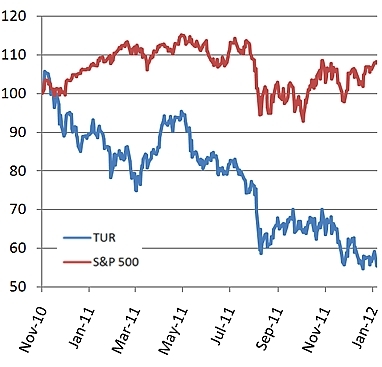
That's the thesis implicit to David Goldman's analysis at "Recall notice for the Turkish model." After dubbing the Turkish economy a bubble that "is bursting, starting with the stock market and national currency," he makes this observation about the prime minister:

Erdoğan has the weirdest economic views of any serving head of government. He justified the credit bubble on religious grounds, pledging repeatedly to cut the "real" interest rate (the cost of interest minus the inflation rate) to zero. "We aim to cut the real interest rate in the long run, so people will increase their incomes through working, not through interest," he said last April. "Eventually we aim to equalize the interest rate and inflation rate." Erdoğan believes that this would fulfill the Islamic injunction against lending for interest; if the real interest rate is zero, he seems to think, the sharia ban on interest is fulfilled de facto.

In other words, Erdoğan's wacky financial ideas, which are likely to doom his country's economy, follow directly from his Islamist dream of eliminating riba (usury). More generally put, the Islamist economic program undermines itself. (January 10, 2012)

Turkish stock market vs. S&P 500 (November 2010 = 100). Source: Bloomberg


Daniel Pipes

Source: National Review Online;http://www.danielpipes.org/blog/2012/01/will-no-interest-banking-undo-turkey-economy

Copyright - Original materials copyright (c) by the authors.

Egyptian Nuclear Power Plant Ransacked


by Daniel Pipes

Egypt Independent reports on vandalizing, looting, and fighting at the nuclear power plant being built at El-Dabaa, a town in the desert to the west of Alexandria. The account draws on an unnamed source at the Ministry of Electricity and Energy who

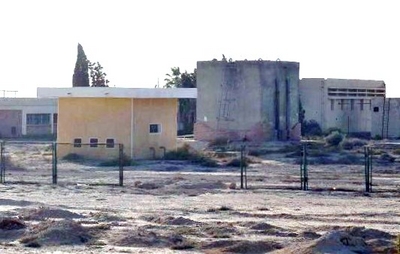
El-Dabaa nuclear power station in its full glory.

accused security authorities and the governor of North Sinai of "causing the disaster." The official said the initial losses were around LE0.5 billion [= US$83 million]. He also accused a businessman and former member in the defunct National Democratic Party of being "behind the chaos," but did not name the businessman allegedly involved.

The source said the meteorological station, ground water station and many of the offices had been attacked by "organized looters," who took objects including computers, monitoring devices for earthquakes, furniture, cables and transformers.

On Friday, about 500 residents had rallied demanding the dismantling of the nuclear power plant, saying their land had been confiscated for the project. They say the government did not compensate them for the land it took.

However, other reports suggest that the construction site was attacked by residents of the area angry at the way in which the land for the power plant had been acquired by the government. Residents of Dabaa staged a sit-in on Saturday after clashes with Egyptian military police on Friday. The clashes left 41 people injured, including 29 soldiers, according to state-run newspaper Al-Ahram.

Comments: (1) L'Institut d'Égypte, a nuclear power plant site … the situation has degenerated in Egypt to the point that nothing is safe.

(2) The Islamists lack real power but they appear to be in charge; so as Egypt heads into economic decay and social anarchy, they will receive the blame. Could this be what the crafty military tyrants want, so they can swoop in and "save" the country? (January 16, 2012)

Jan. 20, 2012 update: The news gets worse, with the possibility that radioactive material was stolen:

The UN atomic energy agency issued a statement Thursday saying "the items that have gone missing are low-level radioactive sources. The sources were stolen not from an operating NPP (nuclear power plant), but from a laboratory at a construction site for an NPP that is not yet operational," the International Atomic Energy Agency said. The Vienna-based agency said it is "in touch with the Egyptian authorities."

Al-Ahram newspaper reported Thursday that a safe containing radioactive material was stolen from a site in Al-Dabaa, on the Mediterranean coast. Another safe was broken and some of its contents were taken, Al-Ahram said. … It said the team of experts entered the site but "did not find the missing safe. It did, however, find two sources of radioactivity in another safe that had been broken into."

Daniel Pipes

Source: http://www.danielpipes.org/blog/2012/01/egyptian-nuclear-power-plant-ransacked

Copyright - Original materials copyright (c) by the authors.

Is The NYT's Agenda to Normalize Islam in the West?


by Phyllis Chesler

There is no nuance, no balance, no justice in the plethora of anti-Israel pieces in the NYT. But there is another agenda as well - normalizing Islam, especially in North America and Europe. See the evidence below.

On a single day, the New York Times has been known to publish anywhere from two to six anti-Israel articles, editorials, op-ed pieces, and letters. Today, I see a new danger arising in their pages.

After spending a year proclaiming the triumph of democracy and the miracle of the Arab Spring and, as PM Netanyahu has just noted, refusing to document the existential danger in which Israel finds herself, the Newspaper of Record has now begun the process of normalizing Islam in North America and Europe. Its pro-Muslim “multicultural” agenda is, paradoxically, another form of racism, but I quibble.

Yesterday, there were at least three articles (3,200 words, four photos, one illustration), devoted to Islam in America and Europe. A 934-word op-ed article titled “How to Integrate Europe’s Muslims” by a Boston College professor is a veritable manifesto of appeasement and racism disguised as a rational call for integration and fairness. Jonathan Laurence suggests that Muslims will be “integrated” into Europe if they are allowed to study Islam at state-sponsored schools, continue their Muslim religious practices, veil women, speak Arabic, Persian, Dari, etc. In his view, this will fend off “fundamentalism” and magically lead to reciprocity in terms of tolerance towards infidels and apostates and to the abolition of Islamic gender and religious apartheid.

According to Canadian professor and author, Dr. Salim Mansur, multiculturalism and the appeasement of tribalism defeats the possibility of citizenship and amounts to a form of “soft bigotry.” As Pascal Bruckner has phrased it: “Multiculturalism is the racism of the anti-racists; it chains people to their roots.” Immigrants are kept confined to their “group” and not encouraged or expected to become “individuals” and “citizens” of a modern democracy.

As we may all recall, the 2011 Goldstone recantation did not make the front page of the NYT; it was buried on page 8. But today, a 1,200 word article, entitled “In Police Training, a Dark Film on U.S. Muslims” is on page one. It continues on page 23 with two photos and it takes up 3/4th of the second page. The article condemns the use of the film, The Third Jihad, as a “training” device for 1,489 police officers. What is so offensive about this film, which is narrated by a (truly) moderate Muslim, Dr. Zuhdi Jasser, a physician and former American military officer? First the film has been funded by Orthodox Jews and Zionists (horrors!). Second, it dares suggest that Muslims have launched a war against the West, a “third jihad.” And, there is “ominous” music. Then “Muslim terrorists shoot Christians in the head, car bombs explode, children lie covered by sheets…”

Is this reporter unfamiliar with the persecution of Christians in Muslim-majority countries and with the Islamic terrorist attacks against Muslim and infidel civilians and against Western military and civilian targets?

In the last four months of 2011, there’s this: In the fall, a 12 year-old Christian girl living in Pakistan was gang-raped, converted, and then forced to marry her Muslim rapist. The incident was by no means a unique occurrence but part of a series of rapes, forced conversions, and forced marriages carried-out by Islamic extremists against female members of Pakistan’s Christian communities. In October of 2011, twenty-two Egyptian Coptic Christians were murdered in clashes with the military government forces during protests. Thugs were directed to target and attack Copts. On November 5th of 2011, the New York Times itself reported that at least 67 people had been killed in a terrorist attack in Nigeria carried out by the Islamist Boko Haram. The area of Lagos is well-known as a predominantly Christian territory.

But apparently these incidents—and there are many more--do not count as much as the film’s “doctored photograph (which shows) an Islamic flag flying over the White House.” Here, I will venture no cheap comment.

This reporter, Michael Powell, and his newspaper seems to forget 9/11; Major Nidal Malik Hasan, who killed thirteen and wounded 29 soldiers at Ft Hood, Texas (2009); Abdul Hakim Mohamed (formerly Carlos Bledsoe), who opened fire with an assault rifle targeting soldiers in front of a military recruiting office in Little Rock, Arkansas (2009); on Christmas Day, Umar AbdulMutallab tried to blow up Northwest Airlines Flight #253 in Amsterdam destined for Detroit (2009); Faisl Shahzad, tried to blow up Times Square (2010). All four Muslim/Islamist terrorists were influenced by the infamous Anwar al-Awlaki who died in Yemen in 2011 in a targeted military assassination.

But this is all so recent. The NYT reporter seems to have forgotten all about the first Islamist-Muslim World Trade Center bombing in 1993; the truck bombing which killed 19 American servicemen in Saudi Arabia in 1996; the Al Qaeda detonation of two car bombs which destroyed the U.S. Embassies in Nairobi and Dar-es-Salam simultaneously, killing 224 and wounding thousands; and the 2000 Al Qaeda bombing attacks on the U.S.S. Cole in the Yemeni port of Aden, killing 17 sailors. Even I was about to move on without mentioning the 1979 Iranian Islamist kidnapping of American diplomats in the Embassy in Teheran and their being held hostage for 444 days.

I really could go on but I think I have made my point. There is an Islamic/Islamist war that has been declared against the West as well as against both Muslim and infidel civilians, but it is one that the Paper of Record refuses to acknowledge, or to fight or win.

Finally, in the same issue, (1/24/12) there was also a 1,200-word book review of a new anthology: Love, Inshallah: The Secret Lives of American Muslim Women, which Neil MacFarquhar handles as if it is a news story or an interview. This piece is titled “Lifting Veil on Love and Islam.” This is a new anthology which hopes to dispel stereotypes and to depict American Muslim women as normal, average, and American in terms of love, sex, and marriage.

Many of the contributors are writing under pseudonyms. Most were found through Facebook and Twitter. MacFarquhar describes these women as grappling with “universal issues.” Perhaps the contributors to this anthology really do so. I hope they do. But the reporter’s examples include how to tell your date that you can’t drink Champagne because you are a religious Muslim; “a Jewish convert to Islam (who) detailed the pain of alienating her father, while another spoke with rapture about joining a polygamous family.” The only contributor who is quoted here and who writes under her own name is an Iranian comedienne, (Zahra Noorbakhsh), who voices the pathos of the self-censorship that Muslim women engage in. “You leave yourself vulnerable to people using your voice to attack your community, so we kind of censor our own voices.”

Of course, the danger is also from one’s own tribal/ethnic community who will treat you as a traitor and act accordingly.

In this very issue, (1/24/12) there are seven additional articles which are set in Jerusalem, (concerning “Palestinian” demonstrators), Islamabad, Cairo, Baghdad, Homs (Syria), Iran, and Saudi Arabia.Clearly, the Times understands that the Islamic world is important to the survival of Western democracies and to their own civilians as well. What is relatively new—and I predict we will see a lot more of this—is their focus on Islam in the West, particularly in America.

In general, journalism has changed in the last decade. Publications like the New York Times emphasize “opinion pieces” more than objective journalism. And, the opinion columns are universally written by single-minded leftist and Islamist apologists. There is no nuance, no balance, no justice. The journalists who dedicate numerous words and hours to such dismal reportage seem psychologically driven to apologize for North American and European (Israeli too, of course), ideals of social equality, magnanimity, scientific inquiry, tolerance, self-criticism, and economic prosperity.

Why have papers likes the Times become so obsessed with protecting the religious rights of one single minority group at the expense of every other religious group, including members of moderate and anti-Islamist Islam, and at the expense of women, who represent approximately 53% of the world’s population? Are they, too, possibly being funded by leftists and by Arab oil magnates? Or, do they simply hope to be?

Just wondering.

Prof. Phyllis Chesler is the author of fifteen books, including Women and Madness (Doubleday, 1972), The Death of Feminism: What's Next in the Struggle for Women's Freedom (Palgrave Macmillan, 2005) and most recently, The New Anti-Semitism. She is the co-founder of the Association for Women in Psychology and the National Women's Health Network.

Source: http://www.israelnationalnews.com/Articles/Article.aspx/11169#.TyBVJ4FvIi4

Copyright - Original materials copyright (c) by the authors.

Tuesday, January 24, 2012

America and the Arab Spring


by Caroline Glick

A year ago this week, on January 25, 2011, the ground began to crumble under then-Egyptian president Hosni Mubarak's feet. One year later, Mubarak and his sons are in prison, and standing trial.

This week, the final vote tally from Egypt's parliamentary elections was published. The Islamist parties have won 72 percent of the seats in the lower house.

The photogenic, Western-looking youth from Tahrir Square the Western media were thrilled to dub the Facebook revolutionaries were disgraced at the polls and exposed as an insignificant social and political force.

As for the military junta, it has made its peace with the Muslim Brotherhood. The generals and the jihadists are negotiating a power-sharing agreement. According to details of the agreement that have made their way to the media, the generals will remain the West's go-to guys for foreign affairs. The Muslim Brotherhood (and its fellow jihadists in the Salafist al-Nour party) will control Egypt's internal affairs.

This is bad news for women and for non-Muslims. Egypt's Coptic Christians have been under continuous attack by Muslim Brotherhood and Salafist supporters since Mubarak was deposed. Their churches, homes and businesses have been burned, looted and destroyed. Their wives and daughters have been raped. The military massacred them when they dared to protest their persecution.

As for women, their main claim to fame since Mubarak's overthrow has been their sexual victimization at the hands of soldiers who stripped female protesters and performed "virginity tests" on them. Out of nearly five hundred seats in parliament, only 10 will be filled by women.

The Western media are centering their attention on what the next Egyptian constitution will look like and whether it will guarantee rights for women and minorities. What they fail to recognize is that the Islamic fundamentalists now in charge of Egypt don't need a constitution to implement their tyranny. All they require is what they already have - a public awareness of their political power and their partnership with the military.

The same literalist approach that has prevented Western observers from reading the writing on the walls in terms of the Islamists' domestic empowerment has blinded them to the impact of Egypt's political transformation on the country's foreign policy posture. US officials forcefully proclaim that they will not abide by an Egyptian move to formally abrogate its peace treaty with Israel. What they fail to recognize is that whether or not the treaty is formally abrogated is irrelevant. The situation on the ground in which the new regime allows Sinai to be used as a launching ground for attacks against Israel, and as a highway for weapons and terror personnel to flow freely into Gaza, are clear signs that the peace with Israel is already dead - treaty or no treaty.

EGYPT'S TRANSFORMATION is not an isolated event. The disgraced former Yemeni president Ali Abdullah Saleh arrived in the US this week. Yemen is supposed to elect his successor next month. The deteriorating security situation in that strategically vital land which borders the Arabian and Red Seas has decreased the likelihood that the election will take place as planned.

Yemen is falling apart at the seams. Al-Qaida forces have been advancing in the south. Last spring they took over Zinjibar, the capital of Abyan province. In recent weeks they captured Radda, a city 160 km. south of the capital of Sana.

Radda's capture underscored American fears that the political upheaval in Yemen will provide al- Qaida with a foothold near shipping routes through the Red Sea and so enable the group to spread its influence to neighboring Saudi Arabia.

Al-Qaida forces were also prominent in the NATO-backed Libyan opposition forces that with NATO's help overthrew Muammar Gaddafi in October. Although the situation on the ground is far from clear, it appears that radical Islamic political forces are intimidating their way into power in post-Gaddafi Libya.

Take for instance last weekend's riots in Benghazi. On Saturday protesters laid siege to the National Transitional Council offices in the city while Mustafa Abdul-Jalil, the head of the NTC, hid inside. In an attempt to quell the protesters' anger, Jalil fired six secular members of the NTC. He then appointed a council of religious leaders to investigate corruption charges and identify people with links to the Gaddafi regime.

In Bahrain, the Iranian-supported Shi'ite majority continues to mount political protests against the Sunni monarchy. Security forces killed two young Shi'ite protesters over the past week and a half, and opened fired at Shi'ites who sought to hold a protest march after attending the funeral of one of them.

As supporters of Bahrain's Shi'ites have maintained since the unrest spread to the kingdom last year, Bahrain's Shi'ites are not Iranian proxies. But then, until the US pulled its troops out of Iraq last month, neither were Iraq's Shi'ites. What happened immediately after the US pullout is another story completely.

Extolling Iraq's swift deterioration into an Iranian satrapy, last Wednesday, Brig.-Gen. Qassem Suleimani, the commander of Iran's Revolutionary Guards Corps Jerusalem Brigade, bragged, "In reality, in south Lebanon and Iraq, the people are under the effect of the Islamic Republic's way of practice and thinking."

While Suleimani probably exaggerated the situation, there is no doubt that Iran's increased influence in Iraq is being felt around the region. Iraq has come to the aid of Iran's Syrian client Bashar Assad who is now embroiled in a civil war. The rise of Iran in Iraq holds dire implications for the Hashemite regime in Jordan which is currently hanging on by a thread, challenged from within and without by the rising force of the Muslim Brotherhood.

Much has been written since the fall of Mubarak about the impact on Israel of the misnamed Arab Spring. Events like September's mob assault on Israel's embassy in Cairo and the murderous cross-border attack on motorists traveling on the road to Eilat by terrorists operating out of Sinai give force to the assessment that Israel is more imperiled than ever by the revolutionary events engulfing the region.

But the truth is that while on balance Israel's regional posture has taken a hit, particularly from the overthrow of Mubarak and the rise of the Muslim Brotherhood and the Salafists in Egypt, Israel is not the primary loser in the so-called Arab Spring.

Israel never had many assets in the Arab world to begin with. The Western-aligned autocracies were not Israel's allies. To the extent the likes of Mubarak and others have cooperated with Israel on various issues over the years, their cooperation was due not to any sense of comity with Jewish state. They worked with Israel because they believed it served their interests to do so. And at the same time Mubarak reined in the Muslim Brotherhood and Hamas because they threatened him, he waged political war against Israel on every international stage and allowed anti-Semitic poison to be broadcast daily on his regime-controlled television stations.

Since Israel's stake in the Arab power game has always been limited, its losses as a consequence of the fall of anti-Israel secular dictatorships and their replacement by anti-Israel Islamist regimes have been marginal. The US, on the other hand, has seen its interests massively harmed. Indeed, the US is the greatest loser of the pan-Arab revolutions.

TO UNDERSTAND the depth and breadth of America's losses, consider that on January 25, 2011, most Arab states were US allies to a greater or lesser degree. Mubarak was a strategic ally. Saleh was willing to collaborate with the US in combating al- Qaida and other jihadist forces in his country.

Gaddafi was a neutered former enemy who had posed no threat to the US since 2004. Iraq was a protectorate. Jordan and Morocco were stable US clients.

One year later, the elements of the US's alliance structure have either been destroyed or seriously weakened. US allies like Saudi Arabia, which have yet to be seriously threatened by the revolutionary violence, no longer trust the US. As the recently revealed nuclear cooperation between the Saudis and the Chinese makes clear, the Saudis are looking to other global powers to replace the US as their superpower protector.

Perhaps the most amazing aspect to the US's spectacular loss of influence and power in the Arab world is that most of its strategic collapse has been due to its own actions. In Egypt and Libya the US intervened prominently to bring down a US ally and a dictator who constituted no threat to its interests. Indeed, it went to war to bring Gaddafi down.

Moreover, the US acted to bring about their fall at the same time it knew that they would be replaced by forces inimical to American national security interests. In Egypt, it was clear that the Muslim Brotherhood would emerge as the strongest political force in the country. In Libya, it was clear at the outset of the NATO campaign against Gaddafi that al-Qaida was prominently represented in the anti-regime coalition. And just as the Islamists won the Egyptian election, shortly after Gaddafi was overthrown, al-Qaida forces raised their flag over Benghazi's courthouse.

US actions from Yemen to Bahrain and beyond have followed a similar pattern.

In sharp contrast to his active interventionism against US-allied regimes, President Barack Obama has prominently refused to intervene in Syria, where the fate of a US foe hangs in the balance.

Obama has sat back as Turkey has fashioned a Syrian opposition dominated by the Muslim Brotherhood, and the Arab League has intervened in a manner that increases the prospect that Syria will descend into chaos in the event that the Assad regime is overthrown.

Obama continues to speak grandly about his vision for the Middle East and his dedication to America's regional allies. And his supporters in the media continue to applaud his great success in foreign policy. But outside of their echo chamber, he and the country he leads are looked upon with increasing contempt and disgust throughout the Arab world.

Obama's behavior since last January 25 has made clear to US friend and foe alike that under Obama, the US is more likely to attack you if you display weakness towards it than if you adopt a confrontational posture against it. As Assad survives to kill another day; as Iran expands its spheres of influence and gallops towards the nuclear bomb; as al- Qaida and its allies rise from the Gulf of Aden to the Suez Canal; and as Mubarak continues to be wheeled into the courtroom on a stretcher, the US's rapid fall from regional power is everywhere in evidence.

Originally published in The Jerusalem Post.

Caroline Glick

Source: http://www.carolineglick.com/e/2012/01/america-and-the-arab-spring.php

Copyright - Original materials copyright (c) by the authors.

Artificially Created States


by Eli E. Hertz

Fifty-one member countries - the entire League of Nations - unanimously declared on July 24, 1922:

"Whereas recognition has been given to the historical connection of the Jewish people with Palestine and to the grounds for reconstituting their national home in that country."

Unlike nation-states in Europe, modern Lebanese, Jordanian, Syrian, and Iraqi nationalities did not evolve. They were arbitrarily created by colonial powers.

In 1919, in the wake of World War I, England and France as Mandatories (e.g., official administrators and mentors) carved up the former Ottoman Empire, which had collapsed a year earlier, into geographic spheres of influence. This divided the Mideast into new political entities with new names and frontiers.

Territory was divided along map meridians without regard for traditional frontiers (i.e., geographic logic and sustainability) or the ethnic composition of indigenous populations.

The prevailing rationale behind these artificially created states was how they served the imperial and commercial needs of their colonial masters. Iraq and Jordan, for instance, were created as emirates to reward the noble Hashemite family from Saudi Arabia for its loyalty to the British against the Ottoman Turks during World War I, under the leadership of Lawrence of Arabia. Iraq was given to Faisal bin Hussein, son of the sheriff of Mecca, in 1918. To reward his younger brother Abdullah with an emirate, Britain cut away 77 percent of its mandate over Palestine earmarked for the Jews and gave it to Abdullah in 1922, creating the new country of Trans-Jordan or Jordan, as it was later named.

The Arabs' hatred of the Jewish State has never been strong enough to prevent the bloody rivalries that repeatedly rocked the Middle East. These conflicts were evident in the civil wars in Yemen and Lebanon, as well as in the war between Iraq and Iran, in the gassing of countless Kurds in Iraq, and in the killing of Iraqis by Iraqis, Syrians by Syrians as well as the killing of Egyptians by Egyptians.

The manner in which European colonial powers carved out political entities with little regard to their ethnic composition not only led to this inter-ethnic violence, but it also encouraged dictatorial rule as the only force capable of holding such entities together.

The exception was Palestine, or Eretz-Israel - the territory between the Jordan River and the Mediterranean Sea, where:

"The Mandatory shall be responsible for placing the country [Palestine] under such political, administrative and economic conditions as will secure the establishment of the Jewish National Home, as laid down in the preamble, and the development of self-governing institutions, and also for safeguarding the civil and religious rights of all the inhabitants of Palestine, irrespective of race and religion."

For the entire article with footnotes Click Here

Eli E. Hertz

Source: http://www.mythsandfacts.org/Conflict/mandate_for_palestine/MandateN2%20-%2010-29-07-English.pdf

Copyright - Original materials copyright (c) by the authors.