The "Middle East and Terrorism" Blog was created in order to supply information about the implication of Arab countries and Iran in terrorism all over the world. Most of the articles in the blog are the result of objective scientific research or articles written by senior journalists.
From the Ethics of the Fathers: "He [Rabbi Tarfon] used to say, it is not incumbent upon you to complete the task, but you are not exempt from undertaking it."
For weeks, the American people have been relatively silent as they digested these ongoing catastrophes. But at some point, their patience will run out.
At the end of the year, we are on the razor’s edge of many things that soon may blow up.
Americans
are far beyond President Joe Biden’s serial untruths of some eight
years that he never discussed Hunter Biden’s various get-rich-quick
schemes.
All
were predicated on the perception of foreign interests purchasing from
the Biden family the influence of then-senator, vice president, and
possibly soon-to-be President Joe Biden.
The
Bidens now risk exposure to criminal charges of multimillion-dollar tax
fraud, perjury, influence selling, and bribery as congressional
committees and a special prosecutor unravel years of tangled-up quid pro
quos.
A
newly indicted Hunter remains reckless and unpredictable. He continues
to publicly blame his mounting legal problems on everyone and everything
other than his own selfish excesses.
Hunter
deliberately involves his family and may even bring down his own
father. His tax lawyers have previously threatened to call President Joe
Biden to testify on his behalf under oath.
He
continues to court public scandal by hawking amateurish
“representational” paintings to the quid-pro-quo wealthy and wannabes
wishing clout with the White House.
His
laptop messages reveal a prodigal son angry that his bagman services
were never fully appreciated by his familial beneficiaries.
Hunter’s
wayward laptop is a felonious trove of drug-addled, illicit Petronian
excess and sex, interspliced with his self-incriminating family
communications on the distributions of pay-for-play payoffs.
Hunter’s business aides will be called back to elaborate on their already incriminating testimonies.
The contents of Joe Biden’s various alias emails will soon see new scrutiny.
Given
Biden’s physical and ethical frailties, age, and bad polling, the
left-wing media and Democratic hierarchy may cease circling the wagons
around him. Instead, some may fuel the effort to sandbag a 2024 Biden
candidacy by releasing or even leaking incriminating evidence.
Harvard
President Claudine Gay’s tenure is even more tenuous than Biden’s.
Harvard can either claim to be the nation’s preeminent academic
institution or continue to protect a plagiarist as president—not both.
It
can profess to be at the center of academia’s moral and intellectual
universe, but not if its president cannot punish those on campus who
daily call for the destruction of Israel and the genocide of the Jewish
people. Gay cannot lie to Congress that Harvard in the past has also
allowed “hate speech” against entire groups the way it now allows
against Jews.
Nor
is it sustainable for Gay to fob off calls for her resignation as
“racist.” In fact, the more the public learns about her academic career,
the more she seems to be a lifetime beneficiary, not a victim of
racially-weighted policies.
Since
the October 7 Hamas massacre of 1,200 Jews, anti-Israeli/pro-Hamas
protests, often violent, have swept the Western world, particularly in
the big cities and on campuses of America.
Protestors
no longer distinguish being anti-Israeli from being anti-Jewish. Now
they just openly mouth anti-Semitic chants and harass individual Jews.
Almost
every hallowed monument—from the Lincoln Memorial to the White House
gates, nearly every cherished national icon from the famed Christmas
tree in New York’s Rockefeller Center to New York’s Naivety scene, and
our most famous infrastructure from the Manhattan Bridge to the Golden
Gate Bridge—has either been swarmed, defaced, or disrupted by pro-Hamas
demonstrators.
Americans
are growing weary of these escalating protests for a variety of
reasons. Most remember that the October 7 war started not with Israeli
preemptive attacks on an independent Gaza, but only after Hamas killers
launched a sneak attack to commit atrocities against Jews residing in
Israel.
The current war is waged between a constitutional state of free elections and a cruel, autocratic terrorist clique.
Indeed,
Hamas has refused negotiations over a ceasefire that would have led to
internationally conducted free elections for the people of
Gaza—something forbidden by enriched Hamas kingpins ensconced in luxury
abroad.
Many
of the loudest and most violent anti-Jewish protestors in the U.S. are
immigrants, green card holders, or on student visas. That fact is
confusing to Americans.
Why
would those who have fled despotic regimes in the Middle East to study,
work, or reside in a free America, once safely here, rally for the very
dictatorships they left behind and apparently do not wish to return to?
Why trash the very foundation and values of their American hosts that ensure their newfound freedoms?
For
weeks, the American people have been relatively silent as they digested
these ongoing catastrophes. But at some point, their patience will run
out.
Americans
will then collectively conclude that Joe Biden has never been truthful
about vast ill-gotten funds that have enriched his family; that Harvard
is no longer preeminent or even prestigious; and that people who do not
like us, our laws, and our values should try cheering on the work of
Hamas from their own homes.
The publicly available documentary evidence and firsthand accounts
from Hunter Biden’s former business associates already prove that Joe
Biden was deeply involved with his son Hunter’s shady influence peddling
schemes with foreign businesses and oligarchs. Moreover, the evidence
points to Joe Biden’s benefiting financially from his son’s pay-to-play
ploys that capitalized on the Biden “brand” of access to the “big guy.”
The corrupt payoffs for access and use of Joe Biden’s influence went on
for years, stretching back to then-Vice President Biden’s days during
the Obama-Biden administration when he was the administration’s point
man for Ukraine.
The extent to which the left-wing media continue to pretend that Joe
Biden was not involved and received nothing of value in connection with
his son’s corrupt business dealings knows no bounds. These media outlets
won’t be satisfied unless Joe Biden himself comes forward to confess
his guilt or a documented direct wire transfer to his bank account from
an account belonging to one of Hunter’s foreign business clients is
produced. And maybe not even then.
In the absence of a smoking gun, investigators often must rely on
circumstantial evidence and the reasonable inferences that can be drawn
from such circumstantial evidence to make out a case of wrongdoing. That
is the situation we have here regarding Joe Biden’s complicity in his
son’s influence peddling schemes.
Unlike a criminal case that requires proof beyond a reasonable doubt
to convict a defendant, a lower standard of proof applies to impeachment
and conviction under Article II, Section 4 of the Constitution. Bribery
is specifically mentioned as grounds for impeachment and conviction.
The New York Times has just recently provided a striking example of
an article that misleads its readers into believing that the evidence
against Joe Biden is, in its words, “flimsy.” Adam Entous, who is
described by the New York Times as “an investigative correspondent in
the Washington bureau of The New York Times,” wrote this article
entitled “Hunter Biden Text Cited in Impeachment Inquiry Is Not What G.O.P. Suggests.” It appeared on the front page of the New York Times’ December 23rd print edition.
Mr. Entous’s article tries to provide a perfectly innocent
explanation for an incriminating text found on Hunter’s infamous laptop,
which admitted his payments to his father. But Mr. Entous’s innocent
explanation holds no water in light of the text’s language itself and
the corroborating circumstantial evidence proving that Joe Biden
benefited financially from Hunter’s influence peddling business
activities.
The publication with the motto “All the News That’s Fit to Print”
committed journalistic malpractice by masquerading this disingenuous
article as news when it was little more than a fawning opinion piece.
The January 2019 Hunter Biden text to his daughter Naomi that Mr.
Entous tries to explain away reads as follows: “I Hope you all can do
what I did and pay for everything for this entire family Fro (sic) 30
years. It’s really hard. But don’t worry unlike Pop I won’t make you
give me half your salary.”
The text, despite its typos, is crystal clear on its face. It refers
to a thirty-year period during which, Hunter told his daughter, he paid
“for everything for this entire family.” Hunter then said that
he would not make his daughter pay him half her salary, in contrast to
his own arrangement to split his “salary” with his “Pop.” There is
nothing in the text to indicate that Hunter was revisiting a 30-year-old
grievance about what he had to pay his father in the distant past from
jobs that he had when he was a college student. And he certainly was not
paying back then “for everything” for the “entire” Biden family from
his meager wages.
Nevertheless, Mr. Entous claimed that his “close examination of the
circumstances surrounding the 2019 text message” revealed that “the 2019
message was a reference to a story from Hunter’s youth that he repeated
to his daughters when they became teenagers.” Entous’s “close
examination” consisted of a “review of Hunter Biden’s communications and
interviews with Biden aides, family friends, and Hunter and Naomi Biden
[Hunter’s daughter].”
There is nothing like an “investigative” correspondent who relies on self-serving sources.
According to Mr. Entous, “The story behind Hunter’s allusion to
handing half of his salary to his father can be traced back to his
childhood, and to the family’s conflicted relationship with money and
class.” Back in his college days, Mr. Entous wrote, Hunter “had to work
in college and pay half of his salary to his father.” This was the story
that family members said Hunter repeated often to his daughters “in
hopes of encouraging them to be more self-sufficient.” The purpose of
Hunter’s 2019 text message to his daughter Naomi, Mr. Entous wrote, was
to deliver that same message once again during their fight over her
sister’s medical treatment for a ski injury.
Mr. Entous ended his article with this quote from Naomi about what
she thought her father meant in his 2019 text to her: “He was repeating a
story from his university days that I grew up hearing. Do people really
think he was texting me things like, ‘I give pop half of the Burisma
money’? No. That’s crazy.”
It is certainly understandable that Hunter’s children would rally to
his defense. But that does not excuse Mr. Entous for doing the same
thing without any critical analysis or making the slightest effort to
connect the dots.
Hunter’s text said that he paid “for everything for this entire
family” during a 30-year span of time. This period covers the years that
Hunter received millions of dollars in compensation from Ukraine’s
corrupt energy company Burisma where he served on its board of
directors. Hunter was being paid this money by Burisma while his father
was vice president and the Obama-Biden administration’s point man for
Ukraine.
There are ample bank records documenting the shell companies that
Hunter used to route monies he received from Burisma and other foreign
entities and individuals to bank accounts he controlled as well as to
other Biden family members’ bank accounts. It is most likely that this
was what Hunter meant when he said in his 2019 text to his daughter that
he has been paying “everything for this entire family,” including half
his salary to his father. Not payments to his father from small salaries
Hunter earned from his odd jobs while he was in college.
Joe Biden does not have to receive illicit money directly into his own personal account to be found guilty of bribery. The federal bribery statute
applies to then-Vice President Biden if he was “influenced in the
performance of any official act” in exchange for his corruptly accepting
“anything of value personally or for any other person or entity.” (Emphasis added)
In exchange for the influence that he used as vice president to get
the prosecutor investigating Burisma removed from office, Joe Biden
corruptly accepted as value a financial benefit directed to his son by
incentivizing Burisma to compensate Hunter lavishly. Other Biden family
members benefited financially as well.
In any event, there is some evidence that then-Vice President Biden
did receive a direct bribe of his own, which was routed through shell
companies from Burisma. Mr. Entous omitted any reference in his article
to the FBI 1023 reporting document
in which a trusted informant implicated Joe Biden in an alleged
criminal bribery scheme involving Burisma while he was vice president.
The informant paraphrased a statement by Mykola Zlochevsky, Burisma’s
owner at the time, to the effect that Hunter will take care of issues
relating to the investigation of corruption at Burisma “through his
dad.” According to the FBI report, Zlochevsky told the informer that he
did not send any funds directly to the “Big Guy” (which the informer
understood to be a reference to Joe Biden). The FBI report recounted
Zlochevsky’s boast that it would “take them (Investigators) 10 years to
find the records (i.e. illicit payments to Joe Biden).”
The banking records and FBI 1023 reporting document provide critical
evidence corroborating the most logical reading of Hunter’s January 2019
text to his daughter Naomi, which flatly contradicts the New York Times
“investigative” correspondent’s benign interpretation. Hunter Biden was
claiming that he was keeping his “Pop” and the entire Biden family
financially afloat. At least since the days when his father was serving
as vice president, the money that Hunter funneled into the Biden family
bank accounts came largely from foreign sources such as Burisma who were
interested in buying access to the “big guy.”
A credible investigator collects, reviews, and analyzes all relevant
evidence before reaching a fact-based conclusion. The New York Times’
“investigative correspondent” fell far short of that mark in his zeal to
insulate Joe Biden from any responsibility for his involvement and
value accepted in connection with his son’s unscrupulous business
affairs.
Joseph Klein is a Harvard-trained lawyer, and the author of Global Deception: The
UN’s Stealth Assault on America’s Freedom and Lethal Engagement: Barack
Hussein Obama, The United Nations & Radical Islam.
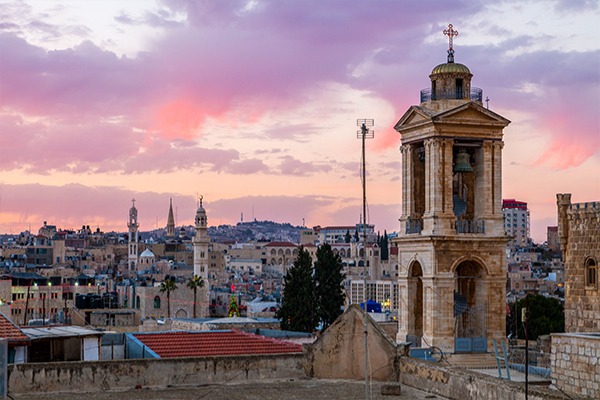
Today, barely 13% of Bethlehem's residents are Christian. At issue was the Palestinian Authority's deep discrimination against Christians.
Rep. Alexandria Ocasio-Cortez
(D-NY), New York's millennial congresswoman, believes herself the
barometer of progressive morality. But by reframing Jesus as akin to
Palestinian terrorists fighting Israel, she instead cloaks herself in a
mantle of ignorance and moral confusion.
Conflating political and religious fervor, AOC took to Instagram on Christmas Eve to opine,
"In the story of Christmas, Christ was born in modern-day Palestine
under the threat of a government engaged in the mass genocide of
innocents. He was part of a targeted population being indiscriminately
killed to protect an unjust leader's power," she wrote. "Thousands of
years later, right-wing forces are violently occupying Bethlehem as
similar stories unfold for today's Palestinians, so much so that the
Christian community in Bethlehem has canceled this year's Christmas Eve
celebrations."
"The entire story of Christmas and Christ himself is about
standing with the poor and powerless, the marginalized and maligned, the
refugees and immigrants, the outcast and misunderstood, without
exception," she added.
Where to begin?
Christians have little say about whether Bethlehem holds Christmas
celebrations. In 1950, Christians made up approximately 86% of the
population of Bethlehem and its surrounding villages. That share of the
population stayed relatively steady until Israel handed the Palestinian
Authority control over Bethlehem, and then the proportion of Christians
plummeted. Today, barely 13% of Bethlehem's residents are Christian. At
issue was the Palestinian Authority's deep discrimination against
Christians. When Muslim families moved to Bethlehem and forcibly took
over Christian property, for example, the Palestinian Authority did
nothing to evict the Islamist squatters, even when judges sided with the
Christians.
Palestinian terrorists in Bethlehem developed the tactics that Hamas
later applied in Gaza. In 2002, for example, Palestinian terrorists
seized the Church of the Nativity, barricading themselves in the holy
site and stealing the priests' and nuns' food and water. They
essentially sought to use the sensitive, civilian site as a shield to
wage war. The Palestinian gunmen desecrated the church during the
six-week siege. An Israeli sniper killed one, a most-wanted terrorist,
after he began firing an automatic weapon from within the church.
Terrorists then set fire to a neighboring building. The siege ended
after six weeks with the evacuation of some terrorists to Gaza and the
remainders to Europe.
Christians in Gaza fared even worse under Hamas. Just like the
Islamic State in Iraq and Syria, Hamas imposed its extremist
interpretations on Christians. It forced women to veil, banned alcohol,
and sought forcibly to convert children. While Islamist propagandists
note that Islam, unlike Judaism, considers Jesus a prophet, they punish
Christians who suggest Jesus to be the son of God who died for mankind's
sins. In 2006, 5,000 Christians lived in Gaza. Within a decade, that
number declined by 80%.
Put aside her whitewashing of terror. AOC and her fellow
travelers lack basic understanding of history. Jews were the indigenous
population of the territory Romans renamed Palestine. Jesus was born a
Jew, his last supper was a Passover Seder, and he died a Jew. Therefore,
when progressive pundit Cenk Uygur posts, "If Jesus returned to the
place of his birth, could he survive the night? Or would he be just
another Palestinian casualty?" he is half right. Should Jesus reappear
today in Bethlehem, he likely would not survive the night because, as a
Jew, he would be subject to Palestinian lynching.
If AOC truly understood Christianity, she would realize that Jesus
would not stand for the rape of girls and women, or the beheading and
burning of children. Jesus preached love and compassion, not
hostage-taking and terror. She would pray for the release of hostages
and the end to terror, not peace under Hamas's yoke. If AOC understood
history, she would realize Israel is the nation of migrants and
refugees. While Jews are indigenous and always lived in the territory,
it was the slaughter of Jews in Europe and the mass expulsion of Jews in
Arab lands that led to a population influx, and that many Palestinians
migrated from Syria as Jews transformed the land.
Politics should never trump principle. Unfortunately, for AOC they
do. Embrace of Hamas principles condemns Jews, Christians, and moderate
Muslims to pay the price.
Michael Rubinis a contributor to the Washington
Examiner's Beltway Confidential blog. He is director of policy analysis
at the Middle East Forum and senior fellow at the American Enterprise
Institute.
So when you watch an anti-Israel demonstration on television, please understand who is behind it and what are their ultimate goals, because the next target is American democracy -- and you.
Many of the protests that now
demand a unilateral ceasefire -- including the attempts to shut down
Christmas celebrations -- are orchestrated by some of the same radical
groups that organized the pro-Hamas demonstrations before Israel went
into Gaza.
Demonstrations and protests by groups such as the Students for
Justice in Palestine, Jewish Voice for Peace or the National Lawyers
Guild seem anything but spontaneous and grassroots responses to
"Israel's military actions in Gaza." They are not demonstrations against
what Israel does; they are protests against what Israel is, namely the democratic nation-state of the Jewish people.
Recall that these protests began before Israel
counterattacked against Hamas. They were in full bloom on October 8,
even while the bodies of 1,200 murdered Israelis, including babies
burned alive, were still being gathered and counted, and the roughly 240
hostages taken by Hamas to Gaza identified.
The protests are exclusively anti-Israel, anti-American, pro-Hamas, and pro-terrorism.
Where are the calls for anything that would actually help the
Palestinians or make their lives better: freedom of speech, equal
justice under the law, freedom of the press, better job opportunities,
and an end to government corruption and abuse?
So when you watch an anti-Israel demonstration on television,
please understand who is behind it and what are their ultimate goals,
because the next target is American democracy -- and you.
Many of the protests that now demand a unilateral ceasefire
-- including the attempts to shut down Christmas celebrations -- are
orchestrated by some of the same radical groups that organized the
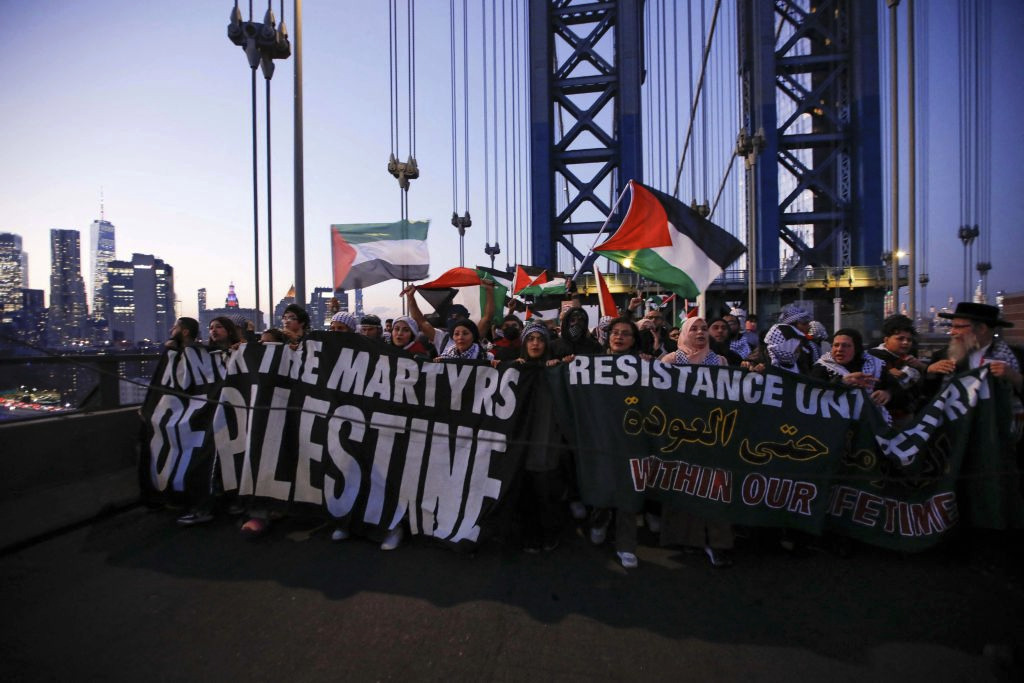
pro-Hamas demonstrations before Israel went into Gaza. Pictured:
Demonstrators protest against Israel on the Brooklyn Bridge in New York
City on November 7, 2023. (Photo by Kena Betankur/AFP via Getty Images)
The main groups that comprise the bulk of organizers and
demonstrators who have supported the Hamas barbarism against Israel are:
1) Radical Islamic groups that, like the Islamic Republic of Iran after the 1979 revolution, regard Israel as the "Little Satan" and America as the "Big Satan."
2) American revolutionary groups who used to be affiliated with
Communism but now call themselves radical socialists or workers parties.
Their goal is to overthrow our government and they attach themselves to
every disruptive movement in the hope of garnering support and creating
distrust for American democracy.
3) Old-fashioned anti-Semites who hate anything associated with Jews
and concoct conspiracy theories that blame "the Jews" for all evils.
4) Useful idiots who have little or no knowledge of the issues but
march in lockstep with all "woke," "hard left," and "anti-colonial"
causes on the theory that "if it's left, it must be right."
Recall that these protests began before Israel counterattacked against Hamas. They were in full bloom on October 8,
even while the bodies of 1,200 murdered Israelis, including babies
burned alive, were still being gathered and counted, and the roughly 240 hostages
taken by Hamas to Gaza identified. These demonstrations were not
against Israeli military actions in Gaza; they had not begun yet. More
joined them after that.
The original responses to the Hamas barbarism in the hours and days
following the morning of October 7 set the tone and began the
organizational actions that followed. Many of the protests that now
demand a unilateral ceasefire -- including the attempts to shut down
Christmas celebrations -- are orchestrated by some of the same radical
groups that organized the pro-Hamas demonstrations before Israel went
into Gaza. Demonstrations and protests by groups such as the Students
for Justice in Palestine, Jewish Voice for Peace or the National Lawyers
Guild seem anything but
spontaneous and grassroots responses to "Israel's military actions in
Gaza." They are not demonstrations against what Israel does; they are
protests against what Israel is, namely the democratic nation-state of the Jewish people.
To be sure, Israel's legitimate military efforts to destroy Hamas
terrorists and the weapons that they have hidden among civilians, and
the resulting civilian deaths, have allowed the anti-Israel organizers
to recruit more useful idiots who believe they are protesting only
against Israeli actions with the chant "from the river to the sea,
Palestine will be free." Many of these undereducated and
over-propagandized students have no idea what bodies of water they are
referring to, or that this chant demands the end of Israel and any
Jewish presence in the Middle East. The radical organizers, however,
know exactly what that chant and others mean: a demand to "clean" the
Middle East of "dirty Jews."
The larger point is that the well-organized and externally funded
demonstrations are directed as much against the United States and its
values as against Israel and its actions. Without the useful idiot
students who join any protest they think is directed against the
"colonial" and "oppressor" targets of "intersectionality," these
demonstrations would be relatively small and limited to long-term
professional haters of Jews and America.
But these useful idiots make these well-funded and organized protests
larger and allow the media to convey the false impression that they are
spontaneous. The media insists on calling these protests
"pro-Palestinian." Nothing could be further from the truth. When it
sounds indelicate to say "pro-Hamas" -- a terrorist organization -- the
signs change to "pro-Palestine." There is nothing to indicate how the
Palestinians would actually be helped by the disappearance of Israel and
leaving them, like the Iranian people, to the tender mercies of a
corrupt, repressive state.
They had voted for Hamas in the first place because they hoped it
would be better. Hamas had promised to be better. It was not. Even most
of its leaders chose not to live in Gaza: they are now billionaires who,
until October 7, had been hiding in five-star hotels in Qatar and
Turkey. When they got word that Israel might hold them accountable, they
reportedly dispersed.
Where are the calls for anything that would actually help the
Palestinians or make their lives better: freedom of speech, equal
justice under the law, freedom of the press, better job opportunities,
and an end to government corruption and abuse?
The protests are exclusively anti-Israel, anti-American, pro-Hamas,
and pro-terrorism. Many of the useful idiots join the protests to
support a ceasefire, without realizing that a unilateral ceasefire now
would constitute an invitation to Hamas to repeat their barbarism over
and over again, as their leaders have promised they would do.
Recall again that the protests against Israel began before there was
any fire to cease – that is before Israel responded militarily to the
Hamas barbarism. The ceasefire demand was added once Israel
counter-attacked, as a way to broaden the base of the protest. The
radical anti-Israel protesters, would not be satisfied with a ceasefire.
They want to see the destruction of Israel and the victory of Hamas.
Indeed, a recent poll suggested that a majority of young Americans would like to see the end of Israel and its replacement by Hamas.
Hamas, of course, would most likely not be satisfied with merely
ending Israel. They want to end all non-Muslim democracies. Already
Hamas has sent operatives to parts of Europe, where several were recently caught. There are probably Hamas operatives in the United States, as well.
Most importantly, what if the useful idiots who now march for Hamas
in favor of Israel's destruction become a fifth column in America and
willingly join Hamas terrorists in targeting Jewish and other
institutions in our nation. It was only a half-century ago that young
Americans joined the Weather Underground and tried to blow up
universities, military recruiting centers and army bases. If Hamas is
not defeated in the Middle East, it is coming to a theater near you.
So when you watch an anti-Israel demonstration on television, please
understand who is behind it and what are their ultimate goals, because
the next target is American democracy -- and you.
Alan M. Dershowitz is the Felix Frankfurter Professor of Law, Emeritus at Harvard Law School, and the author most recently of War Against the Jews: How to End Hamas Barbarism. He is the Jack Roth Charitable Foundation Fellow at Gatestone Institute, and is also the host of "The Dershow" podcast.
During the war in Gaza between Hamas and Israel, the other main
terror group in the region, Hezbollah, based in Lebanon, has been firing
artillery salvos, sending drones, “Burkans” (short-range missiles), and
rockets into northern Israel. The IDF, in turn, has been hitting back —
much harder — at Hezbollah outposts in Lebanon, hitting observation
posts, weapons storehouses, and Hezbollah fighters, of whom the IDF
believes it has killed close to 200. Hezbollah’s official figure is 122
fighters killed as of December 24. That is more than ten times the
number of IDF soldiers killed by Hezbollah in the exchanges since
October 8. Hezbollah has not, however, let fly thousands of rockets, as
it might have done, possibly as part of a ground invasion into the
northern Galilee, if it really wanted to draw the IDF into another major
conflict and thereby lessen the pressure on Hamas in Gaza.
Hezbollah has held back because it is not only a terror group, but a
political group with members in the Lebanese parliament and cabinet, and
it has ambitions to take over the central government. Lebanon is on its
knees economically, with mass impoverishment, and Hezbollah realizes
that were it to start a serious war — as opposed to the current limited
cross-border exchanges of fire with Israel — this would lead to
widespread devastation by the IDF, and the Lebanese would blame
Hezbollah for dragging the country into a damaging war that few in
Lebanon want, one that would only make matters worse for the Lebanese.
So for now Hezbollah is engaged in artillery fire, drone attacks, and
missile attacks, on Israel, across the northern border, making sure to
carefully calibrate its violence so that Israel will not feel compelled
to respond with the ferocity the IDF has demonstrated, much to
Hezbollah’s alarm, in Gaza.
Hezbollah has come up with a different explanation as to why it has
so far limited its rocket, drone, and artillery attacks to northern
Israel, and not sent in ground troops to draw the IDF into a
second-front war. It comes from Nawaf al-Moussawi, a member of
Hezbollah’s political wing and of the Lebanese Parliament. More on his
explanation of why Hezbollah has held back militarily can be found here:
“Hezbollah official: Hamas told us not to begin a war on Israel,” Jerusalem Post, December 23, 2023:
For the first time since the outbreak of the war two and a
half months ago, a senior official in Hezbollah provided an explanation
of the Lebanese terrorist organization’s reluctance to launch an
all-out war against Israel, N12 reported on Saturday.
Nawaf al-Moussawi, a Shia member of Hezbollah’s bloc in the Lebanese
parliament, explains that following Hamas’s terror attack on October 7,
Hezbollah approached the Gaza-based Islamist organization and basically
asked whether they should begin a war against Israel on the northern
border.
“We asked our brothers in Gaza, ‘what can we do?’ If we initiate an
all-out war in Lebanon – will it stop the fighting in Gaza or not?”
al-Moussawi said in an interview broadcast on Al-Manar TV, the official
channel of Hezbollah. “Their answer was no, it will not stop; the
fighting in Gaza will not cease. Only with a victory over Israel within
Gaza,” he continued.
Does this statement seem verisimilar to you? After all, Hezbollah’s
entry into the war would force Israel to redirect some military
resources, as well as some of its attention, away from the war against
Hamas in Gaza. The question Al-Moussawi says Hezbollah asked Hamas was
whether “our launching an all-out war on Israel [will] stop the
fighting.” And Hamas said no. But surely the follow-up to that would
have been Hezbollah telling Hamas that “an all-out war by us won’t stop
the fighting in Gaza, but it will make your task of repelling the
Zionist enemy in Gaza easier, so surely you would welcome that? It would
dilute the IDF’s attention and force it to transfer ground forces to
the northern border with Lebanon.” But Hezbollah did not ask that second
question, because it wanted an excuse to avoid entering a full-scale
war with Israel. It was happy to report that Hamas itself had dissuaded
it from starting such a war.
Thus, it can portray itself as having been ready to enter a major
war, but was willing to defer to Hamas, which wants a “victory” by
withstanding the IDF on its own, hoping that international pressure will
eventually force the IDF to agree to a permanent ceasefire. That is
Hamas’ definition of victory. Hezbollah is a Lebanese group, and is not
ready to risk the destruction of Lebanon in order to help the
Palestinians. Israel has already warned Hezbollah that any escalation by
it on Israel’s northern border could lead to the IDF “turning Lebanon
into Gaza” Having seen what the IDF has managed to accomplish in Gaza,
Hezbollah has to take such a warning seriously.
Israel has said it expects this campaign against Hamas to last for
months. Will Hezbollah continue to engage in intense exchanges of fire
with the IDF but nothing more? What if Hamas, battered by the IDF, and
having by that time lost not 9,000 fighters but twice that number, makes
a public plea for Hezbollah to enter the war in a major way? Could
Hezbollah still resist that call, that would risk the group losing face
in the Arab world? Or would it still want to prevent provoking the IDF
into attacking Lebanon so fiercely that much of the country would lie in
ruins, and the Lebanese would blame Hezbollah? And what will Iran
calculate? If Hezbollah, that everyone understands takes its marching
orders from Iran, that supplies it with both weapons — some 150,000
rockets and missiles from Iran are now in Hezbollah’s arsenal — and
money, enters the war to help Hamas, will Israel then feel compelled to
attack with great ferocity not just Hezbollah, but its puppet-master in
Tehran? Right now the Israelis do not think Hezbollah will enter the
war, as long as Jerusalem continues to respond as fiercely as it has
been doing to each Hezbollah salvo. Let us hope that they are right.
And the media, for some reason, don't call Democrats "election deniers."
The “insurrectionist” clause of the 14th Amendment says, “No person
shall be a Senator or Representative in Congress, or elector of
President and Vice-President, or hold any office, civil or military,
under the United States, or under any State, who, having previously
taken an oath, as a member of Congress, or as an officer of the United
States, or as a member of any State legislature, or as an executive or
judicial officer of any State, to support the Constitution of the United
States, shall have engaged in insurrection or rebellion against the
same, or given aid or comfort to the enemies thereof.” Enacted after the
Civil War, and ratified by the states in 1868, Congress wanted to
prevent officeholders who joined the Confederacy from holding office.
Four of the seven Democrat-appointed Colorado Supreme Court justices
ruled this clause prevents former President Donald Trump from appearing
on that state’s primary ballot. The Michigan Court of Appeals rejected
this argument, and the Minnesota Supreme Court dismissed a similar
lawsuit. But several more states have pending lawsuits based on the
insurrection clause.
Despite democrats having appointed all seven Colorado Supreme
justices, three dissented. Trump vowed to appeal the case to the U.S.
Supreme Court where six of three justices were Republican nominees. It
is practically a foregone conclusion that the Colorado case will be
overturned, and the Supreme Court’s ruling could even be unanimous.
Also, note that while Trump faces three federal conspiracy counts and
one count of obstructing an official proceeding, the special counsel DID
NOT charge the former president with “insurrection.”
In its 200-page majority decision, the Colorado Supreme Court said
that on Jan. 6 Trump told supporters to “walk down to the Capitol” and
“fight like hell” and “take back our country.” Not mentioned is that
Trump also said, “I know that everyone here will soon be
marching over to the capital building to peacefully and patriotically.
Make your voices heard.”
The Colorado Court found “substantial evidence” the Trump was “laying
the groundwork for a claim that the election was rigged” before the
November 2020 election and before the Jan. 6 riot. But does not Trump,
or for that matter, any politician have a First Amendment right to
complain, however unjustifiably, about the integrity of an election?
Hillary Clinton frequently called the 2016 election “stolen” and
President Trump “illegitimate.” Never mind that former President Barack
Obama’s Homeland Security Secretary Jeh Johnson testified that there was
no evidence that the Russians succeeded in changing a single vote
tally. As to the effect of the Russian interference, Johnson said there
was no way of knowing whether it affected public opinion or altered the
election. But Democrats believe otherwise. A 2018 YouGov poll found that
66% of Democrats believe the Russians, to elect Trump, changed vote
tallies. A 2018 Gallup poll found that 78% of Democrats believe the
Russian interference “changed the outcome of the election.” But the
media do not call Democrats “election deniers.”
About the 2020 presidential election, a Quinnipiac University poll
found that “seventy-six percent” of Republicans believed there was
“widespread voter fraud.” Republicans, although slightly less likely to call 2020 stolen than Democrats about 2016, are, of course, “election deniers.”
Finally, the anti-Trump media accuses Trump of peddling “the Big Lie”
about 2020 voter fraud, irregularities or illegality. After all, there
is supposedly no evidence to justify the assertions. John Eastman, a
former Trump lawyer who argued that state legislatures and Vice
President Mike Pence possess the legal authority to reject
certification, now faces disbarment. The California Bar Association
asked this once respected and courtly former dean and law professor at
Chapman University School of Law for evidence about 2020
election-altering widespread fraud. Eastman turned in over 80,000 pages
of documents. In an hourlong speech available for viewing on Rumble,
Eastman spoke in detail about just some of what he considered
substantial election irregularities. It’s called “Taking a Stand Against
a Weaponized Justice System.” I urge the most ardent believer in the
“Trump promoted baseless conspiracy theories” narrative to watch the
speech. Be prepared for discomfort.
“Them Arabs in motherf***ing Detroit tried to kill me!”
Leftists have gone so wildly insane
that their coalition is unraveling. The latest evidence for this
involves a Christmas party — hosted not by the GOP but by Detroit
Democrats in the 13th Congressional District — that was stormed and
attacked by pro-Palestinian protesters. According to World Israel News:
The agitators, members of the Palestinian
Youth Movement and the Party for Socialism and Liberation, first
chanted and banged on the windows, then stormed into the bar, disrupting
the event. They were repeatedly asked to leave, but refused, and
started physically confronting the party attendees.
Pushing and shoving began, with protesters shouting at the revelers.
Democrat party activist Bobbie Johnson
was punched in the face and hospitalized with two black eyes. “They came
in here – they bust me in my head!” she said.
The melee left attendees “bloodied, bruised and in ER,” according to the New York Post:
The brawl even featured 91-year-old former Detroit police commissioner Bernice Smith hitting protesters with a cane.
The Daily Mail quoted an anonymous “black activist” who sustained two black eyes as stating:
‘Them Arabs in motherf***ing Detroit tried to kill me!’
Chaos broke out at the 13th Congressional Democrats' Christmas party Saturday.
A woman was bloodied and called on "black men" to "stand the f*ck up" and fight back against "the Arabs" who crashed the event.
Imagine if a white person said those words about Arabs. Whatever happened to the Left’s self-proclaimed foundational
principles of Diversity, Equity and Inclusion, which their proponents
claim will bring world peace and unity, all while demonizing whites and
pretending that there is solidarity among non-whites — blacks, Arabs,
and, in fact, all people of color? It’s a big lie, and always was.
Indeed, racism
is rampant in the Arab world — a reality most vividly illustrated by
the fact that blacks are still held as slaves in Mauritania, Libya,
Algeria and Sudan. Crossing geographical borders doesn’t necessarily
transform people’s cultures, attitudes and hostilities.
The Detroit incident has not only exposed
the growing antagonism between the black and Arab communities, but it
also brings to light the increasing fractures in the Left’s coalition.
Fractures in the Democrat party and its base are growing amid the heated
emotions of Israel’s war in Gaza.
Take, for instance, Rep. Alexandria Ocasio-Cortez (D-NY). She is herself a member of the Democratic Socialists of America and is rabidly anti-Israel. A 2019 article in Vox asserted that AOC “is more in line with the party’s base than establishment Democrats might think.” Or maybe not. The Detroit brawl exposed divisions
among leftists that carry larger implications for Democrats nationwide:
it pitted mainstream Democrats against Socialist Democrats, and
Israel-supporting Democrats vs. pro-Palestinian Democrats.
It is worth noting that the fracas also
pitted the radical woke agenda (which includes LGBTQ) against the
Islamic expansionary agenda. The two cannot be reconciled on many
levels. The unholy alliance, as David Horowitz has called it, between
the Left and Islam is merely a politically expedient alliance of
convenience. All is not well, and this alliance is not at all what it
has been imagined to be in the Left’s utopian delusion.
Christine Douglass-Williams is Associate Editor of Frontpage, regular writer for
Jihad Watch, a nine-time award-winning journalist, past Canadian
government appointee to the Canadian Race Relations Foundation and the
Office of Religious Freedom; author of "The Challenge of Modernizing
Islam" and "Fired by the Canadian Government for Criticizing Islam".
Atidna has a "Leadership academy to prepare them be citizens in life of Israel" and a works in Israel's storied high-tech sector to find "workplace for Israel-Arabs to integrate them into high-tech jobs. " Atidna partners with the ministry of science.
Atidna—a word that combines Arabic and Hebrew to mean "our future"—is
an innovative grassroots organization that seeks to build a
"partnership with Arabs and Jews" who view themselves as citizens of a
"democratic and Jewish state," Amit Deri, the CEO Partner of Atidna,
told the Jerusalem Post.
The twenty-person delegation, organized their annual trip to Germany before the October 7 war and decided not to cancel it due to the pressing need to explain the nature of the Hamas terrorist movement.
Speaking with the Post from Germany on Thursday, Etaf Shtewe, the
Israeli-Arab project and community manager for Atidna, said Atidna
members were "wearing shirts of the organization with Hebrew and the
Israeli flag" in public.
She said "people were really interested and asking questions." One question was: "What is your position on the war?"
Shtewe said the group told Germans "About Hamas as a terrorist" organization.
The delegation, Shetwe stressed, told the Germans they met that "They
are Arabs and proud of who they are and to be part of Israel."
There was resistance from German Arabs in Berlin, Shetwe said. Many
German Arabs rejected Atidna's mission and are "against the existence of
the State of Israel."
German Cities See Increase in Rallies, Demonstrations Since Start of War
A number of large German
cities, including the capital Berlin, saw mass rallies and
demonstrations since the outbreak of the war filled with antisemitic
slogans calling for the destruction of the Jewish state and expressing
support for Hamas.
In response to attempts by some German
Arabs to reduce Israeli Arabs to Palestinians, the Atidna delegation
rejected the one-dimensional approach and "insisted on their position"
as "citizens of Israel who are very proud of it."
Atidna met with Israeli diplomats at the embassy and German
politicians and educators. Suleiman Suleiman, the second CEO Partner of
Atidna, told the Post, "We had a demonstration in front of the Brandenburg Gate and told them we are against Hamas and terror.
We are not just saying things but want people to know.We stand behind
Israel. We have Arab-Christians with us. We are proud to be Israelis."
He said people on the street had mixed reactions to their views. Some
anti-Israel Germans said "There is no country in the word called
Israel. I had to explain there are Arabs in Israel. If you don't want to
accept Israel, that is your problem."
Suleiman continued to spar against the anti-Israel hate from some
Germans, stating "How can you support Hamas , I asked. They asked how
can we support Israel."
He termed the experience as "Small aggressive reactions, but, on the
other hand, found people who did not know there were Arabs in Israel."
Suleiman said the delegation met with a school teacher in the largely
German Muslim district of Neukölln, where some of the most intense
pro-Hamas demonstrations unfolded. "Suleiman said the group spoke with
an " Iraqi-born teacher who was in Israel and is pro-Israel" and teaches
at a school at Neukölln.
The delegation was also exposed to Germany's history. "We do
education youth exchanges every year. German partners host us and we are
learning about the Holocaust and the history of Berlin and Germany. Our
German partners come to Israel every year and live with families."
Ali Nujidat told the Post "I went to the delegation straight from the
reserves. People were interested" in Atidna. He said he explained to
Germans that Atidna works to "integrate Arabs into Israeli society."
"A lot of people asked us questions on the street. The most
interesting community was the Arab community. An Iraqi studied in the US
and was the first to sign the petition against the actions of Hamas."
The Iraqi is the teacher in the Neukölln district of Berlin.
Deri established Atidna with the late Dr. Dalia Fadila five years
ago. He said Atidna works with more than 30 municipalities across Israel
and has more than 5,000 Israeli-Arab youths enrolled in the NGO's
program.
He noted that Atidna has a "Leadership academy to prepare them be
citizens in life of Israel" and a works in Israel's storied high-tech
sector to find "workplace for Israel-Arabs to integrate them into
high-tech jobs. " Atidna partners with the ministry of science.
Benjamin Weinthal, a Ginsburg/Milstein Writing Fellow at
the Middle East Forum, reports on Israel, Iran, Syria, Turkey and
Europe for Fox News Digital. Follow him on Twitter at @BenWeinthal.
Despite being occasionally reassured by the United States of continuous support, Israel and South Korea also strive to maintain the most vital asset one can provide to the United States: strategic relevance.
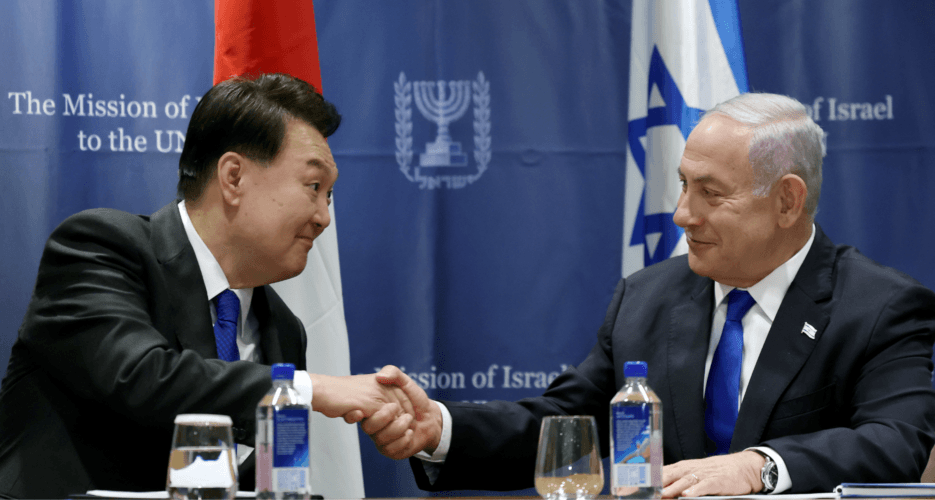
Israeli Prime Minister Banjamin Netanyahu meets with
South Korean President Yoon Suk Yeol in New York City on September 20,
2023.
The parallels between the predicament of Israel and the Republic of
Korea are considerable. Both face existential threats on their borders.
Though both states are democracies, the commonalities between them run
deeper. Both are relatively young countries born out of conflict. Both
exist under threats from their respective neighbors from inception. Both
suffered periods of isolation in world politics,[1]
yet despite heavy economic burdens due to many security challenges,
both managed to build a vibrant democracy and a prosperous economy. Both
countries maintain the most vital asset one can provide to the United
States: strategic relevance. And both states' economies are
export-oriented. A bolstered relationship with Seoul, which is relevant
and useful to American interests, serves Israel's strategic interest.
Considering North Korea's role in exporting missile technologies to
Syria and Iran, its nuclear proliferation role, and its training of
Palestinian terrorists, Israel has developed a special interest in the
Korean Peninsula.[2] North Korea has also helped Hizballah and there is evidence of North Korean assistance in building tunnels exposed in 2006.[3]
Having formally begun their relationship in April 1962, the
connection between Israel and South Korea has continued to improve,
culminating in 2022 in a free trade agreement (FTA). Israel and South
Korea enjoy a mutually beneficial partnership predicated on similarities
in their geopolitical challenges, such as a hostile environment, the
nuclear threat, the relationship with their US ally, make or buy
dilemmas in weapon procurement, and their economic interactions.
Israel first opened its embassy in Seoul in 1964. Shortsightedly,
Israel then closed the embassy in 1978 as part of the budgetary cuts in
the Foreign Ministry.[4]
However, in the wake of the Gulf War and to accommodate Washington's
recommendations, Israeli-South Korean relations resumed in 1992 at the
ambassadorial level,[5] and South Korea opened its embassy in Tel Aviv two years later.
While Israel and South Korea are strong military powers, both tried
to solve their ongoing regional conflicts peacefully at the end of the
last century. Israel tried via the Oslo process, while South Korea
practiced the Sunshine Policy toward North Korea. Interestingly, Israel,
under Yitzhak Rabin even tried to change North Korean behavior in the
Middle East.[6]
These attempts failed. Israel and South Korea remained aware that they
must have the military capabilities to deal with their respective
conflicts should they intensify.
Their separate political biographies are conducive to a better mutual
understanding and cooperation. In 2014, South Korea's former ambassador
to Israel, Lee Gun-Tae, told visiting Israeli president Reuven Rivlin:
"South Korea is probably the only country that can understand Israel's
complicated situation." Rivlin replied: "Until I came to Seoul, I
thought there was only one miracle, Israel, and then I saw what you have
done since the 1950s."[7]
Rivlin was the first Israeli president to visit South Korea. He
expressed his hope for closer cooperation and bilateral tourism. Indeed,
nearly 10 years later, the two countries are more intimate than ever.
This article analyzes the parallels between the predicament of Israel
and the Republic of Korea. It looks first at the geopolitical
situation, followed by an analysis of their current relations with their
main ally, the United States. Subsequently, the significance of the
nuclear threat is assessed, and the role of military industries is
reviewed. Finally, the bilateral economic arena is presented.
The Geopolitical Predicament
The historical background of both countries intensifies their threat
perception: both South Korea and Israel have faced events that have
called into question their very survival as states within living memory.
These form a prism through which contemporary threats are viewed. The
opponents of both countries continue to entertain hopes for achieving
politicide, i.e., destroying their states: Many of Israel's Arab and
Muslim foes remain not ready to accept a Jewish state. Instead, they
desire Israel's demise. In recent years, Iran too has presented an
existential challenge due to its theological opposition to the existence
of the Jewish state and its nuclear aspirations.
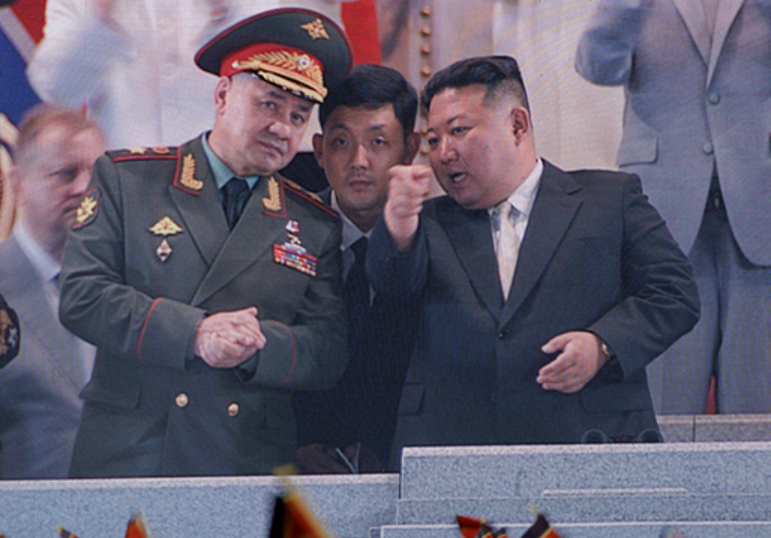
North Korean leader Kim Jong Un and Russian Defense
Minister Sergei Shoigu watch the Day of Victory in the Great Fatherland
Liberation War on July 27, 2023.
Similarly, the North Korean regime wants the South Korean
state to disappear so that it can take over its territory and unite the
peninsula under its rule. The Soviet Union then, and today Russia, has
backed North Korea. China, an ascendant global power, is also a patron.
The most notable existential threat to South Korea comes from its
northern border. In addition, its economic relationship with China puts
South Korea in an uncomfortable geopolitical position. China is a major
market for South Korea's exports, and in 2021, imported about $196.2
billion from South Korea, accounting for about 30 percent of South
Korea's total exports. That, in turn, has created a dependency on China
at a time when the United States, Korea's ally, and China are competing
for regional influence.
China is also an important market for Israel, accounting for 8
percent of total exports and 14 percent of all imports in 2021. Yet its
civilian exports do not constitute a point of friction with the US.
Rather, Israel's export of potentially dual-use items irks Washington,
as well as infrastructure projects built by Chinese firms. As a result,
Israel established a more rigorous mechanism in recent years to monitor
economic interactions with Chinese firms that could attract American
criticism.
The changing international landscape dominated by China-US
competition introduces new national security challenges for Jerusalem.
It is unclear whether Israel retains its strategic value to the US,
which is pivoting in its geostrategic focus to Asia.[8]
This leaves Israel alone to face the Iranian threat. The China-US
competition also negatively affects South Korea, which is militarily
dependent upon America and China for its economic prosperity.
Nevertheless, the United States' increased threat perception of Chinese
encroachment brings its Asian allies that share this concern closer to
Washington.
The decreased American interest in the Middle East threatens the
stability of the region's energy routes and is conducive to closer
relations between Israel and South Korea. South Korea imports 93 percent
of its energy from abroad, including 58 percent of its oil supply from
the Middle East. In 2021, the total cost of its energy imports, which
accounted for about 22 percent of South Korean imports that year,
amounted to $137.2 billion. As one of the world's top consumers of
Middle Eastern oil, South Korea has a stake in the region's stability.
It currently enjoys a strong relationship with the states whose energy
it needs and has, in turn, been a vital economic partner for countries
like the UAE. As a result of the Abraham Accords and Israel joining
CENTCOM, as well as the perceived American decreased profile, Jerusalem
is increasingly viewed as a potential security provider in the region.
Israeli and South Korean interests converge in this respect.
Relationship with the US
The United States plays a great and complicated role in the affairs
of both Israel and South Korea. As a global economic, political, and
military hegemon, being seen as a valuable partner of the United States
is important for small countries like Israel and South Korea. Washington
shields the two states in diplomatic multilateral fora. Moreover, the
strong relationship with the US enhances deterrence. The presence of US
soldiers in the Korean peninsula at the demilitarized zone (DMZ) along
the border with North Korea, reinforced by a defense treaty, has a
powerful effect.
In contrast, Israel's national security doctrine stresses
self-reliance and not requiring a US military presence for its defense.
Nevertheless, Israel is the beneficiary of substantial American arms and
foreign aid. As part of the 2016 Memorandum of Understanding between
the United States and Israel, Jerusalem receives $3.8 billion each year
(which must be spent in the United States) and receives additional sums
allocated by Congress for special projects.[9]
Despite the United States being the first country to recognize Israel
in 1948, the special relationship between the United States and Israel
began to develop only after Israel's victory in the 1967 Six Day War
over Arab Soviet clients. After the Soviet Union disintegrated, radical
Islam became the main enemy of America. In this struggle, Israel, due to
its location and acquaintance with the Arab and Muslim world, remained a
key strategic asset. The amount of aid the United States renders to
Israel reflects its strategic value to the United States as a strong
democratic stronghold in a region mired with unrest but of importance to
the United States.
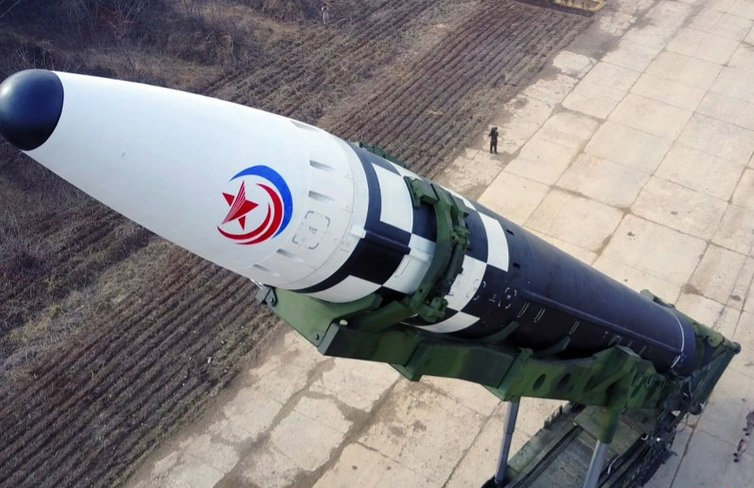
A North Korean Hwasong-17 intercontinental ballistic missile.
The United States is formally committed to preserving
Israel's Qualitative Military Edge (QME), which entails the transfer of
advanced technologies and weapon systems. An important example was the
sale of the American F-35 Stealth Fighter to Israel, the first American
partner to receive one. The transfer of American weapons to Israel makes
the IDF–which continuously engages in military conflict–an important
laboratory for American arms. Israeli upgrades to American weapons
systems and intelligence-gathering capabilities benefit Washington
enormously. Furthermore, the United States invests in Israeli pioneering
military technologies, such as developing the ballistic missile defense
system (Arrow 2, 3, and David's Sling).
Regarding South Korea, the United States constitutes its main buffer
against North Korean aggression. Since the signing of the Mutual Defense
Act at the end of the Korean War in 1953, the United States has
maintained a military presence in South Korea to deter and fight with
the South Korean army against a military invasion.
While South Korea is a sovereign country, it owes much of its current
success to the United States security umbrella. Though it does not
receive direct American foreign aid like Israel does, the massive
deployment of American military resources to the country, which between
2016 and 2019 cost the American government $13.4 billion, has helped
Seoul carry the defense burden. Moreover, the United States intervened
militarily to defend its independence against North Korean and Chinese
invasions.[10]
Since the Korean War, the American government has supported Seoul and
created the context for its development into the economic power it is
today. For example, during the 1990s, South Korea received about $62
billion in foreign direct investment from American businesses, which
helped support the struggling South Korean economy. Furthermore, during
the Asian Financial Crisis of 1997, the United States advocated on its
behalf to the IMF to help save South Korea's economy.
Israel's and South Korea's dependence on the United States has also
led to significant tension between Washington and Jerusalem, and Seoul.
For example, former South Korean president Park Chung Hee initiated in
the 1970s what was South Korea's first attempt to build a nuclear
option. This undertaking began in part because of fears of abandonment
by the United States. In 1970, President Richard Nixon withdrew 20,000
of the 63,000 American servicemen stationed in South Korea. Even after
Seoul stopped its nuclear program in 1976, bowing to US pressure,
tensions worsened as President Jimmy Carter withdrew the 2nd Infantry
Division and the US's nuclear weapons.
President Donald Trump's efforts to create a dialogue with North
Korea upset the South Korean government. Trump had accused the South
Korean government and many others of not paying their fair share to
maintain the American military forces serving outside of the United
States. Former president Moon Jae-in, who helped broker the meetings
between North Korea and the United States, was upset by Trump's
perceived favoritism of North Korea over South Korea. Since President
Joe Biden took office in 2020, he has sought to reverse Trump's Korea
policy and maintain an open dialogue and close partnership with South
Korea without embracing President Kim Jong Un.
Israel too has had moments of tension with Washington. In 1956, the
US lambasted the Israeli, British, and French invasion of the Suez Canal
Zone. During the 1967 Six Day War, tensions were inflamed as the IAF
mistakenly attacked the USS Liberty, an American spy ship. In 1975,
President Ford threatened to withhold support for Israel unless it
withdrew from the Sinai Peninsula, which it had conquered from Egypt in
1967. During the First Lebanon War in 1982, President Ronald Reagan
heavily criticized the Israeli government for using American weapons.
President George H. W. Bush threatened not to approve loan guarantees
unless Israel stopped settling Jews in the West Bank.
Today, Washington is displeased with Israel's and South Korea's
policies toward the Ukraine conflict. Fortunately for both South Korea
and Israel, their respective periods of tension with the United States
were temporary speed bumps in what have been productive and mutually
beneficial relationships. Such strains are typical of great power-small
ally relationships.
Amid its fear of abandonment and the uncertainty regarding the
long-term commitment of the United States to South Korea, President Yoon
Suk Yeol put forward in January 2023 the idea of unilaterally
developing nuclear capabilities to limit his country's dependency upon
US extended nuclear deterrence. In response, Biden called South Korea
the "linchpin of regional security and prosperity" and assured that an
attack from North Korea would "result in the end" of that regime.[11] Yet America's partners around the world surely understand that a promise from a president is not ironclad.
Despite being occasionally reassured by the United States of
continuous support, Israel and South Korea also strive to maintain the
most vital asset one can provide to the United States: strategic
relevance. At different periods in history, the focus of the United
States has shifted from one part of the world to another. As the United
States ends its War on Terrorism in the Middle East, its focus has
shifted to Asia, toward China's rising power. South Korea most likely
benefits greatly from the increased attention the United States grants
its region. Given the already extensive American assets in South Korea,
they will certainly remain relevant during the China-US rivalry.
Though it is unlikely that the US-Israel special relationship will
end soon, Israel has shifted its diplomatic focus to Asia to stay
strategically relevant to America and benefit from the partnership with a
global power. Much more is needed. That is the context that the
Israel-South Korea relationship can best be understood. A bolstered
relationship with South Korea, which will be relevant to American
interests, serves Israel's strategic interest.
The Nuclear Threat
The threat of nuclear weapons has been a central concern for South
Korea as the North Korean regime has ignored every international
prohibition to develop atomic capabilities. Despite harsh sanctions and
diplomatic efforts by Western countries to disarm North Korea, it has
built nuclear weapons. Moreover, despite what seemed to be a pause in
long-range ICBM testing during the Trump administration, Kim continues
to test new, advanced ballistic missiles, thereby threatening the US and
its allies in the region. For example, North Korea successfully
launched a Hwasong-18 solid-fuel ICBM in April 2023.[12]
While North Korea has made a show of launching missiles for years, its
development of an advanced ICBM is of great concern. Despite the clear
threat on its northern border, South Korea decided not to prevent by
force the development of North Korean nuclear weapons, given Seoul's
dependence on United States military support, which objected to a
military strike.
In the 1970s, as South Korea feared abandonment by the United States,
it sought to build a nuclear deterrent. In addition to conducting
independent research under what was then known as "Project 890," South
Korea negotiated with both France and Canada to buy a reprocessing plant
that would allow it to separate plutonium (fissionable material
suitable for a nuclear bomb). The United States blocked the sale and
threatened to pull out even more soldiers and resources from South Korea
if it continued to pursue a nuclear program. By 1978, it was clear that
Seoul would receive no foreign aid for its atomic program, and Project
890 died.[13]
Some voices in South Korea have argued that the peninsula's
unification will finally award their country nuclear weapons. However,
given that the reunification of the Korean Peninsula looks unlikely
in-the-near future, one can understand the recent suggestion by
President Yoon that South Korea may need to renew a nuclear weapons
program. Indeed, Seoul is questioning the credibility of the American
nuclear-extended deterrence after North Korea achieved an atomic
arsenal. The United States responded to the Korean fears. For example,
on April 26, 2023, Biden lauded the US relationship with South Korea and
assured South Korea that it would be absorbed into the American nuclear
umbrella.[14]
While the United States hopes this sentiment will assuage South Korea's
fears of abandonment, it may not be the long-term solution for which
South Korea is hoping.
Israel successfully developed a nuclear option in the 1960s despite
American attempts to interfere. It adopted a posture of ambiguity,
formally denying the existence of nuclear weapons. To counter the threat
of atomic weapons, Israel took unilateral actions. For instance, in
1981 and 2007, the Israeli Air Force successfully struck Iraqi and
Syrian nuclear facilities. This idea of Israel unilaterally stopping its
enemies from developing WMDs is known as the Begin Doctrine.[15]
To date, Israel has failed to follow this doctrine in its ongoing
conflict with Iran and now faces a serious nuclear threat. The different
approaches to the Iranian nuclear threat of Washington and Jerusalem
are a sore point in American-Israeli relations.
South Korea failed to prevent North Korea from developing
WMDs and, as a result, now faces a nuclear North Korea across the DMZ.
The threat of an atomic North Korea has not been felt just by South
Korea. North Korea has worked with other rogue states with nuclear
ambitions, specifically Syria and Iran.[16]
North Korea helped provide Syria with a nuclear reactor before the
Israeli Air Force destroyed it in 2007. North Korean ballistic missile
experts were sent to Syria to facilitate the development of its missile
program. North Korea assisted Iran in developing its nuclear and
ballistic missile programs for years. North Korea's close partnership
with these states that pose the greatest direct threats to South Korea
and Israel is highly troubling. Iran is much farther from Israel than
North Korea is from South Korea, but it still threatens both states'
interests. China also shares responsibility for the proliferation of
missile and nuclear technology in the Middle East. It is hard to believe
that the mischievous North Korean role in transferring destabilizing
technologies to Iran and Syria happened without China looking the other
way.
In addition to South Korea's concerns about Iran as a partner and
ally of North Korea, its interest in helping stop Iran's rise to
hegemony in the Middle East also reflects its own interests in the
Middle East. South Korea's reliance on Middle Eastern energy and the
presence of 25,000 South Koreans who work in the region makes the threat
of a nuclear Iran problematic. North Korea constitutes a challenge
(albeit of a different order) for the two countries. They obviously
share intelligence about the North Korean terrorist threat and its
Middle East activities. Therefore, close cooperation between Israel and
South Korea provides each with a partner that has a stark understanding
of the threat its enemies pose to their state's survival, an existential
threat with which the United States can empathize but cannot fully
appreciate.
The Make or Buy Dilemma
One area where Israel and South Korea have sought to work
independently is weapons development and manufacturing. Having relied on
American military support for most of its history, South Korea
succeeded in developing a remarkable arms industry and became a weapons
exporter. That reflects in part its desire to reduce dependency upon the
United States. Nevertheless, both continue to purchase weapons from the
United States because it is less expensive and more expedient than
manufacturing indigenous-made weapons that still would have to be
integrated with American-supplied weapon systems.
IDF Major General Ori Gordin tests a virtual reality parachute simulator at Camp Lejeune in North Carolina in 2016.
Though it does not host a US military base, the United
States stores equipment in Israel and reportedly has an early warning
system in the Negev. Nothing like South Korea, but a presence is still
signaling at least some continued commitment. Israel has received
billions of dollars in military aid and the latest military hardware
from the United States. In parallel, Israel has made a name for
itself as a global leader in weapons exports. It has used that to
develop closer diplomatic ties with Asian countries that, like South
Korea, hope to modernize and expand their military capabilities outside
the American market.
Israel has also been at the forefront of modern military technology,
notably cybersecurity and missile defense. Having dealt with larger
militaries, Israel had to focus on better technology to compensate for
the quantitative inferiority. The United States recognized this fact and
decided to aid Israel in maintaining its qualitative military edge by
selling advanced weapons and by allowing in the past a portion of the
aid to be channeled to Israel's military industries. The United States
and Israel have benefited greatly from Israel's need to maintain its
QME. Despite having a developed military industry, Israel has been a
great customer of American arms for decades and still relies on the
United States for much of its advanced hardware. However, having
previous periods of frustration with each other, Israel prioritizes its
ability to develop weapons technology independently.
An important example of why this is easier said than done is
the IAI Lavi fighter jet project. In the 1980s, IAI began production on
this fighter jet to be incorporated into its air force. However, the
endeavor was very costly, and the quality of the plane itself would not
have come to par with the fighter jets produced and sold by the United
States at the time. The Lavi shows the limitations of small states in
building large platforms. The Lavi jet reflects the pressure that
countries dependent on arms sales from the United States, like Israel
and South Korea, experience. Being reliant on a foreign power to provide
security is risky, given that the provider may freeze arms transfers
and military cooperation over a political disagreement, thereby putting
the supplier country at a significant advantage.
Regarding the making vs buying dilemma, South Korea has made a
concerted effort in recent years to develop its military-industrial
infrastructure. In 2020, the South Korean government launched the
Defense Reform Plan to make South Korea, like Israel, a notable weapons
exporter and a strong, self-dependent military power. In 2022, South
Korea exported $17.43 billion in defense technology, a 140 percent
increase. That aligns with Yoon's goal of having South Korea become the
world's fourth-largest weapons exporter by 2027. For example, in 2022,
South Korea signed an agreement with Poland to see the Eastern European
country obtain tanks, fighter jets, howitzers, and multiple rocket
launchers. These deals with Poland amounted to approximately $12.4
billion, which may grow as Poland tries to modernize its army. In 2022,
South Korea also set a global record for the most expensive defense sale
when it sold the Cheongung II midrange SAM system to the UAE for $3.5
billion.
South Korea's defense companies were ranked in the top 100 defense companies of the world according to The Defense News Top 100 list of military industries. A similar achievement was part of the Israeli weapon system producers.
Biden has sought to include South Korea as a direct supply chain
partner for NATO weapons, a prospect that certainly would boost the
South Korean defense export industry well into the future. All these
profitable developments for the South Korean defense industry have
aligned with Yeol's goal of becoming a global defense exporter and are
helping shift the country away from being wholly reliant on the United
States for its military needs. While South Korea has become more
ambitious in its weapons manufacturing and export industry, it may find
that the United States is less eager and willing to continue providing
the same level of security it has since the 1950s. South Korea is now
paying more to maintain the American military forces stationed in South
Korea. However, becoming military independent of the United States would
be massively expensive.
From 2016-2019, the United States spent $13.4 billion to maintain its
forces in South Korea. While South Korea has contributed around $1
billion-$1.5 billion[17]
each year to help cover the costs, the American government can threaten
to withdraw its forces if it feels that it is being taken advantage of,
as it has previously done. Countries like Israel and South Korea aim to
balance their relationship with the United States to benefit from the
US's weapons industry while pursuing independent research and
development to help their domestic military sector. A good example of
this comes amidst the supply chain issues that have plagued Western
countries as they supply weapons and armaments to Ukraine. While the
United States military does not buy South Korean weapon systems, it
views them as an ever more important part of its military supply chain
and has continued to purchase South Korean manufactured materials like
artillery shells to maintain its supply. Similarly, Washington pressures
Israel to supply Ukraine with certain weapon systems.
Israeli-South Korean economic cooperation might be bolstered by the
2022 FTA. In 2021, the total value of goods and services traded between
Israel and South Korea surpassed $3.5 billion, a 35 percent increase
from 2020. This trade comprised about 2.26 percent of Israel's exports
in 2021 and 31 percent of South Korea's export. These figures will
probably increase due to the newly signed FTA.
Both states' economies are export-oriented. Israel, with a small
domestic market, seeks overseas markets. Its immediate region, the
Middle East, does not always welcome Israeli goods, and its purchasing
power is limited. In contrast, South Korea's main economic partners are
China (including Hong Kong), Vietnam, Japan, Taiwan, India, and
Singapore. Together, these countries account for 52 percent of South
Korea's exports in 2021. By contrast, Israel's trade within the Middle
East accounted for about 7 percent of its total exports in 2021. Based
on these figures, it is an economic imperative for Israel to find trade
partners with large purchasing power outside of its region.
Israel exported over $1B worth of goods and services to South Korea
in 2020 (before the FTA was signed in 2022). While Israel has a trade
deficit with South Korea, Seoul has a higher purchasing power than
Israel's neighbors. Korean cars comprised roughly 40 percent of South
Korean exports to Israel in 2020. Trade between Jerusalem and Seoul has
grown 4.37 percent annually since 1995. Furthermore, having paused
during the epidemic, direct flights between Tel Aviv and Seoul have
resumed with three flights per week. This more convenient means of
travel for Israelis and Koreans will boost tourism, an industry
important to Israel's economy.
In addition to South Korea, Jerusalem is trying to forge stronger
ties with other Asian countries, including India, Japan, China,
Singapore, and Vietnam, all of whom trade close to or more than $1
billion with Israel. These relationships are predicated on the economic
growth of many Asian countries and the relative advantages of Israel's
products. Enhancing their military capabilities in a region where threat
perception from China has increased is also a factor in buying Israeli
products. Like Israel, South Korea's top trading partners are the United
States and China.
About 30 percent of South Korean exports go to China (including Hong
Kong), as opposed to 16 percent to the United States. The well-being of
South Korea's economy is tied to the success of China. If pushed into a
corner, it is unclear how South Korea will act when confronted with
potentially upsetting China, its main economic partner. That could
paralyze more than a quarter of its economy if areas China could easily
control, like Hong Kong or Taiwan – comprising an additional 10 percent
of South Korean exports–are included. It is precisely because of
dilemmas like this that the value of a relationship with Israel, a
strong independent country outside of Asia, is important.
While South Korea's relationship with the United States is
complicated by its large trade with China, South Korea's economic
involvement with countries outside Asia has been crucial for
diversifying its economy. The Middle East, for example, has been one of
the regions outside of Asia where South Korea has found much success. In
addition to having a central role in the Middle East construction boom
of the 1970s and 1980s, about 25,000 Korean nationals still live and
work in Middle Eastern states.
Exports to the Middle East have proved valuable for the South Korean
economy. In 2021, South Korea exported about $3.5 billion to Saudi
Arabia, $7.5 billion to Turkey, and $4.1 billion to the UAE. While this
may look positive for Seoul, they have significant trade deficits with
all these countries except Turkey. This trade deficit is due to South
Korea's imports of Middle Eastern energy.
For example, Saudi Arabia imported about $3.5 billion worth of goods
from South Korea in 2021 while exporting $24 billion in the same year to
South Korea. Similarly, South Korea exported $4 billion to the UAE
while importing $7 billion and exported $458 million to Qatar while
importing $9.3 billion. Though much of the world relies on renewable
energy, these trade statistics show that South Korea has a massive trade
imbalance in the Middle East largely due to its reliance on Middle
Eastern energy.
According to the South Korean Foreign Ministry, South Korea imports
about 93 percent of its energy, including about 60 percent of its oil,
from Middle Eastern countries.[19]
This accounts for 22 percent of all South Korean imports and amounts to
a total value of $137.2 billion annually. South Korea partially
prioritizes its relationship with Middle Eastern states due to its
dependence on Middle Eastern oil. Furthermore, South Korea's connection
to these Middle Eastern countries may bolster the South Korean-Israeli
partnership. As a result of the Abraham Accords, many of these countries
have normalized relations with Israel. Therefore, closer Israeli-South
Korean economic cooperation will likely continue through their mutual
trade partners in the Middle East, an idea underscored by the signing of
the Israel-South Korea FTA in 2022.
Conclusion
The relationship between Israel and South Korea has not always been
smooth, yet both states have realized the benefits of befriending one
another. Both countries face a hostile geopolitical environment with
significant military and political challenges. South Korea faces an
increasingly strong and bold North Korea. Israel faces terrorist groups,
Iran, and Iran proxies like Hezbollah, all seeking the Jewish state's
destruction. Just as Israel and South Korea deal with significant
defense concerns, having a partner like the United States helps provide
much-needed military and economic opportunities. The United States
relationship with Israel and South Korea is unique, yet both serve
important roles in American grand strategy.
While having a hegemon like the United States as a partner is vital
for both countries, Israel and South Korea also strive to assert their
independence. They try to maintain their independence and utility to the
United States through their military industries. The buying-or-making
dilemma clearly shows that there are risks and rewards for choosing to
develop and export one's own armaments. Nevertheless, Israel and South
Korea have developed global reputations by selling high-quality
munitions and military systems to countries worldwide.
The Israel-South Korea relationship is also predicated on economic
cooperation, especially with other Middle Eastern countries. While South
Korea has lucrative trading opportunities in its region, its reliance
on Middle Eastern energy necessitates maintaining strong ties with the
countries with whom Israel has started normalizing relations and trade.
The 2022 FTA between Israel and South Korea further underscores the
importance each country places on the other and the mutual goal to
develop their partnership further, despite the distance between the two
countries being a constraining factor in the bilateral relationship.
Interestingly, what also brings the two countries together is the
South Korean keen interest in Talmud studies. There is widespread
appreciation of Jewish intellectual achievements and Talmud--a
fundamental Jewish text--has become a popular study subject and a part
of the curriculum in the South Korean education system.
Given this convergence of Israeli and South Korean interests in the
Middle East and Israel's new focus on developing ties with Asian
countries like India, Japan, and Vietnam, a strong partnership with
South Korea is in its best interest.
Efraim Inbar is president and Jakob Rheins is an
intern at the Jerusalem Institute for Strategy and Security. They thank
Yaakov Amidor, Eyal Ben-Ari, Hillel Fisch, and Shmuel Sandler for their
remarks on an earlier version.
[1] Efraim Inbar, Outcast Countries in the World Community (Denver: University of Denver Press, 1985).