by Fiamma Nirenstein
As protests return to Iran’s streets, Tehran escalates its threats against Trump, Israel and the West, raising the prospect of a dangerous new confrontation.
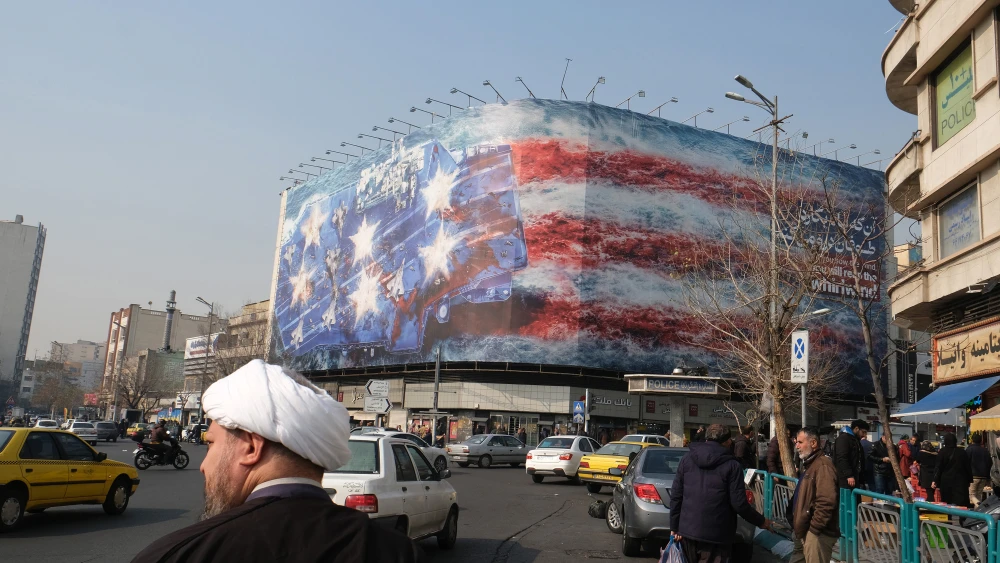 |
| An Iranian clergyman walks in Revolution Square in Tehran with a huge banner that depicts a missile attack on board a U.S. carrier in the Gulf, painted in American flag colors, Jan. 26, 2026. Photo by Kaveh Kazemi/Getty Images. |
Abdanan, a predominantly Kurdish city in western Iran, is a name that, more than the many explosive incidents of recent days, may one day be cited as marking the beginning of the end of the ayatollahs’ regime. The name of this city could signal the start of the collapse of the messianic aggression that has been displaying its peacock feathers so ostentatiously in recent days.
In Abdanan, the deaths of 13 oil and gas workers in a bus crash sparked a large protest march on Tuesday, reviving the anti-regime demonstrations that shook Iran in January. Once again, people are shouting “Death to the dictator” and slogans supporting the Pahlavi dynasty, despite the presence of the Islamic Revolutionary Guard Corps and the Basij militia, backed by death sentences that continue to claim the lives of people already starving under inflation of 89.9%.
The population is being subjugated by force. Yet perhaps precisely because the system is no longer sustainable, the regime is accelerating at a thousand kilometers an hour, veering off the road in its pursuit of the Mahdi.
Tehran is plastered with enormous murals depicting Trump bloodied, chained, hanged and burned. The message, proclaimed in giant letters, is that he will be killed.
CNN has reported on an alleged Iranian plot involving a “dirty bomb” in Washington or the use of chemical weapons. Trump has not backed down. Since “they are crazy,” perhaps they are seeking a catastrophe that will ultimately engulf them as well.
The International Atomic Energy Agency (IAEA) has also warned about Iran’s possible progress in secretly enriching uranium. Against this backdrop came the Nov. 6 announcement of a $20 million reward from the U.S. State Department for information about the locations, equipment and personnel involved in Iran’s nuclear program.
At the same time, U.S. Treasury Secretary Scott Bessent, who oversees sanctions, was reportedly moved to a military facility to protect him from assassination attempts.
Adding to the mounting tensions, a 10-minute film was released showcasing a new ballistic missile facility, reportedly housing some 2,500 missiles capable of striking targets far beyond Iran’s borders.
At the entrance to the Strait of Hormuz, on the island of Qeshm, Iranian opposition sources reported at least seven explosions following an alleged attack on an Iranian air-defense system.
The list also includes a reported strike on a military system in Bahrain; Iranian assassins targeting the regime’s enemies around the world; threats of missile attacks against Europe; and a police operation in Berlin that reportedly uncovered, at 28 locations associated with an organization called “Qalam,” a financing network for Hezbollah, Iran’s terrorist proxy.
The future is unpredictable. Israel knows that air-raid sirens could sound at any moment, and the level of alert is high. It would prefer not to act alone, but if the threat becomes existential, it will have to do so. Even those who oppose such action understand this.
Trump, following the Republican defeat in the midterm elections, faces a contentious debate over Iran. Russia and China have an interest in keeping the ayatollahs in power, while for Trump, Iran represents a direct enemy.
In confronting the United States, Iran could choose the messianic path, seeking to unleash the greatest possible explosion. Such a course is inherent in the regime’s nature.
Trump understands this. Iran represents a potentially fatal danger to the world, one for which no peaceful resolution is in sight and which could materialize in the near future.
Iran’s power rests on its nuclear infrastructure. Destroying it would secure Trump a positive place in history and could be accomplished during his remaining two years in office.
It might also encourage the Iranian people to take to the streets and fight for power.
Perhaps.
Meanwhile, the USS Theodore Roosevelt has arrived in the U.S. Central Command (CENTCOM) theater of operations, joining the USS George Washington and the USS George H.W. Bush.
Fiamma Nirenstein is an Italian-Israeli journalist, author and senior research fellow at the Jerusalem Center for Security and Foreign Affairs (JCFA). An adviser on antisemitism to Israel’s Ministry of Foreign Affairs, she served in the Italian Parliament (2008-2013) as vice president of the Foreign Affairs Committee. A founding member of the Friends of Israel Initiative, she has written 15 books, including October 7, Antisemitism and the War on the West, and is a leading voice on Israel, the Middle East, Europe and the fight against antisemitism.
Source: https://www.jns.org/opinion/column/fiamma-nirenstein/irans-messianic-march-toward-confrontation

No comments:
Post a Comment