by David Isaac
Ra’am’s Mansour Abbas has cultivated a conciliatory image before Hebrew-speaking audiences, but speaks quite differently when addressing his Arab Israeli constituents.
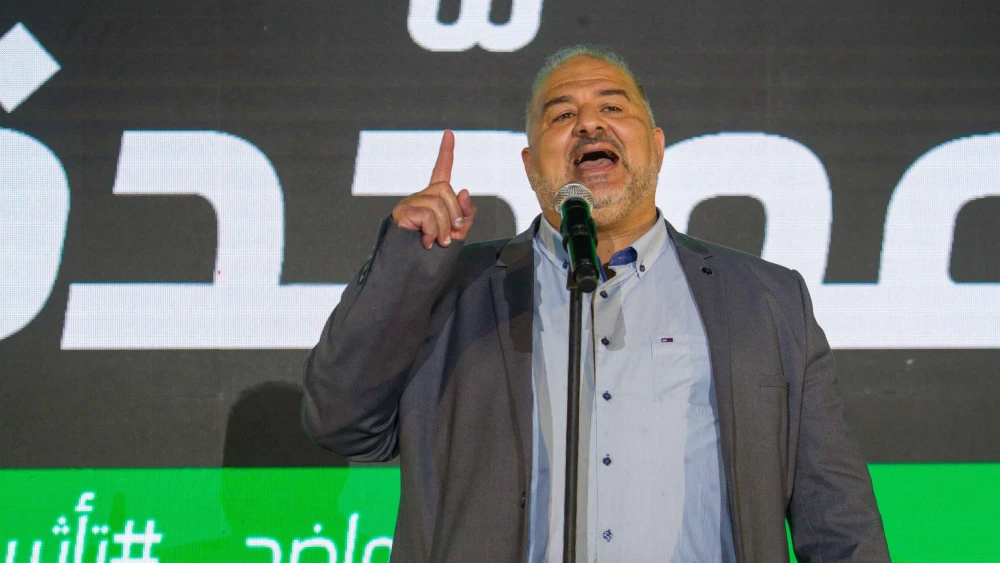 |
| United Arab List (Ra’am) Chairman Mansour Abbas at the party’s campaign headquarters in the Arab city of Tamra in the Lower Galilee, as the results of the Israeli elections are announced, Nov. 1, 2022. Credit: Flash90. |
The United Arab List (Ra’am) presents itself as moderate. Its leader, Mansour Abbas, speaks to Israelis of tolerance, coexistence and conciliation. Some are convinced of his good intentions, while others warn of what they claim are his true intentions.
Ra’am is an Islamist party. It is the political wing of the southern branch of the Islamic Movement in Israel, a Muslim Brotherhood group founded by Sheikh Abdullah Nimr Darwish (1948–2017), an Islamic leader from the Arab Israeli city of Kafr Qassem.
In 1979, Darwish began his Islamist career by establishing an underground terrorist group, Usrat al-Jihad, or “The Family of Jihad.” Israeli authorities uncovered the organization and arrested Darwish in 1981. It engaged in arson and sabotage, weapons stockpiling and the killing of an Arab, who it accused of collaboration.
Moran Tal, an Arabic-language researcher for the Israeli NGO Regavim, told JNS that Ra’am’s ultimate goal is to replace the State of Israel with an Islamic caliphate.
Tal has combed through speeches and interviews of Ra’am’s current leader before he entered politics, “when he spoke openly and didn’t mince words.” So radical is Ra’am’s goal that Abbas, in a 2015 speech, said it would be a “democratic caliphate” to ease the fears of an Arabic-speaking audience, not all of whom were Islamists.
A caliphate would strike most as a pipedream. However, Harold Rhode, a fellow at the Jerusalem Center for Security and Foreign Affairs (JCFA) and the author of “Islamic Warfare and the October 7th Massacre,” told JNS that Islamists have “infinite patience.”
“Once a land is conquered by Islam, it must remain Muslim,” he said. “This whole land was conquered in 637-38 B.C.E. by the Muslims. By their logic, it must be ruled by Muslims forever. There’s no going back. This is what Ra’am is all about.”
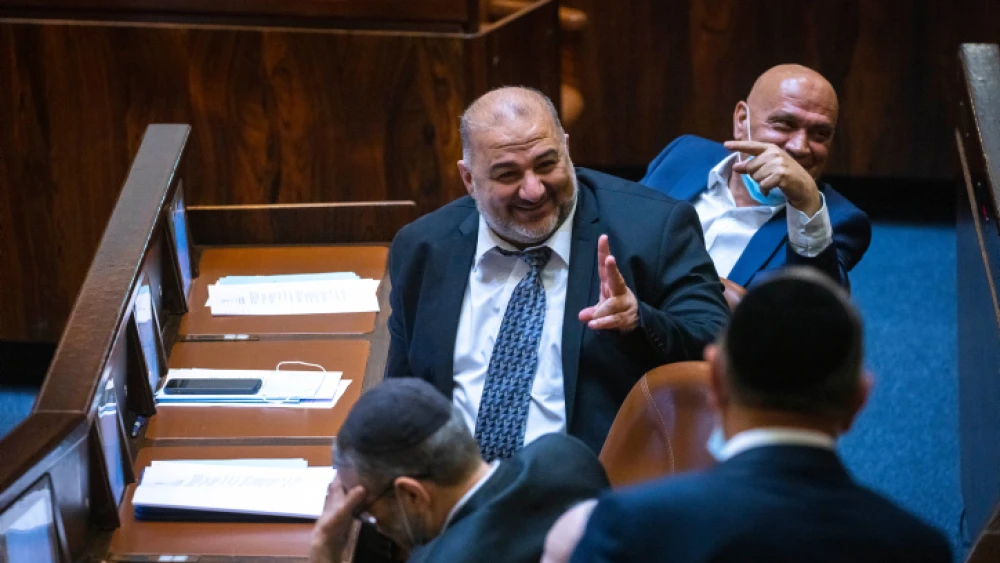
Abbas, with his jovial manner and ready smile, comes off as sincere to Hebrew-speaking audiences, or at least he did until recently. It’s to his advantage that he’s addressing an audience that wants to believe him. “He’s appealing to our desperately wanting to believe that we will not have to live by the sword forever,” said Rhode.
Regavim’s Tal has uncovered numerous video clips showing that Abbas is speaking from both sides of his mouth. When addressing Jewish audiences, he says he recognizes a Jewish state. He broadcasts the opposite message in Arabic.
In 2017, Abbas described the Balfour Declaration, in which Britain declared its support for the establishment of a Jewish national home, as “the promise of one [the British] who isn’t the owner to another [the Jewish people] who isn’t deserving.”
Abbas, a devout Muslim, receives religious sanction for such deception under an Islamic framework called wasatiyyah. It is often translated as “moderation,” “balance,” or “middle way.” To those that follow it, it is defined as the “correct Islam.” Islamic studies professor Sagi Polka, author of “Thinking Islamic: Reviewing the Contemporary Muslim Discourse,” said wasatiyyah is best understood as “pragmatism.”
“This is pragmatism in the sense that they examine the benefits versus the harm. They look at what’s better for them and what serves their interests. So if it isn’t beneficial to engage in terror because they will go to jail or be killed, then it is preferable not to engage in it,” Tal explained. “Those who belong to the wasatiyyah stream can be flexible in the means to the goal. The goal never changes. It’s the means that are changeable.”
The Muslim Brotherhood thinker Yusuf al-Qaradawi (1926–2022) founded the wasatiyyah stream of Islam. Wasatiyyah provides a way for Muslims living as minorities to engage with the dominant culture, or as Tal said, “to speak in a way that the West hears what it wants to hear [while] concealing their true intentions.”
Wasatiyyah doesn’t apply only to Muslims in the West, but wherever they are a minority. So central a concept is it to the Muslim Brotherhood that where the group is outlawed, its followers, instead of saying, “‘I’m with the Muslim Brotherhood,’ say ‘I follow wasatiyyah,’” she explained.
Another important concept Ra’am took from Qaradawi is that of “civil jihad.” Civil jihad may be described as struggle by other means. “This is what their political activity is,” Tal said.
In a 2015 speech, Abbas revealed that Darwish, while sitting in Israeli prison for nearly three years, reconsidered his terror tactics. Darwish changed his mind in discussion with other Islamic movement members, namely imprisoned Hamas leaders from Judea, Samaria and the Gaza Strip. Together, they came to the conclusion that “combat jihad” wasn’t suitable for Arabs living within Israel and that political activity would be more effective.
“Darwish, together with the Hamas leadership, became convinced and reached a deeper understanding of the reality that what is right for the Arabs within the 1948 borders is to move to what is called al-ama siyasa shariyya, or ‘political action based on policy in accordance with shariah [Islamic law],’” Tal said.
In the early 1990s, following his release from prison, Darwish sought out Qaradawi on whether the Islamic movement could participate in Israeli elections. Qaradawi ruled that participation was not only permissible but obligatory, according to research by Uriya Shavit, a Tel Aviv University professor whose specialty is Islamic law and politics in modern Islam.
Ra’am’s apparent focus on civil issues, such as housing and crime, blurs its true goals, although it argues that civil issues are really nationalistic ones, at least when speaking to fellow Arabs. “When we speak of land, housing and the destruction of homes, is this a civil problem? Or is this a problem that’s found at the heart of our struggle over the land and our homeland?” Abbas asked rhetorically in a 2020 interview.
Ra’am did not respond to JNS’s request for comment.
Not all Islamists agree with Ra’am’s participation in Israeli politics. It was a major source of contention when Darwish first broached the idea, leading in 1996 to a split in the Islamic Movement between a northern and southern branch. Sheikh Raed Salah, who leads the northern branch, said it would legitimize Israel. Israel’s government has outlawed the northern branch and arrested Salah several times, mainly for incitement.
Tal said the southern branch is far more dangerous than the northern given its potential to disrupt Israel’s political system. In 2021, Ra’am made history as the first Arab party to join an Israeli government coalition.

In Israel’s Oct. 27 election the Arab parties won an unprecedented 19 seats in the Knesset, making their numbers hard to resist even for those politicians who oppose them. Avigdor Liberman of the Yisrael Beiteinu party, who said during the campaign that it would be “unethical” to rely on the Arabs, this week became chairman of the Foreign Affairs and Defense Committee thanks to their votes.
Yoav Segalovich, who is Jewish and served as a senior police commander and deputy minister of public security, joined Ra’am in August. Ibrahim Hijazi, a senior figure in Ra’am and the southern branch, explained in an Arabic podcast earlier this month that Segalovich was brought in because he could be appointed to sensitive security positions that other Ra’am members could not. In short, he would serve as a Jewish front man. Segalovich has already been appointed to the Foreign Affairs and Defense Committee, which deals with sensitive issues related to foreign relations, the armed forces and security.
“I admire them for their cunning,” Rhode said. “I admire their abilities. They know how to play to our weaknesses.”
Those who defend Ra’am argue that its detractors are attempting to smear the party with comments from Abbas’s past. But Tal presented a clip from 2020 in which Abbas himself argued that he has not changed. Complaining that since entering the Knesset he has been accused of “treason” and “collaboration” with Israel, he turns to the interviewer, who has known him 25 years, and essentially asks for the benefit of the doubt.
In Hebrew, Abbas broadcasts the opposite message—that he has grown and changed. In August, when Israeli journalist Amit Segal presented him with a 2021 comment in which he said, “all of our Palestinian land was occupied by gangs of the Zionist movement,” Abbas replied, “Today, I neither say nor think this.”
Ra’am supporters also note that the party has left the Southern Branch of the Islamic movement. Abbas declared the split in December 2025. But in a podcast on Sept. 17, 2026, Safwat Fureij, leader of the Southern Branch, said the split was not really a split. “It’s not a separation in the sense of complete separation,” he said. “There is no separation in some issues that have a religious, public or organizational dimension.”
Furiej said that they received religious dispensations to accept Segalovich into the party, underscoring that the separation is merely declarative and Ra’am remains in practice the political arm of the Southern Branch of the Islamic movement. Why else would it need religious dispensations?
“This is why we must constantly expose the truth about them and how dangerous they are in Israel and around the world. Ultimately, they want to fulfill [Muslim Brotherhood founder] Hassan al-Banna’s vision of leading Islam globally,” said Tal.
On September 23, a little more than a month before the election, Israel’s Central Elections Committee voted to ban Ra’am from participating. It found the party had violated all three grounds for disqualification listed in section 7A of ‘Basic Law: The Knesset': 1) negating Israel’s existence as a Jewish and democratic state 2) inciting racism and 3) supporting armed struggle against the State of Israel by an enemy state or a terrorist organization.
The Supreme Court overturned the ban on Oct. 2, citing insufficient evidence.
David Isaac, an expert on Jewish history, politics and current events, is an Israel bureau correspondent for JNS.
Source: https://www.jns.org/analysis/raams-moderate-mask-an-islamist-movement-coated-in-honeyed-words

No comments:
Post a Comment