by Uzay Bulut
Al-Sharaa's Syria: Christians, Minorities Targeted, Persecuted, Murdered
Al-Suqaylabiyah has been repeatedly targeted since al-Sharaa and his al-Qaeda- and ISIS-affiliated Hay'at Tahrir al-Sham (HTS) terrorists conquered Damascus in December 2024.
Before Syria's military conquest by Arab Muslims in the 7th century, it was part of the Byzantine Empire, and was majority-Christian (as were Turkey, Egypt, Iraq, Morocco, Libya, Tunisia, Algeria, and Lebanon before they were conquered by Muslims.)
Today Syria is controlled by Hay'at Tahrir al-Sham (HTS), an al-Qaeda-affiliated terror group. HTS is still designated as a terrorist group by the UN due to its ties to al-Qaeda and ISIS (the Islamic State).
Syria's 2025 constitutional declaration names Islam as the main source of legislation and requires the head of state to follow Islam. Earlier Syrian constitutions under the Assad regime also required the president to be a Muslim.
Syria's new textbooks have undergone "sweeping" changes from nationalism to Islamization under al-Sharaa... Schools have dropped Assad's pan-Arabism for Islamist curriculum. Fourth-graders learn that throwing stones at Israeli tanks earns salvation, eighth-graders study jihad against 'occupiers.'
In August, US Secretary of State Marco Rubio bewilderingly removed Syria from the list of State Sponsors of Terrorism, presumably to give al-Sharaa another "chance." Al-Sharaa appears to have used the "chance" to Islamize and radicalize Syria as fast as possible, the same way Iran used then President Barack Obama's 2015 "chance to come in from the cold" to enrich uranium to 84%, just below the 90% level needed for nuclear breakout, upgrade its ballistic missiles, attack its neighbors and brutalize its people.
The only winners today are Turkey and Saudi Arabia. Turkish President Recep Tayyip Erdogan groomed al-Sharaa on how to pass for a moderate, and Saudi Crown Prince Mohammed bin Salman urged US President Donald Trump, apparently against his usually excellent first instincts, to give al-Sharaa "a chance at greatness." Greatness for whom?
Near the end of Trump's 2025 speech in Saudi Arabia, he said: "And very importantly, after discussing the situation in Syria with the Crown Prince, your Crown Prince, and also with President Erdogan of Turkey who called me the other day and asked for a very similar thing, among others and friends of mine, people that I have a lot of respect for in the Middle East, I will be ordering the cessation of sanctions against Syria in order to give them a chance at greatness. Oh, what I'd do for the Crown Prince."
For Turkey, al-Sharaa is helpfully clearing a pathway due south to attack Israel. For Saudi Arabia, al-Sharaa is a tributary gift to the supremacy of Islam.
Syria cannot build a just future on a foundation of atrocities. Al-Sharaa is a terrorist in a suit and tie, whose record is defined by massacres and savage repression. He needs be replaced at once. Keeping him at the helm, presumably on the advice of Erdogan's puppet, US Ambassador to Turkey Thomas J Barrack, who also serves as envoy to Syria and Iraq, perpetuates a cycle of violence and strips the Syrian population of the governance they deserve. It is time for leadership in Syria that brings real openness, not terror. The "chances" are up.
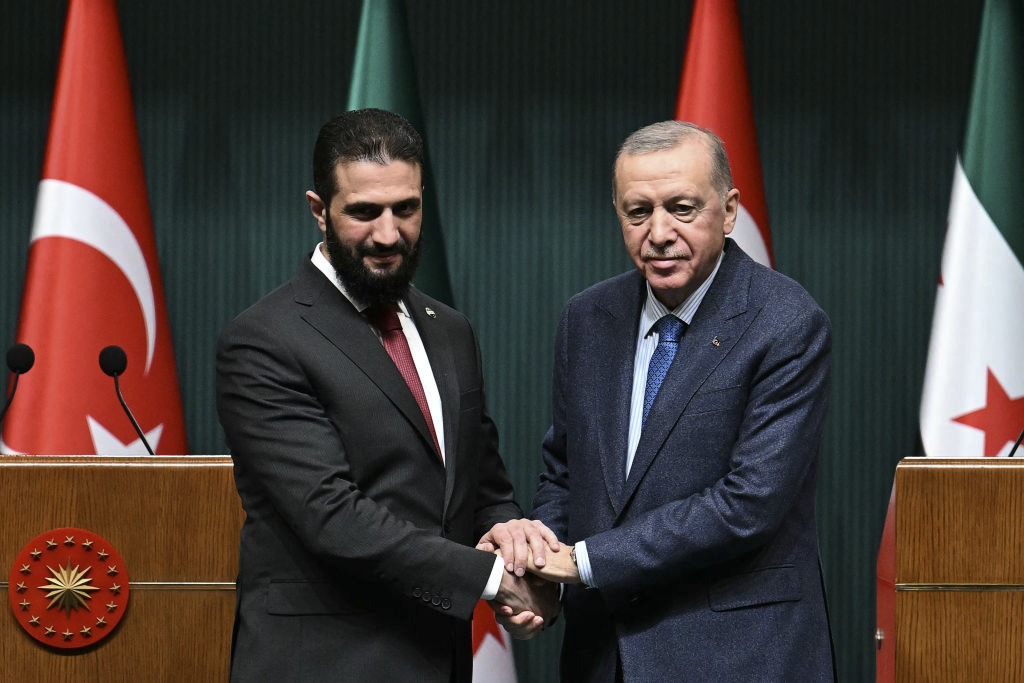
While Ahmed al-Sharaa (aka Abu Mohammad al-Julani) — a former al-Qaeda chief turned self-proclaimed Syrian president — addressed the United Nations General Assembly for the second time in September, on the ground in Syria, Christians continue to face a devastating reality: persecution, arrest and murder.
On October 19, in the predominantly Christian city of Al-Suqaylabiyah, a Christian goldsmith, Maher Nours Sankari was abducted just days after an attack on another Christian goldsmith's workshop in Damascus. His kidnappers are demanding a massive ransom while Syria's new authorities stand accused of knowing their identities and doing nothing.
Al-Suqaylabiyah has been repeatedly targeted since al-Sharaa and his al-Qaeda- and ISIS-affiliated Hay'at Tahrir al-Sham (HTS) terrorists conquered Damascus in December 2024. Conditions for Christians in Syria have since grown significantly darker.
According to reports, on October 3, mobs of Muslims launched a coordinated assault on homes, businesses and Christian religious sites. Members of Syria's General Security forces actively participated in the attacks rather than defending the local population.
SyriacPress reported on October 7 that the Ministry of the Interior's Internal Security Forces (ISF) had summoned 16 Christian young men from Al-Suqaylabiyah to appear before authorities for questioning over events that took place in the city in the previous days.
This is the grim reality today for Syria's Christians, who have lived there for millennia: a relentless campaign of terror that is driving them from their homes and dismantling their businesses, churches and entire communities, under the fist of the new Islamic regime.
Hassan Marwan Jorj, a young Christian man from the Masyaf countryside in Syria, was riding home from work on his motorcycle at night when he accidentally collided with an officer of the General Security Directorate from the Al-Bayda area. He was then brutally beaten by the officer and the other security personnel who later arrived at the scene. Jorj suffered fractures to his head and severe internal bleeding, then died.
The "Greco-Levantines Worldwide" network, which is a member of the Syrian Christian Congress, issued a statement on September 21, addressing the representatives of Greece and Cyprus in Damascus:
"Please... [s]it privately with his mother and sisters, without government or security officials present, and listen. Ask his mother what happened to her son. Ask whether the family has been pressured to call his death an accident. You do not need to accuse anyone or issue a political declaration. Just go. Pray with them. Listen."
Before the month was over, additional Christians were killed. George Nema was found murdered inside his farm in the village of Qaya, on September 30.
In a separate incident earlier, on August 15, a Syrian Christian who had returned from Sweden to rebuild his life in Syria was shot and murdered in the central city of Homs.
Nader Boulos Tannous, 46, was returning home from work in the Karm al-Louz neighborhood when unidentified gunmen targeted him. He died from his wounds; the attackers' identities remain unknown.
The foreign ministries of Greece, Cyprus, and Israel have condemned the murder and called for accountability. Israel's Foreign Ministry stressed that Christians are among the Middle East's most ancient indigenous communities and that their security must be guaranteed.
Suleiman Khalil, a Christian former mayor of Sadad, a historic Christian town he helped defend against ISIS's mass killings and kidnappings in 2015 -- was arrested by al-Sharaa's regime in February of 2025. Khalil has been held without charges for 19 months, denied an attorney and prevented from practicing his Christian faith in prison.
On June 22, 2025, a suicide bombing at the Greek Orthodox Mar Elias Church in Damascus murdered 25 worshippers and injured 63 others
More recently, on September 13, children playing in the yard of the Greek Orthodox Saint George Cathedral in Hama narrowly escaped being killed by a bomb that exploded. The bomb damaged the church building and the surrounding area. The church serves 1,000 parishioners.
While local authorities later claimed it was merely a stun grenade, local sources confirmed it was a targeted explosive intended to instill fear.
"There were no warning signs, threats or disputes with anyone. It happened completely out of nowhere, which makes us and the parish even more worried," shared a cathedral priest.
Open Doors, which monitors Christian persecution globally reported:
"[M]any Christians expressed deep gratitude for God's protection. However, the online response also revealed painful hatred, with Christians labelled as 'infidels' who deserved the attack. One chilling message on the church page said, 'Worse and more bitter days are yet to come, O worshipers of the cross.'"
The hostility highlights the harsh reality facing Christians in Syria, which now ranks number six in Open Doors' latest World Watch List because of a sharp rise in violence against Christians.
Incidents of desecration of churches and religious sites, harassment, and attempted abductions of Christian women have been documented in parts of the Hama and Homs governorates, including areas like Mhardeh, Kfarbo, and Al-Suqaylabiyah.
On July 27, Muslims attacked the headquarters of the Melkite Greek Catholic Patriarchate in the heart of Damascus' Old City. According to reports, intruders stole property and then smashed and vandalized parts of the premises.
On the same day, armed Muslims reportedly entered Al-Suqaylabiyah, harassing Christian women and provoking residents. After being evicted, they allegedly returned with more weapons.
According to social media posts, the regime authorities arrested two Christians from Al-Suqaylabiyah -- Elias Jabour and Raef Shihadeh -- on July 28. Yet the men from a neighboring Muslim-majority town, accused of harassing Christian women, remain free.
Jabour and Shihadeh were reportedly detained by the General Security Directorate after defending women in Suqaylabiyah. The two detainees were released on August 4; nevertheless, dozens of armed attackers allegedly stormed the town with automatic rifles and hand grenades, yet no members of the attacking mobs have reportedly been arrested.
On 16 July, the European Centre for Law and Justice (ECLJ) submitted a report to the United Nations for Syria's Universal Periodic Review. ECLJ's advocacy officer Thibault van den Bossche wrote that Christians in Syria "face growing social pressure":
"Islamist preaching in Christian neighbourhoods, the gradual Islamization of certain public policies and school curricula, restrictions on alcohol, and rhetoric portraying Christians as fouloul—supporters of the former regime. Many also observe an increasing salafization of Syrian society, modelled on policies previously implemented in Idlib Province.
"Beyond discrimination itself, the very survival of Christianity in Syria is now at stake. Christian schools are becoming increasingly vulnerable, families in exile continue to lose their property, and terrorist attacks, violence, kidnappings and widespread impunity have fostered a profound sense of abandonment. Emigration continues unabated, weakening both the churches themselves and Syria's historic religious pluralism. Protecting freedom of worship alone is therefore no longer sufficient. Political, legal, security and economic conditions must be established that allow Christians to remain permanently in their homeland."
The ECLJ's submission to the UN highlighted the challenges faced by Syrian Christians in terms of freedom of religion, social and economic pressures, and emigration:
"Concerns center particularly on freedom of conscience, the ability to change one's religion, pressure on Christian converts, and the growing Islamization of the public sphere. One senior church representative reported that Islamic street-preachers are calling for the "true religion." One humanitarian worker active in Syria also referenced this rhetoric, adding that such preaching has been done by unknown groups or young men who enter majority-Christian neighborhoods to call on residents to convert to Islam, while the local authorities do nothing to intervene despite the tensions created.
"Other frequent concerns are women being pressured regarding wearing the veil, growing Islamic references in school curricula, and reported restrictions on female civil servants' appearances. One source reported that couples must prove their marriage status by carrying marriage certificates. Several interviewees viewed these developments as part of a broader trend toward the Islamization of public life. They indicated that such measures reinforce the perception that certain religious identities and customs are less accepted in the public sphere.
"One bishop recounted: 'The mayor of Damascus prohibited the sale of alcohol. There were demonstrations against this ban; therefore, it created the impression that Christians want alcohol.' Another church representative also decried the measure, which did not extend to the predominantly Christian neighborhoods of Bab-Touma, Bab-Sharqi, and Qassaa: 'This decision was considered insulting by Syrian Christians, giving them, and others, the impression that drinking is immoral and consequently they are themselves immoral.'
"Other concerns involve the future of Christian educational institutions. Several local stakeholders have cited increasing administrative pressure and have questioned whether their autonomy and distinct identity can be preserved in the current climate. The aforementioned bishop reported that his private Christian school must pay 22% of tuition fees in jizya taxes (taxes levied against non-Muslims, despite more than half of its students receiving free education. Additionally, many examinations are scheduled on Sundays despite Christian schools being closed because of worship services.
"These developments compound the economic hardships affecting the entire population. After more than a decade of conflict and resulting impoverishment, many young people struggle to envision a future in Syria. Demonstrations have recently erupted across the country protesting the failed economic reforms of the new government. Interviewees emphasized that emigration remains particularly high among young graduates and families. 'All young people want to leave,' reported the bishop: 'No work, no money. Those from Idlib [the ruling Islamist class] are paid very well.' Several interlocutors stressed that emigration is driven not only by insecurity and economic hardship but also by the perception that Christians no longer have realistic prospects for their future in Syria."
Before Syria's military conquest by Arab Muslims in the 7th century, it was part of the Byzantine Empire, and was majority-Christian (as were Turkey, Egypt, Iraq, Morocco, Libya, Tunisia, Algeria, and Lebanon before they were conquered by Muslims.)
Syria possesses some of the oldest Christian communities in the world whose presence dates back to the first century AD. Christian traditions link the region to the Apostles Peter and Paul, as well as the early travels of disciples and figures like Saint Thecla. Damascus is famous for the conversion of Saul, who turned into the Apostle Paul on the road to Damascus (Acts 9). During early Christianity, Syria became home to prominent monasteries, theological scholarship and major early church leaders.
Christians in Syria belong to Greek, Syriac, Assyrian, Armenian, Protestant and other churches. The country also has a strong Aramaic and Syriac heritage. Local populations have preserved West Aramaic and Syriac — languages closely related to the spoken language of Jesus — in historic mountain villages like Maaloula.
Today Syria is controlled by Hay'at Tahrir al-Sham (HTS), an al-Qaeda-affiliated terror group. HTS is still designated as a terrorist group by the UN due to its ties to al-Qaeda and ISIS (the Islamic State).
What is the strategic rationale behind Western policies that appear to prefer al-Sharaa despite his documented ties to al-Qaeda and ISIS?
Syria's 2025 constitutional declaration names Islam as the main source of legislation and requires the head of state to follow Islam. Earlier Syrian constitutions under the Assad regime also required the president to be a Muslim.
Why has there been no support whatsoever for Christian or pluralistic leadership, perhaps a Christian presidency, in post-conflict planning? What prevents the consideration of autonomous regions and self-defense structures for Syria's minority populations such as Christians, Druze and Alawites?
Syrian Christians cannot exactly look to HTS for protection. True survival and self-determination require an autonomous administration built by – and for – their own community.
In addition, a comprehensive framework for constitutional pluralism in Syria necessitates the official recognition of Syriac/Aramaic, Greek, Armenian and Kurdish alongside Arabic as official state languages, thereby institutionalizing linguistic rights for the country's minority communities.
Syria's new textbooks have undergone "sweeping" changes from nationalism to Islamization under al-Sharaa, according to a new report, "The New Syria: Education Under al-Sharaa: Review of Syria's National School Curriculum, 2025–2026." Schools have dropped Assad's pan-Arabism for Islamist curriculum. Fourth-graders learn that throwing stones at Israeli tanks earns salvation, eighth-graders study jihad against 'occupiers.'
The report, which examined 130 textbooks for grades one through twelve, found that the Arab nationalism that characterized Bashar al-Assad's regime is giving way to an Islamist worldview emphasizing jihad, martyrdom, and armed struggle.
Why has there been no transition at all away from the terrorist regime of HTS?
Reports from international watchdogs, human rights groups, and news services document an escalation in targeted threats, violence, and systemic pressures against Christians in the country. Only the United States government seems not to see it.
In August, US Secretary of State Marco Rubio bewilderingly removed Syria from the list of State Sponsors of Terrorism, presumably to give al-Sharaa another "chance." Al-Sharaa appears to have used the "chance" to Islamize and radicalize Syria as fast as possible, the same way Iran used then President Barack Obama's 2015 "chance to come in from the cold" to enrich uranium to 84%, just below the 90% level needed for nuclear breakout, upgrade its ballistic missiles, attack its neighbors and brutalize its people.
The only winners today are Turkey and Saudi Arabia. Turkish President Recep Tayyip Erdogan groomed al-Sharaa on how to pass for a moderate, and Saudi Crown Prince Mohammed bin Salman urged US President Donald Trump, apparently against his usually excellent first instincts, to give al-Sharaa "a chance at greatness." Greatness for whom?
Near the end of Trump's 2025 speech in Saudi Arabia, he said:
"And very importantly, after discussing the situation in Syria with the Crown Prince, your Crown Prince, and also with President Erdogan of Turkey who called me the other day and asked for a very similar thing, among others and friends of mine, people that I have a lot of respect for in the Middle East, I will be ordering the cessation of sanctions against Syria in order to give them a chance at greatness. Oh, what I'd do for the Crown Prince."
For Turkey, al-Sharaa is helpfully clearing a pathway due south to attack Israel. For Saudi Arabia, al-Sharaa is a tributary gift to the supremacy of Islam.
Syria cannot build a just future on a foundation of atrocities. Al-Sharaa is a terrorist in a suit and tie, whose record is defined by massacres and savage repression. He needs be replaced at once. Keeping him at the helm, presumably on the advice of Erdogan's puppet, US Ambassador to Turkey Thomas J Barrack, who also serves as envoy to Syria and Iraq, perpetuates a cycle of violence and strips the Syrian population of the governance they deserve. It is time for leadership in Syria that brings real openness, not terror. The "chances" are up.
Uzay Bulut, a Turkish journalist, is a Distinguished Senior Fellow at Gatestone Institute.
Source: https://www.gatestoneinstitute.org/23004/syria-christians-persecuted

No comments:
Post a Comment