The "Middle East and Terrorism" Blog was created in order to supply information about the implication of Arab countries and Iran in terrorism all over the world. Most of the articles in the blog are the result of objective scientific research or articles written by senior journalists.
From the Ethics of the Fathers: "He [Rabbi Tarfon] used to say, it is not incumbent upon you to complete the task, but you are not exempt from undertaking it."
A story about Durham University in England helps reveal how Florida is saving at least one state’s education system from decolonizing disaster.
The Florida Department of Education has rejected 41% of the books
submitted to it for mathematics instruction in public schools. It wasn’t
that the math in the books was bad; it was that the publishers were
using the books as a vehicle for pushing hard-left social issues. Even
worse, the bulk of these improper books (71%) was aimed at the youngest
students Kindergarten through 5th grade. At least in Florida, the
government is not going to “de-educate” its students with woke math,
something that’s already happening at Durham University in England.
Today, Commissioner of Education Richard Corcoran approved Florida’s
initial adoption list for mathematics instructional materials properly
aligned to Florida’s Benchmarks for Excellent Student Thinking
(B.E.S.T.) Standards. The approved list followed a thorough review of
submissions at the Department, which found 41 percent of the submitted
textbooks were impermissible with either Florida’s new standards or
contained prohibited topics – the most in Florida’s history. Reasons for
rejecting textbooks included references to Critical Race Theory (CRT),
inclusions of Common Core, and the unsolicited addition of Social
Emotional Learning (SEL) in mathematics. The highest number of books
rejected were for grade levels K-5, where an alarming 71 percent were
not appropriately aligned with Florida standards or included prohibited
topics and unsolicited strategies. Despite rejecting 41 percent of
materials submitted, every core mathematics course and grade is covered
with at least one textbook.
Overall, Florida is initially not including 54 of the 132 (41
percent) submitted textbooks on the state’s adopted list. The full
breakdown is below:
78 of 132 total submitted textbooks are being included on the state’s adopted list.
28 (21 percent) are not included on the adopted list because they
incorporate prohibited topics or unsolicited strategies, including CRT.
12 (9 percent) are not included on the adopted list because they do not properly align to B.E.S.T. Standards.
14 (11 percent) are not included on the adopted list because they
do not properly align to B.E.S.T. Standards and incorporate prohibited
topics or unsolicited strategies, including CRT.
Grades K-5: 71 percent of materials were rejected.
Grades 6-8: 20 percent of materials were rejected.
Grades 9-12: 35 percent of materials were rejected.
Florida’s stand against leftist math books is important. For a long
time, leftist indoctrination was limited to the liberal arts. For
example, Shakespeare, with his deep wisdom about the human condition,
got pushed out in favor of teaching high school students about life in a
South African brothel (as was the case with my children).
However,
Democrats have now pushed wokeness into the STEM classes. (Science,
Technology, Engineering, and Mathematics, for those unfamiliar with the
acronym.) And as always, England is leading the way. Durham University
is aggressively working to “decolonise” [sic; British spelling] its math program:
The prestigious institution, ranked seventh in the UK for their maths
curriculum, asked academics to question themselves if they are
citing ’mostly white or male’ mathematicians in a bid to ‘decolonise’
the syllabus and make the topic ‘more open’.
All staff have been asked to ‘consider giving short biographies’ of
the research they will be citing within the module to ensure the subject
‘can be used to assist in trying to achieve equality’.
The guide says that if mathematicians are ‘almost completely (or even
completely) white and/or male, ask yourself why they are. See if you
can find contributions to the field from mathematicians of other
genders/ethnicities’.
According
to The Telegraph, Durham University scientists were asked to
investigate how the ‘power of 10, represented by the word "billion",
‘differs from country to country’, and how ancient Indian astronomer
Brahmagupta ‘assigned a different meaning to the value of zero.’
On their website, the university said decolonising the mathematical
curriculum ‘means considering the cultural origins of the mathematical
concepts, focuses, and notation we most commonly use.’
The important thing to remember about the left is that it considers everything
to be a vehicle for indoctrination. There is no topic too small, no
child too young, and no fact too firm that it cannot be bent to the
purpose of advancing leftism within a society.
Kudos to Florida
for taking a stand. Other states need to follow suit or else, before we
know it, our engineers will no longer know how to build a safe bridge
but will be able to lecture us about Brahmagupta,
who produced his theories in 7th-century India. He was clearly an
extraordinary genius, but he did not contribute measurably to the
technological Western world in which we function.
Speaking on the first day of Ramadan, the Palestinian Authority’s Supreme Sharia Judge Mahmoud Al-Habbash, instructed:
In the same way as Muslim Prophet Muhammad engaged in war during Ramadan, so too the Palestinians should engage in “Jihad.”
Given the daily indoctrination by the Palestinian leadership, its pay for slay
program as well as the original Charters of all the major Palestinian
groups, which reveal their goal to obliterate Israel, only the cowardly
or deluded could possibly believe that this goal will miraculously
vanish in the face of appeasement.
It’s only a matter of time before Hamas and other jihad groups funded
by the Islamic Republic of Iran regroup and again launch rockets at
Israel, only to be met with Israel’s defensive maneuvers, and then as
usual, the propaganda and hate against Israel and Jews will again
escalate.
Abbas’ Fatah movement praised
the Tel Aviv jihad attack, tell the jihadis: “We bow before you in
honor and admiration.” Speaking on the first day of Ramadan, the
Palestinian Authority’s Supreme Sharia Judge Mahmoud Al-Habbash, instructed:
In the same way as Muslim Prophet Muhammad engaged in war during Ramadan, so too the Palestinians should engage in “Jihad.”
“Israeli authorities remove nearly 6,000 social media posts urging more attacks on Jews,” by Eitan Divinsky, Israel National News, April 13, 2022:
The State Attorney’s Office cyber
prosecution department said it had handled about 5,815 requests from
security officials to remove provocative content or posts supporting
terrorism against Jews from various social media platforms over the past
three weeks.
The posts have come from various locations in
Israel’s Arab and Bedouin sectors following the recent spate of terror
attacks, claiming the lives of over a dozen civilians and maiming
others.
The vast majority of complaints (approximately 3,300) emanated from Facebook, approximately 87% of them being removed.
Tiktok videos received about 770 complaints, with about 84% of them removed.
In
March, popular Palestinian Arab blogger Saleh Zighari praised the
terrorists who carried out the deadly terror attack in Bnei Brak, in
which five individuals were murdered.
Following the attack,
Zighari, who has over a million social media followers, uploaded a
mocking story to his Instagram account. Alongside two winking emojis, he
wrote in Arabic: “Five fresh fish in a bag.”….
The UAE diplomat of course had no choice but to reply with feigned enthusiasm for Blinken’s wanting to invite the Palestinians to take part, not in the Abraham Accords, but in “regional initiatives.”
On April 13, an unidentified Middle Eastern official told The Times of Israel that
the United Arab Emirates was most unenthusiastic about the proposal of
Anthony Blinken at the Negev Summit to include the Palestinians in
“regional initiatives” other than the Abraham Accords.
On April 14, in a direct rebuttal, a senior Emirati diplomat told The Times of Israel that
contrary to that previously reported remark, the UAE is eager to take
part in regional initiatives that incorporate the Palestinians. “UAE
insists it welcomes regional initiatives that include Palestinians,” by
Lazar Berman and Jacob Magid, Times of Israel, April 14, 2022:
“We welcome any
American-led initiative to incorporate the Palestinians,” said the
diplomat. “We were very actively involved” in “the conversation in the
Negev Summit about the Palestinians.”
The UAE diplomat of course had no choice but to reply with feigned
enthusiasm for Blinken’s wanting to invite the Palestinians to take
part, not in the Abraham Accords, but in “regional initiatives.” It is,
after all, the Biden Administration’s idea, and the UAE has no desire to
annoy the Bidenites, especially not when Abu Dhabi is doing everything
it can to persuade Washington not to agree to the “bad, very bad,
terrible” Iran deal. The whole point of the Negev Summit was for Israel
and its Sunni Arab allies to together express their grave reservations
to the Americans about how the Bidenites, and especially the
appeasement-minded Robert Malley, are conducting those
on-again-off-again talks in Vienna. Fortunately, for now they are hung
up – thank god – on the refusal of Biden to lift the designation of
“terrorist group” from the IRGC, which Iran’s diplomats insist is a
condition precedent to their agreeing to any deal.
The diplomat’s comments came after another Middle Eastern official told The
Times of Israel on Wednesday that the UAE was the least enthusiastic
participant in March’s Negev Summit around US efforts to include the
Palestinians in regional cooperation schemes.
That first statement was the truth. There is no love lost between the
UAE and the Palestinians, who have bitterly criticized the Emirates
both for being the first Arab country to join the Abraham Accords, and
for entering so enthusiastically into deals of every kind – trade,
technology, tourism, agriculture — with the Jewish state. The feigned
enthusiasm a day later was an attempt to appease the Bidenites who had
no doubt been angered by the public report made the day before on the
UAE’s opposition to the Palestinian participation. The Bidenite proposal
really makes no sense, unless you think appeasement of the
Palestinians, even if — or especially if — it slows down the integration
of Israel into its neighborhood, is a splendid idea. The PA is not
going to contribute to further improving the ties between Israel and its
Arab neighbors; it will simply use its participation in any “regional
initiative” to throw a spanner in the works whenever it gets the chance,
undermining both Israel, and any Arab state that wants to better its
relations with the Jewish state. The troublemakers in Ramallah should
not be escorted in to join these “regional initiatives” by the
Bidenites, whose keystone-kop foreign policy has led to one collective
pratfall after another, but kept firmly out.
UAE Foreign Minister Abdullah bin
Zayed Al Nahyan was the only participant who didn’t mention the
Palestinians during a joint press statement at the conclusion of the
landmark summit.
The Emiratis insist that the omission is not indicative of any hesitancy about bringing the Palestinians into regional projects.
Of course it is. The UAE Foreign Minister knew that his every word –
what he said and what he omitted –would be studied. That failure to
mention the Palestinians – whom he also failed to mention in his opening
remarks at the summit – was pregnant with meaning. The UAE has washed
its hands of the Palestinians. Like the Saudi Crown Prince, Muhammad bin
Salman, who in 2018 famously told the complaining Mahmoud Abbas just to
“take whatever deal the Americans offer you,” the Crown Prince of Abu
Dhabi, and the UAE over which he rules, have lost interest in the
Palestinians.The UAE is now determined to pursue its own national
interests, undeterred by anything the Palestinians may want. They are no
longer the center of Arab concerns, and become less important every
day. That is the whole point of the Abraham Accords. And the ferocious
criticism of the UAE by the Palestinians, for joining the Abraham
Accords, has alienated the UAE further still from the PA.
“We are ready to engage
whenever the Palestinians are open to a broader cooperation initiative,”
the UAE diplomat said. “We welcome it.”
“Any
regional initiatives that collectively involves the Americans, the
Egyptians, the Jordanians, the Palestinians, we’ll certainly support and
will actively contribute to it,” the diplomat said.
Those remarks by the UAE diplomat were, he must have thought, “what
the Americans want to hear from us, so let’s just mouth the right words
of minimal encouragement. Nothing will come of it, anyway. We’ll
continue on the mutually beneficial path we have started with Israel.
Onward and upward with the Abraham Accords.”
The unprecedented
gathering [the Negev Summit] was partially an attempt by Israel and its
Arab allies to project a unified front against shared regional foe Iran,
and to impress upon Blinken their concern about the direction of US
policy on Iran. Israeli officials told reporters at the scene that the
talks centered around creating a “regional security architecture,” among
other issues.
During their closing statements, the top
diplomats from the US, Bahrain, Morocco, and especially Egypt reiterated
their support for a Palestinian state.
But during the two days of meetings that came before those closing
statements, the Palestinians were never discussed. And not only did the
UAE not mention the Palestinians, but the foreign ministers of the other
states in their closing remarks gave exactly one Laodicean sentence
apiece to their supposed “support for a Palestinian state.” That was the
bare minimum one could expect.
Ramallah, for its part, fiercely criticized the summit.
Senior
Palestinian official Bassam al-Salihi told The Times of Israel that the
Arab diplomats’ visit to the Negev will not help the Palestinians,
“whatever their reasoning” for participating.
“The
Palestinian issue won’t be present in this summit. If it is present, it
will be on Israel’s terms,” said al-Salihi, a member of the Palestine
Liberation Organization’s Executive Committee.
Al-Salihi was right. The Palestinian issue was given short shrift at
Sde Boker, with a single sentence apiece from the Arab participants in
their closing statements about their “support for a Palestinian state.”
It was the American participant, Secretary of State Blinken, who kept
insisting on talking about the Palestinians, and about how good it would
be for the other Arab states at the Negev Summit, and Israel, working
“with them” in the future on these imaginary “regional projects.” The
Bidenites are incapable of pocketing what those Arab states are
offering: a Middle East where the Palestinians are off everyone’s
agenda, and can’t throw a spanner in the works of Arab-Israeli
reconciliation.
Jordan, which did not send its
foreign minister to the summit, has linked the warmth of its
relationship with Israel to Jerusalem’s policies toward the
Palestinians. During the summit itself, PA President Mahmoud Abbas
hosted Jordan’s King Abdullah in Ramallah….
Jordan, of course, has to take care not to alienate the Palestinians.
After all, more than 60% of the Jordanian population is Palestinian.
But at the same time, Amman can’t allow its own national interest in
furthering mutually beneficial economic ties with Israel to be held
hostage to what will satisfy the PA. Right now, Jordan desperately needs
water from Israel, which in response to Jordan’s request last year,
doubled — to some 50 billion cubic meters a year – the amount of water
it sends to Jordan, even though Israel is itself a water-poor country.
Jordan also receives natural gas from Israel’s offshore Leviathan field,
under an agreement that will last until 2035. The Palestinians in the
Jordanian Parliament are constantly demanding that all agreements with
Israel be ended; apparently they do not realize how dependent Jordan is
on supplies of both water and natural gas from the “Zionists.”
Fortunately, the level-headed government bureaucrats in Amman are well
aware of the benefits those agreements bring to the Hashemite kingdom.
Abbas told Blinken when they met
in Ramallah, hours before the secretary of state headed to Sde Boker,
that he welcomed opportunities to incorporate the Palestinians into the
broader regional alliances, a Palestinian official said, while
clarifying that such a move could not come via the platform of the
Abraham Accords.
Of course Abbas will “welcome opportunities” for the Palestinians to
be invited to take part in “broader regional alliances,” where they will
do everything they can to hinder Israel’s progress in improving
relations both with Arab members of the Abraham Accords, and with other
states – Egypt and Saudi Arabia – that have longstanding, and
increasing, security ties to the Jewish state and, consequently, are
potential members of the Accords.
The Negev Summit showed just how much progress Israel has made in
being accepted by several of its Arab neighbors, progress that was
possible because the Palestinian question was simply put on the back
burner, where it has long belonged. Now the Bidenites are trying to
bring the Palestinians again into the regional mix, where they will only
do harm to the possibilities for lengthening, and strengthening (to use
a Bidenite phrase) the Abraham Accords. Long after Israel and the Arab
states have recognized the irrelevance of the PA and the master schemer
in Ramallah, and are making their own deals (nearly $1 billion worth, so
far, just between Israel and the Emirates) the Bidenites apparently
will not concede that reality, and are determined to put the
Palestinians back on center stage. One more reason — did you need
another? — to throw them out of office at the earliest possible
opportunity.
The German website Tichys Einblick comments that "instead of Putin's war, we will finance Islamic terrorism". The unconditional will to shine morally has harmful consequences -- all because nuclear power is "haram" (forbidden).
"When I left Nantes in 1984,
it was tranquility itself, even in the traditionally more working-class
neighborhoods... Today Nantes has become Lebanonized. And its history is
that of France..." — Ivan Rioufol, journalist, Le Figaro, April 7,
2018.
One might even be forgiven for thinking that Qatar's ultimate
goal was to Islamize Europe. In the words of a television documentary,
it is Qatar's "war of influence".
"[T]he Assalam mosque," Le Figaro recounts, "was built on
land sold by the municipality, benefiting from a 'cultural' contribution
of 200,000 euros and a loan guarantee of 346,800 euros". The city
financed its own self-conquest. ...
Russian gas is not free; Qatari gas as well.
The German website Tichys Einblick comments that "instead
of Putin's war, we will finance Islamic terrorism". The unconditional
will to shine morally has harmful consequences -- all because nuclear
power is "haram" (forbidden).
As
Europe turns from its masochistic energy dependence on Russia, and the
potential blackmail that came with it, will it now fall into the open
arms of other dictatorships that stand ready to pump gas into its
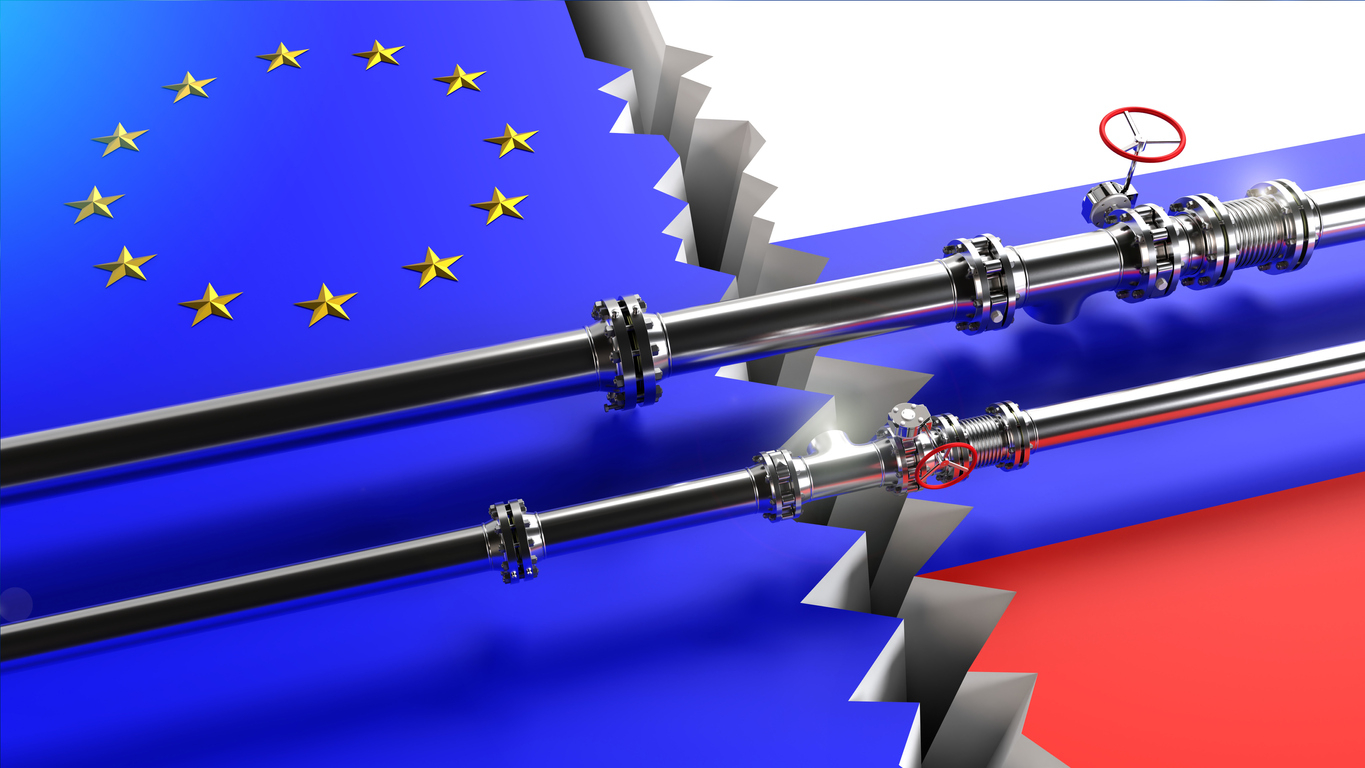
markets? (Image source: iStock)
As Europe turns from its masochistic energy dependence on Russia, and
the potential blackmail that came with it, will it now fall into the
open arms of other dictatorships that stand ready to pump gas into its
markets, such as such as Algeria? Even more dangerous might be a new partnership formed between Germany and Qatar.
They have just agreed on a huge long-term energy partnership to reduce
dependence on Russian gas, according to German Economy Minister Robert
Habeck, who last month visited the Persian Gulf and met with the Emir of
Qatar, Sheikh Tamim bin Hamad al-Thani. Italy was the first to negotiate with Qatar, a country that, according to Freedom House, numbers 25 out of 100 on its the freedom score, only slightly above Russia, at 19.
Qatar is now saying that it stands "in solidarity" with Europe.
Solidarity?
Qatar is an Islamist state where "Islam is the official religion...
and Sharia is the main source of legislation", claims its constitution.
Qatar is governed as an absolute monarchy. Political parties are banned
and elections are sham, and it is illegal to be homosexual. According to Open Doors, there are only 18 states in the world where a Christian is worse off than in Qatar. As for the billion euros
that Qatar has spent on building mosques and Koranic schools in Europe,
perhaps the champions of "progressivism" feel expansively "diverse"
with that. However, even the newspaper of the French left, Libération, has referred to "Qatar, financier of European Islam".
"Qatar and Turkey are the two main supporters of the Muslim Brotherhood ideology in the world," Elie Chouraqui told i24NEWS.
"They presented themselves well and proclaimed themselves
privileged interlocutors of the political world which welcomed them
with open arms to the point of entrusting them with the training of
imams of France".
At the same time as the economy minister of Germany went to the
sheikh to implore him for more gas, in France the ambassador of Qatar
was receiving an award from the mayor of Nice, Christian Estrosi.
Qatar has been extremely active in France. The emirate graciously financed the Islamic Center of Villeneuve-d'Ascq and France's first state-funded Muslim faith school, the Lycée-Collège Averroès. Unfortunately, the Lycée Averroès soon became the center of a scandal. One of its teachers resigned
after writing that the school was "a hotbed of anti-Semitism and
'promoting Islamism' to pupils". Qatar, meanwhile, has financed many
mosques in France, including the Great Mosque of Poitiers,
which sits in the vicinity of the site of the Battle of Tours (also
known as the Battle of Poitiers), where Charles Martel, ruler of the
Franks, stopped the advancing Muslim army of Abdul al-Rahman in the year
732.
The Assalam mosque in Nantes and the Grand Mosque of Paris are other examples of Qatari generosity. Qatar, in fact, has been funding many mega-mosques across Europe.
One might even be forgiven for thinking that Qatar's ultimate goal was
to Islamize Europe. In the words of a television documentary, it is
Qatar's "war of influence".
"Woman's month for the city of Nantes, a veiled woman on the streets
of the city. Unacceptable complacency towards Islamism! This is the real
threat that hangs over France!" is how Eric Ciotti,
a senior leader of the Les Republicans party, described the municipal
billboards in a large city that he sees as lost to Islamization.
Nantes is the city of the Dukes of Brittany, steeped in history on
the Loire estuary. Its story is emblematic of how Europe is sinking.
Ivan Rioufol wrote in Le Figaro:
"Having been a journalist in Nantes for a long time, I
know this city where I was born very well. When I left Nantes in 1984,
it was tranquility itself, even in the traditionally more working-class
neighborhoods... Immigrants were a minority... Today Nantes has become
Lebanonized. And its history is that of France...
"The Malakoff mosque... seats 1,200 and has erected a
17-meter minaret. In addition to this 'cathedral mosque' there are four
other mosques in the city, not to mention those in neighboring
communities. This influence of Islam accompanied the new settlement of
the working-class neighborhoods, under the encouragement of the
socialist municipalities".
The Assalam Mosque was constructed with Qatari money -- but not only. The Assalam mosque," Le Figaro
recounts, "was built on land sold by the municipality, benefiting from a
'cultural' contribution of 200,000 euros and a loan guarantee of
346,800 euros". The city financed its own self-conquest. And who was the
mayor of the city at the time of the financing and the agreement with
Qatar? Jean-Marc Ayrault, mayor of Nantes from 1989 to 2012 and socialist prime minister of France from 2021 to 2014 ...
Pierre Vermeren , in his book Déni français (French Denial), noted:
"In Nantes, Jean-Marc Ayrault practiced a patronage that
led to the construction of three, four, community mosques distributed
among the Muslim Brotherhood, Morocco and Turkey, as well as a Salafi
mosque on the outskirts of his city. He is accused, like the former
mayor of Paris, of violating the religious funding law. In Bordeaux,
Alain Juppé (former prime minister) canceled the Great Mosque project
when it was discovered that the funds came from Qatar and Azerbaijan..."
The magazine L'Incorrect explains how Qatari money is changing the French landscape.
"When you think of Alsace, you imagine a thousand small
flowered villages lost in the vineyards on the side of the Vosges
mountains, whose names give you a headache. We are (for the moment) in
Christian land, as evidenced by the chapels that line roads and paths.
But mosques sprout like mushrooms after the rain, even in villages with a
few thousand inhabitants. This phenomenon reveals a slow but sure
Islamization of this region".
We are in the region where the other capital of the EU, Strasbourg, is located.
"The European capital has among its buildings the most
important mosque in Europe, the center of An-Nour. The largest building
of its kind in France, this center is not just a place of worship, but a
cultural and political one, funded by Qatar".
This is happening not only in France. The Great Mosque of Copenhagen received
a donation of 30 million euros from Hamad bin Khalifa al Thani, former
Emir of Qatar, who is also a leading supporter of the Muslims in Belgium. Europe's Parliament was also asked to investigate Qatari mosques in Kosovo.
Russian gas is not free; Qatari gas as well.
The German website Tichys Einblick
comments that "instead of Putin's war, we will finance Islamic
terrorism". The unconditional will to shine morally has harmful
consequences -- all because nuclear power is "haram" (forbidden).
Former German Foreign Minister Sigmar Gabriel provided a glimpse of the relativism that dominates our ruling classes:
"Qatar does not threaten anyone, does not finance
terrorist organizations, but hosts Hamas and the Taliban at the request
of the USA (!) in order to be able to negotiate with them in Doha. Qatar
is simply a reliable partner of the West.".
Shortly before his death, Christophe de Margerie, the late head of French oil giant Total, said: "Anything can be bought, including men, it's just a question of price".
What is Europe's price?
"This tiny Persian Gulf kingdom is emerging as one of Europe's best
hopes for weaning itself off Russian natural gas, in another sign of how
the war in Ukraine is changing the world's energy relationships", The Wall Street Journal reported. "Germany, France, Belgium and Italy are in talks with Qatar to buy liquefied natural gas on a long-term basis,
said Qatari and European officials". The EU last month dropped
antitrust investigations into Qatar Petroleum, the state energy company,
clearing the way for the country to pursue more long-term contracts
with Europe.
Le Figaro tells one of these extraordinary evenings in which Qatar supported the French cultural élite:
"Dozens of guests flocked to Place de l'Étoile... home to
the Qatari embassy. In the rooms with gilded panels with mosaics and
frescoes of languid nymphs, His Excellency Mohamed al-Kuwari awarded
cartoonist Jean Plantu and Amirouche Laïdi, president of the Averroes
Club, with the 'Doha Arab Cultural Capital' award. The ambassador
awarded André Miquel (famous Arabist from the Collège de France),
Dominique Baudis (writer), Bernard Noël (art critic) and the poet
Adonis. From former Culture Minister Jack Lang to Nouvel Observateur founder Jean Daniel, a total of 66 French cultural figures have been decorated by Qatar".
Making fun of the deal with Qatar, the German newspaper Die Welt ironically proclaimed:
"The relief in Germany is enormous. They are finally no
longer dependent on gas supplies from an autocratically-ruled country
that makes life difficult for homosexuals and does not always take human
rights very seriously."
Before the suspicion arises however, that German
environmentalist-progressive-woke circles are throwing their noble
principles overboard, it must be said that Qatar is willing to make
major concessions to the German "Greens". The emirate has promised to
install wind turbines in the desert and to host the next COP26
conference about how to create a "sustainable world".
Giulio Meotti, Cultural Editor for Il Foglio, is an Italian journalist and author.
Professor sued Shawnee State University, claiming it violated his First Amendment rights
A public university in Ohio
will pay $400,000 in damages and attorney fees after punishing a
professor for declining a male student's demand to be referred to as a
female.
Nick Meriwether, a philosophy professor at Shawnee State University,
responded to a male student's question during a January 2018 political
philosophy class by saying "Yes, sir." When the class ended, the student
identified to the professor as transgender, and demanded to be referred
to as a woman in the future, along with "feminine titles and pronouns,"
according to the Alliance Defending Freedom, which represented the
professor in court. Doing so, Meriwether maintained, would have violated
his convictions as a Christian.
Meriwether didn't agree to the
student's request, and court documents state that the student became
belligerent and told the professor that he would be fired.
The student filed a complaint with the university,
launching an investigation which eventually determined that Meriwether
"effectively created a hostile environment" for the student because he
would not use the preferred pronouns. Meriwether did offer to call the
student by any name requested, but the student did not accept the offer.
A public university in Ohio will pay $400,000 in damages and
attorney fees after punishing a professor for declining a male student's
demand to be referred to as a female.
(Shawnee State University)
Shawnee
State University would then place a written warning in Meriwether's
personnel file, which stated that "further corrective actions" would be
taken if a similar incident occurred.
The professor sued Shawnee
State University, claiming that it violated his "right to free exercise
of religion under the First Amendment."
In March 2021, the U.S.
Court of Appeals for the 6th Circuit ruled in favor of Meriwether,
reversing a district court's prior dismissal of the lawsuit and allowing
the professor to continue his lawsuit against the university.
A public university in Ohio will pay $400,000 in damages and
attorney fees after punishing a professor for declining a male student's
demand to be referred to as a female.
(Shawnee State University/Facebook)
Alliance
Defending Freedom announced on Thursday that it reached a $400,000
settlement with Shawnee State University, which will cover damages and
attorney fees.
Shawnee State University will also rescind the written warning to Meriwether in June 2018.
Tyson Langhofer, senior council for Alliance Defending Freedom, said that Meriwether "defended his freedom to speak."
"Dr.
Meriwether rightly defended his freedom to speak and stay silent, and
not conform to the university’s demand for uniformity of thought. We
commend the university for ultimately agreeing to do the right thing, in
keeping with its reason for existence as a marketplace of ideas,"
Langhofer said.
Adam Sabes is a writer for Fox News Digital. Story tips can be sent to Adam.Sabes@fox.com and on Twitter @asabes10.
Singer Lizzo doubled as show host and musical guest
Elon Musk's $43 billion offer to buy Twitter even made it to "Saturday Night Live."
The NBC show poked fun at the Tesla CEO during the show's "Weekend Update" segment.
Hosts Colin Jost and Michael Che traded lines about the proposed deal.
Che
opened by saying Musk was making the offer so he could loosen its free
speech rules. "That's how badly White guys want to use the N-word," said
Che.
Anchor Colin Jost and anchor Michael Che during Weekend Update on Jan. 22, 2022. (Will Heath/NBC/NBCU Photo Bank via / Getty Images)
Jost
followed by wondering why Musk wanted to buy Twitter. "It used to be
something that seemed important and even fun and now you look at it as
confusing and depressing, it's the Giuliani of apps."
"And
come on, Elon built electric cars, he’s going to Mars, why is he even
involving himself with Twitter?" Jost added. "It would be like if the
Prince of England gave it all up just to marry an actor from Suits." Referring to Prince Harry and Meghan Markle.
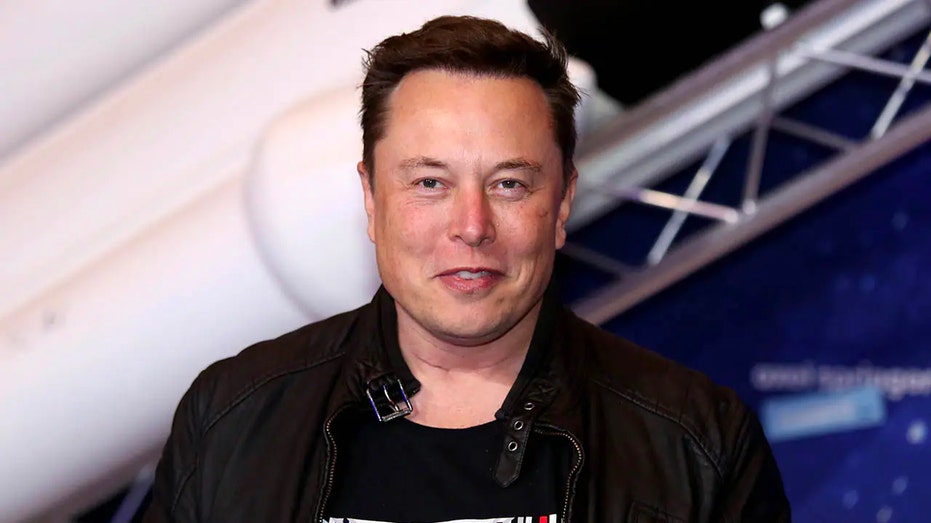
Elon Musk, founder of SpaceX and chief executive officer of Tesla Inc. (Liesa Johannssen-Koppitz/Bloomberg via / Getty Images)
In the show's opening sketch, cast member Mikey Day as Musk said he was making a bid to buy Easter, "offering 43 billion PEEPS."
It was a week filled with a slew of headlines from Musk following his offer.
Musk
suggested changes to the Twitter business model, was offered a position
on the social media company's board, which he turned down, and he
conducted a poll asking people on Twitter about whether they would be in
favor of an edit button.
Both bills now head to the desk of Governor Tom Wolf (D-Penn.), who has voiced his opposition to election integrity efforts in the past, and is thus likely to veto both bills.
On Wednesday, the Pennsylvania State Senate passed two comprehensive
election integrity bills, banning the use of drop boxes for ballots and
cracking down on private funding of election procedures.
As reported by Just The News,
Senate Bill 1200 requires all absentee ballots to be returned by mail
or delivered directly to the county elections office, thus eliminating
the possibility of allowing for drop boxes to be used in future
elections. The bill was passed along party lines, with all Democrats
voting against.
The bill was authored by State Senator Cris Dush (R-Penn.), who said
that “we’ve got a problem with a lack of confidence on the part of the
people…a problem with something that can definitely be utilized to do
ballot stuffing. This is a legitimate issue.”
On the same day, Senate Bill 982 passed with all Republicans and eight Democrats voting in favor.
“Senate Bill 982 simply states what all of us understood to be fact,”
said State Senator Lisa Baker (R-Penn.). “Government should pay for
elections. Voters, taxpayers and citizens alike deserve the most fair
and equitable election system. It should be uniform from one county to
the next regardless of size, demographics, or wealth.”
The private funding bill was crafted and passed in response to the
massive amount of money spent on administering elections in 2020 by
Facebook CEO Mark Zuckerberg, a scheme that has since been dubbed
“Zuckerbucks.” Zuckerberg’s Center for Tech and Civic Life handed out
over $350 million in grants to local elections offices in 2020, but
focused overwhelmingly on more Democratic areas in key swing states,
thus leading to a severe imbalance and artificial boosting of Democratic
turnout.
Both bills now head to the desk of Governor Tom Wolf (D-Penn.), who
has voiced his opposition to election integrity efforts in the past, and
is thus likely to veto both bills.
Eric Lendrum graduated from the University of California, Santa Barbara, where he
was the Secretary of the College Republicans and the founding chairman
of the school’s Young Americans for Freedom chapter. He has interned for
Young America’s Foundation, the Heritage Foundation, and the White
House, and has worked for numerous campaigns including the 2018
re-election of Congressman Devin Nunes (CA-22). He is currently a
co-host of The Right Take podcast.
America, as a society, must decide how much it values life
In June, the Supreme Court will review a case challenging a
Mississippi law banning abortion after 15 weeks of pregnancy. Abortion
advocates are worried that, if the court, increasingly viewed as conservative, reverses the constitutional right to abortion, then 26 states
may go ahead and ban abortion. This case and a Texas fetal-heartbeat
law prohibiting abortion past six weeks have energized them into fervent
campaigning. Democrat states are rallying with them by proposing laws
allowing abortions right up to childbirth—and beyond. Indeed, a Maryland
bill may effectively legalize infanticide.
How did America reach a stage in which
legislatures entertain the idea that an individual’s right can take
precedence over the right to life? The blame lies with advocacy groups
dyed in leftist, feminist, and critical theory ideology. A systemic flaw
they have exploited is the sponsored bill. It allows them to write a
bill—clause, comma, and full stop—and gets it proposed by a pliant or
sympathetic legislator. More on that in a future column. This one looks
at how America has become so deeply divided by abortion laws that states
discuss without guilt the murder of newborns.
Two landmark Supreme Court cases—Roe v. Wade in 1973 and Planned Parenthood v. Casey in 1992—decided the fate of fetuses in the U.S. Both upheld a woman’s constitutional right to seek an abortion. Casey
doubled the first trimester borderline for abortions to 24 weeks (about
six months) but with allowance for appraisal of fetus viability. States
could therefore legislate restrictions between the end of the first
trimester and the end of 24 weeks.
The Mississippi law of 2018—the Gestational Age Act—is
one such law. The Jackson Women’s Health Organization, the only
remaining abortion provider in the state, has challenged the law. Citing
Roe, Casey, and decades of precedent, the Organization claimed that the law was unconstitutional.
Lower courts placed an injunction on the
state, preventing it from enforcing the Act, whereupon Mississippi
petitioned the Supreme Court. Oral arguments were heard in the case (Dobbs v. Jackson Women’s Health
) in December; a final ruling is expected this summer, with a decision
on whether “all pre-viability prohibitions on elective abortions are
unconstitutional.”
Mississippi takes the position that “when an issue affects everyone
and when the Constitution does not take sides on it, it belongs to the
people.” It hopes to convince the Supreme Court to reverse both Roe, which legitimized abortion as a constitutional right, and Casey, which was based on an arbitrary viability position. The issue would then return to the states.
Organizations
and individuals who support “reproductive freedom” and believe limits
on pregnancy termination are “a violation of human rights” have already
drawn the state-level battle lines in anticipation. Democrats, who draw
strength from such groups, are seizing the opportunity to woo them by
promising abortion havens.
Last year, the Texas Heartbeat Act,
prohibiting abortion past six weeks, was enforced after the Supreme
Court turned down a plea for relief filed by abortion providers in the
state. Governor Gavin Newsom of California responded by pledging to
“expand and protect access” to the procedure, turning his state into a
“sanctuary” for abortion. He said,
“I am outraged that the U.S. Supreme Court has allowed Texas’s ban on
most abortions to take effect. Silently, in the dead of night, the
Supreme Court has eviscerated the fundamental protection of a woman’s
right to choose that Roe v. Wade has protected for the last 50 years.”
In December, Newsom formed the California Future of Abortion Council (CA FAB), comprising 40 organizations, including the American Civil Rights Union, Planned Parenthood, and NARAL Pro-Choice, to identify barriers to abortion services and make policy recommendations. Planned Parenthood Associates of California have proposed eight sponsored bills—a legislative package that bypasses voters’ opinions.
One of those eight bills, AB 2223, proposed in the California State Assembly by Buffy Wicks
(D-Oakland), will decriminalize the killing of newborns up until the
first month of life. It will not only shield a mother from civil and
criminal charges but also allow her to sue any police department or
legal authority for charging or arresting her for killing her child.
AB
2223 passed the Assembly Judicial Committee on April 5; the Assembly
Health Committee will consider it on April 19. If approved there, it
will go for a vote in the Assembly.
Wicks says she put forth the bill after two California women who suffered stillbirths related to their extensive drug use were prosecuted and jailed for fetal murder. The cases were dismissed
on the interpretation that the statute used was meant to criminalize
violence done to pregnant women that caused fetal death, not a woman’s
own actions resulting in miscarriage or stillbirth.
Another bill, SB 1375—proposed
by Sen Toni Atkins (D-San Diego) and not sponsored by Planned
Parenthood—allows nurse practitioners, nurse midwives, and physicians’
assistants to perform first-trimester abortions without a physician’s
supervision. The bill takes no account of the fact that women will be
endangered if standards are dropped to put access before considerations
of outcome.
Colorado, meanwhile, has already become the abortion
“sanctuary” that Governor Newsom soon wants to make California. Last
month, the House and Senate passed the Reproductive Health Equity Act, permitting abortion-on-demand for any reason, even for minors. Colorado Governor Jared Polis signed it into law
on April 4. It outlaws government interference in “reproductive
healthcare.” Presuming to define life itself, the law says a “fertilized
egg, embryo, or fetus does not have independent or derivative rights
under the laws of the state.”
The sinister Maryland bill (SB0669), introduced recently, will prevent investigations and legal penalties
at any point in the pregnancy as well as “perinatal” deaths related to
“failure to act” up to the first 28 days after birth. In clear language,
it affirms that fetuses neither have personhood nor any rights. It
allows for a baby surviving an abortion to die without care with no
penalties applied to providers. This gives the green light to
exterminating unwanted and disabled babies. Lawsuits may be brought
against authorities pursuing investigations or charges.
It remains to be seen how the Supreme Court will rule on the Dobbs v. Jackson Women’s Health case. Pro-abortion groups are trying to raise an alarm by presenting the view that if the court overturns Roe v. Wade, abortion will become illegal. This is not true. The case hinges on a conflict between the Roe v. Wade
ruling and court assertions that states have an interest in limiting
abortion and protecting “vulnerable and innocent life” from the point of
conception. What an overturning will do—if it happens—is let
legislators, influenced by abortion advocacy groups, make it possible
for people to go unprosecuted for causing death by neglect or other
means of children up to one month of age. A far cry from abortion up to
the point of viability.
America, as a society, must decide how much it values life.
In an article by Wendy McElroy from bitcoin.com in
2017, Ms. McElroy took on the hazards of a digital currency issued by
the U.S. government. Back then, it was referred to as Fedcoin. The
subject has been on the down-low, but the recent executive order by
President Biden to study the creation of a U.S. government
cryptocurrency brings the subject to the forefront, as a recent NBC news article reports.
The Biden administration is putting its support behind the research and development of a "U.S. Central Bank Digital Currency," or CBDC.
The move is part of a sweeping executive order President Joe Biden
signed Wednesday instructing the federal government to explore possible
uses of and regulations for digital assets like cryptocurrencies.
Most people regard cash as slightly cumbersome. I often
take note of people's choice of payment options at convenience stores
and drive-thru windows. Most prefer plastic. It is speedy, purse
space–efficient, and tight-budget flexible.
Can the government be sufficiently
persuasive to motivate people to give up cash to a rectangle made of
official government plastic? I admit that I have assumed that a
transition to plastic currency would fulfill the predictions of
futurists and sci-fi writers. With the invention of block-chain, it
struck me as inevitable.
Such an inevitability now seems frightening against the backdrop of a
cancel culture and the Edward Snowden realities of everyone's private
internet and cell phone communications being stored on NSA server
farms. Trudeau cutting off the bank accounts of Canada's protesting
truckers was the final nail in the coffin for me to oppose a cashless
future with only plastic Fed-coin-type card.
Monetary guru Doug Casey and Wendy McElroy also answer the how and why of a government, bitcoin-style currency.
Why would people use the cryptocurrency? Fedcoin would
almost certainly emerge as a parallel currency which would be adopted
due to government requirements for its use in paying taxes or accessing
entitlements such as Social Security. Increasingly, however, Fedcoin
would become a tool to push toward a cashless society because physical
money provides a privacy that prevents government control.
The God-like power to control and cancel personal bank account transactions is the stuff of serious totalitarian control.
With cash replaced by a Fedcoin, the government could ctrl/alt/delete one's
ability to spend or generally function until the person got vaccinated,
for example. Because of government access to every financial
transaction, it could fight obesity by limiting one's Snickers Blizzard
purchases.
The
government keeping track of ice cream treats might seem a bit over the
top. Don't forget that banks now must report transactions over six
hundred dollars. Government didn't used to care, but it does now.
Cryptocurrency
uses the high-profile moniker "block-chain," a system of verification
algorithms. Each Bitcoin transaction has a permanent ID tag — in
computer lingo, a "nonce," a genesis reference that acts as an
authenticator, creating a non-changeable transaction history. Thus, it
does not permit falsification by a bad actor. Block-chain is
decentralized, so no one entity has majority control over the
transaction history to fraudulently change it. A U.S. central bank
digital currency could change that.
Financial writer J.P. Koning speculated in an article entitled "Fedcoin."
The
Fed would create a new blockchain. ... There would be an important
difference between Fedcoin and more traditional cryptoledgers. One user —
the Fed — would get special authority to create and destroy ledger
entries[.]"
The government could become the bad actor
precisely because of its majority control over the block-chain ledger
history. The ledger would go from being decentralized to centralized
. With that comes the ability to program and reprogram, putting your
financial privacy and independence in jeopardy. Of course, the
government would promise not to do that.
Once a society goes
cashless, a socialist, ever-voracious government with the
crypto-algorithmic keys to control an individual American's financial
assets is a most frightening prospect.
Spruce Fontaine is an artist and retired college art instructor.
Khan did not realize that embracing a gorilla may include the risk of being crushed by it.
The past four years, however,
depict Khan's premiership as a tale of faux-pas and broken promises. He
tried to use Pakistan's powerful military elite as a support base
against real or imagined political rivals, not realizing that embracing a
gorilla may include the risk of being crushed by it.
He also picked fights with the religious establishment while
adopting a conciliatory posture towards the Pakistani Taliban, who
regard him as no better than an "infidel".
The fact that the Russian project would require 4,000
kilometer-long pipelines passing through Kazakhstan, Uzbekistan,
Turkmenistan and Afghanistan, plus massive investments beyond Pakistan's
ability, should have told Khan that what Putin offered him was a
googlie, a cricket term for "cheating". What Khan took for energy
pipelines could exist only in a pipe dream.
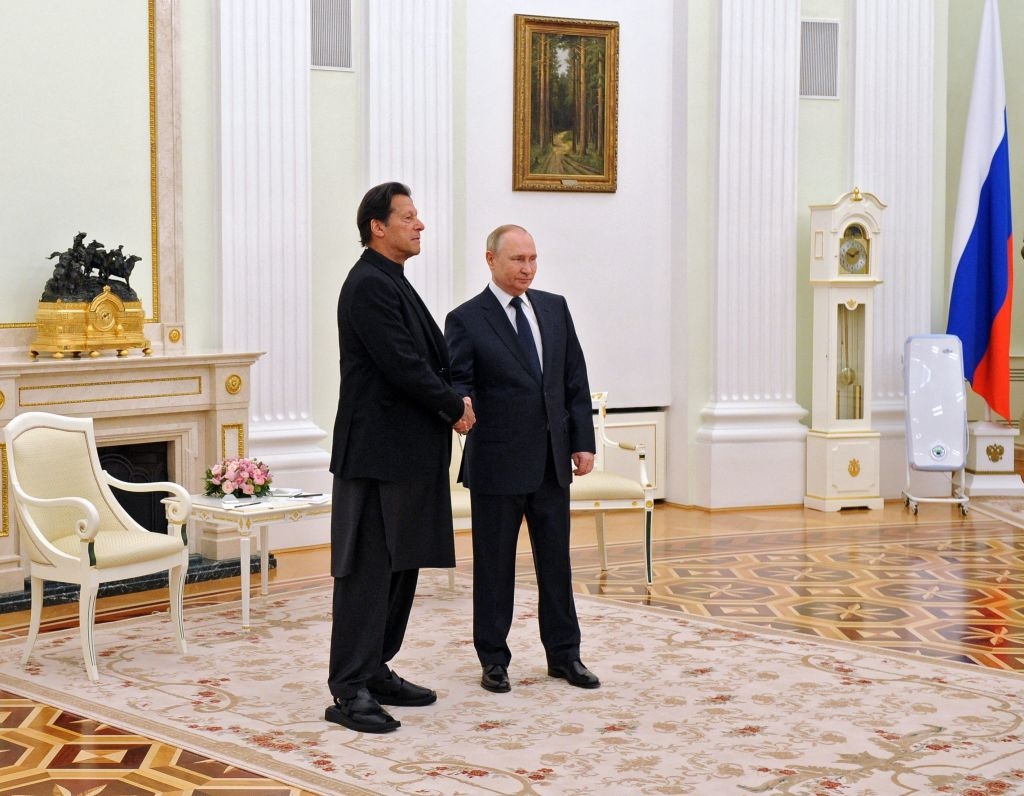
Pictured:
Russian President Vladimir Putin meets with then Pakistani Prime
Minister Imran Khan at the Kremlin in Moscow on February 24, 2022.
(Photo by Mikhail Klimentyev/Sputnik/AFP via Getty Images)
Four years ago when Imran Khan emerged as prime minister of Pakistan
many saw him as a breath of fresh air in a political system marked by
the stink of corruption and ineptitude.
In many ways Khan was an outsider. First, unlike his predecessors, he
was neither a Sindhi nor a Punjabi but a Pathan by descent. He did not
hail from either a feudal clan or a family of urban compradors.
Having made a career as brilliant cricketer, nor was he a
professional politician and was thus unsullied by the scandals that
formed a good part of Pakistani political life.
Khan's marriage to a glamour society girl, daughter of a Jewish English billionaire, also gave him a certain cachet.
Khan was also exceptional because he rose to the top of the greasy
pole of Pakistani politics without a proper political party and thanks
to a support base created through his personal charisma rather than
ideology.
So, earlier this week when Khan's premiership ended, it was no
surprise that he became the only Pakistani prime minister to be ousted
by the parliament in what looked like a palace coup.
The past four years, however, depict Khan's premiership as a tale of
faux-pas and broken promises. He tried to use Pakistan's powerful
military elite as a support base against real or imagined political
rivals, not realizing that embracing a gorilla may include the risk of
being crushed by it.
He also picked fights with the religious establishment while adopting
a conciliatory posture towards the Pakistani Taliban, who regard him as
no better than an "infidel".
To complicate matters further, Khan cast himself as the godfather of
the Afghan Taliban, thus sabotaging the Pakistani army's strategy of
keeping the Afghans on a tight leash. With the return of the Taliban
last August as the force that controls Kabul, Khan became their
self-appointed public relations officer and played a crucial role in
persuading China to unroll the red carpet for Taliban envoys and loosen
the purse strings for them.
That was in contrast with the Pakistani military's insistence that
the Afghan Taliban, before receiving the support they need to
consolidate their hold on Kabul, must first recognize the Durand Line,
the frontier traced by the British between Afghanistan and what was then
the Indian Raj.
It is possible that Khan interpreted the military's growing coldness
towards him as part of a broader plot hatched by political rivals and
endorsed by the Biden administration with a nod and a wink.
That interpretation led Khan on a surprising trajectory on search of a
new big power ally, and he thought he had found it in Vladimir Putin's
Russia. Thus he became one of only two foreign heads of government, the
other being Azerbaijan's President Ilham Aliev, to visit Moscow in the
wake of Putin's invasion of Ukraine, a trip that Russian propaganda
highlighted as full support for the war.
Khan's musings about "Russia's legitimate security concerns" and
implicit endorsement of Putin's claim that Ukraine is, in fact, part of
Russia detached by "neo-Nazis" and "imperialists" rang alarm bells in
Islamabad and beyond.
Putin's narrative about Ukraine sounds very much like the narrative
that pan-Indian nationalists have marketed about Pakistan for years.
According to that narrative, Pakistan and Bangladesh, the former East
Pakistan, were chunks of the Indian "motherland" chopped off by British
colonialists. The excuse that Muslims formed a majority of population
in both Pakistan and Bangladesh is unjustified if only because even
today there are more Muslims in India itself than in either of those two
countries.
Putin's argument about "Russian security concerns" also echoes that
of pan-Indian nationalists with regard to the portion of the disputed
Kashmir attached to Pakistan.
Having crossed several of the red lines set by the Pakistani
military, Khan further underlined his diplomatic naiveté by claiming
that he had reached a deal with Putin under which Russia would supply
Pakistan's energy needs with oil and gas trunk-lines while offering
"friendly prices."
The Russian project would bury the 40-year old accord with Iran to supply gas to Pakistan.
The fact that the Russian project would require 4,000 kilometer-long
pipelines passing through Kazakhstan, Uzbekistan, Turkmenistan and
Afghanistan, plus massive investments beyond Pakistan's ability, should
have told Khan that what Putin offered him was a googlie, a cricket term
for "cheating". What Khan took for energy pipelines could exist only in
a pipe dream.
To be fair, when Khan went to Moscow, the prospect of Russia emerging
from the war in Ukraine, if not with laurels, at least without losing
its feathers, didn't seem as remote as it does today.
Even then, Khan's Moscow trip looked like a strategic move designed
to revise Pakistan's alliances if not reverse them. The US, which has
been pumping in billions of dollars a year into the Pakistani army's
coffers, if not the pockets of its chiefs, was understandably concerned.
Beijing, too, was upset because for decades it had assumed that
Pakistan would make no major move without consulting its Chinese allies
and benefactors.
Khan should have known that in politics, as in cricket, timing is of
crucial importance. Yet in his grand plan for changing alliances, he may
have chosen the worst time to make his move.
After almost four years of economic growth, partly thanks to reforms
introduced by Khan's government, Pakistan has entered what looks like a
phase of severe recession, which most hurts the urban middle and lower
classes, Khan's main sources of support.
Khan's recent ill-advised moves gave the traditional ruling elites of
Pakistan, a coalition of feudal landlords, big merchants, religious
"ulema", and military and security officers the chance to close the
parenthesis of reform and re-organization he had opened and dash the
hopes he had aroused. And that is a loss not only for him as a
politician but also for Pakistan as a nation.
Khan's supporters tell us that he does not intend to drop the wicket
and simply walk off the field into a footnote in history. The
demonstrations launched in his support may lend some credibility to that
claim. However, the "comeback kid" scenario that Khan and his coterie
close to him are peddling seems unlikely. The question worth considering
now is which part of the traditional ruling elite is best able to
attract at least part of Khan's support base.
This article was originally published by Asharq al-Awsat
Amir Taheri was the executive editor-in-chief of the daily Kayhan in
Iran from 1972 to 1979. He has worked at or written for innumerable
publications, published eleven books, and has been a columnist for Asharq Al-Awsat since 1987.