Saturday, October 11, 2014

ISIS: Can the West Win Without a Ground Game? - Jonathan Spyer


by Jonathan Spyer


The United States and its allies have launched a military campaign whose stated goal is, in the words of President Barack Obama, to "degrade and ultimately destroy" the Islamic State (I.S., also known as ISIS or ISIL) established by Sunni jihadis in a contiguous land area stretching from western Iraq to the Syrian-Turkish border.

Smoke rises from a U.S. air strike on Islamic State positions in Kobani.
As the aerial campaign begins in earnest, many observers are wondering what exactly its tactical and strategic objectives are, and how they will be achieved. A number of issues immediately arise.

Any state—even a provisional, slapdash, and fragile one like the jihadi entity now spreading across Iraq and Syria—cannot be "destroyed" from the air. At a certain point, forces on the ground will have to enter and replace the I.S. power. It is not yet clear who is to play this role—especially in the Islamic State's heartland of Raqqa province in Syria.
In Iraq, the national military and the Kurdish Pesh Merga are now having some successes at chipping away at the Islamic State's outer holdings. The role of U.S. air support is crucial here. But the center of the Islamic State is not Iraq, and both the Iraqi forces and the Pesh Merga have made clear that they will not cross the border into Syria. This leaves a major question as to who is to perform this task, if the objectives outlined by President Obama are to be achieved.

The answer we have heard most often of late is that elements among the Syrian rebels will be vetted by the U.S., trained in cooperation with the Saudis, and then deployed as the force to destroy the IS on the ground.

If this is indeed the plan, it is deeply problematic.

The Syrian rebels are characterized by extreme disunity, questionable effectiveness, and the presence of hardline Sunni Islamist elements among their most committed units. There are certainly forces of an anti-jihadist ideology among them—the most well-known being the Syrian Revolutionaries Front, headed by Jamal Ma'arouf from the Jebel Zawiya area in northern Syria, and the smaller Harakat Hazm. Both movements have benefitted from Western aid in recent months.

The Syrian rebels are characterized by extreme disunity, questionable effectiveness, and the presence of hardline Sunni Islamist elements among their most committed units.

The problem, however, is that these organizations are quite prepared to work with salafi groupings whose worldview is essentially identical to that of the I.S., even if their methods are somewhat different. Thus, if we observe the recent fighting between Assad's forces and rebels in the Quneitra area along the border with the Israeli Golan Heights, it is clear that the main contribution to rebel achievements came from the Jabhat al-Nusra group, which constitutes the "official franchise" of the core al-Qaeda group in Syria.

Reliable sources confirm that Nusra cooperates with other rebel groups in southern Syria and has even been prepared to minimize its own role, so as to allow other groups to present achievements as their own to Western and Arab patrons and thus secure a continued flow of arms, benefiting all factions.

What this means is that by championing these rebel elements as the ground force which will seek to enter and destroy a weakened I.S. in Raqqa province, the U.S. would be putting itself in the position of supporting one group of Sunni jihadis against another.

In Iraq, while the Kurdish Pesh Merga cooperates de facto with Iran, their alliance is pragmatic and tactical, one that the Kurds would gladly break given the possibility of clear Western sponsorship.

But the fierce condemnations in recent days (even by supposedly "pro-Western" rebel groups such as Hazm) of the U.S. bombing raids into Syria indicate that there is a deeper problem here. The alliance between these Sunni rebel groups and the salafis has a common anti-Western component to it.

It is, in any case, not clear if these Sunni rebels will prove able to defeat the I.S., but even if they were to do so, the presence of radical anti-Western elements among them attests to the danger of a policy of support and sponsorship of them.

Of course, the Sunni jihadis are not the only dangerous players on the ground. Another possible, no less troubling, outcome of the air campaign against the Islamic State could be the return of Bashar al-Assad's forces to eastern Syria, from which they have been largely expelled over the last year. It is not at all hard to imagine a scenario in which once the I.S. has been weakened by Western air attacks, the Syrian military and its Iranian-backed allies will be able to make gains.

Indeed, the Iranian Revolutionary Guard Corps (IRGC) are already present in northern Iraq (and, of course, in Syria as well) and IRGC personnel have taken part in the fighting in Iraq in recent weeks. Qods force teams are reportedly located at Samarra, Baghdad, Karbala, and the former al-Sahra Air Base near Tikrit. Iran has deployed seven SU-25 ground attack aircraft which have played a role in offering air support to the Kurds and Iraqi special forces.

The Assad regime and its Iranian backers [are] enemies of the West of significantly greater potency and seriousness than the Islamic State itself.

Following intensive Western bombing, the possibility of the Islamic State eventually being sandwiched between pro-Iranian forces on either side before being destroyed would be a real one. This would achieve the desired goal of destroying the jihadi entity, but it could end up handing a major victory to the Assad regime and its Iranian backers—enemies of the West of significantly greater potency and seriousness than the Islamic State itself.

Such a result would be somewhat reminiscent of the Iraq invasion of 2003, in which the destruction of the Sunni regime of Saddam Hussein ended up largely helping Iran.

How does the West get out of this mess? The discussion about which ground force should be used to replace the Islamic State is itself confused by a much larger misunderstanding regarding the nature of the war now taking place in Iraq and in Syria (and periodically spilling over into Lebanon).

The I.S. has now been depicted as the main problematic factor emerging from this conflict. But the Islamic State is in fact merely a particularly extreme and brutal manifestation of a broader process taking place in this area, in which political Islam of a Sunni variety is at war with the Shia political Islam of Iran and its proxies (especially Hezbollah and the Assad regime).

The I.S. may promote a particularly lurid and repulsive version of Sunni political Islam, but in its beliefs and in its practices it does not represent some unique presence in the Syrian and Iraqi context. Rather, it is little more than a particularly virulent manifestation of a strain of politics and ideology which is the primary cause of the conflict taking place across the region.

In the two scenarios discussed above, both quite plausible outcomes of a Western air campaign, the I.S. would be defeated and replaced by another version of Islamism—either that of its fellow Sunnis, or that of the rival Shi'ites.

A third possibility, however, is that the White House does not actually intend to pursue a policy intended to physically destroy the Islamic State in its heartland in northern Syria. Certainly, more recent statements emerging from the Administration appear to be preparing to "walk back" the President's comments.

White House Chief of Staff Denis McDonough said in mid-September that success for U.S. policy vis-à-vis the I.S. would come when the group "no longer threatens our friends in the region, no longer threatens the United States." This sounds like the introduction to a more modest policy of degrading I.S. capabilities, rather than seeking to "destroy" the Islamic State.

Of course, such a modified objective would end the dilemma over which ground forces to ally with. On the other hand, it would also have the effect of a tacit admission that the U.S. did not intend to promote its policy as originally stated by the President in the aftermath of the horrific murder of two U.S. citizens by the Islamic State.

What is taking place across Syria and Iraq, and across their borders into Lebanon, Turkey, and Iran, is a sectarian war, made possible because of the decline of the police states which for half a century kept the lid on sectarian differences.

But whether or not the goal of destroying the Islamic State is pursued with vigor, the current failure to see accurately what is happening in the Levant and Mesopotamia looks set to remain. This, in turn, looks set to prevent the emergence of a coherent policy and a coherent allocation of resources.

What is taking place across Syria and Iraq, and across their borders into Lebanon, Turkey, and Iran, is a sectarian war, made possible because of the decline of the police states which for half a century kept the lid on sectarian differences. The regional ambitions of Iran, which has clients and proxies in all three countries, exacerbate this dynamic. The attempts by Saudi Arabia to block Iran's advance toward the Mediterranean, and by Qatar and Turkey to sponsor various Sunni jihadi elements, have produced a far more confused, and far less effective, Sunni side in this struggle.

The struggle itself, in turn, can be traced back to the failure by these states to develop coherent notions of citizenship or stable national identities in the post-Ottoman period. In other words, this war has been a long time coming, but now it is here.

Because the nature of this struggle is not widely grasped in the West, policy appears somewhat rudderless. This is reflected in the current discussion regarding the response to the Islamic State.

First, Assad was the enemy. This was made clear enough not only by his support for Hezbollah and attempts to nuclearize, but also by his unspeakable brutality and use of chemical weapons against his own citizens.

Then, when the brutality of some of the rebels became apparent, Western public interest in supporting the rebels receded. Soon the I.S. emerged as the new bogeyman. Declarations for its destruction became de rigueur, though it is far from clear how this is going to be carried out—and a de facto alliance with Iran and its clients, at least in Iraq, has emerged. This was seen in the expulsion of the I.S. from the town of Amerli, a pivotal moment in the major setbacks faced by the organization in recent days. In that town, Shi'ite militias were backed by American air power—to telling effect against the Sunni jihadis.

But is it really coherent policy to be backing murderous Shi'ite sectarians against murderous Sunni ones? It is not. Of course, when the West backs the Sunni rebels in Syria, the precise opposite is happening. Weaponry donated to "moderate" rebels then inevitably turns up in the hands of Sunni jihadis, who do most of the fighting associated with the Syrian "rebellion." The result is that in Iraq the U.S. is helping one side of the Sunni-Shia war, and in Syria it's helping the other side.

Only when it is understood that the West cannot partner with either version of political Islam does it become possible to formulate a coherent policy toward the Sunni jihadi forces, on the one hand, and toward the Iran-led bloc, on the other.

Such a policy must rest on the identification and strengthening of non-Islamist forces willing to band together and partner with the West. Not all of them are perfect characters, but they all understand the threat that political Islam poses.

Most obviously, there is a line of pro-American states along the southern side of the arena of the war. These are Israel, Jordan, and in a far more partial and problematic way, Saudi Arabia. Both Israel and Jordan have demonstrated that they are able to successfully contain the spread of the chaos coming out of the north. Both are well-organized states with powerful militaries and intelligence structures. Jordan has clearly benefitted from the deployment of U.S. special forces to prevent incursions by the I.S. Israel has also made clear that its resources will be available to assist the Jordanians should this be required. (Egypt, too, while not in the immediate vicinity of the conflict, can be a silent partner as well—as its campaign against the Muslim Brotherhood and tough line against Hamas have shown, it is nothing if not a virulent opponent to political Islam.)

This is what the proper coordination of allied states is supposed to look like. And it works in containing the conflict. To the east of the war's arena is of course Iran. To its west is the Mediterranean Sea. To its north is a long, contiguous line of Kurdish control, shared between the Kurdish Regional Government of President Massoud Barzani in northern Iraq, as well as the three enclaves created by the PKK-linked Democratic Union Party (PYD) in northern Syria. The YPG militia, which is the military force in these enclaves, has fought the I.S. almost since its inception, and has largely prevailed in keeping the jihadis out of the Kurdish areas.

As part of a strategy of containment, the West should increase support for and recognition of both the Kurdish enclaves in the north of Syria and the Kurdish Regional Government itself.

As part of a strategy of containment, the West should increase support for and recognition of both the Kurdish enclaves in the north of Syria and the Kurdish Regional Government itself. Both are elements capable of containing the spread of the jihadis from the north. It has become clear in recent days that the Pesh Merga, despite early setbacks, is a useful instrument in preventing the further advance westward of the Islamic State, and in so doing protecting the investment of international oil companies in the oil-rich parts of Iraq. The YPG militia, though poorly equipped, has also avoided major losses.

Such a principle of alliance will also encourage the West to reconsider the involvement of Turkey. As events of the last few years have shown, Turkey cannot be a reliable ally in the struggle against political Islam, because its ruling party, AKP, is itself an Islamist party. This is not a theoretical formulation. Turkey's support for Islamist militias in northern Syria and its opening of its border for them has been a major contributing factor in the proliferation of these elements. There is also considerable evidence that Turkey at the very least turned a blind idea to the activities of the I.S. in the border area in 2013, and may well have offered some help to the jihadis in their fight with the YPG.

In order to grasp the rationale for a policy of dual containment, the nature of the war between rival sectarian forces must be grasped. There is also a need for the clear understanding that the effort to preserve at all costs the territorial integrity of "Iraq" and "Syria" is mistaken. Rather, what should take place is support for those forces committed to order, as listed above, and non-support for the forces of political Islam.

In other words: If political Islam (rather than one specific jihadi group, to quickly be replaced by another) is the real problem, then the real solution is to ally, forcefully and over the long haul, with those forces most committed to stopping it: Israel, Jordan, the Saudis, and the Kurds.

So it may be seen that a lack of strategic understanding of the nature of the conflict being waged is preventing the development of a coherent response to the specific problem of the Islamic State, along with the parallel problems of Shia terror groups such as Hezbollah, and the ambitions of the Islamic Republic of Iran. At root is the failure to grasp the implacable nature of political Islam in both its Sunni and Shia variants at the present time.

From this original error, all further errors, and as we can see there are many, inevitably follow.


Jonathan Spyer is a Middle East analyst focusing on Syria, Lebanon and Israeli strategic affairs. He is a senior research fellow at the Global Research in International Affairs (GLORIA) Center, Herzliya, a fellow at the Middle East Forum, and is the author of The Transforming Fire: the Rise of the Israel-Islamist Conflict (Continuum, 2011).

Source: http://www.meforum.org/4846/isis-can-the-west-win-without-a-ground-game

Copyright - Original materials copyright (c) by the authors.

Report: Blast at Iran military site -- intentional sabotage


by Dan Lavie, Daniel Siryoti, Reuters and Israel Hayom Staff


Top Iranian official tells Kuwaiti newspaper, "Only a foreign state with advanced intelligence capabilities could penetrate the facility and carry out an explosion like this" • U.S. security institute says it has located damaged site via satellite imagery.


Parchin military complex in Iran
|
Photo credit: AP


Dan Lavie, Daniel Siryoti, Reuters and Israel Hayom Staff

Source: http://www.israelhayom.com/site/newsletter_article.php?id=20661

Copyright - Original materials copyright (c) by the authors.

Analysis: Does the Islamic State Really Have 'Nothing to Do with Islam'? - Jeffrey M. Bale


by Jeffrey M. Bale


Note: This analysis has been excerpted, with the approval of the author, from a much longer scholarly article that will be published in an academic journal.
"Which will come first, flying cars and vacations to Mars, or a simple acknowledgement that beliefs guide behavior and that certain religious ideas – jihad, martyrdom, blasphemy, apostasy – reliably lead to oppression and murder?"
Sam Harris, Sleepwalking Toward Armageddon
As is invariably the case these days in the wake of the terrorist violence, brutality, and atrocities carried out explicitly in the name of Islam, a host of dissimulating Islamist activists, other Muslims in a state of psychological denial, and apologetic Western pundits insist that the actions of the terrorist group calling itself al-Dawla al-Islamiyya (IS: the Islamic State) have little or nothing to do with Islam.

Not long ago, many such commentators also argued that the horrendous actions committed by the Nigerian jihadist group Jama'at Ahl al-Sunna li al-Da'wa wa al-Jihad, better known as Boko Haram (Western Influence is Sinful), had nothing to do with its members' interpretations of Islam.

In all such cases, however, the perpetrators of these violent actions not only proudly insist that their actions are inspired by the Qur'an and the exemplary words and deeds of Muhammad himself (as recorded in the canonical hadith collections), but explicitly cite relevant Qur'anic passages and the reported actions of their prophet to justify those actions. Therefore, to argue that jihadist terrorists are not directly inspired and primarily motivated by their interpretations of Islamic doctrines and by clear precedents from early Islamic history, one must stubbornly ignore what the actual protagonists keep telling the entire world.

But why ignore the claims of the perpetrators and instead rely on Islamist activists, who are often peddling outright disinformation, or on Western commentators, most of whom know little or nothing about Islam or Islamism, for explanations of this behavior? These pundits are prone to minimize the central role played by Islamist ideology and erroneously ascribe the actions of jihadist terrorists to assorted subsidiary causal factors, such as garden-variety political grievances, poverty, lack of democracy, psychopathology, greed, or simple hunger for power.

Needless to say, most of the commentators who keep insisting, against all evidence to the contrary, that the actions of jihadist terrorists cannot be attributed to their interpretations of Islam do not also argue that the violent actions of other types of extremists cannot be attributed to their ideological beliefs. On the contrary, whenever other types of terrorists carry out gruesome attacks, many of those same commentators are quick to ascribe their actions primarily to their proclaimed theological and ideological beliefs – and justifiably so.

One can easily illustrate this glaring contrast with respect to the analytical treatment of Islamist terrorism by asking a simple question: when was the last time that any more or less respected commentator made the case that Nazi ideology had nothing to do with inspiring particular acts of terrorism committed by self-identified neo-Nazis, or that notions of white supremacy had nothing to do with anti-minority violence committed by members of the Ku Klux Klan? Thus it is virtually only in cases of acts of terrorism committed by jihadists that one encounters so much unwillingness to face reality and so much frantic desperation to absolve Islam itself – or even Islamist interpretations of Islam – from shouldering any responsibility for inspiring acts committed in its name.

Some academicians mistakenly minimize the role of ideology as a key factor in inspiring the violence and terrorism carried out by non-state extremist groups, not just in the case of jihadist terrorism but also in other such cases. These efforts are seriously misleading, since they tend to be based on flawed social science theories that overemphasize the role of "rational choice," materialistic rather than idealistic motives, personal psychological factors, "really existing" political and economic grievances, or larger impersonal structural forces as causal factors in the etiology of terrorism. 

However, they at least have the merit of not employing double standards, i.e., of making an unwarranted and wholly artificial distinction between the causes of Islamist terrorism and other types of ideologically-inspired terrorism. Indeed, although some have specifically applied such problematic notions in the context of Islamist terrorism, there is no reason to suppose that they regard ideology as being any more important in other terrorism contexts.

But the most egregious nonsense about the Islamic State is currently being peddled by ideologues, spokesmen, and activists from Islamist organizations, both in the Muslim world and in the West. Leading Saudi clerics, Saudi-sponsored and Saudi-funded international Islamic organizations like the Organization of Islamic Cooperation (OIC), and numerous Islamist groups and networks linked to the Muslim Brotherhood are now belatedly hastening to denounce the IS and to falsely claim that it has "nothing to do with Islam" or that its appalling actions are "un-Islamic" or even "anti-Islamic."

Unfortunately, many naïve or agenda-driven Western journalists cite these deceptive statements by Islamists in an effort to challenge conservative Western media claims that not enough Muslims are speaking out against the IS. Indeed, those journalists tend to highlight such statements to give the impression that lots of supposedly moderate Muslims are publicly opposing the IS, either without actually knowing or without bothering to mention that most of the people and organizations that are making such statements are in fact Islamists who are trying to whitewash Islam and their own brands of Islamism, burnish their own tarnished images and thereby protect themselves, and/or mislead gullible "infidels" in the media.

Most of these commentators repeat the same one-sided mantras that have been endlessly repeated since the 9/11 terrorist attacks, e.g., that "Islam is a religion of peace" or that "Islam does not sanction terrorism and beheadings," usually without providing any actual textual or historical evidence in support of their claims. This is all the more peculiar, since if the jihadists affiliated with the IS were in fact egregiously misinterpreting Islam, it should be very easy indeed for their critics to point this out by referring to Islam's sacred scriptures and the reported words and deeds of Muhammad to explicitly repudiate barbarous IS actions such as the wholesale massacre or torture of captives, the confiscation of their land and wealth, the enslavement (sexual and otherwise) of their women, the gruesome public beheadings and stonings of designated enemies and "sinners" in order to terrorize others and perhaps also to precipitate the arrival of the Mahdi and the onset of the "end times," the wanton destruction of places of worship and historical monuments, and the list goes on and on.

Yet they generally fail to do this. On those rare occasions when they try to demonstrate that these kinds of activities are "un-Islamic," usually by citing a handful of Qur'anic passages out of context or by noting a few recorded examples of Muhammad's compassion, their arguments are weak and unconvincing, if not preposterous. The jihadists themselves and certain hardline pro-jihadist clerics have thus far seemingly had little trouble rebutting their Muslim critics' often specious arguments.

An illustrative example of such Islamist sophistry is provided by Nihad 'Awad, national executive director of the Council on American-Islamic Relations (CAIR), a key component of the Muslim Brotherhood network in the U.S.

In an opinion piece entitled "ISIS is Not Just Un-Islamic, It is Anti-Islamic," 'Awad describes ISIS as a "criminal gang" that "falsely…claims to uphold the banner of Islam." In support of his claim, 'Awad attempts to redefine the term jihad in such a way that it cannot be associated with offensive warfare.

The claim that the term jihad does not refer, among other things, to offensive warfare against the enemies of Islam with the goal of expanding the dar al-Islam until the entire world is brought under the aegis of Islam is blatantly false. Such a sanitized definition of jihad, a noun deriving from the verb jahada, meaning "to struggle" or "to exert oneself," conveniently ignores the fact that jihad bi al-sayf ("jihad of the sword") has always been the most commonplace meaning of the term, both historically and at the present time.

At a September rally by "Muslims Against ISIS" in Dearborn, Mich., Dawud Walid, another Islamist activist associated with CAIR, cited one Qur'anic passage (5:32) that is invariably referred to by those who are trying to claim that Islam is inherently peaceful. "Whoever kills an innocent soul, it is like they have killed all of mankind," Walid said in summary.

He, like so many others, conveniently ignored the fact that this particular sura refers specifically to the "Children of Israel," rather than to Muslims, and that it was presented for didactic purposes in the context of Cain wrongly killing Abel: "Because of that, We decreed upon the Children of Israel that whoever kills a soul unless for (killing) a soul or for corruption [done] in the land - it is as if he had slain mankind entirely. And whoever saves one - it is as if he had saved mankind entirely. And our messengers had certainly come to them (i.e., Jews) with clear proofs. Then indeed many of them, [even] after that, throughout the land, were transgressors."

Although this message was intended to provide moral guidance to Muslims as well about what was and was not permissible, it was cited in reference to Allah's supposed warning to transgressing Jews. More tellingly, the following aya (5:33) specifies which categories of people can be legitimately killed, crucified, or dismembered by Muslim believers for their sins: "those who wage war [yuharibun] against Allah and His Prophet" and those who "strive to spread corruption/mischief [fasadan] in the land…" Finally, those who cite 5:32 or other ostensibly peaceful passages from the Qur'an (such as 2: 256) as authoritative fail to mention that, according to the doctrine of abrogation (naskh), the intolerant and bellicose passages "revealed" during the later Medinan period supposedly abrogate many if not most of the tolerant, compassionate passages from the prior Meccan and earlier Medinan period.

Hence it is all too easy, and not at all unorthodox or heretical, for jihadists to insist that they are enjoined by the Qur'an itself to kill, subjugate, and enslave the enemies of Islam, irrespective of what Islam apologists or Islamist apologists may claim.

Another participant at the "Muslims Against ISIS" rally in Michigan, Iraqi-American Alia Almulla, made the bold claim that the Qur'an "doesn't teach terrorism" and went on to say that "[p]eople need to become more educated about Islam and actually read the Qur'an." She is absolutely right to encourage people to learn more about Islam and to read the Qur'an, but gives little evidence in her quoted comments that she has carefully read the Qur'an herself. If she had, she could hardly have overlooked sura 8:60, which is so often referred to and praised by Islamists precisely because it sanctions the use of terrorism against the enemies of Islam: "And prepare against them whatever you are able of power and of steeds of war by which you may terrify the enemy of Allah and your enemy and others besides them whom you do not know [but] whom Allah knows. And whatever you spend in the cause of Allah will be fully repaid to you, and you will not be wronged."

That particular passage of the Qur'an has not only been cited favorably by Qa'idat al-Jihad leader Usama bin Ladin and other jihadist terrorists, but the first two words from it (wa a'idduwa = "and prepare/make ready/muster") also appear directly beneath the pair of crossed swords on the bottom of the symbol of the Muslim Brotherhood, the Egyptian Islamist organization with numerous branches and offshoots throughout the world that nowadays tends to publicly eschew armed jihad for purely pragmatic or tactical reasons but not infrequently advocated and resorted to violence and terrorism in the past.

Moreover, there are numerous other Qur'anic passages that explicitly enjoin Muslims to wage war and/or slay, capture, enslave, and subjugate "infidels," "apostates," and "hypocrites," such as 8:39, 8:65, 8:67-68, 9:5, 9:13, 9:29, 9:36, 9:41, 9:73, 9:111, 23:1-6, 33:50, 47:35, 48:29, 2:193, 2:216, 3:140-1, 4:24, 4:76, and 5:33. Indeed, several of those very passages, especially in the Surat al-Tawba, are believed by many Islamic scholars to have abrogated and superseded multiple relatively tolerant passages dating from the Meccan or early Medinan eras. Hence those who cite certain supposedly "abrogated" (mansukh) suras as evidence that Islam really promotes compassion and tolerance rather than intolerance and bellicosity towards unbelievers and "insufficiently Islamic" Muslims, can easily be dismissed as egregious "misinterpreters" of Islam, and indeed demonized and targeted as "apostates," by pro-jihad Islamists. Even if we limited ourselves herein to discussing particularly gruesome high profile actions such as public beheadings, one can find passages sanctioning this behavior in the Qur'an, such as sura 47:4 and sura 8:12.

How, then, is it possible to argue – especially if one interprets the Qur'an in a strict, literalist fashion rather than very loosely – that violent actions which are explicitly enjoined in Islamic scriptures are actually "un-Islamic"?

Furthermore, it is not only the Qur'an itself, but also the recorded "customary practice" (sunna) of Muhammad himself that provides ample justification and sanction for much of the barbaric behavior of IS jihadists, who may in fact be consciously trying to "reenact" Muhammad's own successful actions. In this context, it must be remembered that Muhammad is regarded by other Muslims both as the last of Allah's prophets and as the ideal Muslim. As such, his words and deeds are viewed as both exemplary and worthy of emulation. Unfortunately, Islamic sources that are considered authentic by Muslims, such as the canonical hadith collections, the early biographies of Muhammad, and various historical chronicles of the early phases of the Arab conquests, all provide ample evidence of the harshness, brutality, and cruelty that Muhammad, his companions, and the "rightly-guided" Caliphs at times exhibited, especially in the course of their military campaigns, toward their designated enemies.

On the other hand, there is no doubt that many of the activities of the IS violate the letter and the spirit of traditional Islamic "just war" doctrines, since IS jihadists deliberately and often indiscriminately target, abuse, and slaughter non-combatants from "enemy" groups. These just war doctrines, which in theory forbid Muslims from deliberately targeting women, children, the aged, and the physically or mentally infirm and, more broadly, from carrying out disproportionate levels of violence, were developed by medieval Muslim jurists on the basis of certain Qur'anic passages and various compassionate acts and instructions of Muhammad recorded in ostensibly reliable ahadith.

Even so, the grim reality in practice was that, during the time of Muhammad and his successors, civilians within all of those protected categories were often killed inadvertently or in the normal course of carrying out regular military operations by Muslim troops, especially if doing so was considered necessary in order to defeat their foes.

Fortunately, Islam can be interpreted, and indeed has been interpreted over the centuries, in many different ways by living, breathing Muslims. Although it is neither unorthodox in most respects nor limited to the extremist fringe, the strict, literalist, puritanical interpretation of Islam that is characteristic of the Islamists, including the jihadists, is far from being the only "legitimate" interpretation of Islam. Along with secularists in the Muslim world, Muslim rationalists, modernists, and even some traditionalists have tended to interpret Islam in less restrictive, punitive, or sectarian ways that are at least partially compatible with modernity and democratic pluralism.

Although in many ways scriptural literalists have advantages over moderates in religious debates, Muslims can nonetheless adopt various modes of argumentation to challenge theocratic Islamist interpretations of Islam. As with Judaism and Christianity, genuinely moderate Muslims can argue that the injunctions in the Qur'an and the commands of Muhammad may well have been relevant and even appropriate during the historical contexts in which they were issued, but that they are not all necessarily applicable in today's radically different historical context. They also can argue that many of those Qur'anic passages and statements of Muhammad were difficult to understand and thus do not provide clear, unambiguous guidelines for Muslim behavior at the present time. Hence Muslims should not interpret them slavishly, dogmatically, or in an invariably literalist fashion, but rather apply human reason and interpret them, especially if the meaning is unclear, in a more contextual (historically-grounded), allegorical, or metaphorical way.

They can further make a case that many Qur'anic strictures and ideas of Muhammad were relatively progressive by 7th century standards, especially in the context of Arab tribal society, and that they therefore embodied a spirit of innovation, pragmatism, and moderation that Muslims today should aspire to emulate. And they can simply ignore or reject the doctrine of abrogation on various religio-legal grounds, since that doctrine has frequently been used by some Islamic scholars and militants to justify more extreme interpretations of Islam.

Nevertheless, it is impossible for any knowledgeable person to characterize the beliefs and activities of IS jihadists as "un-Islamic," much less as "anti-Islamic," since Islamic supremacism and intolerance of non-Muslims are all too characteristic in the Qur'an and Muhammad's sunna. As moderate Canadian Muslim Tarek Fatah has justly noted:
"Islam is not a religion of peace. It's not necessarily a religion of war, either, but it would be a lie to deny that its history and literature are seeped [sic] in armed jihad, assassinations and bloodshed that simply cannot be swept under a carpet. Only we Muslims can reform Islam for future generations. But first, we must stop lying in the name of Allah. It's no use denouncing ISIS while refusing to renounce [armed] jihad."
Although many Muslims, like other religious believers, can be expected to be overly defensive about their faith, it remains far less understandable why so many Western leaders and commentators are also peddling the same falsehoods about the IS having "nothing to do with Islam." If the latter honestly believe what they are saying, then they are either hopelessly ignorant about Islam, Islamic history, and Islamism, or are wearing impenetrable ideological blinders that prevent them from seeing reality, or are living in an acute state of psychological denial that borders on the pathological and the clinically delusional. But if such Westerners do not actually believe what they are saying, then they are fooling themselves that their embarrassingly facile attempts to divorce Islam from Islamism will somehow end up being the most effective way to counter Islamist ideology or rally support from Muslims for various Western foreign policy and counterterrorist initiatives in the region.


Jeffrey M. Bale is an Associate Professor in the Nonproliferation and Terrorism Studies Program at the Monterey Institute of International Studies (MIIS), where his focus is on the study of political and religious extremism and terrorism. He obtained his B.A. in Middle Eastern and Islamic history at the University of Michigan, and his Ph.D. in modern European history at the University of California at Berkeley.

Source: http://www.investigativeproject.org/4607/analysis-does-the-islamic-state-really-have

Copyright - Original materials copyright (c) by the authors.

Britain, Sweden - and a State of Palestine? - Dennis MacEoin


by Dennis MacEoin


Many politicians and members of the public have come to see Palestinians as the world's underdogs, who, however ugly their behaviour, can do no wrong; and to portray Israel as a Nazi state that persecutes the Palestinians and "steals" the land -- mystifyingly -- of a people, the Jews, who have lived on that land for roughly 4,000 years.
"In a final resolution, we would not see a single Israeli -- civilian or soldier -- on our lands." — Palestinian Authority President Mahmoud Abbas.
"The Day of Judgement will not come about until Muslims fight and kill the Jews, when the Jew will hide behind stones and trees. The stones and the trees will say, O Muslims, there is a Jew behind me, come and kill him. " — Hamas Charter, Article 7.
"[T]his struggle will not cease unless the Zionist state is demolished and Palestine is completely liberated." Article 19, — Fatah [PLO] Constitution, as of July 19, 2005.

The British parliament, on October 13th, may be debating whether or not to recognize a Palestinian state.

Recognizing what in all likelihood would quickly become yet another Islamic terrorist state can only set a precedent that could have a disastrous impact on future negotiations and international law, and lead to the establishment [of] yet more launching pads for people dedicated to violent jihad, not just in Israel, but, as they now openly admit, worldwide, including Britain and Sweden.

On October 3, newly elected Swedish Prime Minister Stefan Löfven used his inaugural speech to announce a decision to recognize the "state of Palestine." In what must rank as one of the most self-contradictory statements in political history, he declared: "A two-state solution requires mutual recognition and a will to peaceful co-existence. Sweden will therefore recognise the state of Palestine."

One might be forgiven for thinking that to become Prime Minister of an important First World country takes considerable political, social and diplomatic skills and some intelligence. Has Mr. Löfven never heard of the 1967 Khartoum Declaration that declares "No peace with Israel, no negotiations with Israel, no recognition of Israel"? The Palestinians, and evidently the entire Arab world, still think like this, so where is the "mutual recognition" to appear from? While Palestinians and their supporters (including the Swedish left) chant, "Palestine will be free; From the river to the sea" (meaning that Israel will be replaced by a Palestinian state that, under Hamas, is more than likely to turn into another Islamic State), where is this "will to peaceful co-existence" supposed to come from? From the Hamas Charter, perhaps, whose thirteenth article unequivocally declares: "Initiatives, and so-called peaceful solutions and international conferences, are in contradiction to the principles of the Islamic Resistance Movement.... There is no solution for the Palestinian question except through Jihad. Initiatives, proposals and international conferences are all a waste of time and vain endeavors"? Or perhaps an inspiring example may be found in the twenty or so peace proposals Palestinian leaders have turned down flat in the past sixty-six years? Will Sweden's recognition bring peace and a "two-state solution" any closer? Or will it give the Palestinians greater encouragement to fight against the provisions of international law that legitimize Israel's right to exist and the call for two states in 1947? Will the Palestinians continue their demands for a one-state solution, giving them Gaza, the West Bank and all of Israel -- with the Jews now in Israel, Judaea and Samaria maybe allowed to live there on sufferance, as "tolerated" second-class-citizens, or dhimmis like the Christians, Kurds and Yazidis in Iraq, the Kurds in Syria, or the Copts in Egypt? Or will a current Palestinian state mean the death or expulsions of all the Jews in Israel -- for has not Mahmoud Abbas, the chief beneficiary of these ill-thought recognitions, declared: "In a final resolution, we would not see the presence of a single Israeli - civilian or soldier - on our lands"?

There is no Palestinian state to recognize in the first place: the Palestinians rejected the state they were offered by the UN in 1947, they have continued to reject it, and have for years been in breach of UN Resolution 242, to which they had agreed, that "Termination of all claims or states of belligerency and respect for and acknowledgment of the sovereignty, territorial integrity and political independence of every State in the area and their right to live in peace within secure and recognized boundaries free from threats or acts of force" since they demand withdrawal of Israel to the pre-1967 borders, something the resolution was carefully drafted to avoid. Unless Israel is given "secure and recognized boundaries." Such blasé repudiation of an internationally binding commitment is a breach only a totally illiterate politician would fail to see. So long as Israel is a state surrounded by violent countries such as Iran, Syria, Iranian-controlled Lebanon, Yemen -- as well as jihadist movements from Hamas to Hizbullah to Islamic State to Islamic Jihad, all overtly dedicated to its destruction -- no Palestinian state can be recognized.

Sweden was one of the best, most liberal of democracies, a perfect mix of modern social democracy and conservatism. In 2013, The Economist voted it and the other Nordic countries as the best-governed countries in the world -- with Sweden at the top. Sweden guaranteed freedom of the press in 1766; and its social advances from the 1840s onwards made it a model for democracy and individual freedoms. During World War II, it saved the lives of around 8,000 Jews from Denmark and Norway. It remains a creative country, producing great drama and a host of young musicians. On the face of it, Sweden seems to be as progressive and forward thinking a country among the Western democracies. So what went wrong?

Two things seem to have created problems in the land of the reindeer: the arrival of fundamentalist Islam and the introduction of political correctness and multiculturalism into a moderate socialist system that, ironically, made (and still makes) Sweden progressive and economically successful by embracing capitalism.

Much in Sweden is utterly at odds with orthodox Islam. Sweden is one of the world's most gender-egalitarian countries. Women voted (with limitations) in national elections as early as 1758, and with full suffrage from 1921. Sweden was the seventh country in the world to legalize gay marriage, after legalizing homosexual activity as early as 1944.

A majority of Swedes of Islamic origin today are secularists. But for the minority committed to a more rigorous view of the faith, it must be extremely uncomfortable to live in a country so tolerant of almost everything countermanded in shari'a law. That is where political correctness and multiculturalism -- the distorted products of an otherwise commendable opposition to racism and discrimination -- enter the scene, with governments bending over backwards (as also in the UK, Denmark and Norway) to accommodate the demands, in addition to the needs, of immigrant populations.

In 1947, about 2,000 immigrants arrived in Sweden; by 2007, this number had reached 100,000, with escalating figures for several decades, and a record intake in 2013.

Sweden has acted conscientiously in accordance with international and European human rights legislation, and has made serious efforts to integrate immigrants within its society. Despite these efforts, however, discrimination continues, leaving many immigrants unintegrated because of Swedes' reluctance to put reforms into practice.

Despite earnest efforts to turn immigrants into law-abiding Swedes, the intake of soaring numbers of unintegrated foreigners has started to backfire. A section of the large Arab and Muslim communities has led to the emergence of widespread criminal activity in the cities, and the creation of no-go zones that closely resemble the 750 French zones sensibles, where the police, fire brigades and other social services are barred entry by threats of violence or dangerous attacks.

Gatestone author Soeren Kern, in a discussion of no-go zones in Europe, describes the situation in Sweden:
In Sweden, which has some of the most liberal immigration laws in Europe, large swaths of the southern city of Malmö – which is more than 25% Muslim – are "no-go" zones for non-Muslims. Fire and emergency workers, for example, refuse to enter Malmö's mostly Muslim Rosengaard district without police escorts. The male unemployment rate in Rosengaard is estimated to be above 80%.
In the Swedish city of Gothenburg, Muslim youth have been hurling petrol bombs at police cars. In the city's Angered district, where more than 15 police cars have been destroyed, teenagers have also been pointing green lasers at the eyes of police officers, some of whom have been temporarily blinded.
According to the Malmö-based Imam Adly Abu Hajar: "Sweden is the best Islamic state."
An inevitable consequence of this impunity for Muslim radicals has been the rapid growth of anti-Semitism in cities such as Malmö. As far back as 2003-4, a U.S. government report indicated that Sweden was already suffering from a growth in anti-Semitic incidents, many in Malmö.

Another important 2005 report on anti-Semitism in Sweden by the Living History Forum and the National Council for Crime Prevention stated that: "[A]ntisemitic images and ambivalent attitudes towards Jews are comparatively more prevalent amongst Muslims than amongst Christians and non-religious groups. Amongst adults, 39 per cent of those who say they are Muslims harbour systematic antisemitic views compared to 5 per cent in total."

This conclusion explains the curious discrepancy in the ADL 2014 Global 100 Report on anti-Semitism, in which Sweden has one of the lowest rates of anti-Semitism in the world, at 4% (higher only than the Philippines at 3% and Laos at 0.2%). The 4% figure for Sweden is also close to figures for Denmark, Norway and the Netherlands.

The reason for this imbalance between perceptions of growing antisemitism and a world-class record of its absence is that the ADL did not record Muslim attitudes in any Western European country. The earlier 39% (which may be larger now) may be a better indicator of how things actually are on the ground in Sweden.

The situation is, of course, at its worst in cities such as Malmö and Gothenburg, and parts of Stockholm. In 2010, the Skånska Dagbladet reported that attacks on Jews in Malmö reached 79 in 2009, twice the rate for 2008. In that same year, the Simon Wiesenthal Center warned Jews visiting Sweden to exercise "extreme caution" in the south, mainly because of physical attacks in Malmö.

Daniel Radomski, chairman of the Zionist Federation of Sweden, is in no doubt as to the source of most current anti-Semitism in the country: "The recent rise in anti-Semitic activity in Sweden originates directly from the Arab and Muslim communities."

A Swedish Holocaust survivor, Judith Popinski, echoes this sentiment: "This new hatred comes from Muslim immigrants....The hatreds of the Middle East have come to Malmo. Schools in Muslim areas of the city simply won't invite Holocaust survivors to speak any more."

Nowadays, classic Islamic distrust of and contempt for Jews merges tightly with political issues; and here is where seemingly isolated occurrences have consequences for national policy. Radomski skewers this in a few well-chosen sentences: "Most crucially and discouragingly," he writes, "the current political climate in Sweden is a key enabler for the rise of anti-Semitic attacks. This is Swedish Jewry's real clear and present danger; a fatal combination of political correctness, self-righteousness and obliviousness, as leading politicians and opinion makers participate in or blatantly ignore the correlation between a disproportionate demonization of Israel that frequently crosses the line into anti-Semitism. This has created a climate where it is acceptable and encouraged to support calls for Israel's destruction, deliberately ignoring the effect such support has as a vehicle for the rise in Swedish anti-Semitism."

Former mayor of Malmö, Ilmar Reepalu, a ruling Social Democrat party politician (now an adviser to the party's executive committee) gained notoriety when he blamed anti-Jewish violence on the Jews. In a 2010 interview with the Skånska Dagbladet, he said: "I would wish for the Jewish community to denounce Israeli violations against the civilian population in Gaza. Instead it decides to hold a [pro-Israeli] demonstration in the Grand Square [of Malmö], which could send the wrong signals."

The pro-Israel demonstration referred to was a pro-peace march that was attacked by a violent counter-demonstration, yet Reepalu could only blame the Jews. Worse still, on speaking to the British Sunday Telegraph, also in 2010, he even denied that there had been any attacks on Jews in Malmö: "There haven't been any attacks on Jewish people, and if Jews from the city want to move to Israel that is not a matter for Malmö."

Reepalu is not considered an anti-Semite, but his remarks unintentionally identify the reality that in Sweden, as elsewhere, there is a real conflation of anti-Semitism and anti-Zionism. Jews, Reepalu has said, can only look for protection from violence if they "distance themselves from Israel".

Swedish Muslim hatred of Israel and Jews thus found a perfect vehicle for expressing the very things that, under other circumstances, might have brought that hatred hard against a brick wall of national tolerance. That wall would have been built from the bricks of Swedish liberal values, the widespread absence of anti-Semitism among native Swedes (the stunning 4%), the country's long-standing sense of individual and communal democracy, concern for the downtrodden, moral conscience, moderate socialism, and commitment to human rights. In a sane world, all these things would lead to strong support for Jews under attack and sympathy for a Jewish state beleaguered from all sides by Islamist forces, from Hamas to Hizbullah to Islamic State.

In Sweden now, anti-Semitism dressed as anti-Israelism is widespread, not least among sections of the political class:
"Members of Parliament have attended anti-Israel rallies where the Israeli flag was burned while the flags of Hamas and Hezbollah were waved, and the rhetoric was often anti-Semitic—not just anti-Israel. But such public rhetoric is not branded hateful and denounced, said Henrik Bachner, a writer and professor of history at the University of Lund, near Malmo."
Sweden's governments have done many good things for their people. They have created a healthy and balanced economy and a sound social framework. But, as in so many places across Europe, political openness to diversity, with an emphasis on national culture, has given way to waves of political correctness and multicultural denial.

Many politicians and members of the public have come to see the Palestinians as the world's underdogs, who, however ugly their behaviour, can do no wrong; and to portray Israel as a Nazi state that persecutes the Palestinians and "steals" the land -- mystifyingly -- of a people, the Jews, who have lived on that land for roughly 4,000 years.

A country that freely and rightly gives asylum to people persecuted under oppressive regimes (such as the thousands of Iranians who fled there after the 1979 revolution) can fall too easily for the distorted and manufactured Palestinian narrative. Why else would an MP from the ruling Social Democrat party entertain even for a moment the conspiracy theory that Israel's Mossad has been training Islamic State fighters? Adrian Kaba made this very accusation this month. He has since apologized and recognized that he was wrong -- but a member of parliament who suffers from such delusions presumably does so because the political culture within which he operates encourages bizarre beliefs about Israel, and probably also Jews, to begin with.

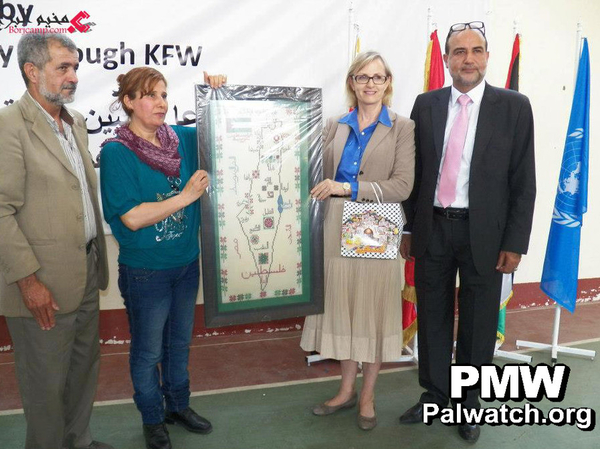
Offering recognition to a "Palestinian State" only serves to give the Palestinians false hopes of achieving their ambition of wiping Israel off the map, literally -- it already started this process long ago by erasing Israel from all its maps -- and permanently upending the consensus of how international affairs are run.

The Director of the United Nations Relief and Works Agency [UNRWA] in Lebanon, Ann Dismorr, poses with a map devoid of any trace of the State of Israel, instead presenting it as a map of "Palestine," May, 2013. (Image source: Palestinian Media Watch)


Dennis MacEoin

Source: http://www.gatestoneinstitute.org/4766/britain-sweden-palestine

Copyright - Original materials copyright (c) by the authors.
Bringing Happiness to Iran - Caroline Glick


by Caroline Glick


1371416420044127700-e1373642361951 Originally published by the Jerusalem Post

It is still unclear what happened on Sunday night at Iran’s illicit nuclear installation at Parchin. According to Iranian sources, there was a large explosion that rocked the area within a 15-km. radius of the facility. Two people were reportedly injured.

According to the UN’s International Atomic Energy Agency and Israel, the Parchin facility is a key component of Iran’s suspected military nuclear program. It is at Parchin that Iran is allegedly building a nuclear explosive device – that is, a nuclear warhead.

The timing of the blast is notable. On Monday night, a delegation from the IAEA landed in Tehran for a new round of talks scheduled for that Tuesday. The UN’s demand to inspect Parchin was set to be one of the top agenda items at the talks.

Given the timing, it is certainly possible that the Iranians carried out the explosion themselves as a means of preventing the IAEA from demanding access.

But let us assume that the widely held automatic assumption – that Israel was behind the blast at Parchin – is accurate. The fact is that in order to destroy Iran’s nuclear weapons program, or seriously setback its completion, dozens, if not hundreds of additional targets need to be hit and destroyed.

Iran has secured its illicit nuclear program by dispersing and replicating its nuclear installations throughout the country. If the Parchin bombing was carried out by Israel, it must be seen as but another strike in Israel’s purported – and if it exists, meandering – campaign to destroy Iran’s capacity to develop nuclear weapons.

At the desultory rate Israel’s assumed campaign is progressing, we can have little confidence that through bombing alone, Israel will be able to prevent Iran from acquiring nuclear weapons in the near future.

One of the main reasons that Israel’s purported strikes in Iran have been so lethargic is because the US opposes them. As we have seen in recent years, the Obama administration has been a sieve of information to the media about Israel’s alleged covert strikes in Iran. To successfully neutralize Iran’s nuclear facilities through acts of sabotage, Israel needs to hide its effort from the US as well as Iran.

In light of these constraints, Israel should consider expanding the goal of its policy towards Iran from merely debilitating Iran’s nuclear project to ending it entirely by overthrowing the regime.

There are many reasons to believe that overthrowing the regime is a realistic option.

First and foremost, to the shock and amazement of the entire world, following the stolen 2009 Iranian presidential elections, the Green Movement arose spontaneously and nearly overthrew the regime. Millions of Iranians from across ethnic lines and throughout the country rose up against the regime. They rallied around presidential candidates Seyyed Mir-Hossein Mousavi and Mehdi Karroubi and demanded that the mullocracy be replaced with a democracy.

Had the Obama administration backed the Iranian people rather than the regime, it is likely that the Iranian Revolutionary Guards Corps (IRGC) and supreme dictator Ali Khamenei would have been finished six years ago along with their nuclear program and worldwide terrorist network.

Dr. Michael Ledeen, Freedom Scholar at the Washington-based Foundation for Defense of Democracies has been closely following the Iranian regime since he served in the Reagan administration in the 1980s. In 2009, he argued that even without US assistance, if Israel had been willing to help the Green Movement, with little effort, it could have empowered the opposition sufficiently to overthrow the regime.

In a conversation this week, Ledeen said Israel still has the capacity to provide opposition forces the tools they require to overthrow the regime.

Today, with Khamenei reportedly seriously ill, the widespread assessment is that Iran is already in the throes of a succession crisis. As Ledeen sees it, radical ayatollahs are vying with the IRGC and Khamenei’s family to succeed him. President Hassan Rouhani is also seeking to ascend to Khamenei’s all powerful throne.

At the same, time, as Iran enters into this period of political uncertainty, the regime itself is less popular than ever.

Rouhani was elected last year on the strength of his promise to expand freedoms in Iran. Since he took office, repression, not freedom has expanded.

Over the past year, the number of regime executions and mass arrests has skyrocketed. So too, the number of Iranian political prisoners subjected to torture has risen. Despite Rouhani’s promise to free them, Mousavi and Karroubi, who were placed under house arrest in 2011, have not been freed.

Last week, the family of Ayatollah Hossein Kazemeyni Boroujerdi announced that the religious leader has been informed that he is about to be executed by the regime. Boroujerdi is serving his eighth year of an 11-year prison sentence for rejecting the religious legitimacy of the regime and demanding, in keeping with Shi’ite jurisprudence, its overthrow and replacement with a democracy in which mosque is separated from state.

Boroujerdi enjoys massive support in Iran. His bravery in the face of regime repression is breathtaking.

Since his arrest, Boroujerdi has been subjected to barbaric torture. And yet, rather than repent his ways, as the regime demands, he has smuggled letters to the world outside his prison exposing the dismal state of human rights in the Iran, and the heresy at the heart of the regime.

Ledeen claims that an Israeli campaign to highlight the suffering of Iranian political prisoners and dissidents that would include constant public condemnations of the regime, calls for the release of political prisoners, and support for greater freedom, particularly for women would have a major impact both globally and in Iran.

If such a campaign is coupled with the provision of communication equipment for the opposition to let its leaders and followers bypass the regime’s firewalls and communicate freely with one another, its chances of success would grow. So too, the provision of financial and other support for Iranian workers’ unions, including building international support for their rejection of the regime, and broadcast of accurate news, by among other things expanding the broadcast time allotted to Voice of Israel Persian service, could empower the regime’s opponents.

Ledeen scoffs at the concern that Israeli support for regime opponents will boomerang against them and strengthen public support for the regime. As he put it, “Opponents of the regime are always accused of being in cahoots with Israel and the US, so getting support doesn’t change their risk, and in fact will strengthen them… The opposition is probably amazed they are not getting help from Israel.”

Ledeen’s policy involves a program of nonviolent, open Israeli political and financial support for regime opponents.

A different policy of regime overthrow was put forward by Nicholas Saidel in an article published last month by Mida online magazine. Saidel recommended that Israel adopt a more involved policy of directly supporting minority liberation movements operating inside Iran. Saidel noted that oppressed, irredentist minorities – including the Azeris, Kurds, Ahwazi Arabs and Baluchis together comprise more than a third of Iran’s population. He suggests that the regime should be overthrown and Iran should be carved up into a number of smaller states that will be too weak to threaten Israel.

Saidel notes that all four minorities have in the past cooperated with Israel. Some have spoken openly in favor of Israel. Israel, he argues, has the wherewithal to help them today in significant ways that will, at a minimum, significantly weaken the regime and so limit its ability to harm Israel.

Of the two options, the potential downside of Saidel’s is far higher. The specter of small, powerful jihadist forces along the lines of Islamic State and the Taliban being installed in power in Iran is distressing. But even in this case, the payoff of destroying the regime, and so ending Iran’s nuclear program and its sponsorship with Hezbollah, Hamas and other jihadist terror groups would be enormous.

Regardless of how one assesses the risk of either policy of supporting regime opponents, given the risk a nuclear armed Iran will constitute for Israel; the Obama administration’s obvious preference for a nuclear armed Iran over an Israeli strike against Iran’s nuclear installations; and the ever growing threat posed by Iran’s terrorist proxies, it would appear that the risks attached to adopting either Ledeen’s approach, or Saidel’s approach, or both, are far smaller than the risk of letting Iran take out membership in the nuclear club.

Distressingly, Israel’s security brass seems utterly bereft of creative or even three dimensional thought in regards to Iran. In an interview with Ma’ariv published last Friday, IDF Chief of General Staff Lt.-Gen. Benny Gantz claimed that international sanctions convinced Iran that its nuclear project was harming its regime.

What the sanctions actually convinced them was that it was worth their while to pretend to be interested in a nuclear deal in order to loosen or end the sanctions. Acting this way would not prevent them from acquiring nuclear weapons but would restore Iran’s economic viability.

Over the past decade, attempts to get Israeli military leaders to even consider a program of assisting the regime’s opponents have come up empty.

The time has come to reconsider this refusal. In his recent public remarks on Iran, Prime Minister Benjamin Netanyahu argued repeatedly and rightly that the Iranian regime is more dangerous to global security than Islamic State. But he has abstained from mentioning that the Iranian regime is as dangerous to those living under its jackboot as Islamic State is to those who come under its power.

Had Netanyahu raised Boroujerdi’s plight in his speech at the UN, it would have weakened Rouhani.

And for his part, Boroujerdi would not have been any more imperiled than he already is.

So too, the seven young Iranians who were sentenced last month to suspended jail sentences and 91 lashes for daring to post an Internet video of themselves singing Pharrell Williams’s song “Happy” will not be any more unhappy and oppressed if Israeli leaders stood up for their right to be happy.

Ledeen remarked, “I’ve rarely seen a policy that was both strategically and morally imperative, but [supporting the Iranian regime’s domestic opponents] is certainly one of them.”

We may never know what exactly happened Sunday night at Parchin. But we certainly know that it will take hundreds more mysterious explosions to prevent Iran from getting the bomb. And even if such explosions take place, so long as the regime remains in power, there is every reason to believe that such achievements will lack significance in the long term.

Iran is Israel’s greatest foe. Between its support for Hezbollah and Hamas and its nuclear program, it threatens Israel more gravely than any other state today. The best way to end these threats is not to fight another round against its proxies. It is to go to the source of the problem.


Caroline Glick is the Director of the David Horowitz Freedom Center's Israel Security Project and the Senior Contributing Editor of The Jerusalem Post. For more information on Ms. Glick's work, visit carolineglick.com.


Source: http://www.frontpagemag.com/2014/caroline-glick/bringing-happiness-to-iran/

Copyright - Original materials copyright (c) by the authors.