Monday, November 13, 2017

U.S. Military: More Fake News from the New York Times - Peter Huessy


by Peter Huessy

For some reason, the Times did not get the memo some half-century ago that the United States deterrent policy does not target an adversary's cities.

  • While it was true, for example, that the Soviets under SALT II had to dismantle many missiles, a point the New York Times emphasized, what was also true was that the remaining silos under the terms of the treaty became the homes of new, vastly more powerful missiles with far more warheads.
  • President Reagan pursued a strategy of peace through strength and building a strong nuclear deterrent. While simultaneously seeking major arms reductions, he modernized what was to be kept. He then in 1983 added the Strategic Defense Initiative (SDI), to enhance further the U.S. deterrent capability and undermine the Soviet push for first-strike threats. The Soviets had no diplomatic answer to nuclear reductions and could not economically match U.S. modernization.
  • Even at such low levels, the U.S. deterrent holds at risk those military assets most important to our adversaries, the destruction of which would cripple them if they attacked the United States first. Radically changing this successful formula, as the Times wants the U.S. to do, would be a reckless, dangerous mistake.
The New York Times appears convinced the United States has plans to hurl 4000 nuclear warheads at Russian cities in the event deterrence breaks down, a retaliatory threat they claim is far beyond what is needed to keep the peace. Instead, they call for a unilateral cut in our nuclear force to roughly 1000.

For some reason, the Times did not get the memo some half-century ago that the United States deterrent policy does not target an adversary's cities. Nor are the number of warheads in the American deployed nuclear arsenal anywhere near the 4000 claimed by the Times.

They were reduced by half that number in 2002 under the Moscow Treaty, and to even lower by the 2010 New START Treaty.

The Times, believing American nuclear deterrent policy is still based on burning down to the ground our adversary's cities, calls for the country to keep no more than a few hundred warheads to incinerate either Russian or Chinese cities, and roughly no more than a total of 1100 warheads to raze the cities of an expansive list of our nuclear-armed enemies.

The Times's glaring error is its failure to grasp that since the late 1960's, the United States deterrent policy with respect to the Soviet Union and now Russia has been one of retaliating against or otherwise holding at risk the military capabilities of our enemies, and moving completely away from relying upon the assured destruction of cities that had earlier been adopted as part of U.S. nuclear policy.

Targeting civilian populations with nuclear weapons has long been held by America's leaders to be both an immoral and ineffective deterrent policy. Deterrence requires holding at risk what tyrannical societies value most -- and that is their military power, not their impoverished citizens.

Despite these facts, the Times claims the alleged current American "stockpile" of 4000 warheads the U.S. now has is far too high and can safely be reduced unilaterally, as the U.S. supposedly has more than enough warheads to target the cities of all our adversaries. Here the Times is adopting the most radical position of the arms control community.

In graphic displays of ostensibly U.S. surplus warheads, the Times calculates -- absurdly -- that the United States needs precisely 1103 warheads to fire at all our adversaries to maintain deterrence, which they define as killing 25% of our adversary's populations.

The Times does acknowledge that American nuclear weapons have already been significantly reduced since the height of the Cold War. The United States has, in fact, cut its deployed, strategic, nuclear, in-the-field weapons from around 13,000 in 1991, to 1550 warheads today, a 90% reduction.

Ironically, at any one time, roughly 1000 warheads -- not the 4000 the Times conjures up -- might be on alert and be available for retaliation. There is no possible way we could launch 4000 warheads at Russia or any adversary.

To get to 4000, after the initial warheads fall to their targets, and the delivery missiles burn up in the atmosphere while returning to earth, we would have to find hundreds of missiles we do not have, place them in our empty silos and submarine launch tubes, load up more warheads and launch them again.

Can we do this? Of course not. So, what are the real facts of its deterrent capability?

The U.S. deterrent policy currently holds at risk the critical military capabilities of our adversaries. U.S. national leaders -- in this instance, President Barack Obama -- determined in the 2010 nuclear posture review and the associated guidance to America's nuclear commanders that this is what the U.S. needs for deterrence. The nuclear force the U.S. now has was determined to be necessary by the previous administration and previous Presidents. At this time, a new nuclear posture review is examining those requirements; the third such review in the past 15 years.

Moreover, the number of warheads the U.S. has deployed -- on station -- in its nuclear deterrent, flow only from the President's determination, not from some false notion that to deter adversaries, it is necessary to kill millions of people.

Ironically, writers at the Times have not always thought 1000 weapons were sufficient to deter America's adversaries or that any deployment number above that level was unnecessary. On May 2, 1982, they ran an column by Senator Gary Hart that chastised the Reagan administration for proposing major reductions in nuclear weapons, and argued that the defunct 1979 SALT II treaty between the United States and Soviet Union -- withdrawn from the Senate by the Carter administration after the Soviet invasion of Afghanistan -- should nonetheless be agreed to as it would supposedly "slow Soviet acquisition of additional nuclear weapons."

As one nuclear expert has noted, the United States Senate Armed Services Committee, under the control of the Democratic majority, disagreed.

It unanimously concluded in 1979 that SALT II was not in the United States' "national security interests" -- precisely because it would not slow the build-up in Soviet nuclear weapons.

The chief criticism of the treaty, in fact, to which the Times seemed oblivious, was that SALT II would permit a destabilizing vast modernization and expansion of Soviet strategic forces, hardly the "arms control" slow-down the Times would claim was anticipated. The Times appeared to not be aware such growth was allowed, or perhaps the editors were taken in by the "arms control" propaganda of the treaty's proponents.
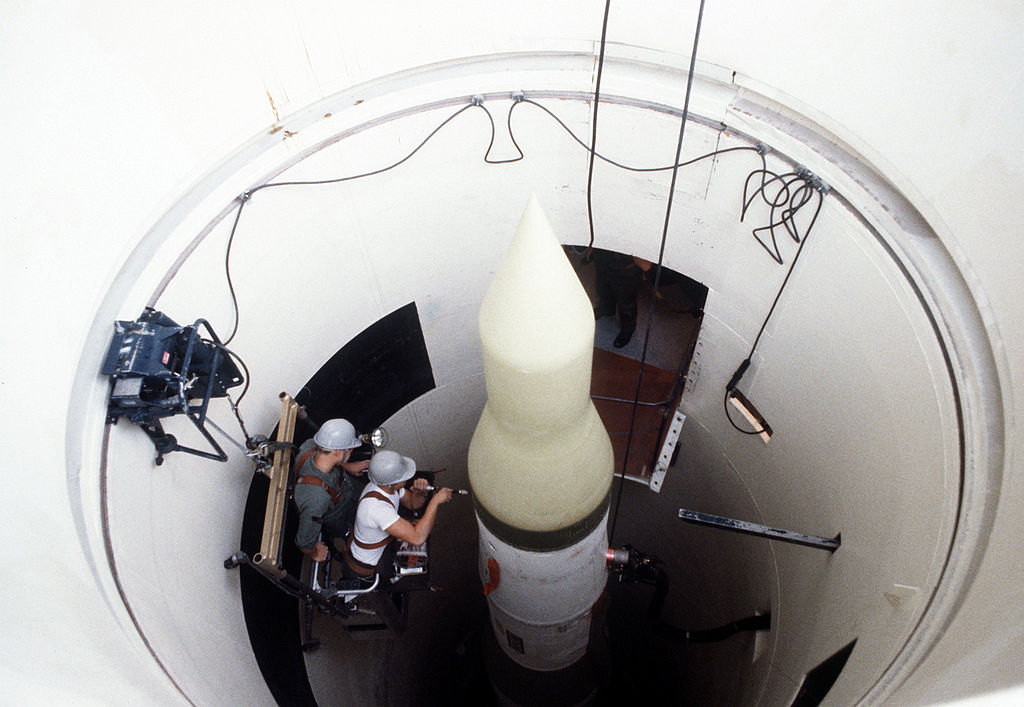

A Minuteman III intercontinental ballistic missile in its silo in Whiteman Air Force Base, Missouri, circa 1980. (Image source: U.S. Department of Defense)
While it is true, for example, that the Soviets under SALT II had to dismantle many missiles, a point the Times emphasized, what was also true was that the remaining silos under the terms of the treaty became the homes of new, vastly more powerful missiles with a lot more warheads. Even if the Soviets adhered to the terms of the 1979 SALT II deal, the Soviets could double the number of their strategic warheads, from 5,000 in 1979 to 9,200 by 1986 and to 12,000 by 1990.

Under the SALT framework, by the end of the Cold War, the Soviets could build more than 13,000 deployed strategic nuclear warheads, hardly characteristic of any "arms control" within the plain meaning of the term.

Reagan, on the other hand, sought real arms control -- reductions -- and spoke about it as early as 1977. As president, he persisted in pushing a strategy of peace through strength, and building a strong nuclear deterrent. While simultaneously seeking major arms reductions, he modernized what was to be kept. He then added the Strategic Defense Initiative (SDI) in 1983, to further enhance our deterrent capability and undermine the Soviet push for first strike threats.

While the SALT treaties in 1972 and 1979 were agreements to build-up both the Soviets' and Americans' nuclear weapons to the level both had already planned to reach, the START process was a revolutionary change to build-down -- reducing while modernizing.

But most importantly, while SALT led to dangerous instabilities with very large multiple warhead missiles dominating the Soviet force, START sought to channel modernization to vastly fewer warheads and more nuclear warheads based on submarines at sea, only single warhead missiles on land, and flexible bomber rules for the only recallable -- air -- portion of the U.S. Triad.

Coupled with that was a major push to challenge the Soviets to eliminate all their SS-20 medium range INF nuclear armed missiles in Europe and Asia under a zero-zero option.

Ironically, all these ideas were opposed by the then-Soviet inspired and popular "nuclear freeze" which, at the time, the New York Times embraced.

What was the result of the Reagan revolution in strategic thinking and doctrine of peace through strength?

Did it work? Yes, the U.S. won the Cold War because President Reagan combined military reductions while pushing for modernization, including SDI. The Soviets had no diplomatic answer to nuclear reductions and could not economically match U.S. modernization.

Bertrand Russell once said that people "often defend most passionately those opinions for which they have the least factual basis". The Times certainly does. It apparently believes there is a US deterrent policy of burning cities to the ground, but the policy does not exist.

The Times supported treaties such as SALT I and II that increased warheads dramatically, but later complained such numbers were far in excessive of what was needed. Russia then labeled as unfair Reagan's proposals to reduce warhead levels that the Times said were excessive.

The United States nuclear arsenal is the smallest it has been since the early Eisenhower administration.

Even at such low levels, the U.S. deterrent holds at risk those military assets most important to our adversaries, the destruction of which would cripple them if they attacked the United States first. That ability has been the essence of American nuclear deterrent policy for at least the past half century -- and it has worked perfectly. Radically changing that successful formula, as the Times wants the U.S. to do, would be a reckless, dangerous mistake.

Dr. Peter Huessy is President of GeoStrategic Analysis, a defense consulting firm he founded in 1981, as well as Director of Strategic Deterrent Studies at the Mitchell Institute for Aerospace Studies. He was also for 20 years, the senior defense consultant at the National Defense University Foundation.

Source: https://www.gatestoneinstitute.org/11335/us-military-new-york-times

Follow Middle East and Terrorism on Twitter

Copyright - Original materials copyright (c) by the authors.

Trump Shines in Foreign Policy - James Lewis


by James Lewis

Obama never, ever seemed to get that basic point of morality, nor did Hillary, nor did any other Democrat. Trump and Mattis obviously understand it.

Remember ISIS? When Obama left office, it was still a growing network of eager sadistic killers, with secret sponsorship by Turkey, by some Gulf Arab regimes, the Wahhabi radicals, and by the Iranians. Today a lot of those boastful YouTube killers are just smoking splotches in the sand.

A single MOAB bomb was dropped on a mountain tunnel complex in Afghanistan, apparently a clean target with no "weddings" going on. The day afterwards the media said that 94 ISIS killers died, but that assumes that somebody had already cleaned up that collapsed tunnel structure; not a chance. So a hundred or more of the worst human beings since Hitler died in one big explosion. 

Most important, the United States sent a strong signal of determination. Trump-Mattis announced a strategy of "surround and kill the enemy in place." For mass-murdering criminals there will be no mercy.

The U.S. media just rolled its eyes and yawned, but the Muslim world got the message loud and clear. They’ve been wondering how long the United States, which was the winning power in the Cold War and the two world wars was going to come back to its senses. Well, the MOAB bombing wasn't wish-washy, it wasn’t half-hearted and it didn't signal cowardice and weakness. The United States was finally getting serious.

Obama would never even name the enemy, and most importantly, under Obama the United States lost the moral high ground against child-murdering sadists; we started to support Sunni killer cults in Syria.

If ISIS is just a minor nuisance, as Obama tried to tell us, that would make the genocides of history meaningless. But genocide is first-degree murder on an enormous scale. Murder with malice aforethought is punished for a good reason. The church killer in Tennessee the other day had a previous conviction for attacking a two-year-old baby, and he should have been put away for good. It would have saved many good and decent lives in Tennessee.

ISIS is just like that guy, except they think God wants them to kill babies.

Obama never, ever seemed to get that basic point of morality, nor did Hillary, nor did any other Democrat. Trump and Mattis obviously understand it, and Mattis has been subtly reminding Muslims that yes, they also have a moral code that prohibits baby killing (it depends on the religion of the baby). Since Mattis took over, DOD press releases constantly remind Muslims that baby-killing is the worst evil.

Obama seemed to take the side of the enemy, and Bush just called the whole thing “the War on Terror," totally ignoring the monstrous doctrine that runs Al Qaida and ISIS and other jihad killer cults. American military who were on the ground in Syria and Afghanistan were tremendously demoralized by U.S. failure to cast this war in the proper moral terms. Mattis in particular emphasizes morality in war, a concept liberals can’t even imagine. You kill people because they are beyond evil. You don’t kill innocents. Somehow the Democrats can’t seem to remember that.

So Trump and Mattis have been effective against ISIS because they know they are doing the right thing. So do the rest of us. (But Hillary never seemed to get the point, either.)

ISIS war theology is still peddled by the Wahhabi priesthood in the Sunni states and by Saudi-funded mosques around the world. The Iranians have their own version of primitive desert morality, and they are still encircling the Sunni states and Israel.

So Trump opened up our domestic oil and gas. In one year we have become the biggest supplier in the world. OPEC doesn’t control the price anymore, and we are now the strong horse.

The new heir to the Saudi throne (known as MBS for Mohammed bin Salman) and the aging king needed our help against Iran. They know Trump won't help Saudi Arabia if they don't purge their own jihad sponsors. That is one big reason for the purge over there, and we will have to see how it comes out.

Now why do you suppose the Bushes, the Clintons, the Obamas and such didn't think of cranking up U.S. oil and gas? They could have done it by executive order at any time since the first truck bomb attack on the Twin Towers in 1993. Just think of that.

Would Bush have opened the American oil spigot? Or Obama? Hillary?

Fat chance.

But Trump did it, and patriots should be cheering.


The Saudis could see their doom coming up fast, and they have been sending surrender signals. So their fabulous century of oil dominance is fading, and it was change or die. That is why the current purge had to come.

Trump is supposed to be an idiot, but this idiot has been a success in the international hotel business for years, and people like that have to know about currencies and commodities. They have to have credible information sources or they'll make the wrong moves. They have to read price signals. Rex Tillerson is one likely source for Trump, and so is Mattis.

(Meanwhile the idiot media are spotting a Trump-Tillerson split. They have no idea how serious these people are, and it’s better to keep them in their hate-hate-hate narrative. They can’t make real trouble that way.)

Pessimists still say you can't defeat the Muslim terror campaign. In jihad you have to kill the diehards on the battlefield, but then you also have to change them ideologically. We did it with Japan in World War II, another war theology with a knack for martyrdom. In Germany, the Nazis were destroyed and the culture changed. In the former Soviet Union, the culture has changed dramatically. So yes, the U.S. does have a track record of beating fanatics and ultimately changing war ideologies.

After the Ottoman Empire went down after World War I, Kemal Ataturk was able to secularize Turkey, and that lasted until the present jihadist dictator Recip Erdogan. Turkey became modern, women were educated, and then the reactionary throwbacks took over again. Erdogan put a stop to modernization, but maybe it’s time for America to take the moral side in Turkey, too.

Let's remember that one year ago, when Obama left office. Obama didn't just leave the United States idling in neutral, foreign-policy-wise, but rather in the worst shape we've ever been in. He made clear his lifelong hatred and contempt for the United States --- that's what the Obama Apology Tour was about -- and our worst enemies were celebrating.

So, post-Obama, the United States wasn't just on level zero. We were below zero.

Today the NYT-WaPo Axis of Sabotage is complaining that Trump is scaring Kim III of North Korea too much. OMG, he's gonna get us into a nuke war!!!

The Wap-NYTs have always whipped up fear about strong U.S. presidents, never about foreign throwbacks like Kim III threatening us with nuclear weapons. They don't care if it's the Soviet Union, or the Nazis way back then, or Stalin, or the 9/11/01 Wahhabi killers. Our enemies are all victims of U.S. Imperialism, and if they're mad at us we gotta just take the punishment we deserve.

This is a form of liberal insanity, of course, but the one positive is that the voters understand it all. The Trump voters include tens of millions of Americans who love their country, and wanted Obama and Hillary out of their lives.

The Democrats still can't believe it, because somewhere in their infantile minds they just can't grasp that normal people do not love them. Just like Harvey the perp, anytime he shook his personal business at a young actress, he just couldn't take No for an answer.

Well, the American voter said No! loud and clear, and the left is still screaming at the heavens in protest. (Though not at God).

The Democrats will lose as long as the current inner cult stays in charge. All we can do is encourage them to get as infantile as possible, and hope they'll never bring in any adults.

Trump might just achieve that all on his own. 

James Lewis

Source: http://www.americanthinker.com/articles/2017/11/trump_shines_in_foreign_policy.html

Follow Middle East and Terrorism on Twitter

Copyright - Original materials copyright (c) by the authors.

Ignorance and Caricatures Mar Our Understanding of Russian Foreign Policy - Bruce Thornton


by Bruce Thornton


And why it's harming our national interests.


Bruce Thornton is a Shillman Journalism Fellow at the David Horowitz Freedom Center.

All it took to transform Vladimir Putin from a candidate for a foreign policy “reset” into a global villain was a change in presidents.

In 2012 Barack Obama mocked Mitt Romney for his 1980s view that Russia under Putin was our most serious global rival. Obama earlier had sent his Secretary of State to offer a cartoonish “reset button” to the Russians, and followed up a few years later by offering Putin “flexibility” after his reelection. After Hillary’s defeat and Trump’s campaign suggestions of outreach to Russia, Putin suddenly became a villain straight out of Joe McCarthy’s central casting, the Svengali who seduced Republicans into “collusion” with “fake news” and “hacks” in order to put into power a president beholden to him. At least Senator John McCain has been consistent, holding fast to his reductive view of Putin as a dead-eyed KGB thug with whom it is impossible to do geopolitical business.

Once again, our foreign policy lacks continuity and coherence because we ignore history and rely instead on gratifying caricatures that serve partisan interests or moral preening rather than our country’s security and interests.

As a result of this bad habit, we find it impossible to look beyond the media cartoons, received wisdom, and partisan trimming, and instead learn the full context of a nation’s motives and beliefs. We need to understand all the springs of a geopolitical rival’s actions, not to forgive or rationalize them, but to follow Sun Tzu’s advice to know your enemy so you can properly counter his designs. It may make us feel better and more righteous to reduce Putin to an autocratic illiberal “gangster” or “murderer” or “kleptocrat,” but that won’t help us manage our relations with a nuclear-armed geopolitical rival seeking to expand its reach and influence.

One important dimension of Russian culture that we slight is religious faith. We in the West have been undergoing secularization for two centuries, and now have reached the point where religion is either an archaic superstition impeding human progress, or a quaint life-style choice with holiday traditions, tolerated as long they stay out of the public square. But Orthodox Christianity has retained a place in Russia that Christianity has lost in the West. And faith remains one of the foundations of Russian national sovereignty and patriotic pride to an extent that our elites, committed to a transnational globalism and secular technocracy, find retrograde. Despite the historical truth that our own political order recognized faith as its foundation, today we find taking religion seriously to be naïve or sinister, a sign of nefarious plots to restrict personal freedom by evoking religious authority. Hence the “evangelical fundamentalist” bogey that for nearly half a century progressives have brandished in order to delegitimize conservatives and their “bitter clinging” to patriotism and religion.

Nationalism and Orthodox Christianity, in contrast, long ago melded in Russian history, and was strong enough to survive the seven decades of atheist communism. Thus ignoring the role of history and religion in Russian foreign policy compromises our understanding of events. Take Putin’s annexation of Crimea a few years ago. In the standard Western narrative, Putin subverted a democratically elected government in Ukraine to protect its puppet oligarchy useful to the Russian plutocrats and their selfish interests. But from Russia’s point of view, it was the West that interfered in Ukraine’s politics and subverted democracy in order to advance a larger design: Basing NATO forces deeper into Russia’s sphere of influence, including Crimea, the historical home of an important Russian naval base.

These two views are not mutually exclusive. As Christopher Caldwell writes, “Both of these accounts are perfectly correct. It is just that one word [democracy] can mean something different to Americans than it does to Russians.” This is not to endorse postmodern radical relativism, the view that, as Hamlet says, “There is nothing either good or bad, but thinking makes it so.” The point is we are handicapping ourselves if we don’t understand that other point of view and take it into account in our calculations. If we had done so in the 1990s, we might not have been so hasty in enlarging NATO to include countries in Russia’s historical sphere of interest, both humiliating Russian national pride, and committing ourselves to protecting those countries against their only possible aggressor, Russia.

Moreover, the Russian connection to Crimea is bound up with the historical Russian view of itself as the bulwark and protector of Christianity against Muslim encroachment. Orlando Figes’ history of the Crimean War (1853-56) is invaluable in recovering for us how much religious faith factored into that conflict. Britain and France may have been playing the great game of Near Eastern geopolitics, but Russia and Tsar Nicholas I were profoundly moved by the plight of their Balkan Slavic Orthodox “brothers” who had lived for centuries under the yoke of the Ottoman Empire, and the Holy Land pilgrims whose faith was restricted by the Ottoman occupiers of a historically Christian region. Thus Nicholas believed “he was fighting a religious war, a crusade, to fulfill Russia’s mission to defend the Christians of the Ottoman Empire,” as Figes writes. The immense sacrifices the Russians suffered during the brutal year-long siege of Sevastopol, in which over 100,000 Russians died, turned that Crimean port into a shrine honoring Russia’s national and religious identity.

Thus for Russians, the recovery of Crimea from Ukraine, which gained it only after the collapse of the Soviet Union, transcends pragmatic geopolitics or authoritarian greed cloaked in patriotism. Russians believed that Crimea, won by decades of hard fighting from the Ottoman invaders, had now returned to its rightful peoples.

This conception of their national identity results from the fact that Russia had fought defensive and offensive wars against Muslims for centuries, and had first-hand experience of Islam’s expansionary imperative and its “bloody borders,” as Samuel Huntington put it. England and France, on the other hand, had already begun to lose their religious ties to the region, which they saw mostly in geopolitical and commercial terms. The resentment against France and England for allying with the Ottoman occupiers of eastern Christendom, and fighting against a fellow Christian power remains today. As the West has appeased and apologized for jihadist violence, Russia has fought it brutally, and successfully, in Chechnya. With 20 million Muslims living in Russia and a long history of conflict with Islam, Russians have first-hand knowledge of Islam and recognize its religious solidarity and doctrines as prime motivations of modern jihadism.

But as Caldwell writes, we lack such experience and so tend to ignore its impact on Russian foreign policy:
One theme runs through Russian foreign policy, and has for much of its history. There is no country, with the exception of Israel, that has a more dangerous frontier with the Islamic world. You would think that this would be the primary lens through which to view Russian conduct—a good place for the West to begin in trying to explain Russian behavior that, at first glance, does not have an obvious rationale. Yet agitation against Putin in the West has not focused on that at all. 
That in a nutshell is the flaw in our understanding of Putin’s behavior. As the leader of the “international system,” one based on questionable assumptions about a universal human identity that transcends cultural differences, we have a blind spot when it comes to understanding religious motives, a failure obvious in our stubborn refusal to believe jihadists when they cite the Islamic dogmas that drive their violence. We can’t see how our own religious decline and decadence reinforce the sense of some Russians that they are still the “third Rome,” the champion of Christianity against its most lethal historical enemy. Nor can we understand why Eastern European countries admire Putin and resist the E.U.’s attempt to force them to let in tens of thousands of unvetted Muslim migrants. To us, they’re just backward Islamophobes.

Finally, the reduction of Putin to a villainous autocrat and America’s irredeemable enemy is a caricature of foreign policy realism, “principled” or otherwise. The U.S. has for decades allied itself, cooperated with, and offered détente to two of history’s greatest mass murdering regimes, China and the Soviet Union. So it must be for the world’s most consequential power. If we cooperated only with the virtuous, we’d have to stand alone, for moral purity is a rare luxury for the those, like our NATO colleagues, who are defended by somebody else. In the real world, the only litmus test for our foreign policy should be how it advances our interests and protects our national security. In recent years we have seen the bloody proof that moralizing idealism is as dangerous as selfish isolationism.

Vladimir Putin very likely is a ruthless autocrat, and we should acknowledge those flaws, not whitewash them. But if we’re not willing to do anything meaningful to prevent his depredations, if we won’t put our military might where our self-righteous mouths are, then we should be thinking about how we can deal with Putin and Russia in ways that advance our national interests and security. One place to start is to understand all the historical experiences and religious ideals that go into Russia’s thinking, and figure out how we can best profit from that understanding.

Bruce Thornton is a Shillman Journalism Fellow at the Freedom Center, a Research Fellow at Stanford's Hoover Institution, and a Professor of Classics and Humanities at the California State University. He is the author of nine books and numerous essays on classical culture and its influence on Western Civilization. His most recent book, Democracy's Dangers and Discontents (Hoover Institution Press), is now available for purchase.

Source: http://www.frontpagemag.com/fpm/268401/ignorance-and-caricatures-mar-our-understanding-bruce-thornton

Follow Middle East and Terrorism on Twitter

Copyright - Original materials copyright (c) by the authors.

The Real Scandal in the Alabama Senate Race - Selwyn Duke


by Selwyn Duke

Not hidden, and fully known to the media.


Scandals take many forms. If you could be transported back to antebellum times, for example, would you not find scandalous the desire to perpetuate the legal institution of slavery? This brings us to the Alabama special election to fill Jeff Sessions’ vacant Senate seat, a contest now front-and-center with the recent sex allegations made against GOP hopeful Judge Roy Moore. Moore denies the charges, but there are certain things that can’t be denied.

Democrat Doug Jones, Moore’s opponent, has some noteworthy positions. He’s pro-prenatal infanticide. It’s not a stance he took 40 years ago but has since abandoned, and it doesn’t mean he’s accused of once having kissed an underage girl.

It means he believes in the murder of underage girls — and boys. That’s beyond scandalous.


Jones supports de-facto amnesty, meaning, he wouldn’t even require illegal aliens to return to their home countries before being granted citizenship. This undermines the rule of law and exemplifies the treasonous attitude that subordinates the good of one’s countrymen to the good of invading foreigners — and all because they’ll vote Democrat after being naturalized. Selling out your culture for political power is scandal on steroids.

Jones supports the regulation of carbon dioxide, otherwise known as plant food, because he pushes the dubious global-warmingclimate-change, uh, “global climate disruption” agenda. Since it’s average Americans who’ll pay these regulations’ costs, this serves to further impoverish the struggling. That’s scandalous.

Jones advocates the unscientific, socially disastrous “transgender” agenda. First, he said President Trump was “wrong, wrong, wrong” to return to the longtime status quo of banning so-called “transgender” people from the military; this means he supports social experimentation in the armed forces.

Second, he also supports allowing boys masquerading as girls to use girls’ bathrooms and locker rooms. In fact, he said that Trump’s rescinding of Barack Obama’s school guidance to that effect was “wrong, wrong, wrong!” (Because, you see, when you say that way it makes the other guy three times as wrong.) By the way, below is a video of Jones expressing these sentiments just last month.


Oh, yeah — the above is scandalous, too.

In addition, Jones advocates using taxpayer money to fund fanciful, economically unviable energy schemes such as solar, wind and thermal energy. Apparently, he’d like to repeat Obama’s “green energy” boondoggles (e.g., Solyndra), which only turned out green in that they wasted 2.2 billion worth of Americans’ greenbacks.

But Jones loves spending other people’s money. While he doesn’t believe in cutting your taxes to spur economic growth, he thinks having government give away your tax money will do so.

Lastly, despite the fact that ObamaCare is unconstitutional, has caused millions of Americans’ healthcare premiums to rise and created co-ops that have collapsed right and left, Jones opposes rescinding the program. Well, no matter. He’ll have great healthcare through the Senate if he wins December 12.

As for the last four positions, some would say calling them scandalous is a stretch, so you can apply your own adjective (stupid comes to mind). And whatever you might prefer for characterizing all his positions, “old” and “repudiated” don’t fit. “Current” sure does, though.

So, killing babies, killing the rule of law, killing with regulations, killing tradition and kids’ right to privacy, killing our pocketbooks, killing the economy and killing healthcare (sounds like an alternate-universe Bill O’Reilly book series). In the scandal department, Roy Moore has a long way to go to have a chance of keeping up with the Joneses.

Simply put, Doug Jones is the most scandalous of creatures: a leftist radical. It’s a wonder he isn’t seeking office in California, New York, Massachusetts or North Korea. Running someone whose positions are so wholly contrary to Alabaman culture is a slap in the face to the state. Is this a political version of Punk’d?

If I lived in Alabama, on December 12 I’d vote for Judge Roy Moore while holding my nose — but only because the stench from Doug Jones’ name would be rising right from the ballot.

Contact Selwyn Duke, follow him on Twitter or log on to SelwynDuke.com

Selwyn Duke

Source: http://www.americanthinker.com/articles/2017/11/the_real_scandal_in_the_alabama_senate_race.html

Follow Middle East and Terrorism on Twitter

Copyright - Original materials copyright (c) by the authors.

Strong earthquake hits Iraq, Iran, killing at least 300 - News Agencies and Israel Hayom Staff


by News Agencies and Israel Hayom Staff 

More than 4,000 are injured as magnitude 7.3 earthquake hits bordering nations


A car smashed by debris from the earthquake at the city of 
Sarpol-e-Zahab in western Iran, Monday
Photo: AP

At least 300 people were killed in Iran and Iraq on Sunday when a powerful magnitude 7.3 earthquake hit the region, state media in the two countries said, as rescuers searched for dozens trapped under rubble.


Behnam Saeedi, a spokesman for Iran's National Disaster Management Organization, said that more than 4,000 were injured, he said.


Officials expected the casualty toll to rise when search and rescue teams reached remote areas of Iran.


Israeli Intelligence Minister Yisrael Katz offered his sympathy to the countries. "My condolences to the people of Iran and Iraq over the loss of human life caused by the earthquake," he said.


The earthquake was felt in several provinces of Iran but the hardest hit province was Kermanshah, which announced three days of mourning.


The U.S. Geological Survey said the quake measured magnitude 7.3. An Iraqi meteorology official put its magnitude at 6.5 with the epicenter in Penjwin in Sulaimaniyah province in the Kurdistan region close to the main border crossing with Iran.


The tremor was felt in Turkey and Israel as well, causing no known damage.


Kurdish health officials said at least four people were killed in Iraq and at least 50 injured.


The quake was felt as far south as Baghdad, where many residents rushed from their houses and tall buildings when tremors shook the Iraqi capital.


"I was sitting with my kids having dinner and suddenly the building was just dancing in the air," said Majida Ameer, who ran out of her building in the capital's Salihiya district with her three children. "I thought at first that it was a huge bomb. But then I heard everyone around me screaming: 'Earthquake!'"


Similar scenes unfolded in Erbil, the capital of the Kurdistan Region, and across other cities in northern Iraq, close to the quake's epicenter.


Electricity was cut off in several Iranian and Iraqi cities, and fears of aftershocks sent thousands of people in both countries out onto the streets and parks in cold weather.


The Iranian seismological center registered around 50 aftershocks and said more were expected.


The head of Iranian Red Crescent said more than 70,000 people were in need of emergency shelter.


Iranian Interior Minister Abdolreza Rahmani Fazli said some roads were blocked and were worried about casualties in remote villages. The Iranian armed forces have been deployed to help the emergency services.


An Iranian oil official said pipelines and refineries in the area remained intact.


Iran sits astride major fault lines and is prone to frequent tremors. A magnitude 6.6 quake on Dec. 26, [2003] devastated the historic city of Bam, 1,000 kilometers (600 miles) southeast of Tehran, killing about 31,000 people.


On the Iraqi side, the most extensive damage was in the town of Darbandikhan, 55 kilometers (34 miles) southeast of the city of Sulaimaniyah in the semiautonomous Kurdistan Region.


More than 30 people were injured in the town, according to Kurdish Health Minister Rekawt Hama Rasheed.


"The situation there is very critical," Rasheed said.


The district's main hospital was severely damaged and had no power, Rasheed said, so the injured were taken to Sulaimaniyah for treatment. Homes and buildings had extensive structural damage, he said.


In Halabja, local officials said a 12-year-old boy died of an electric shock from a falling electric cable.


Iraq's meteorology center advised people to stay away from buildings and not to use elevators, in case of aftershocks.


News Agencies and Israel Hayom Staff

Source: http://www.israelhayom.com/2017/11/13/strong-earthquake-hits-iraq-iran-killing-at-least-300/

Follow Middle East and Terrorism on Twitter

Copyright - Original materials copyright (c) by the authors.

Sunday, November 12, 2017

How Iran Tried to Turn Arab States into Fading Ghosts - Amir Taheri


by Amir Taheri

The aim was to create an archipelago of Shi'ite communities across the Middle East, linked together through a network of religious-political organizations controlled by Iran.

If history is a stage on which the fate of nations is played out, knowing when to step in and when to bow out is of crucial importance. Being in the wrong place at the wrong time and, even worse, in the wrong context, could lead to loss and grief.

These may have been some of the thoughts that Lebanon's outgoing Prime Minister Saad Hariri may have had in mind when he decided to throw in the towel rather than pretend to exercise an office without being able to do so in any effective manner. Hariri realized that he was in office but not in power.

Whatever the reason for Hariri's departure, I think he was right to withdraw from a scenario aimed at turning Lebanon into a ghost of a state with a ghost of a president and ghost prime minister and parliament.


Lebanon's outgoing Prime Minister, Saad Hariri. (Image source: kremlin.ru)

That scenario was written in Tehran in the early 1980s with the creation of the Lebanese branch of Hezbollah by then Iranian Ambassador to Damascus Ayatollah Ali-Akbar Mohtashami-pour. The original idea had taken shape in 1975, when Ayatollah Hadi Ghaffari created the first branch of Hezbollah in Tehran to fight the Shah. By 1977, clandestine branches had been created in Turkey and Kuwait.

The hope was to fade out political frontiers, often created by accidents of history or designs of empires, and replace them with religious frontiers. The aim was to create an archipelago of Shi'ite communities across the Middle East, linked together through a network of religious-political organizations controlled by Iran.

The rationale for this was that throughout Islamic history, the element binding people together was allegiance to a version of the religion (Arabic: Mazhab) rather than political concepts such as citizenship of a state.

The fall of the Shah and the seizure of power in Tehran by mullahs gave the scheme a new impetus by putting Iran's resources at its disposal.

However, very soon it became apparent that the grand design could not be realized without destroying or at least weakening Western-style state structures already in place. The states targeted had more or less strong armed forces that would resist an Iranian takeover.

This was precisely what happened in Turkey, where attempts by the Hezbollah branch to make a splash were crushed by the army.

In Iraq, a premature takeover bid by Khomeini gave Saddam Hussein an excuse to invade Iran and start an eight-year war.

In Syria, according to the memoirs of General Hussein Hamadani, who led the Iranian military contingent there, the national army did all it could to prevent Tehran from creating power bases of its own. The situation in Syria changed only when the nation was plunged into civil war by President Bashar al-Assad's ruthless repression of peaceful protests.

The mullahs learned from their experience in Iran.

Soon after they seized power by a combination of freakish circumstances, Khomeini realized that he would never win the loyalty of existing state structures, while being unable to destroy them altogether.

Thus, he developed the strategy known as "parallelism" (movazi-sazi in Persian).

He created the Islamic Revolutionary Guard Corps (IRGC) as a parallel to the national army. Islamic courts were set up as parallels to state courts based on laws inspired by the Napoleonic Code. The Majlis (parliament) found its parallel in the Assembly of Experts.

Applied to other Middle Eastern countries, this strategy was known as tohi-sazi or "emptying of content".

The first place this was put into practice was Lebanon.

Iran created a Shi'ite militia to "parallel" the regular Lebanese army. Then, through Hezbollah, Tehran also recruited allies among other Lebanese communities and transformed the Lebanese parliament into a toothless bulldog. Finally, Tehran succeeded in propelling its candidate into the presidency, and secured effective power of veto in the Council of Ministers.

All that costs a lot of money.

According to the current Iranian national budget, Iran is spending an average of $60 million a month in Lebanon, most of it through Hezbollah. Consequently, as President Hassan Rouhani said in a speech last month, nothing can be done in Lebanon without Iran's say-so.

The Lebanese branch of Hezbollah has given Iran value for money to the point of sustaining thousands of casualties in combat in the 2006 mini-war with Israel and, more importantly, the campaign to crush Assad's opponents in Syria.

In Iraq, the Iranian scheme has had partial results.

Tehran created the Popular Mobilization Forces, a coalition of 17 Shi'ite militias, plus the Islamic Peshmergas (Kurdish fighters hired by Tehran) to parallel the Iraqi national army and the military force of the Kurdistan Autonomous Region government.

Tehran also exerts political influence through at least part of the Ad-Daawa ("The Call") party. However, Iran's hope of creating a second Lebanon in Iraq has not succeeded because many Iraqis resent Iranian domination while the grand ayatollahs of Najaf regard the Khomeinist regime in Tehran as an abomination.

The mullah's scheme in Syria has also run into trouble because of Russian intervention and President Vladimir Putin's determination that Syria's future is decided in Moscow and not in Tehran.

Tehran's scheme has had partial success in Yemen.

Iran's surrogates, the Houthis, succeeded in creating a parallel army in the shape of Ansar Allah, but failed to fully clip the wings of the regular army. The Houthis also reduced President Ali Abdullah Saleh to a shadow of his past but could not fully get rid of him. On top of that, the Saudi-led coalition's intervention has dealt a decisive blow to Tehran's hope of doing another Lebanon in Yemen.

In the case of Qatar and Oman, Tehran used Finlandization, allowing them to enjoy tranquility in exchange for splitting the Arab ranks and toeing the mullahs' line on key issues.

When Muhammad Morsi took over as Egypt's elected president, Tehran tried to sell its scenario in Cairo as well.

Former Foreign Minister Ali-Akbar Velayati was sent to Egypt with a letter from Supreme Leader Ali Khamenei. In it, Khamenei called on Morsi to disband the Egyptian army and create a parallel military force to "guard the revolution". The proposed scheme was never applied either because, as Velayati and Khamenei claim, Morsi rejected it or the Egyptian army pre-empted it by deposing Morsi.

Hariri's resignation may be a sign that the Arabs are no longer prepared to grin and bear it as Tehran dismantles their state structures by creating doubles to their armies and transforming their governments into puppets with their strings pulled from the Iranian Embassy.

Tehran's scheme for dominating the Arab states may have reached its limits; the rapid advance of the mullahs may now be followed with a roll-back. And that could mean the return of political frontiers and loyalties based on citizenship not religious sect.

This article first appeared in Asharq Al Awsat

Amir Taheri, formerly editor of Iran's premier newspaper, Kayhan, before the Iranian revolution of 1979, is a prominent author based on Europe. He is the Chairman of Gatestone Europe.

Source: https://www.gatestoneinstitute.org/11348/iran-arab-states

Follow Middle East and Terrorism on Twitter

Copyright - Original materials copyright (c) by the authors.
Quiet between storms - Prof. Eyal Zisser


by Prof. Eyal Zisser

Tensions between Saudi Arabia and Iran will continue to deepen because the Saudis view the Iranian threat as an existential matter. These tensions, however, will not necessarily translate into open war.

The downing of an Iranian-made Syrian drone over the Golan Heights on Friday momentarily disrupted the calm that has characterized the Israeli-Syrian border area over the last week. It is clear, however, that the challenge facing Israel on this front, chiefly Iran's growing presence in Syria, is a long-term matter. The path Israel takes to confront this challenge, while continuing to target weapons convoys and facilities inside Syria, largely depends on Moscow and Washington.

These two superpowers, as evidenced by Friday's meeting between U.S. President Donald Trump and Russian President Vladimir Putin, have struck far-reaching understandings concerning Syria's future. Israel could be left to pay the price for these understandings, as they do not stipulate the removal of Iran from the border area.

In Lebanon, tensions came to a head over the weekend, albeit primarily consisting of psychological warfare and propaganda campaigns directed at the Lebanese public – be they the Sunni supporters of recently resigned Prime Minister Saad Hariri or Shiite supporters of the Hezbollah terrorist organization.

A three-pronged crisis is fueling the escalating turmoil in Lebanon, which reached a fever pitch with Hariri's sudden and unexpected resignation, accompanied by a vicious tirade against Iran and his former coalition partner Hezbollah, which he accused of perpetrating "a hostile takeover of Lebanon" and even of using "the power of its weapons to impose a fait accompli."

The first aspect of this crisis is the Saudi bid to curb Iran's growing influence and control in the Middle East. The Iranians have established footholds in Lebanon and Iraq, and now in Syria as well. More importantly, though, they have also secured a bridgehead in Yemen, Saudi Arabia's proverbial backyard.  It is from there that Iran, or perhaps Hezbollah operatives deployed by Iran to train and guide the Houthi rebels, are launching missiles at Riyadh and posing a threat to Saudi Arabia that is similar to the threat posed by Hezbollah to Israel.

The second part of the crisis is Saudi King Salman's efforts, alongside his his son, Crown Prince Mohammed, to ensure the latter's status as heir to the kingdom against the objections of rival family members. The young crown prince not only wants to secure his own position but also to push Saudi Arabia forward into the 21st century. To this end, and befitting his young age, he has implemented combative policies both domestically against his rivals and enemies, and abroad against Iran.

Finally, the upcoming general elections in Lebanon, scheduled to be held in the spring of 2018, comprise the third part of the crisis. Ahead of the elections, Hariri sought to bolster his status among his country's Sunni voters and adopted a contentious tone against Hezbollah and Iran. Twice in the past, however, after emotions and hard feelings waned in the wake of the elections in 2006 and 2009, Hariri agreed to form a coalition with Hezbollah. The upcoming elections could very well follow the same script.

Hezbollah, for its part, is fighting fire with fire. In Hezbollah leader Hassan Nasrallah's fiery speeches, the focus of his ire has shifted from Israel to Saudi Arabia, which has become the "great Satan" trying to push Israel, with a few billion dollars, into a war with Lebanon. Hezbollah officials have even accused Saudi Arabia of coercing Hariri to resign, alleging that he is being held against his will in Riyadh.

Tensions between Saudi Arabia and Iran will continue to deepen because the Saudis view the threat posed by Iran, through its actions and ambitions, as an existential matter. These tensions, however, will not necessarily translate into open war. Saudi Arabia does not possess the requisite military might for a power move against Iran, not in the Persian Gulf and not in Lebanon. In Yemen, where the Saudis have intervened militarily, they have encountered considerable difficulty.

The crisis in Lebanon will continue to intensify until the elections in a few months' time. But the political players in Lebanon, including Hariri, cannot alter the fundamental facts of their situation. In the long run, Hezbollah represents a threat to Lebanon as a home to all its ethnicities, and along with Iran, it is a growing threat to Israel as well.


Prof. Eyal Zisser

Source: http://www.israelhayom.com/opinions/quiet-between-storms/

Follow Middle East and Terrorism on Twitter

Copyright - Original materials copyright (c) by the authors.

'Iran building permanent military base 30 miles from Israel border' - Erez Linn, Yoni Hersch, Lilach Shoval, Daniel Siryoti and News Agencies


by Erez Linn, Yoni Hersch, Lilach Shoval, Daniel Siryoti and News Agencies 

BBC obtains satellite images showing significant construction at military base some 9 miles south of Damascus


Amid rising tensions over Iran's growing influence in the Middle East, Western intelligence sources told the BBC last week that Iran was building a military base in Syria some 30 miles from the border with Israel.

The report appears to confirm Israeli fears that the ayatollahs intend to establish a permanent military base in Syria under the cover of the civil war that has been raging in the country since 2011.

The compound, reportedly already partly built, is located at the site of a Syrian military base outside of Al-Kiswah, some 9 miles from Damascus, an intelligence official told the BBC.

Satellite images obtained by the British broadcasting network show extensive construction on the site between January and October this year. The images show construction or renovation of more than 20 buildings comprising multiple stories. It is believed that the buildings are meant to house soldiers or military vehicles.

Another Western source cited in the report said senior Iranian officials had visited the compound in recent weeks. The network said there was no clear-cut indication of Iranian military presence at the site at the moment, adding that the purpose of the complex was still uncertain.

However, another Western source that spoke to the network said that the construction was consistent with Iran's strategic goals – to strengthen the Shiite crescent from Iran to Lebanon, expanding not only Iran's political power, but also its logistic supply lines.

The BBC reported that Maj. Gen. Qassem Suleimani, the head of Iran's elite Quds Force in the Islamic Revolutionary Guards Corps, had been seen in Syria a number of times.

"With a significant number of IRGC [soldiers] fighting – and in some cases dying – in Syria, there has already been a significant presence in the country, but the question is now whether they are preparing to remain in the long term," the BBC said.

Even though it is unclear who is currently there, the network reported that Shiite "fighters from other countries – including Pakistan and Afghanistan – are also alleged to be operating in Syria under the control of the IRGC and it is possible the base could be used by them. Analysts estimate up to 500 troops could be based at the site."

U.S. President Donald Trump and Russian President Vladimir Putin, both of whom attended the Asia-Pacific Economic Cooperation summit in Vietnam Saturday, issued a joint statement saying that they "agreed that there is no military solution to the conflict in Syria. They confirmed that the ultimate political solution to the conflict must be forged through the Geneva process pursuant to United Nations Security Council Resolution 2254."

In addition, "The presidents agreed to maintain open military channels of communication between military professionals to help ensure the safety of both U.S. and Russian forces and de-confliction of partnered forces engaged in the fight against ISIS. They confirmed these efforts will be continued until the final defeat of ISIS is achieved."

The leaders were seen together three times at the summit, displaying warm relations. According to the White House, they spent some five minutes together, in what the White House called "a good meeting."

Trump even said he asked his Russian counterpart about accusations that Moscow intervened in the last U.S. election, and that Putin categorically denied them.

"He said he absolutely did not meddle in our election," Trump said.

"Every time he sees me he says, 'I didn't do that,' and I really believe that when he tells me that, he means it. But he says, 'I didn't do that.' I think he is very insulted by it, which is not a good thing for our country," Trump said.


Erez Linn, Yoni Hersch, Lilach Shoval, Daniel Siryoti and News Agencies

Source: http://www.israelhayom.com/2017/11/12/report-iran-building-military-base-30-miles-from-israel-border/

Follow Middle East and Terrorism on Twitter

Copyright - Original materials copyright (c) by the authors.